How Hitler Saved Capitalism and Won the War: The Barmen Declaration

Hitler

This is the first in a series on the parallels between Hitler’s rise to power in the 1930s and the path to market totalitarianism which I ‘m convinced the United States is following in this second decade of the 21st century. In fact, it is my view that the U.S. has been on this path since the end of the Second Inter-capitalist War (1939-1945), and especially over the last thirty-five years.

The series represents the back story for an appeal I’ve been making to my friends in our Ecumenical Table Fellowship (an inter-denominational worship group formed over the last year in Madison County, Kentucky). There I’ve been urging that we explore the possibilities and procedures for becoming a “Confessing Church” of resistance like the church formed by Dietrich Bonhoeffer, Karl Barth, Martin Niemoller, and their allies in Hitlerian Germany. In 1934 that church published “The Barmen Declaration” whose intention was to rescue the Judeo-Christian tradition from nationalistic interpretations which supported the Third Reich.

A similarly nationalistic interpretation, I fear, has characterized “Christianity” over the last quarter century plus ten in the United States. There, under the influence of Christian fundamentalists, “Christianity” has become virtually synonymous with the extreme right-wing politics that Hitler championed. Like Hitler, that form of Christianity idealizes white Anglo-Saxon culture above all others. Like der fuhrer, it manipulates the Judeo-Christian tradition to support racism and white privilege.

Let me begin the series by reprinting the Barmen Declaration along with parenthetical “translations” and a brief commentary. Subsequent Monday blog entries will trace Hitler’s rise to power, his program of saving capitalism, and how the U.S. adopted Hitlerism without Hitler following der Fuhrer’s demise.

Please begin by considering the Barmen Declaration as translated (in bold) immediately below:

“We, the representatives of Lutheran, Reformed, and United Churches, of free synods, Church assemblies, and parish organizations united in the Confessional Synod of the German Evangelical Church, declare that we stand together on the ground of the German Evangelical Church as a federation of German Confessional Churches. We are bound together by the confession of the one Lord of the one, holy, catholic, and apostolic Church. (THE BARMEN COMMUNITY ASSERTS ITS FOUNDATION: JESUS ALONE IS ULTIMATE AUTHORITY OF THE CHURCH.)

8.07 We publicly declare before all evangelical Churches in Germany that what they hold in common in this Confession is grievously imperiled, and with it the unity of the German Evangelical Church. It is threatened by the teaching methods and actions of the ruling Church party of the “German Christians” and of the Church administration carried on by them. These have become more and more apparent during the first year of the existence of the German Evangelical Church. This threat consists in the fact that the theological basis, in which the German Evangelical Church is united, has been continually and systematically thwarted and rendered ineffective by alien principles, on the part of the leaders and spokesmen of the “German Christians” as well as on the part of the Church administration. When these principles are held to be valid, then, according to all the Confessions in force among us, the Church ceases to be the Church and th German Evangelical Church, as a federation of Confessional Churches, becomes intrinsically impossible. (NEVERTHELESS THE “GERMAN EVANGELICAL CHURCH” HAS ACCEPTED AUTHORITY OTHER THAN JESUS, NAMELY, THE AUTHORITY OF THE THIRD REICH.)

8.08 As members of Lutheran, Reformed, and United Churches we may and must speak with one voice in this matter today. Precisely because we want to be and to remain faithful to our various Confessions, we may not keep silent, since we believe that we have been given a common message to utter in a time of common need and temptation. We commend to God what this may mean for the interrelations of the Confessional Churches. (THOSE WHO RECOGNIZE THIS CONTRADICTION ARE CONVINCED THEY MUST SPEAK IN OPPOSITION TO THIS OBVIOUS CONTRADICTION.)

8.09 In view of the errors of the “German Christians” of the present Reich Church government which are devastating the Church and also therefore breaking up the unity of the German Evangelical Church, we confess the following evangelical truths: (THEY THEREFORE FEEL COMPELLED TO CONFESS THE FOLLOWING EVANGELICAL TRUTHS.)

8.10 – 1. “I am the way, and the truth, and the life; no one comes to the Father, but by me.” (John 14.6). “Truly, truly, I say to you, he who does not enter the sheepfold by the door, but climbs in by another way, that man is a thief and a robber. . . . I am the door; if anyone enters by me, he will be saved.” (John 10:1, 9.)
8.11 Jesus Christ, as he is attested for us in Holy Scripture, is the one Word of God which we have to hear and which we have to trust and obey in life and in death. (WE MUST OBEY JESUS AND NO OTHER.)

8.12 We reject the false doctrine, as though the church could and would have to acknowledge as a source of its proclamation, apart from and besides this one Word of God, still other events and powers, figures and truths, as God’s revelation.
8.13 – 2. “Christ Jesus, whom God has made our wisdom, our righteousness and sanctification and redemption.” (1 Cor. 1:30.)
8.14 As Jesus Christ is God’s assurance of the forgiveness of all our sins, so, in the same way and with the same seriousness he is also God’s mighty claim upon our whole life. Through him befalls us a joyful deliverance from the godless fetters of this world for a free, grateful service to his creatures.
8.15 We reiect the false doctrine, as though there were areas of our life in which we would not belong to Jesus Christ, but to other lords–areas in which we would not need justification and sanctification through him. (IN ALL AREAS OF OUR LIVES WITHOUT EXCEPTION.)

8.16 – 3. “Rather, speaking the truth in love, we are to grow up in every way into him who is the head, into Christ, from whom the whole body [is] joined and knit together.” (Eph. 4:15,16.)
8.17 The Christian Church is the congregation of the brethren in which Jesus Christ acts presently as the Lord in Word and sacrament through the Holy Spirit. As the Church of pardoned sinners, it has to testify in the midst of a sinful world, with its faith as with its obedience, with its message as with its order, that it is solely his property, and that it lives and wants to live solely from his comfort and from his direction in the expectation of his appearance.
8.18 We reject the false doctrine, as though the Church were permitted to abandon the form of its message and order to its own pleasure or to changes in prevailing ideological and political convictions. (DESPITE CLAIMS AND PRESSURES ISSUING FROM POLITICAL OR OTHER WOULD-BE AUTHORITIES)

8.19 – 4. “You know that the rulers of the Gentiles lord it over them, and their great men exercise authority over them. It shall not be so among you; but whoever would be great among you must be your servant.” (Matt. 20:25,26.)
8.20 The various offices in the Church do not establish a dominion of some over the others; on the contrary, they are for the exercise of the ministry entrusted to and enjoined upon the whole congregation.
8.21 We reject the false doctrine, as though the Church, apart from this ministry, could and were permitted to give itself, or allow to be given to it, special leaders vested with ruling powers. (THAT WOULD HAVE US BELIEVE THAT JESUS’ POWER IS ‘POWER OVER’ RATHER THAN HUMBLE SERVICE OF OTHERS.)

8.22 – 5. “Fear God. Honor the emperor.” (1 Peter 2:17.)
Scripture tells us that, in the as yet unredeemed world in which the Church also exists, the State has by divine appointment the task of providing for justice and peace. [It fulfills this task] by means of the threat and exercise of force, according to the measure of human judgment and human ability. The Church acknowledges the benefit of this divine appointment in gratitude and reverence before him. It calls to mind the Kingdom of God, God’s commandment and righteousness, and thereby the responsibility both of rulers and of the ruled. It trusts and obeys the power of the Word by which God upholds all things.
8.23 We reject the false doctrine, as though the State, over and beyond its special commission, should and could become the single and totalitarian order of human life, thus fulfilling the Church’s vocation as well.
8.24 We reject the false doctrine, as though the Church, over and beyond its special commission, should and could appropriate the characteristics, the tasks, and the dignity of the State, thus itself becoming an organ of the State. (OR THAT THE CHURCH SHOULD BECOME AN OPPRESSIVE INSTRUMENT OF THE STATE.)

8.25 – 6. “Lo, I am with you always, to the close of the age.” (Matt. 28:20.) “The word of God is not fettered.” (2 Tim. 2:9.)
8.26 The Church’s commission, upon which its freedom is founded, consists in delivering the message of the free grace of God to all people in Christ’s stead, and therefore in the ministry of his own Word and work through sermon and sacrament.
8.27 We reject the false doctrine, as though the Church in human arrogance could place the Word and work of the Lord in the service of any arbitrarily chosen desires, purposes, and plans.

8.28 The Confessional Synod of the German Evangelical Church declares that it sees in the acknowledgment of these truths and in the rejection of these errors the indispensable theological basis of the German Evangelical Church as a federation of Confessional Churches. It invites all who are able to accept its declaration to be mindful of these theological principles in their decisions in Church politics. It entreats all whom it concerns to return to the unity of faith, love, and hope.” (IN VIEW OF THESE CONVICTIONS THE “CONFESSION CHURCH” INVITES ALL CHRISTIANS TO RECOGNIZE THE PRIMACY OF GOD’S WORD OVER THE AUTHORITY FALSELY CLAIMED BY THE RIVAL POWERS OF THE STATE.)

Obviously, the Barmen Declaration is cautious, muted and politically astute in its opposition to the hijacking of the Christian message by the Third Reich and the mainline German churches. Nevertheless, the Hitlerian message is clear. Hitler’s ecclesial accomplices have indeed tried to co-opt the Christian message, and have largely been successful in doing so. Nevertheless the Barmen community recognizes that Jesus “WAY” is contradictory to the project of Hitler and his cohorts. The Hitlerian faction aspires to use Christianity as a weapon of power over their opponents. By way of contrast, the authentic Barmen Christianity exercises “power” through humble service and non-violence towards the very groups oppressed by the Hitlerians.

Once again, this blog series on Hitler will explore his parallels with the 21st century “New World Order” that appears to mimic his rise to power while attempting to avoid the errors which inevitably doomed his insidious project. Unlike their opponents, the Hitlerians have learned from the past and are determined not to re-commit the errors that frustrated the success of their totalitarian project.

Opponents of Hitlerianism are not nearly as wise.

(Next Monday: Cheney and Bush as Hitler’s disciples)
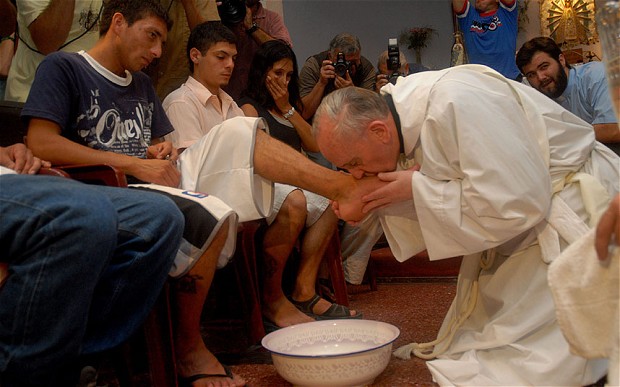
Pope Francis, Summon a Council: It’s Our Tradition!

Francis I

Readings for 6th Sunday after Easter: Acts 15:1-2, 22-29; Ps. 57: 2-3, 5, 6, 8; Rev. 21: 10-14; 22-23; Jn. 14: 23-29. http://www.usccb.org/bible/readings/050513.cfm

Last year was the 50th anniversary of the convocation of the Second Vatican Council. The Catholic Church is still reeling from that earth-shaking event. Conservatives often consider it a huge mistake. They want to return to the Latin Mass, to women’s head-coverings in church, to weekly confessions and communion placed by the priest on the communicant’s outstretched tongue.

Liberals too are disappointed by Vatican II. It didn’t nearly go far enough, they say. It should have eliminated priestly celibacy and the all-male clergy. The church should have divested itself of the Vatican Bank, sold its art treasures and given the proceeds to the poor. The Council’s teaching on collegiality should have decentralized church bureaucracy and made lay-leadership more prominent. The prohibition of contraception should have been changed.

Into which of those camps do you fall? As a church member, do you consider yourself conservative or liberal? Today’s liturgy of the word provokes the question. It reveals a church which at its very beginning surrendered itself to extreme liberalism – or should I say to the “radicalism” of Jesus’ Spirit?

Think about those terms for a minute in the light of today’s readings. Think about what “conservative” and “liberal” mean for us as individuals and community members in our faith tradition. Think of the Holy Spirit as “radical” – something believers are rooted in.

According to every great tradition (Christian or otherwise), the spiritual life – human life itself – is about change, about transformation. Change is the point. We are called to grow. Growth involves transformation. At the biological level, we’re told that all of our cells change every seven years. That means that at my stage in life, I’ve already gone through more than ten bodies! If I tried to keep my body from changing, I would die.

At the personal, psychic and intellectual levels we’re called to change as well. As St. Paul puts it, when we were children, it was appropriate to think, speak and act as children (I Cor. 13:11). But as adults, we’re called to something more. If we don’t change, we can never become who we’re meant to be.

Even institutions must change to survive. That’s true in the realm of politics, economics, and religion. Jesus’ followers found no exemption from this rule of life – of evolution; as community members they had to change or die. In other words, at the end of the day, strategies of conservatism are doomed for Christians as well as for everyone else.

It’s easy to sympathize with conservatives however. I spent much of my life in that category. As such, my concern was simply to preserve what is essential. I saw liberals as being too free with the unchangeable. Like other conservatives I accused them of throwing out the baby with the bath water.

Nonetheless, in today’s liturgy of the word, we get an idea of how difficult it is to determine which is which –baby or bath water. That is, in our readings, we are faced an example of a key conflict between religious conservatives and liberals within the first century infant church. Paul, Barnabas, Silas and Barsabas lead the liberal wing. Peter and Jesus’ brother, James are the leaders of the conservatives.

Paul and his friends come from the gentile world. Their concern is to make Jesus both understandable and acceptable to non-Jews. For their audience, circumcision and dietary restrictions (like not eating pork) represent great obstacles to accepting Jesus’ “Way.”

On the other hand, Peter and Jesus’ brother, James, are Jews through and through. They remember the importance of full observance of the law within the Jewish tradition. They recalled for instance that during the second century Seleucid persecution of the Jews under Antiochus IV Epiphanes, many Jews gave their lives rather than eat forbidden foods. Faced with Paul and his colleagues, the conservative faction wondered: were those lives sacrificed in vain? And besides, circumcision was the identifying mark of Jewish manhood. What good follower of the biblical God set that all-important commandment aside?

The issue is so serious that it provoked a meeting of church leaders – what scholars call the “Council of Jerusalem.” Like Vatican II (1962-’65) it called together church leadership to discuss burning issues of the day and to make changes that responded effectively to what Gaudium et Spes called the “signs of the times.”

Today’s gospel reading implies that leaders could come together with confidence because of Jesus’ promise that his Holy Spirit would continue teaching the church even after he is gone. The Spirit would remind the church of what Jesus himself taught – and more besides.

According to today’s readings, it was the “more besides” that the Jerusalem conservatives were resisting. They didn’t deny, of course, that Jesus himself was a religious liberal. (It was Jesus’ liberalism that angered the Scribes and high priests.) Jesus frequently placed love and compassion above God’s most important commandment, the Sabbath law; he associated with the “unclean;” he even befriended and worked miracles for gentiles. Jesus was never bound by the letter of the law as were his conservative opponents.

At the same time however, Jesus was Jewish to the end. He had no intention of founding a new religion. He was a Jewish reformer. No one could deny that. Jesus didn’t revoke the Law. He simply gave it an enlightened, more humane, more liberal interpretation. He himself had been circumcised!

It was with these understandings that the Council of Jerusalem convened. And according to Luke, the author of Acts, it was a battle royal. Luke says the meeting (like Vatican II) was filled with “dissension and debate.”

What we find in today’s first reading is the final decree of the Council of Jerusalem. Concerning circumcision, it says “never mind.” As for dietary restrictions, fagedaboutit. The Council was concerned with not placing unbearable burdens on converts. In other words, it couldn’t have been more liberal. It could not have been less conservative.

The Council of Jerusalem is reputed to have happened no more than 30 years after the death of Jesus. But by the time John of Patmos writes his book of Revelation at the end of the first century, look where his church had come. His vision of the “New Jerusalem” which we read about in today’s second reading doesn’t even have a temple. Jerusalem without a temple?! The city is founded not on the 12 patriarchs of Israel, but on the 12 apostles. How liberal is that!?

I suppose what I’m saying is that Christians shouldn’t be afraid of change. It’s our tradition – right from the beginning. In fact, in today’s gospel, John has Jesus say specifically that we should not be agitated or fearful. Rather, our hearts should be filled with peace because of our reliance on the Holy Spirit. John’s Jesus teaches that the Spirit’s presence guarantees the community is moving in the right direction, even when the Spirit’s teachings shock and scandalize – as long as it’s moving towards Jesus’ compassion, love, and ease of burden. The guarantee remains even when the Spirit’s guidance seems to dilute what many consider essential – like circumcision, dietary laws and the Jerusalem Temple.

What “essentials” is the church being called to set aside today? Priestly celibacy? An all-male priesthood? Prohibition of contraception? Are any of these really essential?

The question is as unnerving for the church as it is for us as individuals. But the answer is always the same: “Don’t be afraid or agitated; the Holy Spirit guides.”

Think about it: at the personal level, after ten changes of body and innumerable psychic growth spurts and changes of mind, what remains that allows me to identify with that child they tell me I was in my baby pictures? The bath water has been thrown out virtually every day. But somehow I’m able to say “I” remain. Who is that “I?”

Once again, today’s gospel leads us to believe that the answer is the indwelling Holy Spirit herself who continually leads us into the new and unforeseen – but without that “fear or agitation.” That unifying, enlightened Spirit is the same in me as She is in you.

The bottom line: today’s readings teach that there is no future in timid conservatism. Instead we are called to extreme liberalism. And that liberalism actually translates to Jesus-like radicalism (or going to the root of things). The Holy Spirit is that root.

And so we can pray with confidence: “Holy Spirit, in the present crisis of your church, inspire Francis I to call us together once again. Convene a Council. Surprise us. Shock us one more time. Wake us up! Move us towards compassion, love and ease of burden as you did the Jerusalem Council. We believe that under your guidance, we can never go wrong!

Announcing a New Wednesday Series on Critical Thinking: is anyone interested?

Critical thinking

During the last couple of weeks my blogs have addressed the Boston Marathon bombings. I’ve suggested the application of elementary principles to clarify thinking about such tragedies. One of them I’ve termed the “principle of reciprocity.” The meaning I’ve assigned the term has to do with the application of a single standard to all cases involving response to tragedies like the Boston bombing on the one hand and U.S. drone attacks on the other.

Reciprocity is related to judgments about nuclear weapons. If the U.S., Israel, Pakistan, and India are allowed to possess them, so should North Korea and Iran. The principle of reciprocity holds that what I judge as good for me should be good for you as well; what is bad for me is bad for you. Any child can understand such a guideline. It’s what we learned in Kindergarten and Sunday school.

Yet our “leaders” seem incapable of grasping what is perfectly clear even to children.

The principle of reciprocity and its implicit challenge to “American” exceptionalism has elicited energetic response on the part of some who have read the blogs as anti-American, insensitive and judgmental. Those responses in turn have led me to perceive a need on my part to explain in a more detailed manner just where I am coming from. The idea would be to help others come to grips with their own principles of critical thought. (We all have them whether we’re aware of it or not.)

You see, over my 36 years of teaching at Berea College in Kentucky, I’ve taught many courses on critical thinking. And this has led me to bring to consciousness my own approach to the discipline. That approach has centralized what I’ve learned in my years of study under Third World thinkers – especially under liberation theologians in Brazil, Costa Rica, Nicaragua, Cuba, and Zimbabwe.

If you’re wondering what I mean by “liberation theology,” just click on the entries in that category located just below the masthead of this blog site. In a single sentence, “liberation theology” is reflection on the following of Jesus of Nazareth from the viewpoint of those committed to the liberation of the world’s poor and oppressed. I consider it the most important theological development of the last 1700 years and the most important intellectual movement of the last 150 years – going back to the publication of the Communist Manifesto in 1848.

I guess what I’m saying is that my understanding of critical thinking comes from a faith perspective.

In any case, inspired by what I’ve learned, my teaching has led me to develop ten principles for critical thinking. I’ve used feature film clips to illustrate what I’m talking about. I’d like to share those principles and clips with readers in bite-sized portions, in Wednesday blogs over the next several weeks.

I hope there will be an audience out there to follow along. If so, please make a simple “I’m on board” comment below. If there’s no audience, at least my entries will serve as a vehicle for talking to myself in order to clarify my own thinking.

The same holds true for my observations about Hitler, his victory in what liberation philosopher,Enrique Dussel calls “the Second Inter-capitalist War,” and the resurfacing of Hitlerism in the United States over the last 35 years. During the coming weeks, on Fridays, I’d like to give an account of that sad and highly threatening process and its relevance to our own day. Is anyone out there interested in following a series on the topic? I wonder.

None of this would change what I consider the anchor of this blog site. In my view, what holds the whole thing down are my Sunday homilies. My project there is to do my small part to rescue interpretation of the Christian tradition from the political right and religious fundamentalists, and to provide reflections on Sunday liturgical readings from the viewpoint of liberation theology as referenced above.

If any of this interests you, please sign up as a “follower” of this blog, so that you’ll receive automatic notification of the Monday, Wednesday, and Friday posts. If you’re reluctant to sign on as a “follower,” do something to remind yourself to check in from time to time. Your critical feedback will be greatly appreciated.

I await responses.