Protestors against the Pinochet regime during the Mass of John Paul II in Chile’s main soccer stadium
Comment
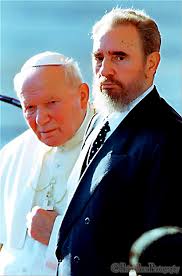
This is one of the chapters with firm grounding in reality. The pope’s nightmare is based on the report of what happened during his 1987 trip to Chile. In their biography (His Holiness: John Paul and the hidden history of our time) Carl Bernstein and Marco Politi described the papal Mass in the national soccer stadium as follows:
Pinochet staged a massive intervention using armored cars, jeeps, policemen with nightsticks and shields, water cannons, and tear gas to combat 700 demonstrators shouting slogans against the dictatorship and throwing stones at police stationed o the edge of the park. The demonstrators, who belonged to the extreme left-wing party Mir and to organizations of young dissidents allied with the Chilean Communist Party, were a tiny fraction of the 700,000 worshipers present at the mass. But the general wanted to make a point. Police charged demonstrators who were burning tires to shield themselves and crashed through the crowd of the faithful. Beneath the altar where the pope was celebrating mass, soldiers in jeeps cut circular swaths. Journalists, pilgrims, and priests who tried to block them were run over and injured. The tear gas fumes even reached the altar, where John Paul II, his eyes red and his throat burning, skipped whole sections of his homily on reconciliation, while his personal physician gave him water and salt to fight off the poisonous air.
“Love is stronger than hate!” shouoted John Paul II, while around him thousands of fear-stricken spectators cried out, “Save the pope!” Six hundred people were injured. All the political parties, including the socialists and Communists, denounced the actions of the security forces, calling their response a provocation. Cardinal Fresno and the president of the Chilean bishops conference, however, issued a communique identifying the police as the chief victims and blaming the demonstrators. It said the demonstrators had tried to prevent those in attendance from expressing their beliefs and had offended the pope. “We protest against this incredible assault, which meant blows and wounds to carabineros, papal guards, journalists, priests, and the faithful.” Not a word was said about police brutality, which had been witnessed by the entire international press corps.
Today, I begin a recording of a novel I wrote more than 20 years ago. At my current age of 81, I just want to get the book out in the public in some form while I still can. The novel is called The Pope, His Chamberlain, The Jinetera & Fidel.
It’s a fictional story about Pope John Paul II’s actual 1997 trip to Cuba. I repeat: it’s a fictional story. So, don’t go accusing the sainted pope of the moral failing I place at the story’s center.
On the other hand, the tale was inspired by my own actual first journey to Cuba in the summer of 1996. It reflects what I learned there during a two-week stay under the auspices of the Greater Cincinnati Council of World Affairs – again, the first of many sojourns for me in the adopted home of Che Guevara and Assata Shakur. I’ve visited Cuba more than a dozen times since.
I originally wrote the book as a virtual vehicle for taking my friends and students to Cuba — to expose them to what I experienced during the 1990s “special period” there — and to clear up common misperceptions about life on the island. It was during the ’90s that U.S. sanctions coupled with the fall of the Soviet Union (and Cuba’s loss in the process of 85% of its trading partners) made life nearly unbearable for the Cuban people.
Today, something similar is transpiring for Cubans. The COVID-19 pandemic along with intensified U.S. sanctions have once again brought the tiny nation to its knees. (Hence the protests we’ve all heard so much about.) So, Cuba today is very similar to the Cuba of the last century’s final decade which is the novel’s setting.
The book’s relevance also stems from its indirect exposition of liberation theology, which I consider the most important theological development of the last 1500 years. Pope John Paul II was its foremost opponent. I’d like readers to come away with a better understanding of that theology and social movements it inspired.
Here’s my bottom line: though largely fictional, the descriptions I’ve portrayed here are true in that many of them reflect my own experience. In the introductions to relevant chapters, I’ll emphasize those non-fictional details.
In any case, I hope that you’ll enjoy to some degree what I’ll read here – a chapter more or less each day for the next month or so.
So, get ready. Here it is: the opening of The Pope, His Chamberlain, the Jinetera, and Fidel.
(By the way, as a work still in progress, the book begs for suggestions about improving or changing it. So feel free to offer advice.)
The Pope, His Chamberlain, the Jinetera, and Fidel: Prologue
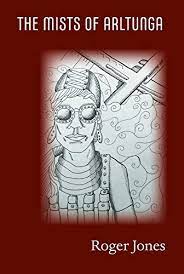
Two years ago, my good friend from Berea, Kentucky, Roger Jones published a thought-provoking extended parable about the current human condition shaped by post-modern capitalism. It’s a wonderfully insightful and artistically composed novel called The Mists of Arltunga. I highly recommend it.
Set In a mining camp (Arltunga) in central Australia 100 years ago, the story presciently portrays a world so polluted by chemical industries that the companies in question mine the foul-smelling air itself. They do so with glider air ships that draw behind them fine nets to capture jelly-like discharges from the open-pit mines below.
Of course, the putrid mists are also ingested by the mine workers whose nostrils and lungs end up hosting the foul emissions. They suffer and die accordingly.
But none of this matters to the chemical company’s absentee owner, nor to the mine overseer. The overriding concern of both is meeting production goals. To achieve those ends, the overseer browbeats his workers, alternatively threatens and sweet-talks them, punishes their shortcomings, and offers meaningless incentives. Worse still, he proves willing to kill troublemakers directly by using his pistol and covertly by provoking a fatal landslide by means of dynamite. He colludes with a competitor for purposes of controlling the workforces of both companies and of mutually enriching themselves.
In short, The Mists of Arltunga presents its mesmerized readers with a tale of unfettered capitalism that is both cautionary and actual.
But of course, (as in the real world) the most rebellious among the story’s exploited mineworkers take none of this lying down. Though they find themselves caught in a web of exploitation, they cannot initially free themselves. They’re impotent because employment in the mine represents their only source of sustenance without which they’d starve to death. Though the mine’s glider pilots can soar above it all for hours each day, they must eventually return to earth to eat the camp’s miserable gruel, turnips and thin soup. Eagles by day (an important metaphor in the book), they’re reduced to precariat slaves when they return to earth.
All of this holds true till one day a zeppelin from Perth crash lands with a deafening explosion and searing ball of flame near the mine site. All the vessel’s crew and passengers perish, except for the burnt and wounded daughter of Arltunga’s absentee owner. She’s saved by one of the mine’s glider-pilots who works in Arltunga alongside his father and younger brother. Unaware of the “sheila’s” true identity, both brothers immediately fall in love with her.
The girl, however, maintains a friendly but aloof distance from the pair. Under threat from the mine overseer, she is forced to conceal her true identity. She blends into the working community proving herself to be invaluable as a gardener and infirmary caregiver. Most surprisingly of all, she reveals herself as a competent glider pilot capable of flying with the best of the men.
A turning point comes when the camp overseer’s collusions with a competing mine operation come to light. It all involves the earlier-mentioned landslide, the resulting near-death experience of the mine owner’s daughter, and her abduction according to the plan of Arltunga’s mine overseer – again, the only character aware of the girl’s real name.
All of this catalyzes worker rebellion led by the story’s love-struck brothers. The climax involves a thrilling glider chase, another crash landing, and a surprising disclosure of hidden identities.
In the end, the revelations concluding The Mists of Arltunga point towards a mythic, parable-like and robust affirmation of the unity of the entire human family. They offer hope that acknowledgment of that single household can unite bosses and workers even altering the behavior of greedy absentee proprietors.
Do yourself a favor. Read Roger Jones’ splendid, hopeful and critical parable. Be inspired accordingly.
Readings for the 19th Sunday in Ordinary Time: I Kgs. 19:4-8; Eph. 4:30-5:2; Jn. 6:41-51
This Sunday’s readings are about prophets and bread. Somehow that seems fitting since last week the world lost an artist whose work centralized both prophecy and the staff of life.
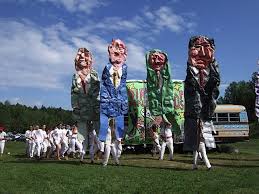
I’m talking about Elka Schumann, the co-founder of Vermont’s Bread and Puppet Theater Company. She died a week ago today at the age of 85.
Elka’s Puppets
Elka was born in the Soviet Union and came to the United States at the age of 6. She was the grandchild of Scott and Helen Nearing, the revered back-to-nature sages and activists. Elka and her husband Peter founded Bread and Puppet in 1963 originally to protest poor housing conditions in New York City. Since then, their giant puppets – some more than 20 feet high – have made spectacular appearances at protests and demonstrations everywhere.
Over those years, the Schumanns’ focus expanded to include the Vietnam War, climate change, Nicaragua and the Contras, El Salvador, Archbishop Romero, liberation theology, and the general failure of capitalism. Every summer hundreds of volunteers participated in their elaborate outdoor pageants highlighting issues like those.
(My wife, Peggy, was once a puppet horse in a Bread and Puppet portrayal of a circus. And a couple of years ago, she and I visited the company’s Museum in Glover, Vermont. Reviewing the various puppet collections was like reliving the great issues of the past half century. It was all such an inspiring display of insight, creativity, commitment, joy, and courage. The Schumanns’ giant puppets have provided a truly prophetic deepening our collective consciousness.)
Elka’s Bread
However, the mammoth puppets were so stunning and arresting that it’s easy to forget the part that bread played in their work. After all, the name of their company is Bread and Puppet.” (And homemade bread was served at all their performances.) Elka Schumann herself made the connection in a 2001 film about her work. The documentary was produced by her daughter Tamar and DeeDee Halleck. Elka said:
“We have a grinder over there, and we grind the grain ourselves. And the bread is not at all like your supermarket bread. You really have to chew it. You really have to put some work into it. But then you get something very good for that. And when our theater is successful, we feel it’s the same way. You’ve got to think about — it doesn’t like tell you everything. It’s not like Wonder Bread: It’s just like there it is, here’s the story, this is what it means. You’ve got to do some figuring yourself in the theater, in our theater. And if the play is successful, then at the end you probably feel it was worth the work.”
Elka’s words underline the essentials of good theater, good art, good religion. They don’t tell you everything. You must put in some work trying to figure out the message, to unpack it all. Good theater, good religion is not like eating white bread from Piggly Wiggly.
Jesus’ Bread
As mentioned earlier, that aspect of theater and faith is important to note this particular Sunday, since the day’s readings highlight the connections between bread, prophets, and the teachings of Yeshua, the giant, larger-than-life (!) construction worker from Nazareth.
What Jesus taught in his illustrative parables – in fact, what’s found throughout the Bible – challenges us to think and question our own lives, the values of our culture, and our too easy “understandings” of life and “God.” That’s what the Schumanns were doing too
Think about the prodigal son, Jesus’ response to the woman about to be stoned for adultery, his dialog with Pontius Pilate about the nature of truth, and the issues raised by the fact that Jesus was executed as a rebel against Rome. Think about the prophet’s dying prayer for his enemies, his injunction to treat others as we would like to be treated, his “beatitudes’” centralizing purity of intention, poverty, gentleness, bereavement, imprisonment, mercy, peacemaking, and passion for justice. At every turn his words and deeds are challenging and (if you puzzle over them) difficult but rewarding to digest.
Understood in terms of rejecting Wonder Bread’s superficiality, all of those elements in the accounts of Jesus’ words and deeds should give “Americans” pause. They should call into question the very notion of patriarchy, our worship of the rich, our wars against the world’s poor, our attitudes towards empire and capital punishment, as well as our very denial of truth’s possibility (which Gandhi boldly identified with God).
That sort of hard-to-chew bread forms the backdrop implied in today’s readings. See for yourself. Here are my “translations.” You could find the originals here to tell if I got them right.
I Kings 19: 4-8

Prophets are lonely people
Living on the edge of
Death and despair.
Elijah was no different.
He even prayed for death
On his way to Mt. Sinai.
Instead, a generous Spirit
Fed him with bread and water
Twice!
He didn’t have to eat again
For the remaining 40 days
Of his journey
To God’s holy mountain.

Psalm 34: 2-9

Elijah’s miraculous bread
Gave him a taste of
Life’s Supreme Goodness
Directed especially
Towards the threatened
And afflicted poor.
The taste of bread
Replaces their shame
And distress
With joy and confidence
In Life’s protective Source.

Ephesians 4: 30-5:2

So, Elijah
Should never have been sad.
In fact,
For those filled with God’s Spirit
(And bread!)
There can be no room for sadness
Bitterness, fury, anger,
Shouting, reviling or malice.
There is room only for
Kindness, compassion,
Forgiveness and love
That mirror
Life’s own abundance
And inherent generosity.

John 6: 42-51

John’s community of faith
Identified Jesus’ teaching
With the bread
That fed Elijah.
In fact,
They called Jesus himself
“The Bread of Heaven”
Whose consumption
Would strengthen them
For “the journey without distance”
(From heart to head).
This still upsets outsiders
Unable to overcome
Fundamentalist literalism
That yet confuses
Spiritual nourishment
With fairy tales
And gross cannibalism.
Conclusion
When I was a kid, I actually liked Wonder Bread. In fact, I still kind of do. Don’t you? I mean it’s a bit sweet; it’s easy to chew; it’s a nice base for peanut butter and jelly, and it goes down easy. My well-intentioned mother fed it to me and my three siblings without a second thought. I ate it the same way.
But then most of us got more conscientious about what we put into our bodies. With Elka Schumann, we realized that Wonder Bread didn’t really nourish us. So, we turned to bread that (initially at least) was less familiar and that required more chewing and changing of taste-preferences – a bit more work – maybe not as strong as Elka’s bread, but more substantial nonetheless.
For many of us who have stuck with faith as a source of meaning, it’s been the same. We outgrew the beliefs that no longer nourished. We woke up to the fact that Jesus’ teachings need adult interpretation that demands thought and decision about those issues I mentioned earlier — patriarchy, grossly unequal wealth distribution, perpetual wars precisely against the world’s poor, empire, capital punishment, and about agnosticism concerning the Truth that parallels our denial of what we know to be genuine relative to the great issues of our day.
Instead, we’ve reduced “faith” to childish fairy tales that none of us can believe. We’ve made it into Wonder Bread. And this at a time in history when acceptance of life’s essential unity – proclaimed not only by Elijah and Jesus, but by all the world’s great religious traditions – is necessary for our species’ very survival.
In the words of John, the Evangelist, I’m trying to say we need the Bread of Heaven, the Bread of Life now more than ever.
Thank you, Elka Schumann for using your puppets and bread to drive home that truth.
Readings for the 19th Sunday in Ordinary Time: I Kgs. 19:4-8; Eph. 4:30-5:2; Jn. 6:41-51
Recently, I had a long talk with one of my dearest friends in the world. After reading a book I recommended, he found himself in crisis.
“I don’t know what to believe now,” he lamented. “I have no idea who Jesus was or is.
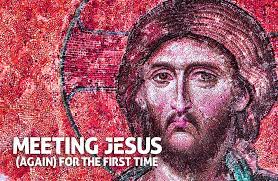
I could sympathize with my friend. I even felt a little guilty that I had recommended that he read the book in question – Marcus Borg’s Meeting Jesus Again for the First Time. In laypersons’ terms, it acquaints readers with the search for the historical Jesus that has been in full swing for more than 100 years.
Borg concludes that the 4th century Council of Nicaea was correct in its assessment that Jesus was a divine person who was fully God and fully human. It just doesn’t say how that’s possible.
Borg’s own explanation is that Jesus was fully human before his resurrection and fully God in the faith of his bereft disciples after the event, whatever its exact nature might have been. That means that the pre-resurrection Jesus was in important respects very like the rest of us. He too shared our spiritual journey and grew (as the Gospel of Luke says) “in age, and wisdom and grace” (LK 2:52).
“Why wasn’t I told any of this before,” my friend complained.
Well, today’s liturgy of the word addresses my friend’s frustration. It highlights the faith quest that all of us share – even with Jesus.
For starters, think about Elijah from I Kings. At first glance, it seems like a child’s tale. I mean: angels, miraculous bread . . .
And then there are those words attributed to Jesus in the reading from John the Evangelist. There, Jesus claims that he is bread, and we’re supposed to eat his flesh?
It all seems so (excuse me) absurd. We’re told Jesus was talking about the Eucharist or something. But, many of us find it harder and harder to believe even what we’ve been taught about that. God in a piece of bread? It’s easy to understand how faith is threatened rather than strengthened by such readings. Spiritually it can be rather discouraging.
But my friend shouldn’t be discouraged by such thoughts. Neither should any of us. On the contrary, they can be seen as signs we’re growing up spiritually. Painful as it is, perhaps it’s time for reassessing our faith.
I mean (if we’re lucky) there comes a point in everyone’s life where faith has to be reevaluated – where what we were taught and believed as children no longer meets our adult needs. At those times discouragement (despondency is the term used in today’s first reading) is actually a good sign. It can mean we’ve outgrown old ways of thinking and are being called to growth which is always difficult. So, we shouldn’t give up in the face of discouragement, but embrace it with hope.
With that in mind, please realize that today’s readings are about the spiritual journey, the search for God and the discouragement that comes along with it. They are about finding God’s presence hidden in plain sight – within our own flesh (as Jesus put it) – closer to us than our jugular vein.
That theme of spiritual journey is announced in the first reading – the story about the prophet Elijah fed by angels under a juniper tree. Elijah did his work in the Northern Kingdom of Israel about 800 years before the birth of Jesus. He is remembered as one of the great, great prophets of the Jewish Testament. In fact, he was so powerful that Jesus’ followers thought Jesus to be the prophet’s reincarnation. John the Baptist’s followers thought the same about him. (Btw: does that mean that Jesus and his contemporaries believed in reincarnation?) So, Elijah is a key figure in our tradition.
In any case, today’s story about Elijah describes the classic stages of the spiritual journey that we’re all called to – from immature believing things about God and Jesus to something more holistic that finds and honors God’s manifestations everywhere.
As we join him in today’s first reading, Elijah is described as beginning a literal journey. He’s traveling to Mt. Horeb (or Sinai) – the place where Moses and the slaves who had escaped from Egypt made their Covenant with their God, Yahweh. Elijah is confused about God (“despondent”), and evidently thinks that by returning to the origins of his faith, he’ll get some clarity.
At this stage of his spiritual growth, Elijah’s faith is less mature. He has a very ethnocentric idea about God. And he’s being called to move beyond that stage of development. The ethnocentric idea has it that God is all about us – our people, our nation, our wars, our prosperity. God is our God and we are his chosen people – truly exceptional. In passages from the Book of Kings just before today’s reading Elijah manifested that understanding of God in a contest with the priests of Baal – a Phoenician God that the King of Israel, Achab and his wife Jezebel had flirted with.
You remember the story. Elijah challenged forty priests to a contest – your sacrifices against ours. Call on your gods to light your sacrificial fires, and I’ll call on Yahweh, and then we’ll see who’s really God. Of course, the priests of Baal can’t get their gods to come through. They chant, and dance, and sing. But the sacrificial wood remains cold. However, Yahweh comes through for his prophet; he lights Elijah’s fire even though in a display of bravado, the prophet had the wood doused with water. Not only that, but Yahweh kills the forty priests for good measure.
That’s the ethnocentric idea: “Our God is better than your god. He has more magic power.” And he’s (this is almost always a male concept) very violent and vindictive. He’ll turn on you and go off on you at the drop of a hat. That’s the God that no longer seems to be working for Elijah. It has made him a wanted man. Queen Jezebel is after him and wants his head. Life is not worth living, the prophet concludes. He wants it all to end – there under the juniper tree.
But two people (whom Elijah later understands as messengers from God) feed him, and on the strength of food provided by strangers he completes his journey and arrives at a cave high on Mt. Sinai. And there, God reveals his true nature not as an ethnocentric God belonging to a single “chosen” people. Neither does God reveal Godself in nature’s elements – not in earth (an earthquake), not in air (a whirlwind), nor in fire (lightning). Instead God (definitely not predominantly male) is disclosed as a “still small voice” within the prophet himself.
And what is a “still” voice, a “small” voice? It seems to me that it’s a communication without sound – one that can be hardly heard – a far cry from the deity who magically lights sacrificial fires and slays Phoenician priests. That magical violent understanding of God seems frankly childish – a God who enters into competition with other “worthy opponents” over whom he has greater magical powers.
No, the revelation to Elijah discloses a God who is much subtler and who resides within all persons be they Hebrew or Phoenician. By traditional standards, it is a “weak” unspectacular God. God is found within; God is small and quiet and belongs to everyone. Or rather, everyone belongs to God regardless of their nationality or race. And in Elijah’s story, it’s not clear that the prophet even grasps the point.
Elijah might not have gotten the point. But it’s evident that his reincarnation in Jesus of Nazareth did – or at least that John the Evangelist writing 60-90 years after Jesus’ death got the point. By then it was possible to put words in Jesus’ mouth that the construction worker from Nazareth could never have said – especially about eating his flesh and above all drinking his blood. Jews, of course, were forbidden from imbibing the blood of any living thing, let alone human blood. However, by John’s time Jesus’ followers had increasingly left behind their Jewish origins. They had become friendly with Gnosticism and were coming to terms with Roman “mystery cults.” Both worshipped “dying and rising gods” who offered “eternal life” to those who ate the god’s body and drank the god’s blood under the forms of bread and wine.
Evidently, John the Evangelist and others like John’s contemporary who wrote “The Gospel of Thomas” recognized an affinity between the teachings of Jesus and the beliefs of the Gnostics who found God’s presence in all of creation. The Gospel of Thomas has Jesus say “Split a block of wood and I am there; lift up a rock and find me there.
In other words, by the end of the first century, Christians were developing an ecumenical understanding of God that went far beyond the Jewish ethnocentrism of Elijah. By that time Christians could see that Jesus was not only a prophet, not only a movement founder of reform within Judaism, not only an insightful story teller and extraordinary healer, but a “Spirit Person” who like the Gnostics found God’s presence in every element of creation – principally in that “still, small voice” revealed to Elijah.
So, Jesus found God’s presence in wood, under rocks, in the breaking of bread, in the sharing of wine, within his self, here and now (not in some afterlife) but in his very flesh and blood. In other words, shared divine presence lent a unity and sameness to everything. Bread and flesh, wine and blood turn out to be the same across time and space. John has Jesus say all of that quite shockingly: “When you eat bread you are eating my flesh; when you drink wine, you are imbibing my blood. We, all of creation, are all one!”
What I’m saying here is that faith changes and grows. Discouragement with old models and paradigms is a hopeful sign. Think of today’s readings and the distance traveled from Elijah’s Magical Killer God to the Still Small Voice to the God present in bread, wine, and in every cell of Jesus’ and our own bodies.
If your own spiritual journey has you longing for further exploration of such adult themes, I can’t do better than to recommend the book I urged that friend of mine to read. I’m referring to Marcus Borg’s Meeting Jesus again for the First Time. His The Heart of Christianity is similarly helpful.
Like my friend, you might find them initially disturbing. But they will deepen your faith and help make it more worthy of a mature adult.
On Saturday, Peggy and I returned from our week on Bustin’s Island in Maine. It was a marvelous time spent not only together, but with our daughter, Maggie, and two of her five children — Markandeya (6 yrs.) and Sebastian (2 yrs.). [Her other three children (Eva 12 yrs., Oscar 10 yrs., and Orlando 8 yrs.) are all away at summer camps.] A dear friend from Berea, Joan Moore, also visited for three days. By way of a report on our collective experience, what follows is a letter to my granddaughter, Eva, who (as I started to say) is spending the last of six weeks at her summer camp (Fernwood) also in Maine.
August 1, 2001
My dearest Eva Maria,
Thanks so much for your two recent letters. It was such a nice surprise to return from Maine to find them waiting for me here — along with the beautiful pin you made for me with our favorite colors, yellow and green. As you suggested, I’ll wear that on my walking duds.
I’m so glad you’re doing the reading you mentioned from Howard Zinn and An Indigenous People’s History. Your comments make me think you’d very much like a four-part film series I’ve just watched (twice!). It’s called “Exterminate All the Brutes.” It’s by Raul Peck (a Haitian born director). He’s the narrator of the series as well. He too loves Zinn and the author of An Indigenous People’s History.
Peck says that all of history can be summarized in three words: civilization (i.e., white supremacy), colonialism, and extermination. The film details the evils of the Native American holocaust and of enslavement of Africans. Grandma Gaga started watching it with me. However, she left after about ten minutes saying that she thought the story and graphics were too violent. So, maybe it’s inappropriate for your viewing at this stage of your life. We can talk about that.
Last night, Gaga and I returned from our week on Bustin’s Island near Freeport, Maine (the home of LL Bean). It was a wonderful experience. It was like going back more than 100 years in a time machine. No cars, internet, plumbing or running water. We fetched our water supply from a town pump, used the outhouse, and boiled all our water including what we used for rinsing dishes. The whole experience was an exercise in simple living. We loved it.
What I liked most about Bustin’s Island was the community of people there. It was formed mainly of families that have been going there each summer for generations. Lots of young people about your age and somewhat older. They were all so enthusiastic about the privilege of living there. I’m sure you’d love it too.
Your mom, Markandeya, and Sebastian shared our experience. Markandeya was especially enthusiastic. Sebastian was fun too. I spent a good amount of time pulling him around in a wagon that belonged to the cottage. Marku loved pumping water and pulling the wagon loaded with more than 100 pounds (including two five-gallon water containers and his brother). Gaga joined the Monopoly enthusiasts. Others of us played Hearts and a bit of Yahtzee. Markandeya’s a fierce Monopoly competitor. (I know you know that quite well!).
Joan Moore, a friend of ours from Berea also spent three days with us. She was a very easy presence – very willing to do her part cleaning, playing with the kids, and generally offering a helping hand. She’s a friend of your grandma Momo’s too and will visit her this week. On her way home, Joan says she may stop off in Westport for a visit. Both Gaga and I love Joan.
Weather at Bustin’s was mixed. But it was never hot. As a matter of fact, at night it was often a bit too cold. Our house was located right on Casco Bay that offered wonderful moments for quiet contemplation.
One morning your great uncle and great aunt, Jerry and Liz (whose summer cottage was nearby on Birch Island), came over and took us by boat to their place. They love it there too. Their house had running water and an indoor composting toilet. I enjoyed talking with both of them.
On the way to Birch Island, we passed some of the Calendar Islands (there are 365 of them) with names like “Sow and Pigs,” “Upper Goose, Lower Goose, and Their Three Goslins.” We passed eagles’ nests that sat like huge card tables on top of giant pine trees. One island that evoked interest from my hermit’s heart was called Moshier. It had only a single house on it. I can imagine living there quite happily.
Your mother and I also had some time together – just one-on-one. We talked over our relationship and other such matters. We both promised to continue the conversation now that we’re back in Westport.
One of these nights all of us here are going to watch the film “NomadLand” on your folks’ outdoor screen. It won this year’s Academy Award as the best film of the year. It’s about people who have left the “rat race” of American life and have returned to simple living of the kind that we experienced last week in Maine. Only, the film’s characters are living on the road in campers, mobile homes, and trailers. I find that stuff fascinating. (Although your mom has hastened to tell me quite emphatically, “Don’t get any ideas, Dad. You are NOT going to end up living that way.”)
I know your regimen at Fernwood doesn’t allow you to watch “Democracy Now” each day as you’re accustomed to do. And maybe that’s for the best. I mean, the reports on the pandemic, on suppression of voting rights (especially for black people), and on the U.S. support of wars everywhere all border on depressing. Nonetheless, when you get back here, I know you’ll take pains to catch up. I’ll help you with that on our walks together.
Of course, Eva, I’m very much looking forward to your return (next Saturday!). It goes without saying that I’ve missed you a great deal. I’m looking forward to your account of this summer’s experience at camp. I’m sure you learned a lot and made many new friends. I’m proud of your rock-climbing achievements. As I always tell you, you’re a much better athlete than you give yourself credit for.
So, until Saturday, let me assure you that you’re never far from my thoughts and (yes!) my prayers. I love you so much and am very, very proud of you – especially for your making the best of Fernwood.



 About Things That Matter