Alexy Navalny Vs. Julian Assange, and Gonzalo Lira

Vladimir Putin has done it again. Just as he did with Yevgeny Prigozhin, he’s murdered another political adversary. This time it’s his “most prominent political opponent,” Alexy Navalny.

That’s the IMMEDIATE conclusion UNIVERSALLY drawn and promulgated by the political establishment and mainstream media in the collective west.

Such unanimity especially in the United States with its record of political assassinations and brutal political imprisonments raises suspicions that we might not be getting the full story.

That’s especially true when one contrasts western handwringing over Navalny’s fate with its indifference to the torture of imprisoned Australian citizen Julian Assange and to the State Department’s lack of concern about the behind bars death of American citizen Gonzalo Lira in Kiev.

So, before we join in premature conclusions, let’s look at the other side of Navalny’s death especially in the light of what we know about Assange and Lira.

Rush to Judgment

First, consider the immediate response to news that Navalny had died. Virtually EVERYONE from Genocide Joe Biden to Hillary Clinton and the Secretary General of Amnesty International claimed certainty that the man had been murdered “by Putin.”

This was even the general thrust of a “Democracy Now” interview with Russia expert Masha Gessen. The latter had authored an article in The New Yorker article entitled “The Death of Alexy Navalny Putin’s Most Formidable Political Opponent.” For Gessen there is “no doubt” Navalny was killed – again “by Putin.”

One wonders where such certainty can possibly come from simply on the report of Navalny’s death. After all, people die in U.S. prisons and migrant detention cells all the time.  Such rush to judgment seems to fly in the face of the foundational legal principle that everyone is innocent until proven guilty.  Nevertheless, before ANY examination of evidence, before any autopsy, before any independent investigation, the case is already closed.

The message to Americans: we too should have “no doubt.” Just as we were getting to know a more humanized Vladimir Putin (thanks to Tucker Carlson’s recent interview) the cruel autocrat has struck again. Whatever “official” autopsies might conclude, Putin is surely guilty and can never be proven innocent. (After all, who could ever believe Russian investigators?)

Moreover, Alexy Navalny is universally portrayed as a heroic advocate of democracy who has always opposed the “autocracy” of Vladimir Putin. He was a “freedom fighter” in the face of anti-democratic oppression.

True, Gessen admits that Navalny had previously been an ultra-nationalist often photographed with Nazi paraphernalia. And yes, he had also been anti-immigrant and Islamophobic. He was a guns-right advocate too who at one point called for the execution of Muslims and for the extermination of “cockroaches” like Russians living in Georgia.

But according to Gessen all of that was in the distant past. Since his arrest and apparently while behind bars, he had undergone a conversion. In fact, like many jailhouse converts, the imprisoned Navalny had become a student of religions. He had even transformed into an advocate of Muslims and their right to access to The Holy Koran while serving their time.

However, even if we grant the man’s conversion, the question remains why would Putin do such a thing? Navalny was already in prison serving a 19- year sentence. He was out of the public eye. He represented no political threat to the Russian leader who by all accounts enjoys high popularity with Russians and will easily win next month’s presidential elections.

In other words, Navalny’s “murder” could do nothing but make Putin look bad, expose him to criticism from his opponents, and hurt him at the ballot box. As ex-CIA officer, Ray McGovern puts it: Navalny “was of no consequence in terms of Putin’s reelection prospects. He had no real following there (i.e. in Russia) except among a certain group of folks that didn’t amount to much.”

The Other Navalny

But who really was Alexy Navalny? According to Scott Ritter, Navalny was a CIA agent “straight up.” He came to political awareness during the Boris Yeltsin years (1991-1999) before Putin’s reforms when Russia was extremely corrupt. Like so many young Russians of that era, he shared a strong admiration of the West that even bordered on rejection of his own Russian identity.

As such, Navalny was recognized by the CIA as a “future leader.” They sent him to the World Fellows Program at Yale University whose connections to the CIA (according to Ritter) are well known. There they groomed the man as a CIA-funded political opponent of Vladimir Putin.

In other words, Navalny was a player in a process that routinely funds so-called non-governmental organizations (NGOs) in Russia and elsewhere for purposes of bringing about regime change. Put still otherwise, the NGOs in question were fronts for U.S. and British intelligence agencies who after the advent of Vladimir Putin took on the task of bringing down the Russian president.

This made Navalny in the eyes of Russian law a traitor guilty of treason. As everywhere else, there are laws in Russia against such things.

Assange & Lira

Ray McGovern, an ex-CIA analyst, goes further still. He contrasts the hand wringing about the Navalny affair with the lack of such distress over Julian Assange, the Australian founder and editor of Wikileaks.  McGovern’s concern is relevant because this week, the 20th and 21st of February, a final hearing will be held in London to determine Assange’s fate.

Julian Assange, of course, faces extradition to the United States to face a 175-year prison sentence for releasing to the public evidence of U.S. war crimes in Afghanistan and Iraq. For five years, he has been held without charge in a 6’X12’ cell in London’s infamous Belmarsh Prison with Great Britain’s worst rapists, murderers, and terrorists. Before that he spent seven years as an asylum seeker in London’s Ecuadorian embassy.

And this despite appeals for his release by the Australian Parliament itself, and despite the CIA’s breach of basic client-lawyer privilege by listening in and recording confidential conferences between Assange and his legal representatives – a fact that alone should disqualify any further legal processes against this Australian citizen.

Where’s the outcry, McGovern says about Assange’s imprisonment and torture? And doesn’t that prominent foreign journalist’s mistreatment deprive the U.S. of any moral authority to criticize, let alone issue demands about the Navalny case?

And then there’s the issue of the apparent murder of American citizen Gonzalo Lira in one of Kiev’s prisons. Lira was charged with suspicion of expressing subversive opinions about Ukraine’s war with Russia. According to Tucker Carlson, “the Biden administration clearly supported his imprisonment and torture. Several weeks ago, we spoke to his father, who predicted his son would be killed.”

I ask my readers: Have you even heard of Gonzalo Lira? If not, don’t worry, you’re in good company. Genocide Joe’s administration acts as if it never heard of him either.

Conclusion  

The conclusion here is not that Vladimir Putin was not ultimately responsible for the death of Alexy Navalny. That remains to be seen. Instead, the proper conclusions include the following:

  • It is far too premature to conclude anything.
  • Such prejudice flies in the face of basic legal assumptions about innocence and guilt.
  • Alexy Navalny was probably not a freedom fighter.
  • In fact, there is clear indication that he was a white supremacist and anti-immigrant ultra-nationalist.
  • He also seems to have been an Islamophobe, an agent of the CIA, and a traitor to his country.
  • Like all countries, Russia has laws about such matters.
  • In the light of its treatment of Julian Assange and Gonzalo Lira, the United States has zero moral authority to posture as a champion of prisoners’ rights, freedom of speech, rule of law, prosecutorial rectitude, or extra-judicial assassinations.

O yes, and then there’s all that business about Jeffrey Epstein‘s death in prison . ..
Tucker Carlson’s Interview with Vladimir Putin

Last Tuesday, ex-Fox News journalist, Tucker Carlson, interviewed Russian president Vladimir Putin. Their conversation lasted more than two hours.

Predictably, The New Yorker described the exchange as “boring.” Times Radio published a video whose clickbait title promised “Putin’s most insane moments in Tucker Carlson interview.” (See video above.)

For me, there was nothing at all “boring” about the exchange. Quite the opposite. Neither was there even a single moment of insanity during the entire conversation.

Instead, Putin came across as an extremely well-informed, historically conscious, careful, and measured diplomat. There was no name-calling, evasion of questions, talking over, or defensiveness. The Russian president showed himself to be calm, thoughtful, respectful of confidentiality, and willing to negotiate and compromise. As well, he often exhibited a subtle sense of humor.

Those were the same characteristics I found manifested during his four hours of published interviews with award winning filmmaker, Oliver Stone. I reviewed those dialogs just after the war in Ukraine started. I did so on May 8th, 2022, and entitled the review: “OK, I’m a Putin Apologist: Here’s Why.”

I stand by the judgments expressed there. In fact, I double down on them. I simply can’t imagine ANY of our politicians holding a candle to Mr. Putin. While he’s calm, they are extremely emotional; they call names like “thug” “dictator,” and “useful idiot.” While he’s thoughtful, they speak in pre-rehearsed “talking points.” They evade questions and tell blatant lies. While Putin is respectful of confidentiality, our politicians make up calumnies. While Putin is willing to negotiate and compromise, they’ll have none of it. And they are so deadly serious without a scintilla of humor.

In fact, after listening to Putin, I’m forced to draw the conclusion that our politicians are not serious people. They’re uninformed and have no sense of real history.

Just think of this year’s presidential candidates. One is a doddering old man who can hardly put two coherent sentences together unless read off a teleprompter. (And by the way, he could also easily qualify as an unindicted co-conspirator in a case of genocide. That’s why they call him “genocide Joe.”) The other is a convicted sexual assailant and Know-Nothing who seems proud of both identities.

Again, they’re not serious people. Yet they aspire to lead what they call “the most powerful nation in the world.” Both belong in prison.

So, with all that in mind, allow me to republish what I wrote about President Putin nearly two years ago.

OK, I’m A Putin Apologist: Here’s Why

Recently, on “Democracy Now,” Amy Goodman interviewed a Yale history professor, Timothy Snyder, about the Ukraine War. He was commenting on his New Yorker article“The War in Ukraine is a Colonial War.”

That was his argument: As if we had to guess Putin’s end game in Ukraine, the good professor opined that it probably is to annex Ukraine and afterwards who knows what other country. Putin’s an imperialist, Snyder charged. Like Hitler, he’s after land and soil.

The colonizer must therefore be stopped, Dr. Snyder concluded, and be brought by force of arms to acknowledge Russia’s total defeat. Turning just war theory on its head, Snyder’s point came across as: war is the first resort; negotiation comes only after your enemy has been militarily defeated and is forced to accept the winner’s terms without reservation.

That kind of support for what has prevailed in America as “the official story,” especially coming from a fellow academic who should know better, struck a fraying nerve within me. I mean, to my understanding, it’s not the function of academics (nor for that matter, of news media such as “Democracy Now”) to lend support to the approved narrative. It is rather to test the received account against documented reality.

So, I decided to find out once and for all (1) who Vladimir Putin is, (2) the detailed background of the Ukraine conflict, and (3) what the Russian president’s intention might be in his “special military operation.”

No need, I found, to speculate on any of that. It’s all quite well recorded – for instance (1) in Oliver Stone‘s four interviews (each an hour long) with the Russian president, (2) in the film “Ukraine on Fire” (counterpointed by “Winter on Fire”), and (3) in Putin’s two long pre-war speeches (one delivered last February 21st, the other just after on February 24th).

Reviewing that material quite carefully has convinced me that as a national leader, Putin stands head and shoulders above any others I can think of. His reasons for initiating his “special operation” are defensible historically, legally, and according to U.S. precedent.

Putin as Statesman

Before mounting the “Putin Bad” bandwagon, be sure to view Oliver Stone’s “The Putin Interviews” on Showtime. They’re the product of 12 conversations between Stone and Mr. Putin over two and a half years between July 2015 and February 2017.

I found the interviews revealing a man who is difficult to dislike. He is charming and humorous. He drives his own car, is a judo enthusiast, plays hockey, and rides horses. He describes himself as a “cautious optimist” who believes, he says, “there is always hope until the day they put you in the ground.”

Born into a working-class family in 1952, his father was wounded in what Russians call “The Great Patriotic War,” when the United States and the USSR were allies against Nazi Germany.

From an early age, young Vladimir studied judo, whose practice, he says, summarizes his theory of life: be flexible and disciplined; think ahead. (For political leaders, he adds, that means planning 25 to 50 years into the future).

Movies and books made Putin, who studied law in the university, an admirer of the KGB as a patriotic organization. He joined up and was assigned to East Germany. Life there, he remembers, was not dismal, but “frozen in the 1950s.”

Then came Mikhail Gorbachev‘s presidency (March 1990 – Dec. 25, 1991). Gorbachev’s “reforms” made everything fall apart. (Putin does not particularly admire him.) Social programs were destroyed. Millions lost their previously guaranteed rights and fell into poverty. Oligarchs criminally seized property belonging to the Russian people and became instant billionaires. Overnight, 25 million people lost their nationality and became displaced.

Though opposed to communism, Lenin, and Stalin, Putin recalls that succession of events “one of the greatest catastrophes of the 20th century.” The country moved towards civil war.

Gorbachev was succeeded by Boris Yeltsin (in office 1991-1999). Before the latter’s resignation, he unexpectedly chose the relatively unknown Vladimir Putin as acting prime minister. Later that year (2000), Putin was elected president with 53% of the vote. He recalls his major accomplishments as bringing the oligarchs more under control and cutting the poverty rate by two-thirds.

As a result, Putin was re-elected in 2004 with 70% of the votes cast. Russia’s constitution forbade his running again in 2008, so he served as prime minister under President Dmitry Medvedev (2008-2012). Putin ran again for president in 20012 and won with 63% of the vote.

As for charges that on his watch, Russia’s system is “authoritarian,” Putin calls for historical perspective. He points out that Russia was a monarchy for 1000 years. Then came what he refers to as “the so-called revolution of 1917” followed by dictatorship under Stalin and his successors until the 1990s. In view of such history, it is unreasonable, Putin observes, to expect Russia’s attempts at democracy to rise to the levels of the United States, Germany, or France in such a short time.

Though a survivor of five assassination attempts and criticized mercilessly by the West’s politicians and press, Putin refuses to respond in kind. For instance, Arizona senator John McCain called him “a killer, butcher, thug, and KGB colonel.” Putin replies, “We could make similar comparisons, but due to the level of our political culture, we abstain from extreme statements.” Instead, Putin consistently refers to the U.S. government at “our friends,” and “our partners,”

“Actually,” he adds, “I admire Senator McCain, because of his patriotism.”

Ukraine

Of course, Oliver Stone’s “Putin Interviews” came long before the present crisis in Ukraine. So, for perspective here, let me turn to President Putin’s speech of February 21, 2022, where he laid out the history of the conflict, as well as to his speech of February 24th, the day his “special military operation” began.

Both addresses were substantial, each lasting more than an hour. Commentary shows that few in the West have read the speeches. (The earlier-referenced film “Ukraine on Fire,” also contains information mirroring what the Russian president said.)

Here’s the way Vladimir Putin tells the story:

  • The conflict in Ukraine takes place between people who share a history, culture, and spiritual space. They are comrades, colleagues, friends, relatives, and family members.
  • Ukraine was always part of Russia. Its modern form as a state was created by the Bolsheviks.
  • Both the Russian Empire and the USSR always found it difficult to control their colonies and federated states.
  • Beginning in 1922, Stalin did so by complete repression.
  • In the 1980s, the nationalist ambitions of local elites resurfaced, supported by some factions of the Communist Party.
  • By 1989, the Communist Party of the Soviet Union (CPSU) conceded sovereignty to its federated states (including Ukraine).
  • Russia was then pillaged by its own oligarchs, while it continued to economically support states like Ukraine.
  • Ukraine suffered similar pillage at the hands of its oligarchs who began allying themselves with western powers.
  • Those same Ukrainian officials allowed Russophobe Neo-Nazi nationalists to arise who supported terrorists in Chechnya and laid new claims to Russian territories.
  • They terrorized Russian-speaking Ukrainians including politicians, activists, and journalists (eventually burning alive peaceful protestors in Odessa).
  • All these events, eventually led to the Maidan Coup (2014) supported by the United States with $1million per day.
  • With corrupt leaders in charge, Ukraine is now run from western capitals as a neo-colony.
  • As such, the west threatens to introduce nuclear weapons into Ukraine while flooding it with conventional arms and conducting constant military exercises aimed at Russia.
  • Ukraine’s application for NATO membership represents a further direct threat to Russia’s national security.
  • Russia has appealed for dialog, peace talks, and negotiations, but its appeals have been ignored by the United States which refuses to countenance the existence of any independent country, especially one as large as Russia.
  • Accords between Russia and Ukraine that have been signed (an apparent reference to the Minsk agreements) have been transgressed by Kyiv.
  • This leaves Moscow with no other choice but to take measures to protect its own interests.
  • It will begin by coming to the rescue of the Donbass region which has been under constant attack by Kyiv since 2014 (with more than 14,000 lives lost).
  • Russia therefore recognizes the sovereignty of Donetsk and Lugansk as “People’s Republics.”

Putin’s Justifications

Reviewing the bullet points just noted along with additional justifications advanced three days later in a similar speech, show that at least according to U.S. logic, Vladimir Putin’s action in Ukraine is completely justified.

Together with additional information garnered from the film “Ukraine on Fire,” Putin’s own words show that he clearly recognizes that Ukraine was given sovereignty by the USSR in 1989. He has no intention (pace, Professor Snyder) of refusing to recognize the country’s existence or of colonizing or occupying it militarily.

As affirmed in his speech of February 24th, the Russian president states his focused intention as protecting his country from a clear, present, and illegal threat represented by NATO’s expansion right up to Russia’s borders despite:

  • Ukraine’s constitutional prohibition against the establishment of foreign military bases on the country’s soil
  • The accords of the Organization for Security Interests in Europe (OSCE)
  • As well as the de-escalating provisions of two Minsk Accords.

Since appeals for negotiation and dialog have been ignored, Putin’s only option, he claims, is military self-defense and rescue of the citizens of Donbass who have appealed to Russia for help in a war which has already taken many thousands of lives.

With all this in mind, Putin declares his intention in Ukraine as restricted to the following goals:

  1. Protecting Donetsk and Luhansk from what he sees as genocide perpetrated there by the Ukrainian Nazi Azov regiment largely responsible for Kyiv’s aggression in Donbass since 2014
  2. Bringing to justice those responsible for the massacres
  3. Denazifying and destroying the Ukrainian army in the process.

To repeat: those goals are clearly limited. The Russian president completely denies an intention or ability to occupy Ukraine which is a sovereign state.

Moreover, all of this is in accord with U.S. doctrine and policy. For instance, just last week when the Solomon Islands (7000 miles distant from the U.S.) announced an intention of signing a security agreement with China, the U.S. threatened military response, on grounds that such agreement threatened its national interests.

Case closed.

Conclusion

According to the word’s definition, an “apologist” is “a person who offers an argument in defense of something controversial.” It refers to one who defends another from what s/he considers an unjust attack. In the name of even handedness, respect for documentary evidence, and historical fact, that’s the role I’ve attempted to assume here.

Considering such factors , I personally have concluded that Alexander Putin has been defamed. He is no Hitler. He is not insane. He is acting according to the “rules based order” long established and acted upon by U.S. presidents in a whole series of wars that have contravened international law and led to the needless deaths of millions of innocent people.

That is to say that Putin no worse than any U.S. president you care to name. As Chomsky points out (see video above), all of them have committed war crimes far worse than Putin’s – mostly without attempting the detailed justifications found in the Russian president’s extended statements. America’s posture towards the Solomon Islands makes the point.

That’s why I’ve turned into a Putin apologist who hopes for Russia’s success in resisting U.S. aggression at its border that (according to Professor Snyder’s logic) will force Biden and NATO to the negotiation table. But don’t hold your breath. There are still Ukrainian proxies available for cannon fodder.

Black Liberation Theology & Zionist Genocide of Gazans

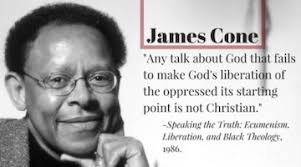
Black History Month has me rereading the late James Cone’s seminal work, The Cross and the Lynching Tree. Cone, of course, is the father of black liberation theology. I’m finding his work especially relevant to the ongoing genocide of Gazans at the hands of white supremacist Zionist Jews.

A central theme of Cone’s writing, public lectures, and teaching focuses on the difference between white versions of Christianity and their black counterpart. He puts that difference succinctly by alleging that whites have used the Bible to oppress blacks and others, while the latter have used that same Bible as a powerful tool to resist that oppression.

The ongoing slaughter in Gaza coupled with the statements of genocidal intent expressed by Benjamin Netanyahu and other Israeli officials have led me to conclude that something similar might be said of Zionists both in Israel and in the U.S. Recently they have used the Bible to ground their genocide of Palestinian children and their mothers. Meanwhile, Islamic Gazans use the Bible along with their Holy Koran to justify their (sometimes violent) resistance.

Who’s right? And what does Cone – what does liberation theology – say about such controversy?

Let’s see.

Consider first how Zionists are using the Bible. Next think about the approach of theologians like James Cone, and how the contrast between the two approaches applies to the Hamas attack of October 7th and Israel’s genocidal response in Gaza. Finally compare the oppressive violence that Zionists have used against Gazans with the violence of Hamas against their overlords. Theologians like Cone as well as his heroes Malcolm X and Martin King find the latter more justifiable than the former.   

Zionist Use of the Bible  

Consider the Zionists’ use of the Bible first.

Early on, Mr. Netanyahu invoked the biblical account of their ancient leaders claiming divine authority to carry out genocide against Israel’s archenemy, the Amalekites (I Samuel 15:1-9). The Gazans are the contemporary equivalent of Israel’s ancient foe, he said. They deserve the same fate of absolute obliteration – i.e. genocide.  

The Prime Minister’s words were turned into a war anthem adopted by the IOF (Israeli Occupation Force). They shocked the world in a video showing them singing and dancing to the words of that anthem calling for the slaughter of Gazans, today’s Amalekites.

Both Netanyahu’s words and the video of the soldiers’ rally were used recently by South African prosecutors in their presentations before the International Court of Justice (ICJ). There the prosecutors alleged that both Netanyahu’s words and the soldiers’ behavior provided convincing evidence of Israel’s intentional violations of the Genocide Convention.

On the one hand, the presentation of such evidence led the ICJ to conclude that the South African charges merit further court deliberation about Israel’s possible conviction for military actions that provide prima facie evidence of being genocidal.

On the other hand, the evidence in question (Netanyahu’s words and the IOC anthem) offers proof positive that (according to Cone’s allegations) white colonial Europeans continue to use the Bible to justify horrendous oppression of their victims.

But what about the Gazans and their use of the Bible? What does liberation theology say about that?

Liberation Theologians & The Bible

For liberation theologians like James Cone, all human beings are loved by the biblical God about whose nature there is evident difference of opinion and controversy throughout sacred scripture. That is, the Bible contains many contradictory understandings of God. In effect, it presents readers with a “battle of the gods.”

For instance, some texts present him (sic) as petty and jealous. Still other texts show him as the national God of the Jews. In that capacity, he is often a God of war like the one demanding the slaughter of the Amalekites.

The Hebrew prophetic tradition presents a very different God. He’s one who in today’s Zionist parlance might be accused of anti-Semitism. That’s because he is often highly critical and fiercely condemnatory of Israel. He frequently punishes them. On at least two occasions he allows their enemies to cart them off for generations-long exiles in Assyria (722-652) and Babylon (586-516).

Again, the prophetic tradition seconds the divine “anti-Semitic” tradition just mentioned. It’s that tradition in which Jesus appears. The Gospel narratives about him along with his preaching and parables sometimes even centralize Jewish enemies (such as “The Good Samaritan”) as heroes while condemning Jewish priests, scribes, Pharisees, and kings. With that in mind, contemporary Zionists would no doubt characterize Jesus as a “self-hating Jew.”

For Jesus, ethnic identity even became entirely immaterial. One thing alone is important, for him, love of God and love of neighbor (Matthew 22:36-40). Connections to Abraham, Jesus says, are no more significant than connections to a stone (Matthew 3: 9-10).

In fact, for the prophets in general (and for liberation theologians like James Cone), what is overwhelmingly central to morality is treatment of widows, orphans, and resident aliens. The prophets constantly remind their fellow religionists that all of them were once slaves in Egypt. They should never forget that. Accordingly, favorable treatment of slaves, aliens, widows, and orphans is the very touchstone of Israel’s identity. In fact, the prophet Jesus makes treatment of “the least of the brethren” the sole criterion of judgment about the final worth of one’s life (Matthew 25: 31-46).

Liberation theologians summarize all of this by asserting that God has made a “preferential option for the poor.” That is, when push comes to shove, and while God loves everyone, the Divine One sides with the poor and oppressed in their struggles against the rich and powerful.

For followers of the Jewish Jesus, that divine preference is evident in the fact that he chose to fully reveal himself not as a king, prince, or rich person, but in the poorest of the poor.  He surfaced in the working class as a construction worker from the nowheresville called Nazareth. He was conceived by an unwed teenage mother. In his youth, he lived as an immigrant in Egypt (Matthew 2: 13-15). He was accused of being a drunkard and a friend of prostitutes (Matthew 11:19). His family thought he was insane (Mark 3:21). He finished disgraced and a victim of torture and capital punishment.

And very significantly for James Cone, forensic archeologists point out that Jesus was probably black and unimposing. He was probably about 5’1” in height and weighed just over 100 pounds. Probably, they say, looked like the figure (below) on the left, not the familiar one on the right. To repeat, it is quite probable that Jesus was literally black. Cone affirms that he was at least figuratively or poetically black. He came from and sided with the poor and oppressed.

Liberation Theology & Violence

Furthermore, it isn’t all that clear that Jesus was a pacifist and non-violent. For instance, all Gospel lists of his apostles identify one of them as “Simon the Zealot.” “Zealot” was the name of patriots in Jesus’ Palestine who resisted Roman occupation by killing Jewish collaborators with Roman occupation. How could “Jesus meek and mild” have associated himself with murderers like that?

On top of that, all four Gospel traditions record that at least one of Jesus’ closest disciples was armed when Jesus was arrested (John 18:10-11). Jesus must have known that. Moreover, the friend in question knew how to use his weapon; he swung it at one of those who came to arrest Jesus and cut off the man’s ear.

Elsewhere, Jesus is remembered as saying, “Don’t think that I have come to bring peace, but the sword” (Matthew 10: 34-36). In another place, he says “Let the man who has no sword, sell his cloak and buy one” (Luke 22:36). And finally, as I said, Jesus was evidently perceived by the Romans as a revolutionary. In any case, they executed him by crucifixion, the means of capital punishment they reserved for violent insurrectionists. He was crucified between two other insurrectionists (not “thieves”}. Jesus must have done something(s) that gave the occupiers the impression that he was in insurrectionist too.

And that brings us back to Gaza, Hamas, and its use of violence on October 7, 2023. Would the revolutionary Jesus have supported such mayhem?

Here’s where distinctions made by liberation theologians {and by James Cone’s primary black hero, Malcolm X} come in. Malcolm was all for peace – but not in response to the oppressor’s aggression. “If someone hits you in the face,” Malcolm would say, “hit him back.” Black people have the right to defend themselves, he was fond of saying, “by any means necessary.”

Liberation theologians like Cone agree. And they go further. They teach that all forms of violence are not the same. At least one form is justifiable; others are not. So, before one can determine possible justification, one must identify its type. Four of them must be considered in any given analysis. Consider them in the context of Israel’s war against Gaza.

  1. The first type of violence is structural and is indefensible. It takes the form of elements such as laws and customs, restrictions, and prohibitions that adversely affect a given population such as inhabitants of the Gaza Strip. European colonialists’ gift of Palestine to white European Jews in 1948 was violent. It resulted in the forced displacement of Palestinians by the hundreds of thousands. Their houses were stolen or destroyed by the Jewish invaders from Germany, Poland, Russia, Lithuania, Latvia, Estonia, and even from the United States. Palestinians who resisted were often simply murdered by the invaders. Moreover, apartheid laws later imposed on Palestinians by Israel’s settler colonists are also violent. Most of the world hasn’t even recognized this structural form of violence as the “original sin” it represents. However, liberation theologians like James Cone do. This form of violence by the powerful against the powerless is never acceptable.
  2. The second type of violence is the truly justifiable violence of self-defense. This is what Malcolm referred to when he spoke of hitting back. It’s a form of violence that the UN recognizes as legitimate in Article 51 of its Charter. Accordingly, people living under occupation have the right to defend themselves against occupying forces. The latter, however, have no right to self-defense. They are robbers, thieves, and murderers. These are the convictions behind the Hamas attacks of October 7th, 2003. Liberation theologians like James Cone agree. This second form of violence is legitimate. However, its adoption is rarely wise. It can be suicidal because it leads to a third type of violence which is always overwhelming.
  3. The third type of violence is reactionary. It is the overwhelming police and military response of those imposing the first type of violence. This third type is on display at this very moment in Gaza. There cowardly Israeli occupation forces have killed more than 27,000 Gazans – more than half of them children and their mothers – in response to Hamas’ employment of the second type of violence. In this case, the response is so overwhelming that according to the ICJ, it provides prima facie evidence of genocide. Obviously, this type of violence cannot be truly justified since it represents restoration of the “order” imposed by violence’s first level. Nonetheless, in most cases such police and military violence is accepted by most as somehow normal.
  4. The fourth type of violence is terroristic. Terrorism is defined as the unlawful use of violence and intimidation, especially against civilians in the pursuit of political aims. Nation states such as Israel and the United States routinely define uprisings against their illegal occupations as “terrorism.” According to them, Hamas is terrorist while Israel and the United States stand for law and order. However, theologians like James Cone maintain that the world’s principal terrorists are states like those just mentioned. They are the ones who impose structural violence and respond with reactionary violence. Their routine murders of those defending their families, homes, and cultures against colonialism’s “legal” crimes are the primary forms of terrorism afflicting our world. By comparison, the violence of groups like Hamas (or even the perpetrators of 9/11) is minor. In other words, though terrorism is never justified, its main perpetrators are those who impose the colonialism of white supremacy in all its forms, not those who resist them.

Conclusion

Yes, the Bible’s Battle of the Gods continues to our day. All of us are involved whether we’re believers or not. But believers especially are called to make up their minds about the nature of the God they believe in and about the nature of the violence they find themselves supporting.

All of this means critical evaluation of Netanyahu’s attempts to biblically justify Zionists’ ongoing genocidal attacks in Gaza and the West Bank. Liberation theologians like James Cone contend that the Prime Minister’s invocation of a genocidal God is a typically white supremacist interpretation. As such it runs completely contrary to Israel’s prophetic tradition and its concerns for the impoverished, widows, and orphans. It runs completely contrary to the words of the Jewish prophet from Nazareth, “Whatever you do to the least of my brethren, you do to me.”

One thing we do know, in the biblical portrayal of its battle of the Gods, the God of the Jewish prophets and the Jewish Jesus is emphatically not the god of I Samuel 15:1-9.

Instead, the divine one is the God of the construction worker from Nazareth, living in a country occupied by invading Europeans, and who gave the invaders reason to believe he supported the Resistance the Romans feared and hated.

In fact, the white European occupiers hated the second level of violence so much that in the year 70 CE, they acted just like Netanyahu and his genocidal army. They reduced Jerusalem and its environs to the same condition we see in Gaza today.