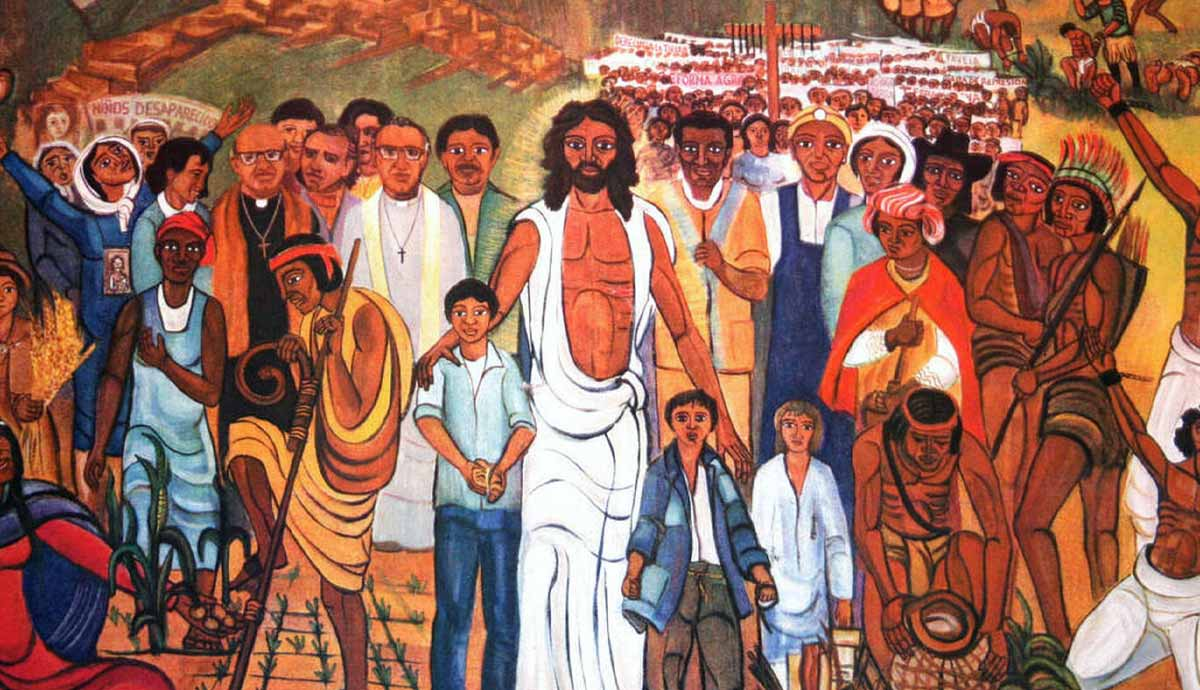
Readings for Easter Sunday:ACTS 10:34A, 37-43; PS 118: 1-2, 16=17, 22-23; COL 3:1-4; JN 20: 1-4.
Did Jesus really rise from the dead? Or is belief in a bodily resurrection no more credible than belief in the Easter Bunny or Santa Claus?
That question, provocative as it sounds, is not new. It has been quietly — and sometimes not so quietly — asked by serious biblical scholars for more than a century. And today, voices within liberation theology and critical biblical scholarship are giving us fresh ways to approach it without abandoning faith, but by deepening it.
Everything depends, as always, on what we mean by “really.”
Let’s begin where the earliest Christians themselves began — not with doctrine, but with experience.
After Jesus’ execution, his followers were shattered. Their movement appeared finished. Rome had done what Rome always does: it crushed yet another threat to imperial order. The disciples scattered, returned to their former lives, and tried to make sense of their failure. Then something happened — something unexpected, transformative, and difficult to describe.
Women in the community reported experiences of Jesus as alive.
That detail is crucial. Scholars from across the spectrum — including liberation theologians like Gustavo Gutiérrez and feminist exegetes such as Elsa Tamez — emphasize that the prominence of women as first witnesses is historically significant. In a culture where women’s testimony was legally discounted, inventing such a story would have been counterproductive. The tradition preserves it precisely because something happened that could not be denied — even if it could not be neatly explained.
But what happened?
The earliest written testimony we have comes not from the gospels, but from Paul — writing around the year 50. And Paul is strikingly clear: his experience of the risen Jesus was visionary. He saw a light, heard a voice, and interpreted that encounter as equivalent to those of earlier disciples. “Last of all,” he writes, “he appeared also to me.”
Paul never met the historical Jesus. Yet he claims equal authority because his experience was of the same kind. That fact alone has led many contemporary scholars — including figures like John Dominic Crossan — to suggest that resurrection “appearances” were not encounters with a resuscitated corpse, but powerful visionary or communal experiences of presence.
When we turn to the earliest gospel, Gospel of Mark, the pattern deepens. There are no appearances of the risen Jesus at all. The tomb is empty; a young man announces that Jesus “has been raised”; the women flee in fear and say nothing to anyone. That’s where the original gospel ends.
No appearances. No triumphal conclusion. Just silence and trembling.
Later gospels — Gospel of Matthew, Gospel of Luke, and Gospel of John — add increasingly detailed stories. But even there, something curious persists. Jesus is consistently difficult to recognize. Mary mistakes him for a gardener. Disciples walk with him for miles without knowing who he is. Others see him — and doubt.
This is not what one would expect if the point were to describe a straightforward resuscitation.
Instead, the texts seem to be grappling with an experience that exceeded ordinary categories. As N. T. Wright himself — no skeptic about resurrection — admits, the gospel accounts point to something that is neither simple physicality nor mere metaphor. The language strains to express a transformed mode of presence.
Liberation theologians push this further.
For thinkers like Jon Sobrino, resurrection is not about the revivification of a corpse, but about God’s vindication of a life committed to the poor and executed by empire. In that sense, Easter is God’s “No” to crucifixion systems — and God’s “Yes” to the victims of history.
That insight changes everything.
It means resurrection is not primarily a claim about what happened to Jesus’ body. It is a claim about what happens to history when the victims of injustice are remembered, honored, and made present again in communities of resistance.
In that light, the resurrection stories begin to make new sense.
Jesus is encountered “in the breaking of the bread.” He is present where two or three gather in his name. He is identified with “the least of these.” These are not secondary theological ideas — they are the very substance of resurrection faith.
The community discovers that Jesus is still with them — not as a corpse returned to life, but as a living presence wherever justice, sharing, and compassion take flesh.
This is why the early Christian communities described in Acts held all things in common. They were not simply remembering Jesus; they were embodying him. Resurrection was not an abstract belief. It was a new way of living — a new social reality.
A different world had opened up.
And that world stood in sharp contrast to the dominant one — the world governed by empire, market logic, and systems of exclusion. As my friend and mentor Franz Hinkelammert would later put it, the struggle is always between a system that sacrifices human beings and a vision of “a world where everyone fits.”
Easter belongs to that second world.
So does belief in resurrection require us to imagine a corpse walking out of a tomb?
Not necessarily.
What it requires is something far more demanding: the recognition that the powers of death — political, economic, and cultural — do not have the final word. It asks us to believe that life can emerge from defeat, that community can arise from despair, and that the executed ones of history are not forgotten.
It asks us to live as if that were true.
In our own time — with images from Gaza, from war zones, from systems that bury the poor under literal and metaphorical rubble — the question of resurrection becomes painfully concrete. Are those lives simply extinguished? Or do they continue to cry out, to summon us, to demand a different world?
Easter answers that question.
It says that the crucified are not gone. They are present. They are calling. They are — in a very real sense — risen.
And so the real question is not whether Jesus rose from the dead.
The real question is whether we are willing to enter the world that his followers discovered — a world beyond domination, beyond fear, beyond the logic of death itself.
A world where, against all odds, life has the last word.
That is Easter.
And that, whatever else one believes, is anything but childish.

 About Things That Matter