In Memoriam: Guy Patrick (1935-2021)

Guy (far left) posing with new homeowners in his capacity as director of Habitat for Humanity in Madison County, KY

I lost my best friend today. Guy Patrick died around 11:00 this morning, a couple of weeks after we celebrated his 85th birthday. For years, he had predicted his death “this Easter.” And then when it didn’t happen, he’d laugh and say, “I guess I’ve been given another year.”

I had known Guy for more than 40 years. Also former priest, he had a kindred monk’s spirit and was wonderful example of the deepest unshakable (though critical) faith. It let him settle for a date near Christmas rather than Easter.

I first met Guy (I forget exactly when) in the late 1970s. He was “in transition” as they say – exploring his exit from the priesthood and an anticipated move to Berea Kentucky. There, his future wife, Peggy Anibaldi (a former religious sister) had just secured employment as a head resident at Berea College where I ended up teaching all those years.

Earlier, Peggy had looked me up having got my name from the bulletin of CORPUS, a Catholic organization of ex-clergy and religious whose mission was to help members find employment and community.

I remember Guy’s Peggy visiting my Peggy and me in our home in Buffalo Holler 5 miles outside the Berea city limits. No sooner was Ms. Anibaldi inside our doors, it seemed, than my Peggy was on the phone to Ruth Butwell (the director of Berea’s residence halls) telling her of this wonderful woman who would make the perfect head resident. Ruth hired Peggy, it seemed, almost on the spot. (My Peggy is very persuasive!)  

In any case, when Guy finally joined his Peggy in Berea, we hit it off immediately. And there in my office on the 4th floor of the Draper Building, began a conversation that lasted through Guy’s final days. It was always the same: some about politics, yes, but mostly about God, philosophy, theology, church, life and death. Always the same. Always delightful. Usually over double Manhattans and popcorn. Sometimes quite animated. Never dull. I loved Guy.

And what was there not to love? He was a wise accomplished man. As he described it, his career path could be roughly divided into 10-year segments. It took him, he said:

  • From Catholic school and setting bowling pins as a kid in PA
  • To the seminary and ordination
  • To securing a degree in theology at DC’s Catholic University
  • To teaching in his diocesan seminary and later in an associated high school
  • To working as a youth minister (with Sister Anibaldi) at Mercyhurst College in Erie, PA
  • To serving as a Berea College head resident and later as a factotum at Emmaus House, an intergenerational home for the elderly which Guy’s Peggy directed as part of Fr. Ralph Beiting’s Christian Appalachian Project
  • To assuming his role as the truly legendary director of Habitat for Humanity in Madison County, Kentucky
  • To retiree status in which he continued to work for Habitat and (always with Peggy) to animate our local St. Clare’s Catholic Church until he (along with other progressive Catholics) surrendered in the face of restorationist pastors rejecting the spirit of the Second Vatican Council

Through it all, Guy retained a wonderful self-deprecatory sense of humor. A laugh or a joking remark was never far from his lips. Some of his more memorable sayings included:

  • “As my dad used to say in similar circumstances, ‘Meh. . .’”
  • “Well, we all have to be somewhere.”
  • “Organize? Hell, I couldn’t organize a two-car funeral.”
  • “They say I’m a pessimist, but I’m really an optimist. A pessimist says things couldn’t get worse. I always say, ‘Oh yes they could!’”
  • “In marrying Peggy, I was just following the advice of Martin Luther. He said ‘Every man should marry a nun.’ And that’s what I did. Never regretted it. Luther was right.”
  • “In fact, (again quoting my dad) here’s the way I’d summarize my life, ‘I loved every minute of it!'”
  • “For that reason, I like what Woody Allen had to say about death: ‘It’s not that I’m afraid of dying. I just don’t want to be there when it happens.’”

Woody Allen notwithstanding, Guy was indeed fully there when it happened. That became evident in meetings of “The Manhattan Club,” a men’s group in which 7 of us Berea types participated for years. At our meetings we each usually drank 2 Manhattans – as well as “cheating on our wives” (as guy put it) by eating non-vegetarian snacks. The conversations were always quite lively.

[And speaking of cheating on our wives. . . Guy and I loved to have our own men’s night out at Richmond’s “Golden Corral Steakhouse.” There we’d select steak, ribs, chops and roast beef from the buffet — not to mention mashed potatoes, gravy and rich dessert samples. Then we’d waddle across the street and bowl a few lines at the alley that always evoked stories about his boyhood days setting pins. (Guy was a good bowler and quite the competitor.) We’d finish at the bowling alley bar for a nightcap.]

But towards the end, our evening Manhattan Club gatherings switched to mornings with coffee. And week by week, we witnessed Guy’s health decline. Nevertheless, he always had reflections to share as well as gallows humor about his approaching end. To the very last he was reading Plato, Thomas Merton, and the postmodernist, Jacques Derrida. Guy went out puzzling over Derrida’s reflections on “the gift of death.”

And at our final Manhattan Club meeting with him, guess what Guy talked about? He was full of recollections of his 6 months spent in Americus GA with the great Millard Fuller, the founder of Habitat for Humanity. He expressed his intention to make one more appeal to his friends to contribute generously to the organization in his memory.

His final sentiments were characteristically prayerful. “After all of this,” he said, “my only prayer is ‘Oh God, be merciful to me, a sinner.’ Along with that, it’s just ‘Thank you.'”

That’s the kind of Guy he was.

A Blessing for Guy Patrick

Just before he left us, our men’s Manhattan Club met via Zoom to say a formal farewell to Guy. I was asked to give a final blessing. As we all extended our hands, this is what I prayed:

 I give this blessing
 In the spirit of the conversations
 All of us have shared
 Over the years
 When we debated questions of life, meaning
 God, and destiny.
 Those were intellectual,
 Head-centered conversations
 Full of laughter and joy.
 We absolutely loved them!
  
 At this important moment however,
 Let’s set all of that aside
 And enter the depths of our hearts.
 Let’s embrace the wisdom of sages
 Who throughout the millennia
 (Along with Guy)
 Have insisted
 That what awaits us all
 Beyond the threshold humans call “death”
 Is the fulfillment of everything
 That any of us can hope for or desire.
  
 Please enter that realm with me now.
 (Pause)
  
 Guy, we bless you
 At this transcendent moment.
 We send you with all our hopes
 On your way –
 Onto the path that all of us must trod.
 We send you into the realm
 Of all the wise people who have ever lived –
 Of angelic beings and light beings
 The realm of our Father-Mother God.
  
 Please know that
 You take with you
 Everything positive, holy,
 Constructive and good -- 
 Every holy thought, word and act
 That has ever crossed your mind,
 Your lips and your heart.
 (There are so many of them
 That you yourself
 Have blessed us with.)
  
 Go in joy, confidence, assurance
 And peace
 Knowing that we are with you in spirit.
 Ours is one of gratitude
 For the blessed life you have lived
 For the lives you have changed
 For the students you have inspired
 For the homes you have constructed
 For the love you have shared
 With Peggy, Gina, Anna, their babies
 With the rest of us
 And so many, many more.
  
 You have especially blessed this group of men
 Who now return the favor.
 You are our brother, our friend, our companion,
 And our inspiring conversation partner.
 You have been our priest, dear Guy
 You have always been that
 And will remain so
 Forever.
  
 (Dare I say it?)
 Yes, I will:
 Behold the Great Priest
 Who in his days pleased God!
 “Ecce sacerdos magnus 
 Qui in diebus suis placuit deo”.
  
 Thank you so much
 For all of that,
 For your wonderful life
 And for showing us
 So marvelously
 How to die.
  
 Go in peace, dear beloved brother.

Epiphany: How Small-God Christians & Jews Reject Arabs’ Immense Cosmic Deity

Readings for Epiphany Sunday: Is. 60:1-6; Ps. 72: 1-2, 7-8, 10-11, 12-13; Eph. 3:2-3a, 5-6; Mt. 2: 1-12

Over the past four years, we’ve heard repeated ad nauseum:

  • Make America great again!”
  • “God bless America – land of the free and home of the brave!”
  • American Exceptionalism.
  • “U.S.A., U.S.A.!”
  • “America’s the greatest country in the world.”
  • “America’s the world’s indispensable nation.”
  • Collin Kaepernick and others should stand for the national anthem.

Additionally (and poignantly on this Epiphany Sunday and its celebration of “Wisemen”) our “leaders” have decided to ignore the world’s best and wisest minds by rejecting climate science and its warning about the greatest threat the human race has ever faced.

None of this is new, of course. Hyper-patriotism and rejection of wisdom have been the order of the day for much longer than the duration of the Trump presidency.

And it has its religious dimension as well: it’s as if American Christians actually believe that God is somehow opposed to the order of creation that S/he allegedly authored. It is as if S/he loves Christians more than Syrians, Mexicans, Iraqis, or Ethiopians. It’s as if God loves Christians more than Muslims, Hindus, Buddhists or Jews.

Witness Michael Flynn, Donald Trump’s disgraced and recently pardoned National Security Advisor. He once described Islam itself and its 1.7 billion followers as a “vicious cancer” that has to be excised. In Flynn’s little mind, the wisdom of that Great Religion is completely ignored.

Even “liberals” like comedian, Bill Maher, are not far behind Flynn in their vilification of Muslims.

Ignored in all of this is the fact that the famous “Three Wise Men” of Matthew’s well-known parable were probably the ancestors of Arabia’s Muslims. In any case, they had a much broader understanding of God and the cosmos than Yeshua’s own people. For sure, Judaea’s King Herod shared Flynn’s and Maher’s constricted views of their seekers’ mentality as dangerously malignant.

Epiphany’s Message

The message of today’s celebration of Jesus’ Epiphany contradicts everything I’ve just described – the hyper-patriotism, the rejection of science, the othering of foreigners, and any attempt to fit the divine into narrow religious categories. Today’s readings challenge Yeshua-followers to grow up – to transcend our blind ethnocentrism, expand our horizons, recognize the immensity of the Life Force some call “God,” and at last become citizens of the world.

Remember: the word “epiphany” means the appearance or manifestation of God – a revelation of who God really is. Accordingly, today’s feast recalls the time when wisemen from the East recognized in Yeshua the long-awaited manifestation of the Universal God announced in today’s reading from the prophet Isaiah. Isaiah and today’s responsorial Psalm 72 tell us clearly that God is not what ethnocentric believers expected or even wanted. S/he loves everyone equally, not just Jews, much less Americans.

That’s part of why Herod “and all Jerusalem with him” were “troubled” when they unexpectedly met the travelers who were seeking the world-centric and cosmic-centered manifestation of God that Isaiah had foreseen. The God Herod and the Jerusalem establishment knew was like the one worshipped by America-firsters. He loved and favored Jews, the Hebrew language, and the Holy Land. He was pleased by Jewish customs and worship marked by animal sacrifice and lots of blood.

So, Herod and Jerusalem were “troubled” when the foreigners came seeking the Palestinian address of a newborn divine avatar. The astrologers claimed that the very cosmos (the Star!) had revealed God’s Self to them even though they were not Jews. Evidently, the wise men had cosmic-centered consciousness. They realized God not only transcended themselves and their countries, but planet earth itself. All creation somehow spoke of God.

Today’s selections from the prophet Isaiah, Psalm 72, and Paul’s letter to the Ephesians agree with the Wise Men. All of them speak of a Divine Being who is universal, not belonging to a particular nation or religion. This God is recognizable and intelligible to all nations regardless of their language or culture. The Divine One brings light to the thick darkness which causes us to limit God to privileged nations, races, and classes. The universal God brings peace and justice and champions of the poor, oppressed, lowly and afflicted. The newly manifested deity leads the rich (like the three astronomers) to redistribute their wealth to the poor (like Jesus and his peasant parents). This God wants all to have their fair share.

Matthew’s story says that Yeshua manifested such a God. Yeshua was the complete revelation of the God of peace and social justice – a world-centered, a cosmic-centered God.

Herod’s and Jerusalem’s response? Kill him! A universal God like that threatened Jerusalem’s Temple and priesthood. The Epiphany meant that such a God was not to be found there exclusively. This God would not be tied down to time or place. What then would become of priestly status, temple treasure, the Jerusalem tourism industry?

Epiphany also threatened Herod’s position. Recognizing a divinity who led the rich to transfer their treasure to the poor threatened class divisions. A God on the side of the poor would embolden the lazy and unclean to rebel against those who used religion to keep the under-classes in line and resigned to their lot in life.

No, there could only be one solution: ignore the Star’s cosmic message, present a friendly face to these stupid foreigners, derive the crucial information from them, and then kill off as many impoverished babies as possible hoping in the process to stop God’s threatening, unacceptable Self-disclosure.

Today’s Readings

All of this is expressed in this Sunday’s readings. What follows are my “translations.” The originals can be found here.

 Isaiah 60: 1-6
 Yes, God’s revelation has enlightened you, Jerusalem!
 It has been like a bright sun piercing dark clouds.
 But know that same light has also graced
 Other nations
 Making their inhabitants your own brothers and sisters.
 Please, embrace that
 Disclosure of God’s immensity!
 The resulting collapse of national barriers
 Will enrich you beyond your wildest dreams
 As all the earth’s treasures are shared
 Among members of a Single Human Family.

 Psalm 72: 1-2, 7-8, 10-13
 Thankfully (though very gradually)
 The human race is coming to realize
 That there is but a single God
 Whose overriding concern is social justice
 As it affects the poor and oppressed.
 In fact, God’s will
 Is the redistribution of wealth
 Across fictitious boundaries.

 Ephesians 3: 2-3a,5-6
 Jesus himself taught that lesson
 As if for the first time:
 All of us, Jews and Gentiles
 Are members of a single body.
 Living by that teaching
 Will bring God’s New Order where
 (He said)
 God reigns
 Instead of earth’s Caesars.

 Matthew 2: 1-12
 Recognizing God’s immensity
 Manifested in the very cosmos,
 Arab astrologers
 Accepted Yeshua’s universal revelation
 Not only before his own people,
 But despite the plot of religious leaders
 To deny and annihilate
 Its Messenger.
 Ironically, Arabs were more open
 To God’s Self disclosure
 Than those who considered themselves
 God’s people!
 (Doesn’t the same seem true today?)

Conclusion

Symbolically (and lamentably), Herod’s and Jerusalem’s response to the “troubling” cosmic consciousness of the Eastern wise men mirrors that of our culture and church. Both keep us at the stage of childish ego-centrism – or at best, at the stage of ethno-centrism, which makes us see the other and the other’s God as somehow foreign and threatening.

Both culture and immature beliefs prevent our inner child from growing up. Ironically, that’s somehow related to infanticide. It’s a form of psychological murder that freezes us at childish stages of consciousness and so prevents us from developing along the lines centralized in today’s celebration of Epiphany.

Epiphany calls us to wake up – to grow up and to return home as the Magi did “by another way” that was not the way of ethnocentrism, wealth, power-over or cooperation with kings, priests and empire.

Christmas Reflection: Mike Pence’s small god vs. Jesus’ Big God

Last Sunday, I offered an Advent reflection on the long history of what Chilean scripture scholar, Pablo Richard, has called “the battle of the gods” that is mirrored in the biblical texts themselves. It’s a battle of the God of the Rich (like David and Solomon) against the God of the poor (like Yeshua himself).

Or as OpEdNews (OEN) editor-in-chief, Rob Kall reminded me: it’s a struggle between what I had previously called the small, exclusive, national god of empire versus the big all-embracing God of prophets both ancient and contemporary – like Gandhi, King, Badshah Kahn, and Dorothy Day. That Big God cares especially for the poor who happen to constitute the vast majority of people in the world. That deity’s spokespersons have harsh words for the rich.

Mike Pence’s small god

Apropos of all that, just three days before Christmas, Vice President Mike Pence, a self-proclaimed and especially fervent follower of Jesus, gave a revealing speech at a Turning Point USA event in West Palm Beach Florida. (Turning Point is a Republican group claiming a membership of more than 250,000 conservative students across 2000 U.S. campuses.) There, in terms lauding the Trump administration, Pence defended the small god of the rich – a national god who stands on the side of the wealthy. More than once, his audience enthusiastically responded “USA, USA, USA” as if our country’s borders constituted the full swath of divine concern.

In the course of his speech, Mr. Pence complained that his party’s opponents “. . . want to make rich people poor, and poor people more comfortable.”

He also alleged that “It was freedom not socialism, that gave us the most prosperous economy in the history of the world. It was freedom not socialism that ended slavery, won two World Wars and stands today as a beacon of hope for all the world.”

Connecting his words specifically with Christmas, the vice-president urged his young audience to “take a moment to be still, and if you’re inclined, this is what we do at my house come Christmas morning, take a moment to reflect on the grace that came to mankind, wrapped in clothes (sic) and lying in a manger so many years ago.”

Though Mr. Pence’s words correctly invite us to reflect on what came to us in that manger so many years ago, they expressly contradict the God revealed in the original Christmas event – especially in relation to socialism and treatment of the poor.

Yeshua’s Big God

The contradiction becomes clear from consideration of the fundamental Christian belief celebrated across the world during the Christmas winter festival. It’s the belief that God elected to disclose divine reality precisely in conditions of extreme poverty. The revelation came in the child of poor parents who had been forced into a long dangerous journey for purposes of taxation by a hated imperial government in the dead of winter. Of course, we’re talking about the Jewish family from hovel-filled Nazareth, Yosef, Miryam, and their firstborn, Yeshua.

(Note that according to the belief in question, everything the God does is revelatory. So, it is significant in itself that the divine revelation did not take place in a palace, a temple, nor among wealthy aristocrats. Instead, it took place in a smelly, vermin infested barn where the child’s parents – too poor to pay for a hotel and refused lodging by locals – were compelled to give birth in dangerous extremely unsanitary conditions.)

Moreover, according to the story, the child in question:

  • Lived his entire life in poverty.
  • Barely escaped infanticide by the state and consequently lived for years as an immigrant asylum seeker in Egypt (Matthew 2: 13-15).
  • As an adult, continued to be houseless (Luke 9:58, Matthew 8:20).
  • Even lacked money to pay taxes (Matthew 17: 24-27).
  • Ended up poorer still than when he began: on death row, stripped naked, a victim of torture and capital punishment by his era’ worldwide imperial state that evidently thought of him as a terrorist (as shown by his crucifixion – a method of execution reserved for insurgents).

Even more to the point and according to his own description, the entire point of Yeshua’s life’s work was to alleviate poverty. Quoting his people’s revered prophet Isaiah, here’s the way he described his very program in Luke 4: 16-22: “The Spirit of the Lord is on me, because he has anointed me to proclaim good news to the poor. He has sent me to proclaim freedom for the prisoners and recovery of sight for the blind, to set the oppressed free, and proclaim the year of the Lord’s favor.”

Please note that those words identify God’s Self – God’s very Spirit – as essentially concerned with the poor, with those blind to poverty’s existence, with prisoners and the oppressed. As Michael Hudson has pointed out in his magisterial . . . And Forgive Them Their Debts, Yeshua’s “good news” (his gospel) was about cancelling the loans of the heavily indebted peasants in the Master’s audience. As he said specifically, it was essentially about wealth redistribution (Luke 18: 22, 23, 28-30). No wonder he was so popular with those living on the edge.

Subsequently and besides:

  • Yeshua spent his life setting up free field health clinics, feeding the hungry gratis whether from his own people (Mark 6: 30-44) or not (Mark 8: 1-21), while rehabilitating the citizenship of the socially despised and marginalized.
  • After his death, his followers demonstrated their understanding of his teaching by adopting a style of living that embodied a form of Christian socialism, not to say communism. Again, it centered on wealth redistribution. As Luke describes it in his Acts of the Apostles: “All the believers were together and had everything in common. Selling their possessions and goods, they shared with anyone who was in need” (Acts 2:44).
  • The Christian Testament’s only description of the final judgment completely bases it on sharing resources with the houseless, hungry and naked, as well as with those the state has imprisoned, “Truly I tell you, whatever you did for one of the least of these brothers and sisters of mine, you did for me” (Matthew 25:40).
  • Those who neglected such people suffer ipso facto exclusion from eternal joy, because “. . . whatever you did not do for one of the least of these, you did not do for me” (Matthew 25: 45).
  • During his life, Yeshua had extremely harsh words for the rich for whom the final judgment would be so negative. He said, “But woe to you who are rich, for you have already received your comfort. Woe to you who are well fed now, for you will go hungry” (Luke 6: 24-26). Such words understandably give hope to the poor and should make us who are well-off examine our consciences at this Christmas season.

Conclusion

Such introspection was entirely absent from Mr. Pence’s reflections before his young impressionable audience. Instead, what he said amounted to a defense of the small god of the rich whom Yeshua’s teachings (just reviewed) show has everything to do with comforting the already comfortable while denigrating the poor.

Instead, Yeshua’s authentic teachings constitute a message of hope and encouragement precisely for the poor and hungry while making the rest of us salvifically uneasy.

So, Christmas properly understood is not a time for self-congratulation nor for overlooking what was revealed in a prophet’s life bookended by houselessness and capital punishment.

It is a call to free health care along with housing and food for everyone. It’s a summons to debt forgiveness, wealth redistribution, socialism, and eliminating poverty as well as empire and differentiating wealth.

That’s the good news of Christmas – for the poor, not for Mr. Pence and the rest of us.

David and Solomon’s Crime Family Was No Better than Trump’s

Readings for the 4th Sunday of Advent: 2 Samuel 7: 1-5, 8B-12, 14A, 16; Psalms 89: 2-5, 27, 29; Romans 16: 25-27; Luke 1: 38

In terms of teaching theology and elucidating the Bible, I’m happy for our nation’s experience of Donald Trump. Otherwise, not so much.

The reason for my contentment is Mr. Trump’s blatant exploitation of religion and his ability to persuade so many people of faith that he is a man of God. Think of his now infamous Bible posing in front of DC’s St. John’s Church after having police clear the area of Black Lives Matter protesters.  

The event clearly illustrated a perennial religious dynamic that is essential for critical thinkers to understand. I’m referring to what Chilean scripture scholar, Pablo Richard, calls the “battle of the gods.”

The Battle of the Gods

The combat in question pits the God of the rich against the God of the poor. Specific to our readings on this fourth Sunday of Advent, it sets the God of Moses against the God of King David’s crime family. Yes, his crime family.

To begin with, the God of the poor set free a motley group of slaves from Egypt and instituted Moses’ order that favored them rather than their Egyptian slavers. Its “preferential option” prioritized the interests of widows, orphans, and resident non-Hebrews living in Israel. Covenant law eventually forgave the debts of impoverished Hebrews every fifty years. In the process, it disadvantaged landlords and bankers. It made no provision for reestablishing the royal class that had made the lives of slaves so miserable in Egyptian captivity.

Then about a thousand years before the birth of Yeshua, all of that changed. Israel’s upper classes decided to reinstitute an order reminiscent of Egypt. It had the rich lording power over the poor, taxing them heavily, instituting forced labor, and sending Israel’s young men to fight and die in gratuitous wars of conquest as conscripts in a standing army.

Saul was Israel’s first king. He was succeeded by King David and then by his son, Solomon. Both father and son were ruthless womanizers committed to increasing their own wealth and power at the expense of the poor. Theirs was truly a crime family masquerading as God’s beloved appointees.

Family dysfunctions included internecine murders and wars, incestuous rape (2nd Samuel 13) and lasting vendettas. David’s deathbed will and testament was worthy of any Mafia don (I Kings 2: 2-12). However, to achieve the power for which they thirsted, both David and Solomon had to convince their subjects that they were indeed men of God.

That called for fabricated visions and assurances from the divine. Both David and Solomon assisted by their court prophets and scribes enthusiastically obliged. And so, David made sure it was recorded that he was a man “after God’s own heart” (I Samuel 13:14). Meanwhile, Solomon’s own court historians portrayed him as the wisest man who ever lived (I Kings 3: 11-15).

Central to the ruse was a reframing of Moses’ Sinai Covenant to favor the newly emergent royalty and their hangers-on rather than the poor. That’s what we find in this Sunday’s first reading from 2nd Samuel. There, David and his court prophet, Nathan, conspire to change the beneficiaries of the Mosaic Covenant from the poor and oppressed to the royals. In this way, the covenant becomes not a divine promise to protect widows and orphans, but to assure a lasting dynasty for David’s crime family. Put otherwise, the Covenant of Moses was replaced by the Covenant of David.

The great prophets of Judah and Israel rebelled against such palace distortions of faith.

Some tried to work within the new system holding kings’ feet to the fire, reminding them of their obligations towards the weak and vulnerable. Others gave up on the royals and called them out for their self-serving cruelty and corruption.

The great prophets celebrated during this advent season, John the Baptist and his disciple Yeshua of Nazareth, fell into the latter category. They had no use for the royals, the temple priests, their lawyers and apologists. They reserved special abhorrence for their country’s Roman occupiers.

Evidently, Yeshua inherited all of that from his mother, Miryam. She and her husband, Yosef, gave all of their children revolutionary names (Matthew 13: 55-56). Yeshua was named after the great liberator Joshua. The evangelist called “Luke” recorded Miryam as singing a fierce revolutionary song calling for the dethronement of the rich and mighty everywhere (Luke 1: 46-55).

All of that is reflected in today’s readings. What follows are my “translations.” You can find them here to see if I got them right.

Readings for 4th Sunday of Advent   

2 Samuel 7: 1-5, 8B-12, 14A, 16: The wily King David conspired with his court prophet, Nathan to persuade their people that God was on his side. The strategy was to build a magnificent temple (actually about the size of a middling parish church today) and then to claim a well-publicized “vision.” There, according to Nathan’s testimony, David’s battlefield accomplishments would be celebrated by God himself. But even more importantly, his country’s constitution (called “The Covenant”) would be subtly changed from centering on the welfare of widows, orphans, and immigrants, to assuring that David’s crime family would stay in power forever. 

Psalms 89: 2-5, 27, 29: The arrangement was then celebrated in song (Psalm 89) praising the goodness of God for establishing David’s throne “for all generations.”

Romans 16: 25-27: Paul’s allegiance, however, was not to any earthly king, but to what Yeshua proclaimed as the Kingdom of God. It embraced the welfare of “all nations.” Following Yeshua, Paul’s understanding re-established the pre-Davidic Covenant (favoring those widows, orphans, and immigrants) which David’s Covenant (in its hijacked form) had attempted to replace.

Luke 1: 38: Vaguely following the example of David, Luke’s early church made up a visionary tale about Yeshua’s very conception. There, the angel Gabriel secures Mary’s permission to have the Holy Spirit impregnate her. The resulting child will be great, the angel said, and (like David) initiate a kingdom to which “there will be no end.” However, Yeshua’s New Covenant would once again centralize not the royal class, but Yahweh’s beloved widows, orphans, and immigrants. As Mary would say beginning eight verses later (LK 1: 46-55), it would “take down the mighty from their thrones and exalt the humble.” So much for palace crime family conspiracies.

Conclusion

So, portraying the Trumps, or Bushes, or Clintons or Kennedys or Obamas as “crime families” is not at all far-fetched or somehow unchristian. On the contrary, insofar as any of them neglect the poor – the widows, orphans, immigrants, asylum seekers, or victims of their wars – they are just that. They’re like the criminal family of David and Solomon.

Yes, they go to church, invoke God’s blessings on America at the end of every formal speech, and even attend “prayer breakfasts.” But like David and Solomon (and most of the kings portrayed in the Bible), they are really in bed with the rich and powerful, with the bankers and corporate heads, and with compliant pastors, priests and court prophet equivalents. At best, they are completely disinterested in the spiritual descendants of Egypt’s slaves. At worst, they are actual enemies of workers, widows, orphans, immigrants as well as of those who side with the unemployed, houseless, and those without medical care.

In summary, this fourth Sunday of Advent provides a stark reminder to critical thinking people of faith. It tells us not to be seduced by Bible-waving presidents or by pastors who endorse them and their God of the rich.

Neither Yeshua whose birthday we are about to celebrate nor his cousin John nor his revolutionary mother had anything to do with that God. Before him, they were all complete atheists. So should we be.

Their God was the God of Moses, not of David. Their God was precisely the one rejected by the rich and the powerful – the One who Miryam said “puts down the mighty from their thrones and exalts the humble,” who “fills the hungry with good things, while the rich he sends empty away” (Luke 1: 53). 

Under the Radar and at Warp Speed Cuba Leads Latin America Towards Affordable Covid-19 Vaccines

Recently Amy Goodman’s “Democracy Now” explored “The Case for People’s Vaccines.”

While those interviewed by Ms. Goodman called for early and affordable access to inoculations in the Global South, no mention was made of perhaps the most promising source of such therapies. The neglected source was not only promising, but implicitly revealed the swindle represented by Big Pharma’s anticipated exorbitant prices for Covid-19 vaccines.

It may surprise readers to know that the source in question is Cuba.

Cuba’s Achievement

In fact, Cuba is the first nation in Latin America to receive authorization from the World Health Organization (WHO) to perform officially sanctioned tests of the four vaccines it now has under development. Those trials have already completed their clinical stages. Promising results so far have Cubans looking forward to completing the (cost free) inoculation of its entire population of 12 million by the end of March 2021.

The vaccines under trial are named Soberana 01, Soberana 02, Abdala (CIGB66) and Mambisa (CIGB669). None of them is dependent for its preservation on super-cold temperatures.

Mambisa is worthy of special note, since as a nasal spray, it requires no needles, but responds locally to the specifically respiratory nature of Covid-19.   

Failure to report such developments even on “Democracy Now” illustrates the complicity of our mainstream media in shunning any news from socialist nations like Cuba that might possibly illustrate the superior ability of their economies to deliver high quality, no-cost healthcare to citizens even during a worldwide pandemic. Moreover, absent the profit motive, Cuba will predictably deliver its vaccines to its neighbors at vastly cheaper prices than its capitalist counterparts.  

Cuba’s Vaccine History

This prediction is based on the fact that Cuba has long been a supplier of vaccines and doctors not only to the Global South, but to countries such as Italy during the height of Covid-19’s first wave. Additionally, with its unequaled ratio of doctors to citizens, the island nation’s response to the pandemic has effectively limited documented coronavirus infections despite supply problems caused by the continued U.S. embargo of the island.

All four developments (the superabundance of doctors, the relative control of Covid-19, Cuba’s research capacities, and the export of medical care to other countries) result from the foresight and vision of Fidel Castro, the revered father of his country. In the early 1980s he sparked initiation of a vigorous homegrown biotech sector – largely to cope with the U.S. embargo’s persistent attempts to deprive the island of medical supplies.

The result was the emergence of 20 research centers and 32 companies employing 20,000 people under the umbrella of the state-run BioCubaFarma Corporation. Recently, spokespersons connected with the corporation tweeted, “The #CubanVaccineCOVID19 is dedicated to the sower of dreams: Fidel. Our tribute to the one who believed in the strength and future of #CubanScience.”  

BioCubaFarma produces 8 of the 12 vaccines Cuba uses to immunize its own population against diseases such as measles and polio. Cuba has also exported hundreds of millions of vaccine doses to more than 40 countries (e.g. to deal with meningitis and hepatitis B).

Conclusion

All of this represents just one more illustration of socialism’s comparative efficiency in the face of crises like the COVID-19 pandemic. Even a poor blockaded country like Cuba can respond to an unprecedented crisis such as the coronavirus without holding sick people hostage to the confiscatory demands of privatized natural monopolies like Big Pharma. The latter’s claims to mammoth profits based upon (largely government-funded) costly research are simply ideological cover for overweening corporate greed that none of us should stand for.     

People’s vaccines can be produced at warp speed and at low cost – despite news blackouts even on “Democracy Now.”

Debt Amnesty Now: The Heart of Jesus’ Good News

Readings for the third Sunday of Advent: Isaiah 61: 1-2A, 10-11; Luke 1: 46-48, 49-50, 53-54;       I Thessalonians 5: 16-24; John 1: 6-8, 19-28

As most are aware, U.S. students currently owe bankers and creditors more than $1.5 trillion. Progressives like Bernie Sanders and Elizabeth Warren want that debt written off. Their opponents however wonder what would be the economic impact of such debt forgiveness? Wouldn’t it spell disaster for the nation’s economy and for banks “too big to fail?”

Economic historian and ex-Chase Manhattan analyst, Michael Hudson answers those questions in ways intimately connected with the readings for this Second Sunday of Advent. He does so in his magisterial study, …and Forgive Them Their Debts: lending, foreclosure and redemption from Bronze Age finance to the jubilee year.

Written in the face of massive worldwide indebtedness far beyond that of U.S. students, the book’s basic thesis is that debts that can’t be paid won’t be paid. So, the only solution is to write off those obligations.

Far from spelling disaster for the world’s economies, Hudson says such amnesty would rejuvenate them. completely.

How does he know?

Because debt amnesties were standard procedure throughout the history of the ancient Near East from 2500 BC in Sumer to 1600 BC in Babylonia and its neighbors. During that long period, it was the common practice for new rulers to proclaim debt jubilee on the day of their ascension to the royal throne. As seen in the Bible’s Book of Leviticus 25, Israel adopted that practice when its ruling class returned from their “Babylonian Captivity” in the 6th century BCE.

And the result?

Uniformly, Hudson says, it was shared prosperity and the prevention of huge wealth differentials between rich and poor. According to Hudson, the same result can be expected if debts were forgiven today.

The Bible & Debt Forgiveness

And that brings us to our readings for this Third Sunday of Advent. They’re all about a central pillar of Jewish social organization and profound spirituality. I’m referring to debt forgiveness and its “preferential option for the poor.”

As seen in Leviticus 25 and in the words of the prophet Isaiah in today’s first reading, the very word “gospel” (“good news” in Isaiah’s words) is assigned to the proclamation of “Jubilee” – the Jewish Testament term for the periodic practice of wiping debt slates clean every 50 years. That custom borrowed from the Babylonians (and others) prevented oligarchies from using debt as a lever to pry land ownership and other forms of wealth away from impoverished debtors.

In other words, Jubilee was an expression of a divinely structured economy whose ideal (unlike our own) prioritized the welfare of widows, orphans, and resident foreigners. That bottom-up arrangement is what I mean by “preferential option for the poor.”

Yeshua & Debt    

Such preference constituted the emphasis in the work of the prophet, Yeshua of Nazareth as well. As a populist leader in the 1st century CE, he made debt amnesty (Jubilee) a central focus of his public platform. Mainstream scripture scholarship has identified such focus in what it terms Yeshua’s “programmatic” declaration in the Gospel of Luke 4:16-30. Quoting our first reading directly, he is remembered as saying:

18 “The Spirit of the Lord is on me,
             because he has anointed me
            to proclaim good news to the poor.
He has sent me to proclaim freedom for the prisoners
    and recovery of sight for the blind,
to set the oppressed free,
19     to proclaim the year of the Lord’s favor. . .”[a]
 20 “Today this scripture is fulfilled in your hearing.” 

Yes, the Master’s principal concern was about the economic and social welfare of the poor. The words “the year of the Lord’s favor” are synonymous with Jubilee.

Today’s Readings

To get a better idea of what I’m saying, please read today’s liturgical selections directly as found here. My “translations” run as follows:

Isaiah 61: 1-2A, 10-11: A Jubilee year! Debts forgiven! Interest payments written off! Here is good news for the poor whose captive hearts are broken in their miserable debtors’ prisons – reminiscent of their ancestors’ captivity In Babylon. It is all a matter of divine justice, salvation and overwhelming joy – like a wedding celebration where both bride and groom, once poor, are now adorned with splendid jewels.

Luke 1: 46-48, 49-50, 53-54: Jesus’ mother shared that nuptial joy. Though dirt poor like her husband and son, she thirsted for the promised Great Reversal. There the hungry would be well fed, while the rich would at last experience a well-deserved famine. What happiness for the vindicated poor in God’s New Order of justice!

I Thessalonians 5: 16-24: Paul shared Mary’s happiness revealed in her son and by the prophets before him. While the rich despise prophetic proclamations of God’s reckoning, the poor cherish them word for word. They know the prophetic arc of justice bends in their direction.

John 1: 6-8, 19-28: Such was the message of John the Baptist too. Justice at last, jubilee for the poor! The light surrounding the man was so bright that even corrupt religious leaders mistook him for the reincarnation of Elijah himself –or maybe the promised messiah. But no, said John; he was merely a voice proclaiming God’s just path that all are called to trod. His baptism of mere water would be displaced by Yeshua’s social and spiritual revolution of raging fire. Jubilee for the poor at last!!

Conclusion

All of this might seem like ancient history. However, it’s really common sense that is extremely relevant to the issue of writing off the world’s unpayable debts in general and student loans in particular. These considerations also tell us a lot about distortions of Christianity to the point of complete irrelevance.

Regarding loans, Hudson teaches that periodic debt forgiveness (as in Jubilee) is absolutely necessary to correct the dynamics of borrowing and lending. It’s a matter of simple math. Compound interest grows exponentially; incomes increase linearly. As a result, debt will always outrun income.

Consequently too, debts that can’t be paid won’t be paid. Requiring the impossible hamstrings any economy. It robs consumers of spending power. They can’t buy homes and other goods that keep markets humming.

(This was demonstrated in post-WWII Germany. There, in contrast to the aftermath of WWI, German debts were for all practical purposes forgiven. An economic “miracle” followed.)

As for Christianity in relation to all of this . . .  Scripture scholars tell us that the lives and concerns of Yeshua’s people were principally three: (1) foreign (Roman) occupation, (2) land reform, and (3) debt forgiveness. That the Master addressed all of these problems directly in accord with the divine “preferential option for the poor” accounts for his wild popularity among the peasant farmers who constituted his audience of focus.

In this he separated himself from Rabbi Hillel and the Pharisees who rejected wealth redistribution through Jubilee. His separation eventually led to his arrest, torture, and submission to a form of capital punishment reserved for rebels against the Roman Empire.

This, however, is not the picture the Christ that most of us carry around in our minds. There, as Hudson points out, Jesus’ resonance with the material concerns of his people has been transformed into insipid spiritual platitudes that would never have made him a threat to the religious leaders of his day, much less to the Roman Empire.

Restoring any relevance to Christianity in our contemporary world hinges on recovering the radical Jesus of history and his connection with issues like debt forgiveness of student loans. It also hinges on our willingness to stand up for the debt-impoverished (ourselves!!) – despite empire’s vile threats.    

Christmas Is Blasphemy: Put Mithra Back in Xmas

Now that we’re in the Christmas season, I thought it might be time to reprint some Xmas reflections from the past. Here’s one that, though obviously dated, still applies. I published it first in 2016.

Last year at this time, two very different religious leaders – one considered left of center, the other a fundamentalist preacher – converged in agreement about the meaninglessness of Christmas. They both concurred: except as a secular winter festival, Christmas is religiously meaningless.

On the left, Pope Francis called the Christian world’s upcoming Christmas celebration a “charade.” He said there’d be parties, gift exchanges, and family gatherings in the name of celebrating Jesus’ birth, but it would all be absurd pretense.

That’s what charade means: an absurd pretense intended to create a pleasant or respectable appearance.

And the pope was right. Starting around Thanksgiving, so-called Christians pretend to honor “the Prince of Peace” – the one who took no one’s life, but sacrificed his own rather than take up arms — who was himself a political refugee – conceived out-of-wedlock – brown-skinned, poor, and living under imperial occupation – the one who would be a victim of torture and capital punishment – who was all the things that good Christian supporters of Donald Trump and of the U.S. War on Terror hate and despise.

That’s right. our culture despises Jesus and all he really stands for.

And that’s where the fundamentalist preacher comes in.  He agrees with the pope – well kind of.

About the same time Pope Francis was talking charade, Rev. Joshua Feuerstein, denounced Starbucks for hating Jesus. The good reverend was outraged by the coffee giant’s holiday cups which display no specific reference to Jesus. That’s a sign, Feuerstein said, that Starbucks agrees with the movement to remove Christ from Christmas. Starbucks hates Jesus. So let’s boycott Starbucks!

On the one hand, could anything be more absurd? The world is burning. Our way of life is destroying God’s creation. Our country is waging war against the poor everywhere – in Afghanistan, Iraq, Libya, Yemen, Somalia . . . We supply weapons to all sides in the endless war our “leaders” have declared. And our man was worried about Starbucks’ drinking cup! He denounced Starbucks for simply recognizing what is: Jesus has long since been removed from Christmas.

On the other hand, there was wisdom in Rev. Feuerstein’s accusations. And it’s not just Starbucks that “hates Jesus;” it’s our entire culture – including our churches. In that sense, Feuerstein agrees with Francis. However, hating Jesus has nothing to do with coffee cups. As I said, it means despising those Jesus identified with in the Gospel of Matthew (25:31-46) – the poor immigrant refugee from our endless bombing campaigns, the hungry street person, the homeless beggar, the imprisoned desperado, the coatless person we pass on our way into Starbucks.

So what to do to avoid making this Christmas an empty charade?

We can start by recognizing that Christmas is a winter festival and nothing more. Every culture has them. They are times for ice sculptures, bright lights, reunions with family, for feasting, drinking, parties and exchanges of gifts. All of that distracts us from the oncoming season’s dark and cold – and from our destruction of God’s planet.

That’s the way it was in ancient Rome too. Rome had its Saturnalia. In fact, December 25th was the birthday of the Sun God, Mithra, who was a favorite with Roman legionnaires. In that sense, Mithra’s birthday was a military holiday – a celebration of empire and its wars. Our militarized culture should be at home with that.

So let’s end the charade. Have fun.  Eat, drink, and be merry. That’s what winter festivals are about. But forget the blasphemy of associating Jesus with any of it. Raise your Starbuck’s cup and toast a happy feast of Mithra!

The First Sunday of Advent: Pope Francis’ Covid-19 Reflection

Readings for the First Sunday of Advent: Isaiah 63: 16B-17, 19B; 64: 2-7; Psalm 80: 2-3, 15-16, 18-19; I Corinthians 1: 3-9; Mark 13: 33-37

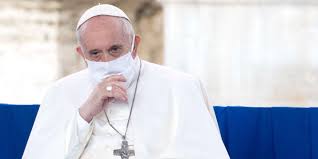
Last week, Pope Francis wrote a beautiful Covid-19 reflection in the New York Times (NYT).

He recalled how the pandemic’s unsung heroes reminded him of his own brush with death when he was just 21 years old.  At that tender age, he was hospitalized with a pulmonary infection that ultimately cost him part of a lung.

At the height of his crisis, two nuns working as nurses in his Argentine hospital ignored doctors’ prescriptions and doubled the dosage of penicillin and streptomycin in one case and increased his pain killers on the other. Their courage in doing so, the Pope is convinced, saved his life.

Generous, courageous souls like the two religious sisters who helped him then have reemerged, Francis noted, during the pandemic. They’re the “saints next door.” They’ve saved innumerable lives as nurses, doctors, caregivers. They’re the essential workers who in many countries have regularly been applauded at doorsteps and windows with genuine gratitude and awe.

The selflessness of such heroes has sometimes cost them their lives. But many among those champions sacrificed freely knowing as Francis put it, that “it is better to live a shorter life serving others than a longer one resisting that call.” They represent the antibodies to an infection among us far more dangerous than Covid 19 – the virus of indifference.

Writing pointedly in the premiere U.S. newspaper, Francis identified that more dangerous virus with governments that have not put the well-being of their people first. Instead, they have “shrugged off the painful evidence of mounting deaths.” They’ve pandered to groups opposing travel restrictions, social distancing and facemasks as if such measures constitute “some kind of political assault on autonomy or personal freedom!” Francis said that worship of that kind of liberty has become for many a kind of ideology obstructing all understandings of common good.

In Francis’ view, such selfish shortsightedness shows that Covid-19 is merely one of the pandemics currently afflicting our planet. Hunger, violence and climate change are others. All of them lack perspective and generosity.

Responding effectively means attuning our sensibilities to the pain of others who have been deprived of life’s basic needs – work, food, housing and human dignity. Responding means recognizing that we’re never saved alone; we are bound by human solidarity and reciprocity.

Reading the pope’s words, I couldn’t help thinking of parallels between them and our readings for the first Sunday of Advent. Together, they call us to reverse course – to wake up from our collective stupor to the presence of what some call God in the neighbors, heroes and martyrs whom Francis’ words identify so poignantly.

What follow are my “translations” of the readings in question. Please check the originals here to see if I’ve got them right.      

 Isaiah 63: 16B-17, 19B; 64: 2-7

 We have lost our way;
 We’ve hardened our hearts;
 We no longer even know
 What faithfulness means.
 We feel somehow unclean,
 Polluted and aimless.
 Yet, we long to see more deeply
 To reality’s very heart
 As never before.
 Reunion with You, Divine Mother
 Is what we ultimately crave –
 To be refashioned
 As if we were clay
 In your lovely hands.
 
 Psalm 80: 2-3, 15-16, 18-19

 So, please show us your face.
 Save us from ourselves.
 Strengthen us.
 Bring us home.
 Demonstrate again
 Your care for us
 As a shepherd guarding her flock,
 As a gardener tending her vine.

 I Corinthians 1: 3-9

 Oh, wait
 You’ve already done that
 Haven’t you?
 You’ve answered our prayer
 In Yeshua, the Christ.
 His loving kindness
 And revolutionary teachings
 Bring clarity, insight
 And serene understanding.
 They restore
 Meaning to our communal lives.
 
 Mark 13: 33-37

 Above all
 (Like the Buddha)
 Yeshua commanded us
 To wake up
 To see
 What sleepers miss:
 Constant divine manifestations
 At our very doorstep
 When we expect
 Them least
 Morning, noon and night.