Did Jesus Justify Armed Resistance to Roman Imperialism? What about Insurgent Resistance to U.S. Imperialism? (Sunday Homily)

Jesus-Said-Video-Preview.jpg

Readings for the 20th Sunday in Ordinary Time: JER 38: 4-10; PS 40: 2-4, 18; HEB 12:1-4; L 12: 49-53

Today’s gospel excerpt presents problems for any serious homilist. That’s because it introduces us to an apparently violent Jesus. It makes one wonder; why does the Church select such problematic passages for Sunday reading? What’s a pastor to make of them?

On the other hand, perhaps it’s all providential. That is, today’s gospel might unwittingly help us understand that even the best of imperialism’s victims (perhaps even Jesus) are drawn towards reactive, revolutionary, or self-defensive violence. After all, Jesus and his audiences were impoverished victims of Roman plunder. By the standards most Christians today accept, they had the right to defend themselves “by any means necessary.”

Here’s what I mean. Without apology, today’s reading from Luke has the ‘Prince of Peace” saying, “I have come to set the earth on fire, and how I wish it were already blazing . . . Do you think that I have come to establish peace on the earth?  No, I tell you, but rather division.”

In a parallel passage, Matthew’s version is even more direct. He has Jesus saying, “Do not suppose that I have come to bring peace to the earth. I did not come to bring peace, but a sword.”

Is that provocative enough for you?

What’s going on here? What happened to “Turn the other cheek,” and “Love your enemy?”

There are two main answers to the question. One is offered by Muslim New Testament scholar, Resa Aslan, the other by Jesus researcher, John Dominic Crossan. Aslan associates the shocking words attributed to Jesus in this morning’s gospel directly with Jesus himself. Crossan connects them with the evangelists, Luke and Matthew who evidently found Jesus’ nonviolent resistance (loving enemies, turning the other cheek) too difficult to swallow for people living under the jackboot of Roman imperialism.

For his part, Aslan points out that the only God Jesus knew and the sole God he worshipped was the God of Jewish scripture. That God was a “man of war” (Exodus 15:3). He repeatedly commands the wholesale slaughter of every foreign man, woman, and child who occupies the land of the Jews. He’s the “blood-spattered God of Abraham, and Moses, and Jacob, and Joshua (Isaiah 63:3). He is the God who “shatters the heads of his enemies” and who bids his warriors to bathe their feet in their blood and leave their corpses to be eaten by dogs (Psalms 68: 21-23). This is a God every bit as violent as any the Holy Koran has to offer.

For Aslan, Jesus’ words about turning the other cheek and loving enemies pertained only to members of the Jewish community. They had nothing to do with the presence of hated foreigners occupying and laying claim to ownership of Israel, which in Jewish eyes belonged only to God. Accordingly, Jesus words about his commitment to “the sword” expressed the hatred he shared with his compatriots for the Roman occupiers.

In other words, when it came to Roman imperialists, Jesus was not a pacifist. He issued no call for nonviolence or nonresistance. Quite the opposite.

John Dominic Crossan disagrees. For him the earliest layers of tradition (even the “Q” source in Matthew and Luke) reveal a champion of non-violent resistance. In fact, the Master’s earliest instructions to his disciples tell them to travel freely from town to town. But in doing so, they are to wear no sandals, carry no backpack, and no staff. He instructs: “Take nothing for the journey–no staff, no bag, no bread, no money, no extra shirt” (LK 9:3).

Crossan finds the prohibition against carrying a staff highly significant. The staff, of course, was a walking stick. However, it was also a defensive weapon against wild animals – and robbers.

So with this proscription Jesus seems to prohibit carrying any weapon – even a purely defensive one like the staff all travelers used.

Apparently, that was too much for the evangelist, Mark. Recall that he wrote the earliest of the canonical gospels we have – during or slightly before the Great Jewish Rebellion against Rome (66-70 CE). Matthew and Luke later copied and adapted his text for their own audiences – one Jewish (in the case of Matthew), the other gentile (in the case of Luke). Mark remembers Jesus’ directions like this: “He instructed them to take nothing but a staff for the journey–no bread, no bag, no money in their belts” (MK 6:8).

Notice that Mark differs from what Crossan identifies as the earliest Jesus traditions upon which Matthew and Luke depended. Instead of prohibiting carrying a staff, Mark’s Jesus identifies the staff as the only thing Jesus’ disciples are allowed to carry. Evidently, that seemed more sensible to a pragmatic Mark than the words Jesus probably spoke. I mean, everyone needs to at least protect themselves from violent others.

Matthew and Luke prove even more pragmatic. By the time we get to them (almost two generations after Jesus’ death and fifteen or twenty years after Mark), we find their Jesus commanding that his disciples carry, not just a staff, but a sword – an offensive, lethal weapon. Matthew even portrays Jesus’ right-hand-man, Peter, actually armed with a sword the night Jesus was arrested. Jesus has to tell him: “Put away your sword. Those who live by the sword will perish by the sword” (MT 26:52). (It makes one wonder if Peter was absent the day Jesus gave instruction about turning the other cheek and loving one’s enemies. Or is Aslan correct about Jesus’ militancy?)

In other words, on Crossan’s reading, it is the gospel authors, not Jesus himself, who subscribe to belief in the blood-spattered God of the Jewish Testament. Jesus’ God was the Forgiving One who recognized no one as enemy, and who (as his later actions showed) refused to defend himself. His dying words were about forgiving his executioners.

Crossan reasons that this more pacifist Jesus is probably the authentic one, precisely because his words (and actions) contradict so radically the Jewish tradition’s violent God.

So whose words do we encounter in today’s gospel? Can we attribute them to the historical Jesus or to his disciples who found themselves unable to accept the Master’s radical non-violence?

Whatever our answer, the shocking words we encounter today remind us that even people of great faith (Mark, Matthew, Luke – or perhaps even Jesus himself) despise imperial invaders. Their arming themselves and fighting revolutionary wars (like the 66-70 Uprising) are completely understandable.

In any case, by gospel (and Koranic?) standards such rebellion is more justified than the entirely unacceptable violence of imperial invasion.

Does any of this shed light on ISIS response to U.S. Middle Eastern invasions, bombings, torture centers and dronings? As a Christian, what would be your response if foreigners did in our country what U.S. soldiers and pilots are doing in Arabia? Would you be a non-violent resister as Crossan says Jesus was? Or would you take up arms – the way violent insurgents have done in Iraq, Afghanistan, Libya, Yemen, Ethiopia, and elsewhere?

Which Jesus do you follow? Can you understand religious people who in the face of United States imperialism say: “I have come to set the earth on fire, and how I wish it were already blazing . . . Do you think that I have come to establish peace on the earth?  No, I tell you, but rather division.”

I Attend a New Age Conference Channeling an Angelic Being: afterwards My Political Prayers Receive Surprising Answers

Kryon

Just recently, my wife Peggy and I attended a two-day New Age retreat in Grand Rapids, MI. We were there at the invitation of two good friends who own a Health and Wellness store in Lakeview.

At the conference, we encountered a “loving angelic entity” from the “other side” who impacted both of us – and an audience of about 250 people – clearly beyond any cynical expectations I may have had. As I’ll explain, the gathering was very Catholic in several ways. Moreover, I was surprised when some highly political prayers I offered there seemed to find rather immediate answers. It was almost enough to convert me – but not without reservations.

The angelic being in question is called Kryon. And he speaks through a medium by the name of Lee Carroll, who’s been channeling him for 26 years. Turns out that Carroll is a delightfully humorous spell-binder himself. He’s a former engineer with a Ph.D. and a reformed skeptic about everything he now teaches so effectively. Years ago, he says, he wouldn’t have been caught dead at a meeting like the one I’m describing. Somehow, I could relate to that.

Here’s what Carroll teaches:

  • Time itself is an illusion – a human construct. The present is all we have. The “past” is a mere memory; the “future” is projection. (In other words, as Einstein said, time is not absolute; it bends with gravity and changes relative to speed of motion.)
  • The evolutionary process is directed. There is indeed “Intelligent Design” in all of it. In fact, left to itself, without direction, the evolution of human consciousness should have taken much, much, much, much longer to develop than the 14 billion years our galaxy has existed.
  • Many of us (called “old souls”) have long participated in the evolutionary process. We’ve passed this way more than once and will do so again and again – but without having to relearn the hard lessons that have wounded us all.
  • In fact, “Old Souls” have an “Akashic Record” of our previous lives that can be accessed with the help of an experienced guide.
  • In tune with Mayan prophecy, “old souls” recognize that a New Age has dawned since 2012 in which people are rejecting obsolete male-centered spiritualties and are turning towards more feminine, indigenous, holistic, positive, experiential approaches to the divine which is the most essential dimension of being human.
  • Eventually within the realm of this dawning consciousness, war will not even be considered as a political option.
  • According to the Mayan calendar, this New Age with a corresponding change in consciousness occurs every 26,000 years, when the earth aligns perfectly with the center of the universe – on this occasion creating circumstances for the greatest, most intense human consciousness ever available.
  • As a result of such cosmic events, for the next 15 years or so, we are entering a sacred time and space where people are waking up to possibilities for creating another world. It is a time of rebellion, where profound changes can happen very quickly making another world truly possible.
  • Put otherwise, the human race is moving forward into a mystical dimension. [Or as the eminent Catholic theologian, Karl Rahner put it: “In the days ahead, you will either be a mystic (one who has experienced God for real) or nothing at all.”]
  • There humans can leave aside the authoritarianism of old religions and step into their own power, into their authentic identities, into their true soul purposes.
  • This shift in consciousness empowers humans to change reality which (from their own bodies to the furthest distant stars) listens to people’s commands.
  • That is, our bodies and the planet know what is best for us; they want to heal us and await our commands.
  • More specifically, if aging people command their bodies to “youth,” their bodies will obey thus allowing seniors to control how fast they age.
  • Kryon has emerged on the scene precisely because the 2012-2030 shift in consciousness is taking place across the planet.
  • However, in the new and exciting age, conservative forces are emerging fighting desperately to prevent the cosmic transformation in question.
  • But none of us should fear the future. Despite appearances, the forces of light (not darkness) are winning.

These are the kind of messages Lee Carroll spoke at the workshop during his three channelings of Kyron’s spirit.

And how is one to enter this new age? According to Dr. Carroll, one does so by forming communities of like-minded mystics. Entrance is facilitated through self-talk, i.e. by reciting personally-chosen affirmations aloud so that the extremely attentive and always responsive cells of our bodies can hear. One drives home such talk using techniques such as “tapping” and wide-ranging prayers offered in ceremonies like Despacho, a Native American prayer ritual which some of us experienced on the final day of our workshop.

The practice of tapping involves lightly drumming on the crown of the head across the meridian separating the left and right sides of the cerebral cortex. (Recall that the left hemisphere of the human brain is more logical; the right side, more intuitive and holistic.) One taps while breathing deeply and reciting a positive, believable, focused, and original affirmation chosen by the tapper.

Typical affirmations include:

  • “My innate intelligence recognizes and supports the eternal nature of my being.”
  • “I am living in a new energy and all around me are new potentials.”
  • “My needs are always met.”
  • “I am in the right place at the right time for everything is in divine order.”

Cerebral cortex drumming is then followed by similar tapping on the heart. The idea is first of all to unite the powers of one’s left and right brain. Tapping one’s heart attempts to plant the affirmation in the human organ that is 5000 times more powerful than the human brain.

Again, before I rolled my eyes too far, I recalled that we Catholics should be familiar with tapping and positive affirmations. We do something similar through the ritual practice of “laying on of hands” accompanied by invocations of the “Holy Spirit.” This happens, for instance, during sacramental ceremonies such as ordination and confirmation. When I thought about it, I realized that placing hands on the crown of ordinandi and confirmandi while invoking the Holy Spirit can be seen as ceremonially attempting to integrate their powers of logic, intuition, and openness to the transcendent Ground of All Being.

Then there’s the Catholic practice of “beating one’s breast” – as in mea culpa, mea culpa, mea maxima culpa. That’s really a version of “tapping” one’s heart. The difference is however, that New Age tapping is completely positive without a trace of guilt, fault, negativity or “beating.” To me that seemed healthier.

As for the Despacho ceremony . . .; it was truly remarkable. It showed me (again!) the power of female priesthood that the Catholic Church ignores. The two-hour ritual was led by a colleague of Dr. Carroll – Michelle Karen. Only about 50 of the 250 workshop participants took part – most of them women.

Michelle is a French deeply insightful astrologer who learned Despacho from shamans of a Native American community in Peru. She had us all sit in a circle while she (with our participation) created a beautiful mandala on a piece of colored fabric. In a circle outlined with sugar (symbolizing the sweetness of life) she had us each place one white and one red carnation petal with a bay leaf sandwiched between. (Obviously, we couldn’t use the more authentic coca leaf.) The red petal represented the female principle of creation; the white, the male. The bay leaf stood for our desire to change our consciousness.

Then successively, while humorously and perceptively explaining the meaning of each element, Michelle added at least 25 other items. They symbolized prayers for the planets, oceans, air, animals, insects, our deceased relatives and friends, and so much else. The symbolic additions to the burgeoning mandala included salt, leaves, twigs, toys, ribbons, hair – you get the idea. With the addition of each element, Michelle offered a corresponding prayer, breathed on the item and touched it to her forehead.

Towards the end of Despacho, each of us was asked to silently offer our most solemn prayers and in the form of a rose petal place them on top of the finished mandala. We were to do so with great care, Michelle advised, because the Despacho ceremony is extremely powerful. We should expect our prayers to be amazingly answered within days.

Our final product was gorgeous. Michelle wrapped it in the underlying fabric and commissioned an “honorary shaman” chosen from our group to later on ceremonially burn the package whose smoke would carry our prayers to the Universal God.

The prayers I offered were mostly quite personal. However, I also decided to add political petitions I’ve been praying each morning for the last eight years or so. (Ever-compassionate Peggy later told me that they seemed rather negative. She didn’t approve. Maybe she’s right.) In any case, my prayers for most of the past decade have included:

  • May U.S. Empire be brought to its knees.
  • May Israel similarly be defeated before liberated Palestinians.
  • May the Republican Party and Fox News disintegrate.
  • And may President Obama be remembered as the best president the United States has ever had. (I’ve given up on this one!)

Wild prayers, no? (I suppose you see what Peggy meant.) But here’s the thing: three days after the conclusion of the Kryon Workshop, Roger Ailes, the head of Fox News, resigned as its CEO. Commentators identified the event as earth-shaking in terms of the Republican Party, since Ailes had shaped its strategy since the Nixon years. Fox News, they predicted, would become more moderate (while, no doubt remaining right wing – thus more closely approaching the center-right position of the U.S. mainstream media).

Then that same day, after Donald Trump accepted the GOP’s nomination for president, a figure no less than George W. Bush expressed his worry that he might end up being the last Republican president ever.

What? Despacho prayers answered after just four days? Should I take credit? (Just kidding.)

Whatever: just two petitions to go. And events promise that the Universe may soon honor those requests as well.

So have I converted to become a Kryonite? Not quite. While I appreciated the weekend and recognize the soundness (and even Catholicity) of much of the underlying spirituality, and while I admired the wonder of female leadership in worship, I was pulled up short towards the end of our retreat.

It happened on Sunday, when Dr. Carroll seemed to get a bit off-script.  He ended up sounding quite like a climate change denier. (Though he claimed, “I’m actually a ‘Greenie’.”) Based on the insights of a single scientist friend of his, Carroll asserted that the planet is essentially cooling and that an ice age is on the way. “It’s a natural process,” he added. Humans have nothing to do with it. Technology will soon appear to save us. Moreover, the oceans can clean up any of the oil spills we might throw at them. “Everyone knows this outside the United States, but not here.”

Hmm. During the Q&A I raised my hand to question. But the session was cut short before I was recognized. I wanted to ask him:

  • Sure, an ice age may be coming, but when? A thousand years from now?
  • With due respect to your scientist friend, ninety-seven percent of climate scientists tell us the catastrophe of climate chaos is upon us. We don’t have 1000 years (or even 100) to wait.
  • What about greenhouse gases?
  • And rising sea levels?
  • How do you explain the consecutive months and years of record-setting rising temperatures?
  • And aren’t “Americans” virtually alone in the world in denying climate change?

Despite my reservations and unanswered questions, it should be clear that there was much to recommend the Kryon Workshop I’ve been describing. It shows a widely shared hunger for meaningful non-patriarchal spirituality – for optimism and hope rather than guilt, sin and hell. It demonstrates the effective leadership of wise women – counsellors, healers, shape-shifters like Michelle Karen.

It highlights the undeniable fact that we have indeed entered a New Age in which old forms are disintegrating and losing credibility while women and other angelic spirits are asking us to rethink everything and create the “other world” we all want and need.

It might even have confirmed my belief in the power of prayer.


Jesus Is Cutting Your Lawn! (Sunday Homily)

immigrant-jesus

Readings for 18th Sunday in Ordinary Time: Wis. 18: 6-9; Ps. 33: 1, 12, 18-20, 22; Heb. 11: 1-2, 8-19; Lk. 12: 32-48.

Today’s liturgy of the word invites us to consider the hot-button issue of immigration. The issue is contentious because conservatives in our country generally oppose immigration reform. More accurately, they tie changes in the legal status of immigrants to strengthening border security with Mexico and the building of walls along our southern border to keep undocumented immigrants out. Until such measures are foolproof, conservatives generally promise to oppose reform of immigration laws.

That’s ironic because Evangelical Christians make up the strongest component of the U.S. conservative party, the GOP. So the dominant attitude of that party on immigration ends up militating against American Christians’ brothers and sisters in faith. After all, according to a recent study by the Pew Research Center’s Forum on Religion & Public Life, an estimated 83 percent, or 9.2 million, of the 11.1 million people living in the United States illegally are Christians from Latin America and the Caribbean.

Our readings this morning call into question such exclusionary attitudes about immigration. They suggest that far from excluding immigrants, insisting on observance of law, and building walls to keep them out, Christian response to immigrants should take the form of welcoming, wealth-sharing and service.

Let me show you what I mean.

To begin with, today’s first passage from the Book of Wisdom underlines the point that the biblical People of God were all immigrants. They were unwanted strangers whose ancestors had come to Egypt to escape famine in Palestine. Remember those Bible stories of Joseph and his brothers? Read them again (Genesis 37-50). Those legends explain how the families of Jacob’s sons came to be enslaved in Egypt in the first place. As you no doubt recall, Joseph’s brothers sold him into Egyptian slavery.

However, in Egypt, Joseph landed on his feet and eventually became the Pharaoh’s Minister of Agriculture. That meant that when famine struck Joseph’s former homeland, his brothers were forced to come hats-in-hand to beg food from the very one they had betrayed. However, when they came into Joseph’s presence, his own brothers didn’t recognize him. In one of the most beautiful stories in all of world literature, the unrecognized Joseph finally discloses his true identity. Instead of punishing them for their betrayal, Joseph feeds his brothers and invites them to join him in Egypt.

In other words, Joseph’s response to immigrants and refugees was to recognize them as members of his own family and to welcome them “home.”

In today’s second reading, Paul digs further into Israel’s past only to find that Abraham himself (the original father of Israel) was himself an immigrant. He entered a land that God decided was to belong to Abraham and his descendants though the ones dwelling there didn’t share that secret understanding. (The Canaanites, of course, thought Canaan belonged to them.)

So Abraham and his sons were forced to live in poor housing – in tents, Paul recalls for us. All the while, however (like most immigrants) they dreamt of better lodging “with foundations.”

Meanwhile Yahweh saw to it that Abraham’s family grew prodigiously. They begat and begat until they seemed to everyone to be “as numerous as the stars of the sky;” they were as plentiful as grains of sand on the beach. Such legendary fertility eventually came to be seen as threatening and led one pharaoh to order the death of all of the Hebrew immigrant boys (Ex. 1:22). By Yahweh’s special intervention, Moses alone was saved from such genocidal population control.

Again, this was Israel’s God protecting immigrants as his chosen people. That’s the point today’s responsorial psalm underlines with its refrain, “Blessed the people the Lord has chosen to be his own.” Ironically those people were persecuted immigrants.

Then in today’s Gospel, Jesus presents a riddle about the identity of his faithful servants. Jesus asks, “Who, then, is the faithful and prudent steward whom the master will put in charge of his servants to distribute the food allowance at the proper time?” His answer has implications for immigration reform measures.

In any case, you can imagine a lengthy interchange between Jesus and his audience about his riddle. No doubt, some identified “faithful and prudent stewards” with those who kept the absolute letter of the law. Others probably cited the Jewish purity code and said fidelity meant keeping the bloodline pure; it meant keeping foreigners out of the Holy Land and preventing inter-marriage with gentiles. Still others may have responded in economic terms. For them the faithful and prudent steward was probably the one who defended Jewish livelihood by keeping foreigners from taking Jewish jobs.

Jesus’ own response is different. He replies in terms of generosity, as well as in terms of service with its “law of abundance.” Jesus also invokes the law of karma. God’s faithful servants are those who sell what they have and give it to the poor. They are not the ones who are served, but those who serve. Meanwhile those who mistreat God’s servants will reap what they sow.

Above all, notice that the emphasis in Jesus’ words today is on service. His riddle brings us entirely from the “upstairs” culture of dominance into the “downstairs” culture of servants. The steward is the head servant. He’s in charge of others, but his service consists in distributing food allowances to his fellow servants. Even the Master ends up serving. When he returns from the wedding, his servants don’t wait on him. Rather as an expression of gratitude, he brings them upstairs, sits them at table and waits on everyone! (How consoling is that?! The “law of abundance” says that what we receive in life is determined by our own generosity.)

Similarly, we can’t mistreat others without harming ourselves. The law of karma decrees that we reap what we sow. Jesus endorsed that law in today’s reading. More specifically Jesus says that those who mistreat God’s servants will find themselves similarly mistreated. Here Jesus gets quite graphic: to the degree that they beat others, they themselves will be beaten. Again, it’s the law of karma; and it’s inescapable.

What does Jesus’ riddle have to do with immigration? First of all, remember it’s told by a former immigrant. According to Matthew’s story, Jesus lived in Egypt when Mary and Joseph sought refuge from Herod’s infanticide. Yes, Matthew’s Jesus must have known first-hand the experience of being an unwanted immigrant. In Egypt he spoke with a Jewish accent. Or maybe his family didn’t even bother to learn Egyptian.

Remember too that the riddle about faithful servants is posed by the Jesus who identifies with “the least of the brethren.” He said that whatever we do to the least, he considers done to him. In terms of today’s considerations, does that mean that what we do to immigrants, we do to Jesus?

As for Jesus’ response to his own riddle, it reminds us to receive immigrants as we would our Master returning home – yes, as our Master, Jesus himself – the one who ends up serving us! Again, Jesus identifies with the least of our brothers and sisters.

Does that mean that Jesus appears to us today in our service industries and in the informal economy where immigrants work as our kids’ nannies, our house cleaners, as construction workers, hotel maids, and gardeners?

At this very moment might Jesus be out there cutting my lawn, roofing my house or cleaning my bathroom?

When our border guards beat “illegals” (and worse!) are they beating Jesus?

And what does that mean for their karma – and for ours?

Those are riddles worth discussing and solving!

The way we answer will determine the side we come down on in the immigration debate.
(Discussion follows)

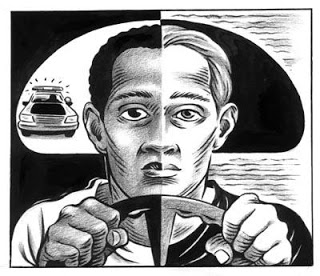
My White Privilege Asserts Itself: Despite Everything, the Cop Doesn’t Shoot Me When I Reach for My Wallet

driving_while_black

Last Monday, Peggy and I were stopped by a police officer on our way back from a doctor’s appointment in Grand Rapids, Michigan. We had nearly arrived at our lake house summer home, when I saw the red and blue flashing lights behind me.

Of course, I pulled over immediately onto the road’s gravel shoulder. I rolled down the driver’s side window (the only one that works dependably) of our 1992 Volvo. I suspect the officer was “intrigued” by our beat up car with its out-of-state Kentucky license. I mean, this may have been a “profiled” stop.

As the officer approached from behind, I reached into my back pocket for my wallet and license. Doing so, I couldn’t help thinking of the difference between me and black drivers in similar circumstances. For them, reaching into a back pocket as an officer approaches might be fatal. So might traveling in a decrepit car far from one’s own neighborhood.

“May I see your license and registration, Sir?” the young officer requested.

I fumbled through my wallet, and it took some time before my license surfaced. The policeman waited patiently without comment. Finally, I handed him my Kentucky license. From the passenger’s side, Peggy found our registration. However, it was from 2015. Somehow, the 2016 registration had not made its way into the glove compartment. Besides that, our “proof of insurance” certificate had expired.

“That’s all right,” the officer said politely. “I’ll just check on my computer. This might take a few minutes. . .  By the way, did you know you were traveling at 68 miles per hour? The speed limit here is 55.”

“No, Sir” I replied. “My wife and I were deep in conversation, and I didn’t realize how fast we were going.” (I didn’t dare tell him that the speedometer on our car doesn’t work.) I also hoped he wouldn’t see that the covering over our right front turn signal was busted out. I’m sure that was some sort of violation too.

A few minutes later, the officer returned.

“Everything checks out,” he said. “I’m not going to give you a citation this time. But I’d get that paper work up to date if I were you.”

We thanked the officer profusely, and went on our way.

Afterwards, I couldn’t help thinking how different our story was from Sandra Bland’s who ended up dead after failing to signal a lane change in Waller County, Texas. It was different too from Philando Castile’s in Falcon Heights, Minnesota. Castile was stopped for a broken tail light.   After informing an officer that he was carrying a licensed gun, Castile was shot when he obeyed the cop’s directions to produce his driver’s license from the wallet in his back pocket.

Bland and Castile were black. I, of course, am not.

But consider my “crimes” each of which have led to police shootings of blacks:

  • Speeding
  • Outdated registration
  • Expired proof of insurance
  • Broken turn signal light
  • Malfunctioning speedometer
  • Driving a beat up car far from my own neighborhood in a predominantly white community
  • Reaching into my back pocket after being stopped by the police

Thankfully, I was not guilty of “driving while black.” So unlike the overwhelming experience of black residents, for instance, of Ferguson, Missouri, I received no interrogation, no harsh words, no citation, no fine, no searching, no arrest, no summons to appear in court, no resulting lost days of employment, no threat of police violence.

And besides, I have lived to tell the story. And this in a country where compared to white drivers, African Americans are 31% more likely to be pulled over, 81% more likely not to be given a reason for it, and 174% more likely to be searched.

Hmm.

Is Pope Francis a Positive Force or a Dangerous Illusion?

Francis wolf

A good friend of mine recently shared a link from the Real News Network that deserves a response. It was an interview with Chris Hedges criticizing Pope Francis for not being radical enough in his denunciation of capitalism and imperialism. The award-winning journalist gave the impression that the pope should have denounced both as such and offered alternatives.

I was surprised by Hedges’ remarks. That’s because my personal assessment is that the pope actually has done all three. He has been scathing in his denunciation of capitalism; he has denounced colonial imperialism, and has offered clear alternatives to capitalism-as-we-know-it. The pope did so during his” homecoming” trip through Latin America late last summer, during his subsequent six-day trip to the United States, and especially in his landmark encyclical, Laudato Si’ (LS).

On his Latin American tour, Pope Francis’ was quite direct in his denunciation of capitalism and imperial colonialism.

For instance, addressing the World Meeting of Popular Movements in Santa Cruz, Bolivia, Francis traced today’s global problems back to their origins in European colonialism beginning in 1492. But he also identified new forms of colonialism exercised through corporations, loan agencies, “free trade” treaties, and imposition of “austerity measures.”

Such actors and policies, he said, subordinate states to outside powers which also exercise control through misguided measures ostensibly aimed at controlling drug trafficking, political corruption, and terrorism. More subtly, external powers colonize, destroy local cultures and foster cultural uniformity through communications monopolies, which the pope described as “ideological colonialism.”

“Let us say NO to forms of colonialism old and new,” he said.

Still in Latin America, the pope went on to criticize capitalism-as-we-know-it as “an invisible thread” connecting problems of world poverty, worker exploitation, landlessness among farmers, homelessness, and destruction of the natural environment. That system imposes the mentality of profit at any price without concern for its impact on displaced peasants and workers or for its destructive effects on “Mother Earth.”

The system, he said “is by now intolerable: farm workers find it intolerable, laborers find it intolerable, communities find it intolerable, peoples find it intolerable … The earth itself – our sister, Mother Earth, as Saint Francis would say – also finds it intolerable.”

For me, all of that represents not only criticism of imperialism, but of the free market system.

Then during his visit to the United States, Pope Francis offered an extremely harsh denunciation of capitalism itself. There he in effect referred to economic system we know as “filthy,” “rotten,” and “putrid.” He called the Wall Street speculators “hypocrites.” Moreover, the pope directly confronted the members of his audience by calling the system they represented “the greatest purveyor of violence” in the world today. And he implied that  the politicians seated before him were a bunch of gangsters.

Even Chris Hedges may have missed all of that, because the polite, soft-spoken, and gentle pontiff was a gracious enough guest to say none of those things directly. He did so instead by offering Dorothy Day, Martin Luther King and Thomas Merton as embodiments of our country’s greatest values.

It was Dorothy Day who is remembered as saying, “We need to overthrow . . . this rotten, decadent, putrid industrial capitalist system which breeds such suffering in the whited sepulcher of New York.”

It was King who called the United States itself, “the greatest purveyor of violence in the world today.”

And it was Thomas Merton, the apostle of non-violence, who classified U.S. politicians and military leaders among the world’s gangsters when he said, “The world is full of great criminals with enormous power, and they are in a death struggle with each other. It is a huge gang battle . . .”

Moreover, Pope Francis did not leave his audience merely reeling from such heavy blows un-complemented by clear systemic alternatives to the filthy rotten arrangement he addressed. Instead, the pontiff called for a deep restructuring of capitalism-as-we-know-it. This would involve turning the present system’s preferential option for the rich precisely on its head, replacing it with his favorite guideline, the “preferential option for the poor.” Even more particularly, restructuring would require a central international legislative body endowed with power to override national economic practices judged to be environmentally unsound.

Both recommendations are found clearly stated in Laudato Si’ which the pope cited in his congressional address (LS 53, 173-175). Surprisingly, both have already been implemented world-wide.

To begin with, the New Deal, the Great Society and (even more so) Europe’s introduction of the welfare state already represent arrangements which forefronted the needs of the working classes and poor. The reform measures were at the very least strong gestures towards economies mixed in favor of the poor rather than of the Wall Street rich. Such reforms demonstrated that another economic order is indeed possible.

As for the world body with power to enforce environmental legislation, the World Trade Organization (WTO) already has it, though perversely in its present form. According to the provisions of the North American Free Trade Agreement (and of the proposed Trans-Pacific Partnership), multinational corporations (MNCs) now have the power to sue before the WTO and invalidate U.S. environmental protection standards if those laws can be shown to diminish a corporation’s expected profits.

What the pope is proposing is an international body that turns the WTOs mandate upside-down.  The body the pope proposes would have binding power to protect the environment from the depredations of MNCs – i.e. is to eliminate their profits if they result from environmental destruction.

So I respectfully suggest that Chris Hedges is mistaken when he says Pope Francis has pulled his punches. The pontiff has been quite specific in offering alternatives to the system he has so sharply critized. As an honored guest, he gently delivered knock-out blows clearly observable to attentive listeners.

It remains for prophets like Hedges and others to highlight and reinforce them and in this way to advance us towards the Other World Pope Francis would convince skeptics is possible.


Jesus and Abraham Call Us to Abandon the Bible’s “Psychopath in the Sky” (Sunday Homily)

Love Enemies

Readings for the 17th Sunday in Ordinary Time: Gn. 18:20-32; Ps. 138:1-3, 608; Col. 2:12-14; Lk. Ll:1-13.

Today’s readings about Abraham bargaining with God and about Jesus teaching his followers to pray raise some vital questions about God’s personality and existence. Abraham’s compassionate God seems to conflict with the warlike God who appears elsewhere in the Bible.

So who’s right? Should we be afraid of God? Or can we trust the very Ground of Our Being? Is God warlike and punitive or kind and forgiving? If he’s our “Daddy” (that’s what “Abba” means in Jesus’ prayer: “Our Daddy who transcends everything”) does our experience show him to be abusive or loving? Today’s readings help us wrestle with those questions. In fact, they call us to a holy atheism.

But before I get to that, let me frame my thoughts.

A few days ago, it was reported that an airstrike led by the United States in Syria killed more civilians than perished in the Bastille Day killing of 84 people in the city of Nice following a celebratory fireworks display.

But whereas the Nice slaughter evoked general consternation, sympathy, and compassion, the U.S. killings elicited very little public notice here. The general feeling seems to be that our killings of civilians are somehow tolerable because the strikes protect Americans from the terrorists actually targeted in what are described as wayward airstrikes.

That’s the logic our government has adopted as it represents our country where 78-85% of the population claims to follow the one who refused to defend himself and gave his life that others might live. The logic of most American Christians says that killing innocents – even children – is acceptable if it saves American lives. Apparently, that’s the American notion of salvation: better them than us.

However that way of thinking is not what’s endorsed in today’s liturgy of the word. (And here I come back to those questions I raised earlier about God’s personality and existence.) There in Sodom and Gomorrah, Yahweh refuses to punish the wicked even if it means that as few as 10 innocents would lose their lives in the process.

Better-us-than-them is not the logic of Jesus who in teaching his disciples to pray tells them that God is better than us. God gives bread to anyone who asks. Yahweh acts like a loving father. He forgives sin and gives his children what they ask for. In fact, God shares his Spirit of love and forgiveness – he shares Jesus’ spirit of self-sacrifice – with anyone who requests it.

Elsewhere, Jesus says something even more shocking. Yahweh doesn’t even prefer the good over the wicked, he says. He showers his blessings (not bombs!) on everyone. Or as Jesus himself put it, God makes the sun rise on the virtuous and the criminal; his rain benefits those we consider evil as well as those we classify as good (Mt. 5:45). We should learn from that God, Jesus says, and be as perfect like him (Mt. 5:48). In fact, we should consider no one “the enemy” not even those who threaten us and kill us even as Jesus was threatened and killed (Lk. 6: 27-36).

How different is that from the way most of us think and act? How different is that from the God we’ve been taught to believe in?

Yes, you might say, but what about those other passages in the Bible where God is fierce and genocidal? After all, the Great Flood must have killed many good people and even children. And God did that, didn’t he? What about his instructions (more than once) to kill everyone without distinction. For example the Book of Joshua records: “Thus Joshua struck all the land, the hill country and the Negev and the lowland and the slopes and all their kings. He left no survivor, but he utterly destroyed all who breathed, just as the LORD, the God of Israel, had commanded (Joshua 10:40). What about the Book of Revelation, which many Christians argue predicts God’s total destruction of the world? What about that violent, pitiless, threatening God? Is that the “Abba” of Jesus?

Good questions. They’re good because they make us face up to the fact that the Bible is ambiguous about God. No, let me put it more strongly. The Bible isn’t just ambiguous about God. It’s often plain wrong – at least If we adopt the perspective of Jesus and Abraham in today’s readings.

After all, Abraham’s God is not genocidal; Joshua’s is. Jesus’ God is not genocidal; Joshua’s is. Those Gods are not compatible. One of them must be false. Or as Jack Nelson Pallmeyer writes in his book Is Religion Killing Us? “Either God is a pathological killer or the Bible is sometimes wrong about God.”

Today’s readings show us that both Abraham and Jesus agree.

The Abraham story is about a man gradually rejecting Nelson’s Psychopath in the sky. Israel’s furthest back ancestor comes to realize that God is merciful, not punitive or cruel. Or as the psalmist puts it in today’s responsorial, God is kind, true, and responsive to prayer. God protects the weak and lowly and is distant from the powerful and haughty. In today’s reading from Genesis, we witness Abraham plodding slowly but surely towards that conclusion.

It’s the realization eventually adopted by Jesus: God is a kind father, not a war God. If Abraham’s God won’t tolerate killing 50 innocent people, nor 45, 40, 30, 20, or even 10, Jesus’ God is gentler still. That God won’t tolerate killing anybody – not even those threatening Jesus’ own life.

All of that should be highly comforting to us. It has implications for us, politically, personally and liturgically.

Politically it means that followers of Jesus should be outraged by anyone connecting Jesus with our country’s perpetual war since 9/11, 2001. A bombing program that kills the innocent with the targeted flies in the face of Abraham’s gradually-dawning insight about a merciful God. The war itself makes a complete mockery of Jesus’ total non-violence and the words of the prayer he taught us. Those supporting “America’s” “better them than us” attitude are atheists before Jesus’ God and the one depicted in the Abraham story.

Personally, what we’ve heard this morning should drive us towards an atheism of our own. It should cause us to review and renew our understandings of God. Impelled by today’s readings, we should cast as far from us as we can any inherited notions of a pathological, punishing, cruel, threatening and vindictive God. We need that holy atheism. Let’s pray for that gift together.

And that brings us to today’s liturgy. In effect, we’ve gathered around this table to hear God’s clarifying word, and symbolically act out the peaceful world that Jesus called “God’s Kingdom.” We’ve gathered around this table to break bread not only with each other, but emblematically with everyone in the world including those our culture considers enemies.

I mean if God is “Our Father,” everyone is our sister, everyone, our brother. It’s just that some couldn’t make it to our family’s table today. But they’re here in spirit; they’re present around this altar. They are Taliban and ISIS; they are Iraqis, Afghanis, Yemenis, and Somalis; they are Muslims and Jews; they include Edward Snowden and Tamir Rice. They include those children killed in U.S. bombing raids. They are you and I!

All of us are children of a loving God. Jesus’ “Lord’s Prayer” says that.

Now that’s something worth celebrating.

THE ATROCITIES in NICE: Replacing War with Truth & Reconciliation

NICE

The entire world was shocked by the horrendous atrocities of July 14th during Bastille Day celebrations in Nice, when a madman ran over scores of his fellow citizens.

Appropriately the crimes were followed by tears, laying of wreaths, moments of silence, and prayer vigils.

France’s President Hollande evoked sympathy when he correctly declared the attacks “an act of war.” No one disagreed.

However, Mr. Hollande was not correct in his implication that the killings in Nice (and earlier in Paris and at Charlie Hebdo) somehow began a war that France and its partners have now self-righteously resolved to “finish.” Rather, all those massacres are part of a much bigger picture that centralizes France’s participation in the U.S.-fabricated War in Iraq and the resulting creation of the Islamic State (ISIS).

To fill out that picture, consider the following home truths about that war in particular, and about war in general. Uncomfortable as they are, allowing those truths to sink in might help uncover non-violent alternatives to the carnage that stupefies everyone.

Begin here:

  • War is hell.
  • In modern warfare, 90% of casualties are civilian.
  • The casualties include refugee migrations.

_____

  • The West’s response to 9/11/01 was to declare war.
  • It began a campaign of bombing and extra-judicial assassination in Afghanistan, Iraq, Libya, Somalia, and elsewhere.

_____

  • According to a study by Lancet (one of the oldest scientific medical journals in the world), since 2003 the U.S. war in Iraq has caused more than one million deaths – again, most of them civilian.
  • Meanwhile, the U.S. has supplied weapons to Israel and Saudi Arabia for their own bombing campaigns against Muslims in Gaza and Yemen.
  • In Gaza alone (with complete U.S. support) the Israeli Defense Force fired 50,000 shells, carried out 6000 airstrikes, destroyed 3,500 buildings, killed 2250 Gazans, including 551 children.

_____

  • In wars there are always at least two sides.
  • All have the right to attack and counter-attack.
  • It is insane to be shocked when counter-attacks occur.
  • Counter-attacks often mimic attacks.
  • So if one side is perceived as attacking defenseless civilians, the other side will likely respond in kind.

_____

  • France itself is at war.
  • President Hollande is a founding member of the U.S.-led coalition that has recently dropped 175,000 bombs on Iraq and Syria killing at least 600 civilians in the process.
  • Therefore no one should be surprised when “in kind” counter-attacks occur. (To repeat: that’s the way war works.)

In view of such home truths, and recognizing that intensified bombing has proven counterproductive, instead of responding to the Paris massacre with more of the same, the U.S., France and their allies should:

  • On principle reject the atrocities of war that on both sides justly horrify everyone.
  • Institute instead a process of Truth and Reconciliation that admits and apologizes for the causal role the War in Iraq has had in the creation of ISIS.
  • Take seriously Britain’s recently published  Chilcot Report that indicted former British Prime Minister Tony Blair for cooperating with the Bush administration in misleading the world into that war.
  • Prosecute Blair, Bush, Cheney and others for the crimes the Chilcot Report describes.
  • Open western borders to the refugees inevitably produced by the U.S.-led wars over the last 15 years.
  • Spend the billions now invested in war against ISIS on rebuilding Afghanistan, Iraq, Libya, Syria, Somalia, Yemen, and Palestine.
  • In churches and other principled fora, specifically condemn all Islamophobic statements of politicians and other public figures.

Only actions like these can release the world from massacres that are the unavoidable consequences of the wars we rightly recognize as hell.

Forget Martha; Be Like Lazy Mary and Jester Jesus (Sunday Homily)

un tal

Readings for the 16th Sunday in Ordinary Time: Gn. 18: 1-10A; Ps. 15: 2-5; Col. 1: 24-28; Lk. 10: 38-42.

What do you think you’ll regret most as you lay dying? If you’re like most, it will be that you spent too much time at your day job – too much time working and not enough time socializing and enjoying life. Study after study affirms that.

Commenting on this regret, one Hospice nurse said:

“This came from every male patient that I nursed. They missed their children’s youth and their partner’s companionship. Women also spoke of this regret, but as most were from an older generation, many of the female patients had not been breadwinners. All of the men I nursed deeply regretted spending so much of their lives on the treadmill of a work existence.”

I’ll bet almost everyone reading this can relate to those words and would like to avoid final regrets about overwork.

Problem is: our culture sets overwork as an ideal. In fact, we’re taught to prize overwork. This is especially true of “American” culture where unlike our European counterparts, we spend an average of three hours per week more on the job. That adds up to something like a month more of work each year than our Europeans sisters and brothers. Most important, Americans take fewer (and shorter) vacations. The average American takes off less than six weeks a year; the average Frenchman almost 12. Swedes take the longest vacations – 16 ½ weeks per year.

Today’s gospel reading from Luke urges us to correct our tendency to overwork before it’s too late. In doing so, it directs our attention to the counter-cultural nature of Jesus’ teachings.

Yes, Jesus was extremely counter-cultural. We shouldn’t forget that. As Deepak Choprapoints out (in his The Third Jesus), the Sermon on the Mount, which captures the essence of Jesus’ wisdom, has him explicitly telling his disciples not to earn a living, save money, plan ahead or worry about the future. Of course, most of us don’t listen to Jesus when he says things like that.

And did you notice the description of the “Just Person” in today’s responsorial psalm? Man or woman, they harm no one, do not slander, speak ill of no one, and refuse to accept bribes. All of that raises no eyebrow. We yawn: none of that seems particularly counter-cultural.

But how about, “They lend not money at usury?” What about that? Yes, lending at interest is considered robbery and is forbidden in the Bible. (What if all Christians (and Jews) kept that commandment? Our world with its economy based on credit and interest, would be entirely different.)
The world would also be different – our lives would not be the same – if we acted like Mary instead of Martha.

The misdirection of traditional sermons obscures that possibility. Customarily homilists understand the story of Martha and Mary in a strictly spiritual sense. Their commentaries use the two sisters to compare the active and the contemplative lives – as though poor Martha stood for lay people having to wait on others with no time for prayer like the more otherworldly Mary. Martha’s sister “choses the better part” like a contemplative “religious” eschewing “the world of work” and spending their time pondering the spiritual teachings of Jesus and living a life rapt in prayer and contemplation.

I used to think that too – until I read Un Tal Jesus (“A Certain Jesus”) written by Maria Lopez Vigil and her brother, Jose Ignacio. (The book has been translated into English under the title Just Jesus.) The authors are Cuban and now live in Nicaragua. Maria is a former nun; Jose Ignacio, a former priest.

Together the Lopez-Vigils created a series of radio programs broadcast all over Latin America. The shows dramatized the four gospels and presented a very human Jesus – the one who emerges from recent scholarship on the historical Jesus.

In Un Tal Jesus, Jesus is black, has a winning smile, and a very down-to-earth sense of humor. (The photo at the top of this blog entry shows Jesus as depicted in the Lopez-Vigil’s book.) The human Jesus portrayed in that radio series scandalized many and inspired even more throughout the Latin world and beyond.

As the Lopez-Vigils envision it, today’s episode takes place in a Bethany tavern owned by Lazarus, the brother of Martha and Mary. It’s a place of eating, drinking and lodging for travelers. It’s a place of laughter, joking, over-eating and drunkenness. And Jesus is right there in the middle of it all.

Passover is approaching, and the inn is full of pilgrims. It’s steamy, noisy, and loud. Martha is on the job, waiting on tables and controlling the rest of the staff. Meanwhile Mary (whom scholars increasingly identify with Mary Magdalene, Jesus closest female companion) is distracted by conversation with Jesus, who is bantering with his friends.

And what are they talking about? Religion? God? Spirituality? No, they’re joking. Jesus is posing riddle after riddle. And Mary finds it completely entertaining. In part, their dialog goes like this:

Jesus: What’s as small as a mouse but it guards the house like a lion. One, two, three: Guess what it is!
Mary: Small as a rat…and…it’s a key! I guessed it, I guessed it!
Jesus: Listen to this one: It’s as small as a nut, has no feet but can climb a mountain.
Mary: Wait… a nut going up the mountain…a snail!…Ha, ha, ha, tell me another one!
Jesus: You won’t guess this one right. Listen well: It has no bones, it is never quiet, with edges sharper than scissors.
Mary: It has no bones… I don’t know…
Jesus: It’s your tongue, Mary, which never rests!

Well, Mary and Jesus might have found that sort of patter entertaining, but Martha did not. She’s in charge of the inn and is worried about her guests waiting impatiently for their food while bread is burning in the oven. So she makes her complaint to Jesus: “Stop your chatter and let my sister do her job!” It’s then that Jesus makes that remark about Mary’s choosing the better part. She’s chosen socializing and play over work.

Does that scandalize you – Jesus distancing himself from work? Well, it seems completely consistent with what I said about Jesus earlier. It coincides with his general approach to work, money, profit, saving, and anxiety about the future.

What difference would it make in our own lives if we accepted that message: socializing, community, and fun are more important than work? What difference would it make in our culture if, in a context of widespread unemployment we elected candidates advocating “spreading the work around,” spreading the money around, shortening the work week, and affording us more time with friends and family, eating, drinking, joking, and playing?

What difference would it make to us on our death beds?

What do you think?

The Peasants Are Coming: Brexit, Free Trade & Mass Migrations

Brexit & Refugees

On June 24th Great Britain shocked the world by voting to exit the European Union (Brexit). Some celebrated the succession as a left wing “Peasant Revolt” against so-called “free trade agreements.”  They were right. Europe (and the world) needs an economic revolution from below. And Brexit was a shot across the bow of corporate globalization.

Others however ascribed the Brexit to narrow right wing anti-immigrant nationalism. They were also correct. However right wing focus on immigrants as if they were the root and sum of Europe’s problems obscures potential connections of interest between the right and its revolutionary counterpart seeking lasting solutions to the problems Brexit lays bare. Those solutions must go far beyond building walls and otherwise restricting immigration. They have to address globalism’s inherent contradictions and the various causes of the largest movement of peoples in world history.

For starters, think of those unprecedented migrations in the light of globalism’s contradictions as reflected in free trade pacts in our hemisphere as compared with the European Union.

Over here, the North American Free Trade Agreement (NAFTA) and its Central American analogue (CAFTA) grant owners of capital the right to cross borders with abandon regardless of the destruction they wreak on local economies in Mexico, Central America, and elsewhere in the Global South. For instance, the dumping low-priced U.S. corn on Mexican markets has converted innumerable peasant farmers into urban workers seeking employment illegally in the United States.

The illegality results from NAFTA’s refusal to recognize that labor is just as essential as capital in the free market paradigm.  If so (and capitalist theory tells us it is), then logic dictates that the freedom of movement accorded one element, must also be granted the other.

However if labor were to enjoy the mobility of capital, the detrimental effects of globalism’s so-called “free trade” would become apparent to all. Workers from Mexico would be free to go where the money is – to the U.S. and Canada. In turn, workers in those countries would see their jobs threatened. They would rebel and reject corporate globalization by demanding the repeal of NAFTA and CAFTA.

Multi-national employers in the U.S. and Canada protect themselves from such reaction by formally pretending to stand with U.S. and Canadian workers against unrestricted immigration. Politically and with great bluster they support building walls. Actually, however, they find immigration essential because Global South workers are required, for example, to harvest tomatoes and lettuce in the United States. Immigrants also exert downward pressure on U.S. wages generally and in construction and service industries in particular. All of that is good for business. The wall-talk is just window dressing.

That’s what’s happening on this side of the pond.

By way of contrast, the granddaddy of all free trade agreements, the European Union (EU) has been less illogical than NAFTA and CAFTA. It has granted labor the same mobility as capital. So workers in the European Union are free to cross borders from economically depressed member states such as Bulgaria and Greece to where the money is in Germany and Great Britain. The results are predictable. In the context of a tight labor market induced by the Great Recession, a huge backlash has resulted against immigrants for reasons described above. Brexit was the outcome.

But the immigrant problem is far more complicated than meets the eye. Ignoring that complexity blocks necessarily nuanced responses. It also blocks union of those right and left wing concerns earlier referenced.

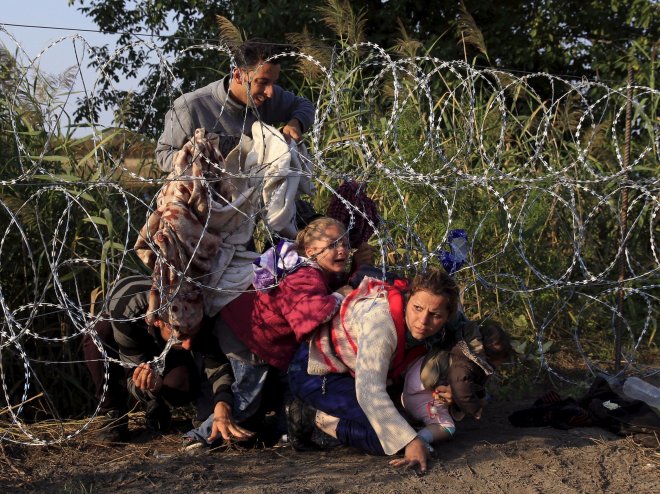
The fact is: not all immigrants are economic. Instead, there are really three types of immigrants taking part in today’s mass migrations. True: some contemporary refugees are economically driven. Many others however are war refugees; a third group seeks refuge from the effects of climate chaos. The legitimate interests of each of these groups dictate separate policy changes that are generally ignored in xenophobic rhetoric about building walls, and protecting national identity.

Economic immigrants are those earlier-mentioned working people who demand the same rights as big capital. Within the European Union, and as already indicated, they have been moving legally from low wage countries to higher wage venues.  In our hemisphere, workers from Mexico and Central America have intuitively followed free-trade logic. They have voted with their feet against the labor restrictions of NAFTA and CAFTA despite the trade agreements’ legal prohibitions.

For their part, war refugees are flooding the world as a result of United States’ and U.S.-supported bombing campaigns (including drones) in Syria, Iraq, Afghanistan, Libya, Somalia, Palestine, Yemen, and elsewhere. Such campaigns have demolished the refugees’ homes, and destroyed their communities and jobs. It’s no wonder then that they reluctantly seek refuge in Europe and the United States. Under international law, they have the legal right to do so. Morally speaking, those responsible for the bombings are most obliged to receive them. The culprit United States should lead the way.

Finally, refugees from climate chaos form a separate category. Many migrants from Syria, for instance, are fleeing not only U.S.-sponsored bombing raids; they are farmers whose fields have been devastated by a years-long drought. Other refugees from island nations and coastal regions find their homes swallowed by rising sea-levels caused by melting polar icecaps. As global temperatures and sea levels continue to rise, this category of refugees will soon dwarf the other two.

In light of such distinctions about free trade, the logic of globalized capitalism, and the three classes of refugees, clear remedies suggest themselves – all inspired by Brexit. In a word, the basic remedy is democracy. More specifically, required policy changes include: (1) Exiting all free trade agreements responsible for economic refugees; (2) Stopping the bombing and wars that create homeless refugees, and (3) Leaving fossil fuels in the ground while adopting mandatory regulations to prevent further warming of the planet.

Though unlikely, all of this is possible. As the Brexit vote demonstrates, there is nothing mandatory or inevitable about free trade agreements. In developing countries, they all can be replaced by what in the past was called “import substitution.” That meant industrialization by Global South economies and instituting protectionist policies to keep imports out and economic emigrants at home.

Such substitution is based three realizations: (1) that no country has ever achieved “developed” status by reliance on supplying raw materials and agricultural products to industrialized nations, (2) that such policy of protectionism and import substitution was itself responsible for the economic advancement of the United States, and (3) after World War II, it worked in Global South countries such as Costa Rica with the result of separating it from its unindustrialized neighbors as economically successful.

[Please note that if free trade agreements remain under consideration, democracy demands that their discussion involve all affected parties with equal representation and vote. Such negotiations would include environmentalists and their concerns for air, water plants and animals. They would involve workers whose jobs might be lost, and community members whose neighborhoods and cities might be devastated by mass emigration, increased pollution or by waves of immigrants. Here absolute transparency is required.  There can be no secret negotiations, top-secret documents, or one-sided elite authorship of policies that end up affecting millions of disenfranchised workers including women and children.]

If Brexit was the start of a peasant revolution, it’s time for all of us to join our brothers and sisters at the barricades across the pond, pitchforks in hand. Our enemies in this struggle are not immigrant workers victims of our wars, or those whom one-percenters call environmental extremists. They are instead the extremist negotiators of secret trade pacts, belligerent prosecutors of wars and obtuse deniers of humanly-induced climate change.

Those are the exploiters whom the Brexit vote indicates we must unite to overthrow and replace.

The Irrelevance of Religion in the Eyes of Jesus (Sunday Homily)

Good Sam Pic

Readings for 15th Sunday in Ordinary Time: DT. 30: 10-14; Ps. 69: 14, 17, 30-31, 34, 36-37; Col. 1: 15-20; Lk. 10: 25-37.

What do you think? Does God care about religion? Does She need it? Do we? Does She even care if we’re Christian, Muslim, Jew or atheist?

Today’s Gospel reading – the familiar parable of “The Good Samaritan – seems to answer “no” to all of those questions.

The tale addresses the problems of crime and violence and of proper human response. Surprisingly, the recommended response is not “religious” at all, but humanitarian. It is unadorned motherly compassion by a specifically irreligious actor.

Jesus makes that point by creating a fictional account where the hero is despicable in the eyes of his audience. He is a Samaritan. Meanwhile, the villains of the piece are religious leaders – a priest and a Levite (virulent enemies of the Goddess religions that biblical patriarchs detested). .

In Jesus’ time, Samaritans were social outcasts belonging to a group of renegade Jews who (by Jesus’ time) had been separated from the Jewish community for nearly 1000 years. They were seen as having polluted the Jewish bloodline by intermarrying with the country’s Assyrian conquerors about 700 years earlier. Female goddesses figured prominently in the religions of ancient Assyria.

As a result, Jewish priests and Levites considered Samaritans “unclean;” they were traitors, enemy-sympathizers, heretics and even atheists. They rejected Jewish understandings of the patriarchal Yahweh and the Temple worship that went along with them. For priests and Levites, Yahweh was interested in temple sacrifice and abstract law.

And yet the Good Samaritan is found to be more worthy, more pleasing in God’s eyes than the priest or Levite, who enjoyed great prestige among Jews as “men of God.”

Yes, Jesus prefers the Samaritan because his actions speak much louder than the religious orthodoxy of Israel’s holy men or than the word “Samaritan” would allow. The outcast expresses typically female compassion; so Jesus approves.

In this way, Jesus’ story calls his audience (and us!) to transcend socially prescribed categories, patriarchy, and even religion in dealing with problems of crime and violence. In fact, the crimes addressed in the parable are not primarily robbery and physical abuse. They are indifference, denial, and patriarchy’s religious hypocrisy.

The solution to such crimes along with robbery and violence is not found in religion, theology or temple sacrifices. It lies simply in compassionate action – in “being there” for victims.

As always, then, Jesus’ words invite us to reconsider our very understanding faith, and our favorite categories of “good” and “evil” — and the identity of God Herself.

Perhaps religion is not that important for followers of Jesus after all — nor to the Great Cosmic Mother..