The Catholic Church is a sinking ship. So are its orders of priests and nuns. The “reforms” presaged by the election of Pope Francis are like rearranging the deck chairs on the Titanic. They’re busy work for those whom history has rendered superfluous.
Similarly, for all the good will behind them, efforts at reforming orders, congregations and societies of priests and religious are doomed from the start. Typically they endorse the hierarchy’s negligence by failing to address the substantive causes of the crises that afflict the sinking church and its semi-submerged sub-organizations.
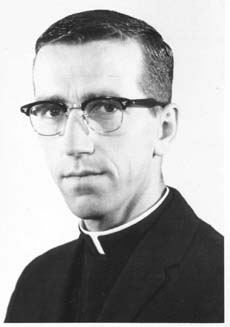
These are the conclusions I drew after attending a joyous reunion of priests and former priests (and their wives) belonging to the Society of St. Columban. That’s the Irish-founded missionary group I joined in 1954 (when I entered the minor seminary at the age of 14) and which I left in 1976. I had been ordained in 1966 (ordination photo above — taken by my classmate, Tom Shaugnessy).
The reunion took place in Bristol, Rhode Island over a three-day period just last week (July 21st-23rd). It was great getting together with friends, colleagues, teachers, former priests and their spouses. It was wonderful to see so many of my one-time missionary friends with their beautiful wives from Ireland as well as Japan, Korea, Chile and other “fields afar” (as the title of one missionary magazine used to put it). Several men’s spouses were former nuns. I can only imagine the wonderful love stories each of those couples might tell.
As with all reunions, there were the usual reminiscences from years long past. We made wisecracks about how all of us have aged, and observations about how quickly time has flown. There was catching up to do about retirement, children, grandchildren, illnesses, deaths of former colleagues, and plans for our declining years – and always in a light-hearted spirit. We even went for a cruise around the Newport Harbor. Great fun!
On the final day, things turned more serious. The newly-elected Regional Director of the Columbans spoke to us about the Society of St. Columban today. After introducing himself, this comparative youngster of 51 years informed his appreciative audience of recent efforts to update the Society in the face of zero vocations over the last number of years in Ireland, the U.S., England, and Australia. The situation is aggravated by the advancing ages of the 400 or so priests who remain in the Society – so many of them over the age of 75.
In response, we were told, the Columbans have made efforts at recruiting seminarians from the “mission” territories. As a result, Columban ordinations have taken place in the Pacific Rim – in Korea, Fiji, the Philippines, and also in Latin America. The Society’s directorate has changed accordingly. With its headquarters now located in Hong Kong instead of Ireland, the current directing council is a rainbow blend of Irish, Latin American, and Philippine “superiors.” Additionally lay associates, both men and women have become more prominent in the Columban scheme of things.
Besides such developments, there have been efforts at dialog with Muslims, especially in Pakistan and the Philippines. Social justice for the poor and ecological concerns have become central themes of documents recently authored by Society “chapters” or long-range planning sessions. Above all continued emphasis on brotherly love and legendary Columban hospitality continue as hallmarks of this group about to celebrate the 100th anniversary of its founding as the “Maynooth Mission to China” in 1918. (“Maynooth” was the name of the Irish National Seminary back then.) With China now open, Columbans are currently making efforts to reintroduce themselves into that continent-sized country thus reclaiming the Society’s original focus.
All of that seemed encouraging. Such updating demonstrates the good will, generosity and continued vitality of men and women still intent on doing good in the world and serving the God their faith envisions. Columbans remain for me the most inspiring community of its kind I’ve ever known.
However questions surfaced for me about the reforms just mentioned. And unfortunately there was little time to raise – much less probe – them during the discussion period that followed the new Regional Director’s fine presentation. For instance:
• What does it mean that Pacific Rim Catholics are more open to the priesthood and mission than Europeans and North Americans? Is faith stronger in the former colonies? Are candidates European wannabes? Or has a pre-Vatican II brand of Christianity been introduced in the Pacific Rim that avoids the crises of the celibate priesthood that emerged following that historic Council whose 50th anniversary we’re currently celebrating?
• Does the incorporation of women and laymen as associates give them equal voice and vote in Society matters? Will there soon be a woman Superior General governing the Society of St. Columban?
• What is the point of Columban-Muslim dialog? Is it conversion of the Muslim dialog partners? Is it enrichment of all conversation participants? Is it collaboration and cooperation? If so, what is the shared project?
• For that matter, what’s the point of missionary work itself? After all, Vatican II recognized the value in God’s eyes of Hinduism, Buddhism, Islam and other faiths. Are missionaries still trying to convert faithful people whose culture seems so distant from a Christianity so long and fatally associated with empire and exploitation?
• What specifically are Columbans doing about ecology and care for the planet? It’s easy for organizations nowadays to claim “green” commitment, but where does the rubber meet the road? Are Columbans encouraging vegetarianism as spiritual and ecological discipline? Are they cutting back on air-conditioning? Are they mandating that their cars be hybrids or have targeted miles-per-gallon ranges? Are they mounting campaigns focused on global warming and the introduction of genetically modified seeds in Latin America and Asia?
Those are some key questions that necessarily remained un-discussed at our Columban reunion. But I did get the opportunity to pose one whose answer led me to draw the conclusions I shared at the beginning – about the Columbans, organizations like them, and the Catholic Church itself being sinking ships. I asked:
• The great Catholic theologian, Karl Rahner, has observed that the Holy Eucharist is constitutive of the church. Without Mass, he said, there simply can be no church. Therefore it is positively sinful on the part of church leadership to deprive Catholics of Eucharist because of an artificial priest shortage caused by blind commitment to mandatory celibacy and an all-male clergy. What are the Columbans doing to lobby for fundamental change in the church to make the Eucharist more available to the communities Columbans serve?
Understandably, the Regional Director gave the expected answer – the only one possible, I think. “Of course,” he said, “where 2 or 3 Columbans get together those questions are always discussed. However, we’re such a small and relatively insignificant organization, we have so little clout. So, no, we haven’t discussed petitions or protests on those matters.”
In other words, the sin of mandatory celibacy for priests, the sin of an all-male clergy will continue until the Vatican repents. But even Francis I is not about to don sack cloth and ashes in that regard.
That institutional obstinacy was underlined for me in the Mass that concluded our magnificent reunion. Two male priests stood before a congregation of “priests forever” – the latter adopting subservient positions in the pews instead of concelebrating. No woman had any role in the Mass. Additionally, the recently mandated pre-Vatican II Latinisms reminded me that the church is actually regressing:
• “Consubstantial” (instead of “one in being”)
• “And with thy spirit” (rather than “also with you”)
• “Shed for you and for many” (not “all”)
• “It is right and just” (instead of “fitting”)
• “Come under my roof” (rather than “receive you”)
The Latinisms are not trivial. They represent subtle messages that the signature liturgical reform of Vatican II is over. In the context of the Columban reunion, they demonstrated how hemmed in good people are by decisions from above.
Talk about rearranging deck chairs . . . . I could almost hear the water bursting through the Ship’s gaping hull.




 About Things That Matter