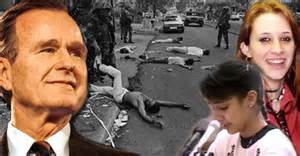
The Canonization of George H.W. and the Elevation of the Bush Crime Family

Readings for the 2nd Sunday of Advent: BAR 5:1-9; PS 126: 1-6; PHIL 1:4-6, 8-11; LK 3:1-6

It all made me very sad. I’m referring to this week’s post-mortem celebration of George H.W. Bush. I was saddened not only because of a family’s loss, but because of what the event said about our country’s amnesia concerning Mr. Bush’s crimes.

Absent that forgetfulness, I saw the funeral as the transformation of a deplorable mass murderer into some kind of Christian saint. It demonstrated what’s wrong with our country and with its supporting Christian ideology.

I’m emboldened to make such irreverent observations because the readings for this Second Sunday of Advent. They reintroduce us to the great prophet, John the Baptist who got himself martyred because of his own irreverent criticism of the royal family of his day. And the Bushes, who occupied the very highest offices in our country for 20 years [8 as vice-president + 4 as president (Bush 41) + 8 as president (Bush 43)] come as close to royalty as our country will allow. So, consider these remarks as coming from John’s voice in the wilderness. They may get me in trouble too.

In any case, I watched H.W.’s celebratory funeral unfold, I couldn’t help thinking of the other side of the story that I and my students at Berea College had learned about the man back in 1990. That’s when participants in my Freshman Seminar section researched Bush’s Desert Shield and Desert Storm disasters as they developed. We produced a book on it all: Eye on the Storm: Berea College Students Examine the First Gulf War.

The book was finally published in 2002 as Mr. Bush’s disgraced son prepared for the even more disastrous Second Gulf War. Here’s how the book-jacket blurb described our work:

“This book shows how the Gulf War was motivated by greed for oil, how it violated elementary ethical principles, and even more elementary human rights. Additionally, this study indicates how such motivations and violations were papered over by a basically uncritical, cheerleading press.

But not all Americans joined in the cheers. There was significant opposition to the war throughout the United States. That opposition surfaced strongly at Berea College, in Berea, Kentucky. There, teach-ins and rallies were held regularly; many students traveled to Washington to join the national protest; General Studies courses focused on understanding the war. One student, whose essay appears in this volume, spent days encamped in front of Berea College’s administration building to make his dissenting voice heard.

That voice and the others appearing in this volume, deserve to be heard. So do dissenting voices today, at Berea and throughout the country. For the Bush war on our immediate horizon threatens not simply to repeat the history of twelve years ago, but to make its horror seem benign.”

Right now, all of that seems eerily prophetic – especially in the light of Bush 43’s indirect creation of ISIS, the absolute devastation of Iraq, and the more-than-one-million deaths caused by his war of aggression.

But before I get to what I and my students learned about W’s father, think of the contrasting story we heard and witnessed about the patriarch last week. 

“He was such a good and noble man,” all the mainstream commentators seemed to whisper in hushed and reverent chorale refrain. “A class act,” Ms. Clinton said. “I so admire his family – so dignified even in mourning,”others gushed. “He was so unlike the present occupant of the White House.” “There’ll never be another like him – such a statesman. “A wonderful father,” Mr. Bush’s son (the greatest war criminal of the 21st century) proclaimed from a pulpit of all places!

That’s what we heard. What we saw was even worse.

All the surviving war-criminal heads of American Empire had come together in Washington’s National Cathedral to normalize a mafia don and invoke God in doing so. There they were: Carter, Clinton, George W., Obama, and Donald Trump. As Chomsky has said, they’re all war lords and mass murderers, every one of them.  

But each had his church game-face on as if they themselves were followers rather than enemies of the non-violent Jesus who was ironically a victim of imperialists exactly like themselves. That’s right: Jesus was tortured and executed in an imperialized province – his own day’s equivalent of our oligarchs’ killing fields in Southeast Asia, the Middle East, Africa, and Latin America.

But there they all sat solemnly honoring one of their own – a rich patrician, a CIA spook, an inveterate racist, a bald-faced liar, and contemptible war criminal. So, we heard the prayers (I’m not sure addressed to whom); we witnessed the crime- boss’ canonization, and our hearts went out to the members of the Bush crime family.

And yes, we all listened in respectful silence. Instead, all of us should have been shouting “Shame! Shame!”

And that returns me to my students’ research. What we discovered was eye-opening. We found out that:

  • George H.W. Bush’s father, Prescott Bush, did business with the Nazis during World War II. In other words, President Bush came from a right-wing Nazi-sympathizer family. (Can you imagine the dinner-table-conversations young George overheard and participated in?)
  • Bush was a racist and misogynist. He pioneered dog-whistle campaign tactics to become POTUS through his infamous Willie Horton campaign ad. He opposed Anita Hill in her testimony against his SCOTUS appointee, Clarence Thomas. (We later learned that Mr. Bush was a serial groper as well.)
  • H.W. was the first ex-CIA Director (1976-’77) to become U.S. president – having served as Vice-President during Ronald Reagan’s genocidal war of terror in Central America which claimed the lives of hundreds of thousands in Guatemala, Nicaragua, El Salvador, and Honduras. In those official capacities, and contradicting the hypocritical “war on drugs,” Bush employed the drug cartel boss, Manuel Noriega, as a CIA asset. He looked the other way as Noriega dealt drugs that eventually ended up in the veins of U.S. citizens.
  • Then just before leaving office, Mr. Bush pardoned his Iran-Contra co-conspirators — the ones responsible for all those Central American deaths.   
  • After the fall of the Berlin Wall, Bush invaded Panama to arrest Noriega (1989) when the Panamanian leader got too independent for his own good. In the process Bush oversaw the killing of anywhere from 3000 to 10,000 impoverished and unarmed Panamanians in the country’s poorest neighborhood. He destroyed the Panamanian Army so that the U.S. would have reason to stay on after a recently-signed treaty turned over ownership of the Panama Canal to local authorities. 
  • According to a long-standing goal articulated in 1988 by Miles Ignotus, the real reason for Bush’s First Persian Gulf War (1990-’91) was to “Seize Arab Oil.”
  • To that end, Bush induced former CIA asset, Saddam Hussein to invade Kuwait by allowing his ambassador to Baghdad, April Glaspie, to mislead Saddam into believing that the Bush administration would not interfere with his invasion of Kuwait.
  • Bush also manipulated U.S. public opinion by using a 15-year-old “eye-witness” from Iraq to falsely allege that Iraqi soldiers tore infants from incubators and left them to die on hospital floors. Bush’s lies swung national opinion in favor of his war.  
  • In the first Gulf War, Bush oversaw the slaughter of retreating Iraqi soldiers, shooting untold (literally!) thousands of them in the back in what perpetrators described as a “turkey shoot.”
  • In a clear effort to dispel the “Vietnam Syndrome,” Mr. Bush elevated the concept of “fake news” to an entirely new level by strictly controlling reporters’ access to combat zones in Panama and Iraq.

That last point deserves special notice, because of my daughter Maggie’s contribution to my class’ study of the Persian Gulf War. At the time of our work, Maggie was in the 6th grade at our local Berea Community School (BCS). For her science project that year, we decided to study the war’s coverage by our local Lexington Herald-Leader.

Together, we collected and examined all editions of the paper from day-one to the war’s official end. We categorized its news accounts, editorials, and cartoons as pro-war, anti-war, or simply descriptive. We counted words and measured column inches.

As you might expect, Maggie found that Bush’s implementation of his “embedded journalist” strategy proved completely successful in his prescient creation of fake news and alternative facts. Words criticizing the war were few and far between. But Maggie’s project ended up achieving recognition beyond BCS. It got her into a regional competition for best science project. As a result, she was exposed to the concept of fake, state-controlled news long before Donald Trump. So were the judges who reviewed her work.

It was all so ironic, isn’t it — transforming a war criminal into a noble saint?  It’s a complete distortion of American history – not to mention of God, Jesus, and Christianity itself.

But what else can we expect in a nation whose entire people have been systematically taught to ignore what all our leaders have done without exception at least since World War II. None of them deserve our admiration.

Our “Christian” leaders are not much better. They’ve wedded themselves to blood-thirsty, deceptive regimes. They’ve sent the authentic story of Jesus of Nazareth down Orwell’s memory hole. In his place they would have us worship as our saviors the rich white patricians who rob us blind while terrorizing and exterminating poor red, yellow, brown and black people across the globe?

As John the Baptist might say, “Shame! Shame!”

Yemen’s Apocalypse: The Threat (and Promise) It Conceals

western imperialism

Readings for 33rd Sunday in Ordinary Time : Dn. 12: 1-3; Ps. 16:5, 8-11; Heb. 10:11-14; Mk. 13:24-32

I hope you’re all watching what’s unfolding in Yemen.

Over the past three years, a Saudi-led coalition there, with complete endorsement and logistical support from the United States has created hell on earth. It’s the world’s worst humanitarian crisis described as absolutely “apocalyptic” by Mark Lowcock, the UN Undersecretary-General for Humanitarian Affairs and Emergency Relief Coordinator.

The reference to apocalypse is relevant to today’s liturgy of the word which features two apocalyptic readings – one from the Book of Daniel and the other from the Gospel of Mark. Your priest or minister will tell you that the excerpts are about the end of the world. But they’re not. They’re both about the end of empire.

Consequently, we who live in the belly of the world’s current imperial beast should take heed. With the affliction our government is causing in Yemen, the readings should make us tremble at the prospect of our inevitable fate.
Before we get to that, think about what’s happening in the poorest country in the Middle East.

Since 2016, bombings by the U.S.-Saudi coalition have killed more than 57,000 people in Yemen. Water supplies, and sewage treatment plants have been destroyed. Epidemics of cholera and diphtheria have resulted. Bombings of the port city of Hodeida have made it impossible for emergency relief to enter the country. And that has pushed 14 million Yemenis to the brink of famine. Fourteen million!! More specifically, 500,000 children currently face death by starvation. As a result of it all, a Yemeni child dies every 10 minutes.

Last week, House Republicans blocked Democrats from forcing a vote on the U.S. role in Yemen under the War Powers Act. Why would those who portray themselves as “pro-life” want to continue killing so many children?

The answer, of course, is: because that’s what empires do. It’s what empire’s victims have always contended with. By their very nature, empires create apocalypses.

And that brings us to today’s readings. The literary form apocalypse first appeared about two centuries before the birth of Jesus. The context for its emergence was Israel’s struggle against the Seleucid (Greek) dynasty headed by Antiochus IV Epiphanes.

In the year 168 C.E., Seleucid troops invaded Palestine and devastated Jerusalem. Antiochus hated Judaism and defiled the Jerusalem Temple by offering a pig on its altar. He also erected an altar to Jupiter in the Temple. Patriotic Jews called it “the abomination of desolation.” While occupying Palestine, Antiochus also destroyed all the copies of Scripture he could find and made it a capital offense to possess such manuscripts. It was against Antiochus IV and the Greek occupation of Palestine that the Bible’s Book of Daniel (excerpted in today’s first reading) was written. Its thrust is to predict the destruction of Antiochus’ imperialist empire. Apocalypse is resistance literature.

Writing nearly two centuries later, Mark adopts Daniel’s resistance form to describe the absolute destruction of Jerusalem that he accurately foresaw. It was very like what’s happening in Yemen. After a six-month siege, the Roman Emperor Titus, with four Roman legions finally captured the city of Jerusalem from its Zealot defenders. Moving from house to house, the Romans destroyed everything within reach, including the City’s Temple. Palestine would not again belong to the Jews until 1947. It was the destruction of Jerusalem by the Romans that Mark has Jesus predicting in today’s Gospel excerpt. It’s that sort of thing that empires have always done.

Years later – sometime in the 90s of our era – John of Patmos penned his Book of Revelation. It employed apocalypse to predict the fall of Rome – the bloody whore seated on her seven hills drinking the blood of martyrs (REV 17:6). John’s context was the persecution of Christians under the Roman emperor, Domitian. John’s prediction about Rome? Absolute devastation! Its leaders, legions and ideologues will be “thrown alive into the lake of fire that burns with sulfur” (REV 19:17-21). That inevitable fate of empires should scare the hell out of us.

However, as I’ve indicated, most of us have been led to think of such writing as describing the end of the world. And why not? It keeps us from facing what our country is doing in the world and the fate that awaits us.

The false connection between apocalypse and the end of the world has been fostered and exploited by a whole industry of empire-friendly evangelical preachers like John Hagee who appear regularly on our television screens. Their domesticated approach to apocalypse is foundational to the publishing success of the Left Behind series of books by Tim LaHaye and Jerry B. Jenkins. It is also foundational to numbing us to scriptural warnings about empire.

According to the preachers and books I’ve just mentioned, apocalypse describes a final battle between Good and Evil. The battle will be fought in the Middle East on the Plain of Armageddon. Two billion people will die as a result – including 2/3 of the Jewish people. The remaining 1/3 will be converted to Christianity because God’s final violent revelation will be so awe-inspiring and convincing. A “Rapture” will then take place, taking all faithful followers of Christ into heaven, while leaving behind the rest of humanity for a period of “tribulation.” In all of this, God is the principal actor. As an angry father, he is finally taking his revenge for the disobedience and lack of faith of his ungrateful children – whom he loves!

Problem is: all of that is dead wrong and blasphemous in terms of the God of love revealed by Jesus. The Rapture story, for instance, appeared for the first time only in the 19th century. In fact, apocalypse is not about the end of the world. It is about the end of empire – the Greek Empire of Antiochus IV Epiphanes in the case of Daniel, and the Roman Empire in the case of the Book of Revelation. The mayhem and unprecedented suffering referenced in all three sources is not something God does to the world, but what empire routinely does to people, their bodies, souls and spirits, as well as to the natural environment.

Because it has ever been so with empire, today’s excerpt from Mark called for a complete end to the politics of violence and domination. That meant obeying the command of Jesus to reject empire, but also to refuse alignment with Zealot nationalists.

As the Romans under Titus approached Jerusalem between 66 and 70, Zealot recruiters traveled throughout Palestine calling on Jewish patriots to defend their homeland by joining guerrilla forces. Instead, the words Mark put in Jesus’ mouth warned the Master’s followers to flee to the mountains (Mark 13:14-16). They were absent themselves not out of cowardice, but from apocalyptic conviction that God’s order of justice could not be established by the sword. Obeying Jesus’ direction meant that Christians were not only threatened by Romans but by Jews who accused Jesus’ followers of treason.

How should those readings affect us today whose Commanders-in-Chief repeat the crimes of the Seleucid Antiochus IV and the Romans Titus and Domitian – all of whom thought of themselves as doing God’s work in destroying what they despised as a superstitious, primitive, tribal, and terrorist religion? (Yes, that’s what they thought of Judaism!)

Today’s readings recommend that we adopt an apocalyptic vision. That means refusing to defend the present order and allowing it to collapse of its own weight. It means total rejection of U.S. imperial ambitions and practices. It means supporting cease-fire measures in Yemen, calling for total U.S. withdrawal of support from the Saudis, and refusing to treat as heroes those who advance the policies of destruction and desecration inevitably intertwined with imperial ambition. It means letting go of the privileges and way of life that depends on foreign conquest and vilification as “terrorists” of patriots defending their countries from invasion by U.S. forces. It means determining what all of that might signify in terms of our consumption patterns and lifestyles and supporting one another in the counter-cultural decisions such brainstorming will evoke.

So, in a sense, apocalypse is after all about the end of the world. The entire Jewish universe was anchored in the temple. Its defilement by the Greek Antiochus IV, its complete destruction by the Roman Titus seemed like the end of the world to the Jews. The threat of westernizing the Arab world might seem that way to the occupied Muslim world today. And the end of the American Way of Life premised on resource wars under cover of a “war on terrorism” might strike us as the end of everything we hold dear.

However, the apocalyptic message of hope is that the passage of empire and nationalism is not really the end. Instead it represents an opportunity for a new beginning. In the words that Mark has Jesus say this morning, “Do not be alarmed . . . This is but the beginning of the birth-pangs.”

How might we support one another in letting go of imperialism, nationalism and the lifestyles dependent on them?
(Discussion follows)

Jesus Was against Machismo Not Divorce

Today’s readings: Gn. 2:18-24; Ps. 128:1-6; Heb. 2:9-11; Mk 10:2-16 http://www.usccb.org/bible/readings/100718.cfm

I shared Tammy Wynette’s award-winning song “D-I-V-O-R-C-E” because it captures the pain that more than half of married people go through when they decide to divorce. Tammy’s opening words, “I want to sing you a song that I didn’t write, but I should have,” as well as the way she sings capture the very sad experience that divorce is for couples who all started out so full of love and hope. As all of us know, divorce is often characterized by regret and feelings of failure especially relative to the children involved. The irony is that many divorced people will come to church this morning and find their pain compounded by today’s readings and no doubt by sermons they will hear.

However today’s liturgy of the word is surprising for what it says about Jesus and his teachings about divorce. The readings tell us that Jesus wasn’t really against divorce as we know it. Instead as the embodiment of compassion, he must have been sympathetic to the pain and abuse that often precede divorce. As a champion of women, he must have been especially sensitive to the abandonment of divorced women in his highly patriarchal culture.

What I’m suggesting is that a sensitive reading shows that what Jesus stands against in today’s Gospel is machismo not divorce as such. Relative to failed marriages, he implicitly invites us to follow his compassionate example in putting the welfare of people – in his day women specifically – ahead of abstract principles or laws. Doing so will make us more understanding and supportive of couples who decide to divorce in the best interests of all.

By the way, the gospel reading also tells us something important about scripture scholarship and its contributions towards understanding the kind of person Jesus was and what he taught on this topic.

First of all consider that scholarship and its importance relative to the topic at hand.

To begin with, it would have been very unlikely that Jesus actually said “let no one” or (as our translation went this morning) “let no human being” put asunder what God has joined together. That’s because in Jesus’ Palestine, only men had the right to initiate a divorce. So in prohibiting divorce, Jesus was addressing men.  The “no one” or “no human being” attribution comes from Mark who wanted Jesus’ pronouncement on divorce to address situations outside of Palestine more than 40 years after Jesus’ death. By the time Mark wrote his Gospel, the church had spread outside of Palestine to Rome and the Hellenistic world.  In some of those communities, women could initiate divorce proceedings as well as men.

Similarly, Jesus probably did not say, “and if she divorces her husband and marries another, she commits adultery.” Such a statement would have been incomprehensible to Jesus’ immediate audience. Once again, in Palestine no woman could divorce her husband. Divorce was strictly a male right. Women could only be divorced; they couldn’t divorce their husbands.

So what did Jesus say? He probably said (as today’s first reading from Genesis puts it) “What God has joined together let no man put asunder. “ His was a statement against the anti-woman, male-centered practice of divorce that characterized the Judaism of his time.

And what was that practice?

In a word, it was highly patriarchal. Until they entered puberty, female children were “owned” by their father. From then on the father’s ownership could be transferred to another male generally chosen by the father as the daughter’s husband. The marriage ceremony made the ownership-transfer legal. After marriage, the husband was bound to support his wife. For her part however the wife’s obedience to her husband became her religious duty.

Meanwhile, even after marriage, the husband could retain as many lovers as he wanted provided he also able to support them. Additionally the husband enjoyed the unilateral right to demand divorce not only for adultery (as some rabbis held), but also according to the majority of rabbinical scholars for reasons that included burning his food, or spending too much time talking with the neighbors. Even after divorce, a man’s former wife needed his permission to remarry. As a result of all this, divorced women were often left totally abandoned. Their only way out was to become once again dependent on another man.

In their book Another God Is Possible, Maria and Ignacio Lopes Vigil put it this way: “Jesus’ saying, ‘What God has joined together, let no man put asunder’ is not the expression of an abstract principle about the indissolubility of marriage. Instead, Jesus’ words were directed against the highly patriarchal marriage practices of his time. ‘Men,’ he said, should not divide what God has joined together. This meant that the family should not be at the mercy of the whimsies of its male head, nor should the woman be left defenseless before her husband’s inflexibility. Jesus cut straight through the tangle of legal interpretations that existed in Israel about divorce, all of which favored the man, and returned to the origins: he reminded his listeners that in the beginning God made man and woman in his own image, equal in dignity, rights, and opportunities. Jesus was not pronouncing against divorce, but against machismo.”

Here it should be noted that Mark’s alteration of Jesus’ words is far less radical than what Jesus said. Mark makes the point of the Master’s utterance divorce rather than machismo. Ironically, in doing so and by treating women the same as men, Mark’s words also offer a scriptural basis for legalists who place the “bond of marriage” ahead of the happiness (and even safety) of those who find themselves in relationships which have become destructive to partners and to children.

Traditionally that emphasis on the inviolability of the marriage bond has represented the position of the Roman Catholic hierarchy. It is very unlikely that the historical Jesus with his extremely liberal attitude towards law and his concern for women would have endorsed it.

Instead however, it never was Jesus position that any law should take precedence over the welfare of people. In fact, his refusal to endorse that precedence – his breaking of religious laws (even the Sabbath law) in favor of human welfare – was the main reason for his excommunication by the religious leaders of his own day. In other words, Jesus was the one who kept God’s law by breaking human law.

So instead of “Anti-Divorce Sunday,” this should be “Anti-Machismo Sunday.” It should remind us all of what a champion women have in Jesus.

Sometimes feminists complain that Christian faith finds its “fullness of revelation” in a man. But as one Latin American feminist theologian put it recently, the point of complaint shouldn’t be that Jesus was a man, but that most of us men are not like Jesus. Today’s Gospel calls us men to take steps towards nullifying that particular objection.

The Real Election Interference Threatening Our Democracy

Voting Machine

Ever since the 2016 election, our non-stop news cycles have focused on Russian meddling in our (supposedly) otherwise well-functioning electoral system.

And just lately, President Trump, who denies that such interference helped get him elected, has warned that the Chinese are also about to intervene – this time, he fears, against the interests of his party.

The President’s double standards aside, all such scapegoating ignores the fact that the real interference threatening our democracy comes from within. In fact, it largely originates with Republicans, whose policies have rendered the system entirely dysfunctional and unreliable.

To begin with, I’m referring to their sponsorship of the Citizens United lawsuit. It opened the door to the corrupting influence of campaign contributions from wealthy donors to Republicans and Democrats alike. I’m also referencing The Supreme Court’s striking down Section 4 of the Voting Rights Act. The Court’s (Republican-led) 5-4 decision opened the door for laws intended to disenfranchise Democrat-leaning minorities.

Add to this the practice of gerrymandering that renders GOP congressional seats virtually invulnerable, along with widespread voter suppression that discounts thousands of votes in each state and millions nation-wide in each election cycle, and you get an idea of just how corrupt our system has become.

And I haven’t even mentioned refusal to eliminate the Electoral College that has overridden the popular electoral will in favor of our last two Republican presidents – or the entirely hackable voting machines controlled by GOP-friendly operatives like Diebold Election Systems.

And then there’s the most fundamental voter-suppression measure of all – holding elections on Tuesdays precisely during the hours when working-class voters are on the job or traveling to the workplace.

All of this suggests that we must face up to the facts that:

• G.O.P. operative, Paul Weyrich, meant what he said in 1980 about Republicans not wanting everyone to vote (because if everyone did cast a ballot, a Republican president would never again darken the White House door).
• Computerized voting machines overwhelmingly favor that minority otherwise unelectable party by potentially miscounting and/or flipping millions of votes that end up completely unverifiable.

Addressing the problem will entail:

• Getting private money out of the electoral process in favor of public funding.
• Eliminating the electoral college in favor of direct popular vote.
• Abolishing gerrymandering by making redistricting a bi-partisan process subject to the approval of a reformed Federal Election Commission whose goal would be to maximize voter turn-out as well as to increase voter confidence by a transparent certification process.
• Outlawing completely highly hackable voting machines.
• More specifically, implementing a system of universal, automatic and verifiable voter registration and reverting to employment of hand-counted paper ballots.
• Changing Election Day from Tuesday to Sunday, or even establishing a national voting holiday (e.g. from Saturday to Tuesday), with ballots hand-counted by unimpeachable young people like senior Boy Scouts and Girl Scouts on Wednesday.

Failure to enact such changes, especially following the debacles of the presidential elections of 2000 and 2016 is not the fault of foreign interference in our electoral process. It’s the fault of a fundamentally broken system intended to discourage grassroots participation in favor of a minority party. Fixing it will require great commitment and work by us all.

Despite the obstacles placed in our paths, a first act towards repairing the systemic dysfunctions just described will present itself to us on November 6th.

In other words, that first reparative step is to vote the Republicans out of office replacing them with progressive democrats who refuse to take corporate money.

A Judicious Wise Woman Shames an Emotional Muddle-Headed Man: Blasey-Ford for SCOTUS!

Kavanaugh

Did you watch the Brent Kavanaugh confirmation hearings yesterday? I couldn’t help myself. I watched much more than I at first intended. I found it all quite fascinating and very conclusive in terms of filling the Supreme Court post left open by the resignation of Anthony Kennedy.

Surprisingly, I decided that if presented with the improbable choice, I’d vote to approve Christine Blasey-Ford, not Brent Kavanaugh, for the vacant post. Her testimony yesterday exhibited the qualities I expect in a judge. She also evidenced a sharper legal mind than the actual nominee.

Let me explain.

At issue, of course, was Dr. Blasey-Ford’s accusation that 36 years ago, when she was 15 and he was 17, Kavanaugh attempted to rape her at a drunken high school party. Perhaps even more importantly, the issue has become whether or not Judge Kavanaugh is lying about the event in question.

Dr. Blasé-Ford’s couples-therapist has notes to prove that the alleged crime remained a disturbing issue long after the alleged event and well before Kavanaugh’s nomination to fill the soon-to-be-vacant SCOTUS position. Blasey-Ford says she is “100% sure” that Kavanaugh was her attacker. She has also taken and passed a lie detector test to that effect.

Her request is that the F.B.I. investigate her allegations – specifically that they take a deposition from the only witness to the crime, one Mark Judge who, she says, was at least an accessory to the crime, if not an active accomplice of the young Kavanaugh she describes. Blasey-Ford alleges that Judge egged Kavanaugh on and that he ended up jumping on top of the pair as the future SCOTUS nominee attempted to disrobe her.

Throughout her testimony, I found Dr. Blasey-Ford’s testimony low-key, measured, open, matter-of-fact, and un-defensive.

For his part, Judge Kavanaugh denies the whole thing. His testimony was loud, aggressive, angry, extremely emotional, tear-filled, defensive, and punctuated by snorting, huffing, puffing and frequent pauses for long gulps of water. With raised voice, he repeatedly talked over his inquisitors. At points, it appeared that he was having a nervous breakdown.

Along with his Republican male colleagues, the judge painted himself as the innocent victim of a calculated smear campaign. Though Dr. Blasey-Ford may well have endured the horrific attack she describes, Kavanaugh maintained that she had mistaken the identity of her attacker.

He further argued that there was no need to depose Mark Judge. It was good enough, Kavanaugh said, that the one Dr. Blasey-Ford had identified as his accomplice or accessory had submitted a statement swearing to the innocence of Kavanaugh (and, naturally, of Judge himself).

Similarly, for Kavanaugh, further F.B.I. investigation would be pointless. Much less would it help for him to take a lie-detector test. He intimated that his detailed calendar from 36 years ago, along with his own interpretation of its meaning was more credible than any such testing might ever be.

And that brings me to the conclusion I mentioned earlier. I thought of the whole spectacle in terms of a job interview. After all, that’s the bottom line here. Regardless of his guilt or innocence, Brent Kavanaugh is interviewing for a position on the highest court in the land. The real question here is not about the alleged event of 36 years ago, but about hiring him for a life-long job with iron-clad tenure.

To help answer that question, I recalled my years of work at Berea College in Kentucky and of the innumerable job candidates I interviewed there. What if Dr. Ford and Judge Kavanaugh were applying for a job there? How would I and my colleagues evaluate their performances? Who would be most the most effective candidate.

It would not be Kavanaugh.

To begin with, measured, thoughtful, humble and articulate would be judged far more favorably than strident, defensive, accusatory and accompaniment by snorting, huffing and puffing. That contrast alone would disqualify Kavanaugh from serious consideration.

But then there’s the more serious question of professional competence. I and my colleagues would wonder who exhibited more . . . well, judiciousness? Who gave evidence of a better legal mind?

Clearly, it was Blasey-Ford. She called for full investigation of new charges. She requested deposition, cross-examination, and judgment based on eye-witness testimony. Meanwhile, he preferred reliance on investigations prior to recent charges. For him, testimony of the accused, endorsements by his friends, and trusting the written self-exoneration of an alleged accomplice or accessory were good enough.

I’m sure I and my colleagues would see such reasoning as sloppy and . . . well, injudicious.

In the words of a Great Man, I’m certain we’d conclude in effect: “Judge, Kavanaugh, you’re fired!”

Improbably, we’d offer the position to Dr. Blasey-Ford instead.

It’s Time for Catholics to Employ the Shock Doctrine: Set Up Alternative Storefront Churches Everywhere

Storefront

“Never let a good crisis go to waste.”

As described by Naomi Kline, that’s been the motto of reactionary politicians forever. In her book by the same title, she calls it “the shock doctrine.” It highlights the fact that when disasters occur, it becomes possible for politicians to ram through policies that otherwise wouldn’t have a snowball’s chance in hell of gaining approval.

9/11 provides the most obvious case in point. Its aftermath saw Congress gain quick endorsement of policies that its neo-fascist members have impotently lusted after for decades. I’m referring to the institution of a police state, to widespread surveillance of U.S. citizens, to the use of torture, to wars against oil and mineral-rich Muslims in Iraq, Libya, and elsewhere, and to the mass expulsions of foreigners from U.S. soil.

It was similar with Hurricane Katrina. Following its devastation, public schools were privatized, government programs of aid to the impoverished were shredded, and black neighborhoods were gentrified on behalf of wealthy real estate moguls and their clients. All of those were prominent among the “impossible” desiderata of Washington’s elite.

And without 9/11 and Katrina, they would have forever languished beyond the pale of prospect.

The argument here is that the mega-crisis of clerical pedophilia has opened the way for ordinary Catholics to apply Klein’s shock doctrine to an institution that has otherwise remained immobile even in the face of the urgent call of Pope Francis (in “The Joy of the Gospel”) for radical change at almost all ecclesiastical levels.

I say “almost all,” because even in his otherwise brilliant Apostolic Exhortation, the pope specifically ruled out the ordination of women. (He did not even mention abolishing the requirement of priestly celibacy.)

However, my point here is that the horrendous pedophilic crisis has cardinals, bishops, priests, and even the pope himself on the run. Consequently, the door has swung wide for those outside the clerical establishment to take matters in their own hands. It’s time for us to demand changes that would otherwise remain unthinkable for the fossilized ecclesiastical establishment.

First on the list should be the re-examination of all church teachings about sex from masturbation to abortion. And here the laity should be in charge. For it has become evident that a celibate clergy has NOTHING at all to teach us about sex. In the light of clerical pedophilia and its coverup, they should forever remain silent on the subject.

Put otherwise: precisely as celibates, the Catholic clergy’s knowledge of sex can only be either entirely theoretical (usually based on a medieval understanding of the topic) or gathered from illicit, guilt-ridden practice. As such it is invalid and should be ignored on principle.

Second on the list should be the elimination of mandatory clerical celibacy itself. Common sense tells us that it is connected with the perversions of sex-starved priests.

Thirdly, it’s time to admit the obvious, viz. that pedophilia would never have flourished under the leadership of women. In other words, the door has swung open to the otherwise unthinkable for the clerical boys’ club – to the ordination of women.

With all of this in mind, Catholics should take advantage of this crisis by:

• Refusing to let the pope and others to get away with mere apologies and discussions about what to do with pedophilic offenders.
• Insisting instead that as a good faith measure, the pope immediately declare his intention to phase out mandatory celibacy and to open the way for women to serve the church at all levels from priest to pope.
• Demanding the convocation of a General Council (under lay leadership) to re-examine the entire corpus of church teaching on human sexuality.

But how apply pressure to bring about such changes? (And it’s here that the Shock Doctrine applies to a heretofore immobile laity as well as the clergy.)

Let me put it in terms of my own experience.

For years, it has been evident to me and other progressives within my local church in Kentucky that restorationist priests coming out of the reactionary papacies of Pope John Paul II and Benedict XVI were not meeting the needs of local parishioners shaped by the teachings of the Second Vatican Council (1962-65). Those teachings, I reminded my friends, remain the official doctrine of the Catholic Church.

With that in mind, I counseled repeatedly that without abandoning our identity as Catholics, we should leave the local church building and open a storefront, lay-led Catholic Church down the street. We would become a “shadow church” with its own lay pastor, its Eucharistic celebrations, its on-going education programs, and its outreach programs to the local poor. I recommended that we publicly invite our entire congregation to join us, and that we notify the local bishop of our intentions. We would continue meeting in this way, I recommended, until changes were instituted that met our needs.

Our model would be the Jesus, Mary, and Joseph (JMJ) Catholic Church centralized in James Patterson’s novel, Woman of God (which I reviewed here).

No one in our group of 20-25 proved ready to do any of that.

What I’m suggesting here is that the pedophilia crisis may have so shocked my sisters and brothers within my own community that they may now be open to follow the example of Brigid Fitzgerald, the priest hero of Patterson’s novel. She and her ex-priest husband opened a storefront church of the type I’m suggesting here.

I’m betting that following that example across the country and world would move local bishops, Pope Francis and the Catholic establishment to adopt something like the reforms I’ve suggested here.

So, let’s form our own JMJ churches. What have we got to lose?

A Reunion of Former Priests Underlines Deep Paradigm Shifts in the World, the Catholic Church – and in Myself

Columbans

Last weekend, I experienced an event that made me realize yet again how much the world, my Catholic faith – and I – have changed over the last 50 years. All at once, I realized that my prayers had been answered: a new age has indeed dawned for us all. It’s all quite revolutionary. Paradigms that once guided me and my contemporaries both religiously and politically have dissolved before my very eyes.

The clarifying event in question was a reunion of Catholic priests most of whom were ordained in the late 1960s and early ‘70s. I was in attendance since I too had been a priest. I was ordained in 1966 – after entering training for the priesthood in 1954 at the age of 14. Unbelievably to me now, at that tender age – as a high school freshman – I had enrolled in St. Columban’s Seminary in Silver Creek, New York. With virtually no experience of the adult world, I decided to give it all up to become a priest.

I changed my mind 22 years later. I left the priesthood in 1976, 10 years after ordination (for reasons I’ve explained here, here, here, here, and here). But it all means that I had spent more than 20 years in the religious life. I don’t regret a minute of it.

The Reunion

However, with all of that baggage, I found myself at this reunion at a former seminary in Bristol, Rhode Island – a place where, in 1960, I passed the “spiritual year” that candidates for the priesthood were required to experience. There, we had made our 30-day Ignatian retreat. We learned to meditate, fast, pray and discern God’s will. Today the seminary is a residence for retired priests.

Everyone at the reunion shared such experiences, though unlike me, few had begun their training as high schoolers. But all present are or had once been members of the Society of St. Columban – an Irish missionary organization founded to convert the Chinese in pre-revolutionary China. Though originally founded for China, Columbans were expelled from the mainland after Mao Tse Tung’s revolution in 1949. Thereafter, they moved on to work in 17 different countries, including Korea, the Philippines, Myanmar, Fiji, Pakistan, and various Latin American venues. Only relatively recently have they returned to resume work in China.

About 30 priests attended last week’s event – about a third of them still active priests, while about 2/3, like me, had long since left the clergy. Many of the “formers” came with their spouses.

Every three or four years, Columbans have held such reunions since the mid 1970s. This one, however, was special, since it marked the 100th anniversary of the Society’s founding in 1918.

Like all Columban gatherings of this type, the centennial version was characterized by reminiscences, jokes, laughter, plenty to eat and drink, along with questions and answers about what we and our families have been up to over the last 50 years or so since ordination. Name tags, of course were de rigueur. Nearly all of us have changed beyond recognition.

Religious Changes

But history was in the air. And a century of work called for placing the event in that wider context. Fr. Tim Mulroy, the Society’s U.S. regional director, obliged on the meeting’s second day. His remarks connected world events over the past 100 years with profound changes not only in the Society of St. Columban, but in its umbrella institution, the Catholic Church – and in everyone’s understanding of God, priesthood, and life itself.

The changes in question were provoked more than anything by the Second Vatican Council (1962-’65), when Pope John XXIII called a meeting of all the world’s bishops for purposes of aggiornamento – for updating and modernizing the Catholic Church – for bringing it into dialog with the contemporary world. That meant embracing modern scripture scholarship and honestly coming to terms with the scientific revolution, evolution, and developments in history, psychology, economics, political theory, and related fields.

Judging by conversations with my reunion colleagues, more than a half century of living with the resulting reforms has rendered our faith as unrecognizable as our wizened and deeply lined faces.

As outlined by Fr. Mulroy, here are some examples of what I’m talking about:

• China has changed drastically; it is now part of the global village. More than ½ million Chinese students are currently studying in the United States. Nothing like that was happening in 1918. To put a finer point on the phenomenon: China is waxing as a world power; the U.S. and Europe are waning.
• Ireland has similarly transformed. Many now even speak of that famously Catholic country as a post-Christian society. The clerical pedophilia scandals are largely responsible for Ireland’s loss of faith, though the transition from a basically rural culture to a more urban, globally-integrated one bears at least equal responsibility. It has introduced a level of materialism never before seen in Ireland.
• The teachings of Vatican II about the salvific value of other religions has called into question the very purpose of missionary endeavor. If, as the Council taught, Buddhists, Muslims, Hindus and tribal peoples all have valid understandings of God and can be “saved” (whatever that means), there doesn’t seem to be much point in trying to convert them.
• The internet has underlined that same point. Moreover, the new atmosphere created by social media means that a strong on-line presence for groups like the Columbans has become even more important than preaching effective Sunday homilies.
• The priesthood has also changed. Again, pedophilia along with Vatican II’s revised theology emphasizing a “priesthood of the laity” has taken priests off the pedestal they once occupied. In the Society of St. Columban, there hasn’t been an ordination either in Ireland or the United States since the year 2000.
• Of necessity then, Columbans have become less western. In fact, there are now two classes of Columban priests: the over-fifties and the under-fifties. The over-fifties are found in Ireland, the United States and in Australia. Most of them are either in or about to enter nursing homes. Meanwhile, the under-fifties typically come from Korea, the Philippines, Peru, Fiji and Brazil. Gradually, they find themselves working in the United States and Ireland evangelizing the now-secularized countries whose priests once evangelized them! Global South clergy working in the U.S. bring with them understandings of mission, life, and family very different from what their new audiences have grown to expect.
• All of the changes just listed have meant that English-speaking Columbans (for reasons of self-preservation) are gradually transitioning towards membership in a lay missionary organization. And fully 80% of its new members are female. One can only imagine what this means in terms of altering the extremely macho, patriarchal culture I experienced growing up in a Columban seminary!

In sum, the centennial celebration of our clerical group caused all of us to face the undeniable fact that our world has been drastically transformed. The Catholic Church has changed along with it. So has the Missionary Society of St. Columban along with all of its members and former members. The last 100 years (and especially the last 60 or so) have altered our understandings of God and the meaning of life.

Spiritual Changes

Take my own case.

When I began my priestly odyssey, my faith was simple. I was certain that God was “up there.” His word was revealed in the Bible whose truths were infallible and valid for all time. I knew for a fact that the Catholic Church was in sole possession that book’s true meaning. My purpose as a missionary-in-training was to get others to see that truth, so, like me, they might get to heaven.

The “holy sacrifice of the Mass” was all important then. I believed that the words of a priest could call Jesus down to enter a piece of bread and a cup of wine. I believed in Jesus actual presence in the tabernacle of every Catholic church where I might literally sit before him and “visit” as I would an intimate friend. Similarly, a priest’s words of absolution spoken in the confessional could open the gates of heaven to sinners previously on the road to hell.

Sin, judgment, heaven and hell were inescapable preoccupations for me. My focus was on the after-life. The priesthood was a divine calling that would make me “another Christ.” What a singular privilege!

Today, I can believe none of those things with the simplicity of faith I once enjoyed. Instead, my idea of God has become belief in the universal presence of a creative Life Force in whom (as St. Paul put it) we live and move and have our being (ACTS 17:28). Other religions are just as valid and questionable as Christianity. I have no idea what happens after death. Heaven and hell are this-worldly realities shaped either by love on the one hand, or fear on the other. Like almost all other Catholics, I’ve given up going to confession. And my commitment to daily meditation has replaced the importance I once gave the Eucharist. I’ve been driven away from the latter by priests still promulgating a vision I can no longer endorse.

Political Changes

All of this, I believe, represents not only a profound paradigm shift, but a kind of liberation. Its process has been a gradual coming of age that is paralleled by a similar shift in the political realm.

During the reunion, that political change was reflected in conversations with my former colleagues in the seminary and priesthood. Almost to a person (there were a few exceptions), everyone was completely scandalized by Donald Trump and his politics that have impacted so negatively the migrant communities to whose welfare (according to Fr. Mulroy) all Columbans are committed. I mean, political remarks at our gathering were more critical and negative about the United States than I’ve ever heard before at similar gatherings.

It all suggested that at least many of my Columban friends had gone through political paradigm shifts like my own. Again, without speaking for others, let me admit my own swing from right to left. My friends may have experienced something similar.

Growing up, of course, and at least till my late twenties, I was a good American and quite conservative. That shouldn’t be surprising, since the pre-Vatican II American church responsible for my seminary education was so conservative, anti-communist and patriotic. As a result, I believed that the United States was a force for good in the world and that it had always been so.

Only afterwards, did events and study correct such misperceptions. For me, the catalyzing elements included:

• The Vietnam War
• The Civil Rights Movement
• Women’s liberation movements
• Study of Global South, post-colonial theologies
• Travel and study in Rome (and across Europe), Brazil, Nicaragua, Guatemala, Costa Rica, Mexico, Cuba, South Africa, Zimbabwe, Israel, and India.

All such experiences gradually revealed to me the truth of Martin Luther King’s identification of the United States as the greatest purveyor of violence in the world – and (I still find it shocking to write this for a polite audience) the challenge of the Nicaraguan Sandinista meme that the United States is “the enemy of mankind.”

Conclusion

A sad highlight of the reunion I’ve just recounted was a meeting with a former mentor of mine. Fr. Dan remains a Columban priest and at the age of 92 resides in the Society’s nursing home in Bristol. For the past few years, dementia has robbed him of his memory to the extent that in our meeting last week, he was unable to remember me or the time we shared in Rome, where we both completed our formal studies. (There, Dan had given me sound advice as I contemplated leaving the priesthood for which I had prepared since the age of 14. I remain extremely grateful for his wise counsel.)

In any case, Dan was always a maverick and I loved him for that. One time, he announced that if he ever made the rank of bishop (fat chance!) the slogan on his coat of arms would be “No more bullshit!”

As I left our reunion last week with the reflections and insights just shared, I couldn’t help thinking of the relevance of Dan’s motto. It applies to church and state as I’ve experienced them over my 78 years. Over those years, both the Catholic Church and the U.S. government have exposed us all to great quantities of b.s.

Thankfully, the events of the past hundred years (especially since Vatican II) have empowered us to leave much of that behind while retaining the friendships and quasi-family ties that have characterized the Society of St. Columban. The evidence I encountered in Bristol last week shows that (despite the ancillary uncertainties) we’re all better off for the process.

I’m grateful to my Columban brothers (and sisters) for the experience of last week, and for the continued friendship and support that have enabled us all to more or less approximate Dan’s ideal.

The Missing Faith Dimension of the Capitalism vs. Socialism Debate

Jesus Communist

Democracy Now recently reported surprising results from a new Gallup poll about evolving attitudes in this country about socialism. The poll concluded that by a 57-47% majority, U.S. Democrats currently view socialism more positively than capitalism.

Let me offer some reflections sparked by those poll results. I offer them in the light of some pushback I received over my related blog posting about the capitalism vs. socialism debate. These current reflections will emphasize the faith perspective that has not only shaped my own world vision, but that should mobilize Christians to be more sympathetic to socialist ideals.

To begin with, the Gallup poll results are themselves astounding in view of the fact that since after World War II all of us have been subjected to non-stop vilification of socialism. As economist and historian, Richard Wolff, continually observes Americans’ overcoming such programming is nothing less than breath-taking. It means that something new is afoot in our culture.

On the other hand, the Gallup results should not be that shocking. That’s because since 2016, we’ve become used to an avowed socialist, Senator Bernie Sanders of Vermont, being the most popular politician in the country.

On top of that the recent 14-point victory of another socialist, Alexandria Ocasio Cortez, grabbed everyone’s attention. Recall that Ms. Cortez defeated 10-term congressional incumbent, Joe Crowley, in her NYC race for the Bronx and Queens seat in the House of Representatives.

Socialist candidates seem to be sprouting up everywhere. They advocate a $15 an hour minimum wage, Medicare for all, and tuition free college education.

Such promises seem to be somehow awakening Americans (at least subconsciously) to the reality that at least since WWII, similar socialist programs have become quite familiar. We’ve all experienced their efficacy since Roosevelt’s New Deal. We expect the government to intervene in the market to make our lives better.

In fact, since the second Great War, there have been no real capitalist or socialist economies anywhere in the world. Instead, all we’ve experienced are mixed economies with huge elements of socialism that we’ve all taken for granted.

Put otherwise, economies across the globe (however they’ve identified themselves) have all combined the three elements of capitalism: (1) private ownership of the means of production, (2) free and open markets, and (3) unlimited earnings, with the corresponding and opposite elements of socialism: (1) public ownership of the means of production, (2) controlled markets, and (3) limited earnings. The result has been what economists everywhere call “mixed economies”: (1) some private ownership and some public ownership of the means of production (exemplified in the post office and national parks), (2) some free markets and some controlled markets (e.g. laws governing alcohol, tobacco and fire arms), and (3) earnings typically limited by progressive income taxes.

What has distinguished e.g. the mixed economy of the United States from the mixed economy, e.g. in Cuba is that the former is mixed in favor of the rich (on some version of trickle-down theory), while the latter is mixed in favor of the poor to ensure that the latter have direct and immediate access to food, housing, education and healthcare.

My article also went on to argue that the socialist elements just mentioned have enjoyed huge successes in the mixed economies across the globe – yes, even in Russia, China and the United States.

“All of that may be true,” one of my readers asked “but how can you ignore the tremendous human rights abuses that have accompanied the “accomplishments” you enumerate in Russia and China? And why do you so consistently admire socialism over capitalism which has proven so successful here at home?”

Let me answer that second question first. Afterwards, I’ll try to clarify an important point made in my recent posting’s argument about the successes I alleged in Russia and China. That point was in no way to defend the horrendous human rights abuses there any more than those associated with the successes of the U.S. economy which are similarly horrific. But we’ll get to that shortly.

In the meantime, let me lead off with a that basic point about faith that I want to centralize here. Here my admission is that more than anything, I’m coming from a believer’s perspective.

That is, without trying to persuade anyone of its truth, I admit that my Judeo-Christian faith dictates that the earth belongs to everyone. So, boundaries and borders are fictions – not part of the divine order. Moreover, for some to consume obscenely while others have little or nothing is an abomination in the eyes of God. (See Jesus’ parable about the rich man and Lazarus (LK 16:19-31).

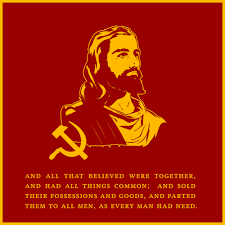
Even more to the point of the discussion at hand, it is evident that the idea of communism (or communalism) comes from the Bible itself. I’m thinking of two descriptions of life in the early Christian community that we find in the Acts of the Apostles. For instance,

Acts 2:44-45 says:

“All who believed were together and had all things in common; they would sell their possessions and goods and distribute the proceeds to all, as any had need.”

Acts 4:32–35 reads:

“All the believers were one in heart and mind. No one claimed that any of their possessions was their own, but they shared everything they had . . . And God’s grace was so powerfully at work in them all that there were no needy persons among them. For from time to time those who owned land or houses sold them, brought the money from the sales and put it at the apostles’ feet, and it was distributed to anyone who had need.”

Jesus’ identification with the poor and oppressed is also important for me. He said that whatever we do to the hungry, sick, ill-clad, thirsty, homeless, and imprisoned, we do to him. The words Matthew attributes to Jesus (in the only biblical description we have of the last judgment) are:

“The King will reply, ‘Truly I tell you, whatever you did for one of the least of these brothers and sisters of mine, you did for me.’ “Then he will say to those on his left, ‘Depart from me, you who are cursed, into the eternal fire prepared for the devil and his angels. For I was hungry, and you gave me nothing to eat, I was thirsty and you gave me nothing to drink, I was a stranger and you did not invite me in, I needed clothes and you did not clothe me, I was sick and in prison and you did not look after me.’ “They also will answer, ‘Lord, when did we see you hungry or thirsty or a stranger or needing clothes or sick or in prison, and did not help you?’ “He will reply, ‘Truly I tell you, whatever you did not do for one of the least of these, you did not do for me.’
There is much, much more to be said about this basic faith perspective. But for now, let that suffice.

Now for the second point about human rights:

• To repeat: no one can defend the obvious human rights abuses of Russia or China. They are clearly indefensible.
• In fact, they are as inexcusable as the similar abuses by the United States in countries which are or have been U.S. client states. I’m referring to Israel, Iraq, Afghanistan, Yemen, Vietnam, and countries throughout Latin America and Africa. In all the latter, it has not been unusual for freedom of press to be violated, for elections to be rigged (think Honduras just recently), for summary executions to be common, for journalists to be assassinated in large numbers, and for dissenters to be routinely imprisoned and tortured. Christians advocating social justice have been persecuted without mercy. (Recall that infamous Salvadoran right-wing slogan, “Be a patriot; kill a priest.”)
• Moreover, while we have been relatively free from such outrages on U.S. soil, the events of 9/11/01 have been used to justify restrictions of freedoms we have historically enjoyed. Here the reference is to wiretappings, e-mail confiscations, neighbors spying on neighbors, and other unconstitutional invasions of privacy that seem to violate the 4th Amendment of the Constitution. It is now even permissible for the nation’s head of state to identify the press as “the enemy of the people.”
• 9/11 has also been used to justify the clearly illegal invasion of at least one sovereign country under false pretenses (Iraq) with the resultant deaths of well over a million people (mostly civilians). Other countries have also been illegally attacked, e.g. Libya, Yemen and Somalia without due congressional authorization. 9/11 has further “justified” the establishment of “black sites” throughout the world, the “rendition” of prisoners to third countries for purposes of torture, innumerable (literally) arrests without charges and imprisonments without trial. It has even led to extrajudicial killings of U.S. citizens.

Such observations make the general point that when countries perceive themselves to be under attack, they implement policies both domestically and abroad that defenders of human rights correctly identify as repressive, cruel, criminal and even homicidal. Russia, China, and Cuba have been guilty of such policies. But so has the United States in supporting friendly regimes throughout the world and by implementing increasingly repressive policies here at home.

Now consider the pressures that led Russia, for example, to implement its own indefensible repression:

• As the most backward country in Europe, its people had suffered enormously under an extremely repressive Czarist regime. [Czarism, in fact, was the model of government that most Russians (including criminals like Stalin) had internalized.]
• Following its revolution, Russia was invaded by a vast coalition of forces (including the United States). It was forced to fight not only the invaders, but Czarist sympathizers and anti-communists within its own population.
• The country had twice been invaded by Germany through Poland and saw itself as needing a buffer from its implacable enemies to the west.
• Its people had fought heroically against German invaders and though suffering 20 million deaths and incredible infrastructure destruction, it managed to defeat the German army and largely be responsible for winning World War II.
• During the Cold War, Russia found itself under constant threat from western powers and especially from the United States, its CIA, and from NATO – as well as from internal enemies allied with the latter.

My only point in making such observations was not to defend Russia’s indefensible violations of human rights (nor China’s, nor Cuba’s); it was, rather, to make my central point about the efficiency of economies mixed in favor of the poor vs. those mixed in favor of the rich.

As shown by Russia (and even more evidently by China), economies mixed in favor of the poor develop much more quickly and efficiently than economies mixed in favor of the rich. While both Russia and China became superpowers in a very short time, the former European and U.S. colonies in Latin America, Africa, and South Asia have remained mired in colonial underdevelopment. The latter’s organizing principle of “comparative advantage” has proven ineffective in enriching them, since it locks them into positions of mere suppliers of raw materials to industrialized countries. No country has ever reached “developed” status by following such principle. In other words, Global South countries are still waiting for that wealth to “trickle down.”

So, readers shouldn’t mistake the argument made by Wolff and others. It was not to defend the indefensible. (Even Khrushchev and Gorbachev recognized and denounced the crimes of Josef Stalin.) The relevant point is about capitalism vs. socialism. It was to indicate that the vilification of socialism overlooks the achievements of that system despite (not because of) restrictions on human rights that are common to both systems in egregious ways that no humanist or follower of Jesus should be able to countenance.

My conclusion remains, then, that it is up to people of conscience (and especially people of faith) to oppose such restrictions and violations wherever we encounter them – but especially in our own system where our voices can be much more powerful than denunciations of the crimes attributable to “those others.”

Three Unspeakable Descriptors of California’s Omni-Fire

FIRE

California is on fire. Its 17 unprecedented conflagrations are predicted to rage out-of-control till at least the end of this month.

Despite such disaster, there are three terms Americans will scarcely hear mentioned in media reporting of the catastrophe. The first two are “climate change” and “profit.” The third is a person, “Pope Francis.”

Begin by considering the silence of our leaders and media about “climate change.” The term hardly crosses the lips of commentators covering the wild fires across an area larger than the sprawling city of L.A.

That’s because virtually alone in the world, the United States (and its media enablers) stand in aggressive denial of the obvious fact that the “American” economy and way of life remain the major causes of such disasters. (Even the Chinese contribution to climate chaos is largely induced by U.S. factories relocated there.) So, you don’t hear much these days connecting wild fires and climate change.

And that brings me to the second culturally unpronounceable word: “profit.” In fact, as Noam Chomsky points out, that word is so unspeakable that it must now be pronounced and spelled as j-o-b-s.

Nevertheless, we all know, the real reason for climate denial is not jobs, but money. It’s greed that drives corporations such as Exxon to accept destruction of the planet over appropriate response to the climate impacts of their products that their own research uncovered decades ago.

Pope Francis has recognized the hypocrisy of it all. And that’s why his name is unmentionable in connection with California’s omni-fire. In fact, more than three years ago, Francis wrote an entire encyclical addressing the problem. (Encyclicals are the most solemn form of official teaching a pope can produce.)

Yet, Francis’ dire warnings in Laudato Si’ (LS) remain largely ignored even by “devout Catholic” leaders like Paul Ryan.

Worse still, the pope’s words generally go unreferenced by pastors in their Sunday homilies.

Yet, the pope’s words are powerfully relevant to not only to wild fires, but to the record temperatures, droughts and increasingly violent hurricanes now happening in real time. For instance, in section 161 of Laudato Si’ Francis says:

“Doomsday predictions can no longer be met with irony or disdain . . . The pace of consumption, waste, and environmental change has so stretched the planet’s capacity that our contemporary lifestyle, unsustainable as it is, can only . . . be reduced by our decisive action here and now”

And what are the “here and now” “decisive actions” the pope called for? Chief among them is the necessity for all nations of the world to submit to international bodies with binding legislative powers to protect rainforests, oceans and endangered species, as well as to promote sustainable agriculture (LS 53, 173-175). That, of course, is exactly what the Exxons of the world fear most. Their rationale? Such submission threatens profits.

But realities much more important than unspeakable profits are at stake here. We’re talking about the survival of human life as we know it.

This is a matter of faith and morality.

In fact, the California fires and the other climate disasters I’ve just mentioned remind us of the most dreadful papal observation of all. “God always forgives,” Pope Francis said. “Human beings sometimes forgive. But nature never forgives.”

The California omni-fires demonstrate that truth.

The question is: why aren’t people of faith listening? Why are we not electing public servants who will simply recognize and respond appropriately to the disasters unfolding before our very eyes?

The Triumph of Socialism: Is My Family Squabble Like Yours?

Socialist Programs

Whenever I’m with my liberal Gen-X sons, the conversation inevitably turns towards the topic: capitalism vs. socialism. They see me as a socialist – a product of my times rooted in the post-depression era and in the 1960s.

Similarly embedded in the Reagan counter-revolution, they argue that socialism is hopelessly impractical. Their arguments echo Margaret Thatcher’s famous dictum about capitalism, “There is no alternative.”

“Just give me one example of any country in the world where socialism has worked,” they demand. . . “See, you can’t,” they continue triumphantly, “because socialism might be great in theory, but it never works in practice.”

Well, I’m tired of that conversation. My dear partners never listen when I mention Sweden, Norway, Denmark, or Iceland. They don’t hear me out when I cite the wildly successful Mondragon workers’ cooperative in Spain. “Never heard of it,” they say.

Even more: they can’t even entertain the possibility that Cuba in comparison to other former colonies is actually the envy of most peers in Africa, Latin America, South Asia – and yes, Puerto Rico, which is part of the capitalist United States. People in Puerto Rico are far worse off than in Cuba. Of course, that’s because of the latter’s socialist system of education, health care, environmental protection, centrally-planned hurricane measures, efficient first-responders, and housing. And this despite decades-long, extremely active efforts by the United States and CIA to make the island’s economy scream.

So, in my argument here that socialism actually does work, I promise to minimize mention of those tired examples. Let me instead take the bull by the horns and simply say: socialism has worked in Russia, China – and (get ready) here in the United States.

There, I’ve said it. Now let me make my case.

[Before I get into that, however, allow me a word of clarification about capitalism and socialism themselves.

Neither system exists in any pure form. I mean, if we understand the three basic elements of capitalism to be (1) private ownership of the means of production, (2) free and open markets, and (3) unlimited earnings, we must conclude that the system exists nowhere outside the world’s black markets. (And everyone considers those to be somehow criminal.)

Instead, especially since the Great Depression, all we have are mixed economies – i.e. blends of capitalism and its opposite on every point, viz. socialism. More specifically, I’m referring to capitalism’s inclusion of socialism’s own three basic elements: (1) public ownership of the means of production, (2) controlled markets, and (3) earnings limited by income ceilings or redistributive taxes. This means that Sweden has a mixed economy, so does Russia, China, Cuba – and the United States.

That is, at least since the 1930s, the world has agreed that capitalism cannot succeed without incorporating elements of socialism. And so, we have the U.S. government filling the role of the country’s largest land-owner; we find ourselves cherishing the Social Security System; and then there’s the IRS. . . Similarly, socialism cannot make it without absorbing the capitalist components of private ownership, markets, and incentivized incomes.

Does this mean that all economies are the same? Obviously, not.

No, what distinguishes the mixed economy of Cuba, for example, from our own, is that Cuba’s is mixed in favor of the working classes, while our economy in the U.S. is mixed in favor of the rich (on the familiar theory that the wealth they “create” will eventually trickle down to the rest of us).

In other words, what my debate with my sons is really about is this: can I offer an example of economies mixed in favor of the poor that have actually worked?

My answer is, of course, that I can.]

So, let me proceed.

Begin with Russia. Yes, Russia. When its revolution triumphed in 1917, it was the most backward country in Europe. Moreover, after the revolution, it faced not only its own civil war but invasions by anti-socialist forces including troops from the United States, Great Britain, France, Japan, Italy, Romania, Greece, Poland, China, and Serbia. At the time, Winston Churchill said that the point of such incursion was to “strangle the baby in its crib.”

Add to that the fact that following World War II, Russia lay in ruins from Hitler’s devastating invasion. Nonetheless, the country’s heroic resistance to Nazism not only was the key element in defeating the Third Reich; it had cost Russia 20 million lives. Greater devastation can hardly be imagined, especially for a country attempting to emerge from cruel Czarist feudalism and to implement a system never before tried on a national scale.

However, despite such overwhelming set-backs, after only 40 years of “socialism,” the USSR assumed the position of the world’s second leading super-power. It was treated as a peer and rival by the United States, Japan and the rest of Europe. That is to say: in purely economic terms, Russia enjoyed success that was historically unprecedented.

In fact, the rapidity of its development remained unsurpassed anywhere in the less developed world – until the emergence of “socialist” China whose largely controlled economy today dwarfs that of the U.S. and Europe in terms of annual growth percentage.

None of this is to say that huge mistakes were not made by both Russia and China. Like the victims of capitalism, for instance in Dickensian Manchester and Liverpool, labor paid a huge price as an emergent system’s leaders attempted to develop a new economic form – industrial capitalism in Manchester, socialism in Leningrad and Peking.

The reason for such failures is obvious. All economic systems develop by trial and error. For instance, in Russia, socialist theoreticians had thought that the root of worker exploitation was found in greedy captains of industry. Replacing them with government officials would solve that problem. It didn’t. Instead, workers soon awoke to find that they had merely exchanged one set of oppressors for another. Very little had changed for them on the factory floor. After Stalin, Nikita Khrushchev was about changing that. So was Mikhail Gorbachev. In the end, though, it was all too little, too late.

In spite of that, however, the rapid economic successes of both Russia and China must be acknowledged. In this country, they never are.

But even more importantly, what is never acknowledged here in the U.S. is the success of those elements of socialism that were incorporated into our economic system with Roosevelt’s New Deal.

Recall that after the Great Stock Market Crash of 1929, capitalism was in its death throes.

Emboldened by the collapse, the U.S. Communist Party along with the country’s two strong socialist parties and powerful trade unionists led by the CIO (Congress of Industrial Workers)pressured F.D.R. with the following proposition: “Either you persuade your fellow upper-class Wall-Streeters to meet our (socialist) demands or you’ll be forced to accept a revolution here like the one in Russia.”

Roosevelt and most (though by no means all) in his economic class, found the argument distasteful, but persuasive. The result was the New Deal with all its socialist programs including Social Security, legalized unions, minimum wages, consumer and worker protections, universal public schooling, environmental protection, government-sponsored jobs programs, and eventually a G.I. Bill that provided free university education and healthcare for veterans.

The New Deal created a large middle class with an unprecedentedly high standard of living. That represented a triumph not principally for the capitalist component of the U.S. mixed economy, but for its socialist elements.

In other words, the U.S. provides a shining example of a place where socialism has worked.

But there’s more.

During times of extreme crisis represented by a truly threatening war such as WWI and WWII, even the most ardent defenders of “capitalism” in our country have chosen to implement “war socialism.” That is, they chose military conscription, wage and price controls, rationing, and direction of privately owned productive facilities away from luxury goods towards military manufacture. They chose to do so evidently because the central planning embodied in such measures is far more efficient than laissez-faire “capitalism.”

And finally, even Wall Street bankers, when it’s a question of their own survival, will opt for socialist programs every time. That was illustrated during the Great Recession of 2008. With the capitalist economy in its worse condition since the Great Depression, the Wall-Streeters all came to the government with hat-in-hand. They wanted a bailout that completely contradicted capitalist theory. The latter would have the inefficient among them fail only to be replaced by something better. That’s capitalist theory.

Behind the bankers’ socialist begging, however, was the implied recognition that such theory really doesn’t work. In fact, their petitions for bailout suggested that the actual implementation of capitalist principles would do irreparable harm to the world’s economy. It would ruin us all!

Keep all of this in mind the next time you get into an argument about capitalism vs. socialism:
• Neither system exists in its pure form.
• It is questionable whether either ever did exist.
• All the world has are mixed economies.
• The question is: will a particular economy be mixed in favor of the rich or the poor.
• Economies mixed in favor of the poor have historically proven more efficient in times of national crisis,
• And in raising the tide that lifts all boats.
• That’s been demonstrated in Russia, China, Cuba – and even in the United States.

I’m hoping my Gen-X sons (who btw have unsubscribed from my blog) may one day transcend their unconscious Reaganite roots to read and ponder this particular entry. At the very least, it supplies context for our interminable debate.