Just for fun, here’s an interview with Marianne Williamson whose candidacy for POTUS I’ve been trying to promote. I’m doing that because I think Marianne offers the national presidential debate a refreshing, deeply spiritual dimension that it sorely needs. She makes that contribution in a way helpful to believers, non-believers, and those who consider themselves “spiritual but not religious.” In any case, give this little interview a look and listen and see what you think.
Category: Current Issues
U.S. Concentration Camps Are Already Worse than Hitler’s

Recently Alexandria Ocasio Cortez (AOC) stirred controversy by characterizing U.S. immigration detention facilities as concentration camps. Critics said her comparison was over the top
It was an insult, some said, to families of Holocaust survivors. After all, none of the U.S. detention facilities is an extermination camp like Auschwitz or Buchenwald.
In response, AOC doubled down on her charge. Along with others, she was joined by historians, and even by the editors of The National Catholic Reporter in affirming her accusation. Concentration camps, they all said, are not synonymous with extermination camps. In essence, the former are locations where prisoners are held without charge. In that sense, the U.S. indeed maintains concentration camps, but nothing like German practice. The intention in making that distinction was evidently to distance U.S. camps from the horrors and death of Hitler’s infamous hell-holes.
The argument here takes issue with that distinction. It maintains instead that our burgeoning camps are every bit as brutal as Hitler’s. In fact, the number of deaths connected with the U.S. system dwarf the iconic number of six million incinerated, gassed, shot, or otherwise executed.
To begin with, we must first of all realize that U.S. concentration camps are not a new phenomenon begun with the presidency of Donald Trump. No, they have been with us at least since the end of the Second Inter-Capitalist War in 1945.
In fact, the argument can be credibly made that our country was explicitly founded on extermination, genocide and concentration camps. Using rationale supplied by John Locke, our Founding Fathers wiped out 90% of North America’s indigenous peoples, eventually confining survivors and their descendants in concentration camps (called “reservations”). They employed the same logic to enslave workers kidnapped from Africa imprisoning them in labor camps (called “plantations”).
For Locke, who inspired Jefferson’s Declaration of Independence, the crucial and ironic pronouncement behind such operations was that “All men are created equal.” But note well that in his formulation, the statement had no liberating relevance for Native Americans, African slaves, women or propertyless whites. Instead, its expressed intention was to establish the right of imperialists like him and his cohorts to steal land and resources from the continent’s indigenous inhabitants and to exterminate resisters.
Locke’s point (as explained in my book, The Magic Glasses of Critical Thinking) was that just because the “Indians” were here first, they had no special claim on the lands they called home. That is, since (in Locke’s estimation) huge tracts were not being farmed as they would be in England, they were there for the taking by the Indians’ equals from Great Britain.
Locke said that a refusal by the Indians to recognize such equality amounted to a declaration of war against the British. So, the natives could be slaughtered with abandon – a task our country’s great Indian Fighters took on with enthusiasm and relish creating a holocaust that killed millions.
Adolph Hitler himself took inspiration from the examples just cited. He liked the concept of concentration and work camps. He was expressly impressed by the efficiency of U.S. extermination of our continent’s First Peoples. It inspired him and evidently the minds behind contemporary concentration camps.
With all this in mind, it is no exaggeration to say that the camps are reincarnating today before our very eyes. Our government has set them up world-wide. They are so ubiquitous and normalized that they remain practically invisible. But consider their contemporary equivalents in:
- The U.S. prison-industrial complex itself for blacks, browns and poor whites transforming “Americans” into the most imprisoned population on the planet
- Guantanamo Bay for holding “terrorists” who after years of internment and torture have yet to be charged with crime and which Fuhrer Trump promises to fill to the brim
- Black Sites (sic!) concealed throughout the world where kidnapped Muslims and others disappear without a trace and are tortured without mercy
- Fort Bliss (sic!), a concentration camp for immigrant children
- Baby Prisons for infants as young as four months
- Detention centers for refugees from U.S. wars of aggression in Afghanistan, Iraq, Libya, Yemen and elsewhere
- Family prisons for immigrant workers from Mexico and Central America as they await trials which can be postponed indefinitely
- The Gaza Strip, the world’s largest open-air prison for Muslim Palestinians, “the Jews’ Jews” – unconditionally endorsed by U.S. politicians of all stripes
In such hell-holes the criminals (often the guards) commit murders, rapes and inflict torture with impunity. Nonetheless, after Hitler, it is no longer permissible for such polite company to crudely incinerate victims in ovens or to poison them in gas chambers. (That would be too “inhumane” and reminiscent of the unspeakable.) So, today’s executioners murder and incinerate Muslims (today’s “Jews”), and others on site. (It saves the trouble and expense of packing them into box cars.)
In other words, the executioners travel to the victims’ countries of origin in the Middle East and Africa and do the dirty work there – often from 10,000 feet in the air, where the screams of incinerated Muslim children cannot be heard. They cremate their victims more humanely in the targets’ own homes with napalm and white phosphorous. Alternatively, “pilots” seated comfortably in their air-conditioned “theaters” send automated Gestapo (killer drones) to decapitate those suspected of evil thoughts. In the process, the system’s butchers have massacred millions far exceeding anything imagined by that little man with the toothbrush mustache:
- Already by 1978, John Stockwell, the highly decorated ex-CIA Station Chief in Angola, estimated that his agency’s “Secret Wars” had killed more than six million in its dirty wars against the world’s poor. In Stockwell’s own words, every one of those wars was illegal and “bloody and gory and beyond comprehension almost.”
- Add to that
- The hundreds of thousands slaughtered during the 1980s in El Salvador, Guatemala, Nicaragua, and Honduras
- More than a million victims in the completely illegal war in Iraq
- Untold fatalities in Afghanistan, Libya, Syria, Ethiopia,
- The 10,000 already killed in Yemen, the poorest country in the Middle East – with the numbers increasing each day from cholera and intentionally-inflicted starvation
Again, the numbers are staggering – far beyond anything accomplished in Hitler’s death camps.
Meanwhile, at home, “Americans” are dissuaded from protest by a militarized skin-head police force of body-builders and thugs. “Dressed to kill” in their black or camouflaged flack suits, and anonymous under their helmets and behind polarized face-shields, they stand ready with batons, tasers, and AK47s – as well as employing surplus military tanks, and Humvees – to punish anyone who dares opposition.
So, congratulations to Ms. Ocasio-Cortez. She’s right again – this time about concentration camps. However, she and others are wrong to downplay the comparative horror of the U.S. system. It is every bit as horrendous as Hitler’s. To see the misery all one has to do is connect the dots. They’re there and though scattered are just waiting to be linked (exactly as they were in Germany during Hitler’s rise to power).
In fact, their presence is becoming more evident each day as is the emergence of Hitler-like fascism. We have only to open our eyes to see both phenomena, even though the camps, holocausts, and the system itself have been effectively renamed and camouflaged.
Thanks to AOC and others, the veils are beginning to fall; the issue is now before us. Ms. Ocasio-Cortez’s message: It’s high time for the rest of us to take note before it’s too late!
Why Not Kill Them All: Abortionists, Soccer Moms and God?
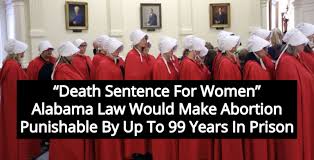
Anti-abortion extremism is in the news again. (Does it ever disappear?) As everyone knows by now, it’s because right-wing lawmakers in Alabama have advanced a law banning abortion at every stage of pregnancy – from the moment that sperm fertilizes egg. The law makes no exceptions for rape or incest.
In terms of logic, the law can easily be debunked as literally absurd. In terms of theology (and remember, the question of abortion has been shaped by theology, regardless of what we might think about that fact) the law makes God himself (sic) deserving of capital punishment. Finally, in terms of the U.S. Constitution, criminalizing abortion contradicts the First Amendment which explicitly states that “Congress shall make no law respecting an establishment of religion or prohibiting the free exercise thereof.”
To clear the air of confusion and to clarify the concept of pro-life itself, let’s consider each one of those points.
Logic
To begin with, consider the law’s logical inconsistency. It begins by holding that abortionists are killers deserving capital punishment. Its reasoning runs as follows: (1) Abortion is murder, (2) But all murders are capital crimes; deserving capital punishment; (3) Therefore abortion-providers should be punished by execution or life imprisonment.
Strangely, the woman who seeks an abortion finds no place in that logic. I say “strangely,” because her exclusion doesn’t make sense according the syllogism just referenced. Murder is murder. And legally speaking, employing a hit-man to kill another person makes the employer guilty of conspiracy to commit murder regardless of who actually pulled the trigger. Both contractor and contractee deserve the same punishment. Since it’s the woman who employs the murderer, why not execute her or imprison her for life, the same as the abortionist?
The answer is because doing so would be absurd. It would be politically untenable.
Virtually no one in the electorate would support it – especially in the light of polls showing that 80% of Americans believe abortion should be legal. Seventy-one percent oppose overturning Roe v. Wade – including 52% of Republicans.
Imprisoning abortion-providers might be one thing. But imagine, if legislators proposed filling jail cells with all the soccer moms among those responsible for the at least 45.7 million abortions performed since 1973 and the passage of Roe. Hundreds of thousands of moms in prison for life wouldn’t make sense. It is patently absurd. It wouldn’t be acceptable to anyone.
But think a little further about those numbers. They are familiar to us, because “pro-birthers” usually employ them to train focus on the zygotes and fetuses in question. However, the numbers can also suggest something else.
Exchange the viewpoint of zygotes and fetuses for that of our mothers, wives, daughters and sisters who’ve undergone the procedure. If the fundamentalists are right, the sheer numbers mean that millions of the women we love are actually murderers. Millions of them over the last nearly 50 years have committed murder and, according to fundamentalist logic, deserve capital punishment – no less than the others on death row. Again, murder is murder. And in the case of abortion, the scale of the slaughter collectively perpetrated by the women we sleep with is beyond compare. It means that American women – women throughout the world – women in general – cooperate in mass murderers dwarfing the crimes of Hitler!
Logically speaking, all of that – treating abortion as murder, punishing abortion providers as capital criminals, refusing to do the same for the women employing them, and identifying millions of women throughout the world as evil murderers (while saying not a word about the men who impregnate them) – reduces to the absurd the position that abortion is murder.
In fact, it constitutes the very definition of logic’s reductio ad absurdum that proves the falsity of an argument by demonstrating that its conclusion is completely untenable. In other words, when you put words to it and draw the logical conclusions, the contentions of the pro-birthers sound absolutely crazy to almost everyone. Case closed.
Theology
And that brings us into the field of theology.
For Catholic moralists, commonly shared perception like that just referenced is called the “sensus fidelium.” Sensus fidelium refers to ordinary people’s conclusions about matters of faith and morals (such as abortion). It refers to conclusions based on common sense rather than the arguments of the experts including theologians. Catholic doctrine regards such agreement as infallible.
But here I’m suggesting a unique kind of sensus fidelium – one accessible primarily to women and their special ways of knowing. After all, male legislators cannot possibly understand women’s physiology, biological processes, psychology, or moral sensitivities in the same way as women.
In other words, women are a uniquely privileged reference group. However, because of the domination of theology (and politics!) by men, the latter act as if they know better than women. As a result, women are treated in effect as pre-rational children in need of direction by the culture’s patriarchs. (This, perhaps, offers another explanation of the disparate treatment of abortion-providers and women seeking abortion. The women in question are not truly responsible moral agents.)
To correct such imbalance, women of all faiths (and none) and not just Christian men should be in charge of any reasoning about and regulations of abortion. At the very least, such women deserve a decisive place at the table where theologians, ethicists and legislators discuss the question. If that were the case, another reductio ad absurdum would soon come to light – this one specifically theological. It would be that God Himself (sic) is the world’s abortionist-in-chief responsible for filling sewers with aborted babies.
What I mean is that according to medical researchers spontaneous abortion is the “predominant outcome of fertilization.” At least half of fertilized eggs are simply flushed down the toilet without their “mothers” even aware of their presence. They never knew they were pregnant in the first place.
If (as pro-birthers maintain) God is responsible for and cares about every fertilized egg, the conclusion is inevitable. God is a wholesale abortionist. Like all abortionists, he deserves the fate that death-of-God theologians declared fifty years ago.
(As a matter of fact, understanding God according to the absurdities just described might well be responsible for the rejection of his existence by rational adults. The fundamentalists themselves may have unwittingly but effectively executed him!)
Constitutional Considerations
What all of this means is that the recently passed Alabama law is unconstitutional, since imposes on Christians and non-Christians alike a particular religious (and therefore unproveable) theory about God’s role in the initiation of specifically personal life.
As we’ve seen, the particular theory arbitrarily holds that each fertilized egg is a unique human person with an immortal soul wedded exclusively to that particular fertilized ovum. The theory further holds that when the ovum in question dies, the soul’s God-intended purpose is forever frustrated. The world is forever deprived of the aborted-one’s unique gifts, which God cannot or will not supply through another person.
The idiosyncrasy of that position is unmistakable. As is the case with other faiths, one could easily understand early abortion as not that important in God’s grand scheme of things. A soul prevented from incarnating in one form could just as easily be imagined as appearing in another – when its time is right.
In other words, and more specifically, the theory that life begins when sperm fertilizes egg is not at all generally shared even across religions, much less by agnostics and atheists. For instance, some locate the beginning of personal life at the moment of “quickening” (when the mother first feels her baby move), others identify it with viability outside the womb, still others with actual emergence from the womb, or (as with some Native Americans) with the “painting” of the emergent child to distinguish it from animals.
Given such differences, it seems clearly unconstitutional to impose the view of one religion on an entire culture. We might expect such preference of one religious view over others from the Taliban. But it has no place in a governed by a constitution with the First Amendment quoted earlier in this essay.
Conclusion
The bottom line here is that in a diverse country like our own, some form of legislation like Roe v. Wade might be the best we can do. There it was determined that the pregnant woman as moral agent can decide about abortion on her own during the first trimester and in consultation with her physician during the second. In the third trimester, however, the state asserts its interest and can make laws restricting abortion to protect the woman’s health and the potentiality of human life.
However, a Roe v. Wade approach can never be sufficient for genuine pro-life advocates. For them, abortion law must be complemented by social programs that provide a welcoming atmosphere for all life forms. These would provide free counselling and pre- natal care for pregnant mothers along with post-natal services for their newborns. Job provisions would be available for new mothers along with free daycare for their pre-school children. Programs would also include low cost housing and (where necessary) help paying grocery bills. All such measures are genuinely pro-life. They not only discourage abortion; they also create a welcoming environment for new life.
However, don’t expect Alabama politicians to endorse such measures. For them, pro-life concern ends at birth. Afterwards, the burden must be assumed entirely by the mothers in question.
Benedictine Sister Joan Chittister has called such typically male attempts to evade responsibility by its true name. She wrote:
“I do not believe that just because you’re opposed to abortion, that that makes you pro-life. In fact, I think in many cases, your morality is deeply lacking if all you want is a child born but not a child fed, not a child educated, not a child housed. And why would I think that you don’t? Because you don’t want any tax money to go there. That’s not pro-life. That’s pro-birth. We need a much broader conversation on what the morality of pro-life is.”
Mike Pompeo’s Cynicism vs. Marianne Williamson’s Politics of Love
Readings for 2nd Sunday of Easter: Acts 5:12-16; Ps. 118: 2-4, 13-15, 22-24; Rev. 1: 9-11A, 12-13, 17-19; Jn. 20: 19-31.
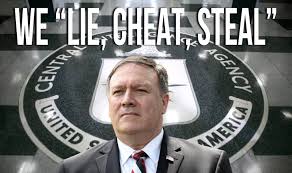
By the time you see this, many of you will have been yet again outraged by the crude cynicism of Mike Pompeo, America’s Secretary of State and former head of the CIA. This time, I’m referring to his embarrassing throw-away line following a speech at Texas A&M last week. Secretary Pompeo said:
“. . . When I was a cadet, what’s the first – what’s the cadet motto at West Point? You will not lie, cheat, or steal, or tolerate those who do. I was the CIA director. We lied, we cheated, we stole. (Laughter.) It’s – it was like – we had entire training courses . . . (Applause.) It reminds you of the glory of the American experiment.”
In this election season, Pompeo’s arrogant disregard for the disastrous effects of the actions he described (in terms of governments overthrown, innocents slaughtered, and our own democracy discredited) offers an instructive foil to recommend the contrasting approach of Marianne Williamson, whose presidential campaign is based on what she terms a “politics of love.” The contrast between Pompeo and Williamson is further illumined by the familiar story of Doubting Thomas which is the focus of today’s liturgy of the word. It locates divine presence precisely in a victim of the imperial double-dealing and cruelty Pompeo finds so amusing and that Williamson finds abhorrent.
But before I get to that, please watch the secretary’s remark for yourselves:
What I found noteworthy in what you just saw was not so much what Pompeo said. (Anyone who knows anything about the CIA would not find that surprising.) What I found amazing was the audience laughter and applause. Both suggested not only rejection of U.S. ideals, but of the faith Americans commonly claim. Pompeo’s words absolutely contradict the Jewish tradition’s Ten Commandments. The laughter and applause also suggested that Pompeo’s audience recognized that lying, cheating, and stealing somehow have more power than the teachings of Jesus about the primacy of love and doing to others what we would have them do to us. (Let’s face it: that’s the underlying reservation many have about Marianne Williamson’s candidacy as well.) Even more, the audience’s approval cynically endorsed Pompeo’s position that such actions constitute something glorious about Americans and their country!
I suppose the secretary would hasten to explain that we’re living in a dangerous world, where enemies lie, cheat, and steal all the time; so, we must do the same. But just imagine if Vladimir Putin or Venezuela’s Nicolas Maduro had uttered Pompeo’s words! We’d never hear the end of it.
It’s principled response to such cynicism that fuels Marianne Williamson’s campaign for president. And in the light of today’s Gospel reading, which endorses miracles over “realism,” she should be taken seriously. More directly, and at a far deeper level than any of the other 20 (so far!) Democratic candidates, Williamson actually believes in a “Politics of Love,” and says so openly.
In fact, Williamson is running on a platform that holds that there is no distinction between personal and public morality. As she points out, the world and our country have a long history of acknowledging that fact. Jesus himself embodied that teaching. So did Gandhi. Abolitionists were Quakers, as were many of the suffragettes. Martin Luther King was a Baptist preacher. The Berrigan brothers were Catholic priests; so was Thomas Merton. None saw any distinction between the personal and political.
However, it’s not that Ms. Williamson is any less aware of our world’s evils than Mr. Pompeo. She doesn’t claim that the Judeo-Christian tradition invites anyone to ignore immorality and violence. Quite the contrary. As she points out, the entire Jewish tradition stems from rebellion precisely against the horror of slavery (in Moses’ Egypt). And the Christian tradition is founded on the teachings of a prophet who was tortured and executed by one of history’s most brutal empires. To ignore such evils, Williamson says, is not transcendence; it’s denial.
And that thought brings us to today’s Gospel reading. It’s the familiar story of Doubting Thomas, whom in today’s context we might call “Realistic Thomas.” That’s because the story is finally about Christ’s call to recognize his own presence in the tortured victims of the kind of empire Pompeo’s audience applauded. It’s a parable told 80 years after Jesus’ death to encourage believers who, unlike Thomas, had not seen the risen Christ, yet believed anyway. The story is about the early Christian community coming to realize the truth of Jesus’ words, “Whatever is done to the least of my brethren, is done to me” (MT 25). Williamson recognizes all those truths. Evidently, Pompeo does not.
Recall the parable.
The disciples are in the Upper Room where they had so recently broken bread with Jesus the night before he died. But Thomas is not present. Then suddenly, the tortured one materializes there in their midst.
“Too bad Thomas is missing this,” they must have said to one another.
Later on, Thomas arrives. Like the believers for whom the story was written (at the end of the first century) he hasn’t met the risen Lord.
“Jesus is alive,” they tell him.
However, Thomas remains unmoved. He protests, “I simply cannot bring myself to share your faith. Things like that don’t happen in the real world.”
The words are hardly out of his mouth, when lightning strikes again. Jesus suddenly materializes a second time in the same place. He tells the realistic one to examine his wounds – to actually probe them with his fingers. It’s then that Thomas recognizes his risen Lord. Yes, he realizes, Jesus is present in the tortured and victims of capital punishment – in those crucified by empire. The story invites hearers to join in Thomas prayer before such victims, “My Lord and my God.”
And that brings me back to Marianne Williamson . . . Let’s be honest: when we heard Williamson’s phrase, “politics of love,” did any of us find ourselves rolling our eyes? If so, that probably means we’ve somehow joined Secretary Pompeo in his cynical realism – in his implicit denial of the power of today’s parable. It suggests that we too believe that lies are more powerful than truth, that cheating is more rewarding than acting justly, that might makes right, that violence represents a more effective strategy than love.
In summary, we’re in denial about the truth of Jesus’ teaching – and that of virtually all of history’s sages. Williamson asks: “How’s that been working out for you – and for the world?” It’s time for a change of heart and soul like that of “Realistic” Thomas and like that represented by the campaign of Marianne Williamson.
She needs about 10,000 more individual contributions to qualify for appearance on the debate stage with the other candidates. If you want to see her there, contribute $1.00 or more right now!
Alexandria Ocasio-Cortez on the Green New Deal: A Must-Watch Video
Here in Connecticut, Peggy and I are part of a Climate-Change activist group that is just getting off the ground. We’re planning on supporting the Green New Deal that I’ve written about earlier here and here and here.
In that connection, here’s the best short video I’ve come across on the topic. It’s co-written and narrated by Alexandria Ocasio-Cortez (D-NY), the most dynamic new member of the House of Representatives. Please watch it and see if it confers understanding of the GND as it invites you to get on board with this important movement.
Socialism’s Specter Revives in China’s Belt and Road Initiative

The Chinese are coming! The Chinese are coming! This time they’re here to spread socialism not by war and invasion, but by good example, economic development and cultural exchange. And in the process, they are eating our lunch. They are demonstrating that it is possible for poor and troubled economies to develop as quickly as China’s by following the latter’s example of mixing the best elements of capitalism and socialism to benefit working class people rather than primarily the rich and elite. Their efforts are showing every sign of success.
Progressives should take heart. Socialism’s specter is once again on the prowl.
Specifically, I’m referring to the Belt and Road Initiative (BRI) that actually looks like a Chinese version of a new Marshall Plan for countries representing 65% of the world’s population. Many of the countries involved would otherwise be unable to afford such development.
Particulars of the BRI include Chinese export of construction materials, especially iron and steel and their use to erect a huge power grid with wind and solar focus. The materials are being used to construct highways, rail facilities and sea ports to the benefit of Europe, Asia, the Middle East, and Latin America. The BRI will also include cultural exchanges and educational assistance. It will eventually account for 40% of the world’s domestic product.
That’s the impressive swath China’s trillion-dollar infrastructure-based development strategy that has been in place for the past six years – since it was announced by the country’s president, Xi Jinping in 2013. In his words, the Belt and Road Initiative is “a bid to enhance regional connectivity and embrace a brighter future.”
However, many in the west are not buying that rosy description. To them the BRI seems like a new form of colonialism. Since much of it is based on loans, critics have even described it as a “debt trap” intended to create dependency in order to reduce participating countries to the status of vassals of an imperial Chinese state.
Ironically, such criticisms actually reflect the patterns of western colonialism and neocolonialism whose “foreign aid” has in fact intentionally continued the traditional underdevelopment of the former colonies in Latin America, Africa, and South Asia. The critique also overlooks the fact that the Chinese plan is based on Marxist principles which are inherently anti-colonial and international rather than imperial and national.
In practice, all of this has yielded a system often described as state capitalism. That is, the Chinese state (like every other economy in the world!) has a mixed economy that (as I mentioned earlier) incorporates the best elements of capitalism and socialism. This gives the Chinese a huge publicly- owned sector along with a smaller, but still large private sector strictly regulated by the state. Crucially, however, and unlike our own mixed economy, the Chinese version aims at mixing its economy not in favor of the elite, but in favor of the working classes.
This is in strict accord with Marxist theory, which recognizes that capitalism is a necessary stage in the history of economic development. It cannot be skipped, because capitalism is required for the development of productive forces that are sine qua non preconditions for the transition to full-blown socialism.
Moreover, the whole world has been watching. We’ve seen China’s implementation of a worker-friendly state-capitalist form of economy as responsible for 80% of the poverty-reduction the world has experienced over the past two or three generations. That is, China has been more successful in reducing poverty than capitalism or any country subscribing to neoliberalism’s trickle-down model. The latter, of course, favors the 1% and expects 95% of the world’s population to endure austerity measures in order to pay the social costs for capitalism’s dysfunctions. None of that is lost on denizens of poor countries.
And now through the Belt and Road Initiative, those same less developed former colonies as well as the poorer countries of the EU are given opportunity to follow China’s example economically and even politically.
Regarding politics, the Chinese example and initiative are demonstrating that a one-party state like China’s might work better at least in some contexts than what we in the west understand by “democracy.” Surprisingly, for the west (where there appears to be a tacit agreement never to allow us to hear anything positive about competing systems) the Chinese version of political organization has proven to yield governance far more meritocratic, flexible and legitimate than our own.
Its meritocracy insures that no one will rise to national leadership in China who has not come through the ranks and demonstrated outstanding leadership capabilities at each step along the way. The whole process takes about 30 years. This means that by Chinese standards, someone like George W. Bush or Barrack Obama (much less Donald Trump) would not qualify to govern even a small province in China. They simply lack the experience and resulting knowledge that in China are prerequisite for assuming greater responsibilities.
Such leadership has made the Chinese system far more flexible in terms of reform than our own. Thus, in China the revolution began with the country following the Soviet model of development. That changed with the Cultural Revolution (1966-1976) which extended the revolution’s benefits to rural populations. This in turn was followed by Deng Xiaoping’s opening to the west around 1977, by entrance into the World Trade Organization years later, and now by Xi Jinping’s Belt and Road Initiative. Every one of those changes was profound and quickly made. Western capitalism has proven incapable of similar flexibility even in the face of climate chaos that threatens planetary life as we know it.
Moreover, in terms of public approval the Chinese system is proving much more legitimate than western models based on periodic elections. Increasingly, those latter models are corrupted by money. As in the United States, often inexperienced politicians (even comedians and reality show personalities) are elected by pluralities below 50%. A month or so after elections, their approval ratings can sink below 40%. This is because those elected prioritize the needs of their corporate donors rather than those of the people they’ve theoretically been elected to serve. As a result, we’ve increasingly lost faith in democracy-as-we’ve-experienced-it. In many elections, only a minority of Americans even bother to vote.
Meanwhile in China, Pew polling has nearly 80% of the population satisfied with the country’s direction. An even greater majority expects their lives to get better in the near future. Those numbers are testimony to government legitimacy far beyond what we experience in the United States.
So, while western governments and their economies lionize the past and strive to implement 18th century free-market policies, China’s Belt and Road Initiative is offering a different option.
And it’s doing so under the principles of internationalism and anti-colonialism based on sound Marxist theory. That theory has not only taken huge strides towards lessening world poverty; it has provided the world with an example of unprecedented economic dynamism. It’s no wonder that socialism these days is getting a new lease on life. It’s no wonder that its’ specter is once again haunting the world.
Jesus Was Not Preoccupied with Sex: Neither Should the Church Be!

Readings for 5th Sunday of Lent: Is. 43:16-21; Ps. 126:1-6; Phil. 3: 8-14; Jn. 8: 1-11.
Not long ago, Catholic journalist and historian, Gary Wills coined an insightful phrase, “The Big Crazy.” Yes, he was talking about the pedophilia scandal. But his point was more general than that. Wills was referring to the Church’s insane obsession with a long list of cringe-worthy and curious topics that for him included “masturbation, artificial insemination, contraception, sex before marriage, oral sex, vasectomy, homosexuality, gender choice, abortion, divorce, priestly celibacy, male-only priests.”
The list is curious because today’s Gospel reading shows that Jesus didn’t share such prudish concern. And this despite the fact that the religious leaders of his day leaned in that direction – at least regarding women and adultery. Consequently, in the eyes of the priests and scribes of his day, Jesus would have been far too liberal, understanding and forgiving of sexual frailty – far too feminist. His attitude seemed to be: “What’s good for the goose is good for the gander.”
Here’s what I mean: Jewish law punished adultery with death by stoning. That was a biblical requirement. However, the Jewish patriarchy applied that law differently to men and women. A man, they said, committed adultery only when he slept with a married woman. But if he slept with a single woman, a widow, a divorced woman, a prostitute or a slave, he remained innocent. A woman, on the other hand committed adultery if she slept with anyone other than her husband.
Jesus calls attention to such hypocrisy and double standards in today’s gospel episode. All the elements of last week’s very long parable of the Prodigal Son are here. Jesus is teaching in the temple surrounded by “the people” – the same outcasts, we presume, that habitually hung on his every word.
Meanwhile, the Scribes and Pharisees are standing on the crowd’s edge wondering how to incriminate such a man?
As if ordained by heaven, an answer comes to them out of the blue. A woman is hustled into the temple. She’s just been caught in flagrante – in the very act of adultery. What luck for Jesus’ opponents!
“Master,” they say, “This woman has just been caught in the act of adultery. As you know, the Bible says we should stone her. But what do you say?” Here Jesus’ enemies suspect he will incriminate himself by recommending disobedience of the Bible’s clear injunction. After all, he is the Compassionate One. He is especially known for his kindness towards women – and others among his culture’s most vulnerable. He is the friend of prostitutes and drunkards.
But instead of falling into their trap, Jesus simply preaches a silent parable. He first scribbles on the ground. Only subsequently does he speak — but only 18 words, “Let the one among you who is without sin be the first to throw a stone at her.”
A wordless parable . . .
What do you suppose Jesus was scribbling on the ground? Was he writing the names of the guilty hypocrites who had cheated on their wives? Was he writing the laws the Scribes and Pharisees were violating? Some say he was simply drawing figures in the dust while considering how to reply to his opponents?
The first two possibilities seem unlikely. How would this poor country peasant from Galilee know the names of the learned and citified Scribes and Pharisees? It is even unlikely that Jesus knew how to write at all. That too was the province of the Scribes. The third possibility – that Jesus was absent-mindedly drawing figures in the dust – is probably closer to the mark.
However, it seems likely that there was more to it than that. It seems Jesus was performing some kind of symbolic action – that mimed parable I mentioned. By scribbling in the dust, he was wordlessly bringing his questioners down to earth. He was reminding them of the common origin of men and women?
Both came from the dust, Jesus seems to say without words. The creation stories in Genesis say both men and women were created from dust and in God’s image – equal in the eyes of God. “In God’s image God created them. Man and woman created he them,” says the first creation account (Genesis 1:27). By scribbling in the dust, Jesus was symbolically moving the earth under the feet of the Scribes and Pharisees. He was asserting that they had no ground to stand on. They were hypocrites.
Then his 18-word pronouncement offers Jesus’ own standard for judging the guilt of others even in the fraught field of sexuality. According to that standard, one may judge and execute only if he himself is without sin. This, of course, means that no one may judge and execute another.
And that brings us back to Gary Will’s “Big Crazy.” Jesus’ silent rearranging of “ground” along with his 18 words seem to call into question the very foundation of the bishops’ right to authoritatively pronounce on any sexual matters. They, after all, are the guilty ones who denied, covered-up, and excused sexual deviance on the part of the clergy they were responsible for overseeing – and whose overriding (public) concern has centered on sexual purity. Does that not dictate that the bishops and their priests have no ground to stand upon in the field of sexual morality? Isn’t it time for them to silently slink away along with their Scribe and Pharisee counterparts, and to replace judgmentalism with Jesus’ relative silence, forgiveness and compassion?
Jesus’ mime also directs all of us to reconsider our double standards and preconceptions about men and women in general. It reverses a prayer every first century Jewish man was to recite each morning. The prayer went, “Blessed are you, Lord, for making me a Jew and not a Gentile, for making me free and not a slave, and for making me a man and not a woman.”
Certainly, Jesus was taught that prayer by his pious father, Joseph. Perhaps for most of his life, Jesus recited that prayer on a daily basis. But something must have happened to him to change his faith. We’ll never know what that “something” or someone was.
After all, if Jesus thought like the Catholic bishops I mentioned, he would have thrown the first stone. He alone in that group was without sin. He would have thought, “Forgiving this woman will seem like condoning adultery. And condoning adultery might lead to abortions of the pregnancies that result. Not throwing the first stone will also lessen the authority of the Bible which clearly justifies punishing women for adultery. I’ve got to do it.”
Luckily for the woman taken in adultery (and for the rest of us), Jesus wasn’t a fundamentalist – or a Roman Catholic bishop. He recognized the equality of men and women. He recognized that what’s good for the goose is good for the gander.
That proverb has incredibly wide application, doesn’t it?
Don’t Be Cowed by the Right: Support the Green New Deal

With everybody finally talking about the Green New Deal, progressives should make sure that remains in the national spotlight. They should focus their efforts on improving and promoting the proposal which is now in early draft mode.
However, many seem reluctant to do so. Apparently intimidated by establishment nay-sayers, liberals have instead more often conceded to the shop-worn tropes of climate-change deniers and neo-liberal advocates of trickle-down economic theory. President Trump has characterized the proposal as “socialist.” House Speaker, Nancy Pelosi dismissed it “the green dream or whatever.”
Such dismissiveness has some progressives repeating the right-wing canard that GND provisions like the following have no connection with fighting climate change:
- Family-sustaining wage guarantees, especially for displaced workers
- Enhanced Social Security for the elderly
- Free higher education and the cancelling of student debt
- Universal health care with adequate family medical leave
- Affordable, energy-efficient housing for all
- Remedies for systemic injustices among the poor, elderly, and people of color
In dismissing those provisions as “irrelevant to climate change,” “unrealistic” and “only aspirational,” liberals and progressives have been apparently cowed by climate-change deniers or at least to those whose remedies would principally benefit corporations, politicians, lawyers, and the infamous 1% instead of our country’s majority. Rather than fully commit to wind, solar, and geo-thermal technologies, the former would prefer retaining present economic arrangements while taxing, sequestering, and trading carbon pollutants.
Despite such diversions, the argument here is that the GND represents the best available response to the climate-change crisis. It deserves the full support of progressives because:
- It’s already prominently “on the table;” everyone’s talking about it.
- It boldly confronts the failed neoliberal economic model at its root – capitalism-as-we-know-it – supplying a green jobs-program-with-benefits that, in the past, have normally been associated with decent employment.
- Far from being off the wall, its provisions are intimately connected with the inevitable dislocations produced by adoption of a carbon-neutral economy.
- It has successful historical precedent.
- The funding for its implementation is readily available.
The GND Is on the Table
I recently attended a meeting of climate change activists where some participants spoke as if we are still searching for some means of getting people to recognize and respond to the problem of climate change. Participants wondered, should we endorse the recommendations of the Sierra Club, or perhaps of 350.Org, or maybe the Environmental Defense Fund? It was suggested that we take the best recommendations from such NGOs and select the ones we’d like to endorse.
It was even proposed that our group author a “manifesto” in hopes that a celebrity like Oprah Winfrey might get behind it.
All such approaches fail to recognize that the problem of climate change is already very much on the table and has huge popular support. It’s there because we all know about the unprecedented multi-billion-dollar disasters like hurricane Maria and the uncontrollable California wildfires that have afflicted us in recent months.
And just since the beginning of the new year, a whole series of dispiriting reports have emerged from the scientific community to underline the point. The studies have scientists warning us that our window for response is closing rapidly. Current estimates are that we have no more than a dozen years before we reach the point of no return on a run-away train headed for a disastrous precipice. That’s the crisis staring us in the face as our train’s engineer commands: “Full speed ahead.”
All of that has already elicited massive support for the Green New Deal proposed by Senator Markey (D-MA) and Representative Ocasio-Cortez (D-NY). Unlike any alternatives, the GND now has scores of co-sponsors in Congress. Every Senate Democrat running for president has endorsed it. The easy-to-understand proposal has 80% of Americans supporting its provisions.
GND and Capitalism
Perhaps the real reason for progressives’ fears about the Green New Deal is that its proponents dare to identify the elephant in the room – capitalism-as-we-know-it. Understandably intimidated by McCarthyism along with 75 years of pro-capitalist propaganda, liberals have a hard time following suit. They shy away from any positions that might be caricatured as critical of capitalism. They bend over backwards to assure debate-opponents that they are not (as one member of our activist group put it) “crazy socialists.”
Progressives need to put those fears aside. We need to follow the bold example of the youngest and most dynamic member of the House of Representatives and that of one of our most senior senators; neither ever backs down in the face of such epithets. In that, both AOC and Bernie Sanders are increasingly joined by Americans under the age of 35. According to Gallup polls, the majority of them prefer socialism over capitalism.
In any case, the Green New Deal is not socialist. Instead, it is merely a green jobs program with the kind of benefits that used to go along with every decent job. In fact, those benefits are what every employer and government official demands for himself or herself – including health care, sound retirement, and remuneration sufficient to buy a house and send their children to college without incurring life-long debt.
Moreover, all the benefits in question are associated with the severe dislocations associated with transition to a carbon-neutral economy: universal health care to remediate problems caused by the fossil fuel economy; universal post-secondary education to equip workers to participate productively in the new high-tech culture; low-cost energy-efficient housing that will accommodate those forced to move from old fossil-fuel-related jobs to new green employment opportunities perhaps far from their current homes; and reparation for the long-standing practice of locating polluting industries in poor and minority communities.
None of that is off the wall or disassociated from combatting climate change effectively.
New Deal Precedent
All the controversy is like what happened with Roosevelt’s original New Deal.
Back then, with their focus fixed firmly on Wall Street, Republicans objected to the apparent overreach of FDR’s proposals. What, they asked, do Social Security, legalized unions, unemployment insurance, minimum wages, and the “alphabet soup” of programs like the WPA (Works Progress Administration) with its FMP (Federal Music Project) and FTP (Federal Theater Project) have to do with reviving the Stock Market? To them such enactments seemed completely off-the-wall. They wanted top-down solutions that would focus on Wall Street – bail-outs, tax breaks, and government subsidies.
However, for Roosevelt and his constituencies none of the New Deal programs were far-fetched. What Republicans failed to acknowledge (but what Roosevelt saw clearly) was that those living on Main Street needed to believe that response to the national crisis of depression would take them into account as well as the rich who had little need of government assistance. Wage-earners needed jobs with benefits. They needed laws to improve their living standards. They needed a tax code benefitting them rather than the already wealthy. Enactment of programs based on those convictions got FDR elected four times in a row. After Lincoln, he’s generally remembered as the greatest American president.
Funding the GND
But how will we pay for the Green New Deal?
In short, it should be financed in the same way FDR paid for his original program – by drastically increasing taxes on those most able to afford them. In Roosevelt’s time (and up until the 1960s) the highest tax bracket was 91% on incomes over $400,000. AOC has suggested a 70% tax on incomes over $10 million.
The truth is that enactment of some version of the GND with its transition away from carbon-based energy provides another rich income-source as well. The Green New Deal promises to make wars-for-oil obsolete. The elimination of such adventures will also go a long way towards eliminating blow-back in the form of international terrorism. As a result, our government should be able to shrink its military budget by at least 50% and to reinvest the resulting resources in GND programs.
Conclusion
Yes, we’ve finally arrived at a point where Americans have a proposal before them that they can both understand and whose provisions they overwhelmingly support. It’s got the public’s attention. So, progressives should make it their business to support its general direction and to take part in refining its provisions. Everybody needs to get involved in that project: wage earners, mothers, fathers, children, the unemployed and homeless, and not merely the usual suspects, viz. politicians, lawyers, economists, and business leaders.
Widespread citizen involvement should have progressives pushing for hearings on the GND throughout the country and well before the Democratic presidential debates. Then the suggestions of local meetings should be collated and processed into a final form that the majority can get behind.
To reiterate: this is not merely or even principally the job of professional politicians, but of our national community. After all, the Green New Deal is by no means a finished product.
The bottom line is that progressives should not be intimidated by gas-lighting nay-sayers, technocrats, politicians and lobbyists. Remember, their precise point is to discourage as unrealistic what the world needs to effectively meet the unprecedented emergency presented by climate change.
The Green New Deal is best understood as a green jobs program with benefits. It’s what we all need; it’s what we all deserve.
Why Progressives Should Focus Exclusively on Promoting the Green New Deal

At last, the Green New Deal (GND) has our country debating climate change in an urgent and understandable way. Though the topic of environmental chaos was totally ignored in the 2016 election cycle, that definitely won’t be the case during the coming election season. We have Alexandria Ocasio Cortez (D-NY), and Ed Markey (D-MS) to thank for that.
With everybody finally talking about the Green New Deal, progressives should make sure that the conversation continues. Unlike its alternatives, the GND is easy to understand, and 80% of Americans support its provisions.
For that combination of reasons, scores of Democrats have already co-sponsored the Cortez-Markey proposal. Editors at the New York Times (NYT) have cautiously supported the GND proposal as “better than our climate nightmare.” The AFL/CIO has demanded inclusion in discussions about the scheme’s final shape. Republicans, of course, are generally ridiculing the proposal as too expensive and based on “fake science.”
This is what a national debate looks like. The Green New Deal has finally given climate change the attention it deserves.
Objections to the Green New Deal
None of this is to deny that the debate has often been contentious even among those with unquestionable commitment to solving the problem of climate change. Some have characterized the GND’s general proposals as “off-the-wall.” They ask: what do issues like universal health care, free post-secondary education, fair housing, paid vacations, state-sponsored childcare, enhanced retirement, and increased minimum wage have to do with climate change? For their part, union representatives have expressed fears that the proposal will adversely impact the good-paying jobs of their rank and file.
Perhaps the NYT editors best expressed the currently prevailing skeptical approach when they asked, “Is the Green New Deal aimed at addressing the climate crisis? Or is addressing the climate crisis merely a cover for a wish-list of progressive policies and a not-so-subtle effort to move the Democratic Party to the left?”
In summary, contrarian assessment so far seems to be that the Cortez-Markey proposition is just too ambitious and disconnected from the actual issue of climate change.
My argument here will be that it is neither. To get what I mean, first of all consider the natural threat posed by climate chaos and then how the Green New Deal ingeniously attempts to meet that threat in ways that surpass any of its alternatives.
The Climate Change Threat
Never in history has the human race faced such peril. We all know about the unprecedented multi-billion-dollar disasters, like hurricane Maria and the uncontrollable California wildfires that have afflicted us in recent months. In January, the Rhodium Group identified unbridled economic growth and factory emissions as the main causes of such disasters.
Then, just since the beginning of the new year, two other dispiriting reports have emerged from the scientific community to underline the point. A study in the journal Science pointed out that the planet’s oceans are warming 40-50% faster than previous UN estimates. The result, we’re told, will be even more virulent hurricanes and other weather events (like tsunamis) in the near future. Meanwhile, the proceedings of the National Academy of Science warned that Antarctica’s huge ice reserves are melting much faster than predicted. As a result, ocean levels are about to swell and swallow up huge areas of coastal plain along with entire island-nations creating possibly billions of climate refugees in the process.
Alarmingly, scientists are warning that our window for response is closing rapidly. Current estimates are that we have no more than a dozen years before we reach the point of no return on a run-away train headed for a disastrous precipice. That’s the crisis staring us in the face as our train’s engineer commands: “Full speed ahead.”
Despite all of that, however, we shouldn’t be discouraged. After all, crises have two aspects. As President Kennedy reminded us 60 years ago, emergencies even like the one before us present a danger, but also an opportunity. I’ve just referred to the dangers; they are obvious to all but the willfully blind.
Incentives to Wall Street
The genius of the Green New Deal is that it highlights the opportunities. Instead of waving the banner of austerity, it upholds the flag of all-inclusive prosperity. It points out unprecedented prospects for improving life on our planet. Yes, it underlines astounding benefits for Wall Street. However, its main beneficiaries live on Main Street. They include our grandchildren yet-to-be-born.
The benefits for Wall Street are surprising but logical at least according to prevailing economic theory. Changing from a carbon-based economy to one based on wind, solar, and geo-thermal energy, promises to create opportunities for innumerable new businesses and entrepreneurs. The UN estimates that the transition will add $26 trillion to the global economy by 2030. Twenty-six trillion dollars! That’s good news for investors.
And they’re beginning to embrace the prospects. Nonetheless, the unaided market gives little indication of mobilizing fast enough or of being focused enough to avoid the impending train wreck. Inducing Wall Street to apply breaks, lay new track and change direction will take time.
Conventional wisdom holds that Wall Street’s market-based solutions will also require hard-to-understand, top-down remedies such as carbon taxes with rebates, carbon sequestration, and carbon trading. None of those have much hope of gaining the popular understanding or traction needed to inspire the mass mobilization required to address climate change effectively.
Additionally, market-based solutions necessitate powerful incentives from the government in the form of tax breaks, deregulation, and outright subsidies to corporations. While virtually no one has trouble with the logic of providing such incentives, the crisis at hand requires immediate action that cannot wait for stimulants to kick in any more than it might wait for market solutions to provide timely response to attack by a foreign enemy.
Incentives to Main Street
And that brings us back to the genius of the Green New Deal. The latter recognizes that government must step in to meet a threat much larger and overwhelming than any attack ever experienced in American history or the history of the world. Doing so necessitates government-directed restructuring the economy from the bottom-up. Washington must take charge just as it would during war time – just as it did during World War II. It means DC’s becoming the employer-of-last-resort in new enterprises that Wall Street has proven incapable of sponsoring or even identifying in timely fashion.
The GND also extends to Main Street the incentives that conventional wisdom routinely offers businesses but is unwilling to distribute to wage-earners. GND proponents understand that responding effectively to the crisis of climate change will require an unprecedented mass mobilization of a population that as yet has exhibited little awareness of the problem’s immediacy. Moreover, the public has been subject to mind-numbing propaganda on the part of powerful climate-change-deniers funded by the fossil fuel industry and by politicians bankrolled by those interests.
GND advocates understand the impossibility of mobilizing an audience like that under the banner of austerity and reduction in living standards. Instead mobilization requires convincing ordinary citizens that responding to climate change will improve their lives and make them more prosperous. It entails providing incentives for them to get on-board just as we saw it might for Wall Street investors.
And no one should object to that. It’s like what happened with Roosevelt’s original New Deal.
Back then, with their focus fixed firmly on Wall Street, Republicans objected to the overreach of FDR’s proposals. What, they asked, do Social Security, legalized unions, unemployment insurance, minimum wages, and the “alphabet soup” of programs like the WPA (Works Progress Administration) with its FMP (Federal Music Project) and FTP (Federal Theater Project) have to do with reviving the Stock Market? To them such enactments seemed completely off-the-wall. They wanted top-down solutions – bail-outs, tax breaks, and government subsidies.
However, for Roosevelt and his constituencies none of the New Deal programs were far-fetched. What Republican cognitive dissonance failed to acknowledge (but what Roosevelt saw clearly) was that those living on Main Street needed incentives too. They needed to believe that response to the national crisis of depression would take them into account as well as the rich who had little need of government assistance. Wage-earners needed subsidies too. They needed laws to improve their living standards. They needed a tax code benefitting them rather than the already wealthy. Enactment of programs based on those convictions got FDR elected four times in a row. After Lincoln, he’s generally remembered as the greatest American president.
Paralleling FDR’s response to the Great Depression, proponents of the Green New Deal recognize that climate chaos “changes everything.” It impacts our standard of living; it threatens our family life, our health and longevity; it makes irrelevant old kinds of jobs (e.g. in fossil-fuel-related industries); it calls for new kinds of homes adapted to new weather patterns. It calls for massive re-education, and for reparations to those victimized by the old fossil fuel order.
With that in mind, the GND provides new kinds of jobs to do work that the private sector has proven unable or unwilling to provide. It offers massive re-education that will emphasize not only science and technology, but the arts, literature, philosophy, and theology (where the wisdom and moral roots of human civilization are to be found). More specifically, to meet the severe dislocations related to understanding our changed world, to health problems caused by the fossil fuel economy, to energy-inefficient housing, to declining living standards caused by job-loss in a more traditional economy, and to the practice of locating polluting industries in poor and minority communities, the GND demands:
- Free higher education and the cancelling of student debt
- Universal health care
- Affordable, energy-efficient housing for all
- Family-sustaining wage guarantees, especially for displaced workers
- Paid vacations for all workers
- Adequate family medical leave
- Retirement security for everybody
- Remedies for systemic injustices among the poor, elderly, and people of color
Grandchildren as Overriding Incentive
As already indicated, all of that is easy to understand and far more likely to secure popular buy-in than cap-and-trade explanations or complex discussions of carbon sequestration or carbon taxes with mathematically calculated rebates for the poor. Everyone can understand higher wages.
However, what’s easiest of all to understand are the benefits such buy-in, popular mobilization, and rapid response will secure for our grandchildren whose very lives are threatened by the inaction rendered likely by those more arcane measures.
To begin with, the Green New Deal will secure for those younger ones we love not only a healthier planet, but longer lives less threatened by war and terrorism. That point is by no means trivial and even goes a long way towards answering the question: How will you pay for it all?
Certainly, the Green New Deal will have to be financed in the same way FDR paid for his original program – by drastically increasing taxes on those most able to afford them. In Roosevelt’s time (and up until the 1960s) the highest tax bracket was 91% on incomes over $400,000. AOC has suggested a 70% tax on incomes over $10 million.
The truth is that enactment of some version of the GND with its transition away from carbon-based energy provides another rich income-source that will benefit our grandchildren. The Green New Deal promises to make wars-for-oil obsolete. So, our descendants will not have to fight such wars or worry so much about the blow-back from “terrorists” created by those foreign adventures. That in turn will enable our government to shrink its military budget by at least 50% and to reinvest the resulting resources in GND programs.
To put a finer point on it: what we’re talking about here is a kind of inverted thinking about military spending. That is, to meet the challenge to national security represented by climate change, we must reduce and redirect rather than increase our bloated military budget. Meeting the financial challenges presented by an alienated and angry Mother Nature calls for a drastic disinvestment from the military and reinvestment in the provisions of a GND – precisely on national security grounds.
Conclusion
Yes, we’ve finally arrived at a point where Americans have a proposal before them that they can both understand and whose provisions they overwhelmingly support. It’s got the public’s attention. So, progressives should make it their business to support its general direction and to take part in refining its provisions. Everybody needs to get involved in that project: wage earners, mothers, fathers, children, the unemployed and homeless, and not merely the usual suspects, viz. politicians, lawyers, economists, and business leaders.
Widespread citizen involvement should have progressives pushing for hearings on the GND throughout the country and well before the Democratic presidential debates. Then the suggestions of local meetings should be collated and processed into final form. To reiterate: this is not merely or even principally the job of professional politicians, but of our national community. After all, the Green New Deal is by no means a finished product.
In short, our unprecedented climate crisis calls for New Beginnings – for a fresh start. That’s what the “New Deal” meant historically. It’s what the Green New Deal should embody today. None of its general provisions are “off the wall.” Each is connected to an actual dislocation caused by the switch to a non-carbon-based economy.
So, progressives should not be intimidated by gas-lighting nay-sayers, technocrats, politicians and lobbyists. Remember, their precise point is to discourage as unrealistic what the world needs to effectively meet the unprecedented emergency presented by climate change.
The NYT Casts Doubt on the Green New Deal’s Radical Objectives

Last Sunday, The New York Times published an editorial on the Green New Deal (GND). It was called “The Green New Deal Is Better than Our Climate Nightmare.”
Though its title purports to second the GND proposal sponsored by Representative Alexandria Ocasio Cortez (D NY) and Senator Ed Markey (D MA), the article actually damns the measure with faint praise. It also endorses remedies for the climate crisis much less comprehensive and closer to what corporate America favors than to the broad worker-friendly recommendations of the Markey-Cortez proposal.
By doing so, the authors obscure the proposal’s historical connections to FDR’s daring New Deal as well as those between climate change and a failed capitalist system itself. Finally, the article’s half-measures imply an unexpressed reservation about paying for the GND that shows little appreciation of the problem’s gravity and of the fundamental socio-economic changes necessarily connected with transition to a truly non-fossil fuel economy.
Faint Praise
Begin with the article’s faint praise. True, the Times editors rightly chastise the Trump administration’s policies as “boneheaded,” including its denial of the problem, rolling back of Obama-era limits on emissions, opening more lands to oil and gas exploration, weakening of fuel economy standards, and its formation of a special committee bent on debunking the climate crisis.
Granted: all of that reflects the thinking of GND advocates. So far, so good.
But then, the Times editors criticize the proposal first because its initial draft was poorly written by Ms. Cortez’s staff and, secondly, because the proposal is too extensive.
As one respondent in the editorial’s “Comments” section observed, the Times editorial devoted twice as much space (150 words) to critiquing the proposal’s initial “poorly written talking points” as it did to describing the actual resolution (72 words).
Comprehensive Solutions
And what about the Times’ disagreement with the broad character of the Green New Deal?
To answer, consider the (in progress) proposal so far . . . It suggests nothing less than a complete overhaul of capitalism-as-we-know-it. In doing so, it purposely parallels the measures implemented by Franklin Delano Roosevelt in his original New Deal.
Following the Great Stock Market Crash of ’29, the latter didn’t content itself with bailing out banks and Wall Street. Instead it more comprehensively addressed the concerns of Main Street providing minimum wage legislation, unemployment benefits, government-funded jobs for the unemployed, and a Social Security retirement plan for all. It also legalized labor unions.
By adopting that strategy, FDR not only addressed the deep-seated problems of capitalism such as widespread unemployment, low wages and huge wealth-disparities. He also met the genuine needs of the country’s majority and secured their buy-in to the New Deal despite pressure by the elite to reduce the great depression to a technical matter solvable by the monied classes. The working class was won over; its members’ anger against the system was mollified; they put down their pitchforks, Roosevelt was elected four times in a row, and capitalism was saved.
This time around, the green version of the New Deal does something similar. It includes not merely a transition to a renewable energy economy powered by wind and sun, but rejection of any nuclear power options, of technology allowing fossil fuel plants to capture and store their own emissions, and of market-based solutions such as carbon taxes and cap and trade policies. As described by the New York Times, and in the spirit of FDR’s program, the GND proposal suggests:
- Free higher education
- Universal health care
- Affordable housing for all
- Remedies for “systemic injustices” among the poor, elderly and people of color
- Family-sustaining wage guarantees
- Adequate family medical leave
- Paid vacations for all workers
- Retirement security for everybody
Like Roosevelt’s measures, these provisions are aimed at securing the required support of the country’s majority who might otherwise be persuaded to continue ignoring the problem by the propaganda of elite climate-change deniers and by the forbidding specter of austerity measures. The generous GND provisions are intended to acquire buy-in on the part of those who also might otherwise be too distracted by simply trying to make ends meet than to comprehend and face up to the very real threats posed by climate chaos.
Failing to see all of that, the Times editorial board asks in effect, what do the social goals listed above have to do with meeting the climate change crisis? Wouldn’t it would be better, the authors imply, to be less radical and more focused on setting a national electricity standard, including the nuclear and carbon capture options along with wind and solar alternatives, providing tax incentives for electrical vehicles, improving the efficiency of buildings and the electrical grid, and intensifying efforts at carbon sequestration?
More specifically, the editors ask, “Is the Green New Deal aimed at addressing the climate crisis? Or is addressing the climate crisis merely a cover for a wish-list of progressive policies and a not-so-subtle effort to move the Democratic Party to the left?”
(See what I meant by “faint praise?”)
In other words, the Newspaper of Record, wants readers to focus narrowly on remediating climate change while overlooking what GND advocates identify as the root cause of the catastrophe. It wants its readers to ignore what Green New Dealers consider the indissoluble link between capitalism-as-we-know-it on the one hand and worker exploitation along with environmental destruction on the other.
The Capitalism Connection
Think about the connections first with workers and then with the environment. (Sorry: but doing so might evoke painful memories of ECON 101.)
With both workers and the environment, capitalists are forced by the logic of market competition to adopt exploitative practices whether they want to or not. That’s because, for one thing, wage workers in particular are compelled to enter a labor market whose compensation level is set by rivalry among laborers seeking the same job.
As a result, each prospective employee will bid his competitors down until what economists have called the “natural” wage level is attained. Marx for one, found this “natural” level below what workers and their families need to sustain themselves in ways worthy of human beings. In other words, wage competition represents nothing less than a race to the bottom. Capitalism’s unregulated labor market assures an inadequate wage for the working class.
Similarly (and this is the major point in the context of climate change) the capitalist system also necessarily devastates the environment. That is, the market’s reliance on competition all but eliminates the presence of environmental conscience on the part of producers.
Thus, for example, environmentally sensitive entrepreneurs might be moved to put scrubbers on the smokestacks of their factories, and filters on the sewage pipes to purify liquid effluents entering nearby rivers, streams and oceans. Doing so would, of course raise the costs of production, Meanwhile, however, competitors who lack environmental conscience will continue spewing unmitigated smoke into the atmosphere and pouring unfiltered toxins into nearby bodies of water. Their lowered costs will enable them to undersell the conscientious producers, and eventually drive the latter out of business. In this way, the market rewards absence of environmental conscience.
In other words, fighting climate change and protecting workers’ rights are intimately connected. They are both aspects of resistance to the destructive logic of capitalist competition.
According to proponents of the Green New Deal, such realizations uncover the failure of the market system itself. That system has proved incapable not only of addressing climate change. It has also failed to provide a living wage for its unskilled workers, jobs for those displaced by technology, affordable housing to the working class, and inexpensive health care – not to mention repair of the country’s crumbling infrastructure. That array of problems calls for remedies far beyond the band-aid solutions suggested by the Times board. It also requires extensive buy-in from the affected majority including those who work for wages. The GND achieves both ends.
Paying for the Green New Deal
Not far in the background of almost any criticism of the Green New Deal is the question unspoken or emphasized, how are we going to pay for such “generous provisions?” The incredible and ironic implication here is not only that it makes sense to do a cost-benefit analysis about saving the planet and the lives of our grandchildren. The implication is also that some price might be too high or some social change (like abandonment of capitalism-as-we-know-it) too drastic!
But overlooked in such mystifying thought processes are the considerations that, among other benefits, abandoning a fossil-fuel-dependent economy will:
- In the end provide very low-cost energy to consumers
- Save government subsidies currently extended to the fossil fuel industry
- Make unnecessary the resource wars currently waged against countries in the Middle East and threatened in Venezuela
- Therefore, render unnecessary the tremendous expenditures such wars entail
- And remove a major stimulus to terrorism
- In summary, necessitate a basic restructuring of our economy including precisely the provisions sought by GND advocates
Conclusion
It’s that fundamental restructuring of everything that the Green New Deal anticipates. The proposal of Alexandria Ocasio Cortez and Ed Markey recognizes that necessity far better than the editorial board of the New York Times.
As Naomi Klein has put it, the climate crisis “changes everything.” It calls for a comprehensive New Deal – for a new start beyond business as usual. It requires recognizing the intrinsic weaknesses of capitalism-as-we-know-it and remediating those weaknesses by incentivizing and including the working class in any solution that has the slightest hope of success.

