My White Privilege Asserts Itself: Despite Everything, the Cop Doesn’t Shoot Me When I Reach for My Wallet

driving_while_black

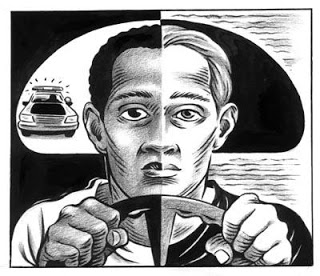
Last Monday, Peggy and I were stopped by a police officer on our way back from a doctor’s appointment in Grand Rapids, Michigan. We had nearly arrived at our lake house summer home, when I saw the red and blue flashing lights behind me.

Of course, I pulled over immediately onto the road’s gravel shoulder. I rolled down the driver’s side window (the only one that works dependably) of our 1992 Volvo. I suspect the officer was “intrigued” by our beat up car with its out-of-state Kentucky license. I mean, this may have been a “profiled” stop.

As the officer approached from behind, I reached into my back pocket for my wallet and license. Doing so, I couldn’t help thinking of the difference between me and black drivers in similar circumstances. For them, reaching into a back pocket as an officer approaches might be fatal. So might traveling in a decrepit car far from one’s own neighborhood.

“May I see your license and registration, Sir?” the young officer requested.

I fumbled through my wallet, and it took some time before my license surfaced. The policeman waited patiently without comment. Finally, I handed him my Kentucky license. From the passenger’s side, Peggy found our registration. However, it was from 2015. Somehow, the 2016 registration had not made its way into the glove compartment. Besides that, our “proof of insurance” certificate had expired.

“That’s all right,” the officer said politely. “I’ll just check on my computer. This might take a few minutes. . .  By the way, did you know you were traveling at 68 miles per hour? The speed limit here is 55.”

“No, Sir” I replied. “My wife and I were deep in conversation, and I didn’t realize how fast we were going.” (I didn’t dare tell him that the speedometer on our car doesn’t work.) I also hoped he wouldn’t see that the covering over our right front turn signal was busted out. I’m sure that was some sort of violation too.

A few minutes later, the officer returned.

“Everything checks out,” he said. “I’m not going to give you a citation this time. But I’d get that paper work up to date if I were you.”

We thanked the officer profusely, and went on our way.

Afterwards, I couldn’t help thinking how different our story was from Sandra Bland’s who ended up dead after failing to signal a lane change in Waller County, Texas. It was different too from Philando Castile’s in Falcon Heights, Minnesota. Castile was stopped for a broken tail light.   After informing an officer that he was carrying a licensed gun, Castile was shot when he obeyed the cop’s directions to produce his driver’s license from the wallet in his back pocket.

Bland and Castile were black. I, of course, am not.

But consider my “crimes” each of which have led to police shootings of blacks:

  • Speeding
  • Outdated registration
  • Expired proof of insurance
  • Broken turn signal light
  • Malfunctioning speedometer
  • Driving a beat up car far from my own neighborhood in a predominantly white community
  • Reaching into my back pocket after being stopped by the police

Thankfully, I was not guilty of “driving while black.” So unlike the overwhelming experience of black residents, for instance, of Ferguson, Missouri, I received no interrogation, no harsh words, no citation, no fine, no searching, no arrest, no summons to appear in court, no resulting lost days of employment, no threat of police violence.

And besides, I have lived to tell the story. And this in a country where compared to white drivers, African Americans are 31% more likely to be pulled over, 81% more likely not to be given a reason for it, and 174% more likely to be searched.

Hmm.

THE ATROCITIES in NICE: Replacing War with Truth & Reconciliation

NICE

The entire world was shocked by the horrendous atrocities of July 14th during Bastille Day celebrations in Nice, when a madman ran over scores of his fellow citizens.

Appropriately the crimes were followed by tears, laying of wreaths, moments of silence, and prayer vigils.

France’s President Hollande evoked sympathy when he correctly declared the attacks “an act of war.” No one disagreed.

However, Mr. Hollande was not correct in his implication that the killings in Nice (and earlier in Paris and at Charlie Hebdo) somehow began a war that France and its partners have now self-righteously resolved to “finish.” Rather, all those massacres are part of a much bigger picture that centralizes France’s participation in the U.S.-fabricated War in Iraq and the resulting creation of the Islamic State (ISIS).

To fill out that picture, consider the following home truths about that war in particular, and about war in general. Uncomfortable as they are, allowing those truths to sink in might help uncover non-violent alternatives to the carnage that stupefies everyone.

Begin here:

  • War is hell.
  • In modern warfare, 90% of casualties are civilian.
  • The casualties include refugee migrations.

_____

  • The West’s response to 9/11/01 was to declare war.
  • It began a campaign of bombing and extra-judicial assassination in Afghanistan, Iraq, Libya, Somalia, and elsewhere.

_____

  • According to a study by Lancet (one of the oldest scientific medical journals in the world), since 2003 the U.S. war in Iraq has caused more than one million deaths – again, most of them civilian.
  • Meanwhile, the U.S. has supplied weapons to Israel and Saudi Arabia for their own bombing campaigns against Muslims in Gaza and Yemen.
  • In Gaza alone (with complete U.S. support) the Israeli Defense Force fired 50,000 shells, carried out 6000 airstrikes, destroyed 3,500 buildings, killed 2250 Gazans, including 551 children.

_____

  • In wars there are always at least two sides.
  • All have the right to attack and counter-attack.
  • It is insane to be shocked when counter-attacks occur.
  • Counter-attacks often mimic attacks.
  • So if one side is perceived as attacking defenseless civilians, the other side will likely respond in kind.

_____

  • France itself is at war.
  • President Hollande is a founding member of the U.S.-led coalition that has recently dropped 175,000 bombs on Iraq and Syria killing at least 600 civilians in the process.
  • Therefore no one should be surprised when “in kind” counter-attacks occur. (To repeat: that’s the way war works.)

In view of such home truths, and recognizing that intensified bombing has proven counterproductive, instead of responding to the Paris massacre with more of the same, the U.S., France and their allies should:

  • On principle reject the atrocities of war that on both sides justly horrify everyone.
  • Institute instead a process of Truth and Reconciliation that admits and apologizes for the causal role the War in Iraq has had in the creation of ISIS.
  • Take seriously Britain’s recently published  Chilcot Report that indicted former British Prime Minister Tony Blair for cooperating with the Bush administration in misleading the world into that war.
  • Prosecute Blair, Bush, Cheney and others for the crimes the Chilcot Report describes.
  • Open western borders to the refugees inevitably produced by the U.S.-led wars over the last 15 years.
  • Spend the billions now invested in war against ISIS on rebuilding Afghanistan, Iraq, Libya, Syria, Somalia, Yemen, and Palestine.
  • In churches and other principled fora, specifically condemn all Islamophobic statements of politicians and other public figures.

Only actions like these can release the world from massacres that are the unavoidable consequences of the wars we rightly recognize as hell.

The Peasants Are Coming: Brexit, Free Trade & Mass Migrations

Brexit & Refugees

On June 24th Great Britain shocked the world by voting to exit the European Union (Brexit). Some celebrated the succession as a left wing “Peasant Revolt” against so-called “free trade agreements.”  They were right. Europe (and the world) needs an economic revolution from below. And Brexit was a shot across the bow of corporate globalization.

Others however ascribed the Brexit to narrow right wing anti-immigrant nationalism. They were also correct. However right wing focus on immigrants as if they were the root and sum of Europe’s problems obscures potential connections of interest between the right and its revolutionary counterpart seeking lasting solutions to the problems Brexit lays bare. Those solutions must go far beyond building walls and otherwise restricting immigration. They have to address globalism’s inherent contradictions and the various causes of the largest movement of peoples in world history.

For starters, think of those unprecedented migrations in the light of globalism’s contradictions as reflected in free trade pacts in our hemisphere as compared with the European Union.

Over here, the North American Free Trade Agreement (NAFTA) and its Central American analogue (CAFTA) grant owners of capital the right to cross borders with abandon regardless of the destruction they wreak on local economies in Mexico, Central America, and elsewhere in the Global South. For instance, the dumping low-priced U.S. corn on Mexican markets has converted innumerable peasant farmers into urban workers seeking employment illegally in the United States.

The illegality results from NAFTA’s refusal to recognize that labor is just as essential as capital in the free market paradigm.  If so (and capitalist theory tells us it is), then logic dictates that the freedom of movement accorded one element, must also be granted the other.

However if labor were to enjoy the mobility of capital, the detrimental effects of globalism’s so-called “free trade” would become apparent to all. Workers from Mexico would be free to go where the money is – to the U.S. and Canada. In turn, workers in those countries would see their jobs threatened. They would rebel and reject corporate globalization by demanding the repeal of NAFTA and CAFTA.

Multi-national employers in the U.S. and Canada protect themselves from such reaction by formally pretending to stand with U.S. and Canadian workers against unrestricted immigration. Politically and with great bluster they support building walls. Actually, however, they find immigration essential because Global South workers are required, for example, to harvest tomatoes and lettuce in the United States. Immigrants also exert downward pressure on U.S. wages generally and in construction and service industries in particular. All of that is good for business. The wall-talk is just window dressing.

That’s what’s happening on this side of the pond.

By way of contrast, the granddaddy of all free trade agreements, the European Union (EU) has been less illogical than NAFTA and CAFTA. It has granted labor the same mobility as capital. So workers in the European Union are free to cross borders from economically depressed member states such as Bulgaria and Greece to where the money is in Germany and Great Britain. The results are predictable. In the context of a tight labor market induced by the Great Recession, a huge backlash has resulted against immigrants for reasons described above. Brexit was the outcome.

But the immigrant problem is far more complicated than meets the eye. Ignoring that complexity blocks necessarily nuanced responses. It also blocks union of those right and left wing concerns earlier referenced.

The fact is: not all immigrants are economic. Instead, there are really three types of immigrants taking part in today’s mass migrations. True: some contemporary refugees are economically driven. Many others however are war refugees; a third group seeks refuge from the effects of climate chaos. The legitimate interests of each of these groups dictate separate policy changes that are generally ignored in xenophobic rhetoric about building walls, and protecting national identity.

Economic immigrants are those earlier-mentioned working people who demand the same rights as big capital. Within the European Union, and as already indicated, they have been moving legally from low wage countries to higher wage venues.  In our hemisphere, workers from Mexico and Central America have intuitively followed free-trade logic. They have voted with their feet against the labor restrictions of NAFTA and CAFTA despite the trade agreements’ legal prohibitions.

For their part, war refugees are flooding the world as a result of United States’ and U.S.-supported bombing campaigns (including drones) in Syria, Iraq, Afghanistan, Libya, Somalia, Palestine, Yemen, and elsewhere. Such campaigns have demolished the refugees’ homes, and destroyed their communities and jobs. It’s no wonder then that they reluctantly seek refuge in Europe and the United States. Under international law, they have the legal right to do so. Morally speaking, those responsible for the bombings are most obliged to receive them. The culprit United States should lead the way.

Finally, refugees from climate chaos form a separate category. Many migrants from Syria, for instance, are fleeing not only U.S.-sponsored bombing raids; they are farmers whose fields have been devastated by a years-long drought. Other refugees from island nations and coastal regions find their homes swallowed by rising sea-levels caused by melting polar icecaps. As global temperatures and sea levels continue to rise, this category of refugees will soon dwarf the other two.

In light of such distinctions about free trade, the logic of globalized capitalism, and the three classes of refugees, clear remedies suggest themselves – all inspired by Brexit. In a word, the basic remedy is democracy. More specifically, required policy changes include: (1) Exiting all free trade agreements responsible for economic refugees; (2) Stopping the bombing and wars that create homeless refugees, and (3) Leaving fossil fuels in the ground while adopting mandatory regulations to prevent further warming of the planet.

Though unlikely, all of this is possible. As the Brexit vote demonstrates, there is nothing mandatory or inevitable about free trade agreements. In developing countries, they all can be replaced by what in the past was called “import substitution.” That meant industrialization by Global South economies and instituting protectionist policies to keep imports out and economic emigrants at home.

Such substitution is based three realizations: (1) that no country has ever achieved “developed” status by reliance on supplying raw materials and agricultural products to industrialized nations, (2) that such policy of protectionism and import substitution was itself responsible for the economic advancement of the United States, and (3) after World War II, it worked in Global South countries such as Costa Rica with the result of separating it from its unindustrialized neighbors as economically successful.

[Please note that if free trade agreements remain under consideration, democracy demands that their discussion involve all affected parties with equal representation and vote. Such negotiations would include environmentalists and their concerns for air, water plants and animals. They would involve workers whose jobs might be lost, and community members whose neighborhoods and cities might be devastated by mass emigration, increased pollution or by waves of immigrants. Here absolute transparency is required.  There can be no secret negotiations, top-secret documents, or one-sided elite authorship of policies that end up affecting millions of disenfranchised workers including women and children.]

If Brexit was the start of a peasant revolution, it’s time for all of us to join our brothers and sisters at the barricades across the pond, pitchforks in hand. Our enemies in this struggle are not immigrant workers victims of our wars, or those whom one-percenters call environmental extremists. They are instead the extremist negotiators of secret trade pacts, belligerent prosecutors of wars and obtuse deniers of humanly-induced climate change.

Those are the exploiters whom the Brexit vote indicates we must unite to overthrow and replace.

For Discussion: The Clearest Explanation of Marxism and Surplus Value I’ve Come Across

Whenever my adult children and I get together, we end up “discussing” current events such as the coming General Election, U.S. foreign policy, Black Lives Matter, or Cuba. And those discussions always lead to exchanges about alternatives to capitalism — especially socialism inspired by Karl Marx. On such occasions I end up defending those alternatives, and my dialog partners offer powerful counter-arguments.

I always come away from such events wishing I could be clearer in expressing my convictions. I’ve taught Marxism in the past. For a while, in a team-taught interdisciplinary course involving 15 Berea College faculty drawn from various disciplines (History, Philosophy, Physics, Biology, Economics . . .), I was asked to give the Karl Marx lecture to those colleagues and the entire B.C. sophomore class. The context was a course called “Religious and Historical Perspectives,” the best teaching (and learning) experience I’ve ever had.

There I wish I had been able to give something like the lecture I’ve pasted below. It’s given by Richard Wolff and it’s the clearest explanation of Marx’s theory of “surplus value” that I’ve come across.

Richard Wolff is emeritus professor of economics at the University of Massachusetts. He is a Marxist educated at Yale,Stanford and Harvard. He currently teaches at the New School in New York City. I am grateful to my good friend, John Capillo, who called him to my attention.

Please watch the video. If my children do, I know it will spark more enlightened conversation. I’m also hoping it will start discussion here among readers of this blog.

See what you think:

Our Dinner with Amy Goodman

Amy Goodman

A week ago today, Peggy and I had dinner with Amy Goodman, the host of “Democracy Now: the War and Peace Report” (DN).  The program airs each Monday through Friday on radio and TV stations across the country. I watch it every morning in its podcast version that can be accessed at any hour at http://www.democracynow.org/

The dinner was a Christmas present from my daughter, Maggie who (with her husband, Kerry) had given DN a substantial contribution.

[The gift came with a black Democracy Now tee shirt (which I wore to our dinner) and two coffee cups showing the program’s logo. The meal portion of the gift was for me and a companion of my choice. Naturally, it was Peggy. Still another of the gift’s components was attendance at one of the show’s morning productions (which we’ll take advantage of sometime in the future).]

There were four of us in Thursday’s dinner party. Amy brought along her factotum, Edith Penty, whose presence was absolutely delightful. We ate at the Hangawi Korean restaurant on 32nd street between Fifth and Madison Avenue. There we shared “The Emperor’s Tasting Menu” that featured starters, appetizers, entrees and dessert –   acorn noodle salad with avocado fritters, dumplings in pine nut and pineapple sauce, tofu with sesame leaves and seaweed sauce, and dessert.

As the meal unfolded we all shared our biographies.

Amy is a New Yorker raised in Bay Shore. She is the daughter of an ophthalmologist father and a mother who taught literature and Women’s Studies. Her family is Jewish Orthodox. Her maternal grandfather was an Orthodox Rabbi.  She studied Hebrew and Torah from kindergarten through high school. Amy graduated from Radcliffe College in 1984, with a degree in anthropology.

From her stories about participation in demonstrations, vigils, and campaigns, it’s clear that Amy Goodman has always been an activist. For some years she worked in an organic bakery that eventually supplied buns for Arby’s restaurants. Journalism has always been in her family’s blood. (Her brother published a family newspaper before reaching his teenage years.) She founded Democracy Now in 1996; this is its 20th anniversary year. Throughout Amy’s account of her life, there wasn’t a trace of self-promotion. On the contrary, both Peggy and I were impressed with her interest in our stories, and with her unassuming presence.

In all the four of us spent about two hours together. And of course conversation went far beyond autobiographies. Inevitably we discussed Trump, Bernie and Hillary.

The most interesting insight came when Amy shared the fact that the Obamas and Clintons can’t stand one another. Obama made Hillary his Secretary of State following the principle: Stay close to your friends, and even closer to your enemies. One of the first questions asked in any Obama or Clinton vetting process is: “What do you think about Hillary?” “What do you think about Barrack?” Hiring decisions are made accordingly.

Towards the end of our time together, Amy left the table for a moment. Soon afterwards waiters came to our table with ice cream and small cakes and a candle. Amy had informed them that Peggy and I are celebrating our 40th wedding anniversary. That’s the kind of thoughtful person Amy Goodman is.

As we left Hangwai, a young African American man caught sight of my Democracy Now tee shirt. He said to me: “Love your tee shirt. I watch that program every day. Love that too!” I pointed ahead of us to Amy who was deep in conversation with Peggy. I said, “That’s Amy Goodman right there.” He couldn’t believe it. Soon we were all taking pictures with the celebrity. It was a moment that topped the evening off just perfectly.

If Democracy Now isn’t part of your daily news-gathering routine, it should be.  Unlike other newscasts, it centralizes stories from the grassroots. So it often interviews victims of police violence, representatives of NGOs (non-governmental organizations), political dissidents, and community organizers. Noam Chomsky, Glen Greenwald, Naomi Klein, Bill McKibben, Medea Benjamin, Cornel West, Lori Wallach, Richard Wolff, Tariq Ali, and many other thought-leaders and journalists are among the program’s frequent guests.

“Democracy Now” covers the Black Lives Matter Movement along with the Boycott, Divest, and Sanction campaign against the Israeli apartheid system – whose proponents are almost never interviewed in the mainstream media.

If you watch Democracy Now, you know details of the recent coup in Brazil, its predecessor in Honduras, and current attempts at still another in Venezuela. You know about Michael Brown, Eric Garner and Tamir Rice. But you also are familiar with police killings of Sandra Bland, Tanisha Anderson, and Miriam Cary.

None of the stories is reduced to sound bites. Interviewees like Noam Chomsky are sometimes given an entire hour (without commercial interruption) to analyze a whole host of world and national issues. An hour-long broadcast was devoted recently to Daniel Berrigan, the Jesuit peace activist who died last month.

Peggy and I are so grateful to Maggie and Kerry for making possible such a memorable evening — and of course, to Amy Goodman for spending so much time with us and for being the huge inspiration she is

What Am I Doing with My Life? A Reflection on a “Left Forum” Event

Pam Africa

“I don’t care if you’re 100 people, or 50, or 10. If there’s just one of you going against these mother f_ _ kers, it’s enough. Together we can warm their asses up!”

Those were the words of 70 year old grandmother, Pam Africa. I heard her speak last weekend at the annual meeting of the Left Forum – an organization of progressive thought leaders and activists. The meeting took place at the John Jay College of Criminal Justice of the City University of New York (CUNY). Its theme was “Rage, Rebellion, and Revolution: Organizing Our Power.”

Ms. Africa was talking about the necessity of organizing and taking to the streets in order to confront U.S. political, social and economic institutions she said were based on theft, murder, and perjury. The entire system, she added, has lost its legitimacy having become increasingly unresponsive to human need, and ever more violent in repressing those demanding their rights.

Pam Africa’s long experience gave her words credibility. She is the former Minister of Confrontation of the Move Organization, the Philadelphia African-American liberation community whose homes were bombed by Philadelphia Police Force back in 1985. Since that time, as the coordinator of the International Concerned Family and Friends of Mumia Abu-Jamal, she has been working for the release of Abu-Jamal and other political prisoners.

That was the theme of the panel discussion where Pam Africa was speaking – political prisoners.  It was the most inspiring of the events I attended, having chosen 6 of them from the more than 400 panels, workshops, and events that filled the Left Forum’s Events Directory.

There were 10 participants in the Political Prisoner presentation. About half of them were African American. Seven were women. Only 3 appeared younger than sixty. All but 1 had spent time in prison. And each and every one of them had dedicated their lives to the struggle for social justice. They’ve done so in the face of a Prison-Industrial Complex that reaps a fortune from the increasingly privatized criminal justice system currently incarcerating 2.3 million Americans – more prisoners per capita than any country in the world. The annual cost of doing so ranges from $24,000 to $47,000 per inmate.

Think of what could be done with that money, we were urged. What if it were it invested in housing, education, or mental healthcare rather than in prisons-for-profit?  Instead, those human warehouses have become a repressive government’s de facto programs for the homeless, poorly educated and mentally ill. Prison activist Anne Lamb described political prisoners there as “the most humble people you ever want to meet.”

How do so many prisoners end up behind bars?  Most of their cases do not go to trial, we were told. Instead plea bargains are struck. An arrestee is typically given the choice to plead guilty to one of a whole list of charges to avoid spending 15 rather than 5 years in prison. On the other hand, those who choose to go to trial get the book thrown at them. They end up doing 20 rather than 5 years and are held up as examples to potential plea bargainers. “You don’t want to end up like him, do you?” is the threat. The whole system saves (i.e. earns) the for-profit system millions.

Witnessing the intensity, commitment and sharp focus of participants in Pam Africa’s panel raised existential questions for me.

“What am I doing with my life?” I scrawled in my notebook. “Playing golf??”  I mean, I’m in my life’s final stage. And there is still work to do – especially around nuclear disarmament, climate change, and prison reform. As Pope Francis has pointed out, all of those issues are inter-related. Everything is! And the sad fact is that I’m largely avoiding the task.

Meanwhile, Pam Africa and the other panel discussants are out there in the streets. Once again, I’m not.

For me, the most logical response to the experience I’ve been describing here is to get involved in the Bard Prison Project. It’s a program for securing college degrees for prison inmates. Two years ago, Berea College (my former employer) was invited to join. I was asked to take part. I and other invitees did some preliminary work. Since then I haven’t heard anything.

It’s time to pursue that possibility.

As one of last weekend’s panelists put it, “We need to stand on the neck of the system and make it cough up justice.”

The Role of Grandparents in Montessori Education

Montessori Quote

Currently, Peggy and I are in Westport CT visiting our grandchildren. The occasion is “Grandparents’ Day” in their Montessori School a week from Friday (May 27th). Maggie (our daughter) has asked me to say a few words as part of the morning’s program. Here’s what I plan to share:

The Role of Grandparents in Montessori Education

Isn’t Grandparents’ Day great?  I’m so happy to be here – as I’m sure we all are – to celebrate our grandchildren. Today I’m here to glory in four of my own:  Eva, Oscar, Orlando, and Markandeya. They’re following in the footsteps of their mother (my daughter) Maggie, who attended Montessori school in Boulder Colorado so many years ago.

This school is such a gift! Recently, I heard our 7 year old granddaughter, Eva, discussing her Montessori experience with one of her friends who attends a normal public school.  Her friend was saying how she’s so bored and just doesn’t like it. Eva said, “O, I love school. Everything we do there is a game. It’s fun.”

We grandparents admired that spirit and reality as we sat in on our grandchildren’s classes today – didn’t we?  We were edified as we observed those we love so much:

  • Practicing democracy in the workplace. (They call all of their activities “work.”)
  • Determining their own learning processes. (They move from one work site to another as they’re led by interest.)
  • Thinking for themselves.
  • Settling conflicts without violence.
  • Taking care of their environment.

The irony is that on the one hand, we applaud all of that as self-evidently admirable. We implicitly agree that it’s the ideal way the world should work. Isn’t that true?

And yet on the other hand, during our long lives, we’ve settled for a world:

  • Where our work lives have often been determined by (shall we say) less than enlightened bosses.
  • Who would rather we thought like them – for eight hours a day or more.
  • Where our work itself is drudgery rather than interesting.
  • Where international conflicts are addressed by bombings and war.
  • And where we are systematically destroying our habitat.

Where did we go wrong?

The question brings me back to this gathering. We are a Council of Elders. If this were a Native American gathering (or if we were in a culture that truly respected its seniors) our assembly would be considered especially holy.

Though we don’t live in a culture like that, our gathering today represents an occasion for facing ourselves, calling on our accumulated wisdom and asking: How will we prevent our grandchildren from contradicting everything they’re learning in this school and ending up like us – often unhappy in our work and inheriting a planet that Pope Francis (an 80 year old senior himself) said is becoming a huge “garbage dump?”

Our tools for accomplishing that pedagogical task are our own example, our wise counsel, our wallets and the organizations we support, the ballot box, and (for some of us) direct action in the streets. I’m sure you can think of others.

I suppose my ironic conclusion is that today our grandchildren are somehow teaching us. They’re reminding us of the way the world should be.

My suggestion here is that we use those tools I mentioned to prevent them from forgetting what they’re teaching today – from making the same mistakes our generation has made. Using especially our wise counsel and what we’ve learned from our long lives, we can save our grandchildren from lives of drudgery. We can help them save the planet.

Maria Montessori was right about education and following our instincts. We all have a “rage to know,” a rage to learn, a desire to live in harmony with nature. After all:

  • Birds fly.
  • Fishes swim.
  • Children learn.

Yes, all of that is true. But it’s also true that GRANDPARENTS TEACH. To paraphrase Crosby, Stills and Nash: It’s up to us to “Teach Our Grandchildren Well.” Whatever our age may be, we’re not done yet.  Our task is incomplete. We still have contributions to make.

Dan Berrigan: in Memoriam

Dan Berrigan Resist

I just spent the last hour in tears. The occasion was a tribute to Dan Berrigan on Democracy Now (the best daily news program available).  The saintly Jesuit poet, peace activist and prolific author died on Saturday. He was about to celebrate his 95th birthday this week. What a giant!

Father Berrigan stands with Dorothy Day and Thomas Merton as the most powerful U.S. prophets and social justice activists or our era. They along with Martin Luther King are the true saints of our time.

All of them changed the way Americans approach issues of war and peace. In particular they changed the Catholic Church – challenging it to reverse 1700 years of belligerence and unquestioning support of imperial war, and to follow instead the clear teachings of Jesus the Christ.

Dan Berrigan not only wrote and spoke in ways that uncomfortably juxtaposed the Gospel of Jesus with United States imperialism; he also walked the walk – literally. He marched, spoke out, carried signs, and was arrested more times than he could remember. He spent years in prison, and staged creative protests against the Pentagon and the arms industry.

During the Vietnam War, Berrigan and other activists raided the Selective Service offices in Catonsville MD. They removed nearly 400 files from the place, and burned them with homemade napalm in the adjoining parking lot. They justified the act saying it was better to burn paper than children’s bodies.

Berrigan knew first-hand what he was talking about.  In 1968 he traveled to North Vietnam with historian, Howard Zinn. They had set out on an ultimately successful mission to free three U.S. airmen captured by the Vietnamese. In the process, he saw the burn wounds of children and the elderly scorched by the liquid fire that pursued them relentlessly even in their underground bunkers. He experienced war’s realities as he huddled there with the children and elderly during terroristic bombing raids by his own country.

On another occasion, Dan along with his brother Phil and other “Plowshares” members entered the General Electric nuclear arms plant in King of Prussia PA. There they found an (as yet unarmed) missile and used hammers to beat its nosecone to smithereens. They said they were following the injunction of the prophet Isaiah to turn swords into plowshares (IS 2:4).

I knew Father Berrigan personally. He spent a fall with us here in Berea in the mid-‘80s. His brother, Phil, visited Berea College more than once in connection with a wonderful course called “The Christian Faith in the Modern World.” Imagine actually conversing with saints like that!

I remember how enthusiastic Dan was in supporting the work of the “Berea Interfaith Task Force for Peace.” We were busy at the time with the Nuclear Freeze Movement and with resisting U.S. wars in Central America, especially in Nicaragua.

He met with us regularly – on at least one occasion, in Peggy’s and my home in Buffalo Holler in Rockcastle County. We have a snapshot of him there in our family album. He’s seated on our deck, eating from a paper plate with a bottle of beer on the floor beside his chair.

Another photo shows him standing up in protest with the rest of us at the Bluegrass Army Depot in Richmond Kentucky.  (The Depot holds WWII ordnance – mustard gas and chemical weapons still awaiting demolition.) We had infiltrated a patriotic celebration there.

Our Task Force had entered the facility with protest signs folded up under our shirts. We stood up to display them in the middle of a triumphant speech by one of the generals. Mine read “US out of Nicaragua!” Dan’s message was printed on his tee shirt. When he removed his outer shirt, everyone could see it.  “Stop the Arms Race!” it said.

One of my most memorable Ash Wednesdays came when Dan was here. In his humble understated way he celebrated a thoughtful Mass to begin the season of Lent. It reminded our packed church of St. Clare’s about the ashes created and left behind by brutal U.S. bombing campaigns and unending wars. He called us to repent by refusing our support of such conflicts.

I attended a class Dan taught three times a week during his semester at Berea. It analyzed the Book of Revelation written by John of Patmos – an otherwise unknown author who had been exiled to the Island of Patmos in the Aegean Sea by the Roman Emperor, Domitian at the end of the first century CE. Like Father Berrigan, the book’s author, “John the Revelator,” was a political prisoner. His crime was that of prophecy – of speaking truth to power. So Father Berrigan claimed a kind of “hermeneutical privilege” in dealing with the Book of Revelation. He said his exegesis was a matter of “one jailbird to another.”

I recall driving Dan to the Bluegrass Airport in Lexington the day he left us. Always on task, Father Berrigan spoke about the similarities between Israel’s occupation of Palestine and the apartheid system still flourishing in South Africa. “All these ‘settler societies,’” he said, “operate in the same brutal ways.” Sadly, his words remain true to this day.

In my early days of working at Berea College, I was privileged to give three lectures a year to the entire sophomore class assembled in Phelps-Stokes Chapel along with my colleagues, their teachers.  The context was a two-semester, primary-source survey course called “Religious and Historical Perspectives.” ( I loved the course. It taught me more than any other academic experience in my life.) My lectures were on Jesus (in the fall), on Marx (in the middle of the spring semester), and on Harvey Cox’s The Secular City (the last presentation of the year).

I remember centralizing Dan Berrigan in my Secular City talk.  I held him up (as I still do) as an example of what the great Jewish prophets, Jesus of Nazareth and Karl Marx, have to tell us about Christians’ relationship to the realities Harvey Cox described in his book.  I recalled Father Berrigan being arrested after spending four months underground resisting relentless pursuit by J. Edgar Hoover and the F.B.I.

Dan’s hands were handcuffed in front of him, I recalled. And he was asked by a reporter if he had anything to say before going off to Danbury State Prison. Father Berrigan gave a one-word response. He held up his handcuffed hands and made a peace sign. He said simply: “Resist!”  That’s his message to us today!

Thank you, Father Berrigan, for having the courage to resist and for challenging us so consistently to do the same. May we follow your prophetic example.

Second Thoughts on Pope Francis & Family Issues

Confessional

Last week I posted a (mostly) tongue-in-cheek comment on Pope Francis’ Apostolic Exhortation, Amoris Laetitia. The document represented the pope’s reflections on the synod of bishops that met over the last two years to reformulate the Church’s teachings on marriage, sexuality and the family.

Obviously, all of those elements find themselves mired in profound crisis in the contemporary world. Given that fact, and despite the pope’s efforts to save the day in the face of the intransigence of the world’s episcopacy, the document proved to be highly disappointing.

Notwithstanding what I wrote last week, Amoris Laetitia left me wishing that the Church could bring itself to speak in plain language accessible to us all.

But no:  the encyclical was full of platitudes and written in opaque Vaticanese. It demonstrated the out-of-touchness of Church leadership, and its inability and/or unwillingness to help today’s women and men face up to their real problems in the light of a rich faith tradition perfectly capable of providing such assistance.

No wonder so many young people – so many couples – have long since dismissed the Church as irrelevant and counterproductive in terms of making sense of their lives in a globalized world!

[News flash to the Vatican: Outside of your little realm, the major problem facing couples today is not whether divorced people should be allowed to receive Holy Communion! It’s not even whether or not artificial birth control is morally acceptable. (Catholics have long since resolved that “problem;” they use contraceptives in the same percentage as everyone else.)]

Instead, think of the real problems we all face around the fraught matters Amoris Laetitia pretends to address, but which it only dances around, and in the end avoids. These problems were recently outlined by psychologist, Dr. Harriet Fraad, in an interview with economist, Richard Wolff. They include the following:

  • The introduction of the internet and easy birth control has changed the nature of dating and sexual relationships.
    • Increasingly, couples meet online instead of through family and friends.
    • It is no longer socially unacceptable for them to have sex before marriage.
    • In fact, hardly anyone waits till marriage.
    • This makes marriage less necessary and attractive as a means of achieving access to sex.
  • Divorce statistics (as well as witnessing the unhappiness of their parents) similarly discourage marriage. Fifty percent of first marriages end in divorce; 60% of second marriages and 70% of third marriages finish the same way. And after divorce women are usually left holding the bag in terms of child support.
  • Families are stressed when economic circumstances make it necessary for both parents to get jobs. That typically means women end up working a double shift – in the workplace and in the home.
  • The prospect of overwork eventual divorce leads more and more women to choose to remain single. Many become Sugar Babies to Sugar Daddies – older, well-established men who pay off their Baby’s overwhelming college loans or credit card debt.
  • Men, on the other hand, find themselves deprived of their traditional, male-defining role as bread-winners. Anger results – deflected towards guns, the military, sports addictions, evangelical religions (where women are subordinate) and pornography.
  • Children suffer the consequences of it all. They are left alone after school, when most of their problems emerge – not the least of which is obesity.
  • With all those realities in mind, marriage is increasingly viewed as an unnecessary hassle — a luxury good – accessible and desirable only for the well-to-do.
  • So young people end up postponing or rejecting it altogether.
  • They opt instead for serial cohabitations without commitment.
  • Or they become “Herbivore” men, “Dried Fish” women, or MGTOWS.

It’s not that Pope Francis doesn’t bring up many of these problems. Nor is he incapable of addressing them in ways helpful to struggling families. In fact, his three major publications (including Amoris Laetitia) provide clear principles for doing so.

  • His eco-encyclical, Laudato Si’, teaches clearly that all things are connected. The role of religion (which means “binding force”) is to make connections apparent.
  • Similarly that encyclical along with his Exhortation, “The Joy of the Gospel,” identifies capitalism-as-we-know-it as the connecting structural cause of contemporary problems. Its demands pits employers against their employees and men against women; it underpays them or deprives them of work; it requires them to work longer hours, drives both parents into double shifts, destroys families in the process, and then claims to represent “family values.”
  • And finally, in Amoris Laetitia itself the pope identifies conscience (informed by thoughtful consideration of the Christian tradition) as the most reliable guide humans have at their disposal.

Simply highlighting those principles and calling Catholics to adult dialog about their application to dating, marriage, divorce, contraception, abortion, and child-rearing would have done much more than the largely impenetrable document the Vatican actually produced.

Abortion: Should a Man’s Wallet Be More Private, Free, and Unregulated than a Woman’s Womb?

Chittister 2

My recent post, “Face It: Donald Trump Is Right about Abortion” drew many responses. (You can read more than 100 of them here.) One comment characterized my position there as “radically pro-choice.” Someone else called it “pro-abortion.”

However, it was not my intention (especially as a Catholic moral theologian) to write a piece that might be interpreted in those ways.

No, I was simply attempting to show that Republican position that “abortion is murder” can be quickly reduced to the absurd.

It was ironic, I suggested, that someone as clueless as Donald Trump should end up being the agent of moral clarity. He did so by verbalizing what the standard Republican position on abortion implies, Viz. that if abortion is murder, those involved should be charged and punished accordingly.

My point was that the immediate vilification of Trump’s impolitic assertion indicated that the judgment that “abortion is murder” is untenable.

What’s not untenable however is the fact that responses to The Donald’s Trumpian logic show that the abortions debate in the public sphere needs a dose of straight talk. So let’s try that out. In the end, it pits women’s sovereignty over their wombs against men’s control of their wallets.

Begin with the fact that few people (if any) are actually pro-abortion. Invariably, it is a painful and regrettable decision usually taken with the utmost seriousness.

From there admit two other facts. One is that abortion cannot be eliminated, no matter what laws are passed. Trying to eliminate abortion is like trying to eradicate prostitution. Large numbers of people have always and will always seek abortion services. The rich will fly their wives, lovers or daughters to the Netherlands or Belgium or wherever safe abortion procedures are legally available. The poor will go to back-alley practitioners or they’ll take drugs or use coat hangers to do the job themselves.

The second undeniable fact is that we live in a pluralistic society where people of good faith find themselves on both sides of the abortion question. And this is because they differ (most frequently on religious grounds) about the key question of when specifically personal life begins. That is, few would argue that a fetus at any stage does not represent human life and should not therefore be treated with respect. No, the real question is when does fetal life become personal? The question is when does aborting a fetus become murder?

In the thirteenth century, Thomas Aquinas and others held the position that personal life began with “ensoulment,” i.e. when God conferred a soul on the developing fetus. According to Thomas, because of the high numbers of spontaneous abortions in the early pregnancy, ensoulment could not logically happen at the moment of conception. So in his patriarchal way, he conjectured it occurred for males 40 days after conception; for females it happened after 80 days. Before those turning points, there was no question of personal life.

Of course, Aquinas’ logical position is no longer held by the Catholic Church. Its official teaching is that personal life is present from the first moment of conception. This means that in a world where as many as 50% of  pregnancies end in miscarriage, half of all “people” are “aborted” spontaneously usually before the mother even knows she is pregnant.

Such facts about miscarriage have led many to conclude that personal life begins well after the moment of conception.  They locate it, for instance, at the moment of “quickening” (when the mother first feels her baby move), with viability outside the womb, with actual emergence from the womb, or (as with some Native Americans) with the “painting” of the emergent child to distinguish it from animals.

Given such differences, it seems counterproductive to impose the view of one religion on an entire culture. We might expect such imposition from the Taliban. But it has no place in a democracy characterized by separation of church and state.

Instead in a country like our own some compromise is necessary. And that is what happened in Roe v. Wade. There it was determined that in the first two trimesters, the pregnant woman can make a decision on her own and in consultation with her physician. In the third trimester, the state asserts its interest and can make laws restricting abortion to protect the woman’s health and the potentiality of human life.

However a Roe v. Wade approach can never be sufficient for genuine pro-life advocates. Abortion law must be complemented by social programs. These include pregnancy prevention measures – sex education in our public schools along with easy access to contraceptives.

Nonetheless when unplanned pregnancies occur, programs discouraging abortion needs to kick in. These would provide free counselling and pre- natal care for pregnant mothers along with post-natal services for their newborns. Job provisions would be available for new mothers along with free daycare for their pre-school children. Programs would also include low cost housing and (where necessary) help paying grocery bills.

All such measures are genuinely pro-life. They create a welcoming environment for new life.

But this is where the real debate about abortion’s relation to privacy enters the picture. Simply put the question is: which should be more vigorously protected from state intervention – a woman’s womb or a man’s wallet?

Put otherwise, the debate about life-friendly social programs pits on the one hand mostly well-to-do male legislators (in the U.S. Congress and in the Catholic Church) against poor women who cannot obtain abortions abroad. The patriarchs are quite willing to have their laws invade the privacy of a woman’s womb while defending invasion of their wallets to provide a welcoming atmosphere for all the unborn.

Benedictine Sister Joan Chittister has called such typically male attempts to evade responsibility by its true name. She wrote:

“I do not believe that just because you’re opposed to abortion, that that makes you pro-life. In fact, I think in many cases, your morality is deeply lacking if all you want is a child born but not a child fed, not a child educated, not a child housed. And why would I think that you don’t? Because you don’t want any tax money to go there. That’s not pro-life. That’s pro-birth. We need a much broader conversation on what the morality of pro-life is.”

Contributing to that broader conversation is what my controversial blog post was about. So is this one.

Tell me what you think.