(Sunday Homily) Few Are Called, Many Are Chosen

many-called-few-chosen 2

Readings for 28th Sunday in Ordinary Time: IS 25: 6-10A; PS 23: 1-6; PHIL 4: 12-14, 19-20; MT 22: 1-14 http://usccb.org/bible/readings/101214.cfm

Currently, I’m back in the saddle. A dear colleague of mine is continuing her courageous fight against cancer. So I was asked to fill in for her teaching a religion course called “Poverty and Social Justice” – the very topic I’ve been struggling to understand and explain to students during my 40 years at Berea College in Kentucky. I have 19 very interested and wonderful students. Most of them are juniors and seniors, even though Religion 126 entry-level.

Together we’ve looked at the experience of white Appalachians, African-Americans in Mississippi, and people living in the former colonies of Africa, Latin America and South Asia. My students are watching “Democracy Now” each day as it deals with issues like ISIS, Ferguson, and voter suppression.

However, the most important lesson I’ve been trying to drive home in “Poverty and Social Justice” is an understanding of Christianity that Pope Francis, the Second Vatican Council, and liberation theology term its “preferential option for the poor.” That option holds that God’s People are not a single national group. Rather, God’s chosen are the poor and oppressed whom Christians have been taught at best to pity or treat with “tough love,” and at worst to despise as unworthy. The Hebrews were merely the paradigmatic example of God’s own choice of the poor as a divinely revelatory people. The poor show us what God is like.

I bring all of that up because today’s liturgy of the word is really about the preferential option for the poor. Our sources pressing that idea include two exiles (Isaiah and Matthew), a prison inmate (Paul), and the Son of God revealing divinity veiled in a working-class prophet who ends up being arrested, tortured, and a victim of capital punishment.

The first selection from Isaiah introduces the theme of “chosenness” by describing what God holds in store for the wretched of the earth. In a word, God’s will is abundance for all those currently experiencing painful exile in Babylon. Those are Isaiah’s words: God wants abundance – but “for all peoples.”

No harps and clouds here; no abstract heaven. Instead, Isaiah envisions God’s utopia taking form here on earth, in a particular place – on “this Mountain” Isaiah says (referring to the exiles’ motherland). There God’s Kingdom will take the form of a huge picnic – an outdoor feast of incomparable abundance. On God’s mountain, all will engorge themselves, Isaiah promises, “with rich foods” and cups overflowing with “choice wines.” The prophet repeats the phrase twice for emphasis: “a feast of rich food and choice wines, juicy, rich food and pure, choice wines.”

The feast will be a celebration of Enlightenment – of revelation or removal of the “veils” or barriers that separate human beings into “chosen” and “unchosen.” Isaiah predicts: “On this mountain he will destroy the veil that veils all peoples, the web that is woven over all nations; he will destroy death forever. The Lord GOD will wipe away the tears from every face; the reproach of his people he will remove from the whole earth.”

Notice this promise is inclusive. Again, it is directed to “all peoples,” not to a single nation. It is addressed to suffering and exiled people who find themselves in a “web” of death, tears and blame caused by deceptive divisions into nation states.

The theme of God’s all-inclusive, life-giving kindness is reinforced in today’s responsorial – the familiar Psalm 23, which begins, “The Lord is my shepherd.” According to the psalmist, God is the one who fulfills everyone’s desire for food and water, wine and oil for cooking. In addition, God provides rest, refreshment, and guidance. The courage God gives removes fear of evil and threat. All of that is music to the ears of the poor and deprived.

In today’s second reading Paul touches a similar chord. From an imperial prison (perhaps like Abu Ghraib), he writes, “God supplies whatever you need.” Imagine Paul’s courage! “Yes, I’m distressed,” he writes. “But don’t worry about me. I have learned the secret of being well fed and of going hungry, of living in abundance and of being in need.” Here then is a prisoner whose experiences of abundance are not contradicted by their opposite. Paul’s own experience of abundance and deprivation keeps his outlook positive and is the basis for his confident promise, “My God will fully supply whatever you need, in accord with his glorious riches in Christ Jesus.”

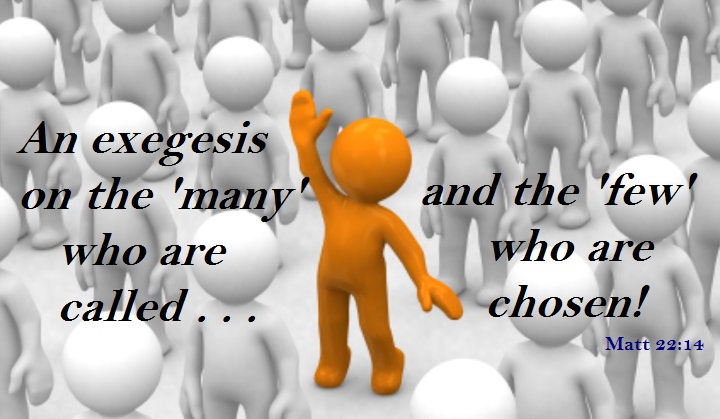
And that brings us to this Sunday’s Gospel selection. It’s a parable illustrating the surprising identity of God’s chosen people. The parable is addressed to the “elders and chief priests,” the political leaders of Jesus’ day who thought of themselves as God’s elect. The tale ends with the familiar tagline, “Many are called, but few are chosen.” But mystifyingly, its point seems to be the opposite: “Few are called, but many are chosen.”

I mean today’s gospel is Matthew’s account of Jesus’ parable about a king inviting his rich friends (the few) to his son’s wedding feast. It’s a party characterized by abundance reminiscent of “the juicy, rich food and pure, choice wines” in today’s first reading.

In the story, that feast is already prepared. But the king’s rich friends exclude themselves from its abundance, preferring instead the pursuit of their individualistic pleasures and profits. Some are so ungrateful that they mistreat and even kill those proffering the king’s invitation. All of this, of course, is Matthew’s thinly veiled reference to the way Jewish leaders treated God’s messengers, the prophets whose line for Matthew culminates in Jesus of Nazareth.

Thinly veiled as well is Matthew’s reference to the destruction of Jerusalem a generation earlier in the year 70. Matthew writes, “The king was enraged and sent his troops, destroyed those murderers, and burned their city.” According to Matthew, then, Jerusalem’s fate was the karmic result of the rich and powerful dishonoring prophets like Jesus and refusing to enter God’s kingdom with the poor and oppressed.

It is at this point that Matthew (and presumably Jesus) makes the point about the real identity of God’s Chosen People. The king says, “’the feast is ready, but those who were invited were not worthy to come. Go out, therefore, into the main roads and invite to the feast whomever you find.’ The servants went out into the streets and gathered all they found, bad and good alike, and the hall was filled with guests.”

There you have it: God’s New People are the dregs of humanity like those my class is studying. They are from the streets – the good and bad alike.” That’s the very point Jesus’ parables have been making for the past few weeks: Prostitutes and tax collectors enter God’s kingdom before the “chief priests and elders of the people.”

But wait; there’s more.

At this government-provided feast of free food, choice alcoholic beverages, and even (it seems) free festive clothing, one person insists on differentiating himself from the rest. He refuses to change his clothes – always a literary (and liturgical) marker for change of lifestyle. At bottom, it’s a refusal to identify with the street people particularly dear to God’s heart.

According to the story, this karmic choice leads to unhappiness – to sharing exterior darkness suffered by the rich Refuseniks whose city was earlier destroyed by imperial armies.

So although the few were called, the many are chosen. Once again, that’s good news for the kind of people my “Poverty and Social Justice” class is studying at Berea College.

What then of Matthew’s tagline that says the opposite – that many are called, but few are chosen?

I think it can only be a koan-like saying we’re meant to puzzle over in the light of the seemingly contradictory message of today’s parable. Perhaps it refers to the few (the 1 %?) whose selfish choices exclude them from God’s New People as though they selected their own destruction on purpose. They are the few self-chosen for destruction.

What do you think?

(Instead of a Sunday Homily) War Mongering at the New York Times: There’s always a “Why”

Urinating soldiers

Today The New York Times published an inflammatory editorial called “The Fundamental Horror of ISIS.” The evident but unstated purpose of the piece was to strengthen support for the latest waste of our tax-payer dollars on the most recent phase of the so-called “war on terror.” Like its predecessors, that phase has nothing to do with protecting our “homeland.” Rather as Dennis Kucinich has observed, it’s yet another phase of the (by-now) 25 year long war against the impoverished masses who have the misfortune of finding their homes floating on top of a vast sea of oil controlled by foreign outsiders.

To help the White House justify its consequent greed-based aggression, the NYT editorial trotted out the well-worn thesis that ISIS represents unmitigated, irrational evil entirely foreign to the sensitive minds of its gentle readers. So it rehearsed “the beheadings, crucifixions, tortures, rapes and slaughter of captives, children, women, Christians, Shiites.”

This, of course, represents a highly familiar litany relative to our state’s designated enemies. The “presstitutes” made similar allegations against “the Russians” during the Cold War as well as the Chinese Communists. It was also the case with the Sandinistas, the PLO, Hezbollah, and Hamas. Similarly, Manual Noriega, Slobodan Milosevic, Saddam Hussein, Osama bin Laden, Muammar Kaddafi, and (until recently) Bashar al-Assad all represented unmitigated evil. Now it’s the turn of ISIS and (as of last Tuesday) Khorasan.

In all of these cases the designated enemies in question have represented pure evil without any legitimate grievance other than sadism that strangely and inexplicably has (according to the Times in the case of ISIS) “attracted hundreds of willing followers — yes, also from Europe and America.”

Times editors put it succinctly in today’s rant: “Comparisons are meaningless at this level of evil, as are attempts to explain the horror by delving into the psychology or rationale of the perpetrators. . . as Roger Cohen, the New York Times columnist, wrote in a recent piece about ISIS, there is no “why” in the heart of darkness.”

To repeat, this level of evil is entirely foreign to the civilized westerners.

Really?

Try explaining that to the victims of the 25 year war in Iraq and Afghanistan.

They remember:

• The million and a half civilian deaths in Iraq caused by the U.S.’s naked “war of aggression” against that country – the “supreme international crime” in the eyes of the United Nations.
• YouTube films of U.S. military personnel urinating on the bodies of dead Iraqi patriots defending their “homeland” from barbarous Marines, Special Forces, and Navy Seals.
• Abu Ghraib and its broadly smiling heroes (from next door) sexually assaulting their victims and proudly posing with thumbs up over bodies of those they’ve just tortured to death.
• President Bush and Dick Cheney not only ordering the war crimes of water-boarding and other acts of torture, but joking about it.
• Fallujah and the use of illegal white phosphorous.
• Haditha and the heartlessness of U.S. soldiers systematically slaughtering entire families there.
• The frequent reports of wedding parties and funerals routinely devastated by drones in Afghanistan, Iraq, Libya, Somalia, Bahrain, Yemen, Pakistan, and who knows where else?
• Chelsea Manning’s release of the film “Collateral Murder,” where U.S. “pilots” joke about “wasting” international journalists and the civilians who came to their aid.
• U.S. insistence on using cluster bombs whose known effect is to blow arms and heads off children attracted to explosives disguised as toys.
• Secretary of State Madeleine Albright’s justification of the effects of U.S. sanctions on Iraq, which she admitted killed 500,000 Iraqi children. “Yes, Leslie,” Ms. Albright said to interviewer Leslie Stahl, “we think it was worth it.”
• U.S. supply of arms enabling Israel’s “Operation Protective Edge” which wantonly slaughtered more than 2500 Palestinians in direct attacks on civilians and the infrastructure of Gaza.
• U.S. stated intent to adopt similar policy of “relaxed rules” around tolerance of civilian deaths in its latest attacks on Iraq and now Syria.

All of that would easily inspire Al-Jazeera editors to write:

“Comparisons are meaningless at this level of evil, as are attempts to explain the horror by delving into the psychology or rationale of the perpetrators. . . as one of our reporters wrote in a recent piece about the United States, there is no “why” in the heart of darkness.”

But of course, there’s always a “why.”

The difference is that the “why” in the U.S. heart of darkness is greed for oil and the protection of an oil economy that will predictably destroy our planet.

Meanwhile the unexamined “why” of ISIS and the thousands attracted to its cause is intimately connected with response in kind to the Original Aggression of colonialism’s systematic rape of the Middle East. ISIS is responding in kind to U.S. crimes. It’s all blowback.

And the gentle editors of the New York Times (speaking for their employers in the military-industrial complex) can’t stand what they see when they look into the mirror.

International Labor Day Posting: Thank God for the Jobs Crisis!

In observance of Labor Day, here’s a posting from May 1, 2012. It’s as relevant now as it was then. See what you think.

Mike Rivage-Seul's Blog's avatarAbout Things That Matter

Mike Tower recently wrote an article Op-ed News about the devastating effect of technology on the job market. We’re in deep sh*t, he wrote, since the large scale introduction of what used to be called “cybernetics.” Technology has eliminated jobs across the board on an alarming scale – from secretarial positions to auto workers. The resulting crisis is compounded by our culture’s deep denial of the basic problem. Even worse, our civic “leaders” at every level refuse even to name technology as playing anything but a positive role in the corporate global economy. What should we be urging them to do? Mike asked.

My first response is simply an expression of gratitude to the author. It’s about time that someone resurrects this problem which clearly is central to the current “jobs crisis” everyone professes to be so concerned about.  I say “resurrects” because I’m old enough to remember the ‘60s and ‘70s when…

View original post 882 more words

(Sunday Homily) Water and Food Are Not Commodities, but Human Rights

Detroit Water

Readings for 18th Sunday in Ordinary Time: IS 55: 1-5; PS 145: 8-9, 15-18; ROM 8: 35, 37-39 MT 14: 13-21 http://www.usccb.org/bible/readings/080314.cfm

I’ve been vacationing in Michigan over the past month. We’re living in the lovely cottage my wife, Peggy, inherited from her father in the northern part of the state.

The community there is called Canadian Lakes. It’s white, upper middle class, and very pretty. Peggy and I have spent large parts of our summers there ever since we we’ve been married. Our kids feel attached to the place. In a sense, they’ve grown up there.

In a word, life at Canadian Lakes is good. It’s water-centered and comfortable.

That makes today’s liturgy of the word (with its emphasis on the free gift of water) especially poignant for me. So does the fact that our lake home is located in Michigan with Detroit not so far away. Water’s a problem there.

You see, the relationship of Detroit’s poor to water is very different from ours in Canadian Lakes. Unlike our lakeside community, 44% of Detroit residents fall under the poverty line; 83% of the city’s population is African American. Unemployment in the former Motor City is well above 14.5%. Yet, Detroit’s (unelected) City Manager has been cutting off the water of poor people there. Regardless of your circumstances, if you’re an ordinary Detroit resident two months, behind on your bill, you will suddenly find yourself without water for drinking, bathing and flushing toilets.

If you’re rich, however, it’s a different story. Some of the city’s largest corporate water users are also behind on their water bills – even years behind. For instance high-end golf courses, the Detroit Red Wings, the city’s football stadium and more than half the city’s commercial and industrial users owe back water bills totaling over $30 million. No one is cutting off their water.

It’s also worth noting that the price of Detroit’s water system (administered by private contractors) is more than twice the national average and that the water cut-off plan is part of a scheme to move the city towards a completely privatized water system. Some see it as a measure intended to drive Detroit’s poorest from the city for purposes of gentrification.

Detroit’s water policy has recently gotten world-wide attention. A United Nations Human Rights office designated it a clear violation of fundamental human rights.

In the light of today’s liturgy of the word, we might also designate Detroit’s plan (and in general the commodification of God’s free gifts to all of creation) as a violation of God’s order. In fact, today’s liturgy of the word implies indictment of water privatization schemes and the market system’s practice of treating food itself as a commodity. These are gifts of God, the readings say – part of God’s gift economy which is unbelievable in its generosity.

And why should we be surprised? The God celebrated in today’s responsorial is described as “answering all our needs.” According to the psalmist, that God is gracious, just, holy, merciful, slow to anger, hugely kind, and compassionate. S/he gives food to everyone and everything – without cost.

So why pay for water? Isaiah asks. “All you who are thirsty, come to the water!” he says. “You who have no money, come, receive grain and eat; come, without paying and without cost, drink wine and milk!”

The point of contrasting God’s “gift economy” with our exploitive “exchange economy” is driven home in today’s Gospel episode from Matthew the evangelist. The famous “miracle of loaves and fishes” is actually a dramatic parable about God’s Reign and its order. The event may even be factual in the way I’m about to explain.

In any case, the tale is symbolic. It’s about the way the world would work if God were king instead of Caesar. In God’s dispensation, the gifts of creation – food and drink – are given to all without payment. God’s order contradicts our own where food production and even water delivery reap huge profits for the rich.

You know the story. Jesus meets with 5000 men in the desert (“not to mention,” Matthew says, “the women and children”). It’s late in the day. People are hungry and no-doubt getting restless. Jesus’ disciples offer a market solution to the problem of the crowd’s hunger. They say, “This is a deserted place and it is already late; dismiss the crowds so that they can go to the villages and buy food for themselves.”

Jesus’ solution is different. He says. “There is no need for them to go away; give them some food yourselves.”

The disciples almost mock Jesus’ suggestion. They say, “Five loaves and two fish are all we have here.” We can imagine them rolling their eyes and smirking ironically in disbelief at Jesus’ naivety. Did he really think that the loaves and fishes they had would be enough to feed 5000 hungry men and their families?

Nevertheless, Jesus “ordered the crowds to sit down on the grass.” Mark adds the detail that he had them break up into small groups of 50 and 100. In those smaller groups, people could see each other’s faces. Inevitably, they must have introduced themselves and shared some personal background, a joke, laughter and human warmth. Friendships blossomed.

Then Jesus “said grace:” That is, with everyone’s eyes on him, the Master Teacher broke the bread, divided the fish and gave it to those around him. No doubt he did so with gestures inviting the crowd to do the same.

As a result, the “miraculous” happened. And it wasn’t a “popcorn miracle” where five loaves suddenly popped into 5000 or where two fish suddenly multiplied by 3000. Instead, the good mothers in the crowd must have followed Jesus’ example. (Can we imagine any good Jewish mamma leaving home for a day in the desert without packing a hearty lunch for their husbands and children?) The mothers opened their picnic lunches and shared them with the people they’d just gotten to know.

It was a “miracle of enough.” Everyone shared. So even the improvident were able to eat with plenty left over – 12 baskets Matthew tells us.

No, I’m not saying the miracle of loaves and fishes was just about food. No. As John Dominic Crossan puts it, the “miracle of loaves and fishes” was not just about food; it was about just food – about just distribution where no one is left hungry. Why? Because that’s the way God and his order are. God gives food, drink – the earth itself – to everyone and everything without cost.

That’s the order Jesus’ followers are called to imitate here and now.

And it is Detroiters (as well as many others throughout the world) who doing just that. They’re busy not only sharing water, but gardening and eating free from their plots on vacant lots – taking grateful advantage of God’s free gifts. You might be surprised to know that Detroit has the largest number of urban gardens in the United States.

We would do well to follow the example of people there and expand on it, taking advantage of God’s free gifts by:

• Opposing water privatization schemes
• Supporting local farmers
• Gardening
• Composting
• Installing water catchment systems
• Heating water (and our homes) with solar energy
• Bicycling to work
• Getting to know our poor neighbors
• Sharing food with them
• Even paying their water bills
• Opposing military spending (e.g. in Israel and the Ukraine) while U.S. citizens go without water.

To repeat: today’s readings are not just about food and drink; they’re about just food and drink. They’re about sharing God’s free gifts rather than turning them into commodities to benefit the 1%.

The Siege of Gaza: A Palestinian Liberation Theology Perspective

AIPAC

Just this morning it was reported that the Israeli State bombed another U.N. designated refugee shelter in Gaza killing children sleeping beside their parents. The attack raised to 1300 the number of Palestinians killed by Israel since the siege of Gaza began. Most of those killed are civilians – at least 20% children. Meanwhile 53 Israelis have lost their lives – all but a handful were soldiers laying siege to Gazan homes and cities protected by their inhabitants.

The ongoing slaughter of Palestinians by the Israeli State makes crystal clear the identity of the real terrorists in Israel-Palestine. They are the State of Israel on the one hand and its unconditional supporter, the U.S. government on the other. Both in fact are terrorist states.

I’ll go even further and argue here that in the present phase of the conflict between Jews and Palestinians, the Jews have little or no right to claim they are acting in self-defense. They are clearly the aggressors guilty of extreme war crimes.

This time I base that argument on helpful analytic distinctions concerning “violence” commonly made be liberation theologians in general and by Palestinian liberation theologians in particular. I interviewed the latter back in 2006 at the Sabeel Ecumenical Center for Liberation Theology in Jerusalem.

Like liberation theologians everywhere, those at the Sabeel Center attempt to analyze their context (and the Judeo-Christian tradition) from the viewpoint of those without public power or voice. Of course, in Palestine that viewpoint belongs to the Palestinians not the Jews.

According to Sabeel analysts, there are really four types of violence at work in the Israel-Palestine conflict. Three of them are employed by Israel’s leadership against the Palestinians. None of the three is justified. In fact, according to liberation theologians, only one level of violence can ever be excused – in very limited circumstances. And that violence happens to be the very type our media uniformly designates as “terroristic” – ironically, the crime of Palestinians defending themselves against criminal Jewish aggression.

Let me explain by reviewing each level of violence identified in liberation theology, connecting each to the conflict under discussion here:

1.Institutionalized Violence:This refers to the destructive social, political and economic “structures” that shape human activity. For instance, the maintenance of a global economic system that causes 35,000 children to die each day from absolutely preventable hunger is a form of institutionalized violence. It kills children, the sick and elderly as predictably as if victims were shot in the head – 35,000 times every day.

In Palestine, the wall snaking through the region is a violent structure. So is the Israeli Army (IDF). Meanwhile Palestinians have no army. So laws preventing Palestinians from arming themselves also represent violent structures depriving them of their right to self-defense. Even legal arrangements which have prevented Palestinian authorities from paying 40,000 workers (because of alleged connections with Hamas) represent structural violence. In Palestine the primary victims of structural violence by far are Palestinians, not Jews.

Structural violence kills Palestinian children every day.

2.The Violence of Self-Defense:Institutionalized violence inevitably gives rise to a response. In the case of Palestine, blowback first took the form of non-violent protests. In 1947 general strikes and demonstrations by Palestinians were so effective that they led the United Nations to suspend its “Partition Plan,” which had awarded 55% of Palestine to Jews, even though they represented only 30% of the area’s population. But when Jewish settlers responded with heavy-handed military measures, violent resistance on the part of Palestinians became more frequent. It eventually culminated in the Six Day War in 1967 and in the Yom Kippur War in 1973.

Later, Palestinian children threw rocks at soldiers illegally occupying their neighborhoods during the First and Second Intifadas in 1982 and 2000. Then in 2009 Palestinian insurgents began firing rudimentary homemade rockets into Israeli neighborhoods. (I will address suicide bombers below.)

Because the first (institutionalized) level of violence goes unidentified as such, this second level of violence typically appears unprovoked. It is therefore identified as “terrorism” pure and simple – an act of evil people who for some reason (e.g. self-interest, racism or sadism) enjoy killing the innocent. This is how Palestinian rocket attacks are portrayed in the U.S. mainstream media to justify Israel’s third level response.

In reality, Palestinians are defending themselves from structural violence and from the third level of violence – its reactionary form.

3.Reactionary Violence: Reactionary violence is the response of the defenders of violent structures to self-defensive, second level violence. This third level violence is routinely overwhelming and shocking in its disproportionality. It is what we are currently witnessing in Israel’s assault on the Gaza Strip, where Palestinian casualties dwarf Israeli deaths (currently 1300 to 53). The victims of third level response are overwhelmingly civilian – 20% of them children. Third level violence destroys houses, schools, hospitals, homes for the elderly, playgrounds and refugee shelters.

Regardless of such disproportionality and direct attacks on civilians, the media portray this third level of violence as justified and therefore not really “violence” in the negative sense. Such portrayal leads many to think that the resisters have merely gotten or are getting what they have asked for and deserve. After all, the police and military are merely upholding the law.

4.Terrorist Violence:This category is complicated – again by bias (on the part of governments, police, media and academia) favoring violent structures and their defense. Though more aptly applied to what has here been termed “reactionary violence,” the term “terrorism” is usually (and erroneously) applied indiscriminately to category two (above), the violence of self-defense. In the official or popular mind, it almost never finds application to categories one or three.

Such error is rendered nearly inevitable by official definitions of “terrorism” For instance, the F.B.I. defines terroristic violence as “The unlawful (emphasis added) use of force and violence against persons or property to intimidate or coerce a government, the civilian population, or any segment thereof, in furtherance of political or social objectives.”

This definition is noteworthy for its emphasis on law (or legal structures). Terrorism, it says, is “unlawful” use of force and violence. That is, following this definition, the possibility of unjust legal structures is rendered completely invisible and ruled out of consideration.

Yet is it is clear that the enforcement of law itself (by the British in colonial America, the Nazis in the 1930s, the Afrikaners in South Africa, by State governments in the Jim Crow South, or by the State of Israel in Palestine) can intimidate or coerce entire “civilian populations or segments thereof, in furtherance of political or social objectives.”

In other words, state terrorism is not only possible, but has arguably been far more destructive than non-state terrorism. Chomsky and Herman recognized this in their classic The Real Terror Network. There they call state terrorism (such as that directed towards Palestinians by the State of Israel) “wholesale terrorism,” and responses to it (even like suicide bombers) as “retail” terror.

[That raises the question of Palestinian suicide bombers, who first appeared in 1995. For most, this is correctly identified as a quintessential act of terrorism. However distinctions made here suggest the following question: In terms of terrorism, what is the difference between suicide bombers and the Israeli response we are now witnessing in Gaza?

To begin with, the suicide bombing was not “original” violence but a response to first-level (structural) and third level (reactionary) violence. Moreover the response of the Israeli State on average takes ten to twenty times the number of Palestinian civilian lives as the original attack – just as indiscriminately as any suicide bombing.

Such figures describe state “terrorism” writ large. They illustrate Chomsky and Herman’s distinction between wholesale and retail terrorism.]

With all of this in mind, the distinctions offered by liberation theologians in Latin America and in Palestine lead the following conclusions:

• Since it is defending the structural violence of illegal occupation (in violation, for instance, of UN Resolution 242), Israel has no justifiable claim to self-defense.
• Its present offensive in Gaza does not even qualify as (unjustifiable) “reactionary violence.”
• Rather, it represents an act of wholesale terrorism in its indiscriminate attacks on civilians, homes, schools, playgrounds, power plants, and refugee centers.
• Meanwhile Palestinians have the right to self-defense. As Chris Hedges has recently pointed out, this is supported by Article 51 of the U.N. Charter and by Article III of the Geneva Convention regarding the Protection of Civilians during Time of War.
• Nevertheless suicide bombing is an act of terrorism and cannot be morally justified.
• But Zionist response is no different in moral terms and far more destructive as an act of wholesale terrorism.
• In comparison to Israel’s structural, reactionary, and terroristic violence, Hamas’ rocket fire into Israel turns out to be more symbolic than destructive. Its nearly victimless effect is to keep the Jewish population aware of the ongoing injustice of illegal occupation, of the illegal separation wall, and the seven year siege of Gaza, the largest prison camp on the face of the earth.

My conclusion to all of this is the following: It is time for media coverage to abandon their pro-Israel coverage which is itself part of the structural violence destroying Palestinian lives. Even more, it is time for peace activists everywhere to find their voices on behalf of the voiceless.

Regardless of threats to our organizations and careers, we must all speak out clearly on behalf of Palestinians and condemn ethnic cleansing by the State of Israel.

Mike Silenced by the AIPAC: A Case Study of Zionist Control of Media and “Peace Groups”

AIPAC

Peggy and I are in San Miguel de Allende, Mexico. We’re here to give papers at the “Moving beyond Capitalism” conference of the Center for Global Justice (CGJ). I’m honored to be part of a panel with Rabbi Michael Lerner (editor of Tikkun Magazine, the Jewish left-progressive quarterly). My job will be to present the Palestinian viewpoint on the conflict with Israel.

Frankly, there’s only one reason I’ve been invited. It’s because of a crisis I created in San Miguel eight years ago when I spoke on the same topic. It nearly brought the end of the Center for Global Justice. It even threatened my job at Berea College.

The whole incident illustrates the way even small-time publications and good-willed advocates of social justice can be intimidated and silenced by champions of Zionism. The incident represents a summons to such agents to break the silence and speak the truth regardless of Zionist bullying and threats.

You see in 2006, Peggy and I were working with the CGJ directing a summer intern project for students from the U.S., Mexico and Cuba. Out of the blue, one week the program chair of the local Unitarian Universalist (U.U.) meeting asked me to speak at their Sunday gathering. I had done that in several places before and accepted without a second thought. The invitation came specifically because of my connection with the Center for Global Justice.

“Why do you want me to speak about?” I asked the organizer.

“Anything you want,” she replied.

“Well, I speak on conflicting understandings of Jesus,” I said. “As a liberation theologian, I like that topic.”

“Oh no,” came the immediate reply. “The last time someone spoke on Jesus we were all bored to tears. Can you talk about something else?”

That gave me pause. . . . But I had just returned from a three week trip to Israel sponsored by Berea College where I taught for 36 years. So I said, “How about sharing observations from my recent trip to Israel?”

“That sounds great,” the program chair said. “Let’s call your talk, ‘A Report from Israel.’”

I agreed, prepared my remarks, and delivered them the next Sunday. My thesis was clear and unambiguous. “The real terrorists in Israel, I said, “are the Jewish Zionists who run the country.” I didn’t consider my basically historical argument particularly original or shocking. Chomsky and others had been making it for years.

What I didn’t realize was that almost everyone in my audience was Jewish. (I didn’t even know about San Miguel’s large Jewish population – mostly “snowbirds” from New York City.) Nonetheless, my remarks that Sunday stimulated an engrossing extended discussion. Everyone was respectful, and the enthusiastic conversation even spilled over beyond the allotted time.

Immediately afterwards, during breakfast in the U.U. center, one of the founders of the CGJ said, “That was great, Mike. You really ought to put all of that down on paper. You can publish it as an article in San Miguel’s weekly English newspaper, Atencion. They give us column space there each week.”

“Great,” I said. (I already had the talk written out.) I sent it into Atencion and it was published about a month later. By then I was back in the states teaching at Berea.

I’ll never forget what followed: all hell broke loose:

• A barrage of angry letters flooded the Atencion pages for the next two weeks and more.
• As a result, Atencion threatened to cancel the CGJ’s weekly column.
• San Miguel’s Bibliotheca talked about ending the CGJ’s access to meeting space there.
• My article was removed from Atencion’s archives and (I think) from the archives of the Center for Global Justice.
• Someone from the AIPAC (American-Israeli Public Affairs Committee) phoned my provost at Berea College reporting me for my inflammatory article, asking whether I really taught there and if my credentials were genuine.
• The CGJ’s leadership was forced to do some back-pedaling distancing itself from me and my remarks.
• They lit candles of reconciliation at a subsequent U.U. meeting begging forgiveness from the community and absolution for that mad man from Berea.
• The guiding assumption in all of this was that my argument was patently false.

In other words, an article that should have stimulated discussion of its thesis (with CGJ activists leading the way as a voice for the voiceless) was met instead with denial and apology.

However, the ongoing slaughter of Palestinians in Gaza only confirms my original thesis. So let me repeat it here: the real terrorists in Israel are the Jewish Zionists. I’ll go even further and say that in the present phase of the conflict between Jews and Palestinians, the Jews have little or no right to claim they are acting in self-defense. They are clearly the aggressors guilty of extreme war crimes.

This time I base that argument on helpful analytic distinctions concerning “violence” commonly made be liberation theologians in general and by Palestinian liberation theologians in particular. I interviewed the latter back in 2006 at the Sabeel
Ecumenical Center for Liberation Theology in Jerusalem.

I’ll explain the relevant distinctions in the second part of this posting. For now my points are these:

• Zionist defenders are afraid of open discussion of the conflict in Palestine.
• Zionist media control extends far beyond The New York Times.
• It even blacks out Palestinian viewpoints in small-time publications like San Miguel de Allende’s Atencion.
• It threatens academic integrity as well attempting to reach into classrooms like my own at Berea College.
• It even intimidates well-meaning and highly informed activists like those at the CGJ.

My conclusion for now: the media and even would-be “radicals” need to own their power in fearlessly denouncing the war crimes of Israel’s Zionists which will be discussed in the article following this one: “The Conflict in Israel: the Perspective of Palestinian Liberation Theology.”

Jesus’ Parable of the Sower: Pete Seeger on Seeds and Sand

Pete Seeger

Readings for 15th Sunday in Ordinary Time: IS 55:10-11; PS 65:10-14; ROM 8:15-23; MT 13: 1-23; http://www.usccb.org/bible/readings/071314.cfm

Last week, on the 4th of July, Amy Goodman replayed an interview with the legendary folk singer, Pete Seeger. In the course of the interview, Pete commented on today’s Gospel reading – the familiar parable of the Sower. His words are simple, unpretentious and powerful. They’re reminders that the stories Jesus made up were intended for ordinary people – for peasants and unschooled farmers. They were meant to encourage such people to believe that simple farmers could change the world – could bring in God’s Kingdom. Doing so was as simple as sowing seeds.

Seeger said:

“Realize that little things lead to bigger things. That’s what Seeds is all about. And there’s a wonderful parable in the New Testament: The sower scatters seeds. Some seeds fall in the pathway and get stamped on, and they don’t grow. Some fall on the rocks, and they don’t grow. But some seeds fall on fallow ground, and they grow and multiply a thousand fold. Who knows where some good little thing that you’ve done may bring results years later that you never dreamed of?”

Farmers in Jesus’ day needed encouragement like that. They were up against the Roman Empire which considered them terrorists. We need encouragement too as we face Rome’s counterpart headed by the U.S.

The obstacles we face are overwhelming. I even hate to mention them. But the short list includes the following – all connected to seeds, and farming, and to cynically controlling the natural abundance which is celebrated in today’s readings as God’s gift to all. Our problems include:

• Creation of artificial food scarcity by corporate giants such as Cargill who patent seeds for profit while prosecuting farmers for the crime of saving Nature’s free production from one harvest to the following year’s planting.
• Climate change denial by the rich and powerful who use the Jesus tradition to persuade the naïve that control of natural processes and the resulting ecocide are somehow God’s will.
• Resulting wealth concentration in the hands of the 85 men who currently own as much as half the world’s (largely agrarian) population.
• Suppression of that population’s inevitable resistance by terming it “terrorism” and devoting more than half of U.S. discretionary spending to military campaigns against farmers and tribal Peoples scattering seed and reaping pitiful harvests in places like Afghanistan, Iraq, and Palestine.
• Ignoring what the UN has pointed out for years (and Thomas Picketty has recently confirmed): that a 4% tax on the world’s richest 225 individuals would produce the $40 billion dollars or so necessary to provide adequate food, water, shelter, clothing, education and health care for the entire world where more than 40% still earn livings by sowing seeds.
• Blind insistence by our politicians on moving in the opposite direction – reducing taxes for the rich and cutting programs for the poor and protection of our planet’s water and soil.

It’s the tired story of the rich getting richer and the poor getting poorer. In today’s Gospel, Jesus quotes the 1st century version of that old saw. In Jesus’ day it ran: “. . . to those who have, more will be given, and they will have an abundance; but from those who have nothing, even what they have will be taken away.”

Today’s liturgy of the word reminds us that such cynical “wisdom” does not represent God’s way. Instead the divine order favors abundance of life for all – not just for the 1%. as our culture would have it. For instance, today’s responsorial psalm proclaims that even without human intervention, the rains and wind plow the ground. As a result, we’re surrounded with abundance belonging to all:

“You have crowned the year with your bounty,
and your paths overflow with a rich harvest;
The untilled meadows overflow with it,
and rejoicing clothes the hills.
The fields are garmented with flocks
and the valleys blanketed with grain.
They shout and sing for joy.”

Because of God’s generosity, there is room for everyone in the Kingdom. The poor have enough; so poverty disappears. Meanwhile, the formerly super-rich have only their due share of the 1/7 billionth part of the world’s product that rightfully belongs to everyone.

To repeat: abundance for all is the way of Nature – the way of God.

Only a syndrome of denial – willful blindness and deafness – enables the rich and powerful to continue their exploitation. Jesus describes the process clearly in today’s final reading. He says:

“They look but do not see and hear but do not listen or understand.
Isaiah’s prophecy is fulfilled in them, which says:
You shall indeed hear but not understand,
you shall indeed look but never see.
Gross is the heart of this people,
they will hardly hear with their ears,
they have closed their eyes,
lest they see with their eyes
and hear with their ears
and understand with their hearts and be converted,
and I heal them.”

Those of us striving to follow Jesus’ Way hear his call to open our eyes and ears. Conversion – deep change at the personal and social levels – is our shared vocation. That’s the only way to bring in God’s Kingdom. Individually our efforts might be as small and insignificant as tiny seeds. But those seeds can be powerful if aligned with the forces of Nature and the Kingdom of God. That’s true even if much of what we sow falls on rocky ground, are trampled underfoot, eaten by birds or are choked by thorns. We never know which seeds will come to fruition.

Such realization means:

• Lowering expectations about results from our individual acts in favor of the Kingdom.
• Nonetheless deepening our faith and hope in the inevitability of the Kingdom’s coming as the result of innumerable small acts that coalesce with similar acts performed by others.

Once again, Pete Seeger expressed it best:

“Imagine a big seesaw. One end of the seesaw is on the ground because it has a big basket half full of rocks in it. The other end of the seesaw is up in the air because it’s got a basket one quarter full of sand. Some of us have teaspoons and we are trying to fill it up. Most people are scoffing at us. They say, “People like you have been trying for thousands of years, but it is leaking out of that basket as fast as you are putting it in.” Our answer is that we are getting more people with teaspoons every day. And we believe that one of these days or years — who knows — that basket of sand is going to be so full that you are going to see that whole seesaw going zoop! in the other direction. Then people are going to say, “How did it happen so suddenly?” And we answer, “Us and our little teaspoons over thousands of years.”

A July 4th Sunday Homily: “I Stood Up” (Inspired by Readings for the 14th Sunday in Ordinary Time)

Door Kicks

Readings for 14th Sunday in Ordinary Time: ZEC 9:9-10; PS 145: 1-2, 8-11, 13-14; ROM 8:9, 11-13; MT 11:25-30; http://www.usccb.org/bible/readings/070614.cfm

Two weeks ago
Between innings
Of a Cubs-Pirates game
At Wrigley Field,
They celebrated a Marine from Iraq –
A local boy
Who emerged from the Cubs’ dugout
Waving
To a hero’s welcome
From a crowd on its feet
Cheering
Between swigs of PBR
As if the poor kid had hit
A game-winning dinger.

Reluctantly I stood up with the rest.

I now regret my applause.
I should have remembered shaved-headed
Brain-washed innocents
Kicking in front doors
Petrifying children
Calling their parents “mother f_ _kers”
And binding tender wrists
With plastic handcuffs.
To rid the world of evil.

Pitiful brainwashed innocents,
They are
Driven to war by poverty
And debt
To Haditha, Fallujah, Abu Grahib,
To weddings transformed in a flash and bang
Into funerals
Leaving mourners shocked and awed –
Collateral Murder,”
By what King called
“The greatest purveyor of violence in the world”
And what the Sandinista hymn identified as
“The enemy of mankind.”

I should have remembered
Iraq (and Afghanistan btw)
Were wars of choice,
Of aggression,
The supreme international crime.”

Why did I not recall Zechariah?
(And here come my references to the readings for this Sunday)
And the peace-making Messiah
Christians claim he prophesied.
The prophet’s Promised One would be
Gentle and meek
Riding an ass
Rather than a war horse
Or Humvee
And banishing chariots, cross-bows
And drones raining hell-fire
From the skies.
His kingdom disarmed
Would encompass the entire world.
Refusing to call
Any of God’s “little ones”
(To use our military’s terms of art)
Rag-heads” or “Sand ni_ ggers

Paul called such imperial hate-speech “flesh.”
(Judging by appearances like skin color, nationality, religion)
“Live according to Christ’s Spirit,” Paul urged.
(Compassion for all, works of mercy)
No room for door-kickers there.

I should have remembered Jesus
And his yoke.
So good and light
He said
Compared with
The heavy burdens
The Roman War-makers
Laid on their subjects
Who kicked in Nazareth’s doors
And called parents like Joseph and Mary
“Mother f_cking Jews.”

Their imperial generals were “learned” and “wise”
In the ways of the world
But they piled crushing burdens
On the shoulders
Of those “little ones”
Jesus preferred –
In places far from the imperial center
Like Palestine (or Iraq today).
Victims there might be out of sight
And mind
For those enjoying bread, circuses
Cubs and Pirates,
But not for the All Parent
Described by the Psalmist today
As gracious, merciful, slow to anger, hugely kind, benevolent to all, compassionate, faithful, holy, and lifting up (rather than crushing) those who have fallen under the weight of the burdens Jesus decries.

I should have asked,
If following that Messiah
If worshipping that All Parent
Allowed standing and applauding
A robot returned
From a war
Where over a million civilians have been slaughtered
To rid the world of violence.
(In 1942 would I have joined the crowd
Applauding an S.S. “hero” in a Munich stadium
Just back from the front –or Auschwitz?
Or a pilot who had bombed Pearl Harbor
At a “Wrigley Field” in Tokyo?)

No: I should have had the courage
To remain seated.
And so should we all
Instead of
• Celebrating the military
• Waving flags on the 4th of July
• Paying war taxes
• And wondering with Fox newscasters
What makes America great?

Sunday Homily: Pope Francis & St. Peter – Throwing Rocks at Empire Then and Now

Stone thrower

Readings for the Solemnity of Sts. Peter and Paul: Acts 12: 1-11; PS 34: 2-9; 2TM 4: 6-8, 17-18; MT 16: 13-19, http://www.usccb.org/bible/readings/062914-day-mass.cfm

Pope Francis is at it again. He’s throwing stones at the U.S. Empire. (Details to follow.) Today’s liturgy of the word tells us that in doing so Francis is following in the footsteps of St. Peter, the” rock-thrower” of whom tradition tells us Pope Francis the successor.

The liturgy promises that joining Francis and Peter in their resistance to empire, while accepting the mysterious keys to God’s kingdom can release us from even the most impregnable imperial prison. This should give all of us encouragement as we struggle against the powerful “beast” whose policies would rather see behind bars people like Francis, Peter and many reading this homily.

To begin with, think about our prophet-pope. Three weeks ago, he reaffirmed what has become a theme of his papacy. Without mentioning the United States by name, he condemned the economic system “America” and its European partners champion.

He also condemned the wars the U.S. prosecutes and weaponizes. According to the pope, far from advancing freedom or democracy, the purpose of such war is to maintain a system of greed based on the worship of money. As such, that system is the cause of scandalous inequalities and unemployment across the globe – even as exposed by French economist, Thomas Picketty in his best-selling Capitalism in the Twenty-first Century.

Here are the pope’s actual words:

“We discard a whole generation to maintain an economic system that no longer endures – a system that to survive has to make war, as the big empires have always done. But since we cannot wage the Third World War, we make regional wars. And what does that mean? That we make and sell arms. And with that the balance sheets of the idolatrous economies — the big world economies that sacrifice man at the feet of the idol of money — are obviously cleaned up.”

As indicated earlier, those words can be understood as following the anti-imperial rock-throwing tradition of Simon the apostle. After all the nom de guerre of that particular insurgent was “Peter,” a name some say meant “rock-thrower” – probably a reference to his prowess at hurling stones at Roman soldiers who occupied his homeland of Galilee. Peter was an insurgent not unlike those who have plagued U.S. misadventures in Iraq and Afghanistan. In today’s gospel, Matthew turns rock-throwing into an anti-imperial metaphor describing the foundation of the Jesus Movement.

The evangelist does so by having Jesus raise three Socratic questions about God’s reign contrasted with Caesar’s – always the focus of Jesus’ teaching.

Jesus’ first question sets an “apocalyptic” tone for the other two. The question represents a marker telling us that what follows will be highly political – a criticism of the imperial order Jesus and his friends found it so painful to live under. (The literary form “apocalypse” always entailed critique of empire.)

So seemingly out of the blue, the carpenter-rabbi asks, “Who do people say the ‘Son of Man’ is?” The question refers us, not to Jesus, but to a revolutionary character introduced in the Book of Daniel – written during the occupation of Palestine under the Greek emperor, Antiochus IV Epiphanes. Daniel’s character was “the Human One.” The book’s author sets that figure in sharp contrast to “the Beasts” (including a lion, a leopard and an iron-toothed dragon) who represent the imperial oppressors of Israel from the Egyptians through the Assyrians, Babylonians, Medes, Persians, and Greeks. In Jesus’ context, the Roman occupiers were the latest bestial incarnation. Everyone knew that.

According to Daniel’s author, the Human One would establish God’s compassionate (humanistic) order destined to replace all savage imperial arrangements. The resulting Kingdom would be friendly not to the royalty, the generals, “our troops,” or the 1%, but to those the biblical tradition identifies as God’s favorites – the widows, orphans, and undocumented foreigners. (This Sunday’s responsorial psalm calls such people the poor, the lowly, fearful, ashamed and distressed. They are the ones, the responsorial says, whom God can be counted on to rescue.)

In answer to Jesus’ question about the Son of Man’s identity, his disciples answer, “Some say he was John the Baptist, others Elijah, still others Jeremiah or one of the prophets.”

Then Jesus asks, “what about me? Who do you think I am in the apocalyptic context I’ve just set – at this particularly pregnant moment when all of us are breathlessly expecting a change in World Order? That’s Jesus’ second question this morning.

Not surprisingly, Peter takes the bait. “You are the messiah,” he responds, “the Son of God.” With these words, the Jewish fisherman is not making a scholar’s metaphysical statement about Jesus’ “consubstantiality” with “the Father.” Rather, he’s distinguishing Jesus from the Roman emperor – the most prominent claimant to the titles, “Messiah” and “Son of God.” Yes, both “Messiah” and “Son of God” were imperial titles. Everyone knew that too.

This makes Peter’s statement highly political. It identifies Jesus as the true head of the New Order which prophets like John the Baptist, Elijah and Jeremiah painted as the Dream of God. In words more relevant to our own time, Peter’s “confession of faith” is like saying “You, Jesus, are the real President, and your order has nothing to do with the United States or ‘America.’ In fact, it turns the values of empires – be they Rome or the United States – completely on their heads.”

Jesus’ response? (And this is the implied third question raised by Jesus – about Peter’s identity.) “You’re right, Simon. They don’t call you ‘Rock Thrower’ for nothing. And you’ve just thrown the most devastating rock of your life – this time at the Roman Empire itself. God’s kingdom puts the last first, the poor above the rich, and prostitutes and tax collectors ahead of priests and rabbis.

Jesus’ further comment shows that Peter has not merely thrown a rock; his understanding of God’s “preferential option for the poor” has moved a mountain. Recognizing Jesus and his priorities as the alternative to empire’s bestial order provides the foundation for the entire Jesus Movement.

It provides the KEY to the very kingdom of heaven. And the key is this: all human acts, whether they bind others (as empires always do) or free them (as Jesus’ followers are called to do) have cosmic significance. “What you bind on earth,” Jesus says, is bound in heaven. What you loose upon earth is loosed in heaven.” To repeat: empire’s nature is to bind the poor. In contrast, Jesus’ followers are called to loosen the bonds of those the empire identifies as “the least.” No effort on behalf of human liberation is insignificant. Despite appearances, they are stronger than those of empire.

As if to illustrate the overwhelming power of God’s loosening over imperial bondage, today’s opening reading from the Acts of the Apostles recounts the miraculous release of Peter from prison. (Prisoners, of course, are also prominent among God’s favorites.) Like our situation today as we attempt to oppose the beast of empire, Peter’s seemed particularly hopeless to say the least. Rome’s puppet, Herod, was waging a major persecution of Jesus’ followers – for their Christ-like opposition to his patron, Caesar. In the process, prominent community leaders have been killed.

Peter himself has been arrested and is awaiting trial. He’s guarded by 16 heavily armed soldiers. He’s restrained by twice as many chains as normal. As he sleeps, one guard stands vigilant to Peter’s right, another to his left. Guards are also posted outside the prison door. The entire city is locked by an iron gate.

And yet Peter escapes. An “angel” (a representative of the cosmic power Jesus referred to) comes to Peter’s rescue. Almost as in a dream, he passes through one obstacle after another. And suddenly the “powers of heaven” set him free.

Joseph Stalin once famously belittled papal power by asking, “And how many divisions does the pope have?” The answer in today’s gospel –“innumerable.” Pope Francis’ words will have their effect, because their point is to loosen the bonds restraining the world’s poor. In the long run, empire’s power is doomed.

Be like Francis then. Resist neo-liberalism and the wars that force its policies on the world. Speak the truth. Work for justice.

History, the cosmos – God is on our side!

That’s the message of today’s liturgy of the word.

Cuba: the Most Important Country in the World!

Malecon

Early in my just-ended three-week visit to Cuba, my wife and I were strolling along Havana’s stunning Malecon walkway which stretches for miles along Havana’s northern coast. It was mid-afternoon on a Friday. We couldn’t help noticing how the seafront was more gorgeous than ever.

Both Peggy and I had been to Cuba many times, but it had been seven years since our last visit. In the meantime, buildings along the Malecon had taken on new coats of paint. Greens and whites, reds, golds, oranges, and blues sparkled in the sunlight alongside as yet unpainted decrepit apartment buildings. As ever, clotheslines of bed sheets, shirts, blouses and underwear flapped from balconies in the sea breeze.

Yes, we couldn’t help noticing, things had changed drastically since our last visit. And it wasn’t only the paint and scaffolding outside the buildings under reconstruction.

Tourists were everywhere. Even those “Hop-on, Hop-off” double-deck tour busses which we had seen in Europe passed at regular intervals. Havana’s atmosphere wordlessly conveyed an optimism we had not witnessed since we began visiting Cuba in 1997.

Sharing observations like that, we suddenly heard someone call out to us.

“Hey, where are you from?” The young man addressing us was Cuban, tall, black and smartly dressed in jeans, Nike T-shirt and sneakers. His wife was lighter skinned and similarly dressed. Both were friendly and smiling. Seeing the couple reminded us that Cuba has a largely Afro-descendent population.

“We’re from the United States,” I replied.

“Oh, the U.S.!” The young man smiled broadly. “We love the United States; the U.S. is the greatest country in the world!” His wife shook her head In agreement.

“No,” I contradicted, “Cuba is the greatest country in the world.”

“That’s where you’re wrong, my friend,” the young man said still smiling. “Cuba is the greatest country in Latin America. The United States is the greatest country in the world!”

The encounter spoke volumes about the new Cuba that impressed us so as we walked the Malecon. The exchange offered a snapshot of an economy that is rebounding from a deep depression, of a people who are friendly, proud and patriotic, and of Cuban aspirations to U.S. levels of consumption. That aspiration contains both promise and threat.

But before I get to that, let me tell you more about our visit. . . .

This time we were in Cuba as part of a Berea College summer school course. We called the course “Cuba: Resilience and Renovation.” Ours was a fact-finding study. What has Cuba been? What will it become? Those were our questions. Thirteen students engaged the conversation along with my daughter and her husband, and several friends. It was great fun.

Our course took us from Havana eastward to Varadero, Santa Clara, Matazanas, Camaguey, and Santiago de Cuba. We filled our days with conferences involving academics and government officials including a representative of the U.S. Interests Section (the U.S. quasi-embassy in Havana).

We found ourselves chatting with people on the street; some of us went into their homes. We met students, social activists, feminists, representatives of the LGBT community, farmers, co-op representatives, merchants, Santeria practitioners, Baptist ministers, medical personnel, hospital patients, children and the elderly in a day-care centers, and members of a Committee in Defense of the Revolution.

On a couple of occasions, I spoke with a fellow OpEdNews contributor – “Guillermo Tell,” a Russian ex-pat who has lived in Havana for 27 years. He reminded me of Cuba’s on-going problems with bureaucracy and of the dangers of “reforms” that could end up selling-out the hard won gains of the Revolution. (More on that later.)

Then there were those casual conversations with Cubans on the street, in night clubs and along the Malecon where Habaneros crowd each evening and especially on weekends for music, dance, love, conversation and arguments about baseball and politics.

We even found our way to a ringside table at the Tropicana nightclub, to a performance of the Buena Vista Social Club, and a children’s theater presentation on the Cuban Five that rivaled anything we’ve seen on Broadway.

Usually however our focus was the Revolution, socialism, and Cuba’s prospects for the future.

And what did we find out? Simply this: Cuba is the most important country in the world. Ernesto Cardenal said that of Nicaragua in the 1980s. And he was right. Nicaragua was then the most prominent center of resistance to U.S. imperialism. Today (and for the past 55 years) Cuba fills that role like none other. Alone in the world, it is demonstrating that Third World Countries can accomplish so much with so little even in the face of pitiless opposition from the most powerful country in the world. Cuba is showing the world a way into a future that accommodates itself to the new globalization – but on its own terms. In doing so, it has already surpassed Latin American darlings of development such as Costa Rica. It has already surpassed the United States in quality of life.

Are you surprised by that? Let me tell you what I mean – and here I address Cuban patriotism and the revolutionary gains evoked by our sidewalk encounter. Those elements are what make Cuba so important even in the face of the seduction by “the greatest country in the world.”

First think about Costa Rica. Peggy and I have lived there on and off for the last 25 years. To begin with, Havana is much more beautiful than Costa Rica’s capital, San Jose. Havana’s seafront, colonial structures, its comparative cleanliness and hospitality far exceed what we’ve found in San Jose which is dirty and bleak by comparison. The latter has nothing like Havana Vieja – the old city whose restorations, museums and newly proliferated restaurants have created a tourist center that rivals anything we have seen in Europe.

Cuba’s Varadero seacoast is cleaner, more orderly, more extensive and luxurious than Costa Rica’s famed Manuel Antonio or Guanacaste’s Flamingo Beach resorts. Cuba’s highways are better than Costa Rica’s pot-holed thruways.

Yet, on the basis of independent surveys and assessments, Costa Rica bills itself as the “happiest country in the world.” I suspect Cubans are happier still.

And that brings me to the reasons why and to my claim about the U.S. and comparative qualities of life. Am I really saying that Cuba has surpassed not only Costa Rica but the U.S. in those terms? Yes – despite the impressions of that young man accosting us on the street.

Or let me put it this way: what do we value most in life? Few, I think, would respond: money, competition, meaningless work with increasing hours with fast-diminishing rewards. Few would list fast food, shopping malls, movies, luxury cars and vast homes at the head of our must-have lists.

Even abstractions like U.S. “freedom” (in our system that imprisons and executes more than any other country in the industrialized world), “democracy” (where voter-suppression is the order of the day), “free speech” (where the mainstream media ignores issues important to the poor and middle class), and “rule of law” (where universal surveillance, torture, police-impunity and extrajudicial killings are common) have become increasingly meaningless.

Instead most of us would say: “What I care most about are my children and grandchildren. I care about my health and that of my family. I care about the well-being of the planet we’ll leave to our descendants. Education is important. And I want safety in the streets. I’d even like to have some years of retirement toward the end of my life.”

In all of those terms – addressing what most humans truly care about – Cuba far outstrips the United States. Consider the following:

 * Education in Cuba is free through the university and graduate degree levels.
 * Health care and medicine are free.
 * Cuban agriculture is largely organic.
 * 80% of Cubans are home-owners.
 * Cuban elections are free of money and negative campaigning. (Yes, there are elections in Cuba – at all levels. Please see my last blog entry.)
 * Nearly half of government officials are women in what some have called “the most feminist country in Latin America.”
 * Drug dealing in Cuba has been eliminated.
 * Homelessness is absent from Cuban streets.
 * Streets are generally safe in Cuba
 * Gun violence is non-existent.

But what about Cuba’s notoriously low incomes for professional classes? They have doctors and teachers earning significantly less than hotel maids and taxi drivers who have access to tourist dollars. Professionals, it is often said, earn between $20 and $60 per month. Taxi drivers can earn as much in a single day.

There’s no denying, the growing income gap is a problem. It’s one of the most vexing issues currently under discussion by the Renewal Commission that is now shaping Cuba’s future after years of consultation with ordinary Cubans nation-wide.

And yet the income gap has to be put into perspective. That’s supplied by noting that Cubans do not live in a dollar economy, but in a peso arrangement where prices are much lower than they are for tourists. One also attains perspective by taking the usually cited $20 monthly wage and adding to it the “social wage” all Cubans routinely receive. And here I’m not just talking about the basket of goods insured by the country’s (inadequate) ration system. I’m referring to the expenses for which “Americans” must budget, but which Cubans don’t have. That is, if we insist on gaging Cuban income by U.S. dollar standards, add to the $20 Cubans receive each month the costs “Americans” incur monthly for such items as

 * Health insurance
 * Medicines
 * Home mortgages or rent
 * Electricity and water
 * School supplies and uniforms
 * College tuition and debt
 * Credit card interest
 * Insurances: home, auto, life
 * Taxes: federal, state, sales
 * Unsubsidized food costs

The point is that those and other charges obviated by Cuba’s socialist system significantly raise the wages Cubans receive far above the level normally decried by Cuba’s critics – far above, I would say, most Third World countries.

None of this, however, is to say that Cuba (like our own country) does not have serious problems. Its wealth-gap though infinitely less severe than in the United States holds potential for social unrest. And hunger (as in the U.S.) is still a problem for many.

To address such challenges and to responsibly integrate itself into today’s globalized economy, Cuba seems to be embracing:

 * A reduction of the government bureaucracy that my friend Guillermo Tell so despises.
 * Changing the state’s role from that of owner of the means of production to manager of the same.
 * Increasing the role of cooperatives in all sectors of the economy.
 * Connecting wages with productivity.
 * Expanding the private sector in an economy based on the general principle, “As much market as possible, and as much planning as necessary” (to insure a dignified life for all Cubans).
 * Elimination of subsidies to those who don’t actually need them.
 * Establishing income “floors” and “ceilings” rendering it impossible for Cubans to become excessively rich or poor.
 * Introducing an income tax system in a country that has no culture of taxation – itself a tremendous challenge. (So tremendous, a friend told me, that a tax system is “impossible” for Cubans even to contemplate.)
 * Perhaps even more difficult: establishing some kind of “wealth tax” a la Thomas Picketty (whom, I’ve been assured, the Economic Planning Body is studying).
 * Incentives to repopulate the countryside with a view to ensuring Cuba’s food sovereignty.

Those are the general directions. Actual decisions will be “transcendent” more than one person at the heart of the process told me. They will be made according to a world vision that is “entirely new.”

Breathlessly, we await the results. They will determine whether Cuba continues to be the change which our deepest concerns indicate most would like to see in the world.

What I’m saying is that Cuba’s resistance to imperialism, its willingness to address real problems (like climate change and income inequalities) rather than ignore or deny them – all of these are what make Cuba “most important.”

They are the reason Cuba might well be poised to become “the greatest country in the world.”