This is International Women’s Day. And what was once my favorite news program, Amy Goodman’s “Democracy Now” (DN) was full of relevant coverage. One of the featured pieces was entitled “Stand up for Afghan Women”: U.N. Calls Afghanistan World’s Most Repressive Country for Women, Girls.” The piece lamented the sad situation plaguing Afghanistan’s female population.
By now the story has become familiar: women required to wear hijabs, girls excluded from schools, and both forbidden to drive cars, work outside the home, or to travel without male accompaniment.
And all of this decried by the United States government which is, we’re told, the champion of women’s rights not only in Afghanistan but throughout the Muslim world.
The problem however with that picture is that the last part is false. That is, far from being the champion of women’s rights in Afghanistan, the United States is the one ultimately responsible for their oppression in that sad country and elsewhere.
In effect, the U.S. is the creator of the Taliban which in 1992 overthrew the Russian-sponsored socialist government that beginning in 1973 freed Afghan women from the repressive restrictions just referenced.
More specifically, supported by the Soviet Union, the so-called “Saur Revolution” improved immeasurably the lives of Afghan women. It introduced progressive policies including land reform and mass literacy projects that benefitted both genders. Child marriage was abolished. Female dress codes were eliminated, freeing women to wear western clothing if desired.
Under socialism, formerly closed employment opportunities for women were opened in both the public and private sectors. Women were allowed to enter schools at all levels. They became university professors, government officials, doctors, nurses, lawyers, judges, parliamentarians and more. In record time, women comprised 50% of the government’s bureaucracy, 70% of the country’s teachers, and 40% of its doctors. Sixty percent of the faculty at Kabul University (KU) were females. For the first time in Afghanistan’s history, women comprised most of the KU student body.
All of that was reversed by United States now familiar divide-and-conquer regime change strategies – this time in Afghanistan. Alarmed by socialism’s advance, Jimmy Carter’s national security advisor Zbigniew Brzezinski saw that Saur progressive reforms though popular in urban centers were not well-received in rural tribal areas. So, he decided to support the landlords, warlords, and religious mullahs there to work regime change in Kabul.
The assistance included the Carter administration’s arming and training Islamic fundamentalists (the Mujahidin) beginning in 1979.
That movement eventually drove from power Afghanistan’s progressive socialists (along with their Russian supporters) with their women-friendly policies. Eventually too, the Mujahidin morphed into the Taliban.
20 years of U.S. occupation and bombing of Afghanistan
With the expressed intent of preventing the Taliban from returning to power
But leading directly to the deaths of more than 250,000 Afghans
With the same number of deaths caused indirectly
Including (between 2015 and 2019 alone) more than 26,000 Afghan children
Along with the creation of over 2.2 million refugees.
We also know about:
Last year’s chaotic U.S. departure from the country
The immediate return of the Taliban to power
And the subsequent application of U.S. sanctions
That are currently causing an unprecedented humanitarian crisis that affects women and their children much more than the Taliban officials.
Everybody knows, of course, that all of this is intentional. The real target of U.S. sanctions is not the Taliban government. No, it’s all part of our government’s familiar regime change strategy aimed at making the lives of ordinary people (including women and children) so miserable that they will arise and overthrow their government.
We shouldn’t be fooled by any of it. Instead, (especially on this International Women’s Day), we should face up to the fact that the United States government doesn’t give a damn about women’s rights either abroad or at home.
At home, its Christian Taliban wing led by its SCOTUS Catholics, Donald Trumps, Ron DeSantises, and Marjorie Taylor Greenes would entirely control women’s bodies and their reproductive rights from the exclusion of sex education to the outlawing of contraception and abortion. Remember that for more than 50 years, “America” has found itself unable to officially recognize that under the Constitution, women have the same rights as men.
In summary, while portraying Muslim-majority countries as inherently misogynistic, U.S. government propaganda and even news sources like “Democracy Now” ignore the fact that the United States was responsible for overthrowing Afghanistan’s progressive governments attempting to improve the lives of its women.
In other words, history shows that our government is as misogynistic as the forces it sponsors.
Readings for the first Sunday of Lent: Genesis 2:7-9, 3:1-7; Psalm 51: 3-17; Romans 5: 12-19; Matthew 4: 1-11
This is the first Sunday of Lent. It’s that miraculous time of year when followers of Yeshua call into question their ways of life – the way they eat, drink, read, and think.
It’s also an intense time for questioning convention – the way the culture reasons, its values, its tales, and narratives. It’s a time for facing the fact that the world’s key perceptions stand 180 degrees opposite those of the Master.
That’s how Marianne Williamson describes miracles. Remember her? She’s the best-known exponent of the modern handbook on Christian mysticism called A Course in Miracles (ACIM). She ran for president in 2020 and hints that she’ll run again in 2024. She describes miracles as changes in perception that completely contradict the world’s “wisdom.”
I bring up Marianne Williamson, today not only for the Lenten and political reasons just mentioned, but because her recently articulated position on the Ukraine war contradicts the spirit of Lent just described. More to the point, it contradicts Marianne herself as well as A Course in Miracles.
As such, it reminds us of the seductive power of American culture based on arms manufacture, war, and deception. Ironically, what I’ll describe as Williamson’s fall from grace and from her own ideals represents a wake-up call not only for her, but for those who would take Lent seriously.
Accordingly, what follows will share Ms. Williamson’s recent thoughts about Ukraine as utterly conventional and (in her terms) completely un-miraculous. I’ll contrast them with the example of Yeshua found in today’s readings for the first Sunday of Lent. There, in the spirit of ACIM, he completely rejects as intrinsically evil any possibility of endorsing empire of the type embodied in the United States’ and NATO’s policy in Ukraine.
My hope is that in the name of the gospel and even ACIM, my words might lead readers to reject the conventionality of the world’s “wisdom” as found in the official narrative Williamson so shockingly endorses.
Marianne Williamson
Let me begin by saying that I feel I know Marianne Williamson. I like her. I used to think of her as a lone prophetic voice in an American political context dominated by warmongers and short-term thinkers with no historical perspective. In fact:
I’ve been a longtime student of A Course in Miracles and have started a podcast called “A Course in Miracles for Social Justice Warriors.”
I once had dinner with Marianne and a few colleagues when she came to speak at Berea College where I taught for 40 years.
Afterwards, we spent two hours in personal conversation as my wife and I drove her and Marianne’s secretary to the Cincinnati airport.
Subsequently, we even exchanged ideas entertaining the possibility of a shared writing project connecting the teachings of Jesus (my focus as a liberation theologian) and A Course in Miracles.
I actively supported Marianne’s candidacy during her 2020 run for president,
Attending rallies, campaign speeches, and a debate in her support,
You can imagine, then, my disappointment when I read a piece she published last week called “The Tragic Conundrum of Ukraine.” My disappointment stemmed from the fact that the brief essay uncritically parroted the liberal, neocon, U.S. party line about Ukraine. – anything but the “miraculous” thinking she describes and advocates.
Marianne’s words reflected the ambition of a woman intent again on running for president in 2024 and therefore in need of assuring the public: Don’t worry, I won’t be reluctant to kill designated enemies like the Russians. Or as Williamson herself put it, “As president I would always seek to avoid the use of military force, yet I would not shy away fromit if I felt it necessary.” (Emphasis added)
You can’t get more conventional than that.
More specifically, here’s what she said:
Despite her support for the creation of a U.S. Department of Peace to counterbalance the egregious influence of America’s military industrial complex,
And despite the U.S. track record in Vietnam, Afghanistan, Iraq, and elsewhere,
The U.S. still retains moral authority to condemn Russia and conduct what she evidently judges as its “surgical” interventions in Ukraine.
After all, countless U.S. interventions (often halfway across the world) were “misadventures” and “mistakes” (not crimes) while Russia’s special military operations on its own borders are cynically illegal and therefore subject to unequivocal condemnation — even by those living in glass houses.
Russia must therefore be stopped by “the Western World” (i.e., the predominantly white 20% that includes the traditional colonial powers like the U.S., EU, Canada, Australia, and New Zealand).
While ignoring (she omits saying) the reluctance or downright refusal of 80% of the (colonized, mostly non-white) world to go along – including China, India, Iran, Saudi Arabia, Argentina, South Africa, Indonesia, Brazil, Mexico, Columbia – virtually the entire Global South.
In Williamson’s pro-war position, there was no mention of historical context. Nothing about the facts that:
By all accounts Ukraine’s government is one of the most corrupt in the world and prominently includes Nazis and Nazi sympathizers.
The war in Ukraine did not begin on February 24th, 2022, but with a U.S. sponsored Ukrainian coup in 2014 that ended up with Kyiv killing more than 13,000 civilians in the country’s Russia-friendly Donbass region.
The stated objectives of U.S. policy in Ukraine have long been regime change in Moscow and the weakening and even balkanization of Russia.
In pursuit of those aims (according to the current German Minister of Foreign Affairs, Analena Baerbock) the war is NATO’s. In other words, NATO is using Ukrainians as proxies for the alliance’s war against Russia.
According to former German Chancellor, Angela Merkel, NATO had no intention of observing the Minsk Peace Agreements that would have prevented the conflict.
The U.S. ignored Russia’s diplomatic overtures in the runup to its special military operation.
Similarly, (according to Israel’s former prime minister Naftali Bennett) a month into the war, Moscow and Kyiv had achieved progress towards a negotiated settlement to the conflict only to be overruled by NATO.
U.S. history, its Monroe Doctrine, and constant violent interventions in its hemisphere show that America would act no differently from Russia in the case of similar circumstances in its “backyard.”
How disappointing is all of that coming from an advocate of miraculous, non-conventional, re-conceptualizations?
Today’s Readings
Moreover, Williamson’s reasoning (or its lack) amounts to a contradiction of Yeshua’s own example in today’s featured selection from the Gospel of Matthew. There, the Master rejects empire and its endemic wars out of hand as the invention of the world’s Evil Spirit.
Recall the scene. It’s the famous story of Yeshua’s temptations in the desert. With variations, it is contained in all four of the canonical gospels.
Jesus has just been baptized by John. In Luke’s version, a voice has told him that he is somehow the “Son of God.” He goes out to the desert to discover what that might mean. Yeshua is on a vision quest. He prays and fasts for 40 days.
Afterwards come the visions of devils, angels, and of his own life’s possibilities. Satan tests him. In Matthew’s account, the culminating enticement is unmistakably imperial. It occurs on a high mountain. Satan shows Jesus all the kingdoms of the earth – an empire much vaster than Rome’s. The tempter says, “All of this can be yours, if only you bow down and worship me.” Jesus refuses. He says, “Be gone, Satan! It is written, the Lord God only shall you adore; him only shall you serve.”
In other words, Matthew endorses a tradition that has Yeshua rejecting empire in no uncertain terms. The story at the beginning of the accounts of Jesus words and deeds establishes him as fiercely anti-imperial. Empire belongs to Satan and has nothing to do with Life’s Source.
No hint of such thinking is found in Williamson’s piece about Ukraine. Instead, she supports “the west’s” right to determine the trajectory of world history even in the face of its rejection of diplomacy and the reluctance and/or refusal of 80% of the world to condemn what it evidently sees as none of its business.
And why does she abandon “miraculous thinking” when it’s needed more than ever? I must confess that I can’t answer that question for sure.
My guess is that it comes from realization on her part that miraculously contradicting conventional thinking would not serve her presidential ambitions. Empire on the one hand versus Christianity and miracles on the other prove simply incompatible.
Put otherwise, it seems that for Williamson, in the choice between presidential aspirations and A Course in Miracles practicality wins out. ACIM loses.
Conclusion
I still like Marianne Williamson. She is a nice lady and an effective spiritual teacher. Her explanations of A Course in Miracles have helped millions (including me) to improve our lives.
However, her essay shows that the world’s wisdom is a difficult beast to tame. Attempting to do so will likely get one cancelled. It will certainly eliminate you as a viable presidential candidate.
That means to get along in our culture and certainly to run for president, one must:
Lie.
Stop thinking contextually.
Or historically.
Or unconventionally.
Critically
Or miraculously
I regret to say that I expected more from Marianne Williamson. Lent expects more from all of us.
Readings for Fourth Sunday in Ordinary Time: ZEPHANIAH 2:3, 3:12-15; PSALM 146:6-7, 8-10; I CORINTHIANS 1: 25-31; MATTHEW 5: 1-12A.
So we’re a Christian nation, right? At least that’s what right wingers would have us believe, despite the presence of millions of Jews, Muslims, Hindus, Buddhists (and atheists!) among us.
Well, if we’re so Christian, here’s an idea for you. How about posting the Beatitudes in front of U.S. courthouses instead of the Ten Commandments? How about posting them on the walls of our schools, and in front of the White House? Doesn’t that seem more appropriate? I mean the Beatitudes come from the specifically Christian Testament. The Ten Commandments, on the other hand, come from the Jewish Testament.
I predict that will never happen. In fact, I’ll bet you anything there’d be a hue and cry (on the part of Christians, mind you) that would prevent the move. And do you know why? Because the Beatitudes centralized in today’s liturgy of the word are too radical and un-American for the “Christian” right. The Beatitudes make sweeping judgments about classes. They indicate that the rich (evidently no matter how they got their money) are at odds with God’s plan, while the poor (regardless of why they’re poor) are his favorites.
No, I’m not so much talking about the version of the Beatitudes found in the Gospel of Matthew which were read in today’s Gospel excerpt. In Matthew, Jesus’ words are already softened. Instead, my reference is to Luke’s probably earlier version that expresses harsher judgments.
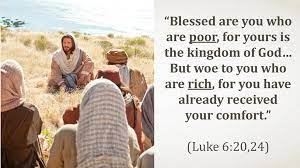
Here’s the way, Luke phrases Jesus’ words in Chapter 6 of his Gospel:
20 And he lifted up his eyes on his disciples, and said:
“Blessed are you who are poor, for yours is the kingdom of God.
21 “Blessed are you who are hungry now, for you shall be satisfied.
“Blessed are you who weep now, for you shall laugh. . .
24 “But woe to you who are rich, for you have received your consolation.
25 “Woe to you who are full now, for you shall be hungry.
“Woe to you who laugh now, for you shall mourn and weep.
26 “Woe to you, when all people speak well of you, for so their fathers did to the false prophets.
Do you see what I mean? Luke’s version doesn’t spiritualize poverty the way Matthew does. Matthew changes Jesus’ second-person statement about poverty (“Blessed are you who are poor”) to a third-person generalized and spiritualized “Blessed are the poor in spirit.”
Similarly, Luke’s “Blessed are you who are hungry now” becomes “Blessed are those who hunger and thirst for justice” in Matthew. In this way physical hunger is turned into something spiritual or psychological. Obviously, Matthew’s community was not as poor as Luke’s – or as the people Jesus habitually addressed.
In fact, the entire Judeo-Christian tradition is so valuable exactly because – unlike most of ancient literature – it represents the lore of poor people about their relationship with God.
Granted, that tradition became the object of class struggle about 1000 years before Jesus’ time, with the contested emergence of a royal class.
That is, starting with King Saul, the royalty of Judah and Israel tried mightily to turn a poor people’s faith into an ideology supporting the country’s elite. More particularly, under King David, palace oligarchs distorted the divine promise to slaves escaped from Egypt. That promise had been “I will be your God and you will be my people.” David turned it into a promise of a permanent dynasty for himself and his descendants. In other words, the country’s royalty transformed the Mosaic Covenant into a Davidic Covenant serving the elite rather than the poor.
However, the people’s prophets resisted them at every step. We find examples of that in all of today’s readings. For instance, in our first selection, the seventh century (BCE) prophet, Zephaniah, addresses the world’s (not simply Israel’s) poor. With his country’s aristocrats and priests in mind, he denounces their lies and “deceitful tongues” and urges them to treat the “humble and lowly” with justice as was prescribed by Moses.
Then with the responsorial Psalm 146 (probably written in the late sixth century) we all found ourselves chanting the words Matthew attributes to Jesus: “Blessed are the poor in spirit; the Kingdom of God is theirs.” The “Kingdom of God,” of course, is shorthand for what the world would be like if God were king instead of those corrupt royal classes. The psalmist says that change would bring justice for the oppressed, hungry, imprisoned, physically handicapped, the fatherless, the widow, and the resident alien. All of these were specific beneficiaries of the Mosaic Covenant.
Today’s third reading from I Corinthians promises a connected Great Reversal. There Paul of Tarsus (in modern day Turkey) identifies Jesus’ earliest followers as those who “count for nothing” in the eyes of the world. (Do you see the return to the Mosaic Covenant?) Jesus followers are riffraff. Paul identifies them as unwise, foolish, and weak. They are lowly and despised. Yet in reality, Paul assures his audience, the despised will finally be proven wise and holy. Ominously for their betters, Paul promises that those who count for nothing will reduce to zero those who in the world’s eyes are considered something.
Jesus, of course, appears in Zephaniah’s and Paul’s prophetic tradition as defender of the poor and the Mosaic Covenant. Matthew makes that point unmistakably by changing the location of Luke’s parallel discourse. In Luke, Jesus announces the Beatitudes “on a level place” (LK 6:17). Matthew puts Jesus “on a mount” for the same sermon. His point is that Jesus is the New Moses who also received the Old Covenant on a mount (Sinai). Put otherwise: the so-called Beatitudes represent the New Law of God.
That’s why it makes more sense to place the Beatitudes on a plaque in front of our courthouses, on the walls of our schools, and in front of the White House.
But as I said, don’t hold your breath. Can you imagine our super-wealthy politicians (not to mention their donors) having to read Luke’s words every day?
“Woe to you who are rich, for you have received your consolation.
25 “Woe to you who are full now, for you shall be hungry.
“Woe to you who laugh now, for you shall mourn and weep.
26 “Woe to you, when all people speak well of you,
for so their fathers did to the false prophets.
No, in its essence, the Judeo-Christian tradition belongs precisely to poor people. It belongs to those whom Americans in general think “count for nothing.” As Paul intimates, those are the very ones who will rise up and reduce to zero those who in the world’s eyes are considered something.
That message is no more welcome today than it was 2000 years ago.
What is the connection between liberation theology and its feminist theologians refusing to wear underwear while writing their articles and books? That’s right: no underwear.
And what is the connection of their resulting theology with the poor lemon vendors in Buenos Aires who, also without underwear, squat defiantly in their full skirts and urinate on the sidewalks in front of watchful and disapproving city police? (Meanwhile, the lemon sellers complain about their “shi*ty priests”, “mafia politicians” and those “puta policia” – fu*kin’ cops).
And what about the mothers, grandmothers, and great-grandmothers, who proudly display their completely unrobed bodies on so many contemporary internet sites? Presumably many of them identify as Christians. But by religious standards, isn’t such display “indecent?”
And finally, is there any relationship between feminist theologians and those Argentine lemon sellers, on the one hand, and rock ‘n’ roll music, Tina Turner, and Chuck Berry on the other.
The late liberation theologian Marcela Althaus-Reid (1952-2009) provocatively raised and addressed questions like those during her brief career as Senior Lecturer in Christian Ethics, Practical Theology, and Systematic Theology at the University of Edinburgh in Scotland. In doing so, she shed light on women’s rebellions against oppressive patriarchal norms across the planet.
You know what I mean. Think about the reaction to the effective repeal of Roe v. Wade by the U.S. Supreme Court. Think of those Muslim women in Iran who cut their hair in public and refuse to obey the “morality police.” Even consider, if you can, the unspoken meaning behind those mature women around the world who provocatively display their unclothed bodies online for all to see.
Althaus-Reid argued that the above are all doing what she called “Indecent Theology.” Here the reference is to her thesis from her 2004 theological potboiler, From Feminist Theology to Indecent Theology: Readings on Poverty, Sexual Identity, and God.
Because of the important light the book sheds on the feminist rebellions just referenced, as well as on liberation theology itself, please consider with me what Althaus-Reid means. Consider the relevance of indecency to liberation theology and to issues like abortion, the morality police, what some might call “pornography,” as well as to patriarchy in general. Consider its connection to rock ‘n’ roll and to popular “saints” like the recently deceased Tina Turner (1939-2023) and Chuck Berry (1926-2017).
Female Indecency
Althaus-Reid begins by reminding readers that Christianity itself is a highly sexualized affair. It is claustrophobically decent. (In what follows, all references in parentheses are to the book just cited.)
She says it’s not that the morality of the Bible in any way endorses Victorian sexual standards. It does not. Instead, its main concerns are liberation in all the senses (economic, political, and spiritual) that the word “liberation” connotes.
That’s because the Biblical tradition was based on the freeing of slaves from Egypt. Its resulting concern was for the welfare of widows, orphans, and resident aliens. Its prophetic tradition boldly spoke radical truth to priests, kings, and other bosses who legislated against, ignored, and/or exploited the poor.
In general, the biblical tradition promised the latter a new and brighter future. The prophet Yeshua called that future the “Kingdom of God.” By that he meant what the world would be like if God were king instead of the world’s oppressive “Caesars.” Such a world would be turned upside down. Its standards of decency would be transgressed at every turn.
Yet despite such a clear emphasis on social justice, it was the biblical tradition itself that ended up doing a headstand instead of the imperial world order. The revolutionary thrust of “The Book’s” pivotal story was tamed by the kings, princes, and popes of the world (27, 28). Far from being scandalous and revolutionary, the Judeo-Christian tradition thus became the defender of the status quo. Its point became the social control of the revolutionary lower classes, with oppressive standards of decency, especially for women.
And why so much attention to women? It is because of their embodiment of the revolutionary energy that the Greeks called eros. As psychologists and philosophers such as Sigmund Freud and Herbert Marcuse have pointed out, eros represents the basic creative energy of the universe.
In a capitalist patriarchal order dependent on overwork, the powers of patriarchy identify eros in the form of female sexuality as the fundamental factor threatening to undermine their entire project. Hence the powers-that-be covertly vilify women for deliciously “tempting” men to find meaning, fulfillment, happiness, and joy in human (and sexual) relationships that undermine the system’s requirement of “surplus repression” in the form of overwork.
And so, repressive concepts of decency in general and of theological decency in particular emerge to dominate women and, by extension, their potential partners. Theological decency decrees that:
• The woman’s body is a source of temptation
• Therefore, it should be covered by layers of clothing.
• Women need men to regulate female bodies and behavior through special rules written by men and (depending on culture and historical period) governing the integrity of women’s sexual organs, their menstrual periods, and issues surrounding marriage, birth control, abortion, divorce, voting and the ability to own property.
• To do theology (i.e., to speak authoritatively about God even in relation to themselves and their bodily processes), women must earn professional degrees grudgingly bestowed by the patriarchal establishment of academia.
• Therefore, the “degrees” informally awarded by the “School of Life” with its deviant and indecent logic are invalid (14, 32, 137). So is the spirituality resulting from lemon vendors engaging in “witchcraft,” in the informal healing arts, working as midwives, abortionists, and spiritual guides.
Theological Indecency
With all this in mind, feminist liberation theologians like Althaus Reid insist on transgressing the limits of theological decency. They insist that:
• Doing theology is a profoundly sexual act (4, 76). To repeat: this is not because sex was central to Jesus’ preaching. Rather it is because the church has for centuries distorted the teachings of Jesus in the service of the empire, acting in the process as an instrument of social control as explained above. Therefore, theologians are forced to write endless pages refuting such distortions.
• Poor women provide the most radical view of theology (16). Their enforced “otherness” teaches us something new about life and about the Greater Queer that some still insist on calling “God” (19).
• Yes, God is Queer (9, 146) in the sense of exceeding all categories and definitions (175) while subverting decent bourgeois concepts like family. [For those who live on the peripheries of society – under bridges, in slums, favelas and shanty towns, “family” ends up being an oppressive category. It arrogantly invalidates alternative basic social groupings that are just as valid, functional (and dysfunctional) as their bourgeois counterparts (159, 160, 164).]
• Far from being a liberating model for Latin American women, the cult of the Virgin Mary ends up functioning as another instrument of social control, this one aimed directly at women (13, 23, 39, 55). After all, Mary is presented as “a gadget” (88) having sex with God without any pre-coital romantic relationship (85). She does not experience sexual pleasure or orgasm from the union (88). And then afterwards she enjoys no meaningful sex life with her husband, Joseph. Such factors are supposed to set an example for all Christian women.
• Similarly, Jesus himself is strangely asexual: a young Hebrew man with no compañera and no unambiguous sexual interests. He also serves as a model of sexual abstinence (45).
• Thus, Jesus was queer in the sense indicated above: an outcast who rejected and was rejected even by his own family. They thought he was crazy (Mark 3:21). He spent a lot of time in the desert. At least once he was tempted to commit suicide by jumping from the pinnacle of Jerusalem’s Temple itself (170).
• In addition, the evangelical representations of Jesus show him as a victim of the machismo of his own culture (45, 48, 51, 80). Yes, he comes to the aid of a woman considered “impure” because of a menstrual problem (Lk 8, 43-48); and yes, he rejects the male executioners of a woman sentenced to death for adultery (John 8: 1-11). However, Jesus never questions the misogynistic patriarchal laws that govern those situations. He does not reject the laws regarding the stoning of women caught in adultery, nor those that classified menstruating women as “unclean” (6, 13).
• In summary, if liberationists take Jesus’ poverty and otherness seriously along with Paul’s dictum that in Christ there is neither male nor female (Galatians 3:28), perhaps the best contemporary identification of “the Master” would be a twelve-year-old girl prostituted by two men in a public toilet in Buenos Aires (84).
Unclothed Theology in the U.S.
Those are just some of the reflections of Althaus-Reid operating as a professional theologian. Meanwhile, she points out, her less academically prepared Latinx sisters do their theology based on popular beliefs and practices. Their well-earned degrees come from the school of very hard knocks. Their insights, Althaus-Reid suggests, are no less valid than their sisters’ teaching in places like the University of Edinburgh.
So, they defiantly continue to honor Santa Evita Perón. She, after all, secured voting rights for Argentine women over the objections of Argentine bishops (79). They also pray to Santo La Muerte (St. Death), Jesús Bandito, and local popular “gangster saints” who are seen as robbing and stealing from the real thieves and criminals who support those who run the government (161). They have “canonized” deceased popular singers like Rodrigo and Gilda offering them prayers and novenas in chapels dedicated to El Angel Rodrigo and La Santa Gilda(157). Those who honor such avatars kneel in church like Althaus-Reid herself without underwear, engulfed, she says, in the fragrance of female sex, and offering fervent prayers to rock stars no doubt considered “indecent” by church authorities.
All of which brings me to rock ‘n’ roll, Tina Turner, Chuck Berry, and those unclothed grandmas.
Take the grandmas first. Althaus-Reid I think would see them as doing a kind of negative theology protesting the false church-supported Victorian standards earlier referenced. They take indecency to the extreme not just rejecting underwear, but displaying their bodies completely unclothed — not for personal gain like strippers or aspiring models, but just for the hell of it.
Their wordless indecency is consistent with Althaus-Reid’s identification of the female body as a privileged locus of rebellion against patriarchal systems of power (45). Such rebellion echoes the status of their sisters in the Global South as “single women” with no visible men (35).
After all, under patriarchy, the skirts that once signified femininity and even priesthood (37), now only convey a deep alienation (20). Set them all aside!
“Do you want indecency?” rebellious women seem to say. “Well, take a look at this! The patriarchs will not tell us how to behave and what to do with our bodies!”
As for rock ‘n’ roll, Tina Turner, and Chuck Berry. . .. How much saintlier can you get?
During their lives, their music performed the basically feminine function of distracting millions from the overwork mandated by the reigning system denounced by Marcuse. In the process, they brought joy, fun, and happiness to millions of people who ended up attending and participating in the huge liturgies we call “concerts” – even over the protests and askance gazes of uptight Victorians and clergy.
By the standards of Althaus-Reid nothing could be more constructively indecent and therefore holy. Thank you, Saint Tina! Thank you, holy Chuck! Thank you, dear Marcella.
Here is the second installment reflecting my recent initiation into the wonders of Tarot cards.
Under the influence of Ruth Rodriguez Sotomayor, the author of The Precursors of Printing, and of the great Chilean filmmaker and tarotista, Alejandro Jodorowsky, I’ve come to see tarot cards as a living, dynamic, interactive book. It has 78 pages that are absolutely fascinating because their subject is YOU and I, the overall direction of our lives, and the most intimate details of our personal relationships and worldly endeavors.
Tarot originated in various parts of Europe during the 15th century when most people were illiterate. No matter. Under the guidance of a master reader, the cards can yield pages and pages of engrossing information of the most practical kind.
Lately, I’ve taken to beginning my day with a tarot reading. After shuffling the cards and offering a prayer for light, I select three of them. One represents the energy of the day. A second card reminds me of what I’m grateful for. The third selection suggests who or what I’m asked to incarnate during the coming hours.
Recall, that in dealing with Tarot’s “Major Arcana,” (major secrets) we’ve been tracing the Fool’s Journey.” It’s the pilgrimage each of us must make from a child’s ignorance to the degree of enlightenment we finally achieve in this lifetime.
In the first five cards we met the image of the fool (ourselves); we were introduced to her (i.e. our) innermost self — a combination of (1) an all powerful Magician and (2) a beautiful, mysterious, and intuitive Priestess; we met the fool’s earthly embodiment of the Magician in the traveler’s (3) Emperor (his father figure) and (4) Empress (her mother figure); and finally we encountered his/her initial teacher and moral guide in (5) the Hierophant.
In reviewing today’s five cards, we’ll see the Fool beginning to transcend the guidance he received from those sources.
6. Lovers: Within the collective, the Fool meets his or her lover and has life’s first meaningful sexual experience connecting him or her with a gender opposite. (This card is very rich. Notice its references to the Biblical myth of the first man and the first woman. That’s a snake wrapped around an apple tree with four (the number of fullness and stability) apples. For his part, the card’s male figure is backed by a tree with 12 flame-like leaves. Fire is the symbol of passion; 12 is the number of enlightenment. A huge, beautiful, and passionate (red-winged) angel oversees and blesses the whole interaction whose trajectory is suggested by the reddish background mountain.)
7. The Chariot: After a honeymoon period, the Fool experiences some form of conflict and separation. It teaches belief in oneself and to be assertive in pursuing one’s goals. [Whereas the traditional reference in the Lovers’ card was to the Bible, the allusion here is to the Bhagavad Gita. The Gita teaches that our bodies are like chariots pulled by horses representing the senses, and controlled by the “reins” of the mind. Note here that the Chariot card has replaced the horses with sphinxes (a reference to Egyptian wisdom and to Sophocles‘ “Riddle of the Sphinx). The white and black colors of the sphinxes remind the reader of the “yes” and the “no” connected with choosing the direction one’s life will take at its various crossroads. Note too that the chariot’s driver has no reins in his hands; he has surrendered guidance to his Inner Self — his true identity. Finally, the chariot is leaving the city; it has crossed the river where the charioteer seeks quiet and repose.]
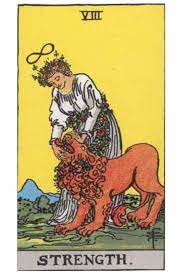
8. Strength: Reflection offered by leaving the city makes the Fool stronger. S/he learns the lesson of mind over matter and that true strength comes not from brute force, but from kindness, warmth, and inner quiet. (The female embodiment of true strength speaks volumes here as does the infinity symbol serving as a halo for the virtue’s embodiment.)
9. The Hermit: With such lessons learned, the Fool now retreats into the Hermit’s introspective world, removed from externals to answer all remaining questions. S/he searches for Self in a cave-like darkness with knapsack replaced by a lantern shedding light in that obscurity.
10. Wheel of Fortune: The Fool eventually realizes the nature of life as determined by a combination of fate and free will. Life has its ups and downs. It is all a cycle with consequences tied to every decision. Faced with his past mistakes, the Fool manages to forgive himself or herself. [Here the source of inspiration are the four canonical gospels, Matthew (the angel), Mark (the lion), Luke (the ox) and John (the eagle). All are connected with the Egyptian wisdom again (as in card 7) signified by the sphinx whose color this time is blue, the hue of heavenly spirituality. The sphinx is holding a sword (symbolizing new ideas) pointing towards the mystical gospel of John. The salamander underlying the wheel is the traditional symbol of fire and life’s energy.
Stay tuned for the next five cards of the Major Arcana. Coming soon.
It may surprise readers of this blog to find out that I’m currently studying Tarot. Yes, I am. My busker friend, Simon, here in Andalusia got me interested by introducing me to the work of Ruth Rodriguez Sotomayor, the great Ecuadorian scholar of “The Precursors of Printing.”
Sotomayor’s work calls us to value “texts” that preserve the wisdom, philosophies and worldvisions of humans before the invention of the printing press — and of those after its invention who had not yet learned to read.
Tarot cards (which first appeared in the 15th century) fall into the latter category. They form a kind of book expressing a profound spirituality of preliterate people in the various cultures which produced them. In Joseph Campbell’s terms, the book in question describes a hero’s journey from ignorance to complete self-consciousness.
And that’s a story we all need in this post-religious age. Please take time to view the video at the top of this posting. Then read the comments that follow. They reveal the absolute hunger that our American contemporaries experience for deep spirituality and how sincerely those who have rejected organized religion respond to the message of the Tarot book.
What I’m claiming is that Tarot cards remain an invaluable tool for navigating the mysteries of one’s life. The 21 “Major Arcana” (Magician, Priestess, Empress, Emperor, Hierophant, Lovers, Charioteer, Justice, Hermit, Wheel of Fortune, Strength, Hanged Man, Death, Temperance, Devil, Tower, Stars, Moon, Sun, Judgment, and World) represent that life in general as stages in “The Fool’s Journey.”
Here, the Fool represents every man and woman. We are all fools, the cards disclose, in the process of discovering our deepest Self as a blend of divine characteristics embodied in the Magician and Priestess. That’s what the Fool discovers in his/her paradigmatic trek. At the end, s/he stops being a fool and assumes a more evolved identity as a Knight or Female Warrior continuing an evolutionary journey beginning with his/her cyclical return to the castle of the King-Father and Queen-Mother.
The 58 “Minor Arcana” depict that subsequent evolution as the Female Warrior and/or Knight secure deeper understandings of their relationships to Source, other human beings, to ideas and to work. In the end, they employ their inherent Divine Energy to establish dominion in those more specific realms while appropriating their unconscious identity as royal kings and queens.
Let’s review the entire process card by card. Here are the first six. I’ll survey the rest in subsequent postings.
Fool’s Journey
According to Tarot’s numerology, the Fool has no number. He is a zero, a clean slate. He is naïve, over-confident, daring, and bordering on stupid. He starts out confidently on his life’s path completely unaware of his True Identity as a blended Magician and Priestess. Notice how confidently he is about to step off a cliff’s edge despite the warnings of his dog:
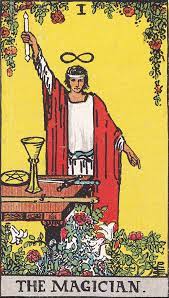
His/Her Unconscious Magician: This second card represents the Fool’s true (but unconscious) masculine identity – dynamic, muscular, gifted, capable, and commanding. The Magician understands and creatively harmonizes himself with Life’s four elements of fire, water, air, and earth, along with its fifth element (its quintessence) of God’s Enabling Energy (or “grace”).
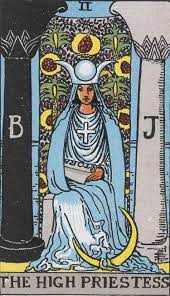
2. Her/His Unconscious Priestess: This third card expresses the Fool’s true (also unconscious) female identity – pure feminine energy seated at the gates of Solomon’s Temple guarding the secrets of divine power. She is receptive and listening. Like the Magician, she is the Fool’s mentor and teacher. She gives the Fool ancient scrolls to explain how to use the Magician’s gifts of fire, water, air, and earth. Above all, she teaches the Fool how to use his or her intuition
3. The Empress (the external expression of the Fool’s inner Priestess): She embodies the Fool’s experience of earthly mother (or mother figure). She is nurturing, unconditionally loving, generous, and giving.
4. The Emperor (the external expression of the Fool’s inner Magician): He depicts the Fool’s experience of earthly father (or father figure). He guides, directs, and sets boundaries.
5. The Hierophant (Pope): The Fool eventually leaves home and encounters the Hierophant from whom s/he seeks guidance in a first encounter with formal education and organized religion. Under this influence, the Fool learns what it’s like to be part of a collective.
As I said, subsequent postings will review the remaining Tarot cards.
Recently, my friend Simon the street musician (who is acting as my Spanish coach) loaned me a book called El Gran Libro Practico del Tarot (The Great Book of Tarot Practice). It offers a detailed introduction to the use of Tarot cards as sources of popular wisdom and prediction of future events.
Simon himself is trying to become expert in tarot – as an alternative source of employment should what he calls the “puta policia” (the effing cops) confiscate his guitar (again!) or should he otherwise be deprived of his current livelihood.
Of course, I was skeptical of the entire project.
Instead, however, I found Simon’s book fascinating. My thought quickly connected it with the work of Franz Hinkelammert, my teacher and colleague at Costa Rica’s Departamento Ecumenico de Investigaciones – the liberation theology think tank where Peggy and I studied off and on since 1992. I thought particularly of Franz’s book called The Critique of Mythological Reason.
In its light, I saw tarot cards as representing valuable attempts to draw together common mythological elements found in religions across the planet (e.g., in Egypt, India, China, among indigenous peoples and in the European west) and in various historical periods, for purposes of making sense of shared human experience. That in itself made the cards precious.
More than that however, I perceived their power to lead practitioners to either surrender to (political and spiritual) forces beyond their control or as empowering them to resist those forces precisely as subjects challenging control by concepts of “normality,” by scientific determinism, or by narrow moralities, legal restrictions, emperors, or popes.
In the latter (Hinkelammertian) sense, Tarot cards can lead practitioners to own the fact that their nonconformity is not “crazy,” and that:
Their mythological and religious traditions commonly rejected by “enlightened” post-moderns are instead highly valuable and liberating.
Practitioners are themselves “magicians” empowered to change “reality” itself so that it benefits human beings and their desire to live and to live well.
They (not those ruling by some fictitious “divine right”) are royalty – empresses and emperors empowered to create a world with room for everyone not just the ruling elite.
They are similarly priestesses and popes “infallibly” empowered to determine their own spirituality independent of ecclesiastical officials
Particularly when precisely as conscious subjects combining feminine and masculine loving energies, they join their complementary powers
To create a world shaped by faith, hope, love, prudence, justice, fortitude, and temperance
And not by “establishment” (capitalist) values of pride, covetousness, lust, anger, envy, sloth, and gluttony.
Such creation entails doing battle with internalized cultural values and with powers and principalities determined to squash holy nonconformity.
To communicate these simple truths, Tarot cards employ images expressing popular understandings of geography, physics, astronomy, astrology, psychology, and (above all) religion and spirituality with their complex interpretations of numerology and color. The cards invite heightened sensitivity to history, poetry, art, music, image, metaphor, simile, the invisible, unpredictable, and ineffable. Each tarot card yields a meaning that corresponds to the degree of sensitivity to such elements attained by its reader.
With all of this in mind, practitioners find the western world of tarot populated by allusions to Greek Gods, the underworld, heaven, angels, devils, saints, and familiar biblical stories such as the Garden of Eden, the Tower of Babel, the crucifixion and resurrection of Jesus, and the Final Judgment. Here for instance, white refers to purity, black to death, blue to spirituality, green to earth, red to passion, yellow to illumination, gold to the (masculine) sun, and silver to the (feminine) moon.
As for personal revelations occurring when cards are “dealt” for the benefit of a particular individual . . .. Here I must claim a kind of agnosticism.
However, given what quantum physics has revealed about everything consisting of energy and light, who’s to say that the energies of the personal subject in question do not influence the way cards fall and what their falling reveals to a skilled reader?
I must give all of this further consideration (and will in future postings). I’m grateful to Simon though for further opening my mind to the relevant possibilities.
This week, Joe Biden summoned 49 African presidents to D.C. for an international conference.
In doing so, the administration offered assurances (through National Security spokesperson, Jake Sullivan) that in contrast to previous gatherings, it would not scold or lecture Africa’s leaders about not obeying U.S. demands, e.g., in the United Nations. (There, by the way, just recently African leaders had to endure something like a schoolboy’s dressing-down when many abstained from supporting American resolutions condemning Russia’s invasion of Ukraine.)
Rather, Sullivan claimed that this time the purpose of the conference would be to listen respectfully to the leaders in question and to help them work out solutions to the continent’s problems on their own terms. Participants would be treated, Sullivan pledged, with respect and as equals.
The reason for the change in attitude? It’s that the United States finds itself currently locked in mortal competition for global influence with its chief rival, China. And, of course, that includes Africa.
There, the U.S. seeks not just access to the continent’s vast mineral and other resources, but also to Africa’s strategic geographical position and its market of over 1 billion consumers. The United States also wants to prevent spread of Chinese influence into what it and its European partners continue to understand as their inviolable post-colonial domain. For those reasons, it’s important to enter into agreements with nations such as the Democratic Republic of the Congo, with South Africa, Libya, Egypt, and Kenya.
But if that’s its goal, the United States has a problem that renders it virtually incapable of competition with China in Africa – or anywhere else for that matter.
I’m referring to U.S. ideology and its history.
As the world’s chief proponent of economic neoliberalism, the ideology of the United States makes it all but constitutionally unwilling to accommodate anything that smacks of socialism.
Relatedly, the U.S. track record shows that wherever there’s a whiff of leftist state ownership, market control, or increased taxes on the elite, Americans will predictably apply sanctions, engage in regime change, or even assassinate, or invade. Think of Egypt’s coup that stopped the Arab spring in its tracks. Think of Ghaddafi’s ignominious fate and of Mrs. Clinton’s epitaph on his behalf, “We came, we saw, he died. Ha, ha!”
All of Africa – all the Global South – remembers such disgraceful interference with their national aspirations.
On the other hand, the People’s Republic of China is hampered by no such limitations. After all, it is run by a party that calls itself “communist.” That party describes its own economy as “socialism with Chinese characteristics.” Its mixed economy has a huge section owned and controlled by the government. Its private sector is tightly regulated. China therefore has no quarrel with public ownership, market regulation, or with taxing the rich. It loves socialism.
Additionally, China’s track record has it freely cooperating with neo-liberal regimes, with despot kingdoms, and with other states aspiring to socialism. Compared with similar arrangements with the United States, China’s loan contracts, Belt-and-Road projects, and other agreements generally come with far fewer if any strings attached.
So, if an African country wants to follow China’s suit of socialism, its leaders will not have to fear sanctions or regime change, much less assassination or invasion from its international economic partner.
To repeat: that’s not the case in dealing with the United States. And that’s why the latter will never triumph in its Global South competition with China!
Readings for the Solemnity of Our Lord Jesus Christ, King of the Universe: 2 SM 5: 1-3, PS 122: 1-5; COL 1: 12-20; LK 23: 35-43
Since taking up residency in Spain two months ago, I’ve developed a new understanding of why I’ve learned Spanish. It has allowed me to access lines of critical thought that would otherwise be closed to me as a resident of the imperial Global North.
Those lines have given me a new understanding of this Sunday’s liturgical focus, viz., the celebration of “The Solemnity of Our Lord Jesus Christ, King of the Universe.” They have shown me how that phrase, “King of the Universe” can be understood in two ways, one that is oppressive and the other that is liberating – one that is Eurocentric and the other that is truly universal.
The Solemnity calls westerners to change our minds from Eurocentrism to one that sees Jesus as promising a New Order where the poor and oppressed displace the earth’s traditional rulers.
Let me try to explain what I mean.
Critical Thinking
To begin with: a word about the critical thinking I’m referencing. (I intend to write much more about this in upcoming posts.)
I’m talking about Global South scholars who have shaped my worldview over my last 50 years. They include Costa Rica’s Franz Hinkelammert, Mexico’s Enrique Dussel, and Puerto Rico’s Ramon Grosfoguel. I consider the first two to be colleagues and mentors of mine. I worked with them in Brazil and Costa Rica.
My initial reason for reconnecting with these scholars while in Spain was to sharpen my understanding of the language here. However, what I’ve learned has gone far beyond that superficial intention.
That’s because the current project of my mentors is the reinterpretation of the “universal history” of humanity in ways that are anti-colonial and decolonized, and that put in ideological perspective the understanding of Jesus as “King of the Universe.”
Fake Eurocentric History
Their critical vision holds that the traditional tri-partite periodization of western history as (1) antiquity, (2) middle ages, and (3) modernity is deceptively Euro-centric and colonial. It completely distorts human experience as if universal history were synonymous with European history – as if God’s self-revelation began with the Hebrews 1200 years before the dawn of the Common Era, as if philosophy started in 5th century (BCE) Greece, and as if modernity began with the European Renaissance in the 16th century CE.
According to Hinkelammert, Dussel, and Grosfoguel, none of that is true. It ignores the fact that in terms of world history, Europe and its understandings of God, philosophy, astronomy, physics, and industrial development are completely marginal. Theology and philosophy began in Africa (think Egypt and the Bantu nations) thousands of years before Moses and Socrates.
Its development moved eastward towards India and China, leaving a marginalized Europe on the periphery.
For instance, China experienced its Renaissance long before Europe. Islam’s understanding of the world based on scientific principles (including the heliocentric universe) preceded Galileo’s and Newton’s by centuries. In fact, the latter European “greats” largely copied their insights from Chinese books printed on presses that predated Guttenberg’s by hundreds of years.
China also developed processes of steel production long before Europe. In the 19th century, it sent advisors to England’s city of Sheffield to teach industrialists there how best to make their world-changing product.
Of course, there is so much more to be said here. But you get the idea. My teachers are insisting that Europe’s culture and achievements, far from groundbreaking were marginal and derivative – not at all central.
This means that establishing the central figure of European religion as the “King of the Universe” was completely ideological, misleading, and imperial. It was part of a colonial project that allowed European despots to delegitimize much older and more deeply spiritual visions – like those of India and China. Europeans used the universalization of their religion to justify their holocausts of “pagans,” “witches,” “Indians,” and “infidels” all in the name of their false “universal” God.
Jesus’ Universal Meaning
But none of this means that Jesus does not have a universal meaning which is in fact portrayed in today’s liturgical readings for the celebration of the “Solemnity of Our Lord Jesus Christ, King of the Universe.”
The texts identify Jesus as a member of a class that perhaps alone merits the term “universal,” viz., the poor and oppressed everywhere – the victims of imperial kingdoms be they European, Muslim, Chinese, or Indian.
The historical experience of such people is shared across cultures. It includes poverty, houselessness, hunger, rejection by their “betters,” rebellion, police harassment, arrest, imprisonment, torture, and execution. It’s all remarkably similar regardless of the historical period or culture in question.
According to Christian belief, that’s the “universal” experience their God chose as the vehicle for revealing the Divine Self. And it’s all reflected in today’s final reading from Luke, Chapter 23. Consider its content for a moment.
Here, Reza Aslan’s best-seller, Zealot, is the most accessible guide I’ve come across. It clarifies what I’ve been saying by paying particular attention to Jesus’ cross, and to the Roman inscription identifying Jesus as “King of the Jews,”
Take the cross first. It was the mode of execution reserved primarily for insurrectionists against the Roman occupation of Palestine. The fact that Jesus was crucified indicates that the Romans believed him to be a revolutionary terrorist. Aslan asks, how could it have been otherwise? After all, Jesus was widely considered the “messiah” – i.e., as the successor of David in today’s first reading who was expected to lead “The Great War” against Israel’s oppressors.
Moreover, Jesus proclaimed the “Kingdom of God,” a highly politicized metaphor which could only be understood as an alternative to Roman rule. It would return Israel, Jesus himself promised, to Yahweh’s governance and accord primacy to the poor and marginalized. The Romans drew logical conclusions.
Put otherwise, the Roman cross itself provides bloody testimony to the radical threat from below that the empire saw personified in Jesus.
That threat was made specific in the inscription the Romans placed over the head of the crucified Jesus. It read, “King of the Jews.”
Typically, those words are interpreted as a cruel joke by the Roman procurator, Pontius Pilate – as if he were simply poking fun at those who saw Jesus as the worthy successor of Israel’s lionized King David.
However, according to Aslan, nothing humorous or ironic was intended by the inscription. Instead, it was a titulus. Every victim of crucifixion had one – a statement of the reason for his execution.
The motive for Jesus’ crucifixion was the same as for the many others among his contemporaries who were executed for the same crime: aspiring to replace Roman rule with home rule – with an Israel governed by Jews instead of Romans. The titulus on Jesus’ cross, along with the cross itself identify him as the antithesis of what he eventually became, a tool of Eurocentric empire.
Conclusion
For years while I was teaching at Berea College in Kentucky, I taught a Great Books course called “Religious and Historical Perspectives.” It was the best education I’ve ever received.
However, the course followed that tripartite historical organization referred to above — ancient roots (in Israel, Greece, and Rome), Middle Ages (with virtually no mention of the Ottoman Empire), and Modern developments (focused on Galileo, Newton, and figures like Marx, Dawin, and Freud).
There was hardly a word about Islam, and none about the great world cultures of India and China. In other words, for all its virtues, the course was completely Eurocentric and colonial. Its treatment of Judeo-Christian texts implicitly justified belief that God chose the Mediterranean West as the exclusive site for his (sic) Self- Revelation.
Moreover, references to Jesus’ “kingship” along with the iconography of the European Renaissance gave the unspoken impression that “Christ the King,” along with his mother “Mary Queen of Heaven and Earth” were from the royal class or at least its supporters.
According to Hinkelammert, Dussel, liberation theologians, and so many others from the Global South, all of that not only distorts history itself, but the true meaning of the significance of a Divine King who was truly universal in the sense of sharing the invariable lot of the poor and oppressed.
According to perspectives from the Global South, the “Kingship” of Yeshua of Nazareth promises to turn the world upside-down. In the words attributed to Jesus mother in Luke’s Gospel (1: 46-55), Jesus reigning from the cross embodies Mary’s promise to “put down the mighty from their seats and exalt the humble.”
From that perspective, today’s liturgical celebration promises the eventual triumph of the marginalized over their royal , imperial, eurocentric oppressors. It’s all about the coming Great Reversal.
Readings for 32nd Sunday in Ordinary Time: 2 MC 7: 1-12, 9-14; PS 17:1, 5-6, 3, 15; 2 THES 2:11-3:5; LK 20: 27-38.
As I’ve note in a recent posting here, one of the wonderful aspects of the Judeo-Christian tradition is how so much of it reflects the consciousness of the poor and oppressed, while at the same time giving expression to a “preferential option for the poor.” That’s a gift for us in a culture that generally despises poor people, oppresses the world’s impoverished majority, and spins the news in ways that ignore the poor and reflect a decided “preferential option for the rich.”
This morning’s first reading is especially valuable for us who live in under the torture regime of American Empire. It actually invites us inside the heads of tortured “terrorists.”
It raises the question, who are the real terrorists – the forces of empire or those who resist them? In doing so, the reading from Second Maccabees sheds light on the contemporary debate about torture in service of empire. It also highlights parallels between the mentalities of “terrorists” then and now. The reading calls us to question our support for the entire War on Terror — for all our wars.
For starters, consider torture itself. Our culture actually debates torture’s use, its effectiveness and morality! (See video above.)
Previously, that would have been unthinkable. Torture used to be considered one of those intrinsic evils about which there simply could be no debate.
However, ever since Abu Ghraib gave the lie to George W. Bush’s famous prevarication, “The United States doesn’t do torture” – ever since our government’s redefinition of the word to exclude even waterboarding – it has become apparent that Bush (and so many others of our “thought-leaders”) was lying. So today, many prominent “court intellectuals” have been pushed to actually defend torture’s permissibility.
But what do tortured terrorists actually think about having limbs removed and tongues cut out? Read today’s selection about the Maccabee brothers and find out.
The Maccabees were members of a heroic family of guerrilla fighters who in the mid- 2nd century BCE terrorized the invading Greek forces of Antiochus IV Epiphanes. (Actually, “Maccabee” wasn’t the family’s name; it was more a nom de guerre for an entire resistance movement. The word meant “Hammer” – the Hammer Gang – so-called because of its delight in pounding to mincemeat the invaders of their beloved homeland. The term “Maccabee” was similar to “al Qaeda,” when it simply meant “the list” – a reference to the Rolodex of assets the CIA used when it employed al Qaeda back when they were “freedom fighters” against the Russians in Afghanistan.)
For his part, the Seleucid king, Antiochus, was anti-Semitic in the extreme. He considered the Jews historically and culturally backward. For him and his empire’s advancement, Jews had to be brought into the 2nd century BCE even if it meant their kicking and screaming the whole way.
Today we might understand Antiochus’ project as “modernizing” the Jews – as Hellenizing them for purposes of imperial control. Evidently the Seleucid king subscribed to the position that if empire can persuade conquered peoples to adopt its patterns of thinking and especially of imagining God, the task of imperial administrators is made that much easier.
Many Jews agreed with the program of Antiochus. After all, the Greeks’ empire seemed invincible. If the empire couldn’t be beat, it was better to join it willingly. So, these “Hellenized Jews” stopped circumcising their sons, and changed their diets even to include eating pork. They became more Greek than the Greeks.
They also became the targets of Maccabee “terrorist” attacks. In today’s terms, such Hellenized Jews would be the targets blown up by Maccabee suicide bombers in marketplaces located in Jewish but Greek-loving neighborhoods. (Even if the Maccabee targeting may have been more selective than that, it is certain that Hellenized Jews were as much the objects of Maccabee terror as were the Seleucid forces themselves.)
In countering such extremism, Antiochus IV proscribed the Jewish religion as itself criminal and illegitimate. This was very similar to the way many “Americans” consider Islam. So Greek troops burnt and otherwise desecrated copies of the Torah in much the same way as our “Christian” troops have frequently been caught burning or urinating on the Holy Koran and on corpses of Muslim resistance fighters.
Though the Greeks considered the Maccabean forces to be terrorist, faithful Jews admired them as national heroes and servants of God. They understood that the Maccabees were fighting a Holy War against the much more powerful Seleucids. It was David against Goliath all over again.
In any case, according to today’s selection from Second Maccabees, seven brothers of the gang’s leadership were finally arrested (along with their mother) by the Greek invaders. (This would have been reported to Greeks “back home” as a great triumph – “Senior Leaders” captured making “our troops” and “our world” much safer.)
Then the torture and the screaming start.
To begin with all eight are beaten with whips and instruments designed to tear open their flesh. Then following standard operating procedures still practiced today, other enhanced interrogation techniques were used to torture the brothers one after the other in the presence of their blood-drenched mother, herself near death. The purpose here, of course, was to induce the woman to divulge names, places, and plans that she was privy to as the wife of the one who started the Jewish resistance to the Seleucids.
But what does she do? And what about her sons?
In a word, they are all – mother as well as her sons – completely defiant.
“What do you expect to achieve by questioning us” one of the brothers shouts? “We are ready to die rather than transgress the laws of our ancestors.”
Even at the point of death he spits out the words: “You accursed fiend” (I wonder what expletive he really used!), “you are depriving us of this present life, but the King of the world will raise us up to live again forever. It is for his laws that we are dying.”
Another of the brothers sees that his torturers are actually enjoying their work. (The text refers to cutting out his tongue and amputating his hands as “cruel sport.” Does that remind you of Abu Ghraib?) So, he sticks out his tongue and stretches out his hands inviting them to do their work. “It was from Heaven that I received these,” he says. “I’d rather lose them than offend Yahweh” (read Allah).
“Even the king and his attendants marveled at the young man’s courage,” the text says. Far from being intimidated, the freedom-fighter “regarded his suffering as nothing.”
Just before dying, another of the tortured brothers undergoing the very same cruelties says: “It is my choice to die at the hands of men with the hope God gives of being raised up by him; but for you, there will be no resurrection to life.” As indicated by those words, conviction of a happy eternity moved these guerrilla fighters to embrace death willingly. (Seventy-two virgins, anyone?)
So, what goes on in the heads of the tortured? Disdain for their torturers. Defiance. Show of courage. Love for the motherland. Hope.
And what goes on for the people they die for? Admiration. Elevation of martyrs and the tortured to sainthood. Motivation to follow their example.
And ultimately victory for the tortured and assassinated. . . . I mean, against all odds, the Jewish resistance – the Hammer Terrorists – did succeed in evicting the Greeks from their homeland.
As I was saying, this reading should cause us to reevaluate our attitude towards terrorism, terrorists, and the scandal of debating the pros and cons of torture.







 About Things That Matter