Here is the second installment reflecting my recent initiation into the wonders of Tarot cards.
Under the influence of Ruth Rodriguez Sotomayor, the author of The Precursors of Printing, and of the great Chilean filmmaker and tarotista, Alejandro Jodorowsky, I’ve come to see tarot cards as a living, dynamic, interactive book. It has 78 pages that are absolutely fascinating because their subject is YOU and I, the overall direction of our lives, and the most intimate details of our personal relationships and worldly endeavors.
Tarot originated in various parts of Europe during the 15th century when most people were illiterate. No matter. Under the guidance of a master reader, the cards can yield pages and pages of engrossing information of the most practical kind.
Lately, I’ve taken to beginning my day with a tarot reading. After shuffling the cards and offering a prayer for light, I select three of them. One represents the energy of the day. A second card reminds me of what I’m grateful for. The third selection suggests who or what I’m asked to incarnate during the coming hours.
Recall, that in dealing with Tarot’s “Major Arcana,” (major secrets) we’ve been tracing the Fool’s Journey.” It’s the pilgrimage each of us must make from a child’s ignorance to the degree of enlightenment we finally achieve in this lifetime.
In the first five cards we met the image of the fool (ourselves); we were introduced to her (i.e. our) innermost self — a combination of (1) an all powerful Magician and (2) a beautiful, mysterious, and intuitive Priestess; we met the fool’s earthly embodiment of the Magician in the traveler’s (3) Emperor (his father figure) and (4) Empress (her mother figure); and finally we encountered his/her initial teacher and moral guide in (5) the Hierophant.
In reviewing today’s five cards, we’ll see the Fool beginning to transcend the guidance he received from those sources.
6. Lovers: Within the collective, the Fool meets his or her lover and has life’s first meaningful sexual experience connecting him or her with a gender opposite. (This card is very rich. Notice its references to the Biblical myth of the first man and the first woman. That’s a snake wrapped around an apple tree with four (the number of fullness and stability) apples. For his part, the card’s male figure is backed by a tree with 12 flame-like leaves. Fire is the symbol of passion; 12 is the number of enlightenment. A huge, beautiful, and passionate (red-winged) angel oversees and blesses the whole interaction whose trajectory is suggested by the reddish background mountain.)
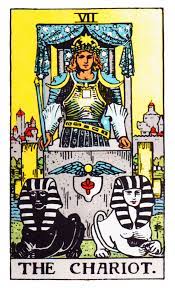
7. The Chariot: After a honeymoon period, the Fool experiences some form of conflict and separation. It teaches belief in oneself and to be assertive in pursuing one’s goals. [Whereas the traditional reference in the Lovers’ card was to the Bible, the allusion here is to the Bhagavad Gita. The Gita teaches that our bodies are like chariots pulled by horses representing the senses, and controlled by the “reins” of the mind. Note here that the Chariot card has replaced the horses with sphinxes (a reference to Egyptian wisdom and to Sophocles‘ “Riddle of the Sphinx). The white and black colors of the sphinxes remind the reader of the “yes” and the “no” connected with choosing the direction one’s life will take at its various crossroads. Note too that the chariot’s driver has no reins in his hands; he has surrendered guidance to his Inner Self — his true identity. Finally, the chariot is leaving the city; it has crossed the river where the charioteer seeks quiet and repose.]
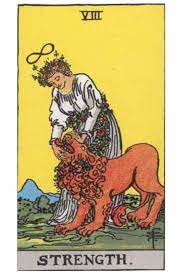
8. Strength: Reflection offered by leaving the city makes the Fool stronger. S/he learns the lesson of mind over matter and that true strength comes not from brute force, but from kindness, warmth, and inner quiet. (The female embodiment of true strength speaks volumes here as does the infinity symbol serving as a halo for the virtue’s embodiment.)
9. The Hermit: With such lessons learned, the Fool now retreats into the Hermit’s introspective world, removed from externals to answer all remaining questions. S/he searches for Self in a cave-like darkness with knapsack replaced by a lantern shedding light in that obscurity.
10. Wheel of Fortune: The Fool eventually realizes the nature of life as determined by a combination of fate and free will. Life has its ups and downs. It is all a cycle with consequences tied to every decision. Faced with his past mistakes, the Fool manages to forgive himself or herself. [Here the source of inspiration are the four canonical gospels, Matthew (the angel), Mark (the lion), Luke (the ox) and John (the eagle). All are connected with the Egyptian wisdom again (as in card 7) signified by the sphinx whose color this time is blue, the hue of heavenly spirituality. The sphinx is holding a sword (symbolizing new ideas) pointing towards the mystical gospel of John. The salamander underlying the wheel is the traditional symbol of fire and life’s energy.
Stay tuned for the next five cards of the Major Arcana. Coming soon.
It may surprise readers of this blog to find out that I’m currently studying Tarot. Yes, I am. My busker friend, Simon, here in Andalusia got me interested by introducing me to the work of Ruth Rodriguez Sotomayor, the great Ecuadorian scholar of “The Precursors of Printing.”
Sotomayor’s work calls us to value “texts” that preserve the wisdom, philosophies and worldvisions of humans before the invention of the printing press — and of those after its invention who had not yet learned to read.
Tarot cards (which first appeared in the 15th century) fall into the latter category. They form a kind of book expressing a profound spirituality of preliterate people in the various cultures which produced them. In Joseph Campbell’s terms, the book in question describes a hero’s journey from ignorance to complete self-consciousness.
And that’s a story we all need in this post-religious age. Please take time to view the video at the top of this posting. Then read the comments that follow. They reveal the absolute hunger that our American contemporaries experience for deep spirituality and how sincerely those who have rejected organized religion respond to the message of the Tarot book.
What I’m claiming is that Tarot cards remain an invaluable tool for navigating the mysteries of one’s life. The 21 “Major Arcana” (Magician, Priestess, Empress, Emperor, Hierophant, Lovers, Charioteer, Justice, Hermit, Wheel of Fortune, Strength, Hanged Man, Death, Temperance, Devil, Tower, Stars, Moon, Sun, Judgment, and World) represent that life in general as stages in “The Fool’s Journey.”
Here, the Fool represents every man and woman. We are all fools, the cards disclose, in the process of discovering our deepest Self as a blend of divine characteristics embodied in the Magician and Priestess. That’s what the Fool discovers in his/her paradigmatic trek. At the end, s/he stops being a fool and assumes a more evolved identity as a Knight or Female Warrior continuing an evolutionary journey beginning with his/her cyclical return to the castle of the King-Father and Queen-Mother.
The 58 “Minor Arcana” depict that subsequent evolution as the Female Warrior and/or Knight secure deeper understandings of their relationships to Source, other human beings, to ideas and to work. In the end, they employ their inherent Divine Energy to establish dominion in those more specific realms while appropriating their unconscious identity as royal kings and queens.
Let’s review the entire process card by card. Here are the first six. I’ll survey the rest in subsequent postings.
Fool’s Journey
According to Tarot’s numerology, the Fool has no number. He is a zero, a clean slate. He is naïve, over-confident, daring, and bordering on stupid. He starts out confidently on his life’s path completely unaware of his True Identity as a blended Magician and Priestess. Notice how confidently he is about to step off a cliff’s edge despite the warnings of his dog:
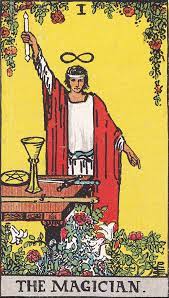
His/Her Unconscious Magician: This second card represents the Fool’s true (but unconscious) masculine identity – dynamic, muscular, gifted, capable, and commanding. The Magician understands and creatively harmonizes himself with Life’s four elements of fire, water, air, and earth, along with its fifth element (its quintessence) of God’s Enabling Energy (or “grace”).
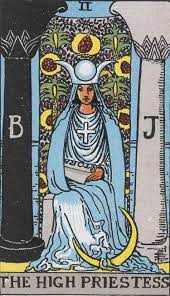
2. Her/His Unconscious Priestess: This third card expresses the Fool’s true (also unconscious) female identity – pure feminine energy seated at the gates of Solomon’s Temple guarding the secrets of divine power. She is receptive and listening. Like the Magician, she is the Fool’s mentor and teacher. She gives the Fool ancient scrolls to explain how to use the Magician’s gifts of fire, water, air, and earth. Above all, she teaches the Fool how to use his or her intuition
3. The Empress (the external expression of the Fool’s inner Priestess): She embodies the Fool’s experience of earthly mother (or mother figure). She is nurturing, unconditionally loving, generous, and giving.
4. The Emperor (the external expression of the Fool’s inner Magician): He depicts the Fool’s experience of earthly father (or father figure). He guides, directs, and sets boundaries.
5. The Hierophant (Pope): The Fool eventually leaves home and encounters the Hierophant from whom s/he seeks guidance in a first encounter with formal education and organized religion. Under this influence, the Fool learns what it’s like to be part of a collective.
As I said, subsequent postings will review the remaining Tarot cards.
Recently, my friend Simon the street musician (who is acting as my Spanish coach) loaned me a book called El Gran Libro Practico del Tarot (The Great Book of Tarot Practice). It offers a detailed introduction to the use of Tarot cards as sources of popular wisdom and prediction of future events.
Simon himself is trying to become expert in tarot – as an alternative source of employment should what he calls the “puta policia” (the effing cops) confiscate his guitar (again!) or should he otherwise be deprived of his current livelihood.
Of course, I was skeptical of the entire project.
Instead, however, I found Simon’s book fascinating. My thought quickly connected it with the work of Franz Hinkelammert, my teacher and colleague at Costa Rica’s Departamento Ecumenico de Investigaciones – the liberation theology think tank where Peggy and I studied off and on since 1992. I thought particularly of Franz’s book called The Critique of Mythological Reason.
In its light, I saw tarot cards as representing valuable attempts to draw together common mythological elements found in religions across the planet (e.g., in Egypt, India, China, among indigenous peoples and in the European west) and in various historical periods, for purposes of making sense of shared human experience. That in itself made the cards precious.
More than that however, I perceived their power to lead practitioners to either surrender to (political and spiritual) forces beyond their control or as empowering them to resist those forces precisely as subjects challenging control by concepts of “normality,” by scientific determinism, or by narrow moralities, legal restrictions, emperors, or popes.
In the latter (Hinkelammertian) sense, Tarot cards can lead practitioners to own the fact that their nonconformity is not “crazy,” and that:
Their mythological and religious traditions commonly rejected by “enlightened” post-moderns are instead highly valuable and liberating.
Practitioners are themselves “magicians” empowered to change “reality” itself so that it benefits human beings and their desire to live and to live well.
They (not those ruling by some fictitious “divine right”) are royalty – empresses and emperors empowered to create a world with room for everyone not just the ruling elite.
They are similarly priestesses and popes “infallibly” empowered to determine their own spirituality independent of ecclesiastical officials
Particularly when precisely as conscious subjects combining feminine and masculine loving energies, they join their complementary powers
To create a world shaped by faith, hope, love, prudence, justice, fortitude, and temperance
And not by “establishment” (capitalist) values of pride, covetousness, lust, anger, envy, sloth, and gluttony.
Such creation entails doing battle with internalized cultural values and with powers and principalities determined to squash holy nonconformity.
To communicate these simple truths, Tarot cards employ images expressing popular understandings of geography, physics, astronomy, astrology, psychology, and (above all) religion and spirituality with their complex interpretations of numerology and color. The cards invite heightened sensitivity to history, poetry, art, music, image, metaphor, simile, the invisible, unpredictable, and ineffable. Each tarot card yields a meaning that corresponds to the degree of sensitivity to such elements attained by its reader.
With all of this in mind, practitioners find the western world of tarot populated by allusions to Greek Gods, the underworld, heaven, angels, devils, saints, and familiar biblical stories such as the Garden of Eden, the Tower of Babel, the crucifixion and resurrection of Jesus, and the Final Judgment. Here for instance, white refers to purity, black to death, blue to spirituality, green to earth, red to passion, yellow to illumination, gold to the (masculine) sun, and silver to the (feminine) moon.
As for personal revelations occurring when cards are “dealt” for the benefit of a particular individual . . .. Here I must claim a kind of agnosticism.
However, given what quantum physics has revealed about everything consisting of energy and light, who’s to say that the energies of the personal subject in question do not influence the way cards fall and what their falling reveals to a skilled reader?
I must give all of this further consideration (and will in future postings). I’m grateful to Simon though for further opening my mind to the relevant possibilities.
Readings for the Solemnity of Our Lord Jesus Christ, King of the Universe: 2 SM 5: 1-3, PS 122: 1-5; COL 1: 12-20; LK 23: 35-43
Since taking up residency in Spain two months ago, I’ve developed a new understanding of why I’ve learned Spanish. It has allowed me to access lines of critical thought that would otherwise be closed to me as a resident of the imperial Global North.
Those lines have given me a new understanding of this Sunday’s liturgical focus, viz., the celebration of “The Solemnity of Our Lord Jesus Christ, King of the Universe.” They have shown me how that phrase, “King of the Universe” can be understood in two ways, one that is oppressive and the other that is liberating – one that is Eurocentric and the other that is truly universal.
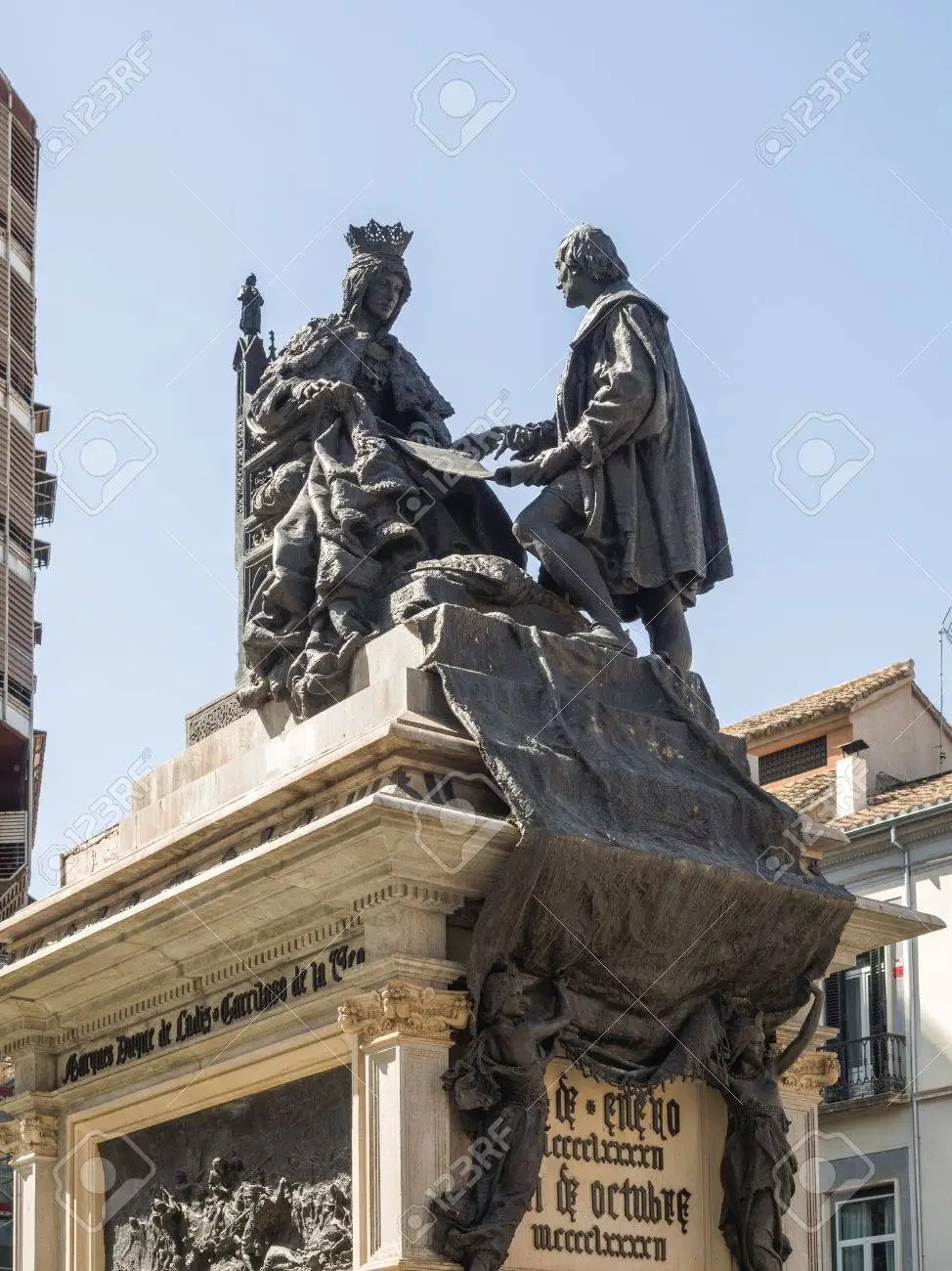
The Solemnity calls westerners to change our minds from Eurocentrism to one that sees Jesus as promising a New Order where the poor and oppressed displace the earth’s traditional rulers.
Let me try to explain what I mean.
Critical Thinking
To begin with: a word about the critical thinking I’m referencing. (I intend to write much more about this in upcoming posts.)
I’m talking about Global South scholars who have shaped my worldview over my last 50 years. They include Costa Rica’s Franz Hinkelammert, Mexico’s Enrique Dussel, and Puerto Rico’s Ramon Grosfoguel. I consider the first two to be colleagues and mentors of mine. I worked with them in Brazil and Costa Rica.
My initial reason for reconnecting with these scholars while in Spain was to sharpen my understanding of the language here. However, what I’ve learned has gone far beyond that superficial intention.
That’s because the current project of my mentors is the reinterpretation of the “universal history” of humanity in ways that are anti-colonial and decolonized, and that put in ideological perspective the understanding of Jesus as “King of the Universe.”
Fake Eurocentric History
Their critical vision holds that the traditional tri-partite periodization of western history as (1) antiquity, (2) middle ages, and (3) modernity is deceptively Euro-centric and colonial. It completely distorts human experience as if universal history were synonymous with European history – as if God’s self-revelation began with the Hebrews 1200 years before the dawn of the Common Era, as if philosophy started in 5th century (BCE) Greece, and as if modernity began with the European Renaissance in the 16th century CE.
According to Hinkelammert, Dussel, and Grosfoguel, none of that is true. It ignores the fact that in terms of world history, Europe and its understandings of God, philosophy, astronomy, physics, and industrial development are completely marginal. Theology and philosophy began in Africa (think Egypt and the Bantu nations) thousands of years before Moses and Socrates.
Its development moved eastward towards India and China, leaving a marginalized Europe on the periphery.
For instance, China experienced its Renaissance long before Europe. Islam’s understanding of the world based on scientific principles (including the heliocentric universe) preceded Galileo’s and Newton’s by centuries. In fact, the latter European “greats” largely copied their insights from Chinese books printed on presses that predated Guttenberg’s by hundreds of years.
China also developed processes of steel production long before Europe. In the 19th century, it sent advisors to England’s city of Sheffield to teach industrialists there how best to make their world-changing product.
Of course, there is so much more to be said here. But you get the idea. My teachers are insisting that Europe’s culture and achievements, far from groundbreaking were marginal and derivative – not at all central.
This means that establishing the central figure of European religion as the “King of the Universe” was completely ideological, misleading, and imperial. It was part of a colonial project that allowed European despots to delegitimize much older and more deeply spiritual visions – like those of India and China. Europeans used the universalization of their religion to justify their holocausts of “pagans,” “witches,” “Indians,” and “infidels” all in the name of their false “universal” God.
Jesus’ Universal Meaning
But none of this means that Jesus does not have a universal meaning which is in fact portrayed in today’s liturgical readings for the celebration of the “Solemnity of Our Lord Jesus Christ, King of the Universe.”
The texts identify Jesus as a member of a class that perhaps alone merits the term “universal,” viz., the poor and oppressed everywhere – the victims of imperial kingdoms be they European, Muslim, Chinese, or Indian.
The historical experience of such people is shared across cultures. It includes poverty, houselessness, hunger, rejection by their “betters,” rebellion, police harassment, arrest, imprisonment, torture, and execution. It’s all remarkably similar regardless of the historical period or culture in question.
According to Christian belief, that’s the “universal” experience their God chose as the vehicle for revealing the Divine Self. And it’s all reflected in today’s final reading from Luke, Chapter 23. Consider its content for a moment.
Here, Reza Aslan’s best-seller, Zealot, is the most accessible guide I’ve come across. It clarifies what I’ve been saying by paying particular attention to Jesus’ cross, and to the Roman inscription identifying Jesus as “King of the Jews,”
Take the cross first. It was the mode of execution reserved primarily for insurrectionists against the Roman occupation of Palestine. The fact that Jesus was crucified indicates that the Romans believed him to be a revolutionary terrorist. Aslan asks, how could it have been otherwise? After all, Jesus was widely considered the “messiah” – i.e., as the successor of David in today’s first reading who was expected to lead “The Great War” against Israel’s oppressors.
Moreover, Jesus proclaimed the “Kingdom of God,” a highly politicized metaphor which could only be understood as an alternative to Roman rule. It would return Israel, Jesus himself promised, to Yahweh’s governance and accord primacy to the poor and marginalized. The Romans drew logical conclusions.
Put otherwise, the Roman cross itself provides bloody testimony to the radical threat from below that the empire saw personified in Jesus.
That threat was made specific in the inscription the Romans placed over the head of the crucified Jesus. It read, “King of the Jews.”
Typically, those words are interpreted as a cruel joke by the Roman procurator, Pontius Pilate – as if he were simply poking fun at those who saw Jesus as the worthy successor of Israel’s lionized King David.
However, according to Aslan, nothing humorous or ironic was intended by the inscription. Instead, it was a titulus. Every victim of crucifixion had one – a statement of the reason for his execution.
The motive for Jesus’ crucifixion was the same as for the many others among his contemporaries who were executed for the same crime: aspiring to replace Roman rule with home rule – with an Israel governed by Jews instead of Romans. The titulus on Jesus’ cross, along with the cross itself identify him as the antithesis of what he eventually became, a tool of Eurocentric empire.
Conclusion
For years while I was teaching at Berea College in Kentucky, I taught a Great Books course called “Religious and Historical Perspectives.” It was the best education I’ve ever received.
However, the course followed that tripartite historical organization referred to above — ancient roots (in Israel, Greece, and Rome), Middle Ages (with virtually no mention of the Ottoman Empire), and Modern developments (focused on Galileo, Newton, and figures like Marx, Dawin, and Freud).
There was hardly a word about Islam, and none about the great world cultures of India and China. In other words, for all its virtues, the course was completely Eurocentric and colonial. Its treatment of Judeo-Christian texts implicitly justified belief that God chose the Mediterranean West as the exclusive site for his (sic) Self- Revelation.
Moreover, references to Jesus’ “kingship” along with the iconography of the European Renaissance gave the unspoken impression that “Christ the King,” along with his mother “Mary Queen of Heaven and Earth” were from the royal class or at least its supporters.
According to Hinkelammert, Dussel, liberation theologians, and so many others from the Global South, all of that not only distorts history itself, but the true meaning of the significance of a Divine King who was truly universal in the sense of sharing the invariable lot of the poor and oppressed.
According to perspectives from the Global South, the “Kingship” of Yeshua of Nazareth promises to turn the world upside-down. In the words attributed to Jesus mother in Luke’s Gospel (1: 46-55), Jesus reigning from the cross embodies Mary’s promise to “put down the mighty from their seats and exalt the humble.”
From that perspective, today’s liturgical celebration promises the eventual triumph of the marginalized over their royal , imperial, eurocentric oppressors. It’s all about the coming Great Reversal.
Readings for 32nd Sunday in Ordinary Time: 2 MC 7: 1-12, 9-14; PS 17:1, 5-6, 3, 15; 2 THES 2:11-3:5; LK 20: 27-38.
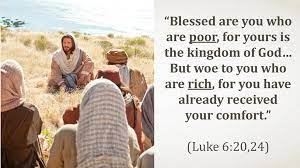
As I’ve note in a recent posting here, one of the wonderful aspects of the Judeo-Christian tradition is how so much of it reflects the consciousness of the poor and oppressed, while at the same time giving expression to a “preferential option for the poor.” That’s a gift for us in a culture that generally despises poor people, oppresses the world’s impoverished majority, and spins the news in ways that ignore the poor and reflect a decided “preferential option for the rich.”
This morning’s first reading is especially valuable for us who live in under the torture regime of American Empire. It actually invites us inside the heads of tortured “terrorists.”
It raises the question, who are the real terrorists – the forces of empire or those who resist them? In doing so, the reading from Second Maccabees sheds light on the contemporary debate about torture in service of empire. It also highlights parallels between the mentalities of “terrorists” then and now. The reading calls us to question our support for the entire War on Terror — for all our wars.
For starters, consider torture itself. Our culture actually debates torture’s use, its effectiveness and morality! (See video above.)
Previously, that would have been unthinkable. Torture used to be considered one of those intrinsic evils about which there simply could be no debate.
However, ever since Abu Ghraib gave the lie to George W. Bush’s famous prevarication, “The United States doesn’t do torture” – ever since our government’s redefinition of the word to exclude even waterboarding – it has become apparent that Bush (and so many others of our “thought-leaders”) was lying. So today, many prominent “court intellectuals” have been pushed to actually defend torture’s permissibility.
But what do tortured terrorists actually think about having limbs removed and tongues cut out? Read today’s selection about the Maccabee brothers and find out.
The Maccabees were members of a heroic family of guerrilla fighters who in the mid- 2nd century BCE terrorized the invading Greek forces of Antiochus IV Epiphanes. (Actually, “Maccabee” wasn’t the family’s name; it was more a nom de guerre for an entire resistance movement. The word meant “Hammer” – the Hammer Gang – so-called because of its delight in pounding to mincemeat the invaders of their beloved homeland. The term “Maccabee” was similar to “al Qaeda,” when it simply meant “the list” – a reference to the Rolodex of assets the CIA used when it employed al Qaeda back when they were “freedom fighters” against the Russians in Afghanistan.)
For his part, the Seleucid king, Antiochus, was anti-Semitic in the extreme. He considered the Jews historically and culturally backward. For him and his empire’s advancement, Jews had to be brought into the 2nd century BCE even if it meant their kicking and screaming the whole way.
Today we might understand Antiochus’ project as “modernizing” the Jews – as Hellenizing them for purposes of imperial control. Evidently the Seleucid king subscribed to the position that if empire can persuade conquered peoples to adopt its patterns of thinking and especially of imagining God, the task of imperial administrators is made that much easier.
Many Jews agreed with the program of Antiochus. After all, the Greeks’ empire seemed invincible. If the empire couldn’t be beat, it was better to join it willingly. So, these “Hellenized Jews” stopped circumcising their sons, and changed their diets even to include eating pork. They became more Greek than the Greeks.
They also became the targets of Maccabee “terrorist” attacks. In today’s terms, such Hellenized Jews would be the targets blown up by Maccabee suicide bombers in marketplaces located in Jewish but Greek-loving neighborhoods. (Even if the Maccabee targeting may have been more selective than that, it is certain that Hellenized Jews were as much the objects of Maccabee terror as were the Seleucid forces themselves.)
In countering such extremism, Antiochus IV proscribed the Jewish religion as itself criminal and illegitimate. This was very similar to the way many “Americans” consider Islam. So Greek troops burnt and otherwise desecrated copies of the Torah in much the same way as our “Christian” troops have frequently been caught burning or urinating on the Holy Koran and on corpses of Muslim resistance fighters.
Though the Greeks considered the Maccabean forces to be terrorist, faithful Jews admired them as national heroes and servants of God. They understood that the Maccabees were fighting a Holy War against the much more powerful Seleucids. It was David against Goliath all over again.
In any case, according to today’s selection from Second Maccabees, seven brothers of the gang’s leadership were finally arrested (along with their mother) by the Greek invaders. (This would have been reported to Greeks “back home” as a great triumph – “Senior Leaders” captured making “our troops” and “our world” much safer.)
Then the torture and the screaming start.
To begin with all eight are beaten with whips and instruments designed to tear open their flesh. Then following standard operating procedures still practiced today, other enhanced interrogation techniques were used to torture the brothers one after the other in the presence of their blood-drenched mother, herself near death. The purpose here, of course, was to induce the woman to divulge names, places, and plans that she was privy to as the wife of the one who started the Jewish resistance to the Seleucids.
But what does she do? And what about her sons?
In a word, they are all – mother as well as her sons – completely defiant.
“What do you expect to achieve by questioning us” one of the brothers shouts? “We are ready to die rather than transgress the laws of our ancestors.”
Even at the point of death he spits out the words: “You accursed fiend” (I wonder what expletive he really used!), “you are depriving us of this present life, but the King of the world will raise us up to live again forever. It is for his laws that we are dying.”
Another of the brothers sees that his torturers are actually enjoying their work. (The text refers to cutting out his tongue and amputating his hands as “cruel sport.” Does that remind you of Abu Ghraib?) So, he sticks out his tongue and stretches out his hands inviting them to do their work. “It was from Heaven that I received these,” he says. “I’d rather lose them than offend Yahweh” (read Allah).
“Even the king and his attendants marveled at the young man’s courage,” the text says. Far from being intimidated, the freedom-fighter “regarded his suffering as nothing.”
Just before dying, another of the tortured brothers undergoing the very same cruelties says: “It is my choice to die at the hands of men with the hope God gives of being raised up by him; but for you, there will be no resurrection to life.” As indicated by those words, conviction of a happy eternity moved these guerrilla fighters to embrace death willingly. (Seventy-two virgins, anyone?)
So, what goes on in the heads of the tortured? Disdain for their torturers. Defiance. Show of courage. Love for the motherland. Hope.
And what goes on for the people they die for? Admiration. Elevation of martyrs and the tortured to sainthood. Motivation to follow their example.
And ultimately victory for the tortured and assassinated. . . . I mean, against all odds, the Jewish resistance – the Hammer Terrorists – did succeed in evicting the Greeks from their homeland.
As I was saying, this reading should cause us to reevaluate our attitude towards terrorism, terrorists, and the scandal of debating the pros and cons of torture.
Readings for 27th Sunday in Ordinary Time: Habakkuk 1: 2-3; 2:2-4; Psalm 95: 1-2, 6-7, 8-9; 2 Timothy 1: 6-8, 13-14; Luke 17: 5-10
This Sunday’s readings address the question of unanswered prayers and the frustration of those who look for evidence of God’s presence in the world but find none.
With that query hanging in the air, here are my “translations” of this week’s selections They represent a prayerful dialog between frustrated believers (like most of us) on the one hand and the Being some still call “God” on the other – with Yeshua’s own example and insight added at the end.
Please check out the actual texts here to see if I got the translations right. I’ll conclude with a few reflections of my own.
1. Our Prayer
Habakkuk 1: 2-3; 2:2-4
I’ve been praying
Dear Mother,
For your Queen's Reign to come,
For violence to cease
For relief from our misery.
Yet you seem deaf
To my pleas.
After all,
Wars continue
Violence increases
Everyone’s at
Each other’s throat.
What should I think?
2. God’s Response
Only this:
(And write it in stone!)
My timetable,
My order
Is vastly different
From yours.
What’s invisible,
What seems delay to you
Is always
And perfectly timely for me.
So, be patient
Keep your commitment
To my just order.
My answer to prayer
Is never late.
It is omnipresent.
3. Our Reply
Psalm 95: 1-2, 6-7, 8-9
I have heard your response,
Holy Mother.
I’m thankful and happy
For the reminder.
Your words
Are solid as rock.
It’s true:
You know far more
Than us.
You have never
Let us down.
I will therefore not ever
Lose faith
Against your
Proven fidelity.
4. Light from Yeshua
2 Timothy 1: 6-8, 13-14
Such words of response
Are wise.
They are the expression
Of a Holy Spirit,
Within us all.
It can set
The world ablaze
With love.
It is courageous
And disciplined,
It expresses the
Strength of God.
It enables us
To endure even prison
And hardships
Of all kinds.
It is the very Spirit
Of Yeshua, the Christ.
Luke 17: 5-10
When Yeshua’s followers
Prayed for stronger faith,
He reminded them
That even a little bit
Can change
Expectations profoundly.
Never forget, he said,
That you are not in charge;
Love is.
You are only Love’s servants.
God is not
Your errand boy
Beholden to
Culturally-shaped
Plans and needs.
My Own Reflections
With those readings in mind, i.e., when we allow the words of the Divine Mother to open our eyes and ears, when we listen to the prophets (her spokespersons), we see concrete manifestations of Goddess presence and siding with the poor everywhere. Right now, they’re evident, I think, in at least three areas, viz., in:
Nature Itself: Regardless of human efforts to obscure and deny the divine, its presence calls constantly to us in events so close to us and taken-for-granted that they’ve become invisible. I’m thinking about the sun, the ocean, trees, the moon, stars, wildflowers – and our own bodies whose intelligence performs unbelievable feats each moment of our lives.
Liberation Theology: This rediscovery of God’s preferential option for the poor has changed and is changing the world. One cannot explain the pink tide that swept Latin America during the 1970s, ‘80s, and 90s – not Brazil, Argentina, Nicaragua, Venezuela – without highlighting the inspiration provided by liberation theology. Neither can one explain the rebellion of the Muslim world against western imperialism without confronting Islam’s inherent liberating drive – again on behalf of the disenfranchised, impoverished, and imperialized.
Contemporary Social Movements: Think Occupy, Black Lives Matter, the Sunrise Movement, Yellow Vests, Standing Rock, the Green New Deal, and prophetic figures like (once again) Greta Thunberg, Naomi Klein, Bill McKibben, and Pope Francis with his landmark climate encyclical Laudato si’. All these movements and figures stand on the side of the poor and are having their effect.
Conclusion
Martin Luther King once famously said that the moral arc of the universe is long, but that it bends towards justice. “Justice” in his vocabulary meant overcoming the laws and social structures crafted by the rich and powerful to keep the poor in their place. King (and Malcolm as well) was a practitioner of African American liberation theology. As such, he was gifted with eyes to see differently — to see the Judeo-Christian tradition as revealing a God on the side of the poor.
That’s what our Sunday liturgies of the word reveal consistently. This week is no exception. It invites us simply to open our eyes.
Just to complete my reflections on the “Dives and Lazarus” parable centralized in last Sunday’s homily, here are my “translations” of the day’s readings. As I said on Sunday, these liturgical selections provide a virtual catechism on liberation theology which I consider the most important theological development of the last 1500 years. Please check out the actual readings here to see if I’ve translated them correctly.
Amos 6:1A, 4-7
The Spirit of Life informs us that:
Complacent “religious” people
Are in for a sad surprise.
They might be enjoying
Their “Sleep Number” mattresses
And Lazy Boy chairs;
While gorging on Wagyu Beef
And meats
No one else can afford;
They might be attending
A-list concerts
And drinking Chateau Lafite
While reeking of Chanel Grand Extrait.
But the world’s on fire!
And its flames will soon consume
Even the decadent lifestyles
Of the super-rich.
Psalm 146: 7, 8-9, 9-10
For the poor,
There’s a certain Schadenfreude
In all of this.
For God’s future assures
Downfall for the rich
While promising
Justice for the oppressed
Rich food for those now hungry
And liberation for the imprisoned.
The obtuse will see,
We’re told.
The overworked
Will be relieved.
Immigrants and refugees
Will be safe at last.
Children born out of wed-lock
And abandoned women
Will finally know peace.
1 Timothy 6:11-16
So, be of good heart.
Despite appearances,
That golden future awaits
Those who live like Jesus.
He was so committed
To the poor
To justice, non-violence
Patience and love
That the imperialized world
Could not stand it.
Nevertheless, his powerful
Christ-consciousness
(That you btw have promised
To live by)
Will bring the world
A completely new order
And enlightenment beyond
Our wildest imaginings.
2 Corinthians 8:9
In fact, Jesus accomplished
All of that
By becoming a poor man
Not a rich one
So that we might know
Where true wealth lies
And live accordingly.
Luke 16: 19-31
Jesus illustrates
His meaning
With the story
(Told to the complacent believers)
Of poor Lazarus
Who often begged
From a rich man.
But soon had Dives
Begging from him
And experiencing
The awful frustration
Of unbridgeable gaps
In consumption
And in ability
To communicate
The desperation
And torment,
Of hunger and thirst
Even if revealed
By a ghost from the other side.
I lead a charmed life. My life has been governed by what some New Age spiritual teachers call “The Law of Attraction.” Simply put, the Law states that like attracts like. It holds that what consumes one’s thoughts eventually manifests in one’s life.
So, what has consumed my thoughts and attention?
As a theologian, teacher, and world-traveler, they have been focused on understanding the world (and especially spirituality) from the underside – not from the usual viewpoint of the rich and powerful, but as experienced by the world’s colonized, but the poor and oppressed.
And what has that attracted to me?
Almost unbidden, it has brought me extraordinary experiences throughout the former colonial world and Global South. It has attracted extended sojourns in Brazil, Costa Rica, Nicaragua, Guatemala, Honduras, Cuba, Mexico, Zimbabwe, South Africa, India, Sri Lanka, and Israel-Palestine. Early on, during my graduate studies and their 5 years in Rome, I also found myself journeying throughout all the home countries of European colonizers in Italy, Great Britain, France, Spain, Austria, the Netherlands, and Germany.
At every stop, I’ve had the privilege of working with and engaging in conversation scholars and activists much more informed than me about the ins and outs of colonialism.
All of that has helped me understand colonialism for what it is – a system of robbery. In the form that has shaped the world, it has had white Europeans and their descendants (a very small fraction of the world’s population) roaming the planet and subduing its entirety for purposes of transferring its wealth and resources to the so-called “Mother Countries.” As a result of colonialism, white Europeans and their descendants has prospered; those they’ve colonized have largely been impoverished.
My current stop in this rather automatic Odyssey has brought me to Granada in Spain a country that happens to be governed by a socialist coalition. Coming from a right-wing country like the United States, that’s noteworthy. Whereas, of course, there is not even a Labor Party in the U.S., Spain happens to be run by a left-wing coalition between the Socialist Workers Party (PSOE) and an even further left anti-austerity party called PODEMOS (“Yes, We Can”).
For decades in this country, such development would have been undreamt of. This because Spain’s left-wing political shift follows hard upon a long period of extreme right-wing rule by the infamous Francisco Franco, who governed the country with an iron fist from 1936 to 1975.
Franco was a Fascist who allied himself with Hitler and Mussolini during World War II.
After the war, his anti-communism secured unwavering support for his regime from the United States which is always more friendly towards fascism than socialism.
To establish and maintain his power wielded on behalf of landowners, industrialists, and the Catholic Church, Franco slaughtered more than 200,000 Spanish workers, trade unionists, teachers, intellectuals, and others who sided with the country’s poor and disenfranchised.
Over the next few months, I want to find out more about that. I also want to get a better idea of what’s really happening here in Europe generally. To that end, I’ll be talking to as many people as I can about these matters.
In the short term, I anticipate that my principal dialog partner will be a language teacher I’ll be employing to help me recover my fluency in Spanish. I’ll keep you posted here.
The Queen Mary 2 by which Peggy and I made our way from NYC to South Hampton before traveling by plane to Madrid and then to Granada in Spain. Our stateroom was on the 11th deck, 2nd room aft.
If anyone’s paying attention, I must offer an apology for such a long gap between postings here. The fact is that for the past 10 days, I’ve been absolutely unable to post anything. The reason? Peggy and I have been in transit from the U.S. to Spain (Grenada), where we’ll be living for at least the next 2 or 3 months. There has also been a serious issue with COVID.
We’ve come to Spain at the invitation of our daughter and son-in-law who are here on a year-long sabbatical. We’re so grateful, since this gives us all that time to be with 5 of our 7 grandchildren.
Getting here was an adventure. For one thing, it involved a 7-night cruise on the Queen Mary 2 (QM2 pictured above). I never imagined my making such a voyage. I guess my face is still red from doing something so luxurious. (How do I square that, for instance, with my professed commitment to liberation theology? Oh well, as Walt Whitman said, “Do I contradict myself? Very well, then, I contradict myself.” Sigh.)
I must admit though that the cruise was wonderful for all the reasons you might suspect: non-stop sumptuous meals, people waiting on us hand and foot, top-class floor shows, dancing, music performances of various kinds in the ship’s many pubs, bars, and parlors, and long hours of silent contemplation of divine presence nowhere as clearly evidenced, I think, as in the ocean. (Someone has said, “The ocean doesn’t simply remind us of God. The ocean is God.” In some mysterious way, I think that’s true. We’ve all come from the water. About 60% of our bodies is water, even now.)
And while I can’t claim that all of that wasn’t fun, it also made me think guiltily about white privilege, colonialism, wealth disparities and the fast-approaching end of my own life.
Yes, almost all of the Queen Mary’s passengers were white. And almost all of the waitpersons were not. Most of the latter turned out to be from the Philippines. And their attitude reflected what colonists have always expected from “the white man’s burden”: “We exist to serve you. How can I make you more comfortable, sir? Can I get you anything else?”
Never, I’m sure, did it cross most of our minds that these “servants” had their own ambitions, romances, families, worries, contradictions, rich stories — and hidden resentments about “the master.”
Oblivious to all that, most of us passengers had the means necessary to have such a luxurious experience. Most of us were wealthy and old. At one point, it occurred to me that the QM2 resembled a floating nursing home with many of the voyagers using canes, walkers, and wheelchairs. The fact is that in 10-years time, few from among us will still be alive. So much for wealth, privilege, and colonialism. Then (as now) all that will matter is what that vast ocean embodies.
I got a sharp reminder of such mortal realities just after disembarking from the QM2 last Sunday. I came down with a devastating case of COVID 19.
I know; I know: what did I expect getting on a ship like that? As one of my friends asked long before our departure: “Do you know what your and Peggy’s favorite game must be? It’s probably Russian Roulette. That’s what you’re doing spending 7 nights on a ship during COVID! You’re toying with your lives!”
Well, my friend turned out to be right. And after a very long day of travel on Sunday, the malady kicked in big time. I literally thought I was going to die.
Thanks be to God, I didn’t of course. But before closing my eyes Sunday night, I did mumble to Peggy, “If I don’t make it through the night, honey, know that I love you and it’s been a good run.”
I even thought, “This would be an easy way to slip out, wouldn’t it? — except there’ll be all the difficulty involved in shipping my body back to the States. Too bad.”
My internal monologue continued, “But there’s still so much left for me to do.”
“And what would that be?” I asked myself.
“Nothing,” came my quick and honest reply. Nothing. And that was it. I felt surprisingly ready to go. I felt so tired.
Three days later, I’m still feeling exhausted. But here I am writing. So, I guess I’m out of the woods.
Thank God for the recent SCOTUS decision to effectively repeal Roe.
I say that not because I think the decision was correct. It wasn’t. I say it because Dobbs vs. Jackson has pinpointed the fundamental source of national polarization not only on the issue of abortion, but on climate change and war as well.
And that source was not correctly identified by Bill Clinton’s phrase (borrowed from James Carville) “it’s the economy, stupid.” Rather, the source of national polarization is not economics, politics, or constitutional law. It’s theology. Yes, theology! And until what passes for the “left” in this country takes that bull by the horns, it is doomed to impotence in the face of the religiously driven right-wing juggernaut that triumphed with Dobbs.
What that decision made clear is that the victorious “pro-life” position is based fundamentally on theological grounds that can only be described as patriarchal. Its foundations are abstract, divorced from life, and ignorant of the experience of those centrally involved in the question, viz., women.
Meanwhile, left-wing “pro-choicers” seem too “sophisticated” to respond in kind within an American context where people are basically religious and have been tricked into accepting mansplained theological reasoning about abortion. I mean, the left has proven strangely reluctant to engage its opponents on that powerful contested spiritual terrain.
What I’m arguing here is that the means for doing so is readily available in a highly developed feminist theology that is much more persuasive, older, comprehensive, and venerable than its more recently developed patriarchal counterpart. It’s the theology of the earth consistently embraced by our ancient ancestors and by indigenous people across the planet. (The latter btw, are not reluctant to address issues in theological terms.)
The theology in question has perhaps been best described by Monica Sjöö’s and Barbara Mor‘s splendid 500-page volume, The Great Cosmic Mother. It’s the religion of the earth explained there that can save the day for humanity and our planet.
To show what I mean, let me begin by sharing The Great Cosmic Mother’s contrast between matricentric and patriarchal religions in general. Secondly, I’ll compare matricentric insights about abortion with their patriarchal counterparts. Thirdly, I’ll show how those insights are essentially theological. My conclusion will suggest profound changes in the ways we speak about or ignore the spiritual dimensions of our lives.
The Religion of the Earth
By “The Religion of the Earth” Sjöö, Mor, and other feminist historians refer to the first religions of the human species which for 30,000 years centered on Goddess worship.
That’s right. Widespread archeological discoveries of detailed goddess statues indicate conclusively that the supreme gods who reigned for most of human history’s concern with religion have been female. Under such dispensation, wise women functioned as community leaders, priestesses, counsellors, midwives, and healers. For millennia, they were humankind’s principal decision-makers.
Accordingly, worship for those 30,000 years celebrated “Mother Earth” with her abundant life-giving powers, as well as natural processes influenced by the moon, ocean tides, and seasonal changes.
Such emphasis also centralized life mysteries unique to women and completely foreign to male experience – the menstrual cycle, conception, gestation, birthing, nursing, contraception, and abortion. Obviously, men have only second-hand knowledge of such processes that largely shape female experience so central to propagation of the species.
So, Goddess religions emphasized female autonomy, male discipleship, the unity of all creation and the knowledge and insight available through the uniquely feminine avenues just listed. Wisdom came to women as well through peer interaction, prayer, contemplation, meditation, ecstatic dance, music, chants, spells, rituals, and female intuition.
Patriarchal Religion
Then about 12,000 years ago (coincident with the development of agriculture) worship of the Great Cosmic Mother was gradually replaced by patriarchal religion. Particularly in the west, the reigning Father God came to replace Mother Earth and women’s “religion of the earth.” Patriarchal religion centered on law, animal and human sacrifice, logic, competition, war, and commercial exchange.
In its Judeo-Christian incarnation, the single Deity (Yahweh) was emphatically male. He replaced Mother Earth with her loving maternal instincts and mysterious natural cycles characterized by predictability, lavish abundance, prodigality, plenty, generosity, sharing, mercy, and forgiveness. Her place was taken by a patriarchal lawgiver and judge who condemned, punished, blamed, and tortured.
Even beyond that, women and their cosmic faith came to be vilified by the new religion as irrational, and as superstitious. Women spiritual leaders — those wise community leaders, priestesses, counsellors, midwives, and healers – fell from grace and were viciously persecuted by vindictive priests as witches and agents of evil spirits.
The religion of the earth with those wise priestesses was forced to go underground. But the patriarchal Inquisition and its Puritan counterparts hunted them down relentlessly – eventually killing as many as 9 million accused witches over a period of 300 years (1450-1750). Obviously, this “women’s holocaust” represented the most extreme attempts to control women and their bodies and to deny their traditional roles as expressions of the divine.
Under this new dispensation, celibate male priests within the Catholic Church (presumably without any experience of women’s sexuality) assumed the role of dictating a predominantly sex-based morality. In this context, the celibate clergy saw women as temptresses. Female bodies and wiles sinfully incited otherwise holy men reluctantly suppressing their own sexual urges and those of others both male and female.
In line with such blatant sexism, priests outlawed extra marital sexual pleasure. They declared that the only valid reason for sexual intercourse was the begetting of children. Consequently, women’s attempts to control their bodies, destinies, and family sizes through their traditional practices of contraception and abortion were classified as evil and warranting eternal punishment with everlasting torture. In particular, the traditional abortion practices of women’s earth religion came to be seen as criminal and even homicidal.
Goddess Religion & Abortion
And what were those practices? How were they justified? Though by no means the focus of their book, here is what Sjöö and Mor have to say about abortion:
Matricentric cultures considered life as a continuous divinely spiraled (vs. straight line) process with both repetitions and ascendent progress. It is a mystery from which human beings emerge.
For women-led societies, human life did not begin when sperm fertilized egg. In fact, in no way was life considered to emerge from humans. Instead, humans were thought to emerge from Life’s incredibly abundant, prodigal, and even wasteful profusion. [For instance, each month of their existence women who do not become pregnant send down the drain an egg with incredible life potential. Similarly, each male ejaculation “wastes” about 2 million sperm. Moreover, 10-20% of known pregnancies end in miscarriage – not to mention unknown pregnancies. Put otherwise, prodigality, abundance, and spontaneous abortion somehow constitute nature’s way (387).]
Amid such prodigality, the first law of matricentric cultures was that women must control their own bodies (200).
Consequently, questions of abortion were traditionally considered outside the realm of masculine competence. They were none of men’s business. This was because questions of pregnancy or nonpregnancy found no analogy within the experience of men who could never become pregnant, gestate fetuses, give birth, or have abortions (385).
Clearly, women in ancient times didn’t (as they still don’t) always want children.
So, under matricentric arrangements, female intuition decided the time to be pregnant or not as well as whether to bring pregnancies to term (385).
With women in charge of their bodies, they developed herbal contraceptives and abortifacients (200). [The earliest discovered recipes for abortion date from around 2700 BCE (203).]
During the time of Spanish colonization of the Americas, indigenous women even practiced abortion to rob the imperialists of “Indian” slave labor (206).
Tribes that practiced abortion and even infanticide (far from considering such practices homicidal) were instead convinced that the spirit of the dead child returned to the earth womb to await a new birth – when the time was right for its mother (201). As expressed by Sjöö and Mor, “What has come once – when the time is wrong – can come once again when the time is right” (388).
Patriarchy & Abortion
Now, contrast this matricentric approach to life and abortion with that of the rather newly arrived patriarchy. As described by the authors of The Great Cosmic Mother, celibate priests, and theologians, along with the male-dominated fields of philosophy and logic made the following highly theoretical and unproveable assumptions:
Morality is determined not by human experience or nature, but by sacred scripture, abstract logic, law and by mostly pre-scientific theology interpreted by those (often celibate and gynophobic) men particularly obsessed with questions related to sex (165).
Ultimately, decisions about pregnancy lie in the hands of an off-planet divine patriarch rather than in those of a female co-creator. A divine Chess Master above the earth decides when to “ensoul” or not a human zygote. (According to Thomas Aquinas, males received souls 40 days after conception; females, 40 days later than that.) The Great Patriarch’s decision is final in all cases.
On this understanding, women are seen as quasi machines or nests– receptive objects rather than actively contributing to the process as autonomous decision-making subjects (365).
History moves in a straight line. Far from being spiral in nature with repetitions along with ascendent progress, it has a beginning and an end.
Individual lives are similarly linear and unrepeatable.
Consequently, each fertilized egg represents from the moment of conception a unique individual, which if aborted is forever lost to the world, humanity, and history. Her or his God-determined destiny remains eternally frustrated.
Therefore, human interference in processes of pregnancy is immoral and (depending on the time of intervention) can even be considered murderous.
Theological Differences
As evident from the above side-by-side comparisons of matricentric and patriarchal approaches to abortion, resolution of the question at hand comes down to theologies describing the nature of God, the direction of history, and autonomous human individuality. None of these considerations is subject to definitive demonstration or proof. They are matters of faith.
Or as Sjöö and Mor put it: “The fundamentalist Protestant and Catholic anti-abortionists are following the ways and dictates of their God. The rudimentary question remains: Is their God the God?”
And where in a pluralistic society do atheists fit in – or citizens whose religious faith locates the beginning of personal life at the stage of viability outside the life support system provided by its mother’s body, or at a baby’s exit from the womb, or (as in some tribal cultures) after the child is painted to distinguish it from the animals?
Again, in a pluralistic culture, why privilege one unproveable faith- based interpretation over all those other ways of understanding the beginnings of personal life?
Sjöö and Mor argue that such questions of faith disappear if matters of pregnancy and abortion are understood within the context of the Great Cosmic Mother’s “religion of the earth.”
There, women whose very monthly processes mirror those of the seasons, moon phases, and tides, are granted overriding insights, intuitions, and understandings about their unique processes inaccessible to the men whose patriarchal pronouncements would explain, invalidate and govern them.
In specifically theological perspective, proponents of the reemergent goddess religion add: “If God is seen as female, the problem of abortion does not exist. The entire question of sex, pregnancy, birth control – and even abortion – undergoes an ontological somersault, a revolution of basic terms”
Conclusion
This article has been about abortion. It has argued that solving its dilemmas begins with recognizing their roots in patriarchy and patriarchy’s God.
The same argument could be made about climate change and the threat of nuclear war. In all three cases, the problem is the relatively recent arrival of a world governed by men (patriarchy).
Theologically speaking, man’s world has been grounded in the worship of a God divorced from life’s most basic processes. Fundamentally, patriarchy’s God is a war deity. He legislates, judges, condemns, and punishes. He is a God of fear. He has been used as a tool to persuade the politically, economically, and historically illiterate to endorse patriarchy’s omnicidal agenda.
[Think about it. It is men who run a world economy that is irreversibly destroying the planet. It is male politicians, generals, and CEOs (aided by the relatively few women admitted to their clubs) who have developed and currently threaten the world with nuclear destruction. It is men, not women who are the planet’s principal rapists, child abusers, mass shooters – and clergy. And the latter’s misogynist theology is unconsciously rooted in a 12,000-year-long battle against The Great Cosmic Mother.]
By contrast The Great Cosmic Mother herself embodies life’s rich abundance, generosity, extravagance, and prodigality. She welcomes humans as co-creators with Life’s Source. She is the Ground of life’s cycles and rhythms. Those rhythms assure that what has come once – when the time is wrong – can come once again when the time is right. The Great Cosmic Mother could never endorse her own matricide whether by climate change or war of any kind, nuclear or not.
And it is women spiritual leaders who are most in touch with her. These are the guides who must replace the male priests, pastors, imams, rabbis – and presidents. And (in American culture) they have names such as Louise Hay, Liz Theoharis, Caroline Myss, Monica Sjöö, Barbara Mor – and Marianne Williamson. Their theology is earthy, experiential, eminently practical, and expresses the insights of those whose lives are deeply connected with earth’s rhythms in ways the patriarchal order has proven incapable of understanding.
What I’m suggesting is that it is high time to overcome “sophisticated” reluctance to recognize such truths and leaders. It is far past time for churches to debunk the modern patriarchal God in favor of the ancient Great Cosmic Mother who frees from patriarchal laws, empowers humans as co-creators, forgives, appreciates, and rewards.
Fundamentally, our problems are not economic, political, or ideological. The left needs the courage to recognize and profess that faith. Only The Great Cosmic Mother can save us now.
Sorry, Mr. Clinton, it’s not the economy. It’s the theology.