The Long Reach of Pope Francis: how he (and Oscar Romero) touched our diocese & our parish

Pope francis oscar romero


I once was once skeptical about Pope Francis.

When he was elected, my first thought was “Can anything good come out of an Electoral College of Cardinals packed so tightly with clones of the reactionaries, John Paul II and Benedict XVI? Bergoglio must be one of those carbon copies.”

But I was wrong.

Jorge Mario Bergoglio turned into Pope Francis. Far from a triplet brother of his immediate predecessors, the new pope has proven to be truly Latin American. That’s so even to the point of embodying the ideals of liberation theology, or reflection on the gospel from the viewpoint of the poor and oppressed. He has espoused the latter’s “preferential option for the poor,” its trenchant critique of corporate globalization, and its openness to marginalized people of all kinds. What a surprise!

My second thought was, “But he’s already old. His papacy will be short. He won’t be able to accomplish much of enduring impact.

Imagine then my further astonishment, when a mere three years into his papacy, Pope Francis’ touched  in remarkable ways our  tiny and remote diocese of Lexington, Kentucky. Even stranger to say, his reach extended to our little Kentucky parish of St. Clare’s in Berea. It made me wonder if this is happening all over Francis’ world. I hope so.

First of all, consider what’s happened in Lexington.

Our previous bishop was a canon lawyer – an appointee of John Paul II. Bishop Ronald Gainer distinguished himself by urging pro-choice politicians to refrain from receiving Holy Communion. He has since shown other overriding concerns by forbidding Catholic School girls in his new diocese from engaging in sports (such as wrestling, rugby, and football) “…that involve substantial and potentially immodest physical contact.” You get the idea.

After waiting for more than a year, Bishop Gainer’s replacement was at last named. It was John Stowe, a Conventual Franciscan. Father Stowe showed his colors in his introductory press conference. There was not a word about abortion, contraception, or gay marriage, much less about girls’ wrestling.

Instead he introduced himself as “a Franciscan educated by the Jesuits and appointed by a Jesuit Pope who has taken the name Francis.” “I love Pope Francis,” Father Stowe said, “and I will do whatever he asks.”

Turns out, the new appointee is not only a disciple of the pope; he is also a sharp critic of reactionary politics – especially as they affect immigrants. (Fr. Stowe, BTW, speaks fluent Spanish.)

For instance, in 2006, when Fr. Stowe addressed the Mayor’s Congress on Immigration Reform in El Paso, Texas, he criticized the U.S. Congress saying, “We shudder to imagine what the inscription on the Statue of Liberty might read if it had been erected by the current U.S. Congress.” Promising words indeed.

And that brings me to our parish, the long reach of Pope Francis and its connection with our new bishop.

You see, during this past Lent, for the second year in a row, a small group of us met each week to study the pope’s “The Joy of the Gospel” – the Apostolic Exhortation published in November 2013. In one of our concluding sessions, we were searching for something practical to connect the pope’s words with our community of St. Clare’s.

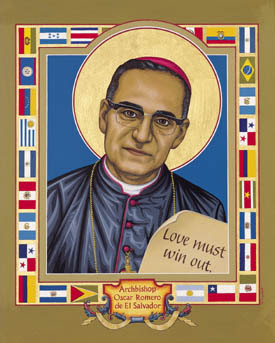
The calendar told us that the beatification of El Salvador’s Oscar Romero was coming up on the 23rd of May. (Beatification is a major step towards canonization or sainthood in the Catholic Church.)

Romero, you recall, was the martyred archbishop of San Salvador. In 1980, he was gunned down at the altar by an assassin connected with El Salvador’s Arena party which was supported by the Reagan administration. Because Romero is considered the patron saint of liberation theology (which the pope saw as too influenced by Marxism), John Paul refused to even call the archbishop a martyr. Instead, he referred to him merely as “a zealous pastor.”

Pope Francis has changed all of that. Romero, he says, was not only a martyr, but has advanced him on the way to official recognition as a saint of the entire Roman Catholic Church.

Well, our little discussion group thought: Why not have our parish celebrate Romero’s beatification?

“Great idea” we all agreed; “We could hire a Mariachi band, invite the Hispanic community and folks from Berea College’s Union Church” (a Church of Christ with whom people from St. Clare’s traveled to El Salvador on more than one occasion). “And then we could follow it all with a big fiesta.”

Someone else added, “And why not invite the new bishop?”

“Wouldn’t hurt to ask,” was the consensus — although we thought his acceptance would be unlikely, since by the end of May, he’d barely have been installed as bishop.

Well, guess what? He agreed to come. That sends a strong signal about his priorities.

So did his letter written immediately after receiving our invitation:

Thank you for your kind words of welcome and the excellent suggestion of celebrating the beatification of Archbishop Romero. I am so happy to know that St Clare’s and Union Church are in a relationship with the Church in El Salvador. That is exactly what Pope Francis is encouraging us to do!

I just returned last night from visiting our Central American Friars; we celebrated the 35th anniversary of Romero’s martyrdom although we were in Costa Rica. This past February 1st, I was able to celebrate mass in the hospital where Romero was killed—all this to say, Oscar Romero is a great inspiration in my life and I am thrilled to know of a community that wishes to celebrate his witness.

I will look for possible dates to celebrate the beatification with your community.

Your message is most welcomed!!

Bishop-elect Stowe’s acceptance of our invitation means that everyone in our parish and from parishes nearby will surely attend an event that might otherwise have been overlooked. Everyone will want to meet the new bishop.

He is sure to have some inspiring words to say about Romero, and hopefully about liberation theology, and U.S. policy in Central America during the 1980s. This will indeed be a teachable moment.

Do you see what I mean about Francis’ long reach? This is already far better than I anticipated three years ago.

(Sunday Homily) Pope Francis Calls for a Global Catholic Climate Movement

Italy Pope Epiphany

Readings for 1st Sunday in Ordinary Time: I SAM 3: 3B-10, 19; PS 40: 4, 7-10; I COR 6: 13C-15A, 17-20; JN 35-42

Recently Pope Francis has come in for some hard criticism from the U.S. right wing. It’s not just because of his rejection of free market capitalism, trickle-down theory, and huge income disparities between the rich and poor. It’s not just his openness to gays and divorcees, and his refusal to obsess about abortion and contraception.

Yes, all of these have undermined what conservatives have seen as a close alliance between the Catholic Church and their pet causes and thinking modes.

However, the straw breaking the back of reactionaries is the pope’s unequivocal warnings about climate change. They’ve gone apoplectic about his intention to publish an encyclical on the matter, and his plans to convoke a conference of religious leaders to address it. The pope’s expressed intention is to influence this year’s U.N. Paris Conference on Climate Change. All of that has raised the specter of a global Catholic climate change movement potentially mobilizing the world’s 1.2 billion members. Think about that for a minute!

In such context, Francis visit this week to the Philippines is extremely significant. The Philippines is not only the home of 80% Asia’s Catholics – more than 100 million. It is also the poster child for the devastation that climate change wreaks on the principal victims of global warming, the world’s poor. In 2013 the archipelago was raked by Typhoon Yolanda whose winds and floods killed more than 7000.

So the world listened when on his way to Manila Pope Francis was asked if climate change is “mostly due to the work of man and his lack of care for nature?” In reply, the pope said:

(F)or the greater part, it is man who gives a slap to nature continually, and we have to some degree become the owners of nature, of sister earth, of mother earth. I recall, and you have heard, what an old peasant once told me: God always forgives, we men forgive sometimes, but nature never forgives. If you give her a slap, she will give you one. I believe that we have exploited nature too much, deforestation, for example.

With words like those, the pope’s critics charge he is speaking beyond his expertise, which involves matters of “faith and morals.” But that’s just the point. The pope is making climate change a moral issue, a matter of ethics even more important than more “traditional” Catholic moral concerns about sex which after all presume the survival of the human species and the planet.

The pope’s critics also ignore, of course, that Francis bases his judgments not only on the testimony of 97% of all climate scientists, but on the research of the Pontifical Academy of Sciences. Its membership roster features the names of the world’s most respected scientists. These include Nobel laureates such as Ernest Rutherford, Max Planck, Otto Hahn, Niels Bohr, and Charles Hard Townes. The Academy’s current president is Werner Arber, himself a Nobel laureate, and the first Protestant to head the group.

But why such right-wing fury? It’s because like Naomi Klein, conservatives see the (for them) disastrous implications of addressing the issue. As announced in the title of Klein’s book, they sense that This Changes Everything. That is, taking on climate change as a moral issue undermines the political right’s program of market deregulation and continued extraction of non-renewable resources.

So pundits like First Things blogger, Maureen Mullarkey have given up on lip sticking the pope and are now in full attack mode. According to Mullarkey Pope Francis is simply “an ideologue and a meddlesome egoist. His clumsy intrusion into the Middle East and covert collusion with Obama over Cuba makes that clear. Megalomania sends him galloping into geopolitical—and now meteorological—thickets, sacralizing politics and bending theology to premature, intemperate policy endorsements.”

For Mullarkey, Pope Francis pretty much stinks.

And that brings me to today’s gospel reading. It’s all about stink – about what Pope Francis calls “the smell of the sheep.” Famously, you recall, the pontiff called on Catholic priests to live closer to the poor, to recognize them as God’s people and their welfare as the guideline for economic and social policy – to “take on,” he said, “the smell of the sheep.”

In other words, conservatives are suspicious of Pope Francis and are on the point of vilifying him because he smells too much like sheep — like the poor. He smells too much like Jesus.

Notice that in today’s gospel, John the Baptizer identifies Jesus as “the Lamb of God.” To begin with, the phrase reminds us of the tribal, Bedouin origin of the biblical “People of God.” Abraham, Isaac, and Jacob, and the great King David were all shepherds. They were primitive people close to the earth. They were tribalists. Jesus was a tribalist. According to John’s image, Jesus didn’t just smell like sheep; he was a sheep! He was in spades like his slave and Bedouin ancestors — like the poor people the pope is centralizing in his visit to the Philippines.

Pope Francis is a tribalist too. And he’s practicing what he preaches — both liberation theology’s “preferential option for the poor,” and the traditionally Catholic principle of subsidiarity. Once again, that means endorsing economic and environmental policy not on the basis of market dictates, but according to human decisions about values like the common good. Humane policy, the pope implies, originates not on Wall Street, but in places like the Philippines’ Tacloban City which was leveled by Typhoon Yolanda. It’s there that the pope’s itinerary reportedly has him dining in the shack of a hurricane victim. (Can you imagine a humble Catholic housewife setting her family table to include the pope?)

As our century’s most powerful illumined voice of conscience, Francis is using his bully pulpit to wake us up. We’re like Samuel in today’s first reading – fast asleep even before the Ark of the Covenant (a reminder of Israel’s enslaved and Bedouin past). But we fail to recognize the biblical tradition’s significance to our lives – its call to tribal values which unfailingly center on animals, human family, and Mother Earth. We fail to see the implications of Paul’s observation in today’s second reading that all human beings – especially the poor and outcast – are temples of God’s spirit. That’s our tradition! That same Spirit resides, the pope says, in the planet that he (like St. Francis himself) calls our Mother and Sister.

So what would a global Catholic climate movement look like? It would entail:

  • Waking up like the young prophet Samuel. Like him we’ve heard God’s call many times. But at last in Pope Francis, we have a thought-leader speaking in a voice the simplest of us can hear. It’s the voice of conscience. And like Eli it’s giving us the proper way to respond: “Speak Lord, for your servant is listening.”

A global Catholic climate movement further entails:

  • Rejection of corporation-based globalization which has us (over)consuming imported necessities that could be home-grown. (This involves lobbying against the Trans-Pacific Partnership.)
  • Joining the fight against fracking and projects like the XL Pipeline
  • Voting accordingly.
  • Urging the institutions we can influence (churches, universities, hospitals . . .) to divest from fossil fuel industries.
  • Adopting a “zero waste” policy in our homes and places of work.
  • Cultivating home gardens.
  • Adopting a vegetarian diet.
  • Educating ourselves about “green burial” and including plans for that in our “living wills.”

The list, of course, goes on. But you get the idea.

This stinkin’ pope is waking us up. He’s showing us the way. Thank God!

Twenty Lessons I learned from My 40 Years of Teaching Social Justice

mike teaching

During the fall semester of 2014, I taught a Religion course at Berea College called “Poverty and Social Justice.” The course was personally significant because it rounded off 40 years of teaching at Berea, where my first class convened in 1974 – exactly 40 years ago. I remember how I came to Berea, fresh from leaving the priesthood, on fire from Vatican II, sensing the increasing importance of liberation theology (see below) and (naively) ready to change the world.

In this 2014 semester, nineteen students (mostly juniors and seniors) participated in REL 126. The students were engaged, committed, funny, energetic and smart. They, along with our readings, films and required community activism, taught me a great deal.  And that, by the way, has been my consistent experience since 1974 – I’m the principal beneficiary of the courses I’ve taught. (I’m thankful every day for the path Life has so gently led me follow.)

In any case, I’d like to share twenty of my own specific learnings here. Of course, none of my students would be able to draw these conclusions. After all, they were exposed to the underlying historical events and to the resulting ideas for the first time during the course. However for me, as I’ve indicated, REL 126 represented a kind of capstone to forty years of teaching and nearly half a century of trying to understand the world from the viewpoint of its disenfranchised majority. Grasping that understanding, I’ve come to realize, is the only hope of salvation our world has.

But before sharing those conclusions, let me tell you a bit more about the course itself.  Like all of my courses over the years, its basic purpose was to stimulate critical thought about poverty, hunger and what the Christian tradition teaches about social justice. Our readings included Ron Sider’s Just Generosity, Cynthia Duncan’s Worlds Apart, and the Bread for the World 2014 Hunger Report. We also analyzed the (still relevant) 1973 Pastoral Letter by the U.S. Catholic bishops of Appalachia, “This Land Is Home to Me.”

In addition, all of us attended monthly meetings of Kentuckians for the Commonwealth (KFTC) and volunteered for their “Get out the Vote” actions. A KFTC activist spent two of our class periods leading us in a game of “Survive or Thrive,” a wonderfully instructive game she had invented to replicate the problems of international “free trade” agreements. The activist wasn’t our only class guest.  A grass roots entrepreneur from a clothing factory in Nicaragua and a Glenmary priest-activist campaigning against Appalachian mountaintop removal also graced our classroom.

Inspired by Howard Zinn’s A People’s History of the United States, and taking Plato’s Allegory of the Cave as our guiding image, the course had us attempting to re-vision U.S. history from the viewpoint of the poor and disenfranchised rather than “the official story” of presidents, generals, the rich and the famous.

So we made sure that our current events source reflected those usually neglected viewpoints. To that end, students watched and reported regularly on “Democracy Now.” We even spent some class time watching and discussing a number of interviews with street-level newsmakers by the show’s anchor, Amy Goodman. Additionally class participants researched and reported on issues highlighted on the program including climate change, police militarization, prison privatization, the philosophy of Ayn Rand, reparations to descendants of African slaves, the campaign for a living wage, the rise of ISIS in the Middle East, and Israel’s bombing of Palestinians in Gaza.

In line with our commitment to understanding the experience of the actually poor and disenfranchised, our approach to the Christian tradition in this religion course was that of liberation theology – understood as “reflection on the following of Christ from the viewpoint of those working for the liberation of the poor and oppressed.” Our readings here were drawn from a series on the topic which I had authored and published on my blog site.

A screening of the film “Romero” along with some other shorter documentaries, put flesh on those intentionally brief to-the-point readings. The documentaries emphasized U.S. sponsorship of third world dictatorships under genocidal U.S. allies like Pinochet (Chile), Saddam Hussein (Iraq), the Duvaliers (Haiti) and Somozas (Nicaragua), Mobutu (Congo), and Diem (Vietnam).

Together our intentionally subversive approaches to history and faith were intended to expose students to the untold history of the United States, and to the untold story of Jesus of Nazareth.  From all of this, I drew the twenty conclusions I mentioned earlier. Remember, my students could never reach such conclusions. My hope is that someday (if they continue reading outside the dominant culture) they might:

  1. Historically speaking, the United States is the country Adolf Hitler and his backers imagined Germany would be had they triumphed in World War II – the absolute ruler of the capitalist world at the service of corporate interests. In short, the U.S. has become the fascist police state Adolf Hitler aspired to lead.
  2. As such the principal enemies of the United States are those Hitler imagined being the protégés of “Jewish Madness”—viz. the world’s poor and disenfranchised.
  3. These are (and have been since the end of World War II) the objects of what C.I.A. whistle-blower, John Stockwell, has termed the ”Third World War against the Poor” located throughout the developing world. It has claimed more than seven million victims.
  4. This war by the United States has made it the principal cause of the world’s problems in general and especially throughout the former colonial world, as well as in the Middle East, Ukraine, and in the revived threat of nuclear war, along with the disaster of climate change.
  5. Its war against the poor has made the United States a terrorist nation. Compared to its acts of state terrorism (embodied e.g. in its worldwide system of torture centers, it unprovoked war in Iraq, illegal drone executions, the unauthorized bombings in Syria, its preparations for nuclear war), the acts of ISIS and al-Qaeda are miniscule.
  6. Far from “the indispensable nation,” the United States is more aptly characterized (in the words of Martin Luther King) as “the greatest purveyor of violence in the world today.” Without the U.S., the world would be far less violent.
  7. At home, “our” country increasingly tracks the path blazed by Nazi Germany. It has become a state where corporate executives and their government servants are excused by one set of laws, whereas U.S. citizens are punished by another. Following this regime, law-breakers go unpunished; those who report them are prosecuted.
  8. This type of law is increasingly enforced by a militarized police state in which law enforcement officers represent an occupying force in communities where those they are theoretically committed to “protect and defend” are treated as enemies, especially in African-American and Latino communities.
  9. As a result, new wave of “lynchings” has swept the United States at the hands of “law enforcement” officers who execute young black men without fear of punishment even if their murders are recorded on video from beginning to end.
  10. In addition, disproportionate numbers of blacks and Latinos have been imprisoned in for-profit gulags that rival in their brutality Nazi concentration camps.
  11. The point of the militarized police state and prison culture is to instill fear in citizens – to discourage them from constitutionally sanctioned free speech, protest and rebellion.
  12. As in Nazi Germany, the dysfunctions of “America’s” police state (including poverty, sub-standard housing and schools, drug addiction, and broken families) are blamed on the usual suspects: the poor themselves, especially non-white minorities. They are faulted as undeserving welfare dependents and rip-off artists. Systemic causes of poverty are routinely ignored.
  13. In reality, welfare and other “government programs” represent hidden subsidies to corporate employers such as Wal-Mart and McDonalds. These latter pay non-living wages to their workers and expect taxpayers to make up the difference through the programs just mentioned.
  14. Government programs such as food stamps could be drastically shrunk and limited to the disabled, children, and the elderly, if all employers were compelled to pay their workers a living wage adjusted for inflation on an annual basis. Currently, that wage must be at least $15.00 an hour.
  15. Moreover, since education quality and achievement are the most reliable predictors of students’ future poverty levels, the U.S. education system should be nationalized, teachers’ salaries should be dramatically increased, and all facilities K through 12 regardless of location should enjoy highly similar quality.
  16. All of this should be financed by declaring an end to the so-called War on Terror, withdrawing from foreign conflicts and reducing by two-thirds the U.S. military budget.
  17. Instead, the current system of corporate domination, state terrorism, war against the world’s poor, and lynching of minority men is kept in place by rigging the nation’s electoral system in favor of right wing extremists. They control the system through practices such as unlimited purchase of government (the Citizens United decision), voter suppression tactics (e.g. voter I.D. laws), redistricting, and rigged voting machines. They do not want everyone to vote.
  18. U.S. citizens are kept unaware of all this by a mainstream media and (increasingly) by a privatized system of education owned and operated by their corporate controllers.
  19. As a result, revolution has been rendered inconceivable.
  20. The only hope and prayer is for a huge general economic crash that will awaken a slumbering people.

The Siege of Gaza: A Palestinian Liberation Theology Perspective

AIPAC

Just this morning it was reported that the Israeli State bombed another U.N. designated refugee shelter in Gaza killing children sleeping beside their parents. The attack raised to 1300 the number of Palestinians killed by Israel since the siege of Gaza began. Most of those killed are civilians – at least 20% children. Meanwhile 53 Israelis have lost their lives – all but a handful were soldiers laying siege to Gazan homes and cities protected by their inhabitants.

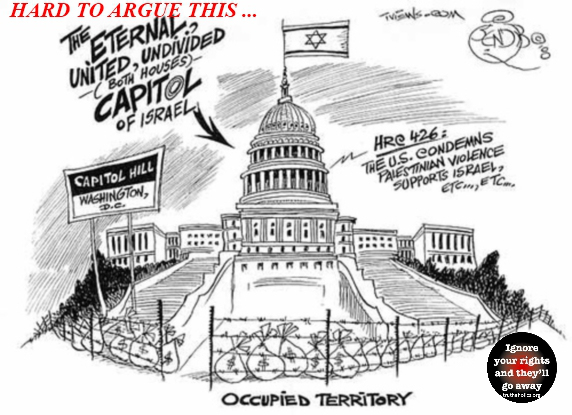
The ongoing slaughter of Palestinians by the Israeli State makes crystal clear the identity of the real terrorists in Israel-Palestine. They are the State of Israel on the one hand and its unconditional supporter, the U.S. government on the other. Both in fact are terrorist states.

I’ll go even further and argue here that in the present phase of the conflict between Jews and Palestinians, the Jews have little or no right to claim they are acting in self-defense. They are clearly the aggressors guilty of extreme war crimes.

This time I base that argument on helpful analytic distinctions concerning “violence” commonly made be liberation theologians in general and by Palestinian liberation theologians in particular. I interviewed the latter back in 2006 at the Sabeel Ecumenical Center for Liberation Theology in Jerusalem.

Like liberation theologians everywhere, those at the Sabeel Center attempt to analyze their context (and the Judeo-Christian tradition) from the viewpoint of those without public power or voice. Of course, in Palestine that viewpoint belongs to the Palestinians not the Jews.

According to Sabeel analysts, there are really four types of violence at work in the Israel-Palestine conflict. Three of them are employed by Israel’s leadership against the Palestinians. None of the three is justified. In fact, according to liberation theologians, only one level of violence can ever be excused – in very limited circumstances. And that violence happens to be the very type our media uniformly designates as “terroristic” – ironically, the crime of Palestinians defending themselves against criminal Jewish aggression.

Let me explain by reviewing each level of violence identified in liberation theology, connecting each to the conflict under discussion here:

1.Institutionalized Violence:This refers to the destructive social, political and economic “structures” that shape human activity. For instance, the maintenance of a global economic system that causes 35,000 children to die each day from absolutely preventable hunger is a form of institutionalized violence. It kills children, the sick and elderly as predictably as if victims were shot in the head – 35,000 times every day.

In Palestine, the wall snaking through the region is a violent structure. So is the Israeli Army (IDF). Meanwhile Palestinians have no army. So laws preventing Palestinians from arming themselves also represent violent structures depriving them of their right to self-defense. Even legal arrangements which have prevented Palestinian authorities from paying 40,000 workers (because of alleged connections with Hamas) represent structural violence. In Palestine the primary victims of structural violence by far are Palestinians, not Jews.

Structural violence kills Palestinian children every day.

2.The Violence of Self-Defense:Institutionalized violence inevitably gives rise to a response. In the case of Palestine, blowback first took the form of non-violent protests. In 1947 general strikes and demonstrations by Palestinians were so effective that they led the United Nations to suspend its “Partition Plan,” which had awarded 55% of Palestine to Jews, even though they represented only 30% of the area’s population. But when Jewish settlers responded with heavy-handed military measures, violent resistance on the part of Palestinians became more frequent. It eventually culminated in the Six Day War in 1967 and in the Yom Kippur War in 1973.

Later, Palestinian children threw rocks at soldiers illegally occupying their neighborhoods during the First and Second Intifadas in 1982 and 2000. Then in 2009 Palestinian insurgents began firing rudimentary homemade rockets into Israeli neighborhoods. (I will address suicide bombers below.)

Because the first (institutionalized) level of violence goes unidentified as such, this second level of violence typically appears unprovoked. It is therefore identified as “terrorism” pure and simple – an act of evil people who for some reason (e.g. self-interest, racism or sadism) enjoy killing the innocent. This is how Palestinian rocket attacks are portrayed in the U.S. mainstream media to justify Israel’s third level response.

In reality, Palestinians are defending themselves from structural violence and from the third level of violence – its reactionary form.

3.Reactionary Violence: Reactionary violence is the response of the defenders of violent structures to self-defensive, second level violence. This third level violence is routinely overwhelming and shocking in its disproportionality. It is what we are currently witnessing in Israel’s assault on the Gaza Strip, where Palestinian casualties dwarf Israeli deaths (currently 1300 to 53). The victims of third level response are overwhelmingly civilian – 20% of them children. Third level violence destroys houses, schools, hospitals, homes for the elderly, playgrounds and refugee shelters.

Regardless of such disproportionality and direct attacks on civilians, the media portray this third level of violence as justified and therefore not really “violence” in the negative sense. Such portrayal leads many to think that the resisters have merely gotten or are getting what they have asked for and deserve. After all, the police and military are merely upholding the law.

4.Terrorist Violence:This category is complicated – again by bias (on the part of governments, police, media and academia) favoring violent structures and their defense. Though more aptly applied to what has here been termed “reactionary violence,” the term “terrorism” is usually (and erroneously) applied indiscriminately to category two (above), the violence of self-defense. In the official or popular mind, it almost never finds application to categories one or three.

Such error is rendered nearly inevitable by official definitions of “terrorism” For instance, the F.B.I. defines terroristic violence as “The unlawful (emphasis added) use of force and violence against persons or property to intimidate or coerce a government, the civilian population, or any segment thereof, in furtherance of political or social objectives.”

This definition is noteworthy for its emphasis on law (or legal structures). Terrorism, it says, is “unlawful” use of force and violence. That is, following this definition, the possibility of unjust legal structures is rendered completely invisible and ruled out of consideration.

Yet is it is clear that the enforcement of law itself (by the British in colonial America, the Nazis in the 1930s, the Afrikaners in South Africa, by State governments in the Jim Crow South, or by the State of Israel in Palestine) can intimidate or coerce entire “civilian populations or segments thereof, in furtherance of political or social objectives.”

In other words, state terrorism is not only possible, but has arguably been far more destructive than non-state terrorism. Chomsky and Herman recognized this in their classic The Real Terror Network. There they call state terrorism (such as that directed towards Palestinians by the State of Israel) “wholesale terrorism,” and responses to it (even like suicide bombers) as “retail” terror.

[That raises the question of Palestinian suicide bombers, who first appeared in 1995. For most, this is correctly identified as a quintessential act of terrorism. However distinctions made here suggest the following question: In terms of terrorism, what is the difference between suicide bombers and the Israeli response we are now witnessing in Gaza?

To begin with, the suicide bombing was not “original” violence but a response to first-level (structural) and third level (reactionary) violence. Moreover the response of the Israeli State on average takes ten to twenty times the number of Palestinian civilian lives as the original attack – just as indiscriminately as any suicide bombing.

Such figures describe state “terrorism” writ large. They illustrate Chomsky and Herman’s distinction between wholesale and retail terrorism.]

With all of this in mind, the distinctions offered by liberation theologians in Latin America and in Palestine lead the following conclusions:

• Since it is defending the structural violence of illegal occupation (in violation, for instance, of UN Resolution 242), Israel has no justifiable claim to self-defense.
• Its present offensive in Gaza does not even qualify as (unjustifiable) “reactionary violence.”
• Rather, it represents an act of wholesale terrorism in its indiscriminate attacks on civilians, homes, schools, playgrounds, power plants, and refugee centers.
• Meanwhile Palestinians have the right to self-defense. As Chris Hedges has recently pointed out, this is supported by Article 51 of the U.N. Charter and by Article III of the Geneva Convention regarding the Protection of Civilians during Time of War.
• Nevertheless suicide bombing is an act of terrorism and cannot be morally justified.
• But Zionist response is no different in moral terms and far more destructive as an act of wholesale terrorism.
• In comparison to Israel’s structural, reactionary, and terroristic violence, Hamas’ rocket fire into Israel turns out to be more symbolic than destructive. Its nearly victimless effect is to keep the Jewish population aware of the ongoing injustice of illegal occupation, of the illegal separation wall, and the seven year siege of Gaza, the largest prison camp on the face of the earth.

My conclusion to all of this is the following: It is time for media coverage to abandon their pro-Israel coverage which is itself part of the structural violence destroying Palestinian lives. Even more, it is time for peace activists everywhere to find their voices on behalf of the voiceless.

Regardless of threats to our organizations and careers, we must all speak out clearly on behalf of Palestinians and condemn ethnic cleansing by the State of Israel.

Mike Silenced by the AIPAC: A Case Study of Zionist Control of Media and “Peace Groups”

AIPAC

Peggy and I are in San Miguel de Allende, Mexico. We’re here to give papers at the “Moving beyond Capitalism” conference of the Center for Global Justice (CGJ). I’m honored to be part of a panel with Rabbi Michael Lerner (editor of Tikkun Magazine, the Jewish left-progressive quarterly). My job will be to present the Palestinian viewpoint on the conflict with Israel.

Frankly, there’s only one reason I’ve been invited. It’s because of a crisis I created in San Miguel eight years ago when I spoke on the same topic. It nearly brought the end of the Center for Global Justice. It even threatened my job at Berea College.

The whole incident illustrates the way even small-time publications and good-willed advocates of social justice can be intimidated and silenced by champions of Zionism. The incident represents a summons to such agents to break the silence and speak the truth regardless of Zionist bullying and threats.

You see in 2006, Peggy and I were working with the CGJ directing a summer intern project for students from the U.S., Mexico and Cuba. Out of the blue, one week the program chair of the local Unitarian Universalist (U.U.) meeting asked me to speak at their Sunday gathering. I had done that in several places before and accepted without a second thought. The invitation came specifically because of my connection with the Center for Global Justice.

“Why do you want me to speak about?” I asked the organizer.

“Anything you want,” she replied.

“Well, I speak on conflicting understandings of Jesus,” I said. “As a liberation theologian, I like that topic.”

“Oh no,” came the immediate reply. “The last time someone spoke on Jesus we were all bored to tears. Can you talk about something else?”

That gave me pause. . . . But I had just returned from a three week trip to Israel sponsored by Berea College where I taught for 36 years. So I said, “How about sharing observations from my recent trip to Israel?”

“That sounds great,” the program chair said. “Let’s call your talk, ‘A Report from Israel.’”

I agreed, prepared my remarks, and delivered them the next Sunday. My thesis was clear and unambiguous. “The real terrorists in Israel, I said, “are the Jewish Zionists who run the country.” I didn’t consider my basically historical argument particularly original or shocking. Chomsky and others had been making it for years.

What I didn’t realize was that almost everyone in my audience was Jewish. (I didn’t even know about San Miguel’s large Jewish population – mostly “snowbirds” from New York City.) Nonetheless, my remarks that Sunday stimulated an engrossing extended discussion. Everyone was respectful, and the enthusiastic conversation even spilled over beyond the allotted time.

Immediately afterwards, during breakfast in the U.U. center, one of the founders of the CGJ said, “That was great, Mike. You really ought to put all of that down on paper. You can publish it as an article in San Miguel’s weekly English newspaper, Atencion. They give us column space there each week.”

“Great,” I said. (I already had the talk written out.) I sent it into Atencion and it was published about a month later. By then I was back in the states teaching at Berea.

I’ll never forget what followed: all hell broke loose:

• A barrage of angry letters flooded the Atencion pages for the next two weeks and more.
• As a result, Atencion threatened to cancel the CGJ’s weekly column.
• San Miguel’s Bibliotheca talked about ending the CGJ’s access to meeting space there.
• My article was removed from Atencion’s archives and (I think) from the archives of the Center for Global Justice.
• Someone from the AIPAC (American-Israeli Public Affairs Committee) phoned my provost at Berea College reporting me for my inflammatory article, asking whether I really taught there and if my credentials were genuine.
• The CGJ’s leadership was forced to do some back-pedaling distancing itself from me and my remarks.
• They lit candles of reconciliation at a subsequent U.U. meeting begging forgiveness from the community and absolution for that mad man from Berea.
• The guiding assumption in all of this was that my argument was patently false.

In other words, an article that should have stimulated discussion of its thesis (with CGJ activists leading the way as a voice for the voiceless) was met instead with denial and apology.

However, the ongoing slaughter of Palestinians in Gaza only confirms my original thesis. So let me repeat it here: the real terrorists in Israel are the Jewish Zionists. I’ll go even further and say that in the present phase of the conflict between Jews and Palestinians, the Jews have little or no right to claim they are acting in self-defense. They are clearly the aggressors guilty of extreme war crimes.

This time I base that argument on helpful analytic distinctions concerning “violence” commonly made be liberation theologians in general and by Palestinian liberation theologians in particular. I interviewed the latter back in 2006 at the Sabeel
Ecumenical Center for Liberation Theology in Jerusalem.

I’ll explain the relevant distinctions in the second part of this posting. For now my points are these:

• Zionist defenders are afraid of open discussion of the conflict in Palestine.
• Zionist media control extends far beyond The New York Times.
• It even blacks out Palestinian viewpoints in small-time publications like San Miguel de Allende’s Atencion.
• It threatens academic integrity as well attempting to reach into classrooms like my own at Berea College.
• It even intimidates well-meaning and highly informed activists like those at the CGJ.

My conclusion for now: the media and even would-be “radicals” need to own their power in fearlessly denouncing the war crimes of Israel’s Zionists which will be discussed in the article following this one: “The Conflict in Israel: the Perspective of Palestinian Liberation Theology.”

Sunday Homily: Is Liberation Theology Obsolete? Insights of the Enlightened Jesus

Enlightened Jesus

Readings for 2nd Sunday of Lent: GN 12:1-4A; PS 33: 4-5, 18-19, 20, 22; 2 TM 1: 8B-10; MT 17: 1-9 http://www.usccb.org/bible/readings/031614.cfm

Have you ever gone through a period when you profoundly question how you’re spending your life? I’m thinking especially about suspicions that you might not be giving enough attention to your interior life – to your enlightenment.

Today’s gospel reading about Jesus’ transfiguration before his friends on a mountaintop with Moses and Elijah raises the issue. Matthew’s account presents a literally en-lightened Jesus. He’s suddenly filled with light. His face shines like the sun; his garments become white as snow. The story points towards enlightenment as the purpose of life with all other matters being secondary. . . .

Personally, Jesus’ transfiguration makes me wonder about all the things I do that distract me from the pursuit of personal enlightenment — distractions from meditation, my mantra, and the other spiritual disciplines the Great Masters tell us are necessary to attain union with God..

I’ll get back to that in a moment.

But let me contextualize my reflections by confessing my own recurring doubts about finding myself on mistaken path of activism. I mean lately I’ve been wondering if in my thinking, teaching and writing I’m too concerned with politics, economics, and issues of oppression and liberation – too influenced, perhaps, by liberation theology. In fact, over the past six months those wonderings have been surfacing with renewed intensity.

I blame it on India.

And why not? Four months spent in such an exotic atmosphere with its sea of people, intense traffic, dime-a-dozen gurus, wild auto-rickshaws, cows on the street, colorful temples, poverty, spicy food, and wonderfully kind people will raise questions about everything.

On top of that there was yoga every day, past life review, learning prana yama (breath control), and living inter-generationally with my daughter, her husband and three children under five. All of that can cause one to question everything.

Above all, a ten day silent Vipassana retreat with its strict “noble silence,” and 10 hours of meditation each day (100 hours in 10 days) will do the trick. So – to repeat – I find myself questioning everything, including all the things I’ve held important in life. I question what I’ve taught my students over my forty years in the college classroom – you know, about economic systems, on the history of colonialism, liberation theology, and the development of the Jesus tradition.

By the way, I am back teaching again. (That’s been my principal form of activism all my life.) And suddenly my life threatens to become very busy, involved, and outward-turned. Oh, right now it’s not nearly the way it was when I was teaching full time. Currently I teach a two-hour class on Monday, and then I have a day off. Wednesdays there’s another two-hour class followed by four days off. That’s not so bad at all, I’m sure you agree. The point is, however, that teaching has me back on campus.

So a couple of weeks ago, one of the deans saw me there walking across Berea’s quadrangle. He thought, “There’s the man I’ve been looking for.” And pretty soon he’s asking me about directing and administering a prison project Berea’s been asked to join.” (It’s the “Bard Prison Initiative” which offers college degrees to inmates.) The dean asked me if I’d be interested.

I said yes. And now I find myself recruiting Berea teachers to take part – helping prisoners in the Northpoint Training Center/Prison in Danville Kentucky to obtain a Berea College degree. So I’m back organizing and attending meetings. True: it’s a wonderful opportunity in so many ways. But it’s filling up my plate which had become delightfully manageable after I retired from Berea College and stopped my teaching in Costa Rica.

What about meditation then, I wonder? What about the pursuit of enlightenment as (at my age) I’m increasingly aware that the moment of death getting closer and closer? Will new responsibilities distract me from such concerns?

Once again, my questions are intensified by what I learned about Jesus specifically in India. There people kept telling me that during his “hidden life” or “lost years,” Jesus had spent time on the subcontinent. They said that between the ages of 12 and 30, Jesus traveled to India and studied under Buddhist masters who schooled him in the ways of Gautama who lived 500 years earlier.

Though virtually no Christian scholars give such tales any credence, many Indian spiritual guides simply take it for granted that Jesus’ time in India. They even point to documents discovered in a Tibetan monastery that offer “proof” of Jesus’ years there.

Even apart from such evidence they ask: how else can we explain Jesus’ teachings about divine sonship and identity with the “Lord of All”? After all, those teachings agree with the tenets of Indian mysticism, viz. (1) that there’s a spark of the divine within us all, (2) that such divinity can be realized (i.e. expressed in life), (3) that it is the purpose of life to do so, and (4) that once we see the divine spark within ourselves we inevitably recognize it as well in every other human being and in all creatures of the earth.

Though I agree with the literal contrary opinions of the scholars just mentioned, I also believe that Jesus did, in a sense, travel to India. He did so, I’d say, in the way that all mystics travel the world – by tuning into the Universal Spirit in whom we live and move and have our being. That Spirit leads mystics wherever they find themselves to reach the same conclusions about the divine that resides within us all. It’s as though they all sat at the Buddha’s feet – or at the feet of the Enlightened Jesus – without ever leaving home. In that sense, Jesus did indeed travel to India.

And that brings me to today’s gospel and the answer it holds to questions about how to invest one’s life – and about the obsolescence of liberation theology. In the gospel, Peter, James and John find themselves at the feet of the enlightened Jesus. They’re on the ground prostrated. But significantly, Moses and Elijah are there too.

That last element (the presence of Moses and Elijah) answers (I think) my question about balancing activism and the pursuit of enlightenment. The two prophetic giants represent the entire Hebrew Tradition: “The Law” (Moses) and “The Prophets” (Elijah).

Moses was the great liberator who led a slave rebellion against Egypt’s pharaoh 1200 years before the birth of Jesus. Like Jesus and his companions, Moses ascended a mountain to receive God’s revelation. Elijah was the 9th century BCE prophet who specialized in speaking truth to power. Both Jesus and his mentor, John the Baptist, were considered reincarnations of Elijah.

Jesus “conversing” with Moses and Elijah represents the conviction of the early church that a strong continuity existed between the Jewish Testament’s “old story” and the new one embodied in the Enlightened Jesus.

Accordingly, Jesus was the new liberating Moses. His law of love and compassion epitomized the fulfillment of Sinai’s covenant. Jesus was the new courageous Elijah – uncompromising in his siding with the poor – the widows, orphans, and immigrants.

As both the new Moses and Elijah reincarnated, the transfigured and enlightened Jesus insists on the indispensability of activism informed by transforming spirituality. And he does so in the face of acute knowledge about his fast-approaching premature death. (Jesus references that in the concluding words in today’s gospel episode: “Tell no one of this vision until the Son of Man has been raised from the dead.”)

What can all of that mean for us today – on this second Sunday in Lent? I think it means:

• We have to learn from Indian masters and the East in general about the importance of seeking enlightenment through cultivation of the interior life. There’s a “division of labor” among the world’s Great Religious Traditions. India’s contribution about spirituality is far better developed than the West’s and Christianity’s. The Enlightened Jesus (fresh from his own trip to India) calls us to daily meditation this Lent. There’s no other way to enlightenment.
• At the same time, Jesus’ conversation with Moses and Elijah highlights Christianity’s part in the global division of humanity’s search for the divine. Side with the poor; take on their cause as your own. Do what you can (by way of phone calls, contributions, lobbying, and teaching) to stop the deportation of immigrants, to restore food stamps and unemployment benefits for the hungry and jobless – to see the world from the margins and periphery. The message is something like that.
• Finally, Jesus’ ever-present awareness of “the prophet script” requiring his own early death reminds us that the work of following our Master can never stop – there’s no retirement from it. The proximity or remoteness of death offers no excuse to relax.

Working without ceasing to change ourselves and the world is the very purpose of life. Jesus’ transfiguration, I believe, suggests all of that.

The Church’s Disastrous Domestication of Jesus (Sunday Homily)

King of the Universe

Readings for the feast of “Our Lord Jesus Christ, King of the Universe”: 2 SM 5: 1-3, PS 122: 1-5; COL 1: 12-20; LK 23: 35-43. http://usccb.org/bible/readings/112413.cfm

Today the Catholic Church celebrates the feast of “Our Lord Jesus Christ, King of the Universe.” The contrast between the feast’s grandiose title and the readings prescribed for the occasion illustrate a basic reason behind the irrelevance of the church (and Jesus) to the post-modern world. It’s irrelevant to the social and economic transformations necessary to redeem the church’s overwhelmingly Third World membership from globalized oppression.

The contrast I’m referring to involves the great makeover of Jesus of Nazareth changing him from the leader of an anti-imperial revolutionary movement into a pillar of the exploitative status quo.

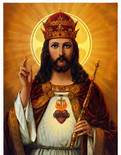
Let me put it this way: through 4th century sleight of hand, the Jesus who sided with the poor and those oppressed by empire – the one who promised a new heaven and earth belonging to the simple and poor, and who was executed as a terrorist by Rome – was made to switch sides. He was co-opted and domesticated – kicked upstairs into the royal class. He became not only a patron of the Roman Empire, but a “king” complete with crown, purple robes, scepter and fawning courtiers.

Following that transformation, kings and popes (now themselves transformed into gaudy temporal rulers) claimed to govern by divine right on behalf of Jesus as his representatives and vicars. In this way, the poor and oppressed (who then and now constitute the world’s majority) lost their paradigmatic leader, example and advocate. Jesus became instead a key part of the apparatus oppressing them.

Reza Aslan’s recent best-seller, Zealot, attempts to rescue the revolutionary historical Jesus from the distortions of the royal classes just mentioned. Aslan connects his salvage project specifically with today’s account of Jesus’ crucifixion in Luke, Chapter 23. In doing so, the author pays particular attention to Jesus’ cross, to the Roman inscription identifying Jesus as “King of the Jews,” and to the dialog between Jesus and the two “thieves” presented as sharing his fate.

According to Aslan, all three – cross, inscription and dialog – mark Jesus as a dangerous revolutionary “terrorist” rather than a domesticated upholder of the given order. That terrorist remains as threatening to today’s dominant empire, the U.S.A., as he was to imperial Rome. So he continues to be erased from history and by “feasts” like today that mask his true identity.

Take the cross first. It was the mode of execution reserved primarily for insurrectionists against the Roman occupation of Palestine. The fact that Jesus was crucified indicates that the Romans believed him to be a revolutionary terrorist. How could it have been otherwise, Aslan asks? After all, Jesus was widely considered the “messiah” – i.e. as the one, like David in today’s first reading, expected to lead “The War” against Israel’s oppressors.

Moreover, he proclaimed the “Kingdom of God,” a highly politicized metaphor which could only be understood as an alternative to Roman rule. It would return Israel, Jesus himself promised, to Yahweh’s governance and accord primacy to the poor and marginalized. The Romans drew logical conclusions. Put otherwise, the Roman cross itself provides bloody testimony to the radical threat the empire saw personified in Jesus.

That threat was made specific in the inscription the Romans placed over the head of the crucified Jesus. It read, “King of the Jews.”

Typically, those words are interpreted as a cruel joke by the Roman procurator, Pontius Pilate – as if he were simply poking fun at those who saw Jesus as the worthy successor of Israel’s beloved King David.

However, according to Reza Aslan, nothing humorous was intended by the inscription. Instead it was a titulus. Every victim of crucifixion had one – a statement of the reason for his execution. The motive for Jesus’ crucifixion was the same as for the many others among his contemporaries who were executed for the same crime: aspiring to replace Roman rule with home rule – with an Israel governed by Jews instead of Romans. The titulus on Jesus’ cross, along with the cross itself identify him as the antithesis of what he eventually became, a Roman tool.

And then there are those two thieves. Aslan says they weren’t “thieves” at all. That’s a mistranslation, he points out. A better translation of the Greek word, lestai , would be “bandits” – the common designation in the first century for insurrectionists. And there probably weren’t just two others crucified the day Jesus was assassinated. There may have been a dozen or more.

And, no, the whole world wasn’t watching either. As scripture scholar John Dominic Crossan observes, Jesus would have represented hardly a blip on the screen of Pontius Pilate. And Jews would have averted their eyes from the spectacle depicted in this morning’s gospel. They wouldn’t want to see “one more good Jew” suffering the fate of so many heroic patriots.

In this context the dialog between Jesus and two of the terrorists crucified with him takes on great significance. Actually, it documents the beginning of the process I described of changing Jesus’ image from insurrectionist to depoliticized teacher.

Think about it. Luke’s account of Jesus’ words and deeds was first penned about the year 85 or 90 – 20 years or so after the Roman-Jewish War (66-70 C.E.). By then the Romans had utterly defeated the Jews, destroyed Jerusalem and its temple as well as slaughtered the city’s population including practically all of the eyewitnesses of Jesus’ messianic campaign. Virtually the only Christians left standing were foreigners – gentiles living in population centers like Rome, Alexandria and Antioch. Few of these had any understanding of or sympathy for Judaism much less for Jewish politics and its liberation movements.

Besides that, in the war’s aftermath, both Jews and Christians sought to distance themselves from the socio-political expectations that had brought on the disaster of the Jewish War. So Judaism tried to transform itself from a Temple-centered religion to one focused on the local synagogue and rabbinic teaching – both overwhelmingly concerned with simply preserving the culture and identity of a people in diaspora.

For their part, Christians became anxious to show the Roman world that it had nothing to fear from their membership.

One way of doing that was to distance the dying Jesus from the Jewish insurgents and their terrorist actions against their oppressors. So in Luke’s death-bed dialog among three crucified revolutionaries, one of the terrorists admits that Jesus is “under the same sentence” as he and his comrade in arms. Given what Aslan said about crucifixion, that fact was undeniable. All three had been sentenced as insurrectionists.

But now comes the distancing between Jesus and Israel’s liberation movements. Luke has the “good thief” (read good terrorist) say, “. . . indeed we have been condemned justly, for the sentence we received corresponds to our crimes, but this man has done nothing criminal.”

In other words, Luke (writing for a post-war Roman audience) dismisses insurrection as “criminal,” and removes Jesus from association with such crime – a fact endorsed, Luke asserts, by insiders like the honest lestai crucified with Jesus. Luke’s message to Rome: the killing of Jesus was a terrible mistake; he meant no harm to Rome. And neither do we, his followers.

Loss of the radical revolutionary Jesus is not a trivial matter in terms of Christianity relevance to a world ruled by a nation that styles itself as Rome’s worthy successor. Like its ancient archetype, the U.S. (and a majority of first-world Christians) found the historical Jesus so threatening, that it determined that Jesus’ followers deserved the same fate as their crucified Master. For this we have the evidence of the war that the U.S. fought against liberation theology when it first emerged following the conclusion of the Second Vatican Council (1963-65).

Liberation theology committed the unforgiveable sin represented by this homily. It was guilty of connecting the Jesus of history described by scholars like Aslan to post-colonial independence movements and struggles against the neo-colonialism spearheaded by the U.S. and its oligarchical clients in the Third World.

In that struggle Pope John Paul II and his henchman, Josef Ratzinger, threw in their lot with a neo-imperial Ronald Reagan. It was deja-vu all over again: Reagan as Pilate and J.P.II and Ratzinger as the temple priesthood. It was the deja-vu of the church melding its interests with Rome towards the end of the 4th century.

More specifically, the two reactionary popes looked the other way and actively supported Reagan’s policies that assassinated hundreds of thousands of Christians (200,000 in Guatemala alone!) who found the radical Jesus threateningly relevant to their struggles in Latin America, Africa, and South Asia.

To balance liberation theology’s threat, Reagan patronized Evangelical Christians who eventually morphed into the Tea Party. It finds Aslan’s understanding of Jesus anathema. Meanwhile, John Paul II and Ratzinger “cleaned house,” eliminating every single progressive bishop from the hierarchy and transforming seminaries into hot houses to nurture a pre-Vatican II reactionary clergy.

Recently Pope Francis delivered a long-winded, very general and content-less speech to the National Council of Bishops in Brazil. That group used to head a church that was a hot-bed of liberation theology I’ve been describing here. The term was never mentioned in the new pope’s remarks. Instead, he presented John Paul II and Pope Ratzinger as champions of Vatican II.

He’ll have to do better than that to fulfill his aspiration towards making the church relevant to the poor he professes to care so much about.

He’ll have to confess the Church’s sins against liberation theology and revive the cult of the historical Jesus – instead of the depoliticized imperial “King of the Universe” today’s feast calls to mind.

Muhammad: Cars, Burkas, Lechery, Pedophilia, and Gold-Digging

Women in Islam

(This is the fourth in a series on Islam as liberation theology and on Muhammad as a prophet for our times. It is based on Karen Armstrong’s book, Muhammad, prophet for our times: London, Perennial Books, 2006.)

Have you noticed how champions of women’s liberation come out of the woodwork and suddenly materialize in the unlikeliest of places to justify wars against Muslims? After all, they argue, Sharia Law won’t even let women drive automobiles. How shocking! This contravenes (rich) women’s unalienable right to drive cars the same as men! Let’s go to war to liberate women!

And then there are those awful burkas and veils imposed by Islam. How cruel! Women should be allowed to wear mini-skirts and bikinis if they want. They should be allowed to coif themselves according to the West’s latest fashions, and to show their faces in public. Hell, if they want to be pole dancers, that’s their right! Those not recognizing it are worthy of death!

As we all know, such arguments have actually been used to mobilize support for wars in places like Afghanistan, Libya and Iran. And they’ve often been advanced by Republicans who like Rush Limbaugh, otherwise despise Women’s Liberation movements, and ridicule feminists as Femi-Nazis. But if it means killing Muslims, GOP Tea Partiers are happy to display pink ribbons. Whatever. Or as a Great Man once put it, “Bomb, bomb, bomb . . . Bomb, bomb Iran

These are the same people, by the way, who downplay the seriousness of rape. They blame it on men’s “understandably” uncontrollable impulses in the presence of women “provocatively” attired. After all women’s bodies are so programmed that pregnancy hardly ever results from rape. Or as another Great Man once said, “When rape is inevitable, just lie back and enjoy it.”

Can you spell “hypocrisy?”

Actually, according to Karen Armstrong, burkas, driving prohibitions, and veils have little to do with the Holy Qur’an and the spirit of the prophet Muhammad. Armstrong argues that he was a champion of women far ahead of his time. In general, women recognized in Muhammad a prophet on their side. In the face of cultural prohibitions, he allowed his wives to express their opinions freely and even to confront and disagree with him in front of others.

Muhammad also advocated complete equality of the sexes, with men and women sharing the same duties and responsibilities. Women were no longer to be treated as property bequeathed from one male to another. They could inherit estates, initiate divorce suits, and hang on to their dowries even following dissolution of marriage. As a result of such revolutionary teachings, women located themselves prominently among the prophet’s earliest and most enthusiastic followers.

Still, however, the western enemies of Islam insist on vilifying Muhammad as a lecher, pedophile, and gold digger. But these accusations turn out to be invidious calumnies. They stem from a failure to appreciate Arab culture 1400 years ago. It was an ethos that encouraged polygamy, just as had been the case among Israel’s patriarchs like Abraham and kings like David and Solomon.

In particular, Arab custom recommended the incorporation of vulnerable widows into the harems of those who could afford them, in order to protect the women from starvation and abuse. Additionally, treaties between tribes and nations were customarily sealed by marriage – again just as they had been in the culture of ancient Israel as described in the Hebrew Testament.

Acting in accord with such norms, Muhammad eventually assembled his own harem which came to include “child brides.” These were often part of the treaties just referenced. In such cases, cohabitation was postponed until the bride’s coming of age.

As for “gold-digging,” this accusation stems from Muhammad’s first marriage to Khadija, a distant relative who as a widow inherited a fortune from her first husband. She was a shrewd trader and employed a twenty-five year old Muhammad as one of her traveling merchants. This eventually led to a proposal of marriage on the part of the older woman. Muhammad accepted.

However, far from providing evidence of gold-digging on the prophet’s part, the history of the subsequent union offers ample proof of sincere love and respect between Muhammad and Khadija. She became his principal confidant as his revelations began to unfold. She encouraged him when they ceased for over two years. Following Khadija’s death, Muhammad continually upset his other wives by regularly singing her praises in their presence.

No, like other calumnies uttered against Muhammad and Islam, the ones about his repression of women contradict a reality that runs in quite the opposite direction.

It was men whose patriarchal instincts caused them to resist Muhammad’s leadership in this field. It was men who following Muhammad’s death interpreted one of the Qur’an’s surahs as requiring women to be segregated and veiled in public.

The surah in question (Number 33) was spoken by Muhammad during the reception following one of his late marriages. There some of his enemies acted passive-aggressively by overstaying their welcome, speaking disrespectfully to Muhammad’s wives, and generally preventing the newly weds from retiring for the night.

In response, after admonishing his guests about good manners, Muhammad gave Surah 33 the following expression:

“And as for the Prophet’s wives, whenever you ask them for anything that you need, ask them from behind a screen; this will but deepen the purity of your hearts and theirs.”

It was not until three generations after the prophet’s death that those controversial words were used to justify the veiling and segregation of Muslim women in general, as though they applied to all of them and not just to Muhammad’s wives.

Still even those late interpretations are understandable in the light of threats to Muslim culture, including those of our own day. As Karen Armstrong puts it,

“In times of vulnerability, women’s bodies often symbolize the endangered community, and in our own day, the hijab (veiling) has acquired new importance in seeming to protect the ummah (community) from the threat of the West (170).” (Parenthetical translations my addition)

In other words, Muslims are not blind. They see clearly the disrespect, abuse, and violence to which western women are routinely subjected. Evidently, it’s their judgment that such repression and negativity can best be avoided by eschewing mini-skirts, bikinis, fashionable hairdos, pole dancing, and even driving.

As another Great Man has said, “Who are we to judge?”

Islam, Violence and Double Standards

Christian Leadership

(This is the third in a series on Islam as liberation theology. It is based on Karen Armstrong’s Muhammad: a prophet for our times. London: Harper Perennial 2006)

Since 9/11 the West has vilified Islam as a violent religion and Muhammad as a blood thirsty fanatic. Since the mid-sixties, liberation theology has suffered similar accusations. Critics ask: What about Islam and violence, jihad and holy war? Isn’t Islam – isn’t liberation theology – inherently violent?

The question is ironic.

That’s because it is almost invariably posed by those wedded to the nation Martin Luther King called “the greatest purveyor of violence in the world today.” Conservatives there identify themselves as Christian. Yet they are among the strongest supporters of spending $2 billion per day (!) on the military. They love holy war.

Back in 1954, their government overthrew a democratically elected head of a Muslim state in favor of a brutal puppet, Reza Palavi. He proceeded to institute a quarter-century-long reign of terror in Iran, the birthplace of the Islamic currents so feared by Americans today.

Additionally the government of these Christians unconditionally supports Israel, a state which since 1948 has evicted Muslims from their ancestral homes in Palestine killing tens of thousands in the process. The majority of U.S. Christians not only support Israel in general (often on religious grounds), but even its possession of a vast arsenal of nuclear “weapons of mass destruction.”

In response, Muslims have used box cutters, stones, sling shots, primitive IEDs and homemade rockets, (along, one day, with hijacked planes) to defend themselves and counter-attack against forces that have declared a perpetual war against them.

Why this condemnation of the violence of the impoverished adherents Islam alongside virtual worship of the “Gods of Metal” by rich imperialists? The answer lies in Muhammad’s attitude towards war.

Like the vast majority of Christians since the 4th century, including our own day, and along with virtually all the prophets of the Jewish Testament, Muhammad was not a pacifist. Remarkably – once again like most Christians – Muhammad was a proponent of just war theory. In fact, he pioneered the theory’s development far ahead of its Christian proponents. Following its dictates, common sense and Muslim doctrine, the poor, he insisted, have the right to self-defense.

Yes, Muhammad recognized the right to jihad. Most of us are familiar with the term which is translated for us as “holy war.” Actually, the word means “struggle.” It signifies resistance to the forces of self-seeking within the individual believer, the Muslim community, and against those forces as represented by those who attack from without.

It’s that latter application that makes Islam so threatening to the West. The West wants no part of people who defend themselves against western depredations. Meanwhile western powers themselves claim not only the right of self-defense but even the prerogative of “preemptive strikes.”

What the West expects in return on the part of those attacked – especially if the attacked are “religious” – is a pacifism that for more than seventeen hundred years has never been a major part of “Christendom’s” belief system. As a matter of fact, western Christians tend to ridicule pacifists as unrealistic, unpatriotic, even cowardly “bleeding hearts.”

No, the West wants an enemy that simply rolls over for colonialism (in Israel), wars of aggression (in Iraq), policies of torture and illegal imprisonment, drone strikes, mass killings of innocent civilians, support of unpopular dictators, rigged elections, and a host of other crimes. In fact, when religious people defend themselves, westerners cry “foul” and condemn their victims for being hypocritical and “violent.” If the self-defenders are Christians influenced by liberation theology, they are characterized as Marxist, communist, totalitarian dupes. If they are not, their religion itself is perverse. Once again, all of this is as if westerners themselves were somehow religiously pacifist. They clearly are not!

Do you see why I used the term “ironic?” Actually, a stronger word is required but is likely unprintable.

And there’s more to this question of violence and Islam . . . . Muhammad’s own experience of being driven from Mecca by opponents of Islam closely tracks that of Israel’s treatment of Arabs in Palestine.

This becomes evident by recalling Muhammad’s basic story. It’s the account of a prophet and his followers attempting to return to a homeland from which (like today’s Palestinians) they have been exiled by force. Here are the elements of Muhammad’s career:

• An impoverished merchant from Mecca
• Living in a period of cultural crisis
• Characterized by neglect of the poor and vulnerable
• Receives revelations from God
• Centralizing surrender (Islam), humility, equality and peace
• He gradually draws to himself many devoted followers
• Drawn especially from society’s castoffs and despised – especially women
• This community is squeezed out of Mecca
• Its dwellings confiscated by the ruling class
• Now based in Medina, Muhammad and his followers (Muslims) wage a decades-long struggle to return home
• The struggle centralizes guerrilla attacks, economic blockade, “sit-ins,” and non-violent demonstration
• (At times, it is true, the tactics stood in conscious violation of basic Muslim commitment to peace and reconciliation)
• By these means, Muslims finally return to Mecca
• And establish Islam as the dominant religion of Arabia

In view of these details, it’s no wonder that Palestinians claiming “right of return” find inspiration in Muhammad. It’s no wonder that sister and brother Muslims throughout the world sympathize with the Palestinian cause and recognize Muhammad as a prophet for our time.

It’s no wonder that the U.S. and Israel vilify Muhammad’s religion so attractive to the impoverished people they are so intent on oppressing.

(Next week: Islam and Women)