Marianne Williamson, Reparations & Restorative Justice

Readings for 31st Sunday in Ordinary Time: WIS 11:22-12:2; PS 145:1-2, 8-9, 10-11, 13, 14; 2 THES 1:11-2:2; JN 3:16; LK 1:1-10

Today’s readings for the 31st Sunday in Ordinary Time bring up questions of restorative justice and reparations for the harm we may have caused others as individuals and as Americans.

The day’s main focus is the familiar story of the tax collector Zacchaeus.  This very wealthy man was inspired by Jesus to give half of his possessions to the poor and to restore to those he had defrauded four times as much as he had embezzled.

Zacchaeus’ example makes me think of Marianne Williamson’s campaign for president which has made reparations a central plank in her platform.  

Of course, Marianne’s reparations focus is the African American community. But her rationale for it suggests something far beyond race relations within the United States.  It intimates as well reparations to victims of U.S. foreign policy and to Mother Nature herself.

Let me explain and then show how the explanation is related to this day’s readings.

To begin with, yes, I’m still supporting Marianne Williamson for president.  She is the only candidate who confronts us with the undeniable truth that Americans need a fundamental change in consciousness if we are to address the unprecedented problems currently facing humankind.

That’s what Marianne means by “miracles” — changes in fundamental perceptions. That was also central to Jesus’ proclamation about the Kingdom of God. We must think differently about the world and act accordingly.

So, it’s not a question of merely tweaking the reigning economic system or of reviving Roosevelt’s New Deal. What we need is an entirely new world vision that operates from the premise that everything we see is completely upside down. Reality stands 180 degrees away from what our culture tells us. All of it. If our culture says “black,” we should think “white.” If it says “good,” we should think “bad.” If it says “peace,” we should know they’re getting us ready for another war.

Instead, we are all one – women, men, children, immigrants, refugees, animals, plants, and the very air we breathe. That’s the basis of Marianne Williamson’s candidacy. There are no foreigners, no sacrosanct borders – no America First. In fact, the United States must take 100% responsibility for the world’s ills.  

My decision to continue my support of Marianne Williamson was reinforced by listening to a campaign speech she gave at Yale University last week.

There she made the following points that she has always centralized in her approach to politics and to simply living as an evolved human being in our troubled world. Notice how they echo today’s Gospel themes, reparations and restorative justice:

  1. We all know that until we identify and address the root of our problems in our personal, family, and community relationships, we’ll never truly solve those problems.
  2. However, what is true in our personal lives also applies to our nation, because nations are simply groups of individuals.
  3. As Americans, we have been unwilling to face up to the harm caused by slavery, Jim Crow, and segregation on the one hand and to the resulting wealth accumulation in the white community on the other.
  4. The same holds true for U.S. foreign policy which has been based on colonialism and neocolonialism which are simply euphemisms for forcefully transferring wealth from the Global South to the Global North.
  5. Such transfer-by-force has been destructive not only to people but to the natural environment destroyed by industrialized agriculture, rainforest destruction, overfishing, and massive waste disposal in what’s been called the Third World.
  6. We thus owe reparations to African Americans, to the Global South, and to Mother Nature.
  7. Marianne’s presidency would have us directly confront those problems as the sine qua non for solving our national dilemmas, world poverty, and impending climate catastrophe.

Now, those are truly radical positions (in the etymological sense of that term). No other candidate – not even Bernie or Elizabeth Warren – addresses them at the level of consciousness emphasized by Marianne Williamson.

So, think about that and Marianne’s position on reparations and restorative justice as you read the selections included in this Sunday’s liturgy of the word. You’ll find them here. They all invite us to radically transformed ideas of God, ourselves and of those we live with – particularly on the other side of the street, on the other side of the tracks and on the other side of the world.  (Note that the first reading is from the Book of Wisdom which imagines God’s Spirit as female.) What follows are my reading’s “translations.” Please check for yourself to see if I’ve got them right:

 WIS 11:22-12:2

The Real Master
Of the Universe
Is immense
And intense
In her presence
In everything
And everyone.
To her
Our “sins” and addictions
Are trivial.
They mean nothing
In her vast
Scheme of things
Where all people
Are loved and cherished
Just as they are –
As God created them.
“Repentance”
Means rejecting
False guilt
And “wickedness”
While repairing
The hurts
We’ve inevitably inflicted
On others.
 
PS 145:1-2, 8-9, 10-11, 13, 14
 
Where God is recognized
As Love
Her name
Is constantly extolled.
She is lovely herself
And merciful
Never angry
But kind and compassionate
Always.
So, set aside
“Fear of the Lord”
And embrace your Queen
Who keeps her word,
Does nothing harmful
And favors her
Heavily burdened
And (necessarily) fallen
Children.
 
2 THES 1:11-2:2
 
Rabbi Paul’s
Constant prayer for us
Is that we might be
Like his teacher, Jesus
Who recognized
Everyone and everything
As lovable
And full of grace.
In fact,
Jesus is among us
Each day
Whenever we gather
Together
And not merely in some
Far distant future
As false teachers say.
 
JN 3:16
 
Yes, our wise Queen
Has given us Jesus
Who showed us Life
In its fullest form
That we might live
Happily ever after
 
LK 1:1-10
 
Zacchaeus,
The rich exploiter
Of his own people,
Was a tiny man
In more ways than one,
But as an example
Of repentance and reparation.
He rose above the crowd
To see Jesus differently.
Imagine his surprise
(And the anger
Of his victims)
When Jesus
Saw him differently
And invited himself for dinner.
The result?
Zacchaeus grew
Into a giant
On the spot
Giving half his possessions
To the poor
And paying
Four times
His extortions!
Four times!!
How’s that
For reparations?

I hope you can see the connection between those readings and Marianne Williamson’s emphasis on reparations for slavery and restorative justice for resources stolen in a system of unequal trades identified in the Global South as neocolonialism. The readings (and especially the example of Zacchaeus) show that such policies based on a clear moral sense of justice should represent the twin pillars of domestic and foreign policy.

No other candidate has identified those pillars with the clarity and conviction of Marianne Williamson. In the end, no other candidate — and very few spiritual leaders of any stripe — challenge us to rethink our entire understanding of life.

According to Williamson and Jesus, life, truth, and our health as a nation are to be found in exactly the opposite direction from that indicated by the reigning ideology.

How We Rich Exclude Ourselves from the Kingdom of God

Readings for 30th Sunday in Ordinary Time: SIR 35: 12-14, 11-18; PS 34: 2-3, 17-18, 19, 28; 2 TM 4: 6-8, 16-18; LK 18: 9-14. 

“A pope and a pimp went into St. Peter’s to Pray.” That’s the way scripture scholar, John Dominic Crossan, conveys the shock that must have been felt by Jesus’ audience when he opened today’s familiar gospel parable with the words “A pharisee and a tax collector went up to the temple to pray.” Even joining the words “Pharisee” and “tax collector” in the same sentence was like putting “pope” and “pimp” together. It jars the ear. And why would a pimp be praying at all? Why would a tax collector?

Despite its shocking overtones, homilists generally domesticate this parable to make it reinforce conventional wisdom about pride and humility. The Pharisee was proud, they say. The tax collector was humble. Be like the tax collector.

Crossan however says that there’s something much more challenging and fundamental going on in this parable. The focus of Jesus’ story is not pride vs. humility. It’s about rejecting the Pharisee’s conventional morality. The parable even calls us to scrap conventional wisdom about pride and humility.

More positively, the story is a summons to enter God’s Kingdom by identifying with the poor and despised who are celebrated throughout today’s liturgy of the word. The parable and its supporting readings also explain why the conventionally good simply cannot enter the Kingdom of God, which in Jesus’ understanding is never about life after death, but a this-worldly reality where God is king instead of Caesar.

Please give a listen to the readings. You can find them here. My “translations” run as follows:

 SIR 35: 1-14, 16-18
 
God’ justice reverses
The world’s preferential option
For the rich.
It is instead
Duly prejudiced
In favor of
The poor, oppressed,
The orphan, and the widow.
God listens to them
And affirms
Their rights
To speedy justice.


PS 34: 2-3, 17-18, 19, 23
 
Yes, be thankful and glad
That God hears
The cry of the poor
The brokenhearted
And those whose spirits
Have been crushed
By oppressors
Whose names
Will soon
Be forgotten.
 
2 TM 4: 6-8, 16-18
 
The apostle Paul was
One of the oppressed.
He kept faith
In God’s justice
Even during
His rigged
Imperial trial
When his friends
Abandoned him.
Though exhausted
Like a long-distance runner
Or a gladiator
Before a lion,
He nonetheless
Felt God’s presence
As his source
Of strength and courage
Enabling him
To proclaim
God’s Kingdom
To everyone.
.
 
2 COR 5:19
 
God’s preferential
Option for the poor
Is the very message
Of Jesus, the Christ.
It can save the world.
 
LK 18: 9-14
 
Jesus’ parable
Of the Pharisee and Tax Collector
Taught that
Self-justifying
Conventional morality
Is not pleasing to God –
Not even when supported
By long prayers,
Generous tithes,
Sexual purity,
And frequent fasting.
(Yes, the Pharisee
Did all of that!)
Instead,
Entrance into God’s Kingdom
Requires nothing
But membership
In the group
Considered sinful
By us pharisees and
Our conventional morality.

To unpack those readings, first of all, think of the last one in terms of popes and pimps. Popes are generally respected people. They’re religious leaders. Wherever they go, crowds flock around them just to get a glimpse, a blessing, or possibly even a smile or touch.

Pharisees in Jesus’ time enjoyed similar respect with the common people. Pharisees were religious teachers and textbook examples of conventional morality. They usually did what the one in today’s gospel said he did. They kept the law. The Pharisee in today’s reading was probably right; chances are he wasn’t like most people.

Generally, Pharisees were not greedy, dishonest, or adulterers. Or as their exemplar in Luke put it, he was not like the tax collector alongside him in the Temple. Pharisees gave tithes on all they possessed – to help with Temple upkeep.

On the other hand, tax collectors in Jesus’ day were notorious crooks. Like pimps, they were usually despised. Tax collectors were typically dishonest and greedy. They were adulterers too. They took advantage of their power by extorting widows unable to pay in money into paying in kind.

In other words, the Pharisee’s prayer was correct on all counts.

But we might ask, what about the tax collector’s prayer: “O God, be merciful to me, a sinner?” A beautiful prayer, no?

Don’t be so quick to say “yes.”

Notice that this tax collector doesn’t repent. He doesn’t say, like the tax collector Zacchaeus in Luke’s very next chapter, “Look, half of my possessions, Lord, I will give to the poor; and if I have defrauded anyone of anything, I will pay back four times as much (LK 19:8). There is no sign of repentance or of willingness to change his profession on the part of this particular crook.

And yet Jesus concludes his parable by saying: “I tell you, the latter (i.e. the tax collector) went home justified, not the former. . .” Why?

I think the rest of today’s liturgy of the word supplies an answer. Each reading is about God’s partiality towards the poor, oppressed, orphans, widows and the lowly – those who need God’s special protection, because the culture at large tends to write them off or ignore them. Typically, they’re the ones conventionality classifies as deviant. The Jewish morality of Jesus time called them all “unclean.”

However, all of them – even the worst – were especially dear to Jesus’ heart. And this not because they were “virtuous,” but simply because of their social location. Elsewhere, Jesus specifically includes tax collectors (and prostitutes) in that group. In MT 21: 38-42, he tells the Pharisees, “Prostitutes and tax collectors will enter God’s Kingdom before you religious professionals.”

But why would a good person like the Pharisee be excluded from God’s Kingdom? Does God somehow bar his entry? I don’t think so. God’s Kingdom is for everyone.

Rather it was because men like the Pharisee in the temple don’t really want to enter that place of GREAT REVERSAL, where the first are last, the rich are poor, the poor are rich, and where (as I said) prostitutes and tax collectors are rewarded.

The Pharisee excludes himself! In fact, the temple’s holy people wanted nothing to do with the people they considered “unclean.” In other words, it was impossible for Pharisees and the Temple Establishment to conceive of a Kingdom open to the unclean. And even if there was such a Kingdom, these purists didn’t want to be there.

Let’s put that in terms we can understand in our culture.

Usually rich white people don’t want to live next door to poor people or in the same neighborhood with people of color – especially if those in question aren’t rich like them.

Imagine God’s Kingdom in terms of the ghetto, the barrio or favela. Rich white people don’t want to be there.

Yes, according to this morning’s readings – according to Jesus – the “undesirables” among us are the ones to whom the Kingdom of God belongs. They are the favorites of the God who Sirach says is “not unduly partial to the weak.” Rather God is fittingly partial to them as the Sirach reading itself and the rest of today’s liturgy of the word make perfectly clear!

This means that any separation from God’s chosen poor amounts to excluding oneself from the Kingdom white Christians spend so much time obsessing about.

So, today’s readings are much more radical than usually understood. The parable of the Pharisee and the tax collector – of the pope and the pimp in St. Peter’s – is not an affirmation of conventional morality. It’s not even a celebration of imagined virtue on the part of the poor or about repentance. It rejects all such ethnocentric hypocrisy! Jesus’ parable is not even about approving conventional wisdom concerning pride and humility.

As always with Jesus’ teachings, it is about the Kingdom of God, about those who belong and about us who exclude ourselves.

A Frightening Child & Prayer to Save the Environment

Readings for the 29th Sunday in Ordinary Time:  EX 17: 8-13; PS 121: 1-8; 2 TM 3: 14-4:2; HEB 4: 12; LK 18: 1-8

Were you inspired by Greta Thunberg? I couldn’t get over her courage.

Imagine: a child of 16 years suddenly thrust beneath the blinding spotlight of the world’s stage – speaking confidently with a pope and with heads of state, addressing huge crowds and the United Nations itself. All of that would frighten me. How about you?

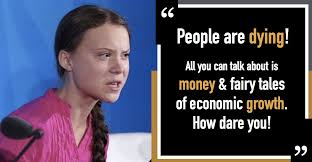
And she called them all to task. “How dare you!” she repeated again and again to the world’s movers and shakers whose programs for addressing climate change fell far short of the goals set by climate scientists. “Don’t listen to me,” she repeated; “listen to the scientists.” In other words, align yourselves with what Mother Nature, Life Itself, and the Universe are telling us.

And, of course, you saw the effects of her audacity. Millions were mobilized across the planet.

What started as a one-girl protest before the Swedish parliament swiftly became a thing.

Youngsters everywhere, including my own grandchildren, walked out of class and imitated Greta’s defiance. My five-year-old grandson challenged us all for driving a Volvo van whose gas engine, he said, is destroying the environment. “We should be driving an electric car instead” he objected. A five-year-old!

As someone pointed out, it’s a “Children’s Crusade” against capitalism’s worship of Moloch.

And what fear it inspired in the powerful! This wisp of a girl exercising the super-powers of concentration and focus conferred by an Asperger’s condition that would have others hiding under a rock, suddenly had the movers and shakers shaking with fear. Some ganged up on her, attacked her parents, and even belittled the teenager as mentally deficient. Their cowardly desperation showed that they were more afraid of her than she of them.

All of that is relevant to today’s liturgy of the word. It’s about prayer understood as Greta- Thunberg-like alignment with Life’s processes. Regardless of what we might call it, such re-orientation can change the world and cause powerful enemies of justice to tremble even before those they see as the weakest among us.

More specifically, today’s readings trace biblical understandings of prayer from a voodoo-like practice intent on harming one’s enemies to the alignment with Life’s purposes just described. Here’s the way they run according to my own “translation.” Judge for yourself to see if I’ve got them right. You can read the originals here

 Long ago
When Israel’s primitive faith
Still pictured God
As a Man O’ War,
They magically imagined
A Yahweh persuaded
To slaughter their enemies
By Moses’ adoption
Of Wiccan postures,
Magic rocks
And feats of
Super-human endurance.
 
PS 121: 1-8
 
They were right,
Of course,
To intuit
That the Creator
Is eternally helpful
In protecting
The lives
And chosen paths
Of his creatures
Providing sunlight by day
And moonlight by night.
Divine power
Is always disposed
To help
The oppressed.
 
2 TM 3: 14-4:2
 
However, the mystic Paul
Had already
Ventured far beyond
His forebears’ voodoo.
Though he recognized
Israel’s written tradition
As inspired,
He also
Identified Jesus
As its ultimate interpreter.
For the Master,
Life’s Author
Was no Man O’ War
But a loving, patient, encouraging
Father.
 
HEB 4: 12
 
Deep in our hearts
We already knew
This to be true.
Thank you!
 
LK 18: 1-8
 
The comic Jesus
Even joked about
Those who thought
Of God as a cruel judge
Susceptible
To tiresome entreaties
And cowering before
Poor widows who
Might cuff him
About the ears
If he didn’t
Answer their petitions.
Better, he said
To “pray always”
In a quiet way
That matches
God’s unwavering disposal
To secure justice
For the oppressed.
No Man O’ War
No exhausting prayers
No Mosaic sorcerer
Here!

There are salutary lessons in those readings.

According to their vision, prayer does not mean persuading some Man in The Sky to change his mind to match our capricious whims. Instead, it’s the process of aligning our minds with the Universal Love that underpins all of reality and that in practice expresses itself in justice for widows, orphans, and immigrants – the traditional biblical protegees of God’s concern. Prayer is a habit of mind that doesn’t call for words or supplications, but for awareness of the places in life where love-as-justice is breaking in.

That love remains nearly invisible because of human attempts to obscure it with tropes about rugged individualism, survival of the fittest, dog-eat-dog reality, and “nature red in tooth and claw.” Such worldly wisdom normalizes fear. Unlike Greta Thunberg, ordinary people adopting that normality become frightened and immobilized before terror -inspiring kings, presidents, bosses and judges.

Jesus’ parable of the widow and the judge turns that familiar dynamic on its head. It calls us to “pray always” in the sense earlier described. Then, once our minds are aligned with God’s loving purposes, we’re called to imitate the widow who insistently sought justice not from God, but from the judge “who neither feared God nor respected any human being.”

In other words, Love understood as Justice for the oppressed will drive us (as it did Greta and her Children’s Crusade) to petition, protest, demonstrate, and engage in the type of direct action that threatens such agents of injustice. Jesus’ joke about the judge’s fear that a poor widow might do him physical harm makes his point that the selfish ones who exercise power over us are more afraid of us than we of them.

So, today’s readings suggest, align with justice and then join Greta in the streets. Be as courageous as she. Become as a little child (MT 18:3). Frighten the hell out of those judges, presidents and worshippers of Moloch! Save the planet!  

The Biblical Tradition Advocates Healthcare for All – Even for Enemies of the State

Readings for the 28th Sunday in Ordinary Time: 2 KGS 5: 14-17; PS 98: 1-4; 2 TM 2: 8-13; 1 THES 5:18; LK 17: 11-19

On October 4th, President Trump signed a proclamation denying visas to immigrants who can’t afford to purchase health insurance within 30 days of their arrival to the United States. The new restrictions are scheduled to be implemented on November 3. They will also exclude immigrants from subsidies under the Affordable Care Act.

In its proclamation, the White House said it was taking this step to safeguard the health-care system for American citizens by preventing immigrants from enrolling in Medicaid or going to emergency rooms with no insurance, requiring hospitals or taxpayers to cover the cost.

“President Trump has taken action to promote immigrant self-sufficiency, which has long been a fundamental aspect of our immigration system,” the proclamation said.

In other words, (and listen for the irony here) the uber-rich president’s action is directed against poor people and is designed to save money for a revenue base recently depleted by tax breaks principally benefitting the richest people in the most affluent country in the world.

It’s simply another onslaught in Trump’s war of rich against poor.

Today’s liturgy of the word shows that the new proclamation is not only ironic, it also stands in sharp contradiction to the Judeo-Christian tradition and its emphasis on gratuitous healing.

I mean, this week’s readings seem providentially related to the issue of healthcare not only for resident aliens, but for explicit enemies of the state. The selections have two prophets (Elisha in the case of the Jewish Testament) and Jesus (in its Christian extension) curing foreign lepers. In Elisha’s case, the beneficiary of his cure is a general in an enemy army (Assyria) actually at war with Israel. That would be like Americans extending care to a notorious terrorist.  

Additionally, the readings connect with current debate about Medicare for All by suggesting the inappropriateness of charging money for healing which is understood as a gift from God. As such, the readings intimate, it should be available to all humans with no distinctions about race, class, or gender.

Please read the texts in question here. What follows is my own “translation” of their unusually coherent message about foreigners and healthcare.

 2 KGS 5: 14-17
 
During Assyria’s war on Israel,
Naaman, an enemy general,
Was cured of leprosy
By Israel’s prophet, Elisha.
The general offered
A valuable gift
In exchange.
But Elisha refused
To profit from
God’s healing.
Such salvation
Is as free as earth itself,
He implied.
It is entirely fungible
To entirely
Fungible people.
 
PS 98: 1-4
 
So, let’s sing
Of God’s healing (salvation).
On behalf of Israel
It manifests
God’s favor to non-Jews too
Causing the whole earth
To break out in song.
 
2 TM 2: 8-13
 
Jesus the Risen Christ
Endorsed Paul’s teaching
About the equality
Of Jews, Greeks,
Slaves and free,
Male and female
Prisoners and criminals.
Jesus identifies with all,
Paul said.
Every one of them
Is “chosen.”
God cannot deny
God’s generous Self.
 
1 THES 5:18
We are so grateful
For this wonderful teaching!
 
LK 17: 11-19
 
Like Elisha,
Jesus cured leprosy
This time
In a gang of 10 –
Including a Samaritan
An enemy of the people
Just like Naaman.
It was Healing
For nothing
Except for the outsider's
Singular word of thanks
Which healed him
Totally.
[No doubt
The ungrateful ones
Remained (partially) healed
As well.]

Not much needs to be added to the teachings so clearly embedded in today’s readings.

They’re about curing a culture’s most dreaded disease. They’re about foreigners and a divine dispensation that recognizes no one as somehow “foreign” or to be “shunned.” That’s true even if they represent a designated enemy of the state or adherents to a religion considered intrinsically evil by prevailing community standards.

As usual, then, and in other words, this week’s readings challenge our most cherished certainties. They call us to open ourselves to the poor, to foreigners, and even to those we’re taught to fear and hate.

They call us to denounce and resist Trumpian “proclamations” like the recent one punishing immigrants and refugees for their poverty and accidents of birth over which they have no control, but which especially endear them to the Author of Life.

Liberation Theology: Seeing Divine Intervention on Behalf of the Poor

Readings for 27th Sunday in Ordinary Time: HAB 1: 2-3; 2:2-4; PS 95: 1-2, 6-7, 8-9; 2 TM 1: 6-8, 13-14; 1 PT 1:25; LK 17: 5-10

Last week’s homily on “Dives and Lazarus” evoked an interesting comment from one of the most faithful and thoughtful readers of this blog. The point of address was a statement in my related reflections on liberation theology, viz. that in the biblical tradition “God passes from being a neutral observer of earth’s injustices to an active participant with the poor as they struggle for justice here on earth.”

In response, the reader commented, “The disheartening truth is that I see no evidence of this ever having been the case in the literal sense. Metaphorically, yes, and in prophetic but unfulfilled texts, but I fail to see even one concrete example. The rich and the poor seem to be equal in that both will have to wait for some nebulous afterlife to receive their reward. Meanwhile, the rich, proverbially, get richer.”

The comment is providentially related to this Sunday’s readings, which address the question of unanswered prayers and the frustration of those who look for evidence of God’s presence in the world and find none. Before I get to that, however, let me respond directly to what the reader said.

To begin with, I agree with his comment in that:

  1. It is often “disheartening” to look for God’s intervention on behalf of the poor (or any of us for that matter) and to see none.
  2. No one will see or ever has seen “literal,” “concrete,” and undeniable evidence of such intervention.
  3. So, in relation to faith and speech about God, metaphor used by “seers” (i.e. prophets gifted with capacity to see what’s opaque to the rest of us) is all we have.
  4. Contrary to biblical tradition, our inherited, domesticated religious culture insists that the rich and poor are equal in God’s eyes and that we must endure obscene wealth disparities till after death.
  5. As a result, wealth disparities flourish; the rich get richer.

So, relative to such observations and according to liberation theologians, what do the seers (those who can see beyond the shadows in our “Plato’s Cave”) tell us about God’s siding with the poor? Just this:

  1. God is Love and has established a loving order with room for everyone. This loving order of Universal Intelligence represents the larger, unchanging dispensation in which we live and move and have our being. It is the world as God created it.
  2. Throughout history, human structures (familial, economic, social, political, etc.) have been set up by the rich and powerful in opposition to the divine order. This is the origin of race-consciousness, nations, borders, latifundial holdings, slavery, poverty and wars. None of these represent the world as it comes from the hand of God, where the world belongs to everyone.
  3. The spokespersons for that other world are the “prophets” who have always been among us pointing out the in-breaking of the Love that is always there (e.g. Krishna, the Buddha, Jesus, Mohammed, Marx, Gandhi, King, Greta Thunberg . . .) Uniformly, they point out the opposition between the order of Universal Intelligence and the “wisdom of the world;” they indicate where Love is manifesting Itself; they invite the rest of us to “see” and to align with Love’s order.
  4. Those who listen to the prophets are the indispensable agents of Universal Intelligence for the “salvation” of humanity from the inevitable destructive results of the world’s “wisdom.” They are everywhere for those with eyes to see.
  5. In the end, however, Love’s order will prevail regardless of human activity; it alone is Real; the rest is illusion and doomed to pass.

With that in mind, please turn your attention to today’s liturgy of the word. You can find the readings here. In the meantime, what follows are my “translations.” As you’ll see, they directly address unanswered prayers and Love’s order as decreed by Universal Intelligence.

 HAB 1: 2-3; 2:2-4
 
I’ve been praying
Dear God,
For your Kingdom to come,
For violence to cease
For relief from our misery.
Yet you seem deaf
To my pleas.
After all,
Wars continue
Violence increases
Everyone’s at
Each other’s throat.
What should I think?
 
Only this:
(And write it in stone!)
My timetable,
My order
Is vastly different
From yours.
What’s invisible,
What seems delay to you
Is always there
And perfectly timely for me.
So, be patient
Keep your commitment
To my just order.
My answer to prayer
Is never late.
It’s omnipresent.
 
PS 95: 1-2, 6-7, 8-9
 
I have heard your response,
Dear God
I’m thankful and happy
For the reminder.
Your words
Are solid as rock.
It’s true:
You know far more
Than us.
You have never
Let us down.
I will therefore not ever
Lose faith
Against your
Proven fidelity.
 
2 TM 1: 6-8, 13-14
 
Such words of response
Are wise.
They are the expression
Of a Holy Spirit,
Within us all.
It can set
The world ablaze
With love.
It is courageous
And disciplined,
It expresses the
Strength of God.
It enables us
To endure even prison
And hardships
Of all kinds.
It is the very Spirit
Of Jesus, the Christ.
 
1 PT 1:25
 
We’re happy to say that
We share
Such enduring faith
With sisters and brothers
Past and present.
What joy to live
In such holy company!
 
 
LK 17: 5-10
 
When Jesus’ followers
Prayed for stronger faith,
He reminded them
That even a little bit
Can change
Expectations profoundly.
Never forget, he said,
That you are not in charge;
Love is.
You are only Love’s servants.
God is not
Your errand boy
Beholden to
Culturally-shaped
Plans and needs.

With those readings in mind, i.e. when we allow God’s word to open our eyes and ears, when we listen to the prophets (God’s spokespersons), we see concrete manifestations of God’s presence and siding with the poor everywhere. Right now, they’re evident, I think, in:

  1. Nature Itself: Regardless of human efforts to obscure and deny the divine, its presence calls constantly to us in events so close to us and taken-for-granted that they’ve become invisible. I’m thinking about the sun, the ocean, trees, the moon, stars, wild flowers – and our own bodies whose intelligence performs unbelievable feats each moment of our lives.
  2. Liberation Theology: This rediscovery of God’s preferential option for the poor has changed and is changing the world. One cannot explain the pink tide that swept Latin America during the 1970s, ‘80s, and 90s – not Brazil, Argentina, Nicaragua, Venezuela – without highlighting the inspiration provided by liberation theology. Neither can one explain the rebellion of the Muslim world against western imperialism without confronting Islam’s inherent liberating drive – again on behalf of the disenfranchised, impoverished, and imperialized.
  3. Contemporary Social Movements: Think Occupy, Black Lives Matter, the Sunrise Movement, Yellow Vests, Standing Rock, the Green New Deal, and prophetic figures like (once again) Greta Thunberg, Naomi Klein, Bill McKibben, and Pope Francis with his landmark climate encyclical Laudato si’ . All of these movements and figures stand on the side of the poor and are having their effect.
  4. Marianne Williamson’s Campaign: Of all the current candidates for president, Marianne Williamson most articulately and faithfully bases her “politics of love” on the five prophetic insights referenced above. The mere fact that she is actually running for president signals an actual and potential awakening of American consciousness far beyond what’s (thankfully) portended even in the candidacies of Bernie Sanders and Elizabeth Warren.

Martin Luther King once famously said that the moral arc of the universe is long, but that it bends towards justice. “Justice” in his vocabulary meant overcoming the laws and social structures crafted by the rich and powerful to keep the poor in their place. King (and Malcolm as well) was a practitioner of African-American liberation theology. As such, he was gifted with eyes to see differently — to see the Judeo-Christian tradition as revealing a God on the side of the poor.

That’s what our Sunday liturgies of the word reveal consistently. This week is no exception. It invites us to open our eyes.

Dives & Lazarus: a primer on liberation theology

Readings for the 26th Sunday in Ordinary Time: AM 6: 1A, 4-7; PS 146: 7-10; I TM 6: 11-16; LK 16: 19-31 

Today’s liturgy of the word provides us with a virtual catechism of liberation theology – Christianity’s most important theological development in the last 1500 years, and the West’s most important social movement of the last 150 years.

I have come to those conclusions over a period of more than forty years studying liberation theology. My interest began in Rome during my graduate studies there, 1967 through 1972. There I first heard Peru’s Gustavo Gutierrez speak. (Fr. Gutierrez is considered the father of liberation theology.)

Subsequently I read Gutierrez’s bookA Theology of Liberation (1971) and was completely taken by it. Reading the book gave me the feeling that I was hearing Jesus’ Gospel for the very first time.

You might ask, what is liberation theology? To answer that question fully, please look at my blog entries under the “liberation theology” button. I’ve written a series on the question. In my blogs, you’ll find that I always define it in a single sentence. Liberation theology is reflection on the following of Christ from the viewpoint of the world’s poor and oppressed. That’s the class of people to which Jesus himself belonged. They constituted the majority of his first followers.

When read from their viewpoint, accounts of Jesus’ words and deeds – the entire Bible for that matter – take on depths of meaning and relevance to our contemporary world that are otherwise inaccessible to people like us who live in the heart of the wealthy world. From the viewpoint of the poor, God passes from being a neutral observer of earth’s injustices to an active participant with the poor as they struggle for justice here on earth. Jesus becomes the personification of that divine commitment to the oppressed. After all, he was poor and oppressed himself. The Roman Empire and its Temple priest collaborators saw to that.

My interest in liberation theology deepened as my teaching career developed at Berea College in Kentucky from 1974 to 2010. There I was encouraged to continue my study of liberation theology. So, I spent extended periods in Brazil, Nicaragua, Costa Rica, Honduras, Guatemala, Cuba, Mexico, Zimbabwe, South Africa, India and elsewhere studying under liberation theologians, dialoging and publishing with them. The poor in all of those countries were suffering from the aggression the United States directed against them.

Meanwhile at Berea, I found the conclusions of liberation theologians validated by the college’s very fine scripture scholars. They had almost no acquaintance with liberation theology, and yet what they were teaching perfectly harmonized with its central tenets. It’s just that they stopped short of drawing what seemed to me the obvious political conclusions from their work.

More specifically, Berea’s scholars identified the Exodus (Yahweh’s liberation of slaves from Egypt) as God’s original and paradigmatic revelation. The whole tradition began there, not in the Garden of Eden. Moreover, the Jewish prophetic tradition emphasized what we now call “social justice.” Even more, Jesus of Nazareth appeared in the prophetic tradition, not as a priest or king. Jesus directed his “ministry” to the poor and outcasts. The Gospel of Luke (4: 18-19) has Jesus describing his program in the following words:

“The Spirit of the Lord is upon me, because he has anointed me to bring good news to the poor. He has sent me to proclaim release to the captives and recovery of sight to the blind, to let the oppressed go free, and to proclaim the year of the Lord’s favor.”

After his death, Jesus’ followers continued along those lines. They lived communally, having sold all their worldly possessions and distributed the proceeds to the poor.

All of that finds vivid expression in today’s liturgy of the word. As I said, it’s a kind of catechism of liberation theology. The reading from Amos the prophet describes the sin that most offends God – wealth disparity in the face of extreme poverty. Amos decries a “wanton revelry” on the part of the wealthy that sounds like the “American Way of Life” or the “Lives of the Rich and Famous” that we Americans find so fascinating.

The prophet describes a rich class that lives like King David himself – in luxurious houses, overeating, drinking wine by the bowlful, and generally ignoring “the collapse of Joseph,” i.e. the poverty of their country’s most destitute. For that, Amos says, the rich will ultimately suffer. All their wealth will be confiscated and they will be driven into shameful exile.

In railing against the rich and defending the poor, Amos was calling Judah back to the worship of Yahweh whose attributes are described in today’s responsorial psalm. There God is depicted as loving the just and thwarting the ways of the wicked. The psalm describes Yahweh as securing justice for the oppressed, giving food to the hungry, and setting captives free. He gives sight to the blind and protects resident aliens, single mothers and their children.

Then today’s excerpt from 1st Timothy outlines the characteristics of those who worship that God by following in Jesus’ footsteps. They keep the commandment which is to do unto others as we would have them do unto us.

According to St. Paul, that means pursuing justice and living with devotion, faith, love, patience, and gentleness.

Finally, the gospel selection from Luke chapter 16 dramatizes the sinful relationship between rich and poor and the destinies awaiting both. Luke tells the story of the rich man and “St. Lazarus” who is honored by the poor throughout Latin America.

It is significant that Lazarus is given a name in Jesus’ parable. Usually we know the names of the rich, while it is the poor that remain anonymous. Here matters are reversed. To remedy this anomaly, tradition has assigned the wealthy man a name. He’s called Dives, which is simply the Latin word for rich man.

For his part, Lazarus is quintessentially poor, hungry, and lacking medical care. His sores are open and the only attention they receive are from dogs that lick his wounds. Meanwhile, Dives seems completely unaware of Lazarus’ presence, though the beggar is standing at his very doorstep. Within the sight of Lazarus, the wealthy one stuffs himself with food to such a degree that the scraps falling from his table would be enough to nourish the poor beggar. But not even those crumbs are shared. How could Dives share? He doesn’t even know that Lazarus exists.

So, the two men die, and things are evened out. The rich man goes to hell. We’re not told why. Within the limits of the story, it seems simply for the crime of being rich and unconsciously blind to the presence of the poor. For his part, Lazarus goes to the “bosom of Abraham,” the original Hebrew patriarch.

Lazarus is rewarded. Again, we’re not told why. Within the story, it seems simply because he was poor and Yahweh is partial to the poor, just as he was to the slaves God intervened to save when they were starving in Egypt.

Seated with Abraham, Lazarus feasts and feasts at the eternal banquet hungry people imagine heaven to be. Dives however is consumed by flame in the afterlife. Fire, of course, is the traditional symbol of God’s presence, or purification, and of punishment. This seems to suggest that after death, both Dives and Lazarus find themselves in the presence of God. However what Lazarus experiences as joyful, Dives experiences as tormenting.

And why? Simply, it seems, because Dives was rich, and Lazarus was poor.

Does the parable tell us that what awaits us all after death is a reversal of the economic conditions in which we now find ourselves? The first will be last; the last first. The rich will be poor, and the poor will be rich. That in itself is highly thought-provoking.

In any case, Yahweh is presented as champion of the poor in this parable, just as in the reading from Amos, in today’s responsorial psalm, and in Paul’s letter to Timothy. And according to liberation theologians, that’s the central characteristic of God throughout the Judeo-Christian tradition. God is on the side of the poor and hates obscene wealth disparity.

You can well imagine how such insight inspired the poor and oppressed throughout the world when it emerged as “liberation theology” following the Second Vatican Council. Poor people everywhere (and especially in Latin America) took courage and were inspired to demand social justice from the rich who had been ignoring them in the New World since the arrival of Columbus 500 years earlier. In fact, Liberation theology motivated social movements more powerfully than any thought current since the publication of the Communist Manifesto in 1848.

And that’s why the reigning empire, the United States of America took action against liberation theology. It initiated what Noam Chomsky calls “the first religious war of the 21st century.” It was a war of the United States against the Catholic Church in Latin America – yes against the Catholic Church. The war killed hundreds of thousands of priests, nuns, lay catechists, social workers, union organizers, students, teachers, and journalists along with ordinary farmers and workers.

Today’s liturgy of the word reminds us not to let the United States have the final word. We are called to divest ourselves of our wealth and to take notice of St. Lazarus at our gates. God is on the side of the poor, not of the rich.

Sunday’s Readings “Translated”

Here are my “translations” of the liturgical readings for the 26th Sunday in ordinary time. As we’ll see more explicitly in my Sunday Homily, they provide a virtual catechism of liberation theology, which I consider the most important theological development of the last 1500 years.

AM 6:1A, 4-7
 
The Spirt of Life informs us that:
Complacent “religious” people
Are in for a sad surprise.
They might be enjoying
Their “Sleep Number” mattresses
And Lazy Boy chairs;
While gorging on Wagyu Beef
And meats
No one else can afford;
They might be attending
A-list concerts
And drinking Chateau Lafite
While reeking of Chanel Grand Extrait.
But the world’s on fire!
And its flames will soon consume
Even the decadent lifestyles
Of the super-rich.
 
 
PS 146: 7, 8-9, 9-10
 
For the poor,
There’s a certain Schadenfreude
In all of this.
For God’s future assures
Downfall for the rich
While promising
Justice for the oppressed
Rich food for those now hungry
And liberation for the imprisoned.
The obtuse will see,
We’re told.
The overworked
Will be relieved.
Immigrants and refugees
Will be safe at last.
Children born out of wed-lock
And abandoned women
Will finally know peace.
 
1 TM 6:11-16
 
So, be of good heart.
Despite appearances,
That golden future awaits
Those who live like Jesus.
He was so committed
To the poor
To justice, non-violence
Patience and love
That the imperialized world
Could not stand it.
Nevertheless, his powerful
Christ-consciousness
(That you btw have promised
To live by)
Will bring the world
A completely new order
And enlightenment beyond
Our wildest imaginings.
 
2 COR 8:9
 
In fact, Jesus accomplished
All of that
By becoming a poor man
Not a rich one
So that we might know
Where true wealth lies
And live accordingly.
 
LK 16: 19-31
 
Jesus illustrates
His meaning
With the story
(Told to the complacent believers)
Of poor Lazarus
Who often begged
From a rich man.
But soon had Dives
Begging from him
And experiencing
The awful frustration
Of unbridgeable gaps
In consumption
And in ability
To communicate
The desperation
And torment,
Of hunger and thirst
Even if revealed
By a ghost from the other side.

Clarifying Economic (& Theological) Terms in the Capitalism-Socialism Debate

Readings for 25th Sunday in Ordinary Time: AM 8: 4-7; PS 113: 1-2, 4-6, 7-8; 1TM 2: 1-8; 2 COR 8:9;LK 16: 1-13

Last weekend, comedian, Bill Maher, and film-maker, Michael Moore, got into a shouting match on Maher’s show “Real Time.” Their point of contention was capitalism vs. socialism. Moore argued for socialism; Maher was against it. Their boisterousness reminded me of dinner-table arguments which (I’m ashamed to admit) I’ve been part of myself.

I bring all this up because the debate is intimately related to this morning’s liturgy of the word. Though the readings obviously pre-date the emergence of the modern system, they all criticize what has historically become “the spirit of capitalism.”  

In any case, the Maher-Moore debate is worth considering not only because it manifests the relevance of the Jesus tradition to arguments like theirs. The argument also demonstrates the counter-productivity of the squabble itself. It’s counter-productive because its terms fall into a trap congenial to the enemies of the biblical tradition. The trap frames alternatives to our present economic system in terms of “socialism” instead of in terms of social justice, mixed economy, and “preferential option for the poor.”

That’s a simple distinction I never tire of making, because (as I point out in my book, The Magic Glasses of Critical Thinking: seeing through alternative fact and fake news) it’s absolutely key to the discussions of capitalism and socialism that will inevitably characterize the election season we’ve just entered – especially following the eventual selection of any Democratic candidate. No matter who the candidate turns out to be, s/he will be predictably vilified for advocating socialism pure and simple – an economic system that simply does not exist.

Maher and Moore both missed that point. The rest of us shouldn’t. In fact, I recommend avoidance of capitalism-socialism framing altogether. I’ll explain what I mean, and then elucidate the connections with today’s readings.

To begin with, Moore’s mistake was to represent as “socialism” his advocacy of Medicare for all (Maher was against it), free college tuition, college loan-forgiveness, and the Green New Deal. In reality, those programs notwithstanding, each of them represents elements of mixed economies – the only form of economic organization that exists in our present context. And a mixed economy always has three elements (1) Some private and some public ownership of the means of production, (2) Some controlled markets and some that are free of control, and (3) earnings limited (usually by progressive income taxes).

Every economy in the world has those elements. There are no exceptions.

Mixed economies contrast with the three elements of capitalism as well as with those of socialism. Capitalism’s three points are (1) Private ownership of the means of production, (2) Free and open markets, and (3) Unlimited earnings. None of the world’s economies embodies those elements untempered by planning.

Meanwhile, socialism’s three points are (1) Public ownership of the means of production, (2) Controlled markets, and (3) Limited earnings. Like untempered capitalism, such economic arrangement exists nowhere (including in “communist” China or Cuba).     

For his part, Maher’s defense of capitalism was also a defense of mixed economy. He agreed with many of Moore’s points. So, Maher’s “capitalism” was no less mixed than Moore’s. The difference was that Maher wanted more market and less planning in economic policy.

This is not to say that all mixed economies are equal. (And this point is essential to keep in mind). The crucial question with them is “Mixed in favor of whom?” Those who mistakenly identify themselves as “capitalists” tend to advocate economies mixed in favor of the rich. They do so on the belief that wealth trickles down; a rising tide lifts all boats, etc.

Those who (equally mistakenly) identify as “socialists” want economies mixed more in favor of the working and unemployed classes. They recognize that unregulated markets respond primarily to those with the most money. Economies therefore have to be controlled to include those with limited (or no) resources.

With all of this in mind, Moore and Maher might have resolved their argument by recognizing that the choice before them is not between capitalism or socialism, but between an economy mixed in favor of the rich or one mixed in favor of the poor. And the formula for doing so might be: As much market as possible, with as much regulation as necessary (to assure a decent standard of living for everyone on the planet).   

Now, a formula like that not only avoids “the socialist trap;” it is also highly compatible with the biblical social justice tradition that’s expressed so clearly in this morning’s liturgy of the word. As I’ve translated them below, today’s selections point out the injustices inherent not only in the economies of the ancient world, but in today’s neoliberal order. Both, the readings imply, were and are rigged in favor of the rich and against the poor.  Check the readings for yourself here.

This is the way I interpret them:

 AM 8: 4-7

Money makes the rich
Exploit the poor.
It leads the wealthy
To distort religion
Manipulate currency
Put thumbs on scales
Sell shoddy products
And underpay workers.
But never doubt:
They will one day reap
Due karma.
 
PS 113: 1-2, 4-6, 7-8
 
For God will lift up
The poor
From the dirt
And “shitholes
They’re forced
To live in.
Thank God:
The lowly
Will one day
Become their own
Masters instead.
 
1 TM 2: 1-8
 
In the meantime,
Pray that the powerful
Might change their ways
For God cares
Even for them.
Pray that they
Might know God
As revealed in
The poor man
Jesus who died
For them too
Despite their bitterness
Lies and self-serving
Talking points.
 
2 COR 8:9
 
Yes, don’t forget:
God chose
Self-revelation
In the poor
Not in the rich.
Ironically,
God’s Preferential Option
For the Poor
Is the only way
To prosperity.
 
LK 16: 1-13
 
In fact,
The poor man, Jesus,
Laughed at the rich
Who can’t use a shovel
To save their lives,
But blame the beggars
Their own policies have created.
The rich are so crooked,
He joked,
That they even admire
Shrewdness in those
Who end up stealing from them!
Their own small larcenies
Grow exponentially.
So they cannot be trusted.
Restitution is therefore in order.
But don't worry
About the bankers:
Their “generous” loans
Can easily be written off
Without in the least
Impacting their
Decadent life-styles.
Their basic mistake
Is believing that
Differentiating wealth and God
Are somehow compatible.
They are not!

Don’t you agree that sentiments like those favor economies mixed in favor of the poor? (That’s the way they appear to me.) The readings imply that if mixed economies are all we have, we shouldn’t allow ourselves to fall into the trap that ensnared Moore and Maher. Instead of arguing about non-existent “capitalism” or “socialism,” we should make sure to embrace the principle “As much market as possible, but as much planning as necessary (to insure a dignified life for all).”

But to avoid pointless shouting matches, it will be necessary to carry around in our minds those clear and easily understood ideas about what capitalism and socialism are. To repeat: capitalism’s essential elements are (1) private ownership of the means of production; (2) free and open markets, and (3) unlimited earnings. Socialism’s defining points are just the opposite: (1) public ownership of the means of production; (2) controlled markets, and (3) limited earnings. Once again, those two definitions make it clear that mixed economies are all we have. 

Finally, we should be emphasizing the incompatibility between  the Judeo-Christian tradition and the spirit of capitalism as characterized in today’s readings. Excessive wealth on the one hand and God on the other are not compatible. Or, as Jesus put it, “No one can serve two masters. Either you will hate the one and love the other, or you will be devoted to the one and despise the other. You cannot serve both God and money.”

Despite our culture’s claims to the contrary, that’s the faith we “People of The Book” (Jews, Muslims, and Christians) are called to embrace.

The Unique Importance of Marianne Williamson’s Campaign (Sunday Homily)

Readings for 24th Sunday in Ordinary Time: WIS 9:13-18B; PS 90: 3-6, 12-14, 17; PHMN 9-10, 12-17; PS 119: 135; LK 14: 25-33

Marianne Williamson’s campaign is not dead. True, she will not be appearing on the stage of the third Democratic debate. Although she has the required number of donors, Williamson has not yet attained the necessary 2% in four polls approved by the Democratic National Committee (DNC). Nonetheless, her campaign continues its concentration on Iowa, where she’s been working for the last several months. Her people confidently anticipate her participation in Debate # 4.

Recently, the New York Times (NYT) ran a long very positive column on Marianne. It was called “The Gospel according to Marianne Williamson.” It reminded readers of Ms. Williamson’s identity, her growing and highly enthusiastic audiences, and the persuasive power of her remarkable eloquence.  

The article assured readers that Williamson is far more than some New Age guru or the spiritual advisor of Oprah Winfrey. Jokes and criticisms aside, she has nothing to do with crystals or burning sage. Instead, she is a widely-hailed, best-selling author, spiritual teacher, counsellor, and generally wise person. For more than 40 years, she has been a student and teacher of A Course in Miracles (ACIM), a book published in 1974) which Williamson describes as “basic Christian mysticism.”

It’s that latter qualification – Williamson’s connection with Christian mysticism – that makes her continued campaign extremely relevant to this Sunday’s liturgy of the word. That’s because the theme of today’s readings contrasts the wisdom of God with the wisdom of the world just as does ACIM. Serious consideration of that contrast illustrates the unique importance of Marianne Williamson’s candidacy at this particular juncture in the history of our nation and world.

For ACIM, the world’s wisdom is based on fear; God’s wisdom is based on love. In fact, according to A Course in Miracles, love and fear are the only two motivational forces in the entire world. That’s true in our personal relationships, but also in politics. Either we see others as enemies poised to attack us at every opportunity, and act accordingly. Or we recognize our very selves in those the world would teach us to fear, mistrust, and hate.

More specifically, the politics of fear sees Muslims, Russia, China, the Taliban, ISIS, immigrants, people of color, LGBTQQIAAPs, and poor people in general as our enemies. Meanwhile, a politics based on love recognizes that none of those the world teaches us to fear is basically hostile. Rather, when we take 100% responsibility for the problems designated enemies ostensibly represent, a path opens up to achieving peace with all concerned.

Does such conviction seem woo-woo or unrealistic to you? If it does, please be reminded first of all, that such belief is basic not only to Christian faith, but (as Williamson constantly reminds us) to all the world’s great religious traditions, including Islam. It is basic also to many secular traditions that consider themselves atheistic or agnostic.

Secondly, remember that according to Christian faith, “God” is synonymous with “love,” so that Williamson’s “Politics of Love” means the politics of God. That means (thirdly) that rejection of political love as woo-woo trivializes Christian faith and Jesus himself.

With all of that in mind, please read for yourselves this Sunday’s liturgical readings. (You’ll find them here.) To repeat, they contrast the wisdom of the world with the Wisdom of God. In any case, and for what it’s worth, here are my “translations” of their content. Their thoughtful review will help you see what I’m getting at in saying that Marianne Williamson’s “Gospel” is far deeper than revealed in the NYT article just referenced.

 WIS 9:13-18B
 
The wisdom of God
Unlike the world’s
Is sure and decisive.
For human thought processes
Focused on the body
And its shifting reality
Are necessarily confused.
Hence, we cannot judge wisely
Without assistance
From the Holy Spirit
Who consistently reveals
God’s Reality
As filled with love.
 
PS 90: 3-6, 12-14, 17
 
This is because
Time has no meaning
For God.
Everything but Love
Passes in an instant.
Consequently
Our prayer must be:
“Teach us
Your changeless vision
Filled with kindness
Joy and gladness.”
Only such
Synonyms for love
Give meaning
To our lives.
 
PHMN 9-10, 12-17
 
For example,
An elderly and imprisoned Paul
Long ago
Rejected the world’s wisdom
About slavery.
Seeing with the eyes of Christ
He says
Miraculously transformed
Onesimus
From slave and chattel
Into a man
A partner
A son and brother.
“Follow my example,”
The shackled one implores.
 
PS 119: 135
 
We agree:
Show us your face,
O, Lord,
In slaves
And in those behind bars.
Yes, teach us your ways.
 
LK 14: 25-33
 
But the Master warns:
“If, like me, you live
According to God’s Wisdom,
The World
Will surely crucify you
As the subversive
You must be
To qualify
As my disciple.
But be sure to
Subvert non-violently
For otherwise,
The militarized
Powers of the world
Will surely crush you.
Sabotage instead
By insistent example
That refuses
To value anything
The world treasures.”

Those are radical thoughts. They are 180 degrees opposed to the “wisdom of the world.” Yes, the very wisdom of God teaches that we have no enemies other than those our thoughts and resulting actions have created. It’s reconciliation with our designated enemies (recognizing them as embodiments of our very selves) that holds the promise of our very salvation.

No Democratic candidate other than Marianne Williamson dares call us to such radicality. It’s that change in attitude that ACIM defines as “miraculous.” Only that sort of basic transformation in consciousness can save us from the unprecedented catastrophes facing our world today.

As Ms. Williamson puts it: “It’s unreasonable to expect those who drove us into the ditch we’re in now to be the ones qualified to get us out.”

No: our present context necessitates an entirely new leadership and consciousness – a new wisdom based on love rather than fear. That’s the vision Marianne Williamson offers us this election season. And it’s not New Age woo-woo. In reality, the wisdom in question is not new at all. It’s reflected in the teachings of Jesus. It’s the wisdom of Paul. It’s the theme of today’s liturgical readings.

Everyone Likes a Good Joke: Jesus Makes Fun of “Humble” Religious Hypocrites (Sunday Homily)

Readings for 22nd Sunday in Ordinary Time: SIR 3: 17-18, 20, 28-29; PS 68: 4-5, 6-7, 10-11; HEB 12: 18-19, 22-24A; LK 14: 1, 7-14.

[What follows is a dramatic re-creation of Luke’s rather abstract account of Jesus’ dinner at a Pharisee’s home. (See the narrative here.) While Luke seems to have the Master recommending impossible (for Jesus) hypocrisy and self-promotion, the re-creation seems more probable and gets at Jesus’ real message about the Kingdom of God and its preferential option for the poor.]

In this morning’s gospel episode, Jesus finds himself invited for dinner to the home of a Pharisee. All present, Luke tells us, are watching Jesus closely. No doubt, they’re keeping an eye on his disciples too. And they don’t approve.

After all, like Jesus, his disciples are mere riff-raff. But at least Jesus is the reputed peasant-rabbi. Everyone’s talking about him. And investigating Jesus is the whole reason for this dinner. So for the moment at least, the Pharisees are willing to cut him some slack. He’s sitting near his hosts towards the head of the table.

His hangers-on however are a different story. They’re rough. They smell of fish and sweat, and have no manners. And yet, as Jesus’ friends, they’ve been granted a place at table — down towards the end. Even there, they feel out of place, but for that very reason they are enjoying themselves tremendously. You can imagine their rough jokes and loud laughter.

Yes, the Pharisees are watching Jesus and his friends. But obviously, Jesus has been watching them as well. He knows they are expecting some words of wisdom. So . . . he tells them a joke. And the joke’s on them. It contains a sharp barb.

“Thanks for inviting us to this banquet,” Jesus begins. “Unaccustomed as we are . . .” He pauses and smiles. “That’s quite generous of you. After all, none of us can repay your kindness. We are homeless people, as you know. We’re unemployed too, so we are in no position to return your kindness.

The best I can do is offer you some wisdom. So let me tell you what I’ve been observing here.

“Evidently,” Jesus goes on, “it’s your custom to adopt the humility recommended in the biblical Book of Sirach. I can’t tell you how impressed I am; I’m edified by your piety. I mean, you have clearly taken to heart the words of the sage, Jesus ben Sirach – what he said about being humble, especially if we are ‘great’ as all of you are here, I’m sure.”

Jesus eyes his listeners. He can tell that they are waiting for the penny to drop. So he drops it.

“I can see that when you come into a place like this, you take the lowest place available — down there where my friends are.” With this, Jesus stands up bows his head, stoops his shoulders and slumps towards the lowest place at table. He laughs.

“That way,” the Master continues, “our host, of course, is obliged to publicly invite you to a more honored position at table. ‘Friend,’ he’ll say, ‘come up higher, and sit in the place you’ve merited not down there with the unwashed and poor.’”

Now Jesus is standing. He throws out his chest and strides towards the seat right next to his pharisaical host. He chuckles again. “That enables you,” Jesus continues,” with great protestations of unworthiness, to take your ‘rightful’ place at table. Your stock has risen in everyone’s eyes.

“So congratulations are in order,” Jesus says. “All of you have learned your lessons well. You’ve just created a show, and have actually exalted yourself by pretending to be humble. In a sense, you’ve received your reward.”

Jesus is seated again and looking intently at everyone. Their mouths are open with shock.

“So here’s my wisdom, friends. . . . Your ‘humility’ is not what Sirach was recommending. In fact, it’s a form of pride and self-promotion.

“Instead, real humility is this: when you throw a party like this one, invite the poor, the lame and the blind, and then serve them. Place them at the head of your table and treat them as honored guests. People like that can’t or won’t repay you. But in fact, YOU OWE THEM.” Jesus fairly shouts those last three words.

“I’m telling you the truth,” he says. And humility is nothing but the truth.”

Jesus pauses, but he hasn’t finished yet. “You see, those belonging to what you consider the Great Unwashed — like my friends — are actually God’s favorite people. Recall what the psalmist said about them in Psalm 68. He said God is the Father of orphans; he’s the defender of widows, of prisoners, of the homeless, and of farmers without land.”

Jesus is quiet now; his smile is broad and friendly. He searches the faces of his table companions one-by-one.

Then he turns to his host and adds.

“To be fair, my friend, you yourself are on the right track. By inviting us today, you’ve shown that you already understand what I’ve been saying. As I say, none of us can repay you, and yet you’ve invited us to this abundant table. We are sincerely grateful.

“But don’t think that you’ve somehow performed an act of charity by your invitation. No, it’s an act of justice – of compensation to make up for what you have stolen from the poor by underpaying them and taxing them heavily. In supporting the poor and even the “lazy,” you are simply imitating our generous God.

“I mean the earth and its produce are all gifts from God. No one has earned them. No one owns them but the creator. If you have food, then, you are obliged to share it with the hungry – even with those unwilling to work. As difficult as it might be to understand, that’s simply the divine dispensation.

“The earth and the life it supports have been freely given to everyone – even to people like me and my friends who refuse to work and live from the alms of people like you. No one deserves life or food more than anyone else. So in effect, you are obliged to do what you’ve done.”

(Homilist’s note) None of this needs commentary from me.

What’s your commentary?

P.S. You might be helped in formulating your thoughts by this short interview of scripture scholar, Reza Aslan, by Russell Brand. In the exchange, Aslan explains how Jesus, the Buddha, and Mohammed were more interested in economics than in theology. They were economic radicals intent on turning their societies upside-down. None of them intended to found a new religion.