Americans Love Jesus, but Hate His Politics

Readings for 7th Sunday in Ordinary Time: 1 SM 28: 2, 7-9, 12-13, 22-23; PS 103: 1-4, 8, 10, 12-13; I COR 15: 45-49; LK 6: 27-38

This Sunday’s instruction from Jesus stands on its own. Comment seems hardly necessary.

Instead, Jesus’ unadorned words should turn bright red the faces of all in our country who claim to be his followers. For they contradict our economic system and entire way of life driven as it is by the military-industrial complex, unending wars, and an economic system that victimizes the poorest among us, while enriching beyond belief a tiny minority.

Moreover, Jesus’ teachings call entirely into question the “realism” of mainstream politicians. Such realism ridicules anyone (like Marianne Williamson) who might have us adopt Jesus’ approach before it’s too late.

Think about that in the light of our readings from the Gospel of Luke these past few weeks. In case you’ve forgotten, here’s a summary of Jesus’ absolutely radical, highly political program found in the passages we’ve read. To begin with, he describes his entire purpose in this way:

“The Spirit of the Lord is upon me,
because he has anointed me 
to bring glad tidings to the poor.
He has sent me to proclaim liberty to captives
and recovery of sight to the blind,
to let the oppressed go free,
and to proclaim a year acceptable to the Lord.”

Notice the undeniable political thrust of Jesus’ teaching. He emphasizes bringing good news to the impoverished. He wants to clear out the prisons, to cure the disabled and liberate those oppressed (by the Roman empire that controlled Israel in Jesus’ day). Notice he is proclaiming a Jubilee Year with its debt forgiveness, release of slaves, and radical land reform. That’s Jesus’ agenda. It’s undeniably political; it’s directed towards the poor.

And just in case we might miss the point, our readings of just last week had Jesus continue like this:

“Blessed are you who are poor,
for the kingdom of God is yours.
Blessed are you who are now hungry,
for you will be satisfied.
Blessed are you who are now weeping,
for you will laugh . . .
But woe to you who are rich . . .
Woe to you who are filled now,
for you will be hungry.
Woe to you who laugh now,
for you will grieve and weep.
Woe to you when all speak well of you,
for their ancestors treated the false
prophets in this way.”

As I indicated last week, those words should shock us. Jesus’ words turn everything upside-down. It’s the poor who are God’s favored, not the rich. According to his promise, the poor will govern God’s Kingdom (a highly politicized image for what the world would be like if God were king instead of Caesar). By contrast, the rich, well-fed, the apparently happy and admired stand in God’s disfavor.

Read those words again. Imagine if our leaders insisted that they instead of the Ten Commandments be posted in front of our court houses and on school walls! “Blessed are you poor! Woe to you rich!”

But the evangelist still isn’t finished. Here’s what he has Jesus say in today’s Gospel selection:

“To you who hear, I say, love your enemies, do good to those who hate you, bless those who curse you, pray for those who mistreat you. To the person who strikes you on one cheek, offer the other one as well, and from the person who takes your cloak, do not withhold even your tunic. Give to everyone who asks of you, and from the one who takes what is yours do not demand it back. Do to others as you would have them do to you . . .  (L) end expecting nothing back . . .”

And yet, despite such clear instruction, here’s what our “Christian” criminals in Washington do (with scarcely a whimper of objection from us “believers”):

  • They spend more on war than the next 12 countries combined.
  • They’re currently fighting wars against poor people in Afghanistan, Iraq, Syria, and Ethiopia – having just destroyed Libya and previously most of the countries in Central America.
  • Against all the principles of international law, they’re tightening the screws on Venezuela causing hunger and shortages of medicine in order to spark rebellion against a government that has not attacked the United States.
  • They have their eyes set on regime change in Nicaragua and Cuba which have harmed the U.S. in no way at all.
  • They’re cooperating with Saudi Arabia in bombing to smithereens Yemen, the poorest country in the Middle East. (And virtually none of us can explain exactly why. Can you?)

With that in mind, doesn’t it seem true to say U.S. policy (especially towards the world’s poor) is 180 degrees opposed to what Jesus is reported to have said? It’s as if Jesus taught:

“To you who hear I say, hate your enemies. Annihilate those who disagree with you. Curse those who speak ill of you. Condemn those who retaliate against you. If someone defends himself by striking you back, waste him. And take everything from the person who tries to recover what you yourselves have stolen; put them in prison and throw away the key. Ignore those who seek alms from you; they’re just lazy freeloaders. And jail the one who takes what your system denies him making sure he pays back every cent with interest. Do others before they can do you. Lend at the highest rate of interest the market will bear – even if it causes women and children to starve.”

Just look at the world such departures from Jesus’ wisdom have produced!

Still, when someone (e.g. like Marianne Williamson) comes forward calling the nation to a radical spiritual change based on the elementary teaching found not only in Christianity but in all religions – viz. “Do unto others as you would have them do unto you” – she’s dismissed as “impractical,” “unrealistic,” and “new age”

No, that teaching is “old age.” It comes from Jesus! It represents his political program.

Isn’t it time for politicians to reverse course and follow the teachings of the spiritual Master they claim as the Savior of the world? For starters, truly following Jesus’ political program that we’ve reviewed these past few weeks would have us:

  • Assume leadership in the fight against climate change
  • Cut our defense budget by at least two-thirds
  • Withdraw from all foreign wars
  • Repair the damage done by those conflicts
  • Close our country’s military bases across the world
  • Forgive the debt of the former colonies
  • Completely reform our prison system from one dominated by punishment to one centered on rehabilitation
  • Make reparation to the descendants of former slaves
  • Renounce interference in foreign elections (as we would have others do in relation to our own voting system)
  • And so much more

You get the idea. I get the idea. Or maybe we can’t . . .

Billionaires Threaten a Hostile Takeover of the Catholic Church

Readings for 6th Sunday in Ordinary Time: JER 17:5-8; PS 1: 1-5; I COR 15: 12, 16-20; LK 6: 17, 20-21;

There’s a plot going on to neutralize Pope Francis. Even worse, it’s about neutralizing Jesus and his “preferential option for the poor” that has dominated our liturgical readings for the past several weeks.

This week’s readings are no exception. In fact, in today’s Gospel selection, that option for the poor receives its starkest expression so far. There, Luke the evangelist has Jesus say clearly that the poor are the object of God’s special favor, while the rich are not. In Luke’s version of the Sermon on the Mount, Jesus speaks frankly: “You poor are blessed.” He tells the rich just as clearly, “you are cursed.” And he does so for no other apparent reason than that the objects of Jesus’ blessing and cursing are poor and rich respectively.

Before I get to that, let me say a word about the plot I just mentioned.

What I’m talking about was reported in January’s Sojourner’s Magazine – the progressive Christian Evangelical monthly published by Jim Wallis. It all appeared there in a piece authored by Tom Roberts, the executive editor of the National Catholic Reporter. The article was entitled “How Right-Wing Billionaires Are Attempting a Hostile Takeover of the Catholic Church.”

There, Roberts described an aggressive project to establish what I would call an ecclesiastical “shadow administration” bent on usurping the authority of the church’s U.S. Conference of Catholic Bishops (USCCB). The undertaking is “financed by the Koch brothers, by Domino Pizza founder Thomas Monaghan, and a slew of other billionaires linked to the Knights of Columbus and conservative Catholic Cardinals – all of whom enjoy favor with Breitbart’s Steve Bannon and the Trump administration.

Seeking to replicate the rise of the Evangelical right in the 1980s, the group advocates a Catholic version of the prosperity gospel described by Roberts as “a hybrid of traditional pieties wrapped in American-style excess and positioned most conspicuously in service of free-market capitalism.” It is “. . . ‘in your face Catholicism’ . . . often expressed amid multi-course meals followed by wine and cigar receptions, private cocktail parties for the especially privileged, traditional Catholic devotionals, Mass said in Latin for those so inclined, ‘patriotic rosary’ sessions that include readings from George Washington and Robert E. Lee, and the occasional break for a round of golf.”

Doctrinally, the goal is to bury more deeply than ever what many have called “the best kept secret of the Catholic Church,” viz. its progressive social teachings. Since Pope Leo XIII’s 1891 encyclical, Rerum Novarum, those teachings have repeatedly criticized the abuses of both capitalism and socialism while advocating workers’ rights, labor unions, fair wages, social security, and (especially with Pope Francis) care for the earth in the face of human-caused climate chaos.

The billionaire cabal in question finds especially offensive not just Francis’ emphasis on social justice themes, but the 1983 pastoral by the USCCB questioning the morality of modern warfare and of nuclear weapons. They resent above all the bishops’ 1986 letter entitled “Economic Justice for All” which disagreed specifically with the economic policies of the group’s great hero, Ronald Reagan.

In place of such teachings, the billionaires in question think that the Catholic social narrative should focus exclusively on sexual issues: abortion, contraception, gay rights, and the rights of divorced and remarried people within the Catholic Church. They want the church to be more celebratory of individualism, entrepreneurship, and of free market fixes for society’s problems. Their goal is to shrink government in general and diminish its services to the poor and marginalized in particular.

Doesn’t that sound completely like the Republican agenda?

And with the Catholic Church currently weakened and reeling from its sex-abuse scandals, the billionaire conspirators are convinced that the time is completely ripe for their hostile takeover.

But could anything be further from the teachings of Jesus which a few weeks ago, our Gospel reading summarized as “good news to the poor?”

There, Jesus announced his program with the following words: “The Spirit of the Lord is upon me, because he has anointed me to bring glad tidings to the poor. He has sent me to proclaim liberty to captives and recovery of sight to the blind, to let the oppressed go free, and to proclaim a year acceptable to the Lord.”

This was a proclamation of a new order (what Jesus called “the Kingdom of God”) directed towards improving the lot of the poor, the imprisoned, the ill and oppressed. It was the proclamation of the Jewish “Jubilee Year,” where debts would be forgiven, slaves freed, and wealth redistributed.

Now in today’s Gospel reading, the Master expresses the same sentiment, only this time in even a more in-your-face manner. Here, it’s worth quoting the words Luke attributes to Jesus.

“Blessed are you who are poor,
for the kingdom of God is yours.
Blessed are you who are now hungry,
for you will be satisfied.
Blessed are you who are now weeping,
for you will laugh.
Blessed are you when people hate you,
and when they exclude and insult you,
and denounce your name as evil
on account of the Son of Man . . .
But woe to you who are rich,
for you have received your consolation.
Woe to you who are filled now,
for you will be hungry.
Woe to you who laugh now,
for you will grieve and weep.
Woe to you when all speak well of you,
for their ancestors treated the false
prophets in this way.”

Shocking words – all of them, don’t you agree? They are part of the great reversal in the new order proclaimed by Jesus. There, the values of the world will be turned on their heads. The poor will be in charge. They will have food to eat. Laughter will replace their tears.

But the rich will experience great misery (woe).  That’s because they have been led astray by false prophets like those cardinals participating in the billionaire hostile takeover of the Catholic Church. Those fake prophets console the super-rich with honeyed words about their specialness

But according to Luke’s Jesus, the rich may be enjoying those multi-course meals, private cocktail parties, cigar receptions and rounds of golf now. But when the Kingdom’s new order comes, they will find themselves hungry. They may be laughing now, but then they will weep and cry. Their false prophets may praise them now but come the new order, the wealthy will be cursed as the most wretched of men.

Obviously, Jesus’ teaching contradicts our culture’s worship of the rich. We think of the rich as heroic entrepreneurs. Jesus sees them as worthless wretches. We see the poor as losers. Jesus sees them as objects of God’s special favor.

In other words, Jesus turns our thinking upside down. As Marianne Williamson puts it: Jesus’ truth (God’s truth) is 180 degrees opposed to what our culture values and teaches.

That realization should be Christians’ fundamental guide in reading the news and thinking about world events. It should be the confident guide of our activist efforts.

Everything is the opposite of what our culture claims!

President Marianne Williamson?? Yes, That Miracle Can Happen!

Readings for 5th Sunday in Ordinary Time: IS 6:1-2A, 3-8; PS 138: 1-8; ICOR 15: 1-11; LK 5: 1-8

In today’s Gospel reading, we encounter Jesus’ radical message of social justice and of the abundance-for-all that results from accepting his insights. Significantly for this series on the presidential candidacy of Marianne Williamson, her program parallels that of the Master whose miraculous teaching has constituted the center of her own career for the last 30 years and more.

Before I get to that, however, allow me a word about miracles and Marianne’s presidential campaign.  

For starters, she herself is very clear about one thing: without a miracle, our country (and the world) is doomed. But that doesn’t mean her thinking is negative or pessimistic.

That’s because (and this is crucial) Marianne’s use of the term “miracle” does not reference marvels contrary to the laws of nature. Instead, her understanding of the word is something more significant even than the “miraculous” catch of fish reported in today’s Gospel reading. By miracle she means a profound change in consciousness. It’s a change in attitude from one governed by fear and guilt to an outlook inspired by love and forgiveness. As I said, without that change, we’re all finished.

Think about it. Isn’t it true that fear and guilt absolutely govern our lives? We’re taught to be very afraid of the Russians, Iranians, the Taliban, ISIS, Muslims, immigrants, climate change, nuclear holocaust, poverty, the police, gun violence, and death. And standard answers to such threats always include denial and violence in the form of war, more guns, sanctions, walls, prisons, weapons-modernization-programs, and an unlimited consumerism that has us drowning in our own waste.

In fact, it’s precisely that fearful thinking that continues to inform the candidacies of our country’s political classes (Democrats as well as Republicans). All of them except Marianne Williamson are imprisoned in old thought patterns. All of them are locked into political group think which typically dismisses Marianne’s approach as “unrealistic,” “impractical,” “inexperienced,” too idealistic.

Ignored is the fact that their own “realistic” thinking has brought us to the brink of extinction. Their “practical” consciousness has given us the war in Iraq and at least six other countries, the resulting uptick in terrorism, a planet on fire, world hunger in the face of enormous food waste, homeless populations freezing to death outside abandoned buildings, huge wealth disparities, the threat of nuclear war, more prisoners than anywhere else in the word, and a whole host of other problems.

All of those catastrophes, Marianne tells us, will remain without solution absent the miracle – absent the change in consciousness – that her campaign represents. She’s fond of quoting Einstein who said that the same kind of thinking that brought us into a crisis cannot extricate us from its predicament.

Now get ready: For Marianne, the answer to all those perceived threats is love and forgiveness. Yes, she actually dares to say that – to say what Jesus said!  But for Williamson, both love and forgiveness are understood in terms of realizing the unity of all human beings. In other words, only a switch in consciousness from seeing others as separate to envisioning humankind’s underlying unity can save us.

Can you imagine seeing ISIS, the Taliban, Muslims, immigrants, refugees, people of all races, religions and skin colors – and Mother Earth Herself – as truly related to us at an intimate level?

Actually, it’s more than that. As Marianne tells us repeatedly, “There is really only one of us here.” All those demonized groups are us. That’s the meaning of Jesus’ teaching about loving our neighbor as ourselves. Our neighbor is our self. When we hate and kill him or her, we’re hating ourselves. We’re committing suicide!

Radicality like Marianne’s is precisely what today’s liturgical readings call us to. They remind us that followers of Jesus (and about 75% of Americans claim to be that) should not shy away from love and forgiveness in the form of wealth redistribution and reparations to exploited classes. No, it’s the heart of our faith. It’s the only realistic solution to our problems, both personal and political.

Consider today’s Gospel story. According to Luke, the crowds of those following Jesus are so thick that he has to get into a boat, a little bit from shore to address the people.

Thanks to what we read from Luke two weeks ago, we know who was in the crowd and why they were so enthusiastic. They were poor people responding to Jesus’ proclamation of a Jubilee Year. (For Jews, Jubilee, “the year of the Lord’s favor,” was good news for the poor. That’s because every 50 years it called for radical wealth redistribution in Israel. Debts were forgiven, slaves were set free, harvests were left un-gleaned and land was returned to its original owners.)  

Recall that using the words of Isaiah, Luke had Jesus summarize his Jubilee message like this: “The Spirit of the Lord is upon me, because he has anointed me to bring good news to the poor. He has sent me to proclaim release to the captives and recovery of sight to the blind, to let the oppressed go free, and to proclaim the year of the Lord’s favor.”  

Yes, Jubilee represented biblical law. But it was honored more in the breach than in the observance. Astoundingly, Jesus was calling for its revival. Hence the overwhelming crowd. 

Not accidentally, Isaiah’s words are a description not only of Jesus’ highly popular program, but of Marianne Williamson’s presidential agenda. It embodies Jubilee Spirit by advocating:

  • Concern for our society’s and the world’s dispossessed (Good News to the poor)
  • Prison reform (Release of captives)
  • Health care (Recovery of sight to the blind)
  • An end to neocolonial wars (Letting the oppressed go free)
  • Reparations to descendants of African slaves (Jubilee)
  • Wealth redistribution that has the rich paying their fair share (Jubilee)
  • Forgiveness of student loans (Jubilee)

Next Jesus demonstrates the counter-intuitive abundance-for-all that inevitably results when his program is implemented. He tells his friends to go out into deeper waters and cast their nets despite the fact that their previous efforts had yielded no results. [Marianne constantly stresses the need for us to “go deeper” if we’re ever to go about Healing the Soul of America (the title of the 20th anniversary edition of her 1997 book.)]

Following Jesus’ instruction, the fishermen net a catch so great that it threatens to tear their nets apart and sink both of their boats. The message: abundance is the result of following Jesus’ program prioritizing “good news to the poor.” Abundance doesn’t trickle down from the elite; it percolates up from the poor.

And, of course, that latter point is underlined by Jesus’ final words in today’s reading, “Do not be afraid. From now on you will be catching men.” In other words, Jesus confirms his “preferential option for the poor” by selecting working class fishermen – not the rich and elite – as his first disciples.

Like Marianne Williamson (and all who miraculously overcome the fear Jesus references), Peter, James, and John leave everything (including evidently the fish they’ve just caught) and follow Jesus into the unknown.

Their audacious act, their detachment from fear, possessions, the past, and the relative wealth they’ve just attained all demonstrate their readiness for further expansions of consciousness – for further miracles.

In our own day, Marianne Williamson’s unusual presidential candidacy summons us to similar changes – to similar miracles.

Yes, it’s true: it may take a miracle to get her elected. But that’s her point. It will also take a profound change in consciousness to save our world.

Let’s work for both wonders. Let’s expect both. We desperately need to change our minds. We desperately need a woman like Marianne Williams as president.

Lexington (KY) Bishop Questions Catholic Support of Donald Trump: He’s Brutally Vilified

Readings for 4th Sunday in Ordinary Time: JER 1:4-5, 17-19; PS 7:1-6, 15-17; I COR 12:31-13:13; LK 4:21-30

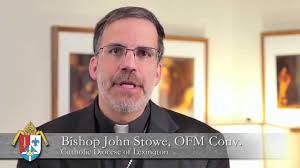
Last week, the bishop of Lexington, Kentucky, profoundly sharpened the recent controversy involving a student from Covington Catholic High School who confronted a Native American elder after this year’s pro-life march in Washington, D.C.

Writing an op-ed in the Lexington Herald-Leader, Bishop John Stowe attempted to deepen the entire conversation. He suggested changing it from superficial wrangling about the apparent disrespect the student displayed to a discussion of whether or not Catholics can support the current occupant of the White House and still be true to their faith.

Bishop Stowe said “no.” It’s a matter of faith, he said.

By taking that position, the Lexington bishop created what I would call a much-needed Dietrich Bonhoeffer moment for the church at a time when Mr. Trump exhibits traits and policies reminiscent of Adolf Hitler during his rise to power in the 1930s. (In the name of their faith, Bonhoeffer and members of his Confessing Church separated themselves from German Christians who supported der Fuhrer.)

The bishop’s words also incurred the wrath of Catholic Trump supporters much as Jesus in today’s Gospel selection sparked anger in his own hometown when he called his neighbors’ faith into question.

Let me explain.

First, recall the context of the bishop’s words. Then connect them to our reading and finally to Bonhoeffer and his church of resistance.  

As for context, a video of the stand-off between the high school student, Nick Sandman and the Native American, Nathan Phillips, had just gone viral. Initial viewings led many to condemn the student’s apparent disrespect.

Then, Sandman’s parents hired a P.R. firm to spin his side of the story. As a result, public commentary quickly changed from blaming the adolescent for his apparently offensive smirk. It centered instead on whose version of the story was correct. Was the student (as the PR firm put it) merely smiling in an attempt to deescalate a threatening situation? Or was he making fun of the Native elder by placing his grin inches from the old man’s face?

In an op-ed published in the Lexington Herald-Leader, Bishop Stowe reframed the debate by adopting the prophetic tack I just mentioned. He focused on the fact that the young student and many of his companions were wearing red “Make America Great Again” hats. That’s what the bishop found incompatible with Catholic faith and its comprehensive approach to life-issues.

He wrote:   

“Without engaging the discussion about the context of the viral video or placing the blame entirely on these adolescents, it astonishes me that any students participating in a pro-life activity on behalf of their school and their Catholic faith could be wearing apparel sporting the slogans of a president who denigrates the lives of immigrants, refugees and people from countries that he describes with indecent words and haphazardly endangers with life-threatening policies.”

In other words, Bishop Stowe was broadening the concept of being “pro-life” – the reason many Catholics back President Trump – to question that support itself. Catholic faith, the bishop implied, cannot tolerate Trump’s policies on immigration, refugees or other words or actions that disrespect Global South countries and endanger life (think capital punishment, drone assassinations, bombings, and illegal wars). Such behavior offends core Catholic beliefs about the inviolable sanctity of human life.

Specifically in reference to abortion, the Lexington bishop added:

“As the leader of the Catholic Church in the 50 counties of Central and Eastern Kentucky . . . I believe that U.S. Catholics must take a look at how our support of the fundamental right to life has become separated from the even more basic truth of the dignity of each human person. . .  While the church’s opposition to abortion has been steadfast, it has become a stand-alone issue for many and has become disconnected to other issues of human dignity.”

Still referencing the abortion issue, Bishop Stowe concluded:

“The pro-life movement claims that it wants more than the policy change of making abortion illegal but aims to make it unthinkable. That would require deep changes in society and policies that would support those who find it difficult to afford children. The association of our young people with racist acts and a politics of hate must also become unthinkable.”

Notice how these words unabashedly connect President Trump with racism and policies that embody hatred. They also recognize that many women are driven to abortion by government policies that make unplanned pregnancies problematic.

Now, that brings me to this Sunday’s Gospel reading and to Jesus’ words that “No prophet is accepted in his hometown.” I make the connection because dozens of people chose to comment very harshly on the bishop’s op-ed. Instead of dealing with the more comprehensive understanding of the phrase “pro-life,” they called Bishop Stowe vile names, brought up the pedophilia issue, and defended Donald Trump as God’s servant. I was surprised that some of the on-line language was actually permitted by the Herald-Leader’s editors.

It was like what happened to Jesus in today’s reading. There the Master himself is pilloried by his neighbors in Nazareth for challenging (like Bishop Stowe) their narrow religious prejudices. When Jesus reminds the people from Nazareth that God cares as much about Syrians and Lebanese as about Jews, they actually try to murder him.

As I said, that proved the truth of his saying that “No prophet is accepted in his hometown.” After all, prophets are those who speak for God. They connect God’s word to events of the day. And that’s what John Stowe did in his op-ed. He made the connection not only between the teaching of Jesus on the one hand and the event in Washington on the other. Echoing Dietrich Bonhoeffer and his Confessing Church, he also used the occasion to denounce Catholic support for latter-day fascism.

In similar circumstances 85 years ago, Bonhoeffer and the German Confessing Church courageously published their famous Barmen Declaration. It held that no one professing to follow Jesus could possibly accept Hitler as their Fuhrer; only Christ could hold that position.

In response, both Protestants and Catholics denounced Bonhoeffer and the others as traitors. Pope Pius XII would even persist in endorsing Hitler as “an indispensable bulwark against the Russians.”

The words of Bishop Stowe seem intent on preventing Catholics in his diocese from recommitting a similar error.

As a long-time Kentuckian and member of the loyal opposition within the Catholic Church, I’m proud of his courage. It’s time for Catholics and the rest of us to take Bishop Stowe’s words seriously.

Simply put, people of faith cannot support Donald Trump and still be authentic followers of Jesus. We must do all we can to frustrate Trump’s policies and see that he is not elected to a second term.

Yes, Bishop Stowe is correct: it’s a matter of faith!

Don’t Buy What Israel’s Selling: Support BDS

Readings for Third Sunday in Ordinary Time: NEH 8; 2-6, 8-10; Ps. 19: 8-10, 15; I Cor. 12: 12-30; Lk. 1:1-4; 4: 14-21 

In these days of rising right-wing fascism, a dangerous religious alliance has emerged. I’m talking about the supportive relationship between Christian Evangelicals and Israeli Zionists. For many, the basis of the support is the belief that Israel represents God’s Chosen People.

However, today’s liturgy of the word suggests something quite different for Christians honoring the Bible as God’s word. It underlines the point that the phrase “God’s Chosen People” does not primarily refer to a national entity, but to the poor and oppressed in general. It even implies that in our present historical context, the phrase “God’s Chosen” applies more aptly to the Palestinians than to the Zionists who kill Palestinians on a daily basis – without the least objection from our government or from most U.S. Christians. (In fact, since last March, Zionist soldiers have shot with impunity peaceful protestors in Gaza. They’ve killed more than 200 and wounded more than 18,000 — with many crippled for life — since the Palestinian rallies around the “Great March of Return” started on March 30th.)

Right now, this point about the identity of God’s People needs to be underlined because so many religiously-motivated people, and legislators in particular have taken such a strong stance against the Boycott Divest and Sanction Movement (BDS) that activists have directed against Israel to stop the slaughter in Gaza, which has been described as the world’s largest open-air prison camp. The conviction behind the divestment campaign is that a Zionist version of apartheid rivals South Africa’s hated system that economic boycotts, divestment and sanctions helped to bring down in 1994. (President Jimmy Carter’s book on the topic, Peace Not Apartheid, supports that conviction. So do the words I’ll soon quote of Dr. Martin Luther King.)

However, in response, anti-BDS legislators in Congress and in 26 of our states have proposed and/or passed legislation forbidding support of the movement. Anti-BDS legislation prohibits government investments, for example, in companies or in pension funds that support BDS. In some cases, anti-BDS laws even require employees (e.g. public-school teachers) to, in effect, pledge allegiance to Israel despite its genocidal policies.

Nonetheless, (as I said earlier) today’s liturgy of the word calls all of that into question.

Biblically speaking, it’s true that Israel did fit the “God’s Chosen” profile at the time of its origin – in Egyptian slavery (13th century B.C.E.) – and later during its captivity in Babylon (6th century B.C.E.). As poor and oppressed, they were “chosen” as well as when Israel was under the control of the Assyrians (8th century), Persians (6th century), Greeks (2nd century), and Romans (1st century). In all those instances, precisely as oppressed, Israel was the paradigmatic object of the biblical God’s special love and protection. In fact, at Mt. Zion, Moses enshrined in Israel’s law protection of people like them – slaves, widows, orphans, immigrants, the imprisoned, and the poor.

That’s the Law that the scribe, Ezra is remembered as reading to the people for hours in today’s first reading. They had just returned from exile in Babylon. For them “The Law” (the first five books of the Jewish Testament) was a source of joy and strength. After all, those books recounted what for Jews was the liberation of all liberations – from Egypt under the leadership of the great rebel hero, Moses. Now in the 6th century BCE, with Ezra in charge, they were celebrating the end of a long and painful Babylonian Captivity in the geographical area that is now “Iraq.” Ezra reminded the assembled people that in their return to the Promised Land, they were experiencing Exodus all over again. Indeed, he said, it was a time for celebration – for eating, as he put it, rich meats and drinking sweet drinks.

Today’s second and third readings pick up on Ezra’s theme – that God favors the poor and oppressed. However, both Jesus and Paul do so emphasizing the point that Yahweh’s favored ones are not always Jews.

When Jesus said that in his hometown synagogue (in the verses immediately following today’s excerpt), it enraged his former neighbors. “Who does this guy think he is?” the Nazarenes asked indignantly. “We know his family; he’s nothing special. Yet here he is speaking critically about his own people! He must be one of those ‘self-hating Jews’.” Luke says Jesus’ hometown citizens were so outraged that they tried to kill him.

Jesus’ words before the Nazarene’s attempted assassination do not merely underline the identity of God’s chosen as the poor and oppressed rather than exclusively the Jews. The words are also central in terms of Luke’s definition of Jesus’ entire project. In fact, they connect that project with God’s very identity as described throughout the Jewish Testament particularly by the prophet Isaiah whose words Jesus quotes: “The Spirit of the Lord is upon me, because he has anointed me to bring good news to the poor. He has sent me to proclaim release to the captives and recovery of sight to the blind.”

Did you notice the importance of the word “because?” It absolutely identifies the “Spirit of the Lord” with Ezra’s good news to the poor about release from captivity and recovery of sight. Jesus is saying we know that “The Spirit of the Lord is upon” him because he brings good news to the poor, those in captivity and the blind. Jesus goes on to say that his commitment to the poor is what will define his entire mission.

Today’s excerpt from Paul’s letter to the Greeks in Corinth continues that theme of Isaiah, Ezra, and Jesus. Only Paul does so in terms of a familiar yet powerful metaphor – what he calls the “Body of Christ” enlivened by the “One Spirit” of God. For Paul followers of Jesus constitute the way the Master is present today long after Jesus’ death. As that presence, we are Jesus’ hands, feet, eyes, ears, and tongue. And elsewhere Paul specifically says it makes no difference whether one is Jew or Greek, slave or free, male or female (GAL 3:28-29).

What does make a difference though is one’s social standing. Paul goes out of his way to say that the “less honorable” and the “less presentable” in Christ’s body are to be more honored and cared for than the more presentable and more honorable according to the standards of the world. The weaker parts, he says are somehow “more necessary” than the stronger parts. This could hardly be a clearer reference to the poor and those who are normally neglected and looked down upon. Here Paul is following the thrust of Jesus’ words and deeds by turning the social order upside-down. The poor and oppressed come first in God’s order.

Today, part of that revolutionary inversion is recognizing that Zionists have nothing positive to do with God’s preferences. Quite the contrary: as the Palestinians’ oppressors, they are the imperial analogues of the Egyptians, Babylonians – and yes, fascists – who persecute God’s Chosen.

Meanwhile, because they side with the poor to whom Jesus brought Good News, the BDS activists stand with Jesus – and Gandhi and Martin Luther King.

With last week’s MLK celebrations still fresh in our minds, and with today’s readings ringing in our ears, we do well to recall Dr. King’s words spoken on December 7th, 1964 – just days before he received the Nobel Peace Prize in Oslo. In a major address in London, he said,

“If the United Kingdom and the United States decided tomorrow morning not to buy South African goods, not to buy South African gold, to put an embargo on oil, if our investors and capitalists would withdraw their support for that racial tyranny that we find there, then apartheid would be brought to an end. Then the majority of South Africans of all races could at last build the shared society they desire.”

King’s words (and those of Jesus, Paul, and Ezra in today’s readings) are as true in relation to Zionist Israel as ever they were of South Africa. Today, the Palestinians not the Zionists are God’s chosen and should be treated as such.

Jesus, the Law, and “Les Miserables” of Today

Les-Miserables[1]

Readings for 2nd Sunday in Ordinary Time: Is. 62; 1-5; Ps. 96: 1-3, 7-10; I Cor. 12: 4-11; Jn. 2: 1-11

During our family’s recent Christmas trip to France, we spent a couple of evenings watching “on location” films. We saw Woody Allen’s “Midnight in Paris” and loved it. Owen Wilson did such a good job of imitating Allen himself. And seeing Wilson wander through the famous sites we were passing each day was great fun.

But on a more serious note, we also took in “Les Miserables” which was such a success back in 2013. At the Golden Globes that year, “Les Miserables” won the “best film” award in the category of musicals and comedies. Hugh Jackson was named best actor for his portrayal of Jean Valjean. Anne Hathaway won best supporting actress for her role as Fantine. She went on to win an Oscar as well.

Watching the film in France this time made it especially poignant. I ended up in quiet tears at its conclusion.

“Les Miserables” is Victor Hugo’s familiar tale of Jean Valjean, a Christ figure intimately connected with today’s Gospel reading about Jesus at the wedding feast in Cana.

Following the royal restoration after the French Revolution of 1789, Valjean was convicted of stealing a loaf of bread to feed his starving children. He was sentenced to twenty years of hard labor in the most brutal conditions.

Having completed his sentence under the watchful and threatening eye of the cruel Inspector Javert (Russell Crowe in the film), a bitter and vengeful Valjean journeyed homeward. As he passed through the town of Digne, he was given food and shelter by the kindly Bishop Myriel, the pastor of the local cathedral.

But Valjean is not impressed. He rises in the dead of night, steals the bishop’s silverware and candelabra, and flees the rectory. Soon he’s captured by the gendarmes. When he’s dragged back to the bishop by the police, Bishop Myriel secures Valjean’s release by confirming the thief’s lie that the stolen goods had been given him as a gift by the priest. Valjean cannot believe his ears. The bishop’s act of generosity, forgiveness, and mercy transforms him. He goes on to become a successful factory owner and champion of the poor.

However the former convict has broken his parole. So he’s pursued by his prison tormentor, Inspector Javert. Javert is determined to return Valjean to chains. The inspector is a lawman in the strictest sense of the word. He believes he is doing God’s work in pursuing Valjean, and often prays for success in his mission.

Nonetheless towards the film’s end, Javert falls into Valjean’s hands. His former ward has the opportunity to kill Javert with impunity for opposing the People in their revolution against the French crown. Yet Valjean refuses to do so, opting instead to follow the example of bishop Myriel, even though releasing Javert means Valjean will likely return to prison.

Javert can neither believe nor accept Valjean’s generosity. In his eyes, since the law has been broken, Valjean must pay the price. Yet Valjean has acted towards him with such generosity. . . . Javert doesn’t know how to handle such kindness. His life dedicated to law enforcement now seems entirely wasted in the light of Valjean’s compassion and wonderful disregard of the law. Confused and disheartened Javert commits suicide.

Of course, Victor Hugo’s tale is much more complex than that – and much more beautiful. (The singing and lyrics are gorgeous!) But that’s the story’s kernel – a portrayal of a conflict between love, compassion, and mercy on the one hand and respect for the law on the other. That’s what makes it relevant to today’s Gospel.

There we find Jesus attending a wedding. With the other revelers at this feast of seven days, he’s been dancing, singing, eating and drinking already for days. Then the wine runs out. The party is in danger of losing its spirit; the guests will go home; the bridal couple will be disgraced. So Jesus responds to the alcohol shortage by providing about 200 gallons of the best wine the partiers had ever tasted. Significantly, he takes the large stone vessels full of water for ritual washing according to Jewish law, and turns that water into wine. As a result, the fun never stops. And believers have never ceased telling this story – the very first of Jesus’ “signs” as John calls them. We’ve come consider them miracles.

But let’s take John at his word. He sees this rather trivial event at what turns out to be Jesus’ coming out party as a sign, a symbol, a metaphor. . . . (I say “trivial” because on its surface nothing “great” is accomplished. A party is saved from petering out. Some friends – the bridal couple and their families – save face. But was that worth this exercise of divine power?) Nevertheless, John says this is a sign. But of what?

The answer, of course, is that changing water into wine so early in John’s story constitutes an image providing indication of Jesus’ entire mission as John understands it. Jesus’ mission is to obey the spirit of the law even when that means disobeying its letter.

In John’s poetic narrative, the letter of the law is cold, hard, and insipid – as hard and frigid as the stone vessels John takes care to mention, and as tasteless as water in comparison with wine. But it’s even worse than that. The law as Jesus will criticize it in John’s pamphlet is routinely used against the poor (people like Valjean in Hugo’s tale) – the lepers, prostitutes, beggars, Samaritans, tax collectors, and the generally “unclean.” The law is used to oppress “Les Miserables.” Meanwhile, the privileged and elite use legalisms for their own benefit – to enrich themselves and elevate their prestige. Jesus, John is saying, has come to transform all of that.

He has come to change the water of the law’s letter into everything wine symbolizes. The wine of Jesus’ teaching and life is meant to lift the spirit. (It’s not for nothing that alcohol is called “spirits.”) Wine is red like blood not colorless and neutral like water. Wine relieves pain. It evokes laughter, and singing and dancing as it did for the revelers at the Cana wedding feast. Wine enlivens life which, John implies, has more to do with a seven-day party than with what happens in the Temple (or our churches!).

We need to be reminded of all that don’t we? That’s especially true today when the law is used so clearly against the poor, while the rich typically escape its reach. Think about the way our political “leaders” villainize the world’s most impoverished people. They tell us that the dirt poor are the cause of the very problems they and their rich friends have produced. (For example, the poor had nothing to do with the Great Recession whose disastrous effects are still ruining the lives of the poor and middle classes.)

Even worse, the coalition of the rich creates refugees by sending planes, missiles and drones to destroy the homes, schools, hospitals of already desperate people throughout the Middle East and Global South. They overthrow the governments the poor have elected, and afterwards install dictators and drug lords to take their places. Then they complain when the refugees they’ve created seek escape in countries like our own.

In the process, distressed mothers and their children are described as drug dealers, gang members, and murderers. So, in the name of unjust laws, our leaders rationalize the separation of pre-teens from their parents and even create baby jails. Meanwhile, the business of privatized prisons prospers, while their dungeons are increasingly filled with the poor and minorities.

In the meantime, the those who dedicate their lives to exposing such crimes are treated like Jesus and Valjean. The Julian Assanges and Chelsea Mannings — the whistle-blowers of the world – are arrested, tortured and threatened with life imprisonment. “The law is the law,” the criminal arresters remind us. Once again, it’s the story of Jesus and Jean Valjean all over again.

Like “Les Miserables,” John’s story of Cana can raise our consciousness about all of that. The tale of water turned into wine can move us to defend the poor, powerless, imprisoned and whistle-blowers that the law routinely oppresses. Jesus’ example calls us to celebrate “spirit,” and feasts, and food, laughter and dancing. It invites us to destroy by our own hands the law-worshipping Javert who resides within each of us.

Both John the Evangelist and Victor Hugo call us to imitate those who dedicate their scandalous lives to obeying the Spirit of God’s Law by disobeying the letter of human law.

Jesus’ Baptism: His Wasted Life — and Our’s

Readings for Feast of Baptism of the Lord: IS 42:1-4, 6-7; PS 29: 1-4, 9-10; ACTS 10: 34-38; LK 3: 15-16, 21-22

Today is the Feast of the Baptism of the Lord. In that context, let’s think about baptism and the differences between the understandings we’ve inherited and those reflected in the practice of John the Baptist and Jesus of Nazareth. Those differences hold practical implications for our own lives as we wrestle with a faith that may have lost meaning for us, and as we struggle with the relative smallness and insignificance of our lives.

To begin with, think about traditional beliefs about baptism. If you’re like me, you may find them hard to swallow. A friend of mine, theologian Tony Equale, has recently pointed out that theology doesn’t really determine worship patterns. Instead superstitious temple and church rituals have shaped our beliefs. Practice determines belief, not the other way around. (See http://tonyequale.wordpress.com/2013/01/03/the-religiosity-of-the-people/)

What my friend means is that theology’s job has traditionally been to rationalize what people actually do in their efforts to tame life and achieve contact with the numinous, the mysterious, and the transcendent. They sacrifice chickens, behead bullocks, or vivisect lambs and then burn the animals’ carcasses. The smoke thus ‘feeds’ the Gods who are believed to need nourishment, placation, and cajoling in order to do the will of the people and their priests. Those congregations actually turn out to be more intelligent than the God who must be informed of their needs and what is best for their welfare. That’s superstition.

Catholic beliefs around baptism and the “sacrifice of the Mass” are cases in point. They were actually formed by the People’s credulous practice of baptism which was informed more by ancient ideas of all-powerful angry Gods than by Jesus’ radical teaching that God is Love. I mean early on, in a time of very high rates of infant mortality, popular belief came to see infant baptism as necessary to somehow save deceased children from a hell created by a threatening God.

This practice of the people rather than reflection on the words and deeds of Jesus led St. Augustine at the beginning of the 5th century to theorize that people have been born guilty – at enmity with God. Augustine thought that since children were condemned even before any personal sin on their parts, they must be born in sin. And that must be, Augustine reasoned, because they had inherited sin from their forebears and ultimately from the first human beings, Adam and Eve. Because of that “original sin,” God is justly angry with humans.

Now, as I said, the ancients believed that sacrifice was necessary to placate an angry God like that. So, in the Roman world, where sacrifice was understood in the terms I’ve just explained, Jesus’ death eventually became to be seen as a sacrifice whose primary purpose was to secure God’s approval of the Roman state. In this way, the “Mass” was transformed from a memorial meal to a re-enactment of Jesus’ sacrificial death. It was moved from a table with friends gathered around sharing food, to a “sacrifice” performed at an “altar” by a priest with his back turned to the people who watched the show from afar.

This Mass differed very little from what Romans were used to before Christianity became the state’s official religion in 381. In fact, it is entirely possible that ordinary people saw no difference between the “Mass” and the religious ritual they had been accustomed to when Jupiter or Mithra were worshipped as the official Gods of Rome. In other words, Christianity was transformed by the Roman Empire rather the empire being transformed by Christianity. There was a “theogony,” a battle of the Gods, between Jupiter and the Bible’s Yahweh; and Jupiter won. We’ve been worshipping him ever since.

How different all this is from what happens to Jesus at the baptism which today’s liturgy of the word celebrates! (And that brings me to my point about meaning in our seemingly wasted lives.) In today’s gospel, there is nothing suggesting “original sin.” Nor is Jesus presented as the incarnation of a God who needs to be mollified by sacrifice. Rather, Jesus comes as a disciple of John. (Scripture scholars tell us that John’s words about his inferiority before Jesus were inventions of the early church in a Jewish context where many still believed that John rather than Jesus was the long-awaited Messiah.)

So at the age of 30 or so, this young peasant from Nazareth presents himself for a ritual washing at the prophet’s hands in the legendary Jordan River. In Israel’s idealized past, that river had been crossed by slaves escaped from Egypt who on the river’s opposite shore found the “Promised Land” that became their national home. Eventually that crossing came to be understood as transforming a motley horde of renegade slaves into a unified nation of free people at the service of the God who had liberated them from demeaning servitude.

John’s practice of baptism in the Jordan (far from the corruption of the priests’ Temple and its endless sacrifices) summoned his Jewish contemporaries to reclaim their ancient identity that had been lost by the priests and scribes who had sold out to Roman re-enslavement of a once proud and liberated people.

John’s was a revivalist movement of Jewish reform. Those presenting themselves for baptism were expressing a desire to return to their religious roots and to alter their lives in a profound way.

Evidently, that’s why Jesus came to be baptized too. This country boy who (according to Luke’s “infancy narratives”) had begun his life with such promise is now about 30 years old. Perhaps in view of his parents’ expectations of him, his life so far seemed wasted. Perhaps he had resolved to finally make a difference. In any case, by approaching John in the Jordan’s waters, he expresses an intense need for change in his life. He wants to be John’s follower.

So John performs his baptismal ritual. And the miraculous happens. An epiphany occurs for Jesus. He hears a voice. It informs him that he is a child of God. Immediately he sets out on a vision quest to discover what those words might mean. Forty days of prayer and fasting bring on the visions – of angels and devils, of temptations, dangers and possibilities.

In the light of his desert experience, Jesus chooses not only to follow John as the leader of a reform movement. He chooses as well to follow Moses as the liberator of an enslaved people. He has truly crossed the Jordan. So he brings his message to the captive poor. Like him, they too are children of God — God’s specially chosen people. God’s kingdom belongs to them, he says, not to their rich oppressors. The poor must not allow themselves to be misled by the stultifying and domesticating doctrines of the priests and scribes. That was the thrust of Jesus’ teaching.

Coherent acts follow Jesus’ words. He discovers wondrous healing powers within himself. By touch, by faith, by his friendship, he cures stinking lepers, dirty beggars, street walkers who have lost their self-respect, the deaf, the dumb, the blind and lame. Jesus eats food with the social outcasts and street people of his day, sharing nourishment the way God does – without cost or expectation of reciprocation. Jesus finds himself explaining the mysterious, transcendent and ineffable in unforgettable stories that capture the imaginations of simple people hungry for the spiritual sustenance that he offers – that he embodies. No wonder his early followers tried to imitate Jesus by choosing John’s baptism as a sign of membership in their community and by following the Master’s example of sharing food the way God does in their re-enactment of the Lord’s Supper.

That was the understanding of baptism and Lord’s Supper that the first generations of Christians embraced. But it didn’t last long. Within a few generations (and especially after Christianity became the official religion of the Roman Empire at the end of the 4th century) the superstitions I referenced earlier had replaced the understanding and practice of Jesus and the Baptist. Soon baptism became an instrument for saving babies from original sin and hell. Soon the Lord’s Supper became the “Holy Sacrifice of the Mass” differing very little in ritual and spirit from offerings to Jupiter and Mithra.

Today’s liturgy of the word calls us beyond all of that. It summons us to follow Jesus who shows us the way to truly change our lives. Change comes by leaving behind the superstitious faith that supports empires past and present. Transformation comes when we share our food with each other and with the poor. It happens by committing ourselves to the “other world” represented by God’s Kingdom that has room for everyone, not just for the 1% served by our own churches, priests, scribes and their superstitious rituals.

Today’s liturgy of the word summons us to the banks of the Jordan to stand with Jesus and to hear God’s voice calling us from what has been so far wasted in our lives. Like Jesus, we are daughters and sons of God. We are beloved by the God of Love. Jesus’ example reminds us that It’s not too late to change our commitments and way of life.

After all (if we take our tradition literally) Jesus redeemed the insignificance of his own life in a single meaningful year – or maybe it was three.

The Dysfunctional Holy Family

Readings for Holy Family Sunday: Sir. 3: 2-6, 12-14; Ps. 128: 1-5; Col. 3: 12-21; Lk. 2: 41-52 http://usccb.org/bible/readings/123018.cfm

Today is the feast of the Holy Family. We’re used to thinking of it as a cozy group of 3, Jesus, Mary and Joseph living in ideal circumstances, the way we picture them in our nativity crib scenes. Or we imagine Jesus’ early life as we find it depicted in medieval paintings of the carpenter Joseph’s workshop. There we often find a loving haloed and elderly foster-father instructing Jesus in his trade while Mary smiles in the background.

However, if we take seriously the “infancy narratives” coming from Matthew and Luke, we must draw the conclusion that Jesus’ home life was more complicated than that. You might even say that it was “troubled” right from the beginning. So for the moment, let’s suspend disbelief surrounding the historicity of the narratives about Jesus’ early years. Let’s try instead to unpack the stories at face value. Doing so, I think, shows them to be quite relevant to our own experiences – especially to that of our family dysfunctions and to our own experiences of being no one, without face, identity, or power before the world’s problems.

To begin with, think about Jesus’ family, the focus of today’s liturgy of the word.  It wasn’t perfect. The holy family was larger than we’re accustomed to imagine. Joseph and Mary probably had 7 or 8 children. According to the gospels, Jesus’ brothers’ names were James, Joseph, Judas, and Simon. Jesus is also said to have had at least 2 unnamed sisters. On the one hand, a large family like that would have been helpful to peasant farmers, if Mary and Joseph had any land. On the other hand, a family of 9 or 10 people would have been hard to maintain for rural peasants living in a backwater like Nazareth. It is likely then that hunger and struggling to make ends meet was a major part of Jesus’ early experience.

Jesus’ country was also war-torn at the time when he was born, and that certainly impacted his family. At approximately the moment of his conception, the Romans had razed the city of Sepphoris, located just an hour’s walk from Nazareth. Sepphoris was the capital of Galilee where Nazareth was located. Galilee was a hotbed of resistance to Rome’s occupation of Palestine. And a rebellion had erupted in Sepphoris about the year 4 BCE. That meant that the countryside would have been crawling with Roman soldiers at the time of Jesus’ conception. Inevitably, many young Jewish girls would have been raped by the occupying forces. Some see that fact as lending credence to an anti-Christian tradition claiming that Jesus was the product of rape of Jesus’ mother, Mary by a Roman soldier called Panthera.

In any case, Mary’s out-of-wedlock pregnancy would have raised many eyebrows in the rural village of Nazareth. Town gossips would have snickered and talked behind their hands about the young girl’s “virginal conception.” We know for certain that Mary’s mysterious pregnancy put Joseph in crisis. According to tradition, he suspected she had been unfaithful and thought her condition reason enough to break off their engagement. We also know that Mary chose to leave town “in haste” and travel to the hill country of Judah to her Cousin Elizabeth’s home – possibly to get some distance from small village talk.

Once that problem was resolved, the holy family’s troubles continued.  There was the matter of Jesus’ homelessness at the time of his birth. For the occasion, Joseph and Mary had to make do with a filthy stable with all of its animal droppings, noises, smells, vermin, rodents and cold.

And things got worse after that. The story goes that the local king Herod ordered an infanticide of all children under the age of 2 in the area surrounding the place of Jesus’ birth.  For Mary and Joseph, avoiding such unspeakable violence meant fleeing to Egypt in the middle of the night. It also meant trying to survive as immigrants in that far-off country – not speaking the language or knowing the customs, or feeling at home among those prejudiced against foreigners.

Once back in Palestine, things apparently settled down. However, the episode in today’s gospel reveals tension in the holy family that will resurface later in the gospels.

“The Finding in the Temple” is a coming of age story. At the age of 13, all Jewish boys would accompany their parents for the first time as a “genuine Israelite.” Each would then become a man, “one who goes up to the temple.” In Jesus’ time, the 13th year was anticipated by a year as a kind of preparation for the “big step” into adulthood.  Coming from a place like Nazareth, the boy from the country would have been dazzled by the splendor of the Temple with its colonnades, precious woods, unending polished steps, gold and silver candelabra. It would have been easy for him to wander away with other boys and become lost in it all.

His parents find him, we are told, easily conversing with learned men from the city whose manners, accents and clothing would have been intimidating to Jesus’ simple parents. And yet here was the country boy Jesus astounding the city people with the incisiveness of his questions and the wisdom of his answers. No doubt, the rural parents waited till they were out of earshot of their “betters” till they gave Jesus the dressing down they thought he deserved. The scolding may have lasted the entire three-day journey back to Nazareth.

His parents, we’re told in this morning’s reading, did not understand their son. We find out later on that the lack of understanding continued. At one point in Mark’s gospel, his mother and his siblings are described as thinking Jesus was out of his mind (Mk. 3: 34-35). This led to a formal estrangement between Jesus and his family. He more or less disowned them. When Jesus was told that his family has come to rescue him from his madness, he said in effect, “My mother – my family? That’s not who those people are. Instead, you (the outcasts, beggars, insurrectionists, prostitutes, unemployed, and ne’er do wells, who were his companions) – you are my real family, my real people.”

And yet today’s gospel concludes that Jesus went back to Nazareth with them. He advanced, Luke tells us in age and wisdom and grace before God and his neighbors. And that’s it. We hear no more about him for 20 years or so. He disappears. He becomes nobody.

And that brings me to the other part of today’s reflection – being a nobody. What does Jesus’ disappearance, his “hidden life,” tell us about the human condition?  According to our faith, Jesus was the full embodiment of God. Presumably, then, he had infinite power at his disposal. His world was as filled with problems as ours. There was Roman imperialism and the occupation of Palestine with its brutality, torture, rape, exploitation and oppression. There was political corruption among Jesus’ own people as the leaders of his time climbed into bed with the Romans. There was extreme poverty alongside obscene wealth. There was religious corruption. There was disease and ignorance.  And yet as far as the record is concerned, this embodiment of God did nothing.  For 97% of his life, Jesus did absolutely nothing!

Why? Do you think it might have been because, like us, he could do nothing significant about all those problems? And even when around the age of 30 he did finally emerge as a more or less public figure, what did he really do? He spoke some inspiring words, healed a few people, and worked some miracles that his contemporaries dismissed as parlor tricks. He provoked the authorities in a temple demonstration for religious purity and social justice, was arrested, tortured and executed as an insurrectionist.  That was pretty much it as far as his “public life” was concerned. Afterwards, the world pretty much continued as it had before his arrival.

I somehow find comfort in both Jesus’ family dysfunctions and in his “nobodiness.”  None of our families is perfect. Unexpected pregnancies, suspicions and jealousies dividing couples, financial struggles, problems with neighbors and gossip, displacement, lost and alienated children – it all seems about par for the course. I’m not even sure that Mary and Joseph didn’t wonder at times where they went wrong. There was a lot for them to process in their pillow talk as they saw their son hanging out with the wrong crowd, apparently losing his faith, and then getting into political problems they didn’t understand. My God, he finally ended up on death row! The black sheep of the family . . . .

And then there are our own little lives and their apparent lack of meaning. In the end, we’re nobodies, all of us. That’s what death makes apparent as we lose our physical form and minds and all that we worked for. We’re nobodies.  Few will remember us or think of us after we’re gone. We’re born, get married, have children, buy and sell a few items, and then die. And what became of all our hopes and dreams? What does it all mean?

Does it mean that it’s all O.K.; it’s all good? Does it mean “that’s life” – what it’s about? In fact, our vocation is to be precisely nobody instead of constantly striving to be Somebody. In the end, death discloses the truth about our vocation. It is the same as Jesus’ vocation. And that is to be open, faceless channels that disclose the presence of God in our very ordinary lives with their family dysfunctions and personal failures. It is to rise above such limitations or rather to use them to express the unbounded love of an apparently powerless God to those around us – especially to our family members who might not even understand.

On the Brink of Apocalypse: Lock Him Up (and Obama & Hillary too)

Readings for 1st Sunday ofAdvent: Jer. 33:14-16; Ps. 25:4-5, 8-9, 10, 14; 1 Thes. 3: 12-4:2; Lk. 21:25-28, 34-35 

We’re standing on the brink of Apocalypse. I don’t mean the end of the world. I’m talking about the end of empire.

That’s the point I tried to make here two weeks ago, when our Sunday liturgies began featuring apocalyptic readings from both the Jewish and Christian Testaments. That’s what the biblical literary form “Apocalypse” is about– not the end of the world, but the end of empire.

Apocalypse is resistance literature, written in code during times of extreme persecution by powerful imperial forces like Greece and Rome. The code was understandable to “insiders” familiar with Jewish scripture. It was impenetrable to “outsiders” like the persecutors of the authors’ people.

In our own case, all the provocations of apocalyptic rebellion are there. Our country is following faithfully in the footsteps of the biblical empires against which apocalypse was written: Egypt, Assyria, the Medes and Persians, Babylon, Greece, and Rome.

To say it unambiguously: Our government is headed by gangsters pure and simple. It’s as if Antiochus IV Epiphanes, Nero, Caligula, Domitian –or Al Capone – were in charge. All of them (Trump, Obama, the Clintons, and the Bushes) should be in jail. In fact, as Chomsky has pointed out every single post-WWII U.S. president from Truman and Eisenhower to Carter, Reagan, the Bushes, Clinton, Obama, and Donald Trump has been guilty of crimes that contradict the Nuremberg Principles. The only policy difference between Donald Trump and his immediate predecessors is that he’s blatantly shameless in owning his criminalities.

Here’s what Chomsky has said:

To clarify Chomsky’s point, here’s a short list of our current president’s most recent atrocities. He has the country:

  • Fighting perpetual and internationally illegal wars against at least five sovereign nations. Count them: Afghanistan, Iraq, Syria, Somalia, Yemen . . . without any sign of ending. (The genocidal war in Yemen has caused a cholera epidemic and will soon have 14 million people starving to death. Can anyone tell me why we’re in Yemen??)
  • Refusing to recognize the validity of a CIA report identifying Mohammed bin Salman as the Mafia Don who ordered the beheading and dismembering of a correspondent for a major U.S. newspaper.
  • Similarly soft-pedaling the climate-change findings of the government’s own scientific panel predicting the devastating effects of climate change for our economy, country, and species including, of course, our children and grandchildren.
  • Spending billions modernizing a nuclear weapons arsenal, while our cities’ bridges, roads, and other infrastructure disintegrate before our eyes.
  • Insisting on wasting billions building a wall along our southern border instead of sea-walls, dykes and levies along our country’s coasts.
  • Following Obama and Hillary Clinton by backing a narco-government in Honduras that has become a street gang making huge profits from the addictions of U.S. citizens while directly producing the immigrants and refugees Trump identifies as our enemies.
  • Using chemical weapons against the resulting caravan of women and children seeking refuge at our southern border and justifying it in a way that would be trumpeted as a casus belli were the perpetrator’s name Bashar al-Assad instead of Donald J. Trump.  

All of that is relevant to today’s liturgical reading, because (as I’ve said) this is the third week in a row that the lectionary has given us readings from apocalyptic literature.

As I indicated, apocalypse differs from ordinary prophecy in that it addresses periods of deep crisis, when the whole world appears to be falling apart. Neither prophets nor apocalyptics were fortunetellers. Instead, they were their days’ social critics. They warned of the disastrous consequences that inevitably follow from national policies that deviate from God’s will – i.e. from policies that harm God’s favorites: widows, orphans, immigrants, the poor – and (we might add) the planet itself.

When Luke was writing his gospel around the year 85 of the Common Era, Jerusalem had been completely destroyed by the Romans in the Jewish War (64-70 CE). The Romans had brutally razed the city and the temple that had been rebuilt after the Babylonian Exile. For Jews that was something like the Death of God, for the Holy City and its Temple were considered God’s dwelling place. The event was apocalyptic.

In today’s gospel, Luke has Jesus predicting that destruction using specifically apocalyptic language. Luke’s Jesus says “There will be signs in the sun, the moon, and the stars, and on the earth distress among nations confused by the roaring of the sea and the waves. People will faint from fear and foreboding of what is coming upon the world, for the powers of the heavens will be shaken.

What can such apocalyptic message mean in our own day faced as we are with a false crisis stemming from U.S. policies in Central America in general and in Honduras in particular that identify the poorest people in the world as the causes of our problems instead of climate chaos and narco-kleptocrats?

Yes, the immigrant crisis is a mere distraction – a completely human and remediable fabrication caused by U.S. policy. Meanwhile, the real threat to our planet is the threat of nuclear war and the environmental cliff that our “leaders” refuse to address. And who’s responsible for that crisis?

Prominent religious leaders would have us believe it’s God. He (sic) is punishing us for opening borders to the poor, for Roe v. Wade, for legalizing same sex marriages, or for allowing women access to contraception. Let’s face it: that’s nonsense. It turns Jesus’ embodiment of the God of love on its head. It turns God into a pathological killer – a cruel punishing father like too many of our own dads.

The real culprit preventing us from addressing climate change is our government. Our elected politicians are truly in the pockets of Big Oil, the Banksters, narco-criminals and other fiscal behemoths whose eyes are fixed firmly on short-term gains, even if it means their own children and grandchildren will experience environmental apocalypse.

What I’m saying is that this government has no validity. How dare a small group of climate-change Philistines take it upon themselves to decide the fate of the entire planet in the face of overwhelming evidence contradicting their stupidity?

It all has me wondering when our fellow peasants who don’t share Jesus’ commitment to non-violence will get out their pitchforks and storm the White House and other seats of government.

Remember: It was Thomas Jefferson who advised periodic revolution. He said: “What country before ever existed a century and a half without a rebellion? And what country can preserve its liberties if their rulers are not warned from time to time that their people preserve the spirit of resistance? Let them take arms. . . The tree of liberty must be refreshed from time to time with the blood of patriots and tyrants. It is its natural manure.”

“It’s Over” for the Catholic Church and Its Abusive Clergy

Pedophilia cartoon

Readings for 32nd Sunday in Ordinary Time: I Kgs. 17: 10-16; Ps. 146:7-10; Heb. 9: 24-28; Mk. 12: 38-44

Last Thursday, the editors of The National Catholic Reporter (NCR) published an open letter to all bishops in the United States. The letter’s topic was the fallout surrounding the clerical abuse scandal. Its theme was “it’s over” – a refrain repeated seven different times in the document.

The repetition is relevant to the Gospel readings for this 32nd Sunday in Ordinary Time, the episode of the “Widow’s Mite.” The story summarizes the attitude of Jesus towards clerical corruption in his own day – and in our own.

After visiting Jerusalem’s temple just before his own execution, Jesus concluded that Judaism as represented there had no future. His words and actions expressed his clear conclusion, “It’s over!” He gives up on the temple system. His despair tempts me to give up on the Catholic Church.

Before I get to that, let me fill you in about the NCR letter and the apparent meaning of its catchphrase which implies that the Catholic Church has no more future than the Jerusalem temple Jesus cursed.

“It’s over,” the editors said because:

• The clerical abuse scandal has brought the church to rock bottom.
• This is a question of such rot at its heart that the corruption threatens the very identity and unity of the Catholic Church not only in the United States, but worldwide.
• The feds have now entered the picture ordering chancery officials not to destroy the paper trail they’ve been hiding for more than 50 years.
• Abusers and their enablers have been recognized as federal criminals.
• The bishops have nowhere left to hide. Like the king in the familiar fable the bishops and clergy all stand naked before the world; we all realize that they have no clothes. They have lost moral authority.
• Even Washington’s Cardinal McCarrick abused boys and seminarians for decades.
• And the cover-ups go right to the top – to the Vatican itself. The hastily-sainted John Paul II “let wolves roam his flock” because of his falsely inflated idea of a “heroic priesthood” to which no one can any longer subscribe.
• Blaming gay priests for the crisis is so obviously yet another diversionary attempt to block the fundamental reforms required in a clerical culture that has demonstrated a basic ignorance of human sexuality.
• So is blaming Pope Francis who alone among recent popes has exhibited the courage to confront the problem and to remove from office clerics even at the highest levels of the hierarchy.
• The only reason for belated confessions of guilt on the part of bishops is that they have at last been caught with their pants down (literally!) beginning as far back as 1985.
• Without relentless journalistic investigation, clerical abuse would have continued unimpeded and remained covered-up.
• As a result, apologies, studies, conferences, and spiritual retreats for prayer and meditation all ring hollow.
• Only very fundamental changes have any hope of saving the church.
Absent such transformation, it’s over!

And that brings me to the familiar story of today’s Gospel reading, “The Widow’s Mite.” Contrary to what you’ve been told, it’s not about the widow’s generosity. It’s about her exploitation by a clergy every bit as corrupt as the popes, bishops and priests we’ve just been discussing.

As Mark tells it, Jesus and his friends are visiting Jerusalem for the Passover Feast during the final week of his life. They are in the Temple. On the previous day, they had all taken part in (and perhaps led) a demonstration there against the temple priesthood and its thievery from the poor. I’m talking about Jesus’ famous “cleansing of the temple.” Soon the temple priesthood and scribal establishment will offer a reward of thirty pieces of silver for information leading to Jesus’ arrest. Judas will find himself seriously considering collecting that reward.

In the meantime, Jesus continues his on-going instruction about the corruption of the Temple System. In the episode before us, he takes a position, Mark says, “opposite” the temple treasury. The treasury was the place where Jews paid the tithe required by the law as interpreted by the priesthood that Jesus despises. It was a “flat tax” applying the same to rich and poor.

Ever class-conscious, Mark points out that “many rich people” somehow made it clear to all that they were putting in large sums. Then a poor widow came along and furtively put in a penny. Jesus calls attention to the contrast: “large sums” vs. “two small copper coins, which are worth a penny.”

“It’s all relative,” Jesus says. “Truly I tell you, this poor widow has put in more than all those who are contributing to the treasury. For all of them have contributed out of their abundance; but she out of her poverty has put in everything she had, all she had to live on.” Jesus then leaves the temple in disgust.

The standard way of treating this reading runs like this: (1) The widow in the Temple donated to the temple priests “all she had to live on” and was rewarded with Jesus’ praise; (2) follow her example (3) donate generously to your priest and you will be richly rewarded either here, in heaven, or in both places.

That’s a standard treatment we have all heard. However, it has severe problems. To begin with, it ignores today’s responsorial from Psalm 146. That excerpt from Psalms sets a back-drop for the entire Liturgy of the Word and provides a key for interpreting not only today’s reading, but the entire Bible. The psalm reminds us that the poor are God’s Chosen People. God’s concern for the poor is not with their generosity towards God but with God’s securing justice for them. As the psalm says, God gives food to the hungry, sets captives free, gives sight to the blind, protects immigrants, and sustains the children of single moms. God loves those concerned with justice for the poor, the Psalm says. God loves prophets like Jesus. On the other hand, God thwarts the ways of the wicked – those who, like the scribes and high priests, exploit God’s favored poor.

With all of that in mind, we are alerted to circumstances in today’s gospel story that summon us to interpret it differently from the standard line.

We are reminded that the episode takes place in an elaborate context of Jesus’ assault on the temple system. In effect, the context is Jesus’ symbolic destruction of the temple itself. Yes, there was that “cleansing” I referenced. But there was also Jesus’ prediction of the deconstruction of the building itself. “Not one stone will be left here upon another; all will be thrown down” (MK 13:1-2). Then there was that strange incident of Jesus cursing a fruitless fig tree as he was entering the temple precincts (11:12-14; 20-24). The fig tree was the symbol of Israel. Here again Jesus pronounces a judgment on an entire system that had become corrupt and forgetful of the poor who are so central to God’s concern.

That judgment is extended in Jesus’ teaching immediately before the episode of the widow’s mite. Again, Jesus takes a position “opposed” to the temple treasury and says, “Beware of the scribes . . . They devour widows’ houses and for the sake of appearance say long prayers.”

With Jesus’ warning ringing in their ears, a case-in-point, a poor widow, arrives on the scene. She pays her tithe – the flat tax – and leaves penniless. Jesus can take no more. He calls attention to the hypocrisy and injustice of the whole situation and leaves the temple in disgust. For him, in the words of the NCR’s Open Letter, “It’s over!”

And that returns me to my own questions about my commitment to the Catholic Church. Increasingly and reluctantly, I’m feeling that’s over too. Having just moved to the Northeast (Westport, CT), I’ve been searching for a community that honors the progressive teachings of the Second Vatican Council (1962-’65) – still the church’s official teaching – with its emphasis on social justice, engaged homilies, ecumenism, and vibrant liturgies.

So, I did an online search for “progressive Catholic Churches near Westport.” The search came up empty – except for a site denouncing progressive Catholicism. Nonetheless, a friend directed me to a church in Norwalk (a 15-minute drive from my new location). I joined a men’s group that meets in the church basement each Saturday morning at 7:00 to discuss the next day’s liturgical readings. However, I soon discovered that one of the ground rules for discussion is “No politics!”

That so leaves me out! The world is burning. And critical, liberationist readings of the Jesus tradition offer perhaps our best hope of putting out the raging fire. Where else but church do hundreds of people come together in every community across the country to ponder questions of goodness, truth, and their relationship to Ultimate Reality? Yet good-willed men are told: Don’t connect this with that.

Why continue?

Until that sort of thing changes, for me it is indeed over. And in leaving in disgust, I’m following the example of Jesus himself.