(Sunday Homily) The ‘Gates of Hell’ from Ferguson to Gaza

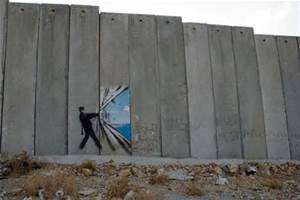
Wall Palestine

Readings for 21st Sunday in Ordinary time: IS 22: 19-23; PS 138:1-3, 6,8; ROM 11: 33-36; MT 16: 13-28. http://usccb.org/bible/readings/082414.cfm

Of course, you’re all following the news, I know. It’s so discouraging, isn’t it? Ferguson, Gaza, Iraq, and (now) Syria – again. . . .

It all reflects such one-dimensional thinking. I mean it gives the impression that in the eyes of public officials from the militarized cop in the street to the POTUS himself, the only solutions to social problems are found in shooting, tear gas, torture, and Hell Fire Missiles? Solving social problems requires locking people of color behind “the Gates of Hell” referenced by Jesus in today’s Gospel reading.

In every case, diplomacy and negotiation seem out of the question. In fact, it’s a vanished art. Who needs it? After all, those damn “others” – be they African Americans in occupied Ferguson, Palestinians in Gaza’s mammoth concentration camp, or the ISIS militants – can’t possibly have legitimate grievances. They simply must be brought to heel by force – shooting, bombing, and killing their children and youth. We’re made to believe that alternatives such as dialog and working out problems by discussion and compromise are signs of weakness. So violence is the first resort. It’s the order of the day in a world ruled by machismo, revenge, violence, and the law of the strongest.

When we’re not bombing, we’re building walls with locked gates. Our “gated communities” and locked doors wall us off from unsightly ghettos and the realities of the world’s poor mostly non-white majority. Better to confine Palestinians in fenced off open-air concentration camps like Gaza, where there’s literally no exit. Then from time to time you “mow the lawn,” i.e. shoot the non-Jews like fish in a barrel – even though most of them are children, women, and aged people.

Better to build a wall along the Mexican border and then lock the gates, throw away the key and pretend that such barriers solve the problem of farmers and their children driven off their land by globalization, poverty and gangs. Better to justify it all by invoking the Ultimate White Privilege: “I feared for my life!” (We whites are the only ones who can get away with that one.)

All that brings us to today’s Liturgy of the Word. It’s about God’s interest in matters like those just enumerated – about politics, oppression and the liberation of non-white people like Jesus, Gazans and residents of Ferguson, Missouri. It’s about breaking bonds and opening the gates of hell so that every Inferno can be transformed into the Kingdom of God. It’s about refusing to be discouraged even though the flow of history make Jesus’ prayer, “They Kingdom come” seem like an impossible dream.

Start with today’s first reading. There the prophet Isaiah has God telling a courtier named Shabna to step down in favor of a man called Eliakim. Little is known about either one. The reason for including the reading today is apparently to establish today’s central point that God is concerned with the world of politics, and that God is ultimately in charge of what happens in that sphere. There can be no separation of politics and religion in the divine dispensation.

The responsorial psalm continues the “this worldly” theme set by the first reading. It had us all singing “Lord, your love is eternal. Forsake not the work of your hands.” Once again, emphasis on “the work of God’s hands” reminds us of God’s commitment to this world – including ghettos, the Gazan concentration camp, and rich people making life unbearable for the world’s largely non-white poor. The psalm goes on to praise Yahweh for divine kindness, truthfulness, encouragement of the weak, care for the impoverished, and God’s alienation from their proud oppressors – again all connected with life here and now.

Then in today’s Gospel selection, we find a reprise of the very reading we shared last June 27th (just two months ago on the “Solemnity of St. Peter and Paul”). We practically know this passage by heart.

The reading centers on three titles associated with Jesus of Nazareth – Son of Man, Son of God, and Christ. All three names are politically loaded – in favor of the poor rather than the privileged and powerful.

Jesus asks his friends, “Who is the Son of Man in history and for us today?” (Scripture scholars remind us that the “Son of Man” is a figure from the Book of Daniel. He is the judge of all those who oppress the People of God whether they’re Egyptians, Assyrians, Babylonians, Medes, Persians, Greeks or Romans. He is “the human one” as opposed to a series of monstrous imperial beasts which the author of Daniel sees arising from the sea against God’s poor.)

So Jesus’ question boils down to this: who do you think has taken the strongest stand against Israel’s oppressors? Jesus’ friends mention the obvious heroes, Elijah and Jeremiah. But in the end, they settle on a contemporary political prisoner in King Herod’s version of Abu Ghraib. He’s John the Baptist who was Jesus’ mentor. (According to Jesus, John was the greatest of all the prophets of Israel.) He’s the Son of Man, they say.

Having set that anti-imperial tone, Jesus then asks the question, “What about me? Who do you say that I am?” No question could be more central for any of us pretending to follow the Teacher from Nazareth. How we answer determines the character of the path we walk as Jesus’ would-be disciples in a world filled with Fergusons, Gazas, Hell Fire Missiles and militarized cops. Our answer determines whose side we are on – that of Messrs. Netanyahu, Obama and Officer Wilson or of the Palestinians, Iraqis and Michael Brown.

Matthew makes sure we won’t miss the political nature of the question. So he locates its asking in Caesarea Philippi – a city Herod obsequiously named for his powerful Roman patron. Herod had commemorated the occasion by minting a coin stamped with the emperor’s countenance and identifying him as “the Son of God.” Caesar was also called “the Christ,” God’s anointed. Good Jews saw all of that as idolatry.

So Peter’s answer, “You are the Christ, the Son of the Living God” has the effect of delegitimizing Caesar and his empire. It’s also a swipe at King Herod. Peter’s response couldn’t be more political. Jesus, not Caesar is king, God’s anointed, the Son of God.

Neither could Peter’s words be more spiritually meaningful and heartening for those of us discouraged by events in Ferguson, Gaza, Iraq, and Syria.

The encouragement is found in Jesus rejoinder about the “gates of hell” and the “keys of the kingdom.” Jesus says, “Blessed are you, Simon son of Jonah . . . I will give you the keys of the kingdom of heaven . . . whatever you bind on earth will be bound in heaven, and whatever you loose on earth will be loosed in heaven.”

What powerful words of encouragement! For those who would join Jesus on “The Way” to God’s Kingdom, they disclose the very key to life’s meaning. In effect, Jesus says, “Here’s the key to opening ‘the gates of hell’ and transforming life’s Infernos into God’s kingdom: all our actions – even apparent failures like my coming crucifixion – have cosmic significance. Don’t be discouraged even when the agents of hell end up killing me – as they inevitably will.”

In other words, we may not be able to see the effect of resisting empire and its bloody agents in the short term. But each act has its effect. God’s Kingdom will come.

In today’s second reading, Paul elaborates the point. He said it’s not always apparent what God is doing in the world. After all, the ways of Transcendent Reality are deep and beyond comprehension – even by the wisest human beings. We may not be able to see God’s (political) purposes at close range. But ultimately their inscrutable wisdom will become apparent (ROM 11: 33-36).

Or as Martin Luther King put it: “The arc of the moral universe is long, but it bends towards justice.”

All of us need to embrace that wisdom, refuse discouragement and continue doing what we can to resist the forces of empire and unlock those “Gates of Hell.”

(Sunday Homily) Jesus Comes Very Close to Rejecting a Palestinian Woman as a “B_tch”

Palestinian Woman

Readings for the 20th Sunday in Ordinary Time: IS 56:1, 6-7; PS 67: 2-3, 5, 6, 8; ROM 11: 13-15, 20-32; MT 15: 21-28. http://usccb.org/bible/readings/081714.cfm

“Have pity on me, Lord, Son of David! My daughter is tormented by a demon.” Those are the words that a woman remembered as “Syrophonecian” addressed to Jesus in today’s gospel reading.

Jesus responds by ignoring the woman at first and then by disrespectfully associating his petitioner with dogs – almost calling her a “b_tch.”

We’ll come back to that in a moment.

For now note that “Syrophonecian” meant the woman was not a Jew. She was a native or inhabitant of Phoenicia when it was part of the Roman province of Syria. She was living near the twin cities of Tyre and Sidon – a gentile or non-Jewish region of the Fertile Crescent where Matthew takes trouble to locate today’s episode.

That would have made Jesus’ petitioner what we call a “Palestinian” today. In other words, Matthew’s geographical note serves to remind us that the Jews never controlled all of their “Promised Land.” Instead, they always had to share it with “Palestinians” including Canaanites, Hittites, Amorites, Perizzites, Hivites, Jebusites, Geshurites, Maacaathites, and Philistines.

That in itself is significant in the light of Israel’s ongoing brutal war of extermination against Palestinians. There the State of Israel (with supporters often invoking biblical precedent) has adopted the one-state position that is bent claiming all of Palestine for itself. It relegates Palestinians to Bantustans in a particularly brutal Israeli version of apartheid and ethnic cleansing.

Were Jesus in Gaza today, millions of Palestinian parents could echo the poor mother’s petition in today’s’ gospel selection, “Have pity on me, Lord, Son of David! My daughter is tormented by a demon.” And the demon in Gaza’s case would be the State of Israel itself – the latest incarnation of the puppets of Empire whom Jesus opposed so strongly in his own day. [Recall that Palestine in Jesus day was controlled by Jewish puppets of Rome. (Jesus clashed with them again and again.) Today those who pull strings on the marionettes reside in Washington.]

The result is that in Gaza over the last five weeks, more than 2000 Palestinians have been slaughtered by the ones considering themselves God’s “chosen” – 25% of the victims being children, at least another 25%, women like the one called “Syrophoenician” and her demon-possessed daughter.

Daniel Ortega, the President of Nicaragua, recently applied the term “demon” appropriately. He said, “Prime Minister Netanyahu appears to be possessed by the devil, he needs Pope Francis to exorcise it, to become appeased.” Ortega wondered, “Why doesn’t anyone condemn or sanction the state of Israel?” In his opinion, Palestine is the victim of “madness” on the part of the Israeli leader, who seeks to “annihilate the Palestinian people.” Ortega meant that Israel is “committing genocide” in the Gaza Strip, a crime so “terrible that it is only comparable to the crimes of the Nazis,” he said.

You might have been surprised at Jesus’ response to the Syrophonecian woman. As I said, at first he gives no reply at all; he ignores the woman completely. If Matthew’s account is accurate, in his silence Jesus was showing himself to be captive to his own cultural norms. It was inconceivable in Hellenistic antiquity for a strange woman to directly approach a man the way the woman in this story did. Above all was it so for a gentile woman to directly address a Jewish man. In other words, Jesus’ silence was part of his “honor culture.”

But it gets worse. When the woman insists, Jesus implicitly calls her a “b_tch.” He says, “I have been sent for the lost children of Israel . . . it is not right to take the food of the children and throw it to the dogs.”

The reply seems out of character for Jesus, doesn’t it? In fact, such dissonance has led many to reject the saying as inauthentic. Whatever the case, Jesus’ reply only echoes the rabbinic saying of the time, “He who eats with idolaters is like one who eats with a dog.”

In other words, Jesus’ comparison stands in a long line of likening cultural outsiders to animals. Most recently, in the case of Gaza, Ayelet Shaked, a member of the Israeli Parliament, compared Palestinians like the woman in today’s gospel to snakes. She endorsed the killing of Palestinian women, like the petitioner in the story before us, calling their children not dogs, but “little snakes” worthy only of extermination.

Shaked said,

“Behind every terrorist stand dozens of men and women, without whom he could not engage in terrorism. They are all enemy combatants, and their blood shall be on all their heads. Now this also includes the mothers of the martyrs, who send them to hell with flowers and kisses. They should follow their sons, nothing would be more just. They should go, as should the physical homes in which they raised the snakes. Otherwise, more little snakes will be raised there.”

The woman in today’s gospel has a very different voice from Ayelet Shaked’s. She replies, “Please, Lord, for even the dogs eat the scraps that fall from the table of their masters.”

The witty reply astonishes Jesus. He exclaims, “O woman, great is your faith! Let it be done for you as you wish.” That is, the woman “converts” Jesus; he concedes her argument. The one the gospels present as the master of verbal riposte is vanquished by this simple Palestinian mom.

What does the interaction between Jesus and the woman called “Syrophonecian” mean for us today – in the context of Israel’s demonic attack on the Palestinian descendants of the woman in question? What does it mean for Gaza and for us who watch in helpless disgust?

I think it means that:

• The “faith” of the Syrophoenician woman was not “in Jesus” as the incarnation of God, but rather in the inclusivity of God’s love that extends beyond ethnic and religious differences.
• In that sense, she believed in the New Universal Order Jesus referred to as God’s Kingdom.
• More specifically, today’s gospel reading presents the woman as enlightening Jesus – as reminding him of the Kingdom’s complete inclusivity.
• In view of Jesus’ own “enlightenment” at the hands of this poor Palestinian woman, it is no longer possible to blindly identify “God’s People” with any particular state.
• I mean, the State of Israel as such does not represent the biblical God’s Chosen People.
• Today that honor (curse?) belongs to the Palestinians who, as good Muslims, share Jesus’ faith that God sides with the widows, orphans, immigrants and oppressed whatever nation they belong to.
• This means that in the case of Palestine, Jesus’ followers should be one the side of Palestinians rather than the Jewish State.
• Being on their side means petitioning the U.S. government to stop its demonic support of Israel which has moved even further from its identity as “People of God” than it had in Jesus’ day.

As always, this week’s readings invite us to break the chains of our cultural norms – just as Jesus was forced to by the Syrophonecian mother.

(Sunday Homily) Dear Pope Francis: Gaza Needed More than Tears; Next Time, Please “Walk on Water”

Walk on Water

Readings for 19th Sunday in ordinary time: I KGS 19: 9A, 11-13A; PS 85: 9-14; ROM 9: 1-5; MT 14: 22-23 http://www.usccb.org/bible/readings/081014.cfm

In today’s Gospel, we hear Matthew’s account of Jesus walking on water – or rather, of Peter’s refusal to follow Jesus’ example of walking on the waves.

The account is relevant to the man in the Vatican who believes he is Peter’s successor. Israel’s month-long siege of Gaza invited Pope Francis to “walk on water” – to follow the example of Jesus in confronting demons. However uncharacteristic timidity left the pope sinking below the waves, out of sight and ear shot, cowering before Monsters like Obama and Netanyahu.

Let me explain. First off, consider today’s Gospel reading.

The story goes that following Jesus’ feeding of the 5000 (last week’s Gospel episode), Jesus forces the apostles to get into their boat and row to the other side. [The text says, “Jesus made (emphasis added) the disciples get into a boat and precede him to the other side.” Perhaps these experienced fishermen (as opposed to the land lubber, Jesus) saw a storm was coming and were reluctant to set sail despite Jesus’ urgings.]

In any case, a storm does come up and the apostles fear they are about to drown. You can imagine them in helpless tears.

Then they see a figure walking on the water in the midst of high threatening waves. At first they think it’s a ghost. Then they realize that it’s Jesus. He’s walking on the raging waters.

Peter, the impetuous leader of the apostles, doubts what he sees. So he says, “Prove to me that it’s you, Jesus; let me walk on the waves just as you’re doing.” Jesus says, “Join me then over here.” So Peter gets out of the boat and, like Jesus actually walks on water for a few steps.

Then, despite the evidence, he begins to doubt. And as he does so, he starts sinking below the water line. “Save me, Lord,” he cries out again. Jesus stretches out his hand and saves Peter. Then he asks, “Where’s your faith, man? Why is it so weak? Why did you doubt?”

Of course, this whole story (like last week’s “Loaves and Fishes”) is one of the dramatic parables Matthew composed. If we get caught up in wondering whether we’re expected to believe that someone actually walked on water, we’ll miss the point of this powerful metaphor. It’s about Jesus’ followers doing the unexpected and irrational in the midst of life-threatening crisis.

You see, Matthew’s Jewish audience shared the belief du jour that the sea was inhabited by dangerous monsters – Leviathan being the most fearful. And fearlessly walking on water was a poetic way of expressing what Matthew’s community believed about Jesus, viz. that he embodied the courage and power to do the completely unexpected in the midst of crisis and subdue the most threatening forces imaginable – even the most lethal of all, the Roman Empire.

Jesus’ invitation to Peter communicates the truth that all of us have the power to confront monsters if we’ll just find the courage to leave safety concerns behind even in the most threatening conditions, to confront life’s monsters, and join Jesus in the midst of its upheavals.

Problem is we easily lose faith and courage. As a result, we’re overcome by life’s surging waves and by the monsters lurking underneath them.

And that brings me back to Pope Francis and his ambiguous response to the slaughter that took place in Gaza over the last month.

We expected more. Over the course of his still-young papacy, Francis has demonstrated wonderful courage attempting to join Jesus on the world’s dangerous waves.

• He’s adopted a comparatively simple lifestyle.
• He’s condemned neo-liberalism and growing income inequality.
• His apostolic exhortation, “The Joy of the Gospel” implicitly endorsed the liberation theology his two immediate predecessors had tried to kill.
• More specifically, he adopted liberation theology’s “preferential option for the poor” as the leitmotif of his papacy.
• In that spirit, his famous “Who am I to judge” gave hope to the LGBTQ community.
• He helped head off President Obama’s plans to bomb Syria.

That last precedent led me to expect more in the context of Gaza. I was in St. Peter’s Square for Francis’ hours-long vigil for peace. There the Pope did as much or more to head off U.S.’ insane plans to bomb Syria as did Russia’s President Putin. Along with Putin, Francis was the hero who subverted the monstrous plans of Obama and his State Department.

But there was no peace vigil for the Gazans. Instead two weeks ago the Pope broke down in tears as he delivered his Sunday remarks from the balcony over St. Peter’s Square. He said:

“Never war, never war! I am thinking, above all, of children who are deprived of the hope of a worthwhile life, a future. Dead children, wounded children, mutilated children, orphaned children, children whose toys are things left over from war, children who don’t know how to smile.” This was the moment when the tears came. “Please stop,” said Francis. “I ask you with all my heart, it’s time to stop. Stop, please!”

The words were powerful; the tears were powerful. But unlike the prayer vigil before a potential Syrian fiasco, they remained largely unreported. Nevertheless, for those with ears to hear, the Pope was lamenting Israel’s killing of Palestine’s innocent. (No Jewish children were killed during the Gaza massacre.) However, to overcome the Media’s deafening pro-Israel tilt, the Pope needed to be stronger and more specific.

Yes, his papacy has daringly left the safe harbor and courageously sailed into the storm. Yes, Francis clearly sees Jesus as his role model demanding courage in the face of today’s unprecedented winds and waves. Indeed Francis has gotten out of the boat to trample underfoot the beasts and monsters roiling the seas all around us. But in the case of Gaza, instead of walking confidently on the waters, he sunk in apparent timidity before the threatening monsters, Obama and Netanyahu.

But what more could he have done? What sort of miracle did I expect?

Well, he could have given courage to all of us who are far less daring than he; he could have performed a miracle more stupendous than actually “walking on water” by:

• Owning the fact that as the leader of 1.2 billion Roman Catholics, with far more power than Jesus had, he was truly able to end Gaza’s slaughter.
• Announcing plans to travel to Gaza in the midst of Israel’s monstrous campaign.
• Before leaving, specifically naming Israel’s assault on civilians as sinful.
• Identifying the U.S. as equally culpable with Israel for crimes against humanity.
• Actually traveling to Gaza in a white papal helicopter (even in defiance of Israel’s predictable prohibitions) and landing in the midst of Gaza’s devastation.
• Celebrating Mass in Gaza on a pile of rubble and refusing to leave till the Israelis stopped their slaughter.
• If the slaughter continued, traveling to the key sites of bombing and shelling.

“Impossible!” you say? Such an act would offend Israel and upset Israel-Vatican relations. Ditto for the U.S.

Hmm. Is the pope a politician or a prophetic religious leader? Please use your imagination and spin out what would have happened if the pope walked on water as just outlined. What do you think?

In any case, those much less courageous than Francis need his example so the rest of us might venture forth to walk on water in our own far less powerful ways.

Yes, in today’s Gospel, Jesus invites us all to do the impossible. Why are we doubting? Where is our faith?

(Sunday Homily) Water and Food Are Not Commodities, but Human Rights

Detroit Water

Readings for 18th Sunday in Ordinary Time: IS 55: 1-5; PS 145: 8-9, 15-18; ROM 8: 35, 37-39 MT 14: 13-21 http://www.usccb.org/bible/readings/080314.cfm

I’ve been vacationing in Michigan over the past month. We’re living in the lovely cottage my wife, Peggy, inherited from her father in the northern part of the state.

The community there is called Canadian Lakes. It’s white, upper middle class, and very pretty. Peggy and I have spent large parts of our summers there ever since we we’ve been married. Our kids feel attached to the place. In a sense, they’ve grown up there.

In a word, life at Canadian Lakes is good. It’s water-centered and comfortable.

That makes today’s liturgy of the word (with its emphasis on the free gift of water) especially poignant for me. So does the fact that our lake home is located in Michigan with Detroit not so far away. Water’s a problem there.

You see, the relationship of Detroit’s poor to water is very different from ours in Canadian Lakes. Unlike our lakeside community, 44% of Detroit residents fall under the poverty line; 83% of the city’s population is African American. Unemployment in the former Motor City is well above 14.5%. Yet, Detroit’s (unelected) City Manager has been cutting off the water of poor people there. Regardless of your circumstances, if you’re an ordinary Detroit resident two months, behind on your bill, you will suddenly find yourself without water for drinking, bathing and flushing toilets.

If you’re rich, however, it’s a different story. Some of the city’s largest corporate water users are also behind on their water bills – even years behind. For instance high-end golf courses, the Detroit Red Wings, the city’s football stadium and more than half the city’s commercial and industrial users owe back water bills totaling over $30 million. No one is cutting off their water.

It’s also worth noting that the price of Detroit’s water system (administered by private contractors) is more than twice the national average and that the water cut-off plan is part of a scheme to move the city towards a completely privatized water system. Some see it as a measure intended to drive Detroit’s poorest from the city for purposes of gentrification.

Detroit’s water policy has recently gotten world-wide attention. A United Nations Human Rights office designated it a clear violation of fundamental human rights.

In the light of today’s liturgy of the word, we might also designate Detroit’s plan (and in general the commodification of God’s free gifts to all of creation) as a violation of God’s order. In fact, today’s liturgy of the word implies indictment of water privatization schemes and the market system’s practice of treating food itself as a commodity. These are gifts of God, the readings say – part of God’s gift economy which is unbelievable in its generosity.

And why should we be surprised? The God celebrated in today’s responsorial is described as “answering all our needs.” According to the psalmist, that God is gracious, just, holy, merciful, slow to anger, hugely kind, and compassionate. S/he gives food to everyone and everything – without cost.

So why pay for water? Isaiah asks. “All you who are thirsty, come to the water!” he says. “You who have no money, come, receive grain and eat; come, without paying and without cost, drink wine and milk!”

The point of contrasting God’s “gift economy” with our exploitive “exchange economy” is driven home in today’s Gospel episode from Matthew the evangelist. The famous “miracle of loaves and fishes” is actually a dramatic parable about God’s Reign and its order. The event may even be factual in the way I’m about to explain.

In any case, the tale is symbolic. It’s about the way the world would work if God were king instead of Caesar. In God’s dispensation, the gifts of creation – food and drink – are given to all without payment. God’s order contradicts our own where food production and even water delivery reap huge profits for the rich.

You know the story. Jesus meets with 5000 men in the desert (“not to mention,” Matthew says, “the women and children”). It’s late in the day. People are hungry and no-doubt getting restless. Jesus’ disciples offer a market solution to the problem of the crowd’s hunger. They say, “This is a deserted place and it is already late; dismiss the crowds so that they can go to the villages and buy food for themselves.”

Jesus’ solution is different. He says. “There is no need for them to go away; give them some food yourselves.”

The disciples almost mock Jesus’ suggestion. They say, “Five loaves and two fish are all we have here.” We can imagine them rolling their eyes and smirking ironically in disbelief at Jesus’ naivety. Did he really think that the loaves and fishes they had would be enough to feed 5000 hungry men and their families?

Nevertheless, Jesus “ordered the crowds to sit down on the grass.” Mark adds the detail that he had them break up into small groups of 50 and 100. In those smaller groups, people could see each other’s faces. Inevitably, they must have introduced themselves and shared some personal background, a joke, laughter and human warmth. Friendships blossomed.

Then Jesus “said grace:” That is, with everyone’s eyes on him, the Master Teacher broke the bread, divided the fish and gave it to those around him. No doubt he did so with gestures inviting the crowd to do the same.

As a result, the “miraculous” happened. And it wasn’t a “popcorn miracle” where five loaves suddenly popped into 5000 or where two fish suddenly multiplied by 3000. Instead, the good mothers in the crowd must have followed Jesus’ example. (Can we imagine any good Jewish mamma leaving home for a day in the desert without packing a hearty lunch for their husbands and children?) The mothers opened their picnic lunches and shared them with the people they’d just gotten to know.

It was a “miracle of enough.” Everyone shared. So even the improvident were able to eat with plenty left over – 12 baskets Matthew tells us.

No, I’m not saying the miracle of loaves and fishes was just about food. No. As John Dominic Crossan puts it, the “miracle of loaves and fishes” was not just about food; it was about just food – about just distribution where no one is left hungry. Why? Because that’s the way God and his order are. God gives food, drink – the earth itself – to everyone and everything without cost.

That’s the order Jesus’ followers are called to imitate here and now.

And it is Detroiters (as well as many others throughout the world) who doing just that. They’re busy not only sharing water, but gardening and eating free from their plots on vacant lots – taking grateful advantage of God’s free gifts. You might be surprised to know that Detroit has the largest number of urban gardens in the United States.

We would do well to follow the example of people there and expand on it, taking advantage of God’s free gifts by:

• Opposing water privatization schemes
• Supporting local farmers
• Gardening
• Composting
• Installing water catchment systems
• Heating water (and our homes) with solar energy
• Bicycling to work
• Getting to know our poor neighbors
• Sharing food with them
• Even paying their water bills
• Opposing military spending (e.g. in Israel and the Ukraine) while U.S. citizens go without water.

To repeat: today’s readings are not just about food and drink; they’re about just food and drink. They’re about sharing God’s free gifts rather than turning them into commodities to benefit the 1%.

(Sunday Homily) Liberation Theology, BRICS and the Untelevised Global Revolution

BRICS 2014

Readings for Seventeenth Sunday in Ordinary Time: I KGS 3: 5, 7-12; PS 119: 57, 72, 76-77, 127-130; ROM 8: 28-30; MT 13: 44-52; http://www.usccb.org/bible/readings/072714.cfm

The whole world was surprised when the Soviet Union dissolved in 1989. The dissolution represented an earth shaking paradigm shift to say the least. However, virtually no one claims foreknowledge on that one. One wonders how such oversight was possible.

Something similar is happening today. The poor of the world are asserting themselves against U.S. hegemony. Yet, virtually no one in the mainstream seems to notice. Once again, the revolution is not being televised.

Not even followers of Jesus’ Way are commenting. And this despite the fact that before all others, we should be attuned to paradigmatic shifts in world order connected with what Jesus termed the Kingdom of God.

Such paradigm contrast is suggested by today’s liturgy of the word. It juxtaposes the dream of Solomon, Israel’s would-be empire builder, and Jesus’ words about the contrasting nature of God’s Kingdom.

Let me show you what I mean by connecting the three elements I’ve just mentioned: (1) today’s untelevised revolution, (2) Solomon’s imperial ambitions, and (3) Jesus’ contrasting Kingdom of God.

Begin by noting that the current world order is dissolving before our very eyes. That became apparent two weeks ago at the Sixth Summit of Heads of State and of Governments of BRICS which took place in Fortaleza, Brasilia. Besides leaders from the BRICS countries (Brazil, Russia, India, China and South Africa), the presidents of UNASUR, the Union of South American Nations, all participated including Kirchner (Argentina), Bachelet (Chile), Santos (Colombia), Morales (Bolivia), Correa (Ecuador), Mujica (Uruguay), Maduro (Venezuela), and Umala (Peru).

Those present at the conference represent more than half the people in the world and fully 25% of its gross domestic product. That’s more economic power than the United States which controls 20% of the world’s GDP with 5% of the planet’s population.

And what did the BRICS Conference participants discuss? Not bombings, sanctions, debt ceilings, presidential impeachments, or lawsuits against heads of state – not birth control, abortion, gay marriage or border security. Instead they actually confronted the shared problems of the world – all the situations our provincial U.S. Congress systematically avoids, denies, and/or manipulates for political purposes.

Even more importantly, BRICS Conference attendees specifically planned the de-Americanization of the global economy and the creation of a multilateral, multipolar world prioritizing the needs of the Global South. Deliberation topics included:

 * Third World development in general
 * The industrialization of Africa in particular
 * The Creation of a BRICS development bank to replace the World Bank and the IMF
 * New international currencies to supplant the U.S. dollar as the world reserve
 * Sustainable responses to climate change
 * Building a railway from the Pacific Ocean in Peru to the Atlantic in Brazil
 * Installation of an IT cable from Vladivostok to Shantou, Chennai, Cape Town and Fortaleza (bypassing the United States).
* BRICS collaboration with the Shanghai Cooperation Organization (SCO) which binds Russia and China into a common security policy with Central Asia.

Such matters are world-transforming.

In fact, they represent practical steps towards something like the global wealth tax suggested by Thomas Picketty in Capital in the 21st Century – a tax dismissed by U.S. mainstream media as excessively idealistic, impractical and never-to-be implemented.

The thing is: those willing to impose such tax for the benefit of the developing world belong to the developing nations themselves. They are going their own way free from the hegemony of the United States.

All of this is relevant to today’s liturgical readings.

The selections implicitly compare the paradigm shift heralded by Jesus and his proclamation of God’s Kingdom to replace the imperial order not only of Rome, but of Israel itself. Israel’s leaders a thousand years earlier had hijacked the Mosaic Covenant favoring God’s poor.

In today’s first reading Solomon’s court historians mask the hijacking by predictably identifying their employer as “the wisest man ever,” just as before him they had identified Solomon’s cruel and womanizing father, David, as “a man after God’s own heart.” In this royally hijacked form, the Covenant connected God and the royal family. It assured a royal dynasty that would last “forever.” It guaranteed God’s blessings on Solomon’s expansionistic policies. (That’s like the clap-trap we have to endure from American Exceptionalists and from those anticipating a New American Century.)

The covenantal truth was much different. In its original Mosaic form (as opposed to the Davidic bastardization), the Covenant joined Yahweh (Israel’s only King) and escaped slaves – poor people all – threatened by royalty and their rich cronies.

The Covenant’s laws celebrated in today’s responsorial psalm protected the poor from their perennial antagonists, Israel’s court and its cronies. For instance, “Thou shalt not steal,” was originally addressed to large landowners intent on appropriating the garden plots belonging to subsistence agriculturalists.

Despite such prohibitions, those who established Israel’s basic laws knew the power of money. The rich would inevitably absorb the holdings of the poor. So Israel’s leaders established the world’s oldest “confiscatory tax.” It was called the “Jubilee Year” which mandated that every 50 years all debts would be forgiven and land would be returned to its original (poor) owners.

Like the BRICS Conference, the Mosaic Covenant prioritized the needs of the poor.

The advent of a Jubilee Year represented the substance of Jesus’ basic proclamation. No wonder the poor loved him. No wonder the refrain we sang together this morning repeated again and again, “Lord I love your commands.” That’s the refrain of the 99% in struggle with the rich 1% represented by Solomon and his court.

In today’s Gospel selection, Jesus indicates the radical swerve necessary for establishing God’s kingdom understood in Jubilee terms. It involves “selling all you have” and buying into the Kingdom concept as if it were buried treasure or a pearl of great price.

I’m not saying that the Kingdom has arrived with the BRICS Conference. I’m not claiming that Jubilee is about to dawn. However a power has emerged which actually prioritizes benefitting the poor instead of the 1%. And followers of Jesus’ Way should buy into it. We need to celebrate it and anticipate it in our own lives.

The New World Order anticipated by BRICS is certainly not perfect. However it’s far from the imperial order which protects the given order, constantly threatens sanctions if you disobey, and whose policies inevitably target the poor and most vulnerable.

In other words the emphasis of the BRICS Conference is not on policies causing Matthew’s “weeping and gnashing of teeth.” Instead it’s on cooperation, mutual respect and common good.

Now that’s a move Jesus’ followers can endorse. It’s moving us towards global change even more significant than the unforeseen fall of the Soviet Union.

That’s reason for hope.

(Sunday Homily) Zionists Are Weeds in the Garden of Palestine

Zionists

The entire world stands aghast at the cruelty of Israel’s vicious and illegal collective punishment of Palestinian civilians for the perceived “crimes” of Hamas – the group of Palestinian resisters committed to the expulsion of illegal Zionist occupiers from the Palestinian homeland.

Today’s liturgy of the word implores the Zionists to abandon their butchery.

It also challenges Christians to denounce such ethnic cleansing and to withdraw the last vestiges of support for a group that more resembles their former Nazi persecutors than the “People of God” celebrated in the Hebrew Bible.

At the same time, today’s readings support rabbi Michael Lerner in cautioning Hamas against its policy of violent resistance. Though many of us would agree that Hamas’ tactics are understandable and often justified by principles of self-defense, today’s Gospel reading identifies them as counterproductive and ultimately harmful to the very people Hamas seeks to defend.

Instead, Jesus suggests that violent resistance should be replaced by greater reliance on more subtle and patient strategies. Such strategies are reflected in the three basic themes of today’s readings. They emphasize (1) the power of God expressed in leniency and forgiveness, (2) the futility of violent response to unwanted foreign presence, and (3) resistance that takes the form of patient trust that God’s forgiving power will prevail. In succession, the themes suggest challenges for Jewish Zionists, Palestinians, and Christians.

Begin with the first reading from the Jewish Testament’s Book of Wisdom. It is particularly relevant to Zionist Jews. The reading says explicitly that God’s power is not expressed in violence but in leniency to all, Jew and non-Jew alike.

That theme is repeated in today’s responsorial psalm with equal relevance to Zionists. There God is described as belonging to all nations. The divine Spirit, as Paul insists in today’s second reading, dwells within all humans regardless of nationality. It is slow to anger, good, forgiving, abounding in kindness.

From this, Jewish wisdom insists that the “People of God” must in turn be kind, lenient and forgiving to all – presumably even to their worst enemies. There is no room here for exceptions involving the indigenous tribal people of Palestine.

The second theme of today’s liturgy enjoys direct relevance to contemporary Palestinians. Whether they are Muslims or Christians (and many are Christians), they also recognize the Bible as the Word of God. I point to Palestinian relevance because this second theme addresses the question of resisting illegal occupation.

That is, Jesus’ parable of the weeds planted by an enemy in a landlord’s field can be read as addressing the Roman occupation forces encumbering Israel during Jesus’ lifetime. [According to John Dominic Crossan, Matthew’s allegorizing of Jesus’ parable – making it about the end of the world – is more reflective of the situation of the Jewish diaspora (following the destruction of Jerusalem in 70 CE) than of the actual revolutionary situation of Jesus’ own day.]

In occupied Israel, the suffocating Roman presence was as unwelcome, alien, and destructive as weeds in a garden or field. It was like the presence of basically European Zionist colonizers who have encumbered Palestinian land since their colonial invasion in 1948.

The question was how to deal with such odious foreign presence. Zealot revolutionaries had their answer: Uproot the weeds here and now. Take up arms; assassinate Romans and their collaborators; drive them out mercilessly. Be as cruel and vicious as the Romans.

Jesus’ response was different. As a non-violent revolutionary, he could surely understand the more apocalyptic strategy. After all, much of his teaching expressed sympathy to the Zealot cause which included land reform, debt forgiveness, and expulsion of the hated Roman occupation forces. Many scripture scholars even identify possibly five members of Jesus’ inner circle as Zealots themselves.

But Jesus’ Parable of the Weeds is more prudent and sensitive to civilian casualties than the strategy of the impatient Zealots – or that of Hamas.

When the landlord’s workers ask, “Should we uproot the weeds?” Jesus’ landlord answers: “No, if you pull up the weeds you might uproot the wheat along with them.”

In other words, Jesus agrees with El Salvador’s Oscar Romero and with Brazil’s Dom Helder Camara that revolutionary violence, though understandable (and justifiable on the grounds of just war theory), is imprudent at the very least.

This is because when faced with a vicious, overwhelmingly armed oppressor (like the Zionist state) resistance inevitably leads to state terrorism – to the war crime of collective punishment impacting women, children, the elderly and disabled. At the very least, that’s why Jesus eschews Zealot violence.

How then respond to illegal occupation like Rome’s in the 1st century or Israel’s over the last more than 60 years?

Jesus’ response? Be like mustard plant, he says. Be like yeast in flour. Both puzzling recommendations are relevant not only to Palestinians, but to Christians who wish to help their brothers and sisters in Palestine against the Zionists-turned-Nazis.

First of all think of the puzzlement that must have struck Jesus’ listeners. Jews didn’t have much use for yeast. They preferred unleavened bread. Neither would any farmer sow mustard seeds in her field or garden. The mustard plant was like kudzu – itself a kind of weed that eventually can take over entire fields and mountainsides while choking out other plants weeds or not. The mustard plant was unstoppable.

So Jesus is saying:

 * The Romans are weeds in your garden.
 * Don’t try to uproot them.
 * That will only lead to slaughter of the innocent.
 * Rather become weeds yourselves – like the mustard plant which is much more powerful than simple Roman (or Zionist) weeds.
 * Resist the Romans by embodying the Spirit of God that is slow to anger, good, forgiving, abounding in kindness.
 * Only imitation of Wisdom’s God can defeat the evil of imperialism.

What does that mean for Christians wishing to express solidarity with Palestinians against their cruel oppressors? At least the following:

 * Reject U.S. militarism in general as counterproductive, since fully 90% of the casualties it inflicts in war are civilians.
 * To bring about change, be instead like the yeast a homemaker puts into 60 pounds of flour, “infecting” the greater culture by non-violent resistance rather than seeking to destroy enemies.
 * Recognize the Zionists for what they are: an outlaw European “settler society” illegally occupying Palestinian land.
 * Take sides with Palestine’s indigenous tribal People.
 * Recognize them for what they are: “the Jews’ Jews” – treated by Zionists in the same way the Nazis treated Jews in Germany.
 * Petition the U.S. government to withdraw its support of Israel (more than one million dollars per day) unless the Zionists obey UN Resolution 242 and abandon the occupied territory while tearing down the odious Wall of Shame protecting the illegal Zionist settlements.
 * Support boycotts of Israel’s products by not buying them and by urging our churches and places of business to do the same.

Surely Jesus’ Way of non-violent resistance, forgiveness and love of enemies will strike many (non-believers and believers alike) as unrealistic. But according to the faith we Christians pretend to embrace, Jesus’ Way is God’s way.

But then perhaps we think we’re smarter and more realistic than Jesus — or God?

(Sunday Homily) Christianity Is Communism! Jesus Was a Communist!

jesus-communist
Readings for 2nd Sunday of Easter: Acts 2:42-47; PS 118: 2-4, 13-15, 22-24; IPT 1:3-9; JN 20: 19-31. http://usccb.org/bible/readings/042714.cfm

My wife, Peggy, and I are going to Cuba again. A week from tomorrow, we’ll be leading a group of Berea College students on a three-week study tour of the island. We’ll be especially interested in having students come to grips with its history, political economy, sustainable agricultural practices, and its form of democracy, its education and health care systems.

Both of us have traveled to Cuba many times before. But today’s liturgy of the word fittingly puts this particulars trip into theological perspective.

It reminds us that even despite the contrary claims of its leaders, the socio-economic project that Cuba represents is essentially Christian. That’s because, as Mexico’s Jose Miranda reminds us, communism originated in Christianity. It doesn’t come from Marx and Engels.

In fact, Christianity is communism. And Christian communism is what we find described in today’s lead-off reading.

Think about what we read there – a description of life among Jesus’ first followers after the experience they called his “resurrection”:

“All who believed were together and had all things in common; they would sell their property and possessions and divide them among all according to each one’s need.”

Luke the evangelist repeats that refrain later in his “Acts of the Apostles” when he writes:
“Now the whole group of those who believed were of one heart and soul, and no one claimed private ownership of any possessions, but everything they owned was held in common . . . There was not a needy person among them, for as many as owned lands or houses sold them and brought the proceeds of what was sold. They laid it at the apostles’ feet, and it was distributed to any as had need.” (Acts 4:32-36).

There you have it. The early Christians:

 * Lived communally
 * Rejected private property
 * Including land and houses
 * Instead held everything in common
 * Pooling all their resources
 * And distributing them “from each according to ability to each according to need.”
 * As a result, they eliminated poverty from their midst.

Did you catch the operative words: they divided their property “among all according to each one’s needs?” To repeat, those are the words of the Bible not of Marx or Engels. In other words the formula “from each according to his ability to each according to his need” comes straight from the Acts of the Apostles. They have nothing to do with atheism. On the contrary, they have everything to do with faith.

They have everything to do with following Jesus who himself was a communist. He’s the one who said, “Every one of you who does not renounce all he has cannot be my disciple” (Luke 14:3).

Jesus, not Marx, is the one who set concern for those in need as the final criterion for judging the authenticity of one’s life. He said, “I was hungry and you gave me to eat; I was thirsty and you gave me to drink, was a stranger and you took me in, was stripped naked and you clothed me; sick and you visited me, imprisoned and you came to see me” (MT 25: 35-36). Everything, Jesus insists, depends on recognizing his presence in the poor and oppressed and responding accordingly.

Of course it’s often pointed out that the Christian experiment in communism was short-lived. Jesus’ followers soon backed off from their early idealism. That observation is supposed to invalidate their communistic lifestyle as impossibly utopian and therefore no longer applicable as Christians’ guiding North Star. In fact, this objection is taken as justifying the persecution of the communism the text idealizes and recommends!

But the same argument, of course, would apply to the Ten Commandments in general or to the Sermon on the Mount – or to the U.S. Constitution for that matter. In our day (and in the course of their histories) all of those statements of ideals have only sporadically been lived out in practice. Should we throw them out then? Should we persecute those espousing the Sermon on the Mount ideals or observance, for instance, of the Fourth Amendment? Few in the Christian community or in the U.S. political world would make that argument.

Others anxious to distance themselves from the communistic ideals of early Christianity would point out that the communal life adopted by Jesus’ first followers was voluntary not imposed from above. In doing so, they point to another passage in Luke’s Acts of the Apostles. That’s the one involving Ananias and Saphira – a couple whose life is exacted for claiming to have sold their property while actually keeping some of it back for themselves.

Referring to their property, Peter says to Ananias, “Was it not still yours if you kept it, and once you sold it was it not yours to dispose of?” (Acts 5:4) But (again as Miranda points out) what was optional was not selling their property – Christianity’s indispensable condition. What was optional was the choice to become a disciple of Christ. Choosing the latter option required practicing communism – and that under pain of death!

As for economic systems imposed from above. . . . Can you name one that isn’t?

How many of us have really chosen to live under capitalism? “None of us” is the answer. That’s because to make an informed choice, one must know the alternative. However, our families, schools, churches and civic organizations, our films and novels and news programs mostly conspire together to vilify alternatives and keep them hidden.

Besides that, our government and military have made sure that experiments in alternatives (like the one implemented in Cuba) fail or are portrayed as failures – lest their “bad example” undermine capitalist claims to be the only viable system.

Even worse, our church leaders (who should know better) jump on the anti-communist band wagon and present Jesus as a champion of a system he would despise. Church people speak and act as if Luke’s passage from Acts had read:

“Now the whole group of those who believed lived in fierce competition with one another, and made sure that the rights of private property were respected. They expelled from their midst any who practiced communalism. As a consequence, God’s ‘invisible hand’ brought great prosperity to some. Many however found themselves in need. The Christians responded with ‘tough love’ demanding that the lazy either work or starve. Many of the unfit, especially the children, the elderly and those who cared for them did in fact starve. Others however raised themselves by their own bootstraps, and became stronger as a result. In this way, the industrious increased their land holdings and banked the profits. The rich got richer and the poor, poorer. Of course, all of this was seen as God’s will and a positive response to the teaching of Jesus.”

When are we going to stop this bastardization of Christianity?

First of all we must face it: Jesus was a communist; so were his earliest followers after his death!
What then should are would-be followers of Yeshua the Christ to do? At least this:

 * Read Jose Miranda’s manifesto, Communism in the Bible.
 * If we can’t bring ourselves to sell what we have, give it to the poor, and live communally, at least conspire with like-minded people to share tools, automobiles, gardens – and perhaps even jobs and homes in an effort to reduce poverty and our planetary footprints.
 * “Out” the “devout Catholic,” Paul Ryan and other congressional “Christians” whose budgets attempt to balance federal accounts by increasing the ranks of the poor whose poverty the communism of the early Christian community successfully eliminated.
 * Pressure our government to get off Cuba’s back and allow it to experiment in prophetic ways of living that can save our planet.
 * I’m sure you can add to this list.
* Please do so below.

(Easter Sunday Homily) Did Jesus Really Rise from the Dead? Here’s the Answer of Pope Francis

pope-easter

Readings for Easter Sunday: ACTS 10: 34A, 37-43; PS 118 1-2, 16-17, 22-23, COL 3L 1-4; JN 20: 1-9. http://usccb.org/bible/readings/042014.cfm

On this Easter Sunday, it’s appropriate to address the reality of Jesus’ resurrection. Did he really rise from the dead? Or is that doctrine simply a remnant of childhood like belief in the Easter Bunny or Santa Claus? And for those of us concerned with social justice, what can the Bible’s resurrection stories possibly mean?

This reflection tries to address those questions.

In response to the one about the factuality of Jesus’ resurrection, let’s look at what the Christian tradition itself tells us. It indicates that the resurrection accounts are not based on the physical resuscitation of a corpse. The experiences there were more visionary and likely metaphorical.

As for the sociopolitical meaning of Jesus’ rising from the dead, Pope Francis addresses that question quite meaningfully in his Apostolic Exhortation, Evangelii Gaudium. We’ll get to that presently.

First however consider the nature of the resurrection traditions themselves. They were inspired by women and emerged from the bleakest depths of despair not unlike what many progressives might be feeling today as our fondest hopes appear further than ever from fulfillment – as a rogue U.S. empire wreaks havoc and its savage economy destroys the planet.

Think about it.

Following Jesus’ death, his disciples returned to business as usual – fishing most prominently. It was their darkest hour. Yeshua, the one on whom they had pinned their hopes for the liberation of Israel from Roman domination was dead. Their world had ended.

But then unexpectedly, women among them reported an experience which effectively raised Jesus back to life (MT 28:1-10; MK 16: 1-8; LK 24:1-11). He was more intensely present, they said, than before his execution. Their tales changed everything.

But what was the exact nature of the resurrection? Did it involve a resuscitated corpse? Or was it something more spiritual, psychic, visionary and prophetic?

In Paul (the only 1st person report we have – written around 50 C.E.) the experience of resurrection is clearly visionary. Paul sees a light and hears a voice, but for him there is no embodiment of the risen Jesus. When Paul reports his experience (I COR 15: 3-8) he equates his vision with the resurrection manifestations to others claiming to have encountered the risen Christ. Paul writes “Last of all, as to one untimely born, he appeared also to me.” In fact, even though Paul never met the historical Jesus, he claims that he too is an “apostle” specifically because he shared the same resurrection experience as the companions of Jesus who were known by that name. This implies that at best the other resurrection appearances might also be accurately described as visionary rather than as physical.

The evangelists support this conclusion. The earliest Gospel account of a “resurrection” is found in Mark, Ch. 16. There a “young man” (not an angel) announces Jesus’ resurrection to a group of women (!) who had come to Jesus’ tomb to anoint his body (16: 5-8). But there is no encounter with the risen Jesus. In fact, Mark’s account actually ends without any narrations of resurrection appearances at all. (According to virtually all scholarly analysis, the “appearances” found in chapter 16 were added by a later editor.)

In Mark’s original ending, the women are told by the young man to go back to Jerusalem and tell Peter and the others. But they fail to do so, because of their great fear (16: 8). This means that in Mark not only are there no resurrection appearances, but the resurrection itself goes un-proclaimed. This in turn indicates either that Mark didn’t know about such appearances or did not think them important enough to include!

Resurrection appearances make their own appearance in Matthew (writing about 80) and in Luke (about 85) with increasing detail. But always there is some initial difficulty in recognizing Jesus. For instance Matthew 28: 11-20 says, “Now the eleven disciples went to Galilee, to the mountain to which Jesus had directed them. And when they saw him they worshipped him; but some doubted.” So the disciples saw Jesus, but not everyone present was sure they did. In Luke 24: 13-53, two disciples walk seven miles with the risen Jesus without recognizing him until the three break bread together.

Even in John’s gospel (published about 90) Mary Magdalene (the woman with the most intimate relationship to Jesus) thinks she’s talking to a gardener when the risen Jesus appears to her (20: 11-18). In the same gospel, the apostle Thomas does not recognize the risen Jesus until he touches the wounds on Jesus’ body (JN 26-29). When Jesus appears to disciples at the Sea of Tiberius, they at first think he is a fishing kibitzer giving them instructions about where to find the most fish (JN 21: 4-8).

All of this raises questions about the nature of the “resurrection.” Once again, it doesn’t seem to have been resuscitation of a corpse. What then was it? Was it the community coming to realize the truth of Jesus’ words, “Whatever you do to the least of my brethren, you do to me” (MT 25:45) or “Wherever two or three are gathered together in my name, I am there in their midst” (MT 18:20)? Do the resurrection stories reveal a Lord’s Supper phenomenon where Jesus’ early followers experienced his intense presence “in the breaking of the bread” (LK 24:30-32)?

Regardless of whether one believes in resurrection as resuscitation of Jesus’ dead body or as a metaphor about the spiritual presence of God in communities resisting empire and serving the poor, the question must be answered, “What does resurrection mean?”

It’s here that Pope Francis helps us. In The Joy of the Gospel (JG), he relates the resurrection accounts, (whatever their factual basis) to our own despair – just as real and hopeless as that of Jesus’ bereft disciples. Francis writes to encourage us who might be worn down and hopeless in the face of a world:

• Pervaded by consumerism and pleasure-seeking without conscience (JG 2)
• Governed by merciless competition and social Darwinism (53)
• Economically organized by failed “trickle-down” ideologies which idolize money (54, 55)
• Controlled by murderers (53) and thieves (57, 189)
• Torn apart by wars and violence (99)
• Rooted in growing income inequality which is the root of all social ills (202), including destruction of the environment and its defenseless non-human animate life (215)

In the face of all that, here’s what Francis says:

“Christ’s resurrection is not an event of the past; it contains a vital power which has permeated this world. Where all seems to be dead, signs of the resurrection suddenly spring up. It is an irresistible force. Often it seems that God does not exist: all around us we see persistent injustice, evil, indifference and cruelty. But it is also true that in the midst of darkness something new always springs to life and sooner or later produces fruit. On razed land life breaks through, stubbornly yet invincibly. However dark things are, goodness always re-emerges and spreads. Each day in our world beauty is born anew, it rises transformed through the storms of history. Values always tend to reappear under new guises, and human beings have arisen time after time from situations that seemed doomed. Such is the power of the resurrection.” (276)

Here the pope says that the power and meaning of Jesus’ resurrection is not found in the past. Neither is there reference here to the resuscitation of the Lord’s body. Instead, the pope explains the resurrection in terms of a story that calls attention to the persistent power of Life itself:

* Of nature and spring after a long cold winter
* Of goodness in a world that seems governed by evil
* Of light where darkness reigns unabated
* Of justice where injustice is simply taken for granted
* Of beauty where ugliness is worshipped as its opposite
* And of hope over despair.

No need for despondency, the pope says. Despite appearances, Life and its irresistible forces are on our side! They will not – they cannot – be controlled even by imperial agents of death as powerful as the Rome that assassinated Jesus or the United States whose economic and military policies are butchering the planet.

Even post moderns, skeptics and agnostics can embrace a story with a spring time message like that.

Resurrection is a law of the universe. That’s the pope’s message.

So despite everything, be happy! it’s spring! Life goes on! Jesus has indeed risen!

Sunday Homily: “Lazarus come forth!” Pope Francis Brings Jesus Back to Life

Lazarus

Readings for the Fifth Sunday of Lent: EZ 37: 12-14; PS 130: 1-8; ROM 8:8-11; JN 11: 1-45 http://usccb.org/bible/readings/040614.cfm

A few weeks ago, Fortune Magazine identified Pope Francis as first among the World’s “Fifty Best Leaders.” President Obama did not even make the list. Bono and President Clinton were among the top ten.

Whatever the magazine’s reasons for selecting the pope, it’s clear that the “Francis Effect,” is real. Seventy-seven percent of Catholics say they have increased their church donations since the new pope took office. Francis has brought the Catholic Church back from the dead. More importantly, he has returned to life the Jesus of the gospels whom conservatives have long since hijacked and buried – the very one our world’s poor majority needs as never before.

That’s relevant this fifth Sunday of Lent where our readings have Ezekiel coining the highly political metaphor of God’s “raising the dead” to refer to Israel’s impending liberation from its own despair during its Babylonian Captivity. Ezekiel’s metaphor reappears in today’s gospel reading where John the evangelist’s presents his familiar parable about Jesus raising Lazarus from the grave where Jesus’ friend lay moldering for more than three days.

Consider the hopelessness of Ezekiel’s Israel. His sixth century was the saddest of times – the era of his nation’s Great Exile. The Hebrews had been defeated and humiliated by Babylon (modern day Iraq). Its leaders and a large portion of its populace had been abducted to that enemy state. The exiles felt as if they had been slaughtered culturally. They were far from home, controlled by foreign masters, and apparently abandoned by God.

But the prophet Ezekiel did not share his people’s general despair. So in an effort to regenerate hope, he coined the idea of resurrection. Ezekiel loved that concept. [Recall his Vision of Dry Bones (EZ 7: 1-14).] For Ezekiel resurrection was a political metaphor that promised a new vital future despite appearances to the contrary. Israel, he said, would be liberated from Babylon, return home and experience rebirth. They would come back to life.

In his Apostolic Exhortation, The Joy of the Gospel (JG), Pope Francis embraces not only Ezekiel’s spirit, but that of Jesus raising Lazarus from the dead. To repeat, he actually revivifies Jesus and the Gospel. The pope does so by rescuing them both from conservative forces whose version of Christianity has held center stage for the last 35 years. It’s the version, the pope strongly implies, that has metaphorically killed the Jesus of the Gospels, who proclaimed the imminent arrival of God’s Kingdom which belongs to the poor, not to the rich whom the conservatives prioritize.

Like Ezekiel, Jesus made his proclamation when all appearances indicated that Israel was dead. It was entirely under the heel of Roman jackboots and there seemed no escape. Yet Jesus described a horizon of hope that enlivened the spirits of the poor who were crushed by the Romans and by their rich Jewish collaborators who headed the temple establishment.

In such dire straits, Jesus proclaimed a new future where everything would be turned upside down. He said audacious things. In God’s realm, he insisted, the poor would be in charge. The last would be first, and the first would be last. The rich would be poor and the poor would be well–fed and prosperous. The powerless and gentle would have the earth for their possession. Jesus’ unemployed and famished audiences couldn’t hear enough of that!

So he elaborated. He told parable after parable – all about the kingdom and its unstoppable power. It was like leaven in bread – unseen but universally active and transforming. It was like the mustard seed – a weed that sprouted up everywhere impervious to eradication efforts. It was like a precious pearl discovered in the ash bin – like a coin a poor woman loses and then rediscovers. His metaphors, similes and parables were powerful.

To repeat, Pope Francis strongly implies that socio-economic conservatism has murdered the Jesus I’ve just described. It has done so by its “preferential option for the rich.” It embraces free-market capitalism, trickle-down theory, and cut-backs in health care, education, and anti-poverty programs. Conservatives complement such horrors with huge tax-breaks for the country’s 1%. All of this is was chillingly represented last week by “devout Catholic,” Paul Ryan whose budget promised to sock it to the poor and middle class, while enriching military industrialists along with his affluent friends.

The Joy of the Gospel makes it clear that no one can support policies like Ryan’s and claim at the same time to be a follower of Jesus.

In other words, Ryan and the pope are on completely different pages. While conservatives have buried the Gospel Jesus, Pope Francis calls him back to life. He stands before Jesus’ grave and shouts “Come Forth!” Even Fortune Magazine recognizes the resulting miracle.

Consider the Pope’s anti-conservative incantation that brings Jesus back to life. It runs like this:

• Wealth does not belong to the rich, but to the world’s poor (JG 57, 184).

• But the world economy as now structured concentrates wealth among an ever-shrinking minority of the rich (56).

• Wealth must therefore be redistributed (189, 204,215).

• Such redistribution must take place by government intervention in the free market, which (in contradiction to failed “trickle-down” theory) cannot by itself eliminate poverty (54).

• The rich who are unwilling to redistribute wealth to its true owners (the poor) are thieves (57, 189).

• More than that, they are murderers, since the world economy as presently configured is homicidal (58).

• This is a question of being pro-life (213).

• Favoring life certainly includes concern for the unborn (213).

• But “. . . defense of the unborn is closely linked to the defense of each and every other human right” (213).

• Human rights include the right to food and shelter, education, health care, employment , and a just wage (191, 192)

• Respecting human rights involves renunciation of war and preparation for war (60).

• It also connects with environmental stewardship – defense of soil, insects, birds, fish, and the seas (215).

And so the tomb opens. And a Jesus who has been buried more than three decades stumbles out. And in doing so, he renews the faith of so many of us who had given up on the church.

Our faith is renewed because we recognize in Francis’ Jesus the embodiment of one of life’s fundamental truths: utopian visions of the good and true and beautiful can never be killed, even though they might appear lifeless and be pronounced dead by those who once loved them.

What should we do as a result of encountering the Jesus Francis has resurrected?

• Be bold in appropriating the vision of Pope Francis that is not at all idiosyncratic within the Catholic tradition. In fact, it represents the authentic teaching of the Catholic Church from Leo XIII to Vatican II and was even articulated by John Paul II and Benedict XVI.

• Accordingly and courageously incorporate into progressive political discourse the language and powerful ideas of the Judeo-Christian tradition. It can move people today just as it did in the times of Ezekiel and Jesus.

• Join Francis in refusing to cede the field of religion to the reactionary forces of neo-liberal conservatism.

• Expose that conservatism for the destructive fraud it is.

• More particularly, expose Paul Ryan and other Bible thumping Republicans as the heretics they are as they defend the interests of the rich and starve the poor in the name of the Gospel.

• Insist that our pastors get on board with Pope Francis in universalizing his pro-life vision to foreground issues of hunger, war and peace, capital punishment, full employment, universal health care, affordable housing, environmental protection. . . .

Francis reminds us that united with our neighbors, we too, the People of God, possess the power to raise the dead.

So as we stand before the grave of God, the church, and Jesus, let’s echo the pope’s cry: “Jesus, come forth!”

Sunday Homily: Gospel Principles to Heal 9/11 Blindness

Architects & Engineers

Readings for 4th Sunday of Lent: I SAM 16: 1B, 6-7, 10-13A; PS 23: 1-6; EPH 5: 8-14; JN 9: 1-14 http://usccb.org/bible/readings/033014.cfm

The Liturgy of the Word for this fourth Sunday of Lent centralizes the themes of blindness, seeing, light and darkness. For me, those topics raise questions about being sightless in our contemporary culture. With us, it’s a nearly universal condition. In fact, you might say that ours is a culture that actually rewards blindness and punishes those who can see. For instance:

• We “Americans” can’t allow ourselves to even imagine the implications of admitting that a right-wing coup took place in our country in the year 2000 when conservative Supreme Court justices overruled the popular electoral will. So we pretend that was normal. We refuse to see what actually happened.

• Meanwhile, politicians assure their electoral futures by asking us to close our eyes to their own crimes while they highlight those of the enemy du jour. For example, they want us to wring our hands over Vladimir Putin’s annexation of Crimea, while ignoring routine and less warranted U.S. interventions from Grenada to Libya.

• Then there are the climate-change deniers. They refuse to recognize the human causes of climate chaos while reaping billions in profit as the world disintegrates before our sightless eyes.

• Additionally, we allow ourselves to be more easily persuaded by explanations of the CIA and NSA (part of whose acknowledged mission is to deceive) than by whistle-blowers like Edward Snowden, Chelsea Manning and Julian Assange who simply release what government says about itself. Somehow we’ve been convinced that the official sources have authority and integrity, while the whistle-blowers are suspect.

• Above all, our culture is blind to what our own eyes told us took place on September 11th 2001, when three World Trade Center (WTC) buildings collapsed in demolition style after a few hours of localized fires of quite ordinary intensity as far as such tragic conflagrations go.

I say “above all” because the events of 9/11/01 have truly changed our world and continue to do so. They have been used to justify “works of darkness” like those Paul alludes to in today’s second reading from Ephesians. Though Paul shrinks from even mentioning them by name, today we might say that they include the War on Terrorism itself along with Afghanistan, Iraq, Libya, racial profiling, drone warfare, torture, water boarding, rendition, Guantanamo, NSA spying, intrusive airport pat-downs . . . .

It’s all justified by 9/11. Paul implies that no one who performs such works is worthy of belief. They operate in secret and in the dark. “Expose them,” Paul urges.

And what needs to be exposed about 9/11? Clearly it’s the weakness of the “official story” we’ve all memorized so well. It says that in the case of two of the WTC buildings, fires feeding off the planes’ jet fuel caused steel girders to melt or weaken to the breaking point. Higher floors fell on top of lower ones, and the buildings pancaked smoothly to the ground. This explanation is accepted even though fires caused by jet fuel cannot even approach the temperatures necessary for such melt-down.

This is not to mention Trade Center Building # 7 that wasn’t even impacted by an airplane and whose demolition style crumbling remains unexplained to this day. Nor need we mention the testimonies of Scientists for 9/11 Truth, the “group of scientific professionals calling for a new, independent, and scientific investigation of the events of September 11, 2001.”

This is not a claim that the U.S. government was necessarily behind the events of 9/11/01. Rather, what’s called for is addressing unanswered questions posed by the scientists just mentioned as well as by scholars of the stature and theological sensibilities of David Ray Griffin.

Griffin is the Process theologian who has devoted the latest phase of his stellar career to raising consciousness about the need to 9/11’s unanswered questions because of the indisputably key role that the tragedy continues to play in “American” political life. He connects 9/11 directly with Jesus and his Kingdom values. I’m sure that, like me, he would see today’s readings as linked to 9/11 blindness.

In 9/11 context, consider today’s readings one by one. They establish principles for dealing with all official stories, explanations and denials.

The first reading tells us that political considerations like the ones just mentioned are not out-of-place in reflections like this. Samuel’s unlikely selection of David from among older and more “worthy” candidates to rule over Israel reminds us that the All Parent is deeply concerned with politics and just governance. In the political realm, Her ways cannot be dictated by what is apparent to merely human wisdom. They always involve preferential option for the least. God’s habit is to turn cultural perceptions upside-down.

The excerpt from Paul’s letter to his friends in Ephesus expands that theme. It identifies Jesus precisely as the one who gives sight to “the least” previously living in the darkness of their contemporary culture governed by falsehood, evil and injustice. Paul says that such darkness is exposed and dispelled by Jesus who brings a bright light that makes everything visible and produces all kinds of goodness, truth and justice.

Then in today’s gospel selection, Jesus shows what it means to bring light. He cures a man born blind. John tells the story through a series of seven interviews involving the poor man. In the process, the formerly sightless beggar doesn’t merely regain the physical ability to see. He also obtains an in-sight that helps him stand up to authorities whose “official” interpretations of Jesus’ healing contradict the blind man’s own senses.

The interviews involve Jesus’ disciples, a conversation with the blind man’s neighbors, three exchanges with Pharisees, interrogation of the blind man’s parents, and a final encounter Jesus himself. In the course of the interactions, the story of the blind man’s cure is recounted three times with delightful elements of magic, humor and irony. The repetition is necessary because the Pharisees, the story’s authority figures, refuse to admit that an ordinary person’s act of seeing can reveal more truth than their official theologized denials and a priori explanations.

So the Pharisees try to convince the cured blind man that he’s lying; he wasn’t really blind at all. They try to get the man’s parents to support their allegations. When that doesn’t work, the Pharisees try to discredit Jesus. He’s a sinner, they say, because he doesn’t observe the Sabbath.

But the beggar refuses to cave in. He insists on believing his own senses, especially sight. “I don’t know much about theology,” he repeats, “but I do know that I was blind and now I see.”

Be like the healed blind man, is the message here. Don’t believe the agents of darkness.

Today’s gospel story goes even further with that instruction. It presents Jesus as not merely turning Pharisaic perceptions upside down, but more generally his culture’s blind spots about truth itself. Those convictions are mirrored in the question of Jesus disciples at the beginning of the episode. Along with Jesus, they see the man born blind. So they ask, “Is this man’s condition the result of his own sin or that of his parents?”

By the end of the story Jesus answers their query with a statement worthy of a Zen master. He says that blindness is no sin at all. It’s seeing that’s sinful. To “clarify,” Jesus adds, “I came into this world for judgment, so that those who do not see might see, and those who do see might become blind.”

In other words, the story is meant to raise the question, what kind of blindness is virtuous and what kind of seeing is sinful? For Jesus, the Pharisees’ claim to clear sightedness is actually blindness. The blind man’s admission that he was formerly blind and that Jesus cured him represents clarity of vision.

With all that in mind, here are the quasi-principles for post 9/11 discernment that today’s readings suggest:

• Sacred Scripture is indeed concerned with political realities.

• From the faith perspective, official explanations are probably false.

• We should not believe those who perform works of darkness.

• Kingdom consciousness turns official “reality” upside-down.

• Those whom dominant culture dismisses as blind probably have clearer insight than their “betters.”

• We should believe what we see with our own eyes regardless of what the agents of darkness tell us.

In a world shaped by our dear “leaders’” entirely suspect account of 9/11, accepting those gospel principles would drive us to join David Ray Griffin and the 9/11 Truth Movement as they call for a new, independent, and scientific investigation of the events of September 11, 2001.

Curing our nation of 9/11 blindness would deprive our masters of a powerful pretext to justify their works of darkness. That deprivation would truly change everything.