Lexington’s New Bishop Channels Pope Francis

Stowe

“A Jesuit pope by the name of Francis sends you a Franciscan bishop trained by the Jesuits.”

Those were the words of Lexington, Kentucky’s new bishop, John Stowe, as he introduced himself at his first press conference last week.

The words came as a breath of fresh air to progressive Catholics in the Lexington Diocese. As a resident of that diocese, they came as a refreshing breeze to me.

In his opening statement, there was not a word about abortion, contraception, or gay marriage – the dreary, unvarying drum beat of doctrinal rigidity that has (in the pope’s words) turned the lives of Catholics into an endless “Lent without Easter.”

Instead, bishop-elect Stowe follows the lead of his boss who emphasizes the “Good News” of the Christian faith, and not right-wing doom and gloom. While not ignoring those other matters, Pope Francis (and, it seems, bishop-elect Stowe) would have Catholics engage the big issues such as the failure of corporate capitalism and its resulting wealth inequalities, wars, climate chaos, and particularly exclusion of those conservatives consider “outsiders.”

In his progressive stances, however, Lexington’s new appointee is not merely a disciple of Pope Francis. He also has a long personal history social activism, community organization, and inter-faith cooperation.

In his earlier posts in Ohio and Texas, the bishop-elect has been a consistent peace and social justice leader, and a critic of reactionary politics – especially as they affect immigrants.

Father Stowe recognizes, for instance, the parallels between the experience of today’s undocumented workers and that of his Italian grandmother who along with her compatriots were routinely called “WOPS,” or immigrants without papers.

More specifically, in 2006, when Fr. Stowe addressed the Mayor’s Congress on Immigration Reform in El Paso, Texas, he rejected the “Minuteman” and vigilante approach to border security. He criticized the U.S. Congress saying, “We shudder to imagine what the inscription on the Statue of Liberty might read if it had been erected by the current U.S. Congress.”

The bishop-elect is fluent in Spanish. His introductory conference featured a long paragraph in perfectly delivered in that language. I’m sure that gladdened the hearts of the growing Hispanic community in the Lexington diocese. Hispanics, Stowe says, (along with his Franciscan emphasis on service to the poor) have formed him as a priest and pastor.

In summarizing his priorities and agenda, Rev. Stowe said he will focus on worship and the service that inevitably flows, he said, out of meaningful liturgy. But like his papal mentor, he would do lots of listening before acting.

In all things, he would take Pope Francis as his inspiration and guide, and would follow his example. “I love Pope Francis,” he said, and will do whatever he asks.“

That augurs well for progressive Catholics, for the Lexington diocese, and for the Commonwealth in general.

On Visiting the Hermitage of Thomas Merton

merton5

Last week I received a surprise phone call from a good friend. It was Don Nugent, a University of Kentucky historian who once taught Peggy during her graduate years. Don told me that his “Thomas Merton Group” would be meeting on Sunday. It would be the once-a-year special gathering in Merton’s hermitage. Would we like to come? What a question! What a privilege! Wild horses couldn’t keep us away (although a severe cold did prevent Peggy from accompanying me). In any case, here are the thoughts the visit provoked:

“On Visiting the Hermitage of Thomas Merton”

I entered a saint’s house today,
Thomas Merton’s hermitage
In Gethsemane, Kentucky,
A stark cinder-block hut
With walls unpainted
Stuck incongruously
At the end of a long muddy path
Covered with stones
And fallen brown leaves
In a bleak December woods.

The journey to Gethsemane was tedious
But grand –
Two hours along twisting roads
Through Bardstown, Paint Lick, and Gravel Switch
With their stunning landscapes
Of rolling bluegrass hills
And endless farms
Dotted with double-wides
And red brick mansions
With identical Christmas lights
Following the contours of their disparate roofs
And bathtub Madonnas adorning their lawns.

Near the monastery
I passed huge black distilleries
of presaging Spirits --
Makers’ Mark, Four Roses, and Wild Turkey.

Merton’s hermitage had a large living room,
A bedroom with a narrow cot
On which (no doubt) the saint dreamed
Of that nurse in Louisville
Who won his heart
And made him human
For the rest of us.
There was a kitchen and bathroom
And a chapel too
With a small square altar
And a wall with the Coptic icons
So dear to that mystic’s soul.

We sat in a circle
Twenty of us
In Father Louis’ living room
On folding chairs
Spotted with rust
Between a smoking fire
And the desk where “Louie”
Used to write.
Jacques Maritain once sat with him there,
We were told,
And MLK would’ve as well
Had not the assassin’s bullet
Aborted his planned pilgrimage
To the Great Man’s feet.

We listened to Brother Paul
Read his poetry –
A gloss on Matthew’s words,
“Blessed are the poor in spirit.”
In the winter cold,
Some dozed,
One snored.
But brother Paul was on fire,
His breath’s vapor blending
With the hearth’s smoke.
For the wakeful,
His words lit flames
That made wood fire redundant.

All of us are poor
He said.
None of this is ours
Everything is gift.
Prayer knows the Reality
That is always there
But not perceived.
It is coming to realize
What we already sense
But normally do not recognize.
Prayer is a pause
That shifts the atmosphere
Of the soul.
It is encountering a Christ
Who comes in ways hidden,
But not recognized
For a long time.
Paul quoted Emily Dickinson
“I’m nobody.
Who are you?
Are you nobody too? . . .
How dreary to be somebody!”

Suddenly Paul jumped up.
“It’s time for Vespers," he said,
And ran off.
The rest of us scurried to follow him
To the monastery chapel.

“I used to live like this,”
I thought as I stared at the monks
In stalls opposed across a narrow aisle.
There were perhaps thirty of them
Mostly middle-aged and older
One black, the rest white, balding; some bearded.
“I did this for twenty-years,” I thought.
I wondered how.
All men, dressed identically,
Praying together seven times each day,
Keeping long silences
Punctuating endless hours of chaste study,
Now and then catching glimpses of women
And wondering about them
Before driving those thoughts from our minds.
I’m  glad I failed at that.

But Brother Paul was right.
It is all gift.
Trying to be somebody
Is quite dreary
Truly I was born without anything .
So were you.
My goal is
To keep most of it
Till I die.
What’s yours?

Thanksgiving Table-Talk: Immigration Reform

thanksgiving-religious-debate-family

I’m not looking forward to Thanksgiving. Oh, it’s not that I don’t like turkey and won’t eat my share. It’s just that, like most of you, I’ve got this Fox News brother-in-law, and he gives me indigestion. I see Harry once a year, and for the past six Thanksgivings it’s always the same: complaints about Obama. You know the drill; just read Rush Limbaugh’s current talking points. They’re all sure to surface at Thanksgiving dinner.

This year, no doubt, we’ll end up arguing about immigrants, immigration reform, and the imperial presidency. My brother-in-law will complain about “illegals” (that’s what he’ll call undocumented workers), the law, amnesty, border security, and Obama’s failure to reach across the aisle to well-meaning and otherwise cooperative Republicans.

But most of all, my dear relative will complain about the disruptive effects of “the brown peril” – waves of immigrants pouring over our borders and disrupting our economy. “I mean,” he’ll say, “if we keep giving amnesty to ‘those people,’ they’ll disrupt everything. You just can’t let everybody into the country without rules. ‘Freedom’ like that is simply anarchy. And anarchy is destructive. They’ll eventually take all the good jobs.”

Well, here’s what I plan on telling old Harry this year:

“You see, Harry, we’re finally getting a taste of the disruption economies like Mexico have experienced since 1994 and the passage of the North American Free Trade Agreement (NAFTA). It was then that in the name of “free trade” tsunami waves of capital investment were unleashed across the Mexican border. To Mexican farmers it was an onslaught of “white peril” that dwarfs any threat you and I might experience from brown people.

“For instance, cheap American corn (actually subsidized in the NAFTA agreement) drove Mexican farmers out of business. True, a relatively few of them got employment in maquiladoras (assembly plants).  But many of those factories soon closed when it became possible to hire lower wage workers in China and Vietnam. And in any case, working in the maquilas meant moving from the countryside to polluted and dangerous cities. It also meant accepting wages of $1.50 a day with no bathroom breaks. Conditions like those inevitably cause desperate workers to relocate to where the money is – to where the jobs are. And that’s the United States.

“Remember, Harry, there are two main components of the economic equation – not just capital. Labor is just as important. So any “free trade agreement” that allows capital to move without regulation should allow the same liberty to labor. Instead, the NAFTA insisted on free movement of capital alongside a captive labor force.

“Workers implicitly recognize the injustice of all that even if they can’t say the words. So despite ‘state law’ forbidding it, the labor force will obey the dictates of capitalism’s Sacred Law of supply and demand – of self-interest. Like capital, labor will migrate to where the money is. And you can’t really stop it. That’s capitalism.

“So here’s the way to stem the brown peril:

  • Renegotiate the NAFTA recognizing labor’s freedom of movement as well as capital’s.
  • That will mean electing governments on all sides of “free trade agreements” that truly represent working people and not just the corporations.
  • Make sure that ALL stake-holders are represented at the negotiating table – including male and female workers, children, environmentalists, and trade unionists.
  • Make sure the final product protects the environment and addresses climate change.
  • See that the newly elected people’s governments establish a living NAFTA wage of $15.00 an hour – indexed to inflation rates.

“Without such provisions, Harry, I’m afraid workers will look abroad to better their condition. They’ll continue (like their capitalist counterparts) to act in their own self-interest relocating quite naturally to where the money is. Really, we can’t do anything about it.

Like I say, that’s capitalism.”

Atheists Saved? The Pope & Billy Graham Say “Yes!”

Not long ago Pope Francis shocked many by saying that atheists can be saved.

However, in doing so, he was catching up with . . . Billy Graham!

Yes, in 1997 on Robert Schuller’s “Hour of Power” telecast, the famous evangelist said people of all religions and of none can be saved, even if they’ve never heard of Jesus or deny his divinity.

Watch and listen to his words for yourself.

Has Billy Graham lost his faith, as some critics charge? Or have he and the pope finally come around to acknowledging the Greatness of the divine and its unwillingness to be limited by denominations, theology, and even by denials of the very existence of what human beings have called “God”?

What is your reaction to Graham’s words – and to Francis I echoing him?

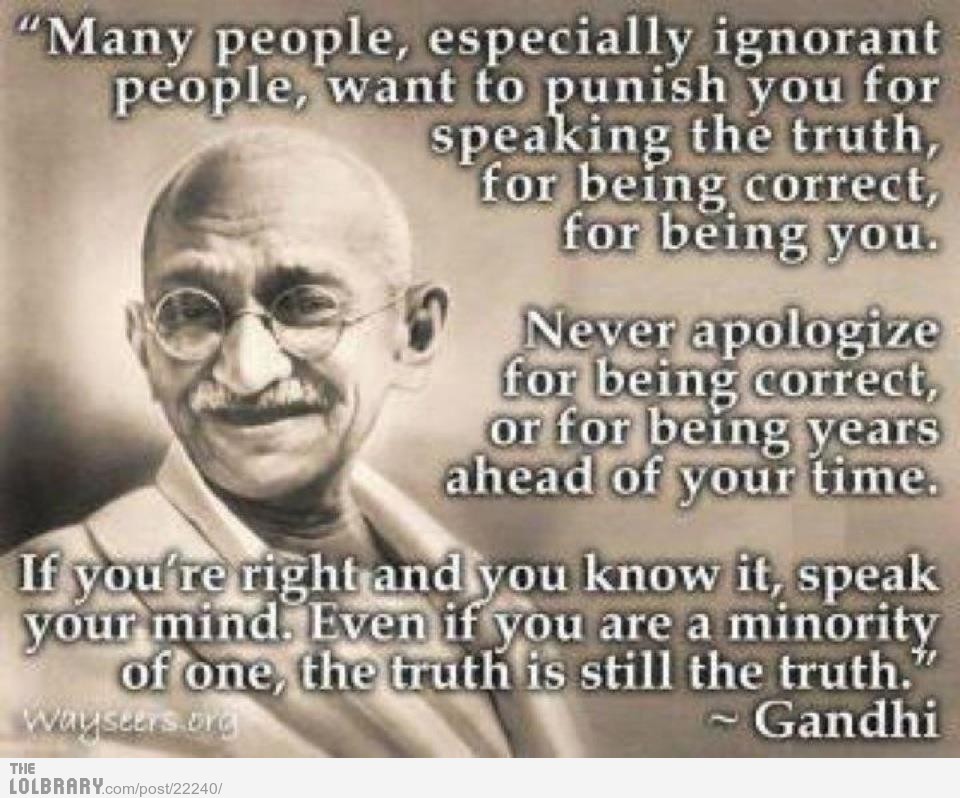
None of Us Can Change the World, So We’d Better Get Busy!

Gandhi

The other day a good friend and I were discussing the state of the world. Our conversation touched on the Boston Marathon bombing, the Bangladesh factory collapse, drone warfare, Guantanamo, the increasing concentration of media ownership, and the sorry state of the Roman Catholic Church. My friend remarked on the futility of attempting to do anything to change the world situation. Better to simply tend your garden, he said, rather than wasting psychic energy and physical effort to affect what cannot be changed.

I must confess that I found myself agreeing with my conversation partner more than not. It all seems so futile when we consider the overwhelming power of money, the state, the military, and of education and media propaganda whose predominantly conservative purpose is to keep things the way they are.

Suitably depressed, I took up my spiritual reading before going to bed. I’m currently pouring over, perhaps for the fifth time, Eknath Easwaran’s commentary on the Bhagavad Gita. In The End of Sorrow, the first of his three volume work (The Bhagavad Gita for Daily Living), Easwaran addresses the question of “detachment.” By that he means being free from anxiety or depression about the results of anything we do. What I read seemed intimately related to my exchange with my dear friend.

Easwaran points to the example of Gandhi:

“Prior to Gandhi, even people who had seen and grieved over the political bondage of India could not bring themselves to act because they thought the situation was impossible. They could not act because even before taking the first step they were already caught in results. We too, when faced with problems, have a tendency to think, ‘There is nothing we can do about it.’ . . . Wherever we find a wrong situation – in our personal life, in our country’s life, or in our world’s conflicts – we all have a duty to work to correct it.”

The words hit home. It’s giving up in the face of seemingly overwhelming odds that so strongly tempts us (me!). It’s just so easy to give up.

But as Kevin Trudeau reminds us, the temptation gives us far more credit for knowing our situation than our actual condition warrants. Coming from a completely secular and otherwise questionable perspective, Trudeau says we’re like people looking at a computer screen, but seeing only the bottom right hand corner – perhaps an inch square. We just don’t see what’s going on in the rest of the screen at all. But we make decisions and value judgments, we go in and out of depression as though we were all-knowing. We react and get attached to results as though our lives were not mere blips on the cosmic screen.

Thankfully, we don’t know very much. And our brief lives don’t offer much perspective on the effects of our actions. I’m reminded of what Mao Tse- tung’s is reputed to have answered when asked whether he thought the French Revolution was successful or not. “Too soon to say,” was his response.

It’s definitely too soon to say what the effects of our actions are or those of Dorothy Day, Daniel Berrigan, Bradley Manning, or John XXIII.

My friend is right. Results are out of our hands. But the person of faith, like Gandhi and those others I’ve just mentioned pushes ahead, doing what’s possible, leaving the results in the hands of the One who directs the universe. Only She sees the whole screen.

I take some comfort in that.

Alexander Being Here Now

OLYMPUS DIGITAL CAMERA

Alexander Kinne-Coyle

This morning’s post is the one I promised last Saturday. This meditation comes from Declan Coyle, a former colleague of mine in the Society of St. Columban, who was ordained in 1969. He later left the priesthood after living for years in slums and poor barrios in the Philippines and Taiwan. Here he reflects on what he and his family have learned from his youngest child, Alexander. Thank you, Declan, for allowing me to share this with my friends.

Alexander
Alexander has Mowat Wilson Syndronme. He cannot eat, walk or speak, and he is doubly incontinent but boy can he communicate.
He is unconditional Love … as near as we’ll ever get to it.
He doesn’t do the past. He doesn’t do the future.
He only does the present.
Here.
Now.
His simple message is always the same:
Be Here Now!
The essence of Zen.

You are only doing what you are doing.
“Chopping wood, drawing water!”

Not the mental noise of the thinking mind goaded into the future by the Ego that cannot live in the now with its victim stories: “how many more years will I have to chop this wood? Why do I always have to draw the water?” “Why is it always me?”

Alexander always invites us to be here now. Fully present. Fully alive. Awake. Aware. Alert.

As Rumi said, “the future and the past veil God from you. Burn both of them with fire.”

He brings all that “be fully present and live with joy in the now” stuff from the gospels alive.
“Take no thought for tomorrow …”
“Look at the flowers of the field how they bloom …”
“Don’t put your hand on the plough and look back … the negative past is a backpack full of manure … learn the life lessons and cut the backpack straps and live fully in the present …”
“Enter through the narrow gate of the now, the present moment …”
“By waiting and calm you will be saved, in quiet and trust your strength lies.” (Isaiah 30:15)
“Be still and know that I am God!”
“Come to me all you who labour and are overburdened and I will give you rest.” Mt. 11.28
“Unless you become like little children …”

Like the poet Rumi he says to us,
“Sell your cleverness and purchase bewilderment, awe and wonder!”

He is God’s gift to us, God, who as St John of the Cross said, hears “the silent language of love.”

Reminding us like Moby Dick author Herman Melville that, “silence is the one and only voice of God!”

Alexander shows us the pearl of great price right there in the centre of our being telling us not to try so hard.
Be one with life.
Go with the flow of life. Let go and let God.
A flower doesn’t work hard or try to bloom. It just does. The sun shines. No effort.

He is all about being here now.
Like the sun, all he wants to do is shine love into our lives even though the clouds of pain often cover his face.
Even then he’s reminding us that we are all children of the resurrection not the crucifixion.

When his laughter returns his constant reminder is to look at the crucifixion, that energy pattern of fear, but not to dwell on it. Not to make the victim-story our home. To look at the darkness, but to proclaim the light.

While we may look at the hands or the side on the Galilean carpenter and victim of abuse, the message is never the victim-story but rather the radical message of new life: “peace be with you, joy be with you!” Not the finger-pointing blaming, “will you look at what they did to me!”

Apart from the times Alexander is in pain, he is almost always smiling, waving and clapping his hands.

P.J. Cunningham saw him at the seafront in Bray one time waving at every single passerby and he said “he’s like a little pontiff!” That little royal or pontifical wave. He is not hard or tough. He is soft. But there is a huge strength in his softness.

Like the Tao Te Ching, Ch. 43:
“The softest thing in the universe overcomes the hardest thing in the universe.”

The ‘softest thing’ referred to is water. We see how, in the course of time, water can erode rock; how, without trouble, it disappears into the earth. Water looks soft, but really is very strong. Because it is silent and unpretentious, seems to have ‘no substance’, it achieves its purpose.

It is not worried about efficiency and profit. But eventually it is more successful than frantic work, because it is based on being.

Non-action tries to imitate this approach. It aims at being, not at producing immediate results. It does not make claims.

Chuang Tzu (300 BC) explains the same idea with reference to the art of target shooting.

“When an archer is shooting for nothing he has all his skill. If he shoots for a brass buckle he is already nervous.

If he shoots for a prize of gold he goes blind or sees two targets – he is out of his mind!

His skill has not changed. But the prize divides him. He cares now about winning.

He thinks more of winning than of shooting and the need to win drains him of power.”

His attachment to the outcome caused him to lose the present, the now, the moment. Process is lost in outcome addiction. The future fear-fuelled focus destroys the now. Fear replaces freedom and fun. Then the action in the now withers and shrivels and loses its free flowing power.

The poet T.S. Eliot captures the doing/being challenge in his poem “The Rock.”
“The endless cycle of idea and action,
Endless invention, endless experiment,
Brings knowledge of motion, but not stillness;
Knowledge of speech, but not silence;
Knowledge of words, but ignorance of the Word!”

Anthony De Mello says that despair is always five minutes ahead, never now. These great thinkers encourage us to “enjoy the precious present!”
D. H. Laurence said: “One’s actions ought to come out of an achieved stillness, not out of a mere rushing on.”
Alexander introduces us to the Being behind the Doing. The God of life behind all the action.

His presence invites us to slow down and step out from the fast pace of this world and reflect. To go receptive. To once again be here now. To allow ourselves to be guided, to be healed and to be loved by God. To dissolve resistance into an aware allowing.

Alexander is not under time pressure. He’s not working on his Ph.D. He teaches us what real love is all about. He shows us that we are not what we do (our work, our job, our title,) nor are we what we have, or even what other people think of us, our reputation. Rather than what we do, it’s who we are and who we become in his presence that matters.

The Chinese word for busy-ness or persistence is “knife” or “killing” and “heart!” When we’re busy we kill what the heart wants to achieve.
The heart wants to connect, to observe, to drink in, and to be aware and awake. But we’re too busy. We rush on past. Maybe tomorrow? We’re asleep.
“It is only with the heart that one sees rightly,” said the Little Prince.
“What is essential to the heart is invisible to the eye.”


Alexander is our “now” teacher. “Am I living well now? What is life teaching me now? What’s the best use of my time right now?”


Now is my gift.
The present has three meanings:
1. A gift.
2. Here.
3. Now.
Wisdom is knowing how to maximise the enjoyment of each moment. Being fully present enables people to give of their best and also to be able to receive the best that is on offer. Every day is a gift for those who really believe that every day is a gift.
When he looks at you, when he smiles, it’s as if he’s saying, “just fuel every moment with the best that’s in you now, and let fear and doubt go. Live out of love and freedom.”
There’s a story in the Orient about a monk who had a little bird on his shoulder who could see and foretell the future. Each morning the monk would ask the little bird, “Is today the day?” Meaning is today the day that I am going to die.
The bird would always reply, “no, but live as if it were.”
When Steve Jobs has his close encounter with life-threatening illness he resolved to live each day as if it were his last.
Being fully present answering the two great mystical questions:
“Where am I?”
“Here!”
“What time is it?”
“Now!”
If we cannot live in the now or discover Zen meditation washing the dishes or changing a dirty nappy there’s no way we’ll find in a cave on a mountain in Nepal or Tibet.
Alexander is our guru of “Being!” He is our master of power of now, the precious present. He is the ultimate cure for destination addiction or outcome addiction. He instinctively knows that the mountain of success is going to be very lonely if we don’t enjoy the climb, the view and the companionship on the way up.

It’s always the journey, never the destination.

He doesn’t label. He doesn’t judge. He doesn’t evaluate you and then decide how he’ll respond to you.
He lives in the unconditional love zone.
He has opened a portal to another world for us.
The world of ‘Being.’ So radically different from the world of doing, but also so root connected with the power of doing.

With Genevieve and Fionn, his brother and sister, when they were growing up, it was often the world of action and doing.
“Brush your teeth.”
“Do your homework.”
“Tidy your room.”
“Hurry up! Get ready!”
“Put away the dishes.”
“Come on! Let’s go … now!”

The doing is fine, but if that’s all there is then life is so so diminished.

With Alexander, when you touch him, hold him, cuddle him, smell him, put his cheek to your cheek, scratch his legs and get him laughing you enter the other portal into the world of Being.

He takes his mother Annette, and Genevieve, Fionn and Mary his friend and godmother, Hugh his godfather into this world of Being. Through that portal. That door. And they are always at their best in that space. Fully alive … here … now … in the moment with him.

As you look at, listen, touch or help him with this or that you are alert, still, completely present not wanting anything other than the moment as it is.

You are the Alertness, the Stillness, the Presence that is listening, looking touching … the Being behind the Doing.

The Loving Living God.
The kingdom inside.
Life to the full.
Joy pressed down, overflowing.
Holy Communion on a weekday.
Eucharistic thanksgiving.

Down in St Catherine’s in Newcastle where angels disguised as nurses and helpers look after him every morning and give him therapy sessions.

The children in his class are getting ready for Holy Communion next May. I asked him how he felt about that. He gave me that look as if to say, “Why should I take a bus to Bray when I’m already in Bray!”

When St. Francis said, “we must preach the gospel, but only if absolutely necessary use words,” he could have been talking about Alexander.

A slice of an apple pie has to be like the apple pie, like the source. Not like a slice of rhubarb pie. Exactly like the source.

Alexander is like a little slice of God. Just like the Source.

Blessing us with his presence all the time.
Reminding us of who we really are.
With him, you’ve entered another portal of life.

He lives what the monk Thick Nhat Hanh wrote about:

“Waking up in the morning, I smile
Twenty-four brand new hours before me
I vow to live fully in each moment
and look at all beings with the eyes of compassion.”

Alexander looks at us all with the eyes of compassion, with the eyes of joy, with the eyes of unconditional love. Never with the eyes of judgement. Never with the eyes of misery.

That’s how he enriches Annette, Genevieve, Fionn and Mary and all who come into his presence.

Last words to Dr Roisin Mulcahy from Bantry: “Children with special needs like Alexander … they soften the hard edges of society.”
Magic!
Here’s how Genevieve captured that magic in a poem she wrote about Alexander some years ago or as she playfully calls him Alexie Balexie Boo:
My Alex

At three minutes to midnight on December the 10th,
You were new to the world and took your first breath,
A gentle baby boy with wide-set eyes,
They sparkle when you’re happy and shine when you cry.
People often comment on your beautiful eyes,
their expressive colour, ever trusting, never shy.

You achieve what you do, you do what you can,
It’s hard to perform with Mowat Wilson syndrome.
Yet the ability to love, to “live in the now,” that’s pretty rare, but you know how.

Your happiness is special, the tint of your hair,
you’ve been sick a lot, and I’ll always be there.

The sounds of your chuckles are laughed with great taste,
It’s something I can’t describe,
it’s nothing I could paint.
Strangers are your friends, you stop, smile and wave,
What a beautiful little boy in that little walking frame.

My baby brother, Alexander,
I love you in every single way,
If it weren’t for you, would I still be the same person I am today?

I love to hug you and keep you very close,
It’s one of the things I love to do the most.

I’m proud to be your sister and also Fionn’s too,
Our beautiful baby brother, Alexie Balexie Boo.
“Run, Ashley, Run!”

ashley-judd

So Mitch McConnell and his staff think Ashley Judd’s bouts with depression and her understandings of Christianity are hilarious. That’s the impression emerging from a meeting of the senator with his staff as recently reported in Mother Jones.

Perhaps instead their hilarity should make us rethink Mitch himself and his fitness for holding public office. Let’s hope it convinces Ms. Judd to rethink her decision about opposing McConnell in 2014. Here’s what I mean . . . .

Until recently film star Ashley Judd had considered running against ole Mitch for his Senate seat. So his staff was huddling about how to discredit this well-known movie star who also happens to be a graduate of Harvard’s J.F. Kennedy School of Government. Apparently, however one staff member was a mole.

Whatever happened, someone recorded the conversation and later released it to Mother Jones. An article based on the transcript showed the McConnell team as a rowdy bunch of “good old boys” having a great time yucking it up about mental illness, environmentalists and of understandings of faith actually daring to differ from their own.

As her autobiography makes clear, Ms. Judd brings those issues together in ways that might appeal to constituents actually living in the twenty-first century, rather than with Mitch, his staff, and the best minds of the Civil War South.

Evidently, those minds have a hard time wrapping themselves around issues that really impact people’s lives such as poverty, climate change and coal’s relationship to global warming. They have difficulty understanding the concept of patriarchy and its impact on women (and men and children!), and that Christianity might not be synonymous with their own Bible-thumping fundamentalism.

So the boys had some good laughs talking over Ms. Judd’s well-known bouts with depression which she has documented in her autobiography. They seemed to agree that far from evincing a rather high degree of maturity, facing up to mental illness, writing about it, and helping others with similar problems make anyone permanently unfit to hold public office. Instead, they implied those who consider mental illnesses laughable are best fit to lead.

The boys also strategized about painting Ms. Judd as an unstable carpetbagger – because of her residence in Tennessee (though she spent the majority of her early years in Kentucky). Furthermore, she takes climate chaos seriously and so could be painted as “anti-coal.”

But above all, staffers gloated, she has these crazy ideas about Christianity! Yeah, she thinks it’s played into the hands of the “patriarchy.” How crazy is that? She actually thinks that God is much bigger than the concepts of male and female. She has this insane idea that the church is too male-dominated and might benefit from women pastors and preaching and who knows what else?

And “Get this,” one of them guffawed, “Judd actually wrote

I still choose the God of my understanding as the God of my childhood. I have to expand my God concept from time to time, and you know particularly I enjoy native faith practices, and have a very nature-based God concept. I’d like to think I’m like St. Francis in that way. Brother Donkey, Sister Bird.”

Evidently, that last line was just too much for everyone. The laughter got even more out of control. Apparently laughing through his tears, one meeting participant managed to get out “Brother Donkey, Sister Bird! That’s my favorite line so far. Absolute favorite one so far!” Ha, ha, ha!

Imagine a person actually taking seriously someone like Francis of Assisi, the 13th century spiritual father of the environmental movement. That particular nut once preached a sermon to birds—”my little sisters”— and referred to his own body as the “Brother Donkey.” How crazy was that?

And imagine a person needing to rethink her concept of God on a regular basis! Ha, ha, ha!

Ashley, you are what Kentucky needs. It’s time for us to ditch Mitch. He’s so 1862!

Run, Ashley, run!

What Is Retirement (and Life) for Anyway?

retirement

Last night Peggy and I had some dear friends over for drinks and conversation. Our friends retired two years ago – about a year after I did so myself. So more or less naturally, our conversation turned to retirement and its ups and downs – and to Florida and warmer climes.

The ups of retirement are obvious. They include not having to show up at the office any more. They entail being free each day to decide what to do. Travel, movies, hobbies like golf and tennis can be pursued freely in retirement. There’s more time to spend with children and grandchildren. And there’s space to think, write, study and pray. All of that is what people dream about doing in their golden years.

And so far, even though Peggy has not yet retired (and probably won’t for 3 or 4 years), my first years of retirement have been filled to overflowing with more of the expected ups than I can count. I’ve spent parts of 3 semesters in Costa Rica teaching in a Latin American Studies Program that was completely enjoyable and fun. The program served North American students from a large number of Christian colleges and universities. It was their “term abroad.” And it introduced them to the realities of the underdeveloped world, taking them to impoverished parts of Costa Rica, living with local families in Nicaragua and investigating first-hand the successes and shortcomings of socialist revolution in Cuba.

My part in the program was to introduce our Evangelical (and Republican) students to liberation theology. On the whole, the students were surprisingly open and receptive. And though I’ve always loved teaching, I’ve never found it as enjoyable as in Costa Rica.

Then last spring Peggy and I used her sabbatical to spend five months in Cape Town, South Africa – or, as they say, in the heart of “whitest Africa.” We were completely captivated by Cape Town which we agreed is the most beautiful city we’ve ever seen. We loved Table Mountain and the beautiful sea vistas everywhere we traveled. We also learned a great deal in South Africa, not only about politics and history, but about African spirituality and the powerful energy of rock formations subtly transformed by the San and Koi-Koi Peoples to track the movements of the heavens.

We traveled South Africa’s “Wine Route” and visited game parks with our grandchildren and their parents. I played golf with my son Brendan on a few of South Africa’s best courses. We passed a day on Robben Island, where Nelson Mandela was imprisoned for 17 of his 28 years of punishment in South African jails. We also spent weeks with Ann Hope and Sally Timmel, colleagues of Steve Biko with a life-long commitment to activism and the struggle against apartheid. We compared notes with them about common experiences, shared friendships, theology and spirituality. What a privilege that was!

With South Africa behind us, we’re now looking forward to five months in India. Can you imagine that? My Peggy has won her second Fulbright Fellowship (the other having brought us to Zimbabwe for a year back in ’97-’98). During this Fulbright term, Peggy will be teaching in Mysore. This will be our second trip to India. In 2004 we attended the World Social Forum in Mumbai.

This time we’ll be living in India with our daughter Maggie, our son-in-law, Kerry, and their three small children, Eva (4), Oscar (2), and Orlando (10 months). Kerry is taking his own sabbatical from his work in finance. So this will be an extraordinary opportunity not only to learn from a deeply spiritual culture, but to bond deeply with our grandchildren.

And then there’s this blog. It’s been unexpectedly fulfilling. I’ve never written as much as I have over these past three years, not only on my blog site, but on OpEdNews and in our local newspaper. Writing a homily each week has kept me grappling with my life-long commitment to spirituality, faith and theology. It’s all helped me think more clearly about life and its purpose.

Actually I’ve thought of the blog as a vehicle for reclaiming the formal priesthood I left more than 36 years ago – as has my involvement in the planning committee of a local Ecumenical Table Fellowship. I’ve seen this new work as a demonstration of the fact that Christian faith isn’t synonymous with fundamentalism. Approaching faith historically and contextually can recover the authentic teaching of Yeshua the Nazarene (the opposite of fundamentalism) and engage and animate radicals and progressives in the process.

How are those for retirement ups? At some level, I couldn’t ask for more.

But then there have been unexpected downs. With retirement comes a loss of identity. With my particular work as a college teacher, I had one of the best jobs I could think of. Imagine getting paid to read, study, write, and travel – all so that you might have hours of interesting conversations with young people?

Yes there was drudgery involved – papers to grade, committees, endless meetings, “administrivia.” But there was no heavy lifting. And there were those long vacations – three weeks at Christmas, three months in the summer, and mid-term breaks fall and spring. The “pay” for teaching went way beyond a monthly check. It involved those conversations I mentioned, but also the resulting life-long friendships, “turning on” students to life’s big questions, seeing that “light” go on, and watching students take their places as agents of transformation in the world.

Most of that (except the now-endless vacation) disappeared with retirement. And whereas previously I could walk across Berea’s campus and meet my students and former students at virtually every turn, I now find students (and myself!) largely anonymous. I miss the interactions with young people. I even have to show my identity card when I enter the Seabury Athletic Center to do my morning exercises. “Mike who. . .?”

On the one hand I find the question liberating, but also a little depressing. It means my identity is gradually slipping away. It all reminds me of the inevitable: the final slipping away, and the complete loss of identity and of any conscious trace of having been here at all. That’s not a morbid thought. It’s simply a fact. Following our deaths and within a generation or less, virtually anyone I know will disappear entirely from everyone’s memory.

And that brings me to my question: what is life for anyway? Truth is: I don’t know for sure.

And that’s where faith comes in. I’ve come to understand faith as taking a leap into what we don’t know for sure. I mean life might be just about family, travel, good food and drink, getting strokes from grateful students, breaking par or watching movies. However, I don’t think it is.

Instead, I’ve come to agree with the great mystics of all traditions – Hindu, Buddhist, Muslim, and Christian. At their highest peak, all of those traditions come together on the following points:

1. There’s a spark of the divine within each of us – our deepest identity.
2. Each human being is called to live from that divine place – to actualize God’s love in the world.
3. And that’s the purpose of life.
4. Gradually, as one strives for such actualization, s/he begins to see divine presence in everything, in all of creation.

So that’s what life is about for me – seeing God everywhere and responding accordingly. That’s what retirement is about. Sixteen years ago I decided to leap in that direction. My jump has involved the daily practice of meditation, repetition of my mantram, training the senses, spiritual reading from the mystics, spiritual companionship, slowing down, and one-pointed attention – the eight-point program of Eknath Easwaran, the great meditation teacher from Kerala state in India. In retirement I finally have time to follow Easwaran’s program more wholeheartedly than ever.

None of this excludes the other activities I’ve mentioned. Peggy and I will still travel, and spend time with our children and grandchildren. I’ll still hack around on the golf course, study, write, and give the occasional class. And I’ll continue learning to grapple with and mostly enjoy my anonymity and nobody-ness.

But meditation and its allied disciplines puts all those things in perspective. And it gets me ready for my next incarnation. [Oh yes, I’ve come to agree with the mystics (including Yeshua) that life won’t end for me or anyone else when those last memories fade . . . .]

Do you agree?

Lenten Reflection II: Why Lenten Penance?

Manhattan

Recently, a good friend of mine wrote to ask how my Lenten resolutions were faring. It’s half-way through Lent, and given what I wrote here on Ash Wednesday (located in the “Thoughts for the Day” category just below the masthead of this blog site), I think I owe her an answer. I’m hoping that the reflection needed for sharing like this might reignite my own Lenten fire. Perhaps it might also encourage reflection in others. They might even share their experiences using the “Comment” feature on this blog site. And that in turn might encourage the rest of us to “save” our Lents before it’s too late.

In general, my Lent is going well. Two elements have made it special. A third (a chance conversation) has given me a fresh understanding of the purpose of Lenten penance.

The two special elements are first of all my experience with an emerging “Ecumenical Table” in our local area. The second is a Lenten study group I’m leading about the historical Jesus.

I’ve mentioned the “Ecumenical Table” several times before in these blog postings. It’s a lay-led gathering of Christians who are looking for deeper meaning in Sunday liturgies. We’ve been gathering monthly for Lord’s Supper liturgies since Pentecost last year. But this Lent we’ve decided to meet every Sunday in a more focused attempt to discern whether our form of community worship is what we’re seeking ultimately. The liturgies the past three weeks have been beautiful and thoughtful. And hearing the voices of women as Lord’s Supper celebrants and homilists is unbelievably enriching. It makes it so apparent how the Catholic Church impoverishes itself and its people by insisting on an all-male clergy.

The second special element of this year’s Lent is our little seminar on the historical Jesus. We’ve been meeting each Wednesday night for an hour and a half. Our purpose is (as Marcus Borg put it) to “meet Jesus again for the first time.” We’re trying to encounter the Jesus of history who stands behind the faith-inspired interpretations of the canonical gospels.

So far the seminar has been going well, although I’ve found my own leadership uneven. But the participants (about 25 at each session) have been unbelievably generous in their showing up, contributing to discussions, and overlooking leadership shortcomings. (Some have told me it’s their Lenten penance!) In any case, the discussion of the gospel readings for the Sunday following each Wednesday’s meeting is proving to be especially rewarding. The same holds true for the segments of the PBS series, “From Jesus to Christ.”

I’ve even found the sessions spilling over into casual conversations. In particular two of my ex-priest friends who have done me the honor of attending have helped clarify my own thought and have advised me about how to do better over hot chocolates at our local gathering place, Berea Coffee and Tea.

The third special element of this year’s Lent, my attempts at Lenten discipline, has been greatly influenced by a conversation I had with a friend weeks before Lent began. He and his wife had come over for supper, and I offered him a cocktail beforehand. My friend declined. He said his son was alcoholic, and as an act of solidarity with his son’s efforts to resist alcohol, my friend too was giving it up.

At first I supposed he was thinking in terms of good example. But then I realized there was far more to it than that. After all, his son wasn’t present to witness my friend’s abstinence. Instead my friend was expressing his faith in the basic unity of all human beings. His abstinence affirmed that acts of solidarity with others somehow influence them even when they are not physically present – even when they’re not consciously aware that those acts are being performed. That’s a deep act of faith quite relevant to Lenten disciplines.

My friend’s words made me realize that at least one purpose of abstinence and other forms of what we used to call “penance” is to raise consciousness of our unity with others – especially with whose negative experiences of life we’ve managed to escape. The hope is that the resulting vicarious experience will somehow strengthen them and move us to action towards eliminating the causes of their distress. So for example,

• Following my friend’s example of abstinence from alcohol establishes a bond with those struggling to break addictions to liquor and drugs.

• Not eating meat somehow unites us with the hungry and raises consciousness about the effects meat-eating has on them and on the environment in general.

• Lowering the water temperature in one’s morning shower creates solidarity with those in U.S. prison camps subjected to water torture in various forms – including cold and scalding showers and waterboarding.

• Turning off the TV above the elliptical machine while exercising, and repeating one’s mantram instead begins to break the bond with the culture of overconsumption and destructive growth.

• The same holds true for establishing a daily discipline of consulting e-mail only once or twice a day instead of every fifteen minutes.

My friend’s refusal of liquor that night taught me that the realization of human solidarity in addictions and other problems is the whole point of Lent and its “penance.” All the rest including formal worship and study of the historical Jesus is simply means to that end.

No, I take that back. The end isn’t realizing human solidarity. The end is doing something about it.

And yet as Gandhi taught us, the end is mysteriously contained in the means – however seemingly insignificant.

Lenten Reflection: The Ash Wednesday after the Pope’s Resignation

ash-wednesday-1[1]

Well, it’s Lent. Today is Ash Wednesday. My question is what does that mean for activists who are aspiring to follow in the footsteps of the great prophet, dissident, teacher of unconventional wisdom, story-teller, mystic, and movement founder, Yeshua of Nazareth?

The question is obscured by long centuries of covering up those identities in favor of Jesus’ overwhelming identification as “Son of God.” That title swallows up all the rest and makes it difficult, if not impossible to engage in what Thomas a Kempis called “The Imitation of Christ.”

But for the moment, suppose we set aside “Jesus the Christ,” and concentrate on that man his mother named Yeshua. He lived in a time not unlike our own, in a province occupied by an empire similar to ours. He found such occupation unbearable, and devoted his public life to replacing the “Pax Romana” with what he called the “Kingdom of God.” There the world would be governed not by Roman jackboots, or by the law of the strongest, but by compassion and gift – even towards those his culture saw as undeserving.

The latter was “Good News” for the poor and oppressed among whom he found himself and his friends – laborers, working girls, beggars, lepers infected with a disease not unlike AIDS, and those fortunate enough to have government work as toll gatherers. He ate with such people. He drank wine with them. Some said he got drunk with them. He defended such friends in public. And he harshly criticized their oppressors, beginning with his religion’s equivalents of popes, bishops, priests, ministers, and TV evangelists. “Woe to you rich!” he said. “White-washed tombs!” he called the religious “leaders.”

What does it mean to follow such an activist and champion of the poor this Ash Wednesday February 13, 2013?

I would say it means first of all to ask that question and to pray humbly for an answer.

Other questions for this Lent: Does following Jesus mean taking a public stance against empire and “church” as he did? Does it mean praying for the defeat of U.S. imperial forces wherever they wage their wars of expansion and aggression? Does it mean discouraging our daughters and sons from participating in a disgrace-full military? Does it mean leaving our churches which have become the white-washed tombs of a God who through failed church leadership has lost credibility and the vital capacity to effectively summon us beyond our nationalism, militarism, and addiction to guns and violence? Does it mean lobbying, making phone calls on behalf of and generally supporting those our culture finds undeserving and “unclean?”

Does it mean for Catholics that we somehow make our voices heard all the way to Rome demanding that any new pope save the church from itself by rejecting the anti-Vatican II schismatic tendencies of the last two popes, healing the wounds of the pedophilia crisis, reversing the disaster of “Humanae Vitae’s” prohibition of contraception, allowing women to become priests, eliminating mandatory celibacy as a prerequisite for ordination, and recognizing and honoring the contributions of Catholic women like the members of the Leadership Conference of Women Religious (LCWR)?

Yes, I think, it means all of those things. But Lent also calls for self-purification from the spirit that arrogantly locates all the world’s evils “out there” in “those people.” In its wisdom, the grassroots church of Hildegard of Bingen, Francis of Assisi and St. Clare, of Daniel and Phil Berrigan, Dorothy Day, Martin Luther King, Oscar Romero, Ignacio Ellacuria, Jean Donovan, and Matthew Fox calls us to deepen our interior lives for purposes of sharpening our discernment about how to contribute towards replacing empire with God’s Kingdom. All of those saints, remember, were condemned by the hierarchy just the way Yeshua was in his own day.

Six weeks is a relatively long time for the purification necessary to eliminate undesirable patterns in our lives and to replace them with habits exemplified in the lives of the saints I’ve just mentioned. It’s plenty of time for working on our addictions to the pursuit of pleasure, profit, power, and prestige. Each of us knows what behaviors in our own lives are associated with those categories. So it’s time to get to work.

As for myself . . . besides using this period for training my senses, I intend to recommit myself with renewed fervor to my daily practice of meditation, my mantram (“Yeshua, Yeshua”), spiritual reading, slowing down, one-pointed attention, spiritual companionship, and putting the needs of others first – the eight-point program outlined by Eknath Easwaran in his book Passage Meditation. I’m going to keep a spiritual journal this Lent to make sure I stay focused.

I’m also joining some friends of mine in a resolution to give up church for Lent. We’re doing so in favor of a six week experiment with an “Ecumenical Table” — a lay-led liturgical gathering often featuring a woman as homilist and Eucharistic Prayer leader. Though some in the group will also continue to attend their normal churches, the experiment may help us discern how to finally cope with the white-washed tombs of God I mentioned earlier.

And then there’s our parish Lenten Program I’ll be facilitating. It’s called “The Quest of the Historical Jesus: from Jesus to Christ.” It will be devoted to discovering the carpenter Yeshua behind the Jesus Christ of the gospels. In the light of our discoveries, we’ll unpack the liturgical readings for the following Sunday in hopes of making those Lenten liturgies more meaningful and challenging.

Additionally, my wife Peggy and I will also be working hard on our communication and have decided to devote significant time each evening to listening to each other in a loving respectful way.

In these ways I hope to pass my most fruitful Lent ever, to be truly able to rise with Yeshua to a new level of Kingdom-commitment on Easter Sunday.