Pope Francis, Donald Trump and the Revelation of Pentecost (Sunday Homily)

Trump & Frank

Readings for Pentecost Sunday: ACTS 5: 2-11; PS 104: 1, 24, 29-31, 34; 1COR 12: 3B-7, 12-13; JN 20: 19-23.

So who do you think is more outspoken, Donald Trump or Pope Francis? Which one should followers of Jesus listen to?

That question was sharpened a few weeks ago, when Pope Francis implied that Donald Trump is not a Christian. Responding to a reporter’s question, the pontiff lit up the internet when he said about Trump, “Anyone, whoever he is, who only wants to build walls and not bridges is not a Christian.” Francis added, “Vote, don’t vote, I won’t meddle. But I simply say, if he says those things, this man is not a Christian.”

The pope’s comment came at the end of Francis’ six-day trip to Mexico. There he celebrated Mass with 300,000 faithful in attendance near the Mexican-U.S. border. He used the occasion to decry the “human tragedy” of worldwide migrations of people fleeing violence, war and the effects of climate change. The pope’s analysis, of course, conflicts with Mr. Trump’s who sees immigrants as rapists, drug-dealers, and terrorists.

Francis’ comments drew a quick response from The Donald. He called the pope’s charges outrageous and accused him of being a pawn of the Mexican government.

While Francis’ words were surprising and the response predictable, both provide occasion for a Pentecost reflection on what it means to be a baptized and confirmed Christian in a world awash with refugees from U.S. bombings and the effects of neo-liberal overconsumption.

That’s because the emphasis in today’s readings is precisely on internationalism. The Kingdom of God, the readings tell us, has no borders. It is open to everyone regardless of nationality, race, occupation or gender. Moreover, the Kingdom of God is a matter of this world – of the Body of Christ.  It is not about some disembodied reality up in the sky.

That twofold message starts with today’s opening reading from the Acts of the Apostles with all those strange identity references that readers usually stumble over. Jews, we are told who were present on that first Pentecost were “Parthians, Medes, and Elamites, inhabitants of Mesopotamia, Judea and Cappadocia, Pontus and Asia, Phrygia and Pamphylia, Egypt and the districts of Libya near Cyrene, as well as travelers from Rome, both Jews and converts to Judaism, Cretans and Arabs.”

Then in today’s second reading, Paul goes even further. God’s Kingdom, he says, isn’t just for Jews. In fact in God’s eyes national distinctions, economic status, and gender identity have been erased for those who accept the Gift of God’s Spirit. Paul writes: “For in one Spirit we were all baptized into one body, whether Jews or Greeks, slaves or free persons, and we were all given to drink of one Spirit.” Elsewhere (Galatians 3:28) he puts it even more directly: “There is neither Jew nor Gentile, neither slave nor free, nor is there male and female, for you are all one in Christ Jesus.”

Paul’s message was a consistent theme in the life of Jesus. He healed and forgave, loved and taught Jews, Gentiles, Samaritans, street walkers, lepers, tax collectors, and even on occasion members of the Roman occupying forces.

Notice too Paul’s words about “body” insert the reception of Jesus’ Spirit into the earthly realm of real life and politics. True, Paul speaks of “spiritual gifts,” but he even more emphatically insists that those gifts must be “manifest” in “service” meant to “benefit” others. We are members of Christ’s “Body,” Paul tells us. That is, we are all somehow living “in Christ” – in God, we might say. The question is, do we recognize that reality or not?

In today’s Gospel, Jesus reminds us more specifically where in the world we encounter his embodied spirit. It happens first of all in the community of peacemakers. Jesus’ first words after his resurrection are about peace. “Peace be with you,” he says.  Then he immediately shows his pierced hands and side to his friends. In doing so he seems to remind his followers that he will forever be found in the victims of war and imperialism. That includes refugees from imperialist wars and excess consumption as well as in victims of torture and capital punishment like Jesus himself.

Is such understanding of Pentecost too political? Donald Trump might think so. Pope Francis does not. Francis himself has pointed out that Aristotle was correct in saying that human beings are political animals. So to be branded “political” is to have one’s humanity recognized. The pope said he is proud to be branded political.

So would-be followers of Jesus are presented with a choice on this particular Pentecost.  Are we to follow Pope Francis or Donald Trump? The choice is ours.

More accurately, do we recognize that we are living not “in America,” but “in Christ?”  Do we recognize (as John Oxenham put it more than 100 years ago) that

1 In Christ there is no east or west,
in him no south or north,
but one great fellowship of love
throughout the whole wide earth.

2 In Christ shall true hearts everywhere
their high communion find;
his service is the golden cord
close-binding humankind.

3 Join hands, disciples of the faith,
whate’er your race may be.
All children of the living God
are surely kin to me.
How Biblical Studies Helped My Critical Thinking: Part Two (Personal Reflections Pt. XIII)

Kennedy

These last three weeks I’ve been trying to show how critical reading of biblical texts is connected to critical reading of every other text — including that of my own life. In all cases, “ideological suspicion” Is central.

It alerts readers to the fact that vested Interests tend to distort analysis — but mostly in conservative ways Intent on supporting the status quo. That’s the way as well with most extra-biblical texts like the mainstream media, best-sellers and school text books.

By way of contrast, readings issuing from the viewpoints of the socially-conscious dispossessed tend towards subversion of the status quo. That’s significant for Bible reading because (as I was saying last week) the Bible largely represents the memory of poor and oppressed communities. As such, books within the biblical cannon are nearly unique in history whose records normally preserve the memories of the rich and famous.

So with that in mind, here are twelve more conclusions I’ve drawn about the Bible. Notice the connections to politics and the very complex question of violence so pertinent in a world characterized by a permanent war against terrorism. Again, I present this second list of 12 conclusions to expose the way biblical studies have influenced my political leanings and the ideas that seem so strange to my adult children. .

  1. The experience of the socially activist poor and oppressed leads them to discover a liberating God in the Bible. He habitually overturns political, economic and social structures oppressive of people like themselves.
  1. In other words, the God of the Bible is not a neutral God. The biblical God is a class-biased God who has made a “preferential option for the poor.”  Similarly, Jesus is class-biased, not averse to making sweeping statements about “the poor” and “the rich” as groups without specific reference to individuals within those groups.
  1. Neither is the Bible a neutral text.  In fact, there are no neutral texts at all.  Any text, biblical or otherwise, either supports the status quo or it attempts to subvert it.  A text which does not subvert supports.  There is no third position.  By and large (though not universally) the biblical texts predominantly produced in situations of persecution, attempt to subvert the order of the world; they support God’s order often described in terms of “the reign of God.”  Once again, it is an order which as the antithesis of the world’s present order favoring the rich and powerful, favors instead the poor and oppressed.
  1. Similarly, there is no neutral exegesis of the sacred texts. Every reading is done by a person of a particular gender, race, nationality, and creed, with a particular personal history, and located in a given historical era.  Inevitably such readers possess more or less definite political commitments, and have predetermined understandings of the world.  Each of these elements as well as others inevitably bias his or her exegesis of the text. Each interpretation facilitates some insights but excludes others.  With this in mind, it is revealing to note that almost invariably respected mainstream exegesis has been done by rather comfortable white males of European background.  This means that the vast majority of believers, women, people of color, the poor, the illiterate, as well as Christians of the Third World have been left voiceless.  All of these have been forced to accept as normative well-off European, white, male biblical interpretations.  And once again, these interpretations almost universally have supported maintenance of white male euro-centric privilege.
  1. Today our Third World brothers and sisters are asking us to open ourselves to the levels of meaning they are discovering. They do not claim these are the only possible meanings; for clearly there are others.  Neither do they hold that those who make diametrically opposed interpretations are insincere; for such a claim would obviously be false.  They do, however, observe that these latter interpretations are extremely partial, for normally such readings take no note of their contradictory alternatives produced for example by unlearned people in the Third World.  Meanwhile, the exegesis of the poor and oppressed is normally more comprehensive, for it is well aware of the mainstream interpretation and usually spends a good deal of its time contesting such understandings as ideological.
  1. Meanings uncovered in this way lead to judgments about the structures of poverty and oppression experienced in the world, and to action towards changing those structures. Here the emphasis is on judgment of sinful structures rather than on sinful human beings.  For although personal sin is a painful reality, it is not up to Christians to judge how others stand in God’s eyes.  Nevertheless, God’s word can shed light on the human institutions which victimize both oppressed and oppressors by facilitating and often appearing to necessitate injustice.  An example of such an institution is international capitalism particularly as it impacts the Global South.  Institutions of this kind must be eliminated by Christian action in the world.
  1. Unfortunately, those who profit from the world’s sinful structures do not usually allow them to be changed willingly; instead their more frequent response to movements for change is one of extreme violence often directed towards the most vulnerable, children, the elderly, women, the sick.
  1. As a last resort, defense of these “least of the brethren” may demand that Christians take up arms and give their lives on behalf of the otherwise defenseless. Here other Christians, especially those outside the violent and threatening context in question must exercise extreme caution in judging such actions as contrary to the spirit of the Gospel.  This is especially true if those tempted to judgements of this type are among those whose taxes and/or silence enable their own  government to sponsor the violence which prompts assumption of arms in defense of the otherwise helpless.

21. Likewise criticism of Christians who take up arms in defense of “the least of the brethren” must be restrained since the Gospel is by no means clear consistent in its judgment about such action. In fact, historically speaking, most Christians who read the Bible in good faith have found that it does not require non-violent resistance.  A close reading of the biblical texts, and an examination of church history seems to reveal that highly contextualized considerations rather than some unchangeable principle of non-violent resistance have dictated the responses of Christians in situations of persecution.

  1. In addition, it must be admitted that not all violence is the same. There is a real difference between (a) the violence of the unprovoked attacker (This is clearly against Gospel teaching); (b) the violence of one defending himself or herself against unprovoked attack (This is less evidently against Christian belief); and (c) the violence employed in similar circumstances by one risking his or her own life in defense of the lives of the otherwise defenseless such as children or the elderly (Arguably this may represent a positive response to the Gospel).  To neglect such distinctions is to obscure questions of violence and non-violence.
  1. For these reasons, advocates of non-violence for others must humbly examine their consciences to see if their advocacy is not unwittingly supporting the interests of those oppressing the defenseless. Here it must be noted that most robbers and perpetrators of other forms of violence are quite enthusiastic supporters of “peace” which takes the form of non-violent response on the parts of their victims.  It should also be observed that in this case those upon whom the strategy of non-violence is so enthusiastically urged are the least able to defend themselves.  In fact, historically speaking, the poor and working classes of the world who for the most part are the victims of oppression, stand virtually without means of self-protection, having no armies of their own.  They are the only ones to whom both state and church authority have forbidden violence  as a legitimate means of defending their loved ones from their oppressors of the propertied classes who have huge armies and defense budgets at their disposal.
  1. Perhaps in view of all this, the most that some North American Christians can say is that they themselves are hearing a vocation to non-violent resistance, and that Christians in other very different situations  are being called to determine how best to defend the “least of the brethren.” in their own contexts.  No doubt some Christians there will choose to arm themselves on behalf of their families, friends and fellow citizens.  Others will choose non-violent resistance. Still others will choose a combination of the two approaches.   A great deal will depend on the context in question. Christians living in the U.S.A. must overcome the affliction of tolerating violence in service to U.S. corporate interests while condemning the violence of those who resist such oppression.  “I would assert that people who have not actively opposed the violence of the powerful against the poor, at some cost to themselves,” writes Philip Berryman, “have no moral authority to question the violence used by the poor.”  (Jack Nelson PallmeyerThe Politics of Compassion.”  Maryknoll, New York: Orbis Books 1986, 87.)

Realizations like the ones I’ve noted here — all of them faith-based have inclined me to:

  • Understand world events in ways that privilege the viewpoints of the  world’s poor.
  • Side with them in their conflicts with the rich and powerful.
  • Acquaint myself with the reasons for what the privileged habitually describe as the unprovoked “violence” of those they habitually oppress.
  • See that the violence of the rich and powerful dwarfs that of the poor they exploit.
  • Perceive that since World War II all of the U.S. wars have actually been fought against the world’s poor and oppressed to keep them in that condition.

Ascension Sunday: What’s The Purpose of Christianity? (Sunday Homily)

Ascension

Readings for Ascension Sunday: Acts 1: 1-11; Ps. 47: 2-3, 6-9; Eph. 1: 17-23; Lk. 24: 48-53

This is Ascension Sunday. For us Catholics, it used to be “Ascension Thursday.” It was a “holy day of obligation.” That phrase meant that Catholics were obliged to attend Mass on Thursday just as they were on Sunday. To miss Mass on such a day was to commit a “mortal sin.” And that meant that if you died before “going to confession,” you would be condemned to hell for all eternity.

So until the years following the Second Vatican Council (1962-1965) Catholics would fill their churches on Ascension Thursday in the same numbers (and under the same threat) that made them come to Mass on Sundays. That’s hard to imagine today.

I suppose that difficulty is responsible for the transfer of the commemoration of Jesus’ “ascension into heaven” from Thursday to Sunday. I mean it wasn’t that the church changed its teaching about “holy days of obligation.” It didn’t. Catholics simply voted with their feet. They stopped believing that God would send them to hell for missing Mass on Ascension Thursday or the feast of the Blessed Virgin’s Assumption (August 15th), or All Saints Day (November 1st) or on any of the other “holy days.” Church once a week was about as much as the hierarchy could expect.

But even there, Catholics stopped believing that God would punish them for missing Mass on Sunday. So these days they more easily attend to other matters on Sunday too. They set up an early tee time or go for a hike in the woods. Afterwards they cut the lawn or go shopping at Wal-Mart. That kind of “servile work on Sundays” or shopping used to be forbidden “under pain of sin” as well. And once again, it isn’t church teaching that has changed. Catholics have just decided that the teachings don’t make sense anymore, and have stopped observing them.

And apparently they do so in good conscience. So you won’t find them running to confession after missing Mass or working and shopping on Sunday. In fact, that’s another way Catholics have voted with their feet. For all practical purposes, they’ve stopped believing in Confession – and largely in many of the mortal sins they were told would send them to hell – like practicing contraception or even getting a divorce.

I remember Saturday evenings when I was a kid (and later on when I was a priest). People would line up from 4:00-6:00, and then from 7:00 -9:00 to “go to Confession.” And the traffic would be steady; the lines were long. No more! In fact, I personally can’t remember the last time I went to confession. And no priests today sit in the confessional box on Saturday afternoons and evenings waiting for penitents to present themselves.

What I’m saying is that the last fifty years have witnessed a tremendous change in faith – at least among Catholics. Our old faith has gone the way of St. Christopher and St. Philomena and “limbo” all of which have been officially decertified since Vatican II.

In fact, since then the whole purpose of being a Catholic (Christianity) has become questioned at the grassroots level. More and more of our children abandon a faith that often seems fantastic, childish and out-of-touch. Was Jesus really about going to heaven and avoiding hell? Or is faith about trying to follow the “Way” of Jesus in this life with a view to making the world more habitable for and hospitable to actually living human beings?

That question is centralized in today’s liturgy of the word. There the attentive reader can discern a conflict brewing. On the one side there’s textual evidence of belief within the early church that following Jesus entails focus on justice in this world – on the kingdom. And on the other side there are the seeds of those ideas that it’s all about the promise of “heaven” with the threat of hell at least implicit. The problem is that the narrative in today’s liturgy of the word is mixed with its alternative.

According the story about following Jesus as a matter of this-worldly justice, the risen Master spent the 40 days following his resurrection instructing his disciples specifically about “the Kingdom.” For Jews that meant discourse about what the world would be like if God were king instead of Caesar. Jesus’ teaching must have been strong. I mean why else in Jesus’ final minutes with his friends, and after 40 days of instruction about the kingdom would they pose the question, “Is it now that you’ll restore the kingdom to Israel?” That’s a political and revolutionary question about driving the Romans out of the country.

Moreover Jesus doesn’t disabuse his friends of their notion as though they didn’t get his point. Instead he replies in effect, “Don’t ask about precise times; just go back to Jerusalem and wait for my Spirit to come.” That Spirit will “clothe you in justice,” he tells them. Then he takes his leave.

Presently two men clothed in white (the color of martyrdom) tell the disciples to stop looking up to heaven as if Jesus were there. He’s not to be found “up there,” they seem to say. Jesus will soon be found “down here.” There’s going to be a Second Coming. Jesus will complete the project his crucifixion cut short – restoring Israel’s kingdom. So the disciples who are Jews who think they’ve found the Messiah in Jesus return in joy to Jerusalem and (as good Jews) spend most of their time in the Temple praising God, and waiting to be “clothed in Jesus’ Spirit” of liberation from Roman rule.

The other story (which historically has swallowed up the first) emphasizes God “up there,” and our going to him after death. It’s woven into the fabric of today’s readings too. Here Jesus doesn’t finally discourse about God’s kingdom, but about “the forgiveness of sin.” After doing so, he’s lifted up into the sky. There Paul tells his readers in Ephesus, he’s enthroned at the Father’s right hand surrounded by angelic “Thrones” and “Dominions.” This Jesus has founded a “church,” – a new religion; and he is the head of the church, which is his body.

This is the story that emerged when Paul tried to make Jesus relevant to gentiles – to non-Jews who were part of the Roman Empire, and who couldn’t relate to a messiah bent on replacing Rome with a world order characterized by God’s justice for a captive people. So it gradually turned Jesus into a “salvation messiah” familiar to Romans. This messiah offered happiness beyond the grave rather than liberation from empire. It centralized a Jesus whose morality reflected the ethic of empire: “obey or be punished.” That’s the ethic we Catholics grew up with and that former and would-be believers find increasingly incredible, and increasingly irrelevant to our 21st century world.

Would all of that incredibility and irrelevance change if the world’s 2.1 billion Christians (about 1/3 of the world’s total population) adopted the this-worldly Jesus as its own instead of the Jesus “up there?” That is, would it change if Christians stopped looking up to heaven and focused instead on the historical Jesus so concerned with God’s New World Order of justice for the poor and rejection of empire?

Imagine if believers uncompromisingly opposed empire and its excesses – if what set them apart was their refusal to fight in empires wars or serve its interests. How different – and more peaceful – our world would be!

A sensitive discerning reading of today’s liturgy of the word, a sensitive and critical understanding of Jesus’ “ascension” presents us with that challenge. How should we respond?

(Discussion follows.)

Dan Berrigan: in Memoriam

Dan Berrigan Resist

I just spent the last hour in tears. The occasion was a tribute to Dan Berrigan on Democracy Now (the best daily news program available).  The saintly Jesuit poet, peace activist and prolific author died on Saturday. He was about to celebrate his 95th birthday this week. What a giant!

Father Berrigan stands with Dorothy Day and Thomas Merton as the most powerful U.S. prophets and social justice activists or our era. They along with Martin Luther King are the true saints of our time.

All of them changed the way Americans approach issues of war and peace. In particular they changed the Catholic Church – challenging it to reverse 1700 years of belligerence and unquestioning support of imperial war, and to follow instead the clear teachings of Jesus the Christ.

Dan Berrigan not only wrote and spoke in ways that uncomfortably juxtaposed the Gospel of Jesus with United States imperialism; he also walked the walk – literally. He marched, spoke out, carried signs, and was arrested more times than he could remember. He spent years in prison, and staged creative protests against the Pentagon and the arms industry.

During the Vietnam War, Berrigan and other activists raided the Selective Service offices in Catonsville MD. They removed nearly 400 files from the place, and burned them with homemade napalm in the adjoining parking lot. They justified the act saying it was better to burn paper than children’s bodies.

Berrigan knew first-hand what he was talking about.  In 1968 he traveled to North Vietnam with historian, Howard Zinn. They had set out on an ultimately successful mission to free three U.S. airmen captured by the Vietnamese. In the process, he saw the burn wounds of children and the elderly scorched by the liquid fire that pursued them relentlessly even in their underground bunkers. He experienced war’s realities as he huddled there with the children and elderly during terroristic bombing raids by his own country.

On another occasion, Dan along with his brother Phil and other “Plowshares” members entered the General Electric nuclear arms plant in King of Prussia PA. There they found an (as yet unarmed) missile and used hammers to beat its nosecone to smithereens. They said they were following the injunction of the prophet Isaiah to turn swords into plowshares (IS 2:4).

I knew Father Berrigan personally. He spent a fall with us here in Berea in the mid-‘80s. His brother, Phil, visited Berea College more than once in connection with a wonderful course called “The Christian Faith in the Modern World.” Imagine actually conversing with saints like that!

I remember how enthusiastic Dan was in supporting the work of the “Berea Interfaith Task Force for Peace.” We were busy at the time with the Nuclear Freeze Movement and with resisting U.S. wars in Central America, especially in Nicaragua.

He met with us regularly – on at least one occasion, in Peggy’s and my home in Buffalo Holler in Rockcastle County. We have a snapshot of him there in our family album. He’s seated on our deck, eating from a paper plate with a bottle of beer on the floor beside his chair.

Another photo shows him standing up in protest with the rest of us at the Bluegrass Army Depot in Richmond Kentucky.  (The Depot holds WWII ordnance – mustard gas and chemical weapons still awaiting demolition.) We had infiltrated a patriotic celebration there.

Our Task Force had entered the facility with protest signs folded up under our shirts. We stood up to display them in the middle of a triumphant speech by one of the generals. Mine read “US out of Nicaragua!” Dan’s message was printed on his tee shirt. When he removed his outer shirt, everyone could see it.  “Stop the Arms Race!” it said.

One of my most memorable Ash Wednesdays came when Dan was here. In his humble understated way he celebrated a thoughtful Mass to begin the season of Lent. It reminded our packed church of St. Clare’s about the ashes created and left behind by brutal U.S. bombing campaigns and unending wars. He called us to repent by refusing our support of such conflicts.

I attended a class Dan taught three times a week during his semester at Berea. It analyzed the Book of Revelation written by John of Patmos – an otherwise unknown author who had been exiled to the Island of Patmos in the Aegean Sea by the Roman Emperor, Domitian at the end of the first century CE. Like Father Berrigan, the book’s author, “John the Revelator,” was a political prisoner. His crime was that of prophecy – of speaking truth to power. So Father Berrigan claimed a kind of “hermeneutical privilege” in dealing with the Book of Revelation. He said his exegesis was a matter of “one jailbird to another.”

I recall driving Dan to the Bluegrass Airport in Lexington the day he left us. Always on task, Father Berrigan spoke about the similarities between Israel’s occupation of Palestine and the apartheid system still flourishing in South Africa. “All these ‘settler societies,’” he said, “operate in the same brutal ways.” Sadly, his words remain true to this day.

In my early days of working at Berea College, I was privileged to give three lectures a year to the entire sophomore class assembled in Phelps-Stokes Chapel along with my colleagues, their teachers.  The context was a two-semester, primary-source survey course called “Religious and Historical Perspectives.” ( I loved the course. It taught me more than any other academic experience in my life.) My lectures were on Jesus (in the fall), on Marx (in the middle of the spring semester), and on Harvey Cox’s The Secular City (the last presentation of the year).

I remember centralizing Dan Berrigan in my Secular City talk.  I held him up (as I still do) as an example of what the great Jewish prophets, Jesus of Nazareth and Karl Marx, have to tell us about Christians’ relationship to the realities Harvey Cox described in his book.  I recalled Father Berrigan being arrested after spending four months underground resisting relentless pursuit by J. Edgar Hoover and the F.B.I.

Dan’s hands were handcuffed in front of him, I recalled. And he was asked by a reporter if he had anything to say before going off to Danbury State Prison. Father Berrigan gave a one-word response. He held up his handcuffed hands and made a peace sign. He said simply: “Resist!”  That’s his message to us today!

Thank you, Father Berrigan, for having the courage to resist and for challenging us so consistently to do the same. May we follow your prophetic example.

Pope Francis: Please Write That Encyclical against War!

Just War

Readings for 6th Sunday after Easter: Acts 15:1-2, 22-29; Ps. 57: 2-3, 5, 6, 8; Rev. 21: 10-14; 22-23; Jn. 14: 23-29.

Last week, David Swanson, the author of War is a Lie shared an interview with the great Jesuit peace activist, John Dear. The latter had just returned from Rome where he participated in a conference convoked by Ghanaian Cardinal Peter Turkson. Cardinal Turkson authored first versions of Laudato Si’, Pope Francis’ landmark encyclical on the environment. He is often mentioned as a possible future pope.

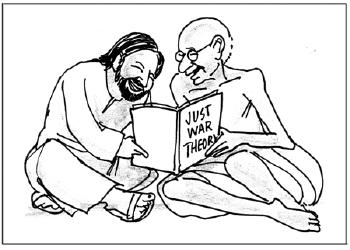
Father John (who doesn’t like to be called “Father Dear”) reported the conference as “unprecedented.” That’s because activists, theoreticians, and scholars of Peace Studies ended by recommending (in a document over the signature of Cardinal Turkson) that Pope Francis publish another encyclical – this one repudiating the Church’s centuries-long endorsement of Just War Theory.

That theory, of course, lays out principles for judging whether or not a given armed conflict might be justified.

The Turkson document repudiated the idea that modern warfare might ever be justified. This is not only because of the terrible destruction caused by modern weaponry, but because, in fact, 90% of casualties of today’s wars end up being innocent civilians. For those reasons, the conference in Rome recommended that Pope Francis not only repudiate war itself, but discourage Catholics from participating in modern military forces.

Imagine what would happen if Pope Francis were to accept those recommendations – especially on top of his denunciations of capitalism-as-we-know-it, his firm embrace of environmentalism, and his statements about homosexuality (“Who am I to judge?”). Catholic radicals would love it, liberals would be inspired. Conservatives who often identify faith and the military would be shocked and scandalized.

Where would you come down?

Think about that question in the light of today’s readings. Think about what “radical,” “conservative” and “liberal” mean for us as individuals and community members in our faith tradition. How would Jesus be classified? What about Paul? What would they say about entirely rejecting the idea of just wars?

Today’s Liturgy of the Word gives us a clue. It presents us first of all with an example of a key conflict between religious conservatives and radicals within the first century infant church. Paul, Barnabas, Silas and Barnabas lead the radical-to-liberal wing. Peter and Jesus’ brother, James are the leaders of the conservatives.

Paul and his friends come from the gentile world. Their concern is to make Jesus both understandable and acceptable to non-Jews. For their audience, circumcision and dietary restrictions (like not eating pork) represent great obstacles to accepting Jesus’ “Way.”

On the other hand, Peter and Jesus’ brother, James, are Jews through and through. They remember the importance of full observance of the law within the Jewish tradition. They recalled for instance that during the second century Seleucid persecution of the Jews under Antiochus IV Epiphanes, many Jews gave their lives rather than eat forbidden foods. Faced with Paul and his colleagues, the conservative faction wondered: were those lives sacrificed in vain? And besides, circumcision was the identifying mark of Jewish manhood. What good follower of the biblical God set that all-important commandment aside?

The issue is so serious that it provoked a meeting of church leaders – what scholars call the “Council of Jerusalem.” Like Vatican II (1962-’65) it called together church leadership to discuss burning issues of the day and to make changes that responded effectively to what Gaudium et Spes called the “signs of the times.”

Today’s gospel reading implies that leaders could come together with confidence because of Jesus’ promise that his Holy Spirit would continue teaching the church even after he is gone. The Spirit would remind the church of what Jesus himself taught – and more besides.

According to today’s readings, it was the “more besides” that the Jerusalem conservatives were resisting. They didn’t deny, of course, that Jesus himself was a Jewish prophet. (It was Jesus’ prophetic radicalism that angered the Scribes and high priests.) Jesus frequently placed love and compassion above God’s most important commandment, the Sabbath law; he associated with the “unclean;” he even befriended and worked miracles for gentiles. Jesus was never bound by the letter of the law as were his conservative opponents.

At the same time however, Jesus was Jewish to the end. He had no intention of founding a new religion. He was a Jewish reformer. No one could deny that. Jesus didn’t revoke the Law. He simply gave it an enlightened, more humane interpretation. He himself had been circumcised!

It was with these understandings that the Council of Jerusalem convened. And according to Luke, the author of Acts, it was a battle royal. Luke says the meeting was filled with “dissension and debate.”

What we find in today’s first reading is the final decree of the Council of Jerusalem. Concerning circumcision, it says “never mind.” As for dietary restrictions, they could be ignored. The Council was concerned with not placing unbearable burdens on converts. In other words, it couldn’t have been less conservative. The Holy Spirit was leading them in the opposite direction.

The Council of Jerusalem is reputed to have happened no more than 30 years after the death of Jesus. But by the time John of Patmos writes his book of Revelation at the end of the first century, look where his church had come. His vision of the “New Jerusalem” which we read about in today’s second reading doesn’t even have a temple. Jerusalem without a temple?! The city is founded not on the 12 patriarchs of Israel, but on the 12 apostles. How radical is that!?

I suppose what I’m saying is that Christians shouldn’t be afraid of radical change in matters of faith. It’s our tradition – right from the beginning.

In fact, in today’s gospel, John has Jesus say specifically that we should not be agitated or fearful. Rather, our hearts should be filled with peace because of our reliance on the Holy Spirit. John’s Jesus teaches that the Spirit’s presence guarantees the community is moving in the right direction, even when the Spirit’s teachings shock and scandalize – as long as it’s moving towards Jesus’ compassion, love, and ease of burden. The guarantee remains even when the Spirit’s guidance seems to dilute what many consider essential – like circumcision, dietary laws and the Jerusalem Temple.

What “essentials” is the church being called to set aside today? Priestly celibacy? An all-male priesthood? Prohibition of contraception? Are any of these really essential?

And what about just war? Are John Dear and Cardinal Turkson right about its absolute unacceptability to followers of Jesus? Could Jesus ever endorse atomic bombs, drone strikes, cluster bombs, or any of today’s wars that end up claiming mostly civilian victims?

If we fear to say “No” to any of those questions, we should keep Jesus’ words in mind: “Don’t be afraid or agitated; the Holy Spirit guides.”

The bottom line: today’s readings teach that there is no future in timid conservatism. Instead we are called to Christian radicalism (or going to the root of things). The Holy Spirit is that root.

And so we can pray with confidence: “Holy Spirit, in our world racked by war, inspire Francis to write another encyclical. Let him surprise and shock us one more time. Wake us up as a community of faith! Move us towards compassion, love and ease of burden as you did the Jerusalem Council.

We believe that under your guidance, we can never go wrong!”

Biblical Study Helps Me Develop Critical Consciousness (Personal Reflections Pt. XII)

,


Biblical Criticism

Here are the first dozen of the twenty-four conclusions I’ve drawn after my years of biblical study. As the cartoon above indicates, what I gained from Eamonn O’Doherty at St. Columban’s  Major Seminary in Milton, MA was an introduction to the historical/critical approach to the Judeo-Christian tradition. It provided a foundation that was deepened and developed by the scholars I mentioned in my last posting.in this series.

The historical/critical approach acts as a corrective to misreadings that emerge from the naive literary/confessional approach that had previously been mine. I learned that the latter is too open to ideological manipulation at the hands of the dominant culture anxious to secure divine support for a status quo favoring the rich and powerful ruling classes..

Accordingly, those more conventional approaches must be treated, I realized, with “ideological suspicion” which methodically doubts the veracity of conventional interpretations.

Such doubt made me suspect of any interpretation issuing from the United States and Europe. There analysis tended to remain largely apolitical and by that very fact ended up supporting the socio-economic status quo.

That was not the case in the underdeveloped world. (I use that term deliberately. Latin America, Africa, and South Asia, I found, have been deliberately under-developed –robbed of their resources by over-developed nations.)

Scholars in the Global South saw clearly and articulated connections between the biblical texts and imperial exploitation. The texts of both the Jewish Testament and its Christian counterpart are unique in the ancient world in that they were largely produced by victims of imperialism at the hands of Egyptians, Assyrians, Babylonians, Persians, Greeks and Romans. To ignore that fact and to interpret them apolitically is to impoverish them and rob them of their critical power vis-a-vis contemporary imperialist situations.

I’m sure such remarks make it clear how the biblical studies I’ve pursued have sensitized me to the dark realities of empires and the intolerable situations they have produced in the past and continue to produce in the present.

In any case, the twelve conclusions I share here unveil my gradual progression towards critical consciousness engendered by biblical studies. As you’ll see, they inexorably become less general and more sharply political. Judge for yourself:

  1. For the Christian Bible reading is extremely important. In some sense, the Bible is the word of God. However its many separate texts were produced by very human authors concerned with addressing highly politicized situations.
  1. But living is more important still. After all, even in the Bible itself, life and history constitute the primary vehicle of God’s revelation. In fact, it was out of reflection on these basic elements that the sacred texts themselves arose.  In other words, the main purpose of the Bible is not preservation or study of tradition for its own sake, but to help believers make faith-full sense out of the lives they are actually living.
  1. Therefore, as important as it is, Bible reading for the believer is a secondary activity, carried on “after the sun goes down.” It illumines life’s primary activity and vocation, living itself.

Continue reading Biblical Study Helps Me Develop Critical Consciousness (Personal Reflections Pt. XII)

Second Thoughts on Pope Francis & Family Issues

Confessional

Last week I posted a (mostly) tongue-in-cheek comment on Pope Francis’ Apostolic Exhortation, Amoris Laetitia. The document represented the pope’s reflections on the synod of bishops that met over the last two years to reformulate the Church’s teachings on marriage, sexuality and the family.

Obviously, all of those elements find themselves mired in profound crisis in the contemporary world. Given that fact, and despite the pope’s efforts to save the day in the face of the intransigence of the world’s episcopacy, the document proved to be highly disappointing.

Notwithstanding what I wrote last week, Amoris Laetitia left me wishing that the Church could bring itself to speak in plain language accessible to us all.

But no:  the encyclical was full of platitudes and written in opaque Vaticanese. It demonstrated the out-of-touchness of Church leadership, and its inability and/or unwillingness to help today’s women and men face up to their real problems in the light of a rich faith tradition perfectly capable of providing such assistance.

No wonder so many young people – so many couples – have long since dismissed the Church as irrelevant and counterproductive in terms of making sense of their lives in a globalized world!

[News flash to the Vatican: Outside of your little realm, the major problem facing couples today is not whether divorced people should be allowed to receive Holy Communion! It’s not even whether or not artificial birth control is morally acceptable. (Catholics have long since resolved that “problem;” they use contraceptives in the same percentage as everyone else.)]

Instead, think of the real problems we all face around the fraught matters Amoris Laetitia pretends to address, but which it only dances around, and in the end avoids. These problems were recently outlined by psychologist, Dr. Harriet Fraad, in an interview with economist, Richard Wolff. They include the following:

  • The introduction of the internet and easy birth control has changed the nature of dating and sexual relationships.
    • Increasingly, couples meet online instead of through family and friends.
    • It is no longer socially unacceptable for them to have sex before marriage.
    • In fact, hardly anyone waits till marriage.
    • This makes marriage less necessary and attractive as a means of achieving access to sex.
  • Divorce statistics (as well as witnessing the unhappiness of their parents) similarly discourage marriage. Fifty percent of first marriages end in divorce; 60% of second marriages and 70% of third marriages finish the same way. And after divorce women are usually left holding the bag in terms of child support.
  • Families are stressed when economic circumstances make it necessary for both parents to get jobs. That typically means women end up working a double shift – in the workplace and in the home.
  • The prospect of overwork eventual divorce leads more and more women to choose to remain single. Many become Sugar Babies to Sugar Daddies – older, well-established men who pay off their Baby’s overwhelming college loans or credit card debt.
  • Men, on the other hand, find themselves deprived of their traditional, male-defining role as bread-winners. Anger results – deflected towards guns, the military, sports addictions, evangelical religions (where women are subordinate) and pornography.
  • Children suffer the consequences of it all. They are left alone after school, when most of their problems emerge – not the least of which is obesity.
  • With all those realities in mind, marriage is increasingly viewed as an unnecessary hassle — a luxury good – accessible and desirable only for the well-to-do.
  • So young people end up postponing or rejecting it altogether.
  • They opt instead for serial cohabitations without commitment.
  • Or they become “Herbivore” men, “Dried Fish” women, or MGTOWS.

It’s not that Pope Francis doesn’t bring up many of these problems. Nor is he incapable of addressing them in ways helpful to struggling families. In fact, his three major publications (including Amoris Laetitia) provide clear principles for doing so.

  • His eco-encyclical, Laudato Si’, teaches clearly that all things are connected. The role of religion (which means “binding force”) is to make connections apparent.
  • Similarly that encyclical along with his Exhortation, “The Joy of the Gospel,” identifies capitalism-as-we-know-it as the connecting structural cause of contemporary problems. Its demands pits employers against their employees and men against women; it underpays them or deprives them of work; it requires them to work longer hours, drives both parents into double shifts, destroys families in the process, and then claims to represent “family values.”
  • And finally, in Amoris Laetitia itself the pope identifies conscience (informed by thoughtful consideration of the Christian tradition) as the most reliable guide humans have at their disposal.

Simply highlighting those principles and calling Catholics to adult dialog about their application to dating, marriage, divorce, contraception, abortion, and child-rearing would have done much more than the largely impenetrable document the Vatican actually produced.

Biblical Studies Awaken Me to Political & Economic Realities (Personal Reflections XI)

Barth

Last week I was reflecting on the importance of Bible courses that were central to the training I received at St. Columban’s Major Seminary in Milton, MA. I was praising my most influential teacher there, Father Eamonn O’Doherty, who introduced us to modern scripture scholarship.

Now I see that what I learned from Eamonn went far beyond the Bible. It was more about process — about thinking for myself even In the face of the strongest authority imaginable — that of God himself. It was about making connections in economic and political terms between the world of the Bible and the world of today.

The kind of historical and analytic thinking to which Eamonn exposed me eventually spilled over into other areas of my life — to personal moral decisions, and to politics. Gradually, I reasoned that if I could question what I had understood to be the authority of God about the Bible, then why not raise questions about the Ten Commandments or what I had been taught concerning the goodness of my country. Perhaps my reading of American History was as erroneous as what I had understood about the Bible.

What I mean is that from my earliest schooling, the Sisters of St. Joseph had taught me that the Bible was the very Word of God. As such it was unquestionable. To even entertain doubts about its truth was sinful.

And though the good sisters taught me how to read, it never crossed their minds (in the 1940s and early ’50s) that the Bible could be read in any other way but literally.

.After all, Pope Pius XII (1939-’58) had then only recently granted permission to Catholic scholars to follow the example of their Protestant counterparts in applying the tools of critical analysis to sacred scripture. This meant approaching the Bible as an historical document — as ancient literature. It meant recognizing the host of literary forms it contained, It meant acknowledging that none of its contents is history in the modern sense of the term, and that it all found analogue in the sacred texts of other religions.

The pope did all of that in his encyclical, Divino Afflante Spiritu (1943).

By the time my formal biblical studies began (1963) Catholic scholars had used the pope’s injunction to catch up. More than that, by ’63, the Second Vatican Council (’62-’65) had already been in session for more than a year. Its reflections and changes all stemmed from re-readings of biblical texts in the light of the scholarship I’m referencing. And the resulting changes were profound touching understandings of church, priesthood, and the relationships of Catholics to the contemporary world.

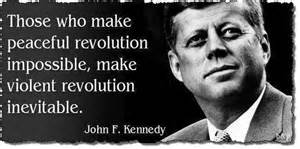
In the 1960s that world was In turmoil; it was experiencing the birth pangs of a dawning new consciousness.  It was the era of the Civil Rights Movement. The missile crisis in Cuba (1962) nearly brought nuclear holocaust. President Kennedy was assassinated (1963) The Gulf of Tonkin (1964) plunged the U.S. more deeply into the Vietnam War.

.My first reaction to those “worldly” events was to dig in my heels. I was critical of war protestors.

I thought Dr. King had overstepped his competence when he criticized the War and U.S. colonialism (1967).I was more sympathetic to the government and police than to those calling for fundamental social change on behalf of African Americans, the colonized, the peace movement, feminists, Native Americans, prisoners, and the LGBTQ communities.

But after initial resistance, I couldn’t deny what I was learning about the Bible. And (as I was saying) that proved to be the thin end of the wedge for changes in other spheres. The evidence driving me to change my mind about the Bible was overwhelming. It had too much explanatory value.

So did the political and economic analysis behind what the biblical scholars I encountered over the years had to say about the connections between the ancient texts they explained and the underdeveloped world in which the majority of humankind lives. They are the ones responsible for awakening me to undeniable political and economic realities. I met them in Rome, and my travels throughout Europe, and in Brazil, Costa Rica, Nicaragua, Mexico, Cuba, India, the Holy Land, South Africa, and Zimbabwe.

I’m referring most prominently to Frei Gorgulho, Ana Flora Anderson, Franz Hinkelammert, Helio Gallardo, Elsa Tamez, Pablo Richard, Maria Lopez Vigil and her brother Ignacio, Ched Myers, Norman Gottwald, Resa Aslan, Marcus Borg, John Dominic Crossan, Robert Funk, Elaine Pagels, and a host of liberation theologians.

All of them helped shape (and continue to do so) my historical, political and economic understanding of the world. It was a long process. I summarize it in the two dozen points (which I’ll list here over the next two weeks). Readers will note how the points gradually become more political and related to empire, structural violence, resistance, and the struggle for justice. That gradualness reflects my own growth in consciousness over the last 50 years.

My point here (as I struggle to explain the origin of my crazy Ideas to my children) is that it’s all grounded In faith.

[Next week: My Understanding of the Bible (and of the world) in 12 of 24 points]

Abortion: Should a Man’s Wallet Be More Private, Free, and Unregulated than a Woman’s Womb?

Chittister 2

My recent post, “Face It: Donald Trump Is Right about Abortion” drew many responses. (You can read more than 100 of them here.) One comment characterized my position there as “radically pro-choice.” Someone else called it “pro-abortion.”

However, it was not my intention (especially as a Catholic moral theologian) to write a piece that might be interpreted in those ways.

No, I was simply attempting to show that Republican position that “abortion is murder” can be quickly reduced to the absurd.

It was ironic, I suggested, that someone as clueless as Donald Trump should end up being the agent of moral clarity. He did so by verbalizing what the standard Republican position on abortion implies, Viz. that if abortion is murder, those involved should be charged and punished accordingly.

My point was that the immediate vilification of Trump’s impolitic assertion indicated that the judgment that “abortion is murder” is untenable.

What’s not untenable however is the fact that responses to The Donald’s Trumpian logic show that the abortions debate in the public sphere needs a dose of straight talk. So let’s try that out. In the end, it pits women’s sovereignty over their wombs against men’s control of their wallets.

Begin with the fact that few people (if any) are actually pro-abortion. Invariably, it is a painful and regrettable decision usually taken with the utmost seriousness.

From there admit two other facts. One is that abortion cannot be eliminated, no matter what laws are passed. Trying to eliminate abortion is like trying to eradicate prostitution. Large numbers of people have always and will always seek abortion services. The rich will fly their wives, lovers or daughters to the Netherlands or Belgium or wherever safe abortion procedures are legally available. The poor will go to back-alley practitioners or they’ll take drugs or use coat hangers to do the job themselves.

The second undeniable fact is that we live in a pluralistic society where people of good faith find themselves on both sides of the abortion question. And this is because they differ (most frequently on religious grounds) about the key question of when specifically personal life begins. That is, few would argue that a fetus at any stage does not represent human life and should not therefore be treated with respect. No, the real question is when does fetal life become personal? The question is when does aborting a fetus become murder?

In the thirteenth century, Thomas Aquinas and others held the position that personal life began with “ensoulment,” i.e. when God conferred a soul on the developing fetus. According to Thomas, because of the high numbers of spontaneous abortions in the early pregnancy, ensoulment could not logically happen at the moment of conception. So in his patriarchal way, he conjectured it occurred for males 40 days after conception; for females it happened after 80 days. Before those turning points, there was no question of personal life.

Of course, Aquinas’ logical position is no longer held by the Catholic Church. Its official teaching is that personal life is present from the first moment of conception. This means that in a world where as many as 50% of  pregnancies end in miscarriage, half of all “people” are “aborted” spontaneously usually before the mother even knows she is pregnant.

Such facts about miscarriage have led many to conclude that personal life begins well after the moment of conception.  They locate it, for instance, at the moment of “quickening” (when the mother first feels her baby move), with viability outside the womb, with actual emergence from the womb, or (as with some Native Americans) with the “painting” of the emergent child to distinguish it from animals.

Given such differences, it seems counterproductive to impose the view of one religion on an entire culture. We might expect such imposition from the Taliban. But it has no place in a democracy characterized by separation of church and state.

Instead in a country like our own some compromise is necessary. And that is what happened in Roe v. Wade. There it was determined that in the first two trimesters, the pregnant woman can make a decision on her own and in consultation with her physician. In the third trimester, the state asserts its interest and can make laws restricting abortion to protect the woman’s health and the potentiality of human life.

However a Roe v. Wade approach can never be sufficient for genuine pro-life advocates. Abortion law must be complemented by social programs. These include pregnancy prevention measures – sex education in our public schools along with easy access to contraceptives.

Nonetheless when unplanned pregnancies occur, programs discouraging abortion needs to kick in. These would provide free counselling and pre- natal care for pregnant mothers along with post-natal services for their newborns. Job provisions would be available for new mothers along with free daycare for their pre-school children. Programs would also include low cost housing and (where necessary) help paying grocery bills.

All such measures are genuinely pro-life. They create a welcoming environment for new life.

But this is where the real debate about abortion’s relation to privacy enters the picture. Simply put the question is: which should be more vigorously protected from state intervention – a woman’s womb or a man’s wallet?

Put otherwise, the debate about life-friendly social programs pits on the one hand mostly well-to-do male legislators (in the U.S. Congress and in the Catholic Church) against poor women who cannot obtain abortions abroad. The patriarchs are quite willing to have their laws invade the privacy of a woman’s womb while defending invasion of their wallets to provide a welcoming atmosphere for all the unborn.

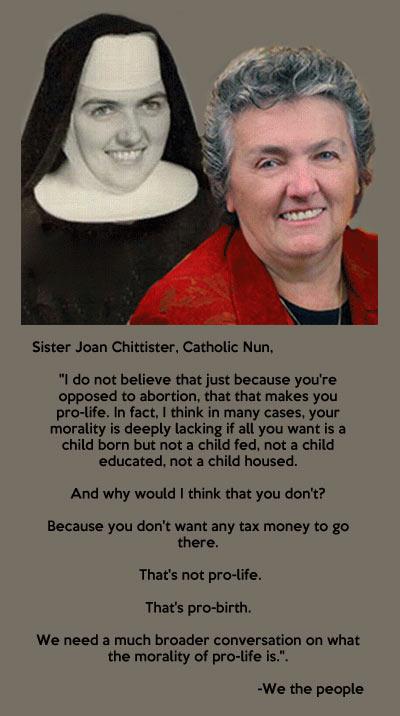
Benedictine Sister Joan Chittister has called such typically male attempts to evade responsibility by its true name. She wrote:

“I do not believe that just because you’re opposed to abortion, that that makes you pro-life. In fact, I think in many cases, your morality is deeply lacking if all you want is a child born but not a child fed, not a child educated, not a child housed. And why would I think that you don’t? Because you don’t want any tax money to go there. That’s not pro-life. That’s pro-birth. We need a much broader conversation on what the morality of pro-life is.”

Contributing to that broader conversation is what my controversial blog post was about. So is this one.

Tell me what you think.

Waking Up To the Real Nature of the Bible (Personal Reflections Pt. X)

Merk

I don’t exactly remember what I thought about the Bible before beginning its formal study the year after receiving my B.A. in Philosophy (1961),

Ironically, although I had been in the seminary all those years (since 1954) the formal study of “religion” hadn’t at all been central in. the curriculum.

Yes, we attended Mass every day (and twice on Sundays). And there were all those daily chapel activities and devotions: morning and evening prayer, afternoon rosary, “visits” to the Blessed Sacrament before and after meals, nightly Benediction, conferences by the seminary spiritual director, etc. There were also those inspirational readings I mentioned accompanying breakfast and lunch in the “refectory.”

But formal study pretty much concentrated on languages (Latin, Greek, and French) and normal secular studies associated with high school, on the one hand, and on the other, college courses associated with a Philosophy Major.

So by the time I began the formal four year (and post-grad) theological curriculum (1962) my understanding of such matters, including the Bible was fairly uninformed. I’m sure I thought the Bible was the very word of God valid for all time.

That began to change with exposure to the teachings of Fathers Eamonn O’Doherty and Jack Moriarity, both of whom introduced us to modern scripture scholarship which emphasized the history behind the Hebrew and Christian Testaments. They introduced us to form criticism and redaction criticism as well.

Form criticism made us aware that the Bible is filled with various kinds of literature. Literary forms found there include myth, legend, debate, fiction, poetry, miracle stories, birth accounts, letters, apocalypse, annals of kings, law, riddles, jokes, parables, allegories, etc.  None of that, really, is history as we understand it. And if we read poetry, for instance, as if it were history we’ll commit huge interpretational errors.

Just realizing that can change one’s entire approach to the Bible. It did mine.

I remember sitting each day for classes in “Old” and “New” Testament in our aula maxima on the second floor or our Major Seminary on 1200 Brush Hill Road in Milton, MA. The entire student body – those about to be ordained, and the three classes behind them – took those classes together. There were probably sixty of us. So I found myself edified (and intimidated) by the good students among my elders whose questions and observations always seemed so sage, perceptive, and sometimes daring.

For a long time, I pretty much kept quiet. But the wheels were whirring at top speed inside my head. For a biblical literalist like me, it was all hard to swallow

For instance, I recall the day during our study of the Gospel of Luke that the penny dropped for me that the Three Wise Men never existed. It was all a “midrash,” we were told, on the part of the gospel’s author (whose real identity remains unknown). Midrashim, it turns out, are usually fictional stories meant to elucidate particular biblical texts or beliefs.

“Say what?” I thought. “The next thing you’ll be telling me is that the resurrection never happened.”

Well, that day never came – from the actual teachings of my Scripture Profs. But it sure did for me. So I remember one day screwing up the courage to ask Father Eamonn about it in class. I asked, “Is it possible, Father, that gospel stories about what’s called the ‘resurrection’ of Jesus were also simply creations of the early Christian community to reflect their gradually dawning consciousness that Jesus’ words were true: ‘Whatever you do to the least of my brethren, you do to me’ and ‘Wherever two or three are gathered in my name, I am there in their midst?’ In other words, might the resurrection, like the tale of the Three Wise Men also be a midrash?”

I awaited Father O’Doherty’s answer with bated breath. Perhaps my question wasn’t clear enough, I feared.

Well, the question was clear enough. Father O’Doherty paused a few moments. Then he responded: “No,” he said. And that was the end of it! He moved on.

Now that might give you the impression that Father Eamonn wasn’t a good teacher. Quite the contrary. I’m confident in saying that nearly all of my peers recall him as their most influential Prof during our four years of theological training. I agree with them. Eamonn imparted to us not only essential facts about the Bible, but an entire approach that stuck with us all.

In my case, his classes provided me better than any other a firm basis for what I would learn in Rome during my doctoral studies there (1967-’72). – and for what I internalized subsequently as I continued my studies with liberation theologians in Brazil, Costa Rica, Nicaragua and elsewhere in the  developing world. Of course, I’ll have more to say about that later.

But for now, I must tell you about Father O’Doherty’s teaching method. Again, it proved extremely effective. However, it’s not the sort of thing you’ll find in the best treatises on pedagogy.

The other day, I was looking at the basic primary source text we used in his New Testament classes.  It’s Augustinus Merk’s Novum Testamentum Graece Et Latine (pictured above). It’s the entire New Testament in its original language, Greek on one side of the page and Latin on the other. Originally published in 1948, its footnotes are filled with scholarly critical apparati. – mostly pointing up and evaluating variant readings of the Greek texts. I[n itself, that’s interesting. We were actually dealing with texts very close to the originals (none of which, it turns out, have survived. Instead all we have are copies of copies of bad copies. But that’s another story.)]

Besides the text itself, what was even more interesting to me were my notes in the margins of each page. Each was jam-packed with cursive scribblings in my smallest possible handwriting – so small, in fact, that I needed a magnifying glass to review some of them last week.

And that was evidence of Father O’Doherty’s teaching method. It involved (1) his lecturing to us each day reading mostly from his notes, (2) our transcribing notes as fast as we could, pausing occasionally for someone to ask questions, (3) Our transferring those notes into the margins of the relevant texts during out study periods, and (4) Recopying those detailed marginal notes onto exam papers in response to our teacher’s exam questions.

To me, in retrospect, that sounds pretty much like what the great Brazilian educator, Paulo Freire, excoriated as “Banking Education” – where teachers make deposits into the “accounts” of students who subsequently make withdrawals at exam time to purchase good grades.

But here’s the funny part: it worked! Father Eamonn wasn’t a particularly dynamic teacher. But what he taught us was so interesting and well-organized that we learned important lessons from a process that seems like pure regurgitation. Put that in your pedagogical pipe and smoke it!

Ask any of my peers. All of us love Eamonn. And we remain grateful to him to this day.

(Next Week: a full account of what I learned about the Bible over the years – in two dozen points)