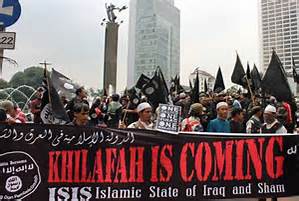
In Defense of ISIS

ISIS Defense

Imagine where America’s wealth would be if at the beginning of the 20th century Mexico had seized control Texas/Oklahoma, Japan had grabbed up California, England the northeast, Spain the south, and the rest of the country was divided into small emirates.

What would the response of Americans have been? Certainly there’d be resistance and rebellion. There would be attacks on occupying forces and/or collaborators with the colonial process by proud, well-armed Americans willing to resist external control “by any means necessary.” There would be bloody battles and excesses of brutal violence where both foreigners and their U.S. collaborators would be killed. The response would surely be called “terrorism” by Mexico, Japan and England.

This impossible scenario puts into perspective the confusing rise of ISIS which most commentators simply write off as a mob of pathological killers motivated to act because “they hate our freedom.”

In the historical perspective supplied by the U.S. analogy, they are much more than that.

In fact ISIS is a sophisticated resistance organization that is well funded and administered.  It not only resists foreign domination by any means necessary, it also provides day-to-day assistance for those impoverished by colonial process. In so doing it secures allegiance from many of those under its sway. These often prefer ISIS’ ministries to that of the U.S.-backed government, for instance, of Iraq. In many places ISIS provides health care, food subsidies, schooling and care for the elderly that is unattainable in Bagdad. These are just some of the reasons why thousands of Europeans flock to the ranks of the “Islamic State.”

More particularly ISIS might be seen as the militant wing of the Arab Spring that began throughout Arabia at the end of 2010. That movement in turn was Arabia’s latest response to the European balkanization of the region that took place with the end of the Ottoman Empire following the First Inter-Capitalist War (aka World War I) which concluded in 1918.

It was then that the European powers in a major act of “divide and rule” carved up Ottoman Arabia, renaming it the Middle East. The Europeans hewed out from a region previously governed by caliphs, sultans, and kings, modern “states” that in most cases never existed before.

In this way, the French colonized what they called Morocco, Algeria, Syria, Tunisia, Cyprus, and Lebanon. The British controlled Egypt, Palestine, Sudan, Iraq, Kuwait, Yemen, Jordan, and Oman. Italy governed Libya.

After the Second Inter-Capitalist War (aka World War II), the U.S. took over as the stabilizer of the colonial New Arab Order. It maintained in power obedient feudal clients resistant to democratic movements. They ruled on condition that they grant access to oil, trade and seaports. If not, they would be removed. The result was enrichment for both the colonial powers and their royal clients, but impoverishment for the vast majority of local populations.

In this perspective ISIS represents today’s impoverished Muslim Arabs seeking the autonomy of the Middle East. Their goal is Arabia for the Arabs. ISIS is struggling to wrest its control from Europeans and Americans who have dominated the area since the dissolution of the Ottoman Empire.

So it is a shallow mistake to write off ISIS forces as a mob of pathological killers with whom negotiation is impossible. To do so is to take one faction of a highly disparate group and universalize it as though it were the entire body. It’s like identifying Christianity with its most extreme faction, the Ku Klux Klan or the Tea Party for that matter.

In other words, there are sane ISIS factions with whom negotiations are possible. It is the task of diplomacy to identify them and to isolate the Klan and Tea Party elements depriving them of support. Bombing is futile.

The problem is: such observations presume a willingness on the part of neo-colonial westerners to cede colonial control and allow Arabia to belong to Arabs. And that in turn means weening western economies from dependence on Middle East oil.

For the arrival of that willingness and weening we should not hold our breath.

Democracy at Work and in Play: Capitalist Rams vs. Socialist Packers

On Tuesday , Stan Kroenke, the owner of the NFL Rams franchise decided to move operations from St. Louis to Los Angeles.

The decision brought sorrow and a bitter sense of betrayal fans in St. Louis who have supported “their” football team through thick and thin. For them the penny dropped: their Rams were not theirs at all.

The obvious injustice prompted them to chant “Kroenke Sucks!” when the move was announced during a St. Louis Blues –New Jersey Devils hockey game.

The chant showed that people intuitively recognize the problem. It’s the problem of capitalism: a single owner backed by a small group of similar wealthy stockholders can override the interests of an entire local community for one reason and one reason only — MONEY!

With capitalism, it happens all the time. A small board of directors (15-20 people) can decide to override the interests of entire communities — Detroit, Youngstown, Camden New Jersey — and move operations offshore to Mexico, China, Taiwan, and who knows where else? In doing so, the private owners devastate the abandoned communities. Yet they bear no responsibility for their actions.

They simply leave. They leave without reimbursing the community for roads built to service their facilities, for tax breaks granted, for plants constructed with community subsidies, for families destroyed by loss of employment.

And, once again, it’s done for one reason and for one reason only — MONEY! It’s the logic of capitalism.

It doesn’t have to be that way.

As economist Richard Wolff has indicated, there can actually be democracy at work. Democracy at work means that if workers shared ownership of their factories, they’d never vote to offshore their jobs.

Following Wolff’s logic, there can also be democracy in play — even in the NFL.

The case of the St. Louis Rams contrasted with that of the Green Bay Packers illustrates the possibility. Unlike the NFL Rams, Packers’ owners could never vote to move their franchise. That’s because the owners are the club’s fans themselves. So moving from Green Bay (pop. 104,000) even to Los Angeles (pop. 4.8 million) is out of the question.

More specifically, according to the Packers’ 1923 Articles of Incorporation, no single person can control more than 4% of the club’s stock. So these spiritual descendants of workers — the Green Bay Meatpackers’ Union — have no one like Kroenke to deal with.

Moreover, Incorporation Articles stipulate that profit from any (unimaginable) transfer of ownership must go not to individuals but to the Green Bay Packer Foundation which benefits community education, civic affairs, health and human services and youth programs.

There are lessons in all of this:

– Democracy at work and in play is possible.

– It is preferable to capitalism’s oligarchical tyranny.

– The traditional name for such democracy is “socialism.”

– Socialism can be successful. (The Packers have won more championships than any of their capitalist competitors).

– Maybe workers should be rooting for the Packers in Saturday’s matchup with the Arizona Cardinals.

– Bernie Sanders is a socialist. Hmm . . .

Pope Francis’ Encyclical: My New Book and a Lenten Program

product_thumbnail

I must apologize for my absence from the blog site over the last couple of weeks. It’s that I’ve been putting the finishing touches on a new book I’ve written about Pope Francis’ eco-encyclical, Laudato Si’, which I consider the most important public document of the present century.

The 150 page book is called Understanding Laudato Si’: A Discussion Guide. (It is featured along with a “Buy Now” button on the right hand side of my blog homepage. The price is $8.15 per copy.) The book is aimed at people of faith who’d like to start or participate in discussion groups about climate change as the moral issue Pope Francis calls it.

(By the way, an “encyclical” is a general letter to the church as a whole. It represents the highest most solemn form of papal teaching.)

Laudato Si’ is unique in that it comes from the pen of history’s first Global South pope. So it is shaped by the experience of the former colonies (Latin America, Africa, and South Asia). It is heavily influenced by colonial and neo-colonial exploitation.

More particularly, Laudato Si’ was written by a priest who comes from country victimized by the U.S.-supported “Dirty War” that the Argentinian Army waged against the pope’s homeland from 1976-1983. That war took the lives of at least 30,000 Argentinians – at least one bishop, many priests, nuns, and lay catechists along with union organizers, teachers, social workers and those suspected of supporting the democratic resistance.

No other pope has had such “Third World” experience of aggression at the hands of the United States. No other pope has been influenced directly by liberation theology – which has centralized the concept of “preferential option for the poor” that marks Francis’ papacy.

Read in that light, Laudato Si’ presents the world with understandings of climate change, economics (especially capitalism), history, theology, and church that are uniquely “Global South” rather than the European understandings that shaped the visions of Francis’ predecessors. All the other commentaries I’ve seen have overlooked those differences.

I’ve shared drafts of the book with friends. One wrote: “Your book should be in the hands of every bishop and priest and parish, as well as to the pundits we daily read and hear in the mass media.”

The great African-American feminist scholar, bell hooks, commented: “You make difficult concepts and theories accessible. The work itself embodies the spirit of inclusion you write about so eloquently. Bravo!!!”

A priest-activist working in the Appalachian region wrote:  “Congratulations, this is a winner! . . . You wrote an amazing book.  I read it and I remembered.  I thought about it and I learned.  I critiqued it, and I grew. . . Let’s see how we can spread the analysis.”

I’m hoping that my book will be used this Lent as a discussion guide in parishes throughout the United States.  It is currently under review by my own diocese of Lexington, Kentucky.

In my own parish, St. Clare’s here in Berea, we’ve made the following proposal for dealing with Pope Francis’ call to action. Perhaps readers of this blog might implement something similar in their own parishes:

Lenten Program, St. Clare Church, Berea, Kentucky (Wed. Feb. 10- Sat. Mar. 26, 2016)

The St. Clare Peace and Social Justice Committee proposes a Lenten adult education program that will centralize the Papal Encyclical, Laudato Si’. Participants in the six week program will pursue the following goals:

  • Acquaintance and familiarity with the content and historical background of Laudato Si’.
  • In the light of that encyclical:
    • Sharpening awareness of the environmental crisis itself and of capitalism’s role in that predicament, as well as the parts played by U.S. policy, Global South theology, and the Catholic Church.
    • Rethinking the elements of each person’s Catholic faith including understandings of God, Jesus, church, and salvation.
    • Re-evaluating the relationship between a reconsidered Catholic faith and the environmental crisis.
    • Identifying practical ways of coping with the environmental crisis in the personal, familial, parochial, national and global dimensions of life.

To achieve these goals, each participant will:

  1. Adopt as a Lent 2016 practice, participation in six 90 minute group sessions discussing issues raised by  Laudato Si’.
  2. Sign up in advance for program participation. (Non-obligatory “interest cards” will be found in each pew on Ash Wednesday and on the First Sunday of Lent.)
  3. Before each meeting, read and reflect on the discussion guide adopted by the group (either the one to be provided by the diocese or Rivage-Seul’s Understanding Laudato Si’: A Discussion Guide).
  4. Actively participate in the discussions.

Program Organization

Feb 14:  View the first half of “Time to Choose” followed by a disciplined discussion. (“Time to Choose is a new 90 minute film by Oscar winner, Charles Ferguson. The film makes the case that we can combat climate change; that we have the tools and the knowledge to begin doing so right now.) (Assignment: Read Discussion Guide, pages 1-30)

Feb 21: View second half of “Time to Choose.” Discuss in the light of the Discussion Guide’s summary of Laudato Si’.  (Assignment: Read Discussion Guide, pages 31-50)

Feb 28: View lecture by economist, Richard Wolff on capitalism and the environment. Discuss the pope’s approach to economy facilitated by Chapter Two of the Discussion Guide.   (Assignment: Read Discussion Guide, pages 51-82).

Mar 6: View the first half of “This Changes Everything” (a new 90 minute film by Naomi Klein based on her book by the same name). Discuss in the light of Pope Francis’ “preferential option for the poor” as explained in Discussion Guide (Assignment: Read Discussion Guide, pages 83-100)

Mar 13: View second half of “This Changes Everything” in the light of liberation theology as explained in Discussion Guide. (Assignment: Read Discussion Guide, pages 101-140).

Mar 20: Discuss the Church as Caravan and practical responses to Laudato Si’.

The Dysfunctional Holy Family

Readings for Holy Family Sunday: Sir. 3: 2-6, 12-14; Ps. 128: 1-5; Col. 3:12-21; Lk. 2: 41-52 

Today is the feast of the Holy Family. We’re used to thinking of it as a cozy group of 3, Jesus, Mary and Joseph living in ideal circumstances, the way we picture them in our nativity crib scenes. Or we imagine Jesus’ early life as we find it depicted in medieval paintings of the carpenter Joseph’s workshop. There we often find a loving haloed and elderly foster-father instructing Jesus in his trade while Mary smiles in the background.

However, if we take seriously the “infancy narratives” coming from Matthew and Luke, we must draw the conclusion that Jesus’ home life was more complicated than that. You might even say that it was “troubled” right from the beginning. So for the moment, let’s suspend disbelief surrounding the historicity of the narratives about Jesus’ early years. Let’s try instead to unpack the stories at face value. Doing so, I think, shows them to be quite relevant to our own experiences – especially to that of our family dysfunctions and to our own experiences of being no one, without face, identity, or power before the world’s problems.

To begin with, think about Jesus’ family, the focus of today’s liturgy of the word.  It wasn’t perfect. The holy family was larger than we’re accustomed to imagine. Joseph and Mary probably had 7 or 8 children. According to the gospels, Jesus’ brothers’ names were James, Joseph, Judas, and Simon. Jesus is also said to have had at least 2 unnamed sisters. On the one hand, a large family like that would have been helpful to peasant farmers, if Mary and Joseph had any land. On the other hand, a family of 9 or 10 people would have been hard to maintain for rural peasants living in a backwater like Nazareth. It is likely then that hunger and struggling to make ends meet was a major part of Jesus’ early experience.

Jesus’ country was also war-torn at the time when he was born, and that certainly impacted his family. At approximately the moment of his conception, the Romans had razed the city of Sepphoris, located just an hour’s walk from Nazareth. Sepphoris was the capital of Galilee where Nazareth was located. Galilee was a hotbed of resistance to Rome’s occupation of Palestine. And a rebellion had erupted in Sepphoris about the year 4 BCE. That meant that the countryside would have been crawling with Roman soldiers at the time of Jesus’ conception. Inevitably, many young Jewish girls would have been raped by the occupying forces. Some see that fact as lending credence to an anti-Christian tradition claiming that Jesus was the product of rape of Jesus’ mother, Mary by a Roman soldier called Panthera.

In any case, Mary’s out-of-wedlock pregnancy would have raised many eyebrows in the rural village of Nazareth. Town gossips would have snickered and talked behind their hands about the young girl’s “virginal conception.” We know for certain that Mary’s mysterious pregnancy put Joseph in crisis. According to tradition, he suspected she had been unfaithful and thought her condition reason enough to break off their engagement. We also know that Mary chose to leave town “in haste” and travel to the hill country of Judah to her Cousin Elizabeth’s home – possibly to get some distance from small village talk.

Once that problem was resolved, the holy family’s troubles continued.  There was the matter of Jesus’ homelessness at the time of his birth. For the occasion, Joseph and Mary had to make do with a filthy stable with all of its animal droppings, noises, smells, vermin, rodents and cold.

And things got worse after that. The story goes that the local king Herod ordered an infanticide of all children under the age of 2 in the area surrounding the place of Jesus’ birth.  For Mary and Joseph, avoiding such unspeakable violence meant fleeing to Egypt in the middle of the night. It also meant trying to survive as immigrants in that far-off country – not speaking the language or knowing the customs, or feeling at home among those prejudiced against foreigners.

Once back in Palestine, things apparently settled down. However, the episode in today’s gospel reveals tension in the holy family that will resurface later in the gospels.

“The Finding in the Temple” is a coming of age story. At the age of 13, all Jewish boys would accompany their parents for the first time as a “genuine Israelite.” Each would then become a man, “one who goes up to the temple.” In Jesus’ time, the 13th year was anticipated by a year as a kind of preparation for the “big step” into adulthood.  Coming from a place like Nazareth, the boy from the country would have been dazzled by the splendor of the Temple with its colonnades, precious woods, unending polished steps, gold and silver candelabra. It would have been easy for him to wander away with other boys and become lost in it all.

His parents find him, we are told, easily conversing with learned men from the city whose manners, accents and clothing would have been intimidating to Jesus’ simple parents. And yet here was the country boy Jesus astounding the city people with the incisiveness of his questions and the wisdom of his answers. No doubt, the rural parents waited till they were out of earshot of their “betters” till they gave Jesus the dressing down they thought he deserved. The scolding may have lasted the entire three-day journey back to Nazareth.

His parents, we’re told in this morning’s reading, did not understand their son. We find out later on that the lack of understanding continued. At one point in Mark’s gospel, his mother and his siblings are described as thinking Jesus was out of his mind (Mk. 3: 34-35). This led to a formal estrangement between Jesus and his family. He more or less disowned them. When Jesus was told that his family has come to rescue him from his madness, he said in effect, “My mother – my family? That’s not who those people are. Instead, you (the outcasts, beggars, insurrectionists, prostitutes, unemployed, and ne’er do wells, who were his companions) – you are my real family, my real people.”

And yet today’s gospel concludes that Jesus went back to Nazareth with them. He advanced, Luke tells us in age and wisdom and grace before God and his neighbors. And that’s it. We hear no more about him for 20 years or so. He disappears. He becomes nobody.

And that brings me to the other part of today’s reflection – being a nobody. What does Jesus’ disappearance, his “hidden life,” tell us about the human condition?  According to our faith, Jesus was the full embodiment of God. Presumably, then, he had infinite power at his disposal. His world was as filled with problems as ours. There was Roman imperialism and the occupation of Palestine with its brutality, torture, rape, exploitation and oppression. There was political corruption among Jesus’ own people as the leaders of his time climbed into bed with the Romans. There was extreme poverty alongside obscene wealth. There was religious corruption. There was disease and ignorance.  And yet as far as the record is concerned, this embodiment of God did nothing.  For 97% of his life, Jesus did absolutely nothing!

Why? Do you think it might have been because, like us, he could do nothing significant about all those problems? And even when around the age of 30 he did finally emerge as a more or less public figure, what did he really do? He spoke some inspiring words, healed a few people, and worked some miracles that his contemporaries dismissed as parlor tricks. He provoked the authorities in a temple demonstration for religious purity and social justice, was arrested, tortured and executed as an insurrectionist.  That was pretty much it as far as his “public life” was concerned. Afterwards, the world mostly continued as it had before his arrival.

I somehow find comfort in both Jesus’ family dysfunctions and in his “nobodiness.”  None of our families is perfect. Unexpected pregnancies, suspicions and jealousies dividing couples, financial struggles, problems with neighbors and gossip, displacement, lost and alienated children – it all seems about par for the course. I’m not even sure that Mary and Joseph didn’t wonder at times where they went wrong. There was a lot for them to process in their pillow talk as they saw their son hanging out with the wrong crowd, apparently losing his faith, and then getting into political problems they didn’t understand. My God, he finally ended up on death row! The black sheep of the family . . . .

And then there are our own little lives and their apparent lack of meaning. In the end, we’re nobodies, all of us. That’s what death makes apparent as we lose our physical form and minds and all that we worked for. We’re nobodies.  Few will remember us or think of us after we’re gone. We’re born, get married, have children, buy and sell a few items, and then die. And what became of all our hopes and dreams? What does it all mean?

Does it mean that it’s all O.K.; it’s all good? Does it mean “that’s life” – what it’s about? In fact, our vocation is to be precisely nobody instead of constantly striving to be Somebody. In the end, death discloses the truth about our vocation. It is the same as Jesus’ vocation. And that is to be open, faceless channels that disclose the presence of God in our very ordinary lives with their family dysfunctions and personal failures. It is to rise above such limitations or rather to use them to express the unbounded love of an apparently powerless God to those around us – especially to our family members who might not even understand.

Christmas Is Blasphemy: Take Jesus Out of Christmas!

Starbucks

Recently two very different religious leaders – one considered left of center, and the other a fundamentalist – converged in agreement about the meaninglessness of Christmas. And they both hit the nail on the head. Christmas is bunk. It’s blasphemous to associate Jesus with the holiday.

From the left, Pope Francis called the Christian world’s upcoming Christmas celebration a “charade.” He said there’d be parties, gift exchanges, and family gatherings in the name of celebrating Jesus’ birth, but it would all be absurd pretense.

That’s what charade means: an absurd pretense intended to create a pleasant or respectable appearance.

And the pope is right. Starting around Thanksgiving, so-called Christians pretend to honor “the Prince of Peace” – the one who took no one’s life, but sacrificed his own rather than take up arms – the one who was himself a political refugee, conceived out-of-wedlock, brown-skinned, poor, and living under imperial occupation – the one who would be a victim of torture and capital punishment – who was all the things that good Christian supporters of Donald Trump and of the U.S. War on Terror hate and despise.

That’s right. our culture hates Jesus and all he really stands for.

And that’s where the fundamentalist preacher comes in.  He agrees with the pope – well kind of . . .

About the same time Pope Francis was talking charade, Rev. Joshua Feuerstein, denounced Starbucks for hating Jesus. The good reverend was outraged by the coffee giant’s holiday cups which display no specific reference to Jesus. That’s a sign, Feuerstein said, that Starbucks agrees with the movement to remove Christ from Christmas. Starbucks hates Jesus. So let’s boycott Starbucks!

On the one hand, could anything be more absurd? The world is burning. Our way of life is destroying God’s creation. Our country is waging war against the poor everywhere – in Afghanistan, Iraq, Libya, Yemen, Somalia . . . . We supply weapons to all sides in the endless war our “leaders” have declared. And our man is worried about Starbucks’ plain red drinking cup! He denounces Starbucks for simply recognizing what is: Jesus has long since been removed from Christmas.

On the other hand, there’s wisdom in Rev. Feuerstein’s accusations. And it’s not just Starbucks that “hates Jesus;” it’s our entire culture – including our churches. In that sense, Feuerstein agrees with Francis. However hating Jesus has nothing to do with coffee cups. As I said, it means despising those Jesus identified with in the Gospel of Matthew (25:31-46) – the poor immigrant refugee from our endless bombing campaigns, the hungry street person, the homeless refugee, the imprisoned desperado, the coatless person we pass on our way into Starbucks.

That’s the one our culture hates – mostly led by “Christians.”

So what to do to avoid making this Christmas an empty charade? How avoid the blasphemy of pretending that Christmas has anything at all to do with Jesus?

I hardly know how to answer that question. I suppose we can start by recognizing that Christmas is a winter festival and nothing more.

But that’s not nothing. Winter festivals are great. They’re fun.  Every culture has them. They are times for ice sculptures, bright lights, reunions with family, for feasting, drinking, parties and exchanges of gifts. All of that distracts us from the oncoming season’s dark and cold.

That’s the way it was in ancient Rome too. Rome had its Saturnalia. In fact, December 25th was the birthday of the Sun God, Mithra, who was a favorite with Roman legionnaires. In that sense, Mithra’s birthday was a military holiday – a celebration of empire and its wars – the antithesis of everything Jesus stood for.

So let’s end the charade. Have fun.  Eat, drink, and be merry. That’s what winter festivals are about. And forget the blasphemy of associating Jesus with any of it.

Raise your red cup and toast a happy feast of Mithra!

Paris, San Bernardino & Double Standards

Double Standard

In the wake of slaughters in Paris and San Bernardino, a wave of Islamophobia is sweeping our country. The killings have revived charges that Islam is an inherently violent religion.

Given their sources, the charges are obscene.

That’s because they are almost invariably made by “Christians” who are among the strongest supporters of spending $2 billion per day (!) on the military. They love holy wars that have (among others) specifically targeted Muslims for the last 60 years.

Back in 1954, the Christians’ government overthrew a democratically elected head of a Muslim state in favor of a brutal puppet, Reza Palavi. There followed a 25 year reign of terror in Iran, whose 1979 revolution inspired and empowered Muslim resisters across the planet.

Additionally the government of these Christians unconditionally supports Israel, a state which since 1948 has evicted Muslims from their ancestral homes in Palestine killing tens of thousands in the process. The majority of U.S. Christians not only support Israel in general (often on religious grounds), but even its possession of a vast arsenal of nuclear “weapons of mass destruction.”

In response, angered Muslims have used box cutters, stones, sling shots, primitive IEDs and rockets, (along, one day, with hijacked planes) to defend themselves and counter-attack against forces that have declared a perpetual war against them.

Why this condemnation of violence by impoverished Muslims alongside virtual worship of the “Gods of Metal” by rich Christians? The answer lies in Muhammad’s attitude towards war.

Like the vast majority of Christians since the 4th century, and along with virtually all the prophets of the Jewish Testament, Muhammad was not a pacifist. Instead he was a proponent of just war theory. In fact, he pioneered the theory’s development far ahead of its Christian proponents. Following its dictates and common sense, he insisted that the poor have the right to self-defense.

That’s what makes Islam so threatening to the West. It wants no part of people who defend themselves against western depredations. Meanwhile western powers themselves claim not only the right of self-defense but even the prerogative of “preemptive strikes.”

What the West expects in return on the part of those attacked – especially if the attacked are “religious” – is a pacifism that for more than seventeen hundred years has never been a major part of “Christendom’s” belief system. On the contrary, western Christians tend to ridicule pacifists as unrealistic, unpatriotic, even cowardly “bleeding hearts.”

No, the West wants an enemy that simply rolls over for colonialism (in Israel), wars of aggression (in Iraq), policies of torture and illegal imprisonment (in Guantanamo), drone strikes, mass killings of innocent civilians, support of unpopular dictators, rigged elections, and a host of other crimes. And when religious people defend themselves, westerners cry “foul” and consider themselves blameless victims.

Paris and San Bernardino should not surprise us. Barring mass conversion of blood thirsty “Christians,” more is on the way.

Pope Francis on Misplaced Safety Concerns: Where’s the Caution on Climate Change?

pope-refugees-2

The chances of a U.S. citizen being killed by a terrorist are slimmer than being struck by lightning. That remains true even after the Paris massacre of last November 13th.  In fact, according to The Economist, the chances of dying at the hands of terrorists are actually one in twenty million. So you’re far more likely to die from a car accident, airplane crash, post-surgery complications, or from gun violence than from terrorism.

Meanwhile, the likelihood of millions dying from the effects of climate change is about 97 in 100. That figure refers to the percentage of climate scientists who tell us that human inaction on the climate front will result in disastrous, planet-wide catastrophe.  (By the way, 97% is about the same percentage as medical researchers who say that smoking causes cancer.)

And yet, in the wake of the recent Paris massacre, politicians call for absolute caution about the acceptance of refugees while siding with the 3% of scientists denying human responsibility for climate change.

On the refugee question, Governor Robert Bentley of Alabama put it this way, “If there’s even the slightest risk that they’re not the kind of people that we wish them to be,” we must exclude Iraqi and Syrian refugees from our state.

And Bentley is not alone. At least 31 governors (almost all of them Republican) have expressed similar determination to prevent refugees from entering their states. Governor Greg Abbot of Texas said, “I will not roll the dice and take the risk on allowing a few refugees in simply to expose Texans to that danger” of some refugee committing a terrorist act. “Better safe than sorry,” adds Republican Speaker of the House, Paul Ryan, who describes himself as “a devout Catholic.”

The Catholic reference is important, because the position of Pope Francis is exactly the reverse of the Republicans’ who overwhelmingly identify themselves as fervent Christians. The pope has called for opening doors to refugees from Syria and Iraq.  He has reminded believers that Jesus himself was a refugee from state violence and that his mother experienced the same terror suffered by Iraqis, Syrians, Somalians and others.

Meanwhile, in his landmark encyclical on climate change, Pope Francis urged extreme caution about climate change. There he quotes the 1992 Rio Declaration on the climate crisis:

“. . . (W)here there are threats of serious or irreversible damage, lack of full scientific certainty shall not be used as a pretext for postponing cost-effective measures” (186).

So who’s right, Paul Ryan and his Republican colleagues or Pope Francis?

That is, given the 1 in 20 million chance of being killed by a terrorist on the one hand, and the near certainty of millions dying from human-induced climate change on the other, is the pertinent popular phrase Ryan’s “Better safe than sorry?  Or is it “Penny wise and pound foolish?”

Perhaps it is both.

Think about that for a minute.

THE PARIS ATROCITIES: SOME HOME TRUTHS ABOUT WAR

Paris Blood

The entire world was shocked by the horrendous atrocities of last weekend. Appropriately, they were followed by tears, laying of wreaths, moments of silence, prayer vigils, and singing of La Marseillaise before football games and other public events.

France’s President Hollande evoked sympathy when he correctly declared the attacks “an act of war.” No one disagreed.

However, Mr. Hollande was not correct in his implication that the killings in Paris somehow began a war that France and its partners have now self-righteously resolved to “finish.” Rather, the Paris massacre is part of a much bigger picture that includes conflicts the West has been part of since 2001.

To fill out that picture, consider the following “home truths” about war. Uncomfortable as they are, allowing them to sink in might help uncover alternatives to the violence that stupefies everyone.

Begin here:

  • War is hell.
  • In modern warfare, 90% of casualties are civilian.
  • The casualties include refugee migrations.

_____

  • The West’s response to 9/11/01 was to declare war.
  • It began a campaign of bombing and extra-judicial assassination in Afghanistan, Iraq, Libya, Somalia, and elsewhere.

_____

  • According to a study by Lancet (one of the oldest scientific medical journals in the world), since 2003 the U.S. war in Iraq has caused more than one million deaths – again, most of them civilian.
  • Meanwhile, the U.S. has supplied weapons to Israel and Saudi Arabia for their own bombing campaigns in Gaza and Yemen.
  • In Gaza alone (with complete U.S. support) the Israeli Defense Force fired 50,000 shells, carried out 6000 airstrikes, destroyed 3,500 buildings, killed 2250 Gazans, including 551 children.

_____

  • In wars there are always at least two sides.
  • All have the right to attack and counter-attack.
  • It is insane to be shocked when counter-attacks occur.
  • Counter-attacks often mimic attacks.
  • So if one side is perceived as attacking defenseless civilians, the other side will likely respond in kind.

_____

  • France itself is at war.
  • President Hollande is a founding member of the U.S.-led coalition that has recently dropped 175,000 bombs on Iraq and Syria killing at least 600 civilians in the process.
  • Therefore no one should be surprised when “in kind” counter-attacks occur. (To repeat: that’s the way war works.)

In view of such home truths, instead of responding to the Paris massacre with more bombings, the U.S., France and their allies should:

  • Realize that the West’s enemies experience many “Paris Massacres” each day at western hands.
  • Accordingly and on principle reject the atrocities of war that on both sides justly horrify everyone.
  • Announce a cessation of all bombing campaigns.
  • With allies including the United States, France, Russia, Iran, and others, call a Summit (appropriately) in Paris to meet with the leaders of the Islamic State to seek a negotiated settlement to the conflicts the West has initiated.
  • Open western borders to the refugees inevitably produced by the U.S.-led wars over the last 14 years.
  • In churches and other principled fora, specifically condemn all Islamophobic statements of politicians and other public figures.

Only actions like these can release the world from massacres that are the unavoidable consequences of the wars we rightly recognize as hell.

(Sunday Homily) Massacre in Paris: The Apocalypse Is upon Us

Readings for 33rd Sunday in Ordinary Time: Dn. 12: 1-3; Ps. 16:5, 8-11; Heb. 10:11-14; Mk. 13:24-3.

The entire world was shocked by yesterday’s brutal attacks on innocent civilians in Paris. President Obama accurately expressed consensus in the West that the attacks “were not just on Paris, but on all of humanity and the universal values we share.”

Early reports have France’s President Hollande attributing the slaughter in Paris to ISIL forces. French police have said that one of the terrorists was carrying a Syrian passport. Such attributions make the attacks part of the war in the Middle East that has been raging since 2001.

France, of course, is a close ally of the United States in its global war on terror. It is a founding member of the coalition which (under U.S. leadership) has been bombing Iraq and Syria for over a year. In fact, hundreds of civilians have been killed in coalition attacks which as of last August had rained 17,000 bombs on Syrian and Iraqi targets and claimed more than 600 civilian lives. Most casual observers don’t know that. Those living under the ’round-the-clock air raids, of course, do.

If Syrians are responsible, it is reasonable to assume their intent is to make the French and their coalition partners (the U.S., Britain, the Netherlands, Denmark, Belgium, and Australia) feel the pain of civilians in Syria and Iraq. President Obama’s words show the point has been made.

_____

It is a sad coincidence that today’s readings centralize apocalyptic texts found in the Book of Daniel and in the Gospel of Mark. Both are war documents. That is, contrary to insistence by evangelical fundamentalists, apocalypse is not about the end of the world. Instead contemporary scholarship identifies it as a literary form always associated with war and resistance to empire. As such (it may shock us to know) the form is more sympathetic to the cause of ISIL and other “terrorists” than to the efforts of the U.S. and its close ally, France, to control their imperial outposts. Nonetheless, apocalypse in no way condones terror — neither the wholesale terror of empire exhibited in its incessant bombings, nor the retail version we witnessed yesterday in France.

The Book of Daniel originates from Israel’s resistance to the Hellenistic empire of Antiochus IV Epiphanes. In the year 168 C.E., he invaded Palestine and devastated Jerusalem. He hated Judaism and went out of his way to offend Jews at every level. He slaughtered them mercilessly. But he also defiled the Jerusalem Temple by offering a pig on its altar. He even erected a monument to Jupiter in the Temple. Patriotic Jews called it “the abomination of desolation.” While occupying Palestine, Antiochus destroyed all the copies of Scripture he could find, and made it a capital offense to possess such manuscripts. It was against Antiochus and the Greek occupation of Palestine that the Book of Daniel was written. It assures the Jewish resistance (which the Greeks saw as a “terrorist force”) that the Seleucid Empire, like all those preceding it, would fall in ignominy.

Something similar is happening in today’s reading from the Gospel of Mark. Written around 70 C.E., its context is a six-month siege of Jerusalem by the Roman Emperor Titus. On September 8th of that year four Roman legions finally captured the city of Jerusalem from its Zealot defenders (whom the Romans considered “terrorists”). Moving from house to house (like U.S. soldiers in Iraq), the legionaries destroyed everything within reach, including the City’s Temple. Palestine would not again belong to the Jews until 1948. It was the destruction of Jerusalem by the Romans that Jesus predicts in today’s Gospel excerpt from Mark.

But the excerpt also calls for a complete end to the politics of violence and domination. That meant not only obeying the command of Jesus to reject empire, but also to refuse alignment with the Zealots and Sicarii — the resistance assassins who specialized (like Palestinian resisters today) in knifing occupation soldiers.

Though sympathetic to the resistance, Mark’s Jesus evidently saw the counter-productivity of tit-for-tat violence. He exhibits no sympathy for the Zealot recruiters who between 66 and 70 traveled throughout Palestine calling on Jewish patriots to defend their homeland by joining guerrilla forces. Instead, Mark’s Jesus counsels his followers to flee to the mountains (Mark 13:14-16). They were to do so not out of cowardice, but from apocalyptic conviction that God’s order of justice could not be established by the sword. Obeying Jesus’ direction meant that Christians were not only threatened by Romans but by Jews who accused Jesus’ followers of treason.

How should today’s Liturgy of the Word affect people of faith whose Commanders-in-Chief repeat the crimes of the Seleucid Antiochus IV and the Roman Titus — both of whom thought of themselves as doing God’s work in destroying what they despised as a superstitious, primitive, tribal, and terrorist religion? (Yes, that’s what they thought of Judaism!)

Today’s readings recommend that we adopt an apocalyptic vision. That means attempting to grasp the worldview of empire’s victims rather than of its agents — i.e. attempting to understand the reasons behind acts of terrorism like those which unfolded yesterday in Paris.

More basically adopting apocalyptic vision means rejecting defense of the present order and allowing it to collapse. It entails total rejection of U.S. and French imperial ambitions and practices. It signifies refusing to treat as heroes those who advance the policies of destruction and desecration inevitably intertwined with imperial ambition. It means letting go of the privileges and way of life that depends on foreign conquest and vilification as “terrorists” patriots desperately defending their countries from invasion by imperial forces. It means determining what such rejection might signify for our consumption patterns and lifestyles, and supporting one another in the counter-cultural decisions such brainstorming will evoke.

Missing the insights of contemporary scripture scholarship, fundamentalists routinely teach that apocalypse is about the end of the world — not about the end of particular empires. In a sense, they are right. Apocalypse is about the end of the world. The entire Jewish universe was anchored in the temple. Its defilement by the Greek Antiochus IV, its complete destruction by the Roman Titus seemed like the end of the world to the Jews. The threat of westernizing the Arab world might seem that way to the occupied Muslim world today. And the end of the American Way of Life premised on resource wars under cover of a “war on terrorism” might strike us as the end of everything we hold dear.

However, the apocalyptic message of hope is that the passage of empire and nationalism is not really the end. Instead it represents an opportunity for a new beginning. In the words Mark put in Jesus’ mouth this morning, “Do not be alarmed . . . This is but the beginning of the birth-pangs.”

Ironically, tragic events like yesterday’s massacre remind followers of the Judeo-Christian tradition to abandon a past based on dominion and violence and to create the entirely new reality based on the apocalyptic visions of Daniel and Jesus.

Encouraging Signs that Capitalism is on Its Last Legs

End of Capitalism

Last week President Obama rejected the Keystone XL pipeline. His announcement caused huge celebration in the anti-fossil fuel resistance movement.  The victory made it clear that we’re living in revolutionary times. Powerful movements for social justice are springing up everywhere, not only on the climate change front, but more generally nationally and internationally.

Even more importantly, there is a red thread running through it all. The changes (and there are many as we’ll see) all represent the impending collapse of capitalism. We are likely standing on the brink of a transformation world-wide that parallels the fall of the Soviet Union a quarter century ago.

To begin with, think about what’s happening with the climate movement. Environmental activists are on a surprising roll in terms of their recent successes.

These include:

  • The September 2014 Great Climate March in New York City which brought out 400,000 people.
  • The subsequent rapid spread of the fossil fuel divestment movement.
  • The recent TransCanada Corporation’s decision to temporarily suspend the XL Pipeline project even before President’s Obama’s announcement.
  • The unexpected election of Justin Trudeau as Canadian Prime Minister on a platform highlighting commitment to Canada’s First Nations who are key players in the movement to keep fossil fuels in the ground.
  • Shell Oil’s abandonment of its arctic drilling plans.
  • The expose of ExxonMobil’s cover-up of its own 1980s research identifying fossil fuel combustion as a major cause of global warming. (Despite its findings the company spent millions over a 27 year period promoting climate change denial.)
  • The prospect of a lawsuit against ExxonMobil for adopting that “cigarette strategy.”
  • Widespread outrage following the release of the Transpacific Partnership text which accords multinational corporations the power to override local environmental protection standards because they might impede corporate profit.
  • The resultant promise of huge demonstrations and citizen lobbying efforts against the treaty.
  • Pope Francis’ eco-encyclical, Laudato Si’, legitimizing the positions of environmental activists previously called “extremists” for expressing the same ideas.
  • Next month’s Climate Conference in Paris which promises to yield further victories.

As Naomi Klein has pointed out, such changes – such widespread resistance throughout what she calls “Blockadia” – change everything. They signal a growing awareness that an economy based on fossil fuel consumption just cannot continue.

And that’s not all. Other mobilizations of people dissatisfied with the socio-economic status quo are sweeping our own nation and creating new socio-political configurations. Here I’m thinking of:

  • The success of the Occupy Movement in coining the “One Percent” watchword and making economic disparity a key political campaign issue.
  • The unexpected phenomenon of the Bernie Sanders presidential candidacy. (After more than 50 years of subjecting Americans to the most intense anti-socialist propaganda, who would have thought that a self-identified socialist could gain such a following?)
  • The mobilization of the Black Lives Matter campaign as a 21st century resurrection of the Civil Rights Movement.
  • The spread of the movement to campuses like Yale and the University of Missouri where students of color forced the resignation of Mizzou’s president and chancellor.
  • The invasion of our country (and of Europe) with refugees from the U.S.-led and/or supported wars in Syria, Afghanistan, Iraq, Somalia, Yemen, and elsewhere. (In fact, refugees represent the most powerful and effective anti-war marchers in the history of our planet.)
  • The invasion of the U.S. with refugees from Mexico and Central America demonstrating the failure of the War on Drugs which has torn that country and region apart.
  • Ditto for immigrants manufactured by the disastrous North American Free Trade Agreement and its Central American counterpart (CAFTA).

Yes, the chickens of Orwellian wars and of neo-liberal economic policies are coming home to roost with a vengeance.  It is now possible to speak openly (as Pope Francis has done) about the failures of unfettered capitalism. It not only destroys the environment. It creates massive wealth disparities and unemployment especially in communities of color. Government cut-backs in public services (including police training) wreak havoc everywhere. As a result people are out in the streets. They’re stopping traffic. Students are walking out of class. Even the Mizzou football team and its coach went on strike.

Finally, think about what’s happening internationally:

  • On June 17 th 2014, 133 of the world’s 196 countries met and declared their intention to “destroy the New World Order” championed by Western Empire.
  • Russia has risen from the ashes and is confronting the Empire on all fronts.
  • Vladimir Putin has emerged as the world’s most effective international leader and practitioner of diplomacy aimed at and independence from U.S. Empire.
  • Russia and China are both returning to their socialist roots often advancing policies far more humane than their western counterparts.
  • Despite recent setbacks, Greece has threatened the neo-liberal order in the heart of the European Union. SYRIZA’s original anti-austerity message has spread to Italy, Spain, and France.
  • Latin America has broken free of the shackles of the Monroe Doctrine. Cuba, Venezuela, Ecuador, Bolivia, Nicaragua, Chile, Argentina, Uruguay and Brazil are all forging their own paths while cooperating with and supporting one another. All are moving closer to Russia and China.
  • The BRICS countries (Brazil, Russia, India, China, and South Africa) representing at least half the planet’s population, are trading with each other in their own currencies now making themselves immune from western sanctions.
  • World-wide computer news sites have largely replaced a corporate-controlled mainstream media (MSM). People have awakened to the fact that the MSM can’t be trusted. In Latin America, Russia, China, and Iran, the new media are not even “alternative” any longer. Their mission is exposing the crimes of the West, its Empire and client states. Their message couldn’t be more straight-forward: No more war, torture, rape or genocide.

Economist, Richard Wolff, is fond of saying that when social change happens, it often comes quickly. He says that for decades it might seem that nothing happens. Then in a matter of days, decades happen. That’s the Soviet Union story of a little over 25 years ago.

We’re now in one of those periods where pent-up frustration and zeal for change is being released with hurricane force. It’s a good time to be alive – and to get on the band wagon.