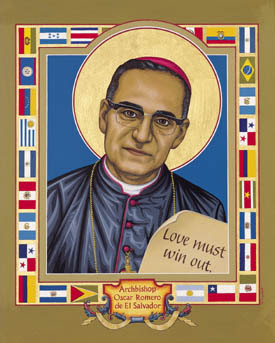
Pope Francis Beatifies Oscar Romero: No More Bullsh*t!

bullshit

I’ve been agonizing about this little talk I’m to make tomorrow evening at the beatification celebration of Oscar Romero of El Salvador. Everybody will be there: parish members, guests from other churches (Protestant and Catholic), former pastors, and John Stowe, our brand new bishop.

So I’ve been boring my friends (and readers of this blog) with draft after draft. To begin with, my worries have centered on the writing concerns I’ve inflicted on my students over the years. You know, the ones about having a sharp thesis, a clear preview of the points to be made, good follow-through on those points, and a strong conclusion.

More than that, however, I’ve fretted about possibly offending my audience. I mean, if I really articulated what I think must be said about Oscar Romero, many listeners might just turn me off. “Too political,” they’d say, “inappropriate,” “polarizing,” “ranting.” I’ve been warned against all those things. (In any case, I’ve been told by a prominent member of my church that “90% of the people are offended by what you write in the Lexington Herald-Leader every month!”)

Yes, I’m worried.

But then I thought of Dan McGinn, a mentor of mine during my doctoral studies in Rome. Like me, he was (but Dan still is) a priest in the Society of St. Columban. He was always refreshingly outspoken and unfailingly called things by their names.

Dan was fond of saying that if he ever “made bishop,” he’d put a special motto on his coat of arms. [Every bishop has a coat of arms with his motto at the bottom. For instance, the motto of the new bishop (John Stowe) heading our diocese of Lexington, Kentucky is “Annunciamus verbum vitae” (We proclaim the word of life.)] Well, Dan said that if ever made bishop, the motto under his coat of arms would be “No more bullshit!”

Bottom line is: I’ve decided to follow Dan’s implicit advice and throw caution to the winds. I no longer know exactly how my talk will come out. But I intend to say something like the following:

Oscar Romero

Good evening.

I’ve been asked by the parish Peace and Social Justice Committee and by the Lenten “Joy of the Gospel” Study Group to say a few words reminding us of why we are here.

Of course, we’re here to celebrate the beatification of Blessed Oscar Romero, the martyred archbishop of San Salvador in El Salvador. But why should we care?

We should care, I think, because Romero’s beatification personifies and embodies Pope Francis’ basic call in “The Joy of the Gospel.” There the pope summons the entire church to reform, to be converted, to repent, and be transformed. Nothing can remain as it has been, the pope says. The church must become relevant to the problems of poverty, inequality, and war that afflict our world.

So I suggest that the pope’s decision to beatify Oscar Romero dramatizes the pontiff’s exhortation.

But which side should we take in a politically polarized world? Which side are we on?

The side of the poor, the pope says. And by that he doesn’t mean greater generosity in making up our Christmas baskets or giving an extra dollar in Sunday’s second collection. He means doing what Oscar Romero did – what Jesus of Nazareth did.  He means identifying with the poor, their ways of seeing the world. He means refusing to support our culture’s favorite way of dealing with them – treating them with “tough love,” depriving them of life’s basics, waiting for wealth to “trickle down,” and when push comes to shove, killing them (whether that’s in Ferguson, Baltimore, Bagdad or Palestine).

In other words, Oscar Romero provides a case study of the kind of conversion and relevance the Holy Father urges us to embrace.

Like most of us – I speak for myself – Oscar Romero started out uncritical and unquestioningly patriotic. Until he was 60 he supported a system that had 1% of El Salvador’s population controlling 90% of its wealth. He sided with his county’s police and military which were at war with its own people to keep things that way.

He bought the line that those opposing the system were communists. So while his country was on fire, his sermons addressed the usual banalities: the afterlife, heaven, hell, and individual salvation.

The United States supported El Salvador’s government too. All during the 1980s, it gave its military more than one million dollars a day to fund what was called “the El Salvador option” for defeating the country’s insurgency. It was a “death squad” solution which killed everyone who might be connected with the insurgency – teachers, union organizers, social workers, priests and nuns. The slogan of the military’s “White Hand” death squad was, “Be a patriot; kill a priest.”

That slogan took on new meaning for Archbishop Romero when his good friend, the Jesuit, Rutilio Grande, was martyred by the White Hand. Grande was killed because El Salvador’s government saw how he lived among and served peasants and slum dwellers sympathetic to the insurgents. So they considered him a terrorist.

In reality, Father Grande was entirely motivated by the Gospel. He had come to see the world from the viewpoint of the poor. That was the essence of Jesus’ message, he said – good news for the poor. In the gospels, Grande found, Jesus not only saw the world from the viewpoint of the poor, he identified with them becoming one of them. He shared the values and characteristics of the poor that El Salvador’s rich despised.

For instance, Jesus’ skin was black or brown, not white like the elite of El Salvador. Jesus was dirt poor. He was conceived out-of-wedlock by a teenage mother. He was an immigrant in Egypt for a while. He belonged to the working class. His hands were calloused; his clothes were sweat-stained. Jesus liked fiestas and was accused of being a drunkard, possessed by the devil, and friend of sex workers. He was harassed constantly by the police and died a victim of torture and capital punishment, because the occupation forces of Rome considered him a terrorist.

That was the Jesus Rutilio Grande worshipped and preached – a Jesus completely like the people he served.

And so the “White Hand” or “The Secret Anti-Communist Army” (or one of those death squads) killed him – along with 75,000 other El Salvadorans. (Imagine the impact of those deaths in a country of just 6 million people!)

Grande’s death profoundly changed Oscar Romero. He said, “When I saw Rutilio lying there dead, I knew I had to follow his path.” And he did.

Archbishop Romero began speaking out against the government, army and police. He saw that the soldiers fighting against peasants and poor people weren’t heroes, but misled and brainwashed victims. Just before his death, he fairly shouted at them in a final homily: “No soldier is bound to follow orders that contradict the law of God. Don’t you see; you are killing your own brothers and sisters? . . . I beg you; I implore you; I order you: stop the repression!”

Those words sealed San Romero’s fate. The next evening while celebrating Mass for nuns in a hospital chapel, a sniper got him too. He became the first bishop to be murdered at the altar since Thomas Beckett at the beginning of the 12th century.

That’s the Romero story. It’s the story of a churchman converted late in life to centralizing peace and social justice concerns. And that’s the “Joy of the Gospel” connection. In that Apostolic Exhortation, the pope calls us to a similar centralization. The beatification of Oscar Romero reinforces that message.

To understand all of that, you have to grasp one shocking fact: Oscar Romero was killed by Catholics. And when he was murdered, there were fireworks and celebrations in the neighborhoods of El Salvador’s elite. These people were friends of the Vatican.

As a result, Pope Francis’ predecessors (John Paul II and Benedict XVI) were not anxious to canonize the archbishop. He was too polarizing, they thought. He too clearly took the side of the poor in their struggle with the rich. They even wondered if he had been duped by the communists.

And besides, how could Romero be classified as a martyr? After all, martyrs, by definition are defenders of the “true faith” against non-believers. But (again) Romero was killed by Catholics and hated by people who went to Mass each Sunday and believed all the right things about abortion, contraception, gay marriage, and divorce.

So John Paul II and Benedict XVI blocked Romero’s canonization and put the process on hold.

Francis has removed the block. Do you see what that implies?

It implies that “the true faith” is Romero’s faith. Its hallmark is identification with the poor in their struggle for justice — not those other narrow “moral” concerns. The true faith addresses issues like the justice of our economic system, wide disparities between the rich and the poor, and an economy based on war. It addresses climate change as a moral problem. All of these are themes central to “The Joy of the Gospel.”

Can you imagine what would happen to our state if the diocese of Lexington followed Romero’s example and became famous and distinguished as “that little peacemaking diocese in Central Kentucky” that everyone’s talking about?

Can you imagine what would happen in Berea if St. Clare’s worked closely with Union Church and cooperated to become as outspoken as Oscar Romero about issues of economic justice, racial and gender equality, war and peace?

Can you imagine what would happen in the world if 1.2 billion Catholics adopted Archbishop Romero’s spirit? What if Catholics on principle decided to absolutely reject war as a solution to the world’s problems and adopt economic justice instead? What if (in effect) we decided to drop books, hospitals, and schools on our perceived enemies instead of bombs and drone “hell fire”?

This evening, as you listen to the words of Oscar Romero during our celebration, please keep those questions in mind. They are vital to our faith.

What I’m saying is that all of us should care about Oscar Romero. He remains relevant to us; he challenges us today.

Archbishop Romero, Pope Francis, and Jesus Himself call us to radical change – to take sides. In effect, Oscar Romero’s beatification raises that old question: “Which side are you on?”

What’s your answer?

Please Help Me with My Reflections about Oscar Romero

Romero's Beatification

As readers here may have gathered from recent posts, my parish, St. Clare’s in Berea, Kentucky is about to celebrate the beatification of Oscar Romero. The celebration will take place a week from tomorrow.

It’s an extraordinary event, because our new bishop, John Stowe, will be in attendance as one of the first acts of his new episcopate.  The bishop has a special devotion to San Romero. That says volumes about his commitment to social justice – a welcome change from his predecessor.

So I’ve been asked to say some words about Archbishop Romero at an ecumenical paraliturgy. What follows are the ones I plan to share.

I will greatly appreciate any feedback. I’m worried about alienating conservatives in my parish – although Archbishop Romero eventually left aside such concerns, even incurring the wrath of his fellow bishops and the displeasure of Rome.

Please tell me what you think.

Oscar Romero

Bishop Stowe, Father Michael, honored guests, and my fellow parishioners.

I’m very grateful for this opportunity to speak about Oscar Romero who has been such an influence on my own life over these last 35 years especially as I’ve worked in Central America off and on since 1985.

Father John Dear, the great Jesuit peace activist calls Archbishop Romero perhaps the most important bishop in the history of the church. Certainly he’s one of the outstanding figures of the 20th century – on a par with Mahatma Gandhi, Martin Luther King, Dorothy Day and Mother Theresa.

But more than that Archbishop Romero is encouraging to each of us because, like Jesus himself, he achieved his greatness in just three years. He shows that it is possible for any of us to become a saint in a very short time if we follow Romero’s example of peacemaking in the face of war and oppression.

Like most of us – I speak for myself – Oscar Romero started out uncritical and unquestioningly patriotic. Until he was 60 he supported a system that had 1% of El Salvador’s population controlling 90% of its wealth. He sided with his county’s police and military which were at war with its own people to keep things that way.

He bought the line that those opposing the system were communists. So his sermons addressed the usual banalities: the afterlife, heaven, hell, and individual salvation.

The United States supported El Salvador’s government too. All during the 1980s, it gave its military more than one million dollars a day to fund what was called “the El Salvador option” for defeating the country’s insurgency. It was a “death squad” solution which killed everyone who might be connected with the insurgency – teachers, union organizers, social workers, priests and nuns. The slogan of the military’s “White Hand” death squad was, “Be a patriot; kill a priest.”

That slogan took on new meaning for Archbishop Romero when his good friend, the Jesuit, Rutilio Grande, was martyred by the White Hand. Grande was killed because El Salvador’s government saw how he lived among and served peasants and slum dwellers sympathetic to the insurgents. So they considered him a terrorist.

In reality, Father Grande was entirely motivated by the Gospel. He had come to see the world from the viewpoint of the poor. That was the essence of Jesus’ message, he said – good news for the poor. In the gospels, Grande found, Jesus not only saw the world from the viewpoint of the poor, he identified with them becoming one of them. He shared the values and characteristics of the poor that the country’s rich despised.

Jesus’ skin was black or brown, not white like the elite of El Salvador. Jesus was dirt poor. He was conceived out-of-wedlock by an unwed teenage mother. He was an immigrant in Egypt for a while. He belonged to the working class. His hands were calloused; his clothes were sweat-stained. Jesus liked fiestas and was accused of being a drunkard and friend of whores. He was harassed constantly by the police and died a victim of torture and capital punishment, because the occupation forces of Rome considered him a terrorist.

That was the Jesus Rutilio Grande worshipped and preached – a Jesus completely like the people he served.

And so the White Hand killed him – along with 70,000 other El Salvadorans.

Grande’s death profoundly changed Oscar Romero. He said, “When I saw Rutilio lying there dead, I knew I had to follow his path.” And he did.

Archbishop Romero began speaking out against the government. He saw that the soldiers fighting against peasants and poor people weren’t heroes, but misled and brainwashed victims. Just before his death, he fairly shouted at them in a final homily: “No soldier is bound to follow orders that contradict the law of God. Don’t you see; you are killing your own brothers and sisters . . . I beg you; I implore you; I order you: stop the repression!”

Those words sealed San Romero’s fate. The next evening while celebrating Mass for nuns in a hospital chapel, a sniper got him too. He became the first bishop to be murdered at the altar since Thomas Beckett at the beginning of the 12th century.

The thing was, the archbishop was killed by good Catholics. And there were fireworks and celebrations in the elite neighborhoods when those good Catholics learned of his death. The celebrators were friends of the Vatican who went to church every Sunday and believed all the right things about abortion, contraception and homosexuality.

Ultimately, that’s what blocked Romero’s path to sainthood. I mean, by definition martyrs are Catholics killed “for the faith” by non-believers. Even Pope St. John Paul II was unenthusiastic about Romero’s cause. When the archbishop had come to see him about El Salvador’s plight, the pope said he was exaggerating.

Today our country, like El Salvador in the ‘70s and ‘80s is at war against poor people everywhere, both at home and abroad. Our 1% has more wealth than the GNPs of the 48 poorest countries combined. Three hundred and fifty men are wealthier than 3.5 billion people – half the world.  When clergymen, like Jeremiah Wright denounce our wars against the poor, we accuse them of “hating America.” When Muslim clergy side with the poor, we call them terrorists too. Our drones kill them sometimes even in their mosques.

I hope you see how Oscar Romero is completely relevant to us and our country. This evening, please listen carefully to his words which will be centralized in our celebration of his status as a saint. See how they relate to us as followers of the impoverished Jesus living in country at war against the world’s poor. His words call us and our church to radical conversion – political conversion – like his own

It’s never too late.

(Sunday Homily) Pentecost: the Spirit of Jesus in Pope Francis & Oscar Romero!

Romero poverty

Today is Pentecost Sunday, sometimes called the “Birthday of the Church.”

Significantly, Pentecost’s vigil (yesterday) is the day the church has chosen to “beatify” Oscar Romero, the martyred archbishop of San Salvador, who was assassinated in El Salvador on March 24th, 1980. His beatification (the final state before canonization or sainthood) took place there yesterday.

The co-incidence of the two anniversaries is full of meaning for a community of faith desperately in need of rebirth.

Politically speaking, the unblocking of San Romero’s beatification process by Pope Francis represents the pope’s call to appropriate Jesus’ Spirit of Life and leave behind all traces of the political conservatism that characterized most of the archbishop’s life. Pope Francis calls us to boldness, radicalism and outspoken partisanship on behalf of the world’s poor. That’s the Spirit of Jesus, he says. It’s the Spirit Oscar Romero eventually embraced.

To get what I mean, please join me in reflecting on (1) Roman Catholic conservatism – at least as I currently experience it, (2) the conversion of Oscar Romero to the radicalism of liberation theology’s “preferential option for the poor,” and (3) the directions for similar change given by Pope Francis in his “Joy of the Gospel.” Following those directions, I argue, promises his church a New Pentecost.

I The Irrelevance of the Catholicism I Experience

To begin with, consider the Catholic Church I experience each week. Its present form is a construction of the reactionary popes, John Paul II (1978-2005) and Benedict XVI (2005-2013). I consider their papal reigns disastrous.

Because of their counter-reforms, my local parish not only ignores the progressive initiatives of the Second Vatican Council, it gives every indication of attempting to reverse them in the minds of my fellow parishioners.

In fact, the documents of Vatican II are rarely referenced in our church. Their place has been taken by the conservative invention, The Catechism of the Catholic Church.

“Masses” from one week to the next show almost no variation or planning. Everything seems rote. Sermons are full of clichés about heaven and churchy bromides. Not a word connects the Radical Jesus with Ferguson, Baltimore, Iraq, drone warfare, torture, the LGBTQQ struggles, or climate chaos. To introduce such topics might “upset” some people, so they’re completely ignored.

No such sensitivity, however, is displayed regarding conservative issues concerning abortion, gay marriage or climate change. The latter is almost never mentioned, while the former issues (abortion and gay marriage) are highlighted at every opportunity. Our diocesan newspaper, The Crossroads, communicates the distinct impression that good Catholics are good Republicans and vote accordingly.

II Oscar Romero’s Pentecost

For most of his life, Oscar Romero would have been comfortable in my local church.

Remember, Monsignor Romero started out conservative in every sense of the word. To a large extent, that’s why he was appointed archbishop in 1977. Romero was considered safe. He was patriotic. He unquestioningly supported his country’s military. He looked on the widespread rebellion of the poor in El Salvador with great suspicion. He considered the would-be revolutionaries communist subversives.

And yet, the archbishop had this close friend on the opposite end of the political spectrum. He helped Romero grow. That friend was Rutilio Grande. Grande was a Jesuit who took seriously his vow of poverty.

So Father Grande moved out of the parish rectory and lived with the poor. He knew first-hand their struggles, their family break-downs, their unemployment, hunger, low wages, and harassment by local police.

Worse still, Grande knew the Salvadoran military’s strategy for defeating the country’s impoverished insurgents. It was simply this: kill everyone who might possibly be sympathetic to rebel forces. That meant most of the country’s non-elite. It meant many of their parish priests. For Rutilio Grande, the slogan of the White Hand death squad represented an everyday reality and threat: “Be a patriot; kill a priest.”

Eventually, of course, the White Hand killed Rutilio Grande himself.

It was his martyrdom that pushed Oscar Romero over the edge and radicalized him. He utterly abandoned his conservatism. He would later say, “When I looked at Rutilio lying there dead, I thought, ‘if they have killed him for doing what he did, then I too have to walk the same path.’” (The “they” Archbishop Romero referred to was his own government, its military, and their backers in the United States.)

So Archbishop Romero started listening to the poor. He attended their “biblical circles,” where peasants shared their thoughts about Sunday gospel readings.

Once after listening to simple farmers sharing thoughts about “The Parable of the Sower,” the archbishop stood up without comment and walked away from the group. The local priest followed him and asked anxiously, “What’s the matter, Monsignor, did something offend you?”

“No,” the archbishop responded, “quite the opposite. It’s just that I think I’ve heard the Gospel of Jesus today for the first time.”

In other words, the archbishop discovered that when poor people read the Bible, they see things that remain invisible for conservatives comfortable with whiteness, patriarchy, and empire.

Jesus was none of those things, the archbishop realized. He was brown or black, poor, a victim of empire, and counter-culturally open to the viewpoints and experience of women. Those were the Master’s viewpoints. They deeply influenced how he saw the world.

More specifically, Jesus stood on the same ground as El Salvador’s poor (and the poor of the Global South). He was born out-of-wedlock to a teenage mother. He was an immigrant in Egypt for a while. He was a working man with calloused hands and sweat-stained clothes. He loved fiestas. His friends, people said, were drunkards and prostitutes. Rabbis expelled Jesus from the synagogue, and thought he was diabolically possessed. Even his family questioned his sanity. Jesus became a vagrant without visible means of support. He lived under an oppressive empire. Imperial authorities saw him as an insurgent and terrorist. He ended up on death row, a victim of torture and of capital punishment.

All those characteristics, Archbishop Romero realized, described Another Jesus that to him was far more compelling, inspiring and faithful to the gospels than the abstract and other-worldly Jesus elaborated in the theological texts that guided his doctoral studies in Rome.

So Romero concluded that the poor knew Jesus more deeply and authentically than he ever could. (They had what scholars called a “hermeneutical privilege.”)

Even more, the Jesus of the Poor revealed Another God who alone can save our world from the path to destruction we’ve embarked upon. (And this is where Pope Francis’ continuity with Romero’s vision comes in.)

III Pope Francis’ Pentecost

Like the converted, Spirit-led Oscar Romero, Pope Francis does not shy away from radicalism, controversy or partisanship in the name of social justice. In fact, the pope identifies the struggle for social justice and participation in political life as “a moral obligation” that is “inescapable” [“Joy of the Gospel” (JG) 220, 258].

And the pope walks his talk. Think about his:

  • Part in negotiating an end to U.S. policy towards Cuba, despite what Miami Cubans might think.
  • Recognition of the Palestinian state in the face of objections from Israel and its supporters.
  • Identification of the Palestinian Authority’s Mahmoud Abbas as an “angel of peace” over the same objections.
  • Famous “who am I to judge” statement about homosexuality.
  • Unblocking of canonization procedures for Oscar Romero, the patron saint of liberation theology.
  • Embrace of liberation theology’s “preferential option for the poor.”
  • Planned encyclical on climate chaos, even over objections by U.S. Republicans and their think tanks like the Heartland Institute.
  • Stated intention to influence the Paris Climate Summit next December.

Yes, (in U.S. terms) the pope has not been afraid to alienate Republicans and give the distinct impression that their agenda is largely incompatible with Christian faith.

I’d even go so far as to say that “The Joy of the Gospel” is like a manifesto against Republican approaches to social issues. I mean, JG:

  • Condemns wide disparities in income (188).
  • Advocates redistribution of wealth (189)
  • Rejects trickle-down economic theory as illusionary and entirely dysfunctional (54).
  • Sees unfettered markets as homicidal (53), ineffective (54), and unjust at their roots (59).
  • Demands market regulation as indispensable (56).
  • Views “each and every human right” [including education, health care, and “above all” employment and a just wage (192)] as intimately connected with “defense of unborn life” (213).
  • Presents environmental protection as a moral imperative (215, 216).
  • Dismisses war as incapable of combatting violence which the pope sees as caused by “exclusion and inequality in society and between peoples” (59).

Conclusion

It will no doubt offend some in my parish to read these words. But that’s the point of Pentecost, isn’t it – to shake us up?

After all, Jesus offended the conservative members of his parish-equivalent. Romero offended conservative Salvadorans and conservative U.S. “Americans.” Pope Francis makes no bones about offending Jewish Zionists, Miami Cubans, U.S. Republicans and climate change deniers.

The Spirit of Life is not conservative. It is not imperial. It wants everyone to survive and thrive – especially the ones the dominant order rejects as unworthy.

In those senses, It makes a preferential option for the poor.

Seven Things You Might Have Missed about Lexington’s New Catholic Bishop

Stowe

At the beginning of this month, Father John Stowe was installed as the new bishop of Lexington’s Roman Catholic diocese. As such he embodies the long reach of Pope Francis, who, in his Apostolic Exhortation, ‘The Joy of the Gospel” (JG) announced his determination to fundamentally reform the church.

There the pope said, “In this Exhortation, I wish to encourage the Christian faithful to embark upon . . .  new paths for the Church’s journey in years to come” (JG 1). Francis called for “. . . conversion which cannot leave things as they presently are” (25).

Early returns indicate that in Bishop Stowe, Pope Francis has appointed a change agent like himself intent on implementing the pope’s program whose essence might be described as prioritizing the needs of the poor.

That prioritization was presaged even before Bishop Stowe’s official installation on May 5th. It was evident the night before at the vespers ceremony and reception at Christ the King Cathedral in Lexington, where the bishop-elect showed himself to be a master of symbolic communication.

In fact, the new bishop has sent at least seven clear signals that he and the pope are on the same page and that Lexingtonians can expect a welcome emphasis on social justice themes.

During the ceremony, then bishop-elect Stowe:

  1. Announced a “new chapter” for the Catholic Church in Lexington. The phrase, which appears in the first paragraph of Francis’ “Joy of the Gospel,” was evidently chosen to indicate the bishop’s endorsement of the pope’s agenda.
  2. Said that the new chapter would emphasize service of the poor. Yes, worship would also be prioritized, he promised. However, even liturgy could never ignore poverty in our midst.
  3. Demonstrated that conviction by prioritizing Spanish (the language of so many of the poor among us) throughout the vespers liturgy – in readings, responsorials, and hymns. In his own remarks, then Bishop-elect Stowe spoke each paragraph first in English and then in Spanish translation. At other times, his initial thought came in Spanish followed immediately by an English translation.
  4. Invoked the example of Jesus as the foundation for emphasizing service of the poor. Jesus himself was impoverished, the bishop said. He was an working man, a carpenter with dirty hands who enjoyed friendship with fishermen and sinners. He accompanied the oppressed and finished his life as a criminal on death row. The authenticity of Jesus’ resurrected presence was certified by display of his body wounded by imperial forces.
  5. Specifically identified other excluded and marginalized groups as the focus of his ministry: overlooked Appalachians, refugees from the Congo, the sexually abused (a clear reference to the Church’s pedophilic scandal), and exploited workers. The church, Bishop Stowe said, must identify with brothers and sisters of that kind or “it isn’t much of a church.”

Outside the vespers introductory ceremony, it was disclosed that Bishop Stowe:

  1. Has a special devotion to Oscar Romero, the martyred archbishop of El Salvador, who is considered the patron saint of liberation theology – which interprets Jesus’ gospel from the viewpoint of the poor and oppressed.
  2. Has decided to abandon residence in the plush quarters of the episcopal mansion. Instead he’s locating among his confreres in a community of retired priests.

It is this last action, more than the others, that signals Bishop Stowe’s intention to channel Pope Francis for us not just in words, but in deeds and life-style.

These are seven good reasons to hope that the new bishop will indeed not “leave things as they presently are.”

Oscar Romero’s Message: Another God Is Possible; Another God Is Necessary!

PROMO9
PROMO9

(This is the second in a three-part series on our parish’s upcoming celebration of the beatification of San Oscar Romero which will take place on May 23rd. The event will be observed in Berea’s St. Clare’s parish on June 3rd, when our new bishop, John Stowe, will join us.)

In the previous installment of this mini-series inspired by the upcoming beatification of El Salvador’s Oscar Romero, I offered a thumb-nail sketch of the great archbishop’s life. Romero’s witness has been inspiring for many, including Lexington’s new bishop, John Stowe. (As I said, think of the thoughts that must have coursed through the bishop’s mind as he celebrated Mass recently at the very altar where Oscar Romero was shot. We look forward to his sharing those thoughts on June 3rd when he joins our local church to celebrate Monsignor Romero’s beatification.)

In fact, Monsignor Romero’s story should be encouraging to each of us because of its life-changing implications. It connects perfectly with the message of Pope Francis in his “Joy of .the Gospel.” Both tell us that political and spiritual transformation is not only possible; it is necessary to save our world.

First of all consider the example of Oscar Romero. His change was profound both politically and religiously. In both dimensions, he became a radical, like Jesus of Nazareth.

Remember, Monsignor Romero started out conservative in every sense of the word. To a large extent, that’s why he was appointed archbishop in 1977. Romero was considered safe. He was patriotic. He unquestioningly supported his country’s military. He looked on the widespread rebellion of the poor in El Salvador with great suspicion. He considered the would-be revolutionaries communist subversives.

And yet, the archbishop had this close friend on the opposite side of the political fence. He helped Romero grow. That friend was Rutilio Grande. Grande was a Jesuit who took very seriously his vow of poverty.

So the priest moved out of the parish rectory and lived with the poor in their barrio slums. He knew first-hand their struggles, their family break-downs, their unemployment, hunger, low wages, and harassment by local police. Those became his issues, his context for interpreting the Gospel of Jesus.

Even more, Grande knew the Salvadoran military’s strategy for defeating the country’s impoverished insurgents. It was simply this: kill everyone who might possibly be sympathetic to rebel forces. That meant targeting most of the country’s non-elite. It meant butchering many of their parish priests. For Rutilio Grande, the slogan of the White Hand death squad represented an everyday reality and threat: “Be a patriot; kill a priest.”

Eventually, of course, the White Hand killed Father Grande himself. It was his martyrdom that pushed Oscar Romero over the edge and radicalized him. He utterly abandoned his conservatism. He would later say, “When I looked at Rutilio lying there dead, I thought, ‘if they have killed him for doing what he did, then I too have to walk the same path.’” (The “they” Archbishop Romero referred to was his own government, its military, and their backers in the United States.)

So Archbishop Romero started listening to the poor. He attended their “biblical circles,” where peasants shared their thoughts about Sunday gospel readings. Once after listening to simple farmers sharing thoughts about “The Parable of the Sower,” the archbishop stood up without comment and walked away from the group. The local priest followed him and asked anxiously, “What’s the matter, Monsignor, did something offend you?”

“No,” the archbishop responded, “quite the opposite. It’s just that I think I’ve heard the Gospel of Jesus today for the first time.”

This is where Romero’s Other Gospel, Other Jesus, Other God comes in. The archbishop discovered that when poor people read the Bible, they see things that remain invisible for people like us who tend to be white, comfortable, patriarchal, and supportive of empire.

Jesus was none of those things, the archbishop realized. He was brown or black, poor, a victim of empire, and counter-culturally open to the viewpoints and experience of women. Those factors constituted the Master’s standpoint. They deeply influenced how he saw the world.

More specifically, Jesus stood on the same ground as El Salvador’s poor (and by extension, the poor of today’s Global South). He was conceived out of wedlock by a teenage mother. He was an immigrant in Egypt for a while. He was a working man with calloused hands and sweat-stained clothes. His friends, people said, were drunkards and prostitutes. Rabbis expelled Jesus from the synagogue, and thought he was diabolically possessed. Even his family thought he was insane. Jesus became a vagrant without visible means of support. He lived under an oppressive empire. Imperial authorities saw him as an insurgent and terrorist. He ended up a victim of torture and of capital punishment.

All those characteristics, Archbishop Romero realized, described Another Jesus that to him was far more compelling, inspiring and faithful to the gospels than the abstract and other-worldly Jesus elaborated in the theological texts that guided his doctoral studies in Rome.

So San Romero concluded that the poor knew Jesus more deeply and authentically than he ever could. (They had what scholars called a “hermeneutical privilege.”)

The Jesus of the Poor revealed that Other God who alone could save El Salvador. Fidelity to that same Jesus can save our world from the path to destruction we’ve embarked upon. (And this is where Pope Francis’ continuity with Romero’s vision comes in.)

Francis too has chosen to prioritize the experience and understanding of the world that belong to its poor. In doing so, he challenges our very idea of God. He evokes the Other God who alone can save us from the abyss.. For the pope, God is not neutral, but stands with the poor in their struggles against oppression. What does it mean, he asks implicitly, that God chose the poor, oppressed and despised as the primary site of his Self-revelation?

It means the poor of the world are God’s Chosen People. That answer has led Pope Francis to be the voice of the voiceless. And he does so even at risk of being called a communist. In this, he’s like Dom Helder Camara the late and sainted bishop of Recife in Brazil. Dom Helder said, “When I give food to the hungry, they call me a saint. When I ask why the hungry have no food, they call me a communist.”

Pope Francis does more than ask Dom Helder’s question. In his Apostolic Exhortation, “The Joy of the Gospel” (J.G.), he answers it. I’ll tell you what causes poverty, he says. It’s the reigning economic system that is homicidal (J.G. 53), and unjust at its roots (59). It’s allegiance to the “trickle down” ideology of the rich – a theory that has never worked (53). The world really belongs to the poor, the pope insists (57). The rich who refuse to return to the impoverished what is rightfully theirs are robbers and thieves (57). The rights of the poor take precedence over those of private property (189).

The pope’s choice to be the voice of the voiceless extends to the environment as well to impoverished humans. Watch for his encyclical on climate change to be published sometime next month. There he’ll surely give voice to the planet’s animals, plants, mountains, forests, rivers, and oceans. In the face of climate change, he warns us, “God always forgives. Human beings sometimes forgive. But nature never forgives.” So what’s the proper response to the challenges of Oscar Romero, Pope Francis, and (we hope) Bishop Stowe? As I see it, proper response entails:

  • Leaving behind the safety of contemporary Christianity’s conservative ways.
  • Committing to a path of parish renewal and personal faith development intent on acquainting ourselves with the biblical God of the poor.
  • Viewing the world and its conflicts from below – from the viewpoint of the Other Jesus embraced by Monsignor Romero – from that of unwed mothers like Miryam of Nazareth, of immigrants, the mentally unbalanced, sex workers, the homeless, insurgents, terrorists and those being water-boarded and executed by the state.
  • Recognizing that with 1.2 billion members world-wide, a Catholic Church attuned to the spirits of Oscar Romero and Pope Francis has unlimited potential for changing the world.
  • Embracing that change as our collective vocation.
  • Abandoning pet convictions that national allegiance, military action, and trickle-down theories will solve our world’s problems.
  • Embracing the Other Jesus of the poor
  • His Other God
  • And the Other World that Oscar Romero, Pope Francis, and Jesus proclaim as the very essence of God’s Kingdom.

Bishop Stowe Is Sending Us a Message by Attending Oscar Romero Celebration

Stowe

(This is the first in a three-part series on our parish’s upcoming celebration of the beatification of San Oscar Romero which will take place on May 23rd. The event will be observed in St. Clare’s parish on June 3rd, when our new bishop, John Stowe, will join us.)

As one of the first acts of his new Episcopate, Bishop John Stowe will be visiting my parish, St. Clare’s in Berea, Kentucky, to celebrate the beatification of Oscar Romero, the Archbishop of San Salvador, who was gunned down at the altar on March 24, 1980.

In accepting the invitation to join the celebration, then bishop-elect Stowe wrote:

“Oscar Romero is a great inspiration in my life and I am thrilled to know of a community that wishes to celebrate his witness.”  

Bishop Stowe’s words and his decision to attend the celebration are freighted with meaning for Catholics of the Lexington Diocese. They speak volumes about Bishop Stowe’s overriding commitment to social justice. The bishop’s words call our attention not only to the person of Oscar Romero, but to the theology that informed his life, and to our vocation as followers of Jesus the Christ.

In today’s posting, think about Oscar Romero himself. (Subsequent blogs – next Wednesday and the following Monday – will focus on liberation theology as it relates to Romero, and then on practical responses to the archbishop’s beatification).

Oscar Romero was born in 1917. Like our present pope, Francis, he was a Jesuit. Monsignor Romero entered the seminary at the age of 13 and was ordained at 26. He studied in Rome, and received his doctorate in theology there from the Gregorian University. In 1977, he was appointed archbishop of San Salvador.

The monsignor was a bookish man – very traditional, both politically and religiously speaking. He was a conservative in every sense of the word.

However, a turning point came for Oscar Romero less than a month after his consecration as San Salvador’s 4th archbishop. A close friend of his – another Jesuit priest, Rutilio Grande – was assassinated by one of El Salvador’s right-wing death squads. Rutilio Grande was an advocate of the poor, an opponent of government oppression of the peasants and workers, and an advocate of radical theology. He saw Jesus as a prophet – the Son of God bringing good news to the poor.

Romero’s own words reveal the impact of Grande’s death. He said, “When I looked at Rutilio lying there dead, I thought, ‘if they have killed him for doing what he did, then I too have to walk the same path.'” The “they” Archbishop Romero referred to was his own government, its military, and their backers in the United States.

In other words, the penny had dropped for the archbishop. He realized that his country and all of Central America was at war. It was what Noam Chomsky called “the first religious war of the 21st century.” It pitted the United States of America and its right wing allies in Central America against the Catholic Church.

But as Romero said in a speech at the Universite Catholicque in Louvain, Belgium, just before his martyrdom, the U.S. war wasn’t against the entire Catholic Church.  Or as the archbishop himself put it,

“. . . (I)t is important to note why [the Church] has been persecuted. Not any and every priest has been persecuted, not any and every institution has been attacked. That part of the church has been attacked and persecuted that put itself on the side of the people and went to the people’s defense. Here again we find the same key to understanding the persecution of the church: the poor.”

In other words, the archbishop had put his finger on the problem: the Catholic Church was divided between the traditionalists who supported the rich, unfettered capitalism, and U.S. Empire on the one hand, and those who took the part of the poor on the other. Grande’s death convinced the archbishop that he had been on the wrong side. So he switched over and took the part of the poor. In doing so, he in effect signed his own death warrant.

Nevertheless, he began speaking out fearlessly each Sunday against his country’s government, its military, and their supporters in the United States. He railed against El Salvador’s endemic poverty, social injustice, assassinations and torture. He specifically criticized the United States for the military aid it gave to El Salvador’s repressive military government.

President Carter ignored the archbishop’s pleas to stop arming El Salvador’s military and death squads. And when he entered office, President Reagan doubled down on his predecessor’s policy.

Still, Archbishop Romero continued to follow faithfully Rutilio Grande’s path. His weekly radio programs became a sensation throughout El Salvador. He named names and listed the disappeared, tortured, murdered and much more. The archbishop’s broadcasts became the main source of trustworthy news for his oppressed people.

As a result, death threats from the White Hand death squad came to him every day. But such intimidation didn’t work on Oscar Romero.

Finally, though, on March 24, 1980, the chickens came home to roost. In a crime intellectually authored by Roberto D’aubuisson, a darling of U.S. Central American policy, the archbishop was assassinated while celebrating the Eucharist in a convent in San Salvador.

The country was plunged into mourning. 250,000 people attended Archbishop Romero’s funeral. However, only one of the country’s bishops attended his funeral. The others considered him too radical and politicized. They stayed home.

The Salvadoran army however did not. Death squad sharpshooters terrorized the funeral, dropping smoke bombs and killing anywhere from 30 to 50 people while wounding many others. It was a world-class scandal.

But it was by no means the end of the war against the Catholic Church. The White Hand death squad continued to follow its slogan, “Be a patriot; kill a priest.”

Less than a month after Archbishop Romero’s martyrdom, four U.S. women religious (all from Cleveland, Ohio) were brutally raped and murdered: Ita Ford, Maura Clarke, Dorothy Kazel, and Jean Donovan. Then in 1989, a team of six Jesuit liberation theologians at the Central American University along with their housekeep and her 15 year old daughter were slaughtered by Salvadoran soldiers trained at the School of the Americas in Fort Benning, Georgia.

By the war’s end, scores of priests were killed along with lay ministers of the word, teachers, social workers, and union organizers. In 1980 alone, more than 11,000 such activists fell victim to the death squads. By the war’s end, more than 70,000 Salvadorans had been killed by their own government. Imagine the impact of such numbers in a small country of just over 6 million people.

International Labor Day Post: The Machines Are Coming! Thank God!

machines coming

Recently Zeynep Tufecki wrote in a New York Times op-ed that “The Machines Are Coming.” Hers was a warning about the devastating effect of technology on the job market. Machines have eliminated jobs across the board, she lamented – from secretarial positions to auto workers to medical diagnosticians and college professors.

Unlike Tufecki, I see this as good news — a promise of more free time and leisure.

In fact, many more jobs than Tufecki indicates might also be eliminated – and probably should be. Think weapons manufacture, the military itself, the advertising industry, call centers, insurance companies, fast food, and (above all!) Wall Street jobs connected with financial speculation. None of these occupations are truly necessary or even productive. Face it: they are mere busy work.

Still other jobs are on their way out. Remember what happened to Encyclopedia Britannica that didn’t see Wikipedia coming. Think of the music industry involuntarily “downsized” by file sharing.

And what about newspapers? They are currently in crisis because of the advent free news websites. They’ll soon be history. Similarly “distance learning” is having its own impact on higher education as bricks and mortar campuses sun-set whether or not their trustees see the coming train wreck.

Again, all of this can be good news.

Energy industries will be especially affected. According to Jeremy Rifkin in The Empathic Civilization, new technology will soon drive climate-changing oil and dirty coal out of business too.

This is not a pipe dream. Surplus energy can already be stored in hydrogen cells. And the energy produced will soon be shared person-to-person across a “smart grid.” Again, the model here is file-sharing.

The European Union’s ideal is to turn every building’s rooftop into a solar energy power plant.

Think of the jobs that will be eliminated as a result – including those required by the energy wars that will be rendered superfluous.

Of course, this doesn’t mean that there isn’t productive work crying out to be done. Green technologies in general and public transportation are obvious needs. The number of potential jobs connected with them is substantial. But there are not nearly enough green jobs to replace the ones that have been eliminated by technology and those that should be discarded because they are environmentally destructive and morally unsustainable.

So what should be done about all of this? Here is the hopeful part. Rifkin showed the way years ago. So did Juliette Shor (The Overworked American).  J.W. Smith (Economic Democracy: the Political Struggle of the Twenty-First Century) was even more articulate about the path ahead: SHARE THE WORK.

The good news is that none of us has to work that hard unless we want to. Thanks to the new technology, we could work four-hour days or three-day weeks, or for only six months a year, or every other year. And with military spending reduced by 75%, we could still make a living wage — retiring by 40. And this is possible world-wide.

It is all now within our grasp. We just have to recognize that and get the subject on the political agenda.

No one needs to be reminded that we are entering the election season. I wonder what Hilary and Jeb think about all of this.

Be sure to ask them.

What Ordinary People Can Do for World Peace

nobel-women

This morning I watched “Democracy Now” as I do each day. All this week, the best news program on air will be broadcast from the Netherlands. There the show’s host, Amy Goodman, will be at the Hague, where she’s attending a World Forum celebrating the 100th anniversary of the Women’s League for Peace and Freedom.

Today’s program featured interviews with three women peace activists and Nobel Peace laureates: Mairead Maguire of Northern Ireland, Leymah Gbowee of Liberia, and Jody Williams of the U.S.  Mairead Maguire received her prize for her actions to end the conflict in her country. Leymah Gbowee was given the Nobel award for her leadership in a women’s movement that brought down dictator, Charles Taylor in Liberia, and saw him sentenced to 50 years in prison. Jody Williams’ prize resulted from her work in an international campaign to ban landmines.

All three women were entirely inspiring as they showed how ordinary people like you and me can change the world if we organize and stay for the long haul  in the struggle for peace.

Their interviews led me to think:

What is Peace?

I recently heard repeated

(In a sermon)

The bromide that

Peace is “not just absence of war.”

That’s right (I suppose) as far as it goes,

But peace is more than that.

It is indeed “not just the absence of war.”

But absence of war without its causes,

Injustice and inequality.

Peace is absence of war

With obscene poverty and income gaps

Outlawed.

_____

That’s the goal.

The question is

What will I do

For peace, justice, and equality

Today?

The Long Reach of Pope Francis: how he (and Oscar Romero) touched our diocese & our parish

Pope francis oscar romero


I once was once skeptical about Pope Francis.

When he was elected, my first thought was “Can anything good come out of an Electoral College of Cardinals packed so tightly with clones of the reactionaries, John Paul II and Benedict XVI? Bergoglio must be one of those carbon copies.”

But I was wrong.

Jorge Mario Bergoglio turned into Pope Francis. Far from a triplet brother of his immediate predecessors, the new pope has proven to be truly Latin American. That’s so even to the point of embodying the ideals of liberation theology, or reflection on the gospel from the viewpoint of the poor and oppressed. He has espoused the latter’s “preferential option for the poor,” its trenchant critique of corporate globalization, and its openness to marginalized people of all kinds. What a surprise!

My second thought was, “But he’s already old. His papacy will be short. He won’t be able to accomplish much of enduring impact.

Imagine then my further astonishment, when a mere three years into his papacy, Pope Francis’ touched  in remarkable ways our  tiny and remote diocese of Lexington, Kentucky. Even stranger to say, his reach extended to our little Kentucky parish of St. Clare’s in Berea. It made me wonder if this is happening all over Francis’ world. I hope so.

First of all, consider what’s happened in Lexington.

Our previous bishop was a canon lawyer – an appointee of John Paul II. Bishop Ronald Gainer distinguished himself by urging pro-choice politicians to refrain from receiving Holy Communion. He has since shown other overriding concerns by forbidding Catholic School girls in his new diocese from engaging in sports (such as wrestling, rugby, and football) “…that involve substantial and potentially immodest physical contact.” You get the idea.

After waiting for more than a year, Bishop Gainer’s replacement was at last named. It was John Stowe, a Conventual Franciscan. Father Stowe showed his colors in his introductory press conference. There was not a word about abortion, contraception, or gay marriage, much less about girls’ wrestling.

Instead he introduced himself as “a Franciscan educated by the Jesuits and appointed by a Jesuit Pope who has taken the name Francis.” “I love Pope Francis,” Father Stowe said, “and I will do whatever he asks.”

Turns out, the new appointee is not only a disciple of the pope; he is also a sharp critic of reactionary politics – especially as they affect immigrants. (Fr. Stowe, BTW, speaks fluent Spanish.)

For instance, in 2006, when Fr. Stowe addressed the Mayor’s Congress on Immigration Reform in El Paso, Texas, he criticized the U.S. Congress saying, “We shudder to imagine what the inscription on the Statue of Liberty might read if it had been erected by the current U.S. Congress.” Promising words indeed.

And that brings me to our parish, the long reach of Pope Francis and its connection with our new bishop.

You see, during this past Lent, for the second year in a row, a small group of us met each week to study the pope’s “The Joy of the Gospel” – the Apostolic Exhortation published in November 2013. In one of our concluding sessions, we were searching for something practical to connect the pope’s words with our community of St. Clare’s.

The calendar told us that the beatification of El Salvador’s Oscar Romero was coming up on the 23rd of May. (Beatification is a major step towards canonization or sainthood in the Catholic Church.)

Romero, you recall, was the martyred archbishop of San Salvador. In 1980, he was gunned down at the altar by an assassin connected with El Salvador’s Arena party which was supported by the Reagan administration. Because Romero is considered the patron saint of liberation theology (which the pope saw as too influenced by Marxism), John Paul refused to even call the archbishop a martyr. Instead, he referred to him merely as “a zealous pastor.”

Pope Francis has changed all of that. Romero, he says, was not only a martyr, but has advanced him on the way to official recognition as a saint of the entire Roman Catholic Church.

Well, our little discussion group thought: Why not have our parish celebrate Romero’s beatification?

“Great idea” we all agreed; “We could hire a Mariachi band, invite the Hispanic community and folks from Berea College’s Union Church” (a Church of Christ with whom people from St. Clare’s traveled to El Salvador on more than one occasion). “And then we could follow it all with a big fiesta.”

Someone else added, “And why not invite the new bishop?”

“Wouldn’t hurt to ask,” was the consensus — although we thought his acceptance would be unlikely, since by the end of May, he’d barely have been installed as bishop.

Well, guess what? He agreed to come. That sends a strong signal about his priorities.

So did his letter written immediately after receiving our invitation:

Thank you for your kind words of welcome and the excellent suggestion of celebrating the beatification of Archbishop Romero. I am so happy to know that St Clare’s and Union Church are in a relationship with the Church in El Salvador. That is exactly what Pope Francis is encouraging us to do!

I just returned last night from visiting our Central American Friars; we celebrated the 35th anniversary of Romero’s martyrdom although we were in Costa Rica. This past February 1st, I was able to celebrate mass in the hospital where Romero was killed—all this to say, Oscar Romero is a great inspiration in my life and I am thrilled to know of a community that wishes to celebrate his witness.

I will look for possible dates to celebrate the beatification with your community.

Your message is most welcomed!!

Bishop-elect Stowe’s acceptance of our invitation means that everyone in our parish and from parishes nearby will surely attend an event that might otherwise have been overlooked. Everyone will want to meet the new bishop.

He is sure to have some inspiring words to say about Romero, and hopefully about liberation theology, and U.S. policy in Central America during the 1980s. This will indeed be a teachable moment.

Do you see what I mean about Francis’ long reach? This is already far better than I anticipated three years ago.

My Secret Thirteen Years in Prison

Silver Creek

Recently my wife, Peggy, and I listened with rapt attention to a CD recording of the John Grisham novel, The Racketeer.  The 2012 Doubleday publication was a page turner from the very start. It caused us to miss a turn on the highway on our way to our Michigan lake house.

The Racketeer is the story of an African-American attorney, Malcolm Bannister, unjustly disbarred and jailed for an alleged and complicated money laundering scheme. It’s about his escape from a federal prison near Frostburg Maryland by means of an equally complicated and fascinating scheme of his own.

Such an interesting novel deserves a separate review. My point here however is different. It’s autobiographical and theological. It’s about the reflections on my own life and on God that The Racketeer stimulated.

You see, Malcolm Bannister’s life in his prison reminded me of my own time served in a similar institution under an infinitely worse warden. It caused me to remember my own escape and the way I finally told the warden off.

From the age of 14 to 27, my life featured the same restrictions as Bannister’s. There was the same dull prison food, interactions with a self-absorbed overseer and redeeming friendships with fellow prisoners. Only, since I was so young, life in prison meant minimal contact with women – nothing at all romantic, much less sexual. The warden had this weird attitude towards sex.  He didn’t care for it at all, and didn’t want us to either.

Like my own, Malcolm Bannister’s prison was minimum security. It had no walls or razor wire. There were no gun towers or barred prison cells. Inmates lived large dormitories or in single rooms with a cot, desk, chair and window. Everyone wore the same uniform. But prisoners were free to roam about the paths winding across the institution’s wooded acres. Escape would be easy, but few “walked off,” because capture would bring reassignment to a real hell-hole. That was my experience too.

The similarities between Bannister’s warden, Robert Earl Wade, and my own were uncanny. As mentioned, both were self-absorbed. But mine was far crueller – the most sadistic person I’ve ever met.

Offending the warden in my prison wouldn’t merely bring reprimands, punitive labor assignments or restrictions on free time. Ultimately, it would result in real torture that was almost unspeakable. We quaked in the warden’s presence. And, no more than children ourselves (at least at the beginning), we had to mouth his praises unceasingly. He was to be our first thought on waking in the morning, and the last before retiring at night.

The warden thought he was God; and so did we. He had ways of knowing everything. We were convinced he could read our minds. And just in case he couldn’t, we were forced to declare forbidden thoughts and deeds to him once a week. (That’s where the warden’s sexual hang-ups played a central part. Yes, we were required to fess up to entertaining sexual thoughts.) As a result, we prisoners were entirely self-regulated in an extremely repressive way.

Almost nothing we did (apart from the prison’s compulsory athletic events) displayed the freedom and spontaneity of the children we were and the young men we became.  For those not athletically inclined, even the requisite “play” was torturous, I’m sure.

As for me (apart from the sports), what saved it all were friendships with fellow internees. That was Bannister’s experience in Frostburg as well. The inmates I lived with were uniformly smart and unusually witty. As a result, they lightened the sameness of our daily life with unrelenting humor – mostly of the inside gallows variety.

Finally, I had enough. I did the forbidden thing. I just walked off. But before leaving, I told the warden what I thought of him.  Who did he think he was . . . God? “You’re not God,” I told him. “You have nothing to do with God. You’re just a projection of a system of absolute control that keeps young people from growing up. It keeps us all children! And once those you have ‘schooled’ in your prison are released, they inflict your hang-ups on others. That’s a big reason our world is in such a mess.”

_____

Of course, the system I’ve been describing is the one that trained priests for the Roman Catholic Church. It’s the seminary I experienced from my early teens till ordination at the age of 27. And its warden (the one we thought was God) is a fraud. Unfortunately, he’s still at work in the world – still torturing people.

No, I don’t regret the time I spent in the seminary. Moreover, I’m sure others would see life on the inside much more positively than I’m expressing here. Sometimes I do too. After all, life there gave me discipline and some valuable academic training – absolutely free through my doctoral studies. Without those gifts, my subsequent life as a professor of Peace and Social Justice Studies would have been impossible. For all of that, I’m eternally grateful. Who wouldn’t be?

And I haven’t lost faith. It’s just that my idea of God has changed radically.  No more Prison Warden. Only the Supreme Self in whom we live and move and have our being. Only the God of love. Only the God embodied in his prophet, Yeshua. Yeshua’s God breaks down separation walls of all types. That’s the one who liberated me from prison.

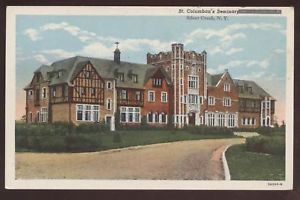
I just wouldn’t want to experience that jail time again. It was the dullest, most restrictive and spiritually wounding period of my life – formative years that (apart from the goodness of my fellow inmates) were little different from Malcolm Bannister’s prison camp. (The picture at the top of this post shows the high school seminary I attended in Silver Creek, New York from 1954 through 1958.)

Those dark years [and (ironically) the academic legacy they gave me] have always stimulated my resolve to help others escape from the confines erected by the false idea of God-as-prison-warden.

That’s been the thrust of my life as a college teacher. It’s what I’m attempting to do on this blog site.

School-Is-Prison-63787456510