(Sunday Homily) Jesus Advocates a $58.00 per Hour Minimum Wage!

living wage

Readings for 25th Sunday in Ordinary Time: IS 55: 6-9; PS 145: 2-3, 8-9; 17-18; PHIL 1: 20c-24, 27A; MT 20: 1-16A. http://usccb.org/bible/readings/092114.cfm

What will the Kingdom of Heaven be like for minimum wage workers? Ask the poor people Jesus speaks to in today’s gospel. There the Great Teacher tells them a story about a character every employee – all of us, I’m sure – encounters at some point in her or his life. He’s the skinflint boss who imagines himself a great humanitarian, despises his workers as lazy, and treats them with complete arbitrariness. He takes great delight in disappointing them – simply because he can.

The familiarity of this comic book character must have set Jesus’ audience laughing. And it probably started a long animated conversation about bosses, wages and employment.

Anyway, the story goes like this . . . It’s late in the harvest season and this big fat landowner goes to the town square to hire fruit pickers who are shaping up there. (You can imagine him coming by in his pick-up truck, smoking his cigar, pointing at the strongest workers, and shouting, “Hey, you guys, get off your lazy duffs and jump in the back. I haven’t got all day. There’s work to be done!”)

In the story, you can tell the owner’s a cheap skate because he’s careful to hire just the minimum number of workers he thinks can get the job done – if he pushes them really hard.

But he miscalculates. So he has to return at noon for more pickers. But instead of blaming his own stupidity, he blames the workers. He calls them “lazy” for “standing around idle.” He shouts at them, “Get in the truck, you lazy no-goods! You should be working!” (What does he expect? They’re waiting for someone to hire them, for God’s sake! But then coupon-clippers, like the boss in the story, always despise calloused hands.)

Now it’s almost quitting time. With only an hour’s daylight left, and with his fruit ready to rot in the fields, the skinflint owner finds himself back in the square hiring more workers. Again, he blames them for being lazy. But off they go to finish the day’s work.

Then the punch line comes. The completely capricious landowner suddenly decides to play the generous humanitarian. So with great flair he gives a full day’s wage to those last hired – my guess is: just a few workers.

Naturally, the other pickers rub their hands together, drooling with expectation that they’ll be paid more generously too. But of course old Scrooge disappoints them. (These kinds of bosses always do! They love it.) He decides instead to turn legalistic and teach these lazy good-for-nothings a lesson – about power.

“What do you mean: ‘MORE?’” he shouts like the beadle in Oliver Twist. “Have you forgotten our contract? And besides, I’m the boss. I can do what I want, and you can’t do a thing about it!”

By this time, Jesus’ audience surely had stopped laughing. They were probably grumbling and rehearsing their own similar experiences with cheap legalistic bosses who love to play the generous philanthropist.

But then Jesus gets everyone smiling again by adding with a wink: “And so it will be when the revolution comes (or as he put it – “in the Kingdom of God”) where “the first will be last and the last will be first – you know what I mean?” He winks again.

It takes a while for the message to sink in. Not everyone “gets it.” The audience scratches its collective head. Finally the penny drops.

“Oh, I see what you’re saying, Jesus,” someone says. She looks around at the others. “Don’t you get it?” she asks. “All of the workers in the story are ‘the last;’ it’s the boss who’s ‘first’.” In the final judgment, Uncle Scrooge will be last and all of us will be first!”

The audience starts to cop on.

“Yeah,” someone else says doing a quick calculation. “And do you know what that means for us, doncha?”

“What?”

“It means we’ll all be on Easy Street; that’s what it means. Think about it; in the Kingdom, we’ll all be making a hundred grand a year!”

Everyone laughs.

“No, I mean it. Do the math: minimum wage is $7.25 an hour, right? That means that those guys who worked only one hour earned $58. That’s $464 dollars a day, if they had worked all day – or $2320 per week, or $9280 per month, or $111,360 per year! Now that’s a just wage for bustin’ our butts. Whaddaya think? Talk about a workers’ paradise!”

By this time, everyone’s laughing so hard, they’re in tears.

Hmm . . . Kingdom economics. Kingdom pay for minimum wage workers: $58.00 an hour. . . . First/last; last/first . . . .

The Waltons should take note!

(Sunday Homily) Jesus Has More in Common with ISIS than with the United States

King Purveyor

Readings for Feast of Exaltation of the Holy Cross: NM 21:48-49; PS 78: 1BC-2, 34-38; PHIL 2: 6-11; JN 3: 13-17 http://www.usccb.org/bible/readings/091414.cfm

Today is the feast of “The Exaltation of the Holy Cross.” It might as well be called the feast of “The Exaltation of the Electric Chair” or of the exaltation of death row or of torture or terrorist martyrs. For relevance’s sake, we might today call the feast “The Exaltation of ISIS or Al Qaeda.”

That’s because the cross on which Jesus died was not only empire’s instrument of unspeakable torture and capital punishment. It was also the punishment the Romans reserved for terrorist insurgents against their empire. Among many others, biblical scholar, Reza Aslan underlines that point in his best-selling study, Zealot. (I recommend the book.)

All of that indicates that the Romans thought of Jesus as a terrorist – just as “Americans” do its enemy du jour whether we call them ISiS, ISIL, or al Qaeda. Let me repeat, Christians worship someone whom the quintessential empire (Rome) and its hangers-on vilified as much as President Obama vilified ISIS last Wednesday night in his address to the nation announcing yet another war. In the eyes of Rome and its Jewish collaborators, Jesus was a terrorist. They said he was stirring up the people and trying to take Caesar’s throne by force (LK 23:5, JN 19:15).

And yet, in today’s liturgy of the word, Jesus himself tells us to follow his example. You might say that he urges us to do what’s necessary to merit the charge of “terrorism” and even its punishment. That’s right. He says, “You cannot be my disciple unless you too take up your cross and follow me to Golgotha – or as we might put it, to Abu Ghraib, Guantanamo, death row, and ultimately to the electric chair or gurney to be lethally injected. That is, following Jesus means all of us should be traitors and rebels and enemies of the murderous state the U.S. has become. This is particularly true since our “leaders” have chosen the path of war without end.

However, (if we’re to believe the polls) instead of taking up our crosses, those calling themselves “Christians” have identified with another of the empires in the long line that has succeeded Rome. In other words, we’ve refused the project of Jesus who had more in common with ISIS than with the United States.

Think about it. Jesus’ “gang” was filled with insurgents. How could it be otherwise – poor working class men coming from the hotbed of rebellion in Galilee? They followed a man proclaiming “God’s Kingdom” as a world where Yahweh is king instead of Caesar. In fact, there were many points of convergence between Jesus’ program and that of Zealot terrorists. Like them he favored land reform, cancellation of debts, and justice for the poor. Both the terrorists of his day and Jesus opposed the Jewish leaders who collaborated with Rome. Both detested Roman occupation of God’s lands.

Even more, one member of Jesus’ inner circle was specifically called “the Zealot” (the 1st century equivalent of ISIS). Another’s nom de guerre was “Iscariot” [quite possibly a “sicarius” or assassin of occupation forces). Peter’s nickname was “Rock Thrower.” And James and John were fierce enough to merit the name “Sons of Thunder.” Recall that one of Jesus’ closest friends tried to cut off the head of one of Jesus’ arresters. Yes, cut off his head! Luckily for the militarized cop in question, Peter narrowly missed and only cut off the man’s ear.

But it was at that point, though traveling with an armed group (Think about that for a minute!) that Jesus made the pronouncement that separated him from his band of patriotic resisters to imperial occupation. It’s here that he departs from ISIS as well. He rebukes Peter for drawing his sword. Jesus said, “Put away your sword. All those who live by the sword will perish by it” (MT 26:52).

Those words should astound would-be Christians so ready to bomb, kill and live by the sword to an extent unsurpassed in all of human history. You’d think that if there’s ever been justification for using weapons, it would be to defend the life of a man like Jesus. But no, Jesus insisted that the way to liberation is not by taking life, but by giving one’s own life in non-violent surrender – an insistence echoed by Martin Luther King Jr. and Mahatma Gandhi.

Last Thursday, the day following President Obama’s war speech, Amy Goodman ran a segment on “Democracy Now” asking the question, “What would Martin King do in the face of ISIS?” The segment recalled for viewers Dr. King’s 1967 speech at the Riverside Church in New York City. There he memorably called our beloved country ”the greatest purveyor of violence in the world today.” http://www.hartford-hwp.com/archives/45a/058.html

King, of course, was right in 1967 when he spoke those words. They ring even truer today. Without the U.S. there would be no ISIS, no al-Qaeda. We’ve trained many of their troops; they’re using weapons the United States military has poured into the region. Without “America,” there would be no crisis in Ukraine evoking threats of World War III. Without U.S. unconditional support of Israel, there would be no “Operation Protective Edge” with more than 2500 Palestinians dead – mostly women and children. Libya would still be intact and so, of course, would Iraq. More than a million people our brutal military has slaughtered in Iraq would still be alive.

(Talk about transubstantiation! Everything our country touches is transformed into the crucified body of Christ. Wine people share at droned weddings and funerals in a sense becomes Jesus’ blood.)

So what would King do? According to Tavis Smiley who has just published Death of a King: the Real Story of Dr. Martin Luther King Jr.’s Final Year, King would urge a sharp turn in U.S. policy. Such repentance would entail:

• Confessing our nation’s responsibility for the crises in Afghanistan, Iraq, Israel-Palestine, Libya, Assyria, Yemen, Somalia, Bahrain, Egypt, Ukraine. . . .
• Paying reparations to all those countries.
• Redirecting the billions (and trillions) wasted in war to health care, education, and infrastructure reconstruction in our own United States.
• Using presidential speeches not to announce further wars, but to lay out emergency plans for addressing the genuine crises that face us, viz. climate chaos world-wide and the Ebola outbreak in Africa.
• Announcing expedited plans to wean the U.S. from the oil consumption that drives our country’s perpetual war policy.

In today’s second reading St. Paul quotes an ancient Christian hymn which scholars universally recognize as encapsulating the belief of the earliest Christians. It’s a song about the Divine One choosing to appear in history not as an exalted king, but as a human being, a slave, and an executed criminal.

If we wish to find God, the hymn suggests, we should look and listen not to our presidents, but to “the other – those the Empire hates – and make their cause our own. It’s in the ranks of the oppressed that God’s Son is found – among empire’s designated enemies, among the enslaved, the tortured and those our “leaders” identify as terrorists.

Does this mean we are being called to somehow recognize Jesus in ISIS?

Yes it does. ISIS has legitimate demands. We need to talk with them, not bomb them. Followers of Jesus should be demanding that – even if it means being branded “terrorists” ourselves.

(Sunday Homily) Listen to ISIS and Stop Committing Suicide!

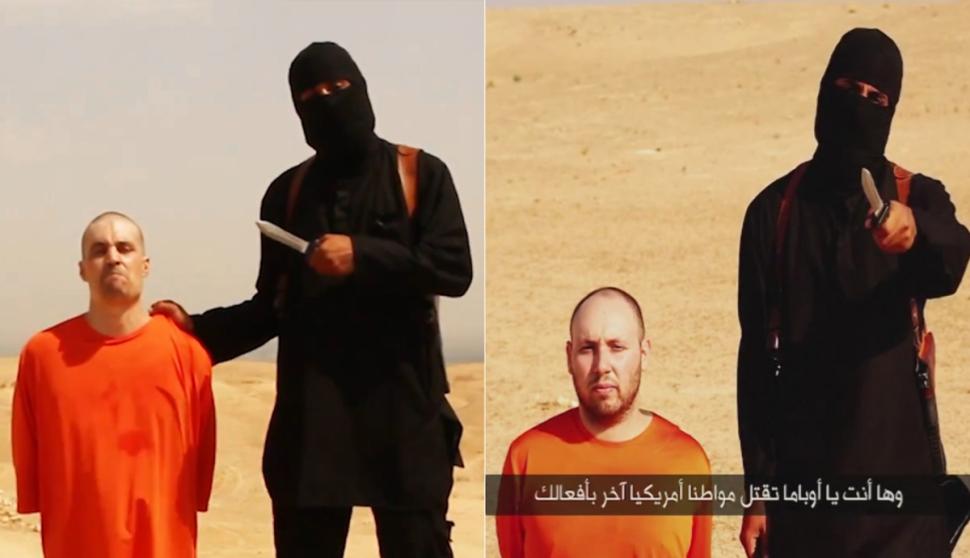
steven sotloff

Readings for 23rd Sunday in Ordinary Time: EZ 33: 7-9; PS 95: 1-2, 6-9; ROM 13: 8-10; MT 18: 15-20 http://usccb.org/bible/readings/090714.cfm.

We’ve met the enemy and it is us!

Indeed! Over the past number of weeks, we’ve been introduced to the Islamic State in Iraq and Syria (ISIS). Its militants seem to have somehow appeared from nowhere.

However, as Tom Engelhardt has pointed out, they actually represent the largely Sunni blowback from U.S. policies over the last 13 years. In fact, ISIS would not exist were it not for the United States.

Think about it. ISIS is the direct result of:

• The U.S. invasion of Afghanistan and its over-the-top, loosely-target response to 9/11.
• The 2003 criminal occupation and destruction of Iraq.
• The thoughtless dismantling of Saddam Hussein’s army with its largely Sunni command structure (which is now directing ISIS).
• The crimes of Abu Ghraib, Fallujah, Haditha, and other massacres perpetrated by barbaric elements in the U.S. military.
• The more than one million Iraqis who have lost their lost their lives as their country has been systematically pulverized by bombings, white phosphorous, and the nuclear waste called “depleted uranium.”
• Former President Bush and Vice President Cheney bragging about ordering the war crimes of water boarding and other forms of torture.
• U.S. soldiers urinating on the bodies of Iraqi insurgents and on copies of the Holy Koran.
• The horrors of the film clip, “Collateral Murder” released by Chelsey Manning.
• Drone strikes across the world in Afghanistan, Iraq, Pakistan, Somalia, Yemen and elsewhere routinely killing women and children, revelers at weddings and mourners at funerals.
• Blind U.S. support of Israel’s pogrom aimed at “the Jews’ Jews” concentrated in the world’s largest open-air prison camp called Gaza.

Such horrendous provocations make it entirely possible for ISIS leaders to echo the words solemnly intoned by President Obama last week in response to their movement’s brutal beheading of journalist Steven Sotloff. ISIS leaders might well have said:

“We will not be intimidated. Those who make the mistake of harming Muslims will learn that we will not forget and that our reach is long and that justice will be served . . . such horrific acts only unite us as movement. . . ISIS will continue to lead the battle against the kind of barbaric and empty vision that the United States represents. We will degrade their forces and destroy them completely.”

In fact, the whole ISIS phenomenon and the response it has evoked only illustrate the senselessness of any strategy of revenge and fatuous, doomed attempts to solve conflict by the unapologetic use of military first response to violence perpetrated against “Americans” or Muslims.

A different way of responding is outlined for followers of Jesus’ Way in today’s liturgy of the word. It might seem idealistic and perhaps even unrealistic in the face of ISIS. But give it a chance.

In today’s gospel reading, Matthew the Evangelist addresses the problem of conflict resolution. He emphasizes dialog not revenge and violence. In fact, he outlines four alternatives towards resolving disputes. He has Jesus say that if step one doesn’t work, move on to the subsequent strategies. The four alternatives include (1) healing conversation with one’s adversary, (2) arbitration with a mediator or two, (3) consultation with the entire community, and (4) shunning the offending party.

More specifically, Matthew has Jesus say, “If your brother sins against you, go and tell him his fault between you and him alone . . . If he does not listen, take one or two others along with you, so that ‘every fact may be established on the testimony of two or three witnesses.’ If he refuses to listen to them, tell the church. If he refuses to listen even to the church, then treat him as you would a Gentile or a tax collector.”

Obviously, these words did not come from Jesus himself. To begin with, there was no “church” at Jesus’ time. Jesus was thoroughly Jewish and a reformer of Judaism rather than the founder of some new religion or “church.”

It was different for Matthew who was writing for a community of specifically Jewish Christians some fifty years after Jesus’ death. By then, questions of community order within the emerging church had become prominent. So Matthew invents this saying of Jesus to deal with them.

Another reason for reaching this conclusion is the reference to treating a recalcitrant individual “as you would a Gentile or a tax collector.” This phrase reflects traditional Jewish avoidance of Gentiles and hatred of Roman collaborators. It runs counter to the practice of Jesus who time and again in the Gospels causes scandal by practicing table fellowship and community with the very people Matthew’s instruction indicates are outsiders to be shunned by believers.

Were Matthew following the Spirit of Jesus, the evangelist’s instructions for addressing conflict resolution might involve the following process: (1) private dialog with one’s adversary, (2) arbitration with a mediator or two, (3) consultation with the entire community, and (4) moving in with the offending party – or at least taking them out for dinner regularly.

In any case, the emphasis in Jesus’ own approach is communion, not shunning or refusal to talk. Nowhere does Jesus’ approach say that one should refuse meeting until the offending party stops offending. Much less does the process outlined include “if he refuses to listen, shoot him, cut his head off, or kill his family.”

“But,” you object, “The words attributed to Jesus in today’s gospel selection are about church order, not about international politics, much less the barbarity of a movement like ISIS. Jesus’ instruction, you might say, is about private disputes among Christians and are laughably impractical in the political sphere.

And that’s just my point. To repeat: Matthew’s account does not reflect the teaching or practice of Jesus. Jesus’ actual teaching was not confined to the private realm. His practice was highly political.

Eating with tax collectors, street walkers, lepers, Pharisees, Gentiles (including members of the Roman army) represented doing the unthinkable, the unexpected, the forbidden. . . . It meant crossing boundaries, breaking taboos, acting counter-culturally, and offending people on all sides of sizzling debates.

This is what the example of Jesus calls us to do even in the case of ISIS. Its emergence calls for departure from business as usual. It requires admission of guilt and responsibility on the part of the United States. It demands a complete reversal of “American” policy.

Today’s second reading from Paul’s letter to the Christian community at Rome puts a finer point on the reasons for such response on the part of those pretending to follow the teachings of Jesus.

Paul reminds us of Jesus’ summary of God’s law. He writes:

“Brothers and sisters: Owe nothing to anyone, except to love one another; for the one who loves another has fulfilled the law. The commandments, ‘You shall not commit adultery; you shall not kill; you shall not steal; you shall not covet,’ and whatever other commandment there may be, are summed up in this saying, namely, ‘You shall love your neighbor as yourself.’ Love does no evil to the neighbor;
hence, love is the fulfillment of the law.”

Emmanuel Levinas helps us understand that Jesus’ teaching on neighbor love is much more radical than commonly accepted. Loving your neighbor as yourself, Levinas says, does not mean “Love your neighbor because s/he is like you.” No, according to Levinas, it means, “Love your neighbor as yourself, because s/he is you.”

In other words, there is no meaningful distinction between you and any other human being you care to name – even if we call them “terrorists.” Moreover, if you shared the same history as your “enemy,” you would be doing exactly the same thing that currently enrages you. As a result, no killing can be justified. It is suicide. That’s the thrust of Jesus’ words: to kill the other is to kill yourself. Killing of any kind is suicide.

What does that mean for followers of Jesus’ way as we try to respond to the ISIS phenomenon? At least the following, I think:

• Facing the fact that the ONLY REASON for our Middle Eastern policy and wars is oil, and doing everything necessary to wean our lives away from dependence on fossil fuels.
• Realizing that we cannot expect politicians like President Obama to initiate any other policy than revenge as if the U.S. were principled, civilized, innocent, and pure before an enemy that is completely unlike us.
• Nonetheless demanding that our officials absolutely reverse course, recognize responsibility for the emergence of ISIS, and establish dialog with their leaders.
• Refusing to allow our children to serve in an armed force that commits ISIS-like crimes on a wholesale scale.
• Imagining what would happen if even a quarter of our country’s 160 million people who claim to be Christian refused the self-destruction the words of Jesus and Paul imply.

For Christ’s sake, do the unthinkable. Hard as it might be: listen to ISIS. Reverse course. Put a stop to our collective suicide!

International Labor Day Posting: Thank God for the Jobs Crisis!

In observance of Labor Day, here’s a posting from May 1, 2012. It’s as relevant now as it was then. See what you think.

Mike Rivage-Seul's Blog's avatarAbout Things That Matter

Mike Tower recently wrote an article Op-ed News about the devastating effect of technology on the job market. We’re in deep sh*t, he wrote, since the large scale introduction of what used to be called “cybernetics.” Technology has eliminated jobs across the board on an alarming scale – from secretarial positions to auto workers. The resulting crisis is compounded by our culture’s deep denial of the basic problem. Even worse, our civic “leaders” at every level refuse even to name technology as playing anything but a positive role in the corporate global economy. What should we be urging them to do? Mike asked.

My first response is simply an expression of gratitude to the author. It’s about time that someone resurrects this problem which clearly is central to the current “jobs crisis” everyone professes to be so concerned about.  I say “resurrects” because I’m old enough to remember the ‘60s and ‘70s when…

View original post 882 more words

Sunday Homily: The Ayatollah Was Correct: the U.S. IS “the Great Shaytan”

Ayatollah

During the 1979 Islamic revolution in Iran, the West became aware of Muslims’ profound mistrust of the United States. The Ayatollah Khomeini repeatedly referred to “America” as “the Great Satan.” Today’s liturgy of the word suggests that the Ayatollah’s reference was spot on. The United States is indeed the Great Satan leading the world astray with its beliefs for instance that limitless wealth brings happiness, that bombing can be a humanitarian act, and that “fearing for our lives” justifies killing others.

As we’ll see in today’s readings, such beliefs are ‘satanic” both in the eyes of Jesus and of the Great Prophet Mohammed. In the United States, their infernal results are on display in each morning’s headlines where:

• The rich and famous end their lives in despair
• The U.S. bombs and drones to save the Yazidis in Iraq (or Libyans in Libya, Afghans in Afghanistan, Ethiopians in Ethiopia . . .)
• Police killings are uniformly justified by the claim “I feared for my life.”

I raise the issue because the term “Satan” is prominent in today’s gospel reading. There Jesus uses it in contrast to his own beliefs about life’s divine purpose which turns out to be incompatible with dominant western beliefs. According to both Jesus and Mohammed, life’s purpose is not to accumulate riches. Nor is life rendered meaningful by killing others even to save one’s friends. Neither do Jesus’ followers have the mandate to protect their own lives at any cost. Quite the opposite!

What is life about then? Consider Jesus’ answer in this morning’s gospel reading.

There Jesus uses the epithet “Satan” to refer to the leader of his inner circle of twelve. In Jesus’ eyes, Peter merits the name because he misunderstands what life is for. That’s shown by the fisherman’s efforts to dissuade the Master from following his divine “prophetic script.” For Jesus, that pattern would require him to lose his life for speaking truth to power. As we’ll see, using such speech in an effort to change the world – to bring on God’s Kingdom – turns out to be central to Jesus’ understanding of life’s purpose.

In any case, like the prophet Jeremiah in today’s first reading, God’s spirit has put Jesus out of control. So, like Jeremiah, he feels compelled by an inner fire to speak the truth, whatever its cost. As the earlier prophet had put it, God’s truth “becomes like fire burning in my heart, imprisoned in my bones; I grow weary of holding it in; I cannot endure it.”

So in today’s reading Jesus “began to show his disciples that he must go to Jerusalem and suffer greatly from the elders, the chief priests and the scribes and be killed and on the third day be raised.”
Peter objects. “God forbid! This will never happen to you,” he says.

It’s then that Jesus replies: “Get behind me, Satan. You are an obstacle to me. You are thinking not as God does, but as human beings do.”

Hearing those words, most of us inevitably connect with images right out of Dante’s Divina Comedia – enhanced by subsequent satanic glosses to include a fire-red body, horns, cloven hooves, tail and pitchfork. But that wasn’t the image in Jesus’ mind.

Instead, Jesus was thinking in terms of the Hebrew tradition. There Satan was a member of God’s heavenly court. He was God’s prosecuting attorney who typically raised questions that Yahweh’s overwhelming goodness and generosity might otherwise obscure.

In Jewish tradition, Satan was a realist who believed that faith and prosperity go together. Take away prosperity and goodness and faith will disappear too.

That was the thrust of Satan’s bet with Yahweh that we find in the book of Job. Job is good and rich. God is proud of his servant’s devotion. Satan says, “Don’t be naïve. All of that will change if you simply remove your servant’s wealth, children, and health. Just watch and see.” The familiar story unfolds from there.

So when Jesus calls Peter “Satan,” he’s not really telling his friend to go to hell. No, he means what he says, “You are an obstacle to me. You are thinking not as God does, but as human beings do.” Human beings (like Satan) connect faith with prosperity. But in Jesus’ eyes, prosperity is not life’s overriding purpose. Neither is personal safety protected by violence.

But what does God really “think” about the purpose of life? Jesus words about saving and losing life provide a clue.

Jesus says, “Whoever wishes to come after me must deny himself, take up his cross, and follow me. For whoever wishes to save his life will lose it, but whoever loses his life for my sake will find it. What profit would there be for one to gain the whole world and forfeit his life? Or what can one give in exchange for his life?”

These are stunning words. They turn the world’s values upside down. They imply that God “thinks” that life’s purpose involves opposing empire. (Remember Rome reserved “taking up the cross” as a punishment for insurgents.) Life’s purpose entails self-denial, not self-gratification. It means holding life loosely, being prepared to surrender it “for justice’s sake” at any moment. It means preferring God’s Reign to possessing the entire world. It means returning kindness for evil, even if that means losing one’s own life as a result. Or as the psalmist puts it in today’s responsorial, “God’s kindness is a greater good than life itself.”

All such ideals run counter to the U.S. culture which Muslims find so threatening. They have become the ideals of the world which in today’s second reading Paul tells us to resist. “Do not conform yourselves to this age,” he writes, “But be transformed.” Only personal transformation, he adds, will enable your mind to discern what is good, pleasing and perfect in God’s eyes – even if it leads to the sacrifice of your own life.

As a Muslim who embraced the New Testament tradition, the Ayatollah Khomeini understood Jesus’ words. He saw that the order championed by the United States contradicts the basic values of Islam and the Judeo-Christian tradition about community, compassion and care for society’s most vulnerable.

So he viewed “America” as what Muslims call “Shaytan.” For Muslims Shaytan is not the devil either. Instead, he is “the Great Deceiver,” whose promises mislead, corrupt and immiserate those who believe them.

In fact, while promising peace, prosperity, and happiness, the West’s elevation of commercial values to a position of supremacy in the moral hierarchy could not be (in Muslim eyes) more deceptive and disastrous. Without care for society’s poor and vulnerable, commercial values lead to individualism, competition, war and unhappiness.

None of those represent God’s purposes for human beings.

Would that we Christians could embrace those teachings and stop our mindless pursuit of wealth, our belief that violence saves, and our cowardly conviction that anything is justified by “fear for our lives.”

As Paul says, the authentic teachings of Jesus challenge such conformity to “this age.” Who among us is willing to embrace such challenging truths?

(Sunday Homily) The ‘Gates of Hell’ from Ferguson to Gaza

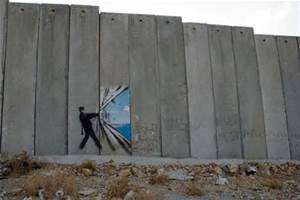
Wall Palestine

Readings for 21st Sunday in Ordinary time: IS 22: 19-23; PS 138:1-3, 6,8; ROM 11: 33-36; MT 16: 13-28. http://usccb.org/bible/readings/082414.cfm

Of course, you’re all following the news, I know. It’s so discouraging, isn’t it? Ferguson, Gaza, Iraq, and (now) Syria – again. . . .

It all reflects such one-dimensional thinking. I mean it gives the impression that in the eyes of public officials from the militarized cop in the street to the POTUS himself, the only solutions to social problems are found in shooting, tear gas, torture, and Hell Fire Missiles? Solving social problems requires locking people of color behind “the Gates of Hell” referenced by Jesus in today’s Gospel reading.

In every case, diplomacy and negotiation seem out of the question. In fact, it’s a vanished art. Who needs it? After all, those damn “others” – be they African Americans in occupied Ferguson, Palestinians in Gaza’s mammoth concentration camp, or the ISIS militants – can’t possibly have legitimate grievances. They simply must be brought to heel by force – shooting, bombing, and killing their children and youth. We’re made to believe that alternatives such as dialog and working out problems by discussion and compromise are signs of weakness. So violence is the first resort. It’s the order of the day in a world ruled by machismo, revenge, violence, and the law of the strongest.

When we’re not bombing, we’re building walls with locked gates. Our “gated communities” and locked doors wall us off from unsightly ghettos and the realities of the world’s poor mostly non-white majority. Better to confine Palestinians in fenced off open-air concentration camps like Gaza, where there’s literally no exit. Then from time to time you “mow the lawn,” i.e. shoot the non-Jews like fish in a barrel – even though most of them are children, women, and aged people.

Better to build a wall along the Mexican border and then lock the gates, throw away the key and pretend that such barriers solve the problem of farmers and their children driven off their land by globalization, poverty and gangs. Better to justify it all by invoking the Ultimate White Privilege: “I feared for my life!” (We whites are the only ones who can get away with that one.)

All that brings us to today’s Liturgy of the Word. It’s about God’s interest in matters like those just enumerated – about politics, oppression and the liberation of non-white people like Jesus, Gazans and residents of Ferguson, Missouri. It’s about breaking bonds and opening the gates of hell so that every Inferno can be transformed into the Kingdom of God. It’s about refusing to be discouraged even though the flow of history make Jesus’ prayer, “They Kingdom come” seem like an impossible dream.

Start with today’s first reading. There the prophet Isaiah has God telling a courtier named Shabna to step down in favor of a man called Eliakim. Little is known about either one. The reason for including the reading today is apparently to establish today’s central point that God is concerned with the world of politics, and that God is ultimately in charge of what happens in that sphere. There can be no separation of politics and religion in the divine dispensation.

The responsorial psalm continues the “this worldly” theme set by the first reading. It had us all singing “Lord, your love is eternal. Forsake not the work of your hands.” Once again, emphasis on “the work of God’s hands” reminds us of God’s commitment to this world – including ghettos, the Gazan concentration camp, and rich people making life unbearable for the world’s largely non-white poor. The psalm goes on to praise Yahweh for divine kindness, truthfulness, encouragement of the weak, care for the impoverished, and God’s alienation from their proud oppressors – again all connected with life here and now.

Then in today’s Gospel selection, we find a reprise of the very reading we shared last June 27th (just two months ago on the “Solemnity of St. Peter and Paul”). We practically know this passage by heart.

The reading centers on three titles associated with Jesus of Nazareth – Son of Man, Son of God, and Christ. All three names are politically loaded – in favor of the poor rather than the privileged and powerful.

Jesus asks his friends, “Who is the Son of Man in history and for us today?” (Scripture scholars remind us that the “Son of Man” is a figure from the Book of Daniel. He is the judge of all those who oppress the People of God whether they’re Egyptians, Assyrians, Babylonians, Medes, Persians, Greeks or Romans. He is “the human one” as opposed to a series of monstrous imperial beasts which the author of Daniel sees arising from the sea against God’s poor.)

So Jesus’ question boils down to this: who do you think has taken the strongest stand against Israel’s oppressors? Jesus’ friends mention the obvious heroes, Elijah and Jeremiah. But in the end, they settle on a contemporary political prisoner in King Herod’s version of Abu Ghraib. He’s John the Baptist who was Jesus’ mentor. (According to Jesus, John was the greatest of all the prophets of Israel.) He’s the Son of Man, they say.

Having set that anti-imperial tone, Jesus then asks the question, “What about me? Who do you say that I am?” No question could be more central for any of us pretending to follow the Teacher from Nazareth. How we answer determines the character of the path we walk as Jesus’ would-be disciples in a world filled with Fergusons, Gazas, Hell Fire Missiles and militarized cops. Our answer determines whose side we are on – that of Messrs. Netanyahu, Obama and Officer Wilson or of the Palestinians, Iraqis and Michael Brown.

Matthew makes sure we won’t miss the political nature of the question. So he locates its asking in Caesarea Philippi – a city Herod obsequiously named for his powerful Roman patron. Herod had commemorated the occasion by minting a coin stamped with the emperor’s countenance and identifying him as “the Son of God.” Caesar was also called “the Christ,” God’s anointed. Good Jews saw all of that as idolatry.

So Peter’s answer, “You are the Christ, the Son of the Living God” has the effect of delegitimizing Caesar and his empire. It’s also a swipe at King Herod. Peter’s response couldn’t be more political. Jesus, not Caesar is king, God’s anointed, the Son of God.

Neither could Peter’s words be more spiritually meaningful and heartening for those of us discouraged by events in Ferguson, Gaza, Iraq, and Syria.

The encouragement is found in Jesus rejoinder about the “gates of hell” and the “keys of the kingdom.” Jesus says, “Blessed are you, Simon son of Jonah . . . I will give you the keys of the kingdom of heaven . . . whatever you bind on earth will be bound in heaven, and whatever you loose on earth will be loosed in heaven.”

What powerful words of encouragement! For those who would join Jesus on “The Way” to God’s Kingdom, they disclose the very key to life’s meaning. In effect, Jesus says, “Here’s the key to opening ‘the gates of hell’ and transforming life’s Infernos into God’s kingdom: all our actions – even apparent failures like my coming crucifixion – have cosmic significance. Don’t be discouraged even when the agents of hell end up killing me – as they inevitably will.”

In other words, we may not be able to see the effect of resisting empire and its bloody agents in the short term. But each act has its effect. God’s Kingdom will come.

In today’s second reading, Paul elaborates the point. He said it’s not always apparent what God is doing in the world. After all, the ways of Transcendent Reality are deep and beyond comprehension – even by the wisest human beings. We may not be able to see God’s (political) purposes at close range. But ultimately their inscrutable wisdom will become apparent (ROM 11: 33-36).

Or as Martin Luther King put it: “The arc of the moral universe is long, but it bends towards justice.”

All of us need to embrace that wisdom, refuse discouragement and continue doing what we can to resist the forces of empire and unlock those “Gates of Hell.”

(Sunday Homily) Jesus Comes Very Close to Rejecting a Palestinian Woman as a “B_tch”

Palestinian Woman

Readings for the 20th Sunday in Ordinary Time: IS 56:1, 6-7; PS 67: 2-3, 5, 6, 8; ROM 11: 13-15, 20-32; MT 15: 21-28. http://usccb.org/bible/readings/081714.cfm

“Have pity on me, Lord, Son of David! My daughter is tormented by a demon.” Those are the words that a woman remembered as “Syrophonecian” addressed to Jesus in today’s gospel reading.

Jesus responds by ignoring the woman at first and then by disrespectfully associating his petitioner with dogs – almost calling her a “b_tch.”

We’ll come back to that in a moment.

For now note that “Syrophonecian” meant the woman was not a Jew. She was a native or inhabitant of Phoenicia when it was part of the Roman province of Syria. She was living near the twin cities of Tyre and Sidon – a gentile or non-Jewish region of the Fertile Crescent where Matthew takes trouble to locate today’s episode.

That would have made Jesus’ petitioner what we call a “Palestinian” today. In other words, Matthew’s geographical note serves to remind us that the Jews never controlled all of their “Promised Land.” Instead, they always had to share it with “Palestinians” including Canaanites, Hittites, Amorites, Perizzites, Hivites, Jebusites, Geshurites, Maacaathites, and Philistines.

That in itself is significant in the light of Israel’s ongoing brutal war of extermination against Palestinians. There the State of Israel (with supporters often invoking biblical precedent) has adopted the one-state position that is bent claiming all of Palestine for itself. It relegates Palestinians to Bantustans in a particularly brutal Israeli version of apartheid and ethnic cleansing.

Were Jesus in Gaza today, millions of Palestinian parents could echo the poor mother’s petition in today’s’ gospel selection, “Have pity on me, Lord, Son of David! My daughter is tormented by a demon.” And the demon in Gaza’s case would be the State of Israel itself – the latest incarnation of the puppets of Empire whom Jesus opposed so strongly in his own day. [Recall that Palestine in Jesus day was controlled by Jewish puppets of Rome. (Jesus clashed with them again and again.) Today those who pull strings on the marionettes reside in Washington.]

The result is that in Gaza over the last five weeks, more than 2000 Palestinians have been slaughtered by the ones considering themselves God’s “chosen” – 25% of the victims being children, at least another 25%, women like the one called “Syrophoenician” and her demon-possessed daughter.

Daniel Ortega, the President of Nicaragua, recently applied the term “demon” appropriately. He said, “Prime Minister Netanyahu appears to be possessed by the devil, he needs Pope Francis to exorcise it, to become appeased.” Ortega wondered, “Why doesn’t anyone condemn or sanction the state of Israel?” In his opinion, Palestine is the victim of “madness” on the part of the Israeli leader, who seeks to “annihilate the Palestinian people.” Ortega meant that Israel is “committing genocide” in the Gaza Strip, a crime so “terrible that it is only comparable to the crimes of the Nazis,” he said.

You might have been surprised at Jesus’ response to the Syrophonecian woman. As I said, at first he gives no reply at all; he ignores the woman completely. If Matthew’s account is accurate, in his silence Jesus was showing himself to be captive to his own cultural norms. It was inconceivable in Hellenistic antiquity for a strange woman to directly approach a man the way the woman in this story did. Above all was it so for a gentile woman to directly address a Jewish man. In other words, Jesus’ silence was part of his “honor culture.”

But it gets worse. When the woman insists, Jesus implicitly calls her a “b_tch.” He says, “I have been sent for the lost children of Israel . . . it is not right to take the food of the children and throw it to the dogs.”

The reply seems out of character for Jesus, doesn’t it? In fact, such dissonance has led many to reject the saying as inauthentic. Whatever the case, Jesus’ reply only echoes the rabbinic saying of the time, “He who eats with idolaters is like one who eats with a dog.”

In other words, Jesus’ comparison stands in a long line of likening cultural outsiders to animals. Most recently, in the case of Gaza, Ayelet Shaked, a member of the Israeli Parliament, compared Palestinians like the woman in today’s gospel to snakes. She endorsed the killing of Palestinian women, like the petitioner in the story before us, calling their children not dogs, but “little snakes” worthy only of extermination.

Shaked said,

“Behind every terrorist stand dozens of men and women, without whom he could not engage in terrorism. They are all enemy combatants, and their blood shall be on all their heads. Now this also includes the mothers of the martyrs, who send them to hell with flowers and kisses. They should follow their sons, nothing would be more just. They should go, as should the physical homes in which they raised the snakes. Otherwise, more little snakes will be raised there.”

The woman in today’s gospel has a very different voice from Ayelet Shaked’s. She replies, “Please, Lord, for even the dogs eat the scraps that fall from the table of their masters.”

The witty reply astonishes Jesus. He exclaims, “O woman, great is your faith! Let it be done for you as you wish.” That is, the woman “converts” Jesus; he concedes her argument. The one the gospels present as the master of verbal riposte is vanquished by this simple Palestinian mom.

What does the interaction between Jesus and the woman called “Syrophonecian” mean for us today – in the context of Israel’s demonic attack on the Palestinian descendants of the woman in question? What does it mean for Gaza and for us who watch in helpless disgust?

I think it means that:

• The “faith” of the Syrophoenician woman was not “in Jesus” as the incarnation of God, but rather in the inclusivity of God’s love that extends beyond ethnic and religious differences.
• In that sense, she believed in the New Universal Order Jesus referred to as God’s Kingdom.
• More specifically, today’s gospel reading presents the woman as enlightening Jesus – as reminding him of the Kingdom’s complete inclusivity.
• In view of Jesus’ own “enlightenment” at the hands of this poor Palestinian woman, it is no longer possible to blindly identify “God’s People” with any particular state.
• I mean, the State of Israel as such does not represent the biblical God’s Chosen People.
• Today that honor (curse?) belongs to the Palestinians who, as good Muslims, share Jesus’ faith that God sides with the widows, orphans, immigrants and oppressed whatever nation they belong to.
• This means that in the case of Palestine, Jesus’ followers should be one the side of Palestinians rather than the Jewish State.
• Being on their side means petitioning the U.S. government to stop its demonic support of Israel which has moved even further from its identity as “People of God” than it had in Jesus’ day.

As always, this week’s readings invite us to break the chains of our cultural norms – just as Jesus was forced to by the Syrophonecian mother.

(Sunday Homily) Dear Pope Francis: Gaza Needed More than Tears; Next Time, Please “Walk on Water”

Walk on Water

Readings for 19th Sunday in ordinary time: I KGS 19: 9A, 11-13A; PS 85: 9-14; ROM 9: 1-5; MT 14: 22-23 http://www.usccb.org/bible/readings/081014.cfm

In today’s Gospel, we hear Matthew’s account of Jesus walking on water – or rather, of Peter’s refusal to follow Jesus’ example of walking on the waves.

The account is relevant to the man in the Vatican who believes he is Peter’s successor. Israel’s month-long siege of Gaza invited Pope Francis to “walk on water” – to follow the example of Jesus in confronting demons. However uncharacteristic timidity left the pope sinking below the waves, out of sight and ear shot, cowering before Monsters like Obama and Netanyahu.

Let me explain. First off, consider today’s Gospel reading.

The story goes that following Jesus’ feeding of the 5000 (last week’s Gospel episode), Jesus forces the apostles to get into their boat and row to the other side. [The text says, “Jesus made (emphasis added) the disciples get into a boat and precede him to the other side.” Perhaps these experienced fishermen (as opposed to the land lubber, Jesus) saw a storm was coming and were reluctant to set sail despite Jesus’ urgings.]

In any case, a storm does come up and the apostles fear they are about to drown. You can imagine them in helpless tears.

Then they see a figure walking on the water in the midst of high threatening waves. At first they think it’s a ghost. Then they realize that it’s Jesus. He’s walking on the raging waters.

Peter, the impetuous leader of the apostles, doubts what he sees. So he says, “Prove to me that it’s you, Jesus; let me walk on the waves just as you’re doing.” Jesus says, “Join me then over here.” So Peter gets out of the boat and, like Jesus actually walks on water for a few steps.

Then, despite the evidence, he begins to doubt. And as he does so, he starts sinking below the water line. “Save me, Lord,” he cries out again. Jesus stretches out his hand and saves Peter. Then he asks, “Where’s your faith, man? Why is it so weak? Why did you doubt?”

Of course, this whole story (like last week’s “Loaves and Fishes”) is one of the dramatic parables Matthew composed. If we get caught up in wondering whether we’re expected to believe that someone actually walked on water, we’ll miss the point of this powerful metaphor. It’s about Jesus’ followers doing the unexpected and irrational in the midst of life-threatening crisis.

You see, Matthew’s Jewish audience shared the belief du jour that the sea was inhabited by dangerous monsters – Leviathan being the most fearful. And fearlessly walking on water was a poetic way of expressing what Matthew’s community believed about Jesus, viz. that he embodied the courage and power to do the completely unexpected in the midst of crisis and subdue the most threatening forces imaginable – even the most lethal of all, the Roman Empire.

Jesus’ invitation to Peter communicates the truth that all of us have the power to confront monsters if we’ll just find the courage to leave safety concerns behind even in the most threatening conditions, to confront life’s monsters, and join Jesus in the midst of its upheavals.

Problem is we easily lose faith and courage. As a result, we’re overcome by life’s surging waves and by the monsters lurking underneath them.

And that brings me back to Pope Francis and his ambiguous response to the slaughter that took place in Gaza over the last month.

We expected more. Over the course of his still-young papacy, Francis has demonstrated wonderful courage attempting to join Jesus on the world’s dangerous waves.

• He’s adopted a comparatively simple lifestyle.
• He’s condemned neo-liberalism and growing income inequality.
• His apostolic exhortation, “The Joy of the Gospel” implicitly endorsed the liberation theology his two immediate predecessors had tried to kill.
• More specifically, he adopted liberation theology’s “preferential option for the poor” as the leitmotif of his papacy.
• In that spirit, his famous “Who am I to judge” gave hope to the LGBTQ community.
• He helped head off President Obama’s plans to bomb Syria.

That last precedent led me to expect more in the context of Gaza. I was in St. Peter’s Square for Francis’ hours-long vigil for peace. There the Pope did as much or more to head off U.S.’ insane plans to bomb Syria as did Russia’s President Putin. Along with Putin, Francis was the hero who subverted the monstrous plans of Obama and his State Department.

But there was no peace vigil for the Gazans. Instead two weeks ago the Pope broke down in tears as he delivered his Sunday remarks from the balcony over St. Peter’s Square. He said:

“Never war, never war! I am thinking, above all, of children who are deprived of the hope of a worthwhile life, a future. Dead children, wounded children, mutilated children, orphaned children, children whose toys are things left over from war, children who don’t know how to smile.” This was the moment when the tears came. “Please stop,” said Francis. “I ask you with all my heart, it’s time to stop. Stop, please!”

The words were powerful; the tears were powerful. But unlike the prayer vigil before a potential Syrian fiasco, they remained largely unreported. Nevertheless, for those with ears to hear, the Pope was lamenting Israel’s killing of Palestine’s innocent. (No Jewish children were killed during the Gaza massacre.) However, to overcome the Media’s deafening pro-Israel tilt, the Pope needed to be stronger and more specific.

Yes, his papacy has daringly left the safe harbor and courageously sailed into the storm. Yes, Francis clearly sees Jesus as his role model demanding courage in the face of today’s unprecedented winds and waves. Indeed Francis has gotten out of the boat to trample underfoot the beasts and monsters roiling the seas all around us. But in the case of Gaza, instead of walking confidently on the waters, he sunk in apparent timidity before the threatening monsters, Obama and Netanyahu.

But what more could he have done? What sort of miracle did I expect?

Well, he could have given courage to all of us who are far less daring than he; he could have performed a miracle more stupendous than actually “walking on water” by:

• Owning the fact that as the leader of 1.2 billion Roman Catholics, with far more power than Jesus had, he was truly able to end Gaza’s slaughter.
• Announcing plans to travel to Gaza in the midst of Israel’s monstrous campaign.
• Before leaving, specifically naming Israel’s assault on civilians as sinful.
• Identifying the U.S. as equally culpable with Israel for crimes against humanity.
• Actually traveling to Gaza in a white papal helicopter (even in defiance of Israel’s predictable prohibitions) and landing in the midst of Gaza’s devastation.
• Celebrating Mass in Gaza on a pile of rubble and refusing to leave till the Israelis stopped their slaughter.
• If the slaughter continued, traveling to the key sites of bombing and shelling.

“Impossible!” you say? Such an act would offend Israel and upset Israel-Vatican relations. Ditto for the U.S.

Hmm. Is the pope a politician or a prophetic religious leader? Please use your imagination and spin out what would have happened if the pope walked on water as just outlined. What do you think?

In any case, those much less courageous than Francis need his example so the rest of us might venture forth to walk on water in our own far less powerful ways.

Yes, in today’s Gospel, Jesus invites us all to do the impossible. Why are we doubting? Where is our faith?

(Sunday Homily) Water and Food Are Not Commodities, but Human Rights

Detroit Water

Readings for 18th Sunday in Ordinary Time: IS 55: 1-5; PS 145: 8-9, 15-18; ROM 8: 35, 37-39 MT 14: 13-21 http://www.usccb.org/bible/readings/080314.cfm

I’ve been vacationing in Michigan over the past month. We’re living in the lovely cottage my wife, Peggy, inherited from her father in the northern part of the state.

The community there is called Canadian Lakes. It’s white, upper middle class, and very pretty. Peggy and I have spent large parts of our summers there ever since we we’ve been married. Our kids feel attached to the place. In a sense, they’ve grown up there.

In a word, life at Canadian Lakes is good. It’s water-centered and comfortable.

That makes today’s liturgy of the word (with its emphasis on the free gift of water) especially poignant for me. So does the fact that our lake home is located in Michigan with Detroit not so far away. Water’s a problem there.

You see, the relationship of Detroit’s poor to water is very different from ours in Canadian Lakes. Unlike our lakeside community, 44% of Detroit residents fall under the poverty line; 83% of the city’s population is African American. Unemployment in the former Motor City is well above 14.5%. Yet, Detroit’s (unelected) City Manager has been cutting off the water of poor people there. Regardless of your circumstances, if you’re an ordinary Detroit resident two months, behind on your bill, you will suddenly find yourself without water for drinking, bathing and flushing toilets.

If you’re rich, however, it’s a different story. Some of the city’s largest corporate water users are also behind on their water bills – even years behind. For instance high-end golf courses, the Detroit Red Wings, the city’s football stadium and more than half the city’s commercial and industrial users owe back water bills totaling over $30 million. No one is cutting off their water.

It’s also worth noting that the price of Detroit’s water system (administered by private contractors) is more than twice the national average and that the water cut-off plan is part of a scheme to move the city towards a completely privatized water system. Some see it as a measure intended to drive Detroit’s poorest from the city for purposes of gentrification.

Detroit’s water policy has recently gotten world-wide attention. A United Nations Human Rights office designated it a clear violation of fundamental human rights.

In the light of today’s liturgy of the word, we might also designate Detroit’s plan (and in general the commodification of God’s free gifts to all of creation) as a violation of God’s order. In fact, today’s liturgy of the word implies indictment of water privatization schemes and the market system’s practice of treating food itself as a commodity. These are gifts of God, the readings say – part of God’s gift economy which is unbelievable in its generosity.

And why should we be surprised? The God celebrated in today’s responsorial is described as “answering all our needs.” According to the psalmist, that God is gracious, just, holy, merciful, slow to anger, hugely kind, and compassionate. S/he gives food to everyone and everything – without cost.

So why pay for water? Isaiah asks. “All you who are thirsty, come to the water!” he says. “You who have no money, come, receive grain and eat; come, without paying and without cost, drink wine and milk!”

The point of contrasting God’s “gift economy” with our exploitive “exchange economy” is driven home in today’s Gospel episode from Matthew the evangelist. The famous “miracle of loaves and fishes” is actually a dramatic parable about God’s Reign and its order. The event may even be factual in the way I’m about to explain.

In any case, the tale is symbolic. It’s about the way the world would work if God were king instead of Caesar. In God’s dispensation, the gifts of creation – food and drink – are given to all without payment. God’s order contradicts our own where food production and even water delivery reap huge profits for the rich.

You know the story. Jesus meets with 5000 men in the desert (“not to mention,” Matthew says, “the women and children”). It’s late in the day. People are hungry and no-doubt getting restless. Jesus’ disciples offer a market solution to the problem of the crowd’s hunger. They say, “This is a deserted place and it is already late; dismiss the crowds so that they can go to the villages and buy food for themselves.”

Jesus’ solution is different. He says. “There is no need for them to go away; give them some food yourselves.”

The disciples almost mock Jesus’ suggestion. They say, “Five loaves and two fish are all we have here.” We can imagine them rolling their eyes and smirking ironically in disbelief at Jesus’ naivety. Did he really think that the loaves and fishes they had would be enough to feed 5000 hungry men and their families?

Nevertheless, Jesus “ordered the crowds to sit down on the grass.” Mark adds the detail that he had them break up into small groups of 50 and 100. In those smaller groups, people could see each other’s faces. Inevitably, they must have introduced themselves and shared some personal background, a joke, laughter and human warmth. Friendships blossomed.

Then Jesus “said grace:” That is, with everyone’s eyes on him, the Master Teacher broke the bread, divided the fish and gave it to those around him. No doubt he did so with gestures inviting the crowd to do the same.

As a result, the “miraculous” happened. And it wasn’t a “popcorn miracle” where five loaves suddenly popped into 5000 or where two fish suddenly multiplied by 3000. Instead, the good mothers in the crowd must have followed Jesus’ example. (Can we imagine any good Jewish mamma leaving home for a day in the desert without packing a hearty lunch for their husbands and children?) The mothers opened their picnic lunches and shared them with the people they’d just gotten to know.

It was a “miracle of enough.” Everyone shared. So even the improvident were able to eat with plenty left over – 12 baskets Matthew tells us.

No, I’m not saying the miracle of loaves and fishes was just about food. No. As John Dominic Crossan puts it, the “miracle of loaves and fishes” was not just about food; it was about just food – about just distribution where no one is left hungry. Why? Because that’s the way God and his order are. God gives food, drink – the earth itself – to everyone and everything without cost.

That’s the order Jesus’ followers are called to imitate here and now.

And it is Detroiters (as well as many others throughout the world) who doing just that. They’re busy not only sharing water, but gardening and eating free from their plots on vacant lots – taking grateful advantage of God’s free gifts. You might be surprised to know that Detroit has the largest number of urban gardens in the United States.

We would do well to follow the example of people there and expand on it, taking advantage of God’s free gifts by:

• Opposing water privatization schemes
• Supporting local farmers
• Gardening
• Composting
• Installing water catchment systems
• Heating water (and our homes) with solar energy
• Bicycling to work
• Getting to know our poor neighbors
• Sharing food with them
• Even paying their water bills
• Opposing military spending (e.g. in Israel and the Ukraine) while U.S. citizens go without water.

To repeat: today’s readings are not just about food and drink; they’re about just food and drink. They’re about sharing God’s free gifts rather than turning them into commodities to benefit the 1%.

The Siege of Gaza: A Palestinian Liberation Theology Perspective

AIPAC

Just this morning it was reported that the Israeli State bombed another U.N. designated refugee shelter in Gaza killing children sleeping beside their parents. The attack raised to 1300 the number of Palestinians killed by Israel since the siege of Gaza began. Most of those killed are civilians – at least 20% children. Meanwhile 53 Israelis have lost their lives – all but a handful were soldiers laying siege to Gazan homes and cities protected by their inhabitants.

The ongoing slaughter of Palestinians by the Israeli State makes crystal clear the identity of the real terrorists in Israel-Palestine. They are the State of Israel on the one hand and its unconditional supporter, the U.S. government on the other. Both in fact are terrorist states.

I’ll go even further and argue here that in the present phase of the conflict between Jews and Palestinians, the Jews have little or no right to claim they are acting in self-defense. They are clearly the aggressors guilty of extreme war crimes.

This time I base that argument on helpful analytic distinctions concerning “violence” commonly made be liberation theologians in general and by Palestinian liberation theologians in particular. I interviewed the latter back in 2006 at the Sabeel Ecumenical Center for Liberation Theology in Jerusalem.

Like liberation theologians everywhere, those at the Sabeel Center attempt to analyze their context (and the Judeo-Christian tradition) from the viewpoint of those without public power or voice. Of course, in Palestine that viewpoint belongs to the Palestinians not the Jews.

According to Sabeel analysts, there are really four types of violence at work in the Israel-Palestine conflict. Three of them are employed by Israel’s leadership against the Palestinians. None of the three is justified. In fact, according to liberation theologians, only one level of violence can ever be excused – in very limited circumstances. And that violence happens to be the very type our media uniformly designates as “terroristic” – ironically, the crime of Palestinians defending themselves against criminal Jewish aggression.

Let me explain by reviewing each level of violence identified in liberation theology, connecting each to the conflict under discussion here:

1.Institutionalized Violence:This refers to the destructive social, political and economic “structures” that shape human activity. For instance, the maintenance of a global economic system that causes 35,000 children to die each day from absolutely preventable hunger is a form of institutionalized violence. It kills children, the sick and elderly as predictably as if victims were shot in the head – 35,000 times every day.

In Palestine, the wall snaking through the region is a violent structure. So is the Israeli Army (IDF). Meanwhile Palestinians have no army. So laws preventing Palestinians from arming themselves also represent violent structures depriving them of their right to self-defense. Even legal arrangements which have prevented Palestinian authorities from paying 40,000 workers (because of alleged connections with Hamas) represent structural violence. In Palestine the primary victims of structural violence by far are Palestinians, not Jews.

Structural violence kills Palestinian children every day.

2.The Violence of Self-Defense:Institutionalized violence inevitably gives rise to a response. In the case of Palestine, blowback first took the form of non-violent protests. In 1947 general strikes and demonstrations by Palestinians were so effective that they led the United Nations to suspend its “Partition Plan,” which had awarded 55% of Palestine to Jews, even though they represented only 30% of the area’s population. But when Jewish settlers responded with heavy-handed military measures, violent resistance on the part of Palestinians became more frequent. It eventually culminated in the Six Day War in 1967 and in the Yom Kippur War in 1973.

Later, Palestinian children threw rocks at soldiers illegally occupying their neighborhoods during the First and Second Intifadas in 1982 and 2000. Then in 2009 Palestinian insurgents began firing rudimentary homemade rockets into Israeli neighborhoods. (I will address suicide bombers below.)

Because the first (institutionalized) level of violence goes unidentified as such, this second level of violence typically appears unprovoked. It is therefore identified as “terrorism” pure and simple – an act of evil people who for some reason (e.g. self-interest, racism or sadism) enjoy killing the innocent. This is how Palestinian rocket attacks are portrayed in the U.S. mainstream media to justify Israel’s third level response.

In reality, Palestinians are defending themselves from structural violence and from the third level of violence – its reactionary form.

3.Reactionary Violence: Reactionary violence is the response of the defenders of violent structures to self-defensive, second level violence. This third level violence is routinely overwhelming and shocking in its disproportionality. It is what we are currently witnessing in Israel’s assault on the Gaza Strip, where Palestinian casualties dwarf Israeli deaths (currently 1300 to 53). The victims of third level response are overwhelmingly civilian – 20% of them children. Third level violence destroys houses, schools, hospitals, homes for the elderly, playgrounds and refugee shelters.

Regardless of such disproportionality and direct attacks on civilians, the media portray this third level of violence as justified and therefore not really “violence” in the negative sense. Such portrayal leads many to think that the resisters have merely gotten or are getting what they have asked for and deserve. After all, the police and military are merely upholding the law.

4.Terrorist Violence:This category is complicated – again by bias (on the part of governments, police, media and academia) favoring violent structures and their defense. Though more aptly applied to what has here been termed “reactionary violence,” the term “terrorism” is usually (and erroneously) applied indiscriminately to category two (above), the violence of self-defense. In the official or popular mind, it almost never finds application to categories one or three.

Such error is rendered nearly inevitable by official definitions of “terrorism” For instance, the F.B.I. defines terroristic violence as “The unlawful (emphasis added) use of force and violence against persons or property to intimidate or coerce a government, the civilian population, or any segment thereof, in furtherance of political or social objectives.”

This definition is noteworthy for its emphasis on law (or legal structures). Terrorism, it says, is “unlawful” use of force and violence. That is, following this definition, the possibility of unjust legal structures is rendered completely invisible and ruled out of consideration.

Yet is it is clear that the enforcement of law itself (by the British in colonial America, the Nazis in the 1930s, the Afrikaners in South Africa, by State governments in the Jim Crow South, or by the State of Israel in Palestine) can intimidate or coerce entire “civilian populations or segments thereof, in furtherance of political or social objectives.”

In other words, state terrorism is not only possible, but has arguably been far more destructive than non-state terrorism. Chomsky and Herman recognized this in their classic The Real Terror Network. There they call state terrorism (such as that directed towards Palestinians by the State of Israel) “wholesale terrorism,” and responses to it (even like suicide bombers) as “retail” terror.

[That raises the question of Palestinian suicide bombers, who first appeared in 1995. For most, this is correctly identified as a quintessential act of terrorism. However distinctions made here suggest the following question: In terms of terrorism, what is the difference between suicide bombers and the Israeli response we are now witnessing in Gaza?

To begin with, the suicide bombing was not “original” violence but a response to first-level (structural) and third level (reactionary) violence. Moreover the response of the Israeli State on average takes ten to twenty times the number of Palestinian civilian lives as the original attack – just as indiscriminately as any suicide bombing.

Such figures describe state “terrorism” writ large. They illustrate Chomsky and Herman’s distinction between wholesale and retail terrorism.]

With all of this in mind, the distinctions offered by liberation theologians in Latin America and in Palestine lead the following conclusions:

• Since it is defending the structural violence of illegal occupation (in violation, for instance, of UN Resolution 242), Israel has no justifiable claim to self-defense.
• Its present offensive in Gaza does not even qualify as (unjustifiable) “reactionary violence.”
• Rather, it represents an act of wholesale terrorism in its indiscriminate attacks on civilians, homes, schools, playgrounds, power plants, and refugee centers.
• Meanwhile Palestinians have the right to self-defense. As Chris Hedges has recently pointed out, this is supported by Article 51 of the U.N. Charter and by Article III of the Geneva Convention regarding the Protection of Civilians during Time of War.
• Nevertheless suicide bombing is an act of terrorism and cannot be morally justified.
• But Zionist response is no different in moral terms and far more destructive as an act of wholesale terrorism.
• In comparison to Israel’s structural, reactionary, and terroristic violence, Hamas’ rocket fire into Israel turns out to be more symbolic than destructive. Its nearly victimless effect is to keep the Jewish population aware of the ongoing injustice of illegal occupation, of the illegal separation wall, and the seven year siege of Gaza, the largest prison camp on the face of the earth.

My conclusion to all of this is the following: It is time for media coverage to abandon their pro-Israel coverage which is itself part of the structural violence destroying Palestinian lives. Even more, it is time for peace activists everywhere to find their voices on behalf of the voiceless.

Regardless of threats to our organizations and careers, we must all speak out clearly on behalf of Palestinians and condemn ethnic cleansing by the State of Israel.