Sunday Homily: It’s Time for Christians to Embrace Pope Francis’ ‘No to War!’

Francis War

Readings for 7th Sunday in Ordinary Time: LV 19: 1-2, 17-18; PS 103: 1-4, 8, 10, 12-13; I COR 3: 16-23; MT 5: 38-48. http://usccb.org/bible/readings/022314.cfm

Like so many of you, I find it increasingly discouraging to read the daily news – and even more so to watch the shouting matches that pass for news coverage on television. The Koch brothers and the extreme right are on the ascendency. The disastrous Citizens United decision along with congressional gerrymandering, fraudulent voting machines, and voter suppression have all but insured that such ascendency will continue to the extreme detriment of democracy itself.

Where is the hope in all of this?

Where money is equated with free speech, where corporations are treated like persons [except they’re never put in jail (or dissolved) for breaking the law], where the powerful (like James Clapper) are immune from perjury charges (though they admit lying under oath), but those who tell the truth (like Edward Snowden) are identified as “enemies of the state,” where’s the hope?

How avoid despair in a country where those responsible for war crimes (like Donald Rumsfeld and Dick Cheney) brag about their crimes publicly and are rewarded on the lecture circuit or where a head of state like George Bush commits what the UN terms “the ultimate war crime” (waging a war of aggression) and avoids prosecution?

Two things: (1) remember history and (2) be awake to history’s counterparts manifesting themselves around us today. Just recalling the names associated with “lost causes” that ended up winning is inspiring. The short list includes Sojourner Truth, Elizabeth Cady Stanton, Mohandas Gandhi, Nelson Mandela, Martin Luther King. . . .

Their counterparts today? How about Amy Goodman, Noam Chomsky, Edward Snowden, Julian Assange, Pope Francis I. . . .

Of these, Pope Francis, it seems, holds the most hope for believers – and for the world. He is the leader of the world’s 1.2 billion Catholics. And when he says, “Never again war! War never again!” Catholics must take his words into account whether they agree or not. Even non-Catholics must do so because of the pope’s stature and since his uncompromising anti-war stance calls into question what Paul identifies in today’s second reading as “the wisdom of the world” – about the inevitability of war.

In fact, today’s readings all steer us away from such worldly wisdom. They point us instead towards the biblical tradition which understands God not as the vengeful warrior of competing biblical traditions, but as merciful and compassionate. As today’s Gospel reading reminds us, that merciful and compassionate understanding (and not its biblical opposite) was the understanding Jesus embraced. It’s the basis of his commandment that his followers’ way of life should mirror the perfection of God. It’s the foundation of indiscriminate love of neighbor and of the Christian pacifism pope Francis so courageously embodies.

To begin with, in today’s Gospel, Jesus takes pains to distinguish between the Bible’s warlike vengeful God and its Compassionate One. Jesus specifically rejects the one and endorses the other. For Matthew that rejection and endorsement was momentous – as significant as Moses reception of the Ten Commandments from his God, Yahweh. That’s why Matthew [in contrast to Luke’s equivalent “Sermon on the Plain” (LK 6:17-49)] has Jesus deliver his “sermon” on a mountain (5:1-7:27). The evangelist is implicitly comparing Moses on Mt. Sinai and Jesus on “the Mount.”

In any case, through a series of antitheses (“You have heard . .. but I say to you . . .”), Jesus contrasts his understanding of the Law with more traditional interpretations. The Mosaic Law demanded an eye for an eye and a tooth for a tooth, but Jesus’ Law commands:

• Turning the other cheek
• Going the extra mile
• Generosity with adversaries
• Open-handedness to beggars
• Lending without charging interest
• Love of enemies

Matthew concludes that if we want to be followers of Jesus, we must also be merciful and compassionate ourselves. As the reading from Leviticus says, we are called to be holy as God is holy. Or as Jesus puts it, perfect as God is perfect.

And how perfect is that? It’s the perfection of nature where the sun shines on good and bad alike – where rain falls on all fields regardless of who owns them. It’s the perfection of the God described in this morning’s responsorial. According to the psalmist, the Divine One pardons all placing an infinite distance (“as far as east is from west”) between sinners and their guilt. God heals all ills and as a loving parent is the very source of human goodness and compassion. That’s the perfection that Jesus’ followers are called to emulate.

All of that is contrasted with what Paul calls “the wisdom of the world” in today’s excerpt from his first letter to the Christian community in Corinth. The world regards turning the other cheek as weakness. Going the extra mile only invites exploitation. Generosity towards legal adversaries will lose you your case in court. Open-handedness towards beggars encourages laziness. Lending without interest is simply bad business. And loving one’s enemies is a recipe for military defeat and enslavement.

Yet Paul insists. And he bases his insistence on the conviction that we encounter God in every human individual whether they be our abusers, exploiters, or legal adversaries – whether they be beggars or debtors unlikely to repay our interest-free loans.

All of those people, Paul points out are “temples of God.” God dwells in each of them just as God does in us. In the end, that’s the basis of the command we heard in the Leviticus reading, “You shall love your neighbor as yourself.”

Normally, our self-centered culture interprets that dictum to mean: (1) we clearly love ourselves more above all; so (2) we should love our neighbors as much as we love ourselves.

But in the light of Paul’s mystical teaching that God dwells within every human being , the command about neighbor-love takes on much deeper implication. That is, Paul the mystic teaches that our deepest self is the very God who dwells within each of us as in the Temple. We should therefore love our neighbor (and our enemy, debtor, adversary, and those who beg and borrow from us) because God dwells within them — because they ARE ourselves. They ARE us! To bomb them, to fight wars against them is therefore suicidal.

No wonder, then, that Paul threatens that God will destroy the person who fails to recognize others as temples of God and harms them. Paul means that by destroying others we inevitably destroy ourselves, because in the end, the God-Self dwelling within us is identical with the Self present in every human being. That is a very high mystical teaching. It should be the faith of those pretending to follow Jesus. It should make all of them (all of us!) pacifists.

If we owned that truth, that would be the end of wars. Imagine if the world’s 1.2 billion Roman Catholics simply refused to destroy their fellow human beings because they recognized in them the indwelling presence of God. Imagine if we stopped worshipping the God Jesus rejects – the “eye for an eye and tooth for a tooth” War God – and embraced Jesus’ compassionate and loving Parent God.

It’s up to us who do accept that recognition not to reject the Christian tradition which speaks so powerfully to so many. Rather we are called to take steps to rescue Jesus’ God from the war mongers and oppressors who have so distorted Jesus’ teaching as presented in this morning’s readings.

I suggest that means

• Returning to church.
• Embracing the “No to war” message of Francis I.
• Making it explicit that our “No” is a matter of faith denied only by those who have (in Paul’s terms) embraced the “wisdom of the world” which is foolishness in God’s eyes.
• Mobilizing our congregations accordingly.
• More particularly, organizing congregations (as a specific response to Pope Francis) to endorse the International Day of Peace (next September 21).

Inspired by Pope Francis, it’s time to take the microphone away from Christian warmongers and to make Christian pacifism a mainstream movement. That’s our best hope, I think, in the face of all those reasons for despair.

Sunday Homily: Richard Dawkins’ 14 Commandments Can Save Our World

Law

Readings for 6th Sunday in Ordinary Time: SIR 15: 15-20; PS 119: 1-2, 4-5, 17-18, 33-34; I Cor 2: 6-10; MT 5: 17-37. http://usccb.org/bible/readings/021614.cfm

The emphasis in today’s liturgy of the word is on the wonders of God’s law. “Keep the commandments; no one has a license to sin,” the first reading from Sirach intones. “Walk blamelessly in God’s law; observe its decrees; delight in its wonder,” sings the psalmist in today’s responsorial. And then in today’s Gospel reading Jesus presents himself as the defender of even the least of the commandments. Break the least, he says, and you’ll be least in God’s Kingdom.

On hearing all of this, most of us probably raise our eyebrows in disbelief. “Wonder of God’s law? What wonder?” one might ask. “My experience of what’s called ‘God’s law’ is entirely negative. When I hear references to the Ten Commandments I think of repressed Bible-thumpers wanting the Commandments posted on school walls and enshrined on lawns before every courthouse.”

And it’s true: negative reaction to talk of God’s Law and the Ten Commandments is completely understandable. From childhood we’ve had “The 10 Commandments,” “sin” and “punishment” shoved down our throats by authority figures intent on controlling the most intimate details of our lives. From the time we were children, and especially as adolescents and young adults “God’s Law” seemed to militate against everything we really wanted to do – especially in the area of sexuality.

However, a close reading of today’s texts show how misplaced such reactions are. All of them (and especially Jesus’ words) suggest that “God’s Law” is not something posted on a classroom wall or on a plaque in front of a government building. It’s not written in stone either. Instead, it’s enshrined deep in the human heart. And human happiness is impossible without observing that law which in its essence is no different from nature’s law.

Because God’s Law reflects nature’s order, the texts suggest how important it is for us to come to agreement about moral and ethical behavior if we truly want peace in the world. The U.N. has realized that and has sponsored research into the content of what it terms “a universal ethic.” According to the U.N., there are just four basic “commandments”: (1) Don’t kill; (2) Don’t rape; (3) Don’t lie, and (4) Don’t steal.

People as diverse as Roman Catholic (but suspended) theologian, Hans Kung and professional atheist Richard Dawkins agree but go further in what seem to me very helpful ways.

In fact, at the age of 85, Kung has dedicated the last part of his career to peacemaking by building bridges between religions whose differences are so often the cause or pretext for violent conflict. Kung works on the four principles that (1) International peace is impossible without peace between religions; (2) there can be no inter-religious peace without inter-religious dialog; (3) there can be no inter-religious dialog without agreement about a global ethic, and (4) our world cannot survive without such an ethic that is universally accepted.

So in terms of “God’s law,” what do all major religions agree about? The Golden rule is the point of convergence.

Christianity puts it this way: “All things whatsoever ye would that men should do to you, do ye so to them; for this is the law and the prophets” (Mt. 7:1). In Confucianism the same statute is expressed in these terms, “Do not do to others what you would not like yourself. Then there will be no resentment against you, either in the family or in the state” (Analects 12:2). Buddhism’s version runs, “Hurt not others in ways that you yourself would find hurtful” (Udana-Varga 5,1). Hinduism agrees in these words, “This is the sum of duty; do naught unto others what you would not have them do unto you” (Mahabharata . 5, 1517). Islam’s expression is, “No one of you is a believer until he desires for his brother that which he desires for himself (Sunnah). In Taoism the same law finds this formulation: “Regard your neighbor’s gain as your gain, and your neighbor’s loss as your own loss” (Tai Shang Kan Yin P’ien). Zoroastrianism says, “That nature alone is good which refrains from doing to another whatsoever is not good for itself” (Dadisten-I-dinik, 94,5). Judaism says, “What is hateful to you do not do to your fellowman; this is the entire law; all the rest is commentary” (Talmud, Shabbat 3id).

Even Richard Dawkins, perhaps the world’s most famous atheist endorses the Golden Rule. In formulating his own Ten Commandments, he leads off with his own version of that principle. Here are Dawkins’ “Ten Commandments:”

1. Do not do to others what you would not want them to do to you
2. In all things, strive to cause no harm
3. Treat your fellow human beings, your fellow living things, and the world in general with love, honesty, faithfulness and respect.
4. Do not overlook evil or shrink from administering justice, but always be ready to forgive wrongdoing freely admitted and honestly regretted.
5. Live life with a sense of joy and wonder
6. Always seek to be learning something new
7. Test all things; always check your ideas against the facts, and be ready to discard even a cherished belief if it does not conform to them.
8. Never seek to censor or cut yourself off from dissent; always respect the right of others to disagree with you.
9. Form independent opinions on the basis of your own reason and experience; do not allow yourself to be led blindly by others.
10. Question everything

Dawkins also has something to say about that fraught area of sexuality I mentioned earlier. He adds four additional statutes:

1. Enjoy your own sexual life (as long as it does not harm to others), and let others enjoy their sexual lives in private according to their own inclinations which in any case are none of your business.
2. Don’t discriminate against or oppress anyone because of their sex, race or (insofar as possible) species.
3. Don’t indoctrinate your children. Teach them to think for themselves, how to weigh evidence, and how to disagree with you.
4. Respect the future beyond the temporal limits of your own life.

Now those laws are “delightful,” many would agree. They make sense because they reflect human nature and nature’s laws.

Imagine the world we’d create if we joined our brothers and sisters in all those religions I referenced and promoted Dawkins commandments with the same vigor the Bible thumpers promote their repressed interpretations of the Ten Commandments.

Kung is right: we might witness an out-breaking of peace.

Republicans Demonize Empowered Workers — Again

republicans health care

Predictably, Fox News distorted this week’s Congressional Budget Office (CBO) report showing that the Affordable Health Care Act (ACA) would reduce the workforce by 2.5 million people. However Fox wasn’t alone in that distortion. Originally reports across the media spectrum (including in The New York Times) misreported the CBO’s study saying instead that the ACA would eliminate 2.5 million jobs.

The distinction between “lost jobs” and “reduced workforce” is important. Douglas Elmendorf, the C.B.O. budget director explained its significance when he testified before the House Budget Committee just after the report’s release. He said:

“The reason that we don’t use the term ‘lost jobs’ is because there is a critical difference between people who would like to work and can’t find a job — or have a job that was lost for reasons beyond their control — and people who choose not to work. If someone comes up to you and says, ‘Well the boss says I’m being laid off because we don’t have enough business to pay me,’ that person feels bad about that and we sympathize with them for having lost their job. If someone says, ‘I decided to retire or stay home and spend more time with my family or spend more time doing my hobby,’ they don’t feel bad about it — they feel good about it. And we don’t sympathize. We say congratulations. And we don’t say they’ve lost their job. We’ve say they’ve chosen to leave their job.”

If, as Elmendorf says, the ACA clearly widens workers’ choices about employment, time devoted to family, and when to retire, what’s wrong with that? What’s wrong with opening doors for entrepreneurs who want to quit their old jobs to start businesses of their own, but whose ambition was impeded by the old health care system?

In addition, it seems undeniable that according to the law of supply and demand, the reduced number of applicants for jobs in a shrunken workforce would exert an upward pressure on wages. This is sounding better all the time.

The clarified understanding of the CBO report also presents Republican opponents of Obamacare with a conundrum. After all “freedom,” “family values,” “entrepreneurship,” and “market law” are all championed by the GOP. They have also specifically advocated reducing “job lock.” That’s when employees find it impossible to quit jobs because leaving would mean losing benefits like health care.

Formerly job lock was a concern for the GOP. For example, in May 2009, Representative Paul Ryan (R-W) said: “[The] key question that ought to be addressed in any healthcare reform legislation is, are we going to continue job-lock or are we going to allow individuals more choice and portability to fit the 21st century workforce?”

Now, however, Ryan and the Republicans have changed their tune. They’re evidently against “more choice and portability.”

Instead, having realized that Obamacare will not eliminate jobs, but increase worker freedom to change jobs or leave the workforce altogether, GOP spokespersons have now readopted their familiar tack of demonizing empowered workers and the poor.

So mothers and fathers leaving coveted jobs at McDonald’s or as greeters in Wal-Mart to spend more time with their families are now characterized as slackers and lazy. According to Ryan, they’ve lost respect for “the dignity of work.” They are now ranked among Republicans’ favorite target, the undeserving poor.

By the way, it’s ironic that the Republicans (and Ryan in particular) should now present themselves as defenders of labor’s dignity, especially after they’ve done so much to undermine its last vestiges. As Michael Hiltzik, Pulitzer Prize-winning business columnist for The Los Angeles Times has put it: “Ryan is opposed to raising the minimum wage, surely a path to dignity at work. His 2011 budget proposal would have cut $99 million from the budget for the Occupational Safety and Health Administration. Republicans have for years waged a battle to eviscerate the National Labor Relations Board, which protects employee organizing rights. Ryan certainly didn’t stand up for extending unemployment benefits for the long-term jobless, which helps keep them in the job market . . .”

Don’t let the Republicans – or their Fox News minions – fool you on this one. Despite its flaws, the ACA is a step in the right direction for working people.

Sunday Homily: The Hypocrisy of Reagan’s “City on a Hill”

City on Hill

Readings for the 5th Sunday in Ordinary Time: IS 58: 7-10; PS 112: 4-9; I COR 2: 1-5; MT 5: 13-16. http://usccb.org/bible/readings/020914.cfm

Today’s readings are about the nature of the light emanating from a shining “City on a Hill.” Jesus introduces that imagery specifically in today’s Gospel selection. In doing so, he alludes to the words of the prophet Isaiah (today’s first reading) which describe the City’s characteristics.

However most Americans don’t primarily associate the City on a Hill image with Jesus, much less with Isaiah. In fact, most cannot hear the phrase without thinking of former U.S. President Ronald Reagan. In Reagan’s mouth, “City on a Hill” became a quintessential expression of American Exceptionalism. As such Reagan’s usage exemplifies how Republicans have hijacked and distorted Christian discourse.

Reagan however didn’t coin the City’s connection to “America.” John Winthrop, the Puritan leader of the Massachusetts Bay Colony, had already done that in 1630. Standing on the deck of the flagship Arbella Winthrop told his shipmates, “We must always consider that we shall be as a city upon a hill—the eyes of all people are upon us.”

Then in 1961 J.F. Kennedy quoted Winthrop’s words specifically as the new president addressed the General Court of Massachusetts. Kennedy added “. . . (W)e are setting out upon a voyage in 1961 no less hazardous than that undertaken by the Arbella in 1630. We are committing ourselves to tasks of statecraft no less fantastic than that of governing the Massachusetts Bay Colony, beset as it was then by terror without and disorder within.”

After Reagan, Gary Bauer, the president of the Family Research Council, attempted to borrow some of the Reagan thunder by using his idol’s words. Bauer repeatedly used the “City on a Hill” metaphor as he attempted unsuccessfully to secure the Republican presidential nomination in 1999. Before him in 1997, Reagan’s adopted son, Michael, had already written a book about his father entitled The City on a Hill: Fulfilling Ronald Reagan’s Vision for America.

As for Reagan himself, here’s what he said about the image in his farewell speech to the nation in 1989:

“…I’ve spoken of the shining city all my political life, but I don’t know if I ever quite communicated what I saw when I said it. But in my mind it was a tall proud city built on rocks stronger than oceans, wind-swept, God-blessed, and teeming with people of all kinds living in harmony and peace, a city with free ports that hummed with commerce and creativity, and if there had to be city walls, the walls had doors and the doors were open to anyone with the will and the heart to get here. That’s how I saw it and see it still . . .”

These words show that Reagan’s image of the “City on the Hill” is one of pride, strength, harmony, peace, open markets and free immigration – all of it specially blessed by God. Noble ideals all. . . .

Nonetheless President Reagan’s policies proved questionably coincident with his words and especially with the biblical ideals expressed in today’s readings.

Think about those ideals.

In the selection from Isaiah, the prophet says the City on the Hill shines because its inhabitants:
• Share bread with the hungry.
• Protect the oppressed and remove oppression from their midst.
• Shelter the homeless.
• Clothe the naked.
• Remove from their midst accusation and malicious speech.

The Responsorial psalm seconds all of that, adding that the hilltop city’s just citizens:
• Lend (without interest).
• Give lavishly to the poor.

In today’s selection from Paul’s letter to the church in Corinth, the apostle himself identifies with the weak and fearful, not those who are “wise” according to the standards of the world. Paul goes on to contrast the world’s logic with what elsewhere he calls the foolishness of Jesus’ Spirit – which chose to identify with those on death row (I COR 1:23).

Finally, today’s Gospel reading has Jesus refer specifically to the “City on a hill” and the light that causes it to shine. Once again, it’s the “light” described by Isaiah – sharing bread, shelter, clothing, and money with the hungry, homeless, naked, impoverished and oppressed.

All of this has little to do with President Reagan’s version of an exceptionally blessed America. In fact, during his term in office Reagan:

• Consistently stigmatized the poor. (Reagan often told the story of a “welfare queen” in Chicago who turned out to be a figment of his speech writers’ imaginations. According to the story, she drove a Cadillac and had cheated the government of $150,000 using 80 aliases, 30 addresses, a dozen social security cards and four fictional dead husbands. Once again, all of that was a lie.)
• Halved the budget for public housing.
• Closed shelters for the mentally ill.
• In so doing, created an epidemic of homelessness virtually unknown since the Great Depression.
• Spent the entire decade of the 1980s supporting oppressive governments Central America – specifically in Nicaragua, El Salvador, Guatemala, and Honduras.
• Oversaw the repeal of the Fairness Doctrine in 1987, thus opening the publicly owned radio airwaves to dominance by privately financed right wing programs whose bread and butter soon became the “false accusations” and “malicious speech” Isaiah saw as incongruous with the light Jesus subsequently saw as characterizing the City on the Hill.
• Inspired his self-proclaimed acolytes (in our own day) to introduce savage reductions in Food Stamp programs for the hungry, and elimination of unemployment benefits.

And that’s the short list of the horrors of the “Reagan Revolution.” None of it has anything to do with Jesus’ vision of a City on a Hill. Rather Reagan policies fly directly in the face of that vision.

The point is that the right wing in this country (personified in Ronald Reagan) has hypocritically identified itself as somehow “Christian” while turning that tradition squarely on its head.

Progressives are missing the boat by surrendering to that hijacking of Jesus’ meaning and message, when in reality that message supports their cause, not that of their reactionary opponents.

It’s high time for progressives to go on the offensive by recognizing and employing the power of myth and image so successfully manipulated by the religious right.

Sunday Homily: What Is Our Vocation: To Remain in the Church or Seek Mystical Enlightenment?

cleansing-of-the-temple

Readings for the feast of the Presentation of the Lord: MAL 3: 1-4; PS 24: 7-10; HEB 2: 14-18; LK 2: 22-48. http://usccb.org/bible/readings/020214.cfm

Today is the feast of the Presentation of the Lord. It recalls the day when the infant Jesus entered Jerusalem’s temple for the first time. Jesus’ presentation began a relationship with the temple and its priesthood that was difficult at best.

This first entrance however was dominated by the simple faith of his impoverished parents. They came offering the sacrifice of the poor – two pigeons or turtle doves.

However all was not smooth even that day. In effect, two elderly fortune tellers, Simeon and Anna, confront Jesus’ parents and predict that trouble lay ahead for Jesus and them.

But that would be long in the future – after (as today’s gospel selection concludes) Jesus matured and advanced in wisdom. Some even say he traveled to India, absorbed the sub-continent’s ancient wisdom, and came back Enlightened.

In any case, by the time of Jesus’ final visit to the temple, he was fully at odds with its priesthood and talked openly about the temple’s destruction – almost as if he relished the thought.

All of this might be reminiscent of our own relationships with the church. Many of us were baptized as infants – introduced to the faith by simple parents.

But then we too advanced in age and wisdom – even to the point where today we might find ourselves at odds with the church and its priests.

Could it be that this is the human vocation – to be loyal church members until (like Jesus) we realize our religion’s hypocrisy, its cooperation with oppression and its need of reform? Where does it leave us vis-a-vis the church? Are we called to step outside its boundaries and embrace mystical enlightenment? Or is our vocation to remain within as outspoken critics? Can the two options be combined?

I try to capture those thoughts and questions in the following attempt at poetic reflection of today’s readings from Malachi, I Corinthians, and Matthew’s Gospel.

I

The prophet Malachi said this day would come!
The Lord would send his messenger to scorch the Temple and its worthless priests.
It would hurt, Malachi warned.
In the presence of God’s anointed,
Those faithless “holy men” would feel their world was melting –
As if they were melting like gold or silver in a refiner’s cauldron,
As if caustic lye were thrown in their hypocritical faces.
Ha!
Then those unworthy priests
Would finally be forced to do
Something pleasing to God.
Let them all go to hell!

II

The prophet Malachi said this day would come!
And here it is at last.
Or so it seems.
But what’s this?
The promised messenger is a poor child
Wrapped in a blanket patched and smelling of baby urine.
His parents with simple uncomprehending faith
Offer the bored priest
Two pigeons or a pair of doves
(I forget which).
The priest hardly notices either.
But he performs his magic rite
And rattles by rote the hackneyed phrases.
He would find the notion laughable that he or his temple
Might have anything to fear from . . .
“What’s this child’s name?” he asks.
“Yeshua ben Joseph,” his father stutters
In tones of humble deference.

III

You see,
That’s the trouble with priests.
Their fulsome selves cannot see
What’s before their eyes,
And clear to everyone else:
Their days are numbered.
And so are the Temple’s – and mosques’ and churches’.
Malachi predicted it.
Yeshua would see to it.
(More below.)

IV

Nonetheless, the Elders, Simeon and Anna see.
Ah, yes!
They are Seers.
Gaunt and bony from years of prayer and long fasts
These elders, recognize in Yeshua
The one Malachi had foretold.
“Now is not the time,” the hoary Simeon intones.
“But the day will surely arrive
When this child will polarize everyone in Israel
Including these wicked priests.”
The prophet’s words startle the rough peasant woman from Nazareth.
“He’ll be a matricide,” the fortune teller warns her.
“He’ll cut you to the quick.”
Anna the widowed prophetess
Echoes Simeon’s threatening words.
Yeshua’s parents tremble with fear.

V

What kind of child have you sired?
Miryam later asks her husband
(half joking)
On the highway home from Jerusalem.
Joseph smiles.
He simply shrugs
And shakes his shaggy peasant’s head.
They walk on in silence.

But Yeshua bides his time
Learning justice from his father
And patience from Miryam.
Some say he journeyed to Egypt
Or India
To study Wakefulness
And Light.
“You have a nice boy,”
The village matrons say to Miryam,
While she ponders Simeon’s words
And waits for the other shoe to drop.

VI

And drop it does – more than a quarter century later!
Jesus returns to the Temple
This time with whip in calloused hand.
He realizes (as the psalmist says today)
That even Herod’s Magnificent Shrine
Is too small for God – or for him.
“All churches are robbers’ dens!”
Jesus shouts.
So the workman lashes out left and right
At those who exploit
Simple peasants like the pair who raised him.
Yeshua despises the priests.
“This Temple,” he says, “will be reduced to rubble.
And good riddance!
These charlatans traffic in your fear of death?
Free yourselves from their superstition
And temple!
Dare to live
With your own thoughts!”

Miryam’s spirit sinks as she hears such words.
Simeon’s sword has begun to cleave her mother’s heart.
“My son has lost his faith,”
She fears.

The priests know Yeshua has lost their faith
And corrupts the crowds
Who hang on his every word.
They conspire to destroy him
As an atheist and blasphemer.

VII

Perhaps that’s our vocation too,
Don’t you see?
As followers of Jesus
To come to the temple
(Or not !)
To present ourselves there
As fullers and refiners
As atheists, blasphemers
In the eyes of a too credulous world
Scared out of its wits
By pretentious ignorant priests and televangelists
Who (as the author of “Hebrews” says)
Traffic in our fear of death.

Instead,
Believe the psalmist’s words:
God’s bigger than that
And so is Jesus.

So must we be!

Sunday Homily: Pope Francis on Wealth Redistribution

85

Readings for 3rd Sunday in Ordinary Time: IS 8: 23-9:3; PS 27: 1, 4, 13-14; I COR 1: 10-13, 17; MT 4: 12=23 http://usccb.org/bible/readings/012614.cfm

According to an Oxfam report released last Monday (Jan. 20th), the 85 richest people in the world now have as much wealth as the world’s 3.6 billion poorest people – i.e. as much as half the planet’s entire population. Eighty-five people!

The report’s publication makes clear the importance of Pope Francis’ recent Apostolic Exhortation, “Evangelii Gaudium” (E.G.). That’s because the pope’s “Joy of the Gospel” specifically addresses the injustices of income inequalities.

The Oxfam report also reveals as fatuous a recently advanced defense of vast wealth differentials in the very terms the pope criticizes. (I’m referring to David Brooks’ New York Times column – see below.) Oxfam’s report also makes relevant the readings in today’s liturgy of the word. They address inequality by reflecting the mentality of the poor and Jesus’ commitment to the working class in first century Palestine’s social context of obscene differences in wealth between rich and poor.

Before looking at those readings, I wonder what you think of that Oxfam statistic. Once again, the richest 85 people in the world have as much wealth as the poorest 3.6 billion – the poorest half of our planet’s population.

Personally, I find that shocking and almost unfathomable. Yet the New York Times’ David Brooks says inequality is not the problem. As a powerful apologist for the rich, Brooks alleges that only those locked into a “primitive zero-sum mentality” would believe that the poor are poor because the rich have too much of the earth’s resources.

The economic pie is continually expanding, Brooks implies. So even though good jobs have been off-shored, and Wall Street bonuses are indefensible, the problem of inequality cannot be solved by wealth redistribution schemes or raises in the minimum wage. Instead, the real solution is to educate the poor – furnishing them with the cultural attitudes and job skills necessary to lift them from poverty caused by single parent families, school drop-outs, and the resulting generations-long culture of poverty.

Brooks’ argument is hackneyed. And in its familiarity, it illustrates the fallacies about poverty commonly subscribed to by the rich. Those approaches nearly always embrace a version of trickle-down theory. They find poverty’s solution in reforming the poor and educating them for the hi-tech jobs that will emancipate them from poverty. Mainstream intellectuals reject measures like minimum wage increases and higher taxes on the rich as “populist” and as introducing class-conflict themes that are dangerous and counterproductive.

It is such dodges by the rich that were specifically rejected by Pope Francis in Evangelii Gaudium. There the pope says unmistakably that extreme wealth on the one hand and abysmal poverty on the other are interconnected. In fact, he accuses the powerful of actually “feeding upon” the powerless (E.G. #53). They’re eating them up! Francis also rejects out of hand the trickle-down mentality behind Brooks’ observations. The pope classifies Brooks’ reference to a “primitive zero-sum mentality” as itself being “crude and naïve.”

In fact, what the pope actually says about trickle-down theories can’t be repeated too often. He writes: “In this context some people continue to defend trickle-down theories . . . This opinion which has never been confirmed by the facts, expresses a crude and naïve trust in the goodness of those wielding economic power . . . Meanwhile the excluded are still waiting.”

Pope Francis also scraps apologetics like those Brooks employs when he essentially blames the poor for their poverty and would save them by “education.” Here Francis’ specific words are: ”Some simply content themselves with blaming the poor and the poorer countries themselves for their troubles; indulging in unwarranted generalizations, they claim that the solution is an “education” that would tranquilize them, making them tame and harmless.”

Pope Francis’ words bring a startling reminder to would-be Christians that economic questions – considerations of social justice and equality – are central to Christian faith. Francis’ words sensitize us to a reality that presents itself to believers every Sunday if we’re attentive enough to perceive the socio-economic dimensions in each week’s readings.

Today’s readings once again offer a case in point. The first selection comes from the prophet Isaiah. It recalls a time when Israel had been released from painful exile and enslavement by ancient Babylon (modern day Iraq). According to Isaiah, exile was a time of anguish, darkness, gloom and distress – the pain inevitably experienced by the exploited then and now. Liberation from slavery’s “rod and yoke” changed all of that. Darkness and gloom were replaced by light, joy and rejoicing.

Significantly for the topic at hand (inequality and its remedies) the prophet uses two poor people’s images to describe the change. The joy of the liberated was like that of peasants reaping the fields at harvest time. Now, however, the harvested crop would belong to them, not to idle landlords. In this new situation reaping the fields presaged a time when hunger would be replaced by feasting.

Even more to the point, according to Isaiah, the joy of those liberated from Babylon was like the ecstasy of rebels dividing spoils after The Revolution – when the wealth of their oppressors was finally redistributed to those who had worked so long producing that wealth in exchange for nothing but “rod and yoke.”

In other words, the reading from Isaiah refers to a time of plenty and of wealth redistribution – always the dream of the poor and dispossessed – a dream, Pope Francis reminds us, that is also the Dream of God.

It was a dream shared by Jesus. He called his revolutionary vision the “Kingdom of God.” In today’s reading from Matthew, we see the working man from Nazareth recruiting those who would help organize the poor around that concept. Matthew presents Jesus as selecting comrades like himself – from the working class. His initial selections are the poor illiterate fishermen Simon, Andrew, James and John. They would accompany him and learn from him as he confronted his culture’s rich elite – the temple priests, rich landlords (again the temple priests), and collaborators with Roman occupation forces.

Reza Aslan tells us that Jesus did all of this in a context of extreme economic inequality. Aslan writes of “the chasm between the starving and indebted poor toiling in the countryside and the wealthy provincial class ruling in Jerusalem . . . .” He describes a Jesus who as a tekton (a Greek word meaning Jack of all trades) worked daily rebuilding the opulent city of Sepphoris, the capital of Galilee, an hour’s walk from his village of Nazareth. “Six days a week,” Aslan writes, “from sunup to sundown, Jesus would have toiled in the royal city, building palatial houses for the Jewish aristocracy during the day, returning to his crumbling mud-brick home at night. He would have witnessed for himself the rapidly expanding divide between the absurdly rich and the indebted poor.”

No doubt that experience sensitized Jesus to the plight of those who shared his social location. Like others he knew, Jesus was convinced that the situation was unsustainable. As Aslan puts it, “There was a feeling particularly among the peasants and pious poor, that the present order was coming to an end, that a new and divinely inspired order was about to reveal itself. The Kingdom of God was at hand. Everyone was talking about it.”

Jesus made it the point of his work as a community organizer par excellence to focus on the advent of God’s kingdom. In today’s Gospel, Matthew says, “Jesus went throughout Galilee, teaching in their synagogues and proclaiming the good news of the kingdom and curing every disease and every sickness among the people.”

And in proclaiming and working for the kingdom, Jesus did not shy away from statements that might be seen as engendering class conflict. “Blessed are you poor,” he said, “for yours is the Kingdom of God” (LK 6:20). “Woe to you rich, you have had your reward” (LK 6:24). “How hard it is for the rich to enter the kingdom of God” (MT 19: 16-24). All of these statements show consciousness of class struggle.

So what are we to do about income inequalities? In 1998, a UN Development Report called for a tax of 4% on the world’s richest 225 people. The report said that such a tax (6% less than the traditional tithe) would provide enough resources to feed, clothe, house, cure and educate the entire Third World.

To the wealthy, such taxation is unthinkable. As a result, 30,000 children die of absolutely preventable starvation each day.

In the eyes of Pope Francis – in the eyes of Jesus, I’m sure – tolerating such needless deaths is sinful and runs entirely contrary to any pretensions of those identifying themselves as “pro-life.”

No, Mr. Brooks, we can’t ignore the connections between extreme wealth and abysmal poverty. Wealth must somehow be redistributed. We have the word of Oxfam and the UN on that. We have the word of Pope Francis and of Jesus too.

India Afterthoughts III: A Rat as Big as a Cat – Living Inter-generationally in Mysore

rodent of unusual size

“Hello . . . hello . . .” It was my eldest son, Brendan, calling out at 2:20 in the morning. He was sitting up in the bed next to mine, and calling towards the window. Hearing him caused me to sit up as well. Brendan thought someone was in our room. My immediate thought was that a monkey had somehow gotten inside.

Brendan and I were sleeping in the room his mother and I had shared during our time in Mysore. My son had just returned from a year in Afghanistan, where he had served as a diplomat in the U.S. Embassy. He was spending a week with us in India before returning for his next assignment in D.C. Peggy had gone home several days earlier; I was to join her in the States a few days later.

Now Brendan had ignited his iPhone flashlight app and was shining it towards the floor near the entry door to our room.

“God, Dad, it’s a rat!” he exclaimed.

I turned on my flashlight too just in time to see a huge rodent – as big as a medium-sized cat – slinking across the floor in front of our beds. Now he was in the corner near the window.

“What do you think we should do?” Brendan said.

“I don’t know,” I replied.

Gingerly I got up and opened the door leading to the outside patio in front of our room. Just then the rat jumped onto the window sill and slipped out through a hole in the screen. I heard him scurry out across the yard.

I closed all the windows and said, “That’s going to make it hard to go back to sleep, won’t it?”

Brendan agreed. But somehow we fell asleep again — I suppose dreaming of “Rodents of Unusual Size,” which played such a role in “The Princess Bride” which ironically we had just viewed that very night.

In any case, that’s only one of the many astonishing incidents Peggy and I shared with our children in India where all of them spent time with us in a funky apartment that housed our wonderful inter-generational community.

That is, for three of our four months in India we shared space and time with our daughter Maggie, her husband Kerry, and those three yellow-haired children, Eva (5), Oscar (nearly 3), and Orlando (nearly 2). Peggy’s roommate from her college days, Micki Janssen, joined us half-way through and stayed for two months. Our sons, Brendan and Patrick came for the Christmas holidays. During one of his leaves from Afghanistan, Brendan and his girlfriend, Erin, had also spent a week with us in Sri Lanka.

Our house in Mysore’s V.V. Mohala neighborhood was perfect for renewing family ties. It resembled a three-story motel right out of the 1950s. Four separate living spaces (each with its own lockable entrance and kitchen) made up the first floor. Peggy and I occupied one of those rooms. That’s where the incident with the rat occurred.

Oscar slept in another room on that same floor. The idea was for Peggy and me to keep tabs on him during the night. The house’s owner (the ever-present Mr. Dass) made his office in a third room. And then there was an American college professor (whom we rarely saw) who lived in the fourth.

The second floor of the “motel” was a two bedroom apartment with a large kitchen, two bathrooms, a living room, dining room and office. That’s where Maggie, Kerry, and our grandkids lived. Early on, they converted one of the walk-in closets into a “bedroom” for baby Orlando.

Peggy and I ate lunch and dinner in that apartment with the whole family every day. (The two of us had breakfast each morning on our own at the “Barista” Coffee Shop a few blocks away – café lattes and “Breckwich” sandwiches consisting of an omelet with lots of cheese on a white bun. I figure that between us we probably ate more than 100 of those sandwiches while in Mysore. )

Everyone eating together twice a day was terrific. What bonding we did! We had a great cook by the name of Anita. She’d fix us Indian food for lunch. And it was always superb – Indian curries, dhal, chapattis, naan, biryani rice, roti, bitter gourd, yogurt, and other delights. Then we usually had something western for supper – pasta, pizza, quesadillas – that sort of thing. Two other women, Vigia (of whom Oscar was strangely afraid) and her daughter Pavrita helped Anita and did the cleaning and laundry as well.

The “motel” had a third floor too. Micki lived in the apartment up there. The third floor’s terrace spread itself in front of Micki’s room. Kerry and Maggie eventually placed two table and chair sets there. That made it nice for parties and occasional meals when the weather was especially fine – and when the laundry had dried and could be removed for the occasion.

Intergenerational living in those circumstances turned out to be wonderful. Many mornings Eva would wake us up, join us in bed, and insist on playing some game – usually involving Pippi Longstocking or Harry Potter. She’d also want to awaken her brother Oscar who always slept longer than Eva and was (as I said) sleeping next door. So we’d have to dissuade her from doing that.

Though the living arrangements and interactions were not without their challenges, I’m sure none of us will ever be the same after living inter-generationally like that. We learned we could do it and have great fun in the process.

Brendan and I will never forget that rat either. . . .

Sunday Homily: Pope Francis’ “New Song” – Seven Points You May Have Missed in “Evangelii Gaudium”

Francis Singing

Readings for Second Sunday in Ordinary Time: IS 49: 3, 5-6; PS 40: 2, 4, 7-10; I COR 1: 1-3; JN 1: 29-34 http://usccb.org/bible/readings/011914.cfm

What will Pope Francis do next? Since his election nine month ago, he seems to be in the news on a daily basis.

We all know, for instance, that he was Time Magazine’s “Person of the Year.” And just last week, the New York Times ran two substantial articles on him. “He has already transformed the tone of the papacy,” one of those articles said, “confessing himself a sinner, declaring ‘Who am I to judge?’ when asked about gays, and kneeling to wash the feet of inmates, including Muslims.”

The article went on to describe the reforms the pope is making in the Vatican. He has disempowered influential conservatives favored by his predecessor, Benedict XVI. The demoted include American Cardinal Raymond L. Burke, and Italian Cardinal Mauro Piacenza, along with Archbishop Guido Pozzo. Such reactionaries have been replaced with Francis’ allies like Secretary of State Pietro Parolin whom the pope listed among those he will make a cardinal in February.

Even more broadly, the Times described the pope’s employment of six Jesuit “spies” to assess and report on various Vatican offices. That’s making Roman apparatchiks very nervous. As a result, job insecurity has become the order of the day in Vatican City, where clerical careerists , the Times said, have responded like sulking teenagers plugging in their headphones, retiring to their rooms, and hoping the storm will pass them by.

Another Times report last week detailed Pope Francis’ recent appointments to the College of Cardinals. The Parolin appointment notwithstanding, the nominations represent a departure from tradition in that the majority of the 19 new cardinals will come from Latin America, Africa, and Asia instead of Italy and Europe. The appointees promise to change the tone of the consistory the pope plans to convene at the end of next month where discussions will begin about decentralizing church decision-making processes and about pastoral responses to changes in family structure including questions of divorce and homosexuality.

Couple last week’s moves with last September’s hugely successful mass demonstration in St. Peter’s against the bombing of Syria, with his denunciation of free market capitalism, under-regulated financial speculation, and “murderous” world-wide income inequality, and you have a worthy successor to John XXIII, the soon-to-be-canonized Great Reformer who convened the Second Vatican Council (1962-’65).

Put otherwise, in a very short time, Pope Francis has made his own the words of today’s responsorial psalm, “The Lord has put a new song in my mouth.” The song the pope is singing takes the emphasis off formal religion – what the responsorial calls the “sacrifice and offerings.” That’s not what God wants, the psalmist says. Instead God’s desire is “a people that hear and obey” — specifically the law of justice that God has placed in the heart of all human beings whether they think of themselves as believers or not . So far, the pope’s actions show that he agrees.

In terms of today’s gospel reading – a continued reflection on last Sunday’s account of Jesus’ baptism – it’s as if we’re witnessing the descent of the Holy Spirit upon a man determined to follow in the footsteps of Jesus of Nazareth.

Like Jesus, Francis has made a “preferential option for the poor.” He’s signaled justice for the oppressed as the overriding theme of his papacy. He has completely rejected war as a solution to any of the world’s problems. This pope is no hawk or friend of hawks — or of the rich who advocate free market solutions to problems of poverty and its attendant hunger and disease. For him, terrorism is blowback for injustice.

As most of us know, all of this is clearly explained in Francis’ “Evangelii Gaudium” whose significance in terms of church reform cannot be overstated. But there are some important aspects of the pope’s exhortation that may have escaped notice. Let me name just seven that have special connection with today’s liturgical readings and their emphasis on peace, justice and the Spirit of God. (Parenthetical numbers refer to the relevant sections in the papal document.):

• “Evangelii Gaudium” is not trivial. The pope writes “In this exhortation my intention is to map out the path for the church to follow in the immediate future” (2).So the pope’s concern for the poor and rejection of war are not simply expressions of his idiosyncratic aspirations. They represent attitudes and actions he expects the church and Roman Catholics to adopt.

• As the Huffington Post has put it, “Evangelii Gaudium” also represents a “remarkable about-face” relative to liberation theology. Significantly, the pope met with Gustavo Gutierrez, the doyen of liberation theology, last September. Gutierrez’s themes are found throughout the pope’s Exhortation – the “preferential option for the poor” (198, 199), the affirmation of “popular piety” (122-126), the historical perspective (54), social analysis uncovering unfettered capitalism as homicidal (53, 57), and recognition of “structural sin” (59, 202). . . .

• The Exhortation’s position on private ownership is much more radical than many have acknowledged so far. The pope actually states that the goods of the earth belong to the poor, not simply to those who can pay for them. Quoting “an ancient sage,” the pope says “The goods we possess don’t really belong to us but to the poor” (57). Can you imagine a stronger rejection of capitalism’s understanding of private property?

• In general, the Papal Exhortation is friendly towards theologians. This also represents an about-face from his immediate predecessor who routinely investigated, warned, condemned and silenced theologians – 106 of them by Matthew Fox’s count. By contrast, Pope Francis values the role of theologians whatever categories of reason they might use – even, one might conclude, if the categories are Marxist. Consider the suggestion in these words: “When certain categories of reason and the sciences are taken up into the proclamation of the message, these categories then become tools of evangelization; water is changed into wine. Whatever is taken up is not just redeemed, but becomes an instrument of the Spirit for enlightening and renewing the world. . . The church . . . appreciates and encourages the charism of theologians.”

• The pope’s appreciation of theologians means that “Evangelii Gaudium” holds promise for women and the campaign for women’s ordination – despite its specific rejection of women priests (104). This is because virtually no theologians or scripture scholars find credible the reasons advanced for restricting ordination to males. Even the pope’s Exhortation suggests the contrary. No sooner does he reject women priests than he falls into the traditional language of “holy mother church” (e.g. 139). The pope writes “. . . the church is a mother, and . . . preaches in the same way that a mother speaks to her child.” Do you detect the dissonance here – of males alone being allowed to speak as women?? Sooner or later that penny will drop.

• The pope’s promotion of the “sensus fidei” (119) holds similar promise for changes in church teaching on contraception. According to the pope, “God furnishes the totality of the faithful with an instinct of faith – sensus fidei – which helps them to discern what is truly of God.” For theologians, sensus fidei means that when the bishops, theologians and laity agree on a matter of faith or morals, their agreement represents the work of the Holy Spirit. On the question of contraception, previous popes have cut the laity and theologians out of the equation entirely. In the spirit of Vatican II, the pope’s words promise to include them once again. Theologians and laity overwhelmingly agree that church prohibition of artificial contraception needs change.

• In his Exhortation, the pope shifts away from just war theory to complete pacifism (239). He devotes a whole section to the rejection of war (98-101). Moreover, he identifies inequality as the cause of violence and war. He writes, “Inequality eventually engenders a violence which recourse to arms cannot and never will be able to resolve . . . weapons and violence rather than providing solutions, create new and more serious conflicts” (60). What if the world’s 1.2 billion Roman Catholics took the pope’s words to heart?

All of this represents the work of the Holy Spirit – the same Spirit that today’s reading from John’s gospel describes as descending upon the just-baptized Jesus. John the Baptist describes Jesus as the gentle “Lamb of God.” The Spirit is pictured as a dove – the symbol of peace.

Like John the Baptist on Jordan’s banks, Pope Francis is calling the faithful to “Behold the Lamb of God” imitating Jesus’ identification with the poor and his gentle non-violence.

India Afterthoughts II: Varanasi

Puja Varanasi

Varanasi was the most memorable of all the places we experienced in India. It’s probably the poorest big city I’ve ever seen – and somehow the most spiritual. Its streets were jammed with pedestrians, scooters, auto-rickshaws, and pedicabs.

Shop owners invited me into their stalls. When I ignored them, they followed me offering marijuana and opium. Ragged beggars held out their pitiful hands. The place was teeming with life. The city’s small shops were shoe-horned into winding streets too narrow even for Vespa and Honda Hero “two wheelers.” But as I walked rubbing shoulders with the crowds, a voice in my head kept repeating, “This is amazing, absolutely amazing!”

And then there was the great puja (religious ritual) we witnessed on the Ganges’ banks. Everyone in Varanasi seemed to be there sitting in sprawling grandstands. Others sat in boats anchored close together just off the river’s edge like the crowds in the gospels listening to Jesus.

As we entered the scene, women painted dark red bindis on our foreheads without being asked, and then demanded money in return. Others equally unsolicited thrust miniature bowls of flowers and candles into our hands to float ceremoniously in the River, and then exacted their fee.

As I returned from floating my own offering, a young man reached out to shake my hand. Suddenly he was giving me a vigorous massage – my hand first, then my arm; he reached out for my shoulders. That cost me a hundred rupes.

And then the ceremony itself! Four brightly lit stages stood before us each covered with golden embroidery. As we watched from the wooden stands, six priests chanted and danced majestically on each stage. They were dressed identically in beautifully gold vestments. They stood at measured intervals on the platforms, and with constant loud chanting blaring from huge loud speakers, the holy men swung thuribles first of smoking incense, then of candles by the dozen, and finally of wild orange fire. All their motions were choreographed with exact precision.

(Meanwhile our blond, blue-eyed grandchildren ran through the crowds laughing and playing as people reached out to touch them , bless them, or snatch them up to be photographed in their arms. It was like that wherever we went. They were constantly ogled and treated like celebrities.)

Totally other; totally amazing!

India Afterthoughts (I)

Mysore Palace - 7pm Sunday

in the airport on my way home from India. My four months here are over. I can hardly believe it.

Just a little while ago my time remaining here seemed endless – in the sense of still having plenty to absorb what life has sent me here to learn.

I ask myself: what was that? What did life teach me in India?

My answer? It taught me about India itself (this “Mahatma” or Great Soul of the world), about my past lives, how to breathe, about meditation, yoga, and the joys and challenges of communal and inter-generational living. Over the next few weeks, I’ll post some thoughts on each of those lessons.

I’ll begin today with some brief impressions of India itself.

Ah, India! I grew to love the place. It’s just beautiful – gorgeous with its deeply green rice paddies, palm trees everywhere, huge mountains, brown rivers, cows standing motionless in the middle of busy intersections, and roadside stands selling coconuts and textiles of every hue and pattern.

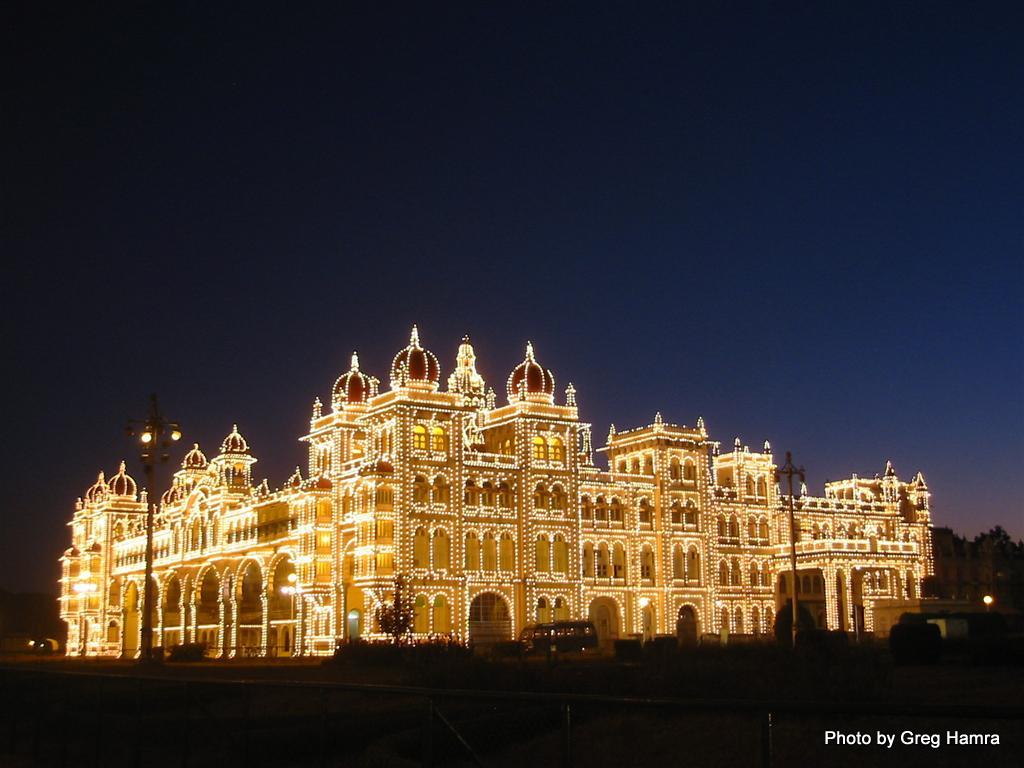
I think of where we’ve been. . . . We spent most of our time in Mysore in the south-central part of this most “foreign” of any of the countries I’ve visited. (The city’s main palace is pictured above.)Compared with other Indian cities we’ve seen – Mumbai, Delhi, Bangalore – Mysore was delightfully sleepy and manageable, even though its population is well over a million. Mysore streets are dirty and spotted with cow dung. Unexpected gaps in sidewalk pavement suddenly reveal holes at times a meter deep. But no one seems to mind.

The traffic is absolutely chaotic. It’s dominated by scooters, motorcycles and Vespa rickshaws. Horns blare constantly. As someone said, “It wouldn’t be India if it weren’t noisy.”

But there’s something about the rhythm of life in India that’s most appealing. The pressure we’re used to in the States seems less prevalent, though people still complain about stress. Arrival and appointment times are approximate, not exact. People smile when they talk. They bobble their heads as they consider responses to questions, and always appear reluctant to say “no.” Women doing even the most menial tasks like street-sweeping or ditch-digging wear the pink, yellow, blue and red saris. They all walk with such stately dignity and grace. Everywhere men stand motionless by the sides of roads urinating against walls, trees and into empty space.

We did some traveling too. There were two idyllic weeks at the beach in Sri Lanka. Over the Christmas holidays we also visited the backwaters of Kerala. We saw Agra (and its Taj Mahal), and the holy city of Varanasi on the Ganges.

I’ll tell you about Varanasi next time.