Fascism Is “Capitalism in Crisis”

Princess Bride

This is the third installment in a series on “How Hitler Saved Capitalism and Won the War.”

[Last Monday this series on the Second Coming of Adolf Hitler tried to connect Hitler and the response to the tragedies of September 11th, 2001. In the aftermath of those events, the U.S. Vice President’s wife, Lynne Cheney and her American Council of Trustees and Alumni identified university and college professors as “the weak link in the fight against terrorism.” They found it particularly offensive that some of the latter had identified the September 11th attacks as “blowback” for “American” Hitler-like policies in the Third World. Such response inspired me to do some research on the question paying particular attention to data found in a standard Western Traditions textbook used in many institutions of higher learning, Jackson Spielvogel’s “Western Civilization.” This third installment attempts to clear up some common misconceptions about fascism which many see as threatening to take over the U.S. today just as it did Germany in the early 1930s. (Unless otherwise indicated, all references are to Spielvogel’s text.)]

The thesis here is that privatized globalization is a continuation of Hitler’s system of fascism which is understood here as “capitalism in crisis.” To understand that position, it is first of all necessary to clear up prevailing confusions about fascism itself. Not surprisingly, misunderstandings abound concerning its nature. Most correctly identify fascism with a police state, with institutionalized racism, anti-Semitism, and totalitarianism (though they typically remain unclear about the term’s meaning). Most too are familiar with concentration camps, the Holocaust, and, of course, with Adolf Hitler. Some can even associate the Nazi form of fascism with homophobia and persecution of Gypsies. However, rarely, if ever will anyone connect fascism with capitalism. For instance, here is Jackson Spielvogel’s (Western Civilization) textbook description of Hitler’s thought:

“In Vienna, then, Hitler established the basic ideas of an ideology from which he never deviated for the rest of his life. At the core of Hitler’s ideas was racism, especially anti-Semitism. His hatred of the Jews lasted to the very end of his life. Hitler had also become an extreme German nationalist who had learned from the mass politics of Vienna how political parties could effectively use propaganda and terror. Finally, in his Viennese years, Hitler also came to a firm belief in the need for struggle, which he saw as the “granite foundation of the world.” Hitler emphasized a crude Social Darwinism; the world was a brutal place filled with constant struggle in which only the fit survived” (794).

Here it is interesting to note that racism, especially anti-Semitism, nationalism, propaganda, terror and Darwinian struggle are signaled as defining attributes of the Hitlerian system. Capitalism is not mentioned, though “struggle” is. Perhaps, had the term “competition” been used instead of “struggle,” the basically capitalist nature of “Social Darwinism,” and fascism might have been clearer.

Fascism and Communism

Textbooks typically add to the confusion by closely connecting fascist Nazism and Communism. For instance, Spielvogel’s Western Civilization deals with Hitler’s fascism and Josef Stalin’s socialism back-to-back, linking the two with the term “totalitarianism.” Spielvogel’s transition from one to the other illustrates how the merely mildly interested (i.e. most college students) might come away confused. He writes, “Yet another example of totalitarianism was to be found in Soviet Russia” (801). Spielvogel defines totalitarianism in the following terms:

“Totalitarianism is an abstract term, and no state followed all its theoretical implications. The fascist states – Italy and Nazi Germany – as well as Stalin’s Communist Russia have all been labeled totalitarian, although their regimes exhibited significant differences and met with varying degrees of success. Totalitarianism transcended traditional political labels. Fascism in Italy and Nazism in Germany grew out of extreme rightist preoccupations with nationalism and, in the case of Germany, with racism. Communism in Soviet Russia emerged out of Marxian socialism, a radical leftist program. Thus, totalitarianism could and did exist in what were perceived as extreme right-wing and left-wing regimes. This fact helped bring about a new concept of the political spectrum in which the extremes were no longer seen as opposites on a linear scale, but came to be viewed as being similar to each other in at least some respects” (Spielvogel 789).

Here Spielvogel correctly points out “significant differences between fascism and communism. One is radically right, the other radically left. Nazism is identified with nationalism and racism (not, it should be noted, with capitalism). Communism is associated with Marxism and socialism. In the end, however, the two are viewed as “similar to each other in at least some respects.” Thus, clarity of distinction given with one hand seems to be erased with the other. Confusion is the typical result. Such fogginess might have been cleared had Spielvogel employed greater parallelism in his expression – i.e. had he identified Stalinist communism with police-state socialism and Hitler’s Nazism with police-state capitalism.

National Socialism

Nonetheless, history books and teachers are not solely at fault for student confusion. There are other understandable reasons for the distancing of fascism from capitalism. For one, Hitler’s Party called itself the National Socialist German Workers’ Party (NSDAP). As a result, it is quite natural for students who reflect on the question at all, to conclude that Hitler and his party were “socialist,” or even “communist,” since the two terms are almost synonymous for most Americans. After all, well-indoctrinated students would be justified in reasoning that Hitler did such terrible things he must have been a communist.

Lost in such analysis is the historical realization that during the 1930s, all sorts of approaches to political-economy called themselves “socialist.” This is because they supported state intervention to save the market system that was in crisis during the Great Depression. Thus, there were socialisms of the left as found in Soviet Russia. But there were also socialisms of the right, such as Hitler’s in Germany, Mussolini’s in Italy, and Franco’s in Spain. In other words, interventionist economies easily adopted the “socialist” identification to distinguish themselves from laissez-faire capitalism, which in the aftermath of the Great Stock Market Crash of 1929, had been completely discredited. As we shall see below, in such context (were it politically possible) Franklin Roosevelt’s interventionist program to save capitalism could easily have been called National Socialism instead of the “New Deal.”

However, analysis of fascism’s approach to socialism must recognize the national character of the socialism advocated. [Yet even here, according to Spielvogel, Hitler’s program had a distinctly international dimension eerily evocative of promises associated with the current global economy. Spielvogel recalls, “After the German victories between 1939 and 1941, Nazi propagandists painted glowing images of a new European order based on “equal chances” for all nations and an integrated economic community.” (829)] The critical adjective (nationalist) was intended precisely to distinguish the right wing brand of socialism from its left wing international antagonist. In this connection Hagen Schulze writes in Germany: a New History (2001):

“The catch-phrase “national socialism” itself had been created before the First World War as a means to unite a variety of nationalistic organizations in the battle against “international socialism.” The term was designated to appeal to the working class, but it also proved attractive to young people from the middle and upper classes with romantic notions of Volksgemeinschaft, a “popular” or “national” community” (231)

The implication here is that right wing zealots “co-opted” a popular term to confuse the young – a strategy employed to this day with great success. Here as well one should note that “national socialism” is signaled as a direct opponent of “international socialism.”

Fascism as Mixed Economy

Yet another reason disjoining fascism from capitalism is that fascism was not capitalism pure and simple. (The same might be said of Roosevelt’s New Deal – and even today’s U.S. economy.) Both systems were “mixed economies.” That is, if capitalism’s essential components are private ownership of the means of production, free and open markets and unlimited earnings, socialism’s corresponding elements are public ownership of the means of production, controlled markets and restricted earnings. Both Roosevelt and Hitler combined the two approaches to economy.

Once again, in a period when free market capitalism had been widely discredited, both Hitler and Roosevelt performed a kind of “perestroika.” Soviet Premier, Mikhail Gorbachev would later use the term to refer to the restructuring of socialism, in order to save it by incorporating elements of capitalism. The suggestion here is that more than a half-century earlier, Roosevelt and Hitler had done the opposite; they had incorporated elements of socialism into the capitalist system in order to resurrect it. So, while the means of production most often remained in private hands, others (such as the railroads, the postal system, telephones and highways) were nationalized.

Similarly, while the free market was allowed to continue in many ways, its freedom was restricted by measures socialists had long advocated (e.g. rationing, legalized unions, social security, wage and price controls). Finally, high income taxes were used to restrict earnings and garner income for the state to finance its interventionist programs. [Few recall, for instance, that during the 1940s, U.S. federal income tax rates assessed incomes over $400,000 at a rate of 91% (See Howard Zinn’s A People’s History of the United States, 567-8). Government revenue collected in this way paid for populist programs that modestly redistributed income to the American working class and unemployed. Such redistribution found its way into workers’ pay envelopes, but also took the form of “social wage.”]

None of this is to say that Roosevelt’s and Hitler’s interventionist economies were the same. Mixed economies, after all, are not the identical. The key question for distinguishing between them is, “Mixed in favor of whom?” Some mixed economies are mixed in favor of the working class, others, in favor of their employers. As the product of a liberal capitalist, Roosevelt’s mixture successfully sold itself as the former. That is, while keeping most means of production securely in the hands of capitalists, Roosevelt gained the support of the working classes through his populist programs aimed at gingerly redistributing income downward towards those unable to fend for themselves. In other words, Roosevelt’s “mixed economy” was blended so as to facilitate its defense in populist terms – that is, as mixed in favor of the working class. And the defense achieved plausibility with the American people. Despite objections from more overtly pro-business Republicans, Roosevelt was elected four times in succession. His party remained in control of the U.S. Congress for nearly a half-century.

Hitler had another approach. Influenced by Herbert Spencer and (indirectly) by Friedrich Nietszche (see below), der Fuhrer was an extreme social Darwinist whose programs unabashedly favored elite Aryans and despised “the others,” particularly socialists, Jews, trade unionists, non-whites, Gypsies, homosexuals, the disabled and other “deviants.” On the other hand, Hitler despised “liberal” politicians like Roosevelt, with their programs of social welfare. On those grounds, he vilified the Weimar government which preceded his own. During the early years of the Great Depression, Weimar politicians had attempted to gain the favor of the working class, and to sidestep civil war by implementing wealth distribution programs (233). Funding the programs necessitated tax increases, unpopular with middle and upper classes. It meant strengthening unions along with socialists and communists.

The point here is that is it with good reason that few make the connection between fascism and capitalism. A student of Spielvogel, for instance, would have to be quasi-heroic to do so. After all, he or she would be not only resisting the confusion fostered by the text itself, but would also be swimming against the stream of American propaganda, which treats Hitler’s system as the product of an evil individual, and unconnected with any specific economic system (other than, mistakenly, socialism or communism).

Despite such ambiguity, next week’s blog entry will attempt to demonstrate more specifically that even a closer reading of a text like Spielvogel’s makes unmistakable the connection between fascism and capitalism.

Gil Rosenberg’s Anniversary, Jesus’ Pentecost (Sunday Homily)

Gil

Readings for Pentecost Sunday:Acts 2: 1-11; Ps. 104: 1, 24, 29-30, 31, 34; I Cor. 12: 3B-7, 12-13; Jn. 20: 19-23. http://www.usccb.org/bible/readings/051913-pentecost-mass-during-day.cfm

A couple of weeks ago Peggy and I were blessed to attend an extraordinarily powerful spiritual gathering. It was at the home of June Widman, a friend of ours in Berea, Kentucky who lost her husband, Gil Rosenberg, in a tragic car accident one year earlier (See my “In Memoriam” blog entry for Gil under the “Personal” button just below this blog site’s masthead). Our friend’s daughter and son (Jessie and Greg), some co-workers and friends like us were all present at this commemoration potluck. There were about 20 of us in all.

Before eating we gathered in a circle. The “priest” among us – a former Mercy Sister who has a real gift for this sort of thing – started us off reminding us of why we were there and of how quickly (and painfully) the intervening year had passed. There were some readings – most moving for me “Death” by Pablo Neruda, read in both English and Spanish. A recorded musical selection followed.

And then people began sharing memories of Gil – an extraordinarily beloved member of our church community in Berea. (His funeral had been attended by an overflow crowd rarely seen in our Catholic church – and this for a man who was himself Jewish, though a faithful attendee at weekly Mass along with June and their children.) Gil was smart, quick-witted, and very funny. A teacher at a local community college, he was also a soccer and basketball coach for many of our children. Everyone loved him.

And that’s what we talked about. But more than that, Gil’s friends told stories of how they continued to experience his presence during the past year. People told of actual “conversations” they had with him (mostly humorous) as they faced problems or were taking themselves too seriously. They told how memories of Gil’s quirky wisdom helped them muddle through otherwise overwhelming circumstances. It was entirely inspiring.

The whole experience made me think of that first Pentecost experienced by Jesus’ followers after his resurrection. What happened then stemmed from an attempt on their part to keep Jesus’ memory alive. That’s what June and the rest of us were going for in relation to Gil as well. And like June’s gathering (and like Gil himself), Pentecost blended Jewish and Christian elements. “Pentecost,” of course, was originally a Jewish feast. It was celebrated fifty days after Passover.

Whereas Passover celebrated the Exodus from Egypt, Pentecost (seven weeks later) commemorated the giving of God’s Law at Mt. Sinai. Also called “the Feast of Weeks,” Pentecost was a harvest festival like our Thanksgiving. And like the Passover, the feast drew Jews from all over the world to Jerusalem and its Temple. The evangelist, Luke, takes time to make this point. He lists Parthians, Medes, and Elamites, inhabitants of Mesopotamia, Judea and Cappadocia, Pontus and Asia, Phrygia and Pamphylia, Egypt and the districts of Libya near Cyrene. He refers to travelers from Rome, both Jews and converts to Judaism, Cretans and Arabs.

Because of the events recorded in today’s readings, Christians have come to consider Pentecost the “birthday of the Church.”

I used to think of Pentecost as taking place among Jesus’ disciples (the 11 apostles and about 110 others, they say, including many women) who had stayed in Jerusalem following Jesus’ death and resurrection simply awaiting the coming of the Holy Spirit. However, now that seems unlikely.

Jesus’ followers and inner circle were poor working people. They needed to earn their daily bread. Even John 21:3ff indicates that following the tragic (and later hopeful) events in Jerusalem, several of them returned to Galilee to resume their labor as fishermen.

Then as the feast of Pentecost approached, they must have decided to return to Jerusalem along with all those other pilgrims I mentioned. No doubt they wanted to re-experience “on location” their final hours with Jesus, even returning to the “Upper Room” to do what June and the rest of us did a couple of weeks ago in commemorating Gil on the anniversary of his death. Surely they wanted to break bread together as Jesus had told them to do – but there in the Upper Room. That would make it truly special.

So they returned to Jerusalem at some risk to their own safety. Luke tells us that they kept the doors locked because they were afraid of the same powers that had arrested, tortured and executed Jesus. After all, Jesus’ disciples had been responsible for circulating the rumor that their Teacher was not really dead. They told their friends that he somehow survived the Roman’s attempts to eliminate him. He was alive.

Evidently, word of that “resurrection” had gotten back to officials of the Sanhedrin – the Jewish court whose members were collaborators with the Romans, working with them hand in glove. The Jewish sell-outs well remembered how the carpenter from Nazareth had “stirred up the people” (Lk. 23:5) with his message about God’s revolutionary “Kingdom.” They especially recalled how just before his execution, he had entered Jerusalem to popular acclaim and led that notorious demonstration in the Temple.

As a result of all that, the people took Jesus for their messiah, which meant he was the enemy of Rome and collaborators like the Sanhedrin members. If word got out that “He lives!” the trouble could well start all over again during the Pentecost feast. So the Sanhedrin mobilized its brutal police to hunt down the members of Jesus’ Galilean terrorist gang and solve the Jesus problem once and for all.

Despite such threat, Jesus’ followers gathered in the Upper Room (or perhaps, some scholars say, it was even in the Temple). There in that place so full of memories, they must have recalled the Master’s words and deeds, and how he continued to influence them even in his apparent absence. I’ll bet their stories were just as dear and humorous as June’s friends’ recollections of Gil.

Then suddenly (in John’s version of the Pentecost event) Jesus is standing there in their midst. He tells them not to worry about the police. “Peace be with you,” he says twice. Jesus shows his friends his pierced hands and wounded rib cage. Don’t be worried, he implies, they can kill you and torture you, but like me, you will not really die.

Then Jesus breathes on them all, and they receive his own Spirit – of forgiveness and discrimination in the sense of discernment. His spirit, Jesus promises, will instruct them about forgiveness — and about what they should never overlook. He tells them to continue his work despite any threats from Rome and its collaborators.

Luke’s version of the same event is recorded in the familiar story from Acts which we heard in today’s first reading. Luke calls on imagery from Exodus – wind and fire – to describe the transforming event of Pentecost. Instead of Jesus appearing personally to bestow his Spirit, Luke says the Spirit came in the form of a mighty wind. It was like the wind that dried up the Sea of Reeds in the Exodus. The Spirit came in the form of “tongues of fire” like the pillar of fire that led the Israelites during the dark nights that followed the initial euphoria of liberation from Egypt.

In both cases (John and Luke), the result of receiving Jesus’ Spirit is the same. The disciples are literally encouraged. Their fear entirely disappears. Doors are unlocked. Jesus’ friends are suddenly are out in the street. And everyone can understand the import of their words: Jesus lives! Everyone can understand because Jesus’ message (as always) is about the Kingdom of God. No matter where people come from, famished stomachs speak the same language of hunger. Calloused hands speak the same eloquent “sign language.” Mothers weep the same tears for their sons tortured and victimized by empire.

According to Jesus’ Spirit, it’s the Romans and their collaborators, not Jesus’ followers, who have reason to fear. Their days are numbered. God’s kingdom is at hand. Once again, Jesus lives! The old order is about to be overturned. The first will be last; the last, first. The rich will be poor; the poor, rich. Those laughing now will find themselves in tears; those in mourning will at last find joy.

In their sheer numbers of converts (3000 says Luke that very first day) the crowds from all over the Jewish world protect Jesus’ friends from the Sanhedrin police. We can picture the lawmen on the edges of the crowd rendered powerless by the crowd’s solidarity.

And what’s to be learned from that first Pentecost experience? Could it be that we must keep Jesus’ memory alive – as the prophetic preacher of God’s Kingdom in the here and now, not in the sky somewhere after death? (Shouldn’t that be the purpose of our weekly gatherings for worship and the Lord’s Supper?) Is the lesson of today’s feast that believers must insist on speaking in language that anyone can understand – the language of the working classes, the hungry, and of mothers in mourning? Is it that a measure of the truth of our beliefs is the degree of threat we feel from empire and its collaborators as a result of the beliefs we fearlessly profess? Is it that followers of Jesus should refuse to accept division but unite instead with a solidarity that protects us from the same forces of empire and its collaborators that threatened Jesus’ first followers?

The truth is that there’s much to learn from Pentecost. June’s and her children’s devotion to Gil Rosenberg along with his friends’ recollections and experiences of Gil’s “real presence” remind us of the nature and purpose of that first Pentecost gathering. It was not only to recall what Jesus said and did in terms of resistance to Rome and its oppression on a macro-level. For us it can also be about creating Kingdom in our personal lives and with our families as Gil himself did. Besides bringing gifts of forgiveness, the Holy Spirit was the basis of Gil’s humor, non-conformity, attention to the needs of the exploited, and refusal to take himself (or others) too seriously.

If we open ourselves wide, we too can receive all of those gifts. The Spirit can make us fierce advocates of God’s Kingdom. It can help us overcome our very selves, along with our fears of the Empire, its police and religious collaborators.

The First Rule of Critical Thinking: Think Systemically (about Capitalism)

This is the second blog entry in a series on critical thinking which lays out ten guidelines for critical thought: (1) Reflect Systemically, (2) Expect challenge, (3) Reject neutrality, (4) Suspect ideology, (5) Respect history, (6) Inspect scientifically, (7) Quadra-sect violence, (8) Connect with your deepest self, (9) Detect silences, (10) Collect conclusions. The series was inspired by responses to my April 16th reflections on the Boston Marathon bombing.

THINK SYSTEMICALLY

The first rule of critical thinking as understood in this series is to think systemically. This is a ground-clearing rule. Its point is to clarify the vocabulary and concepts without which you’ll not be able to think critically about the most important issues facing our world today. You can’t think about poverty, hunger, war, climate change, healthcare, education, or a host of other problems without clear understandings of the basic economic concepts presented here. Without them, you’ll be thrown for a loop; your eyes will glaze over when conversation turns economic. And economics, remember, is the principal language spoken in the world of politics and newscasts.

Think about what’s happened since the 2008 election of Barack Obama. With the implementation of bailout programs, and discussion of “Obamacare,” there has been a lot of talk about “socialism,” hasn’t there? This has come along with accusations about “Marxism,” “communism,” “fascism” – all in a context that supposes the superiority of “capitalism.” The discussions have rarely recognized the universal prevalence of “mixed economies.” Instead, the discourse has illustrated huge divergences of understanding and opinion about the meaning of all the terms just placed in quotation marks.

Most debate participants simply do not have clear ideas about their meaning. They are convinced, of course, that communism is bad, and that capitalism is good. Beyond that however, ideas remain confused. Most are even unaware that all the terms mentioned describe positions adopted towards the free market economic system.

It is the modest, yet ambitious, purpose of the explanation of this first rule of critical thinking to clear up confusion simply by defining terms in an easy- to- understand way. Doing so is absolutely necessary for any critical thinker to join productive discussions about our days’ most important issues. So, oversimplifying for purposes of discussion and clarity, what follows will summarize the crucial categories in three points each, beginning with capitalism, and then moving on to Marxism, socialism, mixed economy, communism, and fascism.

Today’s blog entry will define capitalism in this way.

CAPITALISM

Liberal capitalism is an economic system based on (1) private ownership of the means of production (2) free and open markets (places where goods are bought and sold), and (3) unlimited earnings. Those are the three points.
Private ownership of the means of production dictates that individuals should be empowered to own fields, forests, farms, factories and other sources of products for sale and exchange. Communal ownership is thus excluded. That’s capitalism’s first point.

Free and open markets means that private ownership should permit those in question to produce what they choose to produce, where and when they choose to do so, employing whom they choose, without any power outside of market forces of supply and demand dictating that production. Here government interference in the market by way, for instance, of outlawing or controlling some productions (such as liquor or cigarettes) and mandating others (such as beans and rice) is rejected. Moreover, anyone at all should be able to enter an open market regardless of personal attributes such as race, age, gender, nationality, or religion. In all this emphasis on “freedom,” we find expressed the “liberal” nature of “liberal capitalism.” That’s capitalism’s second point: free and open markets.

Finally, liberal capitalism calls for unlimited earnings. That is, the producer’s talent and the quality of her or his product alone should limit the income goals attainable. Limits on earnings such as taxes should be kept to the minimum necessary to provide public protection of private property (police, military, the judicial system) and to supply the infrastructure necessary for commerce (roads, bridges, etc.) That’s capitalism’s third point: unlimited earnings.

Income ceilings, of course, are out of the question for capitalism strictly understood. For capitalists wide disparities between the rich and the poor are not a problem. And some might even admit to greed as a kind of virtue that is responsible for human progress. That idea was captured in the film, “Wall Street,” where entrepreneur, Gordon Gecko (played by Michael Douglas), praises greed in a speech before the stockholders of his company, Teldar Paper Company:

These words, of course, not only praise greed in business, but in national life. Echoing the words of economist Milton Friedman (at the top of this blog entry) and ignoring the fact that in the past greed was considered by Christians one of the Seven Deadly Sins, Gecko claims that greed leads to salvation. It will not only save his business from low returns on the Stock Market, but the United States itself from what ails it as well. For Gecko and Friedman greed is the virtue at the heart of capitalism. It’s what makes the world go ’round.

(Next week: Marxism in three easy points)

The Western Powers Loved Adolf Hitler

Hitler Love

This is the second installment in a series on “How Hitler Saved Capitalism and Won the War.”

Last Monday this series on the Second Coming of Adolf Hitler began with a brief allusion to the special responsibility Christians have to resist Hitlerism without Hitler. That first entry recalled how Karl Barth, Dietrich Bonhoeffer, Martin Niemoller and others formed a Confessing Church to counter the surrender of Germany’s mainstream churches to Hitler’s nationalism. The example of the Confessing Church and the tenets of its Barmen Declaration should be kept in mind as this series progresses. An underlying thesis here is that given the similarities between Hitler’s Germany and the contemporary United States, would-be followers of Jesus should emulate the defiant example of the Barmen Declaration’s authors.

Today’s entry focuses on the relevance of Adolf Hitler to U.S. policy since 9/11/01:

In the aftermath of the tragic events of September 11th, the American Council of Trustees and Alumni, co-founded by Mrs. Lynne Cheney, the wife of Dick Cheney, the former United States Vice President, accused dissident professors of being the “weak link in America’s response to the attack.” To support its accusation, the Council published a list of more than a hundred recorded statements by such professors characterizing them as “anti-American.” Statements ranged from “Any attack on the Pentagon’s got my vote” to “Ignorance breeds hate,” and America should “build bridges and relationships, not simply bombs and walls.”

Of course, any professorial references to “fascism” and “Nazism” connected with U.S. policy were anathema to Mrs. Cheney’s group. Such accusations, it was alleged, revealed an ignorance or suppression of real United States history. A more genuine narrative of the past showed America to be an unparalleled opponent of Nazism and an unrelenting advocate of freedom and democracy in the face of fascism. Schooling in truer, more patriotic history, Mrs. Cheney said, would make students valued assets in civilization’s war against terrorism.

As a teacher of history in a small liberal arts college in the American South, I found extremely welcome the new centralizing of history’s importance. I also welcomed it as an opportunity to explore a suspicion that had been with me for some time – precisely in connection with the categories of terrorism and anti-terrorism, but especially connected to fascism, Nazism and the study of history.

The suspicion came from reading closely and teaching the standard Western Civilization text many professors use at Berea College, where I teach. It is a book of which Mrs. Cheney might approve – Jackson Spielvogel’s Western Civilization. For a long time, I had been finding unmistakable clues there to support the thesis that far from being a beacon of freedom and democracy, the United States is actually the opposite. More specifically, in relation to most of the world, it has since the conclusion of the Second Inter-Capitalist War (aka World War II) embodied Hitlerism without Adolph Hitler.

Put more starkly, the clues in my students’ textbooks indicated that Hitler’s system actually triumphed in World War II. Moreover, his system was police state capitalism, and Hitler was capitalism’s savior. Even more importantly, police state capitalism continues today in the process of globalization and, most recently, in the U.S. “War on Terrorism.”

Such challenging assertions find additional support in conservative histories like Hagen Schultze’s Germany: A New History, and Paul Johnson’s History of Christianity. Support appears as well in statements by U.S. government officials, and in the daily newspaper.

All of these sources indicate that at the beginning Adolf Hitler enjoyed the support of western powers because of his stern opposition to socialism and communism. Hitler was the West’s champion against the Soviets and those who admired Soviet accomplishments. So after his coming to power in 1933, Hitler’s international sponsors quickly rescinded the harshly punitive clauses of the Treaty of Versailles. They forgave Germany’s debt. British prime minister, Neville Chamberlain hastened to align Great Britain with Hitler. Pius XII referred to der Fuhrer as “an indispensable bulwark against the Russians.” Henry Ford loved the man. The admiration was mutual; Ford accepted a medal of honor from Hitler’s hands, as did the founder of IBM. Trans-Atlantic aviator, Charles Lindbergh and movie actor Errol Flynn were prominent among Hitler’s champions.

With such backing, the Western Powers allowed Hitler’s Germany to rearm. But in the end, der Fuhrer lost the support of his capitalist backers, because he went too far. His crime, however, was not gassing Jews. The West proved remarkably compliant with that. Rather, Hitler’s crime was his attempt to establish control of the world economy – over such capitalist competitors as Great Britain, France, and the United States. He proposed a New World Order, which, he promised, would bring prosperity to all. Nonetheless, Hitler’s attempts to impose his order ultimately met with stiff resistance from his opponents’ Allied Forces. The Second Inter-Capitalist War followed.

Afterwards, the United States emerged relatively unscathed from the conflict, and proceeded to establish its own dominance of the world capitalist system, in ways not extremely different from those employed by Adolph Hitler. That dominance of the capitalist world turned to imperial global dominance following the disappearance of the Soviet Union as the lone super-power adversary of the U.S. at the beginning of the 1990s.

In other words, there is surprising continuity between Hitler’s New World Order and the New World Order embodied in the contemporary system of globalization. To understand this perhaps shocking claim, it is necessary to (1) clear up some common misconceptions about fascism, (2) describe the connections between Hitler and capitalism, (3) indicate how fascism triumphed in World War II and its aftermath, and (4) show how Hitler’s system is continued today in globalization and the War on Terrorism.

These points will be elaborated here (on Mondays) during the coming weeks.

Ascension Sunday: What’s Christianity for Anyway? (Sunday Homily)

People attend the funeral mass for Cardinal Aloysius Ambrozic at St. Michael's Catholic Cathedral

Readings for Ascension Sunday: Acts 1: 1-11; Ps. 47: 2-3, 6-9; Eph. 1: 17-23; Lk. 24: 48-53 http://www.usccb.org/bible/readings/050913-ascension.cfm

This is Ascension Sunday. For us Catholics, it used to be “Ascension Thursday.” It was a “holy day of obligation.” That phrase meant that Catholics were obliged to attend Mass on Thursday just as they were on Sunday. To miss Mass on such a day was to commit a “mortal sin.” And that meant that if you died before “going to confession,” you would be condemned to hell for all eternity.

So until the years following the Second Vatican Council (1962-1965) Catholics would fill their churches on Ascension Thursday in the same numbers (and under the same threat) that made them come to Mass on Sundays. That’s hard to imagine today.

I suppose that difficulty is responsible for the transfer of the commemoration of Jesus’ “ascension into heaven” from Thursday to Sunday. I mean it wasn’t that the church changed its teaching about “holy days of obligation.” It didn’t. Catholics simply voted with their feet. They stopped believing that God would send them to hell for missing Mass on Ascension Thursday or the feast of the Blessed Virgin’s Assumption (August 15th), or All Saints Day (November 1st) or on any of the other “holy days.” Church once a week was about as much as the hierarchy could expect.

But even there, Catholics stopped believing that God would punish them for missing Mass on Sunday. So these days they more easily attend to other matters on Sunday too. They set up an early tee time or go for a hike in the woods. Afterwards they cut the lawn or go shopping at Wal-Mart. That kind of “servile work on Sundays” or shopping used to be forbidden “under pain of sin” as well. And once again, it isn’t church teaching that has changed. Catholics have just decided that the teachings don’t make sense anymore, and have stopped observing them.

And apparently they do so in good conscience. So you won’t find them running to confession after missing Mass or working and shopping on Sunday. In fact, that’s another way Catholics have voted with their feet. For all practical purposes, they’ve stopped believing in Confession – and largely in many of the mortal sins they were told would send them to hell – like practicing contraception or even getting a divorce.

I remember Saturday evenings when I was a kid (and later on when I was a priest). People would line up from 4:00-6:00, and then from 7:00 -9:00 to “go to Confession.” And the traffic would be steady; the lines were long. No more! In fact, I personally can’t remember the last time I went to confession. And no priests today sit in the confessional box on Saturday afternoons and evenings waiting for penitents to present themselves.

What I’m saying is that the last fifty years have witnessed a tremendous change in faith – at least among Catholics. Our old faith has gone the way of St. Christopher and St. Philomena and “limbo” all of which have been officially decertified since Vatican II.

In fact, since then the whole purpose of being a Catholic (Christianity) has become questioned at the grassroots level. More and more of our children abandon a faith that often seems fantastic, childish and out-of-touch. Was Jesus really about going to heaven and avoiding hell? Or is faith about trying to follow the “Way” of Jesus in this life with a view to making the world more habitable for and hospitable to actually living human beings?

That question is centralized in today’s liturgy of the word. There the attentive reader can discern a conflict brewing. On the one side there’s textual evidence of belief within the early church that following Jesus entails focus on justice in this world – on the kingdom. And on the other side there are the seeds of those ideas that it’s all about the promise of “heaven” with the threat of hell at least implicit. The problem is that the narrative in today’s liturgy of the word mixes each view with its alternative.

According to the story about following Jesus as a matter of this-worldly justice, the risen Master spent the 40 days following his resurrection instructing his disciples specifically about “the Kingdom.” For Jews that meant discourse about what the world would be like if God were king instead of Caesar. Jesus’ teaching must have been strong. I mean why else in Jesus’ final minutes with his friends, and after 40 days of instruction about the kingdom would they pose the question, “Is it now that you’ll restore the kingdom to Israel?” That’s a political and revolutionary question about driving the Romans out of the country.

Moreover Jesus doesn’t disabuse his friends of their notion as though they didn’t get his point. Instead he replies in effect, “Don’t ask about precise times; just go back to Jerusalem and wait for my Spirit to come.” That Spirit will “clothe you in justice,” he tells them. Then he takes his leave.

Presently two men clothed in white (the color of martyrdom) tell the disciples to stop looking up to heaven as if Jesus were there. He’s not to be found “up there,” they seem to say. Jesus will soon be found “down here.” There’s going to be a Second Coming. Jesus will complete the project his crucifixion cut short – restoring Israel’s kingdom. So the disciples who are Jews who think they’ve found the Messiah in Jesus return in joy to Jerusalem and (as good Jews) spend most of their time in the Temple praising God, and waiting to be “clothed in Jesus’ Spirit” of liberation from Roman rule.

The other story (which historically has swallowed up the first) emphasizes God “up there,” and our going to him after death. It’s woven into the fabric of today’s readings too. Here Jesus doesn’t finally discourse about God’s kingdom, but about “the forgiveness of sin.” After doing so, he’s lifted up into the sky. There Paul tells his readers in Ephesus, he’s enthroned at the Father’s right hand surrounded by angelic “Thrones” and “Dominions.” This Jesus has founded a “church,” – a new religion; and he is the head of the church, which is his body.

This is the story that emerged when Paul tried to make Jesus relevant to gentiles – to non-Jews who were part of the Roman Empire, and who couldn’t relate to a messiah bent on replacing Rome with a world order characterized by God’s justice for a captive people. So it gradually turned Jesus into a “salvation messiah” familiar to Romans. This messiah offered happiness beyond the grave rather than liberation from empire. It centralized a Jesus whose morality reflected the ethic of empire: “obey or be punished.” That’s the ethic we Catholics grew up with, that sent some of us to weekly “confession,” and that former and would-be believers find increasingly incredible, and increasingly irrelevant to our 21st century world.

Would all of that incredibility and irrelevance change if the world’s 2.1 billion Christians (about 1/3 of the world’s total population) adopted the this-worldly Jesus as its own instead of the Jesus “up there?” That is, would it change if Christians stopped looking up to heaven and focused instead on the historical Jesus so concerned with God’s New World Order of justice for the poor and rejection of empire?

Imagine if believers uncompromisingly opposed empire and its excesses – if what set them apart was their refusal to fight in empires wars or serve its interests. How different – and more peaceful – our world would be!

A sensitive discerning reading of today’s liturgy of the word, a sensitive and critical understanding of Jesus’ “ascension” presents us with that challenge. How should we respond?

(Discussion follows.)

Series on Critical Thinking, Part One: It’s Not What You Think!

Plato's tv cave

This is the first in a series on critical thinking. Its immediate inspiration was the controversy on this blog site sparked by my April 16th entry on the Boston Marathon bombing (see below on this site). Many of the most critical responses showed that their authors did not understand where I was coming from in terms of my own remarks about severity and the “blowback” nature of the tragedy in Boston. I had written that the Boston tragedy was minor compared to the havoc wrought virtually every day in the Muslim world by U.S. drone attacks. Moreover those attacks by U.S. weapons of mass destruction evoked anger and desire for revenge on the parts of their victims. So “Americans,” I suggested, should expect more tragedies like Boston.

In truth, my point of departure was not (as some critics alleged or implied) anti-Americanism or insensitive gloating over the sufferings of the Marathon victims. Far from it, I love the United States; it is my place of birth; I consider myself highly patriotic. Like most people in the world, my heart went out to the dead, maimed and injured in Boylston Square.

However, I am also a teacher of critical thinking and have been for more than 40 years. During that time I’ve developed criteria – 10 of them – for thinking critically about history, politics, economics and religion. For me the essence of critical thought entails the ability to judge oneself (and one’s country) as objectively as possible (i.e. without ego-centrism or ethnocentrism). To that end, the criteria I’ve developed include

1. REFLECT SYSTEMICALLY
2. EXPECT CHALLENGE
3. REJECT NEUTRALITY
4. SUSPECT IDEOLOGY
5. RESPECT HISTORY
6. INSPECT SCIENTIFICALLY
7. QUADRA-SECT VIOLENCE
8. CONNECT WITH YOUR DEEPEST SELF
9. DETECT SILENCES
10. COLLECT CONCLUSIONS

As anyone can see, such criteria are not those one ordinarily finds in critical thinking textbooks – at least not those historically employed at Berea College where I taught for more than 36 years. Standard approaches provide tools for analyzing the thinking process itself. They instruct students in logic, common fallacies, and how to evaluate statements, evidence, statistics and information. Diagrams used to illustrate this understanding of critical thinking often look like the following:

critical-thinking

In many ways “thinking about thinking” accurately describes the project pictured above. According to this understanding, thinking critically is about thought processes and their logic. Once articulated and clarified, the new understandings are applied to cases such as abortion, capital punishment, immigration, and war. Without doubt, this understanding of the discipline is valuable and necessary for any serious scholarship or indeed for responsible citizenship.

However, the problem with this kind of thinking is that it can ignore questioning its own “parameters of perception.” It can work within cultural, institutional and ideological premises that largely remain unquestioned. It can proceed quite successfully without seriously questioning or even acknowledging the possibility of alternatives to existing ideologies, laws, institutions, power relationships, and customs. One can think about the Marathon bombing, for instance, without considering the accuracy of one’s accepted historical narrative about the role of the United States in the world or about the “institutional violence” that might have provoked the atrocity.

By way of contrast, critical thinking as explored in this series will address such neglected elements. The operative image here will be Plato’s Cave. Its representation looks like this:

PlatoCave

About 2500 years ago Plato described the human condition as characterized by a tragic absence of critical thought as I’m proposing it here. We live, Plato said, like people in a cave where they’ve been imprisoned all their lives. They remain there chained in a way that prevents them from moving about. They face a wall unable to move even to see directly the others who like them are chained alongside. However the wall the prisoners face is not blank. This is because a fire burns behind the captives and casts their shadows on the wall much as a movie projector would in a dark theater. And that’s their only image of themselves – shadows.

However other shadows appear on the wall as well. They are cast by people walking behind the prisoners along the “roadway” pictured above. The walkers carry statues of all kinds of things – animals, trees, gods . . . . Viewing those shadows, the prisoners think that life is unfolding before them. Moreover, the “wise” among the prisoners – the teachers – become very good at describing the shadows and at predicting the sequence of their appearance. In terms relevant here, their discourses are taken as expressions of “critical thought.” However, their wisdom describes shadows in an artificial world.

Eventually one of the prisoners escapes the cave and discovers the real world and the sun which makes life possible. The escapee returns to the cave to inform the prisoners of this discovery. The escapee’s intention is to introduce real “criticism.” Far from welcoming him, the other prisoners threaten to kill him.

Plato, of course, was writing about his mentor, Socrates whom the citizens of 5th century BCE Athens actually did kill for teaching what I’m calling here “critical thinking.” They interpreted his project as “corrupting the youth,” because it called into question the “doxa” of their day. The Greek term, doxa, referred to the “of course” statements that go unquestioned everywhere. Our culture is full of them: “The United States” is the best country in the world.” Of course it is! “Ours is the highest standard of living.” Of course! “’We’ are good; ‘they’ are evil.” Of course!

The critical thinking I intend to pursue here is about critiquing doxa; it’s about questioning parameters of perception; it’s about escaping the cave.

More specifically, what I intend to expose here attempts to provide tools for subjecting society’s underlying narratives, along with its economic and political structures and ideologies to careful yet easily accessible analysis. Moreover, it starts not from a place of supposed neutrality, but from a place of commitment to a world with room for everyone. Commitment in one form or another is inescapable.

Consequently this approach to critical thought not only analyzes reasons for such commitment; it evaluates as well ideologies that contradict that vision. This approach will be historical and involve examination of “official” and “competing” narratives about the past. It will treat violence as a multi-dimensional phenomenon connected with structures of political economy, the struggle for survival, and police enforcement of “rules of the game” that benefit some and hurt others. The approach centralized here will give key importance to spirituality and the clear articulation of conclusions about the world and the historical patterns at work there.

My approach will also recognize that some of the best and most engaging stimuli for critical thought are can be found in popular culture’s most powerful and engaging medium, Hollywood film, as well as from outstanding documentaries. So most blog entries on this topic will include film illustration.

My hope is that readers will find these Wednesday blog entries interesting and helpful and worthy of their “critical” feedback.

How Hitler Saved Capitalism and Won the War: The Barmen Declaration

Hitler

This is the first in a series on the parallels between Hitler’s rise to power in the 1930s and the path to market totalitarianism which I ‘m convinced the United States is following in this second decade of the 21st century. In fact, it is my view that the U.S. has been on this path since the end of the Second Inter-capitalist War (1939-1945), and especially over the last thirty-five years.

The series represents the back story for an appeal I’ve been making to my friends in our Ecumenical Table Fellowship (an inter-denominational worship group formed over the last year in Madison County, Kentucky). There I’ve been urging that we explore the possibilities and procedures for becoming a “Confessing Church” of resistance like the church formed by Dietrich Bonhoeffer, Karl Barth, Martin Niemoller, and their allies in Hitlerian Germany. In 1934 that church published “The Barmen Declaration” whose intention was to rescue the Judeo-Christian tradition from nationalistic interpretations which supported the Third Reich.

A similarly nationalistic interpretation, I fear, has characterized “Christianity” over the last quarter century plus ten in the United States. There, under the influence of Christian fundamentalists, “Christianity” has become virtually synonymous with the extreme right-wing politics that Hitler championed. Like Hitler, that form of Christianity idealizes white Anglo-Saxon culture above all others. Like der fuhrer, it manipulates the Judeo-Christian tradition to support racism and white privilege.

Let me begin the series by reprinting the Barmen Declaration along with parenthetical “translations” and a brief commentary. Subsequent Monday blog entries will trace Hitler’s rise to power, his program of saving capitalism, and how the U.S. adopted Hitlerism without Hitler following der Fuhrer’s demise.

Please begin by considering the Barmen Declaration as translated (in bold) immediately below:

“We, the representatives of Lutheran, Reformed, and United Churches, of free synods, Church assemblies, and parish organizations united in the Confessional Synod of the German Evangelical Church, declare that we stand together on the ground of the German Evangelical Church as a federation of German Confessional Churches. We are bound together by the confession of the one Lord of the one, holy, catholic, and apostolic Church. (THE BARMEN COMMUNITY ASSERTS ITS FOUNDATION: JESUS ALONE IS ULTIMATE AUTHORITY OF THE CHURCH.)

8.07 We publicly declare before all evangelical Churches in Germany that what they hold in common in this Confession is grievously imperiled, and with it the unity of the German Evangelical Church. It is threatened by the teaching methods and actions of the ruling Church party of the “German Christians” and of the Church administration carried on by them. These have become more and more apparent during the first year of the existence of the German Evangelical Church. This threat consists in the fact that the theological basis, in which the German Evangelical Church is united, has been continually and systematically thwarted and rendered ineffective by alien principles, on the part of the leaders and spokesmen of the “German Christians” as well as on the part of the Church administration. When these principles are held to be valid, then, according to all the Confessions in force among us, the Church ceases to be the Church and th German Evangelical Church, as a federation of Confessional Churches, becomes intrinsically impossible. (NEVERTHELESS THE “GERMAN EVANGELICAL CHURCH” HAS ACCEPTED AUTHORITY OTHER THAN JESUS, NAMELY, THE AUTHORITY OF THE THIRD REICH.)

8.08 As members of Lutheran, Reformed, and United Churches we may and must speak with one voice in this matter today. Precisely because we want to be and to remain faithful to our various Confessions, we may not keep silent, since we believe that we have been given a common message to utter in a time of common need and temptation. We commend to God what this may mean for the interrelations of the Confessional Churches. (THOSE WHO RECOGNIZE THIS CONTRADICTION ARE CONVINCED THEY MUST SPEAK IN OPPOSITION TO THIS OBVIOUS CONTRADICTION.)

8.09 In view of the errors of the “German Christians” of the present Reich Church government which are devastating the Church and also therefore breaking up the unity of the German Evangelical Church, we confess the following evangelical truths: (THEY THEREFORE FEEL COMPELLED TO CONFESS THE FOLLOWING EVANGELICAL TRUTHS.)

8.10 – 1. “I am the way, and the truth, and the life; no one comes to the Father, but by me.” (John 14.6). “Truly, truly, I say to you, he who does not enter the sheepfold by the door, but climbs in by another way, that man is a thief and a robber. . . . I am the door; if anyone enters by me, he will be saved.” (John 10:1, 9.)
8.11 Jesus Christ, as he is attested for us in Holy Scripture, is the one Word of God which we have to hear and which we have to trust and obey in life and in death. (WE MUST OBEY JESUS AND NO OTHER.)

8.12 We reject the false doctrine, as though the church could and would have to acknowledge as a source of its proclamation, apart from and besides this one Word of God, still other events and powers, figures and truths, as God’s revelation.
8.13 – 2. “Christ Jesus, whom God has made our wisdom, our righteousness and sanctification and redemption.” (1 Cor. 1:30.)
8.14 As Jesus Christ is God’s assurance of the forgiveness of all our sins, so, in the same way and with the same seriousness he is also God’s mighty claim upon our whole life. Through him befalls us a joyful deliverance from the godless fetters of this world for a free, grateful service to his creatures.
8.15 We reiect the false doctrine, as though there were areas of our life in which we would not belong to Jesus Christ, but to other lords–areas in which we would not need justification and sanctification through him. (IN ALL AREAS OF OUR LIVES WITHOUT EXCEPTION.)

8.16 – 3. “Rather, speaking the truth in love, we are to grow up in every way into him who is the head, into Christ, from whom the whole body [is] joined and knit together.” (Eph. 4:15,16.)
8.17 The Christian Church is the congregation of the brethren in which Jesus Christ acts presently as the Lord in Word and sacrament through the Holy Spirit. As the Church of pardoned sinners, it has to testify in the midst of a sinful world, with its faith as with its obedience, with its message as with its order, that it is solely his property, and that it lives and wants to live solely from his comfort and from his direction in the expectation of his appearance.
8.18 We reject the false doctrine, as though the Church were permitted to abandon the form of its message and order to its own pleasure or to changes in prevailing ideological and political convictions. (DESPITE CLAIMS AND PRESSURES ISSUING FROM POLITICAL OR OTHER WOULD-BE AUTHORITIES)

8.19 – 4. “You know that the rulers of the Gentiles lord it over them, and their great men exercise authority over them. It shall not be so among you; but whoever would be great among you must be your servant.” (Matt. 20:25,26.)
8.20 The various offices in the Church do not establish a dominion of some over the others; on the contrary, they are for the exercise of the ministry entrusted to and enjoined upon the whole congregation.
8.21 We reject the false doctrine, as though the Church, apart from this ministry, could and were permitted to give itself, or allow to be given to it, special leaders vested with ruling powers. (THAT WOULD HAVE US BELIEVE THAT JESUS’ POWER IS ‘POWER OVER’ RATHER THAN HUMBLE SERVICE OF OTHERS.)

8.22 – 5. “Fear God. Honor the emperor.” (1 Peter 2:17.)
Scripture tells us that, in the as yet unredeemed world in which the Church also exists, the State has by divine appointment the task of providing for justice and peace. [It fulfills this task] by means of the threat and exercise of force, according to the measure of human judgment and human ability. The Church acknowledges the benefit of this divine appointment in gratitude and reverence before him. It calls to mind the Kingdom of God, God’s commandment and righteousness, and thereby the responsibility both of rulers and of the ruled. It trusts and obeys the power of the Word by which God upholds all things.
8.23 We reject the false doctrine, as though the State, over and beyond its special commission, should and could become the single and totalitarian order of human life, thus fulfilling the Church’s vocation as well.
8.24 We reject the false doctrine, as though the Church, over and beyond its special commission, should and could appropriate the characteristics, the tasks, and the dignity of the State, thus itself becoming an organ of the State. (OR THAT THE CHURCH SHOULD BECOME AN OPPRESSIVE INSTRUMENT OF THE STATE.)

8.25 – 6. “Lo, I am with you always, to the close of the age.” (Matt. 28:20.) “The word of God is not fettered.” (2 Tim. 2:9.)
8.26 The Church’s commission, upon which its freedom is founded, consists in delivering the message of the free grace of God to all people in Christ’s stead, and therefore in the ministry of his own Word and work through sermon and sacrament.
8.27 We reject the false doctrine, as though the Church in human arrogance could place the Word and work of the Lord in the service of any arbitrarily chosen desires, purposes, and plans.

8.28 The Confessional Synod of the German Evangelical Church declares that it sees in the acknowledgment of these truths and in the rejection of these errors the indispensable theological basis of the German Evangelical Church as a federation of Confessional Churches. It invites all who are able to accept its declaration to be mindful of these theological principles in their decisions in Church politics. It entreats all whom it concerns to return to the unity of faith, love, and hope.” (IN VIEW OF THESE CONVICTIONS THE “CONFESSION CHURCH” INVITES ALL CHRISTIANS TO RECOGNIZE THE PRIMACY OF GOD’S WORD OVER THE AUTHORITY FALSELY CLAIMED BY THE RIVAL POWERS OF THE STATE.)

Obviously, the Barmen Declaration is cautious, muted and politically astute in its opposition to the hijacking of the Christian message by the Third Reich and the mainline German churches. Nevertheless, the Hitlerian message is clear. Hitler’s ecclesial accomplices have indeed tried to co-opt the Christian message, and have largely been successful in doing so. Nevertheless the Barmen community recognizes that Jesus “WAY” is contradictory to the project of Hitler and his cohorts. The Hitlerian faction aspires to use Christianity as a weapon of power over their opponents. By way of contrast, the authentic Barmen Christianity exercises “power” through humble service and non-violence towards the very groups oppressed by the Hitlerians.

Once again, this blog series on Hitler will explore his parallels with the 21st century “New World Order” that appears to mimic his rise to power while attempting to avoid the errors which inevitably doomed his insidious project. Unlike their opponents, the Hitlerians have learned from the past and are determined not to re-commit the errors that frustrated the success of their totalitarian project.

Opponents of Hitlerianism are not nearly as wise.

(Next Monday: Cheney and Bush as Hitler’s disciples)

Pope Francis, Summon a Council: It’s Our Tradition!

Francis I

Readings for 6th Sunday after Easter: Acts 15:1-2, 22-29; Ps. 57: 2-3, 5, 6, 8; Rev. 21: 10-14; 22-23; Jn. 14: 23-29. http://www.usccb.org/bible/readings/050513.cfm

Last year was the 50th anniversary of the convocation of the Second Vatican Council. The Catholic Church is still reeling from that earth-shaking event. Conservatives often consider it a huge mistake. They want to return to the Latin Mass, to women’s head-coverings in church, to weekly confessions and communion placed by the priest on the communicant’s outstretched tongue.

Liberals too are disappointed by Vatican II. It didn’t nearly go far enough, they say. It should have eliminated priestly celibacy and the all-male clergy. The church should have divested itself of the Vatican Bank, sold its art treasures and given the proceeds to the poor. The Council’s teaching on collegiality should have decentralized church bureaucracy and made lay-leadership more prominent. The prohibition of contraception should have been changed.

Into which of those camps do you fall? As a church member, do you consider yourself conservative or liberal? Today’s liturgy of the word provokes the question. It reveals a church which at its very beginning surrendered itself to extreme liberalism – or should I say to the “radicalism” of Jesus’ Spirit?

Think about those terms for a minute in the light of today’s readings. Think about what “conservative” and “liberal” mean for us as individuals and community members in our faith tradition. Think of the Holy Spirit as “radical” – something believers are rooted in.

According to every great tradition (Christian or otherwise), the spiritual life – human life itself – is about change, about transformation. Change is the point. We are called to grow. Growth involves transformation. At the biological level, we’re told that all of our cells change every seven years. That means that at my stage in life, I’ve already gone through more than ten bodies! If I tried to keep my body from changing, I would die.

At the personal, psychic and intellectual levels we’re called to change as well. As St. Paul puts it, when we were children, it was appropriate to think, speak and act as children (I Cor. 13:11). But as adults, we’re called to something more. If we don’t change, we can never become who we’re meant to be.

Even institutions must change to survive. That’s true in the realm of politics, economics, and religion. Jesus’ followers found no exemption from this rule of life – of evolution; as community members they had to change or die. In other words, at the end of the day, strategies of conservatism are doomed for Christians as well as for everyone else.

It’s easy to sympathize with conservatives however. I spent much of my life in that category. As such, my concern was simply to preserve what is essential. I saw liberals as being too free with the unchangeable. Like other conservatives I accused them of throwing out the baby with the bath water.

Nonetheless, in today’s liturgy of the word, we get an idea of how difficult it is to determine which is which –baby or bath water. That is, in our readings, we are faced an example of a key conflict between religious conservatives and liberals within the first century infant church. Paul, Barnabas, Silas and Barsabas lead the liberal wing. Peter and Jesus’ brother, James are the leaders of the conservatives.

Paul and his friends come from the gentile world. Their concern is to make Jesus both understandable and acceptable to non-Jews. For their audience, circumcision and dietary restrictions (like not eating pork) represent great obstacles to accepting Jesus’ “Way.”

On the other hand, Peter and Jesus’ brother, James, are Jews through and through. They remember the importance of full observance of the law within the Jewish tradition. They recalled for instance that during the second century Seleucid persecution of the Jews under Antiochus IV Epiphanes, many Jews gave their lives rather than eat forbidden foods. Faced with Paul and his colleagues, the conservative faction wondered: were those lives sacrificed in vain? And besides, circumcision was the identifying mark of Jewish manhood. What good follower of the biblical God set that all-important commandment aside?

The issue is so serious that it provoked a meeting of church leaders – what scholars call the “Council of Jerusalem.” Like Vatican II (1962-’65) it called together church leadership to discuss burning issues of the day and to make changes that responded effectively to what Gaudium et Spes called the “signs of the times.”

Today’s gospel reading implies that leaders could come together with confidence because of Jesus’ promise that his Holy Spirit would continue teaching the church even after he is gone. The Spirit would remind the church of what Jesus himself taught – and more besides.

According to today’s readings, it was the “more besides” that the Jerusalem conservatives were resisting. They didn’t deny, of course, that Jesus himself was a religious liberal. (It was Jesus’ liberalism that angered the Scribes and high priests.) Jesus frequently placed love and compassion above God’s most important commandment, the Sabbath law; he associated with the “unclean;” he even befriended and worked miracles for gentiles. Jesus was never bound by the letter of the law as were his conservative opponents.

At the same time however, Jesus was Jewish to the end. He had no intention of founding a new religion. He was a Jewish reformer. No one could deny that. Jesus didn’t revoke the Law. He simply gave it an enlightened, more humane, more liberal interpretation. He himself had been circumcised!

It was with these understandings that the Council of Jerusalem convened. And according to Luke, the author of Acts, it was a battle royal. Luke says the meeting (like Vatican II) was filled with “dissension and debate.”

What we find in today’s first reading is the final decree of the Council of Jerusalem. Concerning circumcision, it says “never mind.” As for dietary restrictions, fagedaboutit. The Council was concerned with not placing unbearable burdens on converts. In other words, it couldn’t have been more liberal. It could not have been less conservative.

The Council of Jerusalem is reputed to have happened no more than 30 years after the death of Jesus. But by the time John of Patmos writes his book of Revelation at the end of the first century, look where his church had come. His vision of the “New Jerusalem” which we read about in today’s second reading doesn’t even have a temple. Jerusalem without a temple?! The city is founded not on the 12 patriarchs of Israel, but on the 12 apostles. How liberal is that!?

I suppose what I’m saying is that Christians shouldn’t be afraid of change. It’s our tradition – right from the beginning. In fact, in today’s gospel, John has Jesus say specifically that we should not be agitated or fearful. Rather, our hearts should be filled with peace because of our reliance on the Holy Spirit. John’s Jesus teaches that the Spirit’s presence guarantees the community is moving in the right direction, even when the Spirit’s teachings shock and scandalize – as long as it’s moving towards Jesus’ compassion, love, and ease of burden. The guarantee remains even when the Spirit’s guidance seems to dilute what many consider essential – like circumcision, dietary laws and the Jerusalem Temple.

What “essentials” is the church being called to set aside today? Priestly celibacy? An all-male priesthood? Prohibition of contraception? Are any of these really essential?

The question is as unnerving for the church as it is for us as individuals. But the answer is always the same: “Don’t be afraid or agitated; the Holy Spirit guides.”

Think about it: at the personal level, after ten changes of body and innumerable psychic growth spurts and changes of mind, what remains that allows me to identify with that child they tell me I was in my baby pictures? The bath water has been thrown out virtually every day. But somehow I’m able to say “I” remain. Who is that “I?”

Once again, today’s gospel leads us to believe that the answer is the indwelling Holy Spirit herself who continually leads us into the new and unforeseen – but without that “fear or agitation.” That unifying, enlightened Spirit is the same in me as She is in you.

The bottom line: today’s readings teach that there is no future in timid conservatism. Instead we are called to extreme liberalism. And that liberalism actually translates to Jesus-like radicalism (or going to the root of things). The Holy Spirit is that root.

And so we can pray with confidence: “Holy Spirit, in the present crisis of your church, inspire Francis I to call us together once again. Convene a Council. Surprise us. Shock us one more time. Wake us up! Move us towards compassion, love and ease of burden as you did the Jerusalem Council. We believe that under your guidance, we can never go wrong!

Announcing a New Wednesday Series on Critical Thinking: is anyone interested?

Critical thinking

During the last couple of weeks my blogs have addressed the Boston Marathon bombings. I’ve suggested the application of elementary principles to clarify thinking about such tragedies. One of them I’ve termed the “principle of reciprocity.” The meaning I’ve assigned the term has to do with the application of a single standard to all cases involving response to tragedies like the Boston bombing on the one hand and U.S. drone attacks on the other.

Reciprocity is related to judgments about nuclear weapons. If the U.S., Israel, Pakistan, and India are allowed to possess them, so should North Korea and Iran. The principle of reciprocity holds that what I judge as good for me should be good for you as well; what is bad for me is bad for you. Any child can understand such a guideline. It’s what we learned in Kindergarten and Sunday school.

Yet our “leaders” seem incapable of grasping what is perfectly clear even to children.

The principle of reciprocity and its implicit challenge to “American” exceptionalism has elicited energetic response on the part of some who have read the blogs as anti-American, insensitive and judgmental. Those responses in turn have led me to perceive a need on my part to explain in a more detailed manner just where I am coming from. The idea would be to help others come to grips with their own principles of critical thought. (We all have them whether we’re aware of it or not.)

You see, over my 36 years of teaching at Berea College in Kentucky, I’ve taught many courses on critical thinking. And this has led me to bring to consciousness my own approach to the discipline. That approach has centralized what I’ve learned in my years of study under Third World thinkers – especially under liberation theologians in Brazil, Costa Rica, Nicaragua, Cuba, and Zimbabwe.

If you’re wondering what I mean by “liberation theology,” just click on the entries in that category located just below the masthead of this blog site. In a single sentence, “liberation theology” is reflection on the following of Jesus of Nazareth from the viewpoint of those committed to the liberation of the world’s poor and oppressed. I consider it the most important theological development of the last 1700 years and the most important intellectual movement of the last 150 years – going back to the publication of the Communist Manifesto in 1848.

I guess what I’m saying is that my understanding of critical thinking comes from a faith perspective.

In any case, inspired by what I’ve learned, my teaching has led me to develop ten principles for critical thinking. I’ve used feature film clips to illustrate what I’m talking about. I’d like to share those principles and clips with readers in bite-sized portions, in Wednesday blogs over the next several weeks.

I hope there will be an audience out there to follow along. If so, please make a simple “I’m on board” comment below. If there’s no audience, at least my entries will serve as a vehicle for talking to myself in order to clarify my own thinking.

The same holds true for my observations about Hitler, his victory in what liberation philosopher,Enrique Dussel calls “the Second Inter-capitalist War,” and the resurfacing of Hitlerism in the United States over the last 35 years. During the coming weeks, on Fridays, I’d like to give an account of that sad and highly threatening process and its relevance to our own day. Is anyone out there interested in following a series on the topic? I wonder.

None of this would change what I consider the anchor of this blog site. In my view, what holds the whole thing down are my Sunday homilies. My project there is to do my small part to rescue interpretation of the Christian tradition from the political right and religious fundamentalists, and to provide reflections on Sunday liturgical readings from the viewpoint of liberation theology as referenced above.

If any of this interests you, please sign up as a “follower” of this blog, so that you’ll receive automatic notification of the Monday, Wednesday, and Friday posts. If you’re reluctant to sign on as a “follower,” do something to remind yourself to check in from time to time. Your critical feedback will be greatly appreciated.

I await responses.

None of Us Can Change the World, So We’d Better Get Busy!

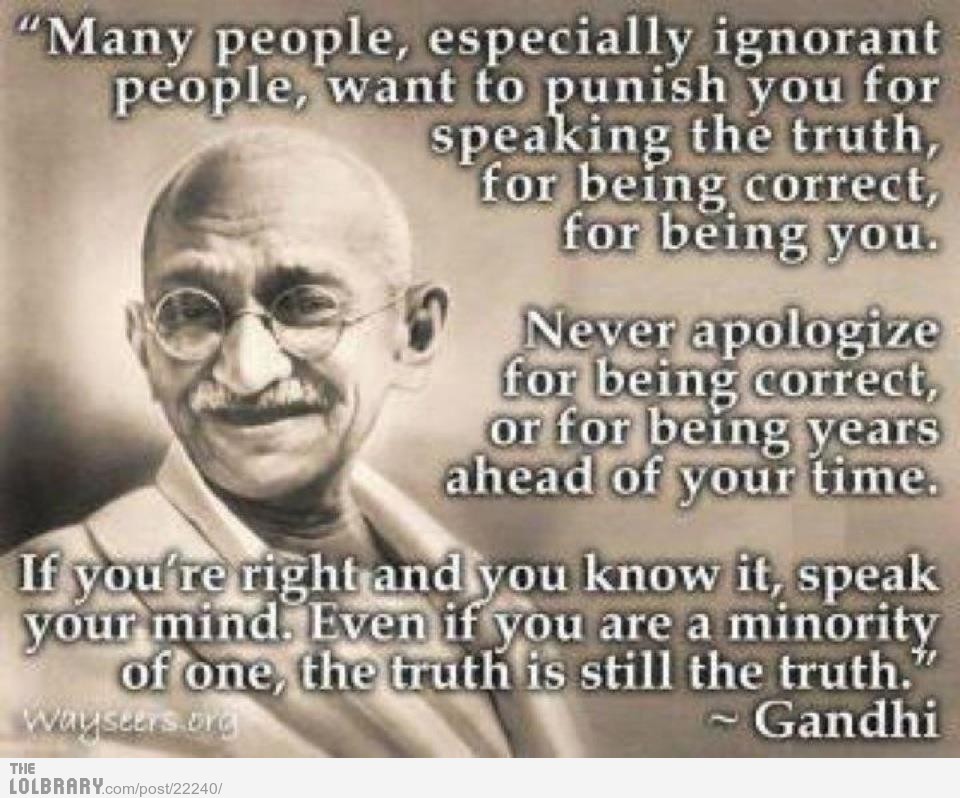
Gandhi

The other day a good friend and I were discussing the state of the world. Our conversation touched on the Boston Marathon bombing, the Bangladesh factory collapse, drone warfare, Guantanamo, the increasing concentration of media ownership, and the sorry state of the Roman Catholic Church. My friend remarked on the futility of attempting to do anything to change the world situation. Better to simply tend your garden, he said, rather than wasting psychic energy and physical effort to affect what cannot be changed.

I must confess that I found myself agreeing with my conversation partner more than not. It all seems so futile when we consider the overwhelming power of money, the state, the military, and of education and media propaganda whose predominantly conservative purpose is to keep things the way they are.

Suitably depressed, I took up my spiritual reading before going to bed. I’m currently pouring over, perhaps for the fifth time, Eknath Easwaran’s commentary on the Bhagavad Gita. In The End of Sorrow, the first of his three volume work (The Bhagavad Gita for Daily Living), Easwaran addresses the question of “detachment.” By that he means being free from anxiety or depression about the results of anything we do. What I read seemed intimately related to my exchange with my dear friend.

Easwaran points to the example of Gandhi:

“Prior to Gandhi, even people who had seen and grieved over the political bondage of India could not bring themselves to act because they thought the situation was impossible. They could not act because even before taking the first step they were already caught in results. We too, when faced with problems, have a tendency to think, ‘There is nothing we can do about it.’ . . . Wherever we find a wrong situation – in our personal life, in our country’s life, or in our world’s conflicts – we all have a duty to work to correct it.”

The words hit home. It’s giving up in the face of seemingly overwhelming odds that so strongly tempts us (me!). It’s just so easy to give up.

But as Kevin Trudeau reminds us, the temptation gives us far more credit for knowing our situation than our actual condition warrants. Coming from a completely secular and otherwise questionable perspective, Trudeau says we’re like people looking at a computer screen, but seeing only the bottom right hand corner – perhaps an inch square. We just don’t see what’s going on in the rest of the screen at all. But we make decisions and value judgments, we go in and out of depression as though we were all-knowing. We react and get attached to results as though our lives were not mere blips on the cosmic screen.

Thankfully, we don’t know very much. And our brief lives don’t offer much perspective on the effects of our actions. I’m reminded of what Mao Tse- tung’s is reputed to have answered when asked whether he thought the French Revolution was successful or not. “Too soon to say,” was his response.

It’s definitely too soon to say what the effects of our actions are or those of Dorothy Day, Daniel Berrigan, Bradley Manning, or John XXIII.

My friend is right. Results are out of our hands. But the person of faith, like Gandhi and those others I’ve just mentioned pushes ahead, doing what’s possible, leaving the results in the hands of the One who directs the universe. Only She sees the whole screen.

I take some comfort in that.