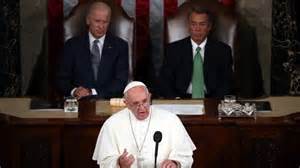
The Pope’s Address to Congress: First Impressions

Pope Congress 2

It was a fabulous speech by the world’s leading spiritual and thought-leader, who has just produced our century’s most important public document, Laudato Si’, the papal encyclical on the environment.

Pope Francis addressed not just the dignitaries in the Senate chambers, but all of us – parents struggling to support families, social activists, the elderly and the young.

The pope emphasized communitarian values: dialog, the common good, solidarity, cooperation, sharing, and the Golden Rule.

He held up for emulation four counter-cultural heroes he understood as embodying the most admirable of “American” values. They weren’t Rockefeller, Reagan, Jobs, or even FDR. Instead they were:

  1. Abraham Lincoln: the champion of liberty for the oppressed
  2. Martin Luther King: the advocate of pluralism and non-exclusion
  3. Dorothy Day: the apostle of social justice and the rights of the poor
  4. Thomas Merton: the Cistercian monk who embodied openness to God and the capacity for inter-faith dialog.

Of course, Lincoln and King were victims of assassination for championing the rights of African Americans.

Day and Merton vigorously resisted what Dorothy Day called “this filthy, rotten system.” (As is well-known, she was also an unwed mother whose first pregnancy ended in abortion.)

Following the examples of The Four, the pope called for the end of:

  • Fundamentalisms of every kind – including economic fundamentalisms
  • Political polarizations that prevent opposing parties from dialog and cooperation
  • Exclusion of immigrants by a nation of immigrant descendants
  • Capital punishment and its replacement by programs of rehabilitation
  • The global arms trade and arms sales in general along with the wars and violence they stimulate
  • Violent conflict and its replacement by difficult but essentially diplomatic process of dialog
  • The human roots of climate chaos and the related problems of poverty
  • Unlimited and directionless development of technology

Throughout this gentle but radical speech, the audience seemed to be waiting for the other shoe to drop – i.e. for the pope to mollify his conservative critics by addressing their favorite “religious issues” contraception, abortion, gay marriage. But the shoe never hit the floor.

At two points the pope about to untie his footwear. In mid-speech, he stated that we must protect and defend human life at every stage of its development. This lured his audience into a standing ovation.

However, the illustration of his point was not abortion, but capital punishment. Punishment for crime, Francis said, must never exclude hope and rehabilitation. We must end the death penalty, he asserted, since every life is sacred.

Then towards the end of his address, Francis spoke of his anticipated presence at this weekend’s Philadelphia Conference on the family. Families, he said, are threatened as never before, both from within and without.

But then, instead of addressing gay marriage, the pope spoke of the “most vulnerable” in this context – not the unborn, but “the young” threatened by violence, abuse and despair. Many of them hesitate to even start families, he lamented – some because of their own lack of possibilities. Others demur because they have too many possibilities. “Their problems are our problems,” the pope said. We must address them and solve their underlying causes.

It was a masterful speech. It continually lured conservatives into standing ovations for issues they constantly oppose: the end of the capital punishment, protection of the environment, openness to immigrants, the end of arms sales of all kinds. The address summoned legislators to their real responsibility – pursuing the common good, the chief aim, the pope said, of all politics.

The pope’s basic message was be daring and courageous – like the counter-cultural activists, Lincoln, King, Day, Merton, and (I would add) Pope Francis!

How to Be Pro-Life and Not Just Pro-Birth

Joan Chittister

Recently, Benedictine Sister, Joan Chittister, grabbed some headlines when she took on the hypocrisy of the “pro-life” crowd.

She wrote,

“I do not believe that just because you’re opposed to abortion, that that makes you pro-life. In fact, I think in many cases, your morality is deeply lacking if all you want is a child born but not a child fed, not a child educated, not a child housed. And why would I think that you don’t? Because you don’t want any tax money to go there. That’s not pro-life. That’s pro-birth. We need a much broader conversation on what the morality of pro-life is.”

Sister Chittister’s point is well-taken. Being truly pro-life means joining reluctant mothers in the sacrifices they routinely make to see that their children are fed, properly housed and educated. So claiming to be pro-life while campaigning against food stamps, universal health care, Head Start, and subsidized housing is disingenuous to say the least. It also seems incompatible with defunding Planned Parenthood, our nation’s largest provider of sex education – probably the most effective, non-intrusive birth control measure of all.

And it’s significant that such reminders come from a woman. Women after all are the ones who primarily bear the burden imposed by the narrow pro-birth demands made mostly by men. Women alone are capable of bringing unwanted pregnancies to term. They are the ones who usually end up raising children as single parents.

Meanwhile, it is primarily men who insist that women fulfill responsibilities men themselves cannot fulfill on the one hand, and can easily evade on the other. The men include most prominently celibate Catholic clergy and an overwhelmingly male U.S. Congress. In biblical terms they are (to use Jesus’ words) “experts in the law” who “load people down with burdens they can hardly carry” and which the “experts” themselves “will not lift one finger” to lighten (LK 11:46). It’s no wonder so many women see pro-birthers as militants in a war against women.

But it’s even worse than that. If abortion is the crime they allege, pro-birthers are criminal accessories. They are co-abortionists. This is because their anti-life policies which deny reluctant mothers sex education, good jobs, decent wages, maternity leave, free child care, programs like Head Start, and subsidized food and housing create an anti-life culture. And that in turn drives desperate women to terminate unwanted pregnancies that will effectively impoverish them.

If lawmakers and religious leaders really care about life and want fewer abortions, they need to create a pro-life culture that invites bringing pregnancies to term. Most obviously, this means that it’s unjust for women to be left holding the bag. In particular it means:

  • Recognizing that the absolute prohibition of abortion endorsed by many Christians is not universally accepted.
  • Realizing that abortion as already restricted (to the first two trimesters) by the Roe v. Wade decision is about as much restriction as possible in such a pluralistic context.
  • In that light, having Christians adopt a prophetic, persuasive approach to limiting abortions rather than a legal coercive one.
  • This means that committed Christians would themselves refuse to abort unwanted fetuses, that they would support others in following suit, and (above all) that they’d promote pro-life measures across the board including anti-poverty legislation, but also advocating war resistance, elimination of capital punishment, and strict environmental protection legislation.
  • Supporting sex education programs like those offered by Planned Parenthood.
  • Changing the patriarchal teaching of the Catholic Church about birth control.

Five Issues for the New Pope to Address — and to guide in his selection

cardinals

So the cardinals of the church are meeting to elect the next pope. Who cares? The media obviously do. The Catholic Church is getting a lot of air time and ink. But some of us might be caught yawning.

The yawn issues from the fact that the last two disastrous papacies (John Paul II and Benedict XVI) have so tightly packed the College of Cardinals with reactionary clones of themselves that any hope of rescuing the Romans from their deepest crisis since the Reformation seems remote at the very best.

But if there is hope of such rescue it resides in electing a pontiff who will directly address five issues: (1) summoning an Ecumenical Council, (2) opening priestly ordination to women, (3) abolition of mandatory celibacy for priests, (4) retraction of the prohibition of artificial contraception, and (5) practical adoption of liberation theology and its preferential option for the poor.

To begin with, an Ecumenical Council seems required not only to overcome the impression that the Roman Curia operating in its bubble has become hopelessly corrupt. It is necessary as well to bolster the teaching of the Second Vatican Council about collegiality after the twin papacies just mentioned did all they could to undermine cooperation with rather than dictating to local bishops.

An Ecumenical Council would also demonstrate serious intent to address the crisis of clerical pedophilia which is global in nature and requires global input to solve. Additionally, a general meeting of the world’s bishops would elicit input from theologian-advisers whose creative thought has been devalued over the last 35 years (dumbing-down the church in the process) and whose collective intellectual power transcends the capacity of any new pope who might be elected.

Secondly, the new pope and his Council must address the issue of women’s ordination. Opening the ranks of the priesthood in this way would have a twofold effect. Above all, it would be an act of restorative justice. It would incorporate into roles of church leadership its single most effective and committed constituents – whose contributions have been especially attacked, belittled and denigrated over the final year of Benedict XVI’s reign.

Admitting women to the priesthood would also have the effect of putting into proper perspective papal claims of infallibility. After all, John Paul II recklessly invoked those claims to bolster his untenable position against women’s ordination. By reversing John Paul’s error, any new pope would implicitly abandon the papacy’s indefensible claim to infallibility – and its attendant inability simply to admit error and reverse other mistakes connected with priestly celibacy, contraception, and the handling of priestly pedophiles.

Priestly celibacy is the third issue crying out for attention. To pretend there is no connection between sexual deviance and mandatory celibacy represents a monumental act of denial. Common sense would dictate that suppression of the most basic of evolutionary drives is a recipe for disaster. It is not only connected with pedophilia and misogyny, but with the loneliness that is endemic to the celibate priesthood and central to the ineffectiveness of celibates preaching to congregations overwhelmingly composed of married couples and young people anticipating marriage.

Along with the opening of the priesthood to women, removal of the celibacy requirement would immediately remedy the priest-shortage of the Catholic Church. Simultaneously it would presumably allow the many who have abandoned their calling in favor of marriage to resume the work for which they were trained all those many years. There’s simply no denying that following Vatican II, the cream of the crop was lost to this senseless and counterproductive prerequisite to ordination. It’s time to welcome back the former priests who wish to return.

Equally senseless has been the top-down decision outlawing artificial contraception made by Pope Paul VI and expressed in his 1969 Encyclical “Humanae Vitae.” That document took the decision about contraception out of the hands of the very commission the pope had then appointed to review the church’s traditional teaching. In doing so, Paul VI backed away from Vatican II’s emphasis on episcopal collegiality, and set the stage for the full retreat embraced by the papacies of John Paul II and Benedict XVI. Reversing “Humanae Vitae” would not only rectify a highly questionable teaching on contraception that obviously undermines the Vatican’s teaching on abortion; it would also move the church back on the track towards the democracy portended by Vatican II, but resisted by Rome since the end of the 18th century.

Finally, and most importantly in terms of relevance to the post-modern world, the new pope and the Council he summons must embrace liberation theology’s preferential option for the poor. I say “most importantly” because this item unlike the others goes directly to the heart of the Christian faith. Even the inveterate enemy of liberation theology, Benedict XVI in his days as Cardinal Ratzinger, recognized that liberation theology’s commitment to the poor is essential to the Judeo-Christian tradition. And with the majority of church members now located in the developing world, it is indispensable to the church’s relevance to insist that global economic and social policy be made on a percolate-up rather than a trickle-down basis.

Correlatively, a church siding with the poor must insist in no uncertain terms that current military expenditure (especially on the part of the United States) represents robbery from the world’s poor. It is also high time for the Vatican to get out of the banking business and its attendant ties to money laundering, the Italian mafia, and banking system’s inevitable preferential option for the rich.

The retreat from Vatican II represented by nearly 35 years of Ratzinger’s overweening influence as right-hand man of John Paul II and as Benedict XVI was premised on a false hope. Evidently the last two popes imagined that a restoration of a vaguely remembered halcyon past would somehow fill pews and restore order to a church irrelevantly led by a hierarchy of out-of-touch old men. So the two popes doubled down on the old order instead of following through on the promise and risks of Vatican II. The disasters of recent years have shown the foolishness of their wager.

It’s now up to the cardinals and the pope they will select to get the church back on track. The unacceptable alternative is to continue along a path that will inevitably lead to further disaster and continued irrelevance.

Oh No: Not another Sermon on Abortion!

Today’s Readings: Wis. 2:12, 17-20; Ps. 54:3-4, 5, 6 &8; Jas. 3:16-4:3; Mk. 9:30-37

When I read today’s gospel selection, I knew it would inspire preachers everywhere in this country to sermonize about abortion. After all, the reading has Jesus embracing a child and saying, “Whoever welcomes one such child in my name welcomes me.”

That scene will lead preachers to say that Jesus loved children. We all love them, they’ll add, and go on to argue that the children most in danger today are the unborn. So homilists will conclude or imply, we should vote for pro-lifers who claim to care about the unborn, and will pass laws to eliminate abortion. It follows then that we should not support those who identify themselves as “pro-choice,” since they care less about the children so close to Jesus’ heart.

Of course, the preachers in question have the best of intentions. And concern for the unborn is well and good. No doubt abortion represents a horrendous choice. It’s painful for everyone.  Virtually no one favors abortion.

However in today’s gospel, Jesus wasn’t embracing a fetus, but a real child of the kind our culture shows little concern about once they’re outside the womb. Even pro-life politicians want to cut back on programs that would help such children. That, I think, is the issue today’s gospel should be made to address. But before getting to that, and since our preachers will inevitably bring it up, let’s talk about abortion like adults.

As adults we have to admit two facts. One is that abortion cannot be eliminated, no matter what laws are passed. Trying to eliminate abortion is like trying to eradicate prostitution. Large numbers of people have always and will always seek abortion services. The rich will fly their wives, lovers or daughters to the Netherlands or Belgium or wherever safe abortion procedures are legally available. The poor will go to back-alley practitioners or they’ll take drugs or use coat hangers to do the job themselves. No, the question is not about eliminating abortion, but of reducing the number of abortions – of lessening the perceived “need” for abortion.

The second undeniable fact is that we live in a pluralistic society where people of good faith find themselves on both sides of the abortion question. And this is because they differ (most frequently on religious grounds) about the key question of when specifically personal life begins. That is, few would argue that a fetus at any stage does not represent human life and should not therefore be treated with respect. No, the real question is when does fetal life become personal? The question is when does aborting a fetus become murder?

In the thirteenth century, Thomas Aquinas and others held the position that personal life began with “ensoulment,” i.e. when God conferred a soul on the developing fetus. According to Thomas, because of the high numbers of spontaneous abortions in the early pregnancy, ensoulment could not logically happen at the moment of conception. So in his patriarchal way, he conjectured it occurred for males 40 days after conception; for females it happened 80 days after the mother’s egg was fertilized. Before those turning points, there was no question of personal life.

Of course, Aquinas’ logical position is no longer held by the Catholic Church. Its official teaching is that personal life is present from the first moment of conception. But even within the Catholic community, prominent moral theologians beg to differ. Some, for instance, would argue their case by directing attention to the way the medical profession determines the moment of death. When the brain stops emitting brain waves, “brain death” occurs. Personal life has stopped though bodily life may continue. Plugs may then be pulled even if the patient continues to breathe with artificial assistance.  If that is so, these moralists reason, no personal life exists before a fetus’ brain begins sending off detectable brain waves. That occurs only several weeks into the pregnancy.

Other people of faith have traditionally identified the beginning of specifically personal life with the moment of “quickening” (when the mother first feels her baby move), with viability outside the womb, with actual emergence from the womb, or (as with some Native Americans) with the “painting” of the emergent child to distinguish it from animals.

[By the way, no Protestant churches took an official position on the abortion question before the 1979. It was then that the Moral Majority decided to adopt abortion as the trump issue of the Republican Party. The idea was to gain partisan allegiance by tapping into racial resentment among whites, especially in the South who saw “big government” as unfairly favoring African-Americans. Accordingly, the issue of abortion was presented as another example of “big government” in a political climate where overt racism was no longer socially or politically acceptable. “Pro-life” became an acceptable substitute for anti-Black.]

Given those differences among people whose religious traditions will not be going away any time soon, the Roe v. Wade decision of 1973 probably goes about as far in restricting abortions as any law in a pluralistic U.S. can go. (Yes, Roe v. Wade does not simply legalize abortions; it restricts them significantly.) The controversial Supreme Court decision specifies that during the first trimester the mother may decide about the termination of her pregnancy without consultation. During the second trimester, she must confer with her physician. And during the final three months of pregnancy, the state recognizes its need to protect the unborn; it can accordingly forbid or otherwise condition pregnancy termination.

But aside from all that, it still must be admitted that the numbers of abortions in the United States and in the world remain unacceptably high. The question remains how to reduce those levels. Ironically, passing laws does not seem to help. For instance, abortion has been completely outlawed in many Latin American countries.  Yet those very countries lead the world in numbers of abortions performed each year. But where abortion has been legalized, as in the Netherlands and Belgium, abortion levels are the lowest in the world.

Government-sponsored social programs explain the difference. These involve provision of thorough sex education in public schools, free contraceptives, pre and post-natal care for expectant mothers, family leave arrangements and affordable child care for working parents, subsidized food grants, and a host of other child-centered programs of the very type “pro-life” politicians would like to abolish.  However, all of the programs just mentioned provide a welcoming atmosphere for children and reduce the perceived “need” for abortion.

Where would Jesus stand on all of this? We don’t know. He said not a word about abortion. But in today’s gospel he says more than a word about children. He embraces a child and says “Whoever welcomes one such child in my name welcomes me.”

Once again, in doing that Jesus is not embracing a fetus, but an actual living child about whose human status there can be no debate. Moreover, the child in question was probably of the type many opponents of abortion have little use for or sympathy with. After all today’s gospel scene takes place in Capernaum, the urban center that Jesus adopted as his home town after he was thrown out of Nazareth.

Remember that Jesus spent his time among the poor who represented his own origins.  So the child Jesus embraces was probably a smelly street kid with matted hair and a dirty face. He or she was probably not unlike the street kids found in any city today – the ones hooked on sniffing glue and who have learned to sell their bodies to dirty old men from way across town, and often from across the world.

I make all this supposition because the reason Jesus embraces the child in today’s gospel is to present his disciples with a living example of “the lowest of the low” – God’s chosen people.  In Jesus’ world, all children were at the bottom of the pecking order whose rabbinical description ended with “idiots, deaf-mutes and the young.” And among the young, street children without father or mother would indeed represent scraping the bottom of the barrel.

Embracing children like the one Jesus held doesn’t mean legally restricting abortions beyond Roe v. Wade. Neither does it mean “tough love,” nor forcing impoverished mothers to bring their children to term and then telling them “You’re on your own.” Rather, embracing poor children – truly being pro-life – means creating a welcoming atmosphere that receives children as we would receive the Jesus who identifies with them in today’s gospel. Yes, it suggests supporting those “Big Government” programs that work so well elsewhere.

Remember all of that when you hear your pastor’s sermon on abortion this Sunday.