Last week at least 137 Russians were killed at the Crocus rock concert outside of Moscow. Untold numbers were wounded, some remaining in critical condition. ISIS K has claimed responsibility.
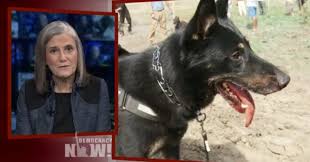
However, do you know who’s truly responsible according to “Democracy Now” (DN)?
“Putin!”
That’s the takeaway the show’s audience was left with at the end of today’s program (3/25/24).
The presentation said little about the attack itself, much less about its impact on the Russian people. Nothing at all about how or by whom the attack was planned. Nothing but denials about Ukraine, and not even a mention of possible U.S. involvement.
Instead, it was all about “Putin” (never “President Putin” or “Mr. Putin,” only a disdainful “Putin.”)
Accordingly, DN centralized interviews with two anti-Kremlin guests whose evident intention it was to blame the whole tragedy on the Russian president. The guests were Nina Khrushcheva, Professor of international affairs at the New School, and Moscow correspondent of The New Yorker, Joshua Yaffa. According to both:
- The attack represents a major failure of Putin and his security apparatus.
- It was the result of longstanding Russian mistreatment of the country’s substantial Muslim population.
- The United States had responsibly and generously warned the Kremlin about the impending attack.
- However, its paranoid president chose to ignore the warnings referring to them as “blackmail.”
- Moreover, with zero evidence, only the Russian president’s “paranoia” has made him accuse Ukraine of being involved.
- Furthermore, It’s a mistake to jump to the conclusion that the perpetrators of the attack were attempting an escape to Ukraine, since their route was interrupted by Russian police 140 miles from that supposed destination.
- After all, Putin’s interests are not in protecting the Russian people, but only his own authoritarian regime that has been responsible for the assassination of Alexi Navalny and has imprisoned more people than were incarcerated under previous Soviet leaders.
- Shockingly, when they appeared in court, those arrested for the crime bore marks of torture.
- And of course, Russia’s (already week’s long) attacks on Ukrainian infrastructure is an attempt to divert attention from Putin’s own failures.
I found all that extremely disappointing – especially since (to her credit) Amy Goodman’s coverage of world events does not usually follow the direction mandated by U.S. propaganda. However, in this case, it clearly did.
Instead of the usual denunciations of “Putin” it would have been much more informative to investigate the actual perpetrators of last week’s massacre. Ex-CIA personnel such as Ray McGovern and Larry Johnson could have helped with that. So could an interview with Scott Ritter (see below). Together or separately, they might have contextualized the horrific event by pointing out:
- Victoria Nuland’s cryptic statement about “nasty surprises” in store for Russia in its near future.
- The Russian president’s un-paranoid reasons for suspecting U.S. involvement in the attack given longstanding U.S connections with ISIS in Afghanistan, Syria, and elsewhere to wage war specifically against Russia.
- A long history of U.S. sponsorship of terrorist attacks on Russia including its recent destruction of the Nord Stream Pipeline.
- John Kirby’s strange premature disavowal of Ukrainian responsibility for the massacre before allowing any time whatsoever for investigation. (This was like the immediate indictment of “Putin” for the death of Alexi Navalny and for that of Yevgeny Prigozhin before their corpses were even cold.)
- The attack’s convenient (for the west) and distracting effect in the wake of Mr. Putin’s recent landslide victory in a presidential election that (according to non-Russian sources) witnessed a voter turnout of 70% and a vote 87% for Mr. Putin.
In any case, here’s what Russian expert and former UN weapons inspector Scott Ritter had to say about the Crocus tragedy:
- The attack indeed represents a puzzling failure on the part of President Putin’s security apparatus. It has much to answer for.
- However, that’s far from the point that needs highlighting – viz., the event’s perpetrators and possible connections to Russia’s avowed enemies, Ukraine, and the United States.
- The attack’s attribution to Muslim terrorists also provides reason to doubt such jihadist identification since the killers untypically accepted money for their crime and did not choose “martyrdom” rather than surrender in its aftermath.
- On March 7th (well before the Russian elections) the United States did indeed issue a warning to U.S. residents in Russia about impending terrorist attacks and the advisability of staying away from large gatherings such as concerts.
- The Russians “know everything” about the attack and the destination of its fleeing perpetrators.
- Principal sources of official information are the captured cell phones of the fugitives.
- Additionally, their phone conversations were intercepted in real time as they fled towards the Ukrainian border.
- Both sources also contain incriminating information such as videos made while casing the crime site just before Russia’s presidential elections.
- Such evidence suggests that the mass shooting was planned to disrupt that process, but that heavy security surrounding it forced postponement of the crime.
- Phone information has also allowed authorities to track down the terrorist cell in Moscow that provided logistical support for their comrades.
- All those arrested are currently divulging much more information that will soon come to light.
The lesson to be drawn from all this is one of extreme caution. Putin is not the issue here. Possible connection with Ukraine and the CIA is.
And regardless of what we might think of Scott Ritter’s analysis, it signals the complications of the questions at hand, the importance of not jumping to conclusions and of asking the right questions.
Propaganda, fake news, changing the subject, and gaslighting are everywhere. Even “Democracy Now,” even Amy Goodman are not immune from disseminating Russophobia. They too can be fooled by the Grand Wurlitzer of U.S. propaganda voiced by characters such as Khrushcheva, and Jaffa.
The lesson here (as always) is to focus on the heart of the matter, don’t allow misdirection of attention; retain constant suspicion of anything our government tells you. They’re all liars. Ex-CIA director Mike Pompeo put it best when he said as much.




 About Things That Matter