Regime Change in the U.S.: A Taste of Our Own Medicine

 I’ve given up on the United States. It’s irreformable. It’s a failed state.

Think about it.  As things stand, the U.S. can do nothing but fight wars, close borders, impose sanctions, and fight meaningless culture wars. And even at that, despite the more than $2 billion it spends on “defense” each day, our country can’t win its forever wars. It lost in Vietnam, in Iraq, and Afghanistan. It’s in the process of losing in Ukraine. And yet, it’s planning a further foray into China.

Ukraine is the best illustration of the failed policy just mentioned. We’ve sent billions upon billions to support the war there, but the Russians are prevailing, nonetheless.

Meanwhile, our own infrastructure is in decay; millions are without healthcare, millions more are addicted to pain killers; there’s a mass shooting every day (literally); homelessness abounds, young people can’t afford college tuition; prisons are overflowing; our money-driven elections are a sham, and our government is complicit with the genocide unfolding in Gaza. At the same time, we end up blaming the poorest people in the world – the immigrants at our southern gates – for all our problems.

Yes, we need regime change.

And I’m not just talking about changing presidents or even the criminals now “serving” in the Congress.

No, I’m talking about REGIME CHANGE – a new order responsive to people like us, rather than to corporations, bankers, financiers, and Wall Street.

That means replacing all that with a system that would cut military spending by at least 75%, prioritize the issue of climate change, close foreign military bases, eliminate nuclear weapons, practice real diplomacy (which always means dialog and compromise) and derive its leadership from the working class, instead of from the bosses who control our work lives.

So, if we need regime change, why not apply to the U.S. the formula our bosses routinely use for that process — I mean the one it’s employed against the Soviet Union all during the Cold War, against Iran in 1953, Guatemala the following year, Cuba over the last 65 years, Chile in 1973, Nicaragua since 1979; Venezuela since Hugo Chavez instituted his Bolivarian Revolution. . .. The list goes on and on., but the formula’s always the same.

In every case, it’s: (1) make the life of working-class people as miserable as possible (2) by creating crisis. (I’m talking about military coups, sanctions, creation of food and fuel shortages, outright terrorism, and deprivation of human rights.) In fact, (3) make ordinary people so miserable that (4) the victims of such measures will rise and overthrow Stalin, Mossadegh, Arbenz, Castro, Allende, the Sandinistas, Maduro, etc. and (5) introduce a fascist American puppet like Resa Pahlavi or Augusto Pinochet.  

Again, that’s the strategy: immiserate ordinary people and make them overthrow America’s official (usually socialist-leaning) enemies and replace those enemies with right-wing fascist pawns.

The problem is (for the U.S.) that such gambits rarely work for long. They often end up awakening the left who then replace American puppets with leftists like Lula in Brazil.

Well, I’m thinking, why not turn the tables on the bosses and run the same gambit here at home, but this time against the bosses themselves? In our current circumstances, this might entail:

  1. Not voting in the next election.
  2. Alternatively, voting for “uncommitted,” for Cornel West, RFK, or Marianne Williamson.
  3. Thereby, allowing Donald Trump to be elected next November.
  4. He’ll of course make our lives miserable over the short term.
  5. But his policies will make clear the above-noted disfunctions of the system and awaken the currently dormant left.
  6. This may eventually spark a progressive movement for the radical systemic change I’ve been referring to.
  7. Which one way or another may eventually overthrow the corrupt system that even now immiserates our lives.

It’s worth a try. And when you think about it, what have we got to lose? As I said:

  • Our system is broken beyond repair.
  • It is incapable of addressing our real problems noted above.
  • We need something to awaken the left and force the required changes,
  • This means enduring at least four years of fascism under Donald Trump who might refuse to leave office after four years.
  • Sparking even wider discontent and rebellion.
  •  And at the very least, giving us a taste of our own medicine.

In any case, it’s what “our” government has been doing all over the world at least since the end of the Second Inter-capitalist War. There’s no way of sugar-coating the required remedy.
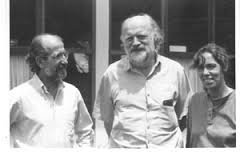
Peggy & I Study with Franz Hinkelammert in Costa Rica (12th in Series on Critical Thinking)

Franz & Peggy

The next stop on the critical thinking odyssey I’m outlining here was Costa Rica. There I finally met Franz Hinkelammert, whose Global South approach to critical thinking provided the theory I sought to make everything I had learned in Brazil come together. Recall that I had encountered his latest work while in Brazil. (Franz is pictured above with Peggy and me in 1992.)

Franz Hinkelammert is a German economist and theologian. After coming to Latin America in 1976, he lived and worked mostly in Chile. But then the 1973 U.S.-sponsored coup removed the democratically-elected Socialist president of the country (Salvador Allende). The subsequent installation of a brutal dictatorship under General Augusto Pinochet, made Chile extremely dangerous for people like Hinkelammert. So he fled to Costa Rica, where he, liberation theologian giant, Hugo Assmann and biblical scholar, Pablo Richard founded the Department of Ecumenical Research (DEI), a liberation theology think tank. The DEI specialized in preparing grassroots organizers to work for social change throughout Latin America. However, its emphasis was not on “training” for activism, but specifically on analysis and critical thought.

My opportunity to study with Franz came with my second sabbatical in 1992. Peggy and I applied and were accepted as the first North American participants in the DEI’s annual Workshop for Invited Researchers. The eight-week course hosted about 20 scholars from across Latin America. Each of us had a research project whose goal was publication in the DEI’s quarterly, Pasos. Not surprisingly, mine was on critical thinking.

During the workshop, Franz, Pablo Richard, and fellow Chilean, Helio Gallardo were the principal presenters and discussion leaders. In his own lectures, Franz emphasized what is for him an enduring key idea about critical thinking. It is expressed most clearly in his Critique of Utopic Reason and also in his Critique of Mythic Reason. In both, he highlighted the essentially utopian nature of critical thought. Its point, he says, is not simply to analyze arguments for logical fallacies. Instead, it is political. It is essentially utopian – to create a better world by imagining the best possible world. Hinkelammert’s argument runs as follows:

  1. If politics is the art of the possible,
  2. Then a utopian idea of the impossible, but at the same time desirable, is required
  3. Not necessarily as a goal to be implemented
  4. But as a “North Star”
  5. Guiding critical thought and action towards what indeed can be practically accomplished.
  6. No such goal can be arrived at without utopian ideas towards which critical thinking gestures.
  7. Utopian thought comes naturally to human beings.
  8. In fact, critical thought without utopian concepts is itself unconsciously utopian.

Franz illustrates his idea by pointing out that utopias are not at all merely the province of starry-eyed idealists. They are essential for any critical thought intent on beneficial social change. In that sense, Franz’s own North Star for critical thought is the simple idea later articulated by the Zapatista rebels in Mexico as a world with room for everyone. Meanwhile, the capitalist utopian ideal is of a completely free market governed only by Adam Smith’s “Invisible Hand.” That is the guiding constellation under whose direction all mainstream economic theory is fabricated.

Hinkelammert’s argument highlights the difference I’ve been trying to describe between critical thinking as taught in the United States and what I discovered in the Global South. In the Global South, critical thinking is concerned with the big picture – with entire systems, with social analysis of economic and political structures. As explained by Franz and others, it is by no means a matter ferreting out what is now called “alternative facts” or “fake news.” Such concern glosses over the lies embedded in the very parameters of perception which act as blinders for both students and their teachers. In that sense, the critical thinking I had become used to had been literally partial in its ignorance and denial of the experience of the world’s majority who live in the former colonies. From that viewpoint concentrating on logical inconsistencies or falsehoods in arguments divorced from the unexamined socio-economic matrix of capitalism only serves to normalize what should be completely unacceptable to human beings.

For Hinkelammert, that was the insight of Hegel, Feuerbach, and Marx. Marx in particular was a humanist who saw critical thought as focusing on human emancipation from the chains imposed by capitalism and the colonialism on which it depended. Critical thinking, in Marx’s estimation, involved identifying those chains and the steps necessary to humanize all relationships between persons and with nature itself. In theological terms, the mandate is: “Do what God did; become a human being!” That is the project of the type of critical thinking I was now encountering.

That, in fact, became what I subsequently attempted to communicate my students. And I began right there in San Jose. There, by mere coincidence and chance, I began teaching in a Latin American Studies Program (LASP). It was a term abroad for Evangelical students from the United States whose institutions were affiliated with the Council for Christian Colleges and Universities (CCCU). Teaching fundamentalist Evangelicals about colonialism, U.S. intervention in the Third World, and the history of capitalism was a wonderful challenge. Even more so was helping them understand liberation theology.

We clashed, especially at the beginning of our semester-long encounters. And (in terms of the topic at hand) that was because I was coming from the world-centric perspective of liberation theology, while their standpoint was almost exclusively ethnocentric. For them, the United States could do no wrong, and the Bible was to be taken at face value. To criticize the U.S. or to interpret parts of the Bible as myth, legend, or poetry was simply unacceptable.

I, on the other hand, owned the world-centric approach I’m describing here. I took to heart international polls that consistently identified the United States as the greatest threat to world peace.[1] Moreover, my approach to the Bible was informed by the historical critical methodology of modern scripture scholarship.[2]

Such challenges however were mitigated by the reality check the LASP program provided each semester’s cadre of students. I’m referring to four days among the descendants of African slaves in Limon on Costa Rica’s Caribbean coast, as well as two weeks each in Nicaragua, Guatemala, and Cuba. In each of those cases, we more or less followed the practice I had experienced in Nicaragua. In the midst of their studies, students lived with local families and received on-site presentations from indigenous tribal leaders, union organizers, politicians, historians, and church officials – most of whom were not ethno-centrists. Students uniformly described it all as life-transforming. And I’m sure that direct contact with the victims of what bell hooks calls “white-supremacist imperialist capitalist patriarchy” made them more thoughtful about their reactions to world-centric perspectives.

Additionally, at least for me, those LASP trips – especially to Cuba – provided opportunities to observe and judge attempts to implement what Hinkelammert would call critical utopian theory.

(Next week: My learnings in Cuba)

[1] Bennett-Smith, Meredith. “Womp! This Country Was Named the Greatest Threat to World Peace.” The Huffington Post. TheHuffingtonPost.com, 02 Jan. 2014. Web. 16 Feb. 2017.

[2] “What Is the Historical-Critical Method?” The Historical-Critical Method. N.p., n.d. Web. 16 Feb. 2017.