Readings for 30th Sunday in Ordinary Time: Jer. 31:7-9; Ps. 126: 1-6; Heb. 5:1-6; Mk. 10: 46-52
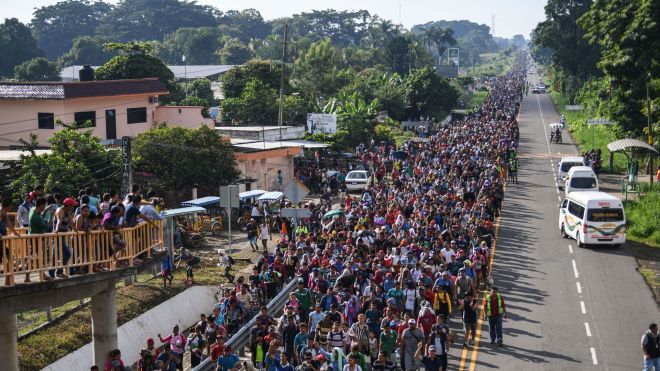
Today’s Gospel reading centralizes spiritual blindness and the nature of the cure Jesus offers. By extension, it provides perspective on the caravan of more than 6000 Central Americans (mostly Hondurans) currently approaching our southern border.
True: on the surface, the episode is simply about Jesus working yet another miracle – this time for the sightless beggar called Bartimaeus. However, in reality the story represents two fundamental biblical paradigms — one describes the true nature of conversion. The other identifies God’s “Chosen People.”
Let me unpack all of that.
Begin by recalling the relevant story as written by Mark.
A blind man is sitting by the roadside. His garment is spread out on the ground before him. The cloak invites passers-by to throw a coin on its fabric. Bartimaeus hears that Jesus is near accompanied by a large crowd. So, he cries out, “Jesus, Son of David, have pity on me!”
Jesus’ followers try to shut the man up. But the beggar won’t hear of it. He shouts even louder, “JESUS HAVE PITY ON ME!”
Finally, Jesus hears the blind man’s voice over the crowd’s din. He calls him over. The man jumps up and throws aside his garment (his only source of income). [In other words, unlike the Rich Young Man Mark presented two weeks ago (MK 10:17-30), this specifically poor man has no trouble renouncing everything he has and confronting the Master empty-handed.]
So, Jesus asks, “What would you have me do?”
The man responds, “I want to see!” Jesus replies, “Your faith has saved you.” So, the blind man is given sight. He then follows Jesus “on the way” of non-violent compassion.
Bartimaeus, then, is a model of conversion.
In performing this wonder, Jesus was acting as compassion itself. As a prophet, he was following in the footsteps of Jeremiah whose words we read in this morning’s first reading. There Jeremiah was a spokesperson for a God announcing good news specifically to women, their children, the exiled, blind, and lame. As today’s readings from the Book of Psalms recalls, that God makes such people’s dreams come true, and turns their tears to laughter, not to guilt and shame.
And that brings me to the Honduran Caravan presently approaching our borders. They say that this caravan of more than 6000 people, mostly from Honduras, constitutes the largest mass exodus we’ve ever seen in this hemisphere.
When I say “Exodus,” I’m choosing my words carefully. The word is loaded, as it recalls the key Jewish Testament paradigm I mentioned earlier. The word reminds us of the original “Exodus,” when a motley horde of slaves stormed the borders of what we now call Palestine.
For Jews today, that first Exodus was the beginning of Hebrew history. In fact, the word Hebrew means the people who cross-over or pass through. Again, that refers to the origins of the ones who thought of themselves as The People of God – as God’s chosen ones. According to their tradition, the Hebrew refugees were God’s chosen ones — God’s favorites.
The Cross-Over People were seeking land. They thought of themselves as on a divinely-inspired mission to take possession of acreage from those who had too much of it. The refugee-invaders believed that the earth belongs to God, and that God’s intention is a world with room for everyone – not just for those who have sufficient resources to claim ownership of the Great Commons God created.
However, such claims made no difference to rich Canaanite landowners. Like many today, they had appropriated the Great Commons as their own. And in doing so (at least according to the Cross-Over People) they transgressed God’s fundamental intention.
As would-be followers of Jesus, self-proclaimed Christians (as well as all Jews) should be the first to recognize and welcome today’s Cross-Over People as contemporary Hebrews.
Moreover, in the case of Hondurans, we should be clear in drawing connections between our government’s oppressive policies that have created the conditions the Hondurans desire to escape. Our government has treated them the way the Egyptian Pharaohs treated their Hebrew slaves. To wit, remember:
• The decades-long support of the United Brands (now Chiquita) Banana company against workers seeking higher wages and better living conditions.
• The wars waged by the U.S. in Central America all during the 1980s.
• The Central American Trade Agreement (CAFTA) that disemployed small farmers and removed protections from workers throughout the region and in Honduras specifically.
• The United States-supported military overthrow of the democratically elected Honduran government in 2009
• U.S. support of the current Honduran president who was elected in a fraudulent election.
With all of this in mind, our prayer today should be, “Lord, I want to see. Help me to ignore those (including those claiming to be your followers) who would shut me up. Lord, let me hear instead the voices of the poor, the widows, orphans, and refugees. Cure my blindness to the true identity of your people. Help me to voice my fearless support for the Honduran refugees.”
 About Things That Matter