On Re-appropriating My Priesthood


Ordination[1]

I’m so appalled at the prospect of a Donald Trump presidency and the threats it poses to everyone and everything I care about:  the environment and climate chaos, avoidance of nuclear war, victims of torture and false imprisonment, Muslims, drone attacks, wealth disparities, women’s reproductive rights, people of color, the LGBT community, our public school system, the right to privacy, human rights in general, labor unions – my children and my grandchildren.

In fact, as I’ve written recently, a Trump presidency portends the dawning of a Fourth Reich, where the victims of incineration will be not only Jews, but all of us, as the White House teems with climate change deniers whose policies threaten all species and the continuity of human life itself.

So the question is, what can we do about it? What talent does each of us have to respond to Trumpism? As parents and grandparents, teachers, writers, counsellors, school board officials, musicians, public speakers, church members, and public citizens, what does each of us have to offer these unprecedentedly dangerous times.

My own answer is my priesthood.

Only gradually and reluctantly have I come to that conclusion. After all, 40 years ago I exited the Catholic priesthood, got married and raised a family of three outstanding children. I remained active in my local church. And as a professor at Berea College and associate of Costa Rica’s Ecumenical Research Institute (DEI), I continued my role as a theologian with a doctoral degree from Rome’s Academia Alfonsiana. For years I taught in a Latin American Studies Program that took students to Nicaragua, Guatemala, and Cuba. In those capacities, I wrote books and articles and offered courses connected with liberation theology.  However, I resigned myself to my role as lay person – a member of the church’s “loyal opposition.”

And the opposition was absolutely called for. Over the years I’ve found myself dismayed as two consecutive regressive popes (John Paul II and Benedict XV) waged a vicious campaign against liberation theology and systematically removed from the hierarchy and Catholic seminaries progressives and theologians like me. The result over the two generations has been the production of a largely reactionary Catholic clergy who long for the good old days before the Second Vatican Council (1962-’65).

So as a lay person, I’ve often found myself sitting passively in my pew while rebelling internally against the reintroduction into the Catholic liturgy Latinisms and even Latin itself. I’ve listened uncomfortably to well-intentioned priests offer ill-prepared pious platitudes in their homilies rather than reflections connected with the historical Jesus and his relationship to the problems that householders like me face in our private and public lives. And, to speak truly, I was blaming them unfairly. After all, how could they possibly offer what their retrenched seminary training prevented them from receiving?

Still, it struck me as ironic that hundreds of people in my parish come together for about 2 hours each Sunday to reflect on their most dearly held (Gospel) values, but come away having barely tapped into the unlimited power for changing their personal lives and the world itself that those values supply. What a waste, I thought – not only for the parishioners directly involved, but for the world.

Then came a breath of fresh air reminiscent of Pope John XXIII’s famous “opening of windows” more than 50 years ago. Argentina’s Jorge Bergoglio became Pope Francis – a man intent on recovering the spirit of Vatican II. Deeply influenced by the liberation theology his predecessors had warred against, he published “The Joy of the Gospel” (J.G.) and then his eco-encyclical, Laudato Si’ (L.S.). Both publications were bolstered by unprecedentedly honest and refreshing public statements. (Who can forget his question about homosexuality: “Who am I to judge?”)  Francis not only called the church to profound reform; he called the world itself to a “bold cultural revolution.”

As for church reform, Francis called for a “new chapter” in the history of the Catholic Church and for the Church to embark on a “new path” (J.G. 1, 25) on which things cannot be left as they presently are (25). He called for new ways of relating to God, for new narratives and new paradigms (74). He wanted new customs, ways of doing things, new times, schedules, and language (27) — with emphasis on better prepared and delivered homilies (135-159).

Despite (lamentably) continuing to exclude women from the priesthood, the pope ordered the church to expand their roles in church life.  He recognized women as generally more sensitive, intuitive, and otherwise skilled than men (103, 104).

Clearly, then, the pope was speaking (as he said) not primarily to pastors and bishops, but to everyone (33). Decisions about change, he said, should be guided by the principle of decentralization (16, 32). They should be made at the parish level, because parishes are more flexible than Rome or the local chancery, and more sensitive to the specific needs of local people (28). The inventiveness of local communities should not be restrained, he said, but limited only by the openness and creativity of the pastor and local community (28). Such decisions should be respected by local bishops (31).

As for connecting the gospel with world issues, Pope Francis identified the struggle for social justice as “a moral obligation” that is “inescapable” (220, 258). He saw “each and every human right” (including education, health care, and “above all” employment and a just wage) as intimately connected with “defense of unborn life” (192, 213). He also completely rejected war as incapable of combatting violence caused by “exclusion and inequality in society and between peoples” (59). Pope Francis rejected unfettered markets and the “trickle down” ideologies as homicidal (53), ineffective (54), and unjust at their roots (59).

In Laudato Si’ the pope issued an urgent call to the Church and the world to address issues connected with human-caused climate chaos.  In this the entire encyclical (see my book, Understanding Laudato Si’: a Discussion Guide) might be seen as a complete rejection of Trumpism and of the entire Republican Party’s denial of that problem.

So, once again: what to do about it?

Experience shows that the anti-Vatican II clergy resistant to Pope Francis remains incapable of responding either to the latter’s Apostolic Exhortation (J.G.) or to his eco-encyclical (L.S.). Much less has it demonstrated a willingness to address the issues of political-economy, racism, sexism, homophobia, xenophobia, war, torture, etc.  raised by the emergence of Trumpism. (Once again, it is wrong to blame the clergy for this. Their training has made effective response impossible.)

So I’ve decided to do something about it myself. I’ve decided to reactivate my priesthood.

Honestly, I have to admit that the process of doing so began about 5 years ago following my retirement after 40 years of teaching at Berea College. It was then that I set goals for myself. One of them was an ill-formed, vague resolve to “reclaim my priesthood.”

As a preliminary step, I started a blog. Its center piece was the publication of a “Sunday Homily” each week. The reflections tried to connect world events, personal, and family problems with each Sunday’s liturgical readings.

Eventually, my homilies were picked up by OpEdNews – a completely secular progressive news source run by a Jewish editor. Over the years, I’ve published more than 200 such homilies covering Catholic lectionary readings for all three liturgical cycles. The result has been the creation of a kind of cyber community of readers that averages 1600 views of each reflection every week.

Now, in view of the crisis of Trumpism, I’ve decided that my contribution to resistance will be to translate that cyber community into a real-time assembly of faith. It will actually attempt do something to implement Pope Francis’ summons to church reform, and address in particular issues connected with climate chaos.

What I’m proposing is not a Protestant or even an ecumenical gathering. Rather my call is to an alternative Catholic “parish” in my town. Of course, this is not unusual; most towns of any size have more than one Catholic parish. Though specifically Catholic, all people will be welcome – Catholics, Protestants, atheists . . . In particular, “drop-outs” from our local community of faith are encouraged to join.

I imagine the gathering will be very simple – nothing of a show or performance. Rather, people will gather in my home (to begin with). We’ll sing or chant for a while, read the week’s liturgical selections, and share reflections. Afterwards we’ll gather at the dining room table for a brief Eucharistic breaking of bread followed immediately by a pot-luck meal. The week’s meeting will conclude with a planning session outlining activities for the coming week to resist the inroads of Trumpism.

All of this reminds me of the activities of Dietrich Bonhoeffer’s “Confessing Church” in the 1930s when Lutherans and others decided they had to do something to resist Hitler’s fascism. What I’m proposing here is an analogue, where people of faith call on their tradition to confront fascism’s re-emergence.

I’m convinced that only resistance fortified by deep faith can effectively combat that reincarnation. And even if only two or three join me in this proposal, I’m determined to go through with it. After all Jesus did say: “Wherever two or three are gathered in my name, I am there in their midst” (MT 18:20).
Fidel & Religion: in His Own Words

fidel-on-rel

“I don’t understand why Fidel doesn’t allow free elections in Cuba. After all, he’d win hands down every time.”

I remember how astonished I was when the young spokesperson at the U.S. Intersection in Havana pronounced those words about 20 years ago. But I had heard her correctly. Despite being a U.S. diplomat, she was admitting that Fidel Castro was extremely popular with Cubans. Her concession contradicted the official U.S. position repeated incessantly since 1959 – and regurgitated mindlessly by U.S. commentators last weekend on the announcement of the comandante’s passing.

The young diplomat’s recognition of Fidel’s popularity was confirmed for me again and again as I visited Cuba repeatedly since 1997. That was the year of my first trip there with the Greater Cincinnati Council of World Affairs. Two years later, I and a colleague led a group of Berea College students to the island for a month-long January Short Term study of the African Diaspora in Cuba. Subsequently, while teaching in a Latin American Studies program sponsored by the Council of Christian Colleges and Universities, I visited the island perhaps eight times as the term-abroad program for U.S. students brought them there each fall and spring. Then three years ago, I returned to Cuba to teach a Berea College summer term there. I’ll return with a similar program next May.

All that experience has given me a love for Cuba and Cubans – and a deep appreciation for the Fidel Castro as one of the most important political figures of the 20th century. Few (outside the United States) would disagree with that evaluation.

But there’s another dimension of Fidel’s person that strikes me as important in these days of widespread religious fundamentalism. As a theologian, I have come to see him as the era’s most theologically sensitive political leader. (My evaluation includes people like Jimmy Carter. Of the two, Fidel was far better informed.) As such he calls friends of revolution everywhere to take theology seriously as an instrument of human liberation from narrow Christian supremacist understandings of faith.

That particular observation is based on a close reading of Dominican Friar, Frei Betto’s book Fidel and Religion (F&R) published in 1987. The volume was a product of interviews between Betto and Fidel carried on over a period of 23 hours in the 1980s. On its publication, F&R sold more copies in Cuba than any previous publication.

In Betto’s work, Fidel highlights the convergence of communism and Christian doctrine. He also expresses his appreciation of liberation theology, and explains the superiority of Cuban democracy to that practiced in the United States. His observations give the lie to our young diplomat’s claim that Cuba lacks free and democratic elections.

Fidel on Communism & Christianity

Read for yourself what the comandante says about coincidences between communism and Christianity. (All page references are to Frei Betto’s F&R. New York: Simon and Shuster, Inc. 1987).

  • “There are 10,000 times more coincidences between Christianity and communism than between Christianity and capitalism” (33).
  • “I believe that Karl Marx could have subscribed to the Sermon on the Mount” (271).
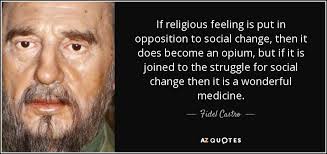
  • “. . . (F)rom the political point of view, religion is not, in itself, an opiate or a miraculous remedy. It may become an opiate or a wonderful cure if it is used or applied to defend oppressors and exploiters or the oppressed and the exploited, depending on the approach adopted toward the political, social or material problems of the human beings who, aside from theology or religious belief, are born and must live in this world” (276).
  • “. . . (I)f (the Catholic bishops) organized a state in accord with Christian precepts, they’d create one similar to ours. . . All those things we’ve fought against, all those problems we’ve solved, are the same ones the Church would try to solve if it were to organize a civil state in keeping with its Christian precepts” (225).
  • (Referring to Catholic nuns) “The things they do are the things we want Communists to do. When they take care of people with leprosy, tuberculosis and other communicable diseases, they are doing what we want Communists to do. . . In fact, I’ve said it quite publicly. . . that the nuns were model Communists. . . I think they have all the qualities we’d like our Party members to have” (227-8).

Fidel on Liberation Theology

  • “I now have almost all of Boff’s and Gutierrez’s works” (214).
  • “I could define the Liberation Church, or Liberation Theology, as Christianity’s going back to its roots, its most beautiful, attractive, heroic and glorious history.” (245)
  • “It’s so important that it forces all of the Latin American left to take notice of it as one of the most important events of our time” (245).
  • “We can describe it as such because it can deprive the exploiters, the conquerors, the oppressors, the interventionists, the plunderers of our peoples, and those who keep us in ignorance, illness, and poverty of the most important tool they have for confusing, deceiving and alienating the masses and continuing to exploit them” (245).
  • “He who betrays the poor betrays Christ” (274).

Fidel on Cuban Democracy

  • (Referring to the U.S. system) “I think that all that alleged democracy is nothing but a fraud, and I mean this literally” (289).
  • “It cannot be said of the so highly praised Western governments that they are generally backed by the majority of the people. . . Let’s take Reagan, for example. In his first election, only about fifty percent of the voters cast their votes. There were three candidates, and with the votes of less than 30 percent of the total number of U.S. voters, Reagan won the election. Half the people didn’t even vote. They don’t believe in it” (289).
  • “An election every four years! The people who elected Reagan . . . had no other say in U.S. policy . . . He could cause a world war without consulting with the people who voted for him, just by making one-man decisions” (290).
  • “In this country . . . the delegates who are elected at the grass-roots level are practically slaves of the people, because they have to work long, hard hours without receiving any pay except the wages they get from their regular jobs” (290).
  • “Every six months they have to report back to their voters on what they’ve done during that period. Any official in the country may be removed from office at any time by the people who elected him” (291).
  • “All this implies having the backing of most of the people. If the Revolution didn’t have the support of most of the people, revolutionary power couldn’t endure” (291).
  • “In other words, I believe – I’m being perfectly frank with you – that our system is a thousand times more democratic than the capitalist, imperialist system of the developed capitalist countries. . . really much fairer . . .” (292).
  • “I’m sorry if I’ve offended anybody, but you force me to speak clearly and sincerely” (292).

Conclusion

But what about Fidel’s nearly 50-year reign as President of Cuba? And what about the puzzle of my diplomat-friend? If he’s so popular, why didn’t Castro run for president the way U.S. candidates do?

I asked my friend Dr. Cliff Durand about that when he recently visited our home. Cliff is emeritus Professor of Philosophy at Morgan State University, and the founder of the Center for Global Justice in San Miguel de Allende, Mexico. He has been leading trips to Cuba every year for the last twenty years, and holds an honorary doctorate from the University of Havana. He’s the most informed USian I know about things Cuban.

Here’s what Cliff said:

  • The diplomat was correct: Castro was extremely popular with the majority of Cubans. He was regarded as the father of his country – like George Washington.
  • More accurately, he’s like Franklin Roosevelt who was elected four times here in the U.S.
  • Who can say how many times Roosevelt would have been re-elected had he not died, but had come to power as Castro did at 33 years of age?
  • Moreover, (as noted above) the U.S. electoral system doesn’t work so well. Most people don’t even vote. Campaigns are interminable and extremely costly and wasteful. And (as indicated by the recent U.S. election) their results often don’t even reflect the will of the majority of voters.
  • Cuba’s conclusion: there’s got to be a better way.
  • Cuba’s way (like that of Great Britain – and of the U.S. for that matter) is not to elect the head of state directly, but to have electors make the choice.
  • So elected members of parliament appoint Cuba’s president.
  • And (as my diplomat-friend indicated), they (election cycle after election cycle) chose their equivalent of Franklin Roosevelt.

My own conclusion is that Fidel Castro was one of the greatest figures of the 20th century. He was an insightful (atheist) theologian of liberation. As a true Communist, he was more Christian than many popes. He was more democratic than most USians can begin to understand.

What Am I Doing with My Life? A Reflection on a “Left Forum” Event

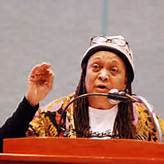
Pam Africa

“I don’t care if you’re 100 people, or 50, or 10. If there’s just one of you going against these mother f_ _ kers, it’s enough. Together we can warm their asses up!”

Those were the words of 70 year old grandmother, Pam Africa. I heard her speak last weekend at the annual meeting of the Left Forum – an organization of progressive thought leaders and activists. The meeting took place at the John Jay College of Criminal Justice of the City University of New York (CUNY). Its theme was “Rage, Rebellion, and Revolution: Organizing Our Power.”

Ms. Africa was talking about the necessity of organizing and taking to the streets in order to confront U.S. political, social and economic institutions she said were based on theft, murder, and perjury. The entire system, she added, has lost its legitimacy having become increasingly unresponsive to human need, and ever more violent in repressing those demanding their rights.

Pam Africa’s long experience gave her words credibility. She is the former Minister of Confrontation of the Move Organization, the Philadelphia African-American liberation community whose homes were bombed by Philadelphia Police Force back in 1985. Since that time, as the coordinator of the International Concerned Family and Friends of Mumia Abu-Jamal, she has been working for the release of Abu-Jamal and other political prisoners.

That was the theme of the panel discussion where Pam Africa was speaking – political prisoners.  It was the most inspiring of the events I attended, having chosen 6 of them from the more than 400 panels, workshops, and events that filled the Left Forum’s Events Directory.

There were 10 participants in the Political Prisoner presentation. About half of them were African American. Seven were women. Only 3 appeared younger than sixty. All but 1 had spent time in prison. And each and every one of them had dedicated their lives to the struggle for social justice. They’ve done so in the face of a Prison-Industrial Complex that reaps a fortune from the increasingly privatized criminal justice system currently incarcerating 2.3 million Americans – more prisoners per capita than any country in the world. The annual cost of doing so ranges from $24,000 to $47,000 per inmate.

Think of what could be done with that money, we were urged. What if it were it invested in housing, education, or mental healthcare rather than in prisons-for-profit?  Instead, those human warehouses have become a repressive government’s de facto programs for the homeless, poorly educated and mentally ill. Prison activist Anne Lamb described political prisoners there as “the most humble people you ever want to meet.”

How do so many prisoners end up behind bars?  Most of their cases do not go to trial, we were told. Instead plea bargains are struck. An arrestee is typically given the choice to plead guilty to one of a whole list of charges to avoid spending 15 rather than 5 years in prison. On the other hand, those who choose to go to trial get the book thrown at them. They end up doing 20 rather than 5 years and are held up as examples to potential plea bargainers. “You don’t want to end up like him, do you?” is the threat. The whole system saves (i.e. earns) the for-profit system millions.

Witnessing the intensity, commitment and sharp focus of participants in Pam Africa’s panel raised existential questions for me.

“What am I doing with my life?” I scrawled in my notebook. “Playing golf??”  I mean, I’m in my life’s final stage. And there is still work to do – especially around nuclear disarmament, climate change, and prison reform. As Pope Francis has pointed out, all of those issues are inter-related. Everything is! And the sad fact is that I’m largely avoiding the task.

Meanwhile, Pam Africa and the other panel discussants are out there in the streets. Once again, I’m not.

For me, the most logical response to the experience I’ve been describing here is to get involved in the Bard Prison Project. It’s a program for securing college degrees for prison inmates. Two years ago, Berea College (my former employer) was invited to join. I was asked to take part. I and other invitees did some preliminary work. Since then I haven’t heard anything.

It’s time to pursue that possibility.

As one of last weekend’s panelists put it, “We need to stand on the neck of the system and make it cough up justice.”

Dan Berrigan: in Memoriam

Dan Berrigan Resist

I just spent the last hour in tears. The occasion was a tribute to Dan Berrigan on Democracy Now (the best daily news program available).  The saintly Jesuit poet, peace activist and prolific author died on Saturday. He was about to celebrate his 95th birthday this week. What a giant!

Father Berrigan stands with Dorothy Day and Thomas Merton as the most powerful U.S. prophets and social justice activists or our era. They along with Martin Luther King are the true saints of our time.

All of them changed the way Americans approach issues of war and peace. In particular they changed the Catholic Church – challenging it to reverse 1700 years of belligerence and unquestioning support of imperial war, and to follow instead the clear teachings of Jesus the Christ.

Dan Berrigan not only wrote and spoke in ways that uncomfortably juxtaposed the Gospel of Jesus with United States imperialism; he also walked the walk – literally. He marched, spoke out, carried signs, and was arrested more times than he could remember. He spent years in prison, and staged creative protests against the Pentagon and the arms industry.

During the Vietnam War, Berrigan and other activists raided the Selective Service offices in Catonsville MD. They removed nearly 400 files from the place, and burned them with homemade napalm in the adjoining parking lot. They justified the act saying it was better to burn paper than children’s bodies.

Berrigan knew first-hand what he was talking about.  In 1968 he traveled to North Vietnam with historian, Howard Zinn. They had set out on an ultimately successful mission to free three U.S. airmen captured by the Vietnamese. In the process, he saw the burn wounds of children and the elderly scorched by the liquid fire that pursued them relentlessly even in their underground bunkers. He experienced war’s realities as he huddled there with the children and elderly during terroristic bombing raids by his own country.

On another occasion, Dan along with his brother Phil and other “Plowshares” members entered the General Electric nuclear arms plant in King of Prussia PA. There they found an (as yet unarmed) missile and used hammers to beat its nosecone to smithereens. They said they were following the injunction of the prophet Isaiah to turn swords into plowshares (IS 2:4).

I knew Father Berrigan personally. He spent a fall with us here in Berea in the mid-‘80s. His brother, Phil, visited Berea College more than once in connection with a wonderful course called “The Christian Faith in the Modern World.” Imagine actually conversing with saints like that!

I remember how enthusiastic Dan was in supporting the work of the “Berea Interfaith Task Force for Peace.” We were busy at the time with the Nuclear Freeze Movement and with resisting U.S. wars in Central America, especially in Nicaragua.

He met with us regularly – on at least one occasion, in Peggy’s and my home in Buffalo Holler in Rockcastle County. We have a snapshot of him there in our family album. He’s seated on our deck, eating from a paper plate with a bottle of beer on the floor beside his chair.

Another photo shows him standing up in protest with the rest of us at the Bluegrass Army Depot in Richmond Kentucky.  (The Depot holds WWII ordnance – mustard gas and chemical weapons still awaiting demolition.) We had infiltrated a patriotic celebration there.

Our Task Force had entered the facility with protest signs folded up under our shirts. We stood up to display them in the middle of a triumphant speech by one of the generals. Mine read “US out of Nicaragua!” Dan’s message was printed on his tee shirt. When he removed his outer shirt, everyone could see it.  “Stop the Arms Race!” it said.

One of my most memorable Ash Wednesdays came when Dan was here. In his humble understated way he celebrated a thoughtful Mass to begin the season of Lent. It reminded our packed church of St. Clare’s about the ashes created and left behind by brutal U.S. bombing campaigns and unending wars. He called us to repent by refusing our support of such conflicts.

I attended a class Dan taught three times a week during his semester at Berea. It analyzed the Book of Revelation written by John of Patmos – an otherwise unknown author who had been exiled to the Island of Patmos in the Aegean Sea by the Roman Emperor, Domitian at the end of the first century CE. Like Father Berrigan, the book’s author, “John the Revelator,” was a political prisoner. His crime was that of prophecy – of speaking truth to power. So Father Berrigan claimed a kind of “hermeneutical privilege” in dealing with the Book of Revelation. He said his exegesis was a matter of “one jailbird to another.”

I recall driving Dan to the Bluegrass Airport in Lexington the day he left us. Always on task, Father Berrigan spoke about the similarities between Israel’s occupation of Palestine and the apartheid system still flourishing in South Africa. “All these ‘settler societies,’” he said, “operate in the same brutal ways.” Sadly, his words remain true to this day.

In my early days of working at Berea College, I was privileged to give three lectures a year to the entire sophomore class assembled in Phelps-Stokes Chapel along with my colleagues, their teachers.  The context was a two-semester, primary-source survey course called “Religious and Historical Perspectives.” ( I loved the course. It taught me more than any other academic experience in my life.) My lectures were on Jesus (in the fall), on Marx (in the middle of the spring semester), and on Harvey Cox’s The Secular City (the last presentation of the year).

I remember centralizing Dan Berrigan in my Secular City talk.  I held him up (as I still do) as an example of what the great Jewish prophets, Jesus of Nazareth and Karl Marx, have to tell us about Christians’ relationship to the realities Harvey Cox described in his book.  I recalled Father Berrigan being arrested after spending four months underground resisting relentless pursuit by J. Edgar Hoover and the F.B.I.

Dan’s hands were handcuffed in front of him, I recalled. And he was asked by a reporter if he had anything to say before going off to Danbury State Prison. Father Berrigan gave a one-word response. He held up his handcuffed hands and made a peace sign. He said simply: “Resist!”  That’s his message to us today!

Thank you, Father Berrigan, for having the courage to resist and for challenging us so consistently to do the same. May we follow your prophetic example.

Showdown in Buffalo Holler (Personal Reflections Pt. IV)

Holiness

As I said last week, while Peggy, our growing family and I were “homesteading” in Appalachia, I learned a lot from our neighbors who lived in a small trailer on a lot next to ours that used to be a garbage dump. Neither Jimmy Lee nor Letty got beyond sophomore status in high school. But they were in many ways far ahead of us. They could build a house as they did together from recycled lumber. Jimmy Lee could do plumbing, electrical work, roofing and auto repair including bodywork and painting. (He was roughly my age.) Family income came from all that, but also from disability checks, food stamps, and welfare payments.

Those neighbors and what I was learning from teaching “Issues and Values” at Berea College influenced us in more ways than I can tell. Our neighbors were very kind and tolerant of us stupid college professors who didn’t know nothin’.

At the time, “Issues and Values” had us reading Silent Spring, Limits to Growth, Small is Beautiful, The No-Growth Economy, Food First, World Hunger: Twelve Myths, Blaming the Victim, and Diet for a Small Planet. Peggy and I also read Mother Earth News every month, and the National Catholic Reporter every week. All of that radically changed our way of thinking and made us want to simplify our lives.

So we dug our own well, because there was no “city water” where we lived. We heated our house entirely from a “Baby Bear” wood stove. That had me spending a lot of time cutting wood, stacking it and splitting it to keep the house warm.  It also meant that our water pipes would freeze periodically. So winter had me crawling in the dirt under the house with torch and solder, repairing our pipes. (It took me a while to learn how to do that without leaving drips.) Inevitably, when we had guests from either side of our family, our water would run out and we’d end up hauling water from a nearby pond to flush toilets. (Our families thought we were completely nuts.)

We also built a solar addition to our house. It was South-facing; with its entire wall in that direction made from recycled sliding glass doors. The floors in the two new rooms were brick (to absorb and store heat). The brick came from the torn-down Sears Building on Berea’s campus. We had gathered it and hauled it home in our old red Ford truck. In front of the windows we stationed eight 50 gallon barrels filled with water – again to store and radiate solar heat. (The barrels by the way came from a nearby ice cream factory. They had been filled with chocolate. So at the bottom of each was a large circle of covering for Eskimo Pies. Of course we broke all of that out and stored it in our refrigerator. That kept us in chocolate for years it seemed.) Our addition also featured a solar chimney to keep the room cool in the summer.

One Saturday a study group from nearby Appalachia Science in the Public Interest came by to examine our “model home.” That was about 1980 – just before the Reagan administration came into office and worked so hard to combat, reverse and defeat the environmental movement.

Besides the solar addition, I also dug a basement for our entire house. It started out as a root cellar (like the one our neighbors had). But then (using a mattock, wheel barrow, and shovel) I just kept expanding the excavation till we had an entire basement. From time to time friends would come by and help me dig. Then we had a carpenter-friend from our church pour a floor, and finish the thing. So we ended up nearly doubling the size of our house. We now had an additional large bedroom, another bathroom and a family room. And besides, all of that kept me from getting fat on Peggy’s gourmet cooking.

We had the only phone in Buffalo Holler. So our neighbors were often in our kitchen making calls. At Thanksgiving and Christmas we celebrated in each other’s home. Jimmy Lee and Letty were the Appalachians Berea College was teaching me about.  That meant they had inherited a rich culture. It included music, food, language (with expressions directly from Shakespeare’s England) and Holiness religion. Jimmy Lee played the guitar.

Several times Letty invited Peggy and me to Holiness Church Saturday evening worship. It took place in a shack not 15 feet from a railroad track located about two miles from where we lived. When trains went by, the entire place shivered as if the Holy Spirit were descending upon us all. There was hymn singing, spiritual gyrating, speaking in tongues, and preaching that went on and on — no snake handling though. At one meeting Peggy and I were prayed over and anointed.

None of this is to idealize our neighbors or neighborhood. The road in front of our house was unpaved. So there were waves of dust in the summer time and mud that wouldn’t end in the winter. On those cold days we had to back up a hundred yards to “get a run” at the hill just to get out of the holler and drive to the college. Inevitably before the hill’s peak, the car would balk, struggle and swerve back and forth in the mud or snow and sometimes not make it. So it was back to the bottom of the hill; get another run going and try again. You should have seen the deep ruts in the mud near that hilltop.

One day we woke up to find our car up on blocks in front of our house with all of the wheels gone. On another occasion, during a snow storm (and to avoid the morning struggles up that hill), we parked our little Subaru at the bottom of the hill about a half-mile from our home. When we returned the next morning, the car was on its head. Evidently, some of “the boys” had come by and decided to play us a trick. They picked the car up and flipped it over. We never again left the car like that out of our sight.

There was lots of alcoholism in the holler. Cars would race up and down the unpaved road in front of our house raising waves of dust in the process. One day, when Patrick was still a baby, Peggy had enough of it. She went down to Letty and Jimmy Lee’s to complain. They agreed to do something about it.

Next morning, about 6:00 their son, Billy Jim did. He was in his early twenties at the time and had already been in and out of jail for burglaries and drugs.  On this particular occasion, Billy Jim had been “a-drinkin’” as his father always put it.

Billy Jim wanted to fight me. “Mock,” he called from the road.  “Mock, get your ass out here!”

I went out on the road still in my pajamas and slippers. “Mock,” Billy Jim slurred, “Yesterday, your woman come down to our trailer – on our property, mind you! And her a-complainin’ about me makin’ noise and raisin’ dust. I don’t like that! Who does she think she is? Now you and me can have it out here with guns or knives or bare fists. What’ll it be?”

Now at this point I realized the conversation was going to end badly.  I hadn’t thrown a punch at anyone since grade school. But thankfully, about then our six-month old Patrick started crying from inside our house.  I said, “Billy Jim, listen. Peggy was worried about our kids, and especially about the baby crying there. Do you hear him? You understand I’m sure: she’s a mother; she’s worried about her baby.”

At that, Billy Jim got more thoughtful. “Well, yeah . . .” he muttered after a moment or two; “I guess you’re right.”

“And anyway,” I continued, “I wouldn’t like to see you lose your driver’s license.”

That was exactly the wrong thing to say.

“What?!” Billy Jim shouted. “You gonna call the Law on me? You gonna call the Law on me!! You do that and I swear I’ll take my car and run right over the top of your’n – and you in it! Y’ear me?!”

I don’t remember what I said to that. But eventually things quieted down. We talked some more and parted “friends” – I guess.

In the midst of all that, Peggy finished her graduate studies. She received her doctorate in Education at UK and wrote an award-winning dissertation on Paulo Freire – the great Brazilian educator whose Pedagogy of the Oppressed had influenced literacy programs throughout the Third World. The American Education Research Association identified Peggy’s work as the “Outstanding Dissertation Award for Conceptual Research.” I was so proud of her! That was in 1986.

Freire’s method of teaching and learning was central to the methodology of liberation theology, which had increasingly seized my attention since I first encountered it in 1969. It also had connections with Letty and Jimmy Lee who had in some ways — I’m sure you can see — had become our teachers. (More about that next week . . .)

My Move to Appalachia (Personal Reflections, Part III)

bereacover

There were, of course, many reasons (intellectual, spiritual, and personal) for my exit from the priesthood. I’ve already explained them here, and here, herehere, and here.

While I was deciding all of that, my request for a year of discernment brought me to Kentucky and the Christian Appalachian Project (CAP) where I mentored young volunteers from all over the States. The job entailed living with the legendary activist priest Monsignor Ralph Beiting. It exposed me not only to his direct influence, but to Appalachia, one of the poorest areas in the U.S. There my education about my own country continued.

After a year with CAP, my exit-decision was made. I resigned from the priesthood and took a job as a cutter in a Dayton, Ohio factory that made protective clothing for fire fighters. Meanwhile I sent out resumes in search of a job in post-secondary teaching, which I felt was my real vocation.

Several months later I landed a job teaching at Berea College in Kentucky. And there (to tell the truth) my own education took a quantum leap. Berea College, it turned out, was a school with a radical history. It had been founded by abolitionists before the Civil War. It was Christian but non-denominational. Berea was committed to racial equality and social justice. I became one of its first Catholic professors.

My first year at Berea found me teaching a required freshman course called “Issues and Values.” I scrambled to learn our curriculum: black history, women’s liberation, Appalachian culture (so resistant to the mainstream), world religions, and the dawning environmental crisis. There in the 1970s we were reading and teaching the Club of Rome’s Limits to Growth, and books like E.F. Schumacher’s Small Is Beautiful, Huston Smith’s The Religions of Man, and Frances Moore Lappe’s Food First. Those books were extremely prescient. They accurately predicted the climate chaos and resulting social unrest we are experiencing today. I find those books even more relevant to the contemporary world than they were then.

More importantly for my development, I took on at Berea another required course. This one was for sophomores – “Religious and Historical Perspectives,” a two-semester offering in the history of ideas.  It was a Great Books course dealing almost exclusively in primary sources. It took students from biblical times through the Greeks and Romans, the medieval period, renaissance, reformation, scientific revolution, enlightenment, industrial revolution, and ended up with Dietrich Bonhoeffer’s Letters and Papers from Prison, and Harvey Cox’s The Secular City.  Students (and I!) were reading directly authors like Plato, Aristotle, Dante, Luther, Galileo, Newton, Marx, Darwin, and Freud. Faculty development had our interdisciplinary team of professors doing summer seminars over several years. Together we took month-long courses from specialists in the scientific revolution, Dante, Darwin, Marx and apocalyptic literature. At that point in my life it all seemed like a capstone course in my own process. Much more however was to come.

More importantly still, at Berea I met my beautiful bride. Ten years younger than me, Peggy also arrived at Berea in 1974. Two years later we were married. I was 36 then.

The two of us were strongly influenced by the environmental movement.  We imagined ourselves as real “back to nature” couple. For $8000, we bought an unfinished house in an Appalachian holler, finished it with our own hands and started raising a family.  Eventually we had three children, Maggie (’79), Brendan (’82), and Patrick (‘86). As citified outsiders, we lived in that holler learning lots from our Appalachian neighbors (all of them kin to one another). Our neighbor next-door taught me about things that had to that point escaped my education: roofing, car repair, plumbing, and about soldering pipes periodically ruptured by freezing winter temperatures. I watched him and his wife build a home next to ours. They made it completely from lumber salvaged from another house they had helped tear down in Berea. For all their problems, Jimmy Lee and Letty were smarter than many of us over-educated college professors.

Twenty Lessons I learned from My 40 Years of Teaching Social Justice

mike teaching

During the fall semester of 2014, I taught a Religion course at Berea College called “Poverty and Social Justice.” The course was personally significant because it rounded off 40 years of teaching at Berea, where my first class convened in 1974 – exactly 40 years ago. I remember how I came to Berea, fresh from leaving the priesthood, on fire from Vatican II, sensing the increasing importance of liberation theology (see below) and (naively) ready to change the world.

In this 2014 semester, nineteen students (mostly juniors and seniors) participated in REL 126. The students were engaged, committed, funny, energetic and smart. They, along with our readings, films and required community activism, taught me a great deal.  And that, by the way, has been my consistent experience since 1974 – I’m the principal beneficiary of the courses I’ve taught. (I’m thankful every day for the path Life has so gently led me follow.)

In any case, I’d like to share twenty of my own specific learnings here. Of course, none of my students would be able to draw these conclusions. After all, they were exposed to the underlying historical events and to the resulting ideas for the first time during the course. However for me, as I’ve indicated, REL 126 represented a kind of capstone to forty years of teaching and nearly half a century of trying to understand the world from the viewpoint of its disenfranchised majority. Grasping that understanding, I’ve come to realize, is the only hope of salvation our world has.

But before sharing those conclusions, let me tell you a bit more about the course itself.  Like all of my courses over the years, its basic purpose was to stimulate critical thought about poverty, hunger and what the Christian tradition teaches about social justice. Our readings included Ron Sider’s Just Generosity, Cynthia Duncan’s Worlds Apart, and the Bread for the World 2014 Hunger Report. We also analyzed the (still relevant) 1973 Pastoral Letter by the U.S. Catholic bishops of Appalachia, “This Land Is Home to Me.”

In addition, all of us attended monthly meetings of Kentuckians for the Commonwealth (KFTC) and volunteered for their “Get out the Vote” actions. A KFTC activist spent two of our class periods leading us in a game of “Survive or Thrive,” a wonderfully instructive game she had invented to replicate the problems of international “free trade” agreements. The activist wasn’t our only class guest.  A grass roots entrepreneur from a clothing factory in Nicaragua and a Glenmary priest-activist campaigning against Appalachian mountaintop removal also graced our classroom.

Inspired by Howard Zinn’s A People’s History of the United States, and taking Plato’s Allegory of the Cave as our guiding image, the course had us attempting to re-vision U.S. history from the viewpoint of the poor and disenfranchised rather than “the official story” of presidents, generals, the rich and the famous.

So we made sure that our current events source reflected those usually neglected viewpoints. To that end, students watched and reported regularly on “Democracy Now.” We even spent some class time watching and discussing a number of interviews with street-level newsmakers by the show’s anchor, Amy Goodman. Additionally class participants researched and reported on issues highlighted on the program including climate change, police militarization, prison privatization, the philosophy of Ayn Rand, reparations to descendants of African slaves, the campaign for a living wage, the rise of ISIS in the Middle East, and Israel’s bombing of Palestinians in Gaza.

In line with our commitment to understanding the experience of the actually poor and disenfranchised, our approach to the Christian tradition in this religion course was that of liberation theology – understood as “reflection on the following of Christ from the viewpoint of those working for the liberation of the poor and oppressed.” Our readings here were drawn from a series on the topic which I had authored and published on my blog site.

A screening of the film “Romero” along with some other shorter documentaries, put flesh on those intentionally brief to-the-point readings. The documentaries emphasized U.S. sponsorship of third world dictatorships under genocidal U.S. allies like Pinochet (Chile), Saddam Hussein (Iraq), the Duvaliers (Haiti) and Somozas (Nicaragua), Mobutu (Congo), and Diem (Vietnam).

Together our intentionally subversive approaches to history and faith were intended to expose students to the untold history of the United States, and to the untold story of Jesus of Nazareth.  From all of this, I drew the twenty conclusions I mentioned earlier. Remember, my students could never reach such conclusions. My hope is that someday (if they continue reading outside the dominant culture) they might:

  1. Historically speaking, the United States is the country Adolf Hitler and his backers imagined Germany would be had they triumphed in World War II – the absolute ruler of the capitalist world at the service of corporate interests. In short, the U.S. has become the fascist police state Adolf Hitler aspired to lead.
  2. As such the principal enemies of the United States are those Hitler imagined being the protégés of “Jewish Madness”—viz. the world’s poor and disenfranchised.
  3. These are (and have been since the end of World War II) the objects of what C.I.A. whistle-blower, John Stockwell, has termed the ”Third World War against the Poor” located throughout the developing world. It has claimed more than seven million victims.
  4. This war by the United States has made it the principal cause of the world’s problems in general and especially throughout the former colonial world, as well as in the Middle East, Ukraine, and in the revived threat of nuclear war, along with the disaster of climate change.
  5. Its war against the poor has made the United States a terrorist nation. Compared to its acts of state terrorism (embodied e.g. in its worldwide system of torture centers, it unprovoked war in Iraq, illegal drone executions, the unauthorized bombings in Syria, its preparations for nuclear war), the acts of ISIS and al-Qaeda are miniscule.
  6. Far from “the indispensable nation,” the United States is more aptly characterized (in the words of Martin Luther King) as “the greatest purveyor of violence in the world today.” Without the U.S., the world would be far less violent.
  7. At home, “our” country increasingly tracks the path blazed by Nazi Germany. It has become a state where corporate executives and their government servants are excused by one set of laws, whereas U.S. citizens are punished by another. Following this regime, law-breakers go unpunished; those who report them are prosecuted.
  8. This type of law is increasingly enforced by a militarized police state in which law enforcement officers represent an occupying force in communities where those they are theoretically committed to “protect and defend” are treated as enemies, especially in African-American and Latino communities.
  9. As a result, new wave of “lynchings” has swept the United States at the hands of “law enforcement” officers who execute young black men without fear of punishment even if their murders are recorded on video from beginning to end.
  10. In addition, disproportionate numbers of blacks and Latinos have been imprisoned in for-profit gulags that rival in their brutality Nazi concentration camps.
  11. The point of the militarized police state and prison culture is to instill fear in citizens – to discourage them from constitutionally sanctioned free speech, protest and rebellion.
  12. As in Nazi Germany, the dysfunctions of “America’s” police state (including poverty, sub-standard housing and schools, drug addiction, and broken families) are blamed on the usual suspects: the poor themselves, especially non-white minorities. They are faulted as undeserving welfare dependents and rip-off artists. Systemic causes of poverty are routinely ignored.
  13. In reality, welfare and other “government programs” represent hidden subsidies to corporate employers such as Wal-Mart and McDonalds. These latter pay non-living wages to their workers and expect taxpayers to make up the difference through the programs just mentioned.
  14. Government programs such as food stamps could be drastically shrunk and limited to the disabled, children, and the elderly, if all employers were compelled to pay their workers a living wage adjusted for inflation on an annual basis. Currently, that wage must be at least $15.00 an hour.
  15. Moreover, since education quality and achievement are the most reliable predictors of students’ future poverty levels, the U.S. education system should be nationalized, teachers’ salaries should be dramatically increased, and all facilities K through 12 regardless of location should enjoy highly similar quality.
  16. All of this should be financed by declaring an end to the so-called War on Terror, withdrawing from foreign conflicts and reducing by two-thirds the U.S. military budget.
  17. Instead, the current system of corporate domination, state terrorism, war against the world’s poor, and lynching of minority men is kept in place by rigging the nation’s electoral system in favor of right wing extremists. They control the system through practices such as unlimited purchase of government (the Citizens United decision), voter suppression tactics (e.g. voter I.D. laws), redistricting, and rigged voting machines. They do not want everyone to vote.
  18. U.S. citizens are kept unaware of all this by a mainstream media and (increasingly) by a privatized system of education owned and operated by their corporate controllers.
  19. As a result, revolution has been rendered inconceivable.
  20. The only hope and prayer is for a huge general economic crash that will awaken a slumbering people.

(Sunday Homily) The Islamic Caliphate and the Final Judgment of “America”

Caliphate

Readings for the Solemnity of Our Lord Jesus Christ, King of the Universe: EZ 34: 11-12, 15-17; PS 23: 1-3, 5-6; I COR 15: 20-26, 28; MT 25: 31-46. http://www.usccb.org/bible/readings/112314.cfm

At the moment, I’m teaching a wonderful course at Berea College, REL 126. It’s called “Poverty and Social Justice” and qualifies as part of the “Religion Requirement” all Berea students must fulfill. The course is populated by 19 very smart and engaged, (mostly third and fourth year) students.

Part of our goal is to become literate about the problems of poverty and justice in our very confusing world. And that has us tuning in to “Democracy Now” each day. We’re getting involved with a powerful group of local activists, “Kentuckians for the Commonwealth” (KFTC). We attend the group’s meetings each month and have volunteered for KFTC activities like voter registration and mobilization.

Additionally, students have been researching burning issues including the war in Ukraine, the conflict in Palestine, voter suppression, police militarization, and the philosophy of Ayn Rand.

All of that has discussing the purpose of government. In that connection, students are finally getting clarity about what I consider THE fundamental political debate in our country: is the government’s role simply to provide infrastructure for commerce and to protect private property? Or is it to sponsor programs to directly help the poor who (unlike their rich counterparts) cannot on their own afford adequate food, shelter, clothing, health care, and education – even if they are working full-time?

For the last thirty-five years or so, the former view has carried the day in the U.S. So it has become fashionable and politically correct even (especially?) for Christians to advocate depriving the poor of health care to help them achieve the American Dream, “ennobling” the unemployed by removing their benefits, criminalizing sharing food with the poor, and “punishing” perpetrators of victimless crimes by routinely placing them in solitary confinement.

Today’s readings reject all of that. And they do so on a specifically political liturgical day – the commemoration of the “Solemnity of Our Lord Jesus Christ, King of the Universe.” Yes, this is a political liturgy if ever there was one. It’s all about “Lords” and “Kings” and how they should govern in favor of the poor. It’s about a new political order presided over by an unlikely monarch – a king who was executed as a terrorist by the imperial power of his day. I’m referring, of course, to the worker-rebel, Jesus the poor carpenter from Nazareth.

Today’s readings promise that the rebel – the “terrorist” – Jesus will institute an order utterly different from Rome’s. That order recognizes the divine nature of immigrants, dumpster-divers, those whose water has been ruined by fracking and pipe lines, the ragged, imprisoned, sick, homeless, and those (like Jesus) on death row. Jesus called it the “Kingdom of God.” It’s what we celebrate on this “Solemnity of Jesus Christ King of the Universe.”

(Btw: in the eyes of Jesus’ executioners, today’s commemoration would be as unlikely as some future world celebrating the “Solemnity of Osama bin Laden, King of the Universe.” Think about that for a minute!)

In any case, today’s readings delineate the parameters of God’s new universal political order. To get from here to there, they call governments to prioritize the needs of the poor and those without public power. Failing to do so will bring destruction for the selfish leaders themselves and for the self-serving political mess they inevitably cultivate.

Today’s first reading gets quite specific about that mess. There the prophet Ezekiel addresses the political corruption Lord Acton saw as inevitable for leaders with absolute power. Ezekiel’s context is the southern kingdom of Judah in the 6th century BCE. It found itself under immediate threat from neighboring Babylon (Iraq). In those circumstances, the prophet words use a powerful traditional image (God as shepherd) to inveigh against Israel’s pretentious potentates. In God’s eyes, they were supposed to be shepherds caring for their country’s least well-off.  Instead, they cared only for themselves. Here’s what Ezekiel says in the lines immediately preceding today’s first lesson:

“Woe to you shepherds of Israel who only take care of yourselves! . . . But you do not take care of the flock. You have not strengthened the weak or healed the sick or bound up the injured. You have not brought back the strays or searched for the lost. You have ruled them harshly and brutally.”

In other words, according to Ezekiel’s biblical vision, government’s job is to address the needs of the weak, the sick and the injured. It is to tenderly and gently bring back the wayward instead of punishing them harshly and brutally.

A great reversal is coming, Ezekiel warns. The leaders’ selfishness will bring about their utter destruction at the hands of Babylon.

On the other hand, Judah’s poor will be saved. That’s because God is on their side, not that of their greedy rulers. This is the message of today’s responsorial psalm – the familiar and beloved Psalm 23 (“The Lord is my shepherd. . . “)  It reminds us that the poor (not their sleek and fat overlords) are God’s “sheep.”  To the poor God offers what biblical government should: nothing but goodness and kindness each and every day. Completely fulfilling their needs, the divine shepherd provides guidance, shelter, rest, refreshing water, and abundant food. Over and over today’s refrain had us singing “There is nothing I shall want.” In the psalmist’s eyes, that’s God’s will for everyone – elimination of want. And so the task of government leaders (as shepherds of God’s flock) is to eradicate poverty and need.

The over-all goal is fullness of life for everyone. That’s Paul’s message in today’s second reading.  It’s as if all of humanity were reborn in Jesus. And that means, Paul says, the destruction of “every sovereignty, every authority, every power” that supports the old necrophiliac order of empire and its love affair with plutocracy, war and death instead of life for God’s poor.

And that brings us to today’s culminating and absolutely transcendent gospel reading. It’s shocking – the most articulate vision Jesus offers us of the basis for judging whether our lives have been worthwhile – whether we have “saved our souls.” The determining point is not whether we’ve accepted Jesus as our personal savior. In fact, the saved in the scene Jesus creates are confused, because their salvific acts had nothing to do with Jesus. So they ask innocently, “Lord, when did we see you hungry and feed you, or thirsty and give you drink?  When did we see you a stranger and welcome you, or naked and clothe you?  When did we see you ill or in prison, and visit you?”

Jesus’ response? “Amen, I say to you, whatever you did for one of the least brothers of mine, you did for me.”

But more than personal salvation is addressed here. Jesus homage to Ezekiel’s sheep and shepherd imagery reminds us of judgment’s political dimension. So does Jesus’ reference to the judge (presumably himself) as “king.” And then there’s the church itself which centralizes this climactic scene precisely on this Solemnity of Jesus Christ King of the Universe. All three elements say quite clearly that “final judgment” is not simply a question of personal salvation, but of judgment upon nations and kingdoms as well. To reiterate: in Matthew’s account, the final judgment centralizes the political.

And what’s the basis for the judgment on both scores? How are we judged as persons and societies? The answer: on the basis of how we treated the immigrants, the hungry, ill-clad, sick, and imprisoned.

On that basis, Jesus’ attitude towards the United States as earlier described ought to be quite clear. It’s the same as Ezekiel’s when he predicted the destruction of Israel at the hands of Iraq:

“Depart from me, you accursed, into the eternal fire prepared for the devil and his angels. For I was hungry and you gave me no food, I was thirsty and you gave me no drink, a stranger and you gave me no welcome, naked and you gave me no clothing, ill and in prison, and you did not care for me.”

Ironically enough that “fire prepared for the devil and his angels” is today being stoked in Iraq just as it was in the days of Ezekiel. This time the Babylonians call themselves the Islāmic Caliphate.

As Ezekiel might say, “You read it here first.”

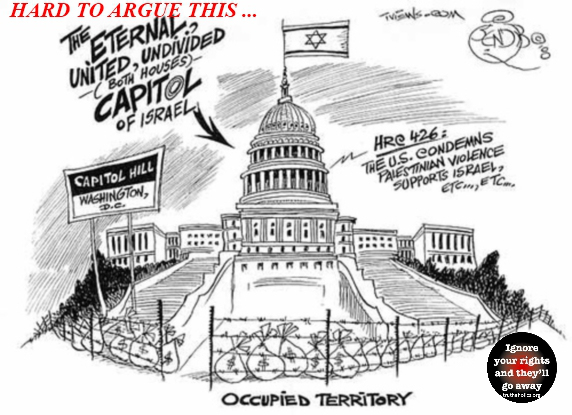
Mike Silenced by the AIPAC: A Case Study of Zionist Control of Media and “Peace Groups”

AIPAC

Peggy and I are in San Miguel de Allende, Mexico. We’re here to give papers at the “Moving beyond Capitalism” conference of the Center for Global Justice (CGJ). I’m honored to be part of a panel with Rabbi Michael Lerner (editor of Tikkun Magazine, the Jewish left-progressive quarterly). My job will be to present the Palestinian viewpoint on the conflict with Israel.

Frankly, there’s only one reason I’ve been invited. It’s because of a crisis I created in San Miguel eight years ago when I spoke on the same topic. It nearly brought the end of the Center for Global Justice. It even threatened my job at Berea College.

The whole incident illustrates the way even small-time publications and good-willed advocates of social justice can be intimidated and silenced by champions of Zionism. The incident represents a summons to such agents to break the silence and speak the truth regardless of Zionist bullying and threats.

You see in 2006, Peggy and I were working with the CGJ directing a summer intern project for students from the U.S., Mexico and Cuba. Out of the blue, one week the program chair of the local Unitarian Universalist (U.U.) meeting asked me to speak at their Sunday gathering. I had done that in several places before and accepted without a second thought. The invitation came specifically because of my connection with the Center for Global Justice.

“Why do you want me to speak about?” I asked the organizer.

“Anything you want,” she replied.

“Well, I speak on conflicting understandings of Jesus,” I said. “As a liberation theologian, I like that topic.”

“Oh no,” came the immediate reply. “The last time someone spoke on Jesus we were all bored to tears. Can you talk about something else?”

That gave me pause. . . . But I had just returned from a three week trip to Israel sponsored by Berea College where I taught for 36 years. So I said, “How about sharing observations from my recent trip to Israel?”

“That sounds great,” the program chair said. “Let’s call your talk, ‘A Report from Israel.’”

I agreed, prepared my remarks, and delivered them the next Sunday. My thesis was clear and unambiguous. “The real terrorists in Israel, I said, “are the Jewish Zionists who run the country.” I didn’t consider my basically historical argument particularly original or shocking. Chomsky and others had been making it for years.

What I didn’t realize was that almost everyone in my audience was Jewish. (I didn’t even know about San Miguel’s large Jewish population – mostly “snowbirds” from New York City.) Nonetheless, my remarks that Sunday stimulated an engrossing extended discussion. Everyone was respectful, and the enthusiastic conversation even spilled over beyond the allotted time.

Immediately afterwards, during breakfast in the U.U. center, one of the founders of the CGJ said, “That was great, Mike. You really ought to put all of that down on paper. You can publish it as an article in San Miguel’s weekly English newspaper, Atencion. They give us column space there each week.”

“Great,” I said. (I already had the talk written out.) I sent it into Atencion and it was published about a month later. By then I was back in the states teaching at Berea.

I’ll never forget what followed: all hell broke loose:

• A barrage of angry letters flooded the Atencion pages for the next two weeks and more.
• As a result, Atencion threatened to cancel the CGJ’s weekly column.
• San Miguel’s Bibliotheca talked about ending the CGJ’s access to meeting space there.
• My article was removed from Atencion’s archives and (I think) from the archives of the Center for Global Justice.
• Someone from the AIPAC (American-Israeli Public Affairs Committee) phoned my provost at Berea College reporting me for my inflammatory article, asking whether I really taught there and if my credentials were genuine.
• The CGJ’s leadership was forced to do some back-pedaling distancing itself from me and my remarks.
• They lit candles of reconciliation at a subsequent U.U. meeting begging forgiveness from the community and absolution for that mad man from Berea.
• The guiding assumption in all of this was that my argument was patently false.

In other words, an article that should have stimulated discussion of its thesis (with CGJ activists leading the way as a voice for the voiceless) was met instead with denial and apology.

However, the ongoing slaughter of Palestinians in Gaza only confirms my original thesis. So let me repeat it here: the real terrorists in Israel are the Jewish Zionists. I’ll go even further and say that in the present phase of the conflict between Jews and Palestinians, the Jews have little or no right to claim they are acting in self-defense. They are clearly the aggressors guilty of extreme war crimes.

This time I base that argument on helpful analytic distinctions concerning “violence” commonly made be liberation theologians in general and by Palestinian liberation theologians in particular. I interviewed the latter back in 2006 at the Sabeel
Ecumenical Center for Liberation Theology in Jerusalem.

I’ll explain the relevant distinctions in the second part of this posting. For now my points are these:

• Zionist defenders are afraid of open discussion of the conflict in Palestine.
• Zionist media control extends far beyond The New York Times.
• It even blacks out Palestinian viewpoints in small-time publications like San Miguel de Allende’s Atencion.
• It threatens academic integrity as well attempting to reach into classrooms like my own at Berea College.
• It even intimidates well-meaning and highly informed activists like those at the CGJ.

My conclusion for now: the media and even would-be “radicals” need to own their power in fearlessly denouncing the war crimes of Israel’s Zionists which will be discussed in the article following this one: “The Conflict in Israel: the Perspective of Palestinian Liberation Theology.”

Off to Cuba: Won’t Be Blogging till End of May

cubaembargo

All of us are stoked. Peggy and I and 14 Berea College students are leaving for three weeks in Cuba beginning on Monday (May 5th). We’ll return on the 25th. So I probably won’t be writing here till then.

Last Wednesday night, Thursday evening, as well as Friday morning and afternoon, Dr. Cliff Durand — the co-founder of the Center for Global Justice in San Miguel de Allende, Mexico — helped us all understand what we’re getting into. Cliff has been leading delegations to Cuba for the last 25 years. He’s an honorary member of the faculty at the University of Havana.

Here are some of the salient ideas he shared:

1. One cannot understand Cuba’s revolution without understanding neo-colonialism. Neo-colonialism refers to the dynamics of control whereby “former” colonies continue to be governed by their colonial masters even after “independence.” The control remains because the now-liberated colony continues its economic relationships with its “mother country.” Of necessity, these relationships foster a dependency similar to that which characterized the original colonial relationship.

2. In other words, former colonies find it impossible to break free from domination by their colonial masters unless they also break free from the capitalist system which of necessity has local governors placing the interests of their international partners ahead of their own citizens. Put otherwise, there is an indissoluble link between revolution, independence, and capitalism’s alternative, socialism.

3. Cuba is the first country in the world to engage in a revolution as a neo-colonial state. Although after 1902 it had freed itself from the domination of Spain, it did so only to become an economic appendage of the United States. Dependency and control by the United States was the form neo-colonialism took in Cuba.

4. The Cuban Revolution of 1959, led by a trained lawyer (Fidel Castro) and a medical doctor (Che Guevara) opened the way to a new experiment in human dignity and social justice. The experiment’s adoption of socialism promised to free Cuba from the dependency international capitalism uniformly imposed on former colonies.

5. Cuba has proven resilient in the face of a 50 year economic embargo imposed by its former neo-colonial “mother country”–the United States. The economic support of the former Soviet Union made it possible for Cubans to enjoy a “middle class” way of life that made Cuba the envy of the Third World.

6. Though characterized in the U.S. as “subsidies,” the Soviet contributions to the Cuban economy were seen in Cuba as “fair trade.” Economic relationships indexed the prices of Cuban raw materials (sugar, tobacco, nickel . . .) to those of the finished products (tractors, refrigerators, spare parts . . .). In fact, this represented an implementation of the New International Economic Order (NIEO) petitioned in 1973 by the entire former colonial world in reparation for the exploitation experienced under colonialism. (Nations of the Global South also demanded transfer of capital and technology — also provided by the USSR to Cuba.)

7. Cuban Democracy: Cuba has a parliamentary system with no political parties, which are seen as divisive. The Communist party is not an electoral organization; it sponsors no candidates. Rather it is the depository of the ideals of the Cuban revolution. In the Cuban form of democracy, elections are held at the municipal, provincial and national levels. At the national level, “Mass Organizations” (five federations of (1) workers, (2) women, (3) small farmers, (4) students, and (5) Committees for the Defense of the Revolution) nominate candidates. (Mass organizations are like 5 political parties sharing commitment to cooperation rather than competition.) All the organizations enjoy equal representation in the Cuban parliament. Forty-seven percent of the delegates there are women. The National Assembly (parliament) elects a Council of State, which then elects a president and vice-president. According to frequent independent polls, well over 80% of the Cuban population supports this system.

8. The Cuban Revolution has passed through five identifiable stages:

o 1960s Revolutionary Fervor: Here the revolutionary government implemented land reform, nationalization of industries and virtually the entire Cuban economy. The U.S. economic embargo (specifically intended to produce hunger, sickness, and social chaos) necessitated alliance with the Soviet Union. During this early period moral incentives worked to unite the people in a common social project. Che and Fidel enjoyed great trust on the part of Cubans.

o 1970s Adoption of Soviet-Style Central Planning: Here Cuba followed the example of the Soviet Union, the only model of socialism available. More specifically, it adopted the agricultural methods of the Green Revolution with its heavy dependence on chemical pesticides and fertilizers. The entire agricultural system was organized into state farms. (This was later admitted to have been a major mistake).

o 1985 Rectification: In the face of excessive bureaucracy and inefficiencies, the entire Cuban population participated in a national dialog to suggest remedies. The process was interrupted by the collapse of the Soviet Union. Overnight Cuba lost 80% of its trading partners. A decade-long period mirroring the experiences of the world’s “Great Depression” (1929-’45) set in for Cuba.

o 1990s “Special Period”: Contrary to the experience following the collapse of socialism throughout Eastern Europe, and despite the extreme hardships of its Great Depression, Cuba did not experience an uprising aimed at regime change. Neither did the government eliminate social programs to deal with the crisis. Instead it strengthened its social safety net and set a goal of “equal distribution of scarcity. “ In the face of extreme impoverishment, the government introduced reforms including:

§ First moving to a dollarization of the Cuban economy and then to the establishment of a convertible currency (CUC)

§ Opening the country to foreign investment

§ Opening itself to trade on the world market

__________

§ Meanwhile ordinary Cubans coped by increasingly living off remittances from relatives the United States.

§ Stealing from government sources and selling the stolen goods on the black market.

§ Engaging in jineterismo (prostitution) – which had been eliminated by the Revolution.

__________

§ U.S. response to the Cuban crisis was its attempt to intensify its catastrophe by aggravating scarcities to induce desperation on the part of ordinary people. The Torricelli and Helms-Burton Acts sought to punish U.S. trading partners for any commerce with Cuba. These responses transformed the Trade Embargo of 1961 into a virtual blockade of Cuba.

o 2007- 2022 Renovation of Socialism: In this process of nation-wide and on-going consultation, more than 163,000 meetings involving 9 million participants (in a population of 11 million) have produced millions of proposals which have been reduced to 313 policy guidelines aimed at reduction of state payrolls, increasing opportunities for self-employment, and rooting out corruption.

o The most important reform is the establishment of urban co-operatives in 2012. With this new economic structure, the emphasis in decision making changed from a “top down” model to one of local participation. Co-operatives get their start-up money from Cuban banks, contributions of members, and remittances. The co-ops must:

o Have at least 3 members with each member having one vote

o Be self-governing independent of the state

o Respond to market dynamics

o Do business with state and private entities

In summary, Dr. Durand observed that socialism is not as good as capitalism at producing consumer goods that inflate gross national product statistics. However, socialism is far better at producing social goods shared by all (not primarily by the wealthy). These social benefits include extended life spans, low infant mortality, universal health care, free education from pre-school through the university, and happiness in general (as measured in identical polls taken in Cuba and the United States).

As you can see, Dr. Durand’s presentations were informative, stimulating and challenging. We’re all looking forward to finding out more during our coming three week trip to Cuba.

I’ll report back at the end of May.