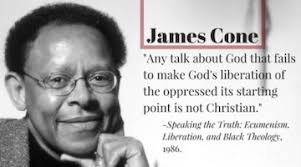
Black History Month has me rereading the late James Cone’s seminal work, The Cross and the Lynching Tree. Cone, of course, is the father of black liberation theology. I’m finding his work especially relevant to the ongoing genocide of Gazans at the hands of white supremacist Zionist Jews.
A central theme of Cone’s writing, public lectures, and teaching focuses on the difference between white versions of Christianity and their black counterpart. He puts that difference succinctly by alleging that whites have used the Bible to oppress blacks and others, while the latter have used that same Bible as a powerful tool to resist that oppression.
The ongoing slaughter in Gaza coupled with the statements of genocidal intent expressed by Benjamin Netanyahu and other Israeli officials have led me to conclude that something similar might be said of Zionists both in Israel and in the U.S. Recently they have used the Bible to ground their genocide of Palestinian children and their mothers. Meanwhile, Islamic Gazans use the Bible along with their Holy Koran to justify their (sometimes violent) resistance.
Who’s right? And what does Cone – what does liberation theology – say about such controversy?
Let’s see.
Consider first how Zionists are using the Bible. Next think about the approach of theologians like James Cone, and how the contrast between the two approaches applies to the Hamas attack of October 7th and Israel’s genocidal response in Gaza. Finally compare the oppressive violence that Zionists have used against Gazans with the violence of Hamas against their overlords. Theologians like Cone as well as his heroes Malcolm X and Martin King find the latter more justifiable than the former.
Zionist Use of the Bible
Consider the Zionists’ use of the Bible first.
Early on, Mr. Netanyahu invoked the biblical account of their ancient leaders claiming divine authority to carry out genocide against Israel’s archenemy, the Amalekites (I Samuel 15:1-9). The Gazans are the contemporary equivalent of Israel’s ancient foe, he said. They deserve the same fate of absolute obliteration – i.e. genocide.
The Prime Minister’s words were turned into a war anthem adopted by the IOF (Israeli Occupation Force). They shocked the world in a video showing them singing and dancing to the words of that anthem calling for the slaughter of Gazans, today’s Amalekites.
Both Netanyahu’s words and the video of the soldiers’ rally were used recently by South African prosecutors in their presentations before the International Court of Justice (ICJ). There the prosecutors alleged that both Netanyahu’s words and the soldiers’ behavior provided convincing evidence of Israel’s intentional violations of the Genocide Convention.
On the one hand, the presentation of such evidence led the ICJ to conclude that the South African charges merit further court deliberation about Israel’s possible conviction for military actions that provide prima facie evidence of being genocidal.
On the other hand, the evidence in question (Netanyahu’s words and the IOC anthem) offers proof positive that (according to Cone’s allegations) white colonial Europeans continue to use the Bible to justify horrendous oppression of their victims.
But what about the Gazans and their use of the Bible? What does liberation theology say about that?
Liberation Theologians & The Bible
For liberation theologians like James Cone, all human beings are loved by the biblical God about whose nature there is evident difference of opinion and controversy throughout sacred scripture. That is, the Bible contains many contradictory understandings of God. In effect, it presents readers with a “battle of the gods.”
For instance, some texts present him (sic) as petty and jealous. Still other texts show him as the national God of the Jews. In that capacity, he is often a God of war like the one demanding the slaughter of the Amalekites.
The Hebrew prophetic tradition presents a very different God. He’s one who in today’s Zionist parlance might be accused of anti-Semitism. That’s because he is often highly critical and fiercely condemnatory of Israel. He frequently punishes them. On at least two occasions he allows their enemies to cart them off for generations-long exiles in Assyria (722-652) and Babylon (586-516).
Again, the prophetic tradition seconds the divine “anti-Semitic” tradition just mentioned. It’s that tradition in which Jesus appears. The Gospel narratives about him along with his preaching and parables sometimes even centralize Jewish enemies (such as “The Good Samaritan”) as heroes while condemning Jewish priests, scribes, Pharisees, and kings. With that in mind, contemporary Zionists would no doubt characterize Jesus as a “self-hating Jew.”
For Jesus, ethnic identity even became entirely immaterial. One thing alone is important, for him, love of God and love of neighbor (Matthew 22:36-40). Connections to Abraham, Jesus says, are no more significant than connections to a stone (Matthew 3: 9-10).
In fact, for the prophets in general (and for liberation theologians like James Cone), what is overwhelmingly central to morality is treatment of widows, orphans, and resident aliens. The prophets constantly remind their fellow religionists that all of them were once slaves in Egypt. They should never forget that. Accordingly, favorable treatment of slaves, aliens, widows, and orphans is the very touchstone of Israel’s identity. In fact, the prophet Jesus makes treatment of “the least of the brethren” the sole criterion of judgment about the final worth of one’s life (Matthew 25: 31-46).
Liberation theologians summarize all of this by asserting that God has made a “preferential option for the poor.” That is, when push comes to shove, and while God loves everyone, the Divine One sides with the poor and oppressed in their struggles against the rich and powerful.
For followers of the Jewish Jesus, that divine preference is evident in the fact that he chose to fully reveal himself not as a king, prince, or rich person, but in the poorest of the poor. He surfaced in the working class as a construction worker from the nowheresville called Nazareth. He was conceived by an unwed teenage mother. In his youth, he lived as an immigrant in Egypt (Matthew 2: 13-15). He was accused of being a drunkard and a friend of prostitutes (Matthew 11:19). His family thought he was insane (Mark 3:21). He finished disgraced and a victim of torture and capital punishment.
And very significantly for James Cone, forensic archeologists point out that Jesus was probably black and unimposing. He was probably about 5’1” in height and weighed just over 100 pounds. Probably, they say, looked like the figure (below) on the left, not the familiar one on the right. To repeat, it is quite probable that Jesus was literally black. Cone affirms that he was at least figuratively or poetically black. He came from and sided with the poor and oppressed.

Liberation Theology & Violence
Furthermore, it isn’t all that clear that Jesus was a pacifist and non-violent. For instance, all Gospel lists of his apostles identify one of them as “Simon the Zealot.” “Zealot” was the name of patriots in Jesus’ Palestine who resisted Roman occupation by killing Jewish collaborators with Roman occupation. How could “Jesus meek and mild” have associated himself with murderers like that?
On top of that, all four Gospel traditions record that at least one of Jesus’ closest disciples was armed when Jesus was arrested (John 18:10-11). Jesus must have known that. Moreover, the friend in question knew how to use his weapon; he swung it at one of those who came to arrest Jesus and cut off the man’s ear.
Elsewhere, Jesus is remembered as saying, “Don’t think that I have come to bring peace, but the sword” (Matthew 10: 34-36). In another place, he says “Let the man who has no sword, sell his cloak and buy one” (Luke 22:36). And finally, as I said, Jesus was evidently perceived by the Romans as a revolutionary. In any case, they executed him by crucifixion, the means of capital punishment they reserved for violent insurrectionists. He was crucified between two other insurrectionists (not “thieves”}. Jesus must have done something(s) that gave the occupiers the impression that he was in insurrectionist too.
And that brings us back to Gaza, Hamas, and its use of violence on October 7, 2023. Would the revolutionary Jesus have supported such mayhem?
Here’s where distinctions made by liberation theologians {and by James Cone’s primary black hero, Malcolm X} come in. Malcolm was all for peace – but not in response to the oppressor’s aggression. “If someone hits you in the face,” Malcolm would say, “hit him back.” Black people have the right to defend themselves, he was fond of saying, “by any means necessary.”
Liberation theologians like Cone agree. And they go further. They teach that all forms of violence are not the same. At least one form is justifiable; others are not. So, before one can determine possible justification, one must identify its type. Four of them must be considered in any given analysis. Consider them in the context of Israel’s war against Gaza.
- The first type of violence is structural and is indefensible. It takes the form of elements such as laws and customs, restrictions, and prohibitions that adversely affect a given population such as inhabitants of the Gaza Strip. European colonialists’ gift of Palestine to white European Jews in 1948 was violent. It resulted in the forced displacement of Palestinians by the hundreds of thousands. Their houses were stolen or destroyed by the Jewish invaders from Germany, Poland, Russia, Lithuania, Latvia, Estonia, and even from the United States. Palestinians who resisted were often simply murdered by the invaders. Moreover, apartheid laws later imposed on Palestinians by Israel’s settler colonists are also violent. Most of the world hasn’t even recognized this structural form of violence as the “original sin” it represents. However, liberation theologians like James Cone do. This form of violence by the powerful against the powerless is never acceptable.
- The second type of violence is the truly justifiable violence of self-defense. This is what Malcolm referred to when he spoke of hitting back. It’s a form of violence that the UN recognizes as legitimate in Article 51 of its Charter. Accordingly, people living under occupation have the right to defend themselves against occupying forces. The latter, however, have no right to self-defense. They are robbers, thieves, and murderers. These are the convictions behind the Hamas attacks of October 7th, 2003. Liberation theologians like James Cone agree. This second form of violence is legitimate. However, its adoption is rarely wise. It can be suicidal because it leads to a third type of violence which is always overwhelming.
- The third type of violence is reactionary. It is the overwhelming police and military response of those imposing the first type of violence. This third type is on display at this very moment in Gaza. There cowardly Israeli occupation forces have killed more than 27,000 Gazans – more than half of them children and their mothers – in response to Hamas’ employment of the second type of violence. In this case, the response is so overwhelming that according to the ICJ, it provides prima facie evidence of genocide. Obviously, this type of violence cannot be truly justified since it represents restoration of the “order” imposed by violence’s first level. Nonetheless, in most cases such police and military violence is accepted by most as somehow normal.
- The fourth type of violence is terroristic. Terrorism is defined as the unlawful use of violence and intimidation, especially against civilians in the pursuit of political aims. Nation states such as Israel and the United States routinely define uprisings against their illegal occupations as “terrorism.” According to them, Hamas is terrorist while Israel and the United States stand for law and order. However, theologians like James Cone maintain that the world’s principal terrorists are states like those just mentioned. They are the ones who impose structural violence and respond with reactionary violence. Their routine murders of those defending their families, homes, and cultures against colonialism’s “legal” crimes are the primary forms of terrorism afflicting our world. By comparison, the violence of groups like Hamas (or even the perpetrators of 9/11) is minor. In other words, though terrorism is never justified, its main perpetrators are those who impose the colonialism of white supremacy in all its forms, not those who resist them.
Conclusion
Yes, the Bible’s Battle of the Gods continues to our day. All of us are involved whether we’re believers or not. But believers especially are called to make up their minds about the nature of the God they believe in and about the nature of the violence they find themselves supporting.
All of this means critical evaluation of Netanyahu’s attempts to biblically justify Zionists’ ongoing genocidal attacks in Gaza and the West Bank. Liberation theologians like James Cone contend that the Prime Minister’s invocation of a genocidal God is a typically white supremacist interpretation. As such it runs completely contrary to Israel’s prophetic tradition and its concerns for the impoverished, widows, and orphans. It runs completely contrary to the words of the Jewish prophet from Nazareth, “Whatever you do to the least of my brethren, you do to me.”
One thing we do know, in the biblical portrayal of its battle of the Gods, the God of the Jewish prophets and the Jewish Jesus is emphatically not the god of I Samuel 15:1-9.
Instead, the divine one is the God of the construction worker from Nazareth, living in a country occupied by invading Europeans, and who gave the invaders reason to believe he supported the Resistance the Romans feared and hated.
In fact, the white European occupiers hated the second level of violence so much that in the year 70 CE, they acted just like Netanyahu and his genocidal army. They reduced Jerusalem and its environs to the same condition we see in Gaza today.

 About Things That Matter