The Conversion of Pope Francis and “Why the New Pope Must Resign”

Francis Capitalism

“Why the New Pope Must Resign.” That was the title of an article I wrote just after the election of Pope Francis in 2013. In it I joined Argentina’s Horacio Verbitsky and others questioning the role of Jorge Bergoglio (aka Pope Francis) in Argentina’s “Dirty War” (1976-’83).

Since then, friends have asked me about that. “What do you think now – in the light of the fresh spirit of reform the pope has introduced – in the light of his tremendous popularity?  Surely you were mistaken in your original, hasty judgment.”

That’s the typical question and observation.

My answer has been that I’m delighted with Pope Francis and the direction his papacy has taken. Both his Apostolic Exhortation, The Joy of the Gospel, and especially his new eco-encyclical, Laudato Si’ are magnificent. Their criticisms of capitalism-as-we-know-it as the structural cause of world poverty and environmental destruction couldn’t be a clearer endorsement of a form of liberation theology that is both spiritually moving and politically engaged.

I’m glad the pope didn’t resign. Pope Francis is great.

But in response to my friends, I also add that the issue of Father Bergoglio’s involvement with the Dirty War is not resolved. Nor should it be ignored. Recalling its elements holds lessons for us – about the Roman Church’s history of supporting oppression, about whitewashed historiography, and most importantly, about the possibility of repentance and deep personal change.

Consider the first point, the Church supporting fascist oppression. It happened in Argentina during the Dirty War as it happened in Germany under Adolf Hitler.

When Bergoglio was Jesuit Provincial, he was accused of turning over to the army two of his Jesuit colleagues and former teachers, Fathers Orlando Yorio and Franz Jalics. Both had been pro-socialist clerics and members of the Third World Priests’ Movement (MSTM). Such membership was considered a capital crime by the country’s ruling junta.

Yorio and Jalics had been embroiled in a long-standing feud with their Provincial not so much about their MSTM affiliation, but about their activities in a slum community the two priests served and lived in. Bergoglio didn’t have much time for Jesuits in his province being associated with left-wing causes – nor for versions of liberation theology tainted with Marxist analysis.

Like John Paul II and his chief advisor Josef Ratzinger (later Benedict XVI), he preferred a strain of liberation theology that prioritized the poor, but apolitically without revolutionary aspirations. Bergoglio liked to call that strain the “Theology of the People.” It prioritized their reflections on the gospel, and popular devotion to images, novenas, etc. Other versions of liberation theology were too “ideological.”

After being arrested and tortured, both Yorio and Jalics accused Bergoglio of fingering them to the army.

Father Yorio died without retracting his accusation. Fr. Jalics at first didn’t want to discuss the matter, saying that he and Bergoglio had reconciled.

Beyond the case of Yorio and Jalics, there was that of Father Christian Von Wernich. He had been a police chaplain during the Dirty War. After its conclusion, during the process of national reconciliation, Von Wernich came under investigation for his direct roles in police tortures and murders.

In response, while Bergoglio was a member, the Argentine Bishops’ Conference protected Von Wernich by transferring him to Chile under an assumed name. That is, the Bishops Conference treated accusations of torture and murder in exactly the same way bishops throughout the world had often dealt with allegations of sexual abuse of children: transfer the offender and cover up the past.

So, the question becomes, was Jesuit Provincial Bergoglio, like the predominant leadership of the Argentine Catholic Church, somehow cooperative with the ruling junta?

This brings us to my second point about historiography.

In defense of the future Pope Francis (and of the church hierarchy in general), his biographer, Austen Ivereigh, offers explanations that end up sounding much like the defense of Pius XII vis-à-vis the Nazis and his failure intervene against the Holocaust. Ivereigh argues:

  1. When the military took over in 1976, Argentina (like Weimar Germany) was in a state of political and economic chaos.
  2. So virtually all segments of society welcomed the military take-over (as Germans and the German Catholic Church welcomed Adolf Hitler).
  3. The military’s brutal Dirty War was secretive about the extremity of its measures. (Fr. Bergoglio testified that it took him some time to realize what was happening.)
  4. So people like Bergoglio didn’t really know what was going on (just as Germans claim they didn’t know about the concentration camps and ovens).
  5. When he did find out (like Pius XII) Bergoglio “worked quietly” to help potential victims escape – while fulfilling his primary duty of protecting the Jesuits from suspicion, investigation and reprisals from the ruling junta.

As with Germany such reasons end up sounding like excuses that raise suspicions of cover-up and historical obscurantism. They evoke the following observations and questions:

  1. Bergoglio gives every indication of being on the same page with John Paul II and Josef Ratzinger who also largely “looked the other way” when confronted with evidence of government brutality in dealing with left-wing elements of the clergy and faithful, e.g. in Central America in general and in El Salvador and Nicaragua in particular.
  2. Bergoglio clearly shared their disdain for priests involved in politics.
  3. If (as Ivereigh suggests) Father Bergoglio was so well-connected and friendly with all factions (including government officials and military leaders on the one hand, and their opponents including MSTM members on the other) how could he not have at least suspected what was really happening?
  4. If Jalics had forgiven Bergoglio (as he originally had said) what had he forgiven?
  5. Why did Jalics apparently change his story a few days after Pope Francis’ election? On being repeatedly contacted by the media about the issue, Jalics said, “The fact is: Orlando Yorio and I were not denounced by Father Bergoglio.”
  6. Father Yorio offered no deathbed recantation of his charges against Bergoglio.

And that brings me to my final point about repentance and its significance for Catholics today.

As Ivereigh indicates, the prevailing method of dealing with such contradictions is to  reluctantly argue that Father Bergoglio perhaps did cooperate with the military – as did so many other churchmen in positions of authority during the Dirty War. However, in Bergoglio’s case, he also courageously helped many escape – at some risk to himself.

But then at some point, he underwent a kind of conversion and is now a progressive. At least at the administrative level, Bergoglio’s own testimony indicates that he experienced a profound conversion. He confesses that as a young Jesuit Provincial (he was only 36 when appointed), he was too headstrong, uncompromising and authoritarian.

Indications are, however, that the about-face went far beyond managerial style.

The exact turning point in the process remains unclear. It could have come after Bergoglio was virtually drummed out of the Jesuits by progressive elements which saw him as an impediment to the Society’s reform in the spirit of Vatican II.

Afterwards he spent two years in a kind of exile and deep introspection. Ivereigh reports that Bergoglio passed days hearing the confessions of simple shantytown poor people. He also spent hours in semi-depression, simply staring out his window. Colleagues worried that he was sick. Was it some type of breakdown?

Whatever the case, clear evidence reveals a subsequently changed man. Previously he was criticized by more liberal fellow Jesuits and others for failing to ask important questions about poverty. As they put it, “He’s great at ministering to the poor. But he never asks why they are poor.” (The criticism evoked the famous comment of Dom Helder Camara, the archbishop of Olinda and Recife in Brazil who said, “When I give food to the poor, they call me a saint. When I ask why the poor have no food, they call me a communist.”)

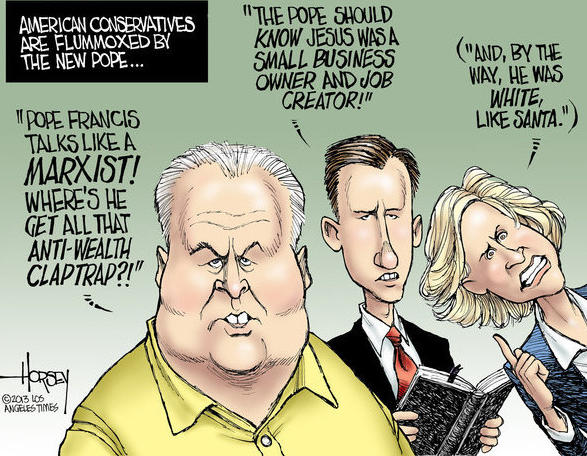
But as pope in Laudato Si’ Francis makes no bones about why the poor have no food, or jobs, or homes, or education. With observations worthy of the MSTM members he rejected, the pope says, all of those problems are connected by the invisible thread called deregulated capitalism. His encyclical says that poverty, environmental destruction and a whole host of other problems are caused by capitalism-as-we-know-it. (So, predictably and true to Dom Helder’s words, Rush Limbaugh and others call Pope Francis a communist.)

Evidence of radical theological change goes much further. Consider, for instance, that Francis has:

  • Surrounded himself with liberation theologian advisers concerned with history and structural analysis.
  • Rehabilitated and consulted pro-socialist theologians blacklisted by his two predecessors – most prominently among them Brazil’s Leonardo Boff.
  • Identified Marxism as similar to the teachings of the early church fathers, claimed Marxists as his friends, and referred to them as “closet Christians.”
  • Echoed Latin America’s liberation theology speaking of Christian faith as “revolutionary,” because it challenges “the tyranny of Mammon.”
  • Peppered both The Joy of the Gospel and Laudato Si’ with frequent uses of the loaded word “liberation” contrasting the deleterious effects of “liberation” of markets (from government control) with the liberation of peoples proclaimed in the Judeo-Christian tradition.
  • Has similarly made Medellin’s phrase “preferential option for the poor” the watchword of his papacy, even going so far as to identify it with “the gospel itself.”
  • Beatified the martyred Archbishop of El Salvador, Oscar Romero, who is considered the patron saint of liberation theology. (Romero did, by the way, confront the ruling military and lost his life as a result.)
  • Described the world’s dominant economic system as running “counter to the plan of Jesus.” He said the system now in place and Jesus’ hoped-for Kingdom of God have different aims.
  • Worked with the Obama administration to open doors to Cuba which for more than 50 years has struggled to construct an economic alternative to capitalism-as-we-know-it.
  • In keeping with the insights of liberation theology, the pope has turned working against capitalism-as-we-know-it into a moral issue. In Laudato Si’ he wrote: “working for just distribution of the fruits of the earth and human labor” – is a “moral obligation.” For Christians, he said, “it is a commandment.” Here the pope echoed what he said in The Joy of the Gospel where he identified the struggle for social justice and participation in political life as “a moral obligation that is “inescapable.”

All of this represents not only a personal conversion for Pope Francis, but a summons to his Church to follow in his footsteps.

What he has written in “The Joy of the Gospel” indicates that he recognizes in a Church the same crisis he underwent. It is out-of-touch and in need of a complete overhaul. “Everything must change,” he has said.

For too long, he has written, the Church has been mired in an authoritarian judgmental paradigm and in viewpoint-narrowness that has focused on important but non-essential matters foreign to the focus of Jesus’ proclamation of God’s Kingdom. So-called “pelvic issues” were of little concern to Christianity’s Great Master.

The pope implicitly calls Catholics resembling his former conservative, apolitical self to engage in the process of political, economic, and ideological change before it’s too late. Stop staring out the window at a world falling apart, he tells us. Emerge from denial and obstructionism and come to grips with climate chaos and changing the economic system that causes not only environmental destruction, but world hunger, poverty, high infant mortality, and war.

Those are statements Fathers Yorio and Jalics could fully endorse.

“Laudato Si’” and Its Preferential Option for the Poor (Part Two): Pope Francis’ Critique of Capitalism

Dung of Devil

This is the second installment in a three-part series on Pope Francis’ new encyclical, Laudato Si’. Overall, the series attempts to place in historical perspective what might well be the most important document yet produced in the 21st century. It also tries to explain the meaning and centrality of the encyclical’s guiding principle, its “preferential option for the poor.”  This second part addresses Pope Francis’ critique of capitalism-as-we-know-it.

Pope Francis’ Critique of Capitalism

The first entry in this series on Laudato Si contextualized the significance of its author’s origins in the Global South. It argued that till Francis, Catholic social teaching had largely focused on Western and Eastern Europe. The social pronouncements of Italian popes were largely concerned with the problems of Western Europe and the threatened loss of the working class to the allures of socialism and communism. Beginning with Leo XIII’s Rerum novarum, the Italians set the stage for the introduction of Europe’s extensive welfare state.

With the election of a Polish and subsequently of a German pope, papal focus shifted to Eastern Europe and the dethroning of communism there. Pope John Paul II and his right hand man, Josef Ratzinger (later to become Benedict XVI) cooperated with the Reagan administration (and specifically with the CIA’s William Casey) in facilitating the collapse of the Soviet Union.

With that demise achieved, it appeared to most that capitalism had won a definitive victory. Corporate globalization stood virtually unchallenged.

However, all of this changed with the ascent of Argentina’s Jorge Bergoglio to the papal throne in 2013. As the first pope from Latin America, Pope Francis has repeatedly called capitalism’s “final victory” into question. No longer focusing on Europe (western or eastern), he shifted focus to the Global South, to the poverty colonialism and unfettered capitalism had caused there.

He focused on connections between deregulated markets and the rape of the Earth Mother indigenous Catholics of the Andes called Pachamama. Without apology, he espoused a “preferential option for the poor,” and spoke clearly about the rejection of the neoliberal globalized order lionized by the corporate elite.

Such sentiments were nowhere more clearly expressed than in the speeches delivered by Pope Francis during his summer “homecoming” trip to Latin America. In written form, they were evident in his landmark encyclical on the environment, Laudato Si’ and in his Apostolic Exhortation, Evangelii Gaudium.

Addressing the World Meeting of Popular Movements in Santa Cruz, Bolivia, Francis traced today’s global problems back to their origins in European colonialism beginning in 1492. But he also identified new forms of colonialism exercised through corporations, loan agencies, “free trade” treaties, and imposition of “austerity measures.”

Such actors and policies subordinate states to outside powers which also exercise control through misguided policies ostensibly aimed at controlling drug trafficking, political corruption, and terrorism. More subtly, external powers colonize, destroy local cultures and foster cultural uniformity through communications monopolies, which the pope described as “ideological colonialism.”

“Let us say NO to forms of colonialism old and new,” he said.

The pope was completely outspoken. He went on to criticize capitalism-as-we-know-it as “an invisible thread” connecting problems of world poverty, worker exploitation, landlessness among farmers, homelessness, and destruction of the natural environment. That system imposes the mentality of profit at any price without concern for its impact on displaced peasants and workers or for its destructive effects on “Mother Earth.”

This is indeed capitalism-as-we-know-it.

The system, he said “is by now intolerable: farm workers find it intolerable, laborers find it intolerable, communities find it intolerable, peoples find it intolerable … The earth itself – our sister, Mother Earth, as Saint Francis would say – also finds it intolerable.”

Though some have criticized the pope for stepping outside his area of competence, his condemnation of the reigning economic system is specifically biblical, theological, and moral.

Like the prophets of the Jewish Testament, he identifies “the existing system” with idolatry, the most serious of biblical sins. In his strongest condemnation yet, Francis quoted the 4th century sage, Basil of Caesarea, calling today’s capitalism “the dung of the devil” – i.e. the excrement of evil personified. Stronger language can hardly be imagined.

Theologically, Francis echoed Latin America’s liberation theology speaking Christian faith as “revolutionary,” because it challenges “the tyranny of Mammon.” The existing system, the pope said, “runs counter to the plan of Jesus.” He said the system now in place and Jesus’ hoped-for Kingdom of God have different aims.

Morally, then, the pope called working against capitalism-as-we-know-it – “working for just distribution of the fruits of the earth and human labor” – a “moral obligation.” For Christians, he said, “it is a commandment.” Here the pope echoed what he said in “Evangelii Gaudium,” where he identified the struggle for social justice and participation in political life as “a moral obligation that is “inescapable.”

(Next installment: the “other world” Francis sees as possible)

NYT Criticism of Pope Francis’ Encyclical: an Early Right Wing Response

Limbaugh

In Sunday’s New York Times, Ross Douthat offered a critique of Pope Francis’ new encyclical, “Laudato Si’.”  His piece was entitled “Pope Francis’ Call to Action Goes beyond the Environment.”

The op-ed is valuable since it offers a preview of the right-wing critiques of “Laudato Si’” (LS) that we’re likely to hear over the next few months. Let’s consider them one-by-one.

To begin with, the author is correct. Pope Francis’ encyclical does go far beyond climate change. It is brilliantly overwhelming in its breadth of scope which sees climate chaos as but one symptom indicating that the present world system is fundamentally unsustainable.

Other symptoms include deforestation and loss of wetlands (8), “water poverty” and infant mortality (28), species extinction (33), over-fishing (40), destruction of coral reefs (41), uncontrolled urbanization (44), food waste (50), the north’s “ecological debt” to the global south (51), debt crises in general (52), war (57), information manipulation (54), desertification (89), cruelty to animals (92), economic domination by unproductive financial interests (109), resource depletion (111), dangerous market-driven production of GMOs (134), secret negotiations of trade deals (135) and human anxiety, loss of purpose and of human community (110).

Additionally there are related problems of  human trafficking, organized crime, the drug trade, commerce in blood diamonds, and the fur of endangered species . . . buying and selling of organs of the poor for resale or use in experimentation. . . and the elimination of children because they are not what their parents wanted (123).

In the pope’s vision, all of these problems are interconnected. In fact, that’s the basic thesis underlying the Francis tour de force: EVERYTHING IS INTERCONNECTED (42, 117, 120, 137, etc.). At root what causes the problems are the unregulated nature of free markets, blind reliance on technological development, and excessive anthropocentrism (LS Chapter 3). Causes are rooted in “the lie” which denies that there are any limits to economic growth (106).

What are needed to combat such manifestations are radical changes in the ways humans live, produce and consume (23). Francis says we need a “bold cultural revolution” – a recovery of values and great goals that have been swept away by human “delusions of grandeur” (114).

Not surprisingly, the pope finds such values and goals embodied in the Judeo-Christian tradition, its teachings about divine ownership of creation, human stewardship of the same, and its unswerving reverence for all forms of life, from the least to the greatest (Chapter Two). All life forms, the pope teaches, from algae to human embryos and the planet itself have intrinsic worth. None of them should be treated as insensate instruments put on earth for human profit and pleasure.

On Douthat’s analysis, such reflections might be all well and good. However, they represent only one viewpoint. And this brings us to the right-wing arguments against the pope’s analysis that we can anticipate over the next months. They have to do with papal negativism, the success of the market in eliminating poverty, the Catholic approach to overpopulation, and the capacity of future technological development to solve the planet’s problems.

For starters, Douthat calls the pope’s approach “catastrophism.” The other viewpoint – evidently Douthat’s own – he terms “dynamism.”

Dynamists are far more optimistic than the pope. They believe that the market and technological advances will possibly head off what the pope sees as inevitable catastrophe especially for the world’s poor absent that earlier-mentioned bold Cultural Revolution.

Coming from his dynamic perspective, Douthat argues that (1) poverty is diminishing world-wide, (2) overpopulation (spurred by the Catholic vision of marriage and fecundity) plays an important role in the problems the pope enumerates, and (3) who knows, the pope could be wrong: technology and the market just might automatically solve the world’s problems.

On the pope’s holistic analysis, each of such conservative arguments fails miserably.

The first (that world poverty is diminishing) is questionable on two counts.

First off, Douthat’s thesis is based on a World Bank study showing that “extreme poverty” as opposed to normal poverty is diminishing. (Normal poverty is defined as an income of $2.00 per day.)

While it’s true that incomes among the world’s poorest have risen from .87 cents per day in 1981 to $1.25 in 2005, the number of people living in normal poverty has remained unchanged over that same period. Moreover, the number of humans living in the “unspeakable conditions” of normal poverty would actually have risen sharply over the same period were it not for the economic development of China, whose improvement cannot be explained by unfettered markets as championed by neo-liberal apologists.

Secondly, Douthat’s approach to poverty misses the pope’s point about including the devastation of the natural environment in definitions of poverty. Given the earlier cited list of problems addressed in the pope’s encyclical, it is impossible to argue that world poverty is diminishing. As he puts it so delicately, humans are turning the planet into a pile of filth (21). Impoverishing nature means growth in world poverty.

Douthat’s second defense of the “dynamic” vs. the “catastrophic” approach – the one about population – is similarly short-sighted. The pope addresses it head-on. In effect he admits that there are too many people in the world – but not the ones Douthat has in mind.

Douthat is thinking about the masses in the global south. By contrast, Pope Francis’ focus is on the global north – the United States and Europe. His implication is that there are indeed too many people. But they are Americans and Europeans whose ecological footprint is far more devastating than the footprint of the poor living in Latin America, Africa and South Asia. The world cannot sustain people living the lifestyle of Americans and Europeans.

The pope writes: “To blame population growth instead of extreme and selective consumerism on the part of some, is one way of refusing to face the issues. It is an attempt to legitimize the present model of distribution, where a minority believes that it has the right to consume in a way which can never be universalized, since the planet could not even contain the waste products of such consumption” (50).

Additionally, Douthat does not address the good economic reasons the world’s impoverished have for contributing to the population pressures the columnist finds so disturbing. Simply put, those reasons center around the absence of social services and benefits Americans and Europeans take for granted, but which conservatives continually rail against.

The impoverished need large families because their economies remain largely agrarian, and each additional child represents another field hand. They need children to provide additional income where jobs provide no government-mandated living wage. They need many children to insure that at least one will survive to care for them in their waning years. They need family members to replace them as income-earners where the government provides no workers’ compensation for injuries sustained on the job, or where there is no government-provided health care.

In short, Americans and Europeans have small families because of urbanization and the government “programs” representing their countries’ “social wage.” Absent income supplements like adequate minimum wages, social security, and health care, large families make complete sense. Or as Barry Commoner put it in 1976, poverty breeds overpopulation and not the other way around.

As for Douthat’s final Pollyanna expression of faith in undirected markets and technology, they are just that “Pollyanna.” Surprisingly (especially for a Republican), they represent a refusal to accept Pope Francis’ call for what GOP members claim to prize so highly – personal responsibility.

Like the interconnectedness of all reality, the call to responsibility is a recurring theme in “Laudato Si’” (e.g. 64, 67, 78, 105, 118).

Moreover, Douthat’s simplistic approach to technology fails to deal with Pope Francis’ key point that technologies are not neutral. Their development and use is largely controlled by the world’s rich and powerful. Francis writes: “We have to accept that technological products are not neutral for they create a framework . . . dictated by the interests of certain powerful groups” (107).

In effect, then, placing hopes in technological development equates with naïve surrender to the very people principally responsible for our planet’s “unprecedented situation” (17).

In the end, Ross Douthat’s loaded categories “Catastrophists” vs. “Dynamists” are misleading. More accurate classifications would be “Ecologists” vs. “Atomists.” Pope Francis is an ecologist. He sees the interrelatedness of all reality and the interrelatedness of all reality with Ultimate Reality. His approach is holistic.

Meanwhile, Douthat is an atomist. In his op-ed nothing seems to be connected.  He can’t see the relative meaninglessness of the categories “extreme poverty” contrasted with the unspeakable conditions of normal poverty. He’s oblivious to the fact that Americans and Europeans represent the planet’s true excess population. His faith in blind markets and future technological developments are slices of pie in the sky.

Pope Francis would say it is out of line with our culture’s best insights and values. It is entirely irresponsible.

(Sunday Homily) Why Listen to Pope Francis on Climate Change? He’s A Prophet in Our Midst

http://https://youtu.be/XlHb_9rJSjw

Readings for 12th Sunday in Ordinary Time: JB 38: 1, 8-11; PS 107: 23-26, 28-31; 2COR 5: 14-17; LK 7:16; MK 4: 35-41.

Thursday Pope Francis published his long-awaited encyclical on the environment and climate change. The document is called Praised Be: on the Care of Our Common Home (PB).

Today’s liturgy of the word is perfectly synchronized with the encyclical’s release. Its elements emphasize God’s sovereignty over nature, its overwhelming beauty and might, the power of Christ-Consciousness to save from nature’s fury, and the new order of God’s Kingdom proclaimed and embodied in the Master from Galilee. Moreover, in articulating today’s themes, the humble Pope Francis distinguishes himself as a “great prophet,” in whom “God has visited his people” – the refrain in today’s Alleluia Verse.

Begin by considering the readings; afterwards we’ll turn to the encyclical and to Pope Francis’ prophetic status.

In our first reading, God speaks to Job sitting on a dung hill like the “pile of filth” into which, the pope says humans are turning the earth (PB 21). Like us, Job is trying desperately to figure out why bad things are happening to his world. Significantly, the Divine One speaks out of a storm and declares God’s sovereignty over nature – its seas with its threatening waves, the sky with its dark clouds, storms with their winds, thunder and lightning.

That theme of God’s sovereignty over nature is picked up in today’s responsorial which emphasizes the fearful might of the world’s oceans. Psalm 107 calls the sea an “abyss” – a threatening black hole. It is the work of the Lord who on the one hand causes storms to arise, but on the other restores calm to the waves and brings relieved travelers back to safe haven. Again, it is God, not humans who controls nature – a major theme of Praised Be.

Then in today’s Gospel selection Jesus calms the sea when it threatens to sink the boat he and his friends are using to travel to the “other shore.”

It’s the identity of Jesus’ followers as “Other Christs” called to do what Jesus did that is emphasized in today’s reading from Second Corinthians. There the apostle identifies Jesus as the herald of a completely new reality. The old order is no longer relevant, Paul says; it has entirely passed away. It’s that reality that followers of Jesus’ Way are to embody and usher in.

All of the themes in today’s liturgy of the word find echo in Pope Francis’ encyclical. Consider them one-by-one:

  • God’s Sovereignty over nature: Here Francis bluntly states that the pervasive understanding that God gave humans power of dominion or destruction over the earth “is not a correct interpretation of the Bible” (67). According to Francis, God denies any pretense of absolute ownership: “The land shall not be sold in perpetuity, for the land is mine; with me you are but aliens and tenants.” (Leviticus 25:23).
  • Nature’s overwhelming beauty and might: The very title of the pope’s encyclical reflects this point. “Laudato Si” are the first words of a prayer composed by Francis’ namesake, the great Italian mystic, Francis of Assisi, identified by the pope as the patron of ecology (10). Of St. Francis the pope writes, “Like it happens when we fall in love with someone, every time that Francis looked at the sun, the moon, the smallest animals, his reaction was to sing, sharing in the glory of all the other creatures. . . he entered into communication with all of creation.” At the same time the Pope Francis argues that today’s climate chaos with its fearful storms, droughts, and extreme temperatures represents the earth protesting against “the violence that exists in the human heart, wounded by sin.”
  • The power of Christ-consciousness to save us from nature’s fury: St. Francis, the pope notes, was a mystic like Jesus of Nazareth (98). He had Christ-consciousness. It allowed him, like Jesus, to speak to elements that most humans understand as impersonal (98). So like Jesus speaking to the wind and waves in today’s Gospel, Francis conversed with animals and regarded the sun as his brother and the moon as his sister. Only the adoption of such sensitivity and reverence, the pope says, can restore balance to our planet (11).
  • The new reality to which we are called: “An economic and technological development that does not leave the world a better place and with an integral superior quality of life cannot be considered progress” (194). So Francis proposes a new model beyond the worship of the “free market.” Its exact shape must be worked out through a process of international dialog (180). However it necessarily includes an international body with legislative power to control excesses of production and consumption connected with unfettered capitalism.”

In providing such clear direction, Pope Francis’ encyclical solidifies his identity as a “great prophet.” As it turns out, he is the only world leader capable of turning the planet around. His power combines the exact virtues required for such a herculean task:

  • Consciousness: Pope Francis’ consciousness is unique. Virtually alone among world leaders, he sees climate change, poverty, morality and spirituality as inextricably interconnected.
  • Courage: Among his peers, Francis’ courage is unparalleled. By comparison the “leader of the free world” (not to mention climate change denialists) looks like a timid child bowing and scraping before the world’s wealthy few – indecisive about Keystone XL and arctic drilling. Moreover, the pope intends to take his message of interconnection directly to the lion’s den. He will speak not only to the United Nations, but will confront a U.S. Congress largely hostile to his position on climate chaos.
  • Credibility: As a scientist with an advanced degree in chemistry and as titular head of the Pontifical Academy of the Sciences, Francis has access to the world’s finest scientific minds. He has done his homework. He addresses not just climate change, but problems undeniably caused by human activity – “water poverty,” food waste, waste in general, overfishing, destruction of coral reefs, human trafficking, income gaps between the global north and south, the rampant elimination of innumerable species, and war.
  • Charisma: The world loves Pope Francis. No other world leader more widely admired or more capable of influencing people regardless of nationality or creed. It is interesting to see Catholic politicians like Jeb Bush, Rick Santorum, Paul Ryan, John Boehner, and Bobby Jindal speak condescendingly about a religious leader’s forays into fields “beyond his expertise” – as if they were better informed and could out-Catholic the pope. This is a battle they cannot win.
  • Constituency: Pope Francis is the leader of 1.2 billion Roman Catholics. There are more than 70 million Catholics in the United States – not to mention the millions of non-Catholics who admire the pope. Can you imagine what would happen world-wide (politically and environmentally) if even a small percentage of them took the pope’s words to heart? What if they radically changed their behavior (and voting) patterns to save the planet for future generations and prevent the poor from suffering the worst effects of industry-induced environmental degradation?

Praised Be leaves none of us off the hook. Rather the virtues just enumerated provide guidelines for each of us. As Paul’s “other Christs” and as humans in general (62) we are called to “Franciscan”:

  • Consciousness: Each of us can become expert. Just reading Praised Be will take us a long way in that direction. Do your part for the planet; read the encyclical now. It is the best, most comprehensive and accessible text available on the most important issue facing our world. (Good supplemental reading is This Changes Everything by Naomi Klein.
  • Courage and credibility: Good information breeds these qualities. Like the pope we all need to fearlessly confront our uninformed, misinforming, head-in-the-sand politicians and demand that they serve us, our planet, children and grandchildren. Enough of letting them confuse us with their obfuscations.
  • Charisma: Few in the world can claim anything like Pope Francis’ charisma. But his fearless outspoken truth-telling is contagious and can infect us all by association. We must follow his example and use our innate talents to spread the message of Praised Be.
  • Constituency: Whether Catholic or not each of us needs to join Pope Francis’ constituency. In my own parish, our Peace and Social Justice Committee plans to buy copies of his encyclical for every parishioner over the age of 16. Beginning in September (about the time of the pope’s visit to the U.S.) we’ll initiate a parish-wide study of the encyclical. We’ll gather to watch Francis’ speeches to the U.N. and our Congress. Praised Be provides a foundation for turning every Catholic Church into a peace and social justice dynamo.

Again, today’s Alleluia Verse proclaims “A great prophet has risen in our midst. God has visited his people.” Today Pope Francis is that prophet. That’s why we should listen to him and follow his example.

Thanksgiving Table-Talk: Immigration Reform

thanksgiving-religious-debate-family

I’m not looking forward to Thanksgiving. Oh, it’s not that I don’t like turkey and won’t eat my share. It’s just that, like most of you, I’ve got this Fox News brother-in-law, and he gives me indigestion. I see Harry once a year, and for the past six Thanksgivings it’s always the same: complaints about Obama. You know the drill; just read Rush Limbaugh’s current talking points. They’re all sure to surface at Thanksgiving dinner.

This year, no doubt, we’ll end up arguing about immigrants, immigration reform, and the imperial presidency. My brother-in-law will complain about “illegals” (that’s what he’ll call undocumented workers), the law, amnesty, border security, and Obama’s failure to reach across the aisle to well-meaning and otherwise cooperative Republicans.

But most of all, my dear relative will complain about the disruptive effects of “the brown peril” – waves of immigrants pouring over our borders and disrupting our economy. “I mean,” he’ll say, “if we keep giving amnesty to ‘those people,’ they’ll disrupt everything. You just can’t let everybody into the country without rules. ‘Freedom’ like that is simply anarchy. And anarchy is destructive. They’ll eventually take all the good jobs.”

Well, here’s what I plan on telling old Harry this year:

“You see, Harry, we’re finally getting a taste of the disruption economies like Mexico have experienced since 1994 and the passage of the North American Free Trade Agreement (NAFTA). It was then that in the name of “free trade” tsunami waves of capital investment were unleashed across the Mexican border. To Mexican farmers it was an onslaught of “white peril” that dwarfs any threat you and I might experience from brown people.

“For instance, cheap American corn (actually subsidized in the NAFTA agreement) drove Mexican farmers out of business. True, a relatively few of them got employment in maquiladoras (assembly plants).  But many of those factories soon closed when it became possible to hire lower wage workers in China and Vietnam. And in any case, working in the maquilas meant moving from the countryside to polluted and dangerous cities. It also meant accepting wages of $1.50 a day with no bathroom breaks. Conditions like those inevitably cause desperate workers to relocate to where the money is – to where the jobs are. And that’s the United States.

“Remember, Harry, there are two main components of the economic equation – not just capital. Labor is just as important. So any “free trade agreement” that allows capital to move without regulation should allow the same liberty to labor. Instead, the NAFTA insisted on free movement of capital alongside a captive labor force.

“Workers implicitly recognize the injustice of all that even if they can’t say the words. So despite ‘state law’ forbidding it, the labor force will obey the dictates of capitalism’s Sacred Law of supply and demand – of self-interest. Like capital, labor will migrate to where the money is. And you can’t really stop it. That’s capitalism.

“So here’s the way to stem the brown peril:

  • Renegotiate the NAFTA recognizing labor’s freedom of movement as well as capital’s.
  • That will mean electing governments on all sides of “free trade agreements” that truly represent working people and not just the corporations.
  • Make sure that ALL stake-holders are represented at the negotiating table – including male and female workers, children, environmentalists, and trade unionists.
  • Make sure the final product protects the environment and addresses climate change.
  • See that the newly elected people’s governments establish a living NAFTA wage of $15.00 an hour – indexed to inflation rates.

“Without such provisions, Harry, I’m afraid workers will look abroad to better their condition. They’ll continue (like their capitalist counterparts) to act in their own self-interest relocating quite naturally to where the money is. Really, we can’t do anything about it.

Like I say, that’s capitalism.”

(Sunday Homily) The Parable of the Talents: Pope Francis as Drop-Out vs. Paul Ryan as Inside Investor

Pope & Rush

Readings for 33rd Sunday in Ordinary Time: PRV 31: 10-13, 19-20, 30-31, PS 128: 1-5; I THES 5: 1-8; MT 25: 14-30. http://www.usccb.org/bible/readings/111614.cfm

Today’s gospel story, the familiar “Parable of the Talents,” is about economics. It’s about the world of investment and profit-taking without real work. It’s also about dropping out and refusing to cooperate with the dynamics of finance, interest and exploitation of the working class.

The parable contrasts obedient conformists with a counter-cultural rebel. The former invest in an economic system embodied in their boss – “a demanding person harvesting where he did not plant and gathering where he did not scatter.” In other words, the boss is a hard-ass S.O.B. who lives off the work of others. The conformists go along with that system which to them has no acceptable alternative.

Meanwhile, the non-conformist hero of the parable refuses to go along. And he suffers the predictable consequences for doing so. Like Jesus and his mentor, John the Baptist, the non-conformist is marginalized into an exterior darkness which the rich see as bleak and tearful (a place of “weeping and grinding of teeth”). However, Jesus promises that exile from the system represents the very kingdom of God. It is filled with light and joy.

In contemporary terms, today’s gospel selection could hardly be more pertinent. It contrasts two current understandings of the contested terrain that is today’s Christianity. One understanding endorses our polarized economic system where “everyone who has is given more so that they grow rich, while the have-nots are robbed even of what they have.”

That concept is embodied today in a “devout Catholic” like House budget chair, Paul Ryan. The other finds its personification in Pope Francis, the head of the church Ryan’s party has all these years relied on for support.

In sharp contrast to Ryan’s faith in the capitalist system, Pope Francis himself is trying mightily to drop out of it. He’s like the servant in today’s parable who buried his talent in the ground refusing to invest it in a corrupt system that invariably widens the gap between the rich, like Ryan, and the poor the pope is attempting to champion.

A year ago Ryan seemed to recognize the contradiction. Then his first response to the pope’s criticism of capitalism (in the apostolic exhortation, “The Joy of the Gospel”) was defensive and dismissive. Referring to the pope as “the guy,” he said “The guy is from Argentina, they haven’t had real capitalism in Argentina.” Apparently Ryan meant that the pope doesn’t really understand the joys of the free market which the U.S.-backed generals shoved down Argentinian throats all during their infamous “dirty war” (1976-1983).

Lately though, a chastened Ryan has become more conciliatory. Last month he claimed that he and the pope are really on the same page. “I love this pope,” Ryan now says. “I’m a big fan of this pope. What he’s trying to do is he’s trying to invite lay Catholics into public policy, into a debate. He’s not trying to settle the debate. He’s trying to start the debate.”

More specifically, the congressman now reads the pope to be “down with a free market that means more participation. I think what he’s [against] is crony capitalism … where the powerful pick the winners and losers [and] influencing government gets to decide who wins and who loses in the marketplace.”

In other words, Ryan now holds that he and the pope are both “down with” the congressman’s own resistance to minimum wage increases, with his union-busting, and cuts to social security. All of these are proposed in Ryan’s “Roadmap for America’s Future.”

For his part, Pope Francis couldn’t be clearer about rejecting the elements of Ryan’s “Roadmap.” As recently as October 28th, Francis urged action to secure the basic entitlements the poor deserve. These include rights to land, housing and work as well as to higher wages, unions and social security – all of which are abhorrent to Republicans.

Francis even connected being Catholic with communism. “It’s strange,” the pope said, that “if I talk about this, there are those who think that the Pope is Communist. . . The fact that the love for the poor is in the center of the gospel is misunderstood.” Fighting for the poor, he added, doesn’t make me a communist; it makes me Catholic.

Obviously, the statement suggests significant overlap between Marx’s critique of free market capitalism and the social teachings of the church. The pope’s words certainly don’t sound like a ringing endorsement of the free market.

And how should Catholics express their love for the poor? Clearly not by endorsing the dynamics of the free market Ryan and his real mentor, Ayn Rand, lionize. In the “Joy of the Gospel” (JG) – published a year ago at this time – the pope identifies the unfettered markets so dear to Rand’s and Ryan’s hearts (along with their “trickle-down” ideologies) as homicidal (JG 53), ineffective (54) and unjust at their roots (59). He sees “each and every human right” (including education, health care, and “above all” employment and a just wage (192) as intimately connected with “defense of unborn life” (213).

And it gets worse for Ryan’s position. His party, of course, loves the free trade agreements that are at the heart of the corporate globalization the pope deplores. One wonders how the congressman reconciles his advocacy of, for instance, the Trans-Pacific Partnership (TPP) with the pope’s words at Cagliari, Sardinia on September 22 of 2013. Then the pope proclaimed, “We don’t want this globalized economic system which does us so much harm.”

These are not the statements of someone merely attempting to start a debate about capitalism as we know it. The debate is settled in the pope’s mind. He has condemned the system. And in doing so, Pope Francis has established himself (along with the Dali Lama) as the foremost moral leader of our time. He alone has the courage to call us away from the worship of Market and Money.

The alternative, he assures us, is not a world of darkness, weeping and grinding of teeth. It is a kingdom of light and joy.

It is time for Jesus’ would-be followers to join that conversation – about getting from here to there in the name of the gospel.

Critical Thinking: Mixed Economies Are All We Have

Mixed Economy

[This is the fourth blog entry in a series on critical thinking which lays out ten guidelines for critical thought. My previous two entries addressed the first rule of critical thought, “Think Systemically.” That rule holds that we can’t really remove our culture’s blinders unless (without prejudice) we’re clear about the meaning of the key systemic terms: capitalism, Marxism, socialism, communism, mixed economy, and fascism. So having already dealt with capitalism, the last installment tried to explain Marxism, socialism and communism in fewer than 1000 words. This week’s episode finishes Rule One by explaining mixed economy and fascism in just three points each. Next time we’ll move on to the second rule of critical thinking, “Expect Challenge.”]

MIXED ECONOMY

Following the Great Depression of the 1930s, the world as a whole has moved away from attempts to implement either pure capitalism or pure socialism. Instead, the trend virtually everywhere has been towards selecting the best elements from each system in a “mixed economy.” As the phrase implies, this involves (1) some private ownership of the means of production and some public ownership, (2) some free and open markets and some controlled markets, and (3) earnings typically limited by a progressive income tax.

Of course what we have in the United States is a highly mixed economy. The U.S. government is, after all, the largest land owner in the nation. Drug, alcohol, food, and medical care markets (and many others) are highly regulated. Following World War II, Americans earning more than $400,000 were taxed at a rate of 91%. Currently, the top income tax bracket is 34%. None of that would be possible under pure free market capitalism.

Similarly, countries claiming to be “socialist” (like Venezuela) or “communist” (like Cuba) have mixed economies. Private enterprise is a key part of both.

Does this mean that the economic systems of the United States and Cuba for example are the same? Not at all. True, both economies are “mixed.” But they differ in terms of whom they are mixed in favor of. The United States economy is mixed in favor of the wealthy and corporations. This is illustrated by consideration of the recipients of recent government bailouts – basically large corporations and Wall Street firms rather than middle or lower class people. The theory at work here is “trickle down.” That is, it is believed that if the wealthy prosper, they won’t hide their money under their mattresses. Instead they’ll invest. Investment will create jobs. Everyone will benefit. So mixing an economy in favor of the wealthy is not sinister; it’s done for the benefit of all.

Cuba, for instance, has a different approach. Its theoreticians observe that historically the wealth hasn’t trickled down – at least not to people living in the Third World (the former colonies). So, (the theory goes) the economy must be mixed directly in favor of the poor majority. The government must adopt a proactive posture and interfere directly in the market to make sure that everyone has free education (even through the university level), free health care, and retirement pensions. Food is subsidized to ensure that everyone eats. And the government is the employer of last resort to provide dignified employment for everyone, so that Cubans are not simply on the dole.

In summary, then, all we have in the world are “mixed economies.” Today, most of them are mixed in favor of the wealthy (once again, on the “trickle-down” theory). Some, like Cuba’s, prioritize the needs of the poor.

FASCISM

What about fascism then? Today the word is thrown around on all sides, and seems to mean “people I disagree with,” or “mean people,” or “those who force their will on the rest of us.” There’s talk of Islamo-fascists. President George W. Bush was accused of being a fascist. Recently President Obama has been similarly labeled.
None of those really capture the essence of fascism. Benito Mussolini, who claimed fascism as a badge of honor in the 1930s (along with Adolph Hitler in Germany, Antonio Salazar in Portugal, and Francisco Franco in Spain), called fascism “corporatism.” By that he meant an alliance between government and large business concerns or corporations.

In terms of Rule One of Critical Thinking, then, we might understand fascism as “capitalism in crisis” or “police state capitalism.” That is fascism is the form capitalism has historically taken in situations of extreme crisis, as occurred in the 1930s following the Great Stock Market Crash of 1929.

More accurately however (in the light of our previous section on mixed economies), we might call fascism police state economy mixed in favor of the wealthy. Fascists are always anti-socialist and anti-communist.

The three elements of fascism then include: (1) A police state (2) enforcing an economy mixed in favor of large corporations, (3) characterized by extreme anti-socialism and anti-communism, and by scapegoating “socialists,” “communists” and minorities (like Jews, blacks, gypsies, homosexuals . . .) for society’s problems.

HUMAN RIGHTS

Both economies mixed in favor of the rich and those mixed in favor of the poor claim to respect human rights. They also blame their opponents for not following suit. The truth is, however, that both types of economies both respect and disrespect human rights. That is, despite claims to the contrary, no system of political-economy has shown consistent respect for all human rights. Instead all systems prioritize them according to what they consider the most basic. This means that capitalism respects some human rights more than others. So does socialism.

Capitalism puts at the top of its list the rights to private property, the right to enter binding contracts and have them fulfilled, as well as the right to maximize earnings. These rights even belong to corporations which under capitalism are considered persons.

On the other hand, capitalism’s tendency is to deny the legitimacy of specifically human rights as recognized, for example, by the U.N. Declaration of Human Rights. For this reason, the United States has never ratified key protocols implementing the Declaration, or other key documents asserting rights beyond the corporate. Moreover, if capitalism’s prioritized rights are threatened, all others are subject to disregard, including the rights to free elections, speech, press, assembly, religion, and freedom from torture. Historical references in the blog entries which follow this one will support that observation.

Similarly, socialism heads its own list with the rights to food, shelter, clothing, healthcare and education. In the name of those rights, socialism relativizes rights to private ownership and the rights to enter binding contracts, and to maximize earnings. If the rights socialism considers basic are threatened, history has shown that it too, like capitalism, will disregard all others.

CONCLUSION

What’s the “take-away” from all of this? Simply this: capitalism is both a simple and complicated system; so is socialism. Both can be summarized quite simply, as can mixed economies, Marxism, communism, and fascism. Capitalism respects some human rights, while disregarding others. The same can be said of socialism and systems that call themselves “communist.”

Critical thinkers should remember those simple summaries and truths about human rights. Doing so will help cut through many of the misunderstandings and distortions that characterize discussion of today’s key issues.

Hitler and Capitalism

John Ralston Saul

[This is the fourth entry in a series on “How Hitler Saved Capitalism and Won the War.”(The previous mini-essays are found under the heading “Hitler and Christianity” just below the masthead of this blog site.) The entry below follows a third installment which attempted to clear up some common misconceptions about fascism which many see as threatening to take over the U.S. today just as it did Germany in the early 1930s. Fascism, the last entry concluded, might best be defined as “capitalism in crisis.” The current installment looks more specifically at Hitler’s relationship to capitalism. (Unless otherwise indicated, all references are to Jackson Spielvogel’s text, “Western Civilization,” a source commonly used in courses by the same name in colleges and universities.)]

To understand Adolph Hitler’s connection to capitalism, it helps to distinguish common perceptions from what textbooks like Spielvogel actually say. Common perceptions are that the German economy was devastated following World War I. The impositions of the Treaty of Versailles are well-known. Images of Germans marshaling wheelbarrows full of deutsch marks to pay their grocery bills are fixed in everyone’s mind. After the Great War, inflation was rampant. In such context, Hitler’s rise to power is typically explained as the reaction of a humiliated German people to the Allies’ shortsighted demands for war reparations and border concessions inherent in their Treaty. Germans were so desperate, the story goes that they turned to a madman, Adolph Hitler, to restore their national pride.

Of course, there is truth to such understanding. Germany’s economy was in a shambles after World War I. Inflation had reached unprecedented levels. Ordinary Germans saw their earnings and pensions disappear. They were humiliated, desperate and in search of an alternative to the Weimar Republic which was under fire from factions on both the left and the right.

However, two key realities, relevant to the argument at hand, are often overlooked about Germany’s post-World War I situation. The first reality is that by the time Hitler emerged as a serious factor in the German political scene, the country’s economy had long since been intensively and triumphantly capitalist. Already by 1870, Germany had become Europe’s undisputed industrial leader, replacing Great Britain in that role (Spielvogel 682). By the 1920s, the country’s real reins of power were firmly in the hands of capitalist giants.

Germany’s most effective leadership came no longer from the aristocrats of William II’s Empire. Much less was it provided by Paul von Hindenburg, the backward-looking monarchist who succeeded Friedrich Ebert and Gustav Stresemann to head the country in the mid-twenties. Instead, leadership and power found location in the private enterprises today being sued for compensation by those they employed as slave labor during Hitler’s Reich. That leadership resided in banking industry giants such as Deutsche Bank and Dresdner Bank; in auto-makers, Volkswagen and BMW; in chemical and pharmaceutical companies Bayer, Hoechst, and BASF; in industrial firms Degussa-Huels, Friedrich Krupp and Siemens; and in the Allianz Insurance Company.

Secondly, Spielvogel makes it clear that Germany’s economy had largely rebounded from the devastation inflicted by the Treaty of Versailles. In fact, from 1924-1929, the country actually participated in “the Roaring Twenties.”

“The late 1920s were . . . years of relative prosperity for Germany, and, as Hitler perceived, they were not conducive to the growth of extremist parties. He declared, however, that the prosperity would not last and that his time would come” (796).

Hitler, of course, was correct that his party’s time had not yet come. During the ‘20s, Hitler’s Nazis remained a minor right-wing faction. For example, in the elections of 1928, the Nazis gained only 2.6 percent of the vote and only twelve seats in the German Parliament (796).

Hitler was also correct that his time would come. It arrived with the onset of the Great Depression (796). The collapse of market economies throughout the industrialized world had their leaders scrambling to save a system that seemed moribund. Socialists and communists were gleeful and ascendant. Indeed, in 1934, Josef Stalin convoked a “Congress of Victory,” to celebrate socialism’s apparent triumph over capitalism and what he called “the end of history.”

As Spielvogel reports, such threats from the left forced German capitalists to turn to Hitler as their Messiah. Industrialists and large landowners provided the firm base of support he needed. More specifically, the elite were fearful, because the Depression’s economic hard times had given heart (and popular appeal) to socialists and communists who in Russia had seized power in the Bolshevik Revolution of 1917. Spielvogel writes:

“Increasingly, the right-wing elites of Germany, the industrial magnates, landed aristocrats, military establishment, and higher bureaucrats, came to see Hitler as the man who had the mass support to establish a right-wing, authoritarian regime that would save Germany and their privileged positions from a Communist takeover” (796).

The capitalist nature of Hitler’s system stands clear in this description – though it is fogged by circumlocutions. The attentive reader should note that, along with the military hierarchy and government administrators, the powers behind Hitler’s takeover of Europe’s leading capitalist nation are the captains of industry and large landowners.

Spielvogel’s avoidance of the term “capitalists” seems dictated by concerns about “political correctness” in a textbook intended for educational institutions whose mission is to inculturate rather than to raise consciousness. Once again, such avoidance contributes to general misconceptions about the nature of the Nazi regime.

(Next week: Capitalist Support for Hitler)

Fascism Is “Capitalism in Crisis”

Princess Bride

This is the third installment in a series on “How Hitler Saved Capitalism and Won the War.”

[Last Monday this series on the Second Coming of Adolf Hitler tried to connect Hitler and the response to the tragedies of September 11th, 2001. In the aftermath of those events, the U.S. Vice President’s wife, Lynne Cheney and her American Council of Trustees and Alumni identified university and college professors as “the weak link in the fight against terrorism.” They found it particularly offensive that some of the latter had identified the September 11th attacks as “blowback” for “American” Hitler-like policies in the Third World. Such response inspired me to do some research on the question paying particular attention to data found in a standard Western Traditions textbook used in many institutions of higher learning, Jackson Spielvogel’s “Western Civilization.” This third installment attempts to clear up some common misconceptions about fascism which many see as threatening to take over the U.S. today just as it did Germany in the early 1930s. (Unless otherwise indicated, all references are to Spielvogel’s text.)]

The thesis here is that privatized globalization is a continuation of Hitler’s system of fascism which is understood here as “capitalism in crisis.” To understand that position, it is first of all necessary to clear up prevailing confusions about fascism itself. Not surprisingly, misunderstandings abound concerning its nature. Most correctly identify fascism with a police state, with institutionalized racism, anti-Semitism, and totalitarianism (though they typically remain unclear about the term’s meaning). Most too are familiar with concentration camps, the Holocaust, and, of course, with Adolf Hitler. Some can even associate the Nazi form of fascism with homophobia and persecution of Gypsies. However, rarely, if ever will anyone connect fascism with capitalism. For instance, here is Jackson Spielvogel’s (Western Civilization) textbook description of Hitler’s thought:

“In Vienna, then, Hitler established the basic ideas of an ideology from which he never deviated for the rest of his life. At the core of Hitler’s ideas was racism, especially anti-Semitism. His hatred of the Jews lasted to the very end of his life. Hitler had also become an extreme German nationalist who had learned from the mass politics of Vienna how political parties could effectively use propaganda and terror. Finally, in his Viennese years, Hitler also came to a firm belief in the need for struggle, which he saw as the “granite foundation of the world.” Hitler emphasized a crude Social Darwinism; the world was a brutal place filled with constant struggle in which only the fit survived” (794).

Here it is interesting to note that racism, especially anti-Semitism, nationalism, propaganda, terror and Darwinian struggle are signaled as defining attributes of the Hitlerian system. Capitalism is not mentioned, though “struggle” is. Perhaps, had the term “competition” been used instead of “struggle,” the basically capitalist nature of “Social Darwinism,” and fascism might have been clearer.

Fascism and Communism

Textbooks typically add to the confusion by closely connecting fascist Nazism and Communism. For instance, Spielvogel’s Western Civilization deals with Hitler’s fascism and Josef Stalin’s socialism back-to-back, linking the two with the term “totalitarianism.” Spielvogel’s transition from one to the other illustrates how the merely mildly interested (i.e. most college students) might come away confused. He writes, “Yet another example of totalitarianism was to be found in Soviet Russia” (801). Spielvogel defines totalitarianism in the following terms:

“Totalitarianism is an abstract term, and no state followed all its theoretical implications. The fascist states – Italy and Nazi Germany – as well as Stalin’s Communist Russia have all been labeled totalitarian, although their regimes exhibited significant differences and met with varying degrees of success. Totalitarianism transcended traditional political labels. Fascism in Italy and Nazism in Germany grew out of extreme rightist preoccupations with nationalism and, in the case of Germany, with racism. Communism in Soviet Russia emerged out of Marxian socialism, a radical leftist program. Thus, totalitarianism could and did exist in what were perceived as extreme right-wing and left-wing regimes. This fact helped bring about a new concept of the political spectrum in which the extremes were no longer seen as opposites on a linear scale, but came to be viewed as being similar to each other in at least some respects” (Spielvogel 789).

Here Spielvogel correctly points out “significant differences between fascism and communism. One is radically right, the other radically left. Nazism is identified with nationalism and racism (not, it should be noted, with capitalism). Communism is associated with Marxism and socialism. In the end, however, the two are viewed as “similar to each other in at least some respects.” Thus, clarity of distinction given with one hand seems to be erased with the other. Confusion is the typical result. Such fogginess might have been cleared had Spielvogel employed greater parallelism in his expression – i.e. had he identified Stalinist communism with police-state socialism and Hitler’s Nazism with police-state capitalism.

National Socialism

Nonetheless, history books and teachers are not solely at fault for student confusion. There are other understandable reasons for the distancing of fascism from capitalism. For one, Hitler’s Party called itself the National Socialist German Workers’ Party (NSDAP). As a result, it is quite natural for students who reflect on the question at all, to conclude that Hitler and his party were “socialist,” or even “communist,” since the two terms are almost synonymous for most Americans. After all, well-indoctrinated students would be justified in reasoning that Hitler did such terrible things he must have been a communist.

Lost in such analysis is the historical realization that during the 1930s, all sorts of approaches to political-economy called themselves “socialist.” This is because they supported state intervention to save the market system that was in crisis during the Great Depression. Thus, there were socialisms of the left as found in Soviet Russia. But there were also socialisms of the right, such as Hitler’s in Germany, Mussolini’s in Italy, and Franco’s in Spain. In other words, interventionist economies easily adopted the “socialist” identification to distinguish themselves from laissez-faire capitalism, which in the aftermath of the Great Stock Market Crash of 1929, had been completely discredited. As we shall see below, in such context (were it politically possible) Franklin Roosevelt’s interventionist program to save capitalism could easily have been called National Socialism instead of the “New Deal.”

However, analysis of fascism’s approach to socialism must recognize the national character of the socialism advocated. [Yet even here, according to Spielvogel, Hitler’s program had a distinctly international dimension eerily evocative of promises associated with the current global economy. Spielvogel recalls, “After the German victories between 1939 and 1941, Nazi propagandists painted glowing images of a new European order based on “equal chances” for all nations and an integrated economic community.” (829)] The critical adjective (nationalist) was intended precisely to distinguish the right wing brand of socialism from its left wing international antagonist. In this connection Hagen Schulze writes in Germany: a New History (2001):

“The catch-phrase “national socialism” itself had been created before the First World War as a means to unite a variety of nationalistic organizations in the battle against “international socialism.” The term was designated to appeal to the working class, but it also proved attractive to young people from the middle and upper classes with romantic notions of Volksgemeinschaft, a “popular” or “national” community” (231)

The implication here is that right wing zealots “co-opted” a popular term to confuse the young – a strategy employed to this day with great success. Here as well one should note that “national socialism” is signaled as a direct opponent of “international socialism.”

Fascism as Mixed Economy

Yet another reason disjoining fascism from capitalism is that fascism was not capitalism pure and simple. (The same might be said of Roosevelt’s New Deal – and even today’s U.S. economy.) Both systems were “mixed economies.” That is, if capitalism’s essential components are private ownership of the means of production, free and open markets and unlimited earnings, socialism’s corresponding elements are public ownership of the means of production, controlled markets and restricted earnings. Both Roosevelt and Hitler combined the two approaches to economy.

Once again, in a period when free market capitalism had been widely discredited, both Hitler and Roosevelt performed a kind of “perestroika.” Soviet Premier, Mikhail Gorbachev would later use the term to refer to the restructuring of socialism, in order to save it by incorporating elements of capitalism. The suggestion here is that more than a half-century earlier, Roosevelt and Hitler had done the opposite; they had incorporated elements of socialism into the capitalist system in order to resurrect it. So, while the means of production most often remained in private hands, others (such as the railroads, the postal system, telephones and highways) were nationalized.

Similarly, while the free market was allowed to continue in many ways, its freedom was restricted by measures socialists had long advocated (e.g. rationing, legalized unions, social security, wage and price controls). Finally, high income taxes were used to restrict earnings and garner income for the state to finance its interventionist programs. [Few recall, for instance, that during the 1940s, U.S. federal income tax rates assessed incomes over $400,000 at a rate of 91% (See Howard Zinn’s A People’s History of the United States, 567-8). Government revenue collected in this way paid for populist programs that modestly redistributed income to the American working class and unemployed. Such redistribution found its way into workers’ pay envelopes, but also took the form of “social wage.”]

None of this is to say that Roosevelt’s and Hitler’s interventionist economies were the same. Mixed economies, after all, are not the identical. The key question for distinguishing between them is, “Mixed in favor of whom?” Some mixed economies are mixed in favor of the working class, others, in favor of their employers. As the product of a liberal capitalist, Roosevelt’s mixture successfully sold itself as the former. That is, while keeping most means of production securely in the hands of capitalists, Roosevelt gained the support of the working classes through his populist programs aimed at gingerly redistributing income downward towards those unable to fend for themselves. In other words, Roosevelt’s “mixed economy” was blended so as to facilitate its defense in populist terms – that is, as mixed in favor of the working class. And the defense achieved plausibility with the American people. Despite objections from more overtly pro-business Republicans, Roosevelt was elected four times in succession. His party remained in control of the U.S. Congress for nearly a half-century.

Hitler had another approach. Influenced by Herbert Spencer and (indirectly) by Friedrich Nietszche (see below), der Fuhrer was an extreme social Darwinist whose programs unabashedly favored elite Aryans and despised “the others,” particularly socialists, Jews, trade unionists, non-whites, Gypsies, homosexuals, the disabled and other “deviants.” On the other hand, Hitler despised “liberal” politicians like Roosevelt, with their programs of social welfare. On those grounds, he vilified the Weimar government which preceded his own. During the early years of the Great Depression, Weimar politicians had attempted to gain the favor of the working class, and to sidestep civil war by implementing wealth distribution programs (233). Funding the programs necessitated tax increases, unpopular with middle and upper classes. It meant strengthening unions along with socialists and communists.

The point here is that is it with good reason that few make the connection between fascism and capitalism. A student of Spielvogel, for instance, would have to be quasi-heroic to do so. After all, he or she would be not only resisting the confusion fostered by the text itself, but would also be swimming against the stream of American propaganda, which treats Hitler’s system as the product of an evil individual, and unconnected with any specific economic system (other than, mistakenly, socialism or communism).

Despite such ambiguity, next week’s blog entry will attempt to demonstrate more specifically that even a closer reading of a text like Spielvogel’s makes unmistakable the connection between fascism and capitalism.

The First Rule of Critical Thinking: Think Systemically (about Capitalism)

This is the second blog entry in a series on critical thinking which lays out ten guidelines for critical thought: (1) Reflect Systemically, (2) Expect challenge, (3) Reject neutrality, (4) Suspect ideology, (5) Respect history, (6) Inspect scientifically, (7) Quadra-sect violence, (8) Connect with your deepest self, (9) Detect silences, (10) Collect conclusions. The series was inspired by responses to my April 16th reflections on the Boston Marathon bombing.

THINK SYSTEMICALLY

The first rule of critical thinking as understood in this series is to think systemically. This is a ground-clearing rule. Its point is to clarify the vocabulary and concepts without which you’ll not be able to think critically about the most important issues facing our world today. You can’t think about poverty, hunger, war, climate change, healthcare, education, or a host of other problems without clear understandings of the basic economic concepts presented here. Without them, you’ll be thrown for a loop; your eyes will glaze over when conversation turns economic. And economics, remember, is the principal language spoken in the world of politics and newscasts.

Think about what’s happened since the 2008 election of Barack Obama. With the implementation of bailout programs, and discussion of “Obamacare,” there has been a lot of talk about “socialism,” hasn’t there? This has come along with accusations about “Marxism,” “communism,” “fascism” – all in a context that supposes the superiority of “capitalism.” The discussions have rarely recognized the universal prevalence of “mixed economies.” Instead, the discourse has illustrated huge divergences of understanding and opinion about the meaning of all the terms just placed in quotation marks.

Most debate participants simply do not have clear ideas about their meaning. They are convinced, of course, that communism is bad, and that capitalism is good. Beyond that however, ideas remain confused. Most are even unaware that all the terms mentioned describe positions adopted towards the free market economic system.

It is the modest, yet ambitious, purpose of the explanation of this first rule of critical thinking to clear up confusion simply by defining terms in an easy- to- understand way. Doing so is absolutely necessary for any critical thinker to join productive discussions about our days’ most important issues. So, oversimplifying for purposes of discussion and clarity, what follows will summarize the crucial categories in three points each, beginning with capitalism, and then moving on to Marxism, socialism, mixed economy, communism, and fascism.

Today’s blog entry will define capitalism in this way.

CAPITALISM

Liberal capitalism is an economic system based on (1) private ownership of the means of production (2) free and open markets (places where goods are bought and sold), and (3) unlimited earnings. Those are the three points.
Private ownership of the means of production dictates that individuals should be empowered to own fields, forests, farms, factories and other sources of products for sale and exchange. Communal ownership is thus excluded. That’s capitalism’s first point.

Free and open markets means that private ownership should permit those in question to produce what they choose to produce, where and when they choose to do so, employing whom they choose, without any power outside of market forces of supply and demand dictating that production. Here government interference in the market by way, for instance, of outlawing or controlling some productions (such as liquor or cigarettes) and mandating others (such as beans and rice) is rejected. Moreover, anyone at all should be able to enter an open market regardless of personal attributes such as race, age, gender, nationality, or religion. In all this emphasis on “freedom,” we find expressed the “liberal” nature of “liberal capitalism.” That’s capitalism’s second point: free and open markets.

Finally, liberal capitalism calls for unlimited earnings. That is, the producer’s talent and the quality of her or his product alone should limit the income goals attainable. Limits on earnings such as taxes should be kept to the minimum necessary to provide public protection of private property (police, military, the judicial system) and to supply the infrastructure necessary for commerce (roads, bridges, etc.) That’s capitalism’s third point: unlimited earnings.

Income ceilings, of course, are out of the question for capitalism strictly understood. For capitalists wide disparities between the rich and the poor are not a problem. And some might even admit to greed as a kind of virtue that is responsible for human progress. That idea was captured in the film, “Wall Street,” where entrepreneur, Gordon Gecko (played by Michael Douglas), praises greed in a speech before the stockholders of his company, Teldar Paper Company:

These words, of course, not only praise greed in business, but in national life. Echoing the words of economist Milton Friedman (at the top of this blog entry) and ignoring the fact that in the past greed was considered by Christians one of the Seven Deadly Sins, Gecko claims that greed leads to salvation. It will not only save his business from low returns on the Stock Market, but the United States itself from what ails it as well. For Gecko and Friedman greed is the virtue at the heart of capitalism. It’s what makes the world go ’round.

(Next week: Marxism in three easy points)