“Laudato Si’” and Its Preferential Option for the Poor (Part Two): Pope Francis’ Critique of Capitalism

Dung of Devil

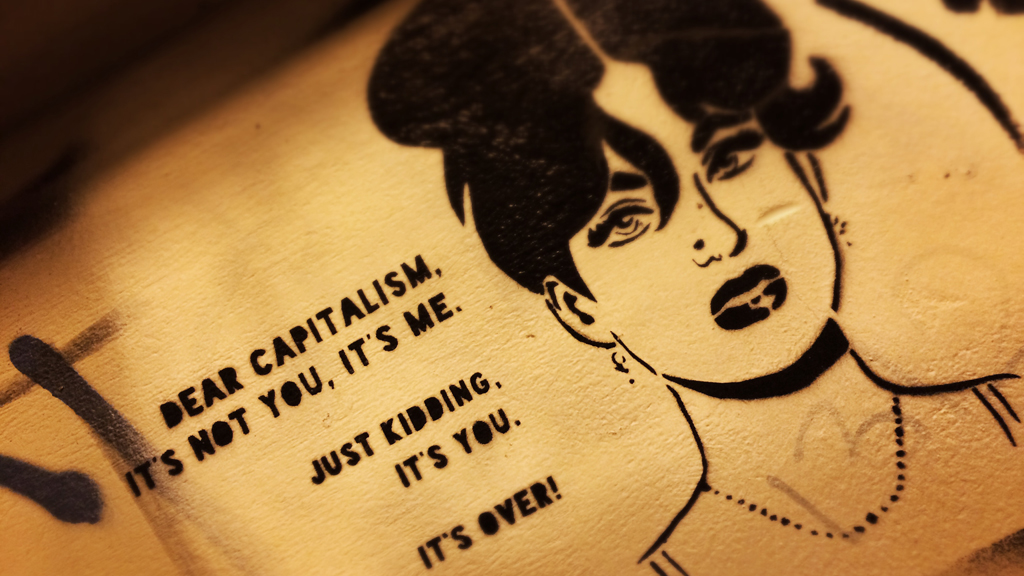
This is the second installment in a three-part series on Pope Francis’ new encyclical, Laudato Si’. Overall, the series attempts to place in historical perspective what might well be the most important document yet produced in the 21st century. It also tries to explain the meaning and centrality of the encyclical’s guiding principle, its “preferential option for the poor.”  This second part addresses Pope Francis’ critique of capitalism-as-we-know-it.

Pope Francis’ Critique of Capitalism

The first entry in this series on Laudato Si contextualized the significance of its author’s origins in the Global South. It argued that till Francis, Catholic social teaching had largely focused on Western and Eastern Europe. The social pronouncements of Italian popes were largely concerned with the problems of Western Europe and the threatened loss of the working class to the allures of socialism and communism. Beginning with Leo XIII’s Rerum novarum, the Italians set the stage for the introduction of Europe’s extensive welfare state.

With the election of a Polish and subsequently of a German pope, papal focus shifted to Eastern Europe and the dethroning of communism there. Pope John Paul II and his right hand man, Josef Ratzinger (later to become Benedict XVI) cooperated with the Reagan administration (and specifically with the CIA’s William Casey) in facilitating the collapse of the Soviet Union.

With that demise achieved, it appeared to most that capitalism had won a definitive victory. Corporate globalization stood virtually unchallenged.

However, all of this changed with the ascent of Argentina’s Jorge Bergoglio to the papal throne in 2013. As the first pope from Latin America, Pope Francis has repeatedly called capitalism’s “final victory” into question. No longer focusing on Europe (western or eastern), he shifted focus to the Global South, to the poverty colonialism and unfettered capitalism had caused there.

He focused on connections between deregulated markets and the rape of the Earth Mother indigenous Catholics of the Andes called Pachamama. Without apology, he espoused a “preferential option for the poor,” and spoke clearly about the rejection of the neoliberal globalized order lionized by the corporate elite.

Such sentiments were nowhere more clearly expressed than in the speeches delivered by Pope Francis during his summer “homecoming” trip to Latin America. In written form, they were evident in his landmark encyclical on the environment, Laudato Si’ and in his Apostolic Exhortation, Evangelii Gaudium.

Addressing the World Meeting of Popular Movements in Santa Cruz, Bolivia, Francis traced today’s global problems back to their origins in European colonialism beginning in 1492. But he also identified new forms of colonialism exercised through corporations, loan agencies, “free trade” treaties, and imposition of “austerity measures.”

Such actors and policies subordinate states to outside powers which also exercise control through misguided policies ostensibly aimed at controlling drug trafficking, political corruption, and terrorism. More subtly, external powers colonize, destroy local cultures and foster cultural uniformity through communications monopolies, which the pope described as “ideological colonialism.”

“Let us say NO to forms of colonialism old and new,” he said.

The pope was completely outspoken. He went on to criticize capitalism-as-we-know-it as “an invisible thread” connecting problems of world poverty, worker exploitation, landlessness among farmers, homelessness, and destruction of the natural environment. That system imposes the mentality of profit at any price without concern for its impact on displaced peasants and workers or for its destructive effects on “Mother Earth.”

This is indeed capitalism-as-we-know-it.

The system, he said “is by now intolerable: farm workers find it intolerable, laborers find it intolerable, communities find it intolerable, peoples find it intolerable … The earth itself – our sister, Mother Earth, as Saint Francis would say – also finds it intolerable.”

Though some have criticized the pope for stepping outside his area of competence, his condemnation of the reigning economic system is specifically biblical, theological, and moral.

Like the prophets of the Jewish Testament, he identifies “the existing system” with idolatry, the most serious of biblical sins. In his strongest condemnation yet, Francis quoted the 4th century sage, Basil of Caesarea, calling today’s capitalism “the dung of the devil” – i.e. the excrement of evil personified. Stronger language can hardly be imagined.

Theologically, Francis echoed Latin America’s liberation theology speaking Christian faith as “revolutionary,” because it challenges “the tyranny of Mammon.” The existing system, the pope said, “runs counter to the plan of Jesus.” He said the system now in place and Jesus’ hoped-for Kingdom of God have different aims.

Morally, then, the pope called working against capitalism-as-we-know-it – “working for just distribution of the fruits of the earth and human labor” – a “moral obligation.” For Christians, he said, “it is a commandment.” Here the pope echoed what he said in “Evangelii Gaudium,” where he identified the struggle for social justice and participation in political life as “a moral obligation that is “inescapable.”

(Next installment: the “other world” Francis sees as possible)

(Sunday Homily) Why Listen to Pope Francis on Climate Change? He’s A Prophet in Our Midst

http://https://youtu.be/XlHb_9rJSjw

Readings for 12th Sunday in Ordinary Time: JB 38: 1, 8-11; PS 107: 23-26, 28-31; 2COR 5: 14-17; LK 7:16; MK 4: 35-41.

Thursday Pope Francis published his long-awaited encyclical on the environment and climate change. The document is called Praised Be: on the Care of Our Common Home (PB).

Today’s liturgy of the word is perfectly synchronized with the encyclical’s release. Its elements emphasize God’s sovereignty over nature, its overwhelming beauty and might, the power of Christ-Consciousness to save from nature’s fury, and the new order of God’s Kingdom proclaimed and embodied in the Master from Galilee. Moreover, in articulating today’s themes, the humble Pope Francis distinguishes himself as a “great prophet,” in whom “God has visited his people” – the refrain in today’s Alleluia Verse.

Begin by considering the readings; afterwards we’ll turn to the encyclical and to Pope Francis’ prophetic status.

In our first reading, God speaks to Job sitting on a dung hill like the “pile of filth” into which, the pope says humans are turning the earth (PB 21). Like us, Job is trying desperately to figure out why bad things are happening to his world. Significantly, the Divine One speaks out of a storm and declares God’s sovereignty over nature – its seas with its threatening waves, the sky with its dark clouds, storms with their winds, thunder and lightning.

That theme of God’s sovereignty over nature is picked up in today’s responsorial which emphasizes the fearful might of the world’s oceans. Psalm 107 calls the sea an “abyss” – a threatening black hole. It is the work of the Lord who on the one hand causes storms to arise, but on the other restores calm to the waves and brings relieved travelers back to safe haven. Again, it is God, not humans who controls nature – a major theme of Praised Be.

Then in today’s Gospel selection Jesus calms the sea when it threatens to sink the boat he and his friends are using to travel to the “other shore.”

It’s the identity of Jesus’ followers as “Other Christs” called to do what Jesus did that is emphasized in today’s reading from Second Corinthians. There the apostle identifies Jesus as the herald of a completely new reality. The old order is no longer relevant, Paul says; it has entirely passed away. It’s that reality that followers of Jesus’ Way are to embody and usher in.

All of the themes in today’s liturgy of the word find echo in Pope Francis’ encyclical. Consider them one-by-one:

  • God’s Sovereignty over nature: Here Francis bluntly states that the pervasive understanding that God gave humans power of dominion or destruction over the earth “is not a correct interpretation of the Bible” (67). According to Francis, God denies any pretense of absolute ownership: “The land shall not be sold in perpetuity, for the land is mine; with me you are but aliens and tenants.” (Leviticus 25:23).
  • Nature’s overwhelming beauty and might: The very title of the pope’s encyclical reflects this point. “Laudato Si” are the first words of a prayer composed by Francis’ namesake, the great Italian mystic, Francis of Assisi, identified by the pope as the patron of ecology (10). Of St. Francis the pope writes, “Like it happens when we fall in love with someone, every time that Francis looked at the sun, the moon, the smallest animals, his reaction was to sing, sharing in the glory of all the other creatures. . . he entered into communication with all of creation.” At the same time the Pope Francis argues that today’s climate chaos with its fearful storms, droughts, and extreme temperatures represents the earth protesting against “the violence that exists in the human heart, wounded by sin.”
  • The power of Christ-consciousness to save us from nature’s fury: St. Francis, the pope notes, was a mystic like Jesus of Nazareth (98). He had Christ-consciousness. It allowed him, like Jesus, to speak to elements that most humans understand as impersonal (98). So like Jesus speaking to the wind and waves in today’s Gospel, Francis conversed with animals and regarded the sun as his brother and the moon as his sister. Only the adoption of such sensitivity and reverence, the pope says, can restore balance to our planet (11).
  • The new reality to which we are called: “An economic and technological development that does not leave the world a better place and with an integral superior quality of life cannot be considered progress” (194). So Francis proposes a new model beyond the worship of the “free market.” Its exact shape must be worked out through a process of international dialog (180). However it necessarily includes an international body with legislative power to control excesses of production and consumption connected with unfettered capitalism.”

In providing such clear direction, Pope Francis’ encyclical solidifies his identity as a “great prophet.” As it turns out, he is the only world leader capable of turning the planet around. His power combines the exact virtues required for such a herculean task:

  • Consciousness: Pope Francis’ consciousness is unique. Virtually alone among world leaders, he sees climate change, poverty, morality and spirituality as inextricably interconnected.
  • Courage: Among his peers, Francis’ courage is unparalleled. By comparison the “leader of the free world” (not to mention climate change denialists) looks like a timid child bowing and scraping before the world’s wealthy few – indecisive about Keystone XL and arctic drilling. Moreover, the pope intends to take his message of interconnection directly to the lion’s den. He will speak not only to the United Nations, but will confront a U.S. Congress largely hostile to his position on climate chaos.
  • Credibility: As a scientist with an advanced degree in chemistry and as titular head of the Pontifical Academy of the Sciences, Francis has access to the world’s finest scientific minds. He has done his homework. He addresses not just climate change, but problems undeniably caused by human activity – “water poverty,” food waste, waste in general, overfishing, destruction of coral reefs, human trafficking, income gaps between the global north and south, the rampant elimination of innumerable species, and war.
  • Charisma: The world loves Pope Francis. No other world leader more widely admired or more capable of influencing people regardless of nationality or creed. It is interesting to see Catholic politicians like Jeb Bush, Rick Santorum, Paul Ryan, John Boehner, and Bobby Jindal speak condescendingly about a religious leader’s forays into fields “beyond his expertise” – as if they were better informed and could out-Catholic the pope. This is a battle they cannot win.
  • Constituency: Pope Francis is the leader of 1.2 billion Roman Catholics. There are more than 70 million Catholics in the United States – not to mention the millions of non-Catholics who admire the pope. Can you imagine what would happen world-wide (politically and environmentally) if even a small percentage of them took the pope’s words to heart? What if they radically changed their behavior (and voting) patterns to save the planet for future generations and prevent the poor from suffering the worst effects of industry-induced environmental degradation?

Praised Be leaves none of us off the hook. Rather the virtues just enumerated provide guidelines for each of us. As Paul’s “other Christs” and as humans in general (62) we are called to “Franciscan”:

  • Consciousness: Each of us can become expert. Just reading Praised Be will take us a long way in that direction. Do your part for the planet; read the encyclical now. It is the best, most comprehensive and accessible text available on the most important issue facing our world. (Good supplemental reading is This Changes Everything by Naomi Klein.
  • Courage and credibility: Good information breeds these qualities. Like the pope we all need to fearlessly confront our uninformed, misinforming, head-in-the-sand politicians and demand that they serve us, our planet, children and grandchildren. Enough of letting them confuse us with their obfuscations.
  • Charisma: Few in the world can claim anything like Pope Francis’ charisma. But his fearless outspoken truth-telling is contagious and can infect us all by association. We must follow his example and use our innate talents to spread the message of Praised Be.
  • Constituency: Whether Catholic or not each of us needs to join Pope Francis’ constituency. In my own parish, our Peace and Social Justice Committee plans to buy copies of his encyclical for every parishioner over the age of 16. Beginning in September (about the time of the pope’s visit to the U.S.) we’ll initiate a parish-wide study of the encyclical. We’ll gather to watch Francis’ speeches to the U.N. and our Congress. Praised Be provides a foundation for turning every Catholic Church into a peace and social justice dynamo.

Again, today’s Alleluia Verse proclaims “A great prophet has risen in our midst. God has visited his people.” Today Pope Francis is that prophet. That’s why we should listen to him and follow his example.

Bishop Stowe Is Sending Us a Message by Attending Oscar Romero Celebration

Stowe

(This is the first in a three-part series on our parish’s upcoming celebration of the beatification of San Oscar Romero which will take place on May 23rd. The event will be observed in St. Clare’s parish on June 3rd, when our new bishop, John Stowe, will join us.)

As one of the first acts of his new Episcopate, Bishop John Stowe will be visiting my parish, St. Clare’s in Berea, Kentucky, to celebrate the beatification of Oscar Romero, the Archbishop of San Salvador, who was gunned down at the altar on March 24, 1980.

In accepting the invitation to join the celebration, then bishop-elect Stowe wrote:

“Oscar Romero is a great inspiration in my life and I am thrilled to know of a community that wishes to celebrate his witness.”  

Bishop Stowe’s words and his decision to attend the celebration are freighted with meaning for Catholics of the Lexington Diocese. They speak volumes about Bishop Stowe’s overriding commitment to social justice. The bishop’s words call our attention not only to the person of Oscar Romero, but to the theology that informed his life, and to our vocation as followers of Jesus the Christ.

In today’s posting, think about Oscar Romero himself. (Subsequent blogs – next Wednesday and the following Monday – will focus on liberation theology as it relates to Romero, and then on practical responses to the archbishop’s beatification).

Oscar Romero was born in 1917. Like our present pope, Francis, he was a Jesuit. Monsignor Romero entered the seminary at the age of 13 and was ordained at 26. He studied in Rome, and received his doctorate in theology there from the Gregorian University. In 1977, he was appointed archbishop of San Salvador.

The monsignor was a bookish man – very traditional, both politically and religiously speaking. He was a conservative in every sense of the word.

However, a turning point came for Oscar Romero less than a month after his consecration as San Salvador’s 4th archbishop. A close friend of his – another Jesuit priest, Rutilio Grande – was assassinated by one of El Salvador’s right-wing death squads. Rutilio Grande was an advocate of the poor, an opponent of government oppression of the peasants and workers, and an advocate of radical theology. He saw Jesus as a prophet – the Son of God bringing good news to the poor.

Romero’s own words reveal the impact of Grande’s death. He said, “When I looked at Rutilio lying there dead, I thought, ‘if they have killed him for doing what he did, then I too have to walk the same path.'” The “they” Archbishop Romero referred to was his own government, its military, and their backers in the United States.

In other words, the penny had dropped for the archbishop. He realized that his country and all of Central America was at war. It was what Noam Chomsky called “the first religious war of the 21st century.” It pitted the United States of America and its right wing allies in Central America against the Catholic Church.

But as Romero said in a speech at the Universite Catholicque in Louvain, Belgium, just before his martyrdom, the U.S. war wasn’t against the entire Catholic Church.  Or as the archbishop himself put it,

“. . . (I)t is important to note why [the Church] has been persecuted. Not any and every priest has been persecuted, not any and every institution has been attacked. That part of the church has been attacked and persecuted that put itself on the side of the people and went to the people’s defense. Here again we find the same key to understanding the persecution of the church: the poor.”

In other words, the archbishop had put his finger on the problem: the Catholic Church was divided between the traditionalists who supported the rich, unfettered capitalism, and U.S. Empire on the one hand, and those who took the part of the poor on the other. Grande’s death convinced the archbishop that he had been on the wrong side. So he switched over and took the part of the poor. In doing so, he in effect signed his own death warrant.

Nevertheless, he began speaking out fearlessly each Sunday against his country’s government, its military, and their supporters in the United States. He railed against El Salvador’s endemic poverty, social injustice, assassinations and torture. He specifically criticized the United States for the military aid it gave to El Salvador’s repressive military government.

President Carter ignored the archbishop’s pleas to stop arming El Salvador’s military and death squads. And when he entered office, President Reagan doubled down on his predecessor’s policy.

Still, Archbishop Romero continued to follow faithfully Rutilio Grande’s path. His weekly radio programs became a sensation throughout El Salvador. He named names and listed the disappeared, tortured, murdered and much more. The archbishop’s broadcasts became the main source of trustworthy news for his oppressed people.

As a result, death threats from the White Hand death squad came to him every day. But such intimidation didn’t work on Oscar Romero.

Finally, though, on March 24, 1980, the chickens came home to roost. In a crime intellectually authored by Roberto D’aubuisson, a darling of U.S. Central American policy, the archbishop was assassinated while celebrating the Eucharist in a convent in San Salvador.

The country was plunged into mourning. 250,000 people attended Archbishop Romero’s funeral. However, only one of the country’s bishops attended his funeral. The others considered him too radical and politicized. They stayed home.

The Salvadoran army however did not. Death squad sharpshooters terrorized the funeral, dropping smoke bombs and killing anywhere from 30 to 50 people while wounding many others. It was a world-class scandal.

But it was by no means the end of the war against the Catholic Church. The White Hand death squad continued to follow its slogan, “Be a patriot; kill a priest.”

Less than a month after Archbishop Romero’s martyrdom, four U.S. women religious (all from Cleveland, Ohio) were brutally raped and murdered: Ita Ford, Maura Clarke, Dorothy Kazel, and Jean Donovan. Then in 1989, a team of six Jesuit liberation theologians at the Central American University along with their housekeep and her 15 year old daughter were slaughtered by Salvadoran soldiers trained at the School of the Americas in Fort Benning, Georgia.

By the war’s end, scores of priests were killed along with lay ministers of the word, teachers, social workers, and union organizers. In 1980 alone, more than 11,000 such activists fell victim to the death squads. By the war’s end, more than 70,000 Salvadorans had been killed by their own government. Imagine the impact of such numbers in a small country of just over 6 million people.

“Joy of the Gospel” Sparks Lively Discussion (and Resistance)

change

Last night, a small group of us meeting Sunday evenings during Lent to discuss Pope Francis’ “Joy of the Gospel” found the discussion more lively than usual. That’s because as Lent draws to a close, our group had decided to actually entertain minor changes in parish life as a result of the pope’s injunction to do so.

Resistance from our pastor and pastoral associate was evident. Nonetheless, while neither (perhaps understandably) was willing to exert leadership in this case, both showed faint signs of willingness to be led.

The mild suggestion sparking discussion was the following:

  • To celebrate the upcoming beatification of Oscar Romero (Saturday, May 23rd) with a special evening Mass and fiesta (featuring a mariachi band, salsa dancing, and food catered by our local Mexican restaurant).
  • To precede the Mass with an hour-long “adult education” session featuring a 15 minute talk on Oscar Romero and liberation theology along with a half-hour documentary on the Salvadoran martyr, and a 15 minute discussion.
  • To have the Mass concelebrated with the main celebrant and homilist being Padre Eulices, the clerical leader of our local Hispanic community.

According to the pastor and his associate, the suggestion was highly problematic. After all:

  • Didn’t we know that May 23rd is the Vigil of Pentecost? “And I, for one,” the pastor said, “am not willing to substitute something like this for the celebration of Pentecost, one of the greatest feasts of the liturgical year.”
  • On top of that, “I have Mass in Mt. Vernon (a congregation of fewer than 30 people btw) at 5:00, and I could never get back to Berea by the 6:00 starting time you have here on your schedule.”
  • And what about McKee (a congregation of perhaps 15-20 people)? “They surely wouldn’t show up for something like this. They’re very stuck in their ways.”
  • “And then there’s the Saturday night crowd! They expect Mass at 7:00. Changes like this would upset them.” (It turned out that the suggested event had taken this into account and had Mass beginning @ the usual 7:00 time).
  • “And what about the Hispanic group? They always celebrate Mass at 11:00 on Sunday morning. I’m sure they would resist coming to Mass Saturday evening as this change suggests.”
  • “And do you mean to say that there’d be no Sunday Mass at 9:00 – the way we’ve done it all these years?”
  • “And why would we spend all that money on a mariachi band? Our Sunday choir along with that of the Hispanic community would be better and would cost no money.”
  • “And wouldn’t it be better to have someone from the chancery come to speak to us about Oscar Romero rather than someone from the parish?”
  • “So let’s: (1) move the program to Sunday at the usual time, (2) shorten up the presentation about Romero, (3) forget the mariachi band, (4) emphasize Pentecost, and (5) see if we can get some speaker from Lexington to speak about Romero.”

Naturally, the lay group had responses to those clerical objections:

  • The themes of Pentecost and Romero’s beatification can quite easily be integrated. They actually complement one another.
  • If the pastor could not get back from Mt. Vernon at 6:00, we could move the event’s starting time to 6:30. Or maybe we could (this one time!) just have a single Mass instead of 5 (!) inviting the Mt. Vernon folks to come to this fun party. If they choose not to come, well, it’s a free country.
  • Same goes for the McKee community.
  • As previously noted, nothing would be changed for the Saturday night crowd in terms of the starting time for their evening Mass.
  • The Hispanic community is the most flexible of all. Its members are anxious to integrate with the Anglo community. And Romero is one of them! Surely it wouldn’t be hard to persuade them to come to a party a mariachi band, salsa dancing, and Mexican food.
  • If we must have a Sunday morning Mass at 9:00, no problem. On this particular Sunday, the congregation will, no doubt, be smaller (with most having satisfied their “Sunday obligation” the previous night). But is that a problem? In fact, nothing would be hurt by cancelling that Mass as well. (But, of course, cancelling the 9:00 Sunday Mass is not part of the plan.)
  • As for the mariachi band . . . We’re talking about a fiesta and illustrating “the joy of the Gospel!” For something worthwhile like that, people are willing to pony up. We could easily raise $1000 to cover an event like this. At least we could float the idea to see.
  • In this college community with so many professors and theologians, do we really need someone from the chancery to speak about Romero and liberation theology?
  • And why Saturday night instead of Sunday? Because Saturday night is a party night! And (again) we’re talking about the joy of the Gospel.

As you can see, it’s not easy for some to make even minor changes in “what we’ve always done.” For others, change is easy. For instance, Padre Eulices was unfazed when asked to consider altering his schedule for the Romero celebration. “Well,” he said, “I normally have Mass in Richmond at 6:00. But I’ll try to get a substitute. I’ll get back to you. Thanks for asking.”

However, the changes implied in this whole event go much deeper than resistance to a one-off Mass-and-fiesta. It all raises serious questions about parish organizations and the way priests in the new pope’s church spend their time. Among the questions to be addressed in our own community, the following seem most obvious:

  • Given the fact that we now have only one pastor (and not the 3 or 4 priests we had when our 3 parishes were founded about 50 years ago), does it really make sense to have 5 Masses (!) each weekend?
  • If we must maintain the dubious practice of “servicing” three parishes, why doesn’t our church sponsor the training and ordination of one or more deacons to provide more meaningful communion services (and preaching) at the churches in question? Our community could easily identify and invite good candidates (male & female) with a gift for preaching and pastoral work.
  • In fact, for some (the 3 or 4 ex-priests among us) additional training would not be necessary. They could start preaching and presiding over a communion service next Sunday!
  • In view of such considerations, shouldn’t we sit down with our pastor and help him brainstorm about less stressful use of his time?
  • Hasn’t the moment arrived for constructing a serious strategic plan for the parish involving input from all its members and taking advantage of their much-needed gifts?

As you can see, it’s been a productive Lenten discussion.

Poll: Why Have You (and/or your children) Left the Church?

quit-church-538x218

Our parish (St. Clare’s in Berea, Kentucky) continues to be inspired by Pope Francis’ “Joy of the Gospel” (JG).  Our pastor has embraced its letter and spirit.  So has the growing number of parishioners attending Sunday evening discussions of the document during Lent.

All of that is significant, because (as in the church as a whole) there is a lot of discontent among us. It’s like the pope says at the beginning of apostolic exhortation: there believers are described as often “resentful, angry and listless” (JG 2).

Those are the sentiments that surfaced during discussion of “The Joy of the Gospel” last Sunday evening.

The spark that caused them to rise came from an unexpected source, our pastor himself. At one point in the meeting, he said, “I have a question: Why is our church losing people?”

Our jaws dropped. A door had finally swung open to meaningful discussion.

Our pastor identified three causes for parish attrition: (1) parishioners have not felt invited to truly participate in parish life; (2) many have moved away from our town, and (3) we’re just not a welcoming enough community.

Parishioners around the table offered alternative analyses that probed a bit deeper. They said: (1) our community lacks effective leadership; (2) liturgies are boring, lifeless, and lacking the “joy” centralized in the pope’s exhortation; (3) homilies are disconnected from the world, our lives, and from the day’s burning issues. In general the church is out-of-touch.

In the midst of the conversation, someone said, “If we want to know why we’re losing people, we should ask our children. Most of us brought them up in the church the way we were supposed to. We took them to Mass every Sunday, sent them to catechism classes (and even taught some of them ourselves); we introduced them to the sacraments. And now virtually none of them go to church. We must be doing something wrong. We should ask them why they’ve left.”

So that’s what I’m doing here. I’m asking any young people who read this blog, why have you left the church. Just a sentence or two will do, though longer responses are welcome. I’m asking parents why they think their children no longer “practice” the faith.

In the meantime, here are a few of my own thoughts:

A Church in Crisis!

Our church has fallen into deep depression.

Even our pastor asks

“Where have all the children gone?

Why are the pews empty?”


His question admits that

We no longer appeal to young people.

We have lost touch with the world

And its problems

Of poverty, systemic dysfunction,

War, Michael Browns, misogyny, and abysmal income gaps.


A fearful church – the Ratzingers among us –

Defensively retreats to an imagined past

Where young people were “moral”

And still came to Mass

And confession!!

Where “reforms” meant rehabilitating words like

“Consubstantial,” “chalice,” and “under my roof.”

And where everyone cowered

In fear of the Lord

And of the Reverend “Father.”


Those days are gone

For good,

Francis says.

Thank God!

Instead,

He’d have us address

The real problems of the world.

Globalism does not work.

It’s destroying the planet.

“War never again,” he repeats

And “Who am I to say?”


This father

Does not pretend

To know best.

Instead,

He looks to the wise

Young carpenter from Nazareth

Who loved the “lazy” poor

(And was one of them!)

Who loved the whores and drunkards,

The lepers, fags and pimps.

Who cursed the rich

And blessed the ragged.

“The Kingdom is yours!”

He promised them all.


Our globe needs that Spirit today

More than ever!

But few find it

In our churches

Where we should.

That’s why the pews

Are empty!

(Sunday Homily) Ten Reasons for Hope in a Time of Despair: Empire Is Crumbling before Our Eyes

Syriza (SYRIZA Poster: http://keithpp)

Readings for 4th Sunday in Ordinary Time: JB 7: 1-4, 6-7; PS 147: 1-6; I COR 9: 16-19; 22-23; MK 1: 29-39 http://www.usccb.org/bible/readings/020815.cfm

Today’s liturgy of the word is about hope in a world wracked by despair. All of us are starved for such hope. In fact, discouragement and apparent powerlessness describe not only our personal consciousness but the larger zeitgeist that is the constant focus of these Sunday reflections dedicated to confronting the world with the Bible in one hand and the newspaper in the other. Today’s confrontation should help progressives realize that our times are actually changing for the better.

Think of the most recent historical roots of today’s despair – the way the world was just 20 years ago. As described recently by Andre Vitchek, it was an unbelievably hard time for opponents of empire.

Then think of how things are different today. It’s the difference between the condition of Job in this Sunday’s first reading, and the healing Jesus brought to the poor in today’s gospel selection.

Twenty years ago Russia was controlled by Boris Yeltsin, a boozy western puppet who betrayed his own people. Like Yeltsin, other heads of state throughout Eastern Europe joined their western counterparts in a shameless surrender to imperial interests. They were largely “led” by the offspring of the elites who preceded them. China 20 years ago was still under the spell of the free market reforms introduced by Deng Xiaoping. Meanwhile, Latin America reeling from decades of dictatorships imposed by the West had turned its economies over to neo-liberals trained in the Chicago School of Economics. The same was largely true of the Middle East and Africa. In those cases, dictators and the one-percenters were firmly in control. Christian vision of a kingdom where the earth belonged to everyone had been completely hijacked by religious fundamentalists and reactionaries including in his own way, the pope of Rome. All of this was largely hidden by both local and international mainstream media (MSM) which applauded dictatorships and plutocracies as “emerging democracies.”

Those were indeed hard times for anti-imperialists. I remember the despair. We were like Job in today’s first reading sitting on a dung heap lamenting the loss of hope enkindled by the Civil Rights and Anti-War movements of the ‘60s and ‘70s.

Remember Job? He too was the victim of an incredible series of misfortunes. They reduced him to a condition worse than poverty. Without warning, he lost all his wealth; his children died; he became terribly sick; and his reputation went entirely south.

Job is the image of us all 20 years ago. Like Job, progressives couldn’t be blamed for wondering if our situation could ever change.

Perhaps believers among us had forgotten the general hope offered in today’s responsorial psalm. It reminds us of the goodness of Life – the divine energy in which we live and move and have our being. (Some call that Energy, “God.”) The psalmist reminds us that time and history itself have a way of healing broken hearts.  Life has a way of supporting even the most devastated.  And (as Job’s case illustrates) it eventually topples even those who appear to live on top of the world. God is good, the Psalmist reminds us. God is gracious and wise beyond our wildest imaginings. God unifies the poor, even when they’re hopelessly fragmented by elite strategies of “divide and rule.”

Today’s gospel reading offers more particular hope.  It recounts the first acts of a prophet from and imperial backwater, Israel – Jesus, the carpenter-preacher from Nazareth, a “Nowheresville” if there ever was one.

There he encourages the downtrodden every bit as crushed as Job. He heals with a touch, an embrace, a smile, a kiss of the foot, a word of encouragement as the afflicted assemble before him to find health and hope and relief from their demons.  In other words, today’s gospel locates hope outside the political structure of the day, outside the realm of priests, lawyers, kings and emperors. It finds hope on the margins of empire.

And when you think of it, that’s where hope is to be found today. It’s not grounded in American presidents, in our imperial army, in the European Union, or in “foreign aid.” As I said, it’s not even reported in the mainstream media.

And yet the world is changing for the better right before our eyes. And the locus of change is on the margins – in the 50% of the world that has almost invisibly (for Americans) broken free of the imperial order that has governed the world since the end of World War II. Eventually the gains of that 50% will change us too.

Think of the progress I’m referring to. To even perceive it you have to step outside the powerful system of propaganda that envelops us all. Here are 10 signs of hope emerging from the margins. They have for years been signaled by J.W. Smith and his Institute for Economic Democracy:

  1. World-wide people have lost faith in the western model of mainstream media (the Great Wurlitzer” as Smith terms it). Most have awakened to the fact that it’s all lies. In Latin America, Russia, China, and Iran, the new media is not even “alternative” any longer. Its mission is exposing the crimes of the West, its Empire and client states. Its message couldn’t be more straight-forward: No more torture, rape or genocide.
  2. Russia has risen from the ashes and is confronting the Empire on all fronts. Vladimir Putin has emerged as the world’s most effective international leader and practitioner of diplomacy and independence from Empire.
  3. Russia and China are both returning to their socialist roots advancing policies far more humane than their western counterparts.
  4. In Greece the overwhelming victory of SYRIZA has threatened the neo-liberal order in the heart of the European Union. The party’s anti-austerity message is already being spread to Italy, Spain, and France.
  5. Latin America has broken free of the shackles of the Monroe Doctrine. Cuba, Venezuela, Ecuador, Bolivia, Nicaragua, Chile, Argentina, Uruguay and Brazil are all forging their own paths while cooperating with and supporting one another. All are moving closer to Russia and China.
  6. The BRICS countries (Brazil, Russia, India, China, and South Africa) themselves represent at least half the planet’s population. They are trading with each other in their own currencies now making themselves immune from western sanctions.
  7. On June 17th of this year, under BRICS leadership, 133 of the world’s 196 countries declared their intention to “destroy the New World Order” championed by western Empire.
  8. For those paying attention, even the ISIS barbarians are unwittingly serving the cause of peace by demonstrating the horror of wars instigated by the West. They behead on YouTube videos, while U.S. moviegoers cheer American Snipers who blow the heads off unsuspecting Iraqis defending their homes from Seals. ISIS barbarians set fire to prisoners with matches, while their U.S. counterparts use napalm and white phosphorous. The clash of barbarisms highlighted by ISIS promises to make pacifists of anyone capable of seeing parallels. (It’s up to progressives to make them apparent.)
  9. Even the U.S. president (the first ever influenced by liberation theology) sees parallels like the ones just referenced. He has criticized American exceptionalism by challenging his people to “remember that during the Crusades and the Inquisition, people committed terrible deeds in the name of Christ. In our home country, slavery and Jim Crow all too often was justified in the name of Christ.”
  10. The pope of Rome is attempting mightily to defeat Catholic fundamentalism and to turn 1/7 of the world’s population (i.e. 1.2 billion Catholics) in the direction of social justice and environmental protection as advocated by liberation theology.

None of these are “pie in the sky” hopes. They are simply facts known to the world outside our borders but hidden from us by the MSM.

Along with today’s liturgical readings, such changes should be cause for hope and encouragement. More than half the world has left Job’s dung heap. The world’s poor whom Jesus served and embodied are leading the way. The rest of us will join them soon.

(Sunday Homily) Pope Francis Calls for a Global Catholic Climate Movement

Italy Pope Epiphany

Readings for 1st Sunday in Ordinary Time: I SAM 3: 3B-10, 19; PS 40: 4, 7-10; I COR 6: 13C-15A, 17-20; JN 35-42

Recently Pope Francis has come in for some hard criticism from the U.S. right wing. It’s not just because of his rejection of free market capitalism, trickle-down theory, and huge income disparities between the rich and poor. It’s not just his openness to gays and divorcees, and his refusal to obsess about abortion and contraception.

Yes, all of these have undermined what conservatives have seen as a close alliance between the Catholic Church and their pet causes and thinking modes.

However, the straw breaking the back of reactionaries is the pope’s unequivocal warnings about climate change. They’ve gone apoplectic about his intention to publish an encyclical on the matter, and his plans to convoke a conference of religious leaders to address it. The pope’s expressed intention is to influence this year’s U.N. Paris Conference on Climate Change. All of that has raised the specter of a global Catholic climate change movement potentially mobilizing the world’s 1.2 billion members. Think about that for a minute!

In such context, Francis visit this week to the Philippines is extremely significant. The Philippines is not only the home of 80% Asia’s Catholics – more than 100 million. It is also the poster child for the devastation that climate change wreaks on the principal victims of global warming, the world’s poor. In 2013 the archipelago was raked by Typhoon Yolanda whose winds and floods killed more than 7000.

So the world listened when on his way to Manila Pope Francis was asked if climate change is “mostly due to the work of man and his lack of care for nature?” In reply, the pope said:

(F)or the greater part, it is man who gives a slap to nature continually, and we have to some degree become the owners of nature, of sister earth, of mother earth. I recall, and you have heard, what an old peasant once told me: God always forgives, we men forgive sometimes, but nature never forgives. If you give her a slap, she will give you one. I believe that we have exploited nature too much, deforestation, for example.

With words like those, the pope’s critics charge he is speaking beyond his expertise, which involves matters of “faith and morals.” But that’s just the point. The pope is making climate change a moral issue, a matter of ethics even more important than more “traditional” Catholic moral concerns about sex which after all presume the survival of the human species and the planet.

The pope’s critics also ignore, of course, that Francis bases his judgments not only on the testimony of 97% of all climate scientists, but on the research of the Pontifical Academy of Sciences. Its membership roster features the names of the world’s most respected scientists. These include Nobel laureates such as Ernest Rutherford, Max Planck, Otto Hahn, Niels Bohr, and Charles Hard Townes. The Academy’s current president is Werner Arber, himself a Nobel laureate, and the first Protestant to head the group.

But why such right-wing fury? It’s because like Naomi Klein, conservatives see the (for them) disastrous implications of addressing the issue. As announced in the title of Klein’s book, they sense that This Changes Everything. That is, taking on climate change as a moral issue undermines the political right’s program of market deregulation and continued extraction of non-renewable resources.

So pundits like First Things blogger, Maureen Mullarkey have given up on lip sticking the pope and are now in full attack mode. According to Mullarkey Pope Francis is simply “an ideologue and a meddlesome egoist. His clumsy intrusion into the Middle East and covert collusion with Obama over Cuba makes that clear. Megalomania sends him galloping into geopolitical—and now meteorological—thickets, sacralizing politics and bending theology to premature, intemperate policy endorsements.”

For Mullarkey, Pope Francis pretty much stinks.

And that brings me to today’s gospel reading. It’s all about stink – about what Pope Francis calls “the smell of the sheep.” Famously, you recall, the pontiff called on Catholic priests to live closer to the poor, to recognize them as God’s people and their welfare as the guideline for economic and social policy – to “take on,” he said, “the smell of the sheep.”

In other words, conservatives are suspicious of Pope Francis and are on the point of vilifying him because he smells too much like sheep — like the poor. He smells too much like Jesus.

Notice that in today’s gospel, John the Baptizer identifies Jesus as “the Lamb of God.” To begin with, the phrase reminds us of the tribal, Bedouin origin of the biblical “People of God.” Abraham, Isaac, and Jacob, and the great King David were all shepherds. They were primitive people close to the earth. They were tribalists. Jesus was a tribalist. According to John’s image, Jesus didn’t just smell like sheep; he was a sheep! He was in spades like his slave and Bedouin ancestors — like the poor people the pope is centralizing in his visit to the Philippines.

Pope Francis is a tribalist too. And he’s practicing what he preaches — both liberation theology’s “preferential option for the poor,” and the traditionally Catholic principle of subsidiarity. Once again, that means endorsing economic and environmental policy not on the basis of market dictates, but according to human decisions about values like the common good. Humane policy, the pope implies, originates not on Wall Street, but in places like the Philippines’ Tacloban City which was leveled by Typhoon Yolanda. It’s there that the pope’s itinerary reportedly has him dining in the shack of a hurricane victim. (Can you imagine a humble Catholic housewife setting her family table to include the pope?)

As our century’s most powerful illumined voice of conscience, Francis is using his bully pulpit to wake us up. We’re like Samuel in today’s first reading – fast asleep even before the Ark of the Covenant (a reminder of Israel’s enslaved and Bedouin past). But we fail to recognize the biblical tradition’s significance to our lives – its call to tribal values which unfailingly center on animals, human family, and Mother Earth. We fail to see the implications of Paul’s observation in today’s second reading that all human beings – especially the poor and outcast – are temples of God’s spirit. That’s our tradition! That same Spirit resides, the pope says, in the planet that he (like St. Francis himself) calls our Mother and Sister.

So what would a global Catholic climate movement look like? It would entail:

  • Waking up like the young prophet Samuel. Like him we’ve heard God’s call many times. But at last in Pope Francis, we have a thought-leader speaking in a voice the simplest of us can hear. It’s the voice of conscience. And like Eli it’s giving us the proper way to respond: “Speak Lord, for your servant is listening.”

A global Catholic climate movement further entails:

  • Rejection of corporation-based globalization which has us (over)consuming imported necessities that could be home-grown. (This involves lobbying against the Trans-Pacific Partnership.)
  • Joining the fight against fracking and projects like the XL Pipeline
  • Voting accordingly.
  • Urging the institutions we can influence (churches, universities, hospitals . . .) to divest from fossil fuel industries.
  • Adopting a “zero waste” policy in our homes and places of work.
  • Cultivating home gardens.
  • Adopting a vegetarian diet.
  • Educating ourselves about “green burial” and including plans for that in our “living wills.”

The list, of course, goes on. But you get the idea.

This stinkin’ pope is waking us up. He’s showing us the way. Thank God!

(Sunday Homily) Dear Pope Francis: Gaza Needed More than Tears; Next Time, Please “Walk on Water”

Walk on Water

Readings for 19th Sunday in ordinary time: I KGS 19: 9A, 11-13A; PS 85: 9-14; ROM 9: 1-5; MT 14: 22-23 http://www.usccb.org/bible/readings/081014.cfm

In today’s Gospel, we hear Matthew’s account of Jesus walking on water – or rather, of Peter’s refusal to follow Jesus’ example of walking on the waves.

The account is relevant to the man in the Vatican who believes he is Peter’s successor. Israel’s month-long siege of Gaza invited Pope Francis to “walk on water” – to follow the example of Jesus in confronting demons. However uncharacteristic timidity left the pope sinking below the waves, out of sight and ear shot, cowering before Monsters like Obama and Netanyahu.

Let me explain. First off, consider today’s Gospel reading.

The story goes that following Jesus’ feeding of the 5000 (last week’s Gospel episode), Jesus forces the apostles to get into their boat and row to the other side. [The text says, “Jesus made (emphasis added) the disciples get into a boat and precede him to the other side.” Perhaps these experienced fishermen (as opposed to the land lubber, Jesus) saw a storm was coming and were reluctant to set sail despite Jesus’ urgings.]

In any case, a storm does come up and the apostles fear they are about to drown. You can imagine them in helpless tears.

Then they see a figure walking on the water in the midst of high threatening waves. At first they think it’s a ghost. Then they realize that it’s Jesus. He’s walking on the raging waters.

Peter, the impetuous leader of the apostles, doubts what he sees. So he says, “Prove to me that it’s you, Jesus; let me walk on the waves just as you’re doing.” Jesus says, “Join me then over here.” So Peter gets out of the boat and, like Jesus actually walks on water for a few steps.

Then, despite the evidence, he begins to doubt. And as he does so, he starts sinking below the water line. “Save me, Lord,” he cries out again. Jesus stretches out his hand and saves Peter. Then he asks, “Where’s your faith, man? Why is it so weak? Why did you doubt?”

Of course, this whole story (like last week’s “Loaves and Fishes”) is one of the dramatic parables Matthew composed. If we get caught up in wondering whether we’re expected to believe that someone actually walked on water, we’ll miss the point of this powerful metaphor. It’s about Jesus’ followers doing the unexpected and irrational in the midst of life-threatening crisis.

You see, Matthew’s Jewish audience shared the belief du jour that the sea was inhabited by dangerous monsters – Leviathan being the most fearful. And fearlessly walking on water was a poetic way of expressing what Matthew’s community believed about Jesus, viz. that he embodied the courage and power to do the completely unexpected in the midst of crisis and subdue the most threatening forces imaginable – even the most lethal of all, the Roman Empire.

Jesus’ invitation to Peter communicates the truth that all of us have the power to confront monsters if we’ll just find the courage to leave safety concerns behind even in the most threatening conditions, to confront life’s monsters, and join Jesus in the midst of its upheavals.

Problem is we easily lose faith and courage. As a result, we’re overcome by life’s surging waves and by the monsters lurking underneath them.

And that brings me back to Pope Francis and his ambiguous response to the slaughter that took place in Gaza over the last month.

We expected more. Over the course of his still-young papacy, Francis has demonstrated wonderful courage attempting to join Jesus on the world’s dangerous waves.

• He’s adopted a comparatively simple lifestyle.
• He’s condemned neo-liberalism and growing income inequality.
• His apostolic exhortation, “The Joy of the Gospel” implicitly endorsed the liberation theology his two immediate predecessors had tried to kill.
• More specifically, he adopted liberation theology’s “preferential option for the poor” as the leitmotif of his papacy.
• In that spirit, his famous “Who am I to judge” gave hope to the LGBTQ community.
• He helped head off President Obama’s plans to bomb Syria.

That last precedent led me to expect more in the context of Gaza. I was in St. Peter’s Square for Francis’ hours-long vigil for peace. There the Pope did as much or more to head off U.S.’ insane plans to bomb Syria as did Russia’s President Putin. Along with Putin, Francis was the hero who subverted the monstrous plans of Obama and his State Department.

But there was no peace vigil for the Gazans. Instead two weeks ago the Pope broke down in tears as he delivered his Sunday remarks from the balcony over St. Peter’s Square. He said:

“Never war, never war! I am thinking, above all, of children who are deprived of the hope of a worthwhile life, a future. Dead children, wounded children, mutilated children, orphaned children, children whose toys are things left over from war, children who don’t know how to smile.” This was the moment when the tears came. “Please stop,” said Francis. “I ask you with all my heart, it’s time to stop. Stop, please!”

The words were powerful; the tears were powerful. But unlike the prayer vigil before a potential Syrian fiasco, they remained largely unreported. Nevertheless, for those with ears to hear, the Pope was lamenting Israel’s killing of Palestine’s innocent. (No Jewish children were killed during the Gaza massacre.) However, to overcome the Media’s deafening pro-Israel tilt, the Pope needed to be stronger and more specific.

Yes, his papacy has daringly left the safe harbor and courageously sailed into the storm. Yes, Francis clearly sees Jesus as his role model demanding courage in the face of today’s unprecedented winds and waves. Indeed Francis has gotten out of the boat to trample underfoot the beasts and monsters roiling the seas all around us. But in the case of Gaza, instead of walking confidently on the waters, he sunk in apparent timidity before the threatening monsters, Obama and Netanyahu.

But what more could he have done? What sort of miracle did I expect?

Well, he could have given courage to all of us who are far less daring than he; he could have performed a miracle more stupendous than actually “walking on water” by:

• Owning the fact that as the leader of 1.2 billion Roman Catholics, with far more power than Jesus had, he was truly able to end Gaza’s slaughter.
• Announcing plans to travel to Gaza in the midst of Israel’s monstrous campaign.
• Before leaving, specifically naming Israel’s assault on civilians as sinful.
• Identifying the U.S. as equally culpable with Israel for crimes against humanity.
• Actually traveling to Gaza in a white papal helicopter (even in defiance of Israel’s predictable prohibitions) and landing in the midst of Gaza’s devastation.
• Celebrating Mass in Gaza on a pile of rubble and refusing to leave till the Israelis stopped their slaughter.
• If the slaughter continued, traveling to the key sites of bombing and shelling.

“Impossible!” you say? Such an act would offend Israel and upset Israel-Vatican relations. Ditto for the U.S.

Hmm. Is the pope a politician or a prophetic religious leader? Please use your imagination and spin out what would have happened if the pope walked on water as just outlined. What do you think?

In any case, those much less courageous than Francis need his example so the rest of us might venture forth to walk on water in our own far less powerful ways.

Yes, in today’s Gospel, Jesus invites us all to do the impossible. Why are we doubting? Where is our faith?

Sunday Homily: “Lazarus come forth!” Pope Francis Brings Jesus Back to Life

Lazarus

Readings for the Fifth Sunday of Lent: EZ 37: 12-14; PS 130: 1-8; ROM 8:8-11; JN 11: 1-45 http://usccb.org/bible/readings/040614.cfm

A few weeks ago, Fortune Magazine identified Pope Francis as first among the World’s “Fifty Best Leaders.” President Obama did not even make the list. Bono and President Clinton were among the top ten.

Whatever the magazine’s reasons for selecting the pope, it’s clear that the “Francis Effect,” is real. Seventy-seven percent of Catholics say they have increased their church donations since the new pope took office. Francis has brought the Catholic Church back from the dead. More importantly, he has returned to life the Jesus of the gospels whom conservatives have long since hijacked and buried – the very one our world’s poor majority needs as never before.

That’s relevant this fifth Sunday of Lent where our readings have Ezekiel coining the highly political metaphor of God’s “raising the dead” to refer to Israel’s impending liberation from its own despair during its Babylonian Captivity. Ezekiel’s metaphor reappears in today’s gospel reading where John the evangelist’s presents his familiar parable about Jesus raising Lazarus from the grave where Jesus’ friend lay moldering for more than three days.

Consider the hopelessness of Ezekiel’s Israel. His sixth century was the saddest of times – the era of his nation’s Great Exile. The Hebrews had been defeated and humiliated by Babylon (modern day Iraq). Its leaders and a large portion of its populace had been abducted to that enemy state. The exiles felt as if they had been slaughtered culturally. They were far from home, controlled by foreign masters, and apparently abandoned by God.

But the prophet Ezekiel did not share his people’s general despair. So in an effort to regenerate hope, he coined the idea of resurrection. Ezekiel loved that concept. [Recall his Vision of Dry Bones (EZ 7: 1-14).] For Ezekiel resurrection was a political metaphor that promised a new vital future despite appearances to the contrary. Israel, he said, would be liberated from Babylon, return home and experience rebirth. They would come back to life.

In his Apostolic Exhortation, The Joy of the Gospel (JG), Pope Francis embraces not only Ezekiel’s spirit, but that of Jesus raising Lazarus from the dead. To repeat, he actually revivifies Jesus and the Gospel. The pope does so by rescuing them both from conservative forces whose version of Christianity has held center stage for the last 35 years. It’s the version, the pope strongly implies, that has metaphorically killed the Jesus of the Gospels, who proclaimed the imminent arrival of God’s Kingdom which belongs to the poor, not to the rich whom the conservatives prioritize.

Like Ezekiel, Jesus made his proclamation when all appearances indicated that Israel was dead. It was entirely under the heel of Roman jackboots and there seemed no escape. Yet Jesus described a horizon of hope that enlivened the spirits of the poor who were crushed by the Romans and by their rich Jewish collaborators who headed the temple establishment.

In such dire straits, Jesus proclaimed a new future where everything would be turned upside down. He said audacious things. In God’s realm, he insisted, the poor would be in charge. The last would be first, and the first would be last. The rich would be poor and the poor would be well–fed and prosperous. The powerless and gentle would have the earth for their possession. Jesus’ unemployed and famished audiences couldn’t hear enough of that!

So he elaborated. He told parable after parable – all about the kingdom and its unstoppable power. It was like leaven in bread – unseen but universally active and transforming. It was like the mustard seed – a weed that sprouted up everywhere impervious to eradication efforts. It was like a precious pearl discovered in the ash bin – like a coin a poor woman loses and then rediscovers. His metaphors, similes and parables were powerful.

To repeat, Pope Francis strongly implies that socio-economic conservatism has murdered the Jesus I’ve just described. It has done so by its “preferential option for the rich.” It embraces free-market capitalism, trickle-down theory, and cut-backs in health care, education, and anti-poverty programs. Conservatives complement such horrors with huge tax-breaks for the country’s 1%. All of this is was chillingly represented last week by “devout Catholic,” Paul Ryan whose budget promised to sock it to the poor and middle class, while enriching military industrialists along with his affluent friends.

The Joy of the Gospel makes it clear that no one can support policies like Ryan’s and claim at the same time to be a follower of Jesus.

In other words, Ryan and the pope are on completely different pages. While conservatives have buried the Gospel Jesus, Pope Francis calls him back to life. He stands before Jesus’ grave and shouts “Come Forth!” Even Fortune Magazine recognizes the resulting miracle.

Consider the Pope’s anti-conservative incantation that brings Jesus back to life. It runs like this:

• Wealth does not belong to the rich, but to the world’s poor (JG 57, 184).

• But the world economy as now structured concentrates wealth among an ever-shrinking minority of the rich (56).

• Wealth must therefore be redistributed (189, 204,215).

• Such redistribution must take place by government intervention in the free market, which (in contradiction to failed “trickle-down” theory) cannot by itself eliminate poverty (54).

• The rich who are unwilling to redistribute wealth to its true owners (the poor) are thieves (57, 189).

• More than that, they are murderers, since the world economy as presently configured is homicidal (58).

• This is a question of being pro-life (213).

• Favoring life certainly includes concern for the unborn (213).

• But “. . . defense of the unborn is closely linked to the defense of each and every other human right” (213).

• Human rights include the right to food and shelter, education, health care, employment , and a just wage (191, 192)

• Respecting human rights involves renunciation of war and preparation for war (60).

• It also connects with environmental stewardship – defense of soil, insects, birds, fish, and the seas (215).

And so the tomb opens. And a Jesus who has been buried more than three decades stumbles out. And in doing so, he renews the faith of so many of us who had given up on the church.

Our faith is renewed because we recognize in Francis’ Jesus the embodiment of one of life’s fundamental truths: utopian visions of the good and true and beautiful can never be killed, even though they might appear lifeless and be pronounced dead by those who once loved them.

What should we do as a result of encountering the Jesus Francis has resurrected?

• Be bold in appropriating the vision of Pope Francis that is not at all idiosyncratic within the Catholic tradition. In fact, it represents the authentic teaching of the Catholic Church from Leo XIII to Vatican II and was even articulated by John Paul II and Benedict XVI.

• Accordingly and courageously incorporate into progressive political discourse the language and powerful ideas of the Judeo-Christian tradition. It can move people today just as it did in the times of Ezekiel and Jesus.

• Join Francis in refusing to cede the field of religion to the reactionary forces of neo-liberal conservatism.

• Expose that conservatism for the destructive fraud it is.

• More particularly, expose Paul Ryan and other Bible thumping Republicans as the heretics they are as they defend the interests of the rich and starve the poor in the name of the Gospel.

• Insist that our pastors get on board with Pope Francis in universalizing his pro-life vision to foreground issues of hunger, war and peace, capital punishment, full employment, universal health care, affordable housing, environmental protection. . . .

Francis reminds us that united with our neighbors, we too, the People of God, possess the power to raise the dead.

So as we stand before the grave of God, the church, and Jesus, let’s echo the pope’s cry: “Jesus, come forth!”

Sunday Homily: Academy Awards, “Gravity,” Lent, and Rebirth

gravity

Readings for First Sunday in Lent: GN 2:7-9, 3:1-7; PS 51: 3-6, 12-13, 17; ROM 5: 12-19; MT 4: 1-11. http://usccb.org/bible/readings/030914.cfm

Today is the first Sunday of Lent. A week ago, Hollywood presented its 2014 Academy Awards. Alfonso Cuaron’s “Gravity” won seven Oscars. I think his story and today’s reading about Jesus’ desert retreat are connected.

Lent actually started last Wednesday when many of us put ashes on our forehead to remind us of our approaching death. All of us, the ashes told us, come from the dirt and are rushing headlong towards the grave, whether we consider ourselves “believers” or not. Our world (at least for us as individuals) is ending. That’s simply a law of nature – as inescapable as gravity. It can’t be avoided. With time running out, Lent reminds us, the moment to change – to appropriate our basically divine nature – is now. Jesus’ vision quest in the desert shows the way.

So does “Gravity.” In fact, it’s possible to see the film as mirroring the experience of Jesus during his own “Lent” in the desert depicted in this morning’s gospel selection.

To begin with, both stories are completely symbolic. Both have their protagonists reliving the history of their people. Both show us the path to liberation. It leads from self-centeredness to God-consciousness. As such, both the account of Jesus in the desert and of Sandra Bullock’s character in “Gravity” represent summonses to either grow up here and now or suffer the consequences.

Think about “Gravity” in those terms. Here’s how the film’s publicity describes the plot:

“Director Alfonso Cuaron’s Gravity stars Sandra Bullock as Dr. Ryan Stone, a scientist on a space shuttle mission headed by astronaut Matt Kowalsky (George Clooney), a talkative, charismatic leader full of colorful stories that he shares with his crewmates as well as mission control. As the two are on a space walk, debris hits the area where they are working, and soon the pair finds themselves detached from their ship and stranded in space. While figuring out what steps they can take to save themselves, Stone grapples with a painful past that makes her consider giving up altogether.”

Without giving too much away, the film can be understood as mirroring the current plight of Mother Earth, the United States and the human species. It’s about our highly technological and artificial way of life and its inevitable destruction by the very laws of nature. It reminds unaware, “spaced out” people to “return home” and live in accordance with our true identity as earth creatures respectful of nature’s laws.

In “Gravity,” Sandra Bullock plays that spaced out American I mentioned. She’s an astronaut. As a medical engineer, she’s a trained healer whose job in NASA is to maintain a basically unsustainable way of life in outer space. To begin with, however she’s totally saddened and distracted by her personal problems. Specifically, she’s still in mourning for her lost daughter who died from an unexplained fall at the age of four. Interestingly, her daughter died conforming to the law of gravity which Dr. Stone’s “mission” requires her to defy.

The point is that Dr. Stone’s mission (like her daughter’s brief life) is doomed by inescapable natural laws. Entropy causes the systems she maintains to run down and demand periodic, extremely costly “missions” like the one she is on. At the same time inertia insures that the inevitable waste produced by the space enterprises will double back to seal the projects’ doom according to the law governing colliding bodies.

In that situation, Dr. Stone becomes the image of an alienated woman called by circumstances to wake up and accept her true divine nature as a healing goddess – as the embodiment of Mother Earth. As such she must return to the larger Divine Mother; she must return to earth and appropriate her own vocation to embody that Mother’s presence.

Think about it: the Bullock character is a “Stone” – the earthiest identification possible. She’s a doctor. She’s an astronaut. In all three identities, she’s out of her element. She’s floating in a weightless atmosphere that has caused her to deny her gravity-governed essence. In addition, like the earth itself, her oxygen supply is threatened. And that, of course, is painful and repulsive. Or as she herself puts it, “I hate space.”

“Gravity’s” story unfolds to display Dr. Stone’s healing efforts to reconnect with earth despite the obstacles working against her. In the process, like Jesus in today’s Gospel, she shows us all the way home from our own alienation and destructive way of life.

Dr. Stone’s way home involves not only using the personal tragedy of her daughter’s death to work in her favor. It also means crossing the Ganges and being blessed by the Buddha. She must also overcome her own ethnocentrism and xenophobia relative to her country’s designated “enemies” (the Russians and Chinese). Her return would have been impossible without an international space platform, a Russian Soyez module and a Chinese Shenzhou space capsule.

Finally, Dr. Stone needs to be “born again,” reliving the entire evolutionary process taking her through human astral origins to earth where she’s plunged into deep baptismal waters. With great effort, she throws off her old identity in the form of her astronaut’s survival gear. In the process, she encounters fish, amphibians and other pre-human life forms in the evolutionary chain. Finally freed of her past, on all fours, Dr. Stone emerges onto Eden’s shore. As a reborn Eve – as Mother Earth – she straightens up and walks forward into a new life. Her final words in the film are “Thank you.”

There’s a similar plot in today’s Gospel – lived out by Jesus, the carpenter from Nazareth. Like Dr. Stone in relation to “America,” Jesus reflects the experience of his Jewish compatriots. They passed forty years in the desert enduring temptation the whole time. Jesus in Matthew’s account passes forty days there. His response to temptation rescues and redeems the collective history of his similarly tempted people more than a thousand years earlier.

Jesus’ first temptation is ego-centric – to feed himself by turning stones into bread. His second temptation is ethnocentric – connected with the temple and the quasi-magical attributes accorded the structure by his Jewish contemporaries. Jesus’ final temptation is world-centric – to exercise dominion of “all the nations of the world.” By rejecting all three, Jesus symbolically achieves cosmic-consciousness. The story ends with his being ministered to by angels.

As in “Gravity,” Jesus’ vision quest in the desert maps out our Lenten path. It leads from self-centeredness to cosmic consciousness of unity with the One in whom we live and move and have our being. The path cannot be traveled without struggle. Its goal cannot be achieved without breaking free from selfishness, xenophobia, and the arrogance of life in an imperial center whose ways are unsustainable and far removed from its evolutionary roots. That’s the point of Lent’s prayerfulness, penance, fasting, and abstinence.

Practically speaking returning home during Lent – realizing our True Self being transformed like Jesus and Dr. Stone – might mean:

• Renewing our prayer life. Even unbelievers can do this. How? I recommend reading Eknath Easwaran’s Passage Meditation to find out. Yes, meditate each day during Lent. It will bring you into contact with your True Self. (And, I predict, you won’t stop at the end of 40 days – it’s that life-transforming.)
• Abstaining from fast food and reclaiming the kitchen. Leave behind for forty days the typically chemicalized, fatty, sugar-hyped American diet, and perhaps experiment with vegetarianism. That seems far more beneficial than traditional “fast and abstinence.”
• Shopping locally and refusing to set foot in any of the Big Boxes during Lent’s 40 days. Think of it as homage to Jesus’ counter-cultural resort to the desert or as Dr. Stone’s leaving behind that artificial life in outer space.
• To escape ethnocentrism and imperial sway,adopting as your news source OpEdNews and/or Al Jazzera rather than the New York Times.
• Resolving each day to actually respond to one of those many appeals we all receive to make phone calls and write letters to our “representatives” in Congress.
• In the “Comment” space below, share other suggestions.

Yes, it’s Lent once again. Like Dr. Ryan Stone, we faced up to our origins in dust last Ash Wednesday. A good Lent which leaves behind selfishness, ethnocentrism and allegiance to empire will also allow us to utter her sincere “Thank You” on Easter as we rise from our knees transformed.