Sunday Homily: Pope Francis’ “New Song” – Seven Points You May Have Missed in “Evangelii Gaudium”

Francis Singing

Readings for Second Sunday in Ordinary Time: IS 49: 3, 5-6; PS 40: 2, 4, 7-10; I COR 1: 1-3; JN 1: 29-34 http://usccb.org/bible/readings/011914.cfm

What will Pope Francis do next? Since his election nine month ago, he seems to be in the news on a daily basis.

We all know, for instance, that he was Time Magazine’s “Person of the Year.” And just last week, the New York Times ran two substantial articles on him. “He has already transformed the tone of the papacy,” one of those articles said, “confessing himself a sinner, declaring ‘Who am I to judge?’ when asked about gays, and kneeling to wash the feet of inmates, including Muslims.”

The article went on to describe the reforms the pope is making in the Vatican. He has disempowered influential conservatives favored by his predecessor, Benedict XVI. The demoted include American Cardinal Raymond L. Burke, and Italian Cardinal Mauro Piacenza, along with Archbishop Guido Pozzo. Such reactionaries have been replaced with Francis’ allies like Secretary of State Pietro Parolin whom the pope listed among those he will make a cardinal in February.

Even more broadly, the Times described the pope’s employment of six Jesuit “spies” to assess and report on various Vatican offices. That’s making Roman apparatchiks very nervous. As a result, job insecurity has become the order of the day in Vatican City, where clerical careerists , the Times said, have responded like sulking teenagers plugging in their headphones, retiring to their rooms, and hoping the storm will pass them by.

Another Times report last week detailed Pope Francis’ recent appointments to the College of Cardinals. The Parolin appointment notwithstanding, the nominations represent a departure from tradition in that the majority of the 19 new cardinals will come from Latin America, Africa, and Asia instead of Italy and Europe. The appointees promise to change the tone of the consistory the pope plans to convene at the end of next month where discussions will begin about decentralizing church decision-making processes and about pastoral responses to changes in family structure including questions of divorce and homosexuality.

Couple last week’s moves with last September’s hugely successful mass demonstration in St. Peter’s against the bombing of Syria, with his denunciation of free market capitalism, under-regulated financial speculation, and “murderous” world-wide income inequality, and you have a worthy successor to John XXIII, the soon-to-be-canonized Great Reformer who convened the Second Vatican Council (1962-’65).

Put otherwise, in a very short time, Pope Francis has made his own the words of today’s responsorial psalm, “The Lord has put a new song in my mouth.” The song the pope is singing takes the emphasis off formal religion – what the responsorial calls the “sacrifice and offerings.” That’s not what God wants, the psalmist says. Instead God’s desire is “a people that hear and obey” — specifically the law of justice that God has placed in the heart of all human beings whether they think of themselves as believers or not . So far, the pope’s actions show that he agrees.

In terms of today’s gospel reading – a continued reflection on last Sunday’s account of Jesus’ baptism – it’s as if we’re witnessing the descent of the Holy Spirit upon a man determined to follow in the footsteps of Jesus of Nazareth.

Like Jesus, Francis has made a “preferential option for the poor.” He’s signaled justice for the oppressed as the overriding theme of his papacy. He has completely rejected war as a solution to any of the world’s problems. This pope is no hawk or friend of hawks — or of the rich who advocate free market solutions to problems of poverty and its attendant hunger and disease. For him, terrorism is blowback for injustice.

As most of us know, all of this is clearly explained in Francis’ “Evangelii Gaudium” whose significance in terms of church reform cannot be overstated. But there are some important aspects of the pope’s exhortation that may have escaped notice. Let me name just seven that have special connection with today’s liturgical readings and their emphasis on peace, justice and the Spirit of God. (Parenthetical numbers refer to the relevant sections in the papal document.):

• “Evangelii Gaudium” is not trivial. The pope writes “In this exhortation my intention is to map out the path for the church to follow in the immediate future” (2).So the pope’s concern for the poor and rejection of war are not simply expressions of his idiosyncratic aspirations. They represent attitudes and actions he expects the church and Roman Catholics to adopt.

• As the Huffington Post has put it, “Evangelii Gaudium” also represents a “remarkable about-face” relative to liberation theology. Significantly, the pope met with Gustavo Gutierrez, the doyen of liberation theology, last September. Gutierrez’s themes are found throughout the pope’s Exhortation – the “preferential option for the poor” (198, 199), the affirmation of “popular piety” (122-126), the historical perspective (54), social analysis uncovering unfettered capitalism as homicidal (53, 57), and recognition of “structural sin” (59, 202). . . .

• The Exhortation’s position on private ownership is much more radical than many have acknowledged so far. The pope actually states that the goods of the earth belong to the poor, not simply to those who can pay for them. Quoting “an ancient sage,” the pope says “The goods we possess don’t really belong to us but to the poor” (57). Can you imagine a stronger rejection of capitalism’s understanding of private property?

• In general, the Papal Exhortation is friendly towards theologians. This also represents an about-face from his immediate predecessor who routinely investigated, warned, condemned and silenced theologians – 106 of them by Matthew Fox’s count. By contrast, Pope Francis values the role of theologians whatever categories of reason they might use – even, one might conclude, if the categories are Marxist. Consider the suggestion in these words: “When certain categories of reason and the sciences are taken up into the proclamation of the message, these categories then become tools of evangelization; water is changed into wine. Whatever is taken up is not just redeemed, but becomes an instrument of the Spirit for enlightening and renewing the world. . . The church . . . appreciates and encourages the charism of theologians.”

• The pope’s appreciation of theologians means that “Evangelii Gaudium” holds promise for women and the campaign for women’s ordination – despite its specific rejection of women priests (104). This is because virtually no theologians or scripture scholars find credible the reasons advanced for restricting ordination to males. Even the pope’s Exhortation suggests the contrary. No sooner does he reject women priests than he falls into the traditional language of “holy mother church” (e.g. 139). The pope writes “. . . the church is a mother, and . . . preaches in the same way that a mother speaks to her child.” Do you detect the dissonance here – of males alone being allowed to speak as women?? Sooner or later that penny will drop.

• The pope’s promotion of the “sensus fidei” (119) holds similar promise for changes in church teaching on contraception. According to the pope, “God furnishes the totality of the faithful with an instinct of faith – sensus fidei – which helps them to discern what is truly of God.” For theologians, sensus fidei means that when the bishops, theologians and laity agree on a matter of faith or morals, their agreement represents the work of the Holy Spirit. On the question of contraception, previous popes have cut the laity and theologians out of the equation entirely. In the spirit of Vatican II, the pope’s words promise to include them once again. Theologians and laity overwhelmingly agree that church prohibition of artificial contraception needs change.

• In his Exhortation, the pope shifts away from just war theory to complete pacifism (239). He devotes a whole section to the rejection of war (98-101). Moreover, he identifies inequality as the cause of violence and war. He writes, “Inequality eventually engenders a violence which recourse to arms cannot and never will be able to resolve . . . weapons and violence rather than providing solutions, create new and more serious conflicts” (60). What if the world’s 1.2 billion Roman Catholics took the pope’s words to heart?

All of this represents the work of the Holy Spirit – the same Spirit that today’s reading from John’s gospel describes as descending upon the just-baptized Jesus. John the Baptist describes Jesus as the gentle “Lamb of God.” The Spirit is pictured as a dove – the symbol of peace.

Like John the Baptist on Jordan’s banks, Pope Francis is calling the faithful to “Behold the Lamb of God” imitating Jesus’ identification with the poor and his gentle non-violence.
Mary’s “Virginity” and the Problem of Military Rape (Sunday Homily)

Rape

Readings for 4th Sunday in Advent: IS 7:10-14; PS 24 1-6;ROM 1: 1-7; MT 1: 18-24. http://usccb.org/bible/readings/122213.cfm

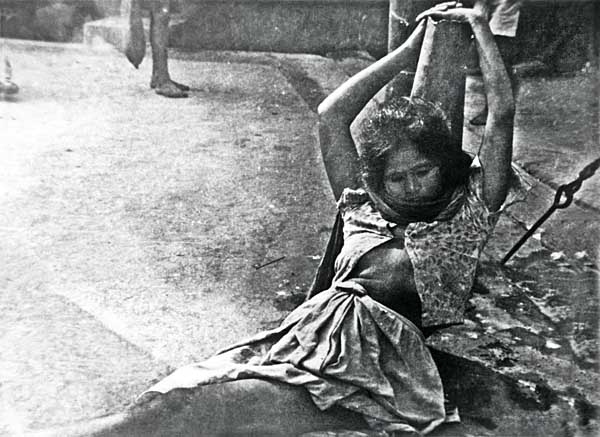
As we know, rape in the military is a huge problem. According to Amy Ziering’s award-winning film, “The Invisible War,” more than 20% of female veterans have been sexually assaulted while serving in the armed forces. In 2009 alone, more than 3200 cases were documented. But since 80% of such instances go unreported, the figure is closer to 16,000.

My question is: if U.S. soldiers are raping and otherwise sexually assaulting their colleagues with such regularity, what do you suppose they’re doing to “enemy” women? What do you suppose the figure is there?

From time immemorial, of course, rape has been used as a weapon of war. It’s a classic way of asserting power over the enemy by defiling the ones they cherish and are expected to protect. Raping their women humiliates enemy men.

Clearly, we have no trouble recognizing rape as an enemy strategy. But what about our servicemen in relation to the “ragheads” and “gooks” they’ve been taught to objectify, hate and despise?

The evidence is that it’s part of their indoctrination too. Years ago, I remember reading in our local paper of how scandalized one of our Kentucky congressmen was when he visited a military base and heard jogging servicemen chanting, “Burn, rape, pillage, kill. . . .” Note the second word in the chant. Why is it there? Is it meaningless in practice?

And then, of course, there’s the logic introduced earlier. If U.S. soldiers rape servicewomen with such abandon, what about those despised women in (most recently) Afghanistan and Iraq?

All of that is relevant to today’s liturgy of the word because of its emphasis on Jesus’ “virgin birth,” and a persistent tradition that Jesus’ conception was the result of rape by a Roman soldier. What if that tradition were true? Would that make the story less inspiring or more? I’d choose the latter – especially in the light of the questions I’ve just raised.

Let me explain simply by offering some background for today’s reading from Matthew along with a reference to the selection from Isaiah traditionally seen as a prophecy of Jesus’ virginal conception.

To get from here to there, try to understand the situation of Joseph and Mary as young marrieds in a context of imperial aggression. They’re a teenage couple; they are poor and living in an occupied country. Joseph is a jack-of-all-trades – that’s what the Greek word we translate as “carpenter” meant in first century Palestine. Like everyone from his class, he was unemployed most of the time. But he’d fix your leaking roof if you hired him. When he could, he’d harvest grapes and wheat for local landlords.

And he was probably deeply involved with the local insurgency against Roman occupation. (Nearly every impoverished patriot is in such situations.) Additionally, the only commentary we have on Joseph’s character is Matthew’s single word “just.” He was a just man. (By the way, his son, James – the one who headed the Jerusalem church following his brother’s death – was also known as “James the just.”) In the Hebrew culture of Jesus’ day, justice meant taking the side of the powerless. It appears to have been a central value Joseph passed on to his children.

As resisters, Joseph’s kind would have been considered terrorists by the Romans. In fact, the very year in which Jesus was likely born (6 BCE) Galilee’s countryside would have been crawling with Roman soldiers fighting against people like Jesus’ supposed father. The occupiers were busy laying siege to the city of Sepphoris, the capital of Galilee – a mere hour’s walk from Joseph’s village.

There the insurgency had taken a decisive stand against Rome’s puppet, King Herod. And like Americans in Iraq’s Fallujah, the Romans were determined to make an example of the city by laying it waste utterly. Before their final offensive, that involved night raids, kicking in doors, and raping young Jewish girls. To repeat, all forces of occupation – even our own today – know the drill.

In any case, according to that persistent tradition about her “virginity,” that’s where Mary came in. She was a young teenager about 12 or 14. Although (as Matthew’s gospel tells it) she eventually became Joseph’s “dream girl,” she was probably linked with him by the village matchmaker perhaps when they were both still toddlers. They had not yet begun to live together, because they were probably waiting for Mary to come officially “of age” – able to bear children.

Be that as it may, Mary suddenly finds herself pregnant out of wedlock. Can you imagine her worry? Innumerable teenage girls can relate to her panic – and disgrace. Obviously, Mary did not want to be just another of her community’s “virgins.” [That’s what (behind their hands) local matrons called unwed mothers.]

According to the story, Joseph too shared Mary’s disgrace and embarrassment. He wanted a divorce (i.e. release from his commitment to marry). And he probably demanded it with the anger and recrimination that are inevitably associated with the dreaded “d” word.

Joseph’s anger, suspicion, and thoughts about divorce may also have come from his hatred of the Romans. (And here comes that persistent tradition about Mary’s “virginity.”) It even remembers the rapist’s name. According to Celsus’ “True Doctrines” written about 178 C.E., the rapist was called “Panthera.” That was also the name of one of the Roman legions involved in that siege of Sepphoris.

Such suspicious circumstances around Jesus’ questionable conception also find some support in John’s gospel, where Jesus is called a “Samaritan” (8:48). That was a harsh term equivalent to our “bastard.” Additionally, Mark refers to Jesus simply as “Son of Mary” (6:3) – a quite unusual reference in a culture where children were identified by their father’s name.

And then (once again) even Matthew’s term “parthenos” (virgin) to refer to Mary was often connected with children of unknown paternity. Such offspring were disparagingly called “virgins’ kids.”

With all of that in mind, and if Celsus’ tradition has merit, it’s easy to understand how the thought of taking up with a girl defiled by a Roman “pig” (what Jews called the occupiers) probably turned Joseph’s stomach. No wonder he wanted a divorce.

That is, if the tradition has merit . . . . You see, we can take our pick here. (And that brings me to the point about the historical veracity of the stories around Jesus’ birth.) All of the traditions are entirely questionable as far as historical fact is concerned.

For instance, the familiar account of Jesus’ virgin birth is found only in two of the canonical gospels (Matthew and Luke). Mark and John make no mention of it. That means that they either didn’t know about the tradition, or Mark and John didn’t think it important enough to include. (By the way, if Jesus’ conception was as miraculous as we’ve always been taught, how likely is either of those alternatives?)

And then there’s that business – recounted in today’s first reading – about Isaiah’s supposed prediction of Jesus’ virginal conception. Matthew takes Isaiah’s words completely out of context.

Actually, Isaiah’s not referring to Jesus at all, but to his own time more than 500 years earlier. And the Hebrew term he uses is not the equivalent of “virgin.” That’s a mistranslation. The word the prophet employs simply means “young girl.” Isaiah’s prediction is that a “young girl” of his own time will conceive. The prophet’s words had nothing to do with Jesus or virgin birth.

The point here is we’re not dealing with “history” in the story of Jesus’ virgin birth. Instead we’re confronted with a miraculous “birth story,” – a literary genre that characterizes accounts of virtually all “Great Men” in the ancient world. Its point is that God’s Spirit entered into Jesus from the very outset – long, long before his actual birth.

In that light, historically speaking, rape is a much more likely explanation of Jesus’ conception than intervention by the Holy Spirit. Think about it. That’s simply a fact.

How then was Jesus begotten? If Joseph was his father, we understand how Jesus was so concerned with social justice. And through this pre-birth story we can hear (once again!) a summons to learn from Joseph the way Jesus and his brother James did. It’s also a reason for re-evaluating our culture’s drumbeat of indoctrination against “terrorists.” As Pope Francis has recently said, if we’re not concerned with justice for the poor, we can’t pretend to be following Jesus’ way.

If Panthera humiliated Jesus’ mother (and Joseph), and Jesus was the product of rape – and if rape is an inevitable strategy of war – then that’s an additional reason for pressuring the U.S. military to aggressively investigate and punish perpetrators of military rape. It’s also a reason for refusing to honor the U.S. military in general, for opposing war, working for peace, and appreciating Jesus’ solidarity with the poorest of the poor.

Once again, as Pope Francis would have it, If we’re not resisting war and working for peace, our observation of this Christmas season is pure theater and sham.

Pope Francis’ Compelling Revolutionary Vision: What Progressives Have Been Waiting for (Sunday Homily)

Pope Bergoglio

Readings for Second Sunday of Advent: IS 11: 1-10; PS 72: 1-2, 7-8, 12-13; ROM 15: 4-9; MT 3: 1-12 http://usccb.org/bible/readings/120813.cfm

Recently articles in OpEdNews (my favorite on-line news source) have been full of revolutionary themes. For instance, Chris Hedges informed us of an invisible revolution simmering and about to erupt. It will be driven, he said, by widespread discontent with wages, wealth disparities, militarism, and climate change denial.

Then in his viral BBC interview, comedian Russell Brand called for revolution stimulated by everyone’s recognition of the futility of politics as we know it. No one should vote, he said; the system is too broken to be improved at the ballot box.

On the other hand, Senator Bernie Sanders’ revolution would be based wider participation in political processes, with everyone voting. That would overcome reactionary moves that disenfranchise voters and empower moneyed interests to determine electoral outcomes against the popular will.

Calling us back to reality, Robert Becker advised that any revolution at all is highly unlikely, since no one on the left offers compelling direction or revolutionary vision.

At the time of its publication, that last remark seemed apt. No world leader capable of mobilizing millions had yet emerged.

However all of that changed two weeks ago. The compelling direction and revolutionary vision whose absence Mr. Becker correctly lamented indeed materialized in an ironically unlikely form – a pronouncement of the Roman Catholic papacy.

On Tuesday November 26th, Pope Francis published his Apostolic Exhortation, Evangelii Gaudium (The Joy of the Gospel). It represents the most articulate and detailed “vision” of a revolutionary future yet offered by anyone actually capable of producing results in the street and at the ballot box.

That is, as a member of the world’s super-elite, and virtually above reproach and easy dismissal by his fellow aristocrats, the pope’s pronouncement demands serious consideration. This is especially true on the parts of the bishops and clergy who weekly have before them captive audiences voluntarily come together to meditate upon, pray about, and attempt to internalize the gospel vision which the pope describes as focused on the poor, peace, social justice and on the structural causes of violence, war and terrorism. Moreover, these themes, the pope insists, should be driven home in homilies at Sunday Mass, since such leitmotifs represent the inescapable essence of the Judeo Christian tradition.

Today’s liturgy of the word provides a case in point. It articulates the revolutionary vision and compelling direction the pope finds throughout the Bible. It’s a utopian vision that courageously connects peace with social justice and environmental consciousness.

Consider the first selection from the prophet Isaiah. It directly links peace and social justice – for the poor and oppressed who in Isaiah’s day and our own are typically ignored. By way of contrast, Isaiah’s concept of justice consists precisely in judging the poor and oppressed fairly and not according to anti-poor prejudice – in Isaiah’s words, not by “appearance or hearsay.” (No room here for “Stop and Frisk,” or “Shop and Frisk!”)

Not only that, but according to the prophet, treating the poor justly is the key to peace between humans and with nature. It produces a utopian wonderland where all of us live in complete harmony with nature and with other human beings. In Isaiah’s poetic reality, lions, lambs, and calves play together. Leopards and goats, cows and bears, little babies and deadly snakes experience no threat from each other. Most surprising of all, even believers (Jews) and non-believers (gentiles) are at peace. (Today’s excerpt from Paul’s Letter to the Romans seconds this point. He tells his correspondents to “welcome one another” – including gentiles – i.e. those the Jewish community normally considered incapable of pleasing God.)

Today’s responsorial psalm reinforces the idea of peace flowing from justice meted out to the “least.” As Psalm 72 was sung, we all responded, “Justice shall flourish in his time, and fullness of peace forever.” And again, the justice in question has the poor as its object. The psalmist praises a God and a government (king) who “rescue the poor and afflicted when they cry out” – who “save the lives of the poor.”

In his own time, the lack of the justice celebrated in today’s first three readings infuriates Jesus’ cousin, John the Baptist. Today’s gospel reading has him excoriating the religious leaders of his day as a “brood of vipers.” Unmistakably clothed as a prophet – in garments that absolutely repudiate fashion and the pretenses of his effete opponents John reminds us of the simple lifestyle adopted by Francis I. John lambasts the Scribal Establishment which had identified with the occupation forces of Rome. As opposition high priest, John promises a religious renewal that will lead to a new Exodus – this time from the power of Rome and its religious collaborators.

As part of today’s revolutionary theme, it’s important to emphasize the Exodus dimensions of Matthew’s description of John. The Baptist is presented as preaching and baptizing specifically outside the temple and sphere of the priests. In fact, John appears in the wilderness – in the desert. For Jews, this would not only have evoked overtones of their great myth of national origin. It would also have signaled a subversive significance in John’s work. After all, the “desert” or “wilderness” was the place where contemporary resistance movements were spawned. (I imagine that if the Romans had the power, they would have “droned” John and his followers in a “signature strike.”)

Do you see what I mean about harnessing the revolutionary power of the Bible’s myth, poetry, utopian visions, and preferential option for the poor? It’s all there in Isaiah, Psalm 72, in Paul’s letter to the Romans, and in Matthew’s portrait of John. And if we look with the eyes of Pope Francis, we can find those themes every Sunday. It’s powerful stuff, I’m sure you agree. And the pope not only sees that himself, he has called 1.2 billion inhabitants of this planet to recognize it along with him and act accordingly.

The action Francis recommends is particular. It consists in combatting a form of capitalism that he describes as systematized murder. He rejects “trickle-down” theory, and demands interference in the out-workings of markets in the name of the common good. The pope calls Catholics and others of good will to recognize access to food, education, and healthcare as human rights.

And the pope does all of this without demanding sophisticated comprehension of history, economic theories, or detailed social analysis.

Instead he relies on the power of myth, poetry, God-talk, and biblical focus on a divine preferential option for the poor and Jesus’ vision of God as universal parent.

All of that is there in today’s liturgy of the word. For any with eyes to see, it’s there every Sunday to assuage our hunger for “vision” and “direction.”

It’s time for progressives to follow the lead of Pope Francis. He’s calling us to set aside our pseudo-sophistication that has intellectuals rejecting the Bible’s power to mobilize huge masses of people. That is, we must reclaim the powerful mythology of the Bible and lay aside our practical disdain for story, myth and symbol. That’s where we’ll find our missing “vision and direction.”

I find that promising, invigorating . . . and somehow ironic.

Pope Francis, “Evangelii Gaudium,” and the Catholic Vote

catholicvote

For the last 30 years the religious right (both Protestant and Catholic) has been telling us that Christian values should influence the way we vote. What will they say now that Pope Francis has called 1.2 billion Roman Catholics to move beyond obsessions with sex – abortion, contraception, and same-sex marriage?

How will they respond to his demands in his recent Pastoral Exhortation (Evangelii Gaudium) to centralize instead issues of poverty and the huge income gaps between the haves and have-nots? How will they answer the pope’s call to recognize the futility of directing billions towards a doomed “War on Terrorism” rather than correcting the structural injustices that cause such violence in the first place? What about his suggestion that those billions would be better invested in meeting human rights to food, health and education? (Yes, they are human rights according to the pope!)

All of that puts the Republicans and their fellow-travelers on the spot. After all, they have been the voting booth beneficiaries of obsession with sexual issues. They are the champion privatization, deregulated markets, and huge tax breaks for the rich. They oppose universal health care, investing money in public education, increasing the minimum wage, supporting labor unions, Food Stamp programs, and even Social Security financed by workers’ own savings. Republicans are the “tough on terrorism” bunch who (unlike the pope) attribute such violence to “hatred of our freedom,” rather than to blowback for the injustices of global capitalism.

According to the pope, such right-wing attitudes represent the very causes not only of world hunger and poverty, but of violence and terrorism. Only by interfering in the out-workings of the free market – by regulation (such as Glass-Steagal or the Tobin Tax), redirecting defense spending towards social programs (such as Medicare, Medicaid, Food Stamps), by increasing the minimum wage, and taxing the rich, – can such problems be solved.

In other words, it’s not possible this time to say “Oh, yes, we all know that good Catholics are expected to give generously to their favorite charities.” That’s not sufficient, Pope Francis asserts. No, the pope has faulted not lack of charitable giving, but the free enterprise system itself for causing the problems of global poverty and hunger as well as those of terrorism and war.

For years at election time, both the political and religious right has inundated us with directions about voting based on what the pope has identified as sexual obsessions.

It will be most interesting to observe any change in tone or direction in the upcoming general election.

Will we now be directed towards voting Democratic – for Hillary? Or will our Christian “leaders” be even more heedful of Pope Francis’ direction and urge voting instead for consumer protectionist Elizabeth Warren, for Socialist Bernie Sanders – or the Green Party candidate?

In red state Kentucky, we anxiously await direction from Mr. McConnell and Lexington’s Bishop Gainer.

The Church’s Disastrous Domestication of Jesus (Sunday Homily)

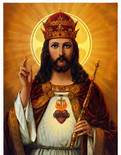
King of the Universe

Readings for the feast of “Our Lord Jesus Christ, King of the Universe”: 2 SM 5: 1-3, PS 122: 1-5; COL 1: 12-20; LK 23: 35-43. http://usccb.org/bible/readings/112413.cfm

Today the Catholic Church celebrates the feast of “Our Lord Jesus Christ, King of the Universe.” The contrast between the feast’s grandiose title and the readings prescribed for the occasion illustrate a basic reason behind the irrelevance of the church (and Jesus) to the post-modern world. It’s irrelevant to the social and economic transformations necessary to redeem the church’s overwhelmingly Third World membership from globalized oppression.

The contrast I’m referring to involves the great makeover of Jesus of Nazareth changing him from the leader of an anti-imperial revolutionary movement into a pillar of the exploitative status quo.

Let me put it this way: through 4th century sleight of hand, the Jesus who sided with the poor and those oppressed by empire – the one who promised a new heaven and earth belonging to the simple and poor, and who was executed as a terrorist by Rome – was made to switch sides. He was co-opted and domesticated – kicked upstairs into the royal class. He became not only a patron of the Roman Empire, but a “king” complete with crown, purple robes, scepter and fawning courtiers.

Following that transformation, kings and popes (now themselves transformed into gaudy temporal rulers) claimed to govern by divine right on behalf of Jesus as his representatives and vicars. In this way, the poor and oppressed (who then and now constitute the world’s majority) lost their paradigmatic leader, example and advocate. Jesus became instead a key part of the apparatus oppressing them.

Reza Aslan’s recent best-seller, Zealot, attempts to rescue the revolutionary historical Jesus from the distortions of the royal classes just mentioned. Aslan connects his salvage project specifically with today’s account of Jesus’ crucifixion in Luke, Chapter 23. In doing so, the author pays particular attention to Jesus’ cross, to the Roman inscription identifying Jesus as “King of the Jews,” and to the dialog between Jesus and the two “thieves” presented as sharing his fate.

According to Aslan, all three – cross, inscription and dialog – mark Jesus as a dangerous revolutionary “terrorist” rather than a domesticated upholder of the given order. That terrorist remains as threatening to today’s dominant empire, the U.S.A., as he was to imperial Rome. So he continues to be erased from history and by “feasts” like today that mask his true identity.

Take the cross first. It was the mode of execution reserved primarily for insurrectionists against the Roman occupation of Palestine. The fact that Jesus was crucified indicates that the Romans believed him to be a revolutionary terrorist. How could it have been otherwise, Aslan asks? After all, Jesus was widely considered the “messiah” – i.e. as the one, like David in today’s first reading, expected to lead “The War” against Israel’s oppressors.

Moreover, he proclaimed the “Kingdom of God,” a highly politicized metaphor which could only be understood as an alternative to Roman rule. It would return Israel, Jesus himself promised, to Yahweh’s governance and accord primacy to the poor and marginalized. The Romans drew logical conclusions. Put otherwise, the Roman cross itself provides bloody testimony to the radical threat the empire saw personified in Jesus.

That threat was made specific in the inscription the Romans placed over the head of the crucified Jesus. It read, “King of the Jews.”

Typically, those words are interpreted as a cruel joke by the Roman procurator, Pontius Pilate – as if he were simply poking fun at those who saw Jesus as the worthy successor of Israel’s beloved King David.

However, according to Reza Aslan, nothing humorous was intended by the inscription. Instead it was a titulus. Every victim of crucifixion had one – a statement of the reason for his execution. The motive for Jesus’ crucifixion was the same as for the many others among his contemporaries who were executed for the same crime: aspiring to replace Roman rule with home rule – with an Israel governed by Jews instead of Romans. The titulus on Jesus’ cross, along with the cross itself identify him as the antithesis of what he eventually became, a Roman tool.

And then there are those two thieves. Aslan says they weren’t “thieves” at all. That’s a mistranslation, he points out. A better translation of the Greek word, lestai , would be “bandits” – the common designation in the first century for insurrectionists. And there probably weren’t just two others crucified the day Jesus was assassinated. There may have been a dozen or more.

And, no, the whole world wasn’t watching either. As scripture scholar John Dominic Crossan observes, Jesus would have represented hardly a blip on the screen of Pontius Pilate. And Jews would have averted their eyes from the spectacle depicted in this morning’s gospel. They wouldn’t want to see “one more good Jew” suffering the fate of so many heroic patriots.

In this context the dialog between Jesus and two of the terrorists crucified with him takes on great significance. Actually, it documents the beginning of the process I described of changing Jesus’ image from insurrectionist to depoliticized teacher.

Think about it. Luke’s account of Jesus’ words and deeds was first penned about the year 85 or 90 – 20 years or so after the Roman-Jewish War (66-70 C.E.). By then the Romans had utterly defeated the Jews, destroyed Jerusalem and its temple as well as slaughtered the city’s population including practically all of the eyewitnesses of Jesus’ messianic campaign. Virtually the only Christians left standing were foreigners – gentiles living in population centers like Rome, Alexandria and Antioch. Few of these had any understanding of or sympathy for Judaism much less for Jewish politics and its liberation movements.

Besides that, in the war’s aftermath, both Jews and Christians sought to distance themselves from the socio-political expectations that had brought on the disaster of the Jewish War. So Judaism tried to transform itself from a Temple-centered religion to one focused on the local synagogue and rabbinic teaching – both overwhelmingly concerned with simply preserving the culture and identity of a people in diaspora.

For their part, Christians became anxious to show the Roman world that it had nothing to fear from their membership.

One way of doing that was to distance the dying Jesus from the Jewish insurgents and their terrorist actions against their oppressors. So in Luke’s death-bed dialog among three crucified revolutionaries, one of the terrorists admits that Jesus is “under the same sentence” as he and his comrade in arms. Given what Aslan said about crucifixion, that fact was undeniable. All three had been sentenced as insurrectionists.

But now comes the distancing between Jesus and Israel’s liberation movements. Luke has the “good thief” (read good terrorist) say, “. . . indeed we have been condemned justly, for the sentence we received corresponds to our crimes, but this man has done nothing criminal.”

In other words, Luke (writing for a post-war Roman audience) dismisses insurrection as “criminal,” and removes Jesus from association with such crime – a fact endorsed, Luke asserts, by insiders like the honest lestai crucified with Jesus. Luke’s message to Rome: the killing of Jesus was a terrible mistake; he meant no harm to Rome. And neither do we, his followers.

Loss of the radical revolutionary Jesus is not a trivial matter in terms of Christianity relevance to a world ruled by a nation that styles itself as Rome’s worthy successor. Like its ancient archetype, the U.S. (and a majority of first-world Christians) found the historical Jesus so threatening, that it determined that Jesus’ followers deserved the same fate as their crucified Master. For this we have the evidence of the war that the U.S. fought against liberation theology when it first emerged following the conclusion of the Second Vatican Council (1963-65).

Liberation theology committed the unforgiveable sin represented by this homily. It was guilty of connecting the Jesus of history described by scholars like Aslan to post-colonial independence movements and struggles against the neo-colonialism spearheaded by the U.S. and its oligarchical clients in the Third World.

In that struggle Pope John Paul II and his henchman, Josef Ratzinger, threw in their lot with a neo-imperial Ronald Reagan. It was deja-vu all over again: Reagan as Pilate and J.P.II and Ratzinger as the temple priesthood. It was the deja-vu of the church melding its interests with Rome towards the end of the 4th century.

More specifically, the two reactionary popes looked the other way and actively supported Reagan’s policies that assassinated hundreds of thousands of Christians (200,000 in Guatemala alone!) who found the radical Jesus threateningly relevant to their struggles in Latin America, Africa, and South Asia.

To balance liberation theology’s threat, Reagan patronized Evangelical Christians who eventually morphed into the Tea Party. It finds Aslan’s understanding of Jesus anathema. Meanwhile, John Paul II and Ratzinger “cleaned house,” eliminating every single progressive bishop from the hierarchy and transforming seminaries into hot houses to nurture a pre-Vatican II reactionary clergy.

Recently Pope Francis delivered a long-winded, very general and content-less speech to the National Council of Bishops in Brazil. That group used to head a church that was a hot-bed of liberation theology I’ve been describing here. The term was never mentioned in the new pope’s remarks. Instead, he presented John Paul II and Pope Ratzinger as champions of Vatican II.

He’ll have to do better than that to fulfill his aspiration towards making the church relevant to the poor he professes to care so much about.

He’ll have to confess the Church’s sins against liberation theology and revive the cult of the historical Jesus – instead of the depoliticized imperial “King of the Universe” today’s feast calls to mind.

Dives & Lazarus: a liberation theology catechism (Sunday Homily)

Lazarus

Readings for the 26th Sunday in Ordinary Time: AM 6: 1A, 4-7; PS 146: 7-10; ITM 6: 11-16; LK 16: 19-31 http://usccb.org/bible/readings/092913.cfm

Today’s liturgy of the word provides us with a catechism of liberation theology – Christianity’s most important theological development in the last 1500 years, and the West’s most important social movement of the last 150 years.

I have come to those conclusions over a period of more than forty years studying liberation theology. My interest began in Rome during my graduate studies there, 1967 through 1972. There I first heard Peru’s Gustavo Gutierrez speak. (Fr. Gutierrez is considered the father of liberation theology.)

Subsequently I read Gutierrez’s book, A Theology of Liberation (1971) and was completely taken by it. Reading the book gave me the feeling that I was hearing Jesus’ Gospel for the very first time.

You might ask, what is liberation theology? To answer that question fully, please look at my blog entries under the “liberation theology” button. I’ve written a series on the question. In my blogs, you’ll find that I always define it in a single sentence. Liberation theology is reflection on the following of Christ from the viewpoint of the world’s poor and oppressed. That’s the class of people to which Jesus himself belonged. They constituted the majority of his first followers.

When read from their viewpoint, accounts of Jesus’ words and deeds – the entire Bible for that matter – take on depths of meaning and relevance to our contemporary world that are otherwise inaccessible to people like us who live in the heart of the wealthy world. From the viewpoint of the poor, God passes from being a neutral observer of earth’s injustices to an active participant with the poor as they struggle for justice here on earth. Jesus becomes the personification of that divine commitment to the oppressed. After all, he was poor and oppressed himself. The Roman Empire and its Temple priest collaborators saw to that.

My interest in liberation theology deepened as my teaching career developed at Berea College in Kentucky from 1974 to 2010. There I was encouraged to continue my study of liberation theology. So I spent extended periods in Brazil, Nicaragua, Costa Rica, Honduras, Guatemala, Cuba, Mexico, Zimbabwe, South Africa, India and elsewhere studying under liberation theologians, dialoging and publishing with them. The poor in all of those countries were suffering from the aggression the United States directed against them.

Meanwhile at Berea, I found the conclusions of liberation theologians validated by the college’s very fine scripture scholars. They had almost no acquaintance with liberation theology, and yet what they were teaching perfectly harmonized with its central tenets. It’s just that they stopped short of drawing what seemed to me the obvious political conclusions from their work.

More specifically, Berea’s scholars identified the Exodus (Yahweh’s liberation of slaves from Egypt) as God’s original and paradigmatic revelation. The whole tradition began there, not in the Garden of Eden. Moreover, the Jewish prophetic tradition emphasized what we now call “social justice.” Even more, Jesus of Nazareth appeared in the prophetic tradition, not as a priest or king. Jesus directed his “ministry” to the poor and outcasts. The Gospel of Luke (4: 18-19) has Jesus describing his program in the following words:

“The Spirit of the Lord is upon me, because he has anointed me to bring good news to the poor. He has sent me to proclaim release to the captives and recovery of sight to the blind, to let the oppressed go free, and to proclaim the year of the Lord’s favor.”

After his death, Jesus’ followers continued along those lines. They lived communally, having sold all their worldly possessions and distributed the proceeds to the poor.

All of that finds vivid expression in today’s liturgy of the word. As I said, it’s a kind of catechism of liberation theology. The reading from Amos the prophet describes the sin that most offends God – wealth disparity in the face of extreme poverty. Amos decries a “wanton revelry” on the part of the wealthy that sounds like the “American Way of Life” or the “Lives of the Rich and Famous” that we Americans find so fascinating. The prophet describes a rich class that lives like King David himself – in luxurious houses, overeating, drinking wine by the bowlful, and generally ignoring “the collapse of Joseph,” i.e. the poverty of their country’s most destitute. For that, Amos says, the rich will ultimately suffer. All their wealth will be confiscated and they will be driven into shameful exile.

In railing against the rich and defending the poor, Amos was calling Judah back to the worship of Yahweh whose attributes are described in today’s responsorial psalm. There God is depicted as loving the just and thwarting the ways of the wicked. The psalm describes Yahweh as securing justice for the oppressed, giving food to the hungry, and setting captives free. He gives sight to the blind and protects resident aliens, single mothers and their children.

Then today’s excerpt from 1st Timothy outlines the characteristics of those who worship that God by following in Jesus’ footsteps. They keep the commandment which is to do unto others as we would have them do unto us. According to St. Paul, that means pursuing justice and living with devotion, faith, love, patience, and gentleness.

Finally, the gospel selection from Luke chapter 16 dramatizes the sinful relationship between rich and poor and the destinies awaiting both. Luke tells the story of the rich man and “St. Lazarus” who is honored by the poor throughout Latin America.

It is significant that Lazarus is given a name in Jesus’ parable. Usually we know the names of the rich, while it is the poor that remain anonymous. Here matters are reversed. To remedy this anomaly, tradition has assigned the wealthy man a name. He’s called Dives, which is simply the Latin word for rich man.

For his part, Lazarus is quintessentially poor, hungry, and lacking medical care. His sores are open and the only attention they receive are from dogs that lick his wounds. Meanwhile, Dives seems completely unaware of Lazarus’ presence, though the beggar is standing at his very doorstep. Within the sight of Lazarus, the wealthy one stuffs himself with food to such a degree that the scraps falling from his table would be enough to nourish the poor beggar. But not even those crumbs are shared. How could Dives share? He doesn’t even know that Lazarus exists.

So the two men die, and things are evened out. The rich man goes to hell. We’re not told why. Within the limits of the story, it seems simply for the crime of being rich and unconsciously blind to the presence of the poor. For his part, Lazarus goes to the “bosom of Abraham,” the original Hebrew patriarch.

Lazarus is rewarded. Again, we’re not told why. Within the story, it seems simply because he was poor and Yahweh is partial to the poor, just as he was to the slaves God intervened to save when they were starving in Egypt.

Seated with Abraham, Lazarus feasts and feasts at the eternal banquet hungry people imagine heaven to be. Dives however is consumed by flame in the afterlife. Fire, of course, is the traditional symbol of God’s presence, or purification, and of punishment. This seems to suggest that after death, both Dives and Lazarus find themselves in the presence of God. However what Lazarus experiences as joyful, Dives experiences as tormenting.

And why? Simply, it seems, because Dives was rich, and Lazarus was poor.

Does the parable tell us that what awaits us all after death is a reversal of the economic conditions in which we now find ourselves? The first will be last; the last first. The rich will be poor, and the poor will be rich. That in itself is highly thought-provoking.

In any case, Yahweh is presented as champion of the poor in this parable, just as in the reading from Amos, in today’s responsorial psalm, and in Paul’s letter to Timothy. And according to liberation theologians, that’s the central characteristic of God throughout the Judeo-Christian tradition. God is on the side of the poor and hates obscene wealth disparity.

You can well imagine how such insight inspired the poor and oppressed throughout the world when it emerged as “liberation theology” following the Second Vatican Council. Poor people everywhere (and especially in Latin America) took courage and were inspired to demand social justice from the rich who had been ignoring them in the New World since the arrival of Columbus 500 years earlier. In fact, Liberation theology motivated social movements more powerfully than any thought current since the publication of the Communist Manifesto in 1848.

And that’s why the reigning empire, the United States of America took action against liberation theology. It initiated what Noam Chomsky calls “the first religious war of the 21st century.” It was a war of the United States against the Catholic Church in Latin America – yes against the Catholic Church. The war killed hundreds of thousands of priests, nuns, lay catechists, social workers, union organizers, students, teachers, and journalists along with ordinary farmers and workers.

Today’s liturgy of the word reminds us not to let the United States have the final word. We are called to divest ourselves of our wealth and to take notice of St. Lazarus at our gates. God is on the side of the poor, not of the rich.

The Rich Are Funny (Sunday Homily)

Rich Man

Readings for 25th Sunday in Ordinary Time: AM 8:4-7; PS 113: 1-2, 4-8; I TM 2:1-8; LK16: 1-13 http://usccb.org/bible/readings/092213.cfm

Jesus loved telling stories that made fun of rich people. He’s at it again in this morning’s gospel.

You can imagine the delight such parables brought Jesus’ audiences of poor peasants, fishermen, beggars, prostitutes, and unemployed day laborers. They surely chuckled as he spun tales about “stewards” who couldn’t dig a hole in the ground if their life depended on it or who were mortified at the very thought of begging. They’d laugh about rich landowners storing up grain and dying before they had a chance to enjoy their profits. They knew what Jesus meant when he mocked pathetically avaricious landlords getting angry when their money managers failed to increase their bank accounts while the boss was away attending parties. They’d shake their heads knowingly when Jesus mocked heartless employers who reaped where they didn’t sow.

Jesus’ listeners would have found today’s story especially entertaining. After all it featured an accountant who cheated his wealthy employer. And then the rich guy ends up appreciating the accountant’s dishonesty. Men and women in Jesus’ audience would have nudged each other and smiled knowingly at the tale.

“That’s the way those people are,” they’d laugh. “They’re so dishonest; they can’t help appreciating corruption in others, even when it means they’re getting screwed themselves!

“Yeah, the rich stick together,” the crowds would agree. “Their greed and dishonesty is the glue. They know: today it’s you getting caught with your hand in the till. Tomorrow it might be me. So let’s not be too hard on one another.

“Ha, ha, what a joke they are!”

In today’s first reading, the prophet Amos uses a different tactic to decry the rich. Instead of humor, Amos straight out lambasts them for “trampling on the needy,” and exploiting poor farmers. They’re so eager to make money, Amos charged; they can’t wait till the Sabbath ends so they can resume their dirty work. Then first chance they get, the crooks manipulate currencies and rig scales in their favor and short-change the buyer. They sell shoddy products and underpay workers. God will never forget such crimes, Amos angrily declares.

Our responsorial psalm agrees with the prophet. The psalmist reminds us that God is not on the side of the rich, but of the poor. In fact God so honors the lowly that (S)he considers them royalty. “He seats them with princes” the psalmist says. Yahweh rescues the lowly from their greedy exploiters.

So Jesus ridicules the rich with humor, while Amos wrings his hands over their crimes with righteous indignation. Both approaches highlight the basic truth put so memorably by Jesus when he says in today’s reading from Luke that we have to choose between money and the biblical God who champions the poor. It’s one or the other. We can’t serve two masters.

“So be like the rich guys in today’s story,” Jesus adds with a twinkle in his eye. He searches the crowd for the pickpockets, the “lame” and “blind” beggars. He looks for the hookers and tax collectors.

“Stick together,” he says. Then he winks. “And that dishonest money you depend on . . . Spread it around and help us all out.

“Better yet, give it to the Resistance Movement and you’ll get one of those rich guys’ houses when the Romans are gone and the Kingdom comes.”

Everyone laughs.

Jesus Would Have Supported al Qaeda Sooner than the U.S.! (Sunday Homily)

jesus  terrorist

Readings for 23rd Sunday in Ordinary Time: WIS 9:13-18B; PS 90: 3-6, 12-14, 17; PHMN 9-10, 12-17; LK 14: 25-33. http://usccb.org/bible/readings/090813.cfm

Did you have trouble with today’s gospel reading? I did. Frankly, it makes me wonder about Jesus’ attitude towards violence and armed attempts to overthrow foreign occupation forces like the Roman legions in Palestine – or American armed forces in Afghanistan or their authoritarian clients in Israel, Egypt, Bahrain, Yemen and elsewhere.

I wonder: whose side would Jesus be on in today’s War on Terrorism? I doubt it would be “ours.” Certainly, Jesus was not on the side of Rome. Instead, he was clearly sympathetic to Rome’s armed opponents. That makes me suspect that he would also have sided with those our own government deems “terrorists.”

What do you suppose that means for us and our politics?

Before answering, think about Jesus’ words in today’s selection from Luke. There Jesus is not telling us to love our enemies. He’s saying that we must hate! Yes he is. And the objects of our hatred must be our family members, down to our spouses and children. According to Jesus, we must even hate our own lives!

That’s pretty outspoken, hyperbolic, radical and edgy. In fact, his words make clear why the Romans and their Jewish collaborators in the Temple would have seen Jesus as an insurgent and terrorist. In any case, he was surely not the apolitical, domesticated preacher tradition later made him. He was not blissfully unaware of or uncaring about the searing resentment his people shared about Rome’s occupation of the land whose only sovereign in their eyes was Yahweh.

Yet Jesus’ words today also make it clear that he was not a violent revolutionary like the many other “messiahs” who sprang up in his 1st century context. As Reza Aslan points out, Jesus was not like Theudas, Hezekiah the bandit chief, Judas the Galilean, Menahem, Simon son of Giora, Simon son of Kochba and the rest.

Still today’s gospel makes it clear that there was genuine cause for concern about Jesus and his followers among the Romans and their Jewish clients in the Temple.

To begin with there were those “great crowds” Luke describes as following Jesus everywhere. In revolutionary situations, masses of people thronging about a charismatic troublemaker are reason for serious concern. According to U.S. standards under American Empire, it’s enough for local armed men in suspect locations to merely assemble to justify their being droned. And, of course, we know that at least some of Jesus’ disciples were armed (MK 14:43-52). Presumably others in the “large crowds” carried weapons as well. They would not have been viewed any more kindly by Roman occupation forces than their U.S. equivalents.

Then, listen to Jesus’ rhetoric as recorded by Luke. There’s all that talk about hating everyone near and dear to us that I already mentioned. That’s the second time we’ve encountered such language from the Prince of Peace in the last few weeks. Remember what we read a month ago about his coming not as a peacemaker, but to create division between children, their parents and in-laws? In MT 10:34 Jesus even said specifically that he had come to bring the sword. “I come not to bring peace” he said, “but to bring a sword.” If he actually said those words, how do you think they would have been understood by Roman and Temple authorities?

However, Jesus’ most dangerous statement this morning is the one about willingness to be crucified in order to qualify as his disciple. In occupied Palestine, those words had nothing to do with patiently bearing life’s inconveniences. No, in Jesus’ context, they could only be about opposing Rome and its Jewish collaborators.

Again, it is Aslan who reminds us that crucifixion was the mode of torture and execution the Romans reserved for insurgents. So in a Palestine where rebels were crucified almost every day (sometimes hundreds at a time), Jesus’ words could mean only one thing: his followers must join him in opposing Roman occupation of their Holy Land and in doing so virtually seal their fates.

But then comes the non-violent “catch.” Opposition to imperial occupation of the homeland might be the duty of every patriotic Jew, Jesus implies. But that doesn’t necessarily mean violent opposition. Calculate well, Jesus says – like a man building a tower. Realize whom we are opposing. We’re talking about Rome. Its legions can mobilize 20,000 well trained and heavily armed troops on a moment’s notice. At best we have less than half that number. To avoid suicide, we must “sue for peace” like a wise king threatened by a superior force. In other words Jesus counsels a prudent non-violence to avoid a bloodbath.

Bishop Oscar Romero made a similar recommendation to the revolutionary forces of El Salvador (the FMLN) in the 1970s. He said he could surely sympathize with the anger of the FMLN towards the United States and its puppet regime in El Salvador. He could understand why peasant farmers might see violent revolution as their only option in fighting brutal forces of “order” which wantonly tortured and murdered women, children, and the elderly, along with teachers, social workers, union organizers, priests, nuns, and other resisters.

No doubt Romero would say the same today about young Egyptians opposing the U.S.-supported military dictators in their own country, or about similar insurgents in the U.S.-controlled countries I’ve already mentioned.

But, Romero said, such violence is suicidal in the face of the billions in arms supplied such forces of oppression by the United States. Better to resist non-violently. At least then, the inevitable ensuing bloodbath (the modern equivalent of crucifixion) will be smaller in scope.

In 1st century Palestine, Jesus was not the only one employing such non-violent reasoning. According to John Dominic Crossan in his book, The Power of Parable, strong non-violent movements of resistance to Rome characterized Jesus’ context.

These movements were sandwiched between two epochs of extremely bloody opposition to Rome. The first occurred exactly in the year of Jesus’ birth, 4 BCE. That was the year the Roman client, Herod the Great, died. Jewish freedom fighters seized upon the resulting leadership vacuum as an opportunity to rise up against Herod’s Roman patrons. Jewish insurgents captured the city of Sephoris, the capital of Galilee. In response, the Romans razed the city to the ground and killed everyone who might be associated with the rebellion. Jesus’ family in nearby Nazareth was lucky to escape.

The second period of extremely violent resistance to Rome occurred about 40 years after Jesus’ crucifixion – just before the gospels of Mark, Matthew and Luke were composed. This time the Jews rose up against the Roman occupiers throughout Palestine. The Roman response? They utterly sacked Jerusalem itself, destroying its temple, and killing virtually all those who had heard Jesus’ words and witnessed his deeds.

In between those fierce chapters, Crossan says, there was a period of non-violent resistance to Rome. That’s when Jesus traversed Palestine and spoke so memorably about God’s Kingdom. According to Crossan, Jesus’ era represented a period of “massive, well-organized, unarmed, nonviolent resistance against Rome.”

That’s the probable context for Jesus’ shocking words this morning.

There’s so much more that could be said about all of this. To fill in the blanks, read Crossan’s book, along with Aslan’s Zealot, which recently topped the New York Times Best Seller list.

For today it’s sufficient to note the implications of Jesus’ shocking words. Personally, I’m so glad the church makes us face them. They show that Jesus was far more complex regarding violence than he’s usually made out to be. These difficult readings open a conversation that would otherwise be unthinkable.

Going forward, the conversation might well address the following questions:

• What difficulties do we have with realizing that Jesus situation vis-à-vis Rome was extremely similar to that of today’s “terrorists” vis-à-vis the United States and that Jesus himself was considered a terrorist?
• Is the “War on Terror” a real war or merely empire once again defending its right to plunder, torture, and kill with impunity?
• How is it that U.S. citizens end up supporting massive U.S. violence against “terrorists,” but that we find the latter’s much less injurious response (like the “Boston Marathon Massacre”) so horrendous?
• Put otherwise, how is it that U.S. citizens generally support the wars of their country which Martin Luther King described as “the greatest purveyor of violence in the world today,” while demanding pacifism on the parts of those whom the U.S. attacks.
• Do the ones our government calls “terrorists” have the right to defend themselves against what Edward Herman has termed the “wholesale terror” of the U.S. and its allies? (See his book, The Real Terror Network.)
• Which terrorists do we support – our government and its brutal military or their victims?

What other questions do the readings raise – for you?

How about my reflections?

(Discussion follows)

Would Jesus Celebrate July 4th?

american-jesus-195x300

Readings for 14th Sunday in Ordinary Time: Is. 66: 10-14c; Ps. 66: 1-7, 16, 20; Gal. 6: 14-15; Lk. 10: 1-12, 17-20. http://www.usccb.org/bible/readings/070713.cfm

Sometimes I wonder if I’m on the right path. Do you ever think that about yourself? I’m talking about wondering if your whole “take” on the world is somehow off base.

My own self-questioning has been intensified by my blogging over the last 15 months. For instance I recently wrote a piece on why I refused to celebrate the 4th of July. My thesis was that the U.S. has lost its way, turned the Constitution into a dead letter, and made its claims to democracy meaningless. We are rapidly moving, I said, in the direction of Nazi Germany. All of that is contrary to the Spirit of 1776. So there’s no point in celebrating Independence Day as if Edward Snowden and Bradley Manning didn’t exist.

One person kind enough to comment said she lost all respect for me as a result of what I had written. Others have told me that my message is just a poor man’s left-wing version of the ideological nonsense spouted by Sean Hannity and Rush Limbaugh. Even people close to me have referred to what I write as diatribes, screeds, and rants. I hope that’s not true.

What is true is that as a theologian, I’m attempting to write “About Things That Matter” (as my blog title puts it) from a self-consciously progressive (i.e. non-conservative) perspective – or rather from a theological perspective that recognizes that following Jesus is counter-cultural and requires a “preferential option for the poor” — not the option for the rich that “America” and its right wing versions of Christianity embrace.

I adopt this position in a national context that I recognize as anti-gospel – materialistic, individualistic, extremely violent, and pleasure-oriented. Or as my meditation teacher Eknath Easwaran says, our culture refuses to recognize that we are fundamentally spiritual beings united by the divine core we all share. At heart, we are 99% the same in a culture that tells us we’re 100% unique. Jesus’ values are not the American values of profit, pleasure, power, and prestige.

Instead what Yeshua held as important is centered around the Kingdom of God – a this-worldly reality that turns the values of this world on their head. The Kingdom embodies a utopian vision that prioritizes the welfare of the poor and understands that the extreme wealth Americans admire is a sure sign that those who possess it have somehow robbed others of their due.

As a possessor of extreme wealth myself (on a world-scale) each time I read the gospels – or the newspaper – I feel extreme discomfort. In other words, it’s Jesus’ Gospel that makes me think I’m on the wrong track. But it’s not the one critics have in mind when they suggest I temper my positions.

Instead, consideration of Jesus’ words and deeds convince me that I’m not radical enough. I do not yet occupy a position on the political spectrum respectful enough of the poor. I’ve forgotten that life outside God’s Kingdom (“Jerusalem”) is “Exile” in God’s eyes (as today’s first reading recalls). The liberation from slavery referenced in this morning’s responsorial psalm has lost its central place in my spirituality.

Our culture might say, that by all this I mean that I’m not far enough “left.” Be that as it may. The truth is that insofar as my daily life doesn’t reflect Jesus’ utopian values, I should feel uncomfortable.

Today’s second and third readings reinforce my discomfort. They highlight the conflict between the values of Jesus and those of “the world” – of American culture in our case. In fact, the world finds it hard to understand Jesus’ real followers at all. And why not? For all practical purposes, our culture denies the very existence and /or relevance of spirituality to everyday life – at least outside the realm of the personal.

In today’s excerpt from his Letter to Galatia, Paul says the world considers the Christian life not even worth living. That’s what Paul means when he says that in Christ he is crucified to the world (i.e. in the world’s opinion). He means that as far as the world is concerned, he as a follower of Jesus is already dead because of his rebellion against the values of Rome. Crucifixion, after all, was the form of torture and capital punishment reserved for insurgents against the Empire.

But then Paul turns that perception on its head. He writes that his accusers are wrong. In reality, it is life lived according to Roman values that is not worth living. Paul says, “As far as I’m concerned, the world has been crucified.” He means that what Rome considers life is really death – a dead end. It constitutes rebellion against God’s Kingdom, the antithesis of Rome.

In today’s Gospel selection Jesus describes the lifestyle of those committed to God’s Kingdom. He sends out 72 community organizers to work on behalf of the Kingdom giving specific instructions on how to conduct themselves. They are to travel in pairs, not as individuals. (Companionship is evidently important to Jesus.) Theirs is to be a message of peace. “Let your first words be ‘peace’ in any location you frequent,” he says. He tells his followers to travel without money, suitcase or even shoes. He urges them to live poorly moving in with hospitable families and developing deep relationships there (not moving from house to house). They are to earn their bread by curing illness and preaching the inevitability of God’s Kingdom which the world routinely rejects as unrealistic.

Jesus’ followers are to spread the word that the world can be different. God should be in charge, not Caesar. Empire is evil in God’s eyes. So peace should replace anger and violence; health should supplant sickness; shared food and drink should eliminate hunger. Those are Jesus’ Kingdom values.

And the world rejects them. Not only that, Jesus’ “lambs among wolves” imagery recognizes that the world embodies an aggressive hostility towards followers of Jesus. It would devour them – so different are its values from the Master’s.

So maybe it shouldn’t surprise any of us when we’re accused of being extreme – as communists or utopians or hippies – if we’re attempting to adopt the values of Jesus.

After all, they thought Jesus was crazy. They thought he had lost his faith. They considered him a terrorist and an insurgent.

Then in the fourth century, Rome co-opted Jesus’ message. Ever since then, we’ve tamed the Master.

As our culture would have it, Jesus would have no trouble celebrating July 4th.

Am I mistaken?

Move Over, Pope FrancIs, and Bring on FrancEs I!! (Fathers’ Day Sunday Homily)

Anointing

Readings for the 11th Sunday in Ordinary Time:2 SM 12:7-10, 13; Ps. 32: 1-2, 5, 7, 11; Gal. 2: 16, 19-21; Lk. 7:36-8:3. http://www.usccb.org/bible/readings/061613.cfm

Today is Father’s Day. So, happy Father’s Day to all of us who merit the title “father.”

However, I must observe that despite the male focus which our culture gives this June 16th, today’s readings end up being quite critical of men and patriarchy. They reveal the misogyny of western culture and of the Christian tradition right from the beginning. Unwittingly, they also make a strong case for female leadership in the church even to the point of suggesting female leadership for the entire enterprise. Sorry, dads!

Start with the first reading. There Nathan condemns the great father-figure, David for his own male chauvinism and for his disregard of all the gifts the prophet says he himself gave David in God’s name.

Nathan recalls that as prophet he himself anointed David king over both Israel and Judah. Nathan rescued David from his rival, Saul. The prophet gave him the Lord’s dwelling and a harem to live with David in his palace. All these including David’s many wives, Nathan says, were gifts from God. (So much for Yahweh’s “traditional family values” allegedly favoring domestic arrangements with one father and one mother.)

And what was David’s response to all the favors conferred by Nathan? Adultery and murder. He used his power as king to steal the wife of one of his generals, Uriah the Hittite. Then in effect, he “rendered” Uriah to the Ammonites to have him killed, while preserving his own “deniability” for the crime. But neither Yahweh nor Nathan was fooled.

Of course, the woman’s in question was the famous Bathsheba who eventually gave birth to King Solomon, who ended up succeeding David as King of Israel instead of David’s eldest son, Adonijah.

In fact the section of 2nd Samuel in which this episode is found is referred to as “the succession narratives,” because it answers the question “why is it that Solomon is sitting on the throne instead of David’s eldest living son, Adonijah?”

Solomon is on the throne, the story says, because of David’s theft of Bathsheba and killing of Uriah, and the curse of Nathan which resulted: “The sword will never depart from your house.” That is, all of David’s sons, but Solomon were condemned to die violent deaths. According to this tradition, God’s sole “blessing” for the eventually penitent king is limited to the boon that he himself will not be killed. Father-rule – the patriarchy – does not come out well in this first reading.

Neither is today’s gospel selection kind to patriarchy. Jesus has been invited to the house of a Pharisee for dinner. For Jews Pharisees were defenders of the father-rule system But in this case, the “host” proves to be an inhospitable man in terms of Jewish custom. He obviously sees the carpenter from Nazareth and his uncouth fisherman friends as riff-raff. He omits giving them the traditional greeting, and doesn’t even offer them water to wash their feet. Evidently he considers the band from Nazareth unclean – dirty people who won’t even know the difference.

Then the hero of the story appears to set things right. She’s a woman whose gender relegated her to unquestionably second class status. She is Mary of Bethany (whom scholars identify with Mary Magdalene). And she does something extraordinary. She does what Nathan the prophet recalled in today’s first reading that he did for David. She anoints Jesus as the Christos – the Christ, designating (and making) him God’s chosen one.

This is extraordinary, since the term “Christos” (or Christ) itself means “anointed.” And in the gospels there is only one anointing of Jesus the Christ. And it occurs at the hands of Mary Magdalene, not of some male priest. In other words, the Magdalene in today’s gospel acts as prophet and priestess on a level arguably above Nathan’s role recalled in the reading from 2nd Samuel.

And there’s more. The Magdalene appears in public with her head uncovered and hair flowing – a condition appropriate for a woman of Jesus’ time only in the presence of her husband. And besides anointing Jesus, she performs what can only be described as an extremely intimate act. She continually kisses his feet with her lips and washes them with tears of love.

But how could a woman perform such an act? Why would Jesus allow it? After all, according to Jewish law, women were not even permitted to say ritual prayers at home, much less perform religious rites of such central import as identification and anointment of the Christ.

That is, not according to Jewish law. However, according to “pagan” law such election by a priestess was not only permitted but essential for any sacred king. There according to the rite of hieros gamos or sacred marriage, the priestess would anoint the priest-king and by virtue of her act (often consummated by ritual sex), the anointed would be flooded with power of the god. Conversely, without the power conferred by the woman, the king would remain powerless and have no knowledge of himself or of the gods. These facts would have been evident to Jesus’ contemporaries.

Why has this history and the prophetic role of Mary Magdalene in identifying (and consecrating) the Christ been hidden from us all these years? Feminist scholars tell us that patriarchal misogyny – anti-woman sentiment – is the answer.

And negativity towards women is written all over today’s excerpt from Luke’s gospel. There the evangelist emphasizes the sinfulness of the Magdalene as that of the other women in Jesus’ company.

Luke describes Mary as “a sinful woman in the city,” and “a sinner.” He has Jesus tell those seated at table that “many sins have been forgiven her,” and say to the woman, “Your sins are forgiven.” So we won’t miss the point, Luke gratuitously describes Mary Magdalene as the one “from whom seven demons had been cast out.” And finally, women in Jesus’ company are described as formerly sick and possessed.

Nevertheless, Luke feels compelled to note what everyone in his community knew: women like the Magdalene and Joanna and Susanna and the “many others” who followed Jesus were his financial supporters of Jesus and “the twelve.”

But Luke doesn’t call the apostles “free-loaders.” Neither does he parallel his description of the women as sinners by recalling that one of the 12, Peter, was identified with Satan himself by Jesus. Nor does he recall that a key apostle, Judas, actually betrayed Jesus or that all of the twelve but one (unlike the Master’s women followers) abandoned him in his hour of greatest need. Instead, Luke simply mentions “the twelve,” who by the evangelist’s omissions are implicitly contrasted with the “sinful” women.

Above all, Luke omits the description of Mary Magdalene which we find in the church-suppressed Gospel of Thomas. There she is described as “the apostle of apostles” – no doubt because of her key role in identifying and anointing Jesus as the “Christos,” and because she was the one to whom the resurrected Jesus appeared before showing himself to any of “the twelve.”

In fact the Gospel of Thomas describes says:

“. . . the companion of the Savior is Mary Magdalene. But Christ loved here more than all the disciples, and used to kiss her often on her mouth. The rest of the disciples were offended . . . They said to him, “Why do you love her more than all of us?'”

Here the word for “companion” is koinonos which refers to a consort of a sexual nature. Moreover in other suppressed writings, Magdalene emerges as Jesus’ star pupil and the center of his attention. He praises her as “one whose heart is raised to the kingdom of heaven more than all thy brethren.” He predicts that she “will tower over all my disciples and over all men who shall receive the mysteries.” Additionally, following Jesus’ ascension, it is Magdalene who comes to the fore to encourage the disheartened apostles to man-up and get on with the business of understanding and living out the teachings of Jesus.

These words and the Magdalene’s functioning as prophet and priest should be extremely meaningful for contemporary women – and us patriarchs so fond of “Father’s Day. They highlight the way at least one female disciple of extraordinary talent and charisma was not only marginalized but denigrated in the church right from the beginning. And that denigration has continued in church circles and beyond to our very day.

Put otherwise, besides shedding light on the distant past, today’s readings expose the extreme weakness of contemporary ecclesiastical “fathers” in their exclusion of women from the priesthood and from other forms of church leadership. They also uncover the perversity of their other anti-woman pronouncements regarding topics such as contraception, abortion, and women’s rights in general.

In short today’s readings help us see beyond the “official story” to discern the fact that female leadership in the Christian community is nothing new. It is the males – the ones we call “father” – who are the interlopers and charlatans.

Mover over, Francis; bring on Pope FrancEs I!