Ascension Sunday: What’s Christianity for Anyway? (Sunday Homily)

People attend the funeral mass for Cardinal Aloysius Ambrozic at St. Michael's Catholic Cathedral

Readings for Ascension Sunday: Acts 1: 1-11; Ps. 47: 2-3, 6-9; Eph. 1: 17-23; Lk. 24: 48-53 http://www.usccb.org/bible/readings/050913-ascension.cfm

This is Ascension Sunday. For us Catholics, it used to be “Ascension Thursday.” It was a “holy day of obligation.” That phrase meant that Catholics were obliged to attend Mass on Thursday just as they were on Sunday. To miss Mass on such a day was to commit a “mortal sin.” And that meant that if you died before “going to confession,” you would be condemned to hell for all eternity.

So until the years following the Second Vatican Council (1962-1965) Catholics would fill their churches on Ascension Thursday in the same numbers (and under the same threat) that made them come to Mass on Sundays. That’s hard to imagine today.

I suppose that difficulty is responsible for the transfer of the commemoration of Jesus’ “ascension into heaven” from Thursday to Sunday. I mean it wasn’t that the church changed its teaching about “holy days of obligation.” It didn’t. Catholics simply voted with their feet. They stopped believing that God would send them to hell for missing Mass on Ascension Thursday or the feast of the Blessed Virgin’s Assumption (August 15th), or All Saints Day (November 1st) or on any of the other “holy days.” Church once a week was about as much as the hierarchy could expect.

But even there, Catholics stopped believing that God would punish them for missing Mass on Sunday. So these days they more easily attend to other matters on Sunday too. They set up an early tee time or go for a hike in the woods. Afterwards they cut the lawn or go shopping at Wal-Mart. That kind of “servile work on Sundays” or shopping used to be forbidden “under pain of sin” as well. And once again, it isn’t church teaching that has changed. Catholics have just decided that the teachings don’t make sense anymore, and have stopped observing them.

And apparently they do so in good conscience. So you won’t find them running to confession after missing Mass or working and shopping on Sunday. In fact, that’s another way Catholics have voted with their feet. For all practical purposes, they’ve stopped believing in Confession – and largely in many of the mortal sins they were told would send them to hell – like practicing contraception or even getting a divorce.

I remember Saturday evenings when I was a kid (and later on when I was a priest). People would line up from 4:00-6:00, and then from 7:00 -9:00 to “go to Confession.” And the traffic would be steady; the lines were long. No more! In fact, I personally can’t remember the last time I went to confession. And no priests today sit in the confessional box on Saturday afternoons and evenings waiting for penitents to present themselves.

What I’m saying is that the last fifty years have witnessed a tremendous change in faith – at least among Catholics. Our old faith has gone the way of St. Christopher and St. Philomena and “limbo” all of which have been officially decertified since Vatican II.

In fact, since then the whole purpose of being a Catholic (Christianity) has become questioned at the grassroots level. More and more of our children abandon a faith that often seems fantastic, childish and out-of-touch. Was Jesus really about going to heaven and avoiding hell? Or is faith about trying to follow the “Way” of Jesus in this life with a view to making the world more habitable for and hospitable to actually living human beings?

That question is centralized in today’s liturgy of the word. There the attentive reader can discern a conflict brewing. On the one side there’s textual evidence of belief within the early church that following Jesus entails focus on justice in this world – on the kingdom. And on the other side there are the seeds of those ideas that it’s all about the promise of “heaven” with the threat of hell at least implicit. The problem is that the narrative in today’s liturgy of the word mixes each view with its alternative.

According to the story about following Jesus as a matter of this-worldly justice, the risen Master spent the 40 days following his resurrection instructing his disciples specifically about “the Kingdom.” For Jews that meant discourse about what the world would be like if God were king instead of Caesar. Jesus’ teaching must have been strong. I mean why else in Jesus’ final minutes with his friends, and after 40 days of instruction about the kingdom would they pose the question, “Is it now that you’ll restore the kingdom to Israel?” That’s a political and revolutionary question about driving the Romans out of the country.

Moreover Jesus doesn’t disabuse his friends of their notion as though they didn’t get his point. Instead he replies in effect, “Don’t ask about precise times; just go back to Jerusalem and wait for my Spirit to come.” That Spirit will “clothe you in justice,” he tells them. Then he takes his leave.

Presently two men clothed in white (the color of martyrdom) tell the disciples to stop looking up to heaven as if Jesus were there. He’s not to be found “up there,” they seem to say. Jesus will soon be found “down here.” There’s going to be a Second Coming. Jesus will complete the project his crucifixion cut short – restoring Israel’s kingdom. So the disciples who are Jews who think they’ve found the Messiah in Jesus return in joy to Jerusalem and (as good Jews) spend most of their time in the Temple praising God, and waiting to be “clothed in Jesus’ Spirit” of liberation from Roman rule.

The other story (which historically has swallowed up the first) emphasizes God “up there,” and our going to him after death. It’s woven into the fabric of today’s readings too. Here Jesus doesn’t finally discourse about God’s kingdom, but about “the forgiveness of sin.” After doing so, he’s lifted up into the sky. There Paul tells his readers in Ephesus, he’s enthroned at the Father’s right hand surrounded by angelic “Thrones” and “Dominions.” This Jesus has founded a “church,” – a new religion; and he is the head of the church, which is his body.

This is the story that emerged when Paul tried to make Jesus relevant to gentiles – to non-Jews who were part of the Roman Empire, and who couldn’t relate to a messiah bent on replacing Rome with a world order characterized by God’s justice for a captive people. So it gradually turned Jesus into a “salvation messiah” familiar to Romans. This messiah offered happiness beyond the grave rather than liberation from empire. It centralized a Jesus whose morality reflected the ethic of empire: “obey or be punished.” That’s the ethic we Catholics grew up with, that sent some of us to weekly “confession,” and that former and would-be believers find increasingly incredible, and increasingly irrelevant to our 21st century world.

Would all of that incredibility and irrelevance change if the world’s 2.1 billion Christians (about 1/3 of the world’s total population) adopted the this-worldly Jesus as its own instead of the Jesus “up there?” That is, would it change if Christians stopped looking up to heaven and focused instead on the historical Jesus so concerned with God’s New World Order of justice for the poor and rejection of empire?

Imagine if believers uncompromisingly opposed empire and its excesses – if what set them apart was their refusal to fight in empires wars or serve its interests. How different – and more peaceful – our world would be!

A sensitive discerning reading of today’s liturgy of the word, a sensitive and critical understanding of Jesus’ “ascension” presents us with that challenge. How should we respond?

(Discussion follows.)
Pope Francis, Summon a Council: It’s Our Tradition!

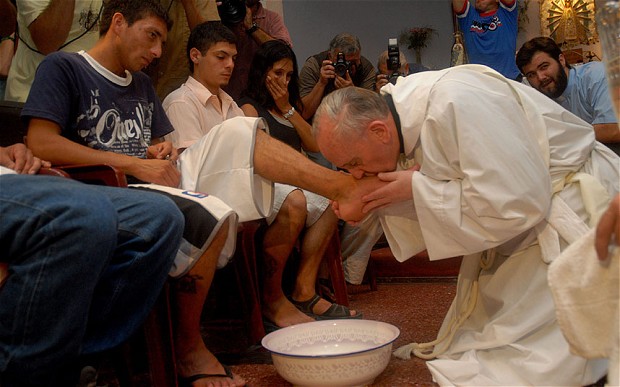
Francis I

Readings for 6th Sunday after Easter: Acts 15:1-2, 22-29; Ps. 57: 2-3, 5, 6, 8; Rev. 21: 10-14; 22-23; Jn. 14: 23-29. http://www.usccb.org/bible/readings/050513.cfm

Last year was the 50th anniversary of the convocation of the Second Vatican Council. The Catholic Church is still reeling from that earth-shaking event. Conservatives often consider it a huge mistake. They want to return to the Latin Mass, to women’s head-coverings in church, to weekly confessions and communion placed by the priest on the communicant’s outstretched tongue.

Liberals too are disappointed by Vatican II. It didn’t nearly go far enough, they say. It should have eliminated priestly celibacy and the all-male clergy. The church should have divested itself of the Vatican Bank, sold its art treasures and given the proceeds to the poor. The Council’s teaching on collegiality should have decentralized church bureaucracy and made lay-leadership more prominent. The prohibition of contraception should have been changed.

Into which of those camps do you fall? As a church member, do you consider yourself conservative or liberal? Today’s liturgy of the word provokes the question. It reveals a church which at its very beginning surrendered itself to extreme liberalism – or should I say to the “radicalism” of Jesus’ Spirit?

Think about those terms for a minute in the light of today’s readings. Think about what “conservative” and “liberal” mean for us as individuals and community members in our faith tradition. Think of the Holy Spirit as “radical” – something believers are rooted in.

According to every great tradition (Christian or otherwise), the spiritual life – human life itself – is about change, about transformation. Change is the point. We are called to grow. Growth involves transformation. At the biological level, we’re told that all of our cells change every seven years. That means that at my stage in life, I’ve already gone through more than ten bodies! If I tried to keep my body from changing, I would die.

At the personal, psychic and intellectual levels we’re called to change as well. As St. Paul puts it, when we were children, it was appropriate to think, speak and act as children (I Cor. 13:11). But as adults, we’re called to something more. If we don’t change, we can never become who we’re meant to be.

Even institutions must change to survive. That’s true in the realm of politics, economics, and religion. Jesus’ followers found no exemption from this rule of life – of evolution; as community members they had to change or die. In other words, at the end of the day, strategies of conservatism are doomed for Christians as well as for everyone else.

It’s easy to sympathize with conservatives however. I spent much of my life in that category. As such, my concern was simply to preserve what is essential. I saw liberals as being too free with the unchangeable. Like other conservatives I accused them of throwing out the baby with the bath water.

Nonetheless, in today’s liturgy of the word, we get an idea of how difficult it is to determine which is which –baby or bath water. That is, in our readings, we are faced an example of a key conflict between religious conservatives and liberals within the first century infant church. Paul, Barnabas, Silas and Barsabas lead the liberal wing. Peter and Jesus’ brother, James are the leaders of the conservatives.

Paul and his friends come from the gentile world. Their concern is to make Jesus both understandable and acceptable to non-Jews. For their audience, circumcision and dietary restrictions (like not eating pork) represent great obstacles to accepting Jesus’ “Way.”

On the other hand, Peter and Jesus’ brother, James, are Jews through and through. They remember the importance of full observance of the law within the Jewish tradition. They recalled for instance that during the second century Seleucid persecution of the Jews under Antiochus IV Epiphanes, many Jews gave their lives rather than eat forbidden foods. Faced with Paul and his colleagues, the conservative faction wondered: were those lives sacrificed in vain? And besides, circumcision was the identifying mark of Jewish manhood. What good follower of the biblical God set that all-important commandment aside?

The issue is so serious that it provoked a meeting of church leaders – what scholars call the “Council of Jerusalem.” Like Vatican II (1962-’65) it called together church leadership to discuss burning issues of the day and to make changes that responded effectively to what Gaudium et Spes called the “signs of the times.”

Today’s gospel reading implies that leaders could come together with confidence because of Jesus’ promise that his Holy Spirit would continue teaching the church even after he is gone. The Spirit would remind the church of what Jesus himself taught – and more besides.

According to today’s readings, it was the “more besides” that the Jerusalem conservatives were resisting. They didn’t deny, of course, that Jesus himself was a religious liberal. (It was Jesus’ liberalism that angered the Scribes and high priests.) Jesus frequently placed love and compassion above God’s most important commandment, the Sabbath law; he associated with the “unclean;” he even befriended and worked miracles for gentiles. Jesus was never bound by the letter of the law as were his conservative opponents.

At the same time however, Jesus was Jewish to the end. He had no intention of founding a new religion. He was a Jewish reformer. No one could deny that. Jesus didn’t revoke the Law. He simply gave it an enlightened, more humane, more liberal interpretation. He himself had been circumcised!

It was with these understandings that the Council of Jerusalem convened. And according to Luke, the author of Acts, it was a battle royal. Luke says the meeting (like Vatican II) was filled with “dissension and debate.”

What we find in today’s first reading is the final decree of the Council of Jerusalem. Concerning circumcision, it says “never mind.” As for dietary restrictions, fagedaboutit. The Council was concerned with not placing unbearable burdens on converts. In other words, it couldn’t have been more liberal. It could not have been less conservative.

The Council of Jerusalem is reputed to have happened no more than 30 years after the death of Jesus. But by the time John of Patmos writes his book of Revelation at the end of the first century, look where his church had come. His vision of the “New Jerusalem” which we read about in today’s second reading doesn’t even have a temple. Jerusalem without a temple?! The city is founded not on the 12 patriarchs of Israel, but on the 12 apostles. How liberal is that!?

I suppose what I’m saying is that Christians shouldn’t be afraid of change. It’s our tradition – right from the beginning. In fact, in today’s gospel, John has Jesus say specifically that we should not be agitated or fearful. Rather, our hearts should be filled with peace because of our reliance on the Holy Spirit. John’s Jesus teaches that the Spirit’s presence guarantees the community is moving in the right direction, even when the Spirit’s teachings shock and scandalize – as long as it’s moving towards Jesus’ compassion, love, and ease of burden. The guarantee remains even when the Spirit’s guidance seems to dilute what many consider essential – like circumcision, dietary laws and the Jerusalem Temple.

What “essentials” is the church being called to set aside today? Priestly celibacy? An all-male priesthood? Prohibition of contraception? Are any of these really essential?

The question is as unnerving for the church as it is for us as individuals. But the answer is always the same: “Don’t be afraid or agitated; the Holy Spirit guides.”

Think about it: at the personal level, after ten changes of body and innumerable psychic growth spurts and changes of mind, what remains that allows me to identify with that child they tell me I was in my baby pictures? The bath water has been thrown out virtually every day. But somehow I’m able to say “I” remain. Who is that “I?”

Once again, today’s gospel leads us to believe that the answer is the indwelling Holy Spirit herself who continually leads us into the new and unforeseen – but without that “fear or agitation.” That unifying, enlightened Spirit is the same in me as She is in you.

The bottom line: today’s readings teach that there is no future in timid conservatism. Instead we are called to extreme liberalism. And that liberalism actually translates to Jesus-like radicalism (or going to the root of things). The Holy Spirit is that root.

And so we can pray with confidence: “Holy Spirit, in the present crisis of your church, inspire Francis I to call us together once again. Convene a Council. Surprise us. Shock us one more time. Wake us up! Move us towards compassion, love and ease of burden as you did the Jerusalem Council. We believe that under your guidance, we can never go wrong!

Meet Declan Coyle, a Real Liberation Theologian (Sunday Homily)

Declan

My Easter homily two weeks ago evoked a wonderful response from one of my former priest-colleagues from the Society of St. Columban – the missionary community of priests I belonged to before I left in 1976. The colleague is Declan Coyle (pictured above).

Declan, it turns out, is a wonderful and witty writer. In a future blog I’ll share his moving piece on his son, Alexander who has Mowat Wilson Syndrome. It’s a truly inspiring essay on the meaning of living in the present moment.

When I asked for permission to share his Easter thoughts, here’s how Declan responded.

Of course Mike you can share it with you audience.

I soldiered (how easily the old militaristic verb crops up, “Who has a blade for a splendid cause … our horses are red to the hocks with the blood of the heathen”) with the Columbans for 27 years from seminary to moving on to marry Annette, an Australian in 1990.

I studied Liberation Theology in St Paul’s Ottawa after ordination, and then I asked the Superior General for five years in a slum in Latin America or Asia. After nine years of post-high school academic study I felt I was not fit to teach in Boston. But I knew that if I got some years in a slum where the slum dwellers who had survived and graduated from the University of Life taught me some life lessons, and I got these in my blood and my guts and my bones and my being, then I could teach Liberation Theology with passion and enthusiasm.

I got five years in the Philippines and six in Taiwan.

I got married to Annette, my wife in 1990. We have three children, Genevieve (19), Fionn (16) and little Alexander who is eight. He is a very special child. He has Mowat Wilson Syndrome. It was only discovered in 1997 and he was the first child in Ireland to be diagnosed with it. I’ll attach a reflection I wrote recently about him. He’s the epitome of the idea that he’s not a human being having the odd spiritual experience, he’s a spiritual being having a human experience.

The last 90 days I was in the Philippines I buried 65 children under two years old … all who died from hunger or hunger related diseases. In the slums we lived Jesus’ Synagogue Speech and Matthew 25 and life to the full and joy overflowing.

From where I’ve lived my so called Christian life, you’ve got your hand on the heart and the soul of the gospel and what the carpenter poet of Galilee was all about. I’m still baffled as to why John Paul II didn’t jump on a plane and go out and finish that Mass that stopped when Romero was shot. Would that not have been a symbolic gesture to lift the hearts of the poor and baffle Reagan?

Every blessing in your great work. You are real good news for the poor. You are real liberation for those oppressed by the historical accretions of the empire and real new sight for those of us who have been blind to the real meaning of the gospels for our world today. You remind me of the great prophet Micah whose words you live: To act justly, to love tenderly with kindness and to walk humbly with your God.

All the lovely things of the Holy Spirit on this Easter Week.

Declan

And now Declan Coyle’s Easter Reflection:

Years ago here at home our eldest two children Genevieve and Fionn were playing hide and seek all over the house. All I could hear all day was, “ready or not, here I come!”

That evening Genevieve asked me how did Jesus rise from the dead. I told her that on Easter Sunday morning the soldiers were outside the tomb, cooking their Easter eggs in a pot on the fire. Then suddenly from the tomb came this thunderous voice, “Ready or not here I come!” Then the rock rolled away and out came Jesus.

The two soldiers fainted with the fright.

The following week, the teacher asked the children to explain how the resurrection happened. Genevieve told her how. The teacher was not impressed.

I asked Genevieve which story she preferred. She said yours Daddy. In one fell swoop, she turned me into the fifth evangelist – a storyteller with a myth, a story, a lie that tells the truth. She understood hermeneutics.

In our recent discussions I told her that if ever she is tempted to go literal, she’ll lose the meaning. Always go symbolic. If you go literal, then you’re wondering at Christmas was Jesus born in a stable, or a cave or was it a kindergarten for the Essenes?

Literal is a dead end. But when you go symbolic you realize that the Christmas story simply means that great power comes in humble packages.

Keep up the great work Mike.

And send your material to Pope Francis.

Happy Easter. Declan

Thug Pope?

Cia Argentina

Last Friday I published a blog calling for the resignation of the newly elected Pope. Of course, I had no expectation that the pope would resign. We can even hope that as Francis I, Jorge Bergoglio will undergo or has undergone a conversion since the days when his silence gave consent to the brutal military regime of Jorge Videla during Argentina’s infamous “Dirty War.”

Nonetheless Bergoglio’s election forces us to face up to the role of religion under imperialism. The ascendancy of Francis I trains focus on the way both the fundamentalist Catholic Church and its Protestant counterparts habitually lie comfortably in bed with the forces of politico-economic exploitation, war, kidnapping, torture, and murder. As bed fellows they share the guilt of their thug partners.

Put otherwise, religious fundamentalism can easily be seen as the most conservative force in the world. Exhibit #1 is Roman Catholicism. The vast majority of its leaders have always lain supine not merely for Constantine, but for a whole host of dictators who followed including Hitler and with Mussolini. On the whole, Protestant fundamentalists have been no better. To reiterate: fundamentalist religionists are the problem, not just their embodiment in an unrepentant Francis I. If their partners are thugs, where does that leave them?

You see, the pope’s defenders are wrong when they say that archbishop Bergoglio was merely another Argentinian cowed by the military and lacking in the heroic courage of a few bishops and many liberation theology priests during Argentina’s “Dirty War” (1976-’83). At the hierarchical level, I’m thinking of heroes whose faith moved them to defy the military governments the U.S. established throughout Latin America from the early 1960s till the fall of the Soviet Union.

I’m thinking of Brazil’s Cardinal Paulo Evaristo Arns, Dom Helder Camara, or Bishop Pedro Casaldaliga — or of El Salvador’s Oscar Romero, or of Mexico’s Samuel Ruiz. All of them recognized that their status provided them with a literal “bully pulpit” for denouncing the oppression of their impoverished flocks which did not enjoy the relative invulnerability their own ecclesiastical status provided for themselves.

Put simply, Bergoglio didn’t have the courage of those men.

Granted, you can’t fault someone for not being a hero. However lacking heroism was not Bergoglio’s problem as his apologists imply. Even if he was merely silent, he lacked the moral responsibility absolutely required for the Christ-like fulfillment of his office. After all, muted and/or compliant churchmen represent an essential ideological cog in the system of oppression. Since the time of Constantine, they have been used to persuade ordinary Christians that God endorses the policies of their oppressors however brutal.

The hell of it is that many priests and preachers, especially at lower levels, are completely unaware of their role in the system. They think of themselves as good pastors, patriotic citizens, supporters of a brave military, and opponents of Godless Communism. This may have been the case even with archbishop Bergoglio. He may simply have been an unconscious, naive pawn. Nonetheless, he was part of the gang, and so are all religious leaders who end up underwriting oppression.

Like Bergoglio, they should know better because Jesus had to deal with the alliance between religion and colonialism too. The priests, scribes, and Sadducees of his day were an essential part of the Roman system of exploitation. In fact, it’s common to refer to the Temple’s “con-dominium” with Rome. The priests and scribes on the one hand along with the emperor and Pilate on the other, all ruled together. To attack one was to attack the other. And Jesus attacked them both.

Opposing imperialism goes beyond simply firing one’s chauffer or taking the bus to work. It goes beyond saying we’re on the side of the poor. (Even Rick Santorum says that!) Instead popes and bishops have to understand critique and oppose the structures that cause and sustain oppression – economic and political systems along with laws, customs, and institutions like those of church, government, and the military. All of those structures transcend the short reigns of popes, presidents and generals. Those occupants of office come and go, but the systems and laws they serve and enforce remain.

The sainted archbishop of Recife in Brazil, Dom Helder Camara understood that. He once said, “When I feed the poor, they called me a saint. When I ask why the poor have no food, they call me a communist.”

Let’s hope that Pope Francis will not only ask that latter question – the why of poverty and hunger. Let’s hope he will answer it strongly and unmistakably. The poor have no food because keeping them hungry is in the interests of the economic and political system that runs the world – international capitalism.

At the moment, hasty hagiographers are saying that Francis I’s concern for the poor makes him a saint. My prayer is that they will soon be calling him a communist. The alternative appellation is “thug.”

Why the New Pope Should Resign: The Pedophilia Syndrome

ChristianVonWernich

Until yesterday’s election of Pope Francis I, I must confess I doubted the ability of the Holy Spirit to influence the election of a successor to recently resigned Benedict XVI. After all, Benedict and his predecessor had so stacked the College of Cardinals that the likelihood of a progressive or reformer being elected seemed impossible. That is, all of the papabile were clones of the previous two popes – all to a man, opponents of women’s ordination, artificial contraception, and of liberation theology. The patriarchy had defeated, it seemed, the very Spirit of Jesus.

However, as they say, the Holy Spirit operates in strange ways. Evidently, she concluded, “I’ll let them elect a clone of John Paul II if they like. But then I’ll take over and allow the scandalous crimes of that clone to become evident. As a result, he’ll have to resign. Then in desperation, the church will turn to a real reformer – this time chosen from outside the ranks of the College of Cardinals – perhaps even a feminine spirit like mine.”

Does that seem so crazy? Let’s move one step at a time. Before thinking about who the next pope should be, or where she should come from, here is the reason for Francis I to abdicate:

To begin with, he shouldn’t resign because he’s ultimately bad for Argentina and Latin America. That is, despite what they’re saying in the media, Cardinal Bergoglio was bad for the poor of Argentina. Remember, he’s a “compassionate conservative.” That means he’s a churchman who talks about combatting poverty, but then ends up opposing progressive politicians like Argentine president Cristina Kirchner.

In this, he’s the analogue of U.S. bishops siding with the Republican Party. All of those bishops claim to support the poor. However they end up doing the opposite. Their positions on the overriding “wedge issues” of contraception, abortion, and same-sex marriage put them in bed with the Republicans and their “preferential option for the rich.” In this way, the bishops end up trying to persuade Catholics to vote Republican. Bergoglio did something similar in Argentine politics.

More accurately still, Francis I is the analogue of John Paul II in Poland. John Paul was ultimately bad for Poland (and the developing world as well). True, he opposed the Polish version of communism and seemed to support the labor union, Solidarity. However John Paul actually undermined his country’s sovereignty and the global labor movement by appearing to give papal blessing to international capitalism. That not only impoverished Poland, it weakened labor and progressives throughout the Catholic world.

The election of Francis I promises to do something similar for (to!) Latin America. As politically conservative, he imparts ecclesiastical approbation to rightist governments throughout the region in their efforts to discredit and unseat Latin America’s newly resurgent progressives.

Secondly, the new pope shouldn’t resign because he betrayed two fellow Jesuits during Argentina’s “Dirty War.” During that conflict (1976-1983), and like most of the hierarchy in Latin America, Bergoglio sided with the criminal dictatorship whose leader has since been put behind bars as a ruthless murderer.

According to Horacio Verbitsky and his book, Silencio, Fr. Bergoglio, then Superior General of the Society of Jesus, removed his order’s protection from two of his brother Jesuits accused of “subversion” (i.e. opposition to the military dictatorship). True, Verbitsky says, the future pope adopted a public posture of seeking the Jesuits’ release. However privately he cooperated in prolonging their detention and torture.

Both priests later brought charges against Bergoglio as an accomplice of the military for the priests’ unjust imprisonment. After initially and repeatedly invoking ecclesiastical privilege to avoid deposition about the case, Bergoglio was finally interviewed by prosecutors. According to Argentine human rights organizations, his answers were highly evasive.

No, the real reason Francis I should resign is because of what he did about the von Wernich case. Von Wernich was a police chaplain during the Dirty War. He was sentenced to life imprisonment for aiding and abetting the military in the illegal kidnapping, torture and murder of prisoners during the brutal dictatorship of the Argentine military. According to the New York Times, while von Wernich was being investigated for his actions, and while Bergoglio was a member of the Argentine Bishops Conference, the priest was transferred to Chile under an assumed name. There he served in a parish until his arrest, conviction and imprisonment for the crimes just mentioned. And von Wernich has never been defrocked, even after Bergoglio was elected head of the Bishops’ Conference, nor has any church apology been issued. In fact, the former police chaplain has been allowed to carry on as a priest while in prison.

Now imagine our reaction if von Wernich had been a pedophile. And imagine if Bergoglio had been part of a decision to transfer a pedophile cleric as he evidently was in the case of this serial kidnaper, murderer and torturer. The whole world would be outraged and would demand the pope’s resignation. He would be completely discredited. And yet, a serial kidnapper, torturer and murderer is infinitely more dangerous than a serial pedophile.

The point is that we have exemplified in the case of the new pope the very same syndrome that has been universally descried in cases of pedophilia. It is the same syndrome that plagued the tenure of Benedict XVI and that possibly evoked his own resignation. It’s the Old Boys protecting their own.

As I said, I’m not discouraged by all of this. Instead, my faith in the Holy Spirit has been renewed. Her ways are strange indeed. The papacy is crumbling before our eyes. But it may be the death necessary before resurrection.

Lenten Reflection II: Why Lenten Penance?

Manhattan

Recently, a good friend of mine wrote to ask how my Lenten resolutions were faring. It’s half-way through Lent, and given what I wrote here on Ash Wednesday (located in the “Thoughts for the Day” category just below the masthead of this blog site), I think I owe her an answer. I’m hoping that the reflection needed for sharing like this might reignite my own Lenten fire. Perhaps it might also encourage reflection in others. They might even share their experiences using the “Comment” feature on this blog site. And that in turn might encourage the rest of us to “save” our Lents before it’s too late.

In general, my Lent is going well. Two elements have made it special. A third (a chance conversation) has given me a fresh understanding of the purpose of Lenten penance.

The two special elements are first of all my experience with an emerging “Ecumenical Table” in our local area. The second is a Lenten study group I’m leading about the historical Jesus.

I’ve mentioned the “Ecumenical Table” several times before in these blog postings. It’s a lay-led gathering of Christians who are looking for deeper meaning in Sunday liturgies. We’ve been gathering monthly for Lord’s Supper liturgies since Pentecost last year. But this Lent we’ve decided to meet every Sunday in a more focused attempt to discern whether our form of community worship is what we’re seeking ultimately. The liturgies the past three weeks have been beautiful and thoughtful. And hearing the voices of women as Lord’s Supper celebrants and homilists is unbelievably enriching. It makes it so apparent how the Catholic Church impoverishes itself and its people by insisting on an all-male clergy.

The second special element of this year’s Lent is our little seminar on the historical Jesus. We’ve been meeting each Wednesday night for an hour and a half. Our purpose is (as Marcus Borg put it) to “meet Jesus again for the first time.” We’re trying to encounter the Jesus of history who stands behind the faith-inspired interpretations of the canonical gospels.

So far the seminar has been going well, although I’ve found my own leadership uneven. But the participants (about 25 at each session) have been unbelievably generous in their showing up, contributing to discussions, and overlooking leadership shortcomings. (Some have told me it’s their Lenten penance!) In any case, the discussion of the gospel readings for the Sunday following each Wednesday’s meeting is proving to be especially rewarding. The same holds true for the segments of the PBS series, “From Jesus to Christ.”

I’ve even found the sessions spilling over into casual conversations. In particular two of my ex-priest friends who have done me the honor of attending have helped clarify my own thought and have advised me about how to do better over hot chocolates at our local gathering place, Berea Coffee and Tea.

The third special element of this year’s Lent, my attempts at Lenten discipline, has been greatly influenced by a conversation I had with a friend weeks before Lent began. He and his wife had come over for supper, and I offered him a cocktail beforehand. My friend declined. He said his son was alcoholic, and as an act of solidarity with his son’s efforts to resist alcohol, my friend too was giving it up.

At first I supposed he was thinking in terms of good example. But then I realized there was far more to it than that. After all, his son wasn’t present to witness my friend’s abstinence. Instead my friend was expressing his faith in the basic unity of all human beings. His abstinence affirmed that acts of solidarity with others somehow influence them even when they are not physically present – even when they’re not consciously aware that those acts are being performed. That’s a deep act of faith quite relevant to Lenten disciplines.

My friend’s words made me realize that at least one purpose of abstinence and other forms of what we used to call “penance” is to raise consciousness of our unity with others – especially with whose negative experiences of life we’ve managed to escape. The hope is that the resulting vicarious experience will somehow strengthen them and move us to action towards eliminating the causes of their distress. So for example,

• Following my friend’s example of abstinence from alcohol establishes a bond with those struggling to break addictions to liquor and drugs.

• Not eating meat somehow unites us with the hungry and raises consciousness about the effects meat-eating has on them and on the environment in general.

• Lowering the water temperature in one’s morning shower creates solidarity with those in U.S. prison camps subjected to water torture in various forms – including cold and scalding showers and waterboarding.

• Turning off the TV above the elliptical machine while exercising, and repeating one’s mantram instead begins to break the bond with the culture of overconsumption and destructive growth.

• The same holds true for establishing a daily discipline of consulting e-mail only once or twice a day instead of every fifteen minutes.

My friend’s refusal of liquor that night taught me that the realization of human solidarity in addictions and other problems is the whole point of Lent and its “penance.” All the rest including formal worship and study of the historical Jesus is simply means to that end.

No, I take that back. The end isn’t realizing human solidarity. The end is doing something about it.

And yet as Gandhi taught us, the end is mysteriously contained in the means – however seemingly insignificant.

Christians Have Been Worshipping the Devil for Millennia: Lent calls us to change Gods

Empires[1]

Readings for First Sunday of Lent: Dt. 26: 4-10; Ps. 91: 1-2; 10-15; Rom. 10: 8-13; Lk. 4: 1-13. http://www.usccb.org/bible/readings/021713.cfm

Today is the first Sunday of Lent. Lent is a time of renewal – of getting back to basics – to asking questions about what we really believe and what God we truly worship. Today’s liturgy of the word helps us to do both. Deuteronomy 26 directs us to the authentic faith of Jesus – in the God who liberates the enslaved. Today’s reading from Luke’s Gospel calls us to worship that God rather than devil – the evil one that our culture and church (!) have been worshipping for centuries – ever since they first embraced imperialism in the 4th century C.E. Let me explain.

Start with that reading from Deuteronomy 26. It’s a key text if we want to understand the God in whom Jesus placed his faith. Jesus, remember, was a Jew, not a Christian. And Deuteronomy 26 provides us with the creedal statement that the Jewish Jesus accepted as did all Jews of his time. I mean, for them, Deuteronomy 26 functioned much like our Nicene Creed does for us each Sunday. It was a reminder of their basic belief. As such, it can be summarized in the passage’s seven points:

1. Our father (Abraham) was a wandering Aramean (a Syrian).
2. “Abraham” (i.e. his descendents) went down into Egypt.
3. There we became a great people.
4. But the Egyptians enslaved us.
5. We cried out to our God, Yahweh, who raised up the rebel prophet, Moses.
6. He led us out of Egypt, across the sea, through the desert, and to this land “flowing with milk and honey.”
7. This land is our gift from Yahweh; Thanks be to God!

That’s it! That was the faith that Jesus, the Jewish prophet, inherited from his ancestors. It was a tribal faith centered on the ownership of a God-given piece of land (Palestine) which (despite its dryness and desert character) the descendents of Jacob saw as rich and productive (flowing with milk and honey).

Notice that this Jewish faith had nothing to do with an afterlife, heaven or hell. (In fact, belief in the afterlife was a very late development among the Jews; it didn’t emerge even for debate until about 200 years before Jesus’ birth.) Instead, as among all hunter-gatherers, herds people and agriculturalists, Jewish faith was centered on land. Obviously then, it had little tolerance for colonial military forces like the Assyrians, Babylonians, Persians, Greeks or Romans all of whom at various times occupied Palestine. Colonialism and foreign occupation contradicted Jewish faith in a fundamental way. It was intolerable.

That was true for Jesus too. As a prophet, his fundamental proclamation was not about himself or about a new religion. Much less was it about the after-life or “going to heaven.” Instead, Jesus proclaimed the “Kingdom of God.” That phrase referred to what the world would be like without empire – if Yahweh were king instead of Rome’s Caesar. In other words, “Kingdom of God” was a political image among a people unable and unwilling to distinguish between politics and religion.

In God’s Kingdom, everything would be reversed and guiding principles would be changed. The first would be last; the last would be first. The rich would weep, and the poor would laugh. Prostitutes and tax collectors would enter the Kingdom, while the priests and “holy people” – all of them collaborators with Rome – would find themselves excluded. The world would belong not to the powerful, but to the “meek,” i.e. to the gentle, humble and non-violent. It would be governed not by force and “power over” but by compassion and gift (i.e. sharing).

The creedal account of Deuteronomy 26 sets the stage for today’s gospel narrative about Jesus’ temptations in the desert. (And it’s here that the devil-worship connected with empire enters the picture. Listen closely.) In a context of Roman occupation, Luke’s account raises the question of whom to worship. The choice he presents is stark: one can worship the devil the author of empire or Yahweh, the opponent of imperial power of all types.

That clear choice becomes apparent in Luke’s version of Jesus’ second temptation. From a high vantage point, the devil shows Jesus all the kingdoms of the earth. Then he says,

“I shall give to you all this power and glory;
for it has been handed over to me,
and I may give it to whomever I wish.
All this will be yours, if you worship me.”

Notice what’s happening here. The devil shows Jesus an empire infinitely larger than Rome’s – “all the kingdoms of the world.” Such empire, the devil claims, belongs to him: “It has been handed over to me.” This means that those who exercise imperial power do so because the devil has chosen to share his possession with them: “I may give it to whomever I wish.” The implication here is that Rome (and whoever exercises empire) is the devil’s agent. Finally, the tempter underlines what all of this means: devil-worship is the single prerequisite for empire’s possession and exercise: “All this will be yours, if you worship me.”

But Jesus responds,
“It is written:
You shall worship the Lord, your God,
and him alone shall you serve.”

Here Jesus quotes the Mosaic tradition summarized in Deuteronomy 26 to insist that empire and worship of Yahweh are incompatible. Put otherwise, at the beginning of his public life, Jesus declares his anti-imperial position in the strongest possible (i.e. scriptural) terms.

Now fast forward to the 4th century – 381 CE to be exact. In 313 Constantine’s Edict of Milan had removed from Christianity the stigma of being a forbidden cult. From 313 on, it was legal. By 325 Constantine had become so involved in the life of the Christian church that he himself convoked the Council of Nicaea to determine the identity of Jesus. Who was Jesus after all – merely a man, or was he a God pretending to be a man, or perhaps a man who became a God? Was he equal to Yahweh or subordinate to him? If he was God, did he have to defecate and urinate? These were the questions.

However, my point is that by the early 4th century the emperor had a strong hand in determining the content of Christian theology. And as time passed, the imperial hand grew more influential by the day. In fact, by 381 under the emperor Theodosius Christianity had become not just legal, but the official religion of the Roman Empire. As such its job was to attest that God (not the devil) had given empire to Rome in exchange for worshipping him (not the devil)!

Do you get my point here? It’s the claim that in the 4th century, Rome presented church fathers with the same temptation that Jesus experienced in the desert. But whereas Jesus had refused empire as diabolical, the prevailing faction of 4th century church leadership embraced it as a gift from God. In so doing they also said “yes” to the devil worship as the necessary prerequisite to aspirations to control “all the kingdoms of the world.” Christians have been worshipping the devil ever since, while calling him “God.”

No, today’s readings insist: all the kingdoms of the world belong only to God. They are God’s Kingdom to be governed not by “power over,” not by dominion and taking, but by love and gift which leave people like the liberated daughters and sons of Abraham free to live in control of their own God-given piece of earth. Or in the words of Jesus, the earth is meant to belong to those “meek” I mentioned – the gentle, humble, and non-violent.

All of this has implications for us as would-be followers of Jesus and as citizens of a country whose “leaders” (supported by their “Christian” counterparts) increasingly embrace empire as the inevitable and fitting destiny of the United States.

In fact, in 2003, then vice-president, Dick Cheney sent out a Christmas card on which was inscribed the words, “And if a sparrow cannot fall to the ground without His notice, is it probable that an empire can rise without His aid?” Cheney’s implication was that the United States is God’s new chosen people. Empire as practiced by the United States represents God’s will.

Instead, today’s Liturgy of the Word tells us the opposite. Empires arise only with the devil’s aid.

Does this mean that faithful followers of Jesus must pray for the defeat of the United States in its imperial conquests? Must we discourage our sons and daughters from joining the military?
(Discussion follows)

Marx and Jesus: The Trouble with Prophets

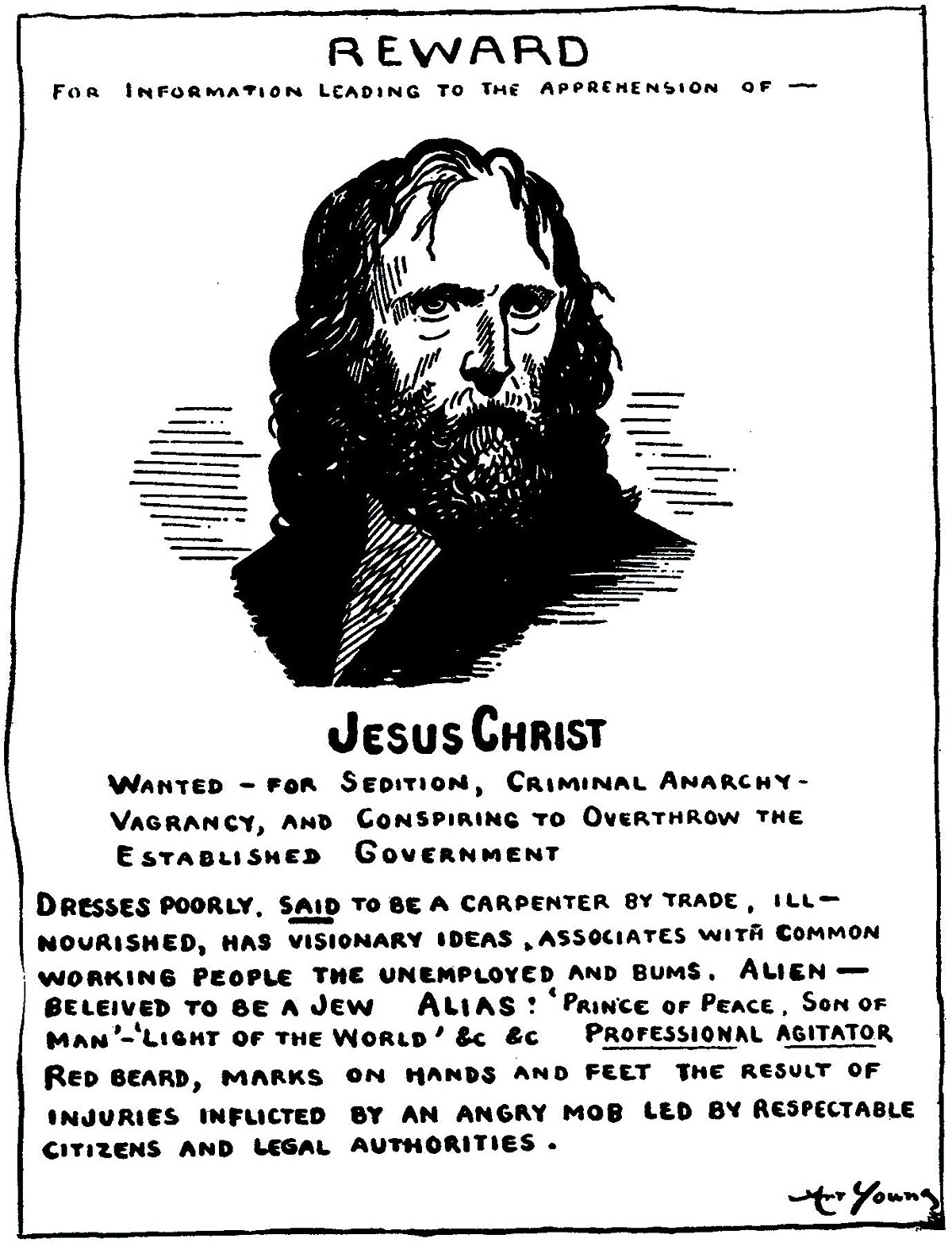
00-art-young-jesus-wanted-poster-he-stirreth-up-the-people-1913

Readings for 4th Sunday in Ordinary Time: Jer. 1: 4-5, 17-19; Ps. 71: 1-6, 15-17; I Cor. 12: 31-13; Lk. 4: 21-30 http://www.usccb.org/bible/readings/020313.cfm

I remember when my ideas about prophecy changed – when I really began to understand the term’s implications. I was a graduate student in Rome – already a priest – and completing my doctoral studies at the Academia Alfonsiana on the Via Merulana there in the “Holy City.” I was taking a class in I’ve forgotten what. But my professor (a German Redemptorist as I recall) got my attention during one of his lectures by referring to Karl Marx as “the last of the great Jewish prophets.” That was in 1970 at the height of the Cold War, and I had been reading Marx and about the then-flourishing Marxist-Christian dialog. I realized that my professor was right.

Marx of course was a Jew like Jesus, and Jeremiah who are centralized in today’s liturgy of the word. Like them, Marx was totally absorbed by questions of social justice for the poor and exploited. He was pretty much penniless, like most prophets, and spent his time thinking, writing, speaking, and organizing workers against exploitive employers. He was also highly critical of organized religion and its idols.

Marx’s insight (shared with the biblical prophets) was to realize that both Judaism and Christianity worshipped idols more often than the God of Israel. And by that he meant “gods” who not only justified an oppressive status quo, but who anesthetized the workers and unemployed to the fact that they were indeed oppressed by the capitalist system. Marx called such idols “the gods of heaven.”

We’re all familiar with what he meant. These idols are worshipped each Sunday – usually from 11:00 to 12:00 in what a theologian friend of mine used to call the “be kind to God hour.” You can encounter the “gods of heaven” any day at any hour on Cable television’s Channel 3 or in most Catholic Churches any Sunday morning. “God” there is concerned with correct worship, with bows, genuflections, and with correct terms such as “consubstantial,” “chalice,” “with thy spirit,” “under my roof” and so on. The stories or mythology upholding such idols have to do with “Jesus as your personal savior,” with “going to heaven,” and with avoiding hell.

Marx was also critical of what he called the “gods of earth.” They’re what people worship all those days and hours when they’re not in church. They include Capitalism, “America,” Nationalism, National Defense, Homeland Security, the Military, Money, and Profit. The issues of this God focus on sexuality: contraception, abortion, and same-sex marriage. This God is a War God – always on the side of “America.” He’s celebrated in songs like “The Battle Hymn of the Republic” and “Proud to Be an American.” He is the protector of “religious freedom” understood as privileging Christianity over other faiths while preserving tax exemptions worth billions each year. He blesses the bishops’ “Fortnight for Freedom” concerned as it is with protecting such benefits.

Marx’s prophetic work made him extremely popular with working classes. It was not uncommon for a worker to request that he be buried with a copy of “The Communist Manifesto” placed on his chest.

At the same time, Marx was vilified as the devil himself by factory owners, businessmen, bankers, and the professors and politicians representing their interests. Defenseless against such “education,” most of us have accepted such defamation of this last of the great Jewish prophets.

You see, that’s the trouble with prophets like Marx, Jesus and Jeremiah. They have to take on the “powers and principalities” of their cultures. They must swim against the torrential stream of public opinion.

In today’s first reading, Jeremiah is informed of his lot. But he must “man-up,” he’s told. He must steel himself to confront the “whole land,” along with kings and princes, priests and people. All of these, he’s warned, will fight against him. Nevertheless, God will make of Jeremiah a ‘fortified city,” a “pillar of iron,” and a “wall of brass.”

I suppose God followed through on those promises. But that didn’t prevent Jeremiah from being imprisoned, tortured, and left for dead.

Of course, the same thing happened to Jesus from the beginning to the end of his public ministry. He was vilified, demonized (literally!) and defamed.

That process begins for Jesus in today’s selection from Chapter 4 of Luke’s gospel. As we saw last week, he returns to his hometown of Nazareth and criticizes his neighbors’ narrow nationalism. In today’s episode his neighbors try to kill him. Later on, of course, Jesus goes more public. Like Jeremiah, he takes on his nation’s priests and scribes, princes and king. Ultimately his words and deeds threaten the Roman Empire itself which classifies him as a terrorist. Together those powers and principalities (national and international) not only defame Jesus the way Jeremiah and Marx were defamed; they actually kill him just as so many prophets have been killed from John the Baptist and Paul to Martin Luther King and Gandhi.

All of them – Jesus, Jeremiah, Gandhi, King, Paul and Marx – followed the same “prophetic script” whose inevitable directive prescribes that no prophet is accepted in her or his native place. It’s easy to see why. It’s because their “native place” bears the brunt of their prophetic words.

Meanwhile, it’s easier for outsiders to recognize prophets. The “outsiders” who concerned Jesus were the uneducated, poor, and unclean. However, even those seem to turn against him this morning. It’s unlikely that there were any rich or powerful resident in Nazareth – a place scripture scholar Ched Myers describes as “Nowheresville.”

Few of us are rich and powerful. Yet we’ve been schooled by those entities to reject prophets who speak in our name and defend our interests – those belonging to our “native land” to use the words of this morning’s gospel. It’s as though we’re looking at reality in that “darkened mirror” Paul wrote about in today’s excerpt from his letter to Corinth. The darkened mirror not only turns things backward, but it’s smudged with the fingerprints and dirt of ignorant and/or perverse propagandists.

The trouble – the trouble with prophets – is that most of us have bought into all that anti-prophet propaganda. So we hate Karl Marx without realizing that he’s on our side and speaks for us. We honor the Martin Luther King who has been reduced to a “dreamer,” but not the MLK who described the United States as the most violent and destructive country in the world. We don’t remember the King who was slandered as a communist and encouraged to commit suicide by the FBI and the COINTELPRO program.

We’re willing to stand by while Wikileaks journalist Julian Assange is persecuted by the governments of Great Britain and the United States. We presume that Bradley Manning is guilty of treason because our government, (despite its record of lies and heinous crimes) says so. We wonder what all the fuss is about Aaron Swartz.

These are the prophets of our time who, like Jesus, do not find a sympathetic hearing in their native place. It might be time to embrace them as our own and see what difference that makes in the way we look at the world and our country. The examples of Jeremiah, Jesus, and Paul — and the hopes of the world’s poor and victims of U.S. wars — beg us to do so.

Jesus Decides to Redeem His Wasted Life (Sunday’s Homily)

Readings for Feast of Baptism of the Lord: http://www.usccb.org/bible/readings/011313.cfm

Today is the Feast of the Baptism of the Lord. In that context, let’s think about baptism and the differences between the understandings we’ve inherited and those reflected in the practice of John the Baptist and Jesus of Nazareth. Those differences hold practical implications for our own lives as we wrestle with a faith that may have lost meaning for us, and as we struggle with the relative smallness and insignificance of our lives.

To begin with, think about traditional beliefs about baptism. If you’re like me, you may find them hard to swallow. A friend of mine, theologian Tony Equale, has recently pointed out that theology doesn’t really determine worship patterns. Instead superstitious temple and church rituals have shaped our beliefs. Practice determines belief, not the other way around. (See http://tonyequale.wordpress.com/2013/01/03/the-religiosity-of-the-people/)

What my friend means is that theology’s job has traditionally been to rationalize what people actually do in their efforts to tame life and achieve contact with the numinous, the mysterious, and the transcendent. They sacrifice chickens, behead bullocks, or vivisect lambs and then burn the animals’ carcasses. The smoke thus ‘feeds’ the Gods who are believed to need nourishment, placation, and cajoling in order to do the will of the people and their priests. Those congregations actually turn out to be more intelligent than the God who must be informed of their needs and what is best for their welfare. That’s superstition.

Catholic beliefs around baptism and the “sacrifice of the Mass” are cases in point. They were actually formed by the People’s credulous practice of baptism which was informed more by ancient ideas of all-powerful angry Gods than by Jesus’ radical teaching that God is Love. I mean early on, in a time of very high rates of infant mortality, popular belief came to see infant baptism as necessary to somehow save deceased children from a hell created by a threatening God.

This practice of the people rather than reflection on the words and deeds of Jesus led St. Augustine at the beginning of the 5th century to theorize that people have been born guilty – at enmity with God. Augustine thought that since children were condemned even before any personal sin on their parts, they must be born in sin. And that must be, Augustine reasoned, because they had inherited sin from their forebears and ultimately from the first human beings, Adam and Eve. Because of that “original sin,” God is justly angry with humans.

Now, as I said, the ancients believed that sacrifice was necessary to placate an angry God like that. So, in the Roman world, where sacrifice was understood in the terms I’ve just explained, Jesus’ death eventually became to be seen as a sacrifice whose primary purpose was to secure God’s approval of the Roman state. In this way, the “Mass” was transformed from a memorial meal to a re-enactment of Jesus’ sacrificial death. It was moved from a table with friends gathered around sharing food, to a “sacrifice” performed at an “altar” by a priest with his back turned to the people who watched the show from afar.

This Mass differed very little from what Romans were used to before Christianity became the state’s official religion in 381. In fact, it is entirely possible that ordinary people saw no difference between the “Mass” and the religious ritual they had been accustomed to when Jupiter or Mithra were worshipped as the official Gods of Rome. In other words, Christianity was transformed by the Roman Empire rather the empire being transformed by Christianity. There was a “theogony,” a battle of the Gods, between Jupiter and the Bible’s Yahweh; and Jupiter won. We’ve been worshipping him ever since.

How different all this is from what happens to Jesus at the baptism which today’s liturgy of the word celebrates! (And that brings me to my point about meaning in our seemingly wasted lives.) In today’s gospel, there is nothing suggesting “original sin.” Nor is Jesus presented as the incarnation of a God who needs to be mollified by sacrifice. Rather, Jesus comes as a disciple of John. (Scripture scholars tell us that John’s words about his inferiority before Jesus were inventions of the early church in a Jewish context where many still believed that John rather than Jesus was the long-awaited Messiah.)

So at the age of 30 or so, this young peasant from Nazareth presents himself for a ritual washing at the prophet’s hands in the legendary Jordan River. In Israel’s idealized past, that river had been crossed by slaves escaped from Egypt who on the river’s opposite shore found the “Promised Land” that became their national home. Eventually that crossing came to be understood as transforming a motley horde of renegade slaves into a unified nation of free people at the service of the God who had liberated them from demeaning servitude.

John’s practice of baptism in the Jordan (far from the corruption of the priests’ Temple and its endless sacrifices) summoned his Jewish contemporaries to reclaim their ancient identity that had been lost by the priests and scribes who had sold out to Roman re-enslavement of a once proud and liberated people.

John’s was a revivalist movement of Jewish reform. Those presenting themselves for baptism were expressing a desire to return to their religious roots and to alter their lives in a profound way.

Evidently, that’s why Jesus came to be baptized too. This country boy who (according to Luke’s “infancy narratives”) had begun his life with such promise is now about 30 years old. Perhaps in view of his parents’ expectations of him, his life so far seemed wasted. Perhaps he had resolved to finally make a difference. In any case, by approaching John in the Jordan’s waters, he expresses an intense need for change in his life. He wants to be John’s follower.

So John performs his baptismal ritual. And the miraculous happens. An epiphany occurs for Jesus. He hears a voice. It informs him that he is a child of God. Immediately he sets out on a vision quest to discover what those words might mean. Forty days of prayer and fasting bring on the visions – of angels and devils, of temptations, dangers and possibilities.

In the light of his desert experience, Jesus chooses not only to follow John as the leader of a reform movement. He chooses as well to follow Moses as the liberator of an enslaved people. He has truly crossed the Jordan. So he brings his message to the captive poor. Like him, they too are children of God — God’s specially chosen people. God’s kingdom belongs to them, he says, not to their rich oppressors. The poor must not allow themselves to be misled by the stultifying and domesticating doctrines of the priests and scribes. That was the thrust of Jesus’ teaching.

Coherent acts follow Jesus’ words. He discovers wondrous healing powers within himself. By touch, by faith, by his friendship, he cures stinking lepers, dirty beggars, street walkers who have lost their self-respect, the deaf, the dumb, the blind and lame. Jesus eats food with the social outcasts and street people of his day, sharing nourishment the way God does – without cost or expectation of reciprocation. Jesus finds himself explaining the mysterious, transcendent and ineffable in unforgettable stories that capture the imaginations of simple people hungry for the spiritual sustenance that he offers – that he embodies. No wonder his early followers tried to imitate Jesus by choosing John’s baptism as a sign of membership in their community and by following the Master’s example of sharing food the way God does in their re-enactment of the Lord’s Supper.

That was the understanding of baptism and Lord’s Supper that the first generations of Christians embraced. But it didn’t last long. Within a few generations (and especially after Christianity became the official religion of the Roman Empire at the end of the 4th century) the superstitions I referenced earlier had replaced the understanding and practice of Jesus and the Baptist. Soon baptism became an instrument for saving babies from original sin and hell. Soon the Lord’s Supper became the “Holy Sacrifice of the Mass” differing very little in ritual and spirit from offerings to Jupiter and Mithra.

Today’s liturgy of the word calls us beyond all of that. It summons us to follow Jesus who shows us the way to truly change our lives. Change comes by leaving behind the superstitious faith that supports empires past and present. Transformation comes when we share our food with each other and with the poor. It happens by committing ourselves to the “other world” represented by God’s Kingdom that has room for everyone, not just for the 1% served by our own churches, priests, scribes and their superstitious rituals.

Today’s liturgy of the word summons us to the banks of the Jordan to stand with Jesus and to hear God’s voice calling us from what has been so far wasted in our lives. Like Jesus, we are daughters and sons of God. We are beloved by the God of Love. Jesus’ example reminds us that It’s not too late to change our commitments and way of life.

After all (if we take our tradition literally) Jesus redeemed the insignificance of his own life in a single meaningful year – or maybe it was three.

John the Baptist’s Desert Revival and Pope John XXIII’s Aggiornamento

Third Sunday of Advent Readings: Zep. 3: 4-18a; Is. 12: 2-6; Phil. 4: 4-7; Lk. 3: 10-18.  http://www.usccb.org/bible/readings/121612.cfm

The lead article in the November 11th edition of our diocesan newspaper, Crossroads, published a sermon by the bishop of our Lexington diocese, Ronald W. Gainer. It had been given on Saturday November 3rd at the Cathedral of Christ the King in Lexington – the Saturday before the General Election. Bishop Gainer called attention to a new and “dangerous, corrosive change . . . at work in the soul of our nation.”  “In recent decades,” the bishop said, “forces are working overtime . . . to eliminate religion and God from the nation’s soul.” According to Bishop Gainer, those forces ignore the consistency of the Church’s moral teaching over the centuries – about “the sacredness of every human life.” Those teachings recognize certain acts as “intrinsically evil.” These include “abortion, euthanasia, assisted suicide and embryonic stem cell research. Being against the intrinsically evil means standing up for the sanctity of marriage between one man and one woman, the God-given right to freedom of religion, and against the evil of racism. There is nothing wrong with being a single-issue voter, the bishop emphasized; and abortion is the pivotal single issue for Catholics. The bishop concluded that political “candidates who refuse to oppose the evils he listed or who actively support them disqualify themselves from receiving Catholics’ support in the voting booth.”

Curiously, Bishop Gainer’s list of “intrinsic evils” did not include priests raping children. As a result, his remarks came off as out-of-touch, triumphalistic, self-serving, dishonest, and tired. We had heard it all before: “They’re wrong; we have never erred. ‘They’ are persecuting us. Only one issue is important, abortion. Vote Republican, even if that means economic disaster for the poor at home or abroad” (e.g., in the wars and drone strikes which also went unmentioned in the bishop’s remarks).

______

A little over a month ago, I attended the concluding Mass at the “Call to Action Conference” (CTA) in the Grand Ballroom of the Galt House in Louisville, Kentucky. CTA is the annual meeting of progressive Catholics who are trying to follow the spirit of the Second Vatican Council. (Vatican II set an agenda of church renewal and reform when the world’s Catholic bishops met in Rome from 1962-1965.) About 1000 people were present at CTA’s concluding liturgy. It reminded me of what spirited worship is like. Our good friend, John Wright Rios was the music leader with a group he assembled of about 15 instrumentalists and singers. There were drums, guitars, piano, trumpet and dancing. Hymns were in English and in Spanish with words projected on four large flat screens. The liturgy featured women in prominent roles, including three of the five concelebrants. Sister Simone Campbell of “Nuns on the bus” fame and who had spoken at last summer’s Democratic Convention gave the homily. What she said was insightful, inspiring, funny, and challenging. It made me see what the church is missing by insisting on an all-male, highly in-bred clergy. Sister Campbell spoke of the deep-seated divisions in our country and the need for universal love even of our enemies. She addressed the spiritual poverty and hunger experienced by all of us including leaders in the church, in politics, in our schools and universities. Poverty and hunger of body and spirit was the focus of Jesus’ work as described in the gospels. The church needs more Jesus, she said, and less triumphalism and pride.

______

Today’s readings are about religious revival and about the renewed recognition of God’s presence in our midst. In the first and third reading, the message is delivered by severe critics of temple worship – Zephaniah and John the Baptist. Zephaniah was a religious reformer from the seventh century BCE (just before the Babylonian Exile). He was known as the champion of “the poor of the land” (2:3; 3:12), and a fierce critic of Assyrian imperialism and the adoption of Assyrian religious ideology by Israel’s ruling elite. He accused the priests of his day of abandoning Yahweh in favor of Baal and Astarte. The outspoken Zephaniah threatened to drive out the priests and cleanse the temple by force.

Then in today’s gospel, John the Baptist picks up Zephaniah’s theme more than five hundred years later. Luke pictures John at the Jordan River – far from Jerusalem’s temple and its priesthood. John is leading a religious revival in the desert – the place of Israel’s birth long before there was any temple. Like Zephaniah, John is a layman. And his words to the religious leadership are harsh. In Luke’s verses immediately preceding today’s excerpt, he calls the crowd a “brood of vipers.” Matthew’s version is more specific. He says that curse was hurled at the Sadducees and Pharisees, the religious leadership of the day. According to John, they are snakes in the grass.

John contrasts the failed leadership of these men with God’s leadership present in the person of Jesus of Nazareth. Jesus, of course, turns out not to be a priest or rabbi either, but a workingman from Nazareth. Yet according to John, Jesus is more powerful and more worthy than John himself. As a lay leader, Jesus will bring not only the Holy Spirit, but a cleansing fire. He will separate the wheat from the chaff – what is essential from what is not – what is nourishing from what is not – the kernel of truth from its encasements. Those shells are now outdated, John says. We are about to enter a new era. Chaff, John declares, is good for nothing but burning in the hottest fire imaginable. He calls the crowds to the kernel of truth: share their surplus with the poor.

This year we celebrate the fiftieth anniversary of the Second Vatican Council.  It was a movement of reform and revival in the spirit of Zephaniah and John the Baptist. Pope John XXIII was the 1960s embodiment of their prophetic tradition. He summoned that meeting of the world’s bishops and used the word aggiornamento to describe the Council’s project. Aggiornamento meant updating.

Pope John’s vision was one of church revival and reform that connected Jesus with the actual lives and problems of people and the world – especially the poor. Those lives are characterized by either unemployment or overwork, by low wages, poverty, over-priced healthcare, misogyny, racism, inaccessible education, scant prospect of retirement, and by the train of evils introduced by climate change, inflated “defense” budgets and wars largely initiated by the United States.

Today’s readings suggest that serving the world (the church’s mission as identified by Vatican II) involves addressing those problems – the kernel instead of the chaff. Doing so leaves no place for triumphalism, infallibility or wallowing in self-pity about how the church is being mistreated and misunderstood by a hostile world. It does however mean trying to address the very good reasons the world might have for being hostile.

Neither is service of the world advanced by focusing on matters (as important as they might be) far removed from daily life. Identifying Christianity with opposition to stem cell research, gay marriage, contraception, and revoking Roe v. Wade is old and tired. It’s a form of denial that distracts from Jesus’ essential concern for the poor and their problems. It is to mistake chaff for wheat. So is silence about the church’s checkered past, its fallibility, errors, crimes against humanity, and scandals as prominent as priests’ rape of children.

“Call to Action”  attempts to recapture the spirit of Vatican II, separate wheat from chaff, and address the “signs of the times.” The “prayers of the faithful” following Sr. Campbell’s homily addressed war, poverty, climate change and the other problems I’ve just mentioned. The response of the people was not the usual “Lord, hear our prayer,” but “Aggiornamento!”

Let that be our response to Zephaniah, John the Baptist, and Jesus today. Aggiornamento!

What might aggiornamento mean for us today?

(Discussion follows)