Reflections for the 5th Sunday in Ordinary Time: Jesus Becomes a “Low-life Scum”: So Should We!

leper

Readings for 5th Sunday in Ordinary Time: LV 13: 1-2, 44-46; PS 32: 1-2, 5, 11; I COR 10: 31-11:1; MK 1 40-45.

“Get out of here, you low life scum!” Those were the words U.S. Senator, John McCain, shouted at protestors two weeks ago when they confronted Henry Kissinger as a “war criminal.” The 91-year-old ex-Secretary of State had been invited to give testimony at a U.S. Senate hearing.

Those are pretty strong words – and perhaps justified, you might think, depending on your political persuasions.

However the point of bringing them up here is to highlight the deeper significance of Jesus’ curing a leper in today’s gospel. In Jesus’ day, lepers appearing in public would have merited Senator McCain’s disdain. Anybody would have felt justified shouting at them, “Get out of here, you low-life scum.” After all, the reigning morality of the day considered lepers not only sick, but morally degenerate. They must have committed some terrible sin to bring the disease upon themselves.

Today’s readings invite us to reject such superstitions. They highlight the radical nature of Jesus’ act of actually touching a man afflicted with one of the ancient world’s most feared diseases. They invite us to identify with those our culture tells us are “unclean.”

Begin by considering today’s first reading from the Book of Leviticus. It lays out the prescriptions of the Mosaic Law for dealing with skin diseases marked by “scabs, pustules and/or blotches.” Leviticus prescribes a priestly declaration designating the afflicted person as “unclean.” Thereafter “lepers” had to wear distinctive dress. They were forbidden to wear head covering that might disguise their affliction. They were to muffle their beards. If they happened upon apparently healthy people, lepers were to declare their status by shouting the warning, “unclean, unclean!” They were to be segregated from the community – banished “outside the camp.”

So in Israel’s ancient world, leprosy was painful physically, but even more so socially. Contracting the disease meant banishment from family, community, synagogue and temple. It made the diseased one “low-life scum” – totally ostracized. No one could touch a leper without themselves incurring the status of “unclean.”

However, today’s responsorial psalm says “no” to all of that. It reminds us that in God’s eyes, no one is scum.  God endorses no system of clean and unclean – no caste arrangement of insiders and outsiders. Instead, the psalmist has us singing, God wants only joy for the troubled. God takes away any fault, covers any sin, and completely removes guilt complexes. No room for ostracism there.

Lepers in Jesus’ day needed that kind of acceptance. (And so do we!) And complete acceptance is just what Jesus offers in today’s gospel. There he addresses not only a physical disease, but even more importantly the social ostracism and lack of compassion that the Master evidently found insufferable for anyone.

So just what is it that Jesus does?

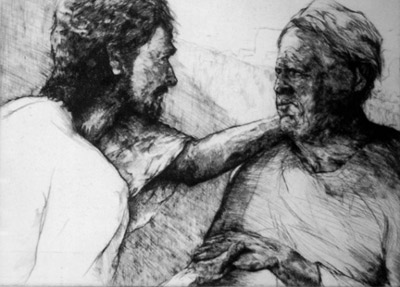
A scum bag of a leper kneels before the working man from Nazareth. “If you wish, you can make me clean,” the poor man begs. The Compassionate Jesus is moved by the leper’s simplicity of faith. So he first gives him a healing touch.

But remember what I said about that: in doing so, Jesus deliberately contaminates himself! By that fateful act (right here in Chapter One of Mark’s Gospel) Jesus identifies with the lowest of the low in his culture. He makes himself an outsider. As a result, Mark informs us, Jesus afterwards could not enter any town openly. As “unclean,” he had to sneak around.

Jesus’ act of identification with “the least of the brethren” holds a powerful message for all of us. It invites us to embrace absolutely everyone as the Master did – even (and especially) those our culture rejects.

Remember how a few weeks ago, following the Charlie Hebdo massacre, mourners carried placards proclaiming, “Je suis Charlie!” (I am Charlie!)? Remember how in Ferguson following the police shooting of Mike Brown six months ago, mourners carried signs saying, “I am Michael Brown!”? Well, Jesus’ example calls us to go even further.

It tells us that we are one not only with the persons with whom we agree, but even with those our culture (and personal prejudices) tells us are somehow “unclean.” So, yes, we might gladly say, “Je suis Charlie!” but we are also the killers who shot up the Charlie Hebdo office. We might be proud to say, “I am Mike Brown.” But we are also his killer, Officer Darren Wilson.

John McCain is somehow the same as those protestors he called “low-life scum.”

Please remember that today at our liturgy’s “kiss of peace.” The person beside you, behind or in front of you might be on a completely different page politically, socially, or even religiously. But Jesus says “touch them;” embrace them; recognize them as your brother and sister – as yourself!

Then continue doing that all week – and beyond.

Mike Rivage-Seul

February 10, 2015


Mike Rivage-Seul is a former priest who in 1972-’73 served St. Clare’s parish. A liberation theologian, Mike  has been a member of St. Clare’s since then. He taught at Berea College for 40 years and was co-founder of its Peace & Social Justice Program. He blogs at   https://mikerivageseul.wordpress.com

In Praise of Persistent Women like Medea Benjamin, Elizabeth Warren, and Amy Goodman (Sunday Homily)

Widow-and-Unjust-Judge

Readings for 29th Sunday in Ordinary Time: EX 17: 8-13; PS 121: 1-8; 2 TM 3:14-4:2; LK 18: 1-8; http://usccb.org/bible/readings/102013.cfm

Medea Benjamin is a peace activist and founder of Code Pink. In May of this year, she interrupted a speech by President Obama about the closing of Guantanamo Bay. Four times during his speech, she reminded the president that as chief executive he had the power to close the prison as he had promised during his campaign of 2008. The president was forced to acknowledge Benjamin’s point, but held that the issue was more complicated than she made it out to be. Clearly her outspokenness called for great courage and exposed to an international audience President Obama’s failure to keep his word. It pressured the president to change policy.
_____
Elizabeth Warren is the Democratic Senator from Massachusetts. Elected to the Senate in 2012, she is the first female senator from Massachusetts. Ms. Warren is a tireless consumer advocate and the first female Senator from Massachusetts. During her campaign, she called attention to the hypocrisy of “self-made men” claiming they owed nothing to government or community to explain their success. She said,

“There is nobody in this country who got rich on his own. Nobody. You built a factory out there — good for you. But I want to be clear. You moved your goods to market on the roads the rest of us paid for. You hired workers the rest of us paid to educate. You were safe in your factory because of police forces and fire forces that the rest of us paid for.….Now look. You built a factory and it turned into something terrific or a great idea — God Bless! Keep a Big Hunk of it. But part of the underlying social contract is you take a hunk of that and pay forward for the next kid who comes along.”
_____
Amy Goodman is a television journalist and host of “Democracy Now: the War and Peace Report” – a daily news hour on the Pacifica Radio and Television network. In the face of mainstream media’s refusal to cover significant grassroots events and issues, Ms. Goodman’s program has been called “probably the most significant progressive news institution that has come around in some time” (by professor and media critic Robert McChesney.) In addition to OpEdNews, “Democracy Now” is an invaluable daily source of information for the well-informed. It is an example of what can be accomplished for peace and social justice in the face of overwhelming odds.
_____

Keep in mind the examples of Medea Benjamin, Elizabeth Warren, and Amy Goodman as we attempt to understand today’s liturgy of the word. Our readings raise the issue of prayer, and what it means (in Jesus’ words) to “pray always without ceasing.”

Actually, the readings compare what might be termed “men’s way of praying” with women’s. At least in today’s readings, men pray that God might intervene to slaughter their enemies. In contrast, the woman in today’s gospel confronts the power structure of her day as her way of praying. That is, she persistently works to bring her world into harmony with God’s justice.

Take that first reading from Exodus. . . . Did it make you raise your eyebrows? It should have. It’s about God facilitating mass slaughter. It tells the story of Moses praying during a battle against the King of Amalek. It’s a classic etiology evidently meant to explain a chair-like rock formation near a site remembered as an early Hebrew battleground.

“What means this formation?” would have been the question inspiring this explanatory folk tale. “Well,” came the answer, “Long ago when our enemy Amelek attacked our people, Moses told Joshua to raise an elite corps of fighters. During the course of the ensuing battle, Moses watched from this very place where we are standing accompanied by his brother Aaron and another friend called Hur.

Moses raised his hands in prayer during the day-long battle. And as long as he did so, Joshua’s troops got the better of Amalek’s. But Moses would get tired from time to time; so he’d lower his hands. When he did so, Amalek’s troops got the better of Joshua’s.

“To solve the problem, Aaron and Hur sat Moses down on this stone you see before us. They held up his arms during the entire battle. That strategy saved the day. Joshua won his battle “mowing down Amelek and his people.”

So here we have a God who responds to ad hoc prayers and reverses history so that one group of his children might “mow down” another group of people he supposedly loves. Hmmm. . . .

In today’s gospel, Jesus has another approach to prayer. For him, prayer is not an ad hoc affair – about changing God’s mind. Rather, praying always represents the adoption of an attitude that consistently seeks justice for the oppressed. Praying always means living from a place that won’t let go of justice concerns like those that drive Medea Benjamin, Elizabeth Warren and Amy Goodman.

To illustrate that point for his own time, Jesus tells a comic parable about a persistent woman. (Remember, he’s speaking to people who have no power in a legal system, which, like ours favors the wealthy and powerful.)

“Imagine a judge,” Jesus said. “He’s like most of the judges we know. He doesn’t give a damn about the God of the poor, and he doesn’t care what people like us think of him.” (Already Jesus’ audience is smiling seeing a funny story coming.)

“But then along comes this widow-woman. Like all of us, she’s poor, and as usual, the judge pays no attention to her.” (Jesus’ audience recognizes the syndrome; they nod to each other.)

“But this woman’s a nagger,” Jesus says. (Now his audience is snickering and chuckling.)

“She just won’t let go. And she’s strong and aggressive besides. She comes back day after day insisting that she get justice against her adversary. And as the days go by, she gets more and more insistent – and threatening. So much so that the judge starts getting worried about his own safety.

(Laughter from the crowd . . .)

“’While it is true,’ he says to himself, ‘that I neither fear God nor respect any human being, because this widow keeps bothering me I shall deliver a just decision for her lest she finally come and strike me.’”

In other words, this macho judge is afraid of this poor widow; he’s afraid she’ll come and beat him up!

Can you imagine Jesus saying that without smiling broadly – and without the crowd roaring in laughter?

Anyway, here’s Jesus point: “If an unjust judge responds to the prayer of the poor like that, how do you suppose the All-Parent will respond when we ask for justice? The All-Parent will respond swiftly, Jesus says, because that’s who God is – the one who (as Martin Luther King put it) has established an arc of history that bends towards justice.

Prayer, then, is about reminding ourselves of that fact, trusting and having faith that in the long run justice and truth will prevail. Taking that position in the face of overwhelming evidence to the contrary, takes great faith that’s harder and harder to find.

So Jesus ends his parable with the rhetorical question, “When the Son of Man returns, do you think he’ll find that kind of faith anywhere?”

What I’m suggesting here is that today we’re more likely to find that kind of faith, that kind of prayer, that kind of persistence in women rather than men. The example of social activist Medea Benjamin encourages us to find our voices in defense of the voiceless in U.S. prison camps throughout the world. Politician, Elizabeth Warren, calls us to pray always by calling into question received truths like those surrounding “self-made men.” Amy Goodman and her “War and Peace Report” inspire us to renounce ideas of God that call us to “mow our enemies down.”

Thank God for persistent women! We men have an awful lot to learn from them.