
The Commandments and the Epstein Revelations: Whom Does God’s Law Really Protect?

Readings for the Sixth Sunday in Ordinary Time: Sirach 15:15-20; Psalm 119; 1 Corinthians 2:6-10; Matthew 5:17-37

Let me say it straight out: the Epstein affair is not primarily about sex. It is about law. It is about whether the commandments — and the legal systems supposedly derived from them — apply equally to everyone.

For decades, Jeffrey Epstein moved among billionaires, politicians, royalty, financiers, academics, and cultural elites. His crimes were known. Complaints were made. Investigations occurred. Yet he received an extraordinary plea deal. Associates remain shielded. Documents remain sealed. Networks remain largely untouched.

Meanwhile, poor defendants fill prisons for far lesser crimes – and in the case of immigrants and asylum seekers, for no crimes at all. Petty theft, drug possession, probation violations, and “illegal” border crossings — these are prosecuted with relentless enforcement of law.

If you want a relevant commentary on such two-tiered systems of “justice,” look no further than today’s liturgical readings. They are explosive in their contemporary application.

Sirach: God Commands No Injustice

 Start with Sirach 15: 15-20. There the book’s author says: “If you choose, you can keep the commandments… He has set before you fire and water… life and death.”

At first glance, that sounds like individual moral exhortation. Choose good. Avoid evil. But Sirach adds something devastating: “No one does he command to act unjustly; to none does he give license to sin.”

That line destroys every attempt to sanctify unjust systems like ours. I mean in the United States, injustice is routinely protected by law. After all, Epstein’s plea deal in 2008 was legal. The shielding of his powerful associates has been legal. Non-disclosure agreements are legal. Sealed records are legal.

But Sirach says God commands no injustice.

If the law functions to shield predators when they are rich and well-connected while punishing the poor with mechanical severity, then the issue is not simply moral failure. It is structural perversion.

Liberation theology (i.e. non-literalist biblical interpretation supported by modern scripture scholarship) reminds us that “choice” is structured. The poor do not choose within the same field of protection as billionaires. There, fire and water are not distributed evenly. Life and death are not equally accessible.

The commandment is not merely “Don’t sin.” The deeper question is: Does the legal order reflect God’s refusal to legalize injustice?

Psalm 119: Blessed Are Those Who Follow the Law

Now look at today’s responsorial psalm. It’s refrain proclaims: “Blessed are they who follow the law of the Lord.”

But what is the law for?

As José Porfirio Miranda and Norman Gottwald argue, the Decalogue emerged not as abstract piety but as social protection. It arose among people resisting royal systems that accumulated land, wealth, and power in elite hands.

Both theologians remind us that biblical law was a shield for subsistence households. “You shall not steal” originally meant: the powerful may not confiscate the livelihood of the vulnerable. “You shall not covet” meant desire backed by power must be restrained.

In that light, now ask the uncomfortable question: when billionaires operate in networks of mutual protection and the law seems reluctant to expose them fully, is that still Torah? Or is it what the prophets called “corruption at the gate?”

Psalm 119 blesses those who follow God’s law — not those who manipulate civil law to protect privilege.

Paul: The Wisdom of the Rulers

In the same spirit of Sirach and Psalm 119, Paul speaks of “a wisdom not of this age, nor of the rulers of this age… who are passing away.” He also adds something chilling: “None of the rulers of this age understood this; for if they had, they would not have crucified the Lord of glory.”

The cross was a legal execution. It was state-sanctioned. It was justified under Roman law and enabled by religious authority.

That’s Paul’s point.

The rulers always believe their system is rational and necessary. Franz Hinkelammert reminds us that ruling ideologies present themselves as inevitable. Markets are inevitable. Elite networks are inevitable. Certain people are untouchable.

When the Epstein affair reveals how proximity to wealth and power appears to blunt accountability, we are witnessing what Paul calls “the wisdom of this age.” A wisdom that protects itself.

The rulers crucified Jesus legally. Legality is not the same as justice.

Jesus: Fulfilling the Law by Protecting the Vulnerable

In Matthew’s Gospel, Jesus declares:
“I have not come to abolish the law but to fulfill it.”

Then he radicalizes it. “You have heard it said, ‘You shall not kill.’ But I say to you, whoever humiliates…”

Jesus’ point is that dehumanization precedes violence. When victims are dismissed because they lack status, when their testimony is doubted because they are young, poor, or socially marginal, contempt is already at work.

“You have heard it said… You shall not commit adultery. But I say to you, whoever looks with lust…”

Could these words be more pertinent to the Epstein Affair? In a world where wealthy men are allowed to treat vulnerable underage girls and women as property, lust backed by power means coercion. Jesus targets the interior logic of such domination.

His teaching on divorce does the same thing. It sides with the economically vulnerable spouse. Legal permission did not equal justice.

Notice the pattern: every intensification of the commandment in today’s readings closes loopholes that allow the powerful to exploit the weak.

That is fulfillment of the law. If a legal system permits exploitation through influence, money, and secrecy, it has not fulfilled the law. It has hollowed it out.

Two Systems

The Epstein affair is not an anomaly. It is a revelation.

It reveals what liberation theology has long argued: sin is social as well as personal. Structures can be sinful. Systems can crucify.

When poor defendants encounter swift prosecution while elite networks encounter delay, protection, and opacity, we are not witnessing isolated moral failure. We are witnessing two systems.

Sirach sets before us life and death. The death-dealing system is one where law bends upward. The life-giving system is one where law protects the vulnerable first:

  • “Blessed are they who follow the law of the Lord.”
  • Blessed are those who refuse to equate legality with justice.
  • Blessed are those who demand that commandments function as protection for the powerless.
  • Blessed are those who see through the “wisdom” of powerful elites

Jesus did not abolish the commandments. He sharpened them until they pierced hypocrisy.

Before us remain fire and water. The question is not whether we personally avoid wrongdoing.

The question is whether we will accept a system where justice is negotiated by wealth — or insist that the law once again become what it was meant to be: protection and good news for the poor.
Jesus Repudiates Machismo Not Divorce

Readings for 27th Sunday in Ordinary Time: Genesis 2:18-24; Psalms. 128:1-6; Hebrews, 2:9-11; Mark 10:2-16 

I shared Tammy Wynette’s award-winning song “D-I-V-O-R-C-E” because it captures the pain that more than half of married people go through when they decide to divorce. Tammy’s opening words, “I want to sing you a song that I didn’t write, but I should have,” as well as the way she sings capture the very sad experience that divorce is for couples who all started out so full of love and hope. As all of us know, divorce is often characterized by regret and feelings of failure especially relative to the children involved. The irony is that many divorced people will come to church this morning and find their pain compounded by today’s readings and no doubt by sermons they will hear.

However today’s liturgy of the word is surprising for what it says about Jesus and his teachings about divorce. The readings tell us that Jesus wasn’t really against divorce as we know it. Instead as the embodiment of compassion, he must have been sympathetic to the pain and abuse that often precede divorce. As a champion of women, he must have been especially sensitive to the abandonment of divorced women in his highly patriarchal culture.

What I’m suggesting is that a sensitive reading shows that what Jesus stands against in today’s Gospel is machismo not divorce as such. Relative to failed marriages, he implicitly invites us to follow his compassionate example in putting the welfare of people – in his day women specifically – ahead of abstract principles or laws. Doing so will make us more understanding and supportive of couples who decide to divorce in the best interests of all.

By the way, the gospel reading also tells us something important about scripture scholarship and its contributions towards understanding the kind of person Jesus was and what he taught on this topic.

First of all consider that scholarship and its importance relative to the topic at hand.

To begin with, it would have been very unlikely that Jesus actually said “let no one” or (as our translation went this morning) “let no human being” put asunder what God has joined together. That’s because in Jesus’ Palestine, only men had the right to initiate a divorce. So in prohibiting divorce, Jesus was addressing men.  The “no one” or “no human being” attribution comes from Mark who wanted Jesus’ pronouncement on divorce to address situations outside of Palestine more than 40 years after Jesus’ death. By the time Mark wrote his Gospel, the church had spread outside of Palestine to Rome and the Hellenistic world.  In some of those communities, women could initiate divorce proceedings as well as men.

Similarly, Jesus probably did not say, “and if she divorces her husband and marries another, she commits adultery.” Such a statement would have been incomprehensible to Jesus’ immediate audience. Once again, in Palestine no woman could divorce her husband. Divorce was strictly a male right. Women could only be divorced; they couldn’t divorce their husbands.

So what did Jesus say? He probably said (as today’s first reading from Genesis puts it) “What God has joined together let no man put asunder. “ His was a statement against the anti-woman, male-centered practice of divorce that characterized the Judaism of his time.

And what was that practice?

In a word, it was highly patriarchal. Until they entered puberty, female children were “owned” by their father. From then on the father’s ownership could be transferred to another male generally chosen by the father as the daughter’s husband. The marriage ceremony made the ownership-transfer legal. After marriage, the husband was bound to support his wife. For her part however the wife’s obedience to her husband became her religious duty.

Meanwhile, even after marriage, the husband could retain as many lovers as he wanted provided he also able to support them. Additionally the husband enjoyed the unilateral right to demand divorce not only for adultery (as some rabbis held), but also according to the majority of rabbinical scholars for reasons that included burning his food, or spending too much time talking with the neighbors. Even after divorce, a man’s former wife needed his permission to remarry. As a result of all this, divorced women were often left totally abandoned. Their only way out was to become once again dependent on another man.

In their book Another God Is PossibleMaria and Ignacio Lopez Vigil put it this way: “Jesus’ saying, ‘What God has joined together, let no man put asunder’ is not the expression of an abstract principle about the indissolubility of marriage. Instead, Jesus’ words were directed against the highly patriarchal marriage practices of his time. ‘Men,’ he said, should not divide what God has joined together. This meant that the family should not be at the mercy of the whimsies of its male head, nor should the woman be left defenseless before her husband’s inflexibility. Jesus cut straight through the tangle of legal interpretations that existed in Israel about divorce, all of which favored the man, and returned to the origins: he reminded his listeners that in the beginning God made man and woman in his own image, equal in dignity, rights, and opportunities. Jesus was not pronouncing against divorce, but against machismo.”

Here it should be noted that Mark’s alteration of Jesus’ words is far less radical than what Jesus said. Mark makes the point of the Master’s utterance divorce rather than machismo. Ironically, in doing so and by treating women the same as men, Mark’s words also offer a scriptural basis for legalists who place the “bond of marriage” ahead of the happiness (and even safety) of those who find themselves in relationships which have become destructive to partners and to children.

Traditionally that emphasis on the inviolability of the marriage bond has represented the position of the Roman Catholic hierarchy. It is very unlikely that the historical Jesus with his extremely liberal attitude towards law and his concern for women would have endorsed it.

Instead however, it never was Jesus position that any law should take precedence over the welfare of people. In fact, his refusal to endorse that precedence – his breaking of religious laws (even the Sabbath law) in favor of human welfare – was the main reason for his excommunication by the religious leaders of his own day. In other words, Jesus was the one who kept God’s law by breaking human law.

So instead of “Anti-Divorce Sunday,” this should be “Anti-Machismo Sunday.” It should remind us all of what a champion women have in Jesus.

Sometimes feminists complain that Christian faith finds its “fullness of revelation” in a man. But as one Latin American feminist theologian put it recently, the point of complaint shouldn’t be that Jesus was a man, but that most of us men are not like Jesus. Today’s Gospel calls us men to take steps towards nullifying that particular objection.

Jesus Was against Machismo Not Divorce

Today’s readings: Gn. 2:18-24; Ps. 128:1-6; Heb. 2:9-11; Mk 10:2-16 http://www.usccb.org/bible/readings/100718.cfm

I shared Tammy Wynette’s award-winning song “D-I-V-O-R-C-E” because it captures the pain that more than half of married people go through when they decide to divorce. Tammy’s opening words, “I want to sing you a song that I didn’t write, but I should have,” as well as the way she sings capture the very sad experience that divorce is for couples who all started out so full of love and hope. As all of us know, divorce is often characterized by regret and feelings of failure especially relative to the children involved. The irony is that many divorced people will come to church this morning and find their pain compounded by today’s readings and no doubt by sermons they will hear.

However today’s liturgy of the word is surprising for what it says about Jesus and his teachings about divorce. The readings tell us that Jesus wasn’t really against divorce as we know it. Instead as the embodiment of compassion, he must have been sympathetic to the pain and abuse that often precede divorce. As a champion of women, he must have been especially sensitive to the abandonment of divorced women in his highly patriarchal culture.

What I’m suggesting is that a sensitive reading shows that what Jesus stands against in today’s Gospel is machismo not divorce as such. Relative to failed marriages, he implicitly invites us to follow his compassionate example in putting the welfare of people – in his day women specifically – ahead of abstract principles or laws. Doing so will make us more understanding and supportive of couples who decide to divorce in the best interests of all.

By the way, the gospel reading also tells us something important about scripture scholarship and its contributions towards understanding the kind of person Jesus was and what he taught on this topic.

First of all consider that scholarship and its importance relative to the topic at hand.

To begin with, it would have been very unlikely that Jesus actually said “let no one” or (as our translation went this morning) “let no human being” put asunder what God has joined together. That’s because in Jesus’ Palestine, only men had the right to initiate a divorce. So in prohibiting divorce, Jesus was addressing men.  The “no one” or “no human being” attribution comes from Mark who wanted Jesus’ pronouncement on divorce to address situations outside of Palestine more than 40 years after Jesus’ death. By the time Mark wrote his Gospel, the church had spread outside of Palestine to Rome and the Hellenistic world.  In some of those communities, women could initiate divorce proceedings as well as men.

Similarly, Jesus probably did not say, “and if she divorces her husband and marries another, she commits adultery.” Such a statement would have been incomprehensible to Jesus’ immediate audience. Once again, in Palestine no woman could divorce her husband. Divorce was strictly a male right. Women could only be divorced; they couldn’t divorce their husbands.

So what did Jesus say? He probably said (as today’s first reading from Genesis puts it) “What God has joined together let no man put asunder. “ His was a statement against the anti-woman, male-centered practice of divorce that characterized the Judaism of his time.

And what was that practice?

In a word, it was highly patriarchal. Until they entered puberty, female children were “owned” by their father. From then on the father’s ownership could be transferred to another male generally chosen by the father as the daughter’s husband. The marriage ceremony made the ownership-transfer legal. After marriage, the husband was bound to support his wife. For her part however the wife’s obedience to her husband became her religious duty.

Meanwhile, even after marriage, the husband could retain as many lovers as he wanted provided he also able to support them. Additionally the husband enjoyed the unilateral right to demand divorce not only for adultery (as some rabbis held), but also according to the majority of rabbinical scholars for reasons that included burning his food, or spending too much time talking with the neighbors. Even after divorce, a man’s former wife needed his permission to remarry. As a result of all this, divorced women were often left totally abandoned. Their only way out was to become once again dependent on another man.

In their book Another God Is Possible, Maria and Ignacio Lopes Vigil put it this way: “Jesus’ saying, ‘What God has joined together, let no man put asunder’ is not the expression of an abstract principle about the indissolubility of marriage. Instead, Jesus’ words were directed against the highly patriarchal marriage practices of his time. ‘Men,’ he said, should not divide what God has joined together. This meant that the family should not be at the mercy of the whimsies of its male head, nor should the woman be left defenseless before her husband’s inflexibility. Jesus cut straight through the tangle of legal interpretations that existed in Israel about divorce, all of which favored the man, and returned to the origins: he reminded his listeners that in the beginning God made man and woman in his own image, equal in dignity, rights, and opportunities. Jesus was not pronouncing against divorce, but against machismo.”

Here it should be noted that Mark’s alteration of Jesus’ words is far less radical than what Jesus said. Mark makes the point of the Master’s utterance divorce rather than machismo. Ironically, in doing so and by treating women the same as men, Mark’s words also offer a scriptural basis for legalists who place the “bond of marriage” ahead of the happiness (and even safety) of those who find themselves in relationships which have become destructive to partners and to children.

Traditionally that emphasis on the inviolability of the marriage bond has represented the position of the Roman Catholic hierarchy. It is very unlikely that the historical Jesus with his extremely liberal attitude towards law and his concern for women would have endorsed it.

Instead however, it never was Jesus position that any law should take precedence over the welfare of people. In fact, his refusal to endorse that precedence – his breaking of religious laws (even the Sabbath law) in favor of human welfare – was the main reason for his excommunication by the religious leaders of his own day. In other words, Jesus was the one who kept God’s law by breaking human law.

So instead of “Anti-Divorce Sunday,” this should be “Anti-Machismo Sunday.” It should remind us all of what a champion women have in Jesus.

Sometimes feminists complain that Christian faith finds its “fullness of revelation” in a man. But as one Latin American feminist theologian put it recently, the point of complaint shouldn’t be that Jesus was a man, but that most of us men are not like Jesus. Today’s Gospel calls us men to take steps towards nullifying that particular objection.

Second Thoughts on Pope Francis & Family Issues

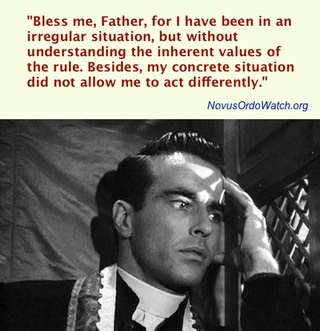
Confessional

Last week I posted a (mostly) tongue-in-cheek comment on Pope Francis’ Apostolic Exhortation, Amoris Laetitia. The document represented the pope’s reflections on the synod of bishops that met over the last two years to reformulate the Church’s teachings on marriage, sexuality and the family.

Obviously, all of those elements find themselves mired in profound crisis in the contemporary world. Given that fact, and despite the pope’s efforts to save the day in the face of the intransigence of the world’s episcopacy, the document proved to be highly disappointing.

Notwithstanding what I wrote last week, Amoris Laetitia left me wishing that the Church could bring itself to speak in plain language accessible to us all.

But no:  the encyclical was full of platitudes and written in opaque Vaticanese. It demonstrated the out-of-touchness of Church leadership, and its inability and/or unwillingness to help today’s women and men face up to their real problems in the light of a rich faith tradition perfectly capable of providing such assistance.

No wonder so many young people – so many couples – have long since dismissed the Church as irrelevant and counterproductive in terms of making sense of their lives in a globalized world!

[News flash to the Vatican: Outside of your little realm, the major problem facing couples today is not whether divorced people should be allowed to receive Holy Communion! It’s not even whether or not artificial birth control is morally acceptable. (Catholics have long since resolved that “problem;” they use contraceptives in the same percentage as everyone else.)]

Instead, think of the real problems we all face around the fraught matters Amoris Laetitia pretends to address, but which it only dances around, and in the end avoids. These problems were recently outlined by psychologist, Dr. Harriet Fraad, in an interview with economist, Richard Wolff. They include the following:

  • The introduction of the internet and easy birth control has changed the nature of dating and sexual relationships.
    • Increasingly, couples meet online instead of through family and friends.
    • It is no longer socially unacceptable for them to have sex before marriage.
    • In fact, hardly anyone waits till marriage.
    • This makes marriage less necessary and attractive as a means of achieving access to sex.
  • Divorce statistics (as well as witnessing the unhappiness of their parents) similarly discourage marriage. Fifty percent of first marriages end in divorce; 60% of second marriages and 70% of third marriages finish the same way. And after divorce women are usually left holding the bag in terms of child support.
  • Families are stressed when economic circumstances make it necessary for both parents to get jobs. That typically means women end up working a double shift – in the workplace and in the home.
  • The prospect of overwork eventual divorce leads more and more women to choose to remain single. Many become Sugar Babies to Sugar Daddies – older, well-established men who pay off their Baby’s overwhelming college loans or credit card debt.
  • Men, on the other hand, find themselves deprived of their traditional, male-defining role as bread-winners. Anger results – deflected towards guns, the military, sports addictions, evangelical religions (where women are subordinate) and pornography.
  • Children suffer the consequences of it all. They are left alone after school, when most of their problems emerge – not the least of which is obesity.
  • With all those realities in mind, marriage is increasingly viewed as an unnecessary hassle — a luxury good – accessible and desirable only for the well-to-do.
  • So young people end up postponing or rejecting it altogether.
  • They opt instead for serial cohabitations without commitment.
  • Or they become “Herbivore” men, “Dried Fish” women, or MGTOWS.

It’s not that Pope Francis doesn’t bring up many of these problems. Nor is he incapable of addressing them in ways helpful to struggling families. In fact, his three major publications (including Amoris Laetitia) provide clear principles for doing so.

  • His eco-encyclical, Laudato Si’, teaches clearly that all things are connected. The role of religion (which means “binding force”) is to make connections apparent.
  • Similarly that encyclical along with his Exhortation, “The Joy of the Gospel,” identifies capitalism-as-we-know-it as the connecting structural cause of contemporary problems. Its demands pits employers against their employees and men against women; it underpays them or deprives them of work; it requires them to work longer hours, drives both parents into double shifts, destroys families in the process, and then claims to represent “family values.”
  • And finally, in Amoris Laetitia itself the pope identifies conscience (informed by thoughtful consideration of the Christian tradition) as the most reliable guide humans have at their disposal.

Simply highlighting those principles and calling Catholics to adult dialog about their application to dating, marriage, divorce, contraception, abortion, and child-rearing would have done much more than the largely impenetrable document the Vatican actually produced.