Our Dinner with Amy Goodman

Amy Goodman

A week ago today, Peggy and I had dinner with Amy Goodman, the host of “Democracy Now: the War and Peace Report” (DN).  The program airs each Monday through Friday on radio and TV stations across the country. I watch it every morning in its podcast version that can be accessed at any hour at http://www.democracynow.org/

The dinner was a Christmas present from my daughter, Maggie who (with her husband, Kerry) had given DN a substantial contribution.

[The gift came with a black Democracy Now tee shirt (which I wore to our dinner) and two coffee cups showing the program’s logo. The meal portion of the gift was for me and a companion of my choice. Naturally, it was Peggy. Still another of the gift’s components was attendance at one of the show’s morning productions (which we’ll take advantage of sometime in the future).]

There were four of us in Thursday’s dinner party. Amy brought along her factotum, Edith Penty, whose presence was absolutely delightful. We ate at the Hangawi Korean restaurant on 32nd street between Fifth and Madison Avenue. There we shared “The Emperor’s Tasting Menu” that featured starters, appetizers, entrees and dessert –   acorn noodle salad with avocado fritters, dumplings in pine nut and pineapple sauce, tofu with sesame leaves and seaweed sauce, and dessert.

As the meal unfolded we all shared our biographies.

Amy is a New Yorker raised in Bay Shore. She is the daughter of an ophthalmologist father and a mother who taught literature and Women’s Studies. Her family is Jewish Orthodox. Her maternal grandfather was an Orthodox Rabbi.  She studied Hebrew and Torah from kindergarten through high school. Amy graduated from Radcliffe College in 1984, with a degree in anthropology.

From her stories about participation in demonstrations, vigils, and campaigns, it’s clear that Amy Goodman has always been an activist. For some years she worked in an organic bakery that eventually supplied buns for Arby’s restaurants. Journalism has always been in her family’s blood. (Her brother published a family newspaper before reaching his teenage years.) She founded Democracy Now in 1996; this is its 20th anniversary year. Throughout Amy’s account of her life, there wasn’t a trace of self-promotion. On the contrary, both Peggy and I were impressed with her interest in our stories, and with her unassuming presence.

In all the four of us spent about two hours together. And of course conversation went far beyond autobiographies. Inevitably we discussed Trump, Bernie and Hillary.

The most interesting insight came when Amy shared the fact that the Obamas and Clintons can’t stand one another. Obama made Hillary his Secretary of State following the principle: Stay close to your friends, and even closer to your enemies. One of the first questions asked in any Obama or Clinton vetting process is: “What do you think about Hillary?” “What do you think about Barrack?” Hiring decisions are made accordingly.

Towards the end of our time together, Amy left the table for a moment. Soon afterwards waiters came to our table with ice cream and small cakes and a candle. Amy had informed them that Peggy and I are celebrating our 40th wedding anniversary. That’s the kind of thoughtful person Amy Goodman is.

As we left Hangwai, a young African American man caught sight of my Democracy Now tee shirt. He said to me: “Love your tee shirt. I watch that program every day. Love that too!” I pointed ahead of us to Amy who was deep in conversation with Peggy. I said, “That’s Amy Goodman right there.” He couldn’t believe it. Soon we were all taking pictures with the celebrity. It was a moment that topped the evening off just perfectly.

If Democracy Now isn’t part of your daily news-gathering routine, it should be.  Unlike other newscasts, it centralizes stories from the grassroots. So it often interviews victims of police violence, representatives of NGOs (non-governmental organizations), political dissidents, and community organizers. Noam Chomsky, Glen Greenwald, Naomi Klein, Bill McKibben, Medea Benjamin, Cornel West, Lori Wallach, Richard Wolff, Tariq Ali, and many other thought-leaders and journalists are among the program’s frequent guests.

“Democracy Now” covers the Black Lives Matter Movement along with the Boycott, Divest, and Sanction campaign against the Israeli apartheid system – whose proponents are almost never interviewed in the mainstream media.

If you watch Democracy Now, you know details of the recent coup in Brazil, its predecessor in Honduras, and current attempts at still another in Venezuela. You know about Michael Brown, Eric Garner and Tamir Rice. But you also are familiar with police killings of Sandra Bland, Tanisha Anderson, and Miriam Cary.

None of the stories is reduced to sound bites. Interviewees like Noam Chomsky are sometimes given an entire hour (without commercial interruption) to analyze a whole host of world and national issues. An hour-long broadcast was devoted recently to Daniel Berrigan, the Jesuit peace activist who died last month.

Peggy and I are so grateful to Maggie and Kerry for making possible such a memorable evening — and of course, to Amy Goodman for spending so much time with us and for being the huge inspiration she is

Pope Francis, Donald Trump and the Revelation of Pentecost (Sunday Homily)

Trump & Frank

Readings for Pentecost Sunday: ACTS 5: 2-11; PS 104: 1, 24, 29-31, 34; 1COR 12: 3B-7, 12-13; JN 20: 19-23.

So who do you think is more outspoken, Donald Trump or Pope Francis? Which one should followers of Jesus listen to?

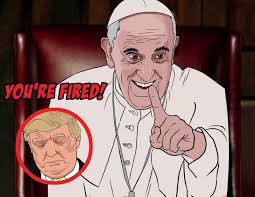
That question was sharpened a few weeks ago, when Pope Francis implied that Donald Trump is not a Christian. Responding to a reporter’s question, the pontiff lit up the internet when he said about Trump, “Anyone, whoever he is, who only wants to build walls and not bridges is not a Christian.” Francis added, “Vote, don’t vote, I won’t meddle. But I simply say, if he says those things, this man is not a Christian.”

The pope’s comment came at the end of Francis’ six-day trip to Mexico. There he celebrated Mass with 300,000 faithful in attendance near the Mexican-U.S. border. He used the occasion to decry the “human tragedy” of worldwide migrations of people fleeing violence, war and the effects of climate change. The pope’s analysis, of course, conflicts with Mr. Trump’s who sees immigrants as rapists, drug-dealers, and terrorists.

Francis’ comments drew a quick response from The Donald. He called the pope’s charges outrageous and accused him of being a pawn of the Mexican government.

While Francis’ words were surprising and the response predictable, both provide occasion for a Pentecost reflection on what it means to be a baptized and confirmed Christian in a world awash with refugees from U.S. bombings and the effects of neo-liberal overconsumption.

That’s because the emphasis in today’s readings is precisely on internationalism. The Kingdom of God, the readings tell us, has no borders. It is open to everyone regardless of nationality, race, occupation or gender. Moreover, the Kingdom of God is a matter of this world – of the Body of Christ.  It is not about some disembodied reality up in the sky.

That twofold message starts with today’s opening reading from the Acts of the Apostles with all those strange identity references that readers usually stumble over. Jews, we are told who were present on that first Pentecost were “Parthians, Medes, and Elamites, inhabitants of Mesopotamia, Judea and Cappadocia, Pontus and Asia, Phrygia and Pamphylia, Egypt and the districts of Libya near Cyrene, as well as travelers from Rome, both Jews and converts to Judaism, Cretans and Arabs.”

Then in today’s second reading, Paul goes even further. God’s Kingdom, he says, isn’t just for Jews. In fact in God’s eyes national distinctions, economic status, and gender identity have been erased for those who accept the Gift of God’s Spirit. Paul writes: “For in one Spirit we were all baptized into one body, whether Jews or Greeks, slaves or free persons, and we were all given to drink of one Spirit.” Elsewhere (Galatians 3:28) he puts it even more directly: “There is neither Jew nor Gentile, neither slave nor free, nor is there male and female, for you are all one in Christ Jesus.”

Paul’s message was a consistent theme in the life of Jesus. He healed and forgave, loved and taught Jews, Gentiles, Samaritans, street walkers, lepers, tax collectors, and even on occasion members of the Roman occupying forces.

Notice too Paul’s words about “body” insert the reception of Jesus’ Spirit into the earthly realm of real life and politics. True, Paul speaks of “spiritual gifts,” but he even more emphatically insists that those gifts must be “manifest” in “service” meant to “benefit” others. We are members of Christ’s “Body,” Paul tells us. That is, we are all somehow living “in Christ” – in God, we might say. The question is, do we recognize that reality or not?

In today’s Gospel, Jesus reminds us more specifically where in the world we encounter his embodied spirit. It happens first of all in the community of peacemakers. Jesus’ first words after his resurrection are about peace. “Peace be with you,” he says.  Then he immediately shows his pierced hands and side to his friends. In doing so he seems to remind his followers that he will forever be found in the victims of war and imperialism. That includes refugees from imperialist wars and excess consumption as well as in victims of torture and capital punishment like Jesus himself.

Is such understanding of Pentecost too political? Donald Trump might think so. Pope Francis does not. Francis himself has pointed out that Aristotle was correct in saying that human beings are political animals. So to be branded “political” is to have one’s humanity recognized. The pope said he is proud to be branded political.

So would-be followers of Jesus are presented with a choice on this particular Pentecost.  Are we to follow Pope Francis or Donald Trump? The choice is ours.

More accurately, do we recognize that we are living not “in America,” but “in Christ?”  Do we recognize (as John Oxenham put it more than 100 years ago) that

1 In Christ there is no east or west,
in him no south or north,
but one great fellowship of love
throughout the whole wide earth.

2 In Christ shall true hearts everywhere
their high communion find;
his service is the golden cord
close-binding humankind.

3 Join hands, disciples of the faith,
whate’er your race may be.
All children of the living God
are surely kin to me.

Abortion: Should a Man’s Wallet Be More Private, Free, and Unregulated than a Woman’s Womb?

Chittister 2

My recent post, “Face It: Donald Trump Is Right about Abortion” drew many responses. (You can read more than 100 of them here.) One comment characterized my position there as “radically pro-choice.” Someone else called it “pro-abortion.”

However, it was not my intention (especially as a Catholic moral theologian) to write a piece that might be interpreted in those ways.

No, I was simply attempting to show that Republican position that “abortion is murder” can be quickly reduced to the absurd.

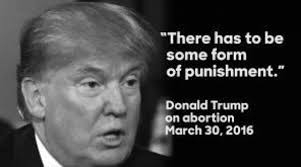
It was ironic, I suggested, that someone as clueless as Donald Trump should end up being the agent of moral clarity. He did so by verbalizing what the standard Republican position on abortion implies, Viz. that if abortion is murder, those involved should be charged and punished accordingly.

My point was that the immediate vilification of Trump’s impolitic assertion indicated that the judgment that “abortion is murder” is untenable.

What’s not untenable however is the fact that responses to The Donald’s Trumpian logic show that the abortions debate in the public sphere needs a dose of straight talk. So let’s try that out. In the end, it pits women’s sovereignty over their wombs against men’s control of their wallets.

Begin with the fact that few people (if any) are actually pro-abortion. Invariably, it is a painful and regrettable decision usually taken with the utmost seriousness.

From there admit two other facts. One is that abortion cannot be eliminated, no matter what laws are passed. Trying to eliminate abortion is like trying to eradicate prostitution. Large numbers of people have always and will always seek abortion services. The rich will fly their wives, lovers or daughters to the Netherlands or Belgium or wherever safe abortion procedures are legally available. The poor will go to back-alley practitioners or they’ll take drugs or use coat hangers to do the job themselves.

The second undeniable fact is that we live in a pluralistic society where people of good faith find themselves on both sides of the abortion question. And this is because they differ (most frequently on religious grounds) about the key question of when specifically personal life begins. That is, few would argue that a fetus at any stage does not represent human life and should not therefore be treated with respect. No, the real question is when does fetal life become personal? The question is when does aborting a fetus become murder?

In the thirteenth century, Thomas Aquinas and others held the position that personal life began with “ensoulment,” i.e. when God conferred a soul on the developing fetus. According to Thomas, because of the high numbers of spontaneous abortions in the early pregnancy, ensoulment could not logically happen at the moment of conception. So in his patriarchal way, he conjectured it occurred for males 40 days after conception; for females it happened after 80 days. Before those turning points, there was no question of personal life.

Of course, Aquinas’ logical position is no longer held by the Catholic Church. Its official teaching is that personal life is present from the first moment of conception. This means that in a world where as many as 50% of  pregnancies end in miscarriage, half of all “people” are “aborted” spontaneously usually before the mother even knows she is pregnant.

Such facts about miscarriage have led many to conclude that personal life begins well after the moment of conception.  They locate it, for instance, at the moment of “quickening” (when the mother first feels her baby move), with viability outside the womb, with actual emergence from the womb, or (as with some Native Americans) with the “painting” of the emergent child to distinguish it from animals.

Given such differences, it seems counterproductive to impose the view of one religion on an entire culture. We might expect such imposition from the Taliban. But it has no place in a democracy characterized by separation of church and state.

Instead in a country like our own some compromise is necessary. And that is what happened in Roe v. Wade. There it was determined that in the first two trimesters, the pregnant woman can make a decision on her own and in consultation with her physician. In the third trimester, the state asserts its interest and can make laws restricting abortion to protect the woman’s health and the potentiality of human life.

However a Roe v. Wade approach can never be sufficient for genuine pro-life advocates. Abortion law must be complemented by social programs. These include pregnancy prevention measures – sex education in our public schools along with easy access to contraceptives.

Nonetheless when unplanned pregnancies occur, programs discouraging abortion needs to kick in. These would provide free counselling and pre- natal care for pregnant mothers along with post-natal services for their newborns. Job provisions would be available for new mothers along with free daycare for their pre-school children. Programs would also include low cost housing and (where necessary) help paying grocery bills.

All such measures are genuinely pro-life. They create a welcoming environment for new life.

But this is where the real debate about abortion’s relation to privacy enters the picture. Simply put the question is: which should be more vigorously protected from state intervention – a woman’s womb or a man’s wallet?

Put otherwise, the debate about life-friendly social programs pits on the one hand mostly well-to-do male legislators (in the U.S. Congress and in the Catholic Church) against poor women who cannot obtain abortions abroad. The patriarchs are quite willing to have their laws invade the privacy of a woman’s womb while defending invasion of their wallets to provide a welcoming atmosphere for all the unborn.

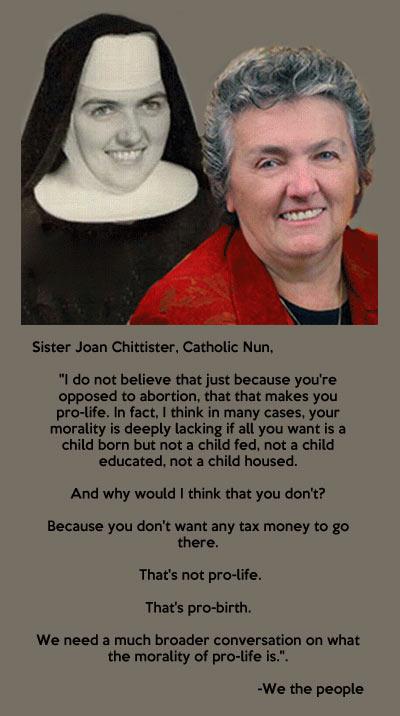
Benedictine Sister Joan Chittister has called such typically male attempts to evade responsibility by its true name. She wrote:

“I do not believe that just because you’re opposed to abortion, that that makes you pro-life. In fact, I think in many cases, your morality is deeply lacking if all you want is a child born but not a child fed, not a child educated, not a child housed. And why would I think that you don’t? Because you don’t want any tax money to go there. That’s not pro-life. That’s pro-birth. We need a much broader conversation on what the morality of pro-life is.”

Contributing to that broader conversation is what my controversial blog post was about. So is this one.

Tell me what you think.

Face It: Donald Trump Is Right about Abortion!

Trump Abortion

Let me get this straight. Republicans in general argue that abortion is MURDER. Isn’t that so?

In fact, don’t Tea Party extremists sometimes rationalize attacking and even killing abortion providers because the latter are murderers pure and simple? Or have I been somehow misreading those pro-life posters along Interstate 75?  “ABORTION IS MURDER,” the signs announce all the way to Florida.

Yet, when Donald Trump argues that such criminality should be punished in the usual ways, the entire Republican establishment is suddenly shocked and appalled.  Of course (they’re now saying) abortion shouldn’t be treated as murder. Who could possibly make such an insensitive misogynist argument?

Say what? Am I hearing that correctly? Or is there an acoustical problem in here?  Doesn’t all of that sound suspiciously “pro-choice?”  Have Republicans suddenly found Feminist Religion?

To give my questions a finer point: Donald Trump seems merely to be drawing the logical conclusion from the continuously reiterated Republican position on abortion. Though no one (not even The Donald) is crazy enough to say it like this, the argument’s syllogism runs as follows: (1) Abortion is murder, (2).But all murders are capital crimes;  deserving capital punishment; (3) Therefore abortion should be punished by execution or life imprisonment.

Though an inevitable conclusion from the standard Republican position, such logic is scary as hell. So even crazies like Ted Cruz are running away from it.

What is the justification for the Establishment’s sudden shift?

Here’s why: the Republican Party leadership doesn’t want Donald Trump to be the GOP standard bearer next fall. He’s not electable, they think. And he’s not orthodox enough on signature Tea Party issues like well . . . abortion. (Historically, he has waffled on the topic.) So they’ll do anything to prevent his advance – even if it means fudging on one of their signature positions. They evidently hope no one will notice the hypocrisy.

However, the fact that no Republican (except for Mr. Trump) is daring or logical enough to say out loud what Republicans have insinuated all along tells us that something is drastically wrong with not with The Donald, but with the “pro-life” position itself.

In Logic the sequence is called a reductio ad absurdum – a method of proving the falsity of an argument (for instance that abortion is murder) by demonstrating that its conclusion is absurd or untenable.

In other words, when you put words to it and draw the logical conclusion, the contention of the pro-lifers that abortion is murder sounds absolutely crazy to everyone.  Few in the electorate – especially women — will support it. Case closed.

In theology, we call such agreement the “sensus fidelium.” It refers to people’s conclusions about matters of faith and morals (such as abortion) based on common sense rather than the arguments of the experts. Catholic doctrine regards such agreement as infallible.

So Mr. Trump has done it again. Until his arrival, the electorate simply hasn’t heard the absurdity of Republican positions expressed so clearly.

As with other matters (immigration, racism, free speech, torture) Donald Trump in no way deviates from standard Republican craziness. His sin (and contribution) is to expose its absolute insanity for all to see.

Thank God for Donald Trump’s logic and candor! Somehow he’s a better thinker than many of us thought.

(Palm Sunday Homily) Christians Supporting Donald Trump: How Luke’s Passion Narrative Prepared the Way

Trump & Jesus

 Readings for Palm Sunday: LK 19:28-40; IS 50: 4-7, PS 22: 8-9, 12-20, 23=24, PHIL 2:6-11, LK 22: 14-23:58.

It’s puzzling to see white Evangelicals rallying around Donald Trump. He’s the presidential candidate who owns casinos and strip clubs, and who has been married three times.

His pre-candidacy positions on social issues conflict with those Evangelicals have considered sacrosanct in the recent past. As Michael Moore points out, Trump has been pro-choice, pro-gun control, and a supporter of Planned Parenthood. He’s been in favor of gay marriage, raising the minimum wage, and single payer health care. Trump has been pro-union (at least in the private sphere), and has proposed a one-time 14% tax on the accumulated wealth of the super-rich in order to retire the U.S. national debt (i.e. to enrich the banksters).

In the foreign policy sphere, Mr. Trump advocates torture beyond water boarding. His desire to “make America great again” leads him to propose intensified wars in the Middle East, building a wall across the U.S.-Mexican border, filling Guantanamo with even more prisoners, and evicting Muslims from the United States.

How is it possible for white evangelicals to support such a candidate? On the one hand, his personal life and long-standing positions on the “social issues” conflict with what such believers have deemed undebatable in the past. And on the other hand, Trump’s foreign policies conflict with the teachings and example of Jesus himself.

After all, Jesus was a poor laborer who criticized the rich in the harshest of terms. He and his family knew what it was like to be unwelcome immigrants (in Egypt). He was a victim of torture, not its administrator. Far from a champion of empire, he was executed as a terrorist and enemy of Rome.  His followers were not about accumulating wealth, but shared what they had according to ability and need.

When you think of it, all of this seems antithetical to not only to Trumpism, but to the positions of virtually all the candidates for president this election year. They’re all imperialists. All of them (except Bernie Sanders) are friends of the one-percent. They all want to increase military spending which now costs taxpayers about a billion dollars a day.

How did all of that happen?

Today’s Palm Sunday readings provide some clues. Luke’s Passion Narratives reveal a first century Christian community already depoliticizing Jesus in order to please Roman imperialists. The stories turn Jesus against his own people as though they were foreign enemies of God.

Think about the context of today’s Palm Sunday readings.

Note that Jesus and his audiences were first and foremost anti-imperialist Jews whose lives were shaped more than anything else by the Roman occupation of their homeland. As such, they weren’t waiting for a Roman-Greco “messiah” who, like the Sun God Mithra, would die and lead them to heaven. They were awaiting a Davidic messiah who would liberate them from the Romans.

So on this Palm Sunday, what do you think was on the minds of the crowds who Luke tells us lined the streets of Jerusalem to acclaim Jesus the Nazarene? Were they shouting “Hosanna! Hosanna!” (Save us! Save us!) because they thought Jesus was about to die and by his sacrificial death open the gates of heaven closed since Adam’s sin by a petulant God? Of course not. They were shouting for Jesus to save them from the Romans.

The palm branches in their hands were (since the time of the Maccabees) the symbols of resistance to empire. Those acclaiming Jesus looked to him to play a key role in the Great Rebellion everyone knew about to take place against the hated Roman occupiers.

And what do you suppose was on Jesus’ mind? He was probably intending to take part in the rebellion just mentioned. It had been plotted by the Jews’ Zealot insurgency. Jesus words at the “Last Supper” show his anticipation that the events planned for Jerusalem might cause God’s Kingdom to dawn that very weekend.

Clearly Jesus had his differences with the Zealots. They were nationalists; he was inter-nationalist who was open to gentiles. The Zealots were violent; Jesus was not.

And yet the Zealots and Jesus came together on their abhorrence of Roman presence in the Holy Land. They found common ground on the issues of debt forgiveness, non-payment of taxes to the occupiers, and of land reform. Within Jesus’ inner circle there was at least one Zealot (Simon). Indications might also implicate Peter, Judas, James, and John. And Jesus’ friends were armed when he is arrested. Whoever cut off the right ear of the high priest’s servant was used to wielding a sword – perhaps as a “sicarius” (the violent wing of the Zealots who specialized in knifing Roman soldiers).

But we’re getting ahead of our story. . . Following his triumphant entry into Jerusalem, Jesus soon found himself and his disciples inside the temple participating in what we’d call a “direct action” protest. They were demonstrating against the collaborative role the temple and its priesthood were fulfilling on behalf of the Romans.

As collaborators, the temple priests were serving a foreign god (the Roman emperor) within the temple precincts. For Jesus that delegitimized the entire system. So, as John Dominic Crossan puts it, Jesus’ direct action was not so much a “cleansing” of the temple as the symbolic destruction of an institution that had completely lost its way.

It was this demonstration that represented the immediate cause of Jesus’ arrest and execution described so poignantly in today’s long gospel reading.

Following the temple demonstration, Jesus and his disciples became “wanted” men (Lk. 19:47). At first Jesus’ popularity affords him protection from the authorities (19:47-48). The people constantly surround him eager to hear Jesus’ words denouncing their treasonous “leaders” (20:9-19), about the issue of Roman taxation (20:20-25), the destruction of the temple (21:1-6), the coming war (21:20-24) and the imminence of God’s Kingdom (21:29-33).

Eventually however, Jesus has to go underground. On Passover eve he sends out Peter and John to arrange for a safe-house to celebrate the feast I mentioned earlier. The two disciples are to locate the “upper room.” They do so by exchanging a set of secret signs and passwords with a local comrade.

Then comes Jesus’ arrest. Judas has betrayed Jesus to collect the reward on Jesus’ head – 30 pieces of silver. The arrest is followed by a series of “trials” before the Jewish Council (the Sanhedrin), before Pilate and Herod. Eventually, Jesus is brought back to Pilate. There he’s tortured, condemned and executed between two other insurgents.

Note that Luke presents Pilate in way completely at odds with what we know of Pilate as described for example by the Jewish historian Josephus. After the presentation of clear-cut evidence that the Nazarene rabbi was “stirring up the people,” and despite Jesus’ own admission to crimes against the state (claiming to be a rival king), Pilate insists three times that the carpenter is innocent of capital crime.

Such tolerance of rebellion contradicts Crossan’s insistence that Pilate had standing orders to execute anyone associated with lower class rebellion during the extremely volatile Passover festivities. In other words, there would have been no drawn-out trial.

What’s going on here? Two things.

First of all, like everyone else, Luke knew that Jesus had been crucified by the Romans. That was an inconvenient truth for Luke’s audience which around the year 85 CE (when Luke wrote) was desperately trying to reconcile with the Roman Empire which lumped the emerging Christian community with the Jews whom the Romans despised.

Luke’s account represents an attempt to create distance between Christians and Jews. So he makes up an account that exonerates Pilate (and the Romans) from guilt for Jesus’ execution. Simultaneously, he lays the burden of blame for Jesus’ execution at the doorstep of Jewish authorities.

In this way, Luke made overtures of friendship towards Rome. He wasn’t worried about the Jews, since by the year 70 the Romans had destroyed Jerusalem and its temple along with more than a million of its inhabitants. After 70 Jewish Christians no longer represented the important factor they once were. Their leadership had been decapitated with the destruction of Jerusalem.

Relatedly, Jesus’ crucifixion would have meant that Rome perceived him as a rebel against the Empire. Luke is anxious to make the case that such perception was false. Rome had nothing to fear from Christians.

I’m suggesting that such assurance was unfaithful to the Jesus of history. It domesticated the rebel who shines through even in Luke’s account when it is viewed contextually.

And so what?

Well, if you wonder why Christians can support Donald Trump . . . if you wonder why they so easily succumb to empires (Roman, Nazi, U.S.) you’ve got your answer. It all starts here – in the gospels themselves – with the great cover-up of the insurgent Jesus.

And if you wonder where the West’s and Hitler’s comfort with xenophobia in general and anti-Semitism in particular come from, you have that answer as well.

The point here is that only by recovering the obscured rebel Jesus can Christians avoid the mistake they made 80 years ago. Then instead of singing “Hosanna” to Jesus, they shouted “Heil Hitler!” to another imperialist torturer, xenophobe, and hypocrite.

The readings for Palm Sunday present us with a cautionary tale about these sad realities.

(Sunday Homily) Angry White Christians, Donald Trump and the Parable of the Prodigal Son

Trump I'm a Christian

Readings for 4th Sunday of Lent: Jos. 5:9A, 10-12; Ps. 34:2-7; 2 Cor. 5: 17-21; Lk. 15: 1-3, 11-32

The rise of Donald Trump has a lot of people worried. Jerry Falwell Jr. and Pat Robertson however are not among them. Rev. Falwell, the president of Liberty University, has called Mr. Trump “one of the greatest visionaries of our time.” Pat Robertson, the founder and chairman of the Christian Broadcasting Network, finds the billionaire universally inspirational.

As New York Times columnist, Peter Wehner, has pointed out, such endorsements are surprising. After all, Mr. Trump seems to be the antithesis of what Evangelicals claim to endorse. If they hated Bill Clinton for his lack of moral probity, they have in Donald Trump a Bill Clinton in spades. Trump’s been married three times, owns gambling casinos and strip clubs, and hasn’t consistently darkened the door of a church for many years – although he does claim to have “eaten my little cracker,” and “drunk my little wine” in liturgical context more than once in the recent past. Moreover, he has supported what Evangelicals call “partial-birth abortion.” Besides, his personal character seems boastful, self-centered and ruthless. None of those qualities seems particularly Christ-like.

What’s up with all that?

Wehner explains it in terms of scapegoating. White evangelicals, he says, “feel increasingly powerless, beaten down, aggrieved and under attack.” They’ve been left out of any “recovery” since the Great Recession of ’07. And demographics seem to be against them. They sense that whites are falling into minority status – a feeling only aggravated by eight years of having an African-American in the White House. They need an Alpha Male like Trump to “take our country back” from “those people” regardless of their champion’s moral deficits.

Despite such rationalizations, the whole dynamic smacks of a certain hypocrisy fueled by resentment – jealousy stemming from loss of status before others seen as less deserving.

This morning’s gospel “Parable of the Prodigal Son” addresses resentment of that kind. It is one of the most beautiful and well-known stories in World Literature. However, standard readings of the parable domesticate it. They turn the parable into an allegory and in so doing rob it of the cutting edge which connects with today’s Angry White Christians. Please think about that with me.

Standard readings of “The Prodigal Son” make it a thinly veiled allegory about God and us. God is the father in the story, non-judgmental, full of compassion, willing to overlook faults and sins. Meanwhile, each of us is the wayward son who temporarily wanders away from home only to return after realizing the emptiness of life without God. The older brother represents the few who have never wandered, but who are judgmental towards those who have.

Such reading never fails to touch our hearts and fill us with hope, since the story presents such a loving image of God so different from the threatening Judge of traditional Christian preaching. And besides, since most of us identify with the prodigal rather than with the older brother, we’re drawn to the image of a God who seems more loving towards the sinner than towards the saint.

Though beautiful and inspiring, such allegorical reading distorts Jesus’ message, because it makes us comfortable rather than shaking us up. At least that’s what modern scripture scholarship tells us. Those studies remind us that Jesus’ stories were parables not allegories. Allegories, of course, are general tales in which each character stands for something else.

Parables on the other hand are very particular rather than general stories about the human condition. Parables are addressed to particular people – to make them uncomfortable with their preconceptions and cause them to think more deeply about the central focus of Jesus’ teaching, the Kingdom of God. In the gospels, Jesus’ parables are usually aimed at his opponents who ask him questions with an eye to trapping or discrediting him. Jesus’ parables turn the tables on his opponents and call them to repentance.

That’s the case with the “Parable of the Prodigal Son.” It contrasts two very particular historical groups absolutely central to the teaching career of Jesus of Nazareth. On the one hand, there is Jesus’ inner circle, “tax collectors and sinners.” These included sex workers, lepers, beggars, poor peasants, fishermen, shepherds, day-laborers, insurgents, and non-Jews, all of whom were especially receptive to Jesus’ teaching. On the other there are the Pharisees and Scribes. They along with the rabbis and temple priesthood were responsible for safeguarding the purity of the Jewish religion. They were Jesus’ antagonists.

Today’s gospel tells us that the sinners were “coming near to Jesus and listening to him.” For their part the Pharisees and Scribes stood afar and were observing Jesus’ interaction with the unwashed and shaking their heads in disapproval. They were “grumbling,” the gospel says, and saying, “This fellow welcomes sinners and eats with them.” That’s a key point in the reading – Jesus was eating with the hungry, poor, and unclean.

The gospel goes on, “So he told them this parable” – the parable of the prodigal son. In other words, the parable was addressed to the Pharisees and Scribes. And the story not about God and humans in general. It’s simply about a father and two sons and the way things work in the Kingdom of God, which (to repeat) was consistently the focus of Jesus’ preaching.

According to Jesus, that New Order will be a Great Party to which everyone is invited. The party will go on and on. There will be laughter, singing and dancing and the wine will never run out. The “fatted calf” will be slaughtered and there will be an overabundance of food. That’s the future willed by the one Jesus called “Father.”

Jesus was anticipating that order by practicing the table fellowship with sinners and outcasts referenced at the beginning of today’s reading. At the kingdom’s banquet, the sinners gathered around Jesus in this morning’s gospel will be the first to accept the invitation. And though the Scribes and Pharisees are invited as well, they freely choose to exclude themselves. Like the older brother, they are “angry and refuse to go in.”

What I’m saying is that the lesson of today’s gospel (read as a parable rather than an allegory) is: Join the Party! Anticipate the New Order of the Kingdom in the here and now. Follow Jesus’ example, sit down with the unwashed, poor and despised. After all, the kingdom of God belongs to them – and to anyone (even the priests, scribes, rabbis, Pharisees, and any of us) who can overcome our reluctance to descend to Jesus’ level and to that of the kind of people he counted as his special friends.

What can that possible mean for us in the age of Angry White Christians? If we keep Jesus’ original meaning in mind, we’ll see “the Prodigal Son” as a call to change attitudes towards those belittled and feared by Mr. Trump’s followers — Muslims, Mexicans, immigrants in general, Black Lives Matters protestors, the families of terrorists the billionaire would “go after,” and those he would torture by means worse than water-boarding.

That’s a hard message for most middle-to-upper class white people to hear. Like the culture of the professionally religious of Jesus’ day, ours despises those with whom Jesus ate and drank. In fact, it teaches us to dislike people resembling Jesus himself. Our culture sees those in Jesus’ class as lazy, dishonest, and undeserving. That’s the vision exploited by politicians like Donald Trump.

So today’s parable should make us squirm just as Jesus’ original words must have embarrassed the scribes and Pharisees. They should make would-be Christian supporters of Donald Trump squirm as well. Being a follower of Jesus has nothing to do with resentment, jealousy or exclusion. Quite the opposite.

But Jesus’ parable shouldn’t just embarrass. His words should be hopeful too. Like the father in the parable, he’s telling angry whites, his self-righteous sons and daughters, “We’re having a party. Why don’t you join us? Come in and share what you have, adopt God’s political program which creates a world with room for everyone – even the ‘undeserving’.”

In other words, it’s not God who excludes us from the Kingdom’s feast. It’s our own prejudice and choice.

It’s following politicians like Donald Trump rather than Jesus of Nazareth.

(Sunday Homily) The Pope’s Faith vs. The Donald’s


Fired

Readings for 2nd Sunday of Lent: Gn. 15:5-12, 17-18; Ps. 27:1, 7-9, 13-14; Phil. 3:17-4:1; Lk. M9:28B-36.

Is faith more about what we say or what we do? And who is more Christian, Donald Trump or Pope Francis?

Those questions were sharpened yesterday, when Pope Francis implied that Donald Trump is not a Christian. Responding to a reporter’s question, the pontiff lit up the internet when he said about Trump, “Anyone, whoever he is, who only wants to build walls and not bridges is not a Christian.” In other words, the pope was saying that actions speak louder than words.

The pope’s comment came at the end of his six-day trip to Mexico, where he celebrated Mass with 300,000 faithful in attendance near the Mexican-U.S. border. He used the occasion to decry the “human tragedy” of worldwide migrations of people fleeing violence, war and the effects of climate change. That analysis, of course, conflicts with Mr. Trump’s who sees immigrants as rapists, drug-dealers, and terrorists.

It’s not surprising then that the pope’s words drew a quick response from The Donald. He called the pope’s charges “disgraceful” and accused him of being a pawn of the Mexican government. His sentiments were mirrored mildly in the comments of Mr. Trump’s competitors for the Republican presidential nomination. They seemed to agree that faith and Christianity is a private matter, between the believer and God. About that no one – not even the pope – can or should judge. For instance, Jeb Bush said, “Christianity is between he and his creator. I don’t think we need to discuss that.”

Today’s liturgy of the word disagrees. It wants us to discuss the relationship between words and actions – even between God’s words and God’s actions. In fact, according to readings for this Second Sunday of Lent, actions constitute demonstrable proof of faith claims. Specifically, the first reading from Genesis presents the God of Israel as one who is willing to stop being God – to butcher himself – if God’s word does not match with God’s deeds.

Then today’s Gospel reading (the account of Jesus’ transfiguration) indicates the type of action of which Israel’s God approves in his People.  It is not action motivated by fear, but by courage – even in the face of failure, personal harm, or death itself. In other words, the Gospel call is to put aside our fearful little selves who rank personal safety and security above everything else.

First of all, consider that very strange first reading from the Book of Genesis. It’s about Abram, an ancient sheik – the Founding Father of the Jewish nation. He originally lived in ancient Babylon but felt called to move off to the west, to start over, find a new homeland, and start a new independent tribe. He somehow felt that God was calling him to do all these things. Problem was, Abram was already advanced in years and his wife, Sarah, was beyond menopause. Still, he felt that God was promising him a large family – a tribe whose people would be as numerous as the stars of the heavens.

In today’s readings, Abram evidently feels time is running out on God’s promise. The sheik is looking for reassurance. It comes in the form of a dream. The dream answers his question: how trustworthy is God? Can God be trusted to have God’s actions and words conform?

Abram’s question makes this tribal pastoralist dream of the most solemn human covenant he knew of – the “Covenant of Pieces.” According to tribal practice, when an inferior made an important agreement with a patron – say to transfer property, do work, fight a battle, or repay a debt – he had to go through an extremely graphic pledge ritual. The ceremony involved sacrificing animals from the client’s flock (in today’s reading a mature heifer, she goat and a ram along with a turtle dove and a pigeon). The inferior was to split the animals in two, and align the carcasses in rows so that they formed a path with one half the heifer’s carcass on the left and the other on the right, and the same with the she goat and ram. Then with the patron holding his hand, the client was to solemnly walk between the carcasses taking note of their dead rotting state, their putrid smell, and of the vultures flying overhead.

All of this was a reminder of the power the client was handing over to his patron. He was saying in effect, if I don’t keep my pledge, I’m giving you permission to do this to me and to my family. You can butcher us all and leave us to rot in the sun. That’s a pretty serious commitment. Sheik Abram could think of nothing more solemn, reassuring or binding.

So his dream which at first glance seems so strange and confusing to us was extremely comforting to him as a tribal pastoralist. It had God (in the form of fire and smoke) playing the role of client to Abram. God was performing the “pieces” ritual in Abram’s presence by running the gauntlet formed by rotting meat. That is if God did not keep his word, God was willing to be butchered! This, of course, could never happen. So the dream meant God could never not keep God’s word. A God willing to be butchered rather than break his word? Reassuring indeed!

That tells us something about the biblical attitude towards word and deed – faith and works. God’s word is God’s bond. The same should be true of those who profess to be God’s people.

But what type of action are believers bonded to? Today’s reading from Luke answers that question. They are called to courageous action against those who oppress the poor (immigrants, victims of war and “scorched earth”) including religious “leaders” cooperating with empire. And they must do so even at the risk of their own lives.

That’s the implication of today’s gospel reading. There the young carpenter from Nazareth is on his way to Jerusalem. He knows something extremely risky is about to happen there. Yet he’s determined to be part of it. The risky action has to do with the temple and the collaboration of its leaders with the Roman Empire.

The temple has become worse than irrelevant to the situation of Jesus’ people living under Roman oppression. What happens there not only ignores Jewish political reality. The temple leadership has become the most important Jewish ally of the oppressing power. And Jesus has decided to address that intolerable situation.

Everyone knows that a big demonstration against the Romans is planned in Jerusalem for the weekend of Passover. There’ll be chanting mobs. The slogans are already set. “Hosanna, hosanna, in the highest” will be one chant. Another will be “Hosanna to the Son of David!” “Hosanna” is the key word here. It means “save us!” The Romans won’t notice that the real meaning is “Save us from the Romans.” “Restore an independent Israel – like David’s kingdom!” It was all very political.

Jesus has heard that one of the main organizers of the demonstration is the guerrilla Zealot called Barabbas. Barabbas doesn’t call what’s planned a “demonstration.” He prefers the term “The Uprising” or “the Insurrection” (Mk. 15). Barabbas has a following as enthusiastic as that of Jesus. After all, Barabbas is a “sicarius” – a guerrilla whose solemn mission is to assassinate Roman soldiers. His courage has made him a hero to the crowds. (John Dominic Cross compares him to the Mel Gibson character in “The Patriot.”)

Jesus’ assigned part in the demonstration will be to attack the Temple and symbolically destroy it. He plans to enter the temple with his friends and disrupt business as usual. They’ll all shout at the money-changers whose business exploits the poor. They’ll turn over their tables. As a proponent of non-violence, they’re thinking not in Barabbas’ terms of “uprising,” but of forcing God’s hand to bring in the Lord’s “Kingdom” to replace Roman domination. Passover, the Jewish holiday of national independence could not be a more appropriate time for the planned event. Jesus is thinking in terms of “Exodus.”

And yet, this peasant from Galilee is troubled by it all. What if the plan doesn’t work and God’s Kingdom doesn’t dawn this Passover? What if the Romans succeed in doing what they’ve always done in response to uprisings and demonstrations? Pilate’s standing order to deal with lower class disturbances is simply to arrest everyone involved and crucify them all as terrorists. Why would it be different this time? Like Abram before him, Jesus has doubts.

So before setting out for Jerusalem, he takes his three closest friends and ascends a mountain for a long night of prayer. He’s seeking reassurance before the single most important act in his life. As usual, Peter, James and John soon fall fast asleep. True to form they are uncomprehending and dull.

However, while the lazy fall into unconsciousness, the ever-alert and thoughtful Jesus has a vision. Moses appears to him, and so does Elijah. (Together they represent the entire Jewish scriptural testament – the law and the prophets.) This means that on this mountain of prayer, Jesus considers his contemplated path in the light of his people’s entire tradition.

Last week, we saw in the reading from Deuteronomy 26, that tradition centered on the Exodus. Fittingly then, Jesus, Moses, and Elijah “discuss” what is about to take place in Jerusalem. Or as Luke puts it, “And behold, two men were conversing with him, Moses and Elijah, who appeared in glory and spoke of his exodus that he was going to accomplish in Jerusalem.” Jesus’ Exodus!

It is easy to imagine Moses’ part in the conversation. That would be to remind Jesus of the chances Moses took when he led the original Exodus from Egypt. That might have failed too. Elijah’s part was likely to recall for Jesus the “prophet script” that all prophets must follow. That script has God’s spokespersons speaking truth to power and suffering the inevitable consequences. Elijah reminds Jesus: So what if Barabbas and those following the path of violence are defeated again? So what if Jesus’ non-violent direct action in the temple fails to bring in the Kingdom? So what if Jesus is arrested and crucified? That’s just the cost of doing prophetic business. Despite appearances to the contrary, Abram’s faithful God will somehow triumph in the end.

Is there a message for us here as the pope and Donald Trump disagree over authentic Christian faith?

I think there is.

Today’s readings tell us that God’s People are not to be led by frightened little men who place security above compassion for the poor and oppressed. Faith is not primarily about words, thinking, written creeds, or feeling in one’s heart. Instead it’s about living God’s life – the One who before Abram was willing to self-immolate rather than “break faith.”

Being a follower of Jesus is not about “security above all.” Quite the opposite: it is about risk on behalf of God’s true people – the poor, immigrants, and victims of war, violence and scorched earth.

Yes, Mr. Trump, there are people who say they believe in God, but who cancel out that belief by their concern for self-preservation and fearful willingness to sacrifice others rather than themselves. Such people cannot claim to be followers of the prophetic Jesus of Nazareth.