Noam Chomsky & Plato’s Allegory: It’s All Fake News (5th in a series on critical thinking)

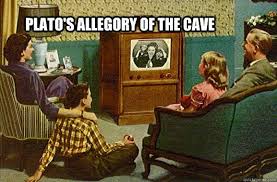
Plato TV

Last week I reviewed Plato’s Allegory of the Cave in an attempt to show that problems of “alternative fact” and “fake news” have been with us a long time.

In their book, Necessary Illusions, Noam Chomsky and Edward Herman in effect, connect Plato’s parable to contemporary controversy about truth in reporting. The authors do so by explaining what they call the Propaganda Model of information dissemination through ethnocentric political discourse, education, and especially the mainstream media.

For Chomsky and Herman, such information sources create for us an unreal shadow world that fails to take into account the realities of the world’s unseen majority whose lives are shaped by U.S. domination. Besides explaining that theory, the authors offer a way of testing its veracity. This week let me explain the propaganda model and its predictions. Next week I’ll show how to test both.

To begin with, the propaganda model holds that the mainstream media function as vehicles of propaganda intended to “manufacture consent” on the part of our culture’s majority – often described within the cave as “special interests.” The majority includes workers, labor unions, the indigenous, family farmers, women, youth, the elderly, the handicapped, ethnic minorities, environmentalists, etc. The MSM and those they represent seek to secure the latter’s consent for policies favoring what is termed “the national interest.” This, according to propagandists, is the province of corporations, financial institutions and other business elites. Such interests in turn are served not only by the media, but by elected officials, educational institutions, churches, and so on. These latter often represent resistant grassroots movements as threats, since such movements actually seek greater influence on national life.

To control such tendencies, the media in the United States defines the limits of national debate within boundaries set by a two party system of wealthy government officials, by unquestioned patriotism, support for the free market, vilification of designated enemies (e.g. ISIS, Russia, China, Cuba, Syria, Iraq, Iran, North Korea . . .) and support for official friends (e.g. Israel, Saudi Arabia, Great Britain . . .). Support for such “client states” ignores their objectionable actions that often parallel and even surpass similar acts committed by designated enemies.

None of this means that “liberal” criticism is excluded from the national media. On the contrary, such criticism of either government officials (like Donald Trump) or the corporate elite is common. However, the media never allow serious criticism of either the free enterprise system as such, nor of the American system of government.

Testing this model involves comparing its predictions with specific stories as reported, for instance, in the New York Times often referred to as the nation’s “paper of record.” The predictions include the following:

  • More articles will be devoted to the “atrocities” of designated enemies than to similar actions by the U.S. or its clients.
  • Less space (column inches) will be similarly allocated for reporting the alleged crimes of the U.S. or its clients.
  • In either case, story sources will tend to be American government officials and intellectuals (university professors, think tank experts, conservative churchmen) friendly to U.S. policy.
  • The reporting of “enemy” crimes will devote comparatively little space to the “official explanations” of the governments in question.
  • It will depend more heavily U.S. government spokespersons, on opposition groups within the offending countries concerned and on grassroots accounts.
  • The crimes and “atrocities” of designated enemies will be explained in terms of a corrupt and unworkable system.
  • On questionable evidence or with none at all, the crimes and atrocities of “designated enemies” will be attributed to the highest levels of government.
  • Meanwhile the crimes of the U.S. or its client states will be denied, rationalized or otherwise excused.
  • Incontrovertible proof (a “smoking gun”) will be demanded to prove the “crimes” of the U.S. or its friends.
  • If admitted, these crimes and atrocities will be explained as exceptional deviations by corrupt individuals (at the lowest level possible).
  • The ultimate conclusion drawn from the discovery of crimes along with any resulting trials and convictions will be that the “system works.”

This bias will be revealed not only in the ways noted above, but by differences in language (words, phrases, allusions) employed in writing the articles in question.

Again, next week I’ll show how Chomsky and Herman suggest testing this model and its predictions.

Jesus Would Have Supported al Qaeda Sooner than the U.S.! (Sunday Homily)

jesus  terrorist

Readings for 23rd Sunday in Ordinary Time: WIS 9:13-18B; PS 90: 3-6, 12-14, 17; PHMN 9-10, 12-17; LK 14: 25-33. http://usccb.org/bible/readings/090813.cfm

Did you have trouble with today’s gospel reading? I did. Frankly, it makes me wonder about Jesus’ attitude towards violence and armed attempts to overthrow foreign occupation forces like the Roman legions in Palestine – or American armed forces in Afghanistan or their authoritarian clients in Israel, Egypt, Bahrain, Yemen and elsewhere.

I wonder: whose side would Jesus be on in today’s War on Terrorism? I doubt it would be “ours.” Certainly, Jesus was not on the side of Rome. Instead, he was clearly sympathetic to Rome’s armed opponents. That makes me suspect that he would also have sided with those our own government deems “terrorists.”

What do you suppose that means for us and our politics?

Before answering, think about Jesus’ words in today’s selection from Luke. There Jesus is not telling us to love our enemies. He’s saying that we must hate! Yes he is. And the objects of our hatred must be our family members, down to our spouses and children. According to Jesus, we must even hate our own lives!

That’s pretty outspoken, hyperbolic, radical and edgy. In fact, his words make clear why the Romans and their Jewish collaborators in the Temple would have seen Jesus as an insurgent and terrorist. In any case, he was surely not the apolitical, domesticated preacher tradition later made him. He was not blissfully unaware of or uncaring about the searing resentment his people shared about Rome’s occupation of the land whose only sovereign in their eyes was Yahweh.

Yet Jesus’ words today also make it clear that he was not a violent revolutionary like the many other “messiahs” who sprang up in his 1st century context. As Reza Aslan points out, Jesus was not like Theudas, Hezekiah the bandit chief, Judas the Galilean, Menahem, Simon son of Giora, Simon son of Kochba and the rest.

Still today’s gospel makes it clear that there was genuine cause for concern about Jesus and his followers among the Romans and their Jewish clients in the Temple.

To begin with there were those “great crowds” Luke describes as following Jesus everywhere. In revolutionary situations, masses of people thronging about a charismatic troublemaker are reason for serious concern. According to U.S. standards under American Empire, it’s enough for local armed men in suspect locations to merely assemble to justify their being droned. And, of course, we know that at least some of Jesus’ disciples were armed (MK 14:43-52). Presumably others in the “large crowds” carried weapons as well. They would not have been viewed any more kindly by Roman occupation forces than their U.S. equivalents.

Then, listen to Jesus’ rhetoric as recorded by Luke. There’s all that talk about hating everyone near and dear to us that I already mentioned. That’s the second time we’ve encountered such language from the Prince of Peace in the last few weeks. Remember what we read a month ago about his coming not as a peacemaker, but to create division between children, their parents and in-laws? In MT 10:34 Jesus even said specifically that he had come to bring the sword. “I come not to bring peace” he said, “but to bring a sword.” If he actually said those words, how do you think they would have been understood by Roman and Temple authorities?

However, Jesus’ most dangerous statement this morning is the one about willingness to be crucified in order to qualify as his disciple. In occupied Palestine, those words had nothing to do with patiently bearing life’s inconveniences. No, in Jesus’ context, they could only be about opposing Rome and its Jewish collaborators.

Again, it is Aslan who reminds us that crucifixion was the mode of torture and execution the Romans reserved for insurgents. So in a Palestine where rebels were crucified almost every day (sometimes hundreds at a time), Jesus’ words could mean only one thing: his followers must join him in opposing Roman occupation of their Holy Land and in doing so virtually seal their fates.

But then comes the non-violent “catch.” Opposition to imperial occupation of the homeland might be the duty of every patriotic Jew, Jesus implies. But that doesn’t necessarily mean violent opposition. Calculate well, Jesus says – like a man building a tower. Realize whom we are opposing. We’re talking about Rome. Its legions can mobilize 20,000 well trained and heavily armed troops on a moment’s notice. At best we have less than half that number. To avoid suicide, we must “sue for peace” like a wise king threatened by a superior force. In other words Jesus counsels a prudent non-violence to avoid a bloodbath.

Bishop Oscar Romero made a similar recommendation to the revolutionary forces of El Salvador (the FMLN) in the 1970s. He said he could surely sympathize with the anger of the FMLN towards the United States and its puppet regime in El Salvador. He could understand why peasant farmers might see violent revolution as their only option in fighting brutal forces of “order” which wantonly tortured and murdered women, children, and the elderly, along with teachers, social workers, union organizers, priests, nuns, and other resisters.

No doubt Romero would say the same today about young Egyptians opposing the U.S.-supported military dictators in their own country, or about similar insurgents in the U.S.-controlled countries I’ve already mentioned.

But, Romero said, such violence is suicidal in the face of the billions in arms supplied such forces of oppression by the United States. Better to resist non-violently. At least then, the inevitable ensuing bloodbath (the modern equivalent of crucifixion) will be smaller in scope.

In 1st century Palestine, Jesus was not the only one employing such non-violent reasoning. According to John Dominic Crossan in his book, The Power of Parable, strong non-violent movements of resistance to Rome characterized Jesus’ context.

These movements were sandwiched between two epochs of extremely bloody opposition to Rome. The first occurred exactly in the year of Jesus’ birth, 4 BCE. That was the year the Roman client, Herod the Great, died. Jewish freedom fighters seized upon the resulting leadership vacuum as an opportunity to rise up against Herod’s Roman patrons. Jewish insurgents captured the city of Sephoris, the capital of Galilee. In response, the Romans razed the city to the ground and killed everyone who might be associated with the rebellion. Jesus’ family in nearby Nazareth was lucky to escape.

The second period of extremely violent resistance to Rome occurred about 40 years after Jesus’ crucifixion – just before the gospels of Mark, Matthew and Luke were composed. This time the Jews rose up against the Roman occupiers throughout Palestine. The Roman response? They utterly sacked Jerusalem itself, destroying its temple, and killing virtually all those who had heard Jesus’ words and witnessed his deeds.

In between those fierce chapters, Crossan says, there was a period of non-violent resistance to Rome. That’s when Jesus traversed Palestine and spoke so memorably about God’s Kingdom. According to Crossan, Jesus’ era represented a period of “massive, well-organized, unarmed, nonviolent resistance against Rome.”

That’s the probable context for Jesus’ shocking words this morning.

There’s so much more that could be said about all of this. To fill in the blanks, read Crossan’s book, along with Aslan’s Zealot, which recently topped the New York Times Best Seller list.

For today it’s sufficient to note the implications of Jesus’ shocking words. Personally, I’m so glad the church makes us face them. They show that Jesus was far more complex regarding violence than he’s usually made out to be. These difficult readings open a conversation that would otherwise be unthinkable.

Going forward, the conversation might well address the following questions:

• What difficulties do we have with realizing that Jesus situation vis-à-vis Rome was extremely similar to that of today’s “terrorists” vis-à-vis the United States and that Jesus himself was considered a terrorist?
• Is the “War on Terror” a real war or merely empire once again defending its right to plunder, torture, and kill with impunity?
• How is it that U.S. citizens end up supporting massive U.S. violence against “terrorists,” but that we find the latter’s much less injurious response (like the “Boston Marathon Massacre”) so horrendous?
• Put otherwise, how is it that U.S. citizens generally support the wars of their country which Martin Luther King described as “the greatest purveyor of violence in the world today,” while demanding pacifism on the parts of those whom the U.S. attacks.
• Do the ones our government calls “terrorists” have the right to defend themselves against what Edward Herman has termed the “wholesale terror” of the U.S. and its allies? (See his book, The Real Terror Network.)
• Which terrorists do we support – our government and its brutal military or their victims?

What other questions do the readings raise – for you?

How about my reflections?

(Discussion follows)