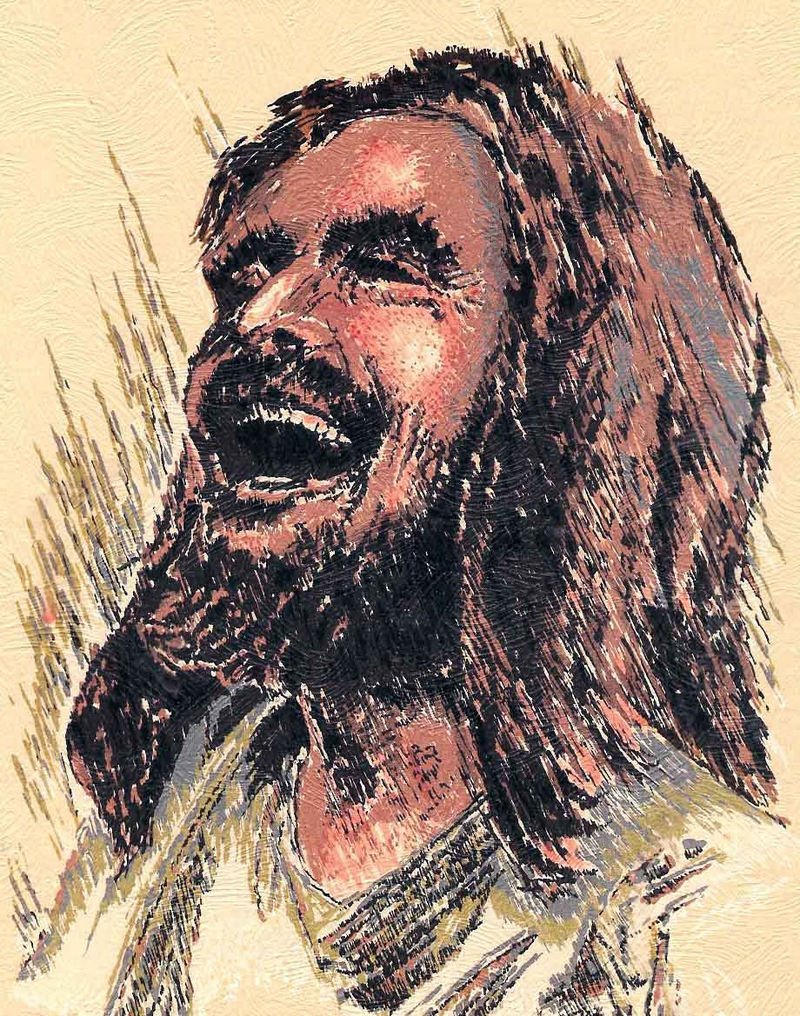
Jesus and Abraham Call Us to Abandon the Bible’s “Psychopath in the Sky” (Sunday Homily)

Love Enemies

Readings for the 17th Sunday in Ordinary Time: Gn. 18:20-32; Ps. 138:1-3, 608; Col. 2:12-14; Lk. Ll:1-13.

Today’s readings about Abraham bargaining with God and about Jesus teaching his followers to pray raise some vital questions about God’s personality and existence. Abraham’s compassionate God seems to conflict with the warlike God who appears elsewhere in the Bible.

So who’s right? Should we be afraid of God? Or can we trust the very Ground of Our Being? Is God warlike and punitive or kind and forgiving? If he’s our “Daddy” (that’s what “Abba” means in Jesus’ prayer: “Our Daddy who transcends everything”) does our experience show him to be abusive or loving? Today’s readings help us wrestle with those questions. In fact, they call us to a holy atheism.

But before I get to that, let me frame my thoughts.

A few days ago, it was reported that an airstrike led by the United States in Syria killed more civilians than perished in the Bastille Day killing of 84 people in the city of Nice following a celebratory fireworks display.

But whereas the Nice slaughter evoked general consternation, sympathy, and compassion, the U.S. killings elicited very little public notice here. The general feeling seems to be that our killings of civilians are somehow tolerable because the strikes protect Americans from the terrorists actually targeted in what are described as wayward airstrikes.

That’s the logic our government has adopted as it represents our country where 78-85% of the population claims to follow the one who refused to defend himself and gave his life that others might live. The logic of most American Christians says that killing innocents – even children – is acceptable if it saves American lives. Apparently, that’s the American notion of salvation: better them than us.

However that way of thinking is not what’s endorsed in today’s liturgy of the word. (And here I come back to those questions I raised earlier about God’s personality and existence.) There in Sodom and Gomorrah, Yahweh refuses to punish the wicked even if it means that as few as 10 innocents would lose their lives in the process.

Better-us-than-them is not the logic of Jesus who in teaching his disciples to pray tells them that God is better than us. God gives bread to anyone who asks. Yahweh acts like a loving father. He forgives sin and gives his children what they ask for. In fact, God shares his Spirit of love and forgiveness – he shares Jesus’ spirit of self-sacrifice – with anyone who requests it.

Elsewhere, Jesus says something even more shocking. Yahweh doesn’t even prefer the good over the wicked, he says. He showers his blessings (not bombs!) on everyone. Or as Jesus himself put it, God makes the sun rise on the virtuous and the criminal; his rain benefits those we consider evil as well as those we classify as good (Mt. 5:45). We should learn from that God, Jesus says, and be as perfect like him (Mt. 5:48). In fact, we should consider no one “the enemy” not even those who threaten us and kill us even as Jesus was threatened and killed (Lk. 6: 27-36).

How different is that from the way most of us think and act? How different is that from the God we’ve been taught to believe in?

Yes, you might say, but what about those other passages in the Bible where God is fierce and genocidal? After all, the Great Flood must have killed many good people and even children. And God did that, didn’t he? What about his instructions (more than once) to kill everyone without distinction. For example the Book of Joshua records: “Thus Joshua struck all the land, the hill country and the Negev and the lowland and the slopes and all their kings. He left no survivor, but he utterly destroyed all who breathed, just as the LORD, the God of Israel, had commanded (Joshua 10:40). What about the Book of Revelation, which many Christians argue predicts God’s total destruction of the world? What about that violent, pitiless, threatening God? Is that the “Abba” of Jesus?

Good questions. They’re good because they make us face up to the fact that the Bible is ambiguous about God. No, let me put it more strongly. The Bible isn’t just ambiguous about God. It’s often plain wrong – at least If we adopt the perspective of Jesus and Abraham in today’s readings.

After all, Abraham’s God is not genocidal; Joshua’s is. Jesus’ God is not genocidal; Joshua’s is. Those Gods are not compatible. One of them must be false. Or as Jack Nelson Pallmeyer writes in his book Is Religion Killing Us? “Either God is a pathological killer or the Bible is sometimes wrong about God.”

Today’s readings show us that both Abraham and Jesus agree.

The Abraham story is about a man gradually rejecting Nelson’s Psychopath in the sky. Israel’s furthest back ancestor comes to realize that God is merciful, not punitive or cruel. Or as the psalmist puts it in today’s responsorial, God is kind, true, and responsive to prayer. God protects the weak and lowly and is distant from the powerful and haughty. In today’s reading from Genesis, we witness Abraham plodding slowly but surely towards that conclusion.

It’s the realization eventually adopted by Jesus: God is a kind father, not a war God. If Abraham’s God won’t tolerate killing 50 innocent people, nor 45, 40, 30, 20, or even 10, Jesus’ God is gentler still. That God won’t tolerate killing anybody – not even those threatening Jesus’ own life.

All of that should be highly comforting to us. It has implications for us, politically, personally and liturgically.

Politically it means that followers of Jesus should be outraged by anyone connecting Jesus with our country’s perpetual war since 9/11, 2001. A bombing program that kills the innocent with the targeted flies in the face of Abraham’s gradually-dawning insight about a merciful God. The war itself makes a complete mockery of Jesus’ total non-violence and the words of the prayer he taught us. Those supporting “America’s” “better them than us” attitude are atheists before Jesus’ God and the one depicted in the Abraham story.

Personally, what we’ve heard this morning should drive us towards an atheism of our own. It should cause us to review and renew our understandings of God. Impelled by today’s readings, we should cast as far from us as we can any inherited notions of a pathological, punishing, cruel, threatening and vindictive God. We need that holy atheism. Let’s pray for that gift together.

And that brings us to today’s liturgy. In effect, we’ve gathered around this table to hear God’s clarifying word, and symbolically act out the peaceful world that Jesus called “God’s Kingdom.” We’ve gathered around this table to break bread not only with each other, but emblematically with everyone in the world including those our culture considers enemies.

I mean if God is “Our Father,” everyone is our sister, everyone, our brother. It’s just that some couldn’t make it to our family’s table today. But they’re here in spirit; they’re present around this altar. They are Taliban and ISIS; they are Iraqis, Afghanis, Yemenis, and Somalis; they are Muslims and Jews; they include Edward Snowden and Tamir Rice. They include those children killed in U.S. bombing raids. They are you and I!

All of us are children of a loving God. Jesus’ “Lord’s Prayer” says that.

Now that’s something worth celebrating.

The Irrelevance of Religion in the Eyes of Jesus (Sunday Homily)

Good Sam Pic

Readings for 15th Sunday in Ordinary Time: DT. 30: 10-14; Ps. 69: 14, 17, 30-31, 34, 36-37; Col. 1: 15-20; Lk. 10: 25-37.

What do you think? Does God care about religion? Does She need it? Do we? Does She even care if we’re Christian, Muslim, Jew or atheist?

Today’s Gospel reading – the familiar parable of “The Good Samaritan – seems to answer “no” to all of those questions.

The tale addresses the problems of crime and violence and of proper human response. Surprisingly, the recommended response is not “religious” at all, but humanitarian. It is unadorned motherly compassion by a specifically irreligious actor.

Jesus makes that point by creating a fictional account where the hero is despicable in the eyes of his audience. He is a Samaritan. Meanwhile, the villains of the piece are religious leaders – a priest and a Levite (virulent enemies of the Goddess religions that biblical patriarchs detested). .

In Jesus’ time, Samaritans were social outcasts belonging to a group of renegade Jews who (by Jesus’ time) had been separated from the Jewish community for nearly 1000 years. They were seen as having polluted the Jewish bloodline by intermarrying with the country’s Assyrian conquerors about 700 years earlier. Female goddesses figured prominently in the religions of ancient Assyria.

As a result, Jewish priests and Levites considered Samaritans “unclean;” they were traitors, enemy-sympathizers, heretics and even atheists. They rejected Jewish understandings of the patriarchal Yahweh and the Temple worship that went along with them. For priests and Levites, Yahweh was interested in temple sacrifice and abstract law.

And yet the Good Samaritan is found to be more worthy, more pleasing in God’s eyes than the priest or Levite, who enjoyed great prestige among Jews as “men of God.”

Yes, Jesus prefers the Samaritan because his actions speak much louder than the religious orthodoxy of Israel’s holy men or than the word “Samaritan” would allow. The outcast expresses typically female compassion; so Jesus approves.

In this way, Jesus’ story calls his audience (and us!) to transcend socially prescribed categories, patriarchy, and even religion in dealing with problems of crime and violence. In fact, the crimes addressed in the parable are not primarily robbery and physical abuse. They are indifference, denial, and patriarchy’s religious hypocrisy.

The solution to such crimes along with robbery and violence is not found in religion, theology or temple sacrifices. It lies simply in compassionate action – in “being there” for victims.

As always, then, Jesus’ words invite us to reconsider our very understanding faith, and our favorite categories of “good” and “evil” — and the identity of God Herself.

Perhaps religion is not that important for followers of Jesus after all — nor to the Great Cosmic Mother..

Jesus’ Response to Terrorism vs. Ours (Sunday Homily)

Cross

Readings for 12th Sunday in Ordinary Time: ZEC. 12:10-11; 13:1; Ps. 63: 2=6, 8-9; Gal. 3: 26-29; Lk. 9:18-24

Why are we Christians so afraid of own deaths while at the same time so indifferent to the horrors we inflict on innocent others? Our attitude stands sharply condemned in today’s Liturgy of the Word.

To begin with, think about our nationwide hysteria to the horrendous massacre in the Orlando nightclub last week. Contrast that understandable reaction with our collective yawn in the face of the American bombing of the Doctors without Borders trauma hospital in Kunduz, Afghanistan in October of last year. The attack killed at least 30 people, including 13 medical staff, 10 patients and 7 unidentified people.

And Kunduz was not an isolated incident. Orlando-gauge tragedies are a daily phenomenon under completely illegal U.S. drone and bombing campaigns that kill far more innocent civilians than so-called “combatants.”

But there are no Hands across the Continents movements for the victims of our government’s terrorism. Rather there is hardly any notice in the mainstream media or awareness by U.S. citizens – no teddy bears, shrines, candles, and love notes. Just excuses on the part of the killers.

And even Christians go along with the too-familiar process as though supporting such mayhem were not only patriotic, but in accord with our faith.

All of that reveals a near obsession with saving our own lives at the expense of others – just the opposite of what’s required of believers in today’s Gospel reading.

There Luke tells us that Jesus has just emerged from a period of solitary prayer. That experience has evidently brought the Master face-to-face with his fundamental God-identity – an identity Paul tells us in the second reading, is shared by all of us who are, the apostle reminds us, “children of God” just like Jesus. Since we exist “in Christ,” Paul implies, we can learn something from the experience of Jesus and from the attitudes he expressed in his words and actions. We should be able to see ourselves “in Christ.”

In any case, Jesus has just encountered the God within. According to the responsorial from Psalm 63, that God is not only powerful and glorious, but our ultimate source of help, support, and joy in life’s greatest difficulties. For that God each of us should be thirsting, the Psalmist says, like parched ground for water. In fact, God’s kindness is more valuable than life itself. Or as the psalmist puts it, God’s kindness is “a greater good than life.” This seems to mean that it’s more important for believers to be kind (i.e. non-violent) than to survive.

With those insights in mind, Jesus decides to share them with his disciples. So he asks a leading question about identity: “Who do the crowds say that I am?” (Jesus really wants his friends to face who they are!) The disciples have a ready response. After all, everyone is talking about Jesus. “Some say you are John the Baptist returned from the dead,” they say. “Others say you are Elijah or one of the prophets come back to life.”

“But who do you say I am?” Jesus insists.

Peter speaks for the others. “You are God’s anointed,” he says – “the Messiah.”

Jesus knows what Peter has in mind. For a Jew living under the Roman jackboot, “Messiah” could mean only one thing – the leader of The War against Rome.

So Jesus says, “Don’t call me that! I am not the Christ you imagine! No, I’m a human being like the rest of you.

“Yes, I’m as much against the Roman enemy as you are.” Like the ‘Son of Man’ in the Book of Daniel, I reject all the enemies of our people in the name of Yahweh our God. I am a patriot just like you – and the prophet Daniel. But rather than use violence to conquer our enemies, I am willing to lose my life even if it means crucifixion at the hands of Rome. They cannot kill my real Self; I will rise again and again despite the way they terrorize us all. In the final analysis the God within all of us cannot be defeated.

“And there’s more. All of you must all be prepared to follow my example – even if it means rejection by the religious establishment and a cross imposed by our foreign enemies. In fact, I tell you all, anyone who tries to save his or her life will lose it.

“Don’t you realize that by killing others, you are killing your Self? You are murdering the God within. But those who follow my example of non-violent resistance will actually save their Selves. They will preserve their in-born unity with the divine core shared by all of God’s children. Don’t be afraid to follow my example of non-violent resistance. You will emerge victorious in the end.”

That, I think, is what Jesus means in this morning’s gospel with his talk about losing life and saving it = with his words about denying self and carrying one’s cross. Suffering, terrorism, and even national enslavement are not the end of the world.

Yes, even national enslavement! The prophet Zachariah makes that point in today’s first reading. Writing at the end of the 6th century BCE, he addresses an Israel defeated and enslaved in Babylon for more than 50 years. They survived, he reminds them. And somehow they’re better off than before. They’ve been purified as if by a gushing fountain.

Of course, the attack in Orlando portends nothing like national defeat by “terrorists.” Such threats to our homeland are remote and relatively insignificant. Americans are more likely to be hit by lightning or killed in an auto accident than by a terrorist attack.

Instead, it is our country’s response to terrorism that threatens us with defeat – responses like the massacre in Kunduz and the killing of civilians in drone attacks. According to Jesus and Zachariah, accepting life’s lessons administered by a foreign enemy might even lead to national purification.

Paradoxically, however, doomed efforts to save our lives through violence will bring about the end we so fearfully seek to avoid.

As Jesus himself put it: “. . . those who want to save their life will lose it, and those who lose their life for my sake (that is, as a result of living ‘in Christ’) will save it.”

Jesus’ instruction today makes it incumbent on all of us to resist our country’s unending wars and state-sponsored terrorism.

Was Mary Magdalene the First Pope? (Sunday Homily)

hieros gamos

Readings for the eleventh Sunday in Ordinary Time: 2SM 12:7-10, 13; PS 32: 1-2, 5, 7, 11; GAL 2: 16, 19-21; LK 7: 36-8:3

As much as we love Pope Francis, many of us have been disappointed by his consistent refusal to consider ordaining women to the Catholic priesthood. In the light of such irritating consistency, the pope would do well to reconsider today’s Gospel reading.

I say that because it offers a compelling argument not merely admitting women to the priesthood, but to the highest office in the church – the papacy itself. It does so by presenting Mary Magdalene as performing an undeniably priestly function far beyond any recorded of Yeshua’s apostles. Doing so brings to mind the Master’s supreme elevation of Mary Magdalene found in patriarchally-suppressed sources outside the canonical Gospels. There Yeshua designates Mary as superior even to Peter.

Consider the episode Luke records.

Yeshua has been invited to the house of a Pharisee for dinner. For Jews Pharisees were defenders of the father-rule system the Church and Pope Francis have made their own. But in this case, the “host” proves to be inhospitable in terms of Jewish custom. He obviously sees the carpenter from Nazareth and his uncouth fisherman friends as riff-raff. He omits giving them the traditional greeting, and doesn’t even offer them water to wash their feet. Evidently he considers the band from Nazareth unclean – dirty people who won’t even know the difference.

Then the hero of the story appears to set things right. She’s a woman whose gender relegated her to unquestionably second class status. She is Mary of Bethany (whom scholars identify with Mary Magdalene). And she does something extraordinary. She does what Nathan the prophet recalled in today’s first reading that he did for David. She anoints Yeshua as the Christos – the Christ, designating (and making) him God’s chosen one. This is the priestly act I referred to earlier.

Mary’s act is absolutely extraordinary. Remember, the term “Christos” (or Christ) itself means “anointed.” And in the gospels there is only one anointing of Yeshua the Christ. And, as we see, it occurs at the hands of Mary Magdalene, not of some male priest. In other words, the Magdalene in today’s gospel acts as prophet and priestess on a level arguably above Nathan’s role recalled in today’s reading from 2nd Samuel.

And there’s more. The Magdalene appears in public with her head uncovered and hair flowing – a condition appropriate for a woman of Yeshua’s time only in the presence of her husband. And besides anointing Yeshua, she performs what can only be described as an extremely intimate act. She continually kisses his feet with her lips and washes them with tears of love.

But how could a woman perform such an act? Why would Yeshua allow it? After all, according to Jewish law, women were not even permitted to say ritual prayers at home, much less perform religious rites of such central import as identification and anointment of the Christ.

That is, not according to Jewish law. . . However, according to universally recognized pre-patriarchal traditions, such election by a priestess was not only permitted but essential for any sacred king. There according to the rite of hieros gamos or sacred marriage, the priestess would anoint the priest-king. By virtue of her act (often consummated by ritual sex), the anointed would be flooded with power of the god. Conversely, without the power conferred by the woman, the king would remain powerless and have no knowledge of himself or of the gods. These facts would have been evident to Yeshua’s contemporaries.

Why has this history and the prophetic role of Mary Magdalene in identifying (and consecrating) the Christ been hidden from us all these years? Feminist scholars tell us that patriarchal misogyny – anti-woman sentiment – is the answer.

And negativity towards women is written all over today’s excerpt from Luke’s Gospel. There the evangelist emphasizes the sinfulness of the Magdalene as that of the other women in Yeshua’s company.

Luke describes Mary as “a sinful woman in the city,” and “a sinner.” He has Yeshua tell those seated at table that “many sins have been forgiven her,” and say to the woman, “Your sins are forgiven.” So we won’t miss the point, Luke gratuitously describes Mary Magdalene as the one “from whom seven demons had been cast out.” And finally, women in Yeshua’s company are described as formerly sick and possessed.

Nevertheless, Luke feels compelled to note what everyone in his community would have known: women like the Magdalene and Joanna and Susanna and the “many others” who followed Yeshua were financial supporters of Yeshua and “The Twelve.”

But Luke reveals no corresponding negativity towards the male leaders of the early church. He doesn’t call the apostles “free-loaders.” Neither does he parallel his description of the women as sinners by recalling that one of the 12, Peter, was identified with Satan himself by Yeshua. Nor does he recall that a key apostle, Judas, actually betrayed Yeshua or that all of the twelve but one (unlike the Master’s women followers) abandoned him in his hour of greatest need. Instead, Luke simply mentions “the twelve,” who by the evangelist’s omissions are implicitly contrasted with the “sinful” women.

Above all, Luke omits the description of Mary Magdalene which we find in the church-suppressed Gospel of Thomas. There she is described as “the apostle of apostles” – no doubt because of her key role in identifying and anointing Yeshua as the “Christos,” and because she was the one to whom the resurrected Yeshua appeared before showing himself to any of “the twelve.”

In fact the Gospel of Thomas says explicitly:

“. . . the companion of the Savior is Mary Magdalene. But Christ loved here more than all the disciples, and used to kiss her often on her mouth. The rest of the disciples were offended . . . They said to him, “Why do you love her more than all of us?’”

Here the word for “companion” is koinonos which refers to a consort of a sexual nature. Moreover in other suppressed writings, Magdalene emerges as Yeshua’s star pupil and the center of his attention. He praises her as “one whose heart is raised to the kingdom of heaven more than all thy brethren.” He predicts that she “will tower over all my disciples and over all men who shall receive the mysteries.” Additionally, following Yeshua’s ascension, it is Magdalene who comes to the fore to encourage the disheartened apostles to man-up and get on with the business of understanding and living out the teachings of the Master.

These words and the Magdalene’s functioning as prophet and priest should be extremely meaningful for contemporary women – and patriarchs blind to women’s leadership in the early church. They highlight the way at least one female disciple of extraordinary talent and charisma was not only marginalized but denigrated in the patriarchal church right from the beginning. And that denigration has continued in church circles and beyond to our very day.

Put otherwise, besides shedding light on the distant past, today’s readings expose the extreme weakness of contemporary ecclesiastical “fathers” in their exclusion of women from the priesthood and from other forms of church leadership. They also uncover the perversity of their other anti-woman pronouncements regarding topics such as contraception, abortion, and women’s rights in general.

In short today’s liturgy of the word helps us see beyond the “official story” to discern the fact that female leadership in the Christian community is nothing new. It is the males – the ones we call “father” – who are the interlopers and charlatans.

Clearly, Pope Francis, should change his mind on women’s ordination.

(Sunday Homily) Jesus Meets with Terrorists in the Desert

Loaves & Fishes

Readings for the Solemnity of the Most Holy Body and Blood of Christ: GN14: 18-20; PS 110: 1-4; I COR 11: 23-26; LK 9: 11B-17.

In this morning’s Gospel episode, a group of 5000 men— presumably with something to hide – meet in in a secret, out-of-the-way place.

The secrecy is entirely appropriate at this time of revolution against the Romans, their country’s hated occupying force. That context requires it. If such a gathering were discovered, the Roman Pigs (MK 5: 1-13) would surely attack and wipe out all present without a trace of pity. It’s been their consistent track record.

The desert context also evokes in everyone’s mind the halcyon years their ancestors spent in the desert following their liberation from Egypt. It reminds them that deliverance from foreign domination is the very core of their faith heritage. As well, the wasteland context recalls the recently martyred prophet, John the Baptizer who lived among the rocks, sand, wild creatures, heat and cold.  In absentia, his own wildness is the unspoken inspiration for this assembly.

Naturally, many of the men present are armed. They are part of the resistance, the Insurrection. Virtually everyone in the country supports them. They are celebrated as heroes.

This day, one of those sympathizers known for his fiery rhetoric spends hours speaking. It’s the worker-rabbi, Yeshua, the carpenter from Nazareth. He is the heir apparent of the assassinated Baptizer. Like John, Yeshua is a social revolutionary hated by the Scribal Establishment. The same is true for the priestly caste and Roman occupiers. They all think “the Master” is a terrorist – an armed Zealot like many in his audience. In fact it is certain that several in his inner circle bear arms (LK 22:38, JN 18:10). They are suspected of being sicarii – patriotic assassins of Roman soldiers.

In the past, Yeshua has routinely excoriated the rich who collaborate with the oppressors of their own people. He has encouraged the destitute. Today is no different. Over and over he has told his oppressed followers “The Kingdom of God is yours.”

All are familiar with that metaphor – “the Kingdom of God.”  It describes what Israel would look like if it were ruled by their tribal God, Yahweh, rather than by filthy goyim. Everything will be reversed in the Kingdom, Jesus has said. The rich will weep; the poor will laugh. The first will be last; the last, first.

“The Kingdom of God” is not about some “heaven up there,” Yeshua insists. “Don’t let anyone tell you different. It is about this world of body and blood, bread and wine.

“Eventually, it will be about my body and blood,” he has also predicted on several occasions. With such words he has signaled his fearless embrace of his “prophetic script.” Like prophets before and after him, he knows his inevitable fate. The Powers and Principalities simply cannot abide prophets or liberators. They call all such resisters “terrorists“ and butcher them without a second thought.

“But my death,” Yeshua has assured, “will be like a seed giving rise to others like me. There have been many before. Many will emerge after my death. Everyone has a duty to resist oppression. Take long quaffs of my blood,” he has said. “Death suffered struggling for God’s justice is nothing to fear.”

Like most revolutionary groups, the assembly this day is highly organized. After Yeshua finishes speaking, it disarticulates into 100 groups of 50 for discussion. A subsequent plenary centralizes the far-reaching conclusions of a group of fishermen especially close to the prophet Yeshua. The fishermen propose a New World Order where wheat farmers share bread and fishermen distribute the fruits of their labor for free. Such sharing, they’ve concluded is the answer to hunger and poverty. It would yield abundance for all with plenty left over.

And that’s what happens on this day. When everyone shares the lunches they’ve brought with them, 12 baskets of bread and fish are left over.

“It’s a miracle,” everyone agrees.

And it’s true: selfless sharing is revolutionary. It’s the nature of God’s Kingdom.

Pope Francis, Donald Trump and the Revelation of Pentecost (Sunday Homily)

Trump & Frank

Readings for Pentecost Sunday: ACTS 5: 2-11; PS 104: 1, 24, 29-31, 34; 1COR 12: 3B-7, 12-13; JN 20: 19-23.

So who do you think is more outspoken, Donald Trump or Pope Francis? Which one should followers of Jesus listen to?

That question was sharpened a few weeks ago, when Pope Francis implied that Donald Trump is not a Christian. Responding to a reporter’s question, the pontiff lit up the internet when he said about Trump, “Anyone, whoever he is, who only wants to build walls and not bridges is not a Christian.” Francis added, “Vote, don’t vote, I won’t meddle. But I simply say, if he says those things, this man is not a Christian.”

The pope’s comment came at the end of Francis’ six-day trip to Mexico. There he celebrated Mass with 300,000 faithful in attendance near the Mexican-U.S. border. He used the occasion to decry the “human tragedy” of worldwide migrations of people fleeing violence, war and the effects of climate change. The pope’s analysis, of course, conflicts with Mr. Trump’s who sees immigrants as rapists, drug-dealers, and terrorists.

Francis’ comments drew a quick response from The Donald. He called the pope’s charges outrageous and accused him of being a pawn of the Mexican government.

While Francis’ words were surprising and the response predictable, both provide occasion for a Pentecost reflection on what it means to be a baptized and confirmed Christian in a world awash with refugees from U.S. bombings and the effects of neo-liberal overconsumption.

That’s because the emphasis in today’s readings is precisely on internationalism. The Kingdom of God, the readings tell us, has no borders. It is open to everyone regardless of nationality, race, occupation or gender. Moreover, the Kingdom of God is a matter of this world – of the Body of Christ.  It is not about some disembodied reality up in the sky.

That twofold message starts with today’s opening reading from the Acts of the Apostles with all those strange identity references that readers usually stumble over. Jews, we are told who were present on that first Pentecost were “Parthians, Medes, and Elamites, inhabitants of Mesopotamia, Judea and Cappadocia, Pontus and Asia, Phrygia and Pamphylia, Egypt and the districts of Libya near Cyrene, as well as travelers from Rome, both Jews and converts to Judaism, Cretans and Arabs.”

Then in today’s second reading, Paul goes even further. God’s Kingdom, he says, isn’t just for Jews. In fact in God’s eyes national distinctions, economic status, and gender identity have been erased for those who accept the Gift of God’s Spirit. Paul writes: “For in one Spirit we were all baptized into one body, whether Jews or Greeks, slaves or free persons, and we were all given to drink of one Spirit.” Elsewhere (Galatians 3:28) he puts it even more directly: “There is neither Jew nor Gentile, neither slave nor free, nor is there male and female, for you are all one in Christ Jesus.”

Paul’s message was a consistent theme in the life of Jesus. He healed and forgave, loved and taught Jews, Gentiles, Samaritans, street walkers, lepers, tax collectors, and even on occasion members of the Roman occupying forces.

Notice too Paul’s words about “body” insert the reception of Jesus’ Spirit into the earthly realm of real life and politics. True, Paul speaks of “spiritual gifts,” but he even more emphatically insists that those gifts must be “manifest” in “service” meant to “benefit” others. We are members of Christ’s “Body,” Paul tells us. That is, we are all somehow living “in Christ” – in God, we might say. The question is, do we recognize that reality or not?

In today’s Gospel, Jesus reminds us more specifically where in the world we encounter his embodied spirit. It happens first of all in the community of peacemakers. Jesus’ first words after his resurrection are about peace. “Peace be with you,” he says.  Then he immediately shows his pierced hands and side to his friends. In doing so he seems to remind his followers that he will forever be found in the victims of war and imperialism. That includes refugees from imperialist wars and excess consumption as well as in victims of torture and capital punishment like Jesus himself.

Is such understanding of Pentecost too political? Donald Trump might think so. Pope Francis does not. Francis himself has pointed out that Aristotle was correct in saying that human beings are political animals. So to be branded “political” is to have one’s humanity recognized. The pope said he is proud to be branded political.

So would-be followers of Jesus are presented with a choice on this particular Pentecost.  Are we to follow Pope Francis or Donald Trump? The choice is ours.

More accurately, do we recognize that we are living not “in America,” but “in Christ?”  Do we recognize (as John Oxenham put it more than 100 years ago) that

1 In Christ there is no east or west,
in him no south or north,
but one great fellowship of love
throughout the whole wide earth.

2 In Christ shall true hearts everywhere
their high communion find;
his service is the golden cord
close-binding humankind.

3 Join hands, disciples of the faith,
whate’er your race may be.
All children of the living God
are surely kin to me.

Pope Francis: Please Write That Encyclical against War!

Just War

Readings for 6th Sunday after Easter: Acts 15:1-2, 22-29; Ps. 57: 2-3, 5, 6, 8; Rev. 21: 10-14; 22-23; Jn. 14: 23-29.

Last week, David Swanson, the author of War is a Lie shared an interview with the great Jesuit peace activist, John Dear. The latter had just returned from Rome where he participated in a conference convoked by Ghanaian Cardinal Peter Turkson. Cardinal Turkson authored first versions of Laudato Si’, Pope Francis’ landmark encyclical on the environment. He is often mentioned as a possible future pope.

Father John (who doesn’t like to be called “Father Dear”) reported the conference as “unprecedented.” That’s because activists, theoreticians, and scholars of Peace Studies ended by recommending (in a document over the signature of Cardinal Turkson) that Pope Francis publish another encyclical – this one repudiating the Church’s centuries-long endorsement of Just War Theory.

That theory, of course, lays out principles for judging whether or not a given armed conflict might be justified.

The Turkson document repudiated the idea that modern warfare might ever be justified. This is not only because of the terrible destruction caused by modern weaponry, but because, in fact, 90% of casualties of today’s wars end up being innocent civilians. For those reasons, the conference in Rome recommended that Pope Francis not only repudiate war itself, but discourage Catholics from participating in modern military forces.

Imagine what would happen if Pope Francis were to accept those recommendations – especially on top of his denunciations of capitalism-as-we-know-it, his firm embrace of environmentalism, and his statements about homosexuality (“Who am I to judge?”). Catholic radicals would love it, liberals would be inspired. Conservatives who often identify faith and the military would be shocked and scandalized.

Where would you come down?

Think about that question in the light of today’s readings. Think about what “radical,” “conservative” and “liberal” mean for us as individuals and community members in our faith tradition. How would Jesus be classified? What about Paul? What would they say about entirely rejecting the idea of just wars?

Today’s Liturgy of the Word gives us a clue. It presents us first of all with an example of a key conflict between religious conservatives and radicals within the first century infant church. Paul, Barnabas, Silas and Barnabas lead the radical-to-liberal wing. Peter and Jesus’ brother, James are the leaders of the conservatives.

Paul and his friends come from the gentile world. Their concern is to make Jesus both understandable and acceptable to non-Jews. For their audience, circumcision and dietary restrictions (like not eating pork) represent great obstacles to accepting Jesus’ “Way.”

On the other hand, Peter and Jesus’ brother, James, are Jews through and through. They remember the importance of full observance of the law within the Jewish tradition. They recalled for instance that during the second century Seleucid persecution of the Jews under Antiochus IV Epiphanes, many Jews gave their lives rather than eat forbidden foods. Faced with Paul and his colleagues, the conservative faction wondered: were those lives sacrificed in vain? And besides, circumcision was the identifying mark of Jewish manhood. What good follower of the biblical God set that all-important commandment aside?

The issue is so serious that it provoked a meeting of church leaders – what scholars call the “Council of Jerusalem.” Like Vatican II (1962-’65) it called together church leadership to discuss burning issues of the day and to make changes that responded effectively to what Gaudium et Spes called the “signs of the times.”

Today’s gospel reading implies that leaders could come together with confidence because of Jesus’ promise that his Holy Spirit would continue teaching the church even after he is gone. The Spirit would remind the church of what Jesus himself taught – and more besides.

According to today’s readings, it was the “more besides” that the Jerusalem conservatives were resisting. They didn’t deny, of course, that Jesus himself was a Jewish prophet. (It was Jesus’ prophetic radicalism that angered the Scribes and high priests.) Jesus frequently placed love and compassion above God’s most important commandment, the Sabbath law; he associated with the “unclean;” he even befriended and worked miracles for gentiles. Jesus was never bound by the letter of the law as were his conservative opponents.

At the same time however, Jesus was Jewish to the end. He had no intention of founding a new religion. He was a Jewish reformer. No one could deny that. Jesus didn’t revoke the Law. He simply gave it an enlightened, more humane interpretation. He himself had been circumcised!

It was with these understandings that the Council of Jerusalem convened. And according to Luke, the author of Acts, it was a battle royal. Luke says the meeting was filled with “dissension and debate.”

What we find in today’s first reading is the final decree of the Council of Jerusalem. Concerning circumcision, it says “never mind.” As for dietary restrictions, they could be ignored. The Council was concerned with not placing unbearable burdens on converts. In other words, it couldn’t have been less conservative. The Holy Spirit was leading them in the opposite direction.

The Council of Jerusalem is reputed to have happened no more than 30 years after the death of Jesus. But by the time John of Patmos writes his book of Revelation at the end of the first century, look where his church had come. His vision of the “New Jerusalem” which we read about in today’s second reading doesn’t even have a temple. Jerusalem without a temple?! The city is founded not on the 12 patriarchs of Israel, but on the 12 apostles. How radical is that!?

I suppose what I’m saying is that Christians shouldn’t be afraid of radical change in matters of faith. It’s our tradition – right from the beginning.

In fact, in today’s gospel, John has Jesus say specifically that we should not be agitated or fearful. Rather, our hearts should be filled with peace because of our reliance on the Holy Spirit. John’s Jesus teaches that the Spirit’s presence guarantees the community is moving in the right direction, even when the Spirit’s teachings shock and scandalize – as long as it’s moving towards Jesus’ compassion, love, and ease of burden. The guarantee remains even when the Spirit’s guidance seems to dilute what many consider essential – like circumcision, dietary laws and the Jerusalem Temple.

What “essentials” is the church being called to set aside today? Priestly celibacy? An all-male priesthood? Prohibition of contraception? Are any of these really essential?

And what about just war? Are John Dear and Cardinal Turkson right about its absolute unacceptability to followers of Jesus? Could Jesus ever endorse atomic bombs, drone strikes, cluster bombs, or any of today’s wars that end up claiming mostly civilian victims?

If we fear to say “No” to any of those questions, we should keep Jesus’ words in mind: “Don’t be afraid or agitated; the Holy Spirit guides.”

The bottom line: today’s readings teach that there is no future in timid conservatism. Instead we are called to Christian radicalism (or going to the root of things). The Holy Spirit is that root.

And so we can pray with confidence: “Holy Spirit, in our world racked by war, inspire Francis to write another encyclical. Let him surprise and shock us one more time. Wake us up as a community of faith! Move us towards compassion, love and ease of burden as you did the Jerusalem Council.

We believe that under your guidance, we can never go wrong!”

Did Jesus Really Rise from the Dead?

Resurrection

Readings for Easter Sunday:ACTS 10:34A, 37-43; PS 118: 1-2, 16=17, 22-23; COL 3:1-4; JN 20: 1-4.

Did Jesus really rise from the dead? Or is belief in his physical resurrection childish and equivalent to belief in the Easter Bunny or Santa Claus?

I suppose the answer to those questions depends on what you mean by “really.” Let’s look at what our tradition tells us.

Following Jesus’ death, his disciples gave up hope and went back to fishing and their other pre-Jesus pursuits. Then, according to the synoptic gospels, some women in the community reported an experience that came to be called Jesus’ “resurrection” (Mt. 28:1-10; Mk. 16: 1-8; Lk. 24:1-11). That is, the rabbi from Nazareth was somehow experienced as alive and as more intensely present among them than he was before his crucifixion.

That women were the first witnesses to the resurrection seems certain. According to Jewish law, female testimony was without value. It therefore seems unlikely that Jesus’ followers, anxious to convince others of the reality of Jesus’ resurrection, would have concocted a story dependent on women as primary witnesses. Ironically then, the story’s “incredible” origin itself lends credence to the authenticity of early belief in Jesus return to life in some way.

But what was the exact nature of the resurrection? Did it involve a resuscitated corpse? Or was it something more spiritual, psychic, metaphorical or visionary?

In Paul (the only 1st person report we have – written around 50 C.E.) the experience of resurrection is clearly visionary. Paul sees a light and hears a voice, but for him there is no embodiment of the risen Jesus. When Paul reports his experience (I Cor. 15: 3-8) he equates his vision with the resurrection manifestations to others claiming to have encountered the risen Christ. Paul writes “Last of all, as to one untimely born, he appeared also to me.”

In fact, even though Paul never met the historical Jesus, he claims that he too is an “apostle” specifically because his experience was equivalent to that of the companions of Jesus who were known by  name. This implies that the other resurrection appearances might also be accurately described as visionary rather than physical.

The earliest gospel account of a “resurrection” is found in Mark, Ch. 16. There a “young man” (not an angel) announces Jesus’ resurrection to a group of women (!) who had come to Jesus’ tomb to anoint him (16: 5-8). But there is no encounter with the risen Jesus.

In fact, Mark’s account actually ends without any narrations of resurrection appearances at all. (According to virtually all scholarly analysis, the “appearances” found in chapter 16 were added by a later editor.) In Mark’s original ending, the women are told by the young man to go back to Jerusalem and tell Peter and the others. But they fail to do so, because of their great fear (16: 8). This means that in Mark there are not only no resurrection appearances, but the resurrection itself goes unproclaimed. This makes one wonder: was Mark unacquainted with the appearance stories? Or did he (incredibly) not think them important enough to include?

Resurrection appearances finally make their own appearance in Matthew (writing about 80) and in Luke (about 85) with increasing detail. Always however there is some initial difficulty in recognizing Jesus. For instance Matthew 28:11-20 says, “Now the eleven disciples went to Galilee, to the mountain to which Jesus had directed them. And when they saw him they worshipped him; but some doubted.” So the disciples saw Jesus, but not everyone was sure they did. In Luke 24:13-53, two disciples walk seven miles with the risen Jesus without recognizing him until the three break bread together.

Even in John’s gospel (published about 90) Mary Magdalene (the woman with the most intimate relationship to Jesus) thinks she’s talking to a gardener when the risen Jesus appears to her (20: 11-18). In the same gospel, the apostle Thomas does not recognize the risen Jesus until he touches the wounds on Jesus’ body (Jn. 26-29). When Jesus appears to disciples at the Sea of Tiberius, they at first think he is a fishing kibitzer giving them instructions about where to find the most fish (Jn. 21: 4-8).

All of this raises questions about the nature of the “resurrection.” It doesn’t seem to have been resuscitation of a corpse. What then was it? Was it the community coming to realize the truth of Jesus’ words, “Whatever you do to the least of my brethren, you do to me” (Mt. 25:45) or “Wherever two or three are gathered together in my name, I am there in their midst” (Mt. 18:20)? Do the resurrection stories reveal a Lord’s Supper phenomenon where Jesus’ early followers experienced his intense presence “in the breaking of the bread” (Lk. 24:30-32)?

Some would say that this “more spiritual” interpretation of the resurrection threatens to destroy faith.

However, doesn’t such perception of threat reveal a quasi-magical understanding of faith? Does it risk limiting faith to belief in a God who operates outside the laws of nature and performs extraordinary physical feats that amaze and mystify? Doesn’t it flatten the significance of resurrection belief to simply one more “proof” of Jesus’ divinity?

But faith doesn’t seem to be principally about amazement, mystification and proof analogous to the scientific. It is about meaning.

And regardless of whether one believes in resurrection as resuscitation of a corpse or as a metaphor about the spiritual presence of God in communities serving the poor, the question must be answered, “What does resurrection mean?”

Surely it meant that Jesus’ original followers experienced a powerful continuity in their relationship Jesus even after his shameful execution. Their realm of experience had expanded. Both Jesus and his followers had entered broadened dimensions of time and space. They had crossed the threshold of another world where life was fuller and where physical and practical laws governing bodies and limiting spirits no longer applied. In other words, the resurrection was not originally about belief or dogma. It was about a realm of experience that had at the very least opened up in the context of sharing bread – in an experience of worship and prayer.

Resurrection meant that another world is possible — in the here and now! Yes, that other world was entered through baptism. But baptism meant participation in a community (another realm) where all things were held in common, and where the laws of market and “normal” society did not apply (Acts 2:44-45).

In order to talk about that realm, Jesus’ followers told exciting stories of encounters with a revivified being who possessed a spiritual body, that was difficult to recognize, needed food and drink, suddenly appeared in their midst, and which just as quickly disappeared. This body could sometimes be touched (Jn. 20:27); at others touching was forbidden (Jn. 20:17).

Resurrection and Easter represent an invitation offered each of us to enter the realm opened by the risen Lord however we understand the word “risen.” We enter that realm through a deepened life of prayer, worship, community and sharing.

We are called to live in the “other world” our faith tells us is possible – a world that is not defined by market, consumption, competition, technology, or war.

Pope Francis’ encyclical, Laudato Si’ supplies the details.

(Palm Sunday Homily) Christians Supporting Donald Trump: How Luke’s Passion Narrative Prepared the Way

Trump & Jesus

 Readings for Palm Sunday: LK 19:28-40; IS 50: 4-7, PS 22: 8-9, 12-20, 23=24, PHIL 2:6-11, LK 22: 14-23:58.

It’s puzzling to see white Evangelicals rallying around Donald Trump. He’s the presidential candidate who owns casinos and strip clubs, and who has been married three times.

His pre-candidacy positions on social issues conflict with those Evangelicals have considered sacrosanct in the recent past. As Michael Moore points out, Trump has been pro-choice, pro-gun control, and a supporter of Planned Parenthood. He’s been in favor of gay marriage, raising the minimum wage, and single payer health care. Trump has been pro-union (at least in the private sphere), and has proposed a one-time 14% tax on the accumulated wealth of the super-rich in order to retire the U.S. national debt (i.e. to enrich the banksters).

In the foreign policy sphere, Mr. Trump advocates torture beyond water boarding. His desire to “make America great again” leads him to propose intensified wars in the Middle East, building a wall across the U.S.-Mexican border, filling Guantanamo with even more prisoners, and evicting Muslims from the United States.

How is it possible for white evangelicals to support such a candidate? On the one hand, his personal life and long-standing positions on the “social issues” conflict with what such believers have deemed undebatable in the past. And on the other hand, Trump’s foreign policies conflict with the teachings and example of Jesus himself.

After all, Jesus was a poor laborer who criticized the rich in the harshest of terms. He and his family knew what it was like to be unwelcome immigrants (in Egypt). He was a victim of torture, not its administrator. Far from a champion of empire, he was executed as a terrorist and enemy of Rome.  His followers were not about accumulating wealth, but shared what they had according to ability and need.

When you think of it, all of this seems antithetical to not only to Trumpism, but to the positions of virtually all the candidates for president this election year. They’re all imperialists. All of them (except Bernie Sanders) are friends of the one-percent. They all want to increase military spending which now costs taxpayers about a billion dollars a day.

How did all of that happen?

Today’s Palm Sunday readings provide some clues. Luke’s Passion Narratives reveal a first century Christian community already depoliticizing Jesus in order to please Roman imperialists. The stories turn Jesus against his own people as though they were foreign enemies of God.

Think about the context of today’s Palm Sunday readings.

Note that Jesus and his audiences were first and foremost anti-imperialist Jews whose lives were shaped more than anything else by the Roman occupation of their homeland. As such, they weren’t waiting for a Roman-Greco “messiah” who, like the Sun God Mithra, would die and lead them to heaven. They were awaiting a Davidic messiah who would liberate them from the Romans.

So on this Palm Sunday, what do you think was on the minds of the crowds who Luke tells us lined the streets of Jerusalem to acclaim Jesus the Nazarene? Were they shouting “Hosanna! Hosanna!” (Save us! Save us!) because they thought Jesus was about to die and by his sacrificial death open the gates of heaven closed since Adam’s sin by a petulant God? Of course not. They were shouting for Jesus to save them from the Romans.

The palm branches in their hands were (since the time of the Maccabees) the symbols of resistance to empire. Those acclaiming Jesus looked to him to play a key role in the Great Rebellion everyone knew about to take place against the hated Roman occupiers.

And what do you suppose was on Jesus’ mind? He was probably intending to take part in the rebellion just mentioned. It had been plotted by the Jews’ Zealot insurgency. Jesus words at the “Last Supper” show his anticipation that the events planned for Jerusalem might cause God’s Kingdom to dawn that very weekend.

Clearly Jesus had his differences with the Zealots. They were nationalists; he was inter-nationalist who was open to gentiles. The Zealots were violent; Jesus was not.

And yet the Zealots and Jesus came together on their abhorrence of Roman presence in the Holy Land. They found common ground on the issues of debt forgiveness, non-payment of taxes to the occupiers, and of land reform. Within Jesus’ inner circle there was at least one Zealot (Simon). Indications might also implicate Peter, Judas, James, and John. And Jesus’ friends were armed when he is arrested. Whoever cut off the right ear of the high priest’s servant was used to wielding a sword – perhaps as a “sicarius” (the violent wing of the Zealots who specialized in knifing Roman soldiers).

But we’re getting ahead of our story. . . Following his triumphant entry into Jerusalem, Jesus soon found himself and his disciples inside the temple participating in what we’d call a “direct action” protest. They were demonstrating against the collaborative role the temple and its priesthood were fulfilling on behalf of the Romans.

As collaborators, the temple priests were serving a foreign god (the Roman emperor) within the temple precincts. For Jesus that delegitimized the entire system. So, as John Dominic Crossan puts it, Jesus’ direct action was not so much a “cleansing” of the temple as the symbolic destruction of an institution that had completely lost its way.

It was this demonstration that represented the immediate cause of Jesus’ arrest and execution described so poignantly in today’s long gospel reading.

Following the temple demonstration, Jesus and his disciples became “wanted” men (Lk. 19:47). At first Jesus’ popularity affords him protection from the authorities (19:47-48). The people constantly surround him eager to hear Jesus’ words denouncing their treasonous “leaders” (20:9-19), about the issue of Roman taxation (20:20-25), the destruction of the temple (21:1-6), the coming war (21:20-24) and the imminence of God’s Kingdom (21:29-33).

Eventually however, Jesus has to go underground. On Passover eve he sends out Peter and John to arrange for a safe-house to celebrate the feast I mentioned earlier. The two disciples are to locate the “upper room.” They do so by exchanging a set of secret signs and passwords with a local comrade.

Then comes Jesus’ arrest. Judas has betrayed Jesus to collect the reward on Jesus’ head – 30 pieces of silver. The arrest is followed by a series of “trials” before the Jewish Council (the Sanhedrin), before Pilate and Herod. Eventually, Jesus is brought back to Pilate. There he’s tortured, condemned and executed between two other insurgents.

Note that Luke presents Pilate in way completely at odds with what we know of Pilate as described for example by the Jewish historian Josephus. After the presentation of clear-cut evidence that the Nazarene rabbi was “stirring up the people,” and despite Jesus’ own admission to crimes against the state (claiming to be a rival king), Pilate insists three times that the carpenter is innocent of capital crime.

Such tolerance of rebellion contradicts Crossan’s insistence that Pilate had standing orders to execute anyone associated with lower class rebellion during the extremely volatile Passover festivities. In other words, there would have been no drawn-out trial.

What’s going on here? Two things.

First of all, like everyone else, Luke knew that Jesus had been crucified by the Romans. That was an inconvenient truth for Luke’s audience which around the year 85 CE (when Luke wrote) was desperately trying to reconcile with the Roman Empire which lumped the emerging Christian community with the Jews whom the Romans despised.

Luke’s account represents an attempt to create distance between Christians and Jews. So he makes up an account that exonerates Pilate (and the Romans) from guilt for Jesus’ execution. Simultaneously, he lays the burden of blame for Jesus’ execution at the doorstep of Jewish authorities.

In this way, Luke made overtures of friendship towards Rome. He wasn’t worried about the Jews, since by the year 70 the Romans had destroyed Jerusalem and its temple along with more than a million of its inhabitants. After 70 Jewish Christians no longer represented the important factor they once were. Their leadership had been decapitated with the destruction of Jerusalem.

Relatedly, Jesus’ crucifixion would have meant that Rome perceived him as a rebel against the Empire. Luke is anxious to make the case that such perception was false. Rome had nothing to fear from Christians.

I’m suggesting that such assurance was unfaithful to the Jesus of history. It domesticated the rebel who shines through even in Luke’s account when it is viewed contextually.

And so what?

Well, if you wonder why Christians can support Donald Trump . . . if you wonder why they so easily succumb to empires (Roman, Nazi, U.S.) you’ve got your answer. It all starts here – in the gospels themselves – with the great cover-up of the insurgent Jesus.

And if you wonder where the West’s and Hitler’s comfort with xenophobia in general and anti-Semitism in particular come from, you have that answer as well.

The point here is that only by recovering the obscured rebel Jesus can Christians avoid the mistake they made 80 years ago. Then instead of singing “Hosanna” to Jesus, they shouted “Heil Hitler!” to another imperialist torturer, xenophobe, and hypocrite.

The readings for Palm Sunday present us with a cautionary tale about these sad realities.

(Sunday Homily) “Thank You, Lord, for Not Making Me a Woman”

adultery

Readings for 5th Sunday of Lent: Is. 43:16-21; Ps. 126:1-6; Phil. 3: 8-14; Jn. 8: 1-11.

Three years ago, President Obama reauthorized the Violence against Women Act of 1994. This time the bill was expanded to cover lesbian, transgender and bisexual women. It also recognized the special circumstances of Native American women and of immigrants who according to government statistics are more likely to be raped and/or beaten than other women.

Some of our Catholic bishops disagreed with the legislation. In part, they said recognizing the rights of LGBT women undermined the “meaning and importance of sexual difference.” The changes, they said, might be “. . . exploited for purposes of marriage redefinition.” After all, they reasoned, “. . . marriage is the only institution that unites a man and a woman with each other and with any children born from their union.”

All of that is important because in today’s gospel, Jesus quietly decrees his own Violence against Women legislation. Better put, he literally performs (acts out) his own Violence against Women anti-legislation. His defiance of biblical law marks out a position quite different from the one taken by the bishops just mentioned.

Here’s what I mean: Jewish law punished adultery with death by stoning. That was a biblical requirement – one that many Muslims today still honor in their fundamentalist interpretation of the Bible. However the Jewish patriarchy applied that law differently to men and women. A man, they said, committed adultery only when he slept with another married woman. But if he slept with a single woman, a widow, a divorced woman, a prostitute or a slave, he remained innocent. A woman, on the other hand committed adultery if she slept with anyone other than her husband.

Of course, great injustices were committed in the name of this law. Often rumors and outright lies led to the death of innocent women. In many cases, the ones throwing the stones of execution were men who had spent their whole lives deceiving their wives.

Jesus calls attention to such hypocrisy and double standards in today’s gospel episode. All the elements of last week’s very long parable of the Prodigal Son are here. Jesus is teaching in the temple surrounded by “the people” – the same outcasts, we presume, that habitually hung on his every word.

Meanwhile, the Scribes and Pharisees are standing on the crowd’s edge wondering how to incriminate such a man? As if ordained by heaven, an answer comes to them out of the blue. A woman is hustled into the temple. She’s just been caught in flagrante – in the very act of adultery. What luck for Jesus’ opponents!

“Master,” they say, “This woman has just been caught in the act of adultery. As you know, the Bible says we should stone her. But what do you say?” Here Jesus’ enemies suspect he will incriminate himself by recommending disobedience of the Bible’s clear injunction. After all, he is the compassionate one. He is especially known for his kindness towards women – and others among his culture’s most vulnerable.

But instead of falling into their trap, Jesus simply preaches a silent parable. He first scribbles on the ground. Only subsequently does he s speak — but only 18 words, “Let the one among you who is without sin be the first to throw a stone at her.”

A wordless parable . . . . What do you suppose Jesus was scribbling on the ground? Was he writing the names of the guilty hypocrites who had cheated on their wives? Was he writing the laws the Scribes and Pharisees were violating? Some say he was simply drawing figures in the dust while considering how to reply to his opponents?

The first two possibilities seem unlikely. How would this poor country peasant from Galilee know the names of the learned and citified Scribes and Pharisees? It is even unlikely that Jesus knew how to write at all. That too was the province of the Scribes. The third possibility – that Jesus was absent-mindedly drawing figures in the dust – is probably closer to the mark.

However, it seems likely that there was more to it than that. It seems Jesus was performing some kind of symbolic action – that mimed parable I mentioned. By scribbling in the dust, he was wordlessly bringing his questioners down to earth. He was reminding them of the common origin of men and women?

Both came from the dust, Jesus seems to say without words. The creation stories in Genesis say both men and women were created from dust and in God’s image – equal in the eyes of God. “In God’s image God created them. Man and woman created he them,” says the first creation account (Genesis 1:27). By scribbling in the dust, Jesus was symbolically moving the earth under the feet of the Scribes and Pharisees. He was gently but strongly asserting that they had no ground to stand on. They were hypocrites.

Then his 18 word pronouncement offers Jesus’ own standard for judging the guilt of others. According to that standard, one may judge and execute only if he himself is without sin. This, of course, means that no one may judge and execute another. All of us are sinful.

What genius in this silent parable! As usual, Jesus outsmarts his interlocutors. They ask him an incriminating question. He refuses to answer, but instead turns their own question against them. They want to know about guilty women and the patriarchal law governing their sexuality. Instead, Jesus’ scribbling redirects the question to something more basic – the very ground his opponents are standing upon and to God’s first law regarding human beings, both men and women. Equality precedes patriarchy and its law, Jesus says without even uttering a word.

And that brings us back to our Catholic bishops and their reasons for opposing the Violence against Women Act. As you recall, they were concerned about the “meaning and importance of sexual difference.” Jesus own Violence against Women Act points in the opposite direction – towards sexual similarity and the original unity of men and women that transcends biology.

Later on St. Paul will give clearer expression to Jesus’ basic insight. In today’s epistle, he claims that his understanding of everything has changed since he began living “in Christ.” In Galatians 3: 26-28, he’ll get even more specific. He’ll say “In Christ there is neither Jew nor Greek, there is neither slave nor free, there is neither male nor female; for you are all one in Christ Jesus (Galatians 3:26-28).

Have the bishops thought about the implications of these biblical words in terms of same-sex marriage? If in Christ there are no males or females, but only persons, does that not mean that any human beings who love one another (regardless of their merely biological differences) may marry?

And finally, Jesus’ silent rearranging of “ground” along with his 18 words seem to call into question the very foundation of the bishops’ right to authoritatively pronounce on sexual matters. They, after all, are the ones who denied, covered-up, and excused sexual deviance on the part of the clergy they were responsible for overseeing – and whose overriding (public) concern has centered on sexual purity. Does that not dictate that the bishops and their priests have no ground to stand upon in the field of sexual morality? Isn’t it time for them to silently slink away along with their Scribe and Pharisee counterparts, and to replace judgmentalism with Jesus’ forgiveness and compassion?

Jesus’ silent assertion of gender equality along with the words Paul adds to Jesus’ mime direct all of us to reconsider our double standards and preconceptions about men and women. Paul’s words in Galatians are especially important. They reverse a prayer first century Jewish men would recite each morning. The prayer went, Blessed are you, Lord, for making me a Jew and not a Gentile, for making me free and not a slave, and for making me a man and not a woman.”

Certainly, Jesus was taught that prayer by his pious father, Joseph. Perhaps for most of his life, Jesus recited that prayer on a daily basis. But something must have happened to him to change his faith. We’ll never know what that “something” or someone was.

We do know however what happened to Paul; as he says this morning he entered “into Christ.” And that turned all his previous perceptions “to rubbish” – including evidently his fundamentalist understandings of biblical law like the one commanding the stoning of adulterous women or alleging the superiority of men.

After all, if Jesus thought like the Catholic bishops I mentioned, he would have thrown the first stone. He alone in that group was without sin. He would have thought, “Forgiving this woman will seem like condoning adultery. And condoning adultery might lead to abortions of the pregnancies that result. Not throwing the first stone will also lessen the authority of the Bible which clearly justifies punishing women for adultery. I’ve got to do it.”

Luckily for the woman taken in adultery (and for the rest of us), Jesus wasn’t a fundamentalist – or a Roman Catholic bishop. He was an opponent of Violence against Women.