Pete Buttigieg & Fake “Good News” About Jesus’ Poverty

Readings for Holy Family Sunday: SIR 3:2-6, 12-14; PS 128: 1-2, 3, 4-5; COL 3: 12-21;NT 2: 13-15, 19-23

Last week Pete Buttigieg annoyed white Evangelicals by calling attention to Jesus’ poverty.

As reported in The Washington Post, his Christmas tweet read: “Today I join millions around the world celebrating the arrival of divinity on earth, who came into this world not in riches but in poverty, not as a citizen but as a refugee. No matter where or how we celebrate, merry Christmas.”

In response, many mostly white evangelicals went apoplectic.  “Jesus was not poor,” they countered. “And he certainly was not one of those despicable refugees. At his birth, his parents were simply obeying imperial law by returning to Joseph’s town of origin.  Bethlehem just happened to have all its rooms filled with similar obedient taxpayers. So even though Joseph and Mary were quite capable of paying, their hotel bill, they had to accept an overnight stay in a smelly, rodent-infested stable. Which of us wouldn’t do the same?”

__________

The next day, when we discussed the controversy over breakfast, my daughter asked, “What’s the big deal? Why do those people care so much?”

I answered, “It’s because if Jesus was poor and a refugee from state violence, the whole anti-poor, anti-refugee program of the Republican Party is nullified at least from the standpoint of faith.” It means for instance that:

  • When they support Donald Trump’s exclusion of immigrants and refugees at the U.S. border, Republicans are really excluding the modern-day equivalents of Jesus, his mother and father as depicted in today’s Gospel selection. There, the Jewish King Herod’s planned slaughter of innocent babies drives Joseph and Mary to flee to Egypt with their new son. In other words, the Holy Family sought refugee status in Egypt.
  • Republicans are refusing to recognize Jesus’ later specific identification with such emigrants, when in the clearest representation of final judgment (MT 25), he says, “Whatever you do to the least of the brethren (i.e. the hungry, thirsty, immigrants (“strangers”), the sick and imprisoned), you do to me.” Those words absolutely identify Jesus with the categories of people just mentioned – all of them impoverished.
  • Jesus advised his followers that they themselves must become poor (MT 19:21).  He’s remembered as telling them “. . . sell what you have, give it to the poor, and come follow me.” (Would Jesus recommend poverty to his followers and remain un-poor himself?)
  • The earliest Christian communities took literally Jesus’ injunction about becoming poor. In the Acts of the Apostles we read, “There were no needy ones among them, because those who owned lands or houses would sell their property, bring the proceeds from the sales and lay them at the apostles’ feet for distribution to anyone as he had need.” That is, the earliest Christians’ desire to follow Jesus drove them to imitate his lowly social status.
  • Jesus described his entire mission as directed towards the poor. He said, “The Spirit of the Lord is on me, because he has anointed me to preach good news to the poor. He has sent me to proclaim deliverance to the captives and recovery of sight to the blind, to release the oppressed, to proclaim the year of the Lord’s favor.”

Even more, as economist Michael Hudson points out in his monumental And Forgive Them Their Debts, Jesus’ programmatic reference to the “year of the Lord’s favor” points to the Jewish Jubilee Year. “Jubilee” was the biblically mandated period when all debts were to be forgiven and land returned to its original (mostly poor) owners. Hudson points out that such debt forgiveness was practiced throughout the ancient mid-east. It was more general than a biblical mandate.

According to Hudson, when new leaders acceded to the throne, they created a clean slate. All debts were forgiven. The corresponding legislation in the Book of Deuteronomy had Israel following suit.

Jesus’ “Good News” to the poor was that (following Deuteronomy) their debts needed forgiveness. Inevitably, that demand was understood by all concerned (especially by Rome’s imperialists and their puppet clients in Jerusalem’s temple) as a highly threatening call to social justice. (Can you see how that understanding of Jesus’ Good News Gospel would be similarly threatening to Republicans while at the same time encouraging Democrats seeking relief for debt -crushed students?)

As I told my daughter, that’s why it’s important to evangelical Trumpists that Jesus not be a poor man himself, that he not be an advocate for the poor, or that he not be a refugee. The contrary calls everything Republicans stand for into question. It makes Donald Trump, his exclusion of refugees, and his baby jails eerily similar to King Herod as depicted in today’s final reading.

__________

But everything I’ve said so far overlooks an even deeper point that I developed in my Christmas reflections last Wednesday. My point there was that the “infancy narratives” (found only in Luke and Matthew) constitute what biblical scholars for the last century and more have recognized as Midrash and Haggadah. That is, following rabbinic tradition, these accounts represent fictional stories based on readings of the Jewish Testament and intended to make a theological point.

And in the case of Herod’s slaughter of the innocents and the Holy Family’s seeking refugee status in Egypt, Matthew’s theological point for his specifically Jewish audience (vs. Luke’s gentile readers) is that Jesus is the New Israel. As such, he relives his people’s early history. [And that entire history from its very beginning (and repeated in its occupation of Palestine in 1948) is that of a refugee people – refugees from Pharaoh’s enslavement to Hitler’s genocide and ubiquitous anti-Semitism.] We might even say that the Jewish Testament’s very message (reiterated in the case of Jesus) is that REFUGEES ARE GOD’S CHOSEN PEOPLE.

Put otherwise, the story of the Holy Family’s “Flight into Egypt” is far more than a rabbinic riff on Moses’s escape from the slaughter of Hebrew children under the Egyptian pharaoh 1200 years earlier. It actually has Jesus:

  • Begin is life, like the family of Abraham, Isaac and Jacob in “The Promised Land”
  • Go down into Egypt to escape disaster
  • Leave Egypt
  • Spend 40 days in the desert (recapitulating Israel’s 40 years there)
  • Like Moses, dispense a New Law (i.e. the Beatitudes)
  • Precisely on a mountain (the analogue of Mt Zion) — as opposed to Luke’s location of the same teaching “on a plain.”

In summary, and in the context of Mayor Pete’s observation about Jesus’ poverty and refugee status, the point made in today’s Gospel reading is not the relatively superficial one that Jesus was poor. By all accounts he was.

No, it’s the much deeper theological point that the earliest Christian believers (like Matthew) identified Jesus with an entire people whose very essence was their refugee status. They were enslaved, had no possessions at all, had no liberty, were completely despised by their captors, and were victims of imperialism, infanticide and even genocide.

And yet this man rejected and executed by empire ended up (according to early Christian faith) destined to rule the entire cosmos.

Could any message be more revolutionary or encouraging to the world’s refugees, immigrants, poor, victims of slavery and genocide? It’s that the future belongs to them; the world belongs to them. In God’s eyes, borders are irrelevant. God is on their side. History is on their side. They have nothing to lose but their chains!

Thanks, Mayor Pete, for starting a dialog that in this election year might help Christians recognize and embrace the real Jesus and his implications for today’s problems of poverty, state-sponsored violence, immigration, and debt.

Evidently, they are not implications Republicans care to entertain.
The Dysfunctional Holy Family

Readings for Holy Family Sunday: Sir. 3: 2-6, 12-14; Ps. 128: 1-5; Col. 3: 12-21; Lk. 2: 41-52 http://usccb.org/bible/readings/123018.cfm

Today is the feast of the Holy Family. We’re used to thinking of it as a cozy group of 3, Jesus, Mary and Joseph living in ideal circumstances, the way we picture them in our nativity crib scenes. Or we imagine Jesus’ early life as we find it depicted in medieval paintings of the carpenter Joseph’s workshop. There we often find a loving haloed and elderly foster-father instructing Jesus in his trade while Mary smiles in the background.

However, if we take seriously the “infancy narratives” coming from Matthew and Luke, we must draw the conclusion that Jesus’ home life was more complicated than that. You might even say that it was “troubled” right from the beginning. So for the moment, let’s suspend disbelief surrounding the historicity of the narratives about Jesus’ early years. Let’s try instead to unpack the stories at face value. Doing so, I think, shows them to be quite relevant to our own experiences – especially to that of our family dysfunctions and to our own experiences of being no one, without face, identity, or power before the world’s problems.

To begin with, think about Jesus’ family, the focus of today’s liturgy of the word.  It wasn’t perfect. The holy family was larger than we’re accustomed to imagine. Joseph and Mary probably had 7 or 8 children. According to the gospels, Jesus’ brothers’ names were James, Joseph, Judas, and Simon. Jesus is also said to have had at least 2 unnamed sisters. On the one hand, a large family like that would have been helpful to peasant farmers, if Mary and Joseph had any land. On the other hand, a family of 9 or 10 people would have been hard to maintain for rural peasants living in a backwater like Nazareth. It is likely then that hunger and struggling to make ends meet was a major part of Jesus’ early experience.

Jesus’ country was also war-torn at the time when he was born, and that certainly impacted his family. At approximately the moment of his conception, the Romans had razed the city of Sepphoris, located just an hour’s walk from Nazareth. Sepphoris was the capital of Galilee where Nazareth was located. Galilee was a hotbed of resistance to Rome’s occupation of Palestine. And a rebellion had erupted in Sepphoris about the year 4 BCE. That meant that the countryside would have been crawling with Roman soldiers at the time of Jesus’ conception. Inevitably, many young Jewish girls would have been raped by the occupying forces. Some see that fact as lending credence to an anti-Christian tradition claiming that Jesus was the product of rape of Jesus’ mother, Mary by a Roman soldier called Panthera.

In any case, Mary’s out-of-wedlock pregnancy would have raised many eyebrows in the rural village of Nazareth. Town gossips would have snickered and talked behind their hands about the young girl’s “virginal conception.” We know for certain that Mary’s mysterious pregnancy put Joseph in crisis. According to tradition, he suspected she had been unfaithful and thought her condition reason enough to break off their engagement. We also know that Mary chose to leave town “in haste” and travel to the hill country of Judah to her Cousin Elizabeth’s home – possibly to get some distance from small village talk.

Once that problem was resolved, the holy family’s troubles continued.  There was the matter of Jesus’ homelessness at the time of his birth. For the occasion, Joseph and Mary had to make do with a filthy stable with all of its animal droppings, noises, smells, vermin, rodents and cold.

And things got worse after that. The story goes that the local king Herod ordered an infanticide of all children under the age of 2 in the area surrounding the place of Jesus’ birth.  For Mary and Joseph, avoiding such unspeakable violence meant fleeing to Egypt in the middle of the night. It also meant trying to survive as immigrants in that far-off country – not speaking the language or knowing the customs, or feeling at home among those prejudiced against foreigners.

Once back in Palestine, things apparently settled down. However, the episode in today’s gospel reveals tension in the holy family that will resurface later in the gospels.

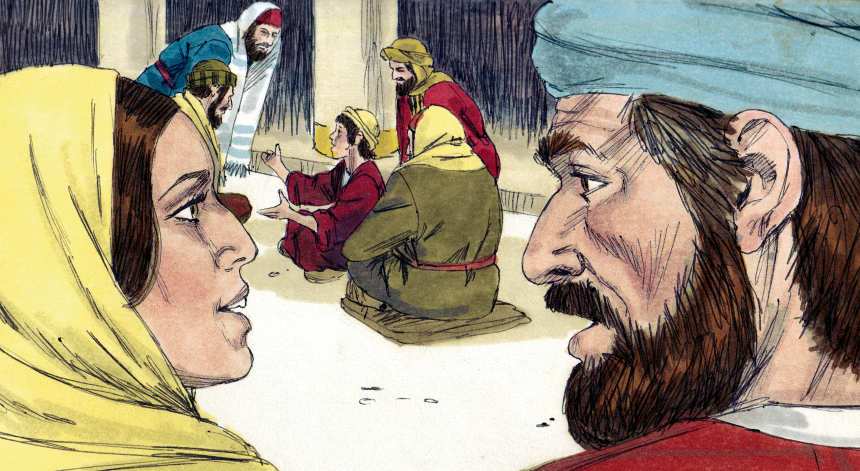
“The Finding in the Temple” is a coming of age story. At the age of 13, all Jewish boys would accompany their parents for the first time as a “genuine Israelite.” Each would then become a man, “one who goes up to the temple.” In Jesus’ time, the 13th year was anticipated by a year as a kind of preparation for the “big step” into adulthood.  Coming from a place like Nazareth, the boy from the country would have been dazzled by the splendor of the Temple with its colonnades, precious woods, unending polished steps, gold and silver candelabra. It would have been easy for him to wander away with other boys and become lost in it all.

His parents find him, we are told, easily conversing with learned men from the city whose manners, accents and clothing would have been intimidating to Jesus’ simple parents. And yet here was the country boy Jesus astounding the city people with the incisiveness of his questions and the wisdom of his answers. No doubt, the rural parents waited till they were out of earshot of their “betters” till they gave Jesus the dressing down they thought he deserved. The scolding may have lasted the entire three-day journey back to Nazareth.

His parents, we’re told in this morning’s reading, did not understand their son. We find out later on that the lack of understanding continued. At one point in Mark’s gospel, his mother and his siblings are described as thinking Jesus was out of his mind (Mk. 3: 34-35). This led to a formal estrangement between Jesus and his family. He more or less disowned them. When Jesus was told that his family has come to rescue him from his madness, he said in effect, “My mother – my family? That’s not who those people are. Instead, you (the outcasts, beggars, insurrectionists, prostitutes, unemployed, and ne’er do wells, who were his companions) – you are my real family, my real people.”

And yet today’s gospel concludes that Jesus went back to Nazareth with them. He advanced, Luke tells us in age and wisdom and grace before God and his neighbors. And that’s it. We hear no more about him for 20 years or so. He disappears. He becomes nobody.

And that brings me to the other part of today’s reflection – being a nobody. What does Jesus’ disappearance, his “hidden life,” tell us about the human condition?  According to our faith, Jesus was the full embodiment of God. Presumably, then, he had infinite power at his disposal. His world was as filled with problems as ours. There was Roman imperialism and the occupation of Palestine with its brutality, torture, rape, exploitation and oppression. There was political corruption among Jesus’ own people as the leaders of his time climbed into bed with the Romans. There was extreme poverty alongside obscene wealth. There was religious corruption. There was disease and ignorance.  And yet as far as the record is concerned, this embodiment of God did nothing.  For 97% of his life, Jesus did absolutely nothing!

Why? Do you think it might have been because, like us, he could do nothing significant about all those problems? And even when around the age of 30 he did finally emerge as a more or less public figure, what did he really do? He spoke some inspiring words, healed a few people, and worked some miracles that his contemporaries dismissed as parlor tricks. He provoked the authorities in a temple demonstration for religious purity and social justice, was arrested, tortured and executed as an insurrectionist.  That was pretty much it as far as his “public life” was concerned. Afterwards, the world pretty much continued as it had before his arrival.

I somehow find comfort in both Jesus’ family dysfunctions and in his “nobodiness.”  None of our families is perfect. Unexpected pregnancies, suspicions and jealousies dividing couples, financial struggles, problems with neighbors and gossip, displacement, lost and alienated children – it all seems about par for the course. I’m not even sure that Mary and Joseph didn’t wonder at times where they went wrong. There was a lot for them to process in their pillow talk as they saw their son hanging out with the wrong crowd, apparently losing his faith, and then getting into political problems they didn’t understand. My God, he finally ended up on death row! The black sheep of the family . . . .

And then there are our own little lives and their apparent lack of meaning. In the end, we’re nobodies, all of us. That’s what death makes apparent as we lose our physical form and minds and all that we worked for. We’re nobodies.  Few will remember us or think of us after we’re gone. We’re born, get married, have children, buy and sell a few items, and then die. And what became of all our hopes and dreams? What does it all mean?

Does it mean that it’s all O.K.; it’s all good? Does it mean “that’s life” – what it’s about? In fact, our vocation is to be precisely nobody instead of constantly striving to be Somebody. In the end, death discloses the truth about our vocation. It is the same as Jesus’ vocation. And that is to be open, faceless channels that disclose the presence of God in our very ordinary lives with their family dysfunctions and personal failures. It is to rise above such limitations or rather to use them to express the unbounded love of an apparently powerless God to those around us – especially to our family members who might not even understand.

What Then Can We Do? New Year’s Resolutions in the light of Jesus’ ‘Nobodiness’ (Sunday Homily)

resolution 1

Readings for “Holy Family Sunday”: SIR 3: 2-6, 12-14; PS 123: 1-5; COL 3: 12-21; MT 2: 13-15, 19-23. http://usccb.org/bible/readings/122913.cfm

Last week, a very good friend of mine wrote an appreciative note on this blog site. He said, “I’ve been stimulated by reading your blogs. They all call us to action, but how to act?”

On the last Sunday of the year – the feast of the Holy Family – the question invites reflections on New Year’s resolutions. The feast itself and today’s liturgy of the word help us by reminding us of Jesus’ “family values.” They were those of immigrants and political refugees. In that light, please allow me to suggest a few resolutions – and to invite readers to follow suit.

Let me begin by telling you about my friend. He’s a meditator and has always shown serious concern about social justice. He’s among the first to take the part of the disadvantaged and has given the rest of us good example in terms of sharing his resources with the poor. So I felt like writing back, “Just continue doing what you’re doing.”

Continue leading quietly by good example. Keep up your work for “Habitat for Humanity,” Stay the course helping that local undocumented family pay for their home. Knock on doors at election time – as you and I have done together in the past. Keep bothering Mitch McConnell and Rand Paul (our senators in Kentucky) with those phone calls I know you already make. Should they decide to throw their hats into the ring, support the candidacies of Elizabeth Warren, Bernie Sanders, or Jill Stein.

And above all, stick to your discipline of meditation with that group of like-minded people meeting each morning at 8:00 in Union Church. In fact, meditating together for peace and social justice might well be the most powerful thing you do in terms of following the path of the Enlightened Jesus which is the intended focus of my blogs and these Sunday homilies.

All of that might not seem like a lot to those (like my friend) specifically attempting to follow Jesus. I mean all of us would like to do more – something more spectacular that would yield immediate measurable results that we and everyone else would recognize as efficacious. We’d like to save the planet, eliminate poverty, and, bring about world peace.

But we can’t. That’s because in the end, we’re nobodies, and seem discouragingly powerless in the face of the evils of capitalism and militarism recently identified by Pope Francis as the principal causes of our world’s problems. Nonetheless, though their accompanying ideologies of greed and violence run entirely counter to gospel values, they’ve somehow been adopted by “Christians” as the way of Jesus. And that in itself, I know, is discouraging.

Jesus, I believe would find it so as well. He rebelled against the organized religion of his day. But strangely (like us) he seemed unable to do much about it. For instance, today’s gospel selection from Matthew portrays Jesus and his family as quintessentially powerless – as political refugees and immigrants. How much power do people like that have to change the world?

Jesus’ powerlessness and “nobodiness” is also evident from considering the long silent years he spent with his “Holy Family,” during what tradition calls his “hidden life.” As an adult, the former political refugee seemed impotent before the evils that continue to afflict our world.

Think about it. According to received interpretations, Jesus was the full embodiment of God. Presumably, then, he had infinite power at his disposal. His world was as filled with problems as ours. There was Roman imperialism and the occupation of Palestine with its brutality, torture, rape, exploitation and oppression. There was political corruption among Jesus’ own people as the leaders of his time climbed into bed with the Romans. There was extreme poverty alongside obscene wealth. There was religious corruption. There was disease and ignorance.

And yet as far as the record is concerned, this embodiment of God did nothing – until he was 30 years old, and then only for a year or possibly 3. For 97% of his life, Jesus did absolutely nothing that we know of!

Why? Do you think it might have been because, like us, he could do nothing significant about all those problems? And even towards the end, as a young 30-something, when he did finally emerge as a more or less public figure, what did he really do?

Yes, he was an activist. He sought justice for the poor and oppressed. He spoke some inspiring words, healed a few people, and worked some miracles that his contemporaries dismissed as parlor tricks. He provoked the authorities in a temple demonstration for religious purity and social justice, was arrested, tortured and executed as an insurrectionist.

But that was pretty much it as far as his “public life” was concerned. Afterwards, the world more or less continued as it had before his arrival.

I somehow find comfort in Jesus’ “nobodiness.” It offers solace to our own little lives and their apparent lack of meaning. In the end, we’re nobodies – all of us. That’s what death makes apparent as we lose our physical form and minds and all that we worked for. We’re nobodies. Few will remember us or think of us after we’re gone. We’re born, get married, have children, buy and sell a few items, and then die. What then became of all our hopes and dreams? What does it all mean?

Perhaps Jesus’ hidden life with Mary and Joseph assures us that it’s all O.K.; it’s all good. Maybe “that’s life” – what it’s about? We’re all called to be open, faceless channels that disclose the presence of God in our very ordinary lives with their personal limitations as far as the big picture is concerned. We’re called to rise above such limitations or rather to use them to express the unbounded love of an apparently powerless God to those around us – especially to our family members who might not even understand.

We’re called to do our best and leave the rest in God’s hands. To be more specific, accepting that reality of our human condition and doing our best in 2014 might include:

• In general, identifying (as Jesus’ family did) with the interests of political refugees and immigrants.
• Stopping our habit of looking to people at the top to solve our world’s problems.
• Considering vegetarianism as a measure against cruelty to animals on factory farms.
• Growing a garden and canning food.
• And/or signing up for local subscription agriculture deliveries.
• Going solar in every way possible.
• Staying out of the “big boxes” as much as we can.
• Being ready and willing to pay higher taxes and live closer to the ground after the world economy collapses when the effects of climate chaos catch up with us.
• Lobbying for an increase in the minimum wage and to increase Social Security benefits.
• Ceasing to support and honor the U.S. military. (Given U.S. wars of aggression and world projection of imperial force, work in the military does not constitute “right livelihood.”)
• Agitating in our local faith communities for the adoption of a liberation theology perspective like that recently articulated by Pope Francis in his exhortation, “Evangelii Gaudium.”

So what do you think?

What do you consider the most powerful action we might take to advance Jesus’ (and so many others’) program of justice, healing, and peace?

Please share your suggestions below.