(Sunday Homily) Black Lives, Muslim Lives Matter: Obama’s as Guilty as Wilson & Pantaleo

awlaki-killing-of-american

Readings for Second Sunday of Advent: IS 40:1-5, 9-11; PS 85: 9-14; 2 PT 3: 8-14; MK 1: 1-8. http://usccb.org/bible/readings/120714.cfm

Michael Brown, Eric Garner, and 12-year-old Tamir Rice. . . .

The very mention of those names calls to mind the protests that have filled our nation’s streets over the past week – in Ferguson Missouri, New York, Chicago, Los Angeles and places in between. The teenager, the father of six, and the sixth grade child represent deeply racist and unjust social structures where criminals and thugs masquerading as law enforcement officers have implicitly been granted a license to kill with impunity.

The nation-wide demonstrations on behalf of black and brown victims of the resulting “American” police state remind us that our country is decidedly on the wrong track. Like John the Baptist in today’s gospel excerpt, statements by New York’s Mayor de Blasio, Eric Holder, President Obama, and the U.N. special rapporteur on torture call us all to what the Greeks called metanoia – a drastic change of direction.

Ironically however that call to repentance is especially addressed to Messrs. Holder and Obama themselves. They, after all, find themselves in charge of a national and world-wide police state of which Mike Brown’s Ferguson and Eric Garner’s Staten Island represent merely the tip of an iceberg. The call to repentance invites all of us to apply pressure for profound systemic reform that far surpasses anything those “leaders” have in mind.

Today’s liturgical readings inspire such thoughts. Listen to the prophet Isaiah as he cries out for repentance and a restructuring of reality so intense that he imagines mountains being levelled and valleys filled. The point is to smooth the way for the advent of a profoundly non-violent God in our midst. The peace-filled change Isaiah envisions is not trivial.

Listen to Jesus’ mentor, John the Baptizer, as he echoes Isaiah word-for-word. (Needless to say, neither Isaiah’s nor John’s words have anything to do with the artificially excited anticipation of our culture’s Winter Festival and its orgy of selling, buying, and conspicuous consumption – even though “Christmas” deceptively continues to somehow associate itself with the homeless child from Nazareth.)

As a matter of fact, the cult of materialism and “Christmas cheer” couldn’t be more antithetical to sincere recollection of the birth of Jesus who had more in common with Mike Brown and Eric Garner than with the white middle-class culture Christmas celebrates.

More specifically, Jesus was the embodiment of nearly everything “good Christians” (presumably) like Officers Wilson and Pantaleo (the executioners of Brown and Garner) give evidence of despising.  After all, the working man from Nazareth was not only the poor son of an unwed teenage mother. He was an immigrant whose family took refuge in Egypt, the penniless friend of prostitutes and drunkards, and the prophet drummed out of his faith community as villain possessed by demons. He was the victim of torture and capital punishment who was treated as a terrorist by the reigning imperial power.

To the authorities of their day, both the Baptizer and Jesus even looked like Eric Garner and Michael Brown. Both were dark-skinned, either black or brown; they were not white men. Today’s gospel emphasizes how poorly John was dressed.

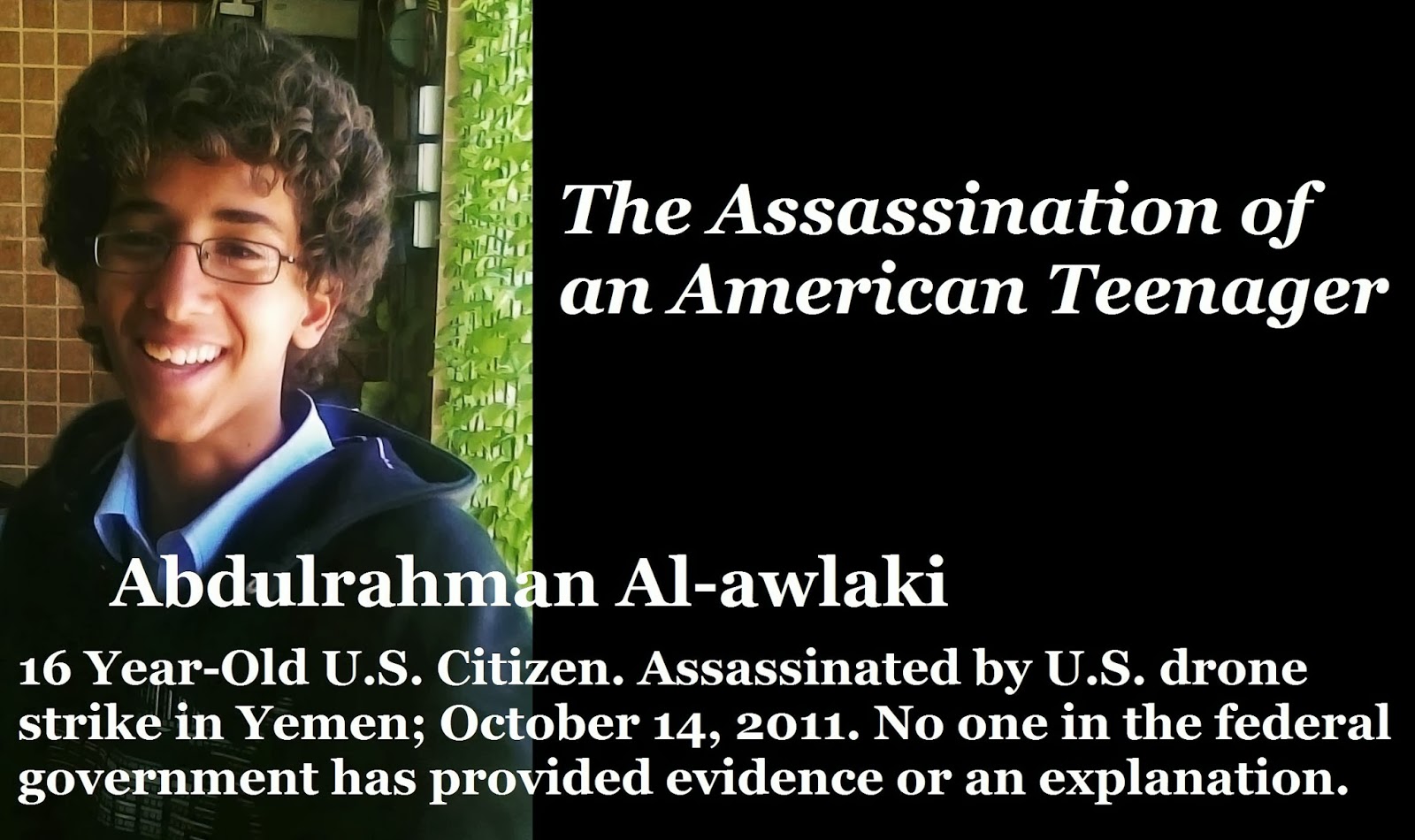
To repeat: during his life Jesus was impoverished, homeless, unemployed, accused of being subversive, placed on death row, and ultimately executed. As a Jew, he was considered as “other” and worthless to Roman authorities as Mike Brown was to Darren Wilson or Eric Garner to Daniel Pantaleo. He was as worthless as Abdulrahman Al-awlaki (pictured above) was to Barack Obama.

And that brings me to today’s real call to repentance.

It can’t merely be:

  • A superficial call to “trust” – an echo of Rodney King’s “Can’t we all get along?”
  • A reform of police culture
  • A de-militarization of police arsenals
  • A mandating of special independent prosecutors to handle incidents like those in Ferguson and Staten Island
  • Or even prosecution and conviction of police thugs like Wilson and Pantaleo

Instead, our nation has to address the root of the problem which is a world-wide policy of extra-judicial killings of racially-profiled Muslims and dark-skinned poor people. (That’s what a “signature strike” means as executed by drone “pilots.”)

Put otherwise, President Obama, Eric Holder and their minions are as guilty as Wilson and Pantaleo. All of them place themselves above the law. They kill with impunity those “others” they consider expendable. They answer to no one. They refuse to investigate much less prosecute such crimes.

John the Baptizer’s call to repentance summons us to publicize such guilt and completely withdraw support from the policies of the thug leaders of the world-wide U.S. police state.

That, I think, is what metanoia and repentance mean for “Americans” this particular advent.

(Sunday Homily) The Islamic Caliphate and the Final Judgment of “America”

Caliphate

Readings for the Solemnity of Our Lord Jesus Christ, King of the Universe: EZ 34: 11-12, 15-17; PS 23: 1-3, 5-6; I COR 15: 20-26, 28; MT 25: 31-46. http://www.usccb.org/bible/readings/112314.cfm

At the moment, I’m teaching a wonderful course at Berea College, REL 126. It’s called “Poverty and Social Justice” and qualifies as part of the “Religion Requirement” all Berea students must fulfill. The course is populated by 19 very smart and engaged, (mostly third and fourth year) students.

Part of our goal is to become literate about the problems of poverty and justice in our very confusing world. And that has us tuning in to “Democracy Now” each day. We’re getting involved with a powerful group of local activists, “Kentuckians for the Commonwealth” (KFTC). We attend the group’s meetings each month and have volunteered for KFTC activities like voter registration and mobilization.

Additionally, students have been researching burning issues including the war in Ukraine, the conflict in Palestine, voter suppression, police militarization, and the philosophy of Ayn Rand.

All of that has discussing the purpose of government. In that connection, students are finally getting clarity about what I consider THE fundamental political debate in our country: is the government’s role simply to provide infrastructure for commerce and to protect private property? Or is it to sponsor programs to directly help the poor who (unlike their rich counterparts) cannot on their own afford adequate food, shelter, clothing, health care, and education – even if they are working full-time?

For the last thirty-five years or so, the former view has carried the day in the U.S. So it has become fashionable and politically correct even (especially?) for Christians to advocate depriving the poor of health care to help them achieve the American Dream, “ennobling” the unemployed by removing their benefits, criminalizing sharing food with the poor, and “punishing” perpetrators of victimless crimes by routinely placing them in solitary confinement.

Today’s readings reject all of that. And they do so on a specifically political liturgical day – the commemoration of the “Solemnity of Our Lord Jesus Christ, King of the Universe.” Yes, this is a political liturgy if ever there was one. It’s all about “Lords” and “Kings” and how they should govern in favor of the poor. It’s about a new political order presided over by an unlikely monarch – a king who was executed as a terrorist by the imperial power of his day. I’m referring, of course, to the worker-rebel, Jesus the poor carpenter from Nazareth.

Today’s readings promise that the rebel – the “terrorist” – Jesus will institute an order utterly different from Rome’s. That order recognizes the divine nature of immigrants, dumpster-divers, those whose water has been ruined by fracking and pipe lines, the ragged, imprisoned, sick, homeless, and those (like Jesus) on death row. Jesus called it the “Kingdom of God.” It’s what we celebrate on this “Solemnity of Jesus Christ King of the Universe.”

(Btw: in the eyes of Jesus’ executioners, today’s commemoration would be as unlikely as some future world celebrating the “Solemnity of Osama bin Laden, King of the Universe.” Think about that for a minute!)

In any case, today’s readings delineate the parameters of God’s new universal political order. To get from here to there, they call governments to prioritize the needs of the poor and those without public power. Failing to do so will bring destruction for the selfish leaders themselves and for the self-serving political mess they inevitably cultivate.

Today’s first reading gets quite specific about that mess. There the prophet Ezekiel addresses the political corruption Lord Acton saw as inevitable for leaders with absolute power. Ezekiel’s context is the southern kingdom of Judah in the 6th century BCE. It found itself under immediate threat from neighboring Babylon (Iraq). In those circumstances, the prophet words use a powerful traditional image (God as shepherd) to inveigh against Israel’s pretentious potentates. In God’s eyes, they were supposed to be shepherds caring for their country’s least well-off.  Instead, they cared only for themselves. Here’s what Ezekiel says in the lines immediately preceding today’s first lesson:

“Woe to you shepherds of Israel who only take care of yourselves! . . . But you do not take care of the flock. You have not strengthened the weak or healed the sick or bound up the injured. You have not brought back the strays or searched for the lost. You have ruled them harshly and brutally.”

In other words, according to Ezekiel’s biblical vision, government’s job is to address the needs of the weak, the sick and the injured. It is to tenderly and gently bring back the wayward instead of punishing them harshly and brutally.

A great reversal is coming, Ezekiel warns. The leaders’ selfishness will bring about their utter destruction at the hands of Babylon.

On the other hand, Judah’s poor will be saved. That’s because God is on their side, not that of their greedy rulers. This is the message of today’s responsorial psalm – the familiar and beloved Psalm 23 (“The Lord is my shepherd. . . “)  It reminds us that the poor (not their sleek and fat overlords) are God’s “sheep.”  To the poor God offers what biblical government should: nothing but goodness and kindness each and every day. Completely fulfilling their needs, the divine shepherd provides guidance, shelter, rest, refreshing water, and abundant food. Over and over today’s refrain had us singing “There is nothing I shall want.” In the psalmist’s eyes, that’s God’s will for everyone – elimination of want. And so the task of government leaders (as shepherds of God’s flock) is to eradicate poverty and need.

The over-all goal is fullness of life for everyone. That’s Paul’s message in today’s second reading.  It’s as if all of humanity were reborn in Jesus. And that means, Paul says, the destruction of “every sovereignty, every authority, every power” that supports the old necrophiliac order of empire and its love affair with plutocracy, war and death instead of life for God’s poor.

And that brings us to today’s culminating and absolutely transcendent gospel reading. It’s shocking – the most articulate vision Jesus offers us of the basis for judging whether our lives have been worthwhile – whether we have “saved our souls.” The determining point is not whether we’ve accepted Jesus as our personal savior. In fact, the saved in the scene Jesus creates are confused, because their salvific acts had nothing to do with Jesus. So they ask innocently, “Lord, when did we see you hungry and feed you, or thirsty and give you drink?  When did we see you a stranger and welcome you, or naked and clothe you?  When did we see you ill or in prison, and visit you?”

Jesus’ response? “Amen, I say to you, whatever you did for one of the least brothers of mine, you did for me.”

But more than personal salvation is addressed here. Jesus homage to Ezekiel’s sheep and shepherd imagery reminds us of judgment’s political dimension. So does Jesus’ reference to the judge (presumably himself) as “king.” And then there’s the church itself which centralizes this climactic scene precisely on this Solemnity of Jesus Christ King of the Universe. All three elements say quite clearly that “final judgment” is not simply a question of personal salvation, but of judgment upon nations and kingdoms as well. To reiterate: in Matthew’s account, the final judgment centralizes the political.

And what’s the basis for the judgment on both scores? How are we judged as persons and societies? The answer: on the basis of how we treated the immigrants, the hungry, ill-clad, sick, and imprisoned.

On that basis, Jesus’ attitude towards the United States as earlier described ought to be quite clear. It’s the same as Ezekiel’s when he predicted the destruction of Israel at the hands of Iraq:

“Depart from me, you accursed, into the eternal fire prepared for the devil and his angels. For I was hungry and you gave me no food, I was thirsty and you gave me no drink, a stranger and you gave me no welcome, naked and you gave me no clothing, ill and in prison, and you did not care for me.”

Ironically enough that “fire prepared for the devil and his angels” is today being stoked in Iraq just as it was in the days of Ezekiel. This time the Babylonians call themselves the Islāmic Caliphate.

As Ezekiel might say, “You read it here first.”

(Sunday Homily) Happy Day of the Dead: Remembrances & Prayers

Day of Dead

Readings for the Commemoration of All the Faithful Departed (All Souls): WIS 3:1-9; PS 23:1-6; ROM 5: 6-11; JN 6: 37-40. http://usccb.org/bible/readings/110214.cfm

Today is the feast of All Souls – or as they call it in Latin America, the “Day of the Dead.” In Mexico, the commemoration of “the faithful departed” is really a triduum that begins on Halloween, proceeds through the Feast of All Saints (Nov. 1st) and finishes today with “All Souls Day” (Nov. 2nd).

In Mexico there are parades and costumes, and skeleton manikins dressed up in silks and finery. In a mocking, light-hearted way, the day reminds everyone of the shortness of life, the impermanent nature of pleasure, prestige, profit and power, and the inevitability of our own fast-approaching demise.

Since death is inevitable and an integral part of life, the Day of the Dead invites us all – “believers” or not – to recall those who have gone before us to “rest in the sleep of peace” and to ready ourselves for The Great Transformation by looking death square in the face.

So to begin with, think about your own loved ones who have passed away. No doubt, there’s some pain in doing that. After all, we loved them. In those terms, today I’m thinking especially of a dear friend and mentor of mine, Glen Stassen. He died unexpectedly this last year. He was a great scholar, teacher, author and peace activist. He taught me so much. And then there are those public figures – like Pete Seeger, Maya Angelou and Robin Williams – whom we all recently lost.

We miss people like that. Nonetheless, death does not wound us without at the same time offering new understandings and appreciations of the ways the lives of those loved ones continue in and around us. In some sense, the ripples of their stories have influenced not only us, but the entire universe.

That’s especially true of the mother and father figures in our lives (not always our biological parents, of course).

Allow me to set the tone by recalling (and honoring) my own parents for a moment.

I am fortunate to be able to identify my original Gift-Givers as my actual mom and dad – Edith and Ray Seul. I owe so much to them and the innumerable ways their lives and deaths have made me and my three siblings what we are. They were wonderful parents – not perfect to be sure – but wonderful all the same.

I think of my mother as my spiritual teacher. She was lovely and gentle, light-hearted, but at the same time quite serious about doing the right thing. Above all her simple faith governed her life. She was a convert to Catholicism having been brought up a Swedish Lutheran – as Edith Swanson. And while she was serious about being Catholic, she somehow made it clear that Protestants were O.K. too. Along with my female grade school teachers (the faithful Sisters of St. Joseph) mom’s example started me on the path to the priesthood and to ecumenical thinking. I love her for that.

I think of my dad whom I had the privilege of attending full time during the final weeks of his life. Dad was strong, a truck driver, and fun-loving. His brothers say he was a wild street-fighter in his youth. But then (they’d joke) he met my mother and she “made a man of him.” That’s how they put it.

Like my mother, Dad took his faith quite seriously too. He was a member of the Holy Name Society and went on spiritual retreats several times, I recall. He brought us back medals and “holy cards.” Dad clearly wanted to live a good life. That was true to such an extent that when I left the priesthood and decided to marry my wife, Peggy, he chose not to come to our wedding. I’m convinced it was a matter of conscience for him. Peggy and I would be living in sin, he thought, and he could not appear to give his approval. None of that however prevented him from later accepting Peggy and loving her.

Yes, I’m grateful for my parents. I love them, and miss them. Not a morning passes without my offering prayers of thanksgiving for mom and dad. So on this Day of the Dead, my mind is filled with nostalgia (rather than sadness) over their loss.

The Day of the Dead also brings that urgency I mentioned earlier – around my own fast-approaching death and the need I feel to use these declining years to make my contribution to a world careening towards disaster as never before. It’s also a time for imagining what awaits me after I breathe my last.

For the past few years the great fifth century mystic, Augustine of Hippo, has helped me think about death, its process and what comes after. He wrote a very long sentence I’ve found so helpful in thinking about death that I’ve committed it to memory and often use for meditation. Here’s what Augustine said. See if his words help you:

Imagine if all the tumult of the body were to quiet down, along with all our busy thoughts about earth and sea and air; if the very world should stop, and the mind stop thinking about itself, go beyond itself, and be quite still;

if all the fantasies that appear in dreams and imagination should cease, and there be no speech, no sign:
Imagine if all things perishable grew still – for if we listen they are saying, “We did not make ourselves; he made us who abides forever” – imagine then, that they should say this and fall silent, listening to the very voice of the one who made them and not to that of God’s creation;

So that we should hear not his word through the tongues of men, nor the voice of angels, nor the clouds’ thunder, nor any symbol, but the very Self which in these things we love, and go beyond ourselves to attain a flash of that eternal wisdom which abides above all things:

And imagine if that moment were to go on and on, leaving behind all other sights and sounds but that one vision which ravishes, absorbs, and fixes the beholder in joy; so that the rest of eternal life were like that moment of illumination that leaves us breathless:

Would this not be what is bidden in scripture, “Enter thou into the joy of thy Lord?

So that’s what happens in death, is it? The end of the world – bodily sensations, thought, and fantasies; great stillness within and without; no sound from human voice or nature itself; but immersion in wisdom, light and breathless joy. That’s what awaits us. At least Augustine thought so.

How different (and so much more consoling) is that vision from what I once anticipated in terms of “the last things” as so wonderfully, but (for the naïve) misleadingly expressed in Dante’s immortal Divina Comedia: death, judgment, heaven, hell. I can no longer believe that as literally as I once did. In fact, I’m persuaded to make my own the prayer of a medieval mystic. (This is another passage I use for my meditations):

Lord, if I love you because I desire the joys of heaven, close its gates to me. And if I love you because I fear the pains of hell, bury me in its depths. But if I love you for the sake of loving you, hide not your face from me.

The mystic’s prayer is a rejection of the childish, hedonistic, and self-interested beliefs about the after-life that I was brought up on. It’s an embrace of the mystical vision that recognizes harmony with God (or Ultimate Reality, the Ground of Being, or Nature with a capital “N”) as the purpose of life. All those other goals (pleasure, profit, power, prestige), I’ve found, are empty and quite misleading.

That learning was reinforced in India last year during our four months in Mysore. The idea of reincarnation, I learned, is not far-fetched and is in some way supported by the theory of evolution. And so on this Day of the Dead, I make my own the prayer that my meditation teacher, Eknath Easwaran recited on his own death bed – once again using the personal term “Lord” to address the mysterious Origin of the things that matter: Life and Love:

Lord, fill my heart with love and devotion for you. And burn out the seeds of selfish desire and sense craving from my mind. Grant that I might be carried by you from this life to the next without suffering, and that I might be born into a holy family with my hear overflowing with love and devotion to you from my earliest childhood onward.

I want that to be my prayer on my death bed.

There’s a final thought I’d like to share with you on this day of the dead – this one from the great American poet, Stanley Kunitz. “The Long Boat” is a poem that reminds me strongly of my father in law, Bob duRivage, who was a sailor and (in my opinion) a sage, and a saint. He loved life and left this world reluctantly. Because of its sailing theme and the poem’s last line, I committed it to memory in Bob’s honor. Because the poem is about death, I hope (on this Day of the Dead) that it may also you think deep thoughts about your own approaching demise and make decisions accordingly:

When his boat snapped loose
from its mooring, under
the screaking of the gulls,
he tried at first to wave
to his dear ones on shore,
but in the rolling fog
they had already lost their faces.
Too tired even to choose
between jumping and calling,
somehow he felt absolved and free
of his burdens, those mottoes
stamped on his name-tag:
conscience, ambition, and all
that caring.
He was content to lie down
with the family ghosts
in the slop of his cradle,
buffeted by the storm,
endlessly drifting.
Peace! Peace!
To be rocked by the Infinite!
As if it didn’t matter
which way was home;
as if he didn’t know
he loved the earth so much
he wanted to stay forever.

(Sunday Homily) Usury More Clearly Contradicts God’s Law than Abortion!

Usury

Readings for 30th Sunday in ordinary time: EX 22: 20-26; PS 18: 2-4, 47, 51, I THES 1:5C-10; MT 22: 36-40. http://www.usccb.org/bible/readings/102614.cfm

Today’s readings raise the question of usury – a word we don’t often hear today, though its reality is part of the air we breathe.

Wikipedia defines usury as: “. . . the practice of making unethical or immoral monetary loans intended to unfairly enrich the lender. A loan may be considered usurious because of excessive or abusive interest rates or other factors, but according to some dictionaries, simply charging any interest at all can be considered usury.”

In the light of that definition, consider the following:

• Last Sunday’s New York Times editorial addressed President Obama’s proposal that interest rates on loans to veterans be capped at 36 percent. The editorial began by saying that “poor and working-class people across the country are being driven into poverty and default by deceptively packaged, usuriously priced loans.” The NYT editorial board argued that the 36 percent interest cap should be extended to all U.S. citizens. Thirty-six percent!

• The same editors reported a case where “. . . (A) South Carolina lender gave a service member a $1,615 title loan on a 13-year-old car and charged $15,613 in interest — an annual rate of 400 percent — without violating federal law.”

• Despite such surprises, Wednesday’s NYT edition ran another story headed “States Ease Interest Rate Laws that Protected Poor Borrowers.” It reported that lenders such as Citigroup, One Main, Springleaf, and the American Financial Services Association claim a need to increase interest rates on their poorest customers in order to keep their rates in line with their own increased business expenses for rent, electricity, and gasoline.

• Meanwhile the prime interest rate for bankers and corporate high rollers is 3.25 percent.

• Last June U.S. Senate Republicans shot down Elizabeth Warren’s Bank on Students Emergency Loan Refinancing Act. The bill would have allowed people with federal and private debt to refinance their loans at 3.86 percent. That would have given relief to more than 25 million borrowers owing $1.2 trillion in student loans. The GOP objected partly because the Refinancing Act would have created a new tax on millionaires to offset the lower interest rates.

The practices just described raise the question: how much interest can be charged before the rate becomes usurious? Today’s liturgy of the word suggests an answer.

Begin with a consideration of today’s gospel.

There Jesus is asked a question consistently addressed to rabbis and to wise persons in all traditions. “Which is the greatest of God’s commandments?”

The question is reminiscent of the familiar cartoon where the bedraggled seeker climbs up that mountain, confronts the guru sitting in front of his cave and asks him, “What’s the purpose of life?” That’s really the gist of the question presented to Jesus. What is life’s purpose?

Jesus’ response is not humorous as we’re always led to expect from those cartoons. His answer is not even surprising. Instead, it’s the standard one usually given by rabbis and wise people: “Look within,” he advises. “Find Ultimate Reality and devote yourself entirely to it. And then love that Reality’s every manifestation beginning with the people closest to you and finishing with the trees, soil, rocks, and cockroaches.”

That’s the meaning of Jesus’ response in today’s gospel. It mirrored perfectly the answer, for instance, of Rabbi Hillel, one of Jesus’ near contemporaries. Both of them said, “Love God with all your heart, mind, and spirit – and your neighbor as yourself. That’s the greatest commandment,” they agreed. “That’s the purpose of life. That summarizes all the content of humanity’s Holy Books. All the rest is commentary.”

We get a snippet of that commentary in today’s first reading from the Book of Exodus, which supplies practical content to the general answer about life’s purpose invariably given by the wise. (And it’s here that the business of interest enters the picture.) Today’s 16 line excerpt from Exodus focuses on two issues: (1) treatment of the most vulnerable in the community, and (2) prohibition of taking interest on loans. The two matters are intimately connected in a world where the poorest among us suffer from crushing debt as earlier described.

The reading says that loving God and neighbor means taking care of society’s most vulnerable – beginning with immigrants and including single mothers and street children. Reality decrees that mistreatment of people like that will bring karmic consequences and death by an invading enemy.

The reading goes on. When dealing with immigrants, remember you were once in their position. So treat them the way you would have liked your great-grandmother to have been treated when she arrived at Ellis Island from the Old Sod.

The second part of the Exodus reading addresses the most common instrument oppressors employ for mistreating society’s vulnerable. You guess it: it’s usury and debt.

You might have been surprised to read that God’s Covenantal Law as recorded in the Bible prohibits the taking of interest at all. The Law indicates that God considers usury (or any interest) sinful! It’s a form of “extortion,” Exodus says – meaning, as the dictionary explains, the “criminal offense of obtaining money, property, or services from a person, entity, or institution, through coercion.” The definition goes on to say that extortion is commonly practiced by organized crime.

For more than a millennium, moral theologians within the Church that developed following Jesus’ death agreed with our dictionary. Under pain of sin (as they put it), no interest could be charged on loans.

But then modern economists discovered the wonders of compound interest. That changed everything. Suddenly, charging interest became not only moral, but virtuous – including for Christians! Even the Vatican owns a bank whose underlying foundation is interest!

So times have indeed changed. Currently, moralists explain that the modern science of economics now understands what was not grasped in the ancient world of Exodus. So, morality had to change to keep up with the times and the advances of science. It’s a new world. (Hmm . . . . Does that same reasoning apply to matters such as homosexuality in relation to the insights of the modern science of psychology? And what about abortion and what modern medicine has disclosed about the beginnings of specifically personal life? After all, the Bible has this clear and strong teaching about prohibiting interest and says nothing at all about abortion.)

The suggestion here is that if we kept The Commandments as explained by Jesus and all the world’s great spiritual teachers:

• We’d prioritize concern for the welfare of immigrant children on our border, single moms in run-down neighborhoods, and street children everywhere. Their welfare, Jesus says, is identical with our own.

• We’d realize that the ability of immigrants, widows, and orphans to meet their transportation, rent and electricity bills is in God’s eyes more important than similar abilities on the part of Citigroup, One Main, Springleaf, or the American Financial Services Association.

• We probably wouldn’t support interest of any amount. (Certainly an interest rate of 36 percent would be out of the question, not to mention 400 percent.)

• At the very least, we’d demand that student loans would be refinanced at the prime rate.

• We probably wouldn’t support “capitalism” as we know it.

• We’d make usury as important a “Christian issue” as some make abortion.

• We’d hear about that from the pulpit, at least occasionally.

• We’d vote accordingly.

After all, an unmistakable critique of usury is actually found in the Bible. That’s not the case with abortion.

(Sunday Homily) U.S. Doublespeak Is More Threatening to the World than ISIS or Khorasan

uncle-sams-lies

Readings for 26th Sunday in ordinary time: EZ 18:25-28; PS 25: 4-5, 8-10, 14; PHIL 2: 1-11; MT 21: 28-32 http://www.usccb.org/bible/readings/092414.cfm

If I were you, I’d be careful about air travel. That’s because, as the President reminded us last week, the enemies we’ve so fiercely created over the last 13 years are plotting to blow U.S. commercial aircraft out of the skies. So one of these days Khorasan’s heat-seeking missiles will find the rear end of your plane, and that will be the end of you.

And, when you think about it, those firing the rockets will be justified in doing so. That is, if we allow them to apply the insane logic behind Mr. Obama’s latest justification for bombing his seventh Muslim country in six years.

In doing so the Nobel Peace Prize laureate said last week, “Once again, it must be clear to anyone who would plot against America and try to do Americans harm that we will not tolerate safe havens for terrorists who threaten our people.”

Wait a minute!

Our “leader’s” logic (if we universalize his pronouncement) has just endorsed an endless cycle of violence that should be completely unacceptable to any human being — not to say any Christian. His words mean that anyone who plots against another country trying to do their citizens harm can claim no safe haven. They will be subject to reprisal.

Tell that to drone victims and to Syrians who lost their children in last week’s bombings – or to similar casualties at weddings and funerals in Afghanistan, Iraq, Libya, Pakistan, Yemen, and Somalia. The President’s doublespeak logic allows them to say, “Once again it must be clear to the Americans plotting against us and trying to do our citizens harm that we will not tolerate safe havens for such terrorists who threaten our people. There will be reprisals.”

That means that the militants in the countries just mentioned can legitimately respond to the terrorism of drone and outright bombing attacks with similar assaults on American citizens in our own “homeland.”

So as I say, hold your breath on your next airline trip to Miami or New York. The blowback is coming – and the blowback to that blowback too.

Such are the realities of Eternal War.

It’s that sort of damned logic (I’m choosing my words) that is addressed in today’s liturgy of the word. It’s not at all comforting.

The first reading from the prophet Ezekiel sets the tone. It underlines what Easterners call the Law of Karma. Ezekiel says that people die because of their wicked deeds. He says, “When someone virtuous turns away from virtue to commit iniquity, and dies, it is because of the iniquity he committed that he must die.” That’s karma. It’s an inescapable law of the universe.

St. Paul put it this way, “Do not be deceived, God is not mocked; for whatever a man sows, this he will also reap.” (GAL 6:7-9). Relative to war, Jesus was even more pointed. He said all those who live by the sword will die by that same instrument (MT 26:52). It’s all karma.

As citizens of a nation that lives by the sword more than any other in world history, what then are we to do? Here, once again, today’s readings supply an answer. We must abandon the destructive path we’re on. That’s what Ezekiel says. Speaking of the potential recipient of negative karma, Ezekiel promises, “But if he turns from the wickedness he has committed, he does what is right and just, he shall preserve his life; since he has turned away from all the sins that he has committed, he shall surely live, he shall not die.” That too is karma.

In other words, to avoid the negative consequences of our actions, we must change course radically. More specifically today’s gospel selection addresses that imperative to political leaders. It calls them to make their actions correspond to their words.

Yes, today’s gospel is addressed to leaders like our president and congresspersons. There Jesus addresses those in power and tells the local rulers of his day (“the chief priests and elders”) a parable about lip service and the required change of direction. (Remember, in Jesus’ context there was no sharp distinction between religious and civil government.)

“A man had two sons,” the Great Teacher tells these government officials. “He came to the first and said, ‘Son, go out and work in the vineyard today.’ He said in reply, ‘I will not, ‘ but afterwards changed his mind and went. The man came to the other son and gave the same order. He said in reply, ‘Yes, sir,‘ but did not go. Which of the two,” Jesus asks, “did his father’s will?”

The chief priests and elders answer,”The first.”

Jesus said to them,”Amen, I say to you, tax collectors and prostitutes are entering the kingdom of God before you.”

I’m sure you see that Jesus’ parable is about governmental lip service and deception. The parable calls them to radical change in policy. Jesus implies that the leaders of his day were like the first son. They said the right things, but their actions belied their words. As a result, their deeds excluded them from the New Order (God’s Kingdom) which was always the focus of Jesus’ revolutionary discourse.

And that brings us back to our own leaders and the differences between what they say and do. Think of the events of recent weeks – even last week. During that time our leaders have:

• Paid lip service to national boundaries in the case of Russia and Ukraine, but then have claimed that national boundaries are irrelevant in their own “war on terrorism.”
• Paid lip service to international law – again in the case of Russia and Ukraine, but then ignored that law by going to war with ISIS without the required U.N. resolution.
• Paid lip service to civilization and decency in decrying ISIS’ brutal beheadings (by knife) of innocent civilians, but then beheaded literally untold others via drones and direct bombings. (Yes, drones and bombs inevitably blow heads off bodies.)
• Paid lip service to the human rights of civilians brutalized by ISIS, while ignoring the million and a half civilians their own armed forces have just as brutally killed in Iraq and Afghanistan.
• Paid lip service to nuclear non-proliferation in their demands upon Iran, but then have pledged billions to modernize their own overwhelming nuclear arsenal.
• Paid lip service to environmental protection (following last Sunday’s “People’s Climate March”), but the very next day implicitly embraced the possibility of “nuclear winter” through that same weapons modernization program.

Of course, there are many more examples of our leaders’ saying one thing and doing the opposite. In fact, their lies come so thick and fast that confusion and weariness results on the part of listeners. Our leaders’ honeyed words accompanied by unspeakably cruel acts paralyze us from taking action against or even recognizing in our own country a world force that is far more destructive than ISIS, Khorasan, or al-Qaeda. In the words of Noam Chomsky, the latter represent “retail terrorism,” while the U.S. “network of death” (with bases all over the world) embodies “wholesale terrorism” that is far more evil and destructive.

I believe that danger of confusion and consequent inaction is why Jesus shocked his opponents by saying simply, “Amen, I say to you, tax collectors and prostitutes are entering the kingdom of God before you.”

That would be as scandalous to Jesus’ audience as if he said to President Obama and John McCain, “Amen, I say to you, ISIS, Khorasan and al-Qaeda will enter God’s kingdom before you.”

What does that mean for us who are attempting to follow the Way of Jesus and are trying to be part of his Kingdom revolution? It means that we must realize that:

• Perpetual war contravenes the teachings of Jesus who taught us to love our enemies.
• Our “leaders” (just like the priests and elders of Jesus’ day) are liars to the core.
• The United States is (in the words of Dr. King) the “greatest purveyor of violence in the world.”
• That the retail terror and brutality of ISIS pales in comparison with the wholesale terror the United States inflicts on the world’s poor.
• That we must work and pray every day for the defeat of the United States in its endless, genocidal wars.

Believe me: that defeat is coming. Better yet, believe Ezekiel. It’s the law of karma.

(Sunday Homily) Listen to ISIS and Stop Committing Suicide!

steven sotloff

Readings for 23rd Sunday in Ordinary Time: EZ 33: 7-9; PS 95: 1-2, 6-9; ROM 13: 8-10; MT 18: 15-20 http://usccb.org/bible/readings/090714.cfm.

We’ve met the enemy and it is us!

Indeed! Over the past number of weeks, we’ve been introduced to the Islamic State in Iraq and Syria (ISIS). Its militants seem to have somehow appeared from nowhere.

However, as Tom Engelhardt has pointed out, they actually represent the largely Sunni blowback from U.S. policies over the last 13 years. In fact, ISIS would not exist were it not for the United States.

Think about it. ISIS is the direct result of:

• The U.S. invasion of Afghanistan and its over-the-top, loosely-target response to 9/11.
• The 2003 criminal occupation and destruction of Iraq.
• The thoughtless dismantling of Saddam Hussein’s army with its largely Sunni command structure (which is now directing ISIS).
• The crimes of Abu Ghraib, Fallujah, Haditha, and other massacres perpetrated by barbaric elements in the U.S. military.
• The more than one million Iraqis who have lost their lost their lives as their country has been systematically pulverized by bombings, white phosphorous, and the nuclear waste called “depleted uranium.”
• Former President Bush and Vice President Cheney bragging about ordering the war crimes of water boarding and other forms of torture.
• U.S. soldiers urinating on the bodies of Iraqi insurgents and on copies of the Holy Koran.
• The horrors of the film clip, “Collateral Murder” released by Chelsey Manning.
• Drone strikes across the world in Afghanistan, Iraq, Pakistan, Somalia, Yemen and elsewhere routinely killing women and children, revelers at weddings and mourners at funerals.
• Blind U.S. support of Israel’s pogrom aimed at “the Jews’ Jews” concentrated in the world’s largest open-air prison camp called Gaza.

Such horrendous provocations make it entirely possible for ISIS leaders to echo the words solemnly intoned by President Obama last week in response to their movement’s brutal beheading of journalist Steven Sotloff. ISIS leaders might well have said:

“We will not be intimidated. Those who make the mistake of harming Muslims will learn that we will not forget and that our reach is long and that justice will be served . . . such horrific acts only unite us as movement. . . ISIS will continue to lead the battle against the kind of barbaric and empty vision that the United States represents. We will degrade their forces and destroy them completely.”

In fact, the whole ISIS phenomenon and the response it has evoked only illustrate the senselessness of any strategy of revenge and fatuous, doomed attempts to solve conflict by the unapologetic use of military first response to violence perpetrated against “Americans” or Muslims.

A different way of responding is outlined for followers of Jesus’ Way in today’s liturgy of the word. It might seem idealistic and perhaps even unrealistic in the face of ISIS. But give it a chance.

In today’s gospel reading, Matthew the Evangelist addresses the problem of conflict resolution. He emphasizes dialog not revenge and violence. In fact, he outlines four alternatives towards resolving disputes. He has Jesus say that if step one doesn’t work, move on to the subsequent strategies. The four alternatives include (1) healing conversation with one’s adversary, (2) arbitration with a mediator or two, (3) consultation with the entire community, and (4) shunning the offending party.

More specifically, Matthew has Jesus say, “If your brother sins against you, go and tell him his fault between you and him alone . . . If he does not listen, take one or two others along with you, so that ‘every fact may be established on the testimony of two or three witnesses.’ If he refuses to listen to them, tell the church. If he refuses to listen even to the church, then treat him as you would a Gentile or a tax collector.”

Obviously, these words did not come from Jesus himself. To begin with, there was no “church” at Jesus’ time. Jesus was thoroughly Jewish and a reformer of Judaism rather than the founder of some new religion or “church.”

It was different for Matthew who was writing for a community of specifically Jewish Christians some fifty years after Jesus’ death. By then, questions of community order within the emerging church had become prominent. So Matthew invents this saying of Jesus to deal with them.

Another reason for reaching this conclusion is the reference to treating a recalcitrant individual “as you would a Gentile or a tax collector.” This phrase reflects traditional Jewish avoidance of Gentiles and hatred of Roman collaborators. It runs counter to the practice of Jesus who time and again in the Gospels causes scandal by practicing table fellowship and community with the very people Matthew’s instruction indicates are outsiders to be shunned by believers.

Were Matthew following the Spirit of Jesus, the evangelist’s instructions for addressing conflict resolution might involve the following process: (1) private dialog with one’s adversary, (2) arbitration with a mediator or two, (3) consultation with the entire community, and (4) moving in with the offending party – or at least taking them out for dinner regularly.

In any case, the emphasis in Jesus’ own approach is communion, not shunning or refusal to talk. Nowhere does Jesus’ approach say that one should refuse meeting until the offending party stops offending. Much less does the process outlined include “if he refuses to listen, shoot him, cut his head off, or kill his family.”

“But,” you object, “The words attributed to Jesus in today’s gospel selection are about church order, not about international politics, much less the barbarity of a movement like ISIS. Jesus’ instruction, you might say, is about private disputes among Christians and are laughably impractical in the political sphere.

And that’s just my point. To repeat: Matthew’s account does not reflect the teaching or practice of Jesus. Jesus’ actual teaching was not confined to the private realm. His practice was highly political.

Eating with tax collectors, street walkers, lepers, Pharisees, Gentiles (including members of the Roman army) represented doing the unthinkable, the unexpected, the forbidden. . . . It meant crossing boundaries, breaking taboos, acting counter-culturally, and offending people on all sides of sizzling debates.

This is what the example of Jesus calls us to do even in the case of ISIS. Its emergence calls for departure from business as usual. It requires admission of guilt and responsibility on the part of the United States. It demands a complete reversal of “American” policy.

Today’s second reading from Paul’s letter to the Christian community at Rome puts a finer point on the reasons for such response on the part of those pretending to follow the teachings of Jesus.

Paul reminds us of Jesus’ summary of God’s law. He writes:

“Brothers and sisters: Owe nothing to anyone, except to love one another; for the one who loves another has fulfilled the law. The commandments, ‘You shall not commit adultery; you shall not kill; you shall not steal; you shall not covet,’ and whatever other commandment there may be, are summed up in this saying, namely, ‘You shall love your neighbor as yourself.’ Love does no evil to the neighbor;
hence, love is the fulfillment of the law.”

Emmanuel Levinas helps us understand that Jesus’ teaching on neighbor love is much more radical than commonly accepted. Loving your neighbor as yourself, Levinas says, does not mean “Love your neighbor because s/he is like you.” No, according to Levinas, it means, “Love your neighbor as yourself, because s/he is you.”

In other words, there is no meaningful distinction between you and any other human being you care to name – even if we call them “terrorists.” Moreover, if you shared the same history as your “enemy,” you would be doing exactly the same thing that currently enrages you. As a result, no killing can be justified. It is suicide. That’s the thrust of Jesus’ words: to kill the other is to kill yourself. Killing of any kind is suicide.

What does that mean for followers of Jesus’ way as we try to respond to the ISIS phenomenon? At least the following, I think:

• Facing the fact that the ONLY REASON for our Middle Eastern policy and wars is oil, and doing everything necessary to wean our lives away from dependence on fossil fuels.
• Realizing that we cannot expect politicians like President Obama to initiate any other policy than revenge as if the U.S. were principled, civilized, innocent, and pure before an enemy that is completely unlike us.
• Nonetheless demanding that our officials absolutely reverse course, recognize responsibility for the emergence of ISIS, and establish dialog with their leaders.
• Refusing to allow our children to serve in an armed force that commits ISIS-like crimes on a wholesale scale.
• Imagining what would happen if even a quarter of our country’s 160 million people who claim to be Christian refused the self-destruction the words of Jesus and Paul imply.

For Christ’s sake, do the unthinkable. Hard as it might be: listen to ISIS. Reverse course. Put a stop to our collective suicide!

Sunday Homily: The Ayatollah Was Correct: the U.S. IS “the Great Shaytan”

Ayatollah

During the 1979 Islamic revolution in Iran, the West became aware of Muslims’ profound mistrust of the United States. The Ayatollah Khomeini repeatedly referred to “America” as “the Great Satan.” Today’s liturgy of the word suggests that the Ayatollah’s reference was spot on. The United States is indeed the Great Satan leading the world astray with its beliefs for instance that limitless wealth brings happiness, that bombing can be a humanitarian act, and that “fearing for our lives” justifies killing others.

As we’ll see in today’s readings, such beliefs are ‘satanic” both in the eyes of Jesus and of the Great Prophet Mohammed. In the United States, their infernal results are on display in each morning’s headlines where:

• The rich and famous end their lives in despair
• The U.S. bombs and drones to save the Yazidis in Iraq (or Libyans in Libya, Afghans in Afghanistan, Ethiopians in Ethiopia . . .)
• Police killings are uniformly justified by the claim “I feared for my life.”

I raise the issue because the term “Satan” is prominent in today’s gospel reading. There Jesus uses it in contrast to his own beliefs about life’s divine purpose which turns out to be incompatible with dominant western beliefs. According to both Jesus and Mohammed, life’s purpose is not to accumulate riches. Nor is life rendered meaningful by killing others even to save one’s friends. Neither do Jesus’ followers have the mandate to protect their own lives at any cost. Quite the opposite!

What is life about then? Consider Jesus’ answer in this morning’s gospel reading.

There Jesus uses the epithet “Satan” to refer to the leader of his inner circle of twelve. In Jesus’ eyes, Peter merits the name because he misunderstands what life is for. That’s shown by the fisherman’s efforts to dissuade the Master from following his divine “prophetic script.” For Jesus, that pattern would require him to lose his life for speaking truth to power. As we’ll see, using such speech in an effort to change the world – to bring on God’s Kingdom – turns out to be central to Jesus’ understanding of life’s purpose.

In any case, like the prophet Jeremiah in today’s first reading, God’s spirit has put Jesus out of control. So, like Jeremiah, he feels compelled by an inner fire to speak the truth, whatever its cost. As the earlier prophet had put it, God’s truth “becomes like fire burning in my heart, imprisoned in my bones; I grow weary of holding it in; I cannot endure it.”

So in today’s reading Jesus “began to show his disciples that he must go to Jerusalem and suffer greatly from the elders, the chief priests and the scribes and be killed and on the third day be raised.”
Peter objects. “God forbid! This will never happen to you,” he says.

It’s then that Jesus replies: “Get behind me, Satan. You are an obstacle to me. You are thinking not as God does, but as human beings do.”

Hearing those words, most of us inevitably connect with images right out of Dante’s Divina Comedia – enhanced by subsequent satanic glosses to include a fire-red body, horns, cloven hooves, tail and pitchfork. But that wasn’t the image in Jesus’ mind.

Instead, Jesus was thinking in terms of the Hebrew tradition. There Satan was a member of God’s heavenly court. He was God’s prosecuting attorney who typically raised questions that Yahweh’s overwhelming goodness and generosity might otherwise obscure.

In Jewish tradition, Satan was a realist who believed that faith and prosperity go together. Take away prosperity and goodness and faith will disappear too.

That was the thrust of Satan’s bet with Yahweh that we find in the book of Job. Job is good and rich. God is proud of his servant’s devotion. Satan says, “Don’t be naïve. All of that will change if you simply remove your servant’s wealth, children, and health. Just watch and see.” The familiar story unfolds from there.

So when Jesus calls Peter “Satan,” he’s not really telling his friend to go to hell. No, he means what he says, “You are an obstacle to me. You are thinking not as God does, but as human beings do.” Human beings (like Satan) connect faith with prosperity. But in Jesus’ eyes, prosperity is not life’s overriding purpose. Neither is personal safety protected by violence.

But what does God really “think” about the purpose of life? Jesus words about saving and losing life provide a clue.

Jesus says, “Whoever wishes to come after me must deny himself, take up his cross, and follow me. For whoever wishes to save his life will lose it, but whoever loses his life for my sake will find it. What profit would there be for one to gain the whole world and forfeit his life? Or what can one give in exchange for his life?”

These are stunning words. They turn the world’s values upside down. They imply that God “thinks” that life’s purpose involves opposing empire. (Remember Rome reserved “taking up the cross” as a punishment for insurgents.) Life’s purpose entails self-denial, not self-gratification. It means holding life loosely, being prepared to surrender it “for justice’s sake” at any moment. It means preferring God’s Reign to possessing the entire world. It means returning kindness for evil, even if that means losing one’s own life as a result. Or as the psalmist puts it in today’s responsorial, “God’s kindness is a greater good than life itself.”

All such ideals run counter to the U.S. culture which Muslims find so threatening. They have become the ideals of the world which in today’s second reading Paul tells us to resist. “Do not conform yourselves to this age,” he writes, “But be transformed.” Only personal transformation, he adds, will enable your mind to discern what is good, pleasing and perfect in God’s eyes – even if it leads to the sacrifice of your own life.

As a Muslim who embraced the New Testament tradition, the Ayatollah Khomeini understood Jesus’ words. He saw that the order championed by the United States contradicts the basic values of Islam and the Judeo-Christian tradition about community, compassion and care for society’s most vulnerable.

So he viewed “America” as what Muslims call “Shaytan.” For Muslims Shaytan is not the devil either. Instead, he is “the Great Deceiver,” whose promises mislead, corrupt and immiserate those who believe them.

In fact, while promising peace, prosperity, and happiness, the West’s elevation of commercial values to a position of supremacy in the moral hierarchy could not be (in Muslim eyes) more deceptive and disastrous. Without care for society’s poor and vulnerable, commercial values lead to individualism, competition, war and unhappiness.

None of those represent God’s purposes for human beings.

Would that we Christians could embrace those teachings and stop our mindless pursuit of wealth, our belief that violence saves, and our cowardly conviction that anything is justified by “fear for our lives.”

As Paul says, the authentic teachings of Jesus challenge such conformity to “this age.” Who among us is willing to embrace such challenging truths?

(Sunday Homily) Jesus Comes Very Close to Rejecting a Palestinian Woman as a “B_tch”

Palestinian Woman

Readings for the 20th Sunday in Ordinary Time: IS 56:1, 6-7; PS 67: 2-3, 5, 6, 8; ROM 11: 13-15, 20-32; MT 15: 21-28. http://usccb.org/bible/readings/081714.cfm

“Have pity on me, Lord, Son of David! My daughter is tormented by a demon.” Those are the words that a woman remembered as “Syrophonecian” addressed to Jesus in today’s gospel reading.

Jesus responds by ignoring the woman at first and then by disrespectfully associating his petitioner with dogs – almost calling her a “b_tch.”

We’ll come back to that in a moment.

For now note that “Syrophonecian” meant the woman was not a Jew. She was a native or inhabitant of Phoenicia when it was part of the Roman province of Syria. She was living near the twin cities of Tyre and Sidon – a gentile or non-Jewish region of the Fertile Crescent where Matthew takes trouble to locate today’s episode.

That would have made Jesus’ petitioner what we call a “Palestinian” today. In other words, Matthew’s geographical note serves to remind us that the Jews never controlled all of their “Promised Land.” Instead, they always had to share it with “Palestinians” including Canaanites, Hittites, Amorites, Perizzites, Hivites, Jebusites, Geshurites, Maacaathites, and Philistines.

That in itself is significant in the light of Israel’s ongoing brutal war of extermination against Palestinians. There the State of Israel (with supporters often invoking biblical precedent) has adopted the one-state position that is bent claiming all of Palestine for itself. It relegates Palestinians to Bantustans in a particularly brutal Israeli version of apartheid and ethnic cleansing.

Were Jesus in Gaza today, millions of Palestinian parents could echo the poor mother’s petition in today’s’ gospel selection, “Have pity on me, Lord, Son of David! My daughter is tormented by a demon.” And the demon in Gaza’s case would be the State of Israel itself – the latest incarnation of the puppets of Empire whom Jesus opposed so strongly in his own day. [Recall that Palestine in Jesus day was controlled by Jewish puppets of Rome. (Jesus clashed with them again and again.) Today those who pull strings on the marionettes reside in Washington.]

The result is that in Gaza over the last five weeks, more than 2000 Palestinians have been slaughtered by the ones considering themselves God’s “chosen” – 25% of the victims being children, at least another 25%, women like the one called “Syrophoenician” and her demon-possessed daughter.

Daniel Ortega, the President of Nicaragua, recently applied the term “demon” appropriately. He said, “Prime Minister Netanyahu appears to be possessed by the devil, he needs Pope Francis to exorcise it, to become appeased.” Ortega wondered, “Why doesn’t anyone condemn or sanction the state of Israel?” In his opinion, Palestine is the victim of “madness” on the part of the Israeli leader, who seeks to “annihilate the Palestinian people.” Ortega meant that Israel is “committing genocide” in the Gaza Strip, a crime so “terrible that it is only comparable to the crimes of the Nazis,” he said.

You might have been surprised at Jesus’ response to the Syrophonecian woman. As I said, at first he gives no reply at all; he ignores the woman completely. If Matthew’s account is accurate, in his silence Jesus was showing himself to be captive to his own cultural norms. It was inconceivable in Hellenistic antiquity for a strange woman to directly approach a man the way the woman in this story did. Above all was it so for a gentile woman to directly address a Jewish man. In other words, Jesus’ silence was part of his “honor culture.”

But it gets worse. When the woman insists, Jesus implicitly calls her a “b_tch.” He says, “I have been sent for the lost children of Israel . . . it is not right to take the food of the children and throw it to the dogs.”

The reply seems out of character for Jesus, doesn’t it? In fact, such dissonance has led many to reject the saying as inauthentic. Whatever the case, Jesus’ reply only echoes the rabbinic saying of the time, “He who eats with idolaters is like one who eats with a dog.”

In other words, Jesus’ comparison stands in a long line of likening cultural outsiders to animals. Most recently, in the case of Gaza, Ayelet Shaked, a member of the Israeli Parliament, compared Palestinians like the woman in today’s gospel to snakes. She endorsed the killing of Palestinian women, like the petitioner in the story before us, calling their children not dogs, but “little snakes” worthy only of extermination.

Shaked said,

“Behind every terrorist stand dozens of men and women, without whom he could not engage in terrorism. They are all enemy combatants, and their blood shall be on all their heads. Now this also includes the mothers of the martyrs, who send them to hell with flowers and kisses. They should follow their sons, nothing would be more just. They should go, as should the physical homes in which they raised the snakes. Otherwise, more little snakes will be raised there.”

The woman in today’s gospel has a very different voice from Ayelet Shaked’s. She replies, “Please, Lord, for even the dogs eat the scraps that fall from the table of their masters.”

The witty reply astonishes Jesus. He exclaims, “O woman, great is your faith! Let it be done for you as you wish.” That is, the woman “converts” Jesus; he concedes her argument. The one the gospels present as the master of verbal riposte is vanquished by this simple Palestinian mom.

What does the interaction between Jesus and the woman called “Syrophonecian” mean for us today – in the context of Israel’s demonic attack on the Palestinian descendants of the woman in question? What does it mean for Gaza and for us who watch in helpless disgust?

I think it means that:

• The “faith” of the Syrophoenician woman was not “in Jesus” as the incarnation of God, but rather in the inclusivity of God’s love that extends beyond ethnic and religious differences.
• In that sense, she believed in the New Universal Order Jesus referred to as God’s Kingdom.
• More specifically, today’s gospel reading presents the woman as enlightening Jesus – as reminding him of the Kingdom’s complete inclusivity.
• In view of Jesus’ own “enlightenment” at the hands of this poor Palestinian woman, it is no longer possible to blindly identify “God’s People” with any particular state.
• I mean, the State of Israel as such does not represent the biblical God’s Chosen People.
• Today that honor (curse?) belongs to the Palestinians who, as good Muslims, share Jesus’ faith that God sides with the widows, orphans, immigrants and oppressed whatever nation they belong to.
• This means that in the case of Palestine, Jesus’ followers should be one the side of Palestinians rather than the Jewish State.
• Being on their side means petitioning the U.S. government to stop its demonic support of Israel which has moved even further from its identity as “People of God” than it had in Jesus’ day.

As always, this week’s readings invite us to break the chains of our cultural norms – just as Jesus was forced to by the Syrophonecian mother.

(Sunday Homily) Dear Pope Francis: Gaza Needed More than Tears; Next Time, Please “Walk on Water”

Walk on Water

Readings for 19th Sunday in ordinary time: I KGS 19: 9A, 11-13A; PS 85: 9-14; ROM 9: 1-5; MT 14: 22-23 http://www.usccb.org/bible/readings/081014.cfm

In today’s Gospel, we hear Matthew’s account of Jesus walking on water – or rather, of Peter’s refusal to follow Jesus’ example of walking on the waves.

The account is relevant to the man in the Vatican who believes he is Peter’s successor. Israel’s month-long siege of Gaza invited Pope Francis to “walk on water” – to follow the example of Jesus in confronting demons. However uncharacteristic timidity left the pope sinking below the waves, out of sight and ear shot, cowering before Monsters like Obama and Netanyahu.

Let me explain. First off, consider today’s Gospel reading.

The story goes that following Jesus’ feeding of the 5000 (last week’s Gospel episode), Jesus forces the apostles to get into their boat and row to the other side. [The text says, “Jesus made (emphasis added) the disciples get into a boat and precede him to the other side.” Perhaps these experienced fishermen (as opposed to the land lubber, Jesus) saw a storm was coming and were reluctant to set sail despite Jesus’ urgings.]

In any case, a storm does come up and the apostles fear they are about to drown. You can imagine them in helpless tears.

Then they see a figure walking on the water in the midst of high threatening waves. At first they think it’s a ghost. Then they realize that it’s Jesus. He’s walking on the raging waters.

Peter, the impetuous leader of the apostles, doubts what he sees. So he says, “Prove to me that it’s you, Jesus; let me walk on the waves just as you’re doing.” Jesus says, “Join me then over here.” So Peter gets out of the boat and, like Jesus actually walks on water for a few steps.

Then, despite the evidence, he begins to doubt. And as he does so, he starts sinking below the water line. “Save me, Lord,” he cries out again. Jesus stretches out his hand and saves Peter. Then he asks, “Where’s your faith, man? Why is it so weak? Why did you doubt?”

Of course, this whole story (like last week’s “Loaves and Fishes”) is one of the dramatic parables Matthew composed. If we get caught up in wondering whether we’re expected to believe that someone actually walked on water, we’ll miss the point of this powerful metaphor. It’s about Jesus’ followers doing the unexpected and irrational in the midst of life-threatening crisis.

You see, Matthew’s Jewish audience shared the belief du jour that the sea was inhabited by dangerous monsters – Leviathan being the most fearful. And fearlessly walking on water was a poetic way of expressing what Matthew’s community believed about Jesus, viz. that he embodied the courage and power to do the completely unexpected in the midst of crisis and subdue the most threatening forces imaginable – even the most lethal of all, the Roman Empire.

Jesus’ invitation to Peter communicates the truth that all of us have the power to confront monsters if we’ll just find the courage to leave safety concerns behind even in the most threatening conditions, to confront life’s monsters, and join Jesus in the midst of its upheavals.

Problem is we easily lose faith and courage. As a result, we’re overcome by life’s surging waves and by the monsters lurking underneath them.

And that brings me back to Pope Francis and his ambiguous response to the slaughter that took place in Gaza over the last month.

We expected more. Over the course of his still-young papacy, Francis has demonstrated wonderful courage attempting to join Jesus on the world’s dangerous waves.

• He’s adopted a comparatively simple lifestyle.
• He’s condemned neo-liberalism and growing income inequality.
• His apostolic exhortation, “The Joy of the Gospel” implicitly endorsed the liberation theology his two immediate predecessors had tried to kill.
• More specifically, he adopted liberation theology’s “preferential option for the poor” as the leitmotif of his papacy.
• In that spirit, his famous “Who am I to judge” gave hope to the LGBTQ community.
• He helped head off President Obama’s plans to bomb Syria.

That last precedent led me to expect more in the context of Gaza. I was in St. Peter’s Square for Francis’ hours-long vigil for peace. There the Pope did as much or more to head off U.S.’ insane plans to bomb Syria as did Russia’s President Putin. Along with Putin, Francis was the hero who subverted the monstrous plans of Obama and his State Department.

But there was no peace vigil for the Gazans. Instead two weeks ago the Pope broke down in tears as he delivered his Sunday remarks from the balcony over St. Peter’s Square. He said:

“Never war, never war! I am thinking, above all, of children who are deprived of the hope of a worthwhile life, a future. Dead children, wounded children, mutilated children, orphaned children, children whose toys are things left over from war, children who don’t know how to smile.” This was the moment when the tears came. “Please stop,” said Francis. “I ask you with all my heart, it’s time to stop. Stop, please!”

The words were powerful; the tears were powerful. But unlike the prayer vigil before a potential Syrian fiasco, they remained largely unreported. Nevertheless, for those with ears to hear, the Pope was lamenting Israel’s killing of Palestine’s innocent. (No Jewish children were killed during the Gaza massacre.) However, to overcome the Media’s deafening pro-Israel tilt, the Pope needed to be stronger and more specific.

Yes, his papacy has daringly left the safe harbor and courageously sailed into the storm. Yes, Francis clearly sees Jesus as his role model demanding courage in the face of today’s unprecedented winds and waves. Indeed Francis has gotten out of the boat to trample underfoot the beasts and monsters roiling the seas all around us. But in the case of Gaza, instead of walking confidently on the waters, he sunk in apparent timidity before the threatening monsters, Obama and Netanyahu.

But what more could he have done? What sort of miracle did I expect?

Well, he could have given courage to all of us who are far less daring than he; he could have performed a miracle more stupendous than actually “walking on water” by:

• Owning the fact that as the leader of 1.2 billion Roman Catholics, with far more power than Jesus had, he was truly able to end Gaza’s slaughter.
• Announcing plans to travel to Gaza in the midst of Israel’s monstrous campaign.
• Before leaving, specifically naming Israel’s assault on civilians as sinful.
• Identifying the U.S. as equally culpable with Israel for crimes against humanity.
• Actually traveling to Gaza in a white papal helicopter (even in defiance of Israel’s predictable prohibitions) and landing in the midst of Gaza’s devastation.
• Celebrating Mass in Gaza on a pile of rubble and refusing to leave till the Israelis stopped their slaughter.
• If the slaughter continued, traveling to the key sites of bombing and shelling.

“Impossible!” you say? Such an act would offend Israel and upset Israel-Vatican relations. Ditto for the U.S.

Hmm. Is the pope a politician or a prophetic religious leader? Please use your imagination and spin out what would have happened if the pope walked on water as just outlined. What do you think?

In any case, those much less courageous than Francis need his example so the rest of us might venture forth to walk on water in our own far less powerful ways.

Yes, in today’s Gospel, Jesus invites us all to do the impossible. Why are we doubting? Where is our faith?

(Sunday Homily) Liberation Theology, BRICS and the Untelevised Global Revolution

BRICS 2014

Readings for Seventeenth Sunday in Ordinary Time: I KGS 3: 5, 7-12; PS 119: 57, 72, 76-77, 127-130; ROM 8: 28-30; MT 13: 44-52; http://www.usccb.org/bible/readings/072714.cfm

The whole world was surprised when the Soviet Union dissolved in 1989. The dissolution represented an earth shaking paradigm shift to say the least. However, virtually no one claims foreknowledge on that one. One wonders how such oversight was possible.

Something similar is happening today. The poor of the world are asserting themselves against U.S. hegemony. Yet, virtually no one in the mainstream seems to notice. Once again, the revolution is not being televised.

Not even followers of Jesus’ Way are commenting. And this despite the fact that before all others, we should be attuned to paradigmatic shifts in world order connected with what Jesus termed the Kingdom of God.

Such paradigm contrast is suggested by today’s liturgy of the word. It juxtaposes the dream of Solomon, Israel’s would-be empire builder, and Jesus’ words about the contrasting nature of God’s Kingdom.

Let me show you what I mean by connecting the three elements I’ve just mentioned: (1) today’s untelevised revolution, (2) Solomon’s imperial ambitions, and (3) Jesus’ contrasting Kingdom of God.

Begin by noting that the current world order is dissolving before our very eyes. That became apparent two weeks ago at the Sixth Summit of Heads of State and of Governments of BRICS which took place in Fortaleza, Brasilia. Besides leaders from the BRICS countries (Brazil, Russia, India, China and South Africa), the presidents of UNASUR, the Union of South American Nations, all participated including Kirchner (Argentina), Bachelet (Chile), Santos (Colombia), Morales (Bolivia), Correa (Ecuador), Mujica (Uruguay), Maduro (Venezuela), and Umala (Peru).

Those present at the conference represent more than half the people in the world and fully 25% of its gross domestic product. That’s more economic power than the United States which controls 20% of the world’s GDP with 5% of the planet’s population.

And what did the BRICS Conference participants discuss? Not bombings, sanctions, debt ceilings, presidential impeachments, or lawsuits against heads of state – not birth control, abortion, gay marriage or border security. Instead they actually confronted the shared problems of the world – all the situations our provincial U.S. Congress systematically avoids, denies, and/or manipulates for political purposes.

Even more importantly, BRICS Conference attendees specifically planned the de-Americanization of the global economy and the creation of a multilateral, multipolar world prioritizing the needs of the Global South. Deliberation topics included:

 * Third World development in general
 * The industrialization of Africa in particular
 * The Creation of a BRICS development bank to replace the World Bank and the IMF
 * New international currencies to supplant the U.S. dollar as the world reserve
 * Sustainable responses to climate change
 * Building a railway from the Pacific Ocean in Peru to the Atlantic in Brazil
 * Installation of an IT cable from Vladivostok to Shantou, Chennai, Cape Town and Fortaleza (bypassing the United States).
* BRICS collaboration with the Shanghai Cooperation Organization (SCO) which binds Russia and China into a common security policy with Central Asia.

Such matters are world-transforming.

In fact, they represent practical steps towards something like the global wealth tax suggested by Thomas Picketty in Capital in the 21st Century – a tax dismissed by U.S. mainstream media as excessively idealistic, impractical and never-to-be implemented.

The thing is: those willing to impose such tax for the benefit of the developing world belong to the developing nations themselves. They are going their own way free from the hegemony of the United States.

All of this is relevant to today’s liturgical readings.

The selections implicitly compare the paradigm shift heralded by Jesus and his proclamation of God’s Kingdom to replace the imperial order not only of Rome, but of Israel itself. Israel’s leaders a thousand years earlier had hijacked the Mosaic Covenant favoring God’s poor.

In today’s first reading Solomon’s court historians mask the hijacking by predictably identifying their employer as “the wisest man ever,” just as before him they had identified Solomon’s cruel and womanizing father, David, as “a man after God’s own heart.” In this royally hijacked form, the Covenant connected God and the royal family. It assured a royal dynasty that would last “forever.” It guaranteed God’s blessings on Solomon’s expansionistic policies. (That’s like the clap-trap we have to endure from American Exceptionalists and from those anticipating a New American Century.)

The covenantal truth was much different. In its original Mosaic form (as opposed to the Davidic bastardization), the Covenant joined Yahweh (Israel’s only King) and escaped slaves – poor people all – threatened by royalty and their rich cronies.

The Covenant’s laws celebrated in today’s responsorial psalm protected the poor from their perennial antagonists, Israel’s court and its cronies. For instance, “Thou shalt not steal,” was originally addressed to large landowners intent on appropriating the garden plots belonging to subsistence agriculturalists.

Despite such prohibitions, those who established Israel’s basic laws knew the power of money. The rich would inevitably absorb the holdings of the poor. So Israel’s leaders established the world’s oldest “confiscatory tax.” It was called the “Jubilee Year” which mandated that every 50 years all debts would be forgiven and land would be returned to its original (poor) owners.

Like the BRICS Conference, the Mosaic Covenant prioritized the needs of the poor.

The advent of a Jubilee Year represented the substance of Jesus’ basic proclamation. No wonder the poor loved him. No wonder the refrain we sang together this morning repeated again and again, “Lord I love your commands.” That’s the refrain of the 99% in struggle with the rich 1% represented by Solomon and his court.

In today’s Gospel selection, Jesus indicates the radical swerve necessary for establishing God’s kingdom understood in Jubilee terms. It involves “selling all you have” and buying into the Kingdom concept as if it were buried treasure or a pearl of great price.

I’m not saying that the Kingdom has arrived with the BRICS Conference. I’m not claiming that Jubilee is about to dawn. However a power has emerged which actually prioritizes benefitting the poor instead of the 1%. And followers of Jesus’ Way should buy into it. We need to celebrate it and anticipate it in our own lives.

The New World Order anticipated by BRICS is certainly not perfect. However it’s far from the imperial order which protects the given order, constantly threatens sanctions if you disobey, and whose policies inevitably target the poor and most vulnerable.

In other words the emphasis of the BRICS Conference is not on policies causing Matthew’s “weeping and gnashing of teeth.” Instead it’s on cooperation, mutual respect and common good.

Now that’s a move Jesus’ followers can endorse. It’s moving us towards global change even more significant than the unforeseen fall of the Soviet Union.

That’s reason for hope.