“No Priests” Is the Remedy for the Priest Shortage: Notes for a Home Church (Pt. 4 of 4)

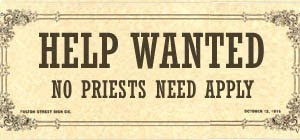
helpwanted

A friend of mine recently told me, “If you’re trying to initiate something new (like reclaiming my priesthood) and the response isn’t ‘Hell yeah!’ you’re probably on the wrong track.”

Well, I haven’t yet heard many “Hell yeahs!” in response to my efforts to (as I said here) re-appropriate my priesthood and start a house church in Berea, Kentucky.

Oh, my very good and generous friends have humored me by showing up on Saturday evenings. But even the closest of them have made it clear that they were doing so out of a sense of duty, rather than enthusiasm.

On top of that, my own reflection on our gatherings has been less than “Hell yeah!” And that’s led me to think that perhaps the whole form of Eucharistic gathering (Mass) might be passé. Certainly, as Garry Wills has pointed out in his book Why Priests? “priesthood” as we’ve known it is beyond recall.

That’s not surprising, since the office of priest turns out to be foreign in the experience of the early church. In fact, no “priest” is mentioned In the accounts of Eucharistic meals found in the first two centuries of Christianity [e.g. in the Dialog with Typho and First Apology of Justin Martyr (100-165)]

Instead, we find mention of a presider – a proestos in Greek – whose function was to stand in front of the congregation, call it to order, and keep the meeting on track. That’s what proestos (the Greek word for the presider at the Eucharist) literally means – the “stander-in-front.”

“Priests” came in much later – and definitively after Christianity became the official religion of Rome. Then, as mentioned earlier, the Christian Eucharist took on the trappings of Roman “mystery cults,” like for instance the cult of the Sun God, Mithra, a favorite of the Roman army, whose birthday was celebrated each year on December 25th.

Mystery cults worshipped gods and goddesses like Mithra, Isis, Osiris, and the Great Mother. All of them descended from heaven, lived on earth for a while, and then ascended back to heaven. From there they offered eternal life to followers who in at least one cult ate the divine one’s body under the form of bread and drank his blood under the form of wine to attain eternal life.

Does that sound familiar?

Of course, it does, because that’s what Jesus became under the aegis of Rome. And priests were part of the syndrome. The new Christian Holy Men dressed up like their mystery cult counterparts, and performed a liturgy so similar to the pagan sacred meal rituals that most Romans probably couldn’t tell the difference.

Nonetheless, the pagan cults were eventually swallowed up entirely by Christianity, and believers were left with a ritual that resembled neither Jesus’ “Lord’s Supper” nor a blood sacrifice. Even the bread stopped looking like bread, but more like a plastic wafer.

But the priests remained, accompanied by an ideological lore that justified their existence by claiming that:

  • Jesus was a priest.
  • His apostles were the first Christian priests.
  • In fact, Jesus’ right-hand man, Peter, was the first pope.
  • Priests were necessary to forgive sin.
  • And to offer what was now called “the holy sacrifice of the Mass.”

Such convictions meant that priests became separated from ordinary Christians. The cleric’s alleged power to miraculously change bread and wine into the body and blood of Christ did that. Performing the miracle seemed to be something between priests and God. Mass was often “celebrated” by the priest alone accompanied by an altar boy.  Even in public, Mass rubrics had the priest facing away from the congregation in a sanctuary fenced off from the congregation by a “communion railing.” There priests completed their duties more or less in secret and using a language (Latin) that few besides the clergy could understand.

Mandatory celibacy also contributed to the otherness of priests. Largely to protect church property from priests’ heirs, the requirement became de rigueur for all priests in the Roman dispensation after the 12th century. Priests were so special that contrary to Jesus’ specific teaching about calling no man “Father” (MT 23:9), they could assume that title for themselves (as in referencing the pope as “Holy Father.”).

Priests signified their specialness by even dressing differently from other Christians – with the pope assuming all the trappings of the Roman Emperor.  Eventually, ecclesiastical life revolved entirely around the “clergy.” They alone were allowed to preach and even touch the sacred elements.

In all of this, the “faithful” were reduced to the role of spectators at priestly cultic events. All such rituals centered on the “Host” consecrated at Mass, and afterwards taking on a life of its own in its “tabernacle,” or displayed for “benediction” in a monstrance, which was sometimes carried ceremoniously in Eucharistic processions.

All of that changed with the Second Vatican Council (1962-’65), when the Church of Rome finally caught up with the Protestant Reformation. The Council recognized the “priesthood of the faithful” that Martin Luther had celebrated. Vatican II also described the Eucharist as a “sacred meal,” rather than simply as a “holy sacrifice.” The altar became a “table” and was turned around and moved closer to the people. More and more frequently, liturgical periti (experts) at the Council described the priest as a “presider.” Lay people were allowed to touch and distribute the sacred elements. Council fathers recognized Jesus’ “real presence” not simply in the Eucharist, but also in Sacred Scripture and in the community they referred to as the “Pilgrim People of God.”

Meanwhile the “search for the historical Jesus” that had begun in earnest with the work of Albert Schweitzer in 1906 took a giant leap forward with the emergence of liberation theology and its adoption by CELAM (the Latin American Bishops’ Conference). Liberation theology was reflection on the following of Christ from the viewpoint of the poor and oppressed, especially in the former colonial world.  It recognized Jesus as a poor peasant like his Third World counterparts. He was seen as thoroughly Jewish and as a resister to Roman Imperialism.

Far from being a priest himself, he was a foe of priests and all they stood for.

Such developments – Vatican II, its theological and liturgical reforms, new insights about the historical Jesus, and re-evaluations of the priesthood itself –  brought priests down from their pedestals; their office became déclassé. With their own baptismal priesthood affirmed, the faithful felt empowered. They spontaneously stopped “going to confession.” Priests everywhere experienced identity crises. Mandatory celibacy entered full debate. As a result, thousands of priests worldwide left the priesthood to marry.

In response, the hierarchical church tried to backpedal. While recognizing the teaching of Vatican II as its own official teaching, the long reign of Pope John Paul II (1978-2005) followed by that of Benedict XVI (2006-2013) gave Vatican II Catholics the feeling that the hierarchy’s honoring of the Council was mostly lip-service.

John Paul II and Benedict systematically replaced cardinals and bishops who had taken to heart the Second Vatican Council’s reforms. The reactionary popes also packed the College of Cardinals (who would elect future popes) with conservatives, made it more difficult for priests to “return to the lay state,” suppressed liberation theology, silenced and removed creative theologians from teaching posts, returned Latinisms to the Eucharistic liturgy, cooperated with neoliberal political regimes, and were generally backward-looking.

Perhaps most importantly, formation programs in Catholic seminaries took a sharp turn to the right. The priests who emerged from them showed little sympathy for conciliar reforms. They displayed ignorance of modern scripture scholarship or awareness of ecumenical theology, as well as any inclination to connect the Gospel with contemporary issues other than abortion or gay marriage.

Such rightward drift came to a sudden and unexpected halt with the election of Pope Francis, an Argentinian, and the first Global South pope in the history of the church. Ordained in 1969, Francis is a product of the Second Vatican Council and inevitably influenced by liberation theology, which was largely a product of Latin America.

His Apostolic Exhortation, “The Joy of the Gospel” (JG, 2013) was seen as his manifesto announcing an acceleration of Vatican II reforms. It called for a “new chapter” in the history of the Catholic Church and for the church to embark on a “new path” on which things could not be left unchanged (JG 25). Preaching had to improve, he said (135-159). The roles of women needed expansion (103-4). Outreach was necessary to Christians of other denominations who share unity with Catholics on many fronts (246). And the struggle for social justice and participation in political life was an inescapable “moral obligation” (220,258).

As for priests, Francis’ Exhortation continued the clerical downgrading implied in Vatican II reforms. The priesthood, the pope taught, represents simply a church function. It is a service not necessarily distinguished in dignity, holiness, or superiority from those rendered by other baptized Christians (204).

And there’s more. Recently, Leonardo Boff (a Brazilian liberation theologian silenced under John Paul II, but reinstated by Pope Francis) spoke glowingly of the current pope. “He is one of us,” Boff said – presumably referring to liberationist Catholics. In any case, Boff went on to speculate that Francis is about to address the Brazilian priest shortage by making possible the reinstatement of the country’s thousands of laicized priests. Boff also conjectured that the pope might be on the brink of allowing women to become deacons. Both changes would represent giant steps towards eliminating mandatory celibacy for priests and towards ordination of women.

CONCLUSION

But is any of those measures sufficient for resolving the priest shortage – or for addressing the irrelevance of the church noted at the beginning of this series of four essays? I doubt it.

That’s because the very bases of priestly powers are in practice no longer believable. I’m referring to the quasi-magic ability to turn bread and wine into the body and blood of Christ, and the authority to forgive sins in the sacrament of Penance. On these two functions, hangs all priestly authority and the entire special identity of the Catholic clergy.

And like the Protestant Reformers before them, many adult, thinking Catholics can no longer accept either. As we have seen, scripture scholars have shown that neither power enjoys biblical endorsement. They are inheritances from post-first century fundamentalists who lacked sensitivity to the rich symbolism of the words attributed to Jesus in the Christian Testament.

As explained earlier, that rich symbolism finds in a loaf of bread a wonderful image of the human condition. Its single reality summarizes it all. Bread is the product of seed, earth, sun, rain, and human labor. When shared it miraculously creates and sustains human community. Wine is similar. Throughout his life, Jesus celebrated the community that such simple elements manifest. His teachings reinforced that basic insight. He was a prophet, a spiritual master, and a religious reformer who preferred rough illiterate fishermen over pretentious, exclusive priests. That was a radical and liberating message.

The Protestant reformers saw all of that quite clearly. And so they did away with priests who insisted on being separate and special, while being honored with titles Jesus forbade.

All of this means that the reforms of Vatican II didn’t go nearly far enough. Pope Francis is correct. To survive, the church must embark on that “new path” he called for.  There nothing can be left unchanged (JG 25). The roles of women need expansion (103-4). Ecumenical cooperation with other denominations and religions must be centralized as well as the struggle for social justice (220, 258). Until all Christians in close cooperation with Muslims, Buddhists, Hindus, New Agers, and atheists cooperate to attack injustice, the survival of the world itself is in doubt.

Evidently, Pope Francis himself has not perceived the implications of his brave words. Certainly, church leaders have not. It remains for the rest of us to take the lead.

Taking that lead was the thought behind my initial “Hell yeah!” to the idea of house church.  


Notes for a Home Church: The Eucharist Is Not a Sacrifice or a Magic Show, But a Shared Meal (Pt. 3 of 4)

magic-show 

My beloved eight-year-old granddaughter is getting ready to receive her First Holy Communion in May, and it’s got me worried. I mean her Sunday School teachers are filling her head with “Catholic” fundamentalist and literalist notions of Jesus’ “Real Presence” in the “Blessed Sacrament” that even St. Augustine rejected. In the 4th century he wrote: “Can Christ’s limbs be digested? Of course, not!”

Eventually, my granddaughter, I predict, will come to the same conclusion. And rather than see the beautiful symbolism of the Eucharist’s Shared Bread, she’ll probably follow the example of so many young people I know and reject the ideas of “Holy Sacrifice” and “Real Presence” as childhood fantasy akin to belief in Santa Claus and the Tooth Fairy.

To my mind, that’s tragic. That’s because it represents a rejection of Jesus’ insightful and salvific teaching about the unity of all creation. In an era of constant global war, that teaching is needed more than ever. It’s contained in the Master’s words, “This is my body . . . this is my blood . . . Do this in remembrance of me?”

Let me explain.

To begin with, according to contemporary historical theologians like Hans Kung, the Great Reformers of the 16th century had it right: The Eucharist of the early church was no sacrifice. It was a commemoration of “The Lord’s Supper.” The phrase however does not refer to “The Last Supper” alone. Instead it references all the meals Jesus shared with friends as he made meal-sharing rather than Temple sacrifice the center of his reform movement, From the wedding feast at Cana (JN2:1-12), through his feeding of 5000 (MK 6:31-44) and then of 4000 (MK 8: 1-9), through his supper at the Pharisee’s home (LK 7:36-50), and with the tax collector Zacchaeus (LK 19:1-10), through the Last Supper (MK 14:12-26), and Emmaus (LK 24:13-35), and his post-resurrection breakfast with his apostles (JN 21:12). Jesus treated shared meals as an anticipatory here-and-now experience of God’s Kingdom.

But why? What’s the connection between breaking bread together and the “salvation” Jesus offers? Think about it like this:

Besides being a prophet, Jesus was a mystic. Like all mystics, he taught the unity of all life.

“Salvation” is the realization of that unity. In fact, if we might sum up the central insight of the great spiritual masters and avatars down through the ages, it would be ALL LIFE IS ONE. That was Jesus’ fundamental teaching as well. It was something uneducated fishermen could grasp. It’s a teaching accessible to any child: All of us are sons (and daughters) of God just as Jesus was. Differences between us are only apparent. In the final analysis, THERE IS REALLY ONLY ONE OF US HERE. In a sense, then we are all Jesus. The Christ-Self (or Krishna-Self or Buddha-Self) is our True Self. God has only one Son and it is us. When we use violence against one another, we are attacking no one but ourselves. What we do to and for others we literally do to and for ourselves. That’s a profound teaching. It’s easy to grasp, but extremely difficult to live out.

Buddhists sometimes express this same insight in terms of waves on the ocean. In some sense, they say, human beings are like those waves which appear to be individual and identifiable as such. Like us, if they had consciousness, the waves might easily forget that they are part of an infinitely larger reality. Their amnesia would lead to great anxiety about the prospect of ceasing to be. They might even see other waves as competitors or enemies. However, recollection that they are really one with the ocean and all its waves would remove that anxiety. It would enable “individual” waves to relax into their unity with the ocean, their larger, more powerful Self. All competition, defensiveness, and individuality would then become meaningless.

Something similar happens to humans, Buddhist masters tell us, when we realize our unity with our True Self which is identical with the True Self of every other human being. In the light of that realization, all fear, defensiveness and violence melt away. We are saved from our own self-destructiveness.

Similarly, Buddhists use the imagery of the sun. As its individual beams pass through clouds, they might get the idea that they are individuals somehow separate from their source and from other sunbeams which (again) they might see as competitors or enemies. But all of that is illusory. All are really manifestations emanating from the same source. It’s like that with human beings too. To repeat: our individuality is only apparent. THERE IS REALLY ONLY ONE OF US HERE.

In his own down-to-earth way, Jesus expressed the same classic mystical insight not in terms of waves or sunbeams, but of bread. Human beings are like a loaf of bread, he taught. The loaf is made up of many grains, but each grain is part of the one loaf. Recognizing the loaf’s unity, then breaking it up, and consuming those morsels together is a powerful reminder that all of life — all of us – are really one. In a sense, that conscious act of eating a single loaf strengthens awareness of the unity that otherwise might go unnoticed and uncelebrated.

Paul took Jesus’ insight a step further. In his writings (the earliest we have in the New Testament) he identifies Christ as the True Self uniting us all. Our True Self is the Christ within. In other words, what Jesus called “the one loaf” Paul referred to as the one Body of Christ.

All of Jesus’ followers, the apostle taught, make up that body.

Evidently, the early church conflated Jesus’ insight with Paul’s. So their liturgies identified Jesus’ One Loaf image with Paul’s Body of Christ metaphor. In this way, the loaf of bread becomes the body of Christ. Jesus is thus presented as blessing a single loaf, breaking it up, and saying, “Take and eat. This is my body.”

And there’s more – the remembrance part of Jesus’ “words of institution.” They are connected with Paul’s teaching about “The Mystical Body of Christ.” His instruction (found in I COR: 12-12-27) is worth quoting at length:

12 There is one body, but it has many parts. But all its many parts make up one body. It is the same with Christ. 13 We were all baptized by one Holy Spirit. And so we are formed into one body. It didn’t matter whether we were Jews or Gentiles, slaves or free people. We were all given the same Spirit to drink. 14 So the body is not made up of just one part. It has many parts.

15 Suppose the foot says, “I am not a hand. So I don’t belong to the body.” By saying this, it cannot stop being part of the body. 16 And suppose the ear says, “I am not an eye. So I don’t belong to the body.” By saying this, it cannot stop being part of the body. 17 If the whole body were an eye, how could it hear? If the whole body were an ear, how could it smell? 18 God has placed each part in the body just as he wanted it to be. 19 If all the parts were the same, how could there be a body? 20 As it is, there are many parts. But there is only one body.

21 The eye can’t say to the hand, “I don’t need you!” The head can’t say to the feet, “I don’t need you!” 22 In fact, it is just the opposite. The parts of the body that seem to be weaker are the ones we can’t do without. 23 The parts that we think are less important we treat with special honor. The private parts aren’t shown. But they are treated with special care. 24 The parts that can be shown don’t need special care. But God has put together all the parts of the body. And he has given more honor to the parts that didn’t have any. 25 In that way, the parts of the body will not take sides. All of them will take care of one another. 26 If one part suffers, every part suffers with it. If one part is honored, every part shares in its joy.

27 You are the body of Christ. Each one of you is a part of it.”

Here it’s easy to see the beauty of Paul’s image. We are all members of Christ’s body (Paul’s fundamental metaphor for that human unity insight I explained). As individual members, we each have our functions – as eye, ear, nose, foot, or private parts. However, the fact that we live separately can lead us to forget that we are all members of the same body. So it helps to RE-MEMBER ourselves occasionally – to symbolically bring our separate members together. That’s what “re-membering” means in this context.  That’s what the Eucharist is: an occasion for getting ourselves together – for recalling that we are the way Christ lives and works in the world today.

In the final analysis, that’s the meaning of Jesus’ injunction: “Do this to RE-MEMBER me.  And then afterwards – as a re-membered Christ, act together as I would.”

Do you see how rich, how poetic, how complex and mysterious all of that is – ocean waves, sunbeams, bread, Christ’s body, re-membering?

It’s powerful. The Eucharist is not a magic show. It’s a meal where the many and separate members of Christ’s body are re-membered so they might subsequently act in a concerted way in imitation of Christ.

That’s why it’s important to recover and make apparent the table fellowship character of The Lord’s Supper. It is not a Jewish or Roman sacrifice; it is a shared meal.

My granddaughter and the world she’ll inherit need everything that signifies. The Eucharist is not childish fantasy. It’s a counter-cultural challenge to our era’s individualism, ethnocentrism, and perpetual war.

(Next Week: How priests fit into the Eucharistic picture of the early church)

Starting a House Church: A Faith-Inspired Response to Trumpism (First in a series of four)

barth

Recently, I surprised friends and readers of this blog by announcing plans to “re-appropriate my priesthood” and start a house church. It would be a faith-based response, I said, to Trumpism and its planetary threat. The community, I hoped, would mobilize the spiritual power that in fact dwarfs the U.S. presidency and the president’s capacity as Commander-in-Chief of the mightiest military in the history of the world.

Some of my former priest-colleagues wondered, “Why on earth would you want to do that?”

After all, the church is for all practical purposes dead and the priesthood along with it.

And good riddance. By and large, the church remains sexist, religiously fundamentalist, and arguably the most conservative force on the face of the earth.

“And there’s more,” they said.  “Virtually no one believes in priestly powers any more. According to Catholic faith, it all hangs on two quasi-magical endowments that priests alone allegedly have to: (1) transform bread and wine into the literal body and blood of Christ, and (2) forgive mortal sins that would otherwise send their perpetrators to hell. Few who think about it take such beliefs seriously any more. The others are just coasting along in thoughtless denial. Their children however perceive the nonsense and are jumping the sinking ship in droves. That’s why if ‘former Catholics’ were an actual denomination, they would constitute the third largest church in the United States.

“Moreover, Catholics are virtually indistinguishable from Protestants (or non-believers for that matter) in their life-styles and political positions. They even practice birth control in exactly the same percentages as other Americans. It’s a similar case with divorce and same-sex relationships. And many Catholics vote Republican, despite papal social teachings on social justice, the environment, and war.

“So what’s the point of the Catholic Church with its anachronistic priesthood? It has become a mere social club – good for keeping old friendships alive, but little more. Most of its committees, sodalities, youth and men’s groups are self-serving. Do-gooders could easily find other organizations elsewhere to satisfy their passion for social change – without having to fight resistant Catholic fundamentalists in the process.”

To be frank, I find such objections persuasive.  Despite the best efforts of Pope Francis, the church seems more dead than alive. For all practical purposes, it whistles past the crises that characterize our age. The Sunday Masses I attend completely ignore the unprecedented contemporary context of threats from nuclear war, climate change, racism and sexism.

And yet, I remain firm in my intention to proceed with the house church. That’s because despite the institutional church’s having lost its way, I still find in my faith a source of spiritual strength and political resistance that for me is irreplaceable.

I intend to start a house church also because the objections just mentioned overlook the fact that Catholic Church pews also seat resisters like me. There are people whose faith has been shaped by the reforms of the Second Vatican Council. In the spirit of the conciliar document, “The Church in the Modern World,” their faith engages them not only with world events, but with one another.

For instance, in my own community, a group of more than 20 has met regularly over the past two or three decades as our church’s Peace and Social Justice Committee. Our gatherings often find us reflecting on liturgical readings. Discussions connect them with political organizing, welcoming refugees, war-resistance, the environmental crisis, and with the needs of local unemployed and impoverished families. Work with Habitat for Humanity has been a constant commitment.

I’m loathe to let such relationships and commitments go. At the same time, I’m convinced there has to be a better, more focused, more regular and consistent way of harnessing the deep faith the 20 or so of us share, especially in the face of Trumpism. To repeat: we’re in an unprecedented situation that calls for an unprecedented response.

I’m convinced that the best response is to experiment with house church Sunday liturgies that would bring our sub-community and others together on a weekly basis to reflect, pray, break bread, and plan creative acts of resistance. The liturgies will take place on Saturday evenings (i.e. on the Sabbath) and thus allow those wishing to attend Mass in our church the next morning, to do so.

In the end, my reasons for starting a house church are rooted in history and theology – in post-Vatican II understandings of church, of Eucharist, and of priesthood. A changed understanding of each – more in accord with the leadership of Pope Francis gives hope and direction.

I will try to explain what I mean in subsequent postings over the next three weeks.