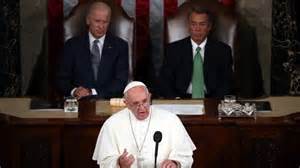
Pope Urges Catholic Parishes to Take in Refugees

pope-refugees-2

I woke up this morning to a promising Washington Post headline. It read: “Pope Urges Europe’s Catholics to take in Syrian refugees.” There he goes again, I thought.

The article described how Pope Francis “has called on ‘every’ parish, religious community, monastery and sanctuary to take in one refugee family – an appeal that, if honored, would offer shelter to tens of thousands.”

Of course the vast majority of such migrants are “illegal” in the eyes of governments where the invited parishes, etc. are located.

The pope implied that Jesus’ attitude towards “the stranger” overrides such legislation. The Master’s words in MT 25:35 have him identifying with immigrants (and the hungry, naked, homeless, and imprisoned) and basing the entire final judgment on the way we treat such people. He says: “. . . I was hungry and you gave me something to eat, I was thirsty and you gave me something to drink, I was a stranger and you invited me in,”

The pope’s appeal comes at a time when immigration along with climate change is a hotly contested issue not only in Europe, but here in the United States.

Of course, the entire panoply of Republican candidates (including the six of them who claim to be “devout Catholics”) consists not only of climate change deniers, but of candidates trying to outdo one another on the issue of excluding immigrants from our borders. Catholic candidates include Jeb Bush, Chris Christie, Bobby Jindal, Rick Santorum, Marco Rubio and George Pataki. Now they specifically diverge from the Pope not just on climate change, but on immigration as well.

Just yesterday, another ardent Christian, Sarah Palin, brought climate change and immigration together in typical GOP fashion. She told CNN that refugees from Mexico not only “better be legal,” but should be made to speak “American,” rather than “Mexican.” She sides with Donald Trump’s plan to build an exclusionary wall along the border. She also aspires to be Mr. Trump’s Secretary of Energy – a position she would embrace enthusiastically “because energy is my baby – oil and gas and minerals, those things that God has dumped on this part of the Earth for mankind’s use. . .”

Of course, Pope Francis words yesterday put him on the side of immigrants and against exclusionists. He invites his flock of 1.2 billion to follow suit. He also expressly rejects Palin’s reading of God’s mind about why the Creator “dumped” gas, oil, and minerals on Earth.

According to his eco-encyclical, Laudato Si’, using the narratives of Genesis to encourage “the unbridled exploitation of nature” is an incorrect interpretation of the Bible (67). “Clearly,” the pope adds, the Bible has no place for a tyrannical anthropocentrism that would encourage the “drill, baby, drill” approach regardless of its effects on the planet (68).

But the pope’s words about welcoming immigrants struck even closer to home.  For years I’ve been wondering what it might take to awaken Catholics to the revolutionary power of the Gospel.

In my own Catholic parish, we find ourselves mired in a detached, decontextualized version of faith that ignores the world’s real problems.

Pope Francis represents the exact opposite trend. Yet despite his invitation to “change everything” issued in The Joy of the Gospel nearly two years ago, and in spite of the urgency of Laudato Si’, nothing at our local level changes.

Yesterday’s papal invitation shows us how to get off the dime. He suggests something practical for every parish to do: welcome at least one immigrant family from the detention centers on our own borders. House and feed them. Be a prophetic example to the exclusionists. Join with other (non-Catholic) churches to do the same.

The infrastructure is there: churches that are used for just a few hours each week, parish basements and halls that are similarly idle most of the time. Also, many of us have space in our own homes – or own second houses – that might similarly provide housing for Jesus presenting himself to us as an immigrant.

Our little parish of St. Clare in Berea, Kentucky has a Peace and Social Justice Committee of 20 highly committed people. We’re meeting next Sunday to plan our gala “Watch Party” on September 27th to see the Pope’s address our Congress and the U.N.

Now in the light of the pope’s invitation to open our buildings to immigrant families, we have something else to discuss and act upon.

Accepting Pope Francis’ invitation could move our parish to truly begin “changing everything.”

Can you imagine what would happen, if the families we accepted were Muslim instead of Christian?

Thank you, Pope Francis.

Going to the Movies in Bangalore: “Elysium,” Snowden, Manning and Assange

Elysium

“Elysium,” the film starring Matt Damon and Jody Foster showed up in India this past weekend. My wife, Peggy, and I happened to be in Bangalore to celebrate her birthday. So we went to see the film – our first time at the movies since arriving in India about three weeks ago. (We intend to stay here another three months as Peggy’s Fulbright at Mysore University takes its course.)

“Elysium” has been panned by some as convoluted in plot, over-the-top in its acting, and filled with typically Hollywood violence as indestructible and robotic adversaries clash in hackneyed, interminable and highly unlikely fight scenes.

I however found “Elysium” strangely intriguing when viewed from our setting in India and in the context of our government’s furor over information leaks. From that perspective, “Elysium” was evocative of the Bhagavad Gita in pitting its protagonist against overwhelming odds in a fight to the finish for human liberation.

More specifically, “Elysium” played out in comic book fashion the battle of Edward Snowden, Chelsea Manning, Julian Assange and other information “criminals” against the overpowering state apparatus of a militarized, out-of-control and venal federal government.

To begin with, take the film’s setting – Los Angeles in 2054. The streets of Bangalore were a good prep for the film. Like L.A. in the film, they are polluted, over-crowded, and dirty. However, unlike the imagined L.A. of the future, Bangalore finds itself going in two directions at once, not simply downhill.

Bangalore is situated somewhere between decay and an undisciplined version of globalized commercialization. It features “branded stores” like The Gap, Nike, KFC, Pizza Hut, and Dominos alongside stalls and shops overflowing with goods of all description. The treatment of workers on this sub-continent (as exemplified in the recent factory collapse in Bangladesh), is not unlike workers take-it-or-leave-it dilemma in the film.

Then consider the film’s plot. It’s about Max, a factory employee (played by Matt Damon) who is injured on the job as he’s exposed to a fatal dose of radiation. With five days to live, he must find his way to “Elysium,” a human-fabricated planet floating above the earth. There the rich live in idyllic conditions, where life-saving medical care is readily available. “Elysium’s” story is about Max’s quest to reach for that star. Damon does so by stealing government secrets.

Meanwhile the government responds with extreme violence. It pursues Max in ways reminiscent of the U.S. pursuit of Snowden, Manning and Assange. Its security apparatus hunts him down relentlessly. He is pursued by an implacable, incredibly powerful mercenary agency. He is threatened by drones. Finally, he sacrifices his life so that the information he divulged might set others free.

All of this happens in an oppressive culture characterized by:

• Dominance of the military-industrial complex that completely subordinates politicians to business moguls.
• A high unemployment rate that makes it a privilege for workers to be exploited in the workplace as opposed to remaining jobless.
• A medical system that provides healthcare only to those who can pay for it.
• Total surveillance of everyone involved.
• Fail-safe border patrol that entirely eliminates refugees by killing those attempting to cross borders illegally.
• A highly brutal police force that acts with robot brutality, absolute lack of compassion, and over-all impunity.
• The use of drones to hunt down and eliminate dissenters.
• Women (personified in the Jodie Foster secretary of defense) who despite finally holding high office prove to be more heartless than their male counterparts.

So in the end, “Elysium” is about the fate of a low-level corporate employee like Edward Snowden. The secrets Max reveals show the Department of Defense violating Elysium’s own constitution that supposedly governs a highly polarized society and keeps the reins of power in the hands of a rich minority. While protecting and empowering the minority, the rules in place deprive the majority of the rights of citizenship.

The disclosure of the planet’s governing secrets not only exposes abuse of power, but ends up dethroning the elite, while enabling ordinary people to claim the rights that belong to them in virtue of their humanity. “Elysium” is about information as the key to revolution.

Very little of this is perceived by movie critics. A movie review in The Indian Times saw “Elysium” as just another Hollywood action flick. Without explanation, it remarked that “conspiracy theorists” might find it interesting, and that the film said something about immigration and health care.

I’m suggesting that “Elysium” says much more than that. It perfectly describes the direction in which our culture is traveling. It represents a story of hope. It’s about the triumph of the working class against overwhelming odds. “Elysium” is about the power of information and the heroism of people like Snowden, Manning, and Assange. As a cautionary tale, the film is a call to support whistle-blowers against our own corrupt “leadership.”

Too bad all that de rigueur Hollywood overlay of violence, chases and predictability obscures “Elysium’s” valuable message.