In Defense of ISIS

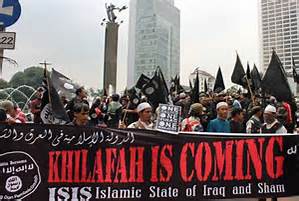
ISIS Defense

Imagine where America’s wealth would be if at the beginning of the 20th century Mexico had seized control Texas/Oklahoma, Japan had grabbed up California, England the northeast, Spain the south, and the rest of the country was divided into small emirates.

What would the response of Americans have been? Certainly there’d be resistance and rebellion. There would be attacks on occupying forces and/or collaborators with the colonial process by proud, well-armed Americans willing to resist external control “by any means necessary.” There would be bloody battles and excesses of brutal violence where both foreigners and their U.S. collaborators would be killed. The response would surely be called “terrorism” by Mexico, Japan and England.

This impossible scenario puts into perspective the confusing rise of ISIS which most commentators simply write off as a mob of pathological killers motivated to act because “they hate our freedom.”

In the historical perspective supplied by the U.S. analogy, they are much more than that.

In fact ISIS is a sophisticated resistance organization that is well funded and administered.  It not only resists foreign domination by any means necessary, it also provides day-to-day assistance for those impoverished by colonial process. In so doing it secures allegiance from many of those under its sway. These often prefer ISIS’ ministries to that of the U.S.-backed government, for instance, of Iraq. In many places ISIS provides health care, food subsidies, schooling and care for the elderly that is unattainable in Bagdad. These are just some of the reasons why thousands of Europeans flock to the ranks of the “Islamic State.”

More particularly ISIS might be seen as the militant wing of the Arab Spring that began throughout Arabia at the end of 2010. That movement in turn was Arabia’s latest response to the European balkanization of the region that took place with the end of the Ottoman Empire following the First Inter-Capitalist War (aka World War I) which concluded in 1918.

It was then that the European powers in a major act of “divide and rule” carved up Ottoman Arabia, renaming it the Middle East. The Europeans hewed out from a region previously governed by caliphs, sultans, and kings, modern “states” that in most cases never existed before.

In this way, the French colonized what they called Morocco, Algeria, Syria, Tunisia, Cyprus, and Lebanon. The British controlled Egypt, Palestine, Sudan, Iraq, Kuwait, Yemen, Jordan, and Oman. Italy governed Libya.

After the Second Inter-Capitalist War (aka World War II), the U.S. took over as the stabilizer of the colonial New Arab Order. It maintained in power obedient feudal clients resistant to democratic movements. They ruled on condition that they grant access to oil, trade and seaports. If not, they would be removed. The result was enrichment for both the colonial powers and their royal clients, but impoverishment for the vast majority of local populations.

In this perspective ISIS represents today’s impoverished Muslim Arabs seeking the autonomy of the Middle East. Their goal is Arabia for the Arabs. ISIS is struggling to wrest its control from Europeans and Americans who have dominated the area since the dissolution of the Ottoman Empire.

So it is a shallow mistake to write off ISIS forces as a mob of pathological killers with whom negotiation is impossible. To do so is to take one faction of a highly disparate group and universalize it as though it were the entire body. It’s like identifying Christianity with its most extreme faction, the Ku Klux Klan or the Tea Party for that matter.

In other words, there are sane ISIS factions with whom negotiations are possible. It is the task of diplomacy to identify them and to isolate the Klan and Tea Party elements depriving them of support. Bombing is futile.

The problem is: such observations presume a willingness on the part of neo-colonial westerners to cede colonial control and allow Arabia to belong to Arabs. And that in turn means weening western economies from dependence on Middle East oil.

For the arrival of that willingness and weening we should not hold our breath.

(Sunday Homily) The Peace of the Risen Lord is Not Merely Interior; It Is about Absence of War! Refuse to Pay Military Taxes!

War Tax Resistance

Readings for Third Sunday of Easter: Acts 3: 15, 17-18; PS 4: 2, 4, 7-9; I JN 2: 1-5A; LK 34: 24-32; LK 24: 35-48

On April 4th, 1967, Martin Luther King infamously called the United States “the greatest purveyor of violence in the world.” That was in his “Beyond Vietnam: a Time to Break Silence.” Delivered at New York’s Riverside Church, it was perhaps his greatest, most courageous speech.  King’s words are worth reading again.

Time Magazine denounced him for it.

Despite the fact that U.S. soldiers had killed more than two million Vietnamese, (and would kill another million before the war’s end), King was excoriated as a traitor. Even the African-American community quickly distanced itself from their champion because of his strong words.

To this day, King’s speech is largely ignored as the daring truth-teller has been successfully transformed into a harmless dreamer – an achievement beyond the wildest dreams of the prophet’s arch-enemy, the FBI’s J. Edgar Hoover who considered King a communist.

One wonders what Rev. King would say about the U.S. today. For despite what the mainstream media tells us about ISIS, the U.S. remains exactly what Dr. King called it. It’s still the greatest purveyor of violence in the world – even more so. By comparison, ISIS is small potatoes.

Face it: absent the United States, the world would surely be a much better place. Even our sitting President has identified the rise of ISIS (our contemporary bete noire) as the direct result of the unlawful and mendacious invasion of Iraq in 2003. That act of supreme aggression (in the U.N.’s terms) is alone responsible for the deaths of well more than one million people.

And this is not even to mention the fact that our country is fighting poor people throughout the world – in Iraq, Afghanistan, Pakistan, Yemen, Bahrain, Somalia, Libya, Syria, and who knows where else?  “Americans” claim the right to assassinate without trial anyone anywhere – even U.S. citizens – simply on suspicion of falling into the amorphous category of “terrorist.”

Can you imagine the terror any of us would experience if enemy drones constantly hovered overhead poised to strike family members or friends because some “pilot” six thousand miles away might judge one of our weddings to be a terrorist gathering? Can you imagine picking up the severed heads and scorched bodies of little children and their mothers for purposes of identification following such terrorist attacks? This is the reality of our day. Again by comparison ISIS beheadings are completely overshadowed.

I bring all of this up because of the Risen Lord’s insistence on peace in today’s gospel reading.  As in last week‘s episode about Doubting Thomas, the Risen Christ’s first words to his disciples breathless from their meeting with him on the Road to Emmaus are “Peace be with you.”

Last week in their own homilies about that greeting, I’m sure that pastors everywhere throughout our Great Country were quick to point out that the peace of Christ is not merely absence of war; it is about the interior peace that passes understanding.

Their observation was, of course, correct. However, reality in the belly of the beast – the world’s greatest purveyor of violence – suggests that such comfort is out-of-place. We need to be reminded that inner tranquility is impossible for citizens of a terrorist nation. Rather than giving us comfort, pastors should be telling us that the peace of the risen Christ is not merely about peace of mind and spirit; IT IS ABOUT ABSENCE OF WAR.

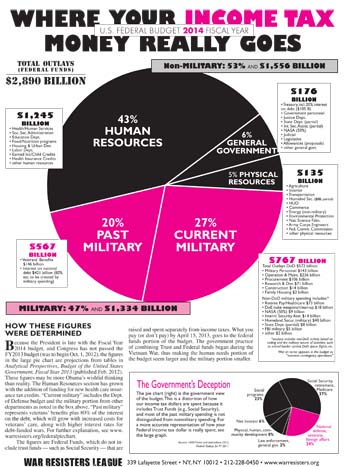
So instead of comforting us, Jesus’ words of greeting should cut us to the heart. They should remind us of our obligation in faith to own our identity as the Peace Church Jesus’ words suggest. More specifically, as Christian tax payers (having performed the annual IRS ritual last week) we should be organizing a nation-wide tax resistance effort that refuses to pay the 40% of IRS levies that go to the military. While it is absolutely heroic for individuals to refuse, there is safety and strength in numbers.

So an ecumenical movement to transform Christian churches into a unified peace movement of tax resistance should start today. All of us need to write letters to Pope Francis begging him on this eve of his visit to the United State (with anticipated speeches to the U.N. and our Congress) to call his constituency to tax resistance – to call the UN and the U.S. Congress to stop the aggression.

Once again: there can be no interior peace for terrorists. And Dr. King was right: Americans remain the world’s greatest terrorists. We are traitors to the Risen Christ!

Focusing on a utopian interior peace while butchering children across the globe is simply obscene.

Terrorism’s Causes? Ask Jihadi John!

jihadi john

Last month The Atlantic headlined Graeme Wood’s article, “What Isis Really Wants and How to Stop It.” That article apparently set the tone for President Obama’s White House Summit on Countering Violent Terrorism (Feb. 18th).

Together the article and the Obama’s meeting gave rise to endless talk show discussions about radicalism and its causes. All reformulated the old 9/11 question, “Why do they hate us?”

Most expert answers missed the obvious historical response. They overlooked the basic law of cause and effect.

Instead, they focused on terrorist psychology.

According to the experts, many ISIS radicals are directionless youths without gainful employment. Others are adventure-seekers, or mentally ill psychopaths. Some radicals are medievalists with an unexplainable bias against the modern world. Most are products of bad religion and corrupt imams.

Ostensibly, the majority are easily influenced by Facebook advertising which ISIS rebels have mastered to an art form that somehow escapes the medium’s inventors.

What to do about such problems? The talk show whizzes weren’t sure. Most highlighted better advertising. We’ve got to improve our Facebook skills, they intoned.

Missed or downplayed in all the ruminations is the obvious. Why not ask Jihadi John?

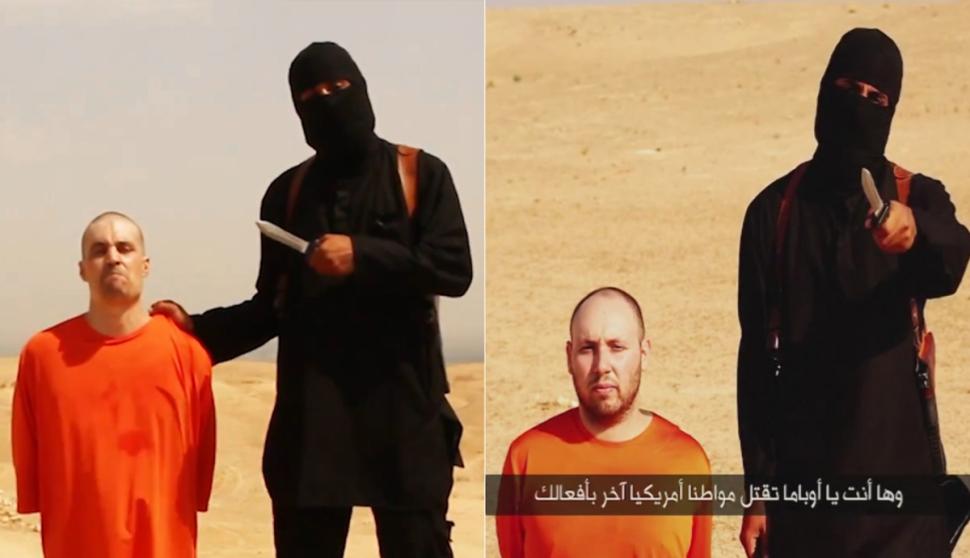
Here’s what he said on YouTube as he pointed his knife at President Obama before beheading yet another victim dressed tellingly in an orange jumpsuit: “As your missiles continue to strike our people, our knives will continue to behead your people.”

Hmm. . . . Wouldn’t you say that’s pretty straight-forward? In a word, the man is talking about blowback. It’s as simple as that.

What causes radicalism? Let me count the ways: everything signified by Guantanamo orange jumpsuits, extra-judicial assassinations, drones hovering over towns terrorizing children, wedding parties whose revelers are suddenly turned into “bug splats,” U.S. soldiers urinating on the lifeless corpses of one’s parents, the work of reassembling body parts for purposes of identification after a U.S. bombing attack, the smell of human flesh incinerated by our napalm and white phosphorous.

The list goes on and on: Abu Grahib, Fallujah, Haditha, the Torture Report, support of dictators throughout the Arabian Peninsula, continued arming of Israel even after Netanyahu incinerated and dismembered more than 495 Muslim children in his latest “turkey shoot” in Gaza, Christian fundamentalists ignorantly crusading against Islam, racist cartoonists lampooning “the Prophet” when they can hardly spell his name, western industrialism destroying the planet by climate change.

Why do they hate us? It’s not rocket science, friends. It’s blowback. It’s what none of our leaders will say because curing the radicalism means drastically reforming U.S. policy.

It means ceasing to be the radical terrorist state “America” itself has become.

For God’s sake, listen to Jihadi John!

(Instead of a Sunday Homily) War Mongering at the New York Times: There’s always a “Why”

Urinating soldiers

Today The New York Times published an inflammatory editorial called “The Fundamental Horror of ISIS.” The evident but unstated purpose of the piece was to strengthen support for the latest waste of our tax-payer dollars on the most recent phase of the so-called “war on terror.” Like its predecessors, that phase has nothing to do with protecting our “homeland.” Rather as Dennis Kucinich has observed, it’s yet another phase of the (by-now) 25 year long war against the impoverished masses who have the misfortune of finding their homes floating on top of a vast sea of oil controlled by foreign outsiders.

To help the White House justify its consequent greed-based aggression, the NYT editorial trotted out the well-worn thesis that ISIS represents unmitigated, irrational evil entirely foreign to the sensitive minds of its gentle readers. So it rehearsed “the beheadings, crucifixions, tortures, rapes and slaughter of captives, children, women, Christians, Shiites.”

This, of course, represents a highly familiar litany relative to our state’s designated enemies. The “presstitutes” made similar allegations against “the Russians” during the Cold War as well as the Chinese Communists. It was also the case with the Sandinistas, the PLO, Hezbollah, and Hamas. Similarly, Manual Noriega, Slobodan Milosevic, Saddam Hussein, Osama bin Laden, Muammar Kaddafi, and (until recently) Bashar al-Assad all represented unmitigated evil. Now it’s the turn of ISIS and (as of last Tuesday) Khorasan.

In all of these cases the designated enemies in question have represented pure evil without any legitimate grievance other than sadism that strangely and inexplicably has (according to the Times in the case of ISIS) “attracted hundreds of willing followers — yes, also from Europe and America.”

Times editors put it succinctly in today’s rant: “Comparisons are meaningless at this level of evil, as are attempts to explain the horror by delving into the psychology or rationale of the perpetrators. . . as Roger Cohen, the New York Times columnist, wrote in a recent piece about ISIS, there is no “why” in the heart of darkness.”

To repeat, this level of evil is entirely foreign to the civilized westerners.

Really?

Try explaining that to the victims of the 25 year war in Iraq and Afghanistan.

They remember:

• The million and a half civilian deaths in Iraq caused by the U.S.’s naked “war of aggression” against that country – the “supreme international crime” in the eyes of the United Nations.
• YouTube films of U.S. military personnel urinating on the bodies of dead Iraqi patriots defending their “homeland” from barbarous Marines, Special Forces, and Navy Seals.
• Abu Ghraib and its broadly smiling heroes (from next door) sexually assaulting their victims and proudly posing with thumbs up over bodies of those they’ve just tortured to death.
• President Bush and Dick Cheney not only ordering the war crimes of water-boarding and other acts of torture, but joking about it.
• Fallujah and the use of illegal white phosphorous.
• Haditha and the heartlessness of U.S. soldiers systematically slaughtering entire families there.
• The frequent reports of wedding parties and funerals routinely devastated by drones in Afghanistan, Iraq, Libya, Somalia, Bahrain, Yemen, Pakistan, and who knows where else?
• Chelsea Manning’s release of the film “Collateral Murder,” where U.S. “pilots” joke about “wasting” international journalists and the civilians who came to their aid.
• U.S. insistence on using cluster bombs whose known effect is to blow arms and heads off children attracted to explosives disguised as toys.
• Secretary of State Madeleine Albright’s justification of the effects of U.S. sanctions on Iraq, which she admitted killed 500,000 Iraqi children. “Yes, Leslie,” Ms. Albright said to interviewer Leslie Stahl, “we think it was worth it.”
• U.S. supply of arms enabling Israel’s “Operation Protective Edge” which wantonly slaughtered more than 2500 Palestinians in direct attacks on civilians and the infrastructure of Gaza.
• U.S. stated intent to adopt similar policy of “relaxed rules” around tolerance of civilian deaths in its latest attacks on Iraq and now Syria.

All of that would easily inspire Al-Jazeera editors to write:

“Comparisons are meaningless at this level of evil, as are attempts to explain the horror by delving into the psychology or rationale of the perpetrators. . . as one of our reporters wrote in a recent piece about the United States, there is no “why” in the heart of darkness.”

But of course, there’s always a “why.”

The difference is that the “why” in the U.S. heart of darkness is greed for oil and the protection of an oil economy that will predictably destroy our planet.

Meanwhile the unexamined “why” of ISIS and the thousands attracted to its cause is intimately connected with response in kind to the Original Aggression of colonialism’s systematic rape of the Middle East. ISIS is responding in kind to U.S. crimes. It’s all blowback.

And the gentle editors of the New York Times (speaking for their employers in the military-industrial complex) can’t stand what they see when they look into the mirror.

(Sunday Homily) U.S. Doublespeak Is More Threatening to the World than ISIS or Khorasan

uncle-sams-lies

Readings for 26th Sunday in ordinary time: EZ 18:25-28; PS 25: 4-5, 8-10, 14; PHIL 2: 1-11; MT 21: 28-32 http://www.usccb.org/bible/readings/092414.cfm

If I were you, I’d be careful about air travel. That’s because, as the President reminded us last week, the enemies we’ve so fiercely created over the last 13 years are plotting to blow U.S. commercial aircraft out of the skies. So one of these days Khorasan’s heat-seeking missiles will find the rear end of your plane, and that will be the end of you.

And, when you think about it, those firing the rockets will be justified in doing so. That is, if we allow them to apply the insane logic behind Mr. Obama’s latest justification for bombing his seventh Muslim country in six years.

In doing so the Nobel Peace Prize laureate said last week, “Once again, it must be clear to anyone who would plot against America and try to do Americans harm that we will not tolerate safe havens for terrorists who threaten our people.”

Wait a minute!

Our “leader’s” logic (if we universalize his pronouncement) has just endorsed an endless cycle of violence that should be completely unacceptable to any human being — not to say any Christian. His words mean that anyone who plots against another country trying to do their citizens harm can claim no safe haven. They will be subject to reprisal.

Tell that to drone victims and to Syrians who lost their children in last week’s bombings – or to similar casualties at weddings and funerals in Afghanistan, Iraq, Libya, Pakistan, Yemen, and Somalia. The President’s doublespeak logic allows them to say, “Once again it must be clear to the Americans plotting against us and trying to do our citizens harm that we will not tolerate safe havens for such terrorists who threaten our people. There will be reprisals.”

That means that the militants in the countries just mentioned can legitimately respond to the terrorism of drone and outright bombing attacks with similar assaults on American citizens in our own “homeland.”

So as I say, hold your breath on your next airline trip to Miami or New York. The blowback is coming – and the blowback to that blowback too.

Such are the realities of Eternal War.

It’s that sort of damned logic (I’m choosing my words) that is addressed in today’s liturgy of the word. It’s not at all comforting.

The first reading from the prophet Ezekiel sets the tone. It underlines what Easterners call the Law of Karma. Ezekiel says that people die because of their wicked deeds. He says, “When someone virtuous turns away from virtue to commit iniquity, and dies, it is because of the iniquity he committed that he must die.” That’s karma. It’s an inescapable law of the universe.

St. Paul put it this way, “Do not be deceived, God is not mocked; for whatever a man sows, this he will also reap.” (GAL 6:7-9). Relative to war, Jesus was even more pointed. He said all those who live by the sword will die by that same instrument (MT 26:52). It’s all karma.

As citizens of a nation that lives by the sword more than any other in world history, what then are we to do? Here, once again, today’s readings supply an answer. We must abandon the destructive path we’re on. That’s what Ezekiel says. Speaking of the potential recipient of negative karma, Ezekiel promises, “But if he turns from the wickedness he has committed, he does what is right and just, he shall preserve his life; since he has turned away from all the sins that he has committed, he shall surely live, he shall not die.” That too is karma.

In other words, to avoid the negative consequences of our actions, we must change course radically. More specifically today’s gospel selection addresses that imperative to political leaders. It calls them to make their actions correspond to their words.

Yes, today’s gospel is addressed to leaders like our president and congresspersons. There Jesus addresses those in power and tells the local rulers of his day (“the chief priests and elders”) a parable about lip service and the required change of direction. (Remember, in Jesus’ context there was no sharp distinction between religious and civil government.)

“A man had two sons,” the Great Teacher tells these government officials. “He came to the first and said, ‘Son, go out and work in the vineyard today.’ He said in reply, ‘I will not, ‘ but afterwards changed his mind and went. The man came to the other son and gave the same order. He said in reply, ‘Yes, sir,‘ but did not go. Which of the two,” Jesus asks, “did his father’s will?”

The chief priests and elders answer,”The first.”

Jesus said to them,”Amen, I say to you, tax collectors and prostitutes are entering the kingdom of God before you.”

I’m sure you see that Jesus’ parable is about governmental lip service and deception. The parable calls them to radical change in policy. Jesus implies that the leaders of his day were like the first son. They said the right things, but their actions belied their words. As a result, their deeds excluded them from the New Order (God’s Kingdom) which was always the focus of Jesus’ revolutionary discourse.

And that brings us back to our own leaders and the differences between what they say and do. Think of the events of recent weeks – even last week. During that time our leaders have:

• Paid lip service to national boundaries in the case of Russia and Ukraine, but then have claimed that national boundaries are irrelevant in their own “war on terrorism.”
• Paid lip service to international law – again in the case of Russia and Ukraine, but then ignored that law by going to war with ISIS without the required U.N. resolution.
• Paid lip service to civilization and decency in decrying ISIS’ brutal beheadings (by knife) of innocent civilians, but then beheaded literally untold others via drones and direct bombings. (Yes, drones and bombs inevitably blow heads off bodies.)
• Paid lip service to the human rights of civilians brutalized by ISIS, while ignoring the million and a half civilians their own armed forces have just as brutally killed in Iraq and Afghanistan.
• Paid lip service to nuclear non-proliferation in their demands upon Iran, but then have pledged billions to modernize their own overwhelming nuclear arsenal.
• Paid lip service to environmental protection (following last Sunday’s “People’s Climate March”), but the very next day implicitly embraced the possibility of “nuclear winter” through that same weapons modernization program.

Of course, there are many more examples of our leaders’ saying one thing and doing the opposite. In fact, their lies come so thick and fast that confusion and weariness results on the part of listeners. Our leaders’ honeyed words accompanied by unspeakably cruel acts paralyze us from taking action against or even recognizing in our own country a world force that is far more destructive than ISIS, Khorasan, or al-Qaeda. In the words of Noam Chomsky, the latter represent “retail terrorism,” while the U.S. “network of death” (with bases all over the world) embodies “wholesale terrorism” that is far more evil and destructive.

I believe that danger of confusion and consequent inaction is why Jesus shocked his opponents by saying simply, “Amen, I say to you, tax collectors and prostitutes are entering the kingdom of God before you.”

That would be as scandalous to Jesus’ audience as if he said to President Obama and John McCain, “Amen, I say to you, ISIS, Khorasan and al-Qaeda will enter God’s kingdom before you.”

What does that mean for us who are attempting to follow the Way of Jesus and are trying to be part of his Kingdom revolution? It means that we must realize that:

• Perpetual war contravenes the teachings of Jesus who taught us to love our enemies.
• Our “leaders” (just like the priests and elders of Jesus’ day) are liars to the core.
• The United States is (in the words of Dr. King) the “greatest purveyor of violence in the world.”
• That the retail terror and brutality of ISIS pales in comparison with the wholesale terror the United States inflicts on the world’s poor.
• That we must work and pray every day for the defeat of the United States in its endless, genocidal wars.

Believe me: that defeat is coming. Better yet, believe Ezekiel. It’s the law of karma.

(Sunday Homily) Jesus Has More in Common with ISIS than with the United States

King Purveyor

Readings for Feast of Exaltation of the Holy Cross: NM 21:48-49; PS 78: 1BC-2, 34-38; PHIL 2: 6-11; JN 3: 13-17 http://www.usccb.org/bible/readings/091414.cfm

Today is the feast of “The Exaltation of the Holy Cross.” It might as well be called the feast of “The Exaltation of the Electric Chair” or of the exaltation of death row or of torture or terrorist martyrs. For relevance’s sake, we might today call the feast “The Exaltation of ISIS or Al Qaeda.”

That’s because the cross on which Jesus died was not only empire’s instrument of unspeakable torture and capital punishment. It was also the punishment the Romans reserved for terrorist insurgents against their empire. Among many others, biblical scholar, Reza Aslan underlines that point in his best-selling study, Zealot. (I recommend the book.)

All of that indicates that the Romans thought of Jesus as a terrorist – just as “Americans” do its enemy du jour whether we call them ISiS, ISIL, or al Qaeda. Let me repeat, Christians worship someone whom the quintessential empire (Rome) and its hangers-on vilified as much as President Obama vilified ISIS last Wednesday night in his address to the nation announcing yet another war. In the eyes of Rome and its Jewish collaborators, Jesus was a terrorist. They said he was stirring up the people and trying to take Caesar’s throne by force (LK 23:5, JN 19:15).

And yet, in today’s liturgy of the word, Jesus himself tells us to follow his example. You might say that he urges us to do what’s necessary to merit the charge of “terrorism” and even its punishment. That’s right. He says, “You cannot be my disciple unless you too take up your cross and follow me to Golgotha – or as we might put it, to Abu Ghraib, Guantanamo, death row, and ultimately to the electric chair or gurney to be lethally injected. That is, following Jesus means all of us should be traitors and rebels and enemies of the murderous state the U.S. has become. This is particularly true since our “leaders” have chosen the path of war without end.

However, (if we’re to believe the polls) instead of taking up our crosses, those calling themselves “Christians” have identified with another of the empires in the long line that has succeeded Rome. In other words, we’ve refused the project of Jesus who had more in common with ISIS than with the United States.

Think about it. Jesus’ “gang” was filled with insurgents. How could it be otherwise – poor working class men coming from the hotbed of rebellion in Galilee? They followed a man proclaiming “God’s Kingdom” as a world where Yahweh is king instead of Caesar. In fact, there were many points of convergence between Jesus’ program and that of Zealot terrorists. Like them he favored land reform, cancellation of debts, and justice for the poor. Both the terrorists of his day and Jesus opposed the Jewish leaders who collaborated with Rome. Both detested Roman occupation of God’s lands.

Even more, one member of Jesus’ inner circle was specifically called “the Zealot” (the 1st century equivalent of ISIS). Another’s nom de guerre was “Iscariot” [quite possibly a “sicarius” or assassin of occupation forces). Peter’s nickname was “Rock Thrower.” And James and John were fierce enough to merit the name “Sons of Thunder.” Recall that one of Jesus’ closest friends tried to cut off the head of one of Jesus’ arresters. Yes, cut off his head! Luckily for the militarized cop in question, Peter narrowly missed and only cut off the man’s ear.

But it was at that point, though traveling with an armed group (Think about that for a minute!) that Jesus made the pronouncement that separated him from his band of patriotic resisters to imperial occupation. It’s here that he departs from ISIS as well. He rebukes Peter for drawing his sword. Jesus said, “Put away your sword. All those who live by the sword will perish by it” (MT 26:52).

Those words should astound would-be Christians so ready to bomb, kill and live by the sword to an extent unsurpassed in all of human history. You’d think that if there’s ever been justification for using weapons, it would be to defend the life of a man like Jesus. But no, Jesus insisted that the way to liberation is not by taking life, but by giving one’s own life in non-violent surrender – an insistence echoed by Martin Luther King Jr. and Mahatma Gandhi.

Last Thursday, the day following President Obama’s war speech, Amy Goodman ran a segment on “Democracy Now” asking the question, “What would Martin King do in the face of ISIS?” The segment recalled for viewers Dr. King’s 1967 speech at the Riverside Church in New York City. There he memorably called our beloved country ”the greatest purveyor of violence in the world today.” http://www.hartford-hwp.com/archives/45a/058.html

King, of course, was right in 1967 when he spoke those words. They ring even truer today. Without the U.S. there would be no ISIS, no al-Qaeda. We’ve trained many of their troops; they’re using weapons the United States military has poured into the region. Without “America,” there would be no crisis in Ukraine evoking threats of World War III. Without U.S. unconditional support of Israel, there would be no “Operation Protective Edge” with more than 2500 Palestinians dead – mostly women and children. Libya would still be intact and so, of course, would Iraq. More than a million people our brutal military has slaughtered in Iraq would still be alive.

(Talk about transubstantiation! Everything our country touches is transformed into the crucified body of Christ. Wine people share at droned weddings and funerals in a sense becomes Jesus’ blood.)

So what would King do? According to Tavis Smiley who has just published Death of a King: the Real Story of Dr. Martin Luther King Jr.’s Final Year, King would urge a sharp turn in U.S. policy. Such repentance would entail:

• Confessing our nation’s responsibility for the crises in Afghanistan, Iraq, Israel-Palestine, Libya, Assyria, Yemen, Somalia, Bahrain, Egypt, Ukraine. . . .
• Paying reparations to all those countries.
• Redirecting the billions (and trillions) wasted in war to health care, education, and infrastructure reconstruction in our own United States.
• Using presidential speeches not to announce further wars, but to lay out emergency plans for addressing the genuine crises that face us, viz. climate chaos world-wide and the Ebola outbreak in Africa.
• Announcing expedited plans to wean the U.S. from the oil consumption that drives our country’s perpetual war policy.

In today’s second reading St. Paul quotes an ancient Christian hymn which scholars universally recognize as encapsulating the belief of the earliest Christians. It’s a song about the Divine One choosing to appear in history not as an exalted king, but as a human being, a slave, and an executed criminal.

If we wish to find God, the hymn suggests, we should look and listen not to our presidents, but to “the other – those the Empire hates – and make their cause our own. It’s in the ranks of the oppressed that God’s Son is found – among empire’s designated enemies, among the enslaved, the tortured and those our “leaders” identify as terrorists.

Does this mean we are being called to somehow recognize Jesus in ISIS?

Yes it does. ISIS has legitimate demands. We need to talk with them, not bomb them. Followers of Jesus should be demanding that – even if it means being branded “terrorists” ourselves.

(Sunday Homily) Listen to ISIS and Stop Committing Suicide!

steven sotloff

Readings for 23rd Sunday in Ordinary Time: EZ 33: 7-9; PS 95: 1-2, 6-9; ROM 13: 8-10; MT 18: 15-20 http://usccb.org/bible/readings/090714.cfm.

We’ve met the enemy and it is us!

Indeed! Over the past number of weeks, we’ve been introduced to the Islamic State in Iraq and Syria (ISIS). Its militants seem to have somehow appeared from nowhere.

However, as Tom Engelhardt has pointed out, they actually represent the largely Sunni blowback from U.S. policies over the last 13 years. In fact, ISIS would not exist were it not for the United States.

Think about it. ISIS is the direct result of:

• The U.S. invasion of Afghanistan and its over-the-top, loosely-target response to 9/11.
• The 2003 criminal occupation and destruction of Iraq.
• The thoughtless dismantling of Saddam Hussein’s army with its largely Sunni command structure (which is now directing ISIS).
• The crimes of Abu Ghraib, Fallujah, Haditha, and other massacres perpetrated by barbaric elements in the U.S. military.
• The more than one million Iraqis who have lost their lost their lives as their country has been systematically pulverized by bombings, white phosphorous, and the nuclear waste called “depleted uranium.”
• Former President Bush and Vice President Cheney bragging about ordering the war crimes of water boarding and other forms of torture.
• U.S. soldiers urinating on the bodies of Iraqi insurgents and on copies of the Holy Koran.
• The horrors of the film clip, “Collateral Murder” released by Chelsey Manning.
• Drone strikes across the world in Afghanistan, Iraq, Pakistan, Somalia, Yemen and elsewhere routinely killing women and children, revelers at weddings and mourners at funerals.
• Blind U.S. support of Israel’s pogrom aimed at “the Jews’ Jews” concentrated in the world’s largest open-air prison camp called Gaza.

Such horrendous provocations make it entirely possible for ISIS leaders to echo the words solemnly intoned by President Obama last week in response to their movement’s brutal beheading of journalist Steven Sotloff. ISIS leaders might well have said:

“We will not be intimidated. Those who make the mistake of harming Muslims will learn that we will not forget and that our reach is long and that justice will be served . . . such horrific acts only unite us as movement. . . ISIS will continue to lead the battle against the kind of barbaric and empty vision that the United States represents. We will degrade their forces and destroy them completely.”

In fact, the whole ISIS phenomenon and the response it has evoked only illustrate the senselessness of any strategy of revenge and fatuous, doomed attempts to solve conflict by the unapologetic use of military first response to violence perpetrated against “Americans” or Muslims.

A different way of responding is outlined for followers of Jesus’ Way in today’s liturgy of the word. It might seem idealistic and perhaps even unrealistic in the face of ISIS. But give it a chance.

In today’s gospel reading, Matthew the Evangelist addresses the problem of conflict resolution. He emphasizes dialog not revenge and violence. In fact, he outlines four alternatives towards resolving disputes. He has Jesus say that if step one doesn’t work, move on to the subsequent strategies. The four alternatives include (1) healing conversation with one’s adversary, (2) arbitration with a mediator or two, (3) consultation with the entire community, and (4) shunning the offending party.

More specifically, Matthew has Jesus say, “If your brother sins against you, go and tell him his fault between you and him alone . . . If he does not listen, take one or two others along with you, so that ‘every fact may be established on the testimony of two or three witnesses.’ If he refuses to listen to them, tell the church. If he refuses to listen even to the church, then treat him as you would a Gentile or a tax collector.”

Obviously, these words did not come from Jesus himself. To begin with, there was no “church” at Jesus’ time. Jesus was thoroughly Jewish and a reformer of Judaism rather than the founder of some new religion or “church.”

It was different for Matthew who was writing for a community of specifically Jewish Christians some fifty years after Jesus’ death. By then, questions of community order within the emerging church had become prominent. So Matthew invents this saying of Jesus to deal with them.

Another reason for reaching this conclusion is the reference to treating a recalcitrant individual “as you would a Gentile or a tax collector.” This phrase reflects traditional Jewish avoidance of Gentiles and hatred of Roman collaborators. It runs counter to the practice of Jesus who time and again in the Gospels causes scandal by practicing table fellowship and community with the very people Matthew’s instruction indicates are outsiders to be shunned by believers.

Were Matthew following the Spirit of Jesus, the evangelist’s instructions for addressing conflict resolution might involve the following process: (1) private dialog with one’s adversary, (2) arbitration with a mediator or two, (3) consultation with the entire community, and (4) moving in with the offending party – or at least taking them out for dinner regularly.

In any case, the emphasis in Jesus’ own approach is communion, not shunning or refusal to talk. Nowhere does Jesus’ approach say that one should refuse meeting until the offending party stops offending. Much less does the process outlined include “if he refuses to listen, shoot him, cut his head off, or kill his family.”

“But,” you object, “The words attributed to Jesus in today’s gospel selection are about church order, not about international politics, much less the barbarity of a movement like ISIS. Jesus’ instruction, you might say, is about private disputes among Christians and are laughably impractical in the political sphere.

And that’s just my point. To repeat: Matthew’s account does not reflect the teaching or practice of Jesus. Jesus’ actual teaching was not confined to the private realm. His practice was highly political.

Eating with tax collectors, street walkers, lepers, Pharisees, Gentiles (including members of the Roman army) represented doing the unthinkable, the unexpected, the forbidden. . . . It meant crossing boundaries, breaking taboos, acting counter-culturally, and offending people on all sides of sizzling debates.

This is what the example of Jesus calls us to do even in the case of ISIS. Its emergence calls for departure from business as usual. It requires admission of guilt and responsibility on the part of the United States. It demands a complete reversal of “American” policy.

Today’s second reading from Paul’s letter to the Christian community at Rome puts a finer point on the reasons for such response on the part of those pretending to follow the teachings of Jesus.

Paul reminds us of Jesus’ summary of God’s law. He writes:

“Brothers and sisters: Owe nothing to anyone, except to love one another; for the one who loves another has fulfilled the law. The commandments, ‘You shall not commit adultery; you shall not kill; you shall not steal; you shall not covet,’ and whatever other commandment there may be, are summed up in this saying, namely, ‘You shall love your neighbor as yourself.’ Love does no evil to the neighbor;
hence, love is the fulfillment of the law.”

Emmanuel Levinas helps us understand that Jesus’ teaching on neighbor love is much more radical than commonly accepted. Loving your neighbor as yourself, Levinas says, does not mean “Love your neighbor because s/he is like you.” No, according to Levinas, it means, “Love your neighbor as yourself, because s/he is you.”

In other words, there is no meaningful distinction between you and any other human being you care to name – even if we call them “terrorists.” Moreover, if you shared the same history as your “enemy,” you would be doing exactly the same thing that currently enrages you. As a result, no killing can be justified. It is suicide. That’s the thrust of Jesus’ words: to kill the other is to kill yourself. Killing of any kind is suicide.

What does that mean for followers of Jesus’ way as we try to respond to the ISIS phenomenon? At least the following, I think:

• Facing the fact that the ONLY REASON for our Middle Eastern policy and wars is oil, and doing everything necessary to wean our lives away from dependence on fossil fuels.
• Realizing that we cannot expect politicians like President Obama to initiate any other policy than revenge as if the U.S. were principled, civilized, innocent, and pure before an enemy that is completely unlike us.
• Nonetheless demanding that our officials absolutely reverse course, recognize responsibility for the emergence of ISIS, and establish dialog with their leaders.
• Refusing to allow our children to serve in an armed force that commits ISIS-like crimes on a wholesale scale.
• Imagining what would happen if even a quarter of our country’s 160 million people who claim to be Christian refused the self-destruction the words of Jesus and Paul imply.

For Christ’s sake, do the unthinkable. Hard as it might be: listen to ISIS. Reverse course. Put a stop to our collective suicide!