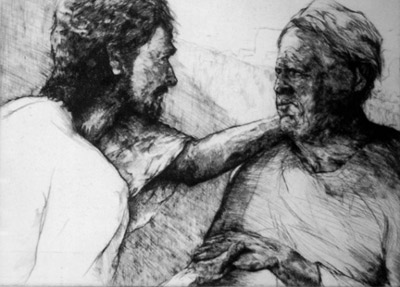
(Sunday Homily) Jesus Has More in Common with ISIS than with the United States

King Purveyor

Readings for Feast of Exaltation of the Holy Cross: NM 21:48-49; PS 78: 1BC-2, 34-38; PHIL 2: 6-11; JN 3: 13-17 http://www.usccb.org/bible/readings/091414.cfm

Today is the feast of “The Exaltation of the Holy Cross.” It might as well be called the feast of “The Exaltation of the Electric Chair” or of the exaltation of death row or of torture or terrorist martyrs. For relevance’s sake, we might today call the feast “The Exaltation of ISIS or Al Qaeda.”

That’s because the cross on which Jesus died was not only empire’s instrument of unspeakable torture and capital punishment. It was also the punishment the Romans reserved for terrorist insurgents against their empire. Among many others, biblical scholar, Reza Aslan underlines that point in his best-selling study, Zealot. (I recommend the book.)

All of that indicates that the Romans thought of Jesus as a terrorist – just as “Americans” do its enemy du jour whether we call them ISiS, ISIL, or al Qaeda. Let me repeat, Christians worship someone whom the quintessential empire (Rome) and its hangers-on vilified as much as President Obama vilified ISIS last Wednesday night in his address to the nation announcing yet another war. In the eyes of Rome and its Jewish collaborators, Jesus was a terrorist. They said he was stirring up the people and trying to take Caesar’s throne by force (LK 23:5, JN 19:15).

And yet, in today’s liturgy of the word, Jesus himself tells us to follow his example. You might say that he urges us to do what’s necessary to merit the charge of “terrorism” and even its punishment. That’s right. He says, “You cannot be my disciple unless you too take up your cross and follow me to Golgotha – or as we might put it, to Abu Ghraib, Guantanamo, death row, and ultimately to the electric chair or gurney to be lethally injected. That is, following Jesus means all of us should be traitors and rebels and enemies of the murderous state the U.S. has become. This is particularly true since our “leaders” have chosen the path of war without end.

However, (if we’re to believe the polls) instead of taking up our crosses, those calling themselves “Christians” have identified with another of the empires in the long line that has succeeded Rome. In other words, we’ve refused the project of Jesus who had more in common with ISIS than with the United States.

Think about it. Jesus’ “gang” was filled with insurgents. How could it be otherwise – poor working class men coming from the hotbed of rebellion in Galilee? They followed a man proclaiming “God’s Kingdom” as a world where Yahweh is king instead of Caesar. In fact, there were many points of convergence between Jesus’ program and that of Zealot terrorists. Like them he favored land reform, cancellation of debts, and justice for the poor. Both the terrorists of his day and Jesus opposed the Jewish leaders who collaborated with Rome. Both detested Roman occupation of God’s lands.

Even more, one member of Jesus’ inner circle was specifically called “the Zealot” (the 1st century equivalent of ISIS). Another’s nom de guerre was “Iscariot” [quite possibly a “sicarius” or assassin of occupation forces). Peter’s nickname was “Rock Thrower.” And James and John were fierce enough to merit the name “Sons of Thunder.” Recall that one of Jesus’ closest friends tried to cut off the head of one of Jesus’ arresters. Yes, cut off his head! Luckily for the militarized cop in question, Peter narrowly missed and only cut off the man’s ear.

But it was at that point, though traveling with an armed group (Think about that for a minute!) that Jesus made the pronouncement that separated him from his band of patriotic resisters to imperial occupation. It’s here that he departs from ISIS as well. He rebukes Peter for drawing his sword. Jesus said, “Put away your sword. All those who live by the sword will perish by it” (MT 26:52).

Those words should astound would-be Christians so ready to bomb, kill and live by the sword to an extent unsurpassed in all of human history. You’d think that if there’s ever been justification for using weapons, it would be to defend the life of a man like Jesus. But no, Jesus insisted that the way to liberation is not by taking life, but by giving one’s own life in non-violent surrender – an insistence echoed by Martin Luther King Jr. and Mahatma Gandhi.

Last Thursday, the day following President Obama’s war speech, Amy Goodman ran a segment on “Democracy Now” asking the question, “What would Martin King do in the face of ISIS?” The segment recalled for viewers Dr. King’s 1967 speech at the Riverside Church in New York City. There he memorably called our beloved country ”the greatest purveyor of violence in the world today.” http://www.hartford-hwp.com/archives/45a/058.html

King, of course, was right in 1967 when he spoke those words. They ring even truer today. Without the U.S. there would be no ISIS, no al-Qaeda. We’ve trained many of their troops; they’re using weapons the United States military has poured into the region. Without “America,” there would be no crisis in Ukraine evoking threats of World War III. Without U.S. unconditional support of Israel, there would be no “Operation Protective Edge” with more than 2500 Palestinians dead – mostly women and children. Libya would still be intact and so, of course, would Iraq. More than a million people our brutal military has slaughtered in Iraq would still be alive.

(Talk about transubstantiation! Everything our country touches is transformed into the crucified body of Christ. Wine people share at droned weddings and funerals in a sense becomes Jesus’ blood.)

So what would King do? According to Tavis Smiley who has just published Death of a King: the Real Story of Dr. Martin Luther King Jr.’s Final Year, King would urge a sharp turn in U.S. policy. Such repentance would entail:

• Confessing our nation’s responsibility for the crises in Afghanistan, Iraq, Israel-Palestine, Libya, Assyria, Yemen, Somalia, Bahrain, Egypt, Ukraine. . . .
• Paying reparations to all those countries.
• Redirecting the billions (and trillions) wasted in war to health care, education, and infrastructure reconstruction in our own United States.
• Using presidential speeches not to announce further wars, but to lay out emergency plans for addressing the genuine crises that face us, viz. climate chaos world-wide and the Ebola outbreak in Africa.
• Announcing expedited plans to wean the U.S. from the oil consumption that drives our country’s perpetual war policy.

In today’s second reading St. Paul quotes an ancient Christian hymn which scholars universally recognize as encapsulating the belief of the earliest Christians. It’s a song about the Divine One choosing to appear in history not as an exalted king, but as a human being, a slave, and an executed criminal.

If we wish to find God, the hymn suggests, we should look and listen not to our presidents, but to “the other – those the Empire hates – and make their cause our own. It’s in the ranks of the oppressed that God’s Son is found – among empire’s designated enemies, among the enslaved, the tortured and those our “leaders” identify as terrorists.

Does this mean we are being called to somehow recognize Jesus in ISIS?

Yes it does. ISIS has legitimate demands. We need to talk with them, not bomb them. Followers of Jesus should be demanding that – even if it means being branded “terrorists” ourselves.

(Sunday Homily) Listen to ISIS and Stop Committing Suicide!

steven sotloff

Readings for 23rd Sunday in Ordinary Time: EZ 33: 7-9; PS 95: 1-2, 6-9; ROM 13: 8-10; MT 18: 15-20 http://usccb.org/bible/readings/090714.cfm.

We’ve met the enemy and it is us!

Indeed! Over the past number of weeks, we’ve been introduced to the Islamic State in Iraq and Syria (ISIS). Its militants seem to have somehow appeared from nowhere.

However, as Tom Engelhardt has pointed out, they actually represent the largely Sunni blowback from U.S. policies over the last 13 years. In fact, ISIS would not exist were it not for the United States.

Think about it. ISIS is the direct result of:

• The U.S. invasion of Afghanistan and its over-the-top, loosely-target response to 9/11.
• The 2003 criminal occupation and destruction of Iraq.
• The thoughtless dismantling of Saddam Hussein’s army with its largely Sunni command structure (which is now directing ISIS).
• The crimes of Abu Ghraib, Fallujah, Haditha, and other massacres perpetrated by barbaric elements in the U.S. military.
• The more than one million Iraqis who have lost their lost their lives as their country has been systematically pulverized by bombings, white phosphorous, and the nuclear waste called “depleted uranium.”
• Former President Bush and Vice President Cheney bragging about ordering the war crimes of water boarding and other forms of torture.
• U.S. soldiers urinating on the bodies of Iraqi insurgents and on copies of the Holy Koran.
• The horrors of the film clip, “Collateral Murder” released by Chelsey Manning.
• Drone strikes across the world in Afghanistan, Iraq, Pakistan, Somalia, Yemen and elsewhere routinely killing women and children, revelers at weddings and mourners at funerals.
• Blind U.S. support of Israel’s pogrom aimed at “the Jews’ Jews” concentrated in the world’s largest open-air prison camp called Gaza.

Such horrendous provocations make it entirely possible for ISIS leaders to echo the words solemnly intoned by President Obama last week in response to their movement’s brutal beheading of journalist Steven Sotloff. ISIS leaders might well have said:

“We will not be intimidated. Those who make the mistake of harming Muslims will learn that we will not forget and that our reach is long and that justice will be served . . . such horrific acts only unite us as movement. . . ISIS will continue to lead the battle against the kind of barbaric and empty vision that the United States represents. We will degrade their forces and destroy them completely.”

In fact, the whole ISIS phenomenon and the response it has evoked only illustrate the senselessness of any strategy of revenge and fatuous, doomed attempts to solve conflict by the unapologetic use of military first response to violence perpetrated against “Americans” or Muslims.

A different way of responding is outlined for followers of Jesus’ Way in today’s liturgy of the word. It might seem idealistic and perhaps even unrealistic in the face of ISIS. But give it a chance.

In today’s gospel reading, Matthew the Evangelist addresses the problem of conflict resolution. He emphasizes dialog not revenge and violence. In fact, he outlines four alternatives towards resolving disputes. He has Jesus say that if step one doesn’t work, move on to the subsequent strategies. The four alternatives include (1) healing conversation with one’s adversary, (2) arbitration with a mediator or two, (3) consultation with the entire community, and (4) shunning the offending party.

More specifically, Matthew has Jesus say, “If your brother sins against you, go and tell him his fault between you and him alone . . . If he does not listen, take one or two others along with you, so that ‘every fact may be established on the testimony of two or three witnesses.’ If he refuses to listen to them, tell the church. If he refuses to listen even to the church, then treat him as you would a Gentile or a tax collector.”

Obviously, these words did not come from Jesus himself. To begin with, there was no “church” at Jesus’ time. Jesus was thoroughly Jewish and a reformer of Judaism rather than the founder of some new religion or “church.”

It was different for Matthew who was writing for a community of specifically Jewish Christians some fifty years after Jesus’ death. By then, questions of community order within the emerging church had become prominent. So Matthew invents this saying of Jesus to deal with them.

Another reason for reaching this conclusion is the reference to treating a recalcitrant individual “as you would a Gentile or a tax collector.” This phrase reflects traditional Jewish avoidance of Gentiles and hatred of Roman collaborators. It runs counter to the practice of Jesus who time and again in the Gospels causes scandal by practicing table fellowship and community with the very people Matthew’s instruction indicates are outsiders to be shunned by believers.

Were Matthew following the Spirit of Jesus, the evangelist’s instructions for addressing conflict resolution might involve the following process: (1) private dialog with one’s adversary, (2) arbitration with a mediator or two, (3) consultation with the entire community, and (4) moving in with the offending party – or at least taking them out for dinner regularly.

In any case, the emphasis in Jesus’ own approach is communion, not shunning or refusal to talk. Nowhere does Jesus’ approach say that one should refuse meeting until the offending party stops offending. Much less does the process outlined include “if he refuses to listen, shoot him, cut his head off, or kill his family.”

“But,” you object, “The words attributed to Jesus in today’s gospel selection are about church order, not about international politics, much less the barbarity of a movement like ISIS. Jesus’ instruction, you might say, is about private disputes among Christians and are laughably impractical in the political sphere.

And that’s just my point. To repeat: Matthew’s account does not reflect the teaching or practice of Jesus. Jesus’ actual teaching was not confined to the private realm. His practice was highly political.

Eating with tax collectors, street walkers, lepers, Pharisees, Gentiles (including members of the Roman army) represented doing the unthinkable, the unexpected, the forbidden. . . . It meant crossing boundaries, breaking taboos, acting counter-culturally, and offending people on all sides of sizzling debates.

This is what the example of Jesus calls us to do even in the case of ISIS. Its emergence calls for departure from business as usual. It requires admission of guilt and responsibility on the part of the United States. It demands a complete reversal of “American” policy.

Today’s second reading from Paul’s letter to the Christian community at Rome puts a finer point on the reasons for such response on the part of those pretending to follow the teachings of Jesus.

Paul reminds us of Jesus’ summary of God’s law. He writes:

“Brothers and sisters: Owe nothing to anyone, except to love one another; for the one who loves another has fulfilled the law. The commandments, ‘You shall not commit adultery; you shall not kill; you shall not steal; you shall not covet,’ and whatever other commandment there may be, are summed up in this saying, namely, ‘You shall love your neighbor as yourself.’ Love does no evil to the neighbor;
hence, love is the fulfillment of the law.”

Emmanuel Levinas helps us understand that Jesus’ teaching on neighbor love is much more radical than commonly accepted. Loving your neighbor as yourself, Levinas says, does not mean “Love your neighbor because s/he is like you.” No, according to Levinas, it means, “Love your neighbor as yourself, because s/he is you.”

In other words, there is no meaningful distinction between you and any other human being you care to name – even if we call them “terrorists.” Moreover, if you shared the same history as your “enemy,” you would be doing exactly the same thing that currently enrages you. As a result, no killing can be justified. It is suicide. That’s the thrust of Jesus’ words: to kill the other is to kill yourself. Killing of any kind is suicide.

What does that mean for followers of Jesus’ way as we try to respond to the ISIS phenomenon? At least the following, I think:

• Facing the fact that the ONLY REASON for our Middle Eastern policy and wars is oil, and doing everything necessary to wean our lives away from dependence on fossil fuels.
• Realizing that we cannot expect politicians like President Obama to initiate any other policy than revenge as if the U.S. were principled, civilized, innocent, and pure before an enemy that is completely unlike us.
• Nonetheless demanding that our officials absolutely reverse course, recognize responsibility for the emergence of ISIS, and establish dialog with their leaders.
• Refusing to allow our children to serve in an armed force that commits ISIS-like crimes on a wholesale scale.
• Imagining what would happen if even a quarter of our country’s 160 million people who claim to be Christian refused the self-destruction the words of Jesus and Paul imply.

For Christ’s sake, do the unthinkable. Hard as it might be: listen to ISIS. Reverse course. Put a stop to our collective suicide!

Sunday Homily: The Ayatollah Was Correct: the U.S. IS “the Great Shaytan”

Ayatollah

During the 1979 Islamic revolution in Iran, the West became aware of Muslims’ profound mistrust of the United States. The Ayatollah Khomeini repeatedly referred to “America” as “the Great Satan.” Today’s liturgy of the word suggests that the Ayatollah’s reference was spot on. The United States is indeed the Great Satan leading the world astray with its beliefs for instance that limitless wealth brings happiness, that bombing can be a humanitarian act, and that “fearing for our lives” justifies killing others.

As we’ll see in today’s readings, such beliefs are ‘satanic” both in the eyes of Jesus and of the Great Prophet Mohammed. In the United States, their infernal results are on display in each morning’s headlines where:

• The rich and famous end their lives in despair
• The U.S. bombs and drones to save the Yazidis in Iraq (or Libyans in Libya, Afghans in Afghanistan, Ethiopians in Ethiopia . . .)
• Police killings are uniformly justified by the claim “I feared for my life.”

I raise the issue because the term “Satan” is prominent in today’s gospel reading. There Jesus uses it in contrast to his own beliefs about life’s divine purpose which turns out to be incompatible with dominant western beliefs. According to both Jesus and Mohammed, life’s purpose is not to accumulate riches. Nor is life rendered meaningful by killing others even to save one’s friends. Neither do Jesus’ followers have the mandate to protect their own lives at any cost. Quite the opposite!

What is life about then? Consider Jesus’ answer in this morning’s gospel reading.

There Jesus uses the epithet “Satan” to refer to the leader of his inner circle of twelve. In Jesus’ eyes, Peter merits the name because he misunderstands what life is for. That’s shown by the fisherman’s efforts to dissuade the Master from following his divine “prophetic script.” For Jesus, that pattern would require him to lose his life for speaking truth to power. As we’ll see, using such speech in an effort to change the world – to bring on God’s Kingdom – turns out to be central to Jesus’ understanding of life’s purpose.

In any case, like the prophet Jeremiah in today’s first reading, God’s spirit has put Jesus out of control. So, like Jeremiah, he feels compelled by an inner fire to speak the truth, whatever its cost. As the earlier prophet had put it, God’s truth “becomes like fire burning in my heart, imprisoned in my bones; I grow weary of holding it in; I cannot endure it.”

So in today’s reading Jesus “began to show his disciples that he must go to Jerusalem and suffer greatly from the elders, the chief priests and the scribes and be killed and on the third day be raised.”
Peter objects. “God forbid! This will never happen to you,” he says.

It’s then that Jesus replies: “Get behind me, Satan. You are an obstacle to me. You are thinking not as God does, but as human beings do.”

Hearing those words, most of us inevitably connect with images right out of Dante’s Divina Comedia – enhanced by subsequent satanic glosses to include a fire-red body, horns, cloven hooves, tail and pitchfork. But that wasn’t the image in Jesus’ mind.

Instead, Jesus was thinking in terms of the Hebrew tradition. There Satan was a member of God’s heavenly court. He was God’s prosecuting attorney who typically raised questions that Yahweh’s overwhelming goodness and generosity might otherwise obscure.

In Jewish tradition, Satan was a realist who believed that faith and prosperity go together. Take away prosperity and goodness and faith will disappear too.

That was the thrust of Satan’s bet with Yahweh that we find in the book of Job. Job is good and rich. God is proud of his servant’s devotion. Satan says, “Don’t be naïve. All of that will change if you simply remove your servant’s wealth, children, and health. Just watch and see.” The familiar story unfolds from there.

So when Jesus calls Peter “Satan,” he’s not really telling his friend to go to hell. No, he means what he says, “You are an obstacle to me. You are thinking not as God does, but as human beings do.” Human beings (like Satan) connect faith with prosperity. But in Jesus’ eyes, prosperity is not life’s overriding purpose. Neither is personal safety protected by violence.

But what does God really “think” about the purpose of life? Jesus words about saving and losing life provide a clue.

Jesus says, “Whoever wishes to come after me must deny himself, take up his cross, and follow me. For whoever wishes to save his life will lose it, but whoever loses his life for my sake will find it. What profit would there be for one to gain the whole world and forfeit his life? Or what can one give in exchange for his life?”

These are stunning words. They turn the world’s values upside down. They imply that God “thinks” that life’s purpose involves opposing empire. (Remember Rome reserved “taking up the cross” as a punishment for insurgents.) Life’s purpose entails self-denial, not self-gratification. It means holding life loosely, being prepared to surrender it “for justice’s sake” at any moment. It means preferring God’s Reign to possessing the entire world. It means returning kindness for evil, even if that means losing one’s own life as a result. Or as the psalmist puts it in today’s responsorial, “God’s kindness is a greater good than life itself.”

All such ideals run counter to the U.S. culture which Muslims find so threatening. They have become the ideals of the world which in today’s second reading Paul tells us to resist. “Do not conform yourselves to this age,” he writes, “But be transformed.” Only personal transformation, he adds, will enable your mind to discern what is good, pleasing and perfect in God’s eyes – even if it leads to the sacrifice of your own life.

As a Muslim who embraced the New Testament tradition, the Ayatollah Khomeini understood Jesus’ words. He saw that the order championed by the United States contradicts the basic values of Islam and the Judeo-Christian tradition about community, compassion and care for society’s most vulnerable.

So he viewed “America” as what Muslims call “Shaytan.” For Muslims Shaytan is not the devil either. Instead, he is “the Great Deceiver,” whose promises mislead, corrupt and immiserate those who believe them.

In fact, while promising peace, prosperity, and happiness, the West’s elevation of commercial values to a position of supremacy in the moral hierarchy could not be (in Muslim eyes) more deceptive and disastrous. Without care for society’s poor and vulnerable, commercial values lead to individualism, competition, war and unhappiness.

None of those represent God’s purposes for human beings.

Would that we Christians could embrace those teachings and stop our mindless pursuit of wealth, our belief that violence saves, and our cowardly conviction that anything is justified by “fear for our lives.”

As Paul says, the authentic teachings of Jesus challenge such conformity to “this age.” Who among us is willing to embrace such challenging truths?

(Sunday Homily) Jesus Comes Very Close to Rejecting a Palestinian Woman as a “B_tch”

Palestinian Woman

Readings for the 20th Sunday in Ordinary Time: IS 56:1, 6-7; PS 67: 2-3, 5, 6, 8; ROM 11: 13-15, 20-32; MT 15: 21-28. http://usccb.org/bible/readings/081714.cfm

“Have pity on me, Lord, Son of David! My daughter is tormented by a demon.” Those are the words that a woman remembered as “Syrophonecian” addressed to Jesus in today’s gospel reading.

Jesus responds by ignoring the woman at first and then by disrespectfully associating his petitioner with dogs – almost calling her a “b_tch.”

We’ll come back to that in a moment.

For now note that “Syrophonecian” meant the woman was not a Jew. She was a native or inhabitant of Phoenicia when it was part of the Roman province of Syria. She was living near the twin cities of Tyre and Sidon – a gentile or non-Jewish region of the Fertile Crescent where Matthew takes trouble to locate today’s episode.

That would have made Jesus’ petitioner what we call a “Palestinian” today. In other words, Matthew’s geographical note serves to remind us that the Jews never controlled all of their “Promised Land.” Instead, they always had to share it with “Palestinians” including Canaanites, Hittites, Amorites, Perizzites, Hivites, Jebusites, Geshurites, Maacaathites, and Philistines.

That in itself is significant in the light of Israel’s ongoing brutal war of extermination against Palestinians. There the State of Israel (with supporters often invoking biblical precedent) has adopted the one-state position that is bent claiming all of Palestine for itself. It relegates Palestinians to Bantustans in a particularly brutal Israeli version of apartheid and ethnic cleansing.

Were Jesus in Gaza today, millions of Palestinian parents could echo the poor mother’s petition in today’s’ gospel selection, “Have pity on me, Lord, Son of David! My daughter is tormented by a demon.” And the demon in Gaza’s case would be the State of Israel itself – the latest incarnation of the puppets of Empire whom Jesus opposed so strongly in his own day. [Recall that Palestine in Jesus day was controlled by Jewish puppets of Rome. (Jesus clashed with them again and again.) Today those who pull strings on the marionettes reside in Washington.]

The result is that in Gaza over the last five weeks, more than 2000 Palestinians have been slaughtered by the ones considering themselves God’s “chosen” – 25% of the victims being children, at least another 25%, women like the one called “Syrophoenician” and her demon-possessed daughter.

Daniel Ortega, the President of Nicaragua, recently applied the term “demon” appropriately. He said, “Prime Minister Netanyahu appears to be possessed by the devil, he needs Pope Francis to exorcise it, to become appeased.” Ortega wondered, “Why doesn’t anyone condemn or sanction the state of Israel?” In his opinion, Palestine is the victim of “madness” on the part of the Israeli leader, who seeks to “annihilate the Palestinian people.” Ortega meant that Israel is “committing genocide” in the Gaza Strip, a crime so “terrible that it is only comparable to the crimes of the Nazis,” he said.

You might have been surprised at Jesus’ response to the Syrophonecian woman. As I said, at first he gives no reply at all; he ignores the woman completely. If Matthew’s account is accurate, in his silence Jesus was showing himself to be captive to his own cultural norms. It was inconceivable in Hellenistic antiquity for a strange woman to directly approach a man the way the woman in this story did. Above all was it so for a gentile woman to directly address a Jewish man. In other words, Jesus’ silence was part of his “honor culture.”

But it gets worse. When the woman insists, Jesus implicitly calls her a “b_tch.” He says, “I have been sent for the lost children of Israel . . . it is not right to take the food of the children and throw it to the dogs.”

The reply seems out of character for Jesus, doesn’t it? In fact, such dissonance has led many to reject the saying as inauthentic. Whatever the case, Jesus’ reply only echoes the rabbinic saying of the time, “He who eats with idolaters is like one who eats with a dog.”

In other words, Jesus’ comparison stands in a long line of likening cultural outsiders to animals. Most recently, in the case of Gaza, Ayelet Shaked, a member of the Israeli Parliament, compared Palestinians like the woman in today’s gospel to snakes. She endorsed the killing of Palestinian women, like the petitioner in the story before us, calling their children not dogs, but “little snakes” worthy only of extermination.

Shaked said,

“Behind every terrorist stand dozens of men and women, without whom he could not engage in terrorism. They are all enemy combatants, and their blood shall be on all their heads. Now this also includes the mothers of the martyrs, who send them to hell with flowers and kisses. They should follow their sons, nothing would be more just. They should go, as should the physical homes in which they raised the snakes. Otherwise, more little snakes will be raised there.”

The woman in today’s gospel has a very different voice from Ayelet Shaked’s. She replies, “Please, Lord, for even the dogs eat the scraps that fall from the table of their masters.”

The witty reply astonishes Jesus. He exclaims, “O woman, great is your faith! Let it be done for you as you wish.” That is, the woman “converts” Jesus; he concedes her argument. The one the gospels present as the master of verbal riposte is vanquished by this simple Palestinian mom.

What does the interaction between Jesus and the woman called “Syrophonecian” mean for us today – in the context of Israel’s demonic attack on the Palestinian descendants of the woman in question? What does it mean for Gaza and for us who watch in helpless disgust?

I think it means that:

• The “faith” of the Syrophoenician woman was not “in Jesus” as the incarnation of God, but rather in the inclusivity of God’s love that extends beyond ethnic and religious differences.
• In that sense, she believed in the New Universal Order Jesus referred to as God’s Kingdom.
• More specifically, today’s gospel reading presents the woman as enlightening Jesus – as reminding him of the Kingdom’s complete inclusivity.
• In view of Jesus’ own “enlightenment” at the hands of this poor Palestinian woman, it is no longer possible to blindly identify “God’s People” with any particular state.
• I mean, the State of Israel as such does not represent the biblical God’s Chosen People.
• Today that honor (curse?) belongs to the Palestinians who, as good Muslims, share Jesus’ faith that God sides with the widows, orphans, immigrants and oppressed whatever nation they belong to.
• This means that in the case of Palestine, Jesus’ followers should be one the side of Palestinians rather than the Jewish State.
• Being on their side means petitioning the U.S. government to stop its demonic support of Israel which has moved even further from its identity as “People of God” than it had in Jesus’ day.

As always, this week’s readings invite us to break the chains of our cultural norms – just as Jesus was forced to by the Syrophonecian mother.

(Sunday Homily) Dear Pope Francis: Gaza Needed More than Tears; Next Time, Please “Walk on Water”

Walk on Water

Readings for 19th Sunday in ordinary time: I KGS 19: 9A, 11-13A; PS 85: 9-14; ROM 9: 1-5; MT 14: 22-23 http://www.usccb.org/bible/readings/081014.cfm

In today’s Gospel, we hear Matthew’s account of Jesus walking on water – or rather, of Peter’s refusal to follow Jesus’ example of walking on the waves.

The account is relevant to the man in the Vatican who believes he is Peter’s successor. Israel’s month-long siege of Gaza invited Pope Francis to “walk on water” – to follow the example of Jesus in confronting demons. However uncharacteristic timidity left the pope sinking below the waves, out of sight and ear shot, cowering before Monsters like Obama and Netanyahu.

Let me explain. First off, consider today’s Gospel reading.

The story goes that following Jesus’ feeding of the 5000 (last week’s Gospel episode), Jesus forces the apostles to get into their boat and row to the other side. [The text says, “Jesus made (emphasis added) the disciples get into a boat and precede him to the other side.” Perhaps these experienced fishermen (as opposed to the land lubber, Jesus) saw a storm was coming and were reluctant to set sail despite Jesus’ urgings.]

In any case, a storm does come up and the apostles fear they are about to drown. You can imagine them in helpless tears.

Then they see a figure walking on the water in the midst of high threatening waves. At first they think it’s a ghost. Then they realize that it’s Jesus. He’s walking on the raging waters.

Peter, the impetuous leader of the apostles, doubts what he sees. So he says, “Prove to me that it’s you, Jesus; let me walk on the waves just as you’re doing.” Jesus says, “Join me then over here.” So Peter gets out of the boat and, like Jesus actually walks on water for a few steps.

Then, despite the evidence, he begins to doubt. And as he does so, he starts sinking below the water line. “Save me, Lord,” he cries out again. Jesus stretches out his hand and saves Peter. Then he asks, “Where’s your faith, man? Why is it so weak? Why did you doubt?”

Of course, this whole story (like last week’s “Loaves and Fishes”) is one of the dramatic parables Matthew composed. If we get caught up in wondering whether we’re expected to believe that someone actually walked on water, we’ll miss the point of this powerful metaphor. It’s about Jesus’ followers doing the unexpected and irrational in the midst of life-threatening crisis.

You see, Matthew’s Jewish audience shared the belief du jour that the sea was inhabited by dangerous monsters – Leviathan being the most fearful. And fearlessly walking on water was a poetic way of expressing what Matthew’s community believed about Jesus, viz. that he embodied the courage and power to do the completely unexpected in the midst of crisis and subdue the most threatening forces imaginable – even the most lethal of all, the Roman Empire.

Jesus’ invitation to Peter communicates the truth that all of us have the power to confront monsters if we’ll just find the courage to leave safety concerns behind even in the most threatening conditions, to confront life’s monsters, and join Jesus in the midst of its upheavals.

Problem is we easily lose faith and courage. As a result, we’re overcome by life’s surging waves and by the monsters lurking underneath them.

And that brings me back to Pope Francis and his ambiguous response to the slaughter that took place in Gaza over the last month.

We expected more. Over the course of his still-young papacy, Francis has demonstrated wonderful courage attempting to join Jesus on the world’s dangerous waves.

• He’s adopted a comparatively simple lifestyle.
• He’s condemned neo-liberalism and growing income inequality.
• His apostolic exhortation, “The Joy of the Gospel” implicitly endorsed the liberation theology his two immediate predecessors had tried to kill.
• More specifically, he adopted liberation theology’s “preferential option for the poor” as the leitmotif of his papacy.
• In that spirit, his famous “Who am I to judge” gave hope to the LGBTQ community.
• He helped head off President Obama’s plans to bomb Syria.

That last precedent led me to expect more in the context of Gaza. I was in St. Peter’s Square for Francis’ hours-long vigil for peace. There the Pope did as much or more to head off U.S.’ insane plans to bomb Syria as did Russia’s President Putin. Along with Putin, Francis was the hero who subverted the monstrous plans of Obama and his State Department.

But there was no peace vigil for the Gazans. Instead two weeks ago the Pope broke down in tears as he delivered his Sunday remarks from the balcony over St. Peter’s Square. He said:

“Never war, never war! I am thinking, above all, of children who are deprived of the hope of a worthwhile life, a future. Dead children, wounded children, mutilated children, orphaned children, children whose toys are things left over from war, children who don’t know how to smile.” This was the moment when the tears came. “Please stop,” said Francis. “I ask you with all my heart, it’s time to stop. Stop, please!”

The words were powerful; the tears were powerful. But unlike the prayer vigil before a potential Syrian fiasco, they remained largely unreported. Nevertheless, for those with ears to hear, the Pope was lamenting Israel’s killing of Palestine’s innocent. (No Jewish children were killed during the Gaza massacre.) However, to overcome the Media’s deafening pro-Israel tilt, the Pope needed to be stronger and more specific.

Yes, his papacy has daringly left the safe harbor and courageously sailed into the storm. Yes, Francis clearly sees Jesus as his role model demanding courage in the face of today’s unprecedented winds and waves. Indeed Francis has gotten out of the boat to trample underfoot the beasts and monsters roiling the seas all around us. But in the case of Gaza, instead of walking confidently on the waters, he sunk in apparent timidity before the threatening monsters, Obama and Netanyahu.

But what more could he have done? What sort of miracle did I expect?

Well, he could have given courage to all of us who are far less daring than he; he could have performed a miracle more stupendous than actually “walking on water” by:

• Owning the fact that as the leader of 1.2 billion Roman Catholics, with far more power than Jesus had, he was truly able to end Gaza’s slaughter.
• Announcing plans to travel to Gaza in the midst of Israel’s monstrous campaign.
• Before leaving, specifically naming Israel’s assault on civilians as sinful.
• Identifying the U.S. as equally culpable with Israel for crimes against humanity.
• Actually traveling to Gaza in a white papal helicopter (even in defiance of Israel’s predictable prohibitions) and landing in the midst of Gaza’s devastation.
• Celebrating Mass in Gaza on a pile of rubble and refusing to leave till the Israelis stopped their slaughter.
• If the slaughter continued, traveling to the key sites of bombing and shelling.

“Impossible!” you say? Such an act would offend Israel and upset Israel-Vatican relations. Ditto for the U.S.

Hmm. Is the pope a politician or a prophetic religious leader? Please use your imagination and spin out what would have happened if the pope walked on water as just outlined. What do you think?

In any case, those much less courageous than Francis need his example so the rest of us might venture forth to walk on water in our own far less powerful ways.

Yes, in today’s Gospel, Jesus invites us all to do the impossible. Why are we doubting? Where is our faith?

(Sunday Homily) Liberation Theology, BRICS and the Untelevised Global Revolution

BRICS 2014

Readings for Seventeenth Sunday in Ordinary Time: I KGS 3: 5, 7-12; PS 119: 57, 72, 76-77, 127-130; ROM 8: 28-30; MT 13: 44-52; http://www.usccb.org/bible/readings/072714.cfm

The whole world was surprised when the Soviet Union dissolved in 1989. The dissolution represented an earth shaking paradigm shift to say the least. However, virtually no one claims foreknowledge on that one. One wonders how such oversight was possible.

Something similar is happening today. The poor of the world are asserting themselves against U.S. hegemony. Yet, virtually no one in the mainstream seems to notice. Once again, the revolution is not being televised.

Not even followers of Jesus’ Way are commenting. And this despite the fact that before all others, we should be attuned to paradigmatic shifts in world order connected with what Jesus termed the Kingdom of God.

Such paradigm contrast is suggested by today’s liturgy of the word. It juxtaposes the dream of Solomon, Israel’s would-be empire builder, and Jesus’ words about the contrasting nature of God’s Kingdom.

Let me show you what I mean by connecting the three elements I’ve just mentioned: (1) today’s untelevised revolution, (2) Solomon’s imperial ambitions, and (3) Jesus’ contrasting Kingdom of God.

Begin by noting that the current world order is dissolving before our very eyes. That became apparent two weeks ago at the Sixth Summit of Heads of State and of Governments of BRICS which took place in Fortaleza, Brasilia. Besides leaders from the BRICS countries (Brazil, Russia, India, China and South Africa), the presidents of UNASUR, the Union of South American Nations, all participated including Kirchner (Argentina), Bachelet (Chile), Santos (Colombia), Morales (Bolivia), Correa (Ecuador), Mujica (Uruguay), Maduro (Venezuela), and Umala (Peru).

Those present at the conference represent more than half the people in the world and fully 25% of its gross domestic product. That’s more economic power than the United States which controls 20% of the world’s GDP with 5% of the planet’s population.

And what did the BRICS Conference participants discuss? Not bombings, sanctions, debt ceilings, presidential impeachments, or lawsuits against heads of state – not birth control, abortion, gay marriage or border security. Instead they actually confronted the shared problems of the world – all the situations our provincial U.S. Congress systematically avoids, denies, and/or manipulates for political purposes.

Even more importantly, BRICS Conference attendees specifically planned the de-Americanization of the global economy and the creation of a multilateral, multipolar world prioritizing the needs of the Global South. Deliberation topics included:

 * Third World development in general
 * The industrialization of Africa in particular
 * The Creation of a BRICS development bank to replace the World Bank and the IMF
 * New international currencies to supplant the U.S. dollar as the world reserve
 * Sustainable responses to climate change
 * Building a railway from the Pacific Ocean in Peru to the Atlantic in Brazil
 * Installation of an IT cable from Vladivostok to Shantou, Chennai, Cape Town and Fortaleza (bypassing the United States).
* BRICS collaboration with the Shanghai Cooperation Organization (SCO) which binds Russia and China into a common security policy with Central Asia.

Such matters are world-transforming.

In fact, they represent practical steps towards something like the global wealth tax suggested by Thomas Picketty in Capital in the 21st Century – a tax dismissed by U.S. mainstream media as excessively idealistic, impractical and never-to-be implemented.

The thing is: those willing to impose such tax for the benefit of the developing world belong to the developing nations themselves. They are going their own way free from the hegemony of the United States.

All of this is relevant to today’s liturgical readings.

The selections implicitly compare the paradigm shift heralded by Jesus and his proclamation of God’s Kingdom to replace the imperial order not only of Rome, but of Israel itself. Israel’s leaders a thousand years earlier had hijacked the Mosaic Covenant favoring God’s poor.

In today’s first reading Solomon’s court historians mask the hijacking by predictably identifying their employer as “the wisest man ever,” just as before him they had identified Solomon’s cruel and womanizing father, David, as “a man after God’s own heart.” In this royally hijacked form, the Covenant connected God and the royal family. It assured a royal dynasty that would last “forever.” It guaranteed God’s blessings on Solomon’s expansionistic policies. (That’s like the clap-trap we have to endure from American Exceptionalists and from those anticipating a New American Century.)

The covenantal truth was much different. In its original Mosaic form (as opposed to the Davidic bastardization), the Covenant joined Yahweh (Israel’s only King) and escaped slaves – poor people all – threatened by royalty and their rich cronies.

The Covenant’s laws celebrated in today’s responsorial psalm protected the poor from their perennial antagonists, Israel’s court and its cronies. For instance, “Thou shalt not steal,” was originally addressed to large landowners intent on appropriating the garden plots belonging to subsistence agriculturalists.

Despite such prohibitions, those who established Israel’s basic laws knew the power of money. The rich would inevitably absorb the holdings of the poor. So Israel’s leaders established the world’s oldest “confiscatory tax.” It was called the “Jubilee Year” which mandated that every 50 years all debts would be forgiven and land would be returned to its original (poor) owners.

Like the BRICS Conference, the Mosaic Covenant prioritized the needs of the poor.

The advent of a Jubilee Year represented the substance of Jesus’ basic proclamation. No wonder the poor loved him. No wonder the refrain we sang together this morning repeated again and again, “Lord I love your commands.” That’s the refrain of the 99% in struggle with the rich 1% represented by Solomon and his court.

In today’s Gospel selection, Jesus indicates the radical swerve necessary for establishing God’s kingdom understood in Jubilee terms. It involves “selling all you have” and buying into the Kingdom concept as if it were buried treasure or a pearl of great price.

I’m not saying that the Kingdom has arrived with the BRICS Conference. I’m not claiming that Jubilee is about to dawn. However a power has emerged which actually prioritizes benefitting the poor instead of the 1%. And followers of Jesus’ Way should buy into it. We need to celebrate it and anticipate it in our own lives.

The New World Order anticipated by BRICS is certainly not perfect. However it’s far from the imperial order which protects the given order, constantly threatens sanctions if you disobey, and whose policies inevitably target the poor and most vulnerable.

In other words the emphasis of the BRICS Conference is not on policies causing Matthew’s “weeping and gnashing of teeth.” Instead it’s on cooperation, mutual respect and common good.

Now that’s a move Jesus’ followers can endorse. It’s moving us towards global change even more significant than the unforeseen fall of the Soviet Union.

That’s reason for hope.

(Sunday Homily) Zionists Are Weeds in the Garden of Palestine

Zionists

The entire world stands aghast at the cruelty of Israel’s vicious and illegal collective punishment of Palestinian civilians for the perceived “crimes” of Hamas – the group of Palestinian resisters committed to the expulsion of illegal Zionist occupiers from the Palestinian homeland.

Today’s liturgy of the word implores the Zionists to abandon their butchery.

It also challenges Christians to denounce such ethnic cleansing and to withdraw the last vestiges of support for a group that more resembles their former Nazi persecutors than the “People of God” celebrated in the Hebrew Bible.

At the same time, today’s readings support rabbi Michael Lerner in cautioning Hamas against its policy of violent resistance. Though many of us would agree that Hamas’ tactics are understandable and often justified by principles of self-defense, today’s Gospel reading identifies them as counterproductive and ultimately harmful to the very people Hamas seeks to defend.

Instead, Jesus suggests that violent resistance should be replaced by greater reliance on more subtle and patient strategies. Such strategies are reflected in the three basic themes of today’s readings. They emphasize (1) the power of God expressed in leniency and forgiveness, (2) the futility of violent response to unwanted foreign presence, and (3) resistance that takes the form of patient trust that God’s forgiving power will prevail. In succession, the themes suggest challenges for Jewish Zionists, Palestinians, and Christians.

Begin with the first reading from the Jewish Testament’s Book of Wisdom. It is particularly relevant to Zionist Jews. The reading says explicitly that God’s power is not expressed in violence but in leniency to all, Jew and non-Jew alike.

That theme is repeated in today’s responsorial psalm with equal relevance to Zionists. There God is described as belonging to all nations. The divine Spirit, as Paul insists in today’s second reading, dwells within all humans regardless of nationality. It is slow to anger, good, forgiving, abounding in kindness.

From this, Jewish wisdom insists that the “People of God” must in turn be kind, lenient and forgiving to all – presumably even to their worst enemies. There is no room here for exceptions involving the indigenous tribal people of Palestine.

The second theme of today’s liturgy enjoys direct relevance to contemporary Palestinians. Whether they are Muslims or Christians (and many are Christians), they also recognize the Bible as the Word of God. I point to Palestinian relevance because this second theme addresses the question of resisting illegal occupation.

That is, Jesus’ parable of the weeds planted by an enemy in a landlord’s field can be read as addressing the Roman occupation forces encumbering Israel during Jesus’ lifetime. [According to John Dominic Crossan, Matthew’s allegorizing of Jesus’ parable – making it about the end of the world – is more reflective of the situation of the Jewish diaspora (following the destruction of Jerusalem in 70 CE) than of the actual revolutionary situation of Jesus’ own day.]

In occupied Israel, the suffocating Roman presence was as unwelcome, alien, and destructive as weeds in a garden or field. It was like the presence of basically European Zionist colonizers who have encumbered Palestinian land since their colonial invasion in 1948.

The question was how to deal with such odious foreign presence. Zealot revolutionaries had their answer: Uproot the weeds here and now. Take up arms; assassinate Romans and their collaborators; drive them out mercilessly. Be as cruel and vicious as the Romans.

Jesus’ response was different. As a non-violent revolutionary, he could surely understand the more apocalyptic strategy. After all, much of his teaching expressed sympathy to the Zealot cause which included land reform, debt forgiveness, and expulsion of the hated Roman occupation forces. Many scripture scholars even identify possibly five members of Jesus’ inner circle as Zealots themselves.

But Jesus’ Parable of the Weeds is more prudent and sensitive to civilian casualties than the strategy of the impatient Zealots – or that of Hamas.

When the landlord’s workers ask, “Should we uproot the weeds?” Jesus’ landlord answers: “No, if you pull up the weeds you might uproot the wheat along with them.”

In other words, Jesus agrees with El Salvador’s Oscar Romero and with Brazil’s Dom Helder Camara that revolutionary violence, though understandable (and justifiable on the grounds of just war theory), is imprudent at the very least.

This is because when faced with a vicious, overwhelmingly armed oppressor (like the Zionist state) resistance inevitably leads to state terrorism – to the war crime of collective punishment impacting women, children, the elderly and disabled. At the very least, that’s why Jesus eschews Zealot violence.

How then respond to illegal occupation like Rome’s in the 1st century or Israel’s over the last more than 60 years?

Jesus’ response? Be like mustard plant, he says. Be like yeast in flour. Both puzzling recommendations are relevant not only to Palestinians, but to Christians who wish to help their brothers and sisters in Palestine against the Zionists-turned-Nazis.

First of all think of the puzzlement that must have struck Jesus’ listeners. Jews didn’t have much use for yeast. They preferred unleavened bread. Neither would any farmer sow mustard seeds in her field or garden. The mustard plant was like kudzu – itself a kind of weed that eventually can take over entire fields and mountainsides while choking out other plants weeds or not. The mustard plant was unstoppable.

So Jesus is saying:

 * The Romans are weeds in your garden.
 * Don’t try to uproot them.
 * That will only lead to slaughter of the innocent.
 * Rather become weeds yourselves – like the mustard plant which is much more powerful than simple Roman (or Zionist) weeds.
 * Resist the Romans by embodying the Spirit of God that is slow to anger, good, forgiving, abounding in kindness.
 * Only imitation of Wisdom’s God can defeat the evil of imperialism.

What does that mean for Christians wishing to express solidarity with Palestinians against their cruel oppressors? At least the following:

 * Reject U.S. militarism in general as counterproductive, since fully 90% of the casualties it inflicts in war are civilians.
 * To bring about change, be instead like the yeast a homemaker puts into 60 pounds of flour, “infecting” the greater culture by non-violent resistance rather than seeking to destroy enemies.
 * Recognize the Zionists for what they are: an outlaw European “settler society” illegally occupying Palestinian land.
 * Take sides with Palestine’s indigenous tribal People.
 * Recognize them for what they are: “the Jews’ Jews” – treated by Zionists in the same way the Nazis treated Jews in Germany.
 * Petition the U.S. government to withdraw its support of Israel (more than one million dollars per day) unless the Zionists obey UN Resolution 242 and abandon the occupied territory while tearing down the odious Wall of Shame protecting the illegal Zionist settlements.
 * Support boycotts of Israel’s products by not buying them and by urging our churches and places of business to do the same.

Surely Jesus’ Way of non-violent resistance, forgiveness and love of enemies will strike many (non-believers and believers alike) as unrealistic. But according to the faith we Christians pretend to embrace, Jesus’ Way is God’s way.

But then perhaps we think we’re smarter and more realistic than Jesus — or God?

Sunday Homily: Academy Awards, “Gravity,” Lent, and Rebirth

gravity

Readings for First Sunday in Lent: GN 2:7-9, 3:1-7; PS 51: 3-6, 12-13, 17; ROM 5: 12-19; MT 4: 1-11. http://usccb.org/bible/readings/030914.cfm

Today is the first Sunday of Lent. A week ago, Hollywood presented its 2014 Academy Awards. Alfonso Cuaron’s “Gravity” won seven Oscars. I think his story and today’s reading about Jesus’ desert retreat are connected.

Lent actually started last Wednesday when many of us put ashes on our forehead to remind us of our approaching death. All of us, the ashes told us, come from the dirt and are rushing headlong towards the grave, whether we consider ourselves “believers” or not. Our world (at least for us as individuals) is ending. That’s simply a law of nature – as inescapable as gravity. It can’t be avoided. With time running out, Lent reminds us, the moment to change – to appropriate our basically divine nature – is now. Jesus’ vision quest in the desert shows the way.

So does “Gravity.” In fact, it’s possible to see the film as mirroring the experience of Jesus during his own “Lent” in the desert depicted in this morning’s gospel selection.

To begin with, both stories are completely symbolic. Both have their protagonists reliving the history of their people. Both show us the path to liberation. It leads from self-centeredness to God-consciousness. As such, both the account of Jesus in the desert and of Sandra Bullock’s character in “Gravity” represent summonses to either grow up here and now or suffer the consequences.

Think about “Gravity” in those terms. Here’s how the film’s publicity describes the plot:

“Director Alfonso Cuaron’s Gravity stars Sandra Bullock as Dr. Ryan Stone, a scientist on a space shuttle mission headed by astronaut Matt Kowalsky (George Clooney), a talkative, charismatic leader full of colorful stories that he shares with his crewmates as well as mission control. As the two are on a space walk, debris hits the area where they are working, and soon the pair finds themselves detached from their ship and stranded in space. While figuring out what steps they can take to save themselves, Stone grapples with a painful past that makes her consider giving up altogether.”

Without giving too much away, the film can be understood as mirroring the current plight of Mother Earth, the United States and the human species. It’s about our highly technological and artificial way of life and its inevitable destruction by the very laws of nature. It reminds unaware, “spaced out” people to “return home” and live in accordance with our true identity as earth creatures respectful of nature’s laws.

In “Gravity,” Sandra Bullock plays that spaced out American I mentioned. She’s an astronaut. As a medical engineer, she’s a trained healer whose job in NASA is to maintain a basically unsustainable way of life in outer space. To begin with, however she’s totally saddened and distracted by her personal problems. Specifically, she’s still in mourning for her lost daughter who died from an unexplained fall at the age of four. Interestingly, her daughter died conforming to the law of gravity which Dr. Stone’s “mission” requires her to defy.

The point is that Dr. Stone’s mission (like her daughter’s brief life) is doomed by inescapable natural laws. Entropy causes the systems she maintains to run down and demand periodic, extremely costly “missions” like the one she is on. At the same time inertia insures that the inevitable waste produced by the space enterprises will double back to seal the projects’ doom according to the law governing colliding bodies.

In that situation, Dr. Stone becomes the image of an alienated woman called by circumstances to wake up and accept her true divine nature as a healing goddess – as the embodiment of Mother Earth. As such she must return to the larger Divine Mother; she must return to earth and appropriate her own vocation to embody that Mother’s presence.

Think about it: the Bullock character is a “Stone” – the earthiest identification possible. She’s a doctor. She’s an astronaut. In all three identities, she’s out of her element. She’s floating in a weightless atmosphere that has caused her to deny her gravity-governed essence. In addition, like the earth itself, her oxygen supply is threatened. And that, of course, is painful and repulsive. Or as she herself puts it, “I hate space.”

“Gravity’s” story unfolds to display Dr. Stone’s healing efforts to reconnect with earth despite the obstacles working against her. In the process, like Jesus in today’s Gospel, she shows us all the way home from our own alienation and destructive way of life.

Dr. Stone’s way home involves not only using the personal tragedy of her daughter’s death to work in her favor. It also means crossing the Ganges and being blessed by the Buddha. She must also overcome her own ethnocentrism and xenophobia relative to her country’s designated “enemies” (the Russians and Chinese). Her return would have been impossible without an international space platform, a Russian Soyez module and a Chinese Shenzhou space capsule.

Finally, Dr. Stone needs to be “born again,” reliving the entire evolutionary process taking her through human astral origins to earth where she’s plunged into deep baptismal waters. With great effort, she throws off her old identity in the form of her astronaut’s survival gear. In the process, she encounters fish, amphibians and other pre-human life forms in the evolutionary chain. Finally freed of her past, on all fours, Dr. Stone emerges onto Eden’s shore. As a reborn Eve – as Mother Earth – she straightens up and walks forward into a new life. Her final words in the film are “Thank you.”

There’s a similar plot in today’s Gospel – lived out by Jesus, the carpenter from Nazareth. Like Dr. Stone in relation to “America,” Jesus reflects the experience of his Jewish compatriots. They passed forty years in the desert enduring temptation the whole time. Jesus in Matthew’s account passes forty days there. His response to temptation rescues and redeems the collective history of his similarly tempted people more than a thousand years earlier.

Jesus’ first temptation is ego-centric – to feed himself by turning stones into bread. His second temptation is ethnocentric – connected with the temple and the quasi-magical attributes accorded the structure by his Jewish contemporaries. Jesus’ final temptation is world-centric – to exercise dominion of “all the nations of the world.” By rejecting all three, Jesus symbolically achieves cosmic-consciousness. The story ends with his being ministered to by angels.

As in “Gravity,” Jesus’ vision quest in the desert maps out our Lenten path. It leads from self-centeredness to cosmic consciousness of unity with the One in whom we live and move and have our being. The path cannot be traveled without struggle. Its goal cannot be achieved without breaking free from selfishness, xenophobia, and the arrogance of life in an imperial center whose ways are unsustainable and far removed from its evolutionary roots. That’s the point of Lent’s prayerfulness, penance, fasting, and abstinence.

Practically speaking returning home during Lent – realizing our True Self being transformed like Jesus and Dr. Stone – might mean:

• Renewing our prayer life. Even unbelievers can do this. How? I recommend reading Eknath Easwaran’s Passage Meditation to find out. Yes, meditate each day during Lent. It will bring you into contact with your True Self. (And, I predict, you won’t stop at the end of 40 days – it’s that life-transforming.)
• Abstaining from fast food and reclaiming the kitchen. Leave behind for forty days the typically chemicalized, fatty, sugar-hyped American diet, and perhaps experiment with vegetarianism. That seems far more beneficial than traditional “fast and abstinence.”
• Shopping locally and refusing to set foot in any of the Big Boxes during Lent’s 40 days. Think of it as homage to Jesus’ counter-cultural resort to the desert or as Dr. Stone’s leaving behind that artificial life in outer space.
• To escape ethnocentrism and imperial sway,adopting as your news source OpEdNews and/or Al Jazzera rather than the New York Times.
• Resolving each day to actually respond to one of those many appeals we all receive to make phone calls and write letters to our “representatives” in Congress.
• In the “Comment” space below, share other suggestions.

Yes, it’s Lent once again. Like Dr. Ryan Stone, we faced up to our origins in dust last Ash Wednesday. A good Lent which leaves behind selfishness, ethnocentrism and allegiance to empire will also allow us to utter her sincere “Thank You” on Easter as we rise from our knees transformed.

Sunday Homily: Jesus Rejects Money and Work: He Embraces ‘Back to Nature’ Abundance

Gandhi Greed

Readings for 8th Sunday in Ordinary Time: IS 49:14-15; PS 62: 2-3, 6-9; I COR 4: 1-5; MT 6: 24-34. http://usccb.org/bible/readings/030214.cfm

Today’s liturgy of the word raises the question of work and money – always two difficult elements of life for those claiming to follow Jesus’ Way. They’re difficult because both occupy so much of our attention and lives that they can distract us from what’s really important – what Jesus calls “the kingdom of God.” Consequently, in this morning’s Gospel selection, Jesus tells us to back off from both money and work while opening ourselves to the abundance of God’s Kingdom.

For American workaholics, that’s surprising. It’s especially challenging for those who love to attack “the undeserving poor” – that is, workers empowered by government programs even like the Affordable Health Care Act. (I’ll get to that in a minute.)

About money Jesus directly compares the worship of God with the common attitude Americans adopt towards money – or as Jesus puts it, “Mammon” (the name for an idol). It’s impossible, Jesus says, to make money the focus of your life while claiming to serve God. In fact money can make us hate God. But that’s not the surprising part.

What is surprising is that Jesus’ claim comes very close to saying that loving God should make us hate money. That seems to be the meaning of his words recorded in today’s selection from Matthew. Jesus says, “No one can serve two masters. He will either hate one and love the other, or be devoted to one and despise the other. You cannot serve God and mammon.”

In other words, there’s a choice to be made here: serve God or money; hate and despise money or hate and despise God. No one can have it both ways. The text seems to bear that reading, don’t you think?

Of course Jesus’ pronouncement will lead many to “clarify” his words to mean don’t be attached to money. It’s the service of money – it’s making money your master – they would explain, that causes hatred of God.

Okay. But who among us (even financiers, banksters and hedge fund managers) would claim to serve money even though they spend all their waking hours scheming about it. Who would admit that they’re attached to money, or have made it their master? Even those 85 individuals proud of owning as much as half the human race would probably deny that they “serve” money or that it’s their master. (And if they’re right, we can stop our discussion right here!)

On the other hand, those wishing to have it both ways might go further. They might invoke “nature.” They might point out we obviously can’t do without money; it’s a product of nature (human nature) they might say. Some might even argue we can’t even do without capitalism and its drive to “maximize profit.” Capitalism and profit maximization simply represent the inescapable way the world works. They are reflections of the natural order. If they allow 85 people to own more than half the world, so be it. That’s simply natural. (Please hold that thought.)

Such talk about nature brings us to my second point – Jesus’ attitude towards work and those who choose not to. Here he definitely has a “back to nature” approach. And once again, it’s surprising. Jesus is not talking about the naturalness of competition or of the law of supply and demand.

In today’s reading from Matthew’s version of the Sermon on the Mount, Jesus says clearly that the natural order not only minimizes the importance of money (at the very least); it also minimizes the importance of work. “Look at the birds of the air,” Jesus says, “they don’t sow or reap or store food in barns.” Or “Consider the lilies of the field. They neither toil nor spin.” Learn from them both. Follow their example.

Say what? Is Jesus intention here to discourage work itself? (Talk about contradicting “American” values!) It’s easy to draw that conclusion, I think. After all, he seems to be saying don’t sow or reap or store products in warehouses. Don’t toil or spin. It’s a short step from there to saying, “Don’t work!”

Besides that, Jesus seems to have lived out that latter implication. I mean as an able-bodied 30-something, he left his job as a carpenter to wander from village to village in Palestine philosophizing and apparently living on hand-outs. On the road, he had no home and must have sought shelter from friends. Moreover, he got rough fishermen to leave their nets and follow his example of what appears to be idleness as far as economic productivity is concerned.

In fact, Republicans today would clearly regard Jesus and his apostles as examples of the idle undeserving poor – not to say bums – living off the donations of hard working people. I mean, does that contradict our Protestant Work Ethic, or what?

And that brings me to that Obamacare business.

Did you follow last month’s flap over the Congressional Budget Office’s Report on jobs and President Obama’s Affordable Health Care Act (ACA)? It said that the ACA would induce 2.5 million people to leave work. They’d escape “job lock” – i.e. the inability to leave employment because doing so would lose them health coverage.

All hell broke loose.

When Paul Ryan (R-Wis) heard that, hypocrisy demanded that he and his Republican cronies reverse their position on “job lock.” Formerly they were against it. In fact a couple of years ago, Ryan said,”[The] key question that ought to be addressed in any healthcare reform legislation is, are we going to continue job-lock or are we going to allow individuals more choice and portability to fit the 21st century workforce?”

Now, however, since freedom from “job lock” represented a boon of the ACA, Ryan and the Republicans had changed their tune. They quickly became opponents of “more choice and portability.” Having realized that Obamacare will not eliminate jobs, but increase worker freedom to change jobs or leave the workforce altogether, GOP spokespersons were forced to readopt their familiar tack of demonizing empowered workers and the poor.

This meant that mothers and fathers leaving coveted jobs at McDonalds or as greeters in Wal-Mart to spend more time with their families were characterized as slackers and lazy. According to Ryan, such people lose respect for “the dignity of work.” They were worthy of their traditional rank among Republicans’ favorite target, the undeserving poor. (Never mind that Ryan has done everything he can to undermine labor’s dignity – but that’s another story.)

The point is that Jesus and his sainted friends were not only among the undeserving poor, they flaunted it. They recognized that according to God’s natural order, the world belongs to all creatures including the birds and flowers. If its resources were shared according to Jesus’ Kingdom values, there’d be enough for everyone – just as there was for birds and flowers in Jesus’ day.

So in minimizing the importance of money and praising freedom from work, Jesus was not being unrealistic or some starry-eyed hippy. Instead (as always) he was proclaiming the Kingdom of God. In God’s order, he insisted, there is abundance for everyone – or as Gandhi said enough for everyone’s need, but not for their greed.

Realizing the reality of God’s and nature’s abundance – and not giving in to the world’s myth of scarcity, overwork, and focus on money – should give workers and those not belonging to Ryan’s 1% courage to demand what is their birthright.

That natural condition is a life without worry about making ends meet and with enough leisure to enjoy life just like the birds and flowers.

Sunday Homily: Richard Dawkins’ 14 Commandments Can Save Our World

Law

Readings for 6th Sunday in Ordinary Time: SIR 15: 15-20; PS 119: 1-2, 4-5, 17-18, 33-34; I Cor 2: 6-10; MT 5: 17-37. http://usccb.org/bible/readings/021614.cfm

The emphasis in today’s liturgy of the word is on the wonders of God’s law. “Keep the commandments; no one has a license to sin,” the first reading from Sirach intones. “Walk blamelessly in God’s law; observe its decrees; delight in its wonder,” sings the psalmist in today’s responsorial. And then in today’s Gospel reading Jesus presents himself as the defender of even the least of the commandments. Break the least, he says, and you’ll be least in God’s Kingdom.

On hearing all of this, most of us probably raise our eyebrows in disbelief. “Wonder of God’s law? What wonder?” one might ask. “My experience of what’s called ‘God’s law’ is entirely negative. When I hear references to the Ten Commandments I think of repressed Bible-thumpers wanting the Commandments posted on school walls and enshrined on lawns before every courthouse.”

And it’s true: negative reaction to talk of God’s Law and the Ten Commandments is completely understandable. From childhood we’ve had “The 10 Commandments,” “sin” and “punishment” shoved down our throats by authority figures intent on controlling the most intimate details of our lives. From the time we were children, and especially as adolescents and young adults “God’s Law” seemed to militate against everything we really wanted to do – especially in the area of sexuality.

However, a close reading of today’s texts show how misplaced such reactions are. All of them (and especially Jesus’ words) suggest that “God’s Law” is not something posted on a classroom wall or on a plaque in front of a government building. It’s not written in stone either. Instead, it’s enshrined deep in the human heart. And human happiness is impossible without observing that law which in its essence is no different from nature’s law.

Because God’s Law reflects nature’s order, the texts suggest how important it is for us to come to agreement about moral and ethical behavior if we truly want peace in the world. The U.N. has realized that and has sponsored research into the content of what it terms “a universal ethic.” According to the U.N., there are just four basic “commandments”: (1) Don’t kill; (2) Don’t rape; (3) Don’t lie, and (4) Don’t steal.

People as diverse as Roman Catholic (but suspended) theologian, Hans Kung and professional atheist Richard Dawkins agree but go further in what seem to me very helpful ways.

In fact, at the age of 85, Kung has dedicated the last part of his career to peacemaking by building bridges between religions whose differences are so often the cause or pretext for violent conflict. Kung works on the four principles that (1) International peace is impossible without peace between religions; (2) there can be no inter-religious peace without inter-religious dialog; (3) there can be no inter-religious dialog without agreement about a global ethic, and (4) our world cannot survive without such an ethic that is universally accepted.

So in terms of “God’s law,” what do all major religions agree about? The Golden rule is the point of convergence.

Christianity puts it this way: “All things whatsoever ye would that men should do to you, do ye so to them; for this is the law and the prophets” (Mt. 7:1). In Confucianism the same statute is expressed in these terms, “Do not do to others what you would not like yourself. Then there will be no resentment against you, either in the family or in the state” (Analects 12:2). Buddhism’s version runs, “Hurt not others in ways that you yourself would find hurtful” (Udana-Varga 5,1). Hinduism agrees in these words, “This is the sum of duty; do naught unto others what you would not have them do unto you” (Mahabharata . 5, 1517). Islam’s expression is, “No one of you is a believer until he desires for his brother that which he desires for himself (Sunnah). In Taoism the same law finds this formulation: “Regard your neighbor’s gain as your gain, and your neighbor’s loss as your own loss” (Tai Shang Kan Yin P’ien). Zoroastrianism says, “That nature alone is good which refrains from doing to another whatsoever is not good for itself” (Dadisten-I-dinik, 94,5). Judaism says, “What is hateful to you do not do to your fellowman; this is the entire law; all the rest is commentary” (Talmud, Shabbat 3id).

Even Richard Dawkins, perhaps the world’s most famous atheist endorses the Golden Rule. In formulating his own Ten Commandments, he leads off with his own version of that principle. Here are Dawkins’ “Ten Commandments:”

1. Do not do to others what you would not want them to do to you
2. In all things, strive to cause no harm
3. Treat your fellow human beings, your fellow living things, and the world in general with love, honesty, faithfulness and respect.
4. Do not overlook evil or shrink from administering justice, but always be ready to forgive wrongdoing freely admitted and honestly regretted.
5. Live life with a sense of joy and wonder
6. Always seek to be learning something new
7. Test all things; always check your ideas against the facts, and be ready to discard even a cherished belief if it does not conform to them.
8. Never seek to censor or cut yourself off from dissent; always respect the right of others to disagree with you.
9. Form independent opinions on the basis of your own reason and experience; do not allow yourself to be led blindly by others.
10. Question everything

Dawkins also has something to say about that fraught area of sexuality I mentioned earlier. He adds four additional statutes:

1. Enjoy your own sexual life (as long as it does not harm to others), and let others enjoy their sexual lives in private according to their own inclinations which in any case are none of your business.
2. Don’t discriminate against or oppress anyone because of their sex, race or (insofar as possible) species.
3. Don’t indoctrinate your children. Teach them to think for themselves, how to weigh evidence, and how to disagree with you.
4. Respect the future beyond the temporal limits of your own life.

Now those laws are “delightful,” many would agree. They make sense because they reflect human nature and nature’s laws.

Imagine the world we’d create if we joined our brothers and sisters in all those religions I referenced and promoted Dawkins commandments with the same vigor the Bible thumpers promote their repressed interpretations of the Ten Commandments.

Kung is right: we might witness an out-breaking of peace.