The Communist Manifesto (Translated for my 15-year-old Granddaughter and 12-year-old Grandson)

I’m currently in Northfield, Massachusetts where Peggy and I are spending the month of July with two of our grandchildren, Eva (15) and Orlando (12). Both are attending a summer session at Eva’s Northfield Mt. Hermon prep school. Eva is acting as a teaching associate for a beloved math instructor there as he teaches summer students pre-cal. Orlando is taking courses in physics and economics. In our spare time, we’re discussing “The Communist Manifesto,” and are planning an overview of the Bible.

To help with the former and to make discussion easier, I’ve done a rough “translation” of Marx and Engels’ “Communist Manifesto.” The basis for the translation below is a version of the text that sophomore students discussed at Berea College in a required course called “Religious and Historical Perspectives.” During my 40 years at Berea, I taught many sections of that two-semester “Great Books” course along with about 15 colleagues drawn from disciplines across the curriculum (each of whom had her or his own section). It was one of the best educational experiences of my life.

I want both Eva and Orlando to tackle the actual text before reading the summary. (I think it’s important for them to be able to claim having read the “Manifesto” which few of its critics can say for themselves.)

Please excuse any typos, obscurities of expression, and other faults in what follows. I pretty much dashed it off.

__________

The Communist Manifesto

In the revolutionary year of 1848, Karl Marx and his friend Friedrich Engels published “The Communist Manifesto.” Here’s what their declaration said:

The threat and fear of Communism has spread across Europe. Opposition to Communism has united everyone from the Pope himself to heads of state in Russia, France, Germany, and Italy.

In fact, virtually any opposition to the way things are is identified as “communist.”

Such universal opposition indicates that Communism has become a world “Power” on a par with the European “leaders” just mentioned. It also means that it’s high time that Communists should openly declare what they stand for.

So, Communists from across Europe have gathered in London to write and publish their Manifesto for all to read.

I

Bourgeois (town dwellers) and Proletarians (members of the working class)

The engine of historical change is class struggle.

That is, lower classes have always rebelled against their exploiters: e.g., slaves vs. their masters in the slave system, and serfs against their lords in the feudal system [an economic, political, and military arrangement where “serfs” (agricultural workers) were given land by their “lords” in exchange for their labor and military service)].

Modern bourgeois society (i.e., the “middle class” between royalty and agricultural workers) has given rise to brand new classes with severe tensions between them.

In fact, society is currently splitting into two camps hostile to one another, viz., the bourgeoisie and the proletariat (working class).

The bourgeoisie emerged from town dwellers (millers, miners, blacksmiths, furniture makers, shopkeepers, lawyers, politicians, clergy, etc.) who no longer were directly connected to agricultural life.

The discovery of America expanded this class to the “New World.”

Thus emerged a serious manufacturing system that overcame the power of guilds (closed associations of craftspeople and/or merchants).

A great leap forward occurred when the steam engine was invented (James Watt 1769). It gave rise to massive increases in production and the emergence of a factory system controlled by millionaires.  

The new system conjoined with European colonialism and advances in navigation and railroads sold products across the planet.

In this way the bourgeoisie accumulated enormous power displacing royalty as Europe’s dominant class. The bourgeoisie established governments that function as mere managers of those powerful manufacturing interests. The resulting laws serve the bourgeoisie not the proletariat.

Moreover, bourgeois culture has destroyed tradition and religious values, replacing them with naked self-interest and cash payment. Under the new system personal worth is determined by one’s degree of wealth. The concept of freedom is reduced to Free Trade.

As a result, non-capitalists (physicians, lawyers, priests, poets, scientists. . ..) have become a wage-laborers.

Bourgeois developments have also reduced families to mere cogs in their machine held together by concern for money.

Nonetheless, it must be acknowledged that the achievements of the bourgeoisie have surpassed even the pyramids of Egypt, the aqueducts of Rome, and the cathedrals of the middle ages.

Still, the bourgeois system cannot continue without constantly improving its means of production and without those improvements changing human relationships – thus sweeping aside even the most sacred traditional social relationships.

Neither can the system continue without expanding across the globe.

This latter development drives out of business local industries displacing their laborers and creating new wants satisfiable only by imports from foreign lands. Thus, nations across the globe can no longer be self-sufficient. There even arises a world literature as well.

This affects even the most backward and barbarous peoples where the attraction of mass-produced cheap products overcomes local resistance to foreign presence.

In the process, enormous cities are created which increasingly exert political, economic, and social control over the countryside. In this way, agrarian cultures become dependent on urbanized cultures. The East (like India and China) becomes dependent on the West (like England and other European colonial powers).

As means of production become centralized in fewer and fewer hands, so does world political power. Small provinces (with their separate laws and governments) disappear and nation states surface under one government and a unified code of laws.

More particularly, in scarcely 100 years the entire world has been transformed by chemistry applied to agriculture, by steam navigation, railways, electric telegraphs, and canalization of rivers. Entire forests have been cleared for growing food. All these developments have destroyed the remnants of feudal relationships.

Free competition has also put the bourgeoisie in charge not only of production and economics, but also of politics and law.

The bourgeoisie have unwittingly assumed the role of a sorcerer who has called up the powers of the nether world that he can no longer control. Thus, capitalist overproduction produces periodic depressions that threaten the existence of the bourgeoisie themselves. This gives rise to wars (i.e., attempts to destroy competitors’ machines and factories) and to intensified and more widespread colonialization (in search of new markets).

The result of all this is rebellion from below, whereby the weapons the bourgeoisie used in the service of their revolution against the royal classes are turned against the bourgeoisie itself.

To wit, bourgeois manufacturing processes have not only created the weapons that will bring about their own demise; they’ve also created an army that will use those weapons against them, viz., the proletariat which has developed step by step with the emergence of the bourgeoisie.  

Workers have become mere commodities (things to be bought and sold) subject to laws of supply and demand.

They’ve become extensions of the machines they tend without skill or understanding. As such, workers are completely interchangeable and receive wages sufficient only to keep body and soul together and to produce other workers. Machines and division of labor (i.e. the breakdown of the productive process into small, isolated operations) makes production rapid but increasingly meaningless and burdensome – a reality intensified by long workdays and the need to keep up with the intensified speed of machinery.

Crowded into ever-larger factories, workers are organized like soldiers and slaves of the capitalist, the bourgeois state, the foreman and the boss.

Machines with their independence from human physical strength have also made it possible for increasing numbers of women and children to enter the workforce – and keep wages low.

But that’s not the end of capitalist exploitation. As soon as workers leave the factory’s area of control, they fall under the control of other members of the bourgeoisie – the landlord, the shopkeeper, the pawnbroker, etc.

Similarly, the lower portions of the middle class (small tradespeople, shopkeeper, handicraftsmen, and peasants) all eventually lose their source of income and fall into the proletariat. They simply can’t compete with the low-cost products of their larger competitors. In the face of machines, their special skills become meaningless.

Workers’ rebellion against all this is first directed against the means of production themselves. In their efforts to restore the status they once held in the Middle Ages, laborers destroy the products they produce, smash the factories’ machines (“sabotage”}, and burn down the factories themselves.

Still, the bourgeoisie (the real enemies of the working class) succeed in persuading workers to fight their wars, i.e., to fight the enemies of the proletariat’s enemy (the bourgeoisie itself).

But as the size of the workforce increases and as everyone’s reduced to the same low-income level while the economy in general experiences increasingly frequent depressions and economic setbacks, the workers’ rebellious instincts turn more and more against the bourgeoisie itself. In practice, rebellion takes the form of workers’ unions (with strikes wherein the workers refuse to work unless their demands are met) and at times of riots.

The workers’ rebellion is enabled by improvements in means of communication (including railways) which transform local struggles into national ones.

England’s 10-hour bill represents an example of successful worker struggle despite many setbacks caused by divisions among the workers themselves.

However, the bourgeoisie experiences its own sources of tension – with the old aristocracy, with national competitors, and with the bourgeoisie of other countries. In such struggles, it is compelled to seek help from the proletariat. This requires education, raising the political awareness of the working class, and other measures which eventually can be turned against the bourgeoisie itself.

Additional elements of enlightenment and progress are supplied to the working class by the members of the ruling class that fall into the proletariat.

And finally, there are certain members of the ruling class that on principle and recognition of history’s direction leave their class loyalties behind and join the workers’ rebellion voluntarily.

Nonetheless, the proletariat remains the only truly revolutionary class.

The others – the small manufacturer, the shopkeeper, the craftsman, the farmer – fight the bourgeoisie to save their traditional positions in society. They are therefore conservative, not revolutionary. They are trying to return to a bygone age that will never return.

In all this, the “social scum” (the “lumpenproletariat”) at times joins the revolution. But they can easily be bribed by the bourgeoisie to be counterrevolutionary.

For the proletariat, bourgeois values around family, morality, religion, and law are just so many bourgeois prejudices invoked to advance the capitalist agenda of profit maximization.

Any class that achieves superiority will always attempt to restructure society in ways that will solidify its property holdings and position of control. For its part and to get the upper hand, the proletariat (who own nothing) must create a clean slate abolishing all forms of ruling class property.

Unlike previous historical movements (which were minority movements – i.e., of slave holders, royalty, and bourgeoisie), the proletarian revolution is that of the world’s immense majority. Its intention must therefore be to destroy the entire social structure which has been shaped by the minority to keep the majority in a subservient position.

At first, the proletariat must rebel against its own national bourgeoisie.

Whereas previous rising classes [serfs and small businesspeople (“petty bourgeoisie”)] rose with the progress of industry, today’s revolutionary class (the proletariat) sinks lower and lower into poverty as capitalism develops. This difference completely discredits the bourgeoisie and its laws.

Bourgeois rule depends for its continuance on increased capital accumulation. Such accumulation demands wage labor. In the process, the wages of workers are driven down by competition with other workers. Workers combat the downward trend in wages by forming the above-mentioned unions which will inevitably overthrow the capitalist class.

II

Proletarians & Communists

The Communists are not interested in setting up a political party separate from other workers’ parties. Their interests are international – those of the proletariat itself. The Communist agenda is the same as that of the whole international proletariat.

 As the most advanced and determined segment of the working class, the Party supplies a vision of the future, a sense of history, and guiding principles to the workers’ movement so understood.

Communist goals are (1) formation of the proletariat into a class (i.e., helping them develop class consciousness), (2) the overthrow of bourgeois supremacy, and (3) the attainment of political power by the proletariat.

Communist theory develops from an analysis of history and experience; it does not originate from the reflections of this or that philosopher.

Neither have the Communists originated the idea of abolishing existing property relationships.

For example, the French Revolution (1789-1799) abolished feudal property in favor of bourgeois property.

Property wise, the goal of Communism is not the abolition of property in general, but of bourgeois property (i.e., the means of production) based on the exploitation of the many by the few.

That’s Communist theory in a nutshell: abolition of private property. (i.e., private ownership of the means of production – factories, land, forests, etc.   

Communists do not seek the abolition of property belonging to the petty artisan or small farmer. The development of industry has already done away with such property.

Wage labor creates no property for the worker. Instead, it creates property for his or her exploiters.  

Capitalist success depends on the cooperation of whole societies.

It is a social power.

When capital is converted into community property it loses its class-character.

As for wage-labor . . ..

Minimum wage = what is necessary for workers to keep body and soul together.

Communist emphasis is on the present not on inheritances from the past. We are against the individuality, independence and freedom of the bourgeoisie. For the latter, freedom = free trade, free selling and buying.

Communists oppose free buying and selling, bourgeois conditions of production, and the bourgeoisie itself.

Are you scandalized by communist abolition of private property? It is already abolished for 9/10 of the population!

Yes, we intend to do away with your private property!

But, you ask, what about individuality?

Your question is really about bourgeois individuality.  It’s that individuality that must be swept away.

Abolition of private property is in no way about depriving people of the products of society. It’s about forbidding owners of such products to subjugate the labor of others.

But won’t abolition of private property make people lazy and reluctant to work?

In fact, it is the bourgeoisie that are reluctant to work. They are the lazy ones. “Work” for the bourgeoisie refers to the exploited activity of workers within the present system. Yes, workers are reluctant to continue doing that. In that sense, they are lazy.

The same is true of intellectual property identified by the bourgeoisie as “culture” (i.e. all the ways of life including arts, beliefs and institutions of a population that are passed down from generation to generation.) Class culture must disappear just as class property must vanish.

Bourgeois culture is nothing but the training of society’s majority to act like machines.

Bourgeois ideas like freedom, culture, and law are mechanisms for controlling the working class.

Like all previous forms of property and law (e.g., those belonging to slave and feudal, arrangements) bourgeois forms pretend to be natural and eternal.

And yes, the Communists do in fact propose abolition of the family as we know it. Don’t be shocked by that. The bourgeois family in question is based on private gain. Under capitalism, children are transformed into simple articles of commerce and instruments of labor. Additionally, capitalist production makes family practically impossible for the proletarians. It encourages public prostitution. It encourages the exploitation of children by their parents. Communists plead guilty to advocating the abolition of all those aberrations – child labor, public prostitution, and parental abuse.

The same holds true for education. Communists propose removing all ruling class influence from educational processes.

But what about bourgeois complaints that Communism introduces a “community of women?” Actually, it is capitalism, not Communism that reduces women to common property – to a pool of cheap labor whose members are nameless and without personality or individuality and whose purpose is to drive down all workers’ wages. At the same time, the bourgeoisie refuse to compensate women for their labor at home (begetting, feeding, clothing, educating, etc. their children so they too can contribute to the “community” of nameless ciphers in the pool of unemployed workers seeking a place in the industrial system.)

As for the bourgeoisie themselves. . .. As a class, they exhibit little aversion towards their dreaded “community of women.” They freely exchange wives through their divorce processes. They take great pleasure in seducing one another’s females. Routinely, they sexually exploit their employees. They frequent public prostitutes and anonymous females desperately displaying their bodies.    

 In short, “The Communists have no need to introduce community of women. It has existed almost from time immemorial.” (It’s part of the patriarchy.)

Similarly, Communists are accused of advocating the abolition of countries and nationalities.

Face it: proletarians are already people without countries. You cannot take from them what they do not have. The system treats them the same no matter where they live; it gives no value to country borders or nationalities. If workers do have a nationality, it is “proletarian.”

As workers recognize this fact, nation states will become less important and will vanish altogether under proletarian leadership. Thus, international conflict will eventually end.

Philosophical and religious objections to Communism are hardly worth noting.

History shows that human consciousness (along with human relationships) transforms along with changes in material circumstances. “THE RULING IDEAS OF EACH AGE HAVE EVER BEEN THE IDEAS OF THE RULING CLASS” (My caps.)

As means of production change, so do ideas. For example, with the dawn of 18th century “Enlightenment,” ideas about freedom of religion and conscience “merely gave expression to the sway of free competition within the domain of knowledge.”

The bourgeois concept of “eternally valid truths” is nothing but a reflection of the fact that class antagonisms (along with slightly modified versions of their supporting ideologies) have always characterized human history.

With the abolition of classes, such perceptions of “eternal verities” will also disappear.

The first step in revolution by the working class is to establish the latter as the ruling class – i.e., to win the battle of democracy (in the sense of government by the people). This entails employment of despotic measures to deprive bourgeois property owners of their property.

Towards that end, Communists advocate the following practical measures:

  1. Abolition of private ownership of land and the application of land rental to public benefit.
  2. A heavy progressive or graduated income tax.
  3. Abolition of all rights of inheritance.
  4. Confiscation of the property of all who flee from or rebel against the new order.
  5. Centralization of the banking system in the hands of the public as represented by the State.
  6. Similar centralization of all means of communication and transport in the hands of the public.
  7. State administration of factories, conversion of wastelands into farms, and general environmental development under State (i.e. public) administration.
  8. Excluding no one on principle from obligation to perform manual labor.
  9. Repopulation of the countryside to restore balance and absence of distinction between town and country.
  10. Public schooling for everyone. Elimination of child labor in its present form.

Once class distinctions have disappeared, and all means of production have been concentrated in public hands, the State will lose its political character (since “political power, properly so called is merely the organized power of one class for oppressing another”). The proletariat will thus abandon its dictatorship. “In place of the old bourgeois society, with its classes and class antagonisms, we shall have an association, in which the free development of each is the condition for the free development of all.”

IV

Position of the Communists in Relation to the Various Existing Opposition Parties

“The Communists everywhere (in France, Switzerland, Poland, Germany, etc.) support every revolutionary movement against the existing social and political order of things.”

Communist aims can only be secured by the forceable overthrow of all existing social conditions.

“Let the ruling classes tremble at a Communistic revolution. The proletarians have nothing to lose but their chains. They have a world to win.

“Working men of all countries, unite!”

Marianne Williamson vs. Sean Hannity: the Radical Jesus vs. the Mainstream Christ

Readings for Ascension Sunday: Acts 1: 1-11; Psalm 47: 2-3, 6-9; Ephesians 1: 17-23; Matthew 28:16-20

The readings for this Seventh Sunday of Easter (Ascension Sunday) should be thought provoking for people with ethical concerns around our upcoming presidential election. In that context, they illustrate the mainstream tendency to domesticate the radical social justice teachings of Yeshua of Nazareth – a tendency vigorously resisted by candidate Marianne Williamson.

The tendency in question stemmed from an early church interested in softening Jesus’ identity as firebrand advocate of social justice who was executed by Rome as an anti-imperial insurgent.

Intent on making peace with Roman imperialism, Christianity’s early message sometimes bordered on “You have nothing to fear from us. We’re not troublemakers. The two of us can get along. We’re not interested in politics.”  

The process is especially noteworthy these days when social justice advocate, Marianne Williamson, raises questions of equity on specifically spiritual grounds.

As a longtime teacher of A Course in Miracles (ACIM) that centralizes the voice of Jesus, Ms. Williamson constantly does so in the context of her own insurgent campaign to unseat Joe Biden as president of the United States.

In that context too, Christians have domesticated Jesus. As a result, Ms. Williamson’s policy positions are portrayed as kooky and incomprehensible even by professed Christians who don’t understand Jesus’ program (Luke 4:14-22) as well as Williamson does.

That was illustrated two weeks ago when the candidate appeared on Sean Hannity’s Fox news program. (See video at the top of this posting.)

In their exchange Hannity ended up specifically advocating the domesticated Jesus. Meanwhile, Ms. Williamson (without directly referencing Jesus) proposed a political spirituality concerned with Spirit, love, equity, and social justice.

To show you what I mean, let me compare the Jewish Ms. Williamson’s understanding of faith with that of the professed Catholic Sean Hannity. Then I’ll show how the roots of the two versions are found in today’s readings. Finally, allow me to draw an important conclusion relative to the current presidential campaign.

Hannity’s Interview

To begin with, Hannity was completely rude. He hardly let his invited guest get a word in edgewise.

His questions were all gotcha queries. For instance, he tried to associate Ms. Williamson’s call for a wealth tax on Americans earning more than $50 million per year ($50 million!!) with Communism’s motto “From each according to his ability to each according to his need.” He said the concept came from Karl Marx. [Too bad Ms. Williamson hadn’t read my homily of a month ago. She would have been able to counter that the concept originates not from Marx, but from the Acts of the Apostles. (See ACTS 2: 45, 4: 35, 11: 29.)]

Of course, Hannity’s bullying style of constant interruption and talking over his guests was absolutely to be expected. That’s what he does.

However, in terms of today’s homily, what was most interesting was the exchange between the Fox News host and Ms. Williamson about faith.

To that point, Hannity ended by saying, “I gotta ask you about some of the weird stuff you’ve said. You have said, ‘Your body is merely your space station from whence you beam your love to the universe. Don’t just relate to the station, relate to the beams. Everyone feels on some level like an alien in this world because we are. We come from another realm of consciousness and are long way from home.’”

With his probably largely “Christian” audience laughing in the background, Hannity asked derisively, “What the hell does that mean?” Ha, ha, ha!

With admirable calm, Ms. Williamson replied, “I’m really surprised to hear you say that. I would think that you would realize that as a very traditional religious and spiritual perspective – that we are spirits, that God created us as spirits. And that is what we are and are here to love one another. And we don’t feel deeply at home on a spiritual level on this planet because this world is not based on love the way it should be. I believe that agrees with the teachings of Jesus.” (That last sentence is my guess. It was obscured by Hannity’s over-talking interruption.)

Then the ex-seminarian said, “That’s fair answer. I’m a Christian. I believe in God the Father, that God created every man, woman, and child on this earth. I believe in Jesus Christ, the Son, that died and resurrected (confused pause) – uh, came back from the dead – to save all of us from our sins. That’s what I believe.”

Do you see what I mean? Williamson’s faith is mildly in tune with the early church’s most radical ideal of “from each according to his ability, to each according to his needs.” In tune with Jesus’ teachings, she holds that we are primarily spiritual creatures called to love one another in a world that believes such idealism is “weird stuff.”

Accordingly, Williamson champions what she calls an “economic and political U-turn.” That involves (among many other policy positions) a wealth tax on the super-rich, something like a Green New Deal, and less of our money transferred to the military industrial complex. For her, all that is a practical expression of Ethics I01.   

Meanwhile, Hannity owns a Christianity whose belief supports (as he put it twice in the interview) limited government, more freedom, lower taxes, and energy independence. In his second iteration of his faith, he added “I want borders secure; I want law and order . . . and freedom from the climate alarmist religious cult.”

As a Republican, Hannity was really saying he wants lower taxes for the rich, fewer restrictions on fossil fuel extraction, the right to ignore international law around asylum for refugees, more policing of poor communities, and less environmental regulation. (He evidently hasn’t read Pope Francis eco-encyclical Laudato Si’ that intimately connects the following of Christ with that U-turn Williamson referenced.)

Today’s Readings

This Sunday’s selections describe Jesus’ ascension into heaven. However, taken together the readings indicate a struggle even in the early church between Hannity’s domestication of Christian faith contrasted with Williamson’s position that gently gestures towards Jesus’ radicalism.

According to the story about following Jesus as a matter of this-worldly justice, the risen Master is said to have spent the 40 days following his resurrection instructing his disciples specifically about “the Kingdom.” For Jews that meant discourse about what the world would be like if God were king instead of Caesar. Jesus’ teaching must have been strong. I mean why else in Jesus’ final minutes with his friends, and after 40 days of instruction about the kingdom, would they pose the question, “Is it now that you’ll restore the kingdom to Israel?” That’s a political and revolutionary question about driving the Romans out of the country.

Moreover, Jesus doesn’t disabuse his friends of their notion as though they didn’t get his point. Instead, he replies in effect, “Don’t ask about precise times; just go back to Jerusalem and wait for my Spirit to come.” Then he takes his leave.

The other story endorsed by Sean Hannity is conveyed by today’s reading from Ephesians. It emphasizes God “up there,” and suggests our going to him after death. In Ephesians, Jesus is less concerned about God’s kingdom, and more about “the forgiveness of sin.” For Ephesians’ Pseudo Paul (probably not Paul himself) Yeshua is enthroned at the father’s right hand surrounded by angelic “Thrones” and “Dominions.” This Jesus has founded a “church,” – a new religion; and he is the head of the church, which is somehow his body.

This is the story that emerged when writers pretending to be Paul tried to make Jesus relevant to gentiles – to non-Jews who were part of the Roman Empire, and who couldn’t relate to a messiah bent on replacing Rome with a world order characterized by God’s justice for an imperialized people.

So, they gradually turned Jesus into a “salvation messiah” familiar to Romans. This messiah offered happiness beyond the grave rather than liberation from empire. It centralized a Jesus whose morality reflected the ethic of empire: “obey or be punished.”

That’s the story that has prevailed for most Christians.

Conclusion

When Sean Hannity professed his faith that “Jesus died for our sins,” Marianne Williamson should have asked, “What sins are you referring to?”

As a traditionalist, Hannity was probably thinking about personal failings – especially anything to do with sex.

However, what actually killed Jesus was the Roman Empire and Jesus’ religious community that (like mainstream churches today) cooperated with empire by going along to get along. That sin accounted for Jesus’ death. It was the sin he died for.

Put otherwise, opposing his people’s cooperation with Rome led to Jesus’ crucifixion – a form of capital punishment reserved for insurrectionists, insurgents, and revolutionaries.

Following in Jesus’ footsteps led his early disciples to “weird” practices like wealth redistribution “from each according to his ability to each according to his need.”

Unlike Jesus’ earliest followers, our compromised contemporary (Christian) religious community as embodied in Sean Hannity finds such practices threatening, ridiculous, laughable, and “weird.”

In tune with today’s Ascension Sunday readings, Marianne Williamson’s candidacy reminds us that they shouldn’t be.


Socialism’s Specter Revives in China’s Belt and Road Initiative

The Chinese are coming! The Chinese are coming! This time they’re here to spread socialism not by war and invasion, but by good example, economic development and cultural exchange. And in the process, they are eating our lunch. They are demonstrating that it is possible for poor and troubled economies to develop as quickly as China’s by following the latter’s example of mixing the best elements of capitalism and socialism to benefit working class people rather than primarily the rich and elite.  Their efforts are showing every sign of success.

Progressives should take heart. Socialism’s specter is once again on the prowl.  

Specifically, I’m referring to the Belt and Road Initiative (BRI) that actually looks like a Chinese version of a new Marshall Plan for countries representing 65% of the world’s population. Many of the countries involved would otherwise be unable to afford such development.

Particulars of the BRI include Chinese export of construction materials, especially iron and steel and their use to erect a huge power grid with wind and solar focus. The materials are being used to construct highways, rail facilities and sea ports to the benefit of Europe, Asia, the Middle East, and Latin America. The BRI will also include cultural exchanges and educational assistance. It will eventually account for 40% of the world’s domestic product.

That’s the impressive swath China’s trillion-dollar infrastructure-based development strategy that has been in place for the past six years – since it was announced by the country’s president, Xi Jinping in 2013. In his words, the Belt and Road Initiative is “a bid to enhance regional connectivity and embrace a brighter future.”

However, many in the west are not buying that rosy description. To them the BRI seems like a new form of colonialism. Since much of it is based on loans, critics have even described it as a “debt trap” intended to create dependency in order to reduce participating countries to the status of vassals of an imperial Chinese state.

Ironically, such criticisms actually reflect the patterns of western colonialism and neocolonialism whose “foreign aid” has in fact intentionally continued the traditional underdevelopment of the former colonies in Latin America, Africa, and South Asia. The critique also overlooks the fact that the Chinese plan is based on Marxist principles which are inherently anti-colonial and international rather than imperial and national.

In practice, all of this has yielded a system often described as state capitalism. That is, the Chinese state (like every other economy in the world!) has a mixed economy that (as I mentioned earlier) incorporates the best elements of capitalism and socialism. This gives the Chinese a huge publicly- owned sector along with a smaller, but still large private sector strictly regulated by the state. Crucially, however, and unlike our own mixed economy, the Chinese version aims at mixing its economy not in favor of the elite, but in favor of the working classes.

This is in strict accord with Marxist theory, which recognizes that capitalism is a necessary stage in the history of economic development. It cannot be skipped, because capitalism is required for the development of productive forces that are sine qua non preconditions for the transition to full-blown socialism.

Moreover, the whole world has been watching. We’ve seen China’s implementation of a worker-friendly state-capitalist form of economy as responsible for 80% of the poverty-reduction the world has experienced over the past two or three generations. That is, China has been more successful in reducing poverty than capitalism or any country subscribing to neoliberalism’s trickle-down model. The latter, of course, favors the 1% and expects 95% of the world’s population to endure austerity measures in order to pay the social costs for capitalism’s dysfunctions. None of that is lost on denizens of poor countries.

And now through the Belt and Road Initiative, those same less developed former colonies as well as the poorer countries of the EU are given opportunity to follow China’s example economically and even politically.

Regarding politics, the Chinese example and initiative are demonstrating that a one-party state like China’s might work better at least in some contexts than what we in the west understand by “democracy.” Surprisingly, for the west (where there appears to be a tacit agreement never to allow us to hear anything positive about competing systems) the Chinese version of political organization has proven to yield governance far more meritocratic, flexible and legitimate than our own.

Its meritocracy insures that no one will rise to national leadership in China who has not come through the ranks and demonstrated outstanding leadership capabilities at each step along the way. The whole process takes about 30 years. This means that by Chinese standards, someone like George W. Bush or Barrack Obama (much less Donald Trump) would not qualify to govern even a small province in China. They simply lack the experience and resulting knowledge that in China are prerequisite for assuming greater responsibilities.

Such leadership has made the Chinese system far more flexible in terms of reform than our own. Thus, in China the revolution began with the country following the Soviet model of development. That changed with the Cultural Revolution (1966-1976) which extended the revolution’s benefits to rural populations. This in turn was followed by Deng Xiaoping’s opening to the west around 1977, by entrance into the World Trade Organization years later, and now by Xi Jinping’s Belt and Road Initiative. Every one of those changes was profound and quickly made. Western capitalism has proven incapable of similar flexibility even in the face of climate chaos that threatens planetary life as we know it.

Moreover, in terms of public approval the Chinese system is proving much more legitimate than western models based on periodic elections. Increasingly, those latter models are corrupted by money. As in the United States, often inexperienced politicians (even comedians and reality show personalities) are elected by pluralities below 50%. A month or so after elections, their approval ratings can sink below 40%. This is because those elected prioritize the needs of their corporate donors rather than those of the people they’ve theoretically been elected to serve. As a result, we’ve increasingly lost faith in democracy-as-we’ve-experienced-it. In many elections, only a minority of Americans even bother to vote.

Meanwhile in China, Pew polling has nearly 80% of the population satisfied with the country’s direction. An even greater majority expects their lives to get better in the near future. Those numbers are testimony to government legitimacy far beyond what we experience in the United States.

So, while western governments and their economies lionize the past and strive to implement 18th century free-market policies, China’s Belt and Road Initiative is offering a different option.

And it’s doing so under the principles of internationalism and anti-colonialism based on sound Marxist theory. That theory has not only taken huge strides towards lessening world poverty; it has provided the world with an example of unprecedented economic dynamism. It’s no wonder that socialism these days is getting a new lease on life. It’s no wonder that its’ specter is once again haunting the world.

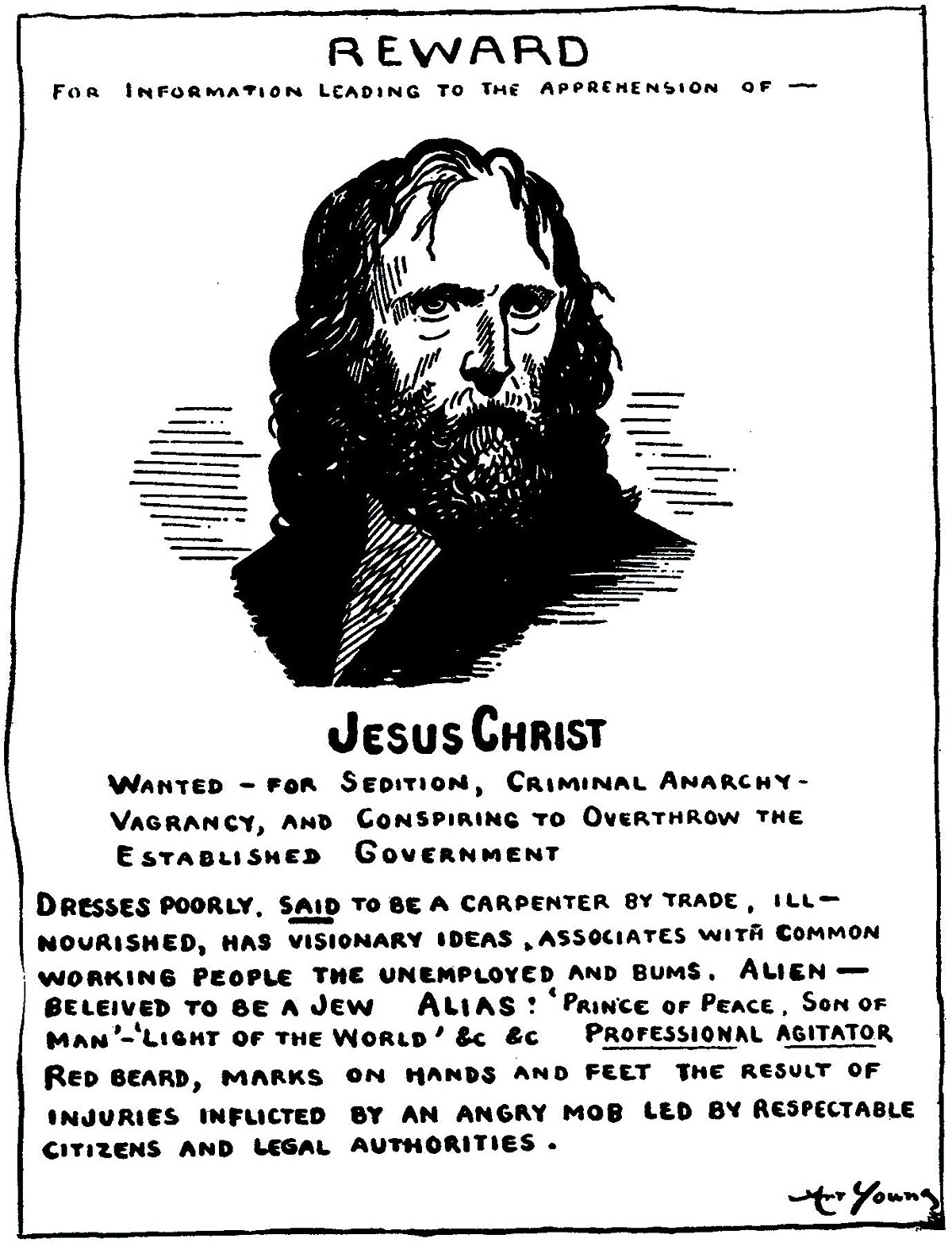
Marx and Jesus: The Trouble with Prophets

 00-art-young-jesus-wanted-poster-he-stirreth-up-the-people-1913

Readings for 4th Sunday in Ordinary Time: Jer. 1: 4-5, 17-19; Ps. 71: 1-6, 15-17; I Cor. 12: 31-13; Lk. 4: 21-30

I remember when my ideas about prophecy changed – when I really began to understand the term’s implications. I was a graduate student in Rome – already a priest – and completing my doctoral studies at the Academia Alfonsiana on the Via Merulana there in the “Holy City.” I was taking a class in I’ve forgotten what. But my professor (a German Redemptorist as I recall) got my attention during one of his lectures by referring to Karl Marx as “the last of the great Jewish prophets.” That was in 1970 at the height of the Cold War, and I had been reading Marx and about the then-flourishing Marxist-Christian dialog. I realized that my professor was right.

Marx of course was a Jew like Jesus, and Jeremiah who are centralized in today’s liturgy of the word. Like them, Marx was totally absorbed by questions of social justice for the poor and exploited. He was pretty much penniless, like most prophets, and spent his time thinking, writing, speaking, and organizing workers against exploitive employers. He was also highly critical of organized religion and its idols.

Marx’s insight (shared with the biblical prophets) was to realize that both Judaism and Christianity worshipped idols more often than the God of Israel. And by that he meant “gods” who not only justified an oppressive status quo, but who anesthetized the workers and unemployed to the fact that they were indeed oppressed by the capitalist system. Marx called such idols “the gods of heaven.”

We’re all familiar with what he meant. These idols are worshipped each Sunday – usually from 11:00 to 12:00 in what a theologian friend of mine used to call the “be kind to God hour.” You can encounter the “gods of heaven” any day at any hour on Cable television’s Channel 3 or in most Catholic Churches any Sunday morning. “God” there is concerned with correct worship, with bows, genuflections, and with correct terms such as “consubstantial,” “chalice,” “with thy spirit,” “under my roof” and so on. The stories or mythology upholding such idols have to do with “Jesus as your personal savior,” with “going to heaven,” and with avoiding hell.

Marx was also critical of what he called the “gods of earth.” They’re what people worship all those days and hours when they’re not in church. They include Capitalism, “America,” Nationalism, National Defense, Homeland Security, the Military, Money, and Profit. The issues of this God focus on sexuality: contraception, abortion, and same-sex marriage. This God is a War God – always on the side of “America.” He’s celebrated in songs like “The Battle Hymn of the Republic” and “Proud to Be an American.” He is the protector of “religious freedom” understood as privileging Christianity over other faiths while preserving tax exemptions worth billions each year. He blesses the bishops’ “Fortnight for Freedom” concerned as it is with protecting such benefits.

Marx’s prophetic work made him extremely popular with working classes. It was not uncommon for a worker to request that he be buried with a copy of “The Communist Manifesto” placed on his chest.

At the same time, Marx was vilified as the devil himself by factory owners, businessmen, bankers, and the professors and politicians representing their interests. Defenseless against such “education,” most of us have accepted such defamation of this last of the great Jewish prophets.

You see, that’s the trouble with prophets like Marx, Jesus and Jeremiah. They have to take on the “powers and principalities” of their cultures. They must swim against the torrential stream of public opinion.

In today’s first reading, Jeremiah is informed of his lot. But he must “man-up,” he’s told. He must steel himself to confront the “whole land,” along with kings and princes, priests and people. All of these, he’s warned, will fight against him. Nevertheless, God will make of Jeremiah a ‘fortified city,” a “pillar of iron,” and a “wall of brass.”

I suppose God followed through on those promises. But that didn’t prevent Jeremiah from being imprisoned, tortured, and left for dead.

Of course, the same thing happened to Jesus from the beginning to the end of his public ministry. He was vilified, demonized (literally!) and defamed.

That process begins for Jesus in today’s selection from Chapter 4 of Luke’s gospel. As we saw last week, he returns to his hometown of Nazareth and criticizes his neighbors’ narrow nationalism. In today’s episode his neighbors try to kill him. Later on, of course, Jesus goes more public. Like Jeremiah, he takes on his nation’s priests and scribes, princes and king. Ultimately his words and deeds threaten the Roman Empire itself which classifies him as a terrorist. Together those powers and principalities (national and international) not only defame Jesus the way Jeremiah and Marx were defamed; they actually kill him just as so many prophets have been killed from John the Baptist and Paul to Martin Luther King and Gandhi.

All of them – Jesus, Jeremiah, Gandhi, King, Paul and Marx – followed the same “prophetic script” whose inevitable directive prescribes that no prophet is accepted in her or his native place. It’s easy to see why. It’s because their “native place” bears the brunt of their prophetic words.

Meanwhile, it’s easier for outsiders to recognize prophets. The “outsiders” who concerned Jesus were the uneducated, poor, and unclean. However, even those seem to turn against him this morning. It’s unlikely that there were any rich or powerful resident in Nazareth – a place scripture scholar Ched Myers describes as “Nowheresville.”

Few of us are rich and powerful. Yet we’ve been schooled by those entities to reject prophets who speak in our name and defend our interests – those belonging to our “native land” to use the words of this morning’s gospel. It’s as though we’re looking at reality in that “darkened mirror” Paul wrote about in today’s excerpt from his letter to Corinth. The darkened mirror not only turns things backward, but it’s smudged with the fingerprints and dirt of ignorant and/or perverse propagandists.

The trouble – the trouble with prophets – is that most of us have bought into all that anti-prophet propaganda. So we hate Karl Marx without realizing that he’s on our side and speaks for us. We honor the Martin Luther King who has been reduced to a “dreamer,” but not the MLK who described the United States as the most violent and destructive country in the world. We don’t remember the King who was slandered as a communist and encouraged to commit suicide by the FBI and the COINTELPRO program.

We’re willing to stand by while Wikileaks journalist Julian Assange is persecuted by the governments of Great Britain and the United States. We presume that Chelsea Manning is guilty of treason because our government, (despite its record of lies and heinous crimes) says so. We wonder what all the fuss is about Aaron Swartz and Edward Snowden.

These are the prophets of our time who, like Jesus, do not find a sympathetic hearing in their native place. It might be time to embrace them as our own and see what difference that makes in the way we look at the world and our country. The examples of Jeremiah, Jesus, and Paul — and the hopes of the world’s poor and victims of U.S. wars — beg us to do so.

Christianity is the Enemy of Humankind (Reflections on the Historical Jesus)

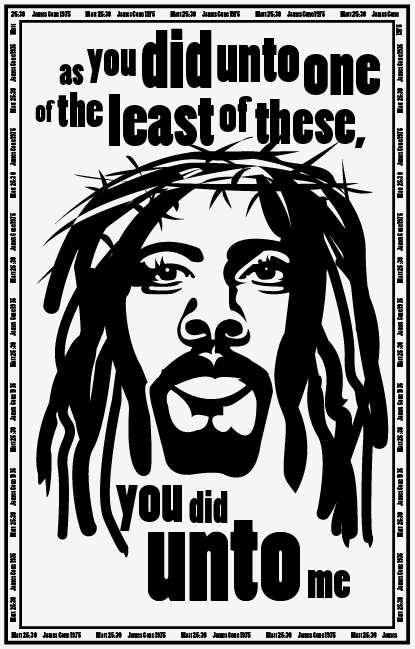
To the least

Last night I concluded a Lenten series of classes on the historical Jesus. As always, the course had its ups and downs. But it was faithfully attended by about 25 soul mates who, like me, remain fascinated by and somehow in love with Jesus of Nazareth.

At last evening’s final meeting, one of the participants – a fierce unflinching seeker of truth, asked the question in the back of everyone’s mind. “So what?” she asked. “If, as we have learned here, Jesus has been distorted beyond recognition by the early church (and especially by Paul and Constantine) why should we believe any of it?”

What a good question! It has forced me to pull together (for myself!) what I have learned from this latest round of studies of the historical Jesus. Let me express them in as clear an unvarnished a way as possible both positively and critically.

First of all, my positive learnings . . . . The study forced me to face the fact that the historical Jesus, un-obscured by later developments is the touchstone for authentic Christian faith. That is, the Jesus of history (vs. the Jesus of later doctrines) trumps all other conceptualizations in terms of being normative for Christian faith. The teachings of the historical Jesus were extremely simple: God is love. God is bread. Salvation consists in sharing food – bread and wine. A world with room for everyone (the Kingdom of God) is entirely possible. Empire is the anti-thesis of love and sharing. It uses religion to enslave. It finds Jesus message of liberation abhorrent. Empire is the enemy.

Second of all, my critical learnings . . . . If anything the Christian Testament makes it extremely difficult to locate the normative historical Jesus. In fact, the canonical gospels often contradict the basic revelations of Jesus. When this happens, those contradictions have to be faced, learned from, and set aside as merely illustrative of the way history and religion are routinely distorted by the rich and powerful. It is evidence of what people either used to believe before Jesus’ revelation, or what they came to believe when the faith of Jesus subsequently interacted with and was domesticated by other cultures and times.

More particularly, examination of the gospels makes it abundantly clear that following the destruction of Jerusalem in the Jewish-Roman War (66-73), the Jesus of history increasingly receded from Christian perception. In his place a Jesus of faith came to prominence. The two are at odds with each other. The Jesus of history strove to liberate the poor. The Jesus of faith became the servant of empire and the rich who run it.

The Jesus of history was a mystic, prophet, teacher, healer, and movement founder. He was intent on reforming Judaism whose leaders had sold Judaism’s soul to the Roman Empire transforming it into a religion of laws, rituals and obedience to the powerful. This Jesus called himself the “Son of Man,” not the “Son of God.” He was perceived by the poor as a “messiah” who would deliver his people from Roman domination. He proclaimed a new social order which he referred to as the “Kingdom of God.” There Rome’s domination model of social organization would be replaced by a sharing model. In God’s kingdom everything would be reversed: the rich would be poor; the poor would be rich; the first would be last; the last would be first; prostitutes and “the unclean” would enter the new order before priests, the rich and the famous.

And although he shied away from accepting the conventional messianic identity associated with “The War” (against the Romans), Jesus’ program of “Good News for the poor” along with his healings and exorcisms confirmed that identification in the eyes of the marginalized and oppressed. It did the same for the Romans and their collaborators to such an extent that they ended up executing him as an insurgent.

The memory of this Jesus of history was preserved and celebrated by the Jerusalem community called “The Way” before its eradication in the horrendous Roman-Jewish War of 66 to 73CE. In obedience to Jesus, they adopted a communal life where food, drink, and material possessions were shared and held in common. Following Jesus’ death, some were even hoping for his “second coming” in their own lifetimes to complete the task of empire-destruction his execution had prevented him from fulfilling.

This prophetic Jesus was replaced by the Jesus of faith who emerged in the post-war world after the Jerusalem church and its leadership had been slaughtered by Rome. At this point, “The Way” (Jesus’ version of reformed Judaism) was replaced by “Christianity.” This religious movement was non-Jewish. It derived from the teaching of Paul of Tarsus (in Turkey) who never met the historical Jesus, and who thought of him in terms of God’s unique and only Son. Paul was a thoroughly Romanized Jewish rabbi intent on acquainting non-Jews with the Jesus he experienced in the visionary psychic experience recorded as his conversion on the Damascus Road.

By ignoring the Jesus of history, Paul’s experience and subsequent preaching laid the foundation for an understanding that centralized a Jesus understood as God’s only Son – a divine being who would have been (and was!) completely unacceptable to the fiercely monotheistic Jews. At the same time, this domesticated Jesus was not threatening to Rome. In fact, he was completely familiar to Romans resembling the “dying and rising gods” of Roman-Greco culture who offered “eternal life” beyond the grave rather than an anti-imperial Kingdom of God in the here and now. In other words, the Jesus of history was co-opted beyond recognition by the Roman Empire.

So what’s the take-away from the study of the historical Jesus? I think the following extremely important lessons:

1. History is unreliable. It has been distorted and manipulated by the powerful to suit their own needs. (If taken seriously, this in itself is an invaluable lesson.)

2. Hard work is required to find historical truth – not just about Jesus but about what happened yesterday!

3. Empire is the enemy. It is a system of robbery whereby the rich and powerful steal resources from the poor they oppress. It is entirely contrary to the will of God (the Principle of Life). It represents a “preferential option” for the rich and powerful. It is absolutely ruthless in its eternal war against the world’s poor and in falsifying history for its own benefit.

4. Those who resist empire can expect to be tortured and assassinated. Nonetheless, from time to time courageous and insightful prophets arise from the non-rich and non-powerful with Good News for the poor. Their very simple message: fullness of life is to be found not in empire, but among the poor and simple of the world (God’s people). Salvation, these prophets teach, consists in sharing the simple realities of bread and wine. In effect: God is Bread.

5. Among the west’s best known prophets of Jesus’ God are Moses, Jesus himself, Gandhi, Bartolommeo de las Casas, Karl Marx, Martin Luther King, Malcolm X, Dorothy Day, and the nameless martyrs (so many of them women!) inspired over the last fifty years by liberation theology.

6. Most people are in denial about these simple facts. They are powerfully assisted in their denial by politicians, scholars, priests, and the media who make the teachings of the prophets extremely complicated. They have transformed the prophets’ message about sharing bread and fullness of life in the here and now into “religion” and a promise of life after death. As such, religion is the enemy of humankind. Christianity is the enemy!

7. Those who accept these learnings should leave institutionalized “religion,” band together, internalize the teachings of the historical Jesus and change the world!