The other day a good friend and I were discussing the state of the world. Our conversation touched on the Boston Marathon bombing, the Bangladesh factory collapse, drone warfare, Guantanamo, the increasing concentration of media ownership, and the sorry state of the Roman Catholic Church. My friend remarked on the futility of attempting to do anything to change the world situation. Better to simply tend your garden, he said, rather than wasting psychic energy and physical effort to affect what cannot be changed.
I must confess that I found myself agreeing with my conversation partner more than not. It all seems so futile when we consider the overwhelming power of money, the state, the military, and of education and media propaganda whose predominantly conservative purpose is to keep things the way they are.
Suitably depressed, I took up my spiritual reading before going to bed. I’m currently pouring over, perhaps for the fifth time, Eknath Easwaran’s commentary on the Bhagavad Gita. In The End of Sorrow, the first of his three volume work (The Bhagavad Gita for Daily Living), Easwaran addresses the question of “detachment.” By that he means being free from anxiety or depression about the results of anything we do. What I read seemed intimately related to my exchange with my dear friend.
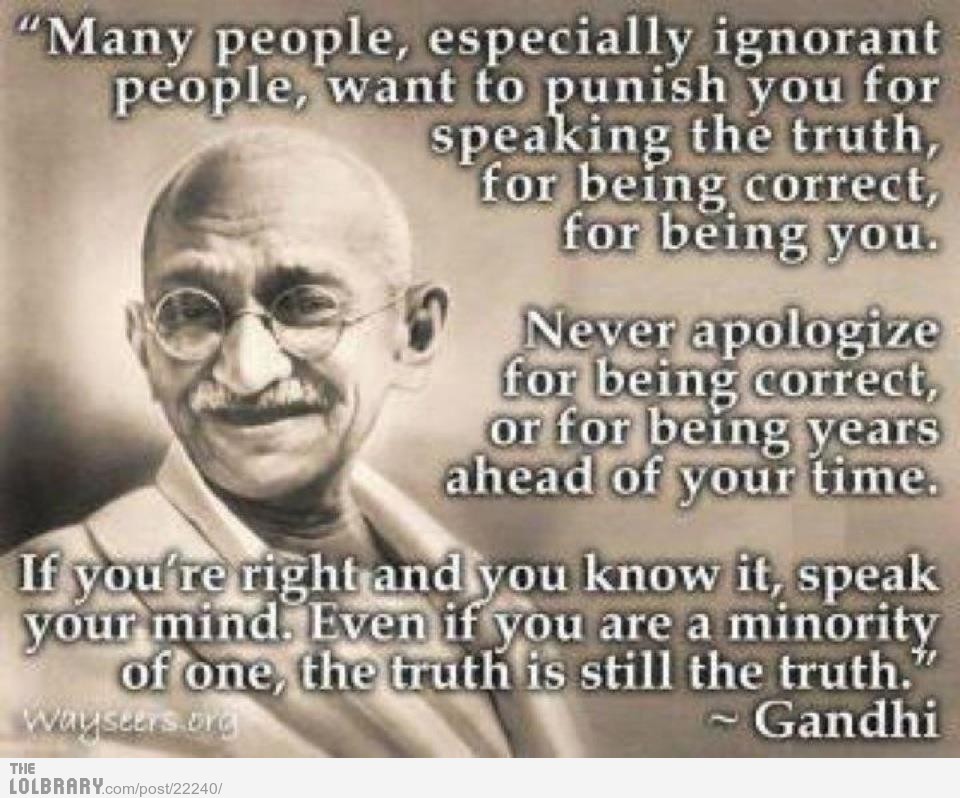
Easwaran points to the example of Gandhi:
“Prior to Gandhi, even people who had seen and grieved over the political bondage of India could not bring themselves to act because they thought the situation was impossible. They could not act because even before taking the first step they were already caught in results. We too, when faced with problems, have a tendency to think, ‘There is nothing we can do about it.’ . . . Wherever we find a wrong situation – in our personal life, in our country’s life, or in our world’s conflicts – we all have a duty to work to correct it.”
The words hit home. It’s giving up in the face of seemingly overwhelming odds that so strongly tempts us (me!). It’s just so easy to give up.
But as Kevin Trudeau reminds us, the temptation gives us far more credit for knowing our situation than our actual condition warrants. Coming from a completely secular and otherwise questionable perspective, Trudeau says we’re like people looking at a computer screen, but seeing only the bottom right hand corner – perhaps an inch square. We just don’t see what’s going on in the rest of the screen at all. But we make decisions and value judgments, we go in and out of depression as though we were all-knowing. We react and get attached to results as though our lives were not mere blips on the cosmic screen.
Thankfully, we don’t know very much. And our brief lives don’t offer much perspective on the effects of our actions. I’m reminded of what Mao Tse- tung’s is reputed to have answered when asked whether he thought the French Revolution was successful or not. “Too soon to say,” was his response.
It’s definitely too soon to say what the effects of our actions are or those of Dorothy Day, Daniel Berrigan, Bradley Manning, or John XXIII.
My friend is right. Results are out of our hands. But the person of faith, like Gandhi and those others I’ve just mentioned pushes ahead, doing what’s possible, leaving the results in the hands of the One who directs the universe. Only She sees the whole screen.
I take some comfort in that.
 About Things That Matter