The Biblical Tradition Advocates Healthcare for All – Even for Enemies of the State

Readings for the 28th Sunday in Ordinary Time: 2 KGS 5: 14-17; PS 98: 1-4; 2 TM 2: 8-13; 1 THES 5:18; LK 17: 11-19

On October 4th, President Trump signed a proclamation denying visas to immigrants who can’t afford to purchase health insurance within 30 days of their arrival to the United States. The new restrictions are scheduled to be implemented on November 3. They will also exclude immigrants from subsidies under the Affordable Care Act.

In its proclamation, the White House said it was taking this step to safeguard the health-care system for American citizens by preventing immigrants from enrolling in Medicaid or going to emergency rooms with no insurance, requiring hospitals or taxpayers to cover the cost.

“President Trump has taken action to promote immigrant self-sufficiency, which has long been a fundamental aspect of our immigration system,” the proclamation said.

In other words, (and listen for the irony here) the uber-rich president’s action is directed against poor people and is designed to save money for a revenue base recently depleted by tax breaks principally benefitting the richest people in the most affluent country in the world.

It’s simply another onslaught in Trump’s war of rich against poor.

Today’s liturgy of the word shows that the new proclamation is not only ironic, it also stands in sharp contradiction to the Judeo-Christian tradition and its emphasis on gratuitous healing.

I mean, this week’s readings seem providentially related to the issue of healthcare not only for resident aliens, but for explicit enemies of the state. The selections have two prophets (Elisha in the case of the Jewish Testament) and Jesus (in its Christian extension) curing foreign lepers. In Elisha’s case, the beneficiary of his cure is a general in an enemy army (Assyria) actually at war with Israel. That would be like Americans extending care to a notorious terrorist.  

Additionally, the readings connect with current debate about Medicare for All by suggesting the inappropriateness of charging money for healing which is understood as a gift from God. As such, the readings intimate, it should be available to all humans with no distinctions about race, class, or gender.

Please read the texts in question here. What follows is my own “translation” of their unusually coherent message about foreigners and healthcare.

 2 KGS 5: 14-17
 
During Assyria’s war on Israel,
Naaman, an enemy general,
Was cured of leprosy
By Israel’s prophet, Elisha.
The general offered
A valuable gift
In exchange.
But Elisha refused
To profit from
God’s healing.
Such salvation
Is as free as earth itself,
He implied.
It is entirely fungible
To entirely
Fungible people.
 
PS 98: 1-4
 
So, let’s sing
Of God’s healing (salvation).
On behalf of Israel
It manifests
God’s favor to non-Jews too
Causing the whole earth
To break out in song.
 
2 TM 2: 8-13
 
Jesus the Risen Christ
Endorsed Paul’s teaching
About the equality
Of Jews, Greeks,
Slaves and free,
Male and female
Prisoners and criminals.
Jesus identifies with all,
Paul said.
Every one of them
Is “chosen.”
God cannot deny
God’s generous Self.
 
1 THES 5:18
We are so grateful
For this wonderful teaching!
 
LK 17: 11-19
 
Like Elisha,
Jesus cured leprosy
This time
In a gang of 10 –
Including a Samaritan
An enemy of the people
Just like Naaman.
It was Healing
For nothing
Except for the outsider's
Singular word of thanks
Which healed him
Totally.
[No doubt
The ungrateful ones
Remained (partially) healed
As well.]

Not much needs to be added to the teachings so clearly embedded in today’s readings.

They’re about curing a culture’s most dreaded disease. They’re about foreigners and a divine dispensation that recognizes no one as somehow “foreign” or to be “shunned.” That’s true even if they represent a designated enemy of the state or adherents to a religion considered intrinsically evil by prevailing community standards.

As usual, then, and in other words, this week’s readings challenge our most cherished certainties. They call us to open ourselves to the poor, to foreigners, and even to those we’re taught to fear and hate.

They call us to denounce and resist Trumpian “proclamations” like the recent one punishing immigrants and refugees for their poverty and accidents of birth over which they have no control, but which especially endear them to the Author of Life.
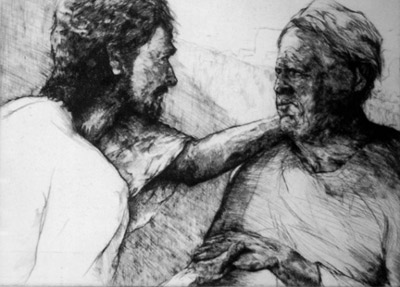
Reflections for the 5th Sunday in Ordinary Time: Jesus Becomes a “Low-life Scum”: So Should We!

leper

Readings for 5th Sunday in Ordinary Time: LV 13: 1-2, 44-46; PS 32: 1-2, 5, 11; I COR 10: 31-11:1; MK 1 40-45.

“Get out of here, you low life scum!” Those were the words U.S. Senator, John McCain, shouted at protestors two weeks ago when they confronted Henry Kissinger as a “war criminal.” The 91-year-old ex-Secretary of State had been invited to give testimony at a U.S. Senate hearing.

Those are pretty strong words – and perhaps justified, you might think, depending on your political persuasions.

However the point of bringing them up here is to highlight the deeper significance of Jesus’ curing a leper in today’s gospel. In Jesus’ day, lepers appearing in public would have merited Senator McCain’s disdain. Anybody would have felt justified shouting at them, “Get out of here, you low-life scum.” After all, the reigning morality of the day considered lepers not only sick, but morally degenerate. They must have committed some terrible sin to bring the disease upon themselves.

Today’s readings invite us to reject such superstitions. They highlight the radical nature of Jesus’ act of actually touching a man afflicted with one of the ancient world’s most feared diseases. They invite us to identify with those our culture tells us are “unclean.”

Begin by considering today’s first reading from the Book of Leviticus. It lays out the prescriptions of the Mosaic Law for dealing with skin diseases marked by “scabs, pustules and/or blotches.” Leviticus prescribes a priestly declaration designating the afflicted person as “unclean.” Thereafter “lepers” had to wear distinctive dress. They were forbidden to wear head covering that might disguise their affliction. They were to muffle their beards. If they happened upon apparently healthy people, lepers were to declare their status by shouting the warning, “unclean, unclean!” They were to be segregated from the community – banished “outside the camp.”

So in Israel’s ancient world, leprosy was painful physically, but even more so socially. Contracting the disease meant banishment from family, community, synagogue and temple. It made the diseased one “low-life scum” – totally ostracized. No one could touch a leper without themselves incurring the status of “unclean.”

However, today’s responsorial psalm says “no” to all of that. It reminds us that in God’s eyes, no one is scum.  God endorses no system of clean and unclean – no caste arrangement of insiders and outsiders. Instead, the psalmist has us singing, God wants only joy for the troubled. God takes away any fault, covers any sin, and completely removes guilt complexes. No room for ostracism there.

Lepers in Jesus’ day needed that kind of acceptance. (And so do we!) And complete acceptance is just what Jesus offers in today’s gospel. There he addresses not only a physical disease, but even more importantly the social ostracism and lack of compassion that the Master evidently found insufferable for anyone.

So just what is it that Jesus does?

A scum bag of a leper kneels before the working man from Nazareth. “If you wish, you can make me clean,” the poor man begs. The Compassionate Jesus is moved by the leper’s simplicity of faith. So he first gives him a healing touch.

But remember what I said about that: in doing so, Jesus deliberately contaminates himself! By that fateful act (right here in Chapter One of Mark’s Gospel) Jesus identifies with the lowest of the low in his culture. He makes himself an outsider. As a result, Mark informs us, Jesus afterwards could not enter any town openly. As “unclean,” he had to sneak around.

Jesus’ act of identification with “the least of the brethren” holds a powerful message for all of us. It invites us to embrace absolutely everyone as the Master did – even (and especially) those our culture rejects.

Remember how a few weeks ago, following the Charlie Hebdo massacre, mourners carried placards proclaiming, “Je suis Charlie!” (I am Charlie!)? Remember how in Ferguson following the police shooting of Mike Brown six months ago, mourners carried signs saying, “I am Michael Brown!”? Well, Jesus’ example calls us to go even further.

It tells us that we are one not only with the persons with whom we agree, but even with those our culture (and personal prejudices) tells us are somehow “unclean.” So, yes, we might gladly say, “Je suis Charlie!” but we are also the killers who shot up the Charlie Hebdo office. We might be proud to say, “I am Mike Brown.” But we are also his killer, Officer Darren Wilson.

John McCain is somehow the same as those protestors he called “low-life scum.”

Please remember that today at our liturgy’s “kiss of peace.” The person beside you, behind or in front of you might be on a completely different page politically, socially, or even religiously. But Jesus says “touch them;” embrace them; recognize them as your brother and sister – as yourself!

Then continue doing that all week – and beyond.

Mike Rivage-Seul

February 10, 2015


Mike Rivage-Seul is a former priest who in 1972-’73 served St. Clare’s parish. A liberation theologian, Mike  has been a member of St. Clare’s since then. He taught at Berea College for 40 years and was co-founder of its Peace & Social Justice Program. He blogs at   https://mikerivageseul.wordpress.com