Black Liberation Theology & Zionist Genocide of Gazans

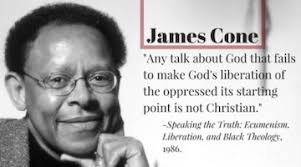
Black History Month has me rereading the late James Cone’s seminal work, The Cross and the Lynching Tree. Cone, of course, is the father of black liberation theology. I’m finding his work especially relevant to the ongoing genocide of Gazans at the hands of white supremacist Zionist Jews.

A central theme of Cone’s writing, public lectures, and teaching focuses on the difference between white versions of Christianity and their black counterpart. He puts that difference succinctly by alleging that whites have used the Bible to oppress blacks and others, while the latter have used that same Bible as a powerful tool to resist that oppression.

The ongoing slaughter in Gaza coupled with the statements of genocidal intent expressed by Benjamin Netanyahu and other Israeli officials have led me to conclude that something similar might be said of Zionists both in Israel and in the U.S. Recently they have used the Bible to ground their genocide of Palestinian children and their mothers. Meanwhile, Islamic Gazans use the Bible along with their Holy Koran to justify their (sometimes violent) resistance.

Who’s right? And what does Cone – what does liberation theology – say about such controversy?

Let’s see.

Consider first how Zionists are using the Bible. Next think about the approach of theologians like James Cone, and how the contrast between the two approaches applies to the Hamas attack of October 7th and Israel’s genocidal response in Gaza. Finally compare the oppressive violence that Zionists have used against Gazans with the violence of Hamas against their overlords. Theologians like Cone as well as his heroes Malcolm X and Martin King find the latter more justifiable than the former.   

Zionist Use of the Bible  

Consider the Zionists’ use of the Bible first.

Early on, Mr. Netanyahu invoked the biblical account of their ancient leaders claiming divine authority to carry out genocide against Israel’s archenemy, the Amalekites (I Samuel 15:1-9). The Gazans are the contemporary equivalent of Israel’s ancient foe, he said. They deserve the same fate of absolute obliteration – i.e. genocide.  

The Prime Minister’s words were turned into a war anthem adopted by the IOF (Israeli Occupation Force). They shocked the world in a video showing them singing and dancing to the words of that anthem calling for the slaughter of Gazans, today’s Amalekites.

Both Netanyahu’s words and the video of the soldiers’ rally were used recently by South African prosecutors in their presentations before the International Court of Justice (ICJ). There the prosecutors alleged that both Netanyahu’s words and the soldiers’ behavior provided convincing evidence of Israel’s intentional violations of the Genocide Convention.

On the one hand, the presentation of such evidence led the ICJ to conclude that the South African charges merit further court deliberation about Israel’s possible conviction for military actions that provide prima facie evidence of being genocidal.

On the other hand, the evidence in question (Netanyahu’s words and the IOC anthem) offers proof positive that (according to Cone’s allegations) white colonial Europeans continue to use the Bible to justify horrendous oppression of their victims.

But what about the Gazans and their use of the Bible? What does liberation theology say about that?

Liberation Theologians & The Bible

For liberation theologians like James Cone, all human beings are loved by the biblical God about whose nature there is evident difference of opinion and controversy throughout sacred scripture. That is, the Bible contains many contradictory understandings of God. In effect, it presents readers with a “battle of the gods.”

For instance, some texts present him (sic) as petty and jealous. Still other texts show him as the national God of the Jews. In that capacity, he is often a God of war like the one demanding the slaughter of the Amalekites.

The Hebrew prophetic tradition presents a very different God. He’s one who in today’s Zionist parlance might be accused of anti-Semitism. That’s because he is often highly critical and fiercely condemnatory of Israel. He frequently punishes them. On at least two occasions he allows their enemies to cart them off for generations-long exiles in Assyria (722-652) and Babylon (586-516).

Again, the prophetic tradition seconds the divine “anti-Semitic” tradition just mentioned. It’s that tradition in which Jesus appears. The Gospel narratives about him along with his preaching and parables sometimes even centralize Jewish enemies (such as “The Good Samaritan”) as heroes while condemning Jewish priests, scribes, Pharisees, and kings. With that in mind, contemporary Zionists would no doubt characterize Jesus as a “self-hating Jew.”

For Jesus, ethnic identity even became entirely immaterial. One thing alone is important, for him, love of God and love of neighbor (Matthew 22:36-40). Connections to Abraham, Jesus says, are no more significant than connections to a stone (Matthew 3: 9-10).

In fact, for the prophets in general (and for liberation theologians like James Cone), what is overwhelmingly central to morality is treatment of widows, orphans, and resident aliens. The prophets constantly remind their fellow religionists that all of them were once slaves in Egypt. They should never forget that. Accordingly, favorable treatment of slaves, aliens, widows, and orphans is the very touchstone of Israel’s identity. In fact, the prophet Jesus makes treatment of “the least of the brethren” the sole criterion of judgment about the final worth of one’s life (Matthew 25: 31-46).

Liberation theologians summarize all of this by asserting that God has made a “preferential option for the poor.” That is, when push comes to shove, and while God loves everyone, the Divine One sides with the poor and oppressed in their struggles against the rich and powerful.

For followers of the Jewish Jesus, that divine preference is evident in the fact that he chose to fully reveal himself not as a king, prince, or rich person, but in the poorest of the poor.  He surfaced in the working class as a construction worker from the nowheresville called Nazareth. He was conceived by an unwed teenage mother. In his youth, he lived as an immigrant in Egypt (Matthew 2: 13-15). He was accused of being a drunkard and a friend of prostitutes (Matthew 11:19). His family thought he was insane (Mark 3:21). He finished disgraced and a victim of torture and capital punishment.

And very significantly for James Cone, forensic archeologists point out that Jesus was probably black and unimposing. He was probably about 5’1” in height and weighed just over 100 pounds. Probably, they say, looked like the figure (below) on the left, not the familiar one on the right. To repeat, it is quite probable that Jesus was literally black. Cone affirms that he was at least figuratively or poetically black. He came from and sided with the poor and oppressed.

Liberation Theology & Violence

Furthermore, it isn’t all that clear that Jesus was a pacifist and non-violent. For instance, all Gospel lists of his apostles identify one of them as “Simon the Zealot.” “Zealot” was the name of patriots in Jesus’ Palestine who resisted Roman occupation by killing Jewish collaborators with Roman occupation. How could “Jesus meek and mild” have associated himself with murderers like that?

On top of that, all four Gospel traditions record that at least one of Jesus’ closest disciples was armed when Jesus was arrested (John 18:10-11). Jesus must have known that. Moreover, the friend in question knew how to use his weapon; he swung it at one of those who came to arrest Jesus and cut off the man’s ear.

Elsewhere, Jesus is remembered as saying, “Don’t think that I have come to bring peace, but the sword” (Matthew 10: 34-36). In another place, he says “Let the man who has no sword, sell his cloak and buy one” (Luke 22:36). And finally, as I said, Jesus was evidently perceived by the Romans as a revolutionary. In any case, they executed him by crucifixion, the means of capital punishment they reserved for violent insurrectionists. He was crucified between two other insurrectionists (not “thieves”}. Jesus must have done something(s) that gave the occupiers the impression that he was in insurrectionist too.

And that brings us back to Gaza, Hamas, and its use of violence on October 7, 2023. Would the revolutionary Jesus have supported such mayhem?

Here’s where distinctions made by liberation theologians {and by James Cone’s primary black hero, Malcolm X} come in. Malcolm was all for peace – but not in response to the oppressor’s aggression. “If someone hits you in the face,” Malcolm would say, “hit him back.” Black people have the right to defend themselves, he was fond of saying, “by any means necessary.”

Liberation theologians like Cone agree. And they go further. They teach that all forms of violence are not the same. At least one form is justifiable; others are not. So, before one can determine possible justification, one must identify its type. Four of them must be considered in any given analysis. Consider them in the context of Israel’s war against Gaza.

  1. The first type of violence is structural and is indefensible. It takes the form of elements such as laws and customs, restrictions, and prohibitions that adversely affect a given population such as inhabitants of the Gaza Strip. European colonialists’ gift of Palestine to white European Jews in 1948 was violent. It resulted in the forced displacement of Palestinians by the hundreds of thousands. Their houses were stolen or destroyed by the Jewish invaders from Germany, Poland, Russia, Lithuania, Latvia, Estonia, and even from the United States. Palestinians who resisted were often simply murdered by the invaders. Moreover, apartheid laws later imposed on Palestinians by Israel’s settler colonists are also violent. Most of the world hasn’t even recognized this structural form of violence as the “original sin” it represents. However, liberation theologians like James Cone do. This form of violence by the powerful against the powerless is never acceptable.
  2. The second type of violence is the truly justifiable violence of self-defense. This is what Malcolm referred to when he spoke of hitting back. It’s a form of violence that the UN recognizes as legitimate in Article 51 of its Charter. Accordingly, people living under occupation have the right to defend themselves against occupying forces. The latter, however, have no right to self-defense. They are robbers, thieves, and murderers. These are the convictions behind the Hamas attacks of October 7th, 2003. Liberation theologians like James Cone agree. This second form of violence is legitimate. However, its adoption is rarely wise. It can be suicidal because it leads to a third type of violence which is always overwhelming.
  3. The third type of violence is reactionary. It is the overwhelming police and military response of those imposing the first type of violence. This third type is on display at this very moment in Gaza. There cowardly Israeli occupation forces have killed more than 27,000 Gazans – more than half of them children and their mothers – in response to Hamas’ employment of the second type of violence. In this case, the response is so overwhelming that according to the ICJ, it provides prima facie evidence of genocide. Obviously, this type of violence cannot be truly justified since it represents restoration of the “order” imposed by violence’s first level. Nonetheless, in most cases such police and military violence is accepted by most as somehow normal.
  4. The fourth type of violence is terroristic. Terrorism is defined as the unlawful use of violence and intimidation, especially against civilians in the pursuit of political aims. Nation states such as Israel and the United States routinely define uprisings against their illegal occupations as “terrorism.” According to them, Hamas is terrorist while Israel and the United States stand for law and order. However, theologians like James Cone maintain that the world’s principal terrorists are states like those just mentioned. They are the ones who impose structural violence and respond with reactionary violence. Their routine murders of those defending their families, homes, and cultures against colonialism’s “legal” crimes are the primary forms of terrorism afflicting our world. By comparison, the violence of groups like Hamas (or even the perpetrators of 9/11) is minor. In other words, though terrorism is never justified, its main perpetrators are those who impose the colonialism of white supremacy in all its forms, not those who resist them.

Conclusion

Yes, the Bible’s Battle of the Gods continues to our day. All of us are involved whether we’re believers or not. But believers especially are called to make up their minds about the nature of the God they believe in and about the nature of the violence they find themselves supporting.

All of this means critical evaluation of Netanyahu’s attempts to biblically justify Zionists’ ongoing genocidal attacks in Gaza and the West Bank. Liberation theologians like James Cone contend that the Prime Minister’s invocation of a genocidal God is a typically white supremacist interpretation. As such it runs completely contrary to Israel’s prophetic tradition and its concerns for the impoverished, widows, and orphans. It runs completely contrary to the words of the Jewish prophet from Nazareth, “Whatever you do to the least of my brethren, you do to me.”

One thing we do know, in the biblical portrayal of its battle of the Gods, the God of the Jewish prophets and the Jewish Jesus is emphatically not the god of I Samuel 15:1-9.

Instead, the divine one is the God of the construction worker from Nazareth, living in a country occupied by invading Europeans, and who gave the invaders reason to believe he supported the Resistance the Romans feared and hated.

In fact, the white European occupiers hated the second level of violence so much that in the year 70 CE, they acted just like Netanyahu and his genocidal army. They reduced Jerusalem and its environs to the same condition we see in Gaza today.

Putin’s A Killer Who’s Guilty until (impossibly) Proven Innocent

The man’s body has hardly been identified as Yevgeni Prigozhin’s, and already The Economist and virtually all western mainstream media already know who killed him.

Here’s The Economist’s headline on the matter: “Prigozhin’s death shows that Russia is a mafia state. A healthy country uses justice to restore order. Mr. Putin uses violence instead.”

The follow-up elaborates: “As we published this editorial, it was not certain that Yevgeny Prigozhin’s private jet was shot down by Russian air-defences, or that the mutineer and mercenary boss was on board. But everyone believes that it was and that his death was a punishment of spectacular ruthlessness ordered by Russia’s president Vladimir Putin. And that is the way Mr. Putin likes it.”

Really? You mean we don’t know:

  • What caused Prigozhin’s jet to crash,
  • Or if Prigozhin was on board,
  • Yet, EVERYONE believes that the plane was shot down,
  • By order of the “ruthless” Vladimir Putin
  • Who The Economist somehow knows is pleased by the turn of events.

Yes, that’s what The Economist says.

And all that passes for sober analysis. Wow! No wonder Caitlin Johnstone can write with perfect logic that we westerners are “More Propagandized than Chinese People.”

Of course, until the completion of a proper investigation (that can take months), there are many other possibilities to explain this apparent final chapter in Prigozhin’s colorful life:

  • His plane might have crashed because of technical failures. Yes, that’s possible!
  • As a master of deception and disguises, Prigozhin might not have been on board. We will not know if he was until DNA tests have been completed.
  • And even then . . ..
  • Ukrainians might have brought the plane down,
  • Or the CIA in one of its covert operations,
  • Or disgruntled Russian military personnel,
  • Or unhappy Wagner minions
  • Or one of his many, many enemies other than Vladimir Putin.
  • Or the plane might have been shot down after misidentification by Russian air defenses,
  • Or. . ..

But even more importantly, using the standard of non-evidence embraced by The Economist to establish the mafioso nature of the Russian state, how are we to characterize our own “United” States in view of its much better documented assassinations and assassination attempts of heads of state and public figures such as:

  • Fidel Castro of Cuba (600 CIA plots)
  • Patrice Lumumba of Congo (1961)
  • Rafael Trujillo of the Dominican Republic (1961)
  • Salvador Allende of Chile (1973)
  • Achmad Sukarno of Indonesia (1975)
  • Muammar Ghadaffy of Libya (2011)
  • Malcolm X of the United States (1965)
  • Martin Luther King of the United States (1968)
  • Robert F. Kennedy Sr. of the United States (1968)
  • President John F. Kennedy of the United States (1963)

That’s just the short list of “punishment of spectacular ruthlessness” allegedly ordered by “our” own government – again, on much sounder evidence than the absolutely pure speculation of the mainstream western press.

By The Economist’s and other mainstream media standards of proof (i.e., pure speculation), is ours then a “healthy country” that “uses justice to restore order?” Or is the U.S. a “mafia state” much worse than Russia?

Clearly, The Economist has once again shown beyond doubt that it is just another propaganda rag along with all those others who voice certainty about designated enemies long before evidence decides the case?

The rag’s yellow journalism underlines its own bias by ignoring much better reasons for identifying our own country as a criminal enterprise that makes Cosa Nostra seem benign by comparison.   

Draw your own conclusions.

Walks with My Granddaughter Eva

Our granddaughter, Eva, has just been elected Ms. President of our town, Westport, CT). We couldn’t be prouder.

In my declining years, I’m leading a charmed life. Here Peggy and I are living in Westport, CT, just down the street from our daughter, Maggie, her husband, Kerry, and five of our grandchildren.

Here’s a picture of our house where we moved just three years ago:

Our grandsons, Oscar (10), Orlando (8), Markandeya (6), and Sebastian (2) usually stay overnight on Fridays and we have breakfast together Saturday mornings. All of them (except little Sebastian) love baseball, so Peggy and I spend a lot of time cheering them on in their Little League games.

About three nights a week, Peggy and I also have dinner at our daughter’s beautiful home. And with the advent of warmer spring nights, we’ve been eating outdoors, where we share not only Maggie’s gourmet meals, but the day’s “roses and thorns,” i.e. all of us taking turns telling about the highpoint and low point of our days.

When my turn comes, my “rose” is often an account of my morning walk with my granddaughter, Eva (12), who is the reigning “Ms. President” of Westport. [That’s right, Eva recently ran (albeit unopposed) for our town’s Ms. President and was elected based on her compelling presentation of a platform promoting planet-saving vegetarianism.]

In any case and for years, Eva has often joined me for my daily four-mile fast walks (which are getting slower all the time). This often happens on weekends, but sometimes we end up walking together to her school about two and a half miles distant. About half-way through our routine, we invariably stop for coffee at Starbucks and spend about 30 minutes just talking there on the shore of the Saugatuck River that runs through Westport’s heart. Our conversations are uniformly wonderful.

We often discuss what we’ve seen and heard lately on “Democracy Now,” Amy Goodman‘s Monday through Friday news program which Eva watches faithfully every day. (I’ve told Eva that if she continues her practice, she’ll end up knowing more about the world than most of her teachers at her Pierrepont School which she absolutely loves.)

Pierrepont School, Westport, CT

Both Eva and I are admirers of Malcolm X. So, we’ve watched and discussed Spike Lee’s film together (along with “Fahrenheit 451,” “Soul,” and “My Octopus Teacher”). We’ve also read Malcolm’s autobiography, and we’ve talked about Les Payne‘s latest biography about our hero, The Dead Are Arising (which I’m sure Eva will read on her own when she gets a bit older). I can imagine her producing some kind of research paper on Malcolm in high school or college. Anyhow, we often talk about X; Eva is intensely interested — as she is about almost everything.

And our conversations are so much fun.

For instance, just this morning, we had maybe our best exchange yet. In her history class at Pierrepont, Eva’s studying the Illiad and Odyssey. While Eva loves the tale, she was mildly complaining that her teacher takes the classic too seriously — i.e. she leads discussions as though Homer’s work were something more than what Eva recognizes as historical fiction.

“You know, Baba,” she confided to me, “I think they’ve misplaced Homer in the history section of our library; it really belongs in the fiction aisle. I mean, all this stuff about Helen of Troy as the cause of the Trojan War doesn’t make sense. How does anyone know that her abduction started the whole thing?”

“That’s a brilliant question,” I said. “You should ask your teacher.

“But you know,” I said, ” that’s probably true of all of the books in your school’s library. I mean they all should probably be classified as fiction. That’s what historians and other authors do; they write accounts that reflect their own biases. And that goes for the Bible too.” (I voiced that last part, because Eva considers herself an atheist, so I wanted to be even-handed about fields of study — she knows I’m especially interested in questions of faith and biblical interpretation.)

“But don’t be too quick to dismiss fiction,” I added. “Fiction is often more revealing of truth than history or scientific theory. It’s like my friend, Guy Patrick, used to observe about the Bible. . . ‘All of it is true,’ he’d say, ‘and some of it even happened.’ Hemingway’s and Faulkner’s novels are true, even though they didn’t happen. You might say the same about the poems of Emily Dickinson.”

And Eva could see all of that. Despite her atheism, she even agreed that the biblical stories of creation might be truer (i.e. more revealing of human meaning) than Darwin’s revolutionary theory. Stifling a theatrical yawn, she said “Darwin might be factually true, but it’s more boring, I agree.”

Can you see what I mean about a charmed life — and about my charming granddaughter?

Controlling History’s Narrative: Who Speaks for God Today?

Rev. Jeremiah Wright

Readings for 4th Sunday in Ordinary Time: Deuteronomy 18: 15-20; Psalm 95: 1-9; I Corinthians; 7: 32-35; Mark 1: 21-28

Today’s readings once again raise the central biblical question of prophets and prophecy.

We should read them carefully remembering that prophets are not fortune tellers focused on the future. They were and today remain social critics focused on present injustices committed against the original beneficiaries of Life’s covenant with Moses – the poor and oppressed (widows, orphans, and resident aliens). Insofar as they predict the future, the prophets’ threat is usually that neglect of the poor will lead to national tragedy.

 Yeshua the Christ, of course, appeared in the prophetic tradition which is always confused by the fact that the Great Mother’s spokespersons are inevitably contradicted by their fake counterparts. This Sunday’s readings highlight that point.

 Prophets Then

I was reminded of all this last week during a Zoom “Talk Back” responding to our pastor’s Sunday sermon on the fictional story of the prophet Jonah. That tale was centralized a week ago in the liturgy of the word. Towards the end, the pastor herself asked the question, “Who today is speaking the harsh truth that the Book of Jonah expressed?”

(As we saw last week the little Jonah parable (only 48 verses) is about a reluctant prophet who eventually has to face the fact that those imagining themselves to be the People of God (Israel) were quite the opposite. Meanwhile those whom Israel viewed as their corrupt enemies (Assyrians) were more responsive to God’s word.

In my own response to our pastor’s question, I observed “That would be like our hearing during the Cold War that Russians (communists) were more on God’s side than Americans. Today, it would be like being told the same thing about the Chinese or Muslims, or (worse still) al-Qaeda and other terrorist groups.”

Yes, that’s the way the Book of Jonah would have been heard in the middle of the 8th century BCE – as the Assyrian hordes massed on Israel’s borders ready to descend on “God’s People.” Eventually, they’d come (as Lord Byron would put it) “like the wolf on the fold.” They’d destroy the Northern Kingdom and take large masses of its people off to the Assyrian capital, Nineveh – as slaves. The book of Jonah dares to identify Assyrians as godly.

Imagine if some prophetic preacher today actually echoed Jonah saying, “You American exceptionalists believe that you’re especially pleasing to God. The exact opposite is true. In fact, your designated ‘enemies,’ Muslims, the Russians, the Chinese, and those you imagine as terrorists are actually God’s favorites.”

How hard would that be for Americans to hear?

Prophets Now

But (to answer our pastor’s question directly) there actually have been and are religious prophets among us who have said such things and who are saying them today. I’m thinking of Malcolm X, Martin Luther King, Jeremiah Wright, William Barber II, the Rev. Liz Theoharis, Dorothy Day, and even Pope Francis. Here’s what they’ve said in the name of God:

  • Malcolm X: “I’m not standing here speaking to you as an American, or a patriot, or a flag-saluter, or a flag-waver — no, not I. I’m speaking as a victim of this American system. And I see America through the eyes of the victim. I don’t see any American dream; I see an American nightmare.”
  • Martin Luther King: The United States is “the greatest purveyor of violence in the world today.”
  • Jeremiah Wright: “When it came to treating her citizens of African descent fairly, America failed. . . The government gives them the drugs, builds bigger prisons, passes a three-strike law and then wants us to sing “God Bless America“. No, no, no, not God Bless America. God damn America. . . as she tries to act like she is God, and she is supreme”
  • William Barber II: “. . . I, too, am an atheist. . . if we were talking about the God who hates poor people, immigrants, and gay folks, I don’t believe in that God either.” 
  • Liz Theoharis: “Jesus led a poor people’s campaign.”
  • Dorothy Day: “Our problems stem from our acceptance of this filthy rotten system.”
  • Pope Francis: “This system is by now intolerable: Farmers find it intolerable; laborers find it intolerable; communities find it intolerable; people find it intolerable.”

Those are not voices most of us are accustomed to hearing as representative of a Christian message that has been completely dominated by right-wingers who have effectively silenced the political voice of the one Christians pretend to recognize as the greatest of all prophets. They silence Yeshua’s authentic voice by focusing exclusively on the fiction of American Exceptionalism and on personal “salvation.”   

The Prophet Yeshua

Instead, the very life of Yeshua the Christ was highly political from start to finish. He literally embodied God’s prioritization of the needs of the poor while specifically condemning the rich and powerful of his day. That’s why he had to be assassinated at a very young age — same as Malcolm, Martin Luther King, Fred Hampton. . .

Think of it this way: Isn’t it true that Christian belief holds that Yeshua was the fullest revelation of God? If so, isn’t it therefore significant that the revelation site supposedly chosen by God was a poor man from the working class? Isn’t it theologically meaningful that he was born out-of-wedlock to a teenage mother (LK 1:34), was houseless at birth (LK 2:7), experienced immigrant status as an asylum seeker (MT 2: 13-15), traveled with a band of young people who had no visible means of support, was thought insane by his mother and close relatives (MK 3:21), was identified as a terrorist by the most powerful nation then on earth, and finished a victim of its torture and capital punishment?

I’d say that believers should find all of that extremely revealing.  

Moreover, the highly political Yeshua is reported to have made radical statements about wealth and poverty, e.g.:

  • “The Spirit of the Lord is on me, because he has anointed me to proclaim good news to the poor. He has sent me to proclaim freedom for the prisoners and recovery of sight for the blind, to set the oppressed free, to proclaim the year of the Lord’s favor” (Luke 4:16-22)
  • “Blessed are you poor, yours is the Kingdom of God” (Luke 6:20).
  • “Woe to you rich, you have had your reward” (Luke 6:24).
  • “It is easier for a camel to pass through the eye of a needle than for a rich man to enter the Kingdom of God” (Matthew 19:24).
  • “So therefore, whoever of you does not renounce all that he has cannot be my disciple” (Luke 14:33)
  • “If you want to be whole, go and sell your possessions and give to the poor, and you will have treasure in heaven; and come, follow me” (Matthew 19:21).

Still more, his followers took their teacher literally as they practiced a kind of primitive communism:

  • “All the believers were together and had everything in common. They sold property and possessions to give to anyone who had need” (Acts 2: 44-47).
  • Now the full number of those who believed were of one heart and soul, and no one said that any of the things that belonged to him was his own, but they had everything in common” (Acts 2: 32).

All of that identifies Yeshua as a great prophet in the tradition of Moses, the liberator of slaves in Egypt, of Amos who defended the poor and criticized the rich, of Karl Marx, the last of the great Jewish prophets, and of the contemporary troublemakers listed above.

Today’s Readings

Keep all of that in mind as you review today’s liturgy of the word which centralizes the question, “Who are the true prophets among us?” What follows are my “translations.” You can find the originals here to see if I’ve got them right.

 
 Deuteronomy 18: 15-20:
 More than 500 years
 After the Great Prophet’s Death
 Moses was remembered
 As predicting the advent
 Of another Great One
 For a people deathly afraid
 Of hearing God’s voice directly.
 Problem was:
 There’d be false prophets too
 Claiming to speak 
 In the name of Yahweh,
 But actually representing 
 False gods
 Whom, if listened to
 Would bring to believers
 Severe punishment. 
 (Hmm.
 Where does that leave us?)
  
 Psalm 95: 1-9
 It leaves us confused
 And in danger
 Of letting our own self-interest
 Harden our hearts
 To the authentic voice
 Of our loving Mother-Father God
 Our firm refuge
 Benefactor and guide.
 Her wonderful handiwork
 In creation itself
 Reveals more
 Than any prophet’s words.
 So, believe and embrace
 What you see
 With your own eyes.
 
 I Corinthians 7: 32-35
 The case of St. Paul
 Illustrates our confusion
 About what to believe – 
 What our eyes tell us
 Or the words 
 Of an anxious 
 Celibate prophet
 Like Paul
 Who’s been interpreted 
 To say that
 Eros is somehow “improper”
 And a huge “distraction”
 For anyone serious
 About what’s truly important.
 (For, doesn’t Life Itself teach
 That Eros is
 A primary source
 Of God’s revelation
 About the nature of Life
 And Love?)
  
 Mark 1: 21-28
 Jesus, on the other hand
 Had no such reservations.
 His followers believed
 Him to be the Great Prophet
 Predicted by Moses.
 He taught astonishing truths
 With authority and certainty
 Unlike the temple scribes
 (And the doubt-filled Paul).
 He terrified unclean spirits
 While delighting
 The (married) women and men
 Who hung on his every word.  

Conclusion

The disparity between the nationalistic and exclusively personal understandings of the prophet Yeshua on the one hand and the highly political nature of his life and discourse on the other is extremely important to confront.

That’s because (as Caitlin Johnstone has recently reminded us) those who control cultural narratives control the world. And no narrative is more important to history’s control than the religious one we’ve just considered. That’s because religious faith addresses life’s most fundamental questions – the ones so thrillingly addressed by the prophets we’ve considered here: about the nature of life; our relations with one another, human connections with the environment, about foreigners, power, love, money, and justice.

I’ll even venture to say that religious story supplies the popular “philosophy” of most people in the world. It organizes their experiences. They might not know much about history, economics, or political parties, but they know what they’ve been told about the Bible, the Bhagavad-Gita, or the Holy Koran.

To ignore this truism is tragically to surrender an essential tool of social justice to its enemies. On the other hand, exposing the radical social justice character of the Judeo-Christian narrative while challenging its domestication by false prophets represents an essential element of any attempts to shape the world by controlling its narrative.

Even completely secular social justice warriors should take note.

The Post: What’s Wrong with the Capitalist Model of News Publication

The POst

Last week some dear friends joined Peggy and me to see The Post. That’s the Steven Spielberg film detailing the story behind The Washington Post’s publication of the Pentagon Papers in 1971. It stars Meryl Streep as Katherine Graham, the Post’s chief executive, and Tom Hanks as the paper’s editor, Ben Bradlee.

Intentionally or otherwise, The Post ended up revealing a huge reason why readers have increasingly given up on large for-profit news organizations. They turn out to be run by ignorant people, who know far less than those they pretend to inform. The would-be informants are blinded by the profit motive. Moreover, their organizations top-down structures prevent them from even hearing those who work for them. Thankfully, however, The Post unwittingly suggests remedies for the dire situation it depicts – some of which are taking form before our very eyes.

The Post begins with a revealing vignette of the Vietnam War. It shows a world invisible to the newspaper’s sophisticated editors. There, U.S. infantry are seen executing one of their commanders’ signature “Search and Destroy” missions. The maneuver consisted in having poor, terrified disproportionately black and brown twenty-somethings make their way through rainforests they knew nothing about in search of Vietnamese farmers exquisitely familiar with the terrain. The idea was to find the farmers awaiting them in ambush and kill them. According to the strategy, if they did that enough times, the Americans would soon eliminate the peasants and win the war.

Brilliant, no?

Obviously not.

In fact, by 1971, when The Post begins, it was clear to nearly everyone outside the Beltway that the whole idea was stupid, crazy, doomed, and immoral. That was especially evident to those at the wrong end of Vietnamese rockets and machine guns, as well as of those with any shred of religious conscience. Buddhist monks called attention to the war’s immorality as they immolated themselves in Saigon as far back as 1963. So did the Baptist preacher, Martin Luther King when in 1967 he “Broke Silence” at New York’s Riverside Church. The Muslim, Malcolm X, knew it, as did the boxer, Mohammed Ali. The Catholic Berrigan Brothers and the Catonsville Nine knew.

Even Bob Dylan, Paul Simon, Jimi Hendrix, and Joan Baez were in the know. So were the college students demonstrating (with four of them murdered) at Kent State in 1970 – not to mention the throngs of young people brutalized by Mayor Daley’s riot police at the Chicago Democratic Convention in 1968.

Yet with straight faces, the enlightened and secular mainstream media continued to parrot the lies of the generals and politicians. “Great progress is being made,” the war-makers told the official stenographers. “There is light at the end of the tunnel.”

All such statements were about Southeast Asia were known to be false by the ones uttering them. They should have been known by Washington Post editors too. An early sequence in the film shows Truman lying about it, then Eisenhower, Kennedy, Johnson, and, of course, Richard Nixon.

And why did they lie? Was it for reasons of national security or to prevent countries in the region from falling to communism like so many dominoes?  Again, no. According to Robert McNamara in the film, seventy percent of it was to prevent embarrassment on the part of the “leaders” responsible for the enterprise in the first place.

Or as Nixon himself put it when he described the ultimate impact of the Pentagon Papers revelations:

“To the ordinary guy, all this is a bunch of gobbledygook. But out of the gobbledygook comes a very clear thing…. You can’t trust the government; you can’t believe what they say; and you can’t rely on their judgment; and the — the implicit infallibility of presidents, which has been an accepted thing in America, is badly hurt by this, because It shows that people do things the president wants to do even though it’s wrong, and the president can be wrong.”

So, to prevent such irreparable damage to “national security,” the wholesale killing went on for years – long after those responsible for the disaster had concluded the war was genocidal and completely unwinnable. In the end, more than 58,000 U.S. soldiers and two million Vietnamese were sacrificed to the myth of Presidential Infallibility – to conceal the fact that OUR GOVERNMENT IS RUN ON LIES.

And (other than repeating government falsehoods) what was the press doing while all of this was going on? What were The Washington Post’s Katherine Graham and Ben Bradlee doing? According to the film, they were hobnobbing with the liars. They were dining with them in expensive DC restaurants, vacationing with them in Hyannis, posing with them for photo-ops, throwing parties for them, guarding their secrets, and attending meetings with Wall Street insiders and white men in dark suits.

Their big news item? Tricia Nixon’s wedding!

But then Daniel Ellsberg risked his life by releasing irrefutable proof of government duplicity. And all the Washington insiders are suddenly shocked and appalled. As if the idea had never previously occurred to them, they realize the people in the streets, the religious prophets, the boxing champion, the rock ‘n roll singers and the student demonstrators and martyrs were all right after all.

The newspaper magnates had to face the facts. Their hand was forced.

But what were their biggest concerns when faced with the prospect of publishing the truth? Was it informing the American people? No. It was:

  • Selling more papers than their competitor
  • The impact of publication on the stock market value of their product
  • Fallout in the form of experiencing the ire of President Nixon
  • Being excluded from his inner circle as a result
  • And thus, losing market share.

Several conclusions suggest themselves from all of this – one particular, others more general. In addition, a basic remedy becomes apparent.

The particular conclusion is that the capitalist model of for-profit news publication is deeply flawed. Its power structure is entirely top-down. As depicted in the film, it empowered a tiny group of rich white mostly males to make decisions of extreme national import. Workers at the newspaper were treated with disdain.

That dismissal of underlings is portrayed at the film’s turning point. One of the paper’s staff far down the food chain obtains a copy The Pentagon Papers long sought by the paper’s editors. It had been delivered furtively to him by an even lesser nobody – a young woman in tie-dye obviously out-of-place in the newsroom. Shaking in his boots, the staffer tries to deliver his acquisition to Bradlee. However, he’s rudely waved off by his arrogant boss who initially refuses to even to acknowledge him. Then when he finally does get the editor’s attention, the staffer remains completely ignored as he tries to explain the information’s origin. That’s of no interest to his superior. Evidently for Mr. Bradlee, the idea was inconceivable and irrelevant that young hippies might be credible news sources.

That in itself represents a bleak commentary on capitalist workplace relationships.

Even more damningly however is the movie’s implied criticism of the system’s ownership structures. In fact, they placed the ultimate decision about whether or not to release The Pentagon Papers entirely in the hands of, Katherine Graham, a CEO presented in the film as singularly unprepared for such responsibility. She occupied her position of authority only because she inherited it from her deceased husband. At least within the confines of the film, she knew nothing of world affairs, much less about the Vietnam conflict or the inner workings of government – or those soldiers in the rainforest. True, she socialized with presidents and Wall Street high-rollers. But basically, she was ignorant. All her advisers (those white men in black suits) shared only one concern – the paper’s profitability.

Yet decisions of extreme national concern were entirely up to Ms. Graham. Only because of residual remnants of motherly conscience was she finally able to resist market pressures and do the right thing.

And so here come the general conclusions suggested by The Post:

  • In terms of informing the public, white male patriarchy is extremely inefficient.
  • Similarly, capitalist structures of inheritance, ownership, and commodification of information inhibit service of the truth.
  • The closer you are to power, the less you are likely to know about the concerns of ordinary people.
  • The richer you are, the less you are likely to know about the way the world really works for people in the street.
  • The higher up in the military you find yourself, the less you probably know about the disastrous outcomes of your pet theories and tactics.

What to do about it all. . .  As I earlier remarked, the solutions are unfolding before our eyes:

  • Stop trusting the mainstream media as reliable sources of information.
  • Realize that news sources can be co-operatives where all workers have meaningful input and respect, because they co-own the newspaper and need tremble before none of their peers.
  • Trust only such non-profit outlets, like Democracy Now and OpEdNews that rely for funding on viewer and reader support. They deserve trust because they depend on street-level sources for all of their information and analysis of official misdeeds and legislation.

In the end, The Post is worth watching. But it’s not for the reasons Hanks, Streep and Spielberg advance in their promotional commentaries. It’s not because Ms. Graham or Mr. Bradlee were heroic and demonstrate that the system somehow works. In fact, it’s quite the opposite. The true heroes were far down the food chain. The Post merely unveils the system’s severe dysfunctions. It demonstrates the need to put news gathering and publication under the decentralized aegis of workers and activists who refuse to be governed by the venal corporate interests of the military-industrial complex.