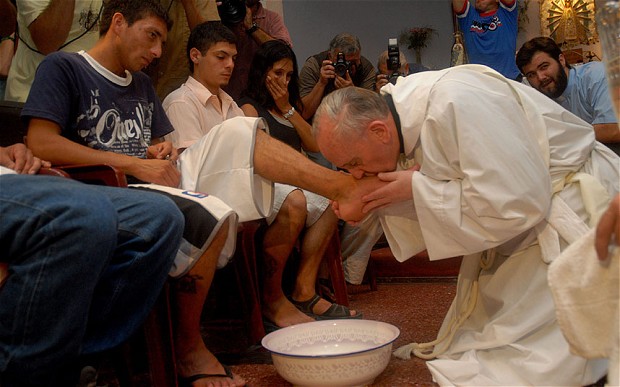
Move Over, Pope FrancIs, and Bring on FrancEs I!! (Fathers’ Day Sunday Homily)

Anointing

Readings for the 11th Sunday in Ordinary Time:2 SM 12:7-10, 13; Ps. 32: 1-2, 5, 7, 11; Gal. 2: 16, 19-21; Lk. 7:36-8:3. http://www.usccb.org/bible/readings/061613.cfm

Today is Father’s Day. So, happy Father’s Day to all of us who merit the title “father.”

However, I must observe that despite the male focus which our culture gives this June 16th, today’s readings end up being quite critical of men and patriarchy. They reveal the misogyny of western culture and of the Christian tradition right from the beginning. Unwittingly, they also make a strong case for female leadership in the church even to the point of suggesting female leadership for the entire enterprise. Sorry, dads!

Start with the first reading. There Nathan condemns the great father-figure, David for his own male chauvinism and for his disregard of all the gifts the prophet says he himself gave David in God’s name.

Nathan recalls that as prophet he himself anointed David king over both Israel and Judah. Nathan rescued David from his rival, Saul. The prophet gave him the Lord’s dwelling and a harem to live with David in his palace. All these including David’s many wives, Nathan says, were gifts from God. (So much for Yahweh’s “traditional family values” allegedly favoring domestic arrangements with one father and one mother.)

And what was David’s response to all the favors conferred by Nathan? Adultery and murder. He used his power as king to steal the wife of one of his generals, Uriah the Hittite. Then in effect, he “rendered” Uriah to the Ammonites to have him killed, while preserving his own “deniability” for the crime. But neither Yahweh nor Nathan was fooled.

Of course, the woman’s in question was the famous Bathsheba who eventually gave birth to King Solomon, who ended up succeeding David as King of Israel instead of David’s eldest son, Adonijah.

In fact the section of 2nd Samuel in which this episode is found is referred to as “the succession narratives,” because it answers the question “why is it that Solomon is sitting on the throne instead of David’s eldest living son, Adonijah?”

Solomon is on the throne, the story says, because of David’s theft of Bathsheba and killing of Uriah, and the curse of Nathan which resulted: “The sword will never depart from your house.” That is, all of David’s sons, but Solomon were condemned to die violent deaths. According to this tradition, God’s sole “blessing” for the eventually penitent king is limited to the boon that he himself will not be killed. Father-rule – the patriarchy – does not come out well in this first reading.

Neither is today’s gospel selection kind to patriarchy. Jesus has been invited to the house of a Pharisee for dinner. For Jews Pharisees were defenders of the father-rule system But in this case, the “host” proves to be an inhospitable man in terms of Jewish custom. He obviously sees the carpenter from Nazareth and his uncouth fisherman friends as riff-raff. He omits giving them the traditional greeting, and doesn’t even offer them water to wash their feet. Evidently he considers the band from Nazareth unclean – dirty people who won’t even know the difference.

Then the hero of the story appears to set things right. She’s a woman whose gender relegated her to unquestionably second class status. She is Mary of Bethany (whom scholars identify with Mary Magdalene). And she does something extraordinary. She does what Nathan the prophet recalled in today’s first reading that he did for David. She anoints Jesus as the Christos – the Christ, designating (and making) him God’s chosen one.

This is extraordinary, since the term “Christos” (or Christ) itself means “anointed.” And in the gospels there is only one anointing of Jesus the Christ. And it occurs at the hands of Mary Magdalene, not of some male priest. In other words, the Magdalene in today’s gospel acts as prophet and priestess on a level arguably above Nathan’s role recalled in the reading from 2nd Samuel.

And there’s more. The Magdalene appears in public with her head uncovered and hair flowing – a condition appropriate for a woman of Jesus’ time only in the presence of her husband. And besides anointing Jesus, she performs what can only be described as an extremely intimate act. She continually kisses his feet with her lips and washes them with tears of love.

But how could a woman perform such an act? Why would Jesus allow it? After all, according to Jewish law, women were not even permitted to say ritual prayers at home, much less perform religious rites of such central import as identification and anointment of the Christ.

That is, not according to Jewish law. However, according to “pagan” law such election by a priestess was not only permitted but essential for any sacred king. There according to the rite of hieros gamos or sacred marriage, the priestess would anoint the priest-king and by virtue of her act (often consummated by ritual sex), the anointed would be flooded with power of the god. Conversely, without the power conferred by the woman, the king would remain powerless and have no knowledge of himself or of the gods. These facts would have been evident to Jesus’ contemporaries.

Why has this history and the prophetic role of Mary Magdalene in identifying (and consecrating) the Christ been hidden from us all these years? Feminist scholars tell us that patriarchal misogyny – anti-woman sentiment – is the answer.

And negativity towards women is written all over today’s excerpt from Luke’s gospel. There the evangelist emphasizes the sinfulness of the Magdalene as that of the other women in Jesus’ company.

Luke describes Mary as “a sinful woman in the city,” and “a sinner.” He has Jesus tell those seated at table that “many sins have been forgiven her,” and say to the woman, “Your sins are forgiven.” So we won’t miss the point, Luke gratuitously describes Mary Magdalene as the one “from whom seven demons had been cast out.” And finally, women in Jesus’ company are described as formerly sick and possessed.

Nevertheless, Luke feels compelled to note what everyone in his community knew: women like the Magdalene and Joanna and Susanna and the “many others” who followed Jesus were his financial supporters of Jesus and “the twelve.”

But Luke doesn’t call the apostles “free-loaders.” Neither does he parallel his description of the women as sinners by recalling that one of the 12, Peter, was identified with Satan himself by Jesus. Nor does he recall that a key apostle, Judas, actually betrayed Jesus or that all of the twelve but one (unlike the Master’s women followers) abandoned him in his hour of greatest need. Instead, Luke simply mentions “the twelve,” who by the evangelist’s omissions are implicitly contrasted with the “sinful” women.

Above all, Luke omits the description of Mary Magdalene which we find in the church-suppressed Gospel of Thomas. There she is described as “the apostle of apostles” – no doubt because of her key role in identifying and anointing Jesus as the “Christos,” and because she was the one to whom the resurrected Jesus appeared before showing himself to any of “the twelve.”

In fact the Gospel of Thomas describes says:

“. . . the companion of the Savior is Mary Magdalene. But Christ loved here more than all the disciples, and used to kiss her often on her mouth. The rest of the disciples were offended . . . They said to him, “Why do you love her more than all of us?'”

Here the word for “companion” is koinonos which refers to a consort of a sexual nature. Moreover in other suppressed writings, Magdalene emerges as Jesus’ star pupil and the center of his attention. He praises her as “one whose heart is raised to the kingdom of heaven more than all thy brethren.” He predicts that she “will tower over all my disciples and over all men who shall receive the mysteries.” Additionally, following Jesus’ ascension, it is Magdalene who comes to the fore to encourage the disheartened apostles to man-up and get on with the business of understanding and living out the teachings of Jesus.

These words and the Magdalene’s functioning as prophet and priest should be extremely meaningful for contemporary women – and us patriarchs so fond of “Father’s Day. They highlight the way at least one female disciple of extraordinary talent and charisma was not only marginalized but denigrated in the church right from the beginning. And that denigration has continued in church circles and beyond to our very day.

Put otherwise, besides shedding light on the distant past, today’s readings expose the extreme weakness of contemporary ecclesiastical “fathers” in their exclusion of women from the priesthood and from other forms of church leadership. They also uncover the perversity of their other anti-woman pronouncements regarding topics such as contraception, abortion, and women’s rights in general.

In short today’s readings help us see beyond the “official story” to discern the fact that female leadership in the Christian community is nothing new. It is the males – the ones we call “father” – who are the interlopers and charlatans.

Mover over, Francis; bring on Pope FrancEs I!

Ascension Sunday: What’s Christianity for Anyway? (Sunday Homily)

People attend the funeral mass for Cardinal Aloysius Ambrozic at St. Michael's Catholic Cathedral

Readings for Ascension Sunday: Acts 1: 1-11; Ps. 47: 2-3, 6-9; Eph. 1: 17-23; Lk. 24: 48-53 http://www.usccb.org/bible/readings/050913-ascension.cfm

This is Ascension Sunday. For us Catholics, it used to be “Ascension Thursday.” It was a “holy day of obligation.” That phrase meant that Catholics were obliged to attend Mass on Thursday just as they were on Sunday. To miss Mass on such a day was to commit a “mortal sin.” And that meant that if you died before “going to confession,” you would be condemned to hell for all eternity.

So until the years following the Second Vatican Council (1962-1965) Catholics would fill their churches on Ascension Thursday in the same numbers (and under the same threat) that made them come to Mass on Sundays. That’s hard to imagine today.

I suppose that difficulty is responsible for the transfer of the commemoration of Jesus’ “ascension into heaven” from Thursday to Sunday. I mean it wasn’t that the church changed its teaching about “holy days of obligation.” It didn’t. Catholics simply voted with their feet. They stopped believing that God would send them to hell for missing Mass on Ascension Thursday or the feast of the Blessed Virgin’s Assumption (August 15th), or All Saints Day (November 1st) or on any of the other “holy days.” Church once a week was about as much as the hierarchy could expect.

But even there, Catholics stopped believing that God would punish them for missing Mass on Sunday. So these days they more easily attend to other matters on Sunday too. They set up an early tee time or go for a hike in the woods. Afterwards they cut the lawn or go shopping at Wal-Mart. That kind of “servile work on Sundays” or shopping used to be forbidden “under pain of sin” as well. And once again, it isn’t church teaching that has changed. Catholics have just decided that the teachings don’t make sense anymore, and have stopped observing them.

And apparently they do so in good conscience. So you won’t find them running to confession after missing Mass or working and shopping on Sunday. In fact, that’s another way Catholics have voted with their feet. For all practical purposes, they’ve stopped believing in Confession – and largely in many of the mortal sins they were told would send them to hell – like practicing contraception or even getting a divorce.

I remember Saturday evenings when I was a kid (and later on when I was a priest). People would line up from 4:00-6:00, and then from 7:00 -9:00 to “go to Confession.” And the traffic would be steady; the lines were long. No more! In fact, I personally can’t remember the last time I went to confession. And no priests today sit in the confessional box on Saturday afternoons and evenings waiting for penitents to present themselves.

What I’m saying is that the last fifty years have witnessed a tremendous change in faith – at least among Catholics. Our old faith has gone the way of St. Christopher and St. Philomena and “limbo” all of which have been officially decertified since Vatican II.

In fact, since then the whole purpose of being a Catholic (Christianity) has become questioned at the grassroots level. More and more of our children abandon a faith that often seems fantastic, childish and out-of-touch. Was Jesus really about going to heaven and avoiding hell? Or is faith about trying to follow the “Way” of Jesus in this life with a view to making the world more habitable for and hospitable to actually living human beings?

That question is centralized in today’s liturgy of the word. There the attentive reader can discern a conflict brewing. On the one side there’s textual evidence of belief within the early church that following Jesus entails focus on justice in this world – on the kingdom. And on the other side there are the seeds of those ideas that it’s all about the promise of “heaven” with the threat of hell at least implicit. The problem is that the narrative in today’s liturgy of the word mixes each view with its alternative.

According to the story about following Jesus as a matter of this-worldly justice, the risen Master spent the 40 days following his resurrection instructing his disciples specifically about “the Kingdom.” For Jews that meant discourse about what the world would be like if God were king instead of Caesar. Jesus’ teaching must have been strong. I mean why else in Jesus’ final minutes with his friends, and after 40 days of instruction about the kingdom would they pose the question, “Is it now that you’ll restore the kingdom to Israel?” That’s a political and revolutionary question about driving the Romans out of the country.

Moreover Jesus doesn’t disabuse his friends of their notion as though they didn’t get his point. Instead he replies in effect, “Don’t ask about precise times; just go back to Jerusalem and wait for my Spirit to come.” That Spirit will “clothe you in justice,” he tells them. Then he takes his leave.

Presently two men clothed in white (the color of martyrdom) tell the disciples to stop looking up to heaven as if Jesus were there. He’s not to be found “up there,” they seem to say. Jesus will soon be found “down here.” There’s going to be a Second Coming. Jesus will complete the project his crucifixion cut short – restoring Israel’s kingdom. So the disciples who are Jews who think they’ve found the Messiah in Jesus return in joy to Jerusalem and (as good Jews) spend most of their time in the Temple praising God, and waiting to be “clothed in Jesus’ Spirit” of liberation from Roman rule.

The other story (which historically has swallowed up the first) emphasizes God “up there,” and our going to him after death. It’s woven into the fabric of today’s readings too. Here Jesus doesn’t finally discourse about God’s kingdom, but about “the forgiveness of sin.” After doing so, he’s lifted up into the sky. There Paul tells his readers in Ephesus, he’s enthroned at the Father’s right hand surrounded by angelic “Thrones” and “Dominions.” This Jesus has founded a “church,” – a new religion; and he is the head of the church, which is his body.

This is the story that emerged when Paul tried to make Jesus relevant to gentiles – to non-Jews who were part of the Roman Empire, and who couldn’t relate to a messiah bent on replacing Rome with a world order characterized by God’s justice for a captive people. So it gradually turned Jesus into a “salvation messiah” familiar to Romans. This messiah offered happiness beyond the grave rather than liberation from empire. It centralized a Jesus whose morality reflected the ethic of empire: “obey or be punished.” That’s the ethic we Catholics grew up with, that sent some of us to weekly “confession,” and that former and would-be believers find increasingly incredible, and increasingly irrelevant to our 21st century world.

Would all of that incredibility and irrelevance change if the world’s 2.1 billion Christians (about 1/3 of the world’s total population) adopted the this-worldly Jesus as its own instead of the Jesus “up there?” That is, would it change if Christians stopped looking up to heaven and focused instead on the historical Jesus so concerned with God’s New World Order of justice for the poor and rejection of empire?

Imagine if believers uncompromisingly opposed empire and its excesses – if what set them apart was their refusal to fight in empires wars or serve its interests. How different – and more peaceful – our world would be!

A sensitive discerning reading of today’s liturgy of the word, a sensitive and critical understanding of Jesus’ “ascension” presents us with that challenge. How should we respond?

(Discussion follows.)

Pope Francis, Summon a Council: It’s Our Tradition!

Francis I

Readings for 6th Sunday after Easter: Acts 15:1-2, 22-29; Ps. 57: 2-3, 5, 6, 8; Rev. 21: 10-14; 22-23; Jn. 14: 23-29. http://www.usccb.org/bible/readings/050513.cfm

Last year was the 50th anniversary of the convocation of the Second Vatican Council. The Catholic Church is still reeling from that earth-shaking event. Conservatives often consider it a huge mistake. They want to return to the Latin Mass, to women’s head-coverings in church, to weekly confessions and communion placed by the priest on the communicant’s outstretched tongue.

Liberals too are disappointed by Vatican II. It didn’t nearly go far enough, they say. It should have eliminated priestly celibacy and the all-male clergy. The church should have divested itself of the Vatican Bank, sold its art treasures and given the proceeds to the poor. The Council’s teaching on collegiality should have decentralized church bureaucracy and made lay-leadership more prominent. The prohibition of contraception should have been changed.

Into which of those camps do you fall? As a church member, do you consider yourself conservative or liberal? Today’s liturgy of the word provokes the question. It reveals a church which at its very beginning surrendered itself to extreme liberalism – or should I say to the “radicalism” of Jesus’ Spirit?

Think about those terms for a minute in the light of today’s readings. Think about what “conservative” and “liberal” mean for us as individuals and community members in our faith tradition. Think of the Holy Spirit as “radical” – something believers are rooted in.

According to every great tradition (Christian or otherwise), the spiritual life – human life itself – is about change, about transformation. Change is the point. We are called to grow. Growth involves transformation. At the biological level, we’re told that all of our cells change every seven years. That means that at my stage in life, I’ve already gone through more than ten bodies! If I tried to keep my body from changing, I would die.

At the personal, psychic and intellectual levels we’re called to change as well. As St. Paul puts it, when we were children, it was appropriate to think, speak and act as children (I Cor. 13:11). But as adults, we’re called to something more. If we don’t change, we can never become who we’re meant to be.

Even institutions must change to survive. That’s true in the realm of politics, economics, and religion. Jesus’ followers found no exemption from this rule of life – of evolution; as community members they had to change or die. In other words, at the end of the day, strategies of conservatism are doomed for Christians as well as for everyone else.

It’s easy to sympathize with conservatives however. I spent much of my life in that category. As such, my concern was simply to preserve what is essential. I saw liberals as being too free with the unchangeable. Like other conservatives I accused them of throwing out the baby with the bath water.

Nonetheless, in today’s liturgy of the word, we get an idea of how difficult it is to determine which is which –baby or bath water. That is, in our readings, we are faced an example of a key conflict between religious conservatives and liberals within the first century infant church. Paul, Barnabas, Silas and Barsabas lead the liberal wing. Peter and Jesus’ brother, James are the leaders of the conservatives.

Paul and his friends come from the gentile world. Their concern is to make Jesus both understandable and acceptable to non-Jews. For their audience, circumcision and dietary restrictions (like not eating pork) represent great obstacles to accepting Jesus’ “Way.”

On the other hand, Peter and Jesus’ brother, James, are Jews through and through. They remember the importance of full observance of the law within the Jewish tradition. They recalled for instance that during the second century Seleucid persecution of the Jews under Antiochus IV Epiphanes, many Jews gave their lives rather than eat forbidden foods. Faced with Paul and his colleagues, the conservative faction wondered: were those lives sacrificed in vain? And besides, circumcision was the identifying mark of Jewish manhood. What good follower of the biblical God set that all-important commandment aside?

The issue is so serious that it provoked a meeting of church leaders – what scholars call the “Council of Jerusalem.” Like Vatican II (1962-’65) it called together church leadership to discuss burning issues of the day and to make changes that responded effectively to what Gaudium et Spes called the “signs of the times.”

Today’s gospel reading implies that leaders could come together with confidence because of Jesus’ promise that his Holy Spirit would continue teaching the church even after he is gone. The Spirit would remind the church of what Jesus himself taught – and more besides.

According to today’s readings, it was the “more besides” that the Jerusalem conservatives were resisting. They didn’t deny, of course, that Jesus himself was a religious liberal. (It was Jesus’ liberalism that angered the Scribes and high priests.) Jesus frequently placed love and compassion above God’s most important commandment, the Sabbath law; he associated with the “unclean;” he even befriended and worked miracles for gentiles. Jesus was never bound by the letter of the law as were his conservative opponents.

At the same time however, Jesus was Jewish to the end. He had no intention of founding a new religion. He was a Jewish reformer. No one could deny that. Jesus didn’t revoke the Law. He simply gave it an enlightened, more humane, more liberal interpretation. He himself had been circumcised!

It was with these understandings that the Council of Jerusalem convened. And according to Luke, the author of Acts, it was a battle royal. Luke says the meeting (like Vatican II) was filled with “dissension and debate.”

What we find in today’s first reading is the final decree of the Council of Jerusalem. Concerning circumcision, it says “never mind.” As for dietary restrictions, fagedaboutit. The Council was concerned with not placing unbearable burdens on converts. In other words, it couldn’t have been more liberal. It could not have been less conservative.

The Council of Jerusalem is reputed to have happened no more than 30 years after the death of Jesus. But by the time John of Patmos writes his book of Revelation at the end of the first century, look where his church had come. His vision of the “New Jerusalem” which we read about in today’s second reading doesn’t even have a temple. Jerusalem without a temple?! The city is founded not on the 12 patriarchs of Israel, but on the 12 apostles. How liberal is that!?

I suppose what I’m saying is that Christians shouldn’t be afraid of change. It’s our tradition – right from the beginning. In fact, in today’s gospel, John has Jesus say specifically that we should not be agitated or fearful. Rather, our hearts should be filled with peace because of our reliance on the Holy Spirit. John’s Jesus teaches that the Spirit’s presence guarantees the community is moving in the right direction, even when the Spirit’s teachings shock and scandalize – as long as it’s moving towards Jesus’ compassion, love, and ease of burden. The guarantee remains even when the Spirit’s guidance seems to dilute what many consider essential – like circumcision, dietary laws and the Jerusalem Temple.

What “essentials” is the church being called to set aside today? Priestly celibacy? An all-male priesthood? Prohibition of contraception? Are any of these really essential?

The question is as unnerving for the church as it is for us as individuals. But the answer is always the same: “Don’t be afraid or agitated; the Holy Spirit guides.”

Think about it: at the personal level, after ten changes of body and innumerable psychic growth spurts and changes of mind, what remains that allows me to identify with that child they tell me I was in my baby pictures? The bath water has been thrown out virtually every day. But somehow I’m able to say “I” remain. Who is that “I?”

Once again, today’s gospel leads us to believe that the answer is the indwelling Holy Spirit herself who continually leads us into the new and unforeseen – but without that “fear or agitation.” That unifying, enlightened Spirit is the same in me as She is in you.

The bottom line: today’s readings teach that there is no future in timid conservatism. Instead we are called to extreme liberalism. And that liberalism actually translates to Jesus-like radicalism (or going to the root of things). The Holy Spirit is that root.

And so we can pray with confidence: “Holy Spirit, in the present crisis of your church, inspire Francis I to call us together once again. Convene a Council. Surprise us. Shock us one more time. Wake us up! Move us towards compassion, love and ease of burden as you did the Jerusalem Council. We believe that under your guidance, we can never go wrong!

Saving Jesus from Paul and John (Sunday Homily)

rebel_jesus2

Readings for the 4th Sunday after Easter: Acts 13:14; Ps. 100: 1-2, 3-5; Rev. 7:9, 14B-17; Jn. 10: 27-30. http://www.usccb.org/bible/readings/042113.cfm

As I’ve been reporting here, a group of about 25 people met weekly during Lent for an intensely rewarding study of “The Historical Jesus.” The group included members of our local Catholic church in Berea, Kentucky along with an equal number from our Ecumenical Table in nearby Richmond. In the aftermath of that experience, I find it impossible to read selections like those in today’s liturgy of the word without making connections with our little seminar.

For instance, today’s readings remind me that would-be followers of Jesus might more accurately call ourselves “Paulists” rather than “Christians.” That observation is sparked by the tension between Paul and “the Jews” in this morning’s selection from Acts. The tension reminds us that our belief system has been shaped more by Paul of Tarsus than by Jesus of Nazareth who was himself a Jew. The same holds true for the gospel selection from John the Evangelist with its emphasis on Jesus’ divinity (“I and the Father are one”). As a result of the influence of Paul and John, our faith tends to be other-worldly and de-politicized. Our Jesus tends to be one-dimensionally divine rather than the enlightened very human rabbi who graced the Palestinian landscape 2000 years ago. Let me explain.

To begin with it’s important to point out that we know more about Paul than we do about the historical Jesus. And we know more about the historical Jesus than did the rabbi from Tarsus. The reasons why are simple. On the one hand, most of the Christian Testament is written by or heavily influenced by Paul. The New Testament, then, is more Pauline than Christian.

On the other, Paul never met the historical Jesus and shows almost no knowledge of Jesus’ words and deeds in his epistles. Meanwhile, scholarship based on manuscript discoveries at Nag Hammadi in Upper Egypt in 1945 and at the Dead Sea in 1947 (the famous Dead Sea Scrolls) has yielded unprecedented knowledge of the historical Jesus. That means we know more about the rabbi from Nazareth than did Paul.

Think about the Pauline nature of the faith we’ve inherited. There are 27 books in the “New Testament.” Thirteen of those 27 are letters written by Paul. Then there’s the “Acts of the Apostles” which really is a travelogue about the mission and adventures of Paul written by Paul’s companion, Luke the evangelist. Luke also wrote his own Gospel, which, of course, was heavily influenced by his mentor. Finally, as the earliest entries in the New Testament, Paul’s epistles (written from about 50 to 64 CE) evidently exercised great influence on the other evangelists Mark, Matthew and John who wrote much later.

That means that nearly half of the New Testament (13 of 27 entries) is comprised of letters attributed to Paul. Fifty-five percent (15 of 27 entries) was written by Paul or Luke. And more than 66% (18 of 27 entries) was arguably more influenced by Paul than by Jesus.

I say “more influenced by Paul than by Jesus” because what we have in Paul’s letters, the Acts of the Apostles and in the gospels themselves are proclamations about Jesus rather than the proclamation of Jesus. Remember, Jesus’ proclamation was about the Kingdom of God, “Repent, the Kingdom of God is at hand.” In contrast, the New Testament’s proclamations about Jesus are “Jesus is Lord.”

The differences between these two “gospels” are enormous and they are, as I indicated, illustrated in today’s readings on this fourth Sunday after Easter. Today’s selection from John’s Gospel (written about 70 years after the crucifixion of the Enlightened Yeshua) has Jesus discoursing about himself. He speaks of himself as a “shepherd” leading his sheep and about offering them “eternal life.” He concludes by claiming to be God’s Son equal to the Father. “I and the Father are one,” he says. (The historical Jesus could never have made such statements without being stoned by his fiercely monotheistic Jewish audience.)

However, Jesus’ discourse as reported in John’s gospel is completely coherent with the gospel of Paul. Paul, I repeat, never met the historical Jesus. In fact, as we all know, before his famous conversion on the road to Damascus, he was a persecutor of Christians. He pursued them on behalf of the Sanhedrin, the Jewish high court, which worked hand-in-glove with the Romans.

The Romans were hunting down Christians for the same reason they arrested and executed Jesus – because he was perceived as the Jewish Messiah whose overriding responsibility was the overthrow the Roman occupation of Palestine. With good reason, the Romans considered Jesus’ followers to be subversives.

In other words, the Romans, their Sanhedrin collaborators, and their point-man, Saulous (Paul’s name before his conversion) were cooperating in a counter-revolutionary program that targeted Jesus’ nationalistic followers.
Those followers had actually lived with Jesus. They were Jews primarily – members of a Jerusalem community gathered around Jesus’ brother, James, the apostles, and Jesus’ “inner circle” of followers including many women and numbering perhaps 120 people or more. Together they constituted a group of reformed Jews. Many of them had been eye-witnesses of Jesus’ deeds and followers of his teachings.

Those teachings centralized a new understanding of “the Law” which Yeshuaists called “the Way.” It emphasized love and forgiveness over fear, punishment and a purity code that divided people into “clean” and “unclean.” It emphasized justice for the poor and oppressed and freedom from foreign domination. The Jerusalem community of The Way recognized Jesus as the True Prophet predicted in their scriptures – a wonder-working Messiah and liberator who would usher in an era reminiscent of the Exodus from Egypt under the great rebel Moses. This Jewish messiah was human (the Son of Man) not a divine Son of God.

Paul, as I said, had never met the Son of Man. His writings show neither knowledge of Jesus’ deeds nor of specific teachings which were so important to the Jewish Yeshuaist community. Instead, Paul preached a kind of mythological Jesus who was entirely recognizable to the gentile audiences which interested him. Paul’s Jesus was born, crucified, risen and ascended to heaven. Evidently, Paul considered nothing between Jesus’ birth and death worth reporting.

For Paul’s gentile audience, any wonder-working “messiah” had to be a divine incarnation like the gods Romans and Egyptians worshipped — Mithra, Isis, Osiris, the Great Mother God. These “dying and rising gods” descended from heaven, lived for a while on earth, died, and then rose from the dead. Typically, they offered “eternal life” beyond the grave to believers who ate sacred meals together sharing the gods’ body and blood in the form of bread and wine. These are the terms Paul used to explain Jesus to his gentile audiences.

As reformed Jews, the Jerusalem community along with most unreformed (non-Yeshuaist) Jews had trouble with such explanations which offended their strictly monotheistic beliefs. How could Jesus be uniquely “one with the Father?” That sounded like two Gods and was entirely offensive and unacceptable.

Moreover, Paul’s version of the gospel seemed to remove the Kingdom of God to an other-worldly heaven. It left the Romans in charge of Palestine ruled by a god (the Roman emperor) who was a rival of Yahweh, who, for good Jews, alone was God and who alone was the legitimate ruler of the Palestinian homeland. Such a gospel along with Paul’s background of cooperation with the Romans made all Jews (Yeshuaist and orthodox) deeply suspect of Paul. They remained adamant in their hope of the “Second Coming” of Jesus who would finally defeat the Romans and introduce God’s Reign to replace Caesar’s.

We pick up the tension between Paul’s message aimed at gentiles and the anti-imperial faith of Jews (including Yeshuaists) in today’s readings. In the selection from Acts, Paul proclaims his version of Jesus. And “the Jews” respond as expected. To them Paul’s (and John’s) understanding of Jesus as God’s only Son, his understanding of salvation as “eternal life” rather than messianic liberation from foreign domination was completely blasphemous. So Paul and Barnabas end up “shaking the dust” of Antioch’s streets from their feet against “the Jews.”

Eventually, Paul’s gospel (with the deeply engrained seeds of anti-Semitism) ends up triumphing completely. This is because the base of the Jerusalem Yeshuaist community (the inner circle referenced earlier) was completely destroyed during the Jewish war with Rome (64-73). In the absence of strong Yeshuaist leadership, the way was thus opened for the triumph of a divine Jesus proclaiming himself (rather than God’s Kingdom) and offering an other-worldly “eternal life” rather than a new revolutionary social order characterized by love, forgiveness, justice, and room for everyone.

That other-worldly “Christianity” was finally canonized by Constantine in the fourth century (325 at Nicaea). Afterwards, in his zeal for uniformity of belief, the emperor and his church accomplices ordered the destruction of documents reflecting anything other than the Pauline and Johannine understandings of Jesus. The rest is history. The historical Jesus was lost. We’ve been worshipping a Roman Mithra instead of a prophetic Enlightened Jewish Jesus ever since.

Luckily disobedient monks ignored Constantine’s order to destroy manuscripts reflecting understandings of Jesus other than Paul’s. That happened at the Dead Sea and at Nag Hammadi.

Thank God for their crime! At this late date it has directed our focus away from the Gospel about Jesus to the Gospel of Jesus. It calls us to work not for an after-life heaven, but for God’s Kingdom in the here and now.

Did Jesus Really Rise from the Dead?

resurrection

Did Jesus really rise from the dead? Or is belief in his physical resurrection childish and equivalent to belief in the Easter Bunny or Santa Claus?

I suppose the answer to those questions depends on what you mean by “really.” Let’s look at what our tradition tells us.

Following Jesus’ death, his disciples gave up hope and went back to fishing and their other pre-Jesus pursuits. Then, according to the synoptic tradition, some women in the community reported an experience that came to be called Jesus’ “resurrection” (Mt. 28:1-10; Mk. 16: 1-8; Lk. 24:1-11). That is, the rabbi from Nazareth was somehow experienced as alive and as more intensely present among them than he was before his crucifixion.

That women were the first witnesses to the resurrection seems certain. According to Jewish law, female testimony was without value. It therefore seems unlikely that Jesus’ followers, anxious to convince others of the reality of Jesus’ resurrection, would have concocted a story dependent on women as primary witnesses. Ironically then, the story’s “incredible” origin itself lends credence to the authenticity of early belief in Jesus return to life in some way.

But what was the exact nature of the resurrection? Did it involve a resuscitated corpse? Or was it something more spiritual, psychic, metaphorical or visionary?

In Paul (the only 1st person report we have – written around 50 C.E.) the experience of resurrection is clearly visionary. Paul sees a light and hears a voice, but for him there is no embodiment of the risen Jesus. When Paul reports his experience (I Cor. 15: 3-8) he equates his vision with the resurrection manifestations to others claiming to have encountered the risen Christ. Paul writes “Last of all, as to one untimely born, he appeared also to me.” In fact, even though Paul never met the historical Jesus, he claims that he too is an “apostle” specifically because he shared the same resurrection experience as the companions of Jesus who were known by that name. This implies that the other resurrection appearances might also be accurately described as visionary rather than physical.

The earliest Gospel account of a “resurrection” is found in Mark, Ch. 16. There a “young man” (not an angel) announces Jesus’ resurrection to a group of women (!) who had come to Jesus’ tomb to anoint him (16: 5-8). But there is no encounter with the risen Jesus. In fact, Mark’s account actually ends without any narrations of resurrection appearances at all. (According to virtually all scholarly analysis, the “appearances” found in chapter 16 were added by a later editor.) In Mark’s original ending, the women are told by the young man to go back to Jerusalem and tell Peter and the others. But they fail to do so, because of their great fear (16: 8). This means that in Mark there are not only no resurrection appearances, but the resurrection itself goes unproclaimed. This makes one wonder: was Mark unacquainted with the appearance stories? Or did he simply not think them important enough to include?

Resurrection appearances finally make their own appearance in Matthew (writing about 80) and in Luke (about 85) with increasing detail. Always however there is some initial difficulty in recognizing Jesus. For instance Matthew 28: 11-20 says, “Now the eleven disciples went to Galilee, to the mountain to which Jesus had directed them. And when they saw him they worshipped him; but some doubted.” So the disciples saw Jesus, but not everyone was sure they did. In Luke 24: 13-53, two disciples walk seven miles with the risen Jesus without recognizing him until the three break bread together.

Even in John’s gospel (published about 90) Mary Magdalene (the woman with the most intimate relationship to Jesus) thinks she’s talking to a gardener when the risen Jesus appears to her (20: 11-18). In the same gospel, the apostle Thomas does not recognize the risen Jesus until he touches the wounds on Jesus’ body (Jn. 26-29). When Jesus appears to disciples at the Sea of Tiberius, they at first think he is a fishing kibitzer giving them instructions about where to find the most fish (Jn. 21: 4-8).

All of this raises questions about the nature of the “resurrection.” It doesn’t seem to have been resuscitation of a corpse. What then was it? Was it the community coming to realize the truth of Jesus’ words, “Whatever you do to the least of my brethren, you do to me” (Mt. 25:45) or “Wherever two or three are gathered together in my name, I am there in their midst” (Mt. 18:20)? Do the resurrection stories reveal a Lord’s Supper phenomenon where Jesus’ early followers experienced his intense presence “in the breaking of the bread” (Lk. 24:30-32)?

Some would say that this “more spiritual” interpretation of the resurrection threatens to destroy faith.
However, doesn’t such perception of threat reveal a quasi-magical understanding of faith? Does it risk limiting faith to belief in a God who operates outside the laws of nature and performs extraordinary physical feats that amaze and mystify? Doesn’t it reduce the significance of resurrection belief to simply another “proof” of Jesus’ divinity?

But faith doesn’t seem to be principally about amazement, mystification and proof analogous to the scientific. It is about meaning.

And regardless of whether one believes in resurrection as resuscitation of a corpse or as a metaphor about the spiritual presence of God in communities serving the poor, the question must be answered, “What does resurrection mean?”

Surely it meant that Jesus’ original followers experienced a powerful continuity in their relationship Jesus even after his shameful execution. Their realm of experience had expanded. Both Jesus and his followers had entered broadened dimensions of time and space. They had crossed the threshold of another world where life was fuller and where physical and practical laws governing bodies and limiting spirits no longer applied. In other words, the resurrection was not originally about belief or dogma. It was about a realm of experience that had at the very least opened in the context of sharing bread – in an experience of worship and prayer.

Resurrection meant that another world is possible — in the here and now! Yes, that other world was entered through baptism. But baptism meant participation in a community (another realm) where all things were held in common, and where the laws of market and “normal” society did not apply (Acts 2:44-45).

In order to talk about that realm, Jesus’ followers told exciting stories of encounters with a revivified being who possessed a spiritual body, that was difficult to recognize, needed food and drink, suddenly appeared in their midst, and which just as quickly disappeared. This body could sometimes be touched (Jn. 20:27); at others touching was forbidden (Jn. 20:17).

Resurrection and Easter represent an invitation offered each of us to enter the realm opened by the risen Lord however we understand the word “risen.” We enter that realm through a deepened life of prayer, worship, community and sharing.

I for one feel a need to think together about practical responses to an Easter invitation understood in this way.

Reading the Passion Narrative again for the First Time: The Origins of Submission to Authority and Anti-Semitism

no-jews-allowed

Readings for Palm Sunday: http://www.usccb.org/bible/readings/032413.cfm

Since the beginning of Lent, I’ve been teaching a seminar on the historical Jesus. About twenty-five of us have come together each week to get closer to the Jesus who taught and served the poor in Palestine two millennia ago.

In that context, it’s nearly impossible for me not to read this Sunday’s Passion Narrative from Luke without applying what we’ve been learning at our group’s Wednesday night meetings. Doing so provides a fresh set of ears for understanding a familiar story as if hearing it for the first time. The result can in turn cause us to re-vision and re-conceptualize our lives as Jesus’ followers living under the sway of U.S. Empire.

As part of our seminar’s study, we’ve been watching excerpts the PBS video series “From Jesus to Christ.” It has helped us see that Jesus and his audiences were first and foremost Jews whose lives were shaped more than anything else by the Roman occupation of their homeland. As such, they weren’t waiting for a Roman-Greco “messiah” who, like the Sun God Mithra, would die and lead them to heaven. They were awaiting a Davidic messiah who would liberate them from the Romans.

Roman rule was especially odious for Jews. After all, they believed they had been given the land of Palestine by their God, Yahweh, whom Jews regarded as their land’s rightful sovereign. And yet, at the time of Jesus, Roman occupiers claimed that their emperor was god. In other words, the Palestine of Jesus’ day was blasphemously controlled by a foreign god. That was intolerable for Jews in general and for Jesus of Nazareth in particular.

So on this Palm Sunday, what do you think was on the minds of the crowds who Luke tells us lined the streets of Jerusalem to acclaim Jesus the Nazarene? Were they shouting “Hosanna! Hosanna!” (Save us! Save us!) because they thought Jesus was about to die and by his sacrificial death open the gates of heaven closed since Adam’s sin by a petulant God? Of course not. They were shouting for Jesus to save them from the Romans. They looked to him to play a key role in the Great Rebellion everyone knew about to take place against the hated Roman occupiers.

And what do you suppose was on Jesus’ mind? He was probably intending to take part in the rebellion just mentioned. It had been plotted by the Jews’ Zealot insurgency. Jesus words at the “Last Supper” show his anticipation that the events planned for Jerusalem might cause God’s Kingdom to dawn that very weekend.

At least Jesus’ Passover words show that something big was brewing for him – something on a par with the liberation from Egypt that had occurred more than 1000 years earlier. So over bread and wine he speaks of a “new covenant” to replace the old one the rebel Moses had mediated from Yahweh. After spending three years preaching about it, God’s Reign seemed so immediate to Jesus that he evidently thought it might dawn even before their next meal. He says “I will not drink wine with you again before the kingdom comes.”

So Jesus issues new and mysterious tactical orders. The advocate of simple living says “Whereas once I sent you out without money or a change of clothes, I’m telling you now to fill your wallet and pack a suitcase.” The non-violent one tells his friends to arm themselves. The courageous teacher of “the Twelve” warns darkly about intrigue, betrayal and denial by members of his innermost circle. Anticipation of all that causes such stress that Jesus eventually sweats blood over it.

Clearly Jesus had his differences with the Zealots. They were nationalists; he was inter-nationalist who was open to gentiles. The Zealots were violent; Jesus was not. And yet the Zealots and Jesus came together on their abhorrence of Roman presence in the Holy Land. They found common ground on the issues of debt forgiveness, non-payment of taxes to the occupiers, and of land reform. Within Jesus’ inner circle there was at least one Zealot (Simon). Indications might also implicate Peter, Judas, James, and John. And Jesus’ friends were armed when he is arrested. Whoever cut off the right ear of the high priest’s servant was used to wielding a sword – perhaps as a “sicarius” (the violent wing of the Zealots who specialized in knifing Roman soldiers).

But we’re getting ahead of our story. . . Following his triumphant entry into Jerusalem, Jesus soon found himself and his disciples inside the temple participating in what we’d call a “direct action” protest. They were demonstrating against the collaborative role the temple and its priesthood were fulfilling on behalf of the Romans.

As collaborators, the temple priests were serving a foreign god within the temple precincts. For Jesus that delegitimized the entire system. So, as John Dominic Crossan puts it, Jesus’ direct action was not so much a “cleansing” of the temple as the symbolic destruction of an institution that had completely lost its way.
It was this demonstration that represented the immediate cause of Jesus’ arrest and execution described so poignantly in today’s long gospel reading.

Following the temple demonstration, Jesus and his disciples became “wanted” men (Lk. 19:47). At first Jesus’ popularity affords him protection from the authorities (19:47-48). The people constantly surround him eager to hear Jesus’ words denouncing their treasonous “leaders” (20:9-19), about the issue of Roman taxation (20:20-25), the destruction of the temple (21:1-6), the coming war (21:20-24) and the imminence of God’s Kingdom (21:29-33). By night Jesus and his friends repair to their Garden of Olives hideout (21:37).

Eventually however, Jesus has to go underground. On Passover eve he sends out Peter and John to arrange for a safe-house to celebrate the feast I described earlier. The two disciples are to locate the “upper room.” They do so by exchanging a set of secret signs and passwords with a local comrade.

Then comes Jesus’ arrest. Judas has betrayed Jesus to collect the reward on Jesus’ head – 30 pieces of silver. The arrest is followed by a series of “trials” before the Jewish Council (the Sanhedrin), before Pilate and Herod. Eventually, Jesus is brought back to Pilate. There he’s tortured, condemned and executed between two other insurgents.

The trials point up an interesting and important difference between the Jesus of history and the political project of the author of Luke’s Gospel. In the past, we’ve been told the real charge against Jesus was blasphemy; the Jewish authorities were offended because Jesus claimed to be God. However, under Roman law, the Jewish leaders lacked authority to execute criminals. So they were forced to trump up political charges and involve the Romans who alone had the power to inflict capital punishment.

Clearly, however, this was not the case. As we saw last week with the woman taken in adultery, the Jews had the authority to execute people for religious crimes such as adultery or (in Jesus’ case, blasphemy). If Jesus had committed blasphemy, they could have stoned him using the Jewish form of execution.

Instead, Luke presents Jesus as hauled off to Pilate. And completely out-of-character, and after the presentation of clear-cut evidence that the Nazarene rabbi was “stirring up the people,” and despite Jesus’ own admission to crimes against the state (claiming to be a rival king), Pilate insists three times that the carpenter is innocent of capital crime. Such tolerance of rebellion contradicts what we know of Pilate as described for example by the Jewish historian Josephus.

Contradicting all of this as well, Crossan insists that Pilate had standing orders to execute anyone associated with lower class rebellion during the extremely volatile Passover festivities. In other words, there would have been no drawn-out trial.

What’s going on here? Two things.

First of all, like everyone else, Luke knew that Jesus had been crucified by the Romans. That was an inconvenient truth for Luke’s audience who around the year 85 CE (when Luke was writing) was desperately trying to reconcile with the Roman Empire which lumped the emerging Christian community with the Jews whom the Romans despised.

Luke’s account represents an attempt to create distance between Christians and Jews. So he creates an account that exonerates Pilate (and the Romans) from guilt for Jesus’ execution. Simultaneously, he lays the burden of blame for Jesus’ execution at the doorstep of Jewish authorities.

In this way, Luke made overtures of friendship towards Rome. He wasn’t worried about the Jews, since by the year 70 the Romans had destroyed Jerusalem and its temple along with more than a million of its inhabitants. After 70 Jewish Christians no longer represented the important factor they once were. Their leadership had been decapitated with the destruction of Jerusalem.

Relatedly, Jesus’ crucifixion would have meant that Rome perceived him as a rebel against the Empire. Luke is anxious to make the case that such perception was false. Rome had nothing to fear from Christians.
As we have seen in today’s readings, that assurance itself was untrue. It domesticated the Jesus of history who shines through even in Luke’s account when it is viewed contextually. That’s the vision we’ve been attempting grasp in the Historical Jesus Seminar.

And so what?

Well, if you wonder why Christians have lost their edge . . . if you wonder why they so easily succumb to empires (Roman, Nazi, U.S.) you’ve got your answer. It all starts here – in the gospels themselves – with the great cover-up of the rebel Jesus.

And if you wonder where the West’s and Hitler’s anti-Semitism came from . . .

Jesus’ Message to Angry White Christians: Join the Party! (Sunday Homily)

angry-white-man

Readings for 4th Sunday of Lent: Jos. 5:9A, 10-12; Ps. 34:2-7; 2 Cor. 5: 17-21; Lk. 15: 1-3, 11-32 http://www.usccb.org/bible/readings/031013-fourth-sunday-of-lent.cfm

There’s a lot of anger in our culture these days, isn’t there? And a lot of anger among Christians. . . . That was apparent in the last elections – and really in the politics of the last 35 years or so. Over that period, Catholic and Evangelical fundamentalists (especially men) have identified more and more closely with conservative politics. That’s because conservative politicians have presented themselves as upholding what they take to be Christian values.

In the name of those values, they and their constituents find themselves resentful of the social advancement of African Americans, women, gays, welfare recipients, and undocumented immigrants. Such groups are seen as threatening Christian values with their alleged disregard of white middle class values around families, sexuality, work, and legality.

This morning’s gospel “Parable of the Prodigal Son” addresses resentment of that kind. It is one of the most beautiful and well-known stories in World Literature. However, standard readings of the parable domesticate it. They turn the parable into an allegory and in so doing rob it of the cutting edge which makes it relevant to our age of Angry White Christians. Please think about that with me.

Standard readings of “The Prodigal Son” make it a thinly veiled allegory about God and us. God is the father in the story, non-judgmental, full of compassion, willing to overlook faults and sins. Meanwhile, each of us is the wayward son who temporarily wanders away from home only to return after realizing the emptiness of life without God. The older brother represents the few who have never wandered, but who are judgmental towards those who have.

Such reading never fails to touch our hearts and fill us with hope, since the story presents such a loving image of God so different from the threatening Judge of traditional Christian preaching. And besides, since most of us identify with the prodigal rather than with the older brother, we’re drawn to the image of a God who seems more loving towards the sinner than towards the saint.

Though beautiful and inspiring, such allegorical reading distorts Jesus’ message, because it makes us comfortable rather than shaking us up. At least that’s what modern scripture scholarship tells us. Those studies remind us that Jesus’ stories were parables not allegories. Allegories, of course, are general tales in which each character stands for something else.

Parables on the other hand are very particular rather than being general stories about the human condition. Unlike allegories, they’re not about human beings in general – everywoman and everyman. Instead, parables are addressed to particular people – to make them uncomfortable with their preconceptions and cause them to think more deeply about the central focus of Jesus’ teaching, the Kingdom of God. In the gospels, Jesus’ parables are usually aimed at his opponents who ask him questions with an eye to trapping or discrediting him. Jesus’ parables turn the tables on his opponents and call them to repentance.

That’s the case with the “Parable of the Prodigal Son.” It contrasts two very particular historical groups absolutely central to the teaching career of Jesus of Nazareth. On the one hand, there is Jesus’ inner circle, “tax collectors and sinners.” These including sex workers, lepers, beggars, poor peasants, fishermen, shepherds, day-laborers, insurgents, and non-Jews, all of whom were especially receptive to Jesus’ teaching. On the other there are the Pharisees and Scribes. They along with the rabbis and temple priesthood were responsible for safeguarding the purity of the Jewish religion. They were Jesus’ antagonists.

Today’s gospel tells us that the sinners were “coming near to Jesus and listening to him.” For their part the Pharisees and Scribes stood afar and were observing Jesus’ interaction with the unwashed and shaking their heads in disapproval. They were “grumbling,” the gospel says, and saying, “This fellow welcomes sinners and eats with them.” That’s a key point in the reading – Jesus was eating with the hungry, poor, and unclean.

The gospel goes on, “So he told them this parable” – the parable of the prodigal son. In other words, the parable was addressed to the Pharisees and Scribes. And the story not about God and humans in general. It’s simply about a father and two sons and the way things work in the Kingdom of God, which (to repeat) was consistently the focus of Jesus’ preaching.

According to Jesus, that New Order will be a Great Party to which everyone is invited. The party will go on and on. There will be laughter, singing and dancing and the wine will never run out. The “fatted calf” will be slaughtered and there will be an overabundance of food. What fun!

Jesus was anticipating that order by practicing table fellowship with sinners and outcasts. At the kingdom’s banquet, the sinners gathered around Jesus in this morning’s gospel will be the first to accept the invitation. And though the Scribes and Pharisees are invited as well, they freely choose to exclude themselves. Like the older brother, they are “angry and refuse to go in.”

What I’m saying is that the lesson of today’s gospel (read as a parable rather than an allegory) is: Join the Party! Anticipate the New Order of the Kingdom in the here and now. Follow Jesus’ example, sit down with the unwashed, poor and despised. After all, the kingdom of God belongs to them – and to anyone (even the priests, scribes, rabbis, Pharisees, and any of us) who can overcome our reluctance to descend to Jesus’ level and to that of the kind of people he counted as his special friends.

What can that possible mean for us today? First of all it means don’t allegorize Jesus’ parables. It’s easy to understand how parables were turned into allegories as time passed. After all, Christians found themselves distanced further and further from the historical circumstances of Jesus in Galilee. They were looking for meaning and forgot who the scribes and Pharisees were. They forgot how those religious leaders despised the Great Unwashed. As well, with growing emphasis on heaven, Christians gradually lost capacity to recall the here and now nature of God’s Kingdom as envisioned by Jesus. They eventually came to identify it completely with the afterlife.

Additionally, there is no denying the truth to be found in allegorizing a parable like the Prodigal Son. Even according to the historical Jesus, God is good, forgiving, compassionate and non-judgmental. We are wayward people indeed. And like a loving father, God does receive us back no matter how far afield we may have gone. Nonetheless such allegorizing distorts the message of the historical Jesus which, as always, centralizes the Kingdom of God, and not the general human condition.

However, if we keep Jesus’ original meaning in mind, we’ll more likely see “the Prodigal Son” as a call to change our attitudes towards the second and third class citizens of our culture. That’s a hard message for most middle-to-upper class white people to hear. Like the culture of the professionally religious of Jesus’ day, our own despises those with whom Jesus ate and drank. In fact, it teaches us to dislike people like Jesus himself. Our culture sees those in Jesus’ class as lazy, dishonest, and undeserving.

So rather than making us feel more comfortable, today’s gospel should have the same effect Jesus’ parables in general were intended to have. It should make us squirm just as Jesus’ original words must have embarrassed the scribes and Pharisees.

But Jesus’ parable shouldn’t just embarrass us. His words should be hopeful too. Like the father in the parable, he’s telling us, his self-righteous sons and daughters, “We’re having a party. Why don’t you join us? Come in and share what you have, adopt God’s political program which creates a world with room for everyone – even the undeserving.”

In other words, it’s not God who excludes us from the Kingdom’s feast. It’s our own prejudice and choice.

Jesus’ Case for Non-Violent Resistance to Rome (Sunday Homily)

images16[1]

Readings for 3rd Sunday of Lent: Ex. 3:1-8A, 13-15; Ps. 103: 1-4, 6-8, 11; I Cor. 10:1-6, 10-12; Lk. 13: 1-9 http://www.usccb.org/bible/readings/030313-third-sunday-lent.cfm

I’m currently teaching a little Lenten seminar on the historical Jesus. Its central emphasis explores the context of Jesus life and words. The idea is that understanding that context will help us better interpret the gospel readings we encounter in church each Sunday. Our goal is to get closer to the meaning intended by the Four Evangelists and beyond that by the historical Jesus who stands behind the evangelists’ interpretations of the carpenter from Nazareth.

We’ve discovered that one of the criteria for identifying the authentic words and deeds of Jesus is the unconventionality of Jesus’ teaching. By all the accounts we find in the gospels, Jesus regularly scandalized and angered his straight-laced listeners – especially the professional rabbis, priests and scribes. So anything in the gospels that smacks of the scandalous has a point in its favor regarding the authenticity that concerns our seminar. By the same token, expressions of conventional wisdom are doubtfully authentic for that very reason.

With this in mind, there are at least two ways of interpreting today’s gospel reading from Luke. The more or less standard reading boils down to conventional wisdom. It’s what we usually hear from the pulpit. The other interpretation is truer to Jesus’ context. The difference between the two interpretations illustrates what we’re about in the seminar I mentioned. Contrasting the understandings also uncovers a strong challenge otherwise concealed in this more contextualized reading.

Before we get to that, consider the standard interpretation of this text. Jesus is asked about “the Galileans whose blood Pilate had mingled with the blood of their sacrifices.” Evidently, Roman soldiers had surprised some Galilean insurgents while the rebels were engaged in worship. The soldiers had slaughtered the men then and there. Jesus asks “Do you think that because these Galileans suffered in this way because they were greater sinners than all other Galileans?” Then he answers his own question, “By no means! But I tell you, if you do not repent, you will all perish as they did!”

Jesus continues his questioning. He asks,

“Or those eighteen people who were killed
when the tower at Siloam fell on them—
do you think they were more guilty
than everyone else who lived in Jerusalem?
By no means!
But I tell you, if you do not repent,
you will all perish as they did!”

Here interpreters unfamiliar with the historical context in question usually understand Jesus as referring to a random accident that was well-known in his time. A tower had fallen by chance and killed some innocents. It raised the familiar question, “Why do bad things happen to good people?”

In both cases, Jesus’ answer seems to be: bad things happen to good people because the people aren’t really good. The insurgents were guilty and deserved what they got. The same is true about the apparently innocent bystanders killed by the tower’s freak accident. Even more, Jesus seems to be saying, everyone is guilty and needs to repent or all will perish in the same way. “Repentance” is usually understood as more faithful observance of the 10 Commandments – especially those having to do with sex.

There are obvious problems with this interpretation. To begin with, the “wisdom” attributed to Jesus is nothing if not “conventional.” That in itself distances the explanation from the decidedly unconventional historical Jesus. Secondly, the standard interpretation ignores the political nature of this passage. It places in the same category of “acts of God” the accidental collapse of a tower on the one hand and the murder of Jewish patriots on the other. This equivalency has Jesus more or less endorsing Pilate as the agent of God’s punishment for the sins of the Galileans in question. Such endorsement and lack of political nuance is hard to imagine coming from the mouth of a Galilean Jew of the 1st century.

An explanation more faithful to Jesus’ context takes the topic of today’s readings to be violence, counter-violence and the need for non-violent resistance. According to this reading, Jesus’ words are not taken as an abstract statement about bad things happening to good people. His pronouncement doesn’t equate Pilate’s murder of innocents with the accidental collapse of a building. Instead the two incidents are seen as mirror images of each other. Together they warn about the cycle of violence Jesus sees as destroying his people. This approach contextualizes Jesus’ words and takes seriously the political intent of the news item shared with Jesus at the very outset. Luke tells us,

“Some people told Jesus about the Galileans
whose blood Pilate had mingled with the blood of their sacrifices.”

No doubt, this was not news to Jesus. Everyone in Galilee must have been talking about it. Some Galileans – people from Jesus’ own province – had been slaughtered by Roman soldiers while offering sacrifice. The opening words of today’s gospel were not meant to communicate news but to complain about the Roman occupiers. Those introducing the topic were looking for sympathy and agreement. Jesus does not disappoint.

Pilate, of course, would have claimed that his victims were insurgents against the Roman occupation; they were “guilty” as terrorists, he would have said. That was his official line. Jesus says, “Don’t believe it” – as if his audience were tempted to believe Roman lies. “Do you think they were guilty?” Jesus asks. “By no means,” he answers.

Here Jesus is agreeing with his Galilean compatriots. If the ones Pilate killed were terrorists, he says, so are all Galileans; we’re all guilty in Pilate’s eyes. None of us wants the Romans here, Jesus implies. After all, it wasn’t the Galileans who threw the first stone; it was Pilate and the Roman soldiers who did so by invading Israel’s sovereign territory.

But then Jesus suddenly takes another tack. He connects Pilate’s butchery with another headline of his day – an act of counter-violence taken by the “Zealot” forces Pilate was attempting to punish. (Zealots were the revolutionary force committed to ousting the Roman occupiers from Palestine.) Pilate’s action, Jesus suggests, started the cycle of violence that evoked a disaster at Siloam at a spot near the Fountain of Ezekias. Siloam was the location of a small arsenal, where the Romans kept their swords, shields, battering rams and other weapons.

According to Maria and Ignacio Lopez-Vigil, a group of Zealot insurgents had tried to dig a tunnel up to the tower with hopes of seizing the weapons and turning them against the Romans. But the tower’s foundation was already in a state of decay, and the tunnel caused the entire construction to suddenly collapse. The falling tower claimed the lives of several Galilean families who had built their houses near the arsenal.

Jesus point: Pilate is certainly a bloodthirsty man. None of us want him or his armies on our soil. However, those who return his violence with their own are bloodthirsty too. And if we don’t reform our ways we’ll all drown in a bloody deluge. Or as Jesus put it, “I tell you, if you do not repent, you will all perish as they did!”

And time is running short, he adds with his parable about a fig tree. The bloody deluge has been building for at least three years. We have maybe another twelve months before the chickens of the deadly cycle of violence come home to roost. Without repentance, without replacing violent resistance to Roman butchery with non-violent tactics, we’ll all be cut down like a barren fig tree. (Later on, remember, Jesus himself demonstrates the kind of non-violent direct action he had in mind, with his “cleansing” of Jerusalem’s temple.)

Jesus’ prediction of bloodbath, of course, eventually comes true, but not as soon as he thought. The Romans would defeat the Zealot uprising in the year 70, and definitively squash all Jewish rebellion in 132. Jesus was right however about the extent of the slaughter. It was horrific resulting in the deaths of more than a million Jews. Such disaster is inevitable, Jesus teaches for all who “live by the sword.”

What does all of this say to us today? The message is quite relevant. It says first of all that we must be careful about domesticating Jesus and the gospel. The standard interpretation of this passage has the effect of making us comfortable with empire as somehow the instrument of God. It is not. Instead, empire represents the systematized oppression of the poor and defenseless by the rich and powerful. That was true of Rome; it’s true of U.S. empire today. We’re still killing insurgents in their churches and mosques.

Secondly, this passage calls us to non-violence and warns us about where the cycle of violence will inevitably lead. Sandy Hook provides a window into the world created by the worship of guns. Another window is provided by Afghanistan and Iraq, Vietnam, Hiroshima, the Cold War, and the general impoverishment of our country and world brought on by so-called “defense” spending. All of it has us drowning in a deluge of blood. And it promises to get worse and eventually destroy us all. How much time do we have before our chickens come home to roost – three years, one year. . .?

Christians represent about 30% of the world’s inhabitants. There are more than 2 billion of us. Imagine the world we’d create if we insisted on following the call to non-violence represented by Jesus’ words in this morning’s gospel!

Marx and Jesus: The Trouble with Prophets

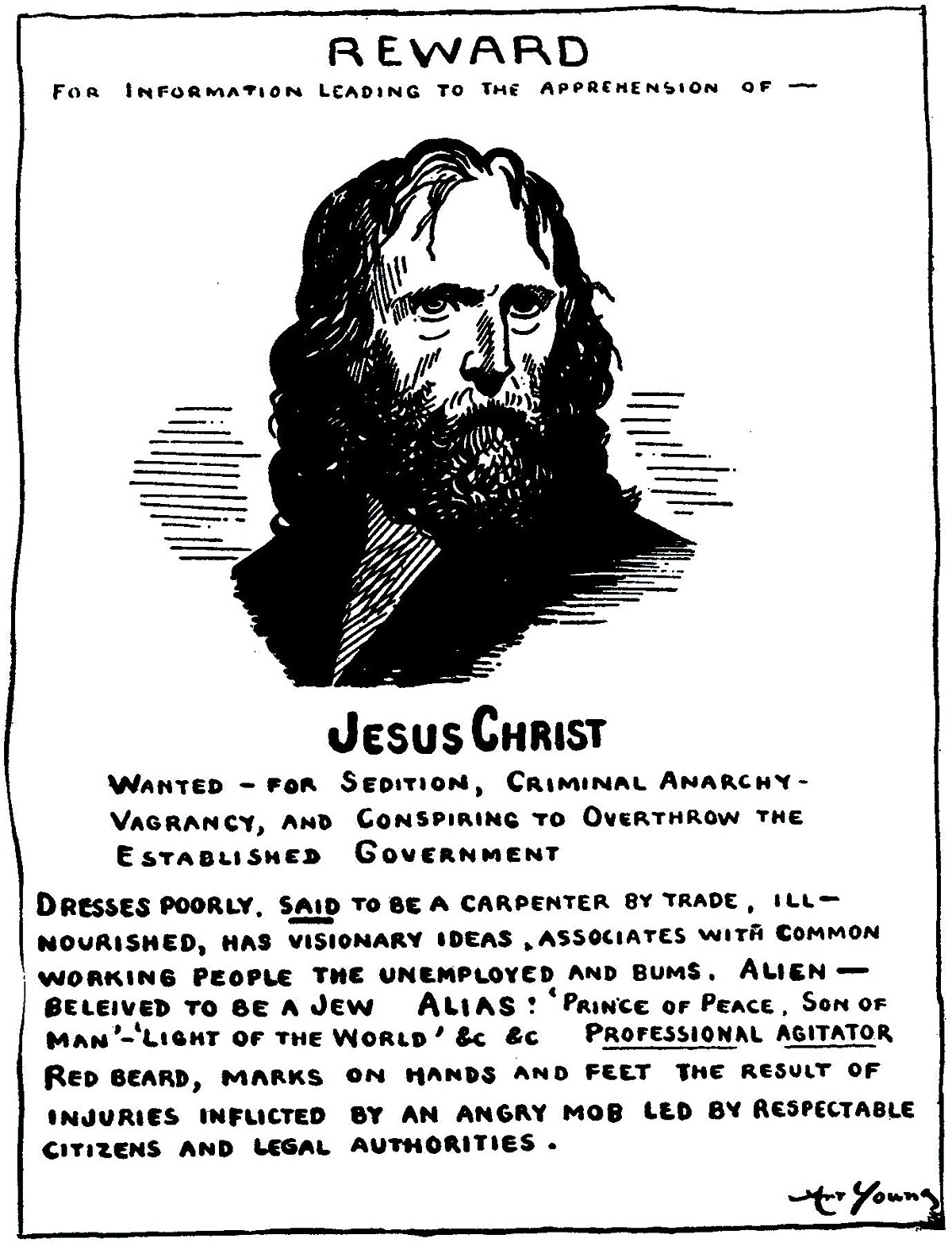
00-art-young-jesus-wanted-poster-he-stirreth-up-the-people-1913

Readings for 4th Sunday in Ordinary Time: Jer. 1: 4-5, 17-19; Ps. 71: 1-6, 15-17; I Cor. 12: 31-13; Lk. 4: 21-30 http://www.usccb.org/bible/readings/020313.cfm

I remember when my ideas about prophecy changed – when I really began to understand the term’s implications. I was a graduate student in Rome – already a priest – and completing my doctoral studies at the Academia Alfonsiana on the Via Merulana there in the “Holy City.” I was taking a class in I’ve forgotten what. But my professor (a German Redemptorist as I recall) got my attention during one of his lectures by referring to Karl Marx as “the last of the great Jewish prophets.” That was in 1970 at the height of the Cold War, and I had been reading Marx and about the then-flourishing Marxist-Christian dialog. I realized that my professor was right.

Marx of course was a Jew like Jesus, and Jeremiah who are centralized in today’s liturgy of the word. Like them, Marx was totally absorbed by questions of social justice for the poor and exploited. He was pretty much penniless, like most prophets, and spent his time thinking, writing, speaking, and organizing workers against exploitive employers. He was also highly critical of organized religion and its idols.

Marx’s insight (shared with the biblical prophets) was to realize that both Judaism and Christianity worshipped idols more often than the God of Israel. And by that he meant “gods” who not only justified an oppressive status quo, but who anesthetized the workers and unemployed to the fact that they were indeed oppressed by the capitalist system. Marx called such idols “the gods of heaven.”

We’re all familiar with what he meant. These idols are worshipped each Sunday – usually from 11:00 to 12:00 in what a theologian friend of mine used to call the “be kind to God hour.” You can encounter the “gods of heaven” any day at any hour on Cable television’s Channel 3 or in most Catholic Churches any Sunday morning. “God” there is concerned with correct worship, with bows, genuflections, and with correct terms such as “consubstantial,” “chalice,” “with thy spirit,” “under my roof” and so on. The stories or mythology upholding such idols have to do with “Jesus as your personal savior,” with “going to heaven,” and with avoiding hell.

Marx was also critical of what he called the “gods of earth.” They’re what people worship all those days and hours when they’re not in church. They include Capitalism, “America,” Nationalism, National Defense, Homeland Security, the Military, Money, and Profit. The issues of this God focus on sexuality: contraception, abortion, and same-sex marriage. This God is a War God – always on the side of “America.” He’s celebrated in songs like “The Battle Hymn of the Republic” and “Proud to Be an American.” He is the protector of “religious freedom” understood as privileging Christianity over other faiths while preserving tax exemptions worth billions each year. He blesses the bishops’ “Fortnight for Freedom” concerned as it is with protecting such benefits.

Marx’s prophetic work made him extremely popular with working classes. It was not uncommon for a worker to request that he be buried with a copy of “The Communist Manifesto” placed on his chest.

At the same time, Marx was vilified as the devil himself by factory owners, businessmen, bankers, and the professors and politicians representing their interests. Defenseless against such “education,” most of us have accepted such defamation of this last of the great Jewish prophets.

You see, that’s the trouble with prophets like Marx, Jesus and Jeremiah. They have to take on the “powers and principalities” of their cultures. They must swim against the torrential stream of public opinion.

In today’s first reading, Jeremiah is informed of his lot. But he must “man-up,” he’s told. He must steel himself to confront the “whole land,” along with kings and princes, priests and people. All of these, he’s warned, will fight against him. Nevertheless, God will make of Jeremiah a ‘fortified city,” a “pillar of iron,” and a “wall of brass.”

I suppose God followed through on those promises. But that didn’t prevent Jeremiah from being imprisoned, tortured, and left for dead.

Of course, the same thing happened to Jesus from the beginning to the end of his public ministry. He was vilified, demonized (literally!) and defamed.

That process begins for Jesus in today’s selection from Chapter 4 of Luke’s gospel. As we saw last week, he returns to his hometown of Nazareth and criticizes his neighbors’ narrow nationalism. In today’s episode his neighbors try to kill him. Later on, of course, Jesus goes more public. Like Jeremiah, he takes on his nation’s priests and scribes, princes and king. Ultimately his words and deeds threaten the Roman Empire itself which classifies him as a terrorist. Together those powers and principalities (national and international) not only defame Jesus the way Jeremiah and Marx were defamed; they actually kill him just as so many prophets have been killed from John the Baptist and Paul to Martin Luther King and Gandhi.

All of them – Jesus, Jeremiah, Gandhi, King, Paul and Marx – followed the same “prophetic script” whose inevitable directive prescribes that no prophet is accepted in her or his native place. It’s easy to see why. It’s because their “native place” bears the brunt of their prophetic words.

Meanwhile, it’s easier for outsiders to recognize prophets. The “outsiders” who concerned Jesus were the uneducated, poor, and unclean. However, even those seem to turn against him this morning. It’s unlikely that there were any rich or powerful resident in Nazareth – a place scripture scholar Ched Myers describes as “Nowheresville.”

Few of us are rich and powerful. Yet we’ve been schooled by those entities to reject prophets who speak in our name and defend our interests – those belonging to our “native land” to use the words of this morning’s gospel. It’s as though we’re looking at reality in that “darkened mirror” Paul wrote about in today’s excerpt from his letter to Corinth. The darkened mirror not only turns things backward, but it’s smudged with the fingerprints and dirt of ignorant and/or perverse propagandists.

The trouble – the trouble with prophets – is that most of us have bought into all that anti-prophet propaganda. So we hate Karl Marx without realizing that he’s on our side and speaks for us. We honor the Martin Luther King who has been reduced to a “dreamer,” but not the MLK who described the United States as the most violent and destructive country in the world. We don’t remember the King who was slandered as a communist and encouraged to commit suicide by the FBI and the COINTELPRO program.

We’re willing to stand by while Wikileaks journalist Julian Assange is persecuted by the governments of Great Britain and the United States. We presume that Bradley Manning is guilty of treason because our government, (despite its record of lies and heinous crimes) says so. We wonder what all the fuss is about Aaron Swartz.

These are the prophets of our time who, like Jesus, do not find a sympathetic hearing in their native place. It might be time to embrace them as our own and see what difference that makes in the way we look at the world and our country. The examples of Jeremiah, Jesus, and Paul — and the hopes of the world’s poor and victims of U.S. wars — beg us to do so.

Jesus as Self-Hating Jew!

Readings for Third Sunday in Ordinary Time: NEH 8; 2-6, 8-10; Ps. 19: 8-10, 15; I Cor. 12: 12-30; Lk. 1:1-4; 4: 14-21 http://www.usccb.org/bible/readings/012713.cfm

Last week I published an editorial on my blog site that was picked up by the Lexington Herald-Leader (http://www.kentucky.com/2013/01/19/2482073/ky-voices-the-chosen-people-are.html) and by OpEdNews (http://www.opednews.com/articles/Unconditional-Support-for-by-Mike-Rivage-Seul-130118-813.html.) It was about Chuck Hegel and the criticism he has endured from the American Israel Public Affairs Committee (AIPAC) and people like Elliot Abrams, the former Undersecretary of State for Human Rights in the Reagan administration.

Hegel had been nominated for Secretary of Defense by President Obama. Abrams and the others had criticized the nominee for being insufficiently supportive of Israel and therefore unfit for the “Sec Def” position. Hegel’s critics were looking for “unconditional support” for Israel, and didn’t find it in President Obama’s candidate. Their criticism was so effective that Hegel has since been forced to apologize for his past criticisms of the Jewish-Zionist Lobby.

Many Christians probably felt vindicated by Hegel’s groveling before his Jewish critics. After all, they might reason, Israel is God’s Chosen People; they deserve unconditional support.

However, today’s liturgy of the word underlines the point I tried to make in my op-ed: the phrase “God’s Chosen People” does not primarily refer to a national entity, but to the poor and oppressed.

Biblically speaking, it is true that Israel did fit that profile at the time of its origin – in Egyptian slavery (13th century B.C.E.) – and later during its captivity in Babylon (6th century B.C.E.). They were oppressed as well as when Israel was under the control of the Assyrians (8th century), Persians (6th century), Greeks (2nd century), and Romans (1st century). Then, precisely as oppressed, they were the object of God’s special love and protection.

At Mt. Zion, Moses enshrined in the law protection of people like them – slaves, widows,orphans, immigrants, the imprisoned, and the poor.

That’s the Law that the scribe, Ezra is recorded as reading to the people for hours in today’s first reading. They had just returned from exile in Babylon. For them “The Law” (the first five books of the Bible) was a source of joy and strength. After all, those books recounted what for Jews was the liberation of all liberations – from Egypt under the leadership of the great rebel hero, Moses. With Ezra in charge, they were celebrating the end of a long and painful experience in the geographical area that is now “Iraq.” Ezra reminded the assembled people that in their return to the Promised Land, they were experiencing Exodus all over again. Indeed, he said, it was a time for celebration – eating rich meats and drinking sweet drinks.

Today’s second and third readings pick up on Ezra’s theme – that God favors the poor and oppressed. However both Jesus and Paul do so emphasizing the point that Yahweh’s favored ones are not always Jews. When Jesus said that in his hometown synagogue, it enraged his former neighbors. (Their response reminds me of Elliot Abrams and the AIPAC demanding “unconditional support” for Israel.)

By the way, did you notice the strangeness of the reading from Luke’s gospel today? It starts out with the very first verses of Luke, verses 1-4. There the evangelist announces his intention – to carefully draw on the oral traditions of eyewitnesses and present an orderly researched account of what Jesus said and did.

But then the reading suddenly jumps ahead to Luke chapter 4 and presents Jesus’ preaching in his hometown synagogue in Nazareth. That gives the impression that Jesus’ first significant act was that Nazareth sermon. Perhaps it was – since Luke’s “infancy narratives” belong more to the realm of poetic imagination than of history.

Today’s reading also leaves out the response of those who heard Jesus’ words in Nazareth. (And that’s where the theme of “chosen people” becomes relevant.) Verses 22-30 tell us that the Nazarenes were outraged by Jesus’ implied criticism of Jews and his openness to non-Jews. After all, he had charged that prophets like Elijah and Elisha found more receptivity to their work in Lebanon (Sidon) and Syria than they found among Jews in Israel.

“Who does this guy think he is?” the Nazarenes asked indignantly. “We know his family; he’s nothing special. Yet here he is speaking critically about his own people! He must be one of those ‘self-hating Jews’.” Luke says Jesus’ hometown citizens were so outraged that they tried to kill him. (Chuck Hegel is in good company!)

Jesus’ words before the Nazarene’s attempted assassination do not merely underline the identity of God’s chosen as the poor and oppressed rather than exclusively the Jews. The words are also central in terms of Luke’s definition of Jesus’ entire project. In fact they connect that project with God’s very identity as described throughout the Jewish Testament particularly by the prophet Isaiah whose words Jesus quotes: “The Spirit of the Lord is upon me, because he has anointed me to bring good news to the poor. He has sent me to proclaim release to the captives and recovery of sight to the blind.”

Did you notice the importance of the word “because?” It absolutely identifies the “Spirit of the Lord” with Ezra’s good news to the poor about release from captivity and recovery of sight? Jesus is saying we know that “The Spirit of the Lord is upon” him because he brings good news to the poor, those in captivity and the blind. Jesus goes on to say that his commitment to the poor is what will define his entire mission. (The implication here is that anyone who brings good news to the poor, those in captivity and the blind embodies the Spirit of God.)

Today’s excerpt from Paul’s letter to the Greeks in Corinth continues that theme of Isaiah, Ezra, and Jesus. Only Paul does so in terms of a familiar yet powerful metaphor – what he calls the “Body of Christ” enlivened by the “One Spirit” of God. For Paul followers of Jesus constitute the way the Master is present today long after Jesus’ death. As that presence, we are Jesus’ hands, feet, eyes, ears, and tongue. And Paul specifically says it makes no difference whether one is Jew or Greek, slave or free, male or female.

What does make a difference though is one’s social standing. Paul goes out of his way to say that the “less honorable” and the “less presentable” in Christ’s body are to be more honored and cared for than the more presentable and more honorable according to the standards of the world. The weaker parts, he says are somehow “more necessary” than the stronger parts. This could hardly be a clearer reference to the poor and those who are normally neglected and looked down upon. Here Paul is following the thrust of Jesus’ words and deeds by turning the social order upside-down. The poor and oppressed come first in God’s order.

Today’s readings are calling us to grow out of our nationalism that understands Jews or Americans as God’s favorites. They call us to become citizens of the world – or in Jesus’ words to be cured of our blindness.

He wants us to finally see, the readings suggest, that the Jews as such are not God’s people. Neither are Americans. In God’s eyes, (despite the protests of our politicians and talking heads) our country is not the greatest in the world. For in the body of Christ there is neither Jew nor Greek, American, Afghani, Iraqi or Cuban.

Instead, true followers of Christ recognize that our allegiance belongs to the Body of Christ. This means that our care should be showered on the widows, orphans, undocumented immigrants, beggars, and social outcasts – LGBTQs, victims of AIDS, mothers on welfare, and on Mother Earth herself. These are the poor and oppressed. These are God’s people.

Our presence at this Eucharist represents our pledge to put the needs of those groups and individuals before our own.

Given the numbers of those who claim to be Christian, if we followed through on that pledge, how drastically different our world would be! Don’t you agree?